

ISSN 0439-755X
CN 11-1911/B
主办:中国心理学会
中国科学院心理研究所
出版:科学出版社
CN 11-1911/B
主办:中国心理学会
中国科学院心理研究所
出版:科学出版社
心理学报 ›› 2026, Vol. 58 ›› Issue (5): 976-994.doi: 10.3724/SP.J.1041.2026.0976 cstr: 32110.14.2026.0976
王天鸿1,2, 谢晓非2( )
)
收稿日期:2025-07-04
发布日期:2026-03-04
出版日期:2026-05-25
通讯作者:
谢晓非, E-mail: xiaofei@pku.edu.cn基金资助:
WANG Tianhong1,2, XIE Xiaofei2()
Received:2025-07-04
Online:2026-03-04
Published:2026-05-25
摘要:
助人者主动展示善举(利他炫耀)有助于利他行为的传播, 却常因担忧会被视为自我炫耀而产生心理冲突, 形成“利他炫耀悖论”。本研究提出, 与他人共同参与利他行为(群体利他)能有效缓解这种心理冲突并促进利他炫耀行为, 通过10项研究, 采用实验室实验、真实助人者调查、大语言模型模拟等多种方法, 发现相比于单独行善, 个体在参与群体利他行为后更倾向于进行利他炫耀。中介分析揭示, 群体利他通过双路径机制促进利他炫耀:既提升利他传播的内在动机, 也增强印象管理的外在动机。这一发现丰富了利他炫耀的理论框架, 为促进利他行为的传播提供了新视角, 为公益组织和互联网公益平台设计有效的传播策略提供了依据。
中图分类号:
王天鸿, 谢晓非. (2026). 众人拾柴火焰高:群体利他促进利他炫耀. 心理学报, 58(5), 976-994.
WANG Tianhong, XIE Xiaofei. (2026). Gathering wood for a brighter flame: How group altruism promotes conspicuous altruism. Acta Psychologica Sinica, 58(5), 976-994.
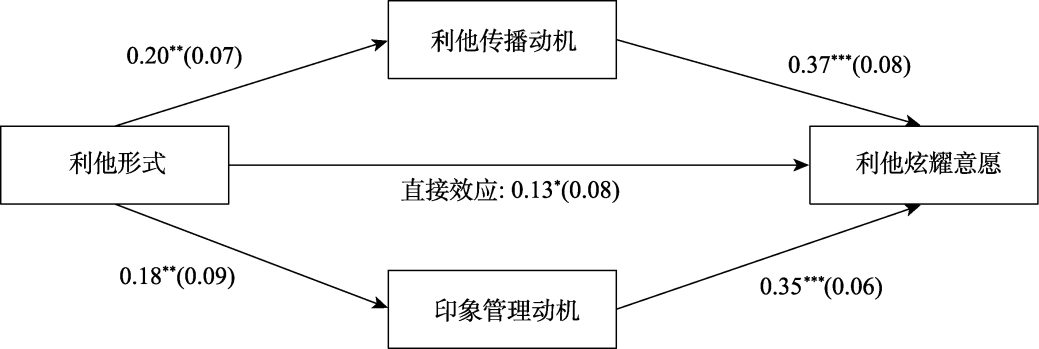
图1 研究4a群体利他促进利他炫耀的双路径中介模型图 注:“*”代表在0.05水平上显著, “**”代表在0.01水平上显著, “***”代表在0.001水平上显著, 括号内为标准误, 图中回归系数为标准化回归系数
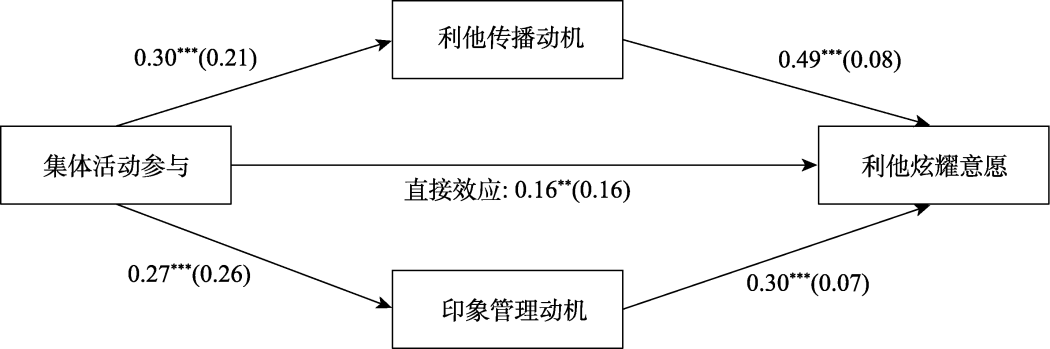
图2 研究5是否参与集体活动对利他炫耀意愿影响的中介分析图 注:“*”代表在0.05水平上显著, “**”代表在0.01水平上显著, “***”代表在0.001水平上显著, 括号内为标准误, 图中回归系数为标准化回归系数
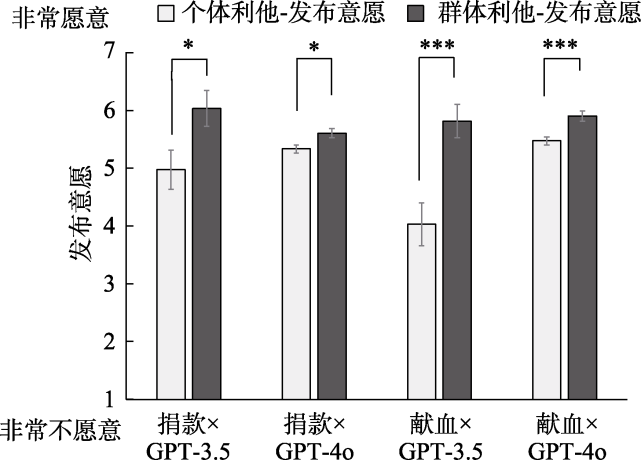
图3 研究6a大模型模拟利他炫耀意愿的组间差异 注:“*”代表在0.05水平上显著, “***”代表在0.001水平上显著, 误差线代表标准误
| 情境×模型 | 个体组发布率 | 群体组发布率 | χ²(1) | p |
|---|---|---|---|---|
| 捐款×GPT-3.5 | 69% | 88% | 3.90 | 0.048 |
| 捐款×GPT-4o | 45% | 80% | 10.45 | 0.001 |
| 献血×GPT-3.5 | 70% | 86% | 3.04 | 0.081 |
| 献血×GPT-4o | 3% | 73% | 41.81 | <0.001 |
表1 研究6a大模型模拟利他炫耀决策的卡方检验结果表
| 情境×模型 | 个体组发布率 | 群体组发布率 | χ²(1) | p |
|---|---|---|---|---|
| 捐款×GPT-3.5 | 69% | 88% | 3.90 | 0.048 |
| 捐款×GPT-4o | 45% | 80% | 10.45 | 0.001 |
| 献血×GPT-3.5 | 70% | 86% | 3.04 | 0.081 |
| 献血×GPT-4o | 3% | 73% | 41.81 | <0.001 |
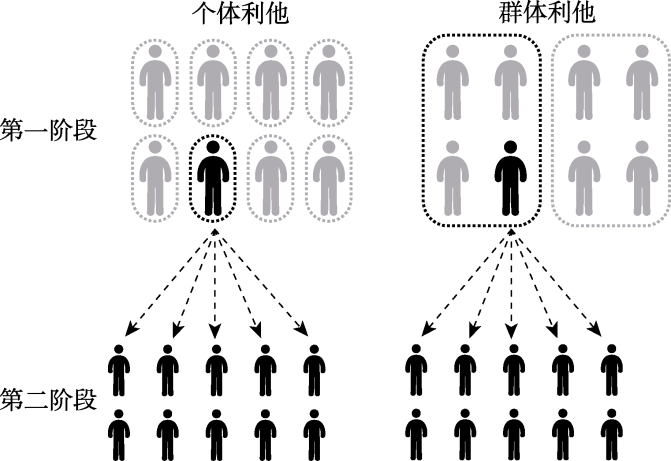
图4 研究6b大模型模拟的两阶段设计示意图
| 子研究 | 情境 | 条件 | 均值 | 标准差 | 样本量 | Cohen’s d及其95% CI |
|---|---|---|---|---|---|---|
| 1a | 支教 | 个体利他 | 5.69 | 1.33 | 100 | −0.39, [−0.67, −0.11] |
| 群体利他 | 6.12 | 0.81 | 100 | |||
| 1b | 月捐 | 个体利他 | 5.20 | 1.56 | 125 | −0.40, [−0.66, −0.15] |
| 群体利他 | 5.74 | 1.03 | 125 | |||
| 1c | 敬老服务 | 个体利他 | 5.29 | 1.30 | 120 | −0.34, [−0.59, −0.08] |
| 群体利他 | 5.70 | 1.15 | 120 | |||
| 4a | 支教 | 个体利他 | 5.85 | 0.86 | 94 | −0.55, [−0.83, −0.27] |
| 群体利他 | 6.25 | 0.56 | 117 | |||
| 4b | 月捐 | 个体利他 | 5.18 | 1.17 | 96 | −0.83, [−1.13, −0.52] |
| 群体利他 | 5.99 | 0.76 | 101 | |||
| 5 | 真实志愿者 | 未参加集体活动 | 4.30 | 1.65 | 42 | −0.94, [−1.31, −0.57] |
| 参加集体活动 | 5.53 | 1.17 | 109 | |||
| 6a | 捐款×GPT-3.5 | 个体利他 | 4.97 | 2.13 | 39 | −0.52, [−0.97, −0.06] |
| 群体利他 | 6.03 | 1.94 | 40 | |||
| 6a | 捐款×GPT-4o | 个体利他 | 5.33 | 0.47 | 40 | −0.57, [−1.02, −0.11] |
| 群体利他 | 5.60 | 0.50 | 40 | |||
| 6a | 献血×GPT-3.5 | 个体利他 | 4.03 | 2.34 | 40 | −0.85, [−1.34, −0.36] |
| 群体利他 | 5.81 | 1.79 | 37 | |||
| 6a | 献血×GPT-4o | 个体利他 | 5.47 | 0.55 | 40 | −0.85, [−1.32, −0.37] |
| 群体利他 | 5.90 | 0.44 | 40 | |||
| 6b | 献血×GPT-4o | 个体利他 | 4.35 | 0.59 | 20 | −0.89, [−1.53, −0.23] |
| (第一阶段) | 群体利他 | 4.80 | 0.41 | 20 |
表2 各项子研究中个体/群体组利他炫耀意愿差异检验统计结果总结
| 子研究 | 情境 | 条件 | 均值 | 标准差 | 样本量 | Cohen’s d及其95% CI |
|---|---|---|---|---|---|---|
| 1a | 支教 | 个体利他 | 5.69 | 1.33 | 100 | −0.39, [−0.67, −0.11] |
| 群体利他 | 6.12 | 0.81 | 100 | |||
| 1b | 月捐 | 个体利他 | 5.20 | 1.56 | 125 | −0.40, [−0.66, −0.15] |
| 群体利他 | 5.74 | 1.03 | 125 | |||
| 1c | 敬老服务 | 个体利他 | 5.29 | 1.30 | 120 | −0.34, [−0.59, −0.08] |
| 群体利他 | 5.70 | 1.15 | 120 | |||
| 4a | 支教 | 个体利他 | 5.85 | 0.86 | 94 | −0.55, [−0.83, −0.27] |
| 群体利他 | 6.25 | 0.56 | 117 | |||
| 4b | 月捐 | 个体利他 | 5.18 | 1.17 | 96 | −0.83, [−1.13, −0.52] |
| 群体利他 | 5.99 | 0.76 | 101 | |||
| 5 | 真实志愿者 | 未参加集体活动 | 4.30 | 1.65 | 42 | −0.94, [−1.31, −0.57] |
| 参加集体活动 | 5.53 | 1.17 | 109 | |||
| 6a | 捐款×GPT-3.5 | 个体利他 | 4.97 | 2.13 | 39 | −0.52, [−0.97, −0.06] |
| 群体利他 | 6.03 | 1.94 | 40 | |||
| 6a | 捐款×GPT-4o | 个体利他 | 5.33 | 0.47 | 40 | −0.57, [−1.02, −0.11] |
| 群体利他 | 5.60 | 0.50 | 40 | |||
| 6a | 献血×GPT-3.5 | 个体利他 | 4.03 | 2.34 | 40 | −0.85, [−1.34, −0.36] |
| 群体利他 | 5.81 | 1.79 | 37 | |||
| 6a | 献血×GPT-4o | 个体利他 | 5.47 | 0.55 | 40 | −0.85, [−1.32, −0.37] |
| 群体利他 | 5.90 | 0.44 | 40 | |||
| 6b | 献血×GPT-4o | 个体利他 | 4.35 | 0.59 | 20 | −0.89, [−1.53, −0.23] |
| (第一阶段) | 群体利他 | 4.80 | 0.41 | 20 |
| [1] |
Andreoni, J., & Petrie, R. (2004). Public goods experiments without confidentiality: A glimpse into fund-raising. Journal of Public Economics, 88(7-8), 1605-1623. https://doi.org/10.1016/S0047-2727(03)00040-9
doi: 10.1016/S0047-2727(03)00040-9 URL |
| [2] | Ash, E. (2017). Emotional responses to savior films: Concealing privilege or appealing to our better selves? Projections, 11(2). https://doi.org/10.3167/proj.2017.110203 |
| [3] | Ashraf, M. H., Zhang, J., & Özpolat, K. (2023). Antecedents of blatant benevolence on social media. Behaviour & Information Technology, 42(8), 1230-1252. https://doi.org/10.1080/0144929X.2022.2069595 |
| [4] | Batson, C., D. (2010). Empathy-induced altruistic motivation. In M. Mikulincer & P. R. Shaver (Eds.), Prosocial motives, emotions, and behavior: The better angels of our nature (pp. 15-34). American Psychological Association. https://doi.org/10.1037/12061-001 |
| [5] |
Bénabou, R., & Tirole, J. (2006). Incentives and prosocial behavior. The American Economic Review, 96(5), 1652-1678.
doi: 10.1257/aer.96.5.1652 URL |
| [6] |
Berman, J. Z., Levine, E. E., Barasch, A., & Small, D. A. (2015). The braggart’s dilemma: On the social rewards and penalties of advertising prosocial behavior. Journal of Marketing Research, 52(1), 90-104. https://doi.org/10.1509/jmr.14.0002
doi: 10.1509/jmr.14.0002 URL |
| [7] |
Carr, P. B., & Walton, G. M. (2014). Cues of working together fuel intrinsic motivation. Journal of Experimental Social Psychology, 53, 169-184. https://doi.org/10.1016/j.jesp.2014.03.015
doi: 10.1016/j.jesp.2014.03.015 URL |
| [8] |
Caviola, L., Schubert, S., & Greene, J. D. (2021). The psychology of (in)effective altruism. Trends in Cognitive Sciences, 25(7), 596-607. https://doi.org/10.1016/j.tics.2021.03.015
doi: 10.1016/j.tics.2021.03.015 URL pmid: 33962844 |
| [9] |
Chen, Y., & Lu, J. (2025). Misunderstanding interpersonal costs from expressing opposing views. Acta Psychologica Sinica, 57(8), 1437-1451. https://doi.org/10.3724/SP.J.1041.2025.1437
doi: 10.3724/SP.J.1041.2025.1437 URL |
|
[陈宇琦, 陆静怡. (2025). 提异议者高估异议接收者的消极反应. 心理学报, 57(8), 1437-1451. https://doi.org/10.3724/SP.J.1041.2025.1437 ]
doi: 10.3724/SP.J.1041.2025.1437 URL |
|
| [10] |
Cialdini, R. B., Reno, R. R., & Kallgren, C. A. (1990). A focus theory of normative conduct: Recycling the concept of norms to reduce littering in public places. Journal of Personality and Social Psychology, 58(6), 1015-1026. https://doi.org/10.1037/0022-3514.58.6.1015
doi: 10.1037/0022-3514.58.6.1015 URL |
| [11] |
Costello, J. P., & Malkoc, S. A. (2022). Why are donors more generous with time than money? The role of perceived control over donations on charitable giving. Journal of Consumer Research, 49(4), 678-696. https://doi.org/10.1093/jcr/ucac011
doi: 10.1093/jcr/ucac011 URL |
| [12] |
Cumming, G. (2014). The new statistics: Why and how. Psychological Science, 25(1), 7-29. https://doi.org/10.1177/0956797613504966
doi: 10.1177/0956797613504966 URL pmid: 24220629 |
| [13] |
Darley, J. M., & Latané, B. (1968). Bystander intervention in emergencies: Diffusion of responsibility. Journal of Personality and Social Psychology, 8(4, Pt.1), 377-383. https://doi.org/10.1037/h0025589
doi: 10.1037/h0025589 URL |
| [14] |
David, E. M., Kim, T., Rodgers, M., & Chen, T. (2021). Helping while competing? The complex effects of competitive climates on the prosocial identity and performance relationship. Journal of Management Studies, 58(6), 1507-1531. https://doi.org/10.1111/joms.12675
doi: 10.1111/joms.v58.6 URL |
| [15] | Demszky, D., Yang, D., Yeager, D. S., Bryan, C. J., Clapper, M., Chandhok, S., … Pennebaker, J. W. (2023). Using large language models in psychology. Nature Reviews Psychology, 2, 688-701. https://doi.org/10.1038/s44159-023-00241-5 |
| [16] |
Eikenberry, A. M., & Breeze, B. (2018). Growing philanthropy through giving circles: Collective giving and the logic of charity. Social Policy and Society, 17(3), 349-364. https://doi.org/10.1017/S1474746417000124
doi: 10.1017/S1474746417000124 URL |
| [17] |
Ellemers, N., Pagliaro, S., & Barreto, M. (2013). Morality and behavioural regulation in groups: A social identity approach. European Review of Social Psychology, 24(1), 160-193. https://doi.org/10.1080/10463283.2013.841490
doi: 10.1080/10463283.2013.841490 URL |
| [18] |
Faul, F., Erdfelder, E., Lang, A.-G., & Buchner, A. (2007). G*Power 3: A flexible statistical power analysis program for the social, behavioral, and biomedical sciences. Behavior Research Methods, 39(2), 175-191. https://doi.org/10.3758/BF03193146
doi: 10.3758/bf03193146 URL pmid: 17695343 |
| [19] |
Goh, J. X., Hall, J. A., & Rosenthal, R. (2016). Mini meta-analysis of your own studies: Some arguments on why and a primer on how. Social and Personality Psychology Compass, 10(10), 535-549. https://doi.org/10.1111/spc3.12267
doi: 10.1111/spc3.v10.10 URL |
| [20] |
Grace, D., & Griffin, D. (2006). Exploring conspicuousness in the context of donation behaviour. International Journal of Nonprofit and Voluntary Sector Marketing, 11(2), 147-154. https://doi.org/10.1002/nvsm.24
doi: 10.1002/nvsm.v11:2 URL |
| [21] |
Grace, D., & Griffin, D. (2009). Conspicuous donation behaviour: Scale development and validation. Journal of Consumer Behaviour, 8(1), 14-25. https://doi.org/10.1002/cb.270
doi: 10.1002/cb.v8:1 URL |
| [22] |
Grant, A. M. (2012). Giving time, time after time: Work design and sustained employee participation in corporate volunteering. Academy of Management Review, 37(4), 589-615. https://doi.org/10.5465/amr.2010.0280
doi: 10.5465/amr.2010.0280 URL |
| [23] |
Grant, A. M., Dutton, J. E., & Rosso, B. D. (2008). Giving commitment: Employee support programs and the prosocial sensemaking process. Academy of Management Journal, 51(5), 898-918. https://doi.org/10.5465/amj.2008.34789652
doi: 10.5465/amj.2008.34789652 URL |
| [24] |
Grant, A. M., Molinsky, A., Margolis, J., Kamin, M., & Schiano, W. (2009). The performer’s reactions to procedural injustice: When prosocial identity reduces prosocial behavior. Journal of Applied Social Psychology, 39(2), 319-349. https://doi.org/10.1111/j.1559-1816.2008.00440.x
doi: 10.1111/jasp.2008.39.issue-2 URL |
| [25] |
Green, T., & Peloza, J. (2014). Finding the right shade of green: The effect of advertising appeal type on environmentally friendly consumption. Journal of Advertising, 43(2), 128-141. https://doi.org/10.1080/00913367.2013.834805
doi: 10.1080/00913367.2013.834805 URL |
| [26] |
Griskevicius, V., Tybur, J. M., & Van den Bergh, B. (2010). Going green to be seen: Status, reputation, and conspicuous conservation. Journal of Personality and Social Psychology, 98(3), 392-404. https://doi.org/10.1037/a0017346
doi: 10.1037/a0017346 URL pmid: 20175620 |
| [27] |
Henrich, J., Heine, S. J., & Norenzayan, A. (2010). The weirdest people in the world? Behavioral and Brain Sciences, 33(2-3), 61-83. https://doi.org/10.1017/S0140525X0999152X
doi: 10.1017/S0140525X0999152X URL pmid: 20550733 |
| [28] |
Jaeger, B., & van Vugt, M. (2022). Psychological barriers to effective altruism: An evolutionary perspective. Current Opinion in Psychology, 44, 130-134. https://doi.org/10.1016/j.copsyc.2021.09.008
doi: 10.1016/j.copsyc.2021.09.008 URL |
| [29] |
Karlan, D., & McConnell, M. A. (2014). Hey look at me: The effect of giving circles on giving. Journal of Economic Behavior & Organization, 106, 402-412. https://doi.org/10.1016/j.jebo.2014.06.013
doi: 10.1016/j.jebo.2014.06.013 URL |
| [30] |
Lacetera, N., & Macis, M. (2010). Social image concerns and prosocial behavior: Field evidence from a nonlinear incentive scheme. Journal of Economic Behavior & Organization, 76(2), 225-237. https://doi.org/10.1016/j.jebo.2010.08.007
doi: 10.1016/j.jebo.2010.08.007 URL |
| [31] |
Leary, M. R., Allen, A. B., & Terry, M. L. (2011). Managing social images in naturalistic versus laboratory settings: Implications for understanding and studying self-presentation. European Journal of Social Psychology, 41(4), 411-421. https://doi.org/10.1002/ejsp.813
doi: 10.1002/ejsp.v41.4 URL |
| [32] |
Leary, M. R., & Kowalski, R. M. (1990). Impression management: A literature review and two-component model. Psychological Bulletin, 107(1), 34-47. https://doi.org/10.1037/0033-2909.107.1.34
doi: 10.1037/0033-2909.107.1.34 URL |
| [33] |
Levine, M., Prosser, A., Evans, D., & Reicher, S. (2005). Identity and emergency intervention: How social group membership and inclusiveness of group boundaries shape helping behavior. Personality and Social Psychology Bulletin, 31(4), 443-453. https://doi.org/10.1177/0146167204271651
doi: 10.1177/0146167204271651 URL pmid: 15743980 |
| [34] |
Li, P., Castelo, N., Katona, Z., & Sarvary, M. (2024). Frontiers: Determining the validity of large language models for automated perceptual analysis. Marketing Science, 43(2), 254-266. https://doi.org/10.1287/mksc.2023.0454
doi: 10.1287/mksc.2023.0454 URL |
| [35] |
McShane, B. B., & Böckenholt, U. (2017). Single-paper meta-analysis: Benefits for study summary, theory testing, and replicability. Journal of Consumer Research, 43(6), 1048-1063. https://doi.org/10.1093/jcr/ucw085
doi: 10.1093/jcr/ucw085 URL |
| [36] |
Mei, Q., Xie, Y., Yuan, W., & Jackson, M. O. (2024). A Turing test of whether AI chatbots are behaviorally similar to humans. Proceedings of the National Academy of Sciences, 121(9), e2313925121. https://doi.org/10.1073/pnas.2313925121
doi: 10.1073/pnas.2313925121 URL |
| [37] |
Newman, G. E., & Cain, D. M. (2014). Tainted altruism: When doing some good is evaluated as worse than doing no good at all. Psychological Science, 25(3), 648-655. https://doi.org/10.1177/0956797613504785
doi: 10.1177/0956797613504785 URL pmid: 24403396 |
| [38] |
Newman, G. E., & Shen, J. Y. (2012). The counterintuitive effects of thank-you gifts on charitable giving. Journal of Economic Psychology, 33(5), 973-983. https://doi.org/10.1016/j.joep.2012.05.002
doi: 10.1016/j.joep.2012.05.002 URL |
| [39] |
Nook, E. C., Ong, D. C., Morelli, S. A., Mitchell, J. P., & Zaki, J. (2016). Prosocial conformity: Prosocial norms generalize across behavior and empathy. Personality and Social Psychology Bulletin, 42(8), 1045-1062. https://doi.org/10.1177/0146167216649932
doi: 10.1177/0146167216649932 URL pmid: 27229679 |
| [40] | Ouyang, L., Wu, J., Jiang, X., Almeida, D., Wainwright, C. L., Mishkin, P., … Lowe, R. (2024). Training language models to follow instructions with human feedback. Proceedings of the 36th International Conference on Neural Information Processing Systems. https://doi.org/10.48550/arXiv.2203.02155 |
| [41] | Park, J. S., O’Brien, J., Cai, C. J., Morris, M. R., Liang, P., & Bernstein, M. S. (2023). Generative agents: Interactive simulacra of human behavior. Proceedings of the 36th Annual ACM Symposium on User Interface Software and Technology. https://doi.org/10.1145/3586183.3606763 |
| [42] |
Ramarajan, L., Berger, I. E., & Greenspan, I. (2017). Multiple identity configurations: The benefits of focused enhancement for prosocial behavior. Organization Science, 28(3), 495-513. https://doi.org/10.1287/orsc.2017.1129
doi: 10.1287/orsc.2017.1129 URL |
| [43] |
Ran, Y., Niu, Y., & Chen, S. (2021). “More” is less: Why multiple payment mechanism impairs individual donation. Acta Psychologica Sinica, 53(4), 413-430. https://doi.org/10.3724/SP.J.1041.2021.00413
doi: 10.3724/SP.J.1041.2021.00413 URL |
|
[冉雅璇, 牛熠欣, 陈斯允. (2021). “多”反而少: 元认知推断视角下支付渠道数量对个体捐赠的影响. 心理学报, 53(4), 413-430.]
doi: 10.3724/SP.J.1041.2021.00413 |
|
| [44] |
Romani, S., Grappi, S., & Bagozzi, R. P. (2016). Corporate socially responsible initiatives and their effects on consumption of green products. Journal of Business Ethics, 135(2), 253-264. https://doi.org/10.1007/s10551-014-2485-0
doi: 10.1007/s10551-014-2485-0 URL |
| [45] |
Ryan, R. M., & Deci, E. L. (2000). Self-determination theory and the facilitation of intrinsic motivation, social development, and well-being. American Psychologist, 55(1), 68-78. https://doi.org/10.1037/0003-066X.55.1.68
doi: 10.1037//0003-066x.55.1.68 URL pmid: 11392867 |
| [46] |
Silver, I., & Small, D. A. (2024). Put your mouth where your money is: A field experiment encouraging donors to share about charity. Marketing Science, 43(2), 392-406. https://doi.org/10.1287/mksc.2023.1450
doi: 10.1287/mksc.2023.1450 URL |
| [47] |
Smith, E. A., & Bird, R. L. B.(2000). Turtle hunting and tombstone opening: Public generosity as costly signaling. Evolution and Human Behavior, 21(4), 245-261. https://doi.org/10.1016/S1090-5138(00)00031-3
URL pmid: 10899477 |
| [48] |
Suri, G., Slater, L. R., Ziaee, A., & Nguyen, M. (2024). Do large language models show decision heuristics similar to humans? A case study using GPT-3.5. Journal of Experimental Psychology: General, 153(4), 1066-1075. https://doi.org/10.1037/xge0001547
doi: 10.1037/xge0001547 URL |
| [49] | Tajfel,, H., & Turner, J. C. (1986). The Social Identity Theory of Inter-Group Behavior. In S. Worchel & W. G. Austin (Eds.), Psychology of intergroup relations (Vol. 3, pp. 7-24). Nelson-Hall Publishers. |
| [50] |
Tan, X., Yan, L., & Pedraza-Martinez, A. J. (2024). Navigating the digital terrain of prosocial disclosures and likability. MIS Quarterly, 48(2), 613-644.
doi: 10.25300/MISQ/2023/17700 URL |
| [51] |
Thomson, N. D. (2015). Priming social affiliation promotes morality - Regardless of religion. Personality and Individual Differences, 75, 195-200. https://doi.org/10.1016/j.paid.2014.11.022
doi: 10.1016/j.paid.2014.11.022 URL |
| [52] |
Van Baaren, R. B., Holland, R. W., Kawakami, K., & Van Knippenberg, A. (2004). Mimicry and prosocial behavior. Psychological Science, 15(1), 71-74. https://doi.org/10.1111/j.0963-7214.2004.01501012.x
doi: 10.1111/j.0963-7214.2004.01501012.x URL pmid: 14717835 |
| [53] |
van Zomeren, M., Postmes, T., & Spears, R. (2008). Toward an integrative social identity model of collective action: A quantitative research synthesis of three socio-psychological perspectives. Psychological Bulletin, 134(4), 504-535. https://doi.org/10.1037/0033-2909.134.4.504
doi: 10.1037/0033-2909.134.4.504 URL pmid: 18605818 |
| [54] |
Wallace, E., Buil, I., & De Chernatony, L. (2020). ‘Consuming good’ on social media: What can conspicuous virtue signalling on facebook tell us about prosocial and unethical intentions. Journal of Business Ethics, 162(3), 577-592. https://doi.org/10.1007/s10551-018-3999-7
doi: 10.1007/s10551-018-3999-7 URL |
| [55] |
Wang, T., Jin, S., Cheng, Z., Lou, Y., & Xie, X. (2024). The prediction bias of conspicuous altruism: Helpers underestimate social evaluations from bystanders. Acta Psychologica Sinica, 56(9), 1210-1224. https://doi.org/10.3724/SP.J.1041.2024.01210
doi: 10.3724/SP.J.1041.2024.01210 URL |
|
[王天鸿, 金珊, 程子鹏, 娄宇, 谢晓非. (2024). 利他炫耀中的预测偏差:助人者低估来自旁观者的社会评价. 心理学报, 56(9), 1210-1224. https://doi.org/10.3724/SP.J.1041.2024.01210 ]
doi: 10.3724/SP.J.1041.2024.01210 URL |
|
| [56] | White, K., & Peloza, J. (2009). Self-benefit versus other-benefit marketing appeals: Their effectiveness in generating charitable support. Journal of Marketing, 73(4), 109-124. https://doi.org/10.1509/jmkg.73.4.109 |
| [57] |
Xie, X., Wang, Y., Gu, S., & Li, W. (2017). Is altruism just other-benefiting? A dual pathway model from an evolutionary perspective. Advances in Psychological Science, 25(9), 1441-1455. https://doi.org/10.3724/SP.J.1042.2017.01441
doi: 10.3724/SP.J.1042.2017.01441 URL |
|
[谢晓非, 王逸璐, 顾思义, 李蔚. (2017). 利他仅仅利他吗?——进化视角的双路径模型. 心理科学进展, 25(9), 1441-1455. https://doi.org/10.3724/SP.J.1042.2017.01441 ]
doi: 10.3724/SP.J.1042.2017.01441 URL |
|
| [58] |
Xu, R., Sun, Y., Ren, M., Guo, S., Pan, R., Lin, H., Sun, L., & Han, X. (2024). AI for social science and social science of AI: A survey. Information Processing & Management, 61(3), 103665. https://doi.org/10.1016/j.ipm.2024.103665
doi: 10.1016/j.ipm.2024.103665 URL |
| [59] |
Yang, A. X., & Hsee, C. K. (2022). Obligatory publicity increases charitable acts. Journal of Consumer Research, 48(5), 839-857. https://doi.org/10.1093/jcr/ucab020
doi: 10.1093/jcr/ucab020 URL |
| [1] | 孙思捷, 赵欢欢, 皮乔, 张和云. 超越“多多益善”: 利他程度对道德评价的影响及调节机制[J]. 心理学报, 2026, 58(5): 935-960. |
| [2] | 蒯玲, 卫海英, 姚琦, 肖婷文, 谢升成. 时间标志对炫耀性亲社会行为意愿的影响[J]. 心理学报, 2025, 57(4): 526-543. |
| [3] | 李卉, 刘思懿, 庞怡. 社交机器人对3~5岁儿童分享行为的影响[J]. 心理学报, 2025, 57(4): 573-583. |
| [4] | 李曦, 纪林芹, 迟晓慧, 王舒冉, 张文新, 曹衍淼. 多巴胺系统基因调节青少年同伴拒绝与亲社会行为关系: 平行潜增长模型[J]. 心理学报, 2025, 57(4): 584-598. |
| [5] | 聂衍刚, 陈沛, 王林欣, 喻承甫, 利振华. 父母情感温暖、自我控制与青少年亲社会行为的关系: 多基因的调节作用及父母差异[J]. 心理学报, 2025, 57(4): 599-613. |
| [6] | 韩宪国, 金国敏, 李丹, 刘世宏, 吴琴, 刘俊升, 陈欣银. 父母温暖与儿童晚期亲社会行为的关系: 集体取向的作用[J]. 心理学报, 2025, 57(4): 614-630. |
| [7] | 林荣茂, 余巧华, 胡添祥, 张九妹, 叶玉珊, 连榕. 敬畏感与亲社会行为关系的三水平和结构方程模型元分析[J]. 心理学报, 2025, 57(4): 631-651. |
| [8] | 孙瑾, 杨静舒. 互惠利他的先行优势:品牌的互惠角色影响消费者亲社会行为[J]. 心理学报, 2025, 57(2): 315-330. |
| [9] | 王舒琪, 程峰, 郭冰, 王巧, 成晓君. 倾诉的力量:负性情绪自我表露促进同伴亲社会行为[J]. 心理学报, 2025, 57(10): 1762-1776. |
| [10] | 王天鸿, 金珊, 程子鹏, 娄宇, 谢晓非. 利他炫耀中的预测偏差:助人者低估来自旁观者的社会评价[J]. 心理学报, 2024, 56(9): 1210-1224. |
| [11] | 王婧嫣, 张洪. 直觉还是推理?亲社会行为的决策模式与人性感知[J]. 心理学报, 2024, 56(9): 1225-1238. |
| [12] | 石荣, 刘昌, 唐慧琳, 郝俊懿, 沈汪兵. 自发的善行:加工模式和情境紧急性影响亲社会行为[J]. 心理学报, 2024, 56(9): 1239-1251. |
| [13] | 林靓, 徐博雅, 杨莹, 张庆鹏, 寇彧. 青少年亲社会行为的网络分析及核心维度[J]. 心理学报, 2024, 56(9): 1252-1265. |
| [14] | 滕玥, 张昊天, 赵偲琪, 彭凯平, 胡晓檬. 多元文化经历提升人类对机器人的利他行为及心智知觉的中介作用[J]. 心理学报, 2024, 56(2): 146-160. |
| [15] | 刘新燕, 伍海兰, 涂菊, 王璐. 一心多用的双刃剑效应:多任务对亲社会行为的影响[J]. 心理学报, 2024, 56(12): 1800-1820. |
| 阅读次数 | ||||||
|
全文 |
|
|||||
|
摘要 |
|
|||||
