

ISSN 0439-755X
CN 11-1911/B
主办:中国心理学会
中国科学院心理研究所
出版:科学出版社
CN 11-1911/B
主办:中国心理学会
中国科学院心理研究所
出版:科学出版社
心理学报 ›› 2026, Vol. 58 ›› Issue (5): 995-1014.doi: 10.3724/SP.J.1041.2026.0995 cstr: 32110.14.2026.0995
• 研究报告 • 上一篇
刘凯1,2, 郭治辰1, 王琴1, 汪大勋1( ), 蔡艳1(), 涂冬波1,3,4()
收稿日期:2024-04-26
发布日期:2026-03-04
出版日期:2026-05-25
通讯作者:
蔡艳, E-mail: cy1979123@aliyun.com;作者简介:郭治辰和王琴为本文共同第一作者。
基金资助:
LIU Kai1,2, GUO Zhichen1, WANG Qin1, WANG Daxun1(), CAI Yan1(), TU Dongbo1,3,4()
Received:2024-04-26
Online:2026-03-04
Published:2026-05-25
摘要:
在认知诊断评估中, 项目功能差异(DIF)检测是评估其测验公平性以及测量效度的重要技术手段。然而, 现有的认知诊断DIF检测方法局限于单一协变量视角下的主效应DIF检测, 对于由多个协变量交互作用引发的交互式DIF尚缺乏有效的检测手段。针对这一局限, 研究借鉴递归分割技术的核心思想, 提出了一种能够在认知诊断评估中同时检测主效应DIF和交互式DIF的新方法(记为ISRPM)。模拟研究结果表明, ISRPM不仅在主效应DIF检测中的整体表现与传统方法大体相当, 更重要的是, 其在交互式DIF检测方面的性能表现优于传统方法。实证研究则进一步支持了该方法的可用性, 结果显示, ISRPM与传统DIF检测方法在检测结果上具有较高一致性, 并在识别交互式DIF方面展现出潜在优势。总体而言, ISRPM的提出有望进一步提升认知诊断DIF检测精度, 并促进认知诊断评估在心理与教育测评实践中的推广与应用。
中图分类号:
刘凯, 郭治辰, 王琴, 汪大勋, 蔡艳, 涂冬波. (2026). 认知诊断评估中主效应DIF与交互式DIF检测方法开发: 基于递归分割视角. 心理学报, 58(5), 995-1014.
LIU Kai, GUO Zhichen, WANG Qin, WANG Daxun, CAI Yan, TU Dongbo. (2026). Development of main effect DIF and interactive DIF detection method in cognitive diagnosis assessments: A recursive partitioning-based perspective. Acta Psychologica Sinica, 58(5), 995-1014.
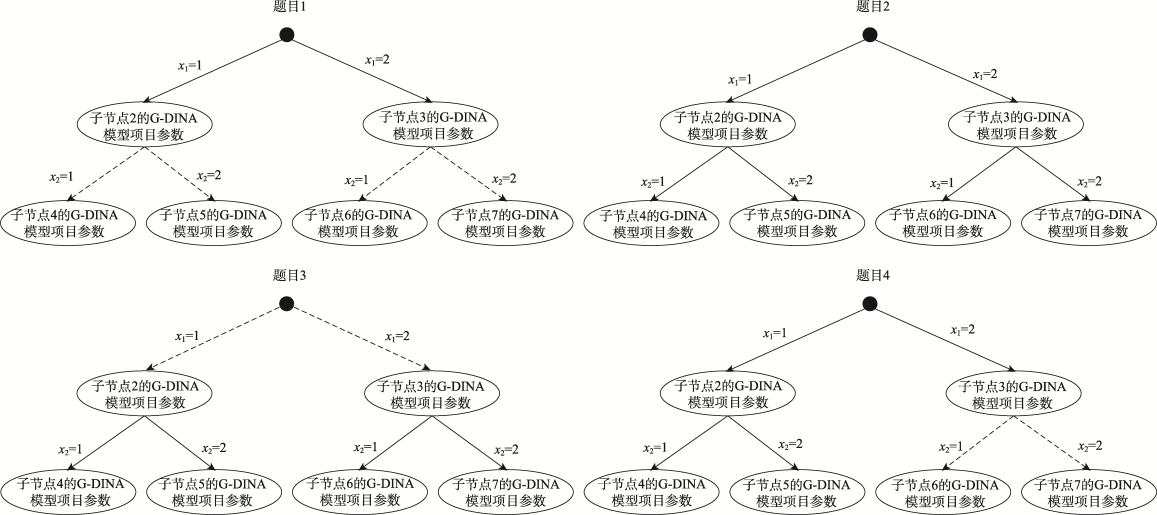
图1 ISRPM中不同题目在两个协变量情境下的递归分割树示意图
| DIF形式 | |
|---|---|
| 只有主效应DIF | |
| 只有交互式DIF | |
| 同时存在主效应DIF和交互式DIF |
表1 不同DIF形式下的DIF模拟方法
| DIF形式 | |
|---|---|
| 只有主效应DIF | |
| 只有交互式DIF | |
| 同时存在主效应DIF和交互式DIF |
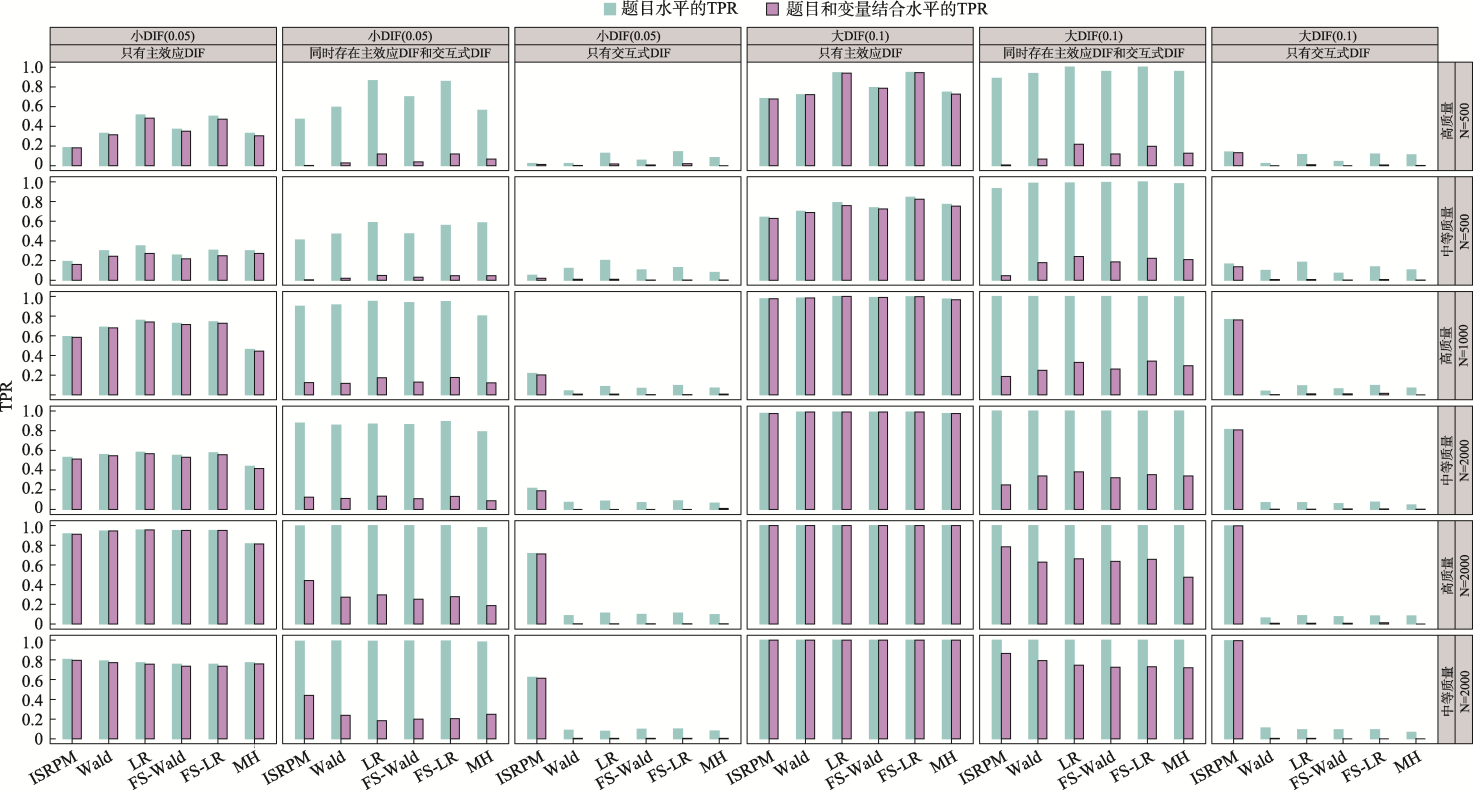
图2 各认知诊断DIF检测方法在不同实验条件下的统计检验力结果
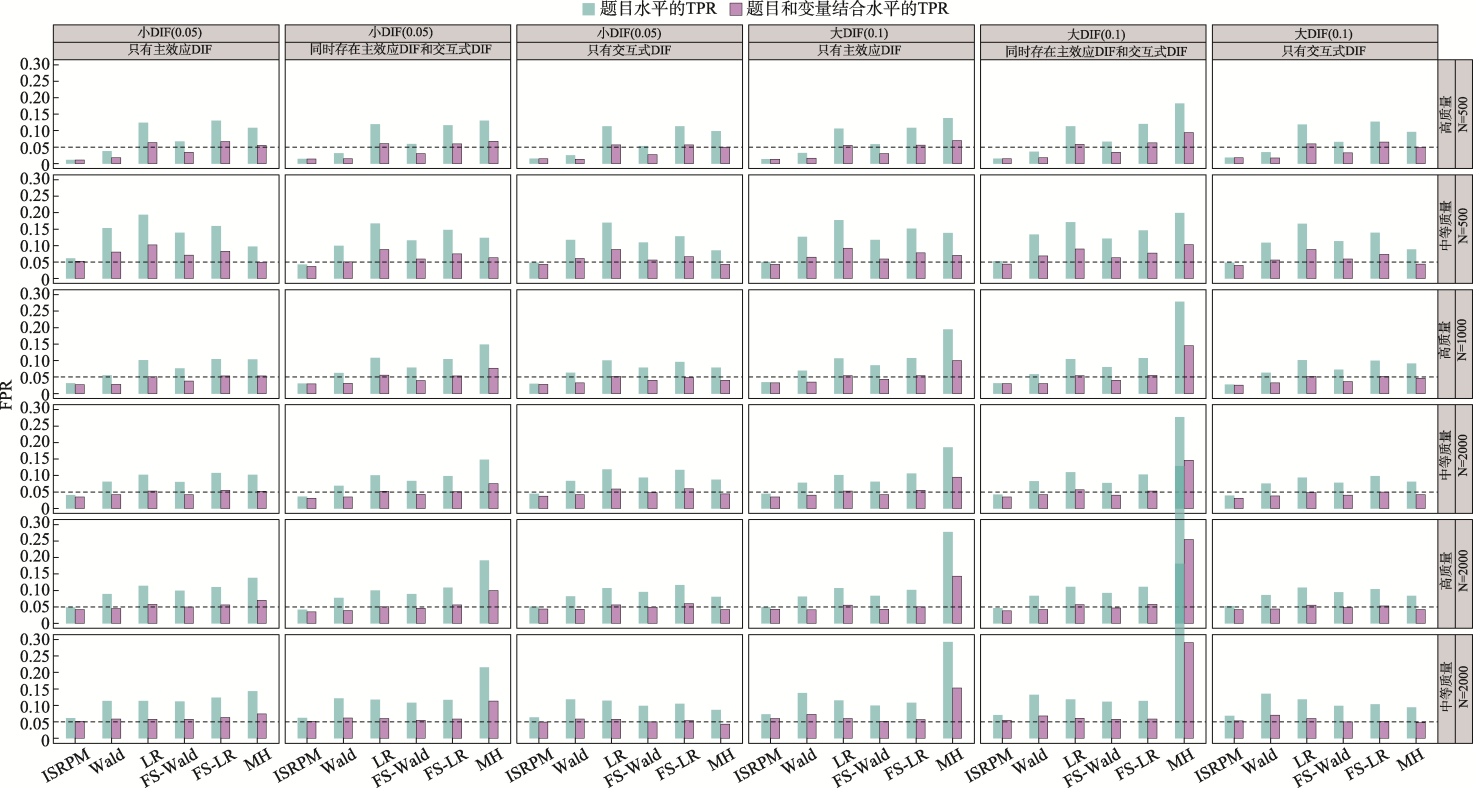
图3 各认知诊断DIF检测方法在不同实验条件下的一类错误率结果
| 题目 | ISRPM | Wald | MH | LR | FS-Wald | FS-LR | ||||||||
|---|---|---|---|---|---|---|---|---|---|---|---|---|---|---|
| 首层变量 | 1st | 2nd-L | 2nd-R | 性别 | 地区 | 性别 | 地区 | 性别 | 地区 | 性别 | 地区 | 性别 | 地区 | |
| 1 | 性别 | ×(×) | ×(×) | ×(×) | ×(×) | ×(×) | √(√) | ×(×) | √(×) | ×(×) | √(×) | ×(×) | √(√) | ×(×) |
| 2 | 性别 | ×(×) | ×(×) | ×(×) | ×(×) | ×(×) | ×(×) | ×(×) | ×(×) | ×(×) | ×(×) | ×(×) | ×(×) | ×(×) |
| 3 | 性别 | √(√) | ×(×) | ×(×) | √(√) | √(×) | √(×) | ×(×) | ×(×) | √(√) | ×(×) | √(×) | √(×) | √(×) |
| 5 | 户籍 | ×(×) | ×(×) | ×(×) | ×(×) | ×(×) | ×(×) | √(×) | ×(×) | √(×) | ×(×) | ×(×) | ×(×) | √(×) |
| 7 | 性别 | ×(×) | ×(×) | ×(×) | ×(×) | ×(×) | ×(×) | ×(×) | √(×) | ×(×) | √(×) | ×(×) | √(√) | ×(×) |
| 9 | 户籍 | √(√) | ×(×) | ×(×) | ×(×) | √(√) | ×(×) | √(√) | ×(×) | √(√) | ×(×) | √(×) | ×(×) | √(√) |
| 12 | 性别 | √(√) | ×(×) | ×(×) | √(√) | ×(×) | ×(×) | √(×) | √(√) | ×(×) | √(√) | ×(×) | √(√) | ×(×) |
| 14 | 性别 | √(×) | ×(×) | ×(×) | √(×) | √(×) | √(√) | √(√) | √(√) | √(√) | ×(×) | √(√) | √(×) | √(√) |
| 15 | 户籍 | √(×) | ×(×) | ×(×) | ×(×) | √(×) | ×(×) | √(×) | ×(×) | √(√) | ×(×) | √(×) | ×(×) | √(×) |
| 16 | 户籍 | √(×) | ×(×) | ×(×) | ×(×) | √(×) | √(√) | √(×) | √(√) | √(√) | √(×) | √(√) | √(√) | √(√) |
| 18 | 性别 | √(×) | ×(×) | ×(×) | √(×) | ×(×) | √(√) | ×(×) | √(×) | ×(×) | ×(×) | ×(×) | √(×) | ×(×) |
| 20 | 性别 | √(√) | ×(×) | ×(×) | √(√) | ×(×) | √(√) | ×(×) | √(√) | ×(×) | √(√) | ×(×) | √(√) | ×(×) |
| 22 | 性别 | √(√) | ×(×) | ×(×) | √(√) | ×(×) | ×(×) | ×(×) | √(√) | ×(×) | √(√) | ×(×) | √(√) | ×(×) |
| 24 | 性别 | √(×) | ×(×) | ×(×) | √(×) | ×(×) | √(×) | √(×) | √(√) | ×(×) | √(×) | ×(×) | √(√) | ×(×) |
| 25 | 性别 | √(√) | ×(×) | ×(×) | √(×) | ×(×) | √(√) | ×(×) | √(√) | ×(×) | √(√) | ×(×) | √(√) | ×(×) |
| 26 | 性别 | √(√) | ×(×) | ×(×) | √(×) | ×(×) | √(√) | ×(×) | √(√) | ×(×) | √(√) | ×(×) | √(√) | ×(×) |
| 27 | 性别 | √(√) | ×(×) | ×(×) | √(×) | ×(×) | √(√) | ×(×) | √(√) | ×(×) | √(√) | ×(×) | √(√) | ×(×) |
| 28 | 性别 | ×(×) | ×(×) | ×(×) | ×(×) | ×(×) | ×(×) | ×(×) | √(×) | ×(×) | ×(×) | ×(×) | √(×) | ×(×) |
| 29 | 性别 | ×(×) | ×(×) | ×(×) | √(×) | ×(×) | √(√) | ×(×) | √(×) | ×(×) | ×(×) | ×(×) | ×(×) | ×(×) |
| 30 | 性别 | ×(×) | ×(×) | ×(×) | ×(×) | ×(×) | √(×) | ×(×) | ×(×) | ×(×) | √(×) | ×(×) | √(×) | ×(×) |
| 31 | 户籍 | √(×) | ×(×) | ×(×) | ×(×) | √(×) | ×(×) | ×(×) | ×(×) | √(√) | ×(×) | ×(×) | ×(×) | √(×) |
| 34 | 性别 | ×(×) | ×(×) | ×(×) | ×(×) | ×(×) | ×(×) | ×(×) | ×(×) | ×(×) | ×(×) | ×(×) | √(×) | ×(×) |
| 35 | 性别 | ×(×) | ×(×) | √(×) | ×(×) | ×(×) | √(×) | ×(×) | √(×) | ×(×) | ×(×) | ×(×) | ×(×) | ×(×) |
| 38 | 性别 | √(×) | ×(×) | ×(×) | √(×) | ×(×) | ×(×) | ×(×) | √(×) | ×(×) | ×(×) | ×(×) | ×(×) | ×(×) |
| 40 | 性别 | √(√) | ×(×) | ×(×) | √(√) | ×(×) | √(√) | ×(×) | √(√) | √(×) | √(√) | ×(×) | √(√) | √(×) |
| 43 | 性别 | ×(×) | ×(×) | ×(×) | ×(×) | ×(×) | ×(×) | ×(×) | ×(×) | ×(×) | ×(×) | √(×) | ×(×) | ×(×) |
| 44 | 户籍 | ×(×) | ×(×) | ×(×) | ×(×) | ×(×) | ×(×) | ×(×) | ×(×) | ×(×) | ×(×) | ×(×) | √(×) | ×(×) |
| 46 | 性别 | √(√) | ×(×) | ×(×) | √(√) | ×(×) | √(√) | ×(×) | √(√) | ×(×) | √(√) | ×(×) | √(√) | ×(×) |
| 48 | 户籍 | ×(×) | ×(×) | ×(×) | ×(×) | ×(×) | ×(×) | ×(×) | ×(×) | √(×) | ×(×) | ×(×) | ×(×) | ×(×) |
| 49 | 性别 | √(×) | ×(×) | ×(×) | √(×) | ×(×) | √(×) | ×(×) | √(√) | ×(×) | √(×) | ×(×) | √(√) | ×(×) |
| 50 | 户籍 | ×(×) | ×(×) | ×(×) | ×(×) | ×(×) | ×(×) | ×(×) | ×(×) | √(×) | ×(×) | √(×) | ×(×) | √(×) |
| 52 | 户籍 | ×(×) | ×(×) | ×(×) | ×(×) | ×(×) | ×(×) | √(√) | ×(×) | √(√) | ×(×) | ×(×) | ×(×) | √(×) |
| 54 | 性别 | √(√) | ×(×) | ×(×) | √(√) | ×(×) | ×(×) | ×(×) | √(√) | ×(×) | √(√) | ×(×) | √(√) | √(×) |
| 55 | 户籍 | ×(×) | ×(×) | ×(×) | ×(×) | ×(×) | ×(×) | ×(×) | ×(×) | √(×) | ×(×) | ×(×) | ×(×) | ×(×) |
| 59 | 户籍 | ×(×) | ×(×) | ×(×) | ×(×) | ×(×) | ×(×) | ×(×) | ×(×) | √(×) | ×(×) | ×(×) | ×(×) | √(×) |
| 61 | 户籍 | √(√) | ×(×) | ×(×) | ×(×) | √(√) | ×(×) | ×(×) | ×(×) | √(√) | ×(×) | √(√) | ×(×) | √(√) |
| 62 | 性别 | √(×) | ×(×) | ×(×) | √(×) | ×(×) | √(√) | ×(×) | √(√) | ×(×) | √(×) | ×(×) | √(√) | ×(×) |
| 64 | 性别 | ×(×) | ×(×) | ×(×) | ×(×) | ×(×) | √(√) | ×(×) | √(×) | ×(×) | √(×) | ×(×) | √(×) | ×(×) |
| 65 | 户籍 | √(×) | ×(×) | ×(×) | ×(×) | √(×) | ×(×) | √(×) | ×(×) | √(√) | ×(×) | √(√) | ×(×) | √(√) |
| 69 | 性别 | √(×) | ×(×) | ×(×) | √(×) | ×(×) | ×(×) | √(√) | √(√) | ×(×) | √(×) | ×(×) | √(√) | ×(×) |
| 71 | 性别 | √(√) | ×(×) | ×(×) | √(√) | ×(×) | √(√) | ×(×) | √(√) | √(×) | ×(×) | ×(×) | √(×) | ×(×) |
| 72 | 性别 | ×(×) | ×(×) | ×(×) | ×(×) | ×(×) | ×(×) | √(√) | √(×) | ×(×) | √(√) | ×(×) | √(×) | ×(×) |
| 74 | 性别 | √(√) | ×(×) | ×(×) | √(√) | ×(×) | √(√) | ×(×) | √(√) | ×(×) | √(√) | ×(×) | √(√) | ×(×) |
表2 整体显著性水平为0.05(0.01)时, DC-SPQ各题目在不同DIF检测方法下的检测结果
| 题目 | ISRPM | Wald | MH | LR | FS-Wald | FS-LR | ||||||||
|---|---|---|---|---|---|---|---|---|---|---|---|---|---|---|
| 首层变量 | 1st | 2nd-L | 2nd-R | 性别 | 地区 | 性别 | 地区 | 性别 | 地区 | 性别 | 地区 | 性别 | 地区 | |
| 1 | 性别 | ×(×) | ×(×) | ×(×) | ×(×) | ×(×) | √(√) | ×(×) | √(×) | ×(×) | √(×) | ×(×) | √(√) | ×(×) |
| 2 | 性别 | ×(×) | ×(×) | ×(×) | ×(×) | ×(×) | ×(×) | ×(×) | ×(×) | ×(×) | ×(×) | ×(×) | ×(×) | ×(×) |
| 3 | 性别 | √(√) | ×(×) | ×(×) | √(√) | √(×) | √(×) | ×(×) | ×(×) | √(√) | ×(×) | √(×) | √(×) | √(×) |
| 5 | 户籍 | ×(×) | ×(×) | ×(×) | ×(×) | ×(×) | ×(×) | √(×) | ×(×) | √(×) | ×(×) | ×(×) | ×(×) | √(×) |
| 7 | 性别 | ×(×) | ×(×) | ×(×) | ×(×) | ×(×) | ×(×) | ×(×) | √(×) | ×(×) | √(×) | ×(×) | √(√) | ×(×) |
| 9 | 户籍 | √(√) | ×(×) | ×(×) | ×(×) | √(√) | ×(×) | √(√) | ×(×) | √(√) | ×(×) | √(×) | ×(×) | √(√) |
| 12 | 性别 | √(√) | ×(×) | ×(×) | √(√) | ×(×) | ×(×) | √(×) | √(√) | ×(×) | √(√) | ×(×) | √(√) | ×(×) |
| 14 | 性别 | √(×) | ×(×) | ×(×) | √(×) | √(×) | √(√) | √(√) | √(√) | √(√) | ×(×) | √(√) | √(×) | √(√) |
| 15 | 户籍 | √(×) | ×(×) | ×(×) | ×(×) | √(×) | ×(×) | √(×) | ×(×) | √(√) | ×(×) | √(×) | ×(×) | √(×) |
| 16 | 户籍 | √(×) | ×(×) | ×(×) | ×(×) | √(×) | √(√) | √(×) | √(√) | √(√) | √(×) | √(√) | √(√) | √(√) |
| 18 | 性别 | √(×) | ×(×) | ×(×) | √(×) | ×(×) | √(√) | ×(×) | √(×) | ×(×) | ×(×) | ×(×) | √(×) | ×(×) |
| 20 | 性别 | √(√) | ×(×) | ×(×) | √(√) | ×(×) | √(√) | ×(×) | √(√) | ×(×) | √(√) | ×(×) | √(√) | ×(×) |
| 22 | 性别 | √(√) | ×(×) | ×(×) | √(√) | ×(×) | ×(×) | ×(×) | √(√) | ×(×) | √(√) | ×(×) | √(√) | ×(×) |
| 24 | 性别 | √(×) | ×(×) | ×(×) | √(×) | ×(×) | √(×) | √(×) | √(√) | ×(×) | √(×) | ×(×) | √(√) | ×(×) |
| 25 | 性别 | √(√) | ×(×) | ×(×) | √(×) | ×(×) | √(√) | ×(×) | √(√) | ×(×) | √(√) | ×(×) | √(√) | ×(×) |
| 26 | 性别 | √(√) | ×(×) | ×(×) | √(×) | ×(×) | √(√) | ×(×) | √(√) | ×(×) | √(√) | ×(×) | √(√) | ×(×) |
| 27 | 性别 | √(√) | ×(×) | ×(×) | √(×) | ×(×) | √(√) | ×(×) | √(√) | ×(×) | √(√) | ×(×) | √(√) | ×(×) |
| 28 | 性别 | ×(×) | ×(×) | ×(×) | ×(×) | ×(×) | ×(×) | ×(×) | √(×) | ×(×) | ×(×) | ×(×) | √(×) | ×(×) |
| 29 | 性别 | ×(×) | ×(×) | ×(×) | √(×) | ×(×) | √(√) | ×(×) | √(×) | ×(×) | ×(×) | ×(×) | ×(×) | ×(×) |
| 30 | 性别 | ×(×) | ×(×) | ×(×) | ×(×) | ×(×) | √(×) | ×(×) | ×(×) | ×(×) | √(×) | ×(×) | √(×) | ×(×) |
| 31 | 户籍 | √(×) | ×(×) | ×(×) | ×(×) | √(×) | ×(×) | ×(×) | ×(×) | √(√) | ×(×) | ×(×) | ×(×) | √(×) |
| 34 | 性别 | ×(×) | ×(×) | ×(×) | ×(×) | ×(×) | ×(×) | ×(×) | ×(×) | ×(×) | ×(×) | ×(×) | √(×) | ×(×) |
| 35 | 性别 | ×(×) | ×(×) | √(×) | ×(×) | ×(×) | √(×) | ×(×) | √(×) | ×(×) | ×(×) | ×(×) | ×(×) | ×(×) |
| 38 | 性别 | √(×) | ×(×) | ×(×) | √(×) | ×(×) | ×(×) | ×(×) | √(×) | ×(×) | ×(×) | ×(×) | ×(×) | ×(×) |
| 40 | 性别 | √(√) | ×(×) | ×(×) | √(√) | ×(×) | √(√) | ×(×) | √(√) | √(×) | √(√) | ×(×) | √(√) | √(×) |
| 43 | 性别 | ×(×) | ×(×) | ×(×) | ×(×) | ×(×) | ×(×) | ×(×) | ×(×) | ×(×) | ×(×) | √(×) | ×(×) | ×(×) |
| 44 | 户籍 | ×(×) | ×(×) | ×(×) | ×(×) | ×(×) | ×(×) | ×(×) | ×(×) | ×(×) | ×(×) | ×(×) | √(×) | ×(×) |
| 46 | 性别 | √(√) | ×(×) | ×(×) | √(√) | ×(×) | √(√) | ×(×) | √(√) | ×(×) | √(√) | ×(×) | √(√) | ×(×) |
| 48 | 户籍 | ×(×) | ×(×) | ×(×) | ×(×) | ×(×) | ×(×) | ×(×) | ×(×) | √(×) | ×(×) | ×(×) | ×(×) | ×(×) |
| 49 | 性别 | √(×) | ×(×) | ×(×) | √(×) | ×(×) | √(×) | ×(×) | √(√) | ×(×) | √(×) | ×(×) | √(√) | ×(×) |
| 50 | 户籍 | ×(×) | ×(×) | ×(×) | ×(×) | ×(×) | ×(×) | ×(×) | ×(×) | √(×) | ×(×) | √(×) | ×(×) | √(×) |
| 52 | 户籍 | ×(×) | ×(×) | ×(×) | ×(×) | ×(×) | ×(×) | √(√) | ×(×) | √(√) | ×(×) | ×(×) | ×(×) | √(×) |
| 54 | 性别 | √(√) | ×(×) | ×(×) | √(√) | ×(×) | ×(×) | ×(×) | √(√) | ×(×) | √(√) | ×(×) | √(√) | √(×) |
| 55 | 户籍 | ×(×) | ×(×) | ×(×) | ×(×) | ×(×) | ×(×) | ×(×) | ×(×) | √(×) | ×(×) | ×(×) | ×(×) | ×(×) |
| 59 | 户籍 | ×(×) | ×(×) | ×(×) | ×(×) | ×(×) | ×(×) | ×(×) | ×(×) | √(×) | ×(×) | ×(×) | ×(×) | √(×) |
| 61 | 户籍 | √(√) | ×(×) | ×(×) | ×(×) | √(√) | ×(×) | ×(×) | ×(×) | √(√) | ×(×) | √(√) | ×(×) | √(√) |
| 62 | 性别 | √(×) | ×(×) | ×(×) | √(×) | ×(×) | √(√) | ×(×) | √(√) | ×(×) | √(×) | ×(×) | √(√) | ×(×) |
| 64 | 性别 | ×(×) | ×(×) | ×(×) | ×(×) | ×(×) | √(√) | ×(×) | √(×) | ×(×) | √(×) | ×(×) | √(×) | ×(×) |
| 65 | 户籍 | √(×) | ×(×) | ×(×) | ×(×) | √(×) | ×(×) | √(×) | ×(×) | √(√) | ×(×) | √(√) | ×(×) | √(√) |
| 69 | 性别 | √(×) | ×(×) | ×(×) | √(×) | ×(×) | ×(×) | √(√) | √(√) | ×(×) | √(×) | ×(×) | √(√) | ×(×) |
| 71 | 性别 | √(√) | ×(×) | ×(×) | √(√) | ×(×) | √(√) | ×(×) | √(√) | √(×) | ×(×) | ×(×) | √(×) | ×(×) |
| 72 | 性别 | ×(×) | ×(×) | ×(×) | ×(×) | ×(×) | ×(×) | √(√) | √(×) | ×(×) | √(√) | ×(×) | √(×) | ×(×) |
| 74 | 性别 | √(√) | ×(×) | ×(×) | √(√) | ×(×) | √(√) | ×(×) | √(√) | ×(×) | √(√) | ×(×) | √(√) | ×(×) |
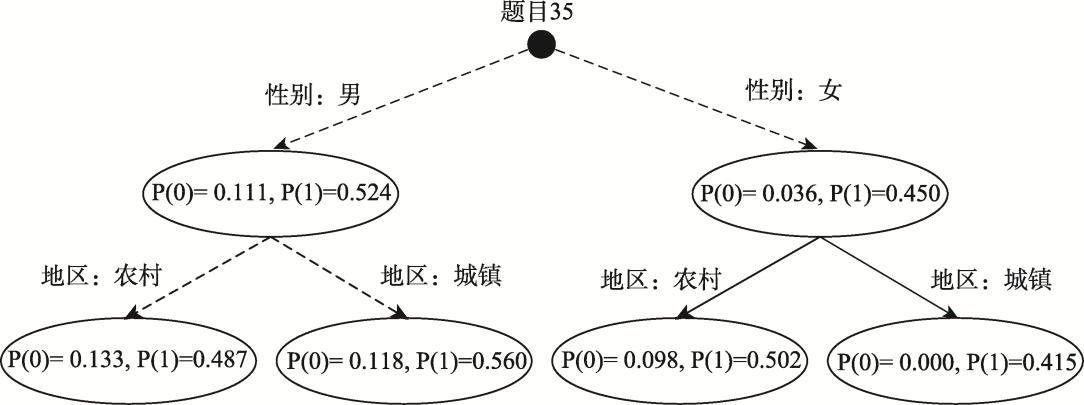
图4 题目35中基于ISRPM输出的递归分割树图
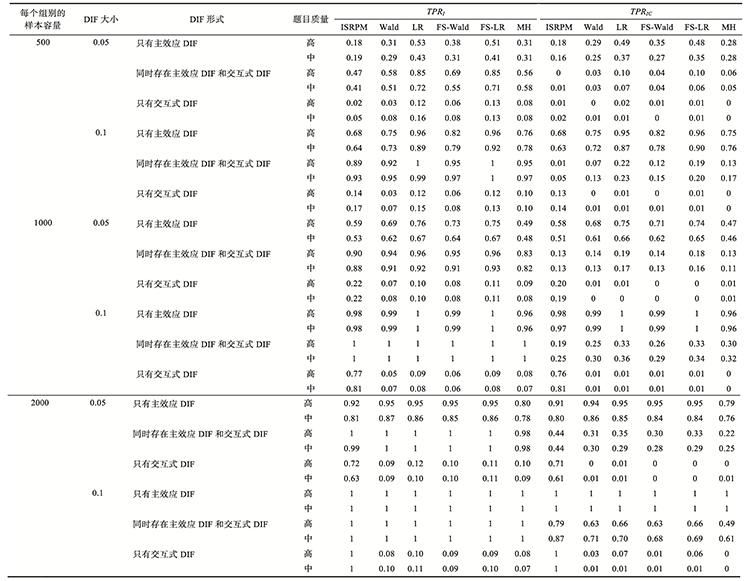 |
附表1 属性掌握模式分布为均匀分布的条件下,不同认知诊断DIF检测方法在不同实验条件下的统计检验力结果
| |
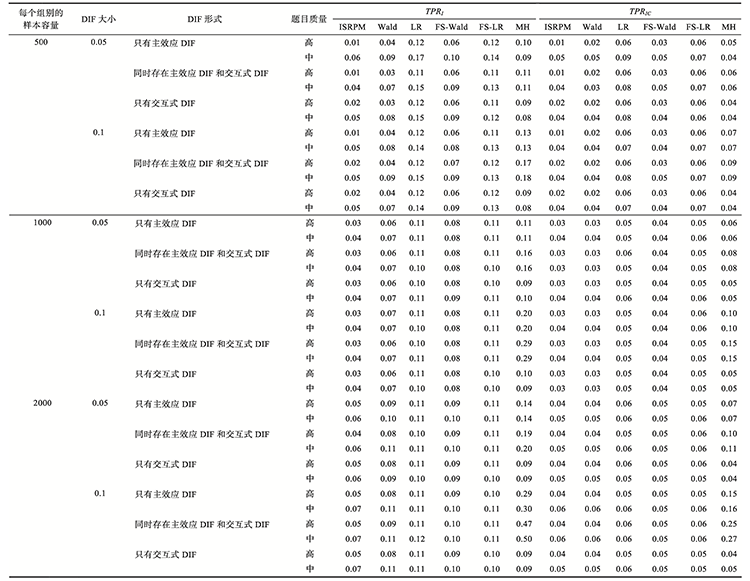 |
附表2 属性掌握模式分布为均匀分布的条件下,不同认知诊断DIF检测方法在不同实验条件下的一类错误率结果
| |
| [1] | American Education Research Association, American Psychological Association, & National Council on Measurement in Education. (2014). The standards for educational and psychological testing. Washington, DC: AERA Publications. |
| [2] | Barnett, V., & Lewis, T. (1994). Outliers in statistical data. Hoboken: Wiley. |
| [3] |
Bauer, D. J. (2017). A more general model for testing measurement invariance and differential item functioning. Psychological Methods, 22(3), 507-526.
doi: 10.1037/met0000077 pmid: 27266798 |
| [4] |
Belzak, W. C. (2023). The multidimensionality of measurement bias in high-stakes testing: Using machine learning to evaluate complex sources of differential item functioning. Educational Measurement: Issues and Practice, 42(1), 24-33.
doi: 10.1111/emip.v42.1 URL |
| [5] |
Belzak, W. C. M., & Bauer, D. J. (2020). Improving the assessment of measurement invariance: Using regularization to select anchor items and identify differential item functioning. Psychological Methods, 25(6), 673-690.
doi: 10.1037/met0000253 URL |
| [6] | Benjamini, Y., & Hochberg, Y. (1995). Controlling the false discovery rate: A practical and powerful approach to multiple testing. Journal of the Royal Statistical Society: Series B (Methodological), 57(1), 289-300. |
| [7] |
Bollmann, S., Berger, M., & Tutz, G. (2018). Item-focused trees for the detection of differential item functioning in partial credit models. Educational and Psychological Measurement, 78(5), 781-804.
doi: 10.1177/0013164417722179 pmid: 32655170 |
| [8] | Collins, P. H. (1990). Black feminist thought: Knowledge, consciousness, and the politics of empowerment. UnwinHyman. |
| [9] |
de la, Torre, J. (2011). The generalized DINA model framework. Psychometrika, 76(2), 179-199.
doi: 10.1007/s11336-011-9207-7 URL |
| [10] |
de la Torre, J., van der Ark, L. A. & Rossi, G.(2018). Analysis of clinical data from a cognitive diagnosis modeling framework. Measurement and Evaluation in Counseling and Development, 51(4), 281-296.
doi: 10.1080/07481756.2017.1327286 URL |
| [11] | DiBello, L. V., Roussos, L. A., & Stout, W. (2006). 31a review of cognitively diagnostic assessment and a summary of psychometric models. Handbook of Statistics, 26, 979-1030. |
| [12] |
Finch, W. H., Hernández Finch, M. E., & French, B. F. (2015). Recursive partitioning to identify potential causes of differential item functioning in cross-national data. International Journal of Testing, 16(1), 21-53.
doi: 10.1080/15305058.2015.1039644 URL |
| [13] | Holland, P. W., & Wainer, H. (1993). Differential item functioning. Hillsdale, NJ: Erlbaum. |
| [14] | Hothorn, T., Hornik, K., & Zeileis, A. (2006). Unbiased recursive partitioning: A conditional inference framework. Journal of Computational and Graphical Statistics, 15(3), 651-674. |
| [15] | Hou, L. (2013). Differential item functioning assessment in cognitive diagnostic modeling: Applying the Wald test to investigate DIF in the generalized DINA model framework (Unpublished doctoral dissertation). University of Delaware. |
| [16] |
Hou, L., de la Torre, J., & Nandakumar, R. (2014). Differential item functioning assessment in cognitive diagnostic modeling: Application of the Wald test to investigate DIF in the DINA model. Journal of Educational Measurement, 51(1), 98-125.
doi: 10.1111/jedm.2014.51.issue-1 URL |
| [17] |
Komboz, B., Strobl, C., & Zeileis, A. (2016). Tree-based global model tests for polytomous Rasch models. Educational and Psychological Measurement, 78(1), 128-166.
doi: 10.1177/0013164416664394 URL |
| [18] | Leighton, J. P., & Gierl, M. (2007). Cognitive diagnostic assessment for education: Theory and Applications. Cambridge, UK: Cambridge University Press. |
| [19] | Li, F. (2008). A modified higher-order DINA model for detecting differential item functioning and differential attribute functioning (Unpublished doctoral dissertation). University of Georgia. |
| [20] |
Li, L., Zhou, X., Huang, J., Tu, D., Gao, X., Yang, Z., & Li, M. (2020). Assessing kindergarteners’ mathematics problem solving: The development of a cognitive diagnostic test. Studies in Educational Evaluation, 66, 100879.
doi: 10.1016/j.stueduc.2020.100879 URL |
| [21] |
Li, X., & Wang, W.-C. (2015). Assessment of differential item functioning under cognitive diagnosis models: The DINA model example. Journal of Educational Measurement, 52(1), 28-54.
doi: 10.1111/jedm.2015.52.issue-1 URL |
| [22] |
Liu, Y., Xin, T., Li, L., Tian, W., & Liu, X. (2016). An improved method for differential item functioning detection in cognitive diagnosis models: An application of Wald statistic based on observed information matrix. Acta Psychologica Sinica, 48(5), 588-598.
doi: 10.3724/SP.J.1041.2016.00588 |
| [刘彦楼, 辛涛, 李令青, 田伟, 刘笑笑. (2016). 改进的认知诊断模型项目功能差异检验方法——基于观察信息矩阵的Wald统计量. 心理学报, 48(5), 588-598.] | |
| [23] | Ma, W., & de la Torre, J. (2020). GDINA: An R package for cognitive diagnosis modeling. Journal of Statistical Software, 93(14), 1-26. |
| [24] |
Ma, W., Terzi, R., & de la Torre, J. (2021). Detecting differential item functioning using multiple-group cognitive diagnosis models. Applied Psychological Measurement, 45(1), 37-53.
doi: 10.1177/0146621620965745 pmid: 33304020 |
| [25] |
Magis, D., Béland, S., Tuerlinckx, F., & de Boeck, P. (2010). A general framework and an R package for the detection of dichotomous differential item functioning. Behavior Research Methods, 42(3), 847-862.
doi: 10.3758/BRM.42.3.847 pmid: 20805607 |
| [26] |
Meade, A. W., & Wright, N. A. (2012). Solving the measurement invariance anchor item problem in item response theory. Journal of Applied Psychology, 97(5), 1016-1031.
doi: 10.1037/a0027934 pmid: 22468848 |
| [27] |
Mehrazmay, R., Ghonsooly, B., & de la Torre, J. (2021). Detecting differential item functioning using cognitive diagnosis models: Applications of the Wald test and likelihood ratio test in a university entrance examination. Applied Measurement in Education, 34(4), 262-284.
doi: 10.1080/08957347.2021.1987906 URL |
| [28] |
Meredith, W. (1993). Measurement invariance, factor analysis and factorial invariance. Psychometrika, 58(4), 525-543.
doi: 10.1007/BF02294825 URL |
| [29] | Nichols, P. D., Chipman, S. F., & Brennan, R. L. (1995). Cognitively diagnostic assessment. Routledge. |
| [30] |
Paulsen, J., Svetina, D., Feng, Y., & Valdivia, M. (2020). Examining the impact of differential item functioning on classification accuracy in cognitive diagnostic models. Applied Psychological Measurement, 44(4), 267-281.
doi: 10.1177/0146621619858675 pmid: 32536729 |
| [31] | R, Core Team. (2021). R: A language and environment for statistical computing. R Foundation for Statistical Computing, Vienna, Austria. https://www.Rproject.org/ |
| [32] | Rupp, A. A., Templin, J., & Henson, R. A. (2010). Diagnostic measurement: Theory, methods, and applications. Guilford Press. |
| [33] |
Strobl, C., Kopf, J., & Zeileis, A. (2015). Rasch trees: A new method for detecting differential item functioning in the Rasch model. Psychometrika, 80(2), 289-316.
doi: 10.1007/s11336-013-9388-3 pmid: 24352514 |
| [34] |
Strobl, C., Malley, J., & Tutz, G. (2009). An introduction to recursive partitioning: Rationale, application, and characteristics of classification and regression trees, bagging, and random forests. Psychological Methods, 14(4), 323-348.
doi: 10.1037/a0016973 pmid: 19968396 |
| [35] | Sun, X., Liu, Y., Wang, S., Xin, T., Song, N., & Zhou, M. (2022). Using information matrix-based method to detect differential item functioning with multiple groups in cognitive diagnostic test. Journal of Psychological Science, 45(3), 710-717. |
| [孙小坚, 刘彦楼, 王诗梦, 辛涛, 宋乃庆, 周蔓. (2022). 认知诊断测验中基于信息矩阵的多群组DIF检验. 心理科学, 45(3), 710-717.] | |
| [36] |
Tan, Z., de La Torre, J., Ma, W., Huh, D., Larimer, M. E., & Mun, E.-Y. (2023). A tutorial on cognitive diagnosis modeling for characterizing mental health symptom profiles using existing item responses. Prevention Science, 24(3), 480-492.
doi: 10.1007/s11121-022-01346-8 |
| [37] |
Tay, L., Huang, Q., & Vermunt, J. K. (2015). Item response theory with covariates (IRT-C): Assessing item recovery and differential item functioning for the three-parameter logistic model. Educational and Psychological Measurement, 76(1), 22-42.
doi: 10.1177/0013164415579488 URL |
| [38] |
Templin, J. L., & Henson, R. A. (2006). Measurement of psychological disorders using cognitive diagnosis models. Psychological Methods, 11(3), 287-305.
pmid: 16953706 |
| [39] | Tu, D., Cai, Y., Gao, X., & Wang, D. (2019). Advanced cognitive diagnosis. Beijing: Beijing Normal University Publishing Group. |
| [涂冬波, 蔡艳, 高旭亮, 汪大勋. (2019). 高级认知诊断. 北京: 北京师范大学出版社.] | |
| [40] |
Tutz, G., & Berger, M. (2016). Item-focussed trees for the identification of items in differential item functioning. Psychometrika, 81(3), 727-750.
doi: 10.1007/s11336-015-9488-3 pmid: 26596721 |
| [41] |
Wang, D., Gao, X., Cai, Y., & Tu, D. (2019). Development of a new instrument for depression with cognitive diagnosis models. Frontiers in Psychology, 10, 1306.
doi: 10.3389/fpsyg.2019.01306 pmid: 31214095 |
| [42] | Wang, X. (2019). Development and verification of cognitive diagnostic test for cross-grade pupils’ mathematics learning ability. Chinese Exam, 8, 71-78. |
| [王欣瑜. (2019). 跨年级小学数学学力认知诊断测验的开发与验证. 中国考试, 8, 71-78.] | |
| [43] |
Wang, Z., Guo, L., & Bian, Y. (2014). Comparison of DIF detecting methods in cognitive diagnostic test. Acta Psychologica Sinica, 46(12), 1923-1932.
doi: 10.3724/SP.J.1041.2014.01923 |
| [王卓然, 郭磊, 边玉芳. (2014). 认知诊断测验中的项目功能差异检测方法比较. 心理学报, 46(12), 1923-1932.] | |
| [44] | Xi, C., Cai, Y., Peng, S., Lian, J., & Tu, D. (2020). A diagnostic classification version of schizotypal personality questionnaire using diagnostic classification models. International Journal of Methods in Psychiatric Research, 29(1), e1807. |
| [45] |
Yuan, K. H., Liu, H., & Han, Y. (2021). Differential item functioning analysis without a priori information on anchor items: QQ plots and graphical test. Psychometrika, 86(2), 345-377.
doi: 10.1007/s11336-021-09746-5 URL |
| [46] | Zhang, W. (2006). Detecting differential item functioning using the DINA model (Unpublished doctoral dissertation). The University of North Carolina at Greensboro. |
| [1] | 郭磊, 周文杰. 基于选项层面的认知诊断非参数方法[J]. 心理学报, 2021, 53(9): 1032-1043. |
| [2] | 刘彦楼;辛涛;李令青;田伟;刘笑笑. 改进的认知诊断模型项目功能差异检验方法 ——基于观察信息矩阵的Wald统计量[J]. 心理学报, 2016, 48(5): 588-598. |
| [3] | 汪文义;丁树良;宋丽红. 认知诊断中基于条件期望的距离判别方法[J]. 心理学报, 2015, 47(12): 1499-1510. |
| [4] | 王卓然; 郭磊; 边玉芳. 认知诊断测验中的项目功能差异检测方法比较[J]. 心理学报, 2014, 46(12): 1923-1932. |
| [5] | 张勋;李凌艳;刘红云;孙研. IRT_Δb法和修正LR法对矩阵取样 DIF检验的有效性[J]. 心理学报, 2013, 45(8): 921-934. |
| [6] | 刘红云,李冲,张平平,骆方. 分类数据测量等价性检验方法及其比较:项目阈值(难度)参数的组间差异性检验[J]. 心理学报, 2012, 44(8): 1124-1136. |
| [7] | 郑蝉金,郭聪颖,边玉芳. 变通的题组项目功能差异检验方法在篇章阅读测验中的应用[J]. 心理学报, 2011, 43(07): 830-835. |
| [8] | 曹亦薇. 项目功能差异在跨文化人格问卷分析中的应用[J]. 心理学报, 2003, 35(01): 120-126. |
| [9] | 曹亦薇,张厚粲. 汉语词汇测验中的项目功能差异初探[J]. 心理学报, 1999, 31(4): 460-467. |
| 阅读次数 | ||||||
|
全文 |
|
|||||
|
摘要 |
|
|||||
