

ISSN 0439-755X
CN 11-1911/B
主办:中国心理学会
中国科学院心理研究所
出版:科学出版社
CN 11-1911/B
主办:中国心理学会
中国科学院心理研究所
出版:科学出版社
心理学报 ›› 2026, Vol. 58 ›› Issue (5): 918-934.doi: 10.3724/SP.J.1041.2026.0918 cstr: 32110.14.2026.0918
王祯1, 左果果2, 管健1( )
)
收稿日期:2025-08-04
发布日期:2026-03-04
出版日期:2026-05-25
通讯作者:
管健, E-mail: nkguanjian@nankai.edu.cn基金资助:
WANG Zhen1, ZUO Guoguo2, GUAN Jian1()
Received:2025-08-04
Online:2026-03-04
Published:2026-05-25
摘要:
努力作为通往成功道路上的关键因素, 对个人的积极影响不言而喻, 但当前研究对强调努力是否会引发消极影响还不清楚。本研究根据归因理论和“表现 = 努力 + 能力”理论, 结合特定领域能力信念和聪明性别刻板印象, 通过4个实验(N = 1038), 探讨了强调努力对个体追求STEM领域造成的消极影响(实验1~4)及其内在机制(实验3~4)。结果发现, 强调目标个体的努力, 会引发对其不聪明感知, 进而导致他人不建议其追求STEM领域; 同时, 还会降低目标个体自身追求STEM领域的意愿、兴趣、归属感和动机。本研究将这一现象称为“强调努力悖论”, 该概念的提出有助于打破“强调努力 = 积极结果”的片面认知, 对STEM教育具有重要启示意义。
中图分类号:
王祯, 左果果, 管健. (2026). 强调努力悖论:强调努力阻碍对STEM领域的追求. 心理学报, 58(5), 918-934.
WANG Zhen, ZUO Guoguo, GUAN Jian. (2026). Paradox of emphasizing effort: How emphasizing effort discourages pursuit of STEM fields. Acta Psychologica Sinica, 58(5), 918-934.
| 实验 | 强调努力组 M (SD) | 控制组 M (SD) | t [χ2] | d | 95% CI |
|---|---|---|---|---|---|
| 实验1 | 6.54 (0.81), 96% | 4.19 (0.63), 91% | 23.75*** | 3.21 | [2.81, 3.61] |
| 实验2 | 6.51 (0.86), 96% | 4.09 (0.41), 94% | 30.60*** | 3.48 | [3.13, 3.84] |
| 实验3 | 6.34 (0.91), 97% | 4.13 (0.43), 91% | 25.42*** | 3.15 | [2.79, 3.52] |
| 实验4 | 95% | 94% | 197.75*** |
表1 实验1~4中组别的操作检验
| 实验 | 强调努力组 M (SD) | 控制组 M (SD) | t [χ2] | d | 95% CI |
|---|---|---|---|---|---|
| 实验1 | 6.54 (0.81), 96% | 4.19 (0.63), 91% | 23.75*** | 3.21 | [2.81, 3.61] |
| 实验2 | 6.51 (0.86), 96% | 4.09 (0.41), 94% | 30.60*** | 3.48 | [3.13, 3.84] |
| 实验3 | 6.34 (0.91), 97% | 4.13 (0.43), 91% | 25.42*** | 3.15 | [2.79, 3.52] |
| 实验4 | 95% | 94% | 197.75*** |
| 实验 | 女性 | 男性 | 未明确性别 | χ2 |
|---|---|---|---|---|
| 实验1 | 97% | 93% | 94% | 371.52*** |
| 实验2 | 97% | 96% | 293.98*** | |
| 实验3 | 95% | 95% | 245.12*** | |
| 实验4 | 94% | 96% | 235.33*** |
表2 实验1~4中目标个体性别的操作检验
| 实验 | 女性 | 男性 | 未明确性别 | χ2 |
|---|---|---|---|---|
| 实验1 | 97% | 93% | 94% | 371.52*** |
| 实验2 | 97% | 96% | 293.98*** | |
| 实验3 | 95% | 95% | 245.12*** | |
| 实验4 | 94% | 96% | 235.33*** |
| 因变量 | 自变量 | M (SD) | F | df | p | η2p |
|---|---|---|---|---|---|---|
| 建议 | 组别 | |||||
| 强调努力组 | 3.65 (1.22) | 21.55 | 1, 213 | < 0.001 | 0.09 | |
| 控制组 | 4.31 (0.85) | |||||
| 目标个体性别 | ||||||
| 女性 | 3.49 (1.14) | 11.94 | 2, 213 | < 0.001 | 0.10 | |
| 男性 | 4.29 (1.06) | |||||
| 未明确性别 | 4.13 (0.95) | |||||
| 组别×目标个体性别 | 0.02 | 2, 213 | 0.98 | 0.00 |
表3 实验1中因变量的方差分析
| 因变量 | 自变量 | M (SD) | F | df | p | η2p |
|---|---|---|---|---|---|---|
| 建议 | 组别 | |||||
| 强调努力组 | 3.65 (1.22) | 21.55 | 1, 213 | < 0.001 | 0.09 | |
| 控制组 | 4.31 (0.85) | |||||
| 目标个体性别 | ||||||
| 女性 | 3.49 (1.14) | 11.94 | 2, 213 | < 0.001 | 0.10 | |
| 男性 | 4.29 (1.06) | |||||
| 未明确性别 | 4.13 (0.95) | |||||
| 组别×目标个体性别 | 0.02 | 2, 213 | 0.98 | 0.00 |
| 因变量 | 自变量 | M (SD) | F | df | p | η2p |
|---|---|---|---|---|---|---|
| 建议 | 组别 | |||||
| 强调努力组 | 3.51 (1.22) | 56.99 | 1, 308 | < 0.001 | 0.16 | |
| 控制组 | 4.46 (0.95) | |||||
| 目标个体性别 | ||||||
| 女性 | 3.71 (1.19) | 10.04 | 1, 308 | 0.002 | 0.03 | |
| 男性 | 4.13 (1.17) | |||||
| 组别×目标个体性别 | 0.04 | 1, 308 | 0.85 | 0.00 | ||
| 预期意愿 | 组别 | |||||
| 强调努力组 | 3.27 (1.24) | 44.04 | 1, 308 | < 0.001 | 0.13 | |
| 控制组 | 4.12 (0.95) | |||||
| 目标个体性别 | ||||||
| 女性 | 3.46 (1.19) | 7.06 | 1, 308 | 0.008 | 0.02 | |
| 男性 | 3.81 (1.17) | |||||
| 组别×目标个体性别 | 0.06 | 1, 308 | 0.81 | 0.00 |
表4 实验2中因变量的方差分析
| 因变量 | 自变量 | M (SD) | F | df | p | η2p |
|---|---|---|---|---|---|---|
| 建议 | 组别 | |||||
| 强调努力组 | 3.51 (1.22) | 56.99 | 1, 308 | < 0.001 | 0.16 | |
| 控制组 | 4.46 (0.95) | |||||
| 目标个体性别 | ||||||
| 女性 | 3.71 (1.19) | 10.04 | 1, 308 | 0.002 | 0.03 | |
| 男性 | 4.13 (1.17) | |||||
| 组别×目标个体性别 | 0.04 | 1, 308 | 0.85 | 0.00 | ||
| 预期意愿 | 组别 | |||||
| 强调努力组 | 3.27 (1.24) | 44.04 | 1, 308 | < 0.001 | 0.13 | |
| 控制组 | 4.12 (0.95) | |||||
| 目标个体性别 | ||||||
| 女性 | 3.46 (1.19) | 7.06 | 1, 308 | 0.008 | 0.02 | |
| 男性 | 3.81 (1.17) | |||||
| 组别×目标个体性别 | 0.06 | 1, 308 | 0.81 | 0.00 |
| 因变量 | 自变量 | M (SD) | F | df | p | η2p |
|---|---|---|---|---|---|---|
| 建议 | 组别 | |||||
| 强调努力组 | 3.94 (1.54) | 26.31 | 1, 256 | < 0.001 | 0.09 | |
| 控制组 | 4.84 (1.27) | |||||
| 目标个体性别 | ||||||
| 女性 | 4.35 (1.44) | 0.26 | 1, 256 | 0.61 | 0.001 | |
| 男性 | 4.47 (1.51) | |||||
| 组别×目标个体性别 | 1.36 | 1, 256 | 0.24 | 0.005 | ||
| 预期意愿 | 组别 | |||||
| 强调努力组 | 4.37 (1.51) | 17.76 | 1, 256 | < 0.001 | 0.07 | |
| 控制组 | 5.04 (1.05) | |||||
| 目标个体性别 | ||||||
| 女性 | 4.68 (1.24) | 0.11 | 1, 256 | 0.74 | 0.00 | |
| 男性 | 4.75 (1.43) | |||||
| 组别×目标个体性别 | 0.34 | 1, 256 | 0.56 | 0.001 | ||
| 预期兴趣 | 组别 | |||||
| 强调努力组 | 5.55 (1.63) | 10.97 | 1, 256 | 0.001 | 0.04 | |
| 控制组 | 6.14 (1.16) | |||||
| 目标个体性别 | ||||||
| 女性 | 5.71 (1.35) | 2.23 | 1, 256 | 0.14 | 0.009 | |
| 男性 | 5.99 (1.50) | |||||
| 组别×目标个体性别 | 0.02 | 1, 256 | 0.89 | 0.00 | ||
| 预期归属感 | 组别 | |||||
| 强调努力组 | 4.01 (1.29) | 18.49 | 1, 256 | < 0.001 | 0.07 | |
| 控制组 | 4.60 (0.90) | |||||
| 目标个体性别 | ||||||
| 女性 | 4.21 (1.22) | 1.81 | 1, 256 | 0.18 | 0.007 | |
| 男性 | 4.41 (1.06) | |||||
| 组别×目标个体性别 | 0.44 | 1, 256 | 0.51 | 0.002 | ||
| 预期动机 | 组别 | |||||
| 强调努力组 | 4.25 (1.21) | 8.07 | 1, 256 | 0.005 | 0.03 | |
| 控制组 | 4.63 (0.90) | |||||
| 目标个体性别 | ||||||
| 女性 | 4.32 (1.12) | 3.84 | 1, 256 | 0.05 | 0.02 | |
| 男性 | 4.58 (1.01) | |||||
| 组别×目标个体性别 | 0.50 | 1, 256 | 0.48 | 0.002 |
表5 实验3中因变量的方差分析
| 因变量 | 自变量 | M (SD) | F | df | p | η2p |
|---|---|---|---|---|---|---|
| 建议 | 组别 | |||||
| 强调努力组 | 3.94 (1.54) | 26.31 | 1, 256 | < 0.001 | 0.09 | |
| 控制组 | 4.84 (1.27) | |||||
| 目标个体性别 | ||||||
| 女性 | 4.35 (1.44) | 0.26 | 1, 256 | 0.61 | 0.001 | |
| 男性 | 4.47 (1.51) | |||||
| 组别×目标个体性别 | 1.36 | 1, 256 | 0.24 | 0.005 | ||
| 预期意愿 | 组别 | |||||
| 强调努力组 | 4.37 (1.51) | 17.76 | 1, 256 | < 0.001 | 0.07 | |
| 控制组 | 5.04 (1.05) | |||||
| 目标个体性别 | ||||||
| 女性 | 4.68 (1.24) | 0.11 | 1, 256 | 0.74 | 0.00 | |
| 男性 | 4.75 (1.43) | |||||
| 组别×目标个体性别 | 0.34 | 1, 256 | 0.56 | 0.001 | ||
| 预期兴趣 | 组别 | |||||
| 强调努力组 | 5.55 (1.63) | 10.97 | 1, 256 | 0.001 | 0.04 | |
| 控制组 | 6.14 (1.16) | |||||
| 目标个体性别 | ||||||
| 女性 | 5.71 (1.35) | 2.23 | 1, 256 | 0.14 | 0.009 | |
| 男性 | 5.99 (1.50) | |||||
| 组别×目标个体性别 | 0.02 | 1, 256 | 0.89 | 0.00 | ||
| 预期归属感 | 组别 | |||||
| 强调努力组 | 4.01 (1.29) | 18.49 | 1, 256 | < 0.001 | 0.07 | |
| 控制组 | 4.60 (0.90) | |||||
| 目标个体性别 | ||||||
| 女性 | 4.21 (1.22) | 1.81 | 1, 256 | 0.18 | 0.007 | |
| 男性 | 4.41 (1.06) | |||||
| 组别×目标个体性别 | 0.44 | 1, 256 | 0.51 | 0.002 | ||
| 预期动机 | 组别 | |||||
| 强调努力组 | 4.25 (1.21) | 8.07 | 1, 256 | 0.005 | 0.03 | |
| 控制组 | 4.63 (0.90) | |||||
| 目标个体性别 | ||||||
| 女性 | 4.32 (1.12) | 3.84 | 1, 256 | 0.05 | 0.02 | |
| 男性 | 4.58 (1.01) | |||||
| 组别×目标个体性别 | 0.50 | 1, 256 | 0.48 | 0.002 |
| 实验 | 中介路径 | b | SE | 95% CI |
|---|---|---|---|---|
| 实验3 | 组别→不聪明感知→建议 | −0.30 | 0.09 | [−0.49, −0.15] |
| 组别→不聪明感知→预期意愿 | −0.20 | 0.07 | [−0.34, −0.08] | |
| 组别→不聪明感知→预期兴趣 | −0.19 | 0.08 | [−0.35, −0.05] | |
| 组别→不聪明感知→预期归属感 | −0.24 | 0.07 | [−0.40, −0.11] | |
| 组别→不聪明感知→预期动机 | −0.19 | 0.07 | [−0.34, −0.08] | |
| 实验4 | 组别→不聪明感知→建议 | −0.35 | 0.09 | [−0.54, −0.19] |
| 组别→不聪明感知→预期意愿 | −0.34 | 0.10 | [−0.54, −0.16] | |
| 组别→不聪明感知→预期兴趣 | −0.45 | 0.11 | [−0.70, −0.25] | |
| 组别→不聪明感知→预期归属感 | −0.40 | 0.08 | [−0.57, −0.25] | |
| 组别→不聪明感知→预期动机 | −0.34 | 0.08 | [−0.50, −0.18] |
表6 实验3~4中的中介效应
| 实验 | 中介路径 | b | SE | 95% CI |
|---|---|---|---|---|
| 实验3 | 组别→不聪明感知→建议 | −0.30 | 0.09 | [−0.49, −0.15] |
| 组别→不聪明感知→预期意愿 | −0.20 | 0.07 | [−0.34, −0.08] | |
| 组别→不聪明感知→预期兴趣 | −0.19 | 0.08 | [−0.35, −0.05] | |
| 组别→不聪明感知→预期归属感 | −0.24 | 0.07 | [−0.40, −0.11] | |
| 组别→不聪明感知→预期动机 | −0.19 | 0.07 | [−0.34, −0.08] | |
| 实验4 | 组别→不聪明感知→建议 | −0.35 | 0.09 | [−0.54, −0.19] |
| 组别→不聪明感知→预期意愿 | −0.34 | 0.10 | [−0.54, −0.16] | |
| 组别→不聪明感知→预期兴趣 | −0.45 | 0.11 | [−0.70, −0.25] | |
| 组别→不聪明感知→预期归属感 | −0.40 | 0.08 | [−0.57, −0.25] | |
| 组别→不聪明感知→预期动机 | −0.34 | 0.08 | [−0.50, −0.18] |
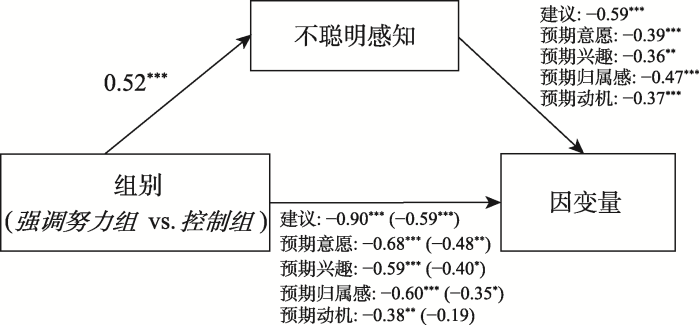
图1 强调努力悖论的中介模型(实验3) 注:因变量包括建议、预期意愿、兴趣、归属感和动机;路径系数为非标准化系数;*p < 0.05, **p < 0.01, ***p < 0.001,下同。
| 因变量 | 自变量 | M (SD) | F | df | p | η2p |
|---|---|---|---|---|---|---|
| 建议 | 组别 | |||||
| 强调努力组 | 3.57 (1.26) | 56.39 | 1, 243 | < 0.001 | 0.19 | |
| 控制组 | 4.79 (1.20) | |||||
| 目标个体性别 | ||||||
| 女性 | 3.94 (1.25) | 4.42 | 1, 243 | 0.04 | 0.02 | |
| 男性 | 4.42 (1.45) | |||||
| 组别×目标个体性别 | 0.83 | 1, 243 | 0.36 | 0.003 | ||
| 预期意愿 | 组别 | |||||
| 强调努力组 | 3.75 (1.49) | 34.39 | 1, 243 | < 0.001 | 0.12 | |
| 控制组 | 4.89 (1.37) | |||||
| 目标个体性别 | ||||||
| 女性 | 3.94 (1.57) | 12.70 | 1, 243 | < 0.001 | 0.05 | |
| 男性 | 4.71 (1.41) | |||||
| 组别×目标个体性别 | 0.002 | 1, 243 | 0.97 | 0.00 | ||
| 预期兴趣 | 组别 | |||||
| 强调努力组 | 4.95 (1.65) | 24.25 | 1, 243 | < 0.001 | 0.09 | |
| 控制组 | 6.03 (1.56) | |||||
| 目标个体性别 | ||||||
| 女性 | 5.07 (1.71) | 12.82 | 1, 243 | < 0.001 | 0.05 | |
| 男性 | 5.92 (1.56) | |||||
| 组别×目标个体性别 | 0.06 | 1, 243 | 0.81 | 0.00 | ||
| 预期归属感 | 组别 | |||||
| 强调努力组 | 3.89 (1.11) | 22.58 | 1, 243 | < 0.001 | 0.09 | |
| 控制组 | 4.60 (1.07) | |||||
| 目标个体性别 | ||||||
| 女性 | 4.02 (1.14) | 7.44 | 1, 243 | 0.007 | 0.03 | |
| 男性 | 4.48 (1.10) | |||||
| 组别×目标个体性别 | 0.003 | 1, 243 | 0.96 | 0.00 | ||
| 预期动机 | 组别 | |||||
| 强调努力组 | 4.00 (1.21) | 18.95 | 1, 243 | < 0.001 | 0.07 | |
| 控制组 | 4.67 (1.01) | |||||
| 目标个体性别 | ||||||
| 女性 | 4.05 (1.19) | 13.38 | 1, 243 | < 0.001 | 0.05 | |
| 男性 | 4.63 (1.06) | |||||
| 组别×目标个体性别 | 0.31 | 1, 243 | 0.58 | 0.001 |
表7 实验4中因变量的方差分析
| 因变量 | 自变量 | M (SD) | F | df | p | η2p |
|---|---|---|---|---|---|---|
| 建议 | 组别 | |||||
| 强调努力组 | 3.57 (1.26) | 56.39 | 1, 243 | < 0.001 | 0.19 | |
| 控制组 | 4.79 (1.20) | |||||
| 目标个体性别 | ||||||
| 女性 | 3.94 (1.25) | 4.42 | 1, 243 | 0.04 | 0.02 | |
| 男性 | 4.42 (1.45) | |||||
| 组别×目标个体性别 | 0.83 | 1, 243 | 0.36 | 0.003 | ||
| 预期意愿 | 组别 | |||||
| 强调努力组 | 3.75 (1.49) | 34.39 | 1, 243 | < 0.001 | 0.12 | |
| 控制组 | 4.89 (1.37) | |||||
| 目标个体性别 | ||||||
| 女性 | 3.94 (1.57) | 12.70 | 1, 243 | < 0.001 | 0.05 | |
| 男性 | 4.71 (1.41) | |||||
| 组别×目标个体性别 | 0.002 | 1, 243 | 0.97 | 0.00 | ||
| 预期兴趣 | 组别 | |||||
| 强调努力组 | 4.95 (1.65) | 24.25 | 1, 243 | < 0.001 | 0.09 | |
| 控制组 | 6.03 (1.56) | |||||
| 目标个体性别 | ||||||
| 女性 | 5.07 (1.71) | 12.82 | 1, 243 | < 0.001 | 0.05 | |
| 男性 | 5.92 (1.56) | |||||
| 组别×目标个体性别 | 0.06 | 1, 243 | 0.81 | 0.00 | ||
| 预期归属感 | 组别 | |||||
| 强调努力组 | 3.89 (1.11) | 22.58 | 1, 243 | < 0.001 | 0.09 | |
| 控制组 | 4.60 (1.07) | |||||
| 目标个体性别 | ||||||
| 女性 | 4.02 (1.14) | 7.44 | 1, 243 | 0.007 | 0.03 | |
| 男性 | 4.48 (1.10) | |||||
| 组别×目标个体性别 | 0.003 | 1, 243 | 0.96 | 0.00 | ||
| 预期动机 | 组别 | |||||
| 强调努力组 | 4.00 (1.21) | 18.95 | 1, 243 | < 0.001 | 0.07 | |
| 控制组 | 4.67 (1.01) | |||||
| 目标个体性别 | ||||||
| 女性 | 4.05 (1.19) | 13.38 | 1, 243 | < 0.001 | 0.05 | |
| 男性 | 4.63 (1.06) | |||||
| 组别×目标个体性别 | 0.31 | 1, 243 | 0.58 | 0.001 |
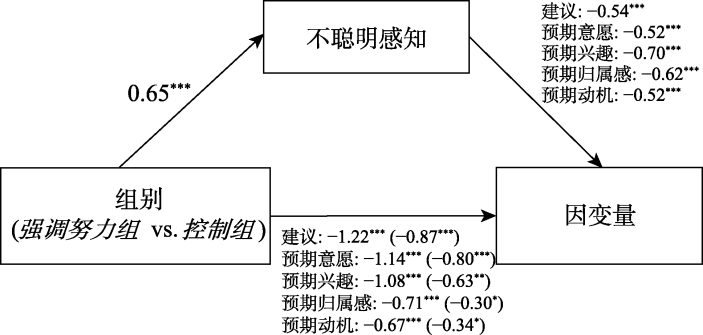
图2 强调努力悖论的中介模型(实验4)
| [1] |
Amemiya, J., Heyman, G. D., & Walker, C. M. (2023). Emphasizing others’ persistence can promote unwarranted social inferences in children and adults. Journal of Experimental Psychology: General, 152(10), 2977-2988.
doi: 10.1037/xge0001428 URL |
| [2] |
Amemiya, J., & Wang, M. T. (2018). Why effort praise can backfire in adolescence. Child Development Perspectives, 12(3), 199-203.
doi: 10.1111/cdep.12284 URL |
| [3] |
Apascaritei, P., Radl, J., & Swarr, M. (2024). Material incentives moderate gender differences in cognitive effort among children. Learning and Individual Differences, 114, 102494.
doi: 10.1016/j.lindif.2024.102494 URL |
| [4] |
Bian, L., Leslie, S. J., & Cimpian, A. (2017). Gender stereotypes about intellectual ability emerge early and influence children’s interests. Science, 355(6323), 389-391.
doi: 10.1126/science.aah6524 pmid: 28126816 |
| [5] |
Bian, L., Leslie, S. J., & Cimpian, A. (2018a). Evidence of bias against girls and women in contexts that emphasize intellectual ability. American Psychologist, 73(9), 1139-1153.
doi: 10.1037/amp0000427 URL |
| [6] |
Bian, L., Leslie, S. J., Murphy, M. C., & Cimpian, A. (2018b). Messages about brilliance undermine women’s interest in educational and professional opportunities. Journal of Experimental Social Psychology, 76, 404-420.
doi: 10.1016/j.jesp.2017.11.006 URL |
| [7] |
Ceci, S. J., & Williams, W. M. (2010). Sex differences in math-intensive fields. Current Directions in Psychological Science, 19(5), 275-279.
pmid: 21152367 |
| [8] |
Cheryan, S., Lombard, E. J., Hailu, F., Pham, L. N., & Weltzien, K. (2024). Global patterns of gender disparities in STEM and explanations for their persistence. Nature Reviews Psychology, 4(1), 6-19.
doi: 10.1038/s44159-024-00380-3 |
| [9] |
Cheryan, S., Plaut, V. C., Davies, P. G., & Steele, C. M. (2009). Ambient belonging: How stereotypical cues impact gender participation in computer science. Journal of Personality and Social Psychology, 97(6), 1045-1060.
doi: 10.1037/a0016239 pmid: 19968418 |
| [10] |
Cheryan, S., Ziegler, S. A., Montoya, A. K., & Jiang, L. (2017). Why are some STEM fields more gender balanced than others? Psychological Bulletin, 143(1), 1-35.
doi: 10.1037/bul0000052 pmid: 27732018 |
| [11] |
Cimpian, J. R., Kim, T. H., & McDermott, Z. T. (2020). Understanding persistent gender gaps in STEM. Science, 368(6497), 1317-1319.
doi: 10.1126/science.aba7377 pmid: 32554586 |
| [12] |
Dweck, C. S., & Yeager, D. S. (2019). Mindsets: A view from two eras. Perspectives on Psychological Science, 14(3), 481-496.
doi: 10.1177/1745691618804166 pmid: 30707853 |
| [13] |
Good, C., Rattan, A., & Dweck, C. S. (2012). Why do women opt out? Sense of belonging and women’s representation in mathematics. Journal of Personality and Social Psychology, 102(4), 700-717.
doi: 10.1037/a0026659 URL |
| [14] |
Graham, S. (2020). An attributional theory of motivation. Contemporary Educational Psychology, 61, 101861.
doi: 10.1016/j.cedpsych.2020.101861 URL |
| [15] | Guo, J., Marsh, H. W., Parker, P. D., & Hu, X. (2024). Cross-cultural patterns of gender differences in STEM: Gender stratification, gender equality and gender-equality paradoxes. Educational Psychology Review, 36(2), 37. |
| [16] |
Hannak, A., Joseph, K., Larremore, D. B., & Cimpian, A. (2023). Field-specific ability beliefs as an explanation for gender differences in academics’ career trajectories: Evidence from public profiles on ORCID.Org. Journal of Personality and Social Psychology, 125(4), 681-698.
doi: 10.1037/pspa0000348 pmid: 37347899 |
| [17] |
Inzlicht, M., Shenhav, A., & Olivola, C. Y. (2018). The effort paradox: Effort is both costly and valued. Trends in Cognitive Sciences, 22(4), 337-349.
doi: S1364-6613(18)30020-2 pmid: 29477776 |
| [18] |
Ito, T. A., & McPherson, E. (2018). Factors influencing high school students’ interest in pSTEM. Frontiers in Psychology, 9, 1535.
doi: 10.3389/fpsyg.2018.01535 URL |
| [19] |
Jaxon, J., Lei, R. F., Shachnai, R., Chestnut, E. K., & Cimpian, A. (2019). The acquisition of gender stereotypes about intellectual ability: Intersections with race. Journal of Social Issues, 75(4), 1192-1215.
doi: 10.1111/josi.v75.4 URL |
| [20] |
Jenifer, J. B., Jaxon, J., Levine, S. C., & Cimpian, A. (2024). “You need to be super smart to do well in math!” Young children’s field‐specific ability beliefs. Developmental Science, 27(1), e13429.
doi: 10.1111/desc.v27.1 URL |
| [21] |
Jiang, S., Simpkins, S. D., & Eccles, J. S. (2020). Individuals’ math and science motivation and their subsequent STEM choices and achievement in high school and college: A longitudinal study of gender and college generation status differences. Developmental Psychology, 56(11), 2137-2151.
doi: 10.1037/dev0001110 URL |
| [22] |
Kim, S., Jin, K. S., & Bian, L. (2024). Gender brilliance stereotype emerges early and predicts children’s motivation in South Korea. Child Development, 95(3), 913-928.
doi: 10.1111/cdev.14043 URL |
| [23] |
Lam, S. F., Jimerson, S., Kikas, E., Cefai, C., Veiga, F. H., Nelson, B., ... Zollneritsch, J. (2012). Do girls and boys perceive themselves as equally engaged in school? The results of an international study from 12 countries. Journal of School Psychology, 50(1), 77-94.
doi: 10.1016/j.jsp.2011.07.004 URL |
| [24] |
Lee, H., Shirley, L. Y., Lin, T. J., & Kim, M. (2025). “Am I trying hard or harder than others?”: Gender differences in reciprocal relations between perceived effort, science self-concept, and achievement in chemistry. Contemporary Educational Psychology, 80, 102349.
doi: 10.1016/j.cedpsych.2025.102349 URL |
| [25] |
Leslie, S. J., Cimpian, A., Meyer, M., & Freeland, E. (2015). Expectations of brilliance underlie gender distributions across academic disciplines. Science, 347(6219), 262-265.
doi: 10.1126/science.1261375 URL |
| [26] |
Lucca, K., Horton, R., & Sommerville, J. A. (2019). Keep trying!: Parental language predicts infants’ persistence. Cognition, 193, 104025.
doi: 10.1016/j.cognition.2019.104025 URL |
| [27] |
Lovakov, A., & Agadullina, E. R. (2021). Empirically derived guidelines for effect size interpretation in social psychology. European Journal of Social Psychology, 51(3), 485-504.
doi: 10.1002/ejsp.v51.3 URL |
| [28] |
Master, A., Meltzoff, A. N., & Cheryan, S. (2021). Gender stereotypes about interests start early and cause gender disparities in computer science and engineering. Proceedings of the National Academy of Sciences, 118(48), e2100030118.
doi: 10.1073/pnas.2100030118 URL |
| [29] | Meyer, M., Cimpian, A., & Leslie, S. J. (2015). Women are underrepresented in fields where success is believed to require brilliance. Frontiers in Psychology, 6, 132930. |
| [30] |
Miele, D. B., Browman, A. S., & Vasilyeva, M. (2020). Individual differences in students’ effort source beliefs predict their judgments of ability. Motivation Science, 6(2), 110-132.
doi: 10.1037/mot0000124 URL |
| [31] |
Morgenroth, T., Ryan, M. K., & Peters, K. (2015). The motivational theory of role modeling: How role models influence role aspirants’ goals. Review of General Psychology, 19(4), 465-483.
doi: 10.1037/gpr0000059 URL |
| [32] |
Muenks, K., & Miele, D. B. (2017). Students’ thinking about effort and ability: The role of developmental, contextual, and individual difference factors. Review of Educational Research, 87(4), 707-735.
doi: 10.3102/0034654316689328 URL |
| [33] |
Muenks, K., Miele, D. B., & Wigfield, A. (2016). How students’ perceptions of the source of effort influence their ability evaluations of other students. Journal of Educational Psychology, 108(3), 438-454.
doi: 10.1037/edu0000068 URL |
| [34] |
Muradoglu, M., Arnold, S. H., Leslie, S. J., & Cimpian, A. (2023). “What does it take to succeed here?”: The belief that success requires brilliance is an obstacle to diversity. Current Directions in Psychological Science, 32(5), 379-386.
doi: 10.1177/09637214231173361 URL |
| [35] |
Muradoglu, M., & Cimpian, A. (2020). Children’s intuitive theories of academic performance. Child Development, 91(4), e902-e918.
doi: 10.1111/cdev.13325 |
| [36] |
Muradoglu, M., Horne, Z., Hammond, M. D., Leslie, S. J., & Cimpian, A. (2022). Women—particularly underrepresented minority women—and early-career academics feel like impostors in fields that value brilliance. Journal of Educational Psychology, 114(5), 1086-1100.
doi: 10.1037/edu0000669 URL |
| [37] | Napp, C., & Breda, T. (2022). The stereotype that girls lack talent: A worldwide investigation. Science Advances, 8(10), eabm3689. |
| [38] |
Nosek, B. A., Smyth, F. L., Sriram, N., Lindner, N. M., Devos, T., Ayala, A., ... Greenwald, A. G. (2009). National differences in gender-science stereotypes predict national sex differences in science and math achievement. Proceedings of the National Academy of Sciences, 106(26), 10593-10597.
doi: 10.1073/pnas.0809921106 URL |
| [39] |
Nyul, B., Ksenofontov, I., Fleischmann, A., & Kahalon, R. (2025). Brilliance as gender deviance: Gender-role incongruity as another barrier to women’s success in academic fields. Journal of Experimental Social Psychology, 116, 104680.
doi: 10.1016/j.jesp.2024.104680 URL |
| [40] | Okanda, M., Meng, X., Kanakogi, Y., Uragami, M., Yamamoto, H., & Moriguchi, Y. (2022). Gender stereotypes about intellectual ability in Japanese children. Scientific Reports, 12(1), 16748. |
| [41] |
Richardson, M., Abraham, C., & Bond, R. (2012). Psychological correlates of university students’ academic performance: A systematic review and meta-analysis. Psychological Bulletin, 138(2), 353-387.
doi: 10.1037/a0026838 pmid: 22352812 |
| [42] |
Schmader, T. (2023). Gender inclusion and fit in STEM. Annual Review of Psychology, 74(1), 219-243.
doi: 10.1146/psych.2023.74.issue-1 URL |
| [43] | Schoneveld, E., & Brummelman, E. (2023). “You did incredibly well!”: Teachers’ inflated praise can make children from low-SES backgrounds seem less smart (but more hardworking). NPJ Science of Learning, 8(1), 31. |
| [44] |
Shu, Y., Hu, Q., Xu, F., & Bian, L. (2022). Gender stereotypes are racialized: A cross-cultural investigation of gender stereotypes about intellectual talents. Developmental Psychology, 58(7), 1345-1359.
doi: 10.1037/dev0001356 pmid: 35298190 |
| [45] |
Simon, J. (1967). The paradoxical effect of effort. British Journal of Medical Psychology, 40(4), 375-379.
pmid: 5582762 |
| [46] |
Siy, J. O., Germano, A. L., Vianna, L., Azpeitia, J., Yan, S., Montoya, A. K., & Cheryan, S. (2023). Does the follow-your-passions ideology cause greater academic and occupational gender disparities than other cultural ideologies? Journal of Personality and Social Psychology, 125(3), 548-570.
doi: 10.1037/pspi0000421 pmid: 37141034 |
| [47] |
Smith, J. L., Lewis, K. L., Hawthorne, L., & Hodges, S. D. (2013). When trying hard isn’t natural: Women’s belonging with and motivation for male-dominated STEM fields as a function of effort expenditure concerns. Personality and Social Psychology Bulletin, 39(2), 131-143.
doi: 10.1177/0146167212468332 URL |
| [48] |
Starr, C. R. (2018). “I’m not a science nerd!” STEM stereotypes, identity, and motivation among undergraduate women. Psychology of Women Quarterly, 42(4), 489-503.
doi: 10.1177/0361684318793848 URL |
| [49] |
Stoet, G., & Geary, D. C. (2018). The gender-equality paradox in science, technology, engineering, and mathematics education. Psychological Science, 29(4), 581-593.
doi: 10.1177/0956797617741719 pmid: 29442575 |
| [50] |
Storage, D., Charlesworth, T. E., Banaji, M. R., & Cimpian, A. (2020). Adults and children implicitly associate brilliance with men more than women. Journal of Experimental Social Psychology, 90, 104020.
doi: 10.1016/j.jesp.2020.104020 URL |
| [51] |
Streck, H., & Kessels, U. (2023). Nice, but not smart? Attributional backlash from displaying prosocial behavior in the classroom. Social Psychology of Education, 26(6), 1621-1649.
doi: 10.1007/s11218-023-09811-0 |
| [52] |
Vial, A. C., Muradoglu, M., Newman, G. E., & Cimpian, A. (2022). An emphasis on brilliance fosters masculinity- contest cultures. Psychological Science, 33(4), 595-612.
doi: 10.1177/09567976211044133 URL |
| [53] |
Weiner, B. (2010). The development of an attribution-based theory of motivation: A history of ideas. Educational Psychologist, 45(1), 28-36.
doi: 10.1080/00461520903433596 URL |
| [54] |
Workman, J., & Heyder, A. (2020). Gender achievement gaps: The role of social costs to trying hard in high school. Social Psychology of Education, 23(6), 1407-1427.
doi: 10.1007/s11218-020-09588-6 |
| [55] |
Zhao, L., Li, Y., Qin, W., Amemiya, J., Fang, F., Compton, B. J., & Heyman, G. D. (2022a). Overheard evaluative comments: Implications for beliefs about effort and ability. Child Development, 93(6), 1889-1902.
doi: 10.1111/cdev.13829 URL |
| [56] |
Zhao, S., Setoh, P., Storage, D., & Cimpian, A. (2022b). The acquisition of the gender-brilliance stereotype: Age trajectory, relation to parents’ stereotypes, and intersections with race/ethnicity. Child Development, 93(5), e581-e597.
doi: 10.1111/cdev.13809 URL |
| [1] | 蒋家丽, 章鹏, 樊利芳, 刘颖, 卢柳柳, 白学军. 由“俭”入“奢”与由“奢”入“俭”:稀缺感知顺序与童年稀缺经历对抑制控制的影响[J]. 心理学报, 2026, 58(5): 903-917. |
| [2] | 孙思捷, 赵欢欢, 皮乔, 张和云. 超越“多多益善”: 利他程度对道德评价的影响及调节机制[J]. 心理学报, 2026, 58(5): 935-960. |
| [3] | 王天鸿, 谢晓非. 众人拾柴火焰高:群体利他促进利他炫耀[J]. 心理学报, 2026, 58(5): 976-994. |
| [4] | 马家涛, 李纾, 何贵兵. 损失领域跨时间段决策的框架效应将影响债务置换决策偏好[J]. 心理学报, 2026, 58(4): 651-666. |
| [5] | 许销冰, 张忞硕, 张瑾. 看见信任:眼镜影响信任的机制与在商业中的后效[J]. 心理学报, 2026, 58(4): 725-739. |
| [6] | 王健树, 姜啸威, 陈亚楠, 王明辉, 杜峰. 从显性威慑到隐性内化:AI监管和黑暗三联征人格对诚实行为的影响[J]. 心理学报, 2026, 58(3): 381-398. |
| [7] | 周蕾, 李立统, 王旭, 区桦烽, 胡倩瑜, 李爱梅, 古晨妍. 能辨“单次−多次博弈”的大语言模型: 理解与干预风险决策[J]. 心理学报, 2026, 58(3): 416-436. |
| [8] | 屈国梁, 鞠恩霞, 薛一宁, 陈煦海, 罗扬眉. 内外奖励和情境线索稳定性对志愿服务行为习惯的交互影响[J]. 心理学报, 2026, 58(3): 534-557. |
| [9] | 苏微, 方晓义, 侯娟. 心相应, 爱相随: 夫妻相似性与婚姻满意度[J]. 心理学报, 2026, 58(2): 350-361. |
| [10] | 张衍, 王俊秀, 许博洋, 崔雨晴. 迈向橄榄型社会的心理意义:扩大中等收入群体与公平感提升[J]. 心理学报, 2026, 58(2): 292-307. |
| [11] | 江程铭, 杨小娟, 余淑琦, 陈李娜, 马家涛. 工作场所募捐: 上级与同事捐赠额信息对员工捐赠额的影响[J]. 心理学报, 2026, 58(2): 279-291. |
| [12] | 丁毅, 欧阳雪萍, 郭永玉. 人穷或地方穷?区域性贫困信息增加贫困救助意愿与行为[J]. 心理学报, 2026, 58(2): 264-278. |
| [13] | 茆家焱, 杨沈龙, 田彩玉. 想成功又想躺平:经济不平等引发的冲突后效及其作用机制[J]. 心理学报, 2026, 58(2): 247-263. |
| [14] | 李凯, 许丽颖, 刘采梦, 喻丰. 技术接受的贫富分化?主观社会阶层影响个体对人工智能的态度[J]. 心理学报, 2026, 58(2): 235-246. |
| [15] | 胡小勇, 杜棠艳, 冀月欣, 宫文卓, 王笛新, 郭永玉. 稀缺威胁下低社会经济地位者的短视决策过程[J]. 心理学报, 2026, 58(2): 198-220. |
| 阅读次数 | ||||||
|
全文 |
|
|||||
|
摘要 |
|
|||||
