

ISSN 0439-755X
CN 11-1911/B
主办:中国心理学会
中国科学院心理研究所
出版:科学出版社
CN 11-1911/B
主办:中国心理学会
中国科学院心理研究所
出版:科学出版社
心理学报 ›› 2026, Vol. 58 ›› Issue (2): 279-291.doi: 10.3724/SP.J.1041.2026.0279 cstr: 32110.14.2026.0279
• “社会治理视角下经济处境的心理影响及其干预策略”专栏 • 上一篇 下一篇
江程铭1( ), 杨小娟1, 余淑琦1, 陈李娜1, 马家涛2
收稿日期:2024-12-22
发布日期:2025-12-03
出版日期:2026-02-25
通讯作者:
江程铭, E-mail: jiangchengming@zjut.edu.cn基金资助:
JIANG Chengming1(), YANG Xiaojuan1, YU Shuqi1, CHEN Lina1, MA Jiatao2
Received:2024-12-22
Online:2025-12-03
Published:2026-02-25
摘要: 工作场所募捐是慈善捐赠的重要来源。在工作场所募捐实践中, 上级通常会率先捐赠以期发挥榜样作用, 但这种策略的效果如何却少有检验。本研究通过7项实验, 以同事率先捐赠为对照条件, 检验了组织内部上级(包括直接上级、更高级别的上级以及旁部门的上级)率先捐赠对员工捐赠行为的影响及其心理机制。结果发现:在上级捐赠额信息示范下, 员工捐赠额更低, 并且这种影响由员工感知到的劣势感(自己在职位、薪水和职业前景方面的劣势)所中介。本研究对工作场所的募捐理论和实践有重要启示。
中图分类号:
江程铭, 杨小娟, 余淑琦, 陈李娜, 马家涛. (2026). 工作场所募捐: 上级与同事捐赠额信息对员工捐赠额的影响. 心理学报, 58(2), 279-291.
JIANG Chengming, YANG Xiaojuan, YU Shuqi, CHEN Lina, MA Jiatao. (2026). Workplace fundraising: The impact of donation information from superior and coworker on employee donations. Acta Psychologica Sinica, 58(2), 279-291.
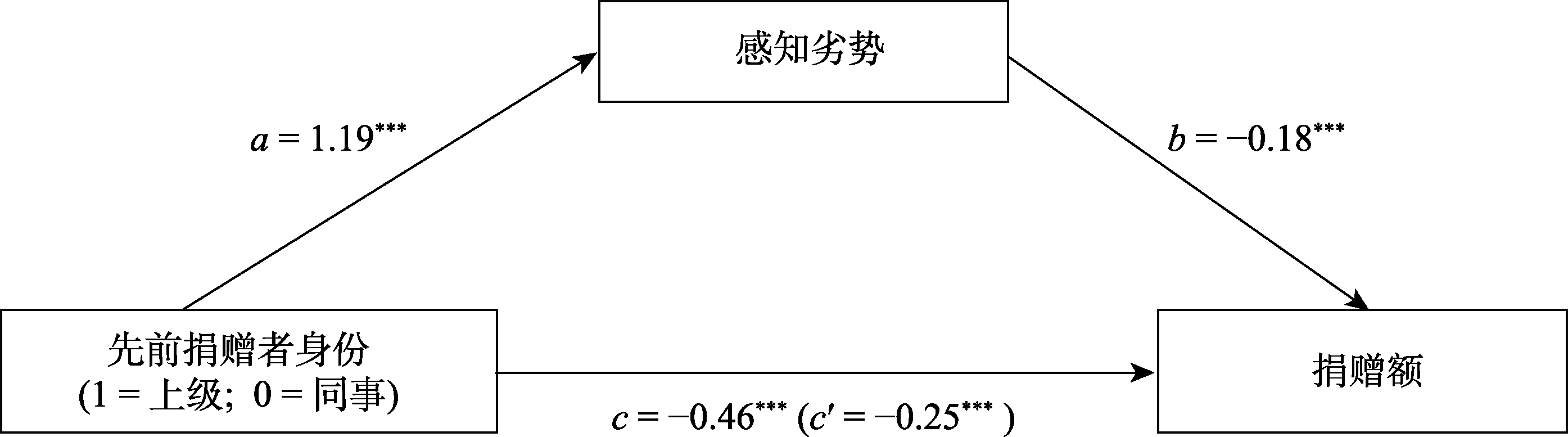
图1 感知劣势在先前捐赠者身份对员工捐赠额影响的中介作用 注:***代表在0.001水平上显著, 图中回归系数均为非标准化回归系数
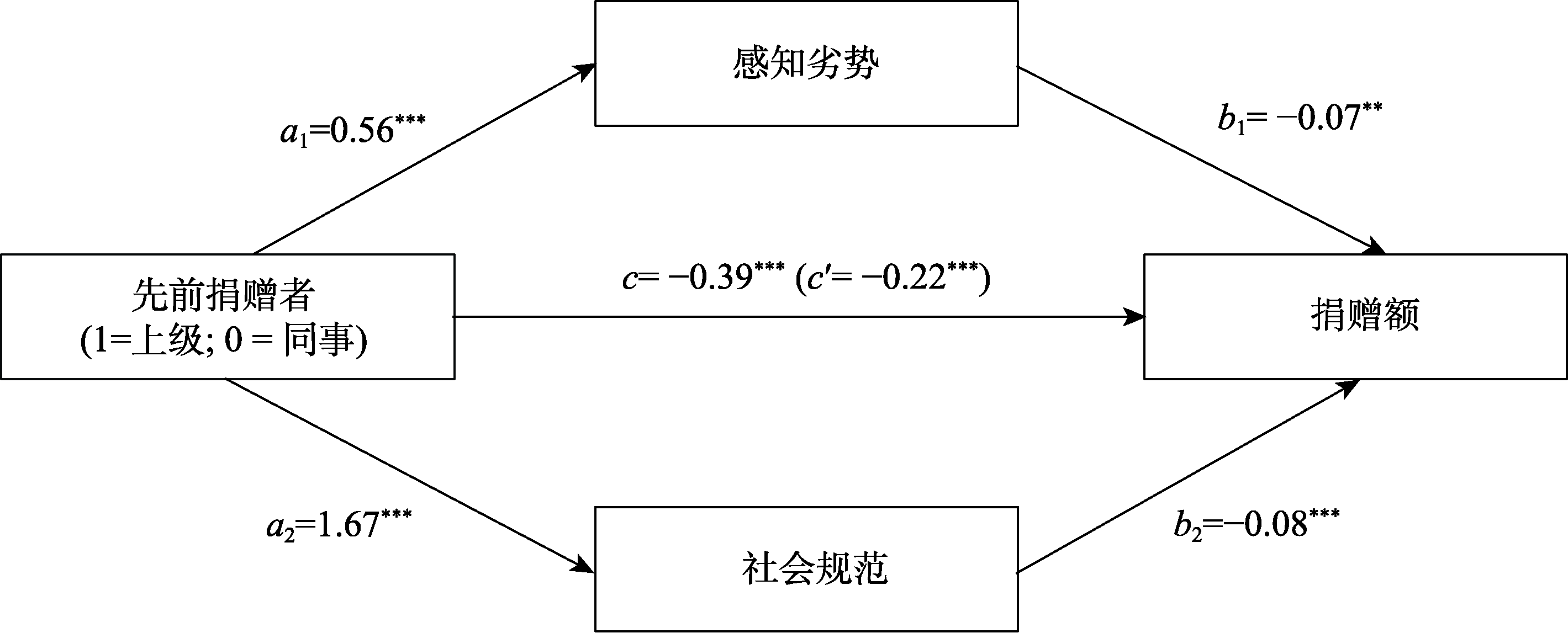
图2 感知劣势在先前捐赠者身份对员工捐赠额影响的中介作用 注: ***代表在0.001水平上显著, **代表在0.01水平上显著, 图中回归系数均为非标准化回归系数
| 中介路径 | 估计值 | 95% CI |
|---|---|---|
| 以同事组为参照 | ||
| 直接上级→感知劣势→捐赠额 | −4.38 | [−8.47, −0.33] |
| 直接上级→捐赠额 | −24.77 | [−33.23, −16.29] |
| 更高级别的上级→感知劣势→捐赠额 | −5.39 | [−10.33, −0.33] |
| 更高级别的上级→捐赠额 | −35.46 | [−44.04, −26.89] |
| 旁部门上级→感知劣势→捐赠额 | −3.57 | [−6.98, −0.25] |
| 旁部门上级→捐赠额 | −21.98 | [−30.61, −13.35] |
表1 感知劣势的中介效应分析
| 中介路径 | 估计值 | 95% CI |
|---|---|---|
| 以同事组为参照 | ||
| 直接上级→感知劣势→捐赠额 | −4.38 | [−8.47, −0.33] |
| 直接上级→捐赠额 | −24.77 | [−33.23, −16.29] |
| 更高级别的上级→感知劣势→捐赠额 | −5.39 | [−10.33, −0.33] |
| 更高级别的上级→捐赠额 | −35.46 | [−44.04, −26.89] |
| 旁部门上级→感知劣势→捐赠额 | −3.57 | [−6.98, −0.25] |
| 旁部门上级→捐赠额 | −21.98 | [−30.61, −13.35] |
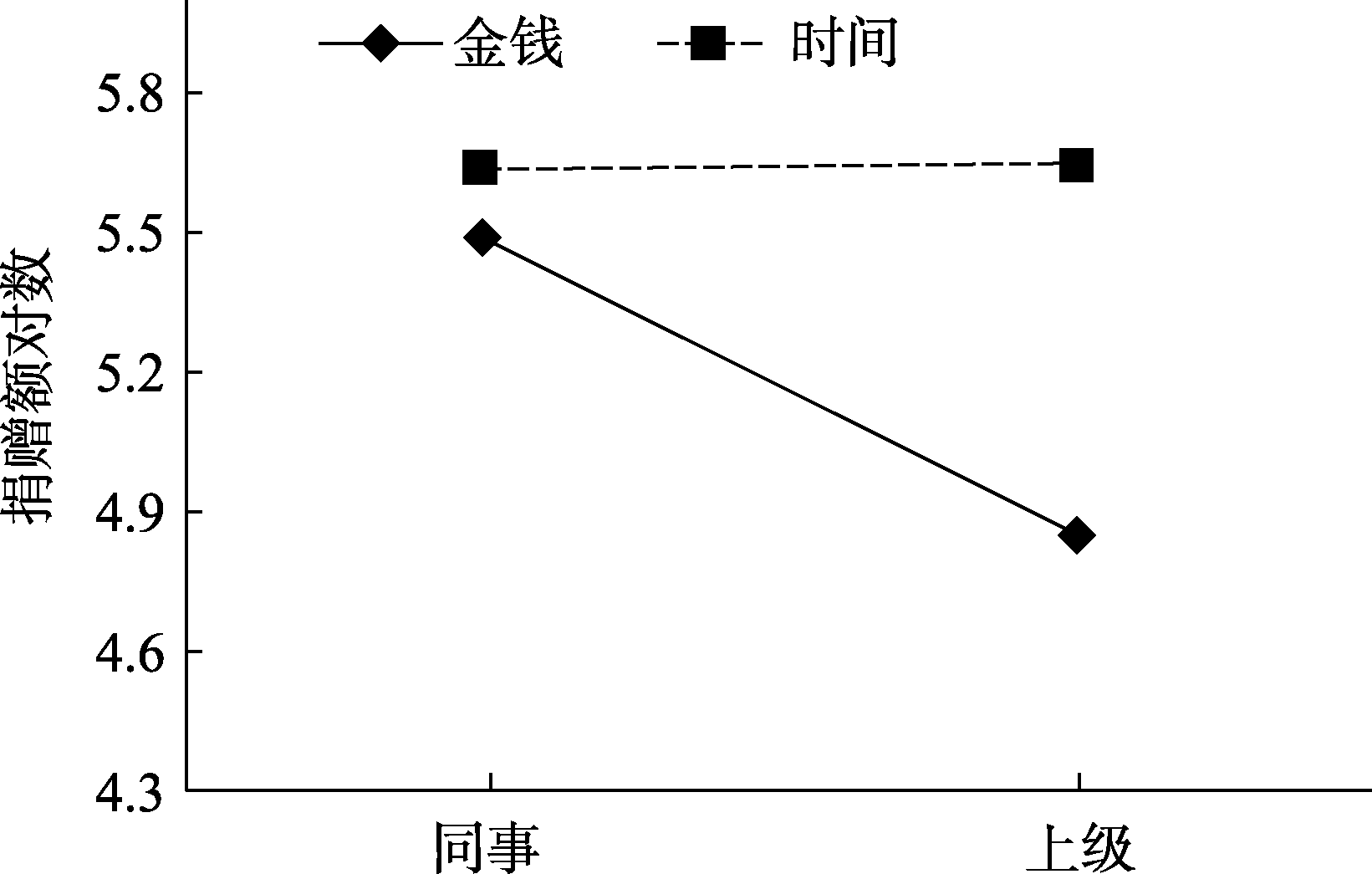
图3 上级(vs. 同事)的不同捐赠资源信息对员工捐赠行为影响
| [1] |
Bandura A. (2001). Social cognitive theory: An agentic perspective. Annual Review of Psychology, 52(1), 1-26.
doi: 10.1146/psych.2001.52.issue-1 URL |
| [2] | Bi X. Y., Jin J., Ma M. J., & He J. S. (2010). The reach of Danwei mobilization: An analysis on urban residents’ charitable giving to Project Hope. Sociological Studies, 25(6), 149-177. |
| [毕向阳, 晋军, 马明洁, 何江穗. (2010). 单位动员的效力与限度——对我国城市居民“希望工程”捐款行为的社会学分析. 社会学研究, 25(6), 149-177.] | |
| [3] |
Blass T. (1991). Understanding behavior in the Milgram obedience experiment: The role of personality, situations, and their interactions. Journal of Personality and Social Psychology, 60(3), 398-413.
doi: 10.1037/0022-3514.60.3.398 URL |
| [4] |
Bohra K. A., & Pandey J. (1984). Ingratiation toward strangers, friends, and bosses. The Journal of Social Psychology, 122(2), 217-222.
doi: 10.1080/00224545.1984.9713483 URL |
| [5] |
Breeze B., & Wiepking P. (2020). Different drivers: Exploring employee involvement in corporate philanthropy. Journal of Business Ethics, 165(3), 453-467.
doi: 10.1007/s10551-018-4093-x |
| [6] |
Brown D. J., Ferris D. L., Heller D., & Keeping L. M. (2007). Antecedents and consequences of the frequency of upward and downward social comparisons at work. Organizational Behavior and Human Decision Processes, 102(1), 59-75.
doi: 10.1016/j.obhdp.2006.10.003 URL |
| [7] |
Campbell E. M., Liao H., Chuang A., Zhou J., & Dong Y. (2017). Hot shots and cool reception? An expanded view of social consequences for high performers. Journal of Applied Psychology, 102(5), 845-866.
doi: 10.1037/apl0000183 pmid: 28191991 |
| [8] |
Christensen R. K., Nesbit R., & Agypt B. (2016). To give or not to give: Employee responses to workplace giving campaigns over time. Nonprofit and Voluntary Sector Quarterly, 45(6), 1258-1275.
doi: 10.1177/0899764015619704 URL |
| [9] |
Christensen R. K., Nesbit R., & Stritch J. M. (2018). The role of employees’ public service motives and organizational commitment in workplace giving campaigns. The American Review of Public Administration, 48(7), 644-658.
doi: 10.1177/0275074017701223 URL |
| [10] |
Cialdini R. B., & Goldstein N. J. (2004). Social influence: Compliance and conformity. Annual Review of Psychology, 55(1), 591-621.
doi: 10.1146/psych.2004.55.issue-1 URL |
| [11] |
Croson R., & Shang J. (2013). Limits of the effect of social information on the voluntary provision of public goods: Evidence from field experiments. Economic Inquiry, 51(1), 473-477.
doi: 10.1111/ecin.2013.51.issue-1 URL |
| [12] | Deci E. L., & Ryan R. M. (2012). Self-determination theory. In P. A. M. Van Lange, A. W. Kruglanski, & T. T. Higgins (Eds.), Handbook of theories of social psychology (pp. 416-436). Sage Publications Ltd. |
| [13] |
Du L., Zhao F., & Zhang C. (2014). Impact of mobilization context on employees' donation intentions in China. Social Behavior and Personality: An International Journal, 42(1), 115-124.
doi: 10.2224/sbp.2014.42.1.115 URL |
| [14] |
Duffy J., & Kornienko T. (2010). Does competition affect giving?. Journal of Economic Behavior & Organization, 74(1-2), 82-103.
doi: 10.1016/j.jebo.2010.02.001 URL |
| [15] | Fang J., Wen Z. L., & Zhang M. Q. (2017). Mediation analysis of categorical variables. Journal of Psychological Science, 40(2), 471-477. |
| [方杰, 温忠麟, 张敏强. (2017). 类别变量的中介效应分析. 心理科学, 40(2), 471-477.] | |
| [16] | Fang X., & Zhang M. (2025). The vision of common prosperity and individual charitable giving: A study on the self-realization of common prosperity. Comparative Economic & Social Systems, (1), 127-138. |
| [方兴, 张明. (2025). 共同富裕愿景与个人慈善捐赠——兼论共同富裕的自我实现. 经济社会体制比较, (1), 127-138.] | |
| [17] |
Farmer A., Kidwell B., & Hardesty D. M. (2020). Helping a few a lot or many a little: Political ideology and charitable giving. Journal of Consumer Psychology, 30(4), 614-630.
doi: 10.1002/jcpy.v30.4 URL |
| [18] |
Faul F., Erdfelder E., Lang A. G., & Buchner A. (2007). G*Power 3: A flexible statistical power analysis program for the social, behavioral, and biomedical sciences. Behavior Research Methods, 39(2), 175-191.
doi: 10.3758/BF03193146 URL |
| [19] |
Fischer T., & Sitkin S. B. (2023). Leadership styles: A comprehensive assessment and way forward. Academy of Management Annals, 17(1), 331-372.
doi: 10.5465/annals.2020.0340 URL |
| [20] |
Fitzsimons G. M., & Kay A. C. (2004). Language and interpersonal cognition: Causal effects of variations in pronoun usage on perceptions of closeness. Personality and Social Psychology Bulletin, 30(5), 547-557.
pmid: 15107155 |
| [21] |
Forehand M. R., Deshpandé R., & Reed II A. (2002). Identity salience and the influence of differential activation of the social self-schema on advertising response. Journal of Applied Psychology, 87(6), 1086-1099.
pmid: 12558216 |
| [22] |
Gächter S., & Renner E. (2018). Leaders as role models and ‘belief managers’ in social dilemmas. Journal of Economic Behavior & Organization, 154, 321-334.
doi: 10.1016/j.jebo.2018.08.001 URL |
| [23] |
Goswami I., & Urminsky O. (2016). When should the ask be a nudge? The effect of default amounts on charitable donations. Journal of Marketing Research, 53(5), 829-846.
doi: 10.1509/jmr.15.0001 URL |
| [24] | Hayes A. F. (2013). Introduction to mediation, moderation, and conditional process analysis: A regression-based approach. Guilford Press, Kindle Edition. |
| [25] | Jiang C. M., Ma J. T., & Sun H. Y. (2019). Nudge charity donation by setting default options. Journal of Psychological Science, 42(5), 1174-1179. |
| [江程铭, 马家涛, 孙红月. (2019). 助推爱心:利用默认选项促进捐赠行为. 心理科学, 42(5), 1174-1179.] | |
| [26] |
Jin M. H., & McDonald B. (2017). Understanding employee engagement in the public sector: The role of immediate supervisor, perceived organizational support, and learning opportunities. The American Review of Public Administration, 47(8), 881-897.
doi: 10.1177/0275074016643817 URL |
| [27] |
Karlsson N., Gärling T., Dellgran P., & Klingander B. (2005). Social comparison and consumer behavior: When feeling richer or poorer than others is more important than being so. Journal of Applied Social Psychology, 35(6), 1206-1222.
doi: 10.1111/jasp.2005.35.issue-6 URL |
| [28] | Kiewitz C., Zagenczyk T. J., Shoss M., & Cruz K. S. (2023). O’Coworker, who art thou? The conundrum of not knowing who is or is not one’s coworker and a preliminary definition. Group & Organization Management. |
| [29] |
Keating B., Pitts R., & Appel D. (1981). United way contributions: Coercion, charity or economic self-interest?. Southern Economic Journal, 47(3), 816-823.
doi: 10.2307/1057377 URL |
| [30] |
Kumar K., & Beyerlein M. (1991). Construction and validation of an instrument for measuring ingratiatory behaviors in organizational settings. Journal of Applied Psychology, 76(5), 619-627.
doi: 10.1037/0021-9010.76.5.619 URL |
| [31] |
Li R., & Tian, X. M. (2014). Supervisor authoritarian leadership and subordinate proactive behavior: Test of a mediated- moderation model. Acta Psychologica Sinica, 46(11), 1719-1733.
doi: 10.3724/SP.J.1041.2014.01719 URL |
| [李锐, 田晓明. (2014). 主管威权领导与下属前瞻行为: 一个被中介的调节模型构建与检验. 心理学报, 46(11), 1719-1733.] | |
| [32] | Lou H. X. (2009). On the function of the Charities in the national income redistribution. Studies in Ethics, 42(4), 40-45. |
| [楼慧心. (2009). 慈善活动及其社会利益调节功能. 伦理学研究, 42(4), 40-45.] | |
| [33] |
Mogilner C. (2010). The pursuit of happiness: Time, money, and social connection. Psychological Science, 21(9), 1348-1354.
doi: 10.1177/0956797610380696 pmid: 20732902 |
| [34] | Nesbit R., Christensen R. K., & Gossett L. M. (2012). Charitable giving in the public workplace: A framework for understanding employees' philanthropic performance. Public Performance & Management Review, 35(3), 449-474. |
| [35] |
Paharia N., Keinan A., Avery J., & Schor J. B. (2011). The underdog effect: The marketing of disadvantage and determination through brand biography. Journal of Consumer Research, 37(5), 775-790.
doi: 10.1086/656219 URL |
| [36] |
Shang J., & Croson R. (2009). A field experiment in charitable contribution: The impact of social information on the voluntary provision of public goods. The Economic Journal, 119(540), 1422-1439.
doi: 10.1111/j.1468-0297.2009.02267.x URL |
| [37] |
Shang J., Reed A., & Croson R. (2008). Identity congruency effects on donations. Journal of Marketing Research, 45(3), 351-361.
doi: 10.1509/jmkr.45.3.351 URL |
| [38] |
Simpson B., White K., & Laran J. (2018). When public recognition for charitable giving backfires: The role of independent self-construal. Journal of Consumer Research, 44(6), 1257-1273.
doi: 10.1093/jcr/ucx101 URL |
| [39] |
Spencer S. J., Zanna M. P., & Fong G. T. (2005). Establishing a causal chain: Why experiments are often more effective than mediational analyses in examining psychological processes. Journal of Personality and Social Psychology, 89(6), 845-851.
pmid: 16393019 |
| [40] | Sun L. P., Jin J., He J. S., & Bi X. Y. (Eds). (1999). Mobilization and participation: A case study of third sector fundraising mechanisms. Zhejiang People’s Publishing House. |
| [孙立平, 晋军, 何江穗, 毕向阳.(编). (1999). 动员与参与:第三部门募捐机制个案研究.浙江人民出版社.] | |
| [41] |
Van Teunenbroek C., Bekkers R., & Beersma B. (2020). Look to others before you leap: A systematic literature review of social information effects on donation amounts. Nonprofit and Voluntary Sector Quarterly, 49(1), 53-73.
doi: 10.1177/0899764019869537 |
| [42] |
Wagner III J. A. (1995). Studies of individualism-collectivism: Effects on cooperation in groups. Academy of Management Journal, 38(1), 152-173.
doi: 10.2307/256731 URL |
| [43] | Walker I., & Smith H. J. (Eds.). (2002). Relative deprivation: Specification, development, and integration. Cambridge University Press. |
| [44] |
Wang D., Qin Y., & Zhou W. (2021). The effects of leaders’ prosocial orientation on employees’ organizational citizenship behavior - The roles of affective commitment and workplace ostracism. Psychology Research and Behavior Management, 14, 1171-1185.
doi: 10.2147/PRBM.S324081 pmid: 34393526 |
| [45] |
Zhang H., Liu M., & Tian Y. (2016). Individual-based relative deprivation (IRD) decreases prosocial behaviors. Motivation and Emotion, 40, 655-666.
doi: 10.1007/s11031-016-9564-8 URL |
| [46] |
Zhao X., Cai F., & Yang Z. (2023). Are people less generous after a family member gives to charity? The interaction of self-construal and relationship type. International Journal of Research in Marketing, 40(2), 398-416.
doi: 10.1016/j.ijresmar.2022.11.003 URL |
| [47] |
Zhao X., Lynch Jr J. G., & Chen Q. (2010). Reconsidering Baron and Kenny: Myths and truths about mediation analysis. Journal of Consumer Research, 37(2), 197-206.
doi: 10.1086/651257 URL |
| [48] |
Zheng X. Y., Peng S. Q., & Peng L. L. (2015). Feeling better and becoming more benevolent: Impact of social comparison on prosocial behavior. Acta Psychologica Sinica, 47(2), 243-250.
doi: 10.3724/SP.J.1041.2015.00243 URL |
| [郑晓莹, 彭泗清, 彭璐珞. (2015). “达”则兼济天下?社会比较对亲社会行为的影响及心理机制. 心理学报, 47(2), 243-250.] | |
| [49] |
Zoogah D. B. (2010). Why should I be left behind? Employees’ perceived relative deprivation and participation in development activities. Journal of Applied Psychology, 95(1), 159-173.
doi: 10.1037/a0018019 pmid: 20085413 |
| [1] | 张衍, 王俊秀, 许博洋, 崔雨晴. 迈向橄榄型社会的心理意义:扩大中等收入群体与公平感提升[J]. 心理学报, 2026, 58(2): 292-307. |
| [2] | 贾建锋, 刘伟鹏, 段锦云, 赵洋. 妒忌还是钦佩: 员工对同事被授权的心理与行为反应[J]. 心理学报, 2024, 56(10): 1401-1416. |
| [3] | 栾墨, 李俊澎. 失败的游戏玩家, 成功的广告:展示失败体验会令观察者更想尝试吗?[J]. 心理学报, 2022, 54(12): 1562-1578. |
| [4] | 宫秀双, 张红红. “别人家的孩子”vs.平庸的自己:社会比较对独特性寻求行为的影响[J]. 心理学报, 2020, 52(5): 645-658. |
| [5] | 王天鸿, 陈宇琦, 陆静怡. 差距知觉的泛化效应:我和你之间的差距有多大?[J]. 心理学报, 2020, 52(11): 1327-1339. |
| [6] | 连帅磊, 孙晓军, 牛更枫, 周宗奎. 社交网站中的上行社会比较与抑郁的关系: 一个有调节的中介模型及性别差异[J]. 心理学报, 2017, 49(7): 941-952. |
| [7] | 刘文, 张雪, 张玉, 俞睿玮. 4~8岁儿童公平认知与行为差距: 社会比较的作用[J]. 心理学报, 2017, 49(12): 1504-1512. |
| [8] | 刘庆奇;牛更枫;范翠英;周宗奎. 被动性社交网站使用与自尊和自我概念清晰性:有调节的中介模型[J]. 心理学报, 2017, 49(1): 60-71. |
| [9] | 黄婷婷; 刘莉倩;王大华;张文海. 经济地位和计量地位:社会地位比较对主观幸福感的影响及其年龄差异[J]. 心理学报, 2016, 48(9): 1163-1174. |
| [10] | 牛更枫;孙晓军;周宗奎;孔繁昌;田媛. 基于QQ空间的社交网站使用对青少年抑郁的影响:上行社会比较和自尊的序列中介作用[J]. 心理学报, 2016, 48(10): 1282-1291. |
| [11] | 郑晓莹;彭泗清;彭璐珞. “达”则兼济天下?社会比较对亲社会行为的影响及心理机制[J]. 心理学报, 2015, 47(2): 243-250. |
| [12] | 窦炜;曲璐璐;曲琛. 社会比较对合作任务结果评价的影响:来自ERP的证据[J]. 心理学报, 2014, 46(3): 405-414. |
| 阅读次数 | ||||||
|
全文 |
|
|||||
|
摘要 |
|
|||||
