

ISSN 0439-755X
CN 11-1911/B
主办:中国心理学会
中国科学院心理研究所
出版:科学出版社
CN 11-1911/B
主办:中国心理学会
中国科学院心理研究所
出版:科学出版社
心理学报 ›› 2026, Vol. 58 ›› Issue (2): 235-246.doi: 10.3724/SP.J.1041.2026.0235 cstr: 32110.14.2026.0235
• “社会治理视角下经济处境的心理影响及其干预策略”专栏 • 上一篇 下一篇
李凯1, 许丽颖2, 刘采梦3, 喻丰2( )
)
收稿日期:2024-06-05
发布日期:2025-12-03
出版日期:2026-02-25
通讯作者:
喻丰, E-mail: psychpedia@whu.edu.cn基金资助:
LI Kai1, XU Liying2, LIU Caimeng3, YU Feng2()
Received:2024-06-05
Online:2025-12-03
Published:2026-02-25
摘要: 新科技常常带来新的社会贫富分化, 如何防范人工智能带来新的贫富分化是巩固共同富裕成果的重要议题。已有研究指出阶层不同则社会认知不同, 但社会阶层如何影响他们对人工智能的态度尚不清楚。本文通过3个递进研究(5个子研究)检验主观社会阶层对人工智能态度的影响及其心理机制。结果发现, 主观社会阶层越高, 人们对人工智能的态度也越积极; 社会流动信念是社会阶层影响人工智能的中介因素, 社会阶层越高, 社会流动信念越高, 对人工智能的态度也越积极; 集体主义是社会流动信念影响个体对人工智能态度的调节因素, 集体主义越高, 社会流动信念和个体对人工智能的积极态度的正相关关系越强。这些结果表明, 不同阶层在社会认知上的差异导致他们对人工智能的态度也出现差异, 提高社会流动信念或加强集体主义文化可以提高较低收入阶层对人工智能的积极态度, 从而缓解因人工智能带来的贫富分化。
中图分类号:
李凯, 许丽颖, 刘采梦, 喻丰. (2026). 技术接受的贫富分化?主观社会阶层影响个体对人工智能的态度. 心理学报, 58(2), 235-246.
LI Kai, XU Liying, LIU Caimeng, YU Feng. (2026). How social class influences attitudes towards artificial intelligence: The mediating role of mobility beliefs. Acta Psychologica Sinica, 58(2), 235-246.
| 预测变量 | 方程1 (阶层流动信念) | 方程2 (对AI的积极态度) | 方程3 (对AI的积极态度) | |||||||||
|---|---|---|---|---|---|---|---|---|---|---|---|---|
| B | SE | t | 95% CI | B | SE | t | 95% CI | B | SE | t | 95% CI | |
| 主观社会阶层 | 0.06 | 0.03 | 2.24 | [0.01, 0.11] | 0.06 | 0.03 | 1.71 | [−0.01, 0.12] | 0.05 | 0.03 | 1.73 | [−0.01. 0.11] |
| 阶层流动信念 | 0.30 | 0.07 | 4.17 | [0.16, 0.44] | −0.73 | 0.19 | −3.81 | [−1.10, −0.35] | ||||
| 集体主义 | −0.55 | 0.17 | −3.28 | [−0.88, −0.22] | ||||||||
| 交互项 | 0.20 | 0.04 | 4.83 | [0.12, 0.28] | ||||||||
| R2 | 0.02 | 0.07 | 0.21 | |||||||||
| F | 5.02 | 11.23 | 21.72 | |||||||||
表1 有调节的中介模型检验(N = 326)
| 预测变量 | 方程1 (阶层流动信念) | 方程2 (对AI的积极态度) | 方程3 (对AI的积极态度) | |||||||||
|---|---|---|---|---|---|---|---|---|---|---|---|---|
| B | SE | t | 95% CI | B | SE | t | 95% CI | B | SE | t | 95% CI | |
| 主观社会阶层 | 0.06 | 0.03 | 2.24 | [0.01, 0.11] | 0.06 | 0.03 | 1.71 | [−0.01, 0.12] | 0.05 | 0.03 | 1.73 | [−0.01. 0.11] |
| 阶层流动信念 | 0.30 | 0.07 | 4.17 | [0.16, 0.44] | −0.73 | 0.19 | −3.81 | [−1.10, −0.35] | ||||
| 集体主义 | −0.55 | 0.17 | −3.28 | [−0.88, −0.22] | ||||||||
| 交互项 | 0.20 | 0.04 | 4.83 | [0.12, 0.28] | ||||||||
| R2 | 0.02 | 0.07 | 0.21 | |||||||||
| F | 5.02 | 11.23 | 21.72 | |||||||||
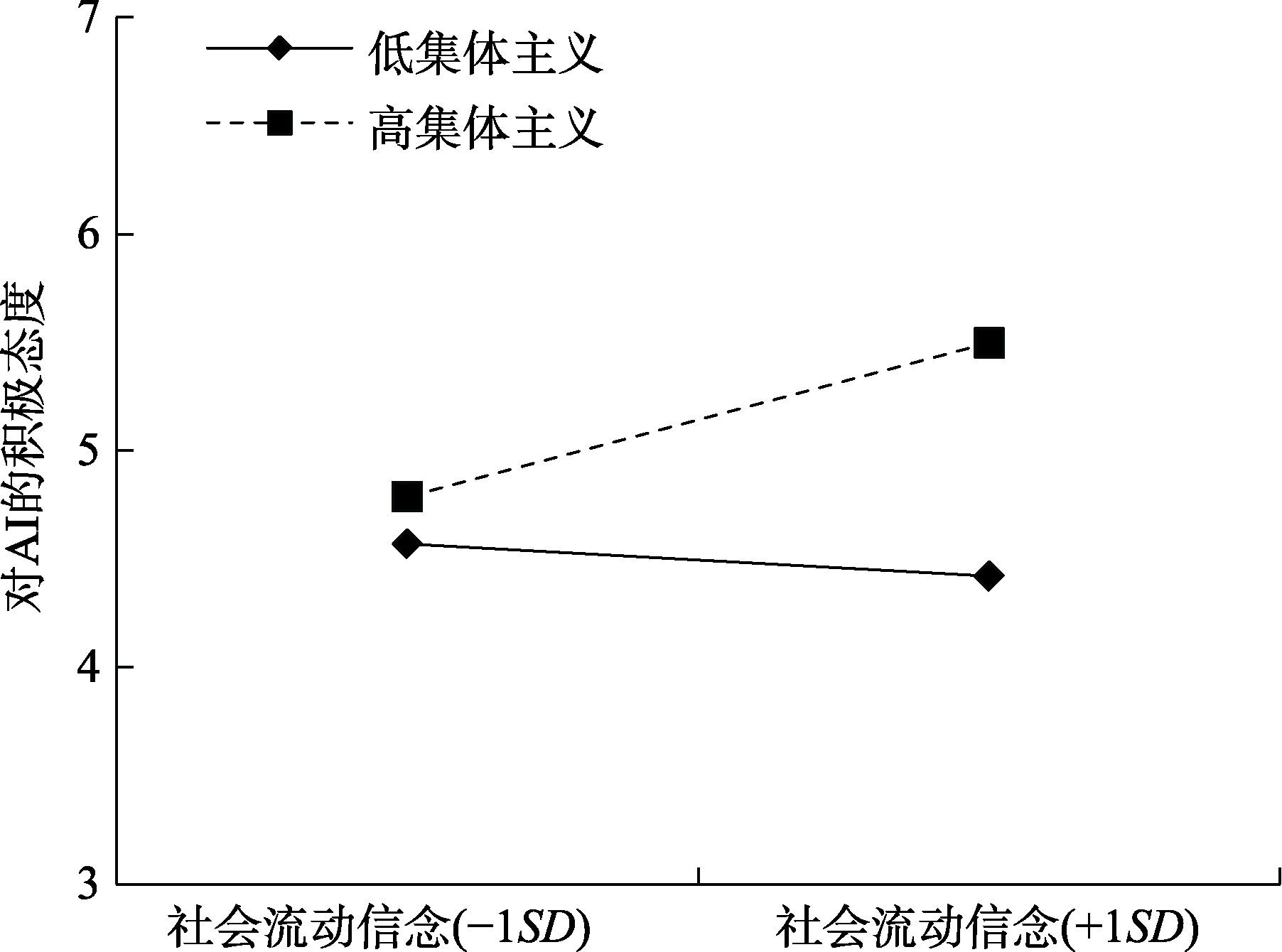
图1 集体主义对社会流动信念预测对人工智能的积极态度的调节作用
| [1] |
Adler N. E., Epel E. S., Castellazzo G., & Ickovics J. R. (2000). Relationship of subjective and objective social status with psychological and physiological functioning: Preliminary data in healthy, White women. Health Psychology, 19(6), 586-592.
doi: 10.1037//0278-6133.19.6.586 pmid: 11129362 |
| [2] | Asbrock F., Mayerl J., Holz M., Andersen H., & Maskow B. (2022). AI Takeover… doesn’t sound that bad!. Authoritarian ambivalence towards artificial intelligence. PsyArXiv. April, 15. |
| [3] |
Atwal G., & Bryson D. (2021). Antecedents of intention to adopt artificial intelligence services by consumers in personal financial investing. Strategic Change, 30(3), 293-298.
doi: 10.1002/jsc.v30.3 URL |
| [4] | Bai B., Dai H., Zhang D. J., Zhang F., & Hu H. (2022). The impacts of algorithmic work assignment on fairness perceptions and productivity: Evidence from field experiments. Manufacturing & Service Operations Management, 24(6), 3060-3078. |
| [5] | Belanche D., Casaló L. V., & Flavián C. (2019). Artificial Intelligence in FinTech: Understanding robo-advisors adoption among customers. Industrial Management & Data Systems, 119(7), 1411-1430. |
| [6] |
Belmi P., Neale M. A., Reiff D., & Ulfe R. (2020). The social advantage of miscalibrated individuals: The relationship between social class and overconfidence and its implications for class-based inequality. Journal of Personality and Social Psychology, 118(2), 254-282.
doi: 10.1037/pspi0000187 pmid: 31107052 |
| [7] |
Carradore M. (2022). People’s attitudes towards the use of robots in the social services: A multilevel analysis using eurobarometer data. International Journal of Social Robotics, 14(3), 845-858.
doi: 10.1007/s12369-021-00831-4 |
| [8] |
Cave S., & Dihal K. (2019). Hopes and fears for intelligent machines in fiction and reality. Nature Machine Intelligence, 1(2), 74-78.
doi: 10.1038/s42256-019-0020-9 |
| [9] | Chen B. K., & Xu X. (2024). Artificial Intelligence and social justice: International experiences and mechanism and public police. International Economic Review, 3, 70-88. |
| [陈斌开, 徐翔. (2024). 人工智能与社会公平:国际经验、影响机制与公共政策. 国际经济评论, 3, 70-88.] | |
| [10] |
Choi Y., Oh M., Choi M., & Kim S. (2021). Exploring the influence of culture on tourist experiences with robots in service delivery environment. Current Issues in Tourism, 24(5), 717-733.
doi: 10.1080/13683500.2020.1735318 URL |
| [11] |
Corrales J., & Westhoff F. (2006). Information technology adoption and political regimes. International Studies Quarterly, 50(4), 911-933.
doi: 10.1111/isqu.2006.50.issue-4 URL |
| [12] |
Cui Y., & van Esch P. (2022). Autonomy and control: How political ideology shapes the use of artificial intelligence. Psychology & Marketing, 39(6), 1218-1229.
doi: 10.1002/mar.v39.6 URL |
| [13] |
Darko A., Chan A. P., Adabre M. A., Edwards D. J., Hosseini M. R., & Ameyaw E. E. (2020). Artificial intelligence in the AEC industry: Scientometric analysis and visualization of research activities. Automation in Construction, 112, 103081.
doi: 10.1016/j.autcon.2020.103081 URL |
| [14] | Davidai S., & Wienk M. N. (2021). The psychology of lay beliefs about economic mobility. Social and Personality Psychology Compass, 15(8), e12625. |
| [15] |
Davis F. D. (1989). Perceived usefulness, perceived ease of use, and user acceptance of information technology. MIS Quarterly, 13(3), 319-340.
doi: 10.2307/249008 URL |
| [16] |
Day M. V., & Fiske S. T. (2017). Movin’on up? How perceptions of social mobility affect our willingness to defend the system. Social Psychological and Personality Science, 8(3), 267-274.
doi: 10.1177/1948550616678454 URL |
| [17] | Day M. V., & Fiske S. T. (2019). Understanding the nature and consequences of social mobility beliefs. In J. Jetten & K. Peters (Eds.), The social psychology of inequality (pp. 365-380). Springer. |
| [18] |
De Graaf M. M., & Allouch S. B. (2013). Exploring influencing variables for the acceptance of social robots. Robotics and Autonomous Systems, 61(12), 1476-1486.
doi: 10.1016/j.robot.2013.07.007 URL |
| [19] | Druga S., Vu S. T., Likhith E., & Qiu T. (2019). Inclusive AI literacy for kids around the world. In Proceedings of FabLearn 2019 (pp. 104-111), ACM, New York, USA. |
| [20] |
Faul F., Erdfelder E., Lang A. G., & Buchner A. (2007). G* Power 3: A flexible statistical power analysis program for the social, behavioral, and biomedical sciences. Behavior Research Methods, 39(2), 175-191.
doi: 10.3758/BF03193146 URL |
| [21] | Fleischmann C., Cardon P. W., & Aritz J. (2020). Smart collaboration in global virtual teams: The influence of culture on technology acceptance and communication effectiveness. In Proceedings of the 53rd Hawaii International Conference on System Science (pp. 363-372). Maui, Hawaii. |
| [22] | Gao S., He L., Chen Y., Li D., & Lai K. (2020). Public perception of artificial intelligence in medical care: Content analysis of social media. Journal of Medical Internet Research, 22(7), e16649. |
| [23] | Gillespie N., Lockey S., Curtis C., Pool J., & Akbari A. (2023). Trust in Artificial Intelligence: A global study. The University of Queensland and KPMG Australia. https://doi. org/10.14264/00d3c94 |
| [24] |
Gnambs T., & Appel M. (2019). Are robots becoming unpopular? Changes in attitudes towards autonomous robotic systems in Europe. Computers in Human Behavior, 93, 53-61.
doi: 10.1016/j.chb.2018.11.045 |
| [25] |
Gugushvili A. (2016). Intergenerational social mobility and popular explanations of poverty: A comparative perspective. Social Justice Research, 29(4), 402-428.
doi: 10.1007/s11211-016-0275-9 URL |
| [26] |
Guo Y. Y., Yang S. L., Li J., Hu X. Y. (2015). Social fairness researches in perspectives of social class psychology. Advances in Psychological Science, 23(8), 1299-1311.
doi: 10.3724/SP.J.1042.2015.01299 |
|
[郭永玉, 杨沈龙, 李静, 胡小勇. (2015). 社会阶层心理学视角下的公平研究. 心理科学进展, 23(8), 1299-1311.]
doi: 10.3724/SP.J.1042.2015.01299 |
|
| [27] |
Hagger M. S., Rentzelas P., & Koch S. (2014). Evaluating group member behaviour under individualist and collectivist norms: A cross-cultural comparison. Small Group Research, 45(2), 217-228.
doi: 10.1177/1046496414525479 URL |
| [28] | Hartwig B. (2023, January 04). Benefits of artificial intelligence. From https://hackr.io/blog/benefits-of-artificial-intelligence |
| [29] | Hayes A. F. (2013). Introduction to mediation, moderation, and conditional process analysis: A regression-based approach. New York: Guilford Press. |
| [30] |
Hofstede G., & Minkov M. (2010). Long-versus short-term orientation: New perspectives. Asia Pacific Business Review, 16(4), 493-504.
doi: 10.1080/13602381003637609 URL |
| [31] |
Jiang L. Y., Cao L. M., Qin X., Tan L., Chen C., & Peng X. F. (2022). Fairness perceptions of artificial intelligence decision-making. Advances in Psychological Science, 30(5), 1078-1092.
doi: 10.3724/SP.J.1042.2022.01078 |
|
[蒋路远, 曹李梅, 秦昕, 谭玲, 陈晨, 彭小斐. (2022). 人工智能决策的公平感知. 心理科学进展, 30(5), 1078-1092].
doi: 10.3724/SP.J.1042.2022.01078 |
|
| [32] |
Kaplan A., & Haenlein M. (2019). Siri, Siri, in my hand: Who’s the fairest in the land? On the interpretations, illustrations, and implications of artificial intelligence. Business Horizons, 62(1), 15-25.
doi: 10.1016/j.bushor.2018.08.004 URL |
| [33] |
Kelly S., Kaye S. A., & Oviedo-Trespalacios O. (2022). What factors contribute to the acceptance of artificial intelligence? A systematic review. Telematics and Informatics, 77, 101925.
doi: 10.1016/j.tele.2022.101925 URL |
| [34] |
Kraus M. W., & Keltner D. (2013). Social class rank, essentialism, and punitive judgment. Journal of Personality and Social Psychology, 105(2), 247-261.
doi: 10.1037/a0032895 pmid: 23713698 |
| [35] |
Kraus M. W., Piff P. K., & Keltner D. (2009). Social class, sense of control, and social explanation. Journal of Personality and Social Psychology, 97(6), 992-1004.
doi: 10.1037/a0016357 pmid: 19968415 |
| [36] |
Kraus M. W., Piff P. K., Mendoza-Denton R., Rheinschmidt M. L., & Keltner D. (2012). Social class, solipsism, and contextualism: How the rich are different from the poor. Psychological Review, 119(3), 546-572.
doi: 10.1037/a0028756 pmid: 22775498 |
| [37] |
Kraus M. W., & Tan J. J. (2015). Americans overestimate social class mobility. Journal of Experimental Social Psychology, 58, 101-111.
doi: 10.1016/j.jesp.2015.01.005 URL |
| [38] |
Kraus M. W., Tan J. J., & Tannenbaum M. B. (2013). The social ladder: A rank-based perspective on social class. Psychological Inquiry, 24(2), 81-96.
doi: 10.1080/1047840X.2013.778803 URL |
| [39] |
Lee S. G., Trimi S., & Kim C. (2013). The impact of cultural differences on technology adoption. Journal of World Business, 48(1), 20-29.
doi: 10.1016/j.jwb.2012.06.003 URL |
| [40] | Li B., Yu W., Hu X., & Jin L. (2023). The impact of subjective social class on subjective well-being: Examining the mediating roles of perceived scarcity and sense of control. Current Psychology, 43, 27327-27338. |
| [41] |
Li W., Yang Y., Wu J., & Kou Y. (2020). Testing the status- legitimacy hypothesis in China: Objective and subjective socioeconomic status divergently predict system justification. Personality and Social Psychology Bulletin, 46(7), 1044-1058.
doi: 10.1177/0146167219893997 URL |
| [42] | Lichtenthaler U. (2020). Extremes of acceptance: Employee attitudes toward artificial intelligence. Journal of Business Strategy, 41(5), 39-45. |
| [43] | Lin C. H., Liu E. Z. F., & Huang Y. Y. (2012). Exploring parents' perceptions towards educational robots: Gender and socio-economic differences. British Journal of Educational Technology, 43(1), E31-E34. |
| [44] | Liu F. L., Wu M. F., & Xu S. F. (2022). The wealth distribution effect of artificial intelligence. Economic Theory and Business Management, 42(6), 64-78. |
| [刘凤良, 吴孟非, 徐少锋. (2022). 人工智能的财富分配效应研究. 经济理论与经济管理, 42(6), 64-78.] | |
| [45] | Lu X. Y. (2003). The divisions and changes of the contemporary Chinese social class. Jiangsu Social Science. 4(1), 1-9. |
| [陆学艺. (2003). 当代中国社会阶层的分化与流动. 江苏社会科学, 4(1), 1-9.] | |
| [46] |
Luan H., Geczy P., Lai H., Gobert J., Yang S. J., Ogata H., ... Tsai C. C. (2020). Challenges and future directions of big data and artificial intelligence in education. Frontiers in Psychology, 11, 580820.
doi: 10.3389/fpsyg.2020.580820 URL |
| [47] |
Manstead A. S. (2018). The psychology of social class: How socioeconomic status impacts thought, feelings, and behaviour. British Journal of Social Psychology, 57(2), 267-291.
doi: 10.1111/bjso.12251 pmid: 29492984 |
| [48] |
McBride R. E., Xiang P., Wittenburg D., & Shen J. (2002). An analysis of preservice teachers' dispositions toward critical thinking: A cross-cultural perspective. Asia-Pacific Journal of Teacher Education, 30(2), 131-140.
doi: 10.1080/13598660220135649 URL |
| [49] |
Mittal S., & Mehar M. (2016). Socio-economic factors affecting adoption of modern information and communication technology by farmers in India: Analysis using multivariate probit model. The Journal of Agricultural Education and Extension, 22(2), 199-212.
doi: 10.1080/1389224X.2014.997255 URL |
| [50] |
Piff P. K., & Moskowitz J. P. (2018). Wealth, poverty, and happiness: Social class is differentially associated with positive emotions. Emotion, 18(6), 902-905.
doi: 10.1037/emo0000387 pmid: 29251946 |
| [51] |
Qin G. (2021). Liberal or conservative? The differentiated political values of the middle class in contemporary China. The China Quarterly, 245, 1-22.
doi: 10.1017/S0305741020000296 URL |
| [52] |
Rheinschmidt M. L., & Mendoza-Denton R. (2014). Social class and academic achievement in college: The interplay of rejection sensitivity and entity beliefs. Journal of Personality and Social Psychology, 107(1), 101-121.
doi: 10.1037/a0036553 pmid: 24956316 |
| [53] |
Sagioglou C., Forstmann M., & Greitemeyer T. (2019). Belief in social mobility mitigates hostility resulting from disadvantaged social standing. Personality and Social Psychology Bulletin, 45(4), 541-556.
doi: 10.1177/0146167218789073 pmid: 30141360 |
| [54] |
Schepman A., & Rodway P. (2022). The General Attitudes towards Artificial Intelligence Scale (GAAIS): Confirmatory validation and associations with personality, corporate distrust, and general trust. International Journal of Human- Computer Interaction, 39(13), 1-18.
doi: 10.1080/10447318.2021.2020008 URL |
| [55] | Selwyn N., & Cordoba B. G. (2022). Australian public understandings of artificial intelligence. AI & Society, 37(4), 1645-1662. |
| [56] | Shoss M. K., & Ciarlante K. (2022). Are robots/AI viewed as more of a workforce threat in unequal societies? Evidence from the Eurobarometer survey. Technology, Mind, and Behavior, 3, 1-14. |
| [57] |
Sindermann C., Yang H., Elhai J. D., Yang S., Quan L., Li M., & Montag C. (2022). Acceptance and fear of Artificial Intelligence: Associations with personality in a German and a Chinese sample. Discover Psychology, 2(1), 8. https://doi. org/10.1007/s44202-022-00020-y
doi: 10.1007/s44202-022-00020-y |
| [58] | Smids J., Nyholm S., & Berkers H. (2020). Robots in the workplace: A threat to-or opportunity for-meaningful work?. Philosophy & Technology, 33(3), 503-522. |
| [59] |
Snibbe A. C., & Markus H. R. (2005). You can't always get what you want: Educational attainment, agency, and choice. Journal of Personality and Social Psychology, 88(4), 703-720.
pmid: 15796669 |
| [60] |
Song S. Y., & Kim Y. K. (2022). Factors influencing consumers’ intention to adopt fashion robot advisors: Psychological network analysis. Clothing and Textiles Research Journal, 40(1), 3-18.
doi: 10.1177/0887302X20941261 URL |
| [61] |
Stacey B. G., & Green R. T. (1971). Working-class conservatism: A review and an empirical study. British Journal of Social and Clinical Psychology, 10(1), 10-26.
doi: 10.1111/bjc.1971.10.issue-1 URL |
| [62] |
Stephanidis C., Salvendy G., Antona M., Chen J. Y., Dong J., Duffy V. G., ... Zhou J. (2019). Seven HCI grand challenges. International Journal of Human-Computer Interaction, 35(14), 1229-1269.
doi: 10.1080/10447318.2019.1619259 URL |
| [63] |
Stephens N. M., Markus H. R., & Phillips L. T. (2014). Social class culture cycles: How three gateway contexts shape selves and fuel inequality. Annual Review of Psychology, 65(1), 611-634.
doi: 10.1146/psych.2013.65.issue-1 URL |
| [64] |
Tetzner J., & Becker M. (2019). Why are you so optimistic? Effects of sociodemographic factors, individual experiences, and peer characteristics on optimism in early adolescents. Journal of Personality, 87(3), 661-675.
doi: 10.1111/jopy.12424 pmid: 30040130 |
| [65] | Vesnic-Alujevic L., Nascimento S., & Pólvora A. (2020). Societal and ethical impacts of artificial intelligence: Critical notes on European policy frameworks. Telecommunications Policy, 44(6), 101961. |
| [66] |
Weissberger G. H., Han S. D., Yu L., Barnes L. L., Lamar M., Bennett D. A., & Boyle P. A. (2022). Subjective socioeconomic status is associated with risk aversion in a community-based cohort of older adults without dementia. Frontiers in Psychology, 13, 963418.
doi: 10.3389/fpsyg.2022.963418 URL |
| [67] |
Wilson G., Roscigno V., Sauer C., & Petersen N. (2022). Mobility, inequality, and beliefs about distribution and redistribution. Social Forces, 100(3), 1053-1079.
doi: 10.1093/sf/soab047 URL |
| [68] |
Wissing B. G., & Reinhard M. A. (2018). Individual differences in risk perception of artificial intelligence. Swiss Journal of Psychology, 77(4), 149-157.
doi: 10.1024/1421-0185/a000214 URL |
| [69] |
Yam K. C., Tan T., Jackson J. C., Shariff A., & Gray K. (2023). Cultural differences in people's reactions and applications of robots, algorithms, and artificial intelligence. Management and Organization Review, 19(5), 1-17.
doi: 10.1017/mor.2023.3 URL |
| [70] |
Yao Q., Wu Z., & Zhou W. (2022). The impact of social class and service type on preference for AI service robots. International Journal of Emerging Markets, 17(4), 1049-1066.
doi: 10.1108/IJOEM-05-2021-0804 URL |
| [71] | Yoo B., & Donthu N. (2005). The effect of personal cultural orientation on consumer ethnocentrism: Evaluations and behaviors of U.S. consumers toward Japanese products. Journal of International Consumer Marketing, 18(1-2), 7-44. |
| [72] |
Yu S., & Blader S. L. (2020). Why does social class affect subjective well-being? The role of status and power. Personality and Social Psychology Bulletin, 46(3), 331-348.
doi: 10.1177/0146167219853841 pmid: 31200620 |
| [73] |
Zhang D., Lowry P. B., Zhou L., & Fu X. (2007). The impact of individualism-collectivism, social presence, and group diversity on group decision making under majority influence. Journal of Management Information Systems, 23(4), 53-80.
doi: 10.2753/MIS0742-1222230404 URL |
| [74] |
Zhang Y. Y., Xu L. Y., Yu F., Ding X. J., Wu J. H., & Zhao L. (2022). A three-dimensional motivation model of algorithm aversion. Advances in Psychological Science, 30(5), 1093-1105.
doi: 10.3724/SP.J.1042.2022.01093 |
|
[张语嫣, 许丽颖, 喻丰, 丁晓军, 邬家骅, 赵靓. (2022). 算法拒绝的三维动机理论. 心理科学进展, 30(5), 1093-1105].
doi: 10.3724/SP.J.1042.2022.01093 |
|
| [75] | Zhou H., & Long L. R., (2004). Statistical remedies for common method biases. Advances in Psychological Science. 12(6), 942-950. |
| [周浩, 龙立荣. (2004). 共同方法偏差的统计检验与控制方法. 心理科学进展, 12(6), 942-950.] |
| [1] | 吴胜涛, 高承海, 胡琬莹, 王宁, 彭凯平. 集体主义促进亲社会正义感:共同责任的作用[J]. 心理学报, 2025, 57(4): 700-719. |
| [2] | 任小云, 段锦云, 张茜. 社会阶层成长型心智对大学生学业和职业投入的影响[J]. 心理学报, 2025, 57(3): 447-462. |
| [3] | 张明杨, 杨盈, 包寒吴霜, 蔡华俭. 中国人的积极理想情绪:近几十年来的变迁[J]. 心理学报, 2024, 56(7): 847-858. |
| [4] | 傅根跃, 李康. 社会变迁中心理与行为的稳定性:以谦虚效应为例[J]. 心理学报, 2024, 56(7): 994-998. |
| [5] | 赵纤, 胡义秋, 黎志华. 脱贫家庭青少年社会流动信念与亲社会行为的纵向发展关系:城乡差异的调节作用[J]. 心理学报, 2024, 56(11): 1499-1511. |
| [6] | 孙庆洲, 黄靖茹, 虞晓芬, 高倾德. 授人以鱼还是授人以渔?高、低社会阶层的捐助行为差异[J]. 心理学报, 2023, 55(10): 1677-1695. |
| [7] | 陈思静, 杨莎莎, 汪昊, 万丰华. 主观社会阶层正向预测利他性惩罚[J]. 心理学报, 2022, 54(12): 1548-1561. |
| [8] | 姜平, 张丽华. 委屈可以求全吗?自我表现视角下职场排斥对个体绩效的影响机制[J]. 心理学报, 2021, 53(4): 400-412. |
| [9] | 白洁, 杨沈龙, 徐步霄, 郭永玉. 达者何以兼济天下:高阶层再分配偏向的心理机制及谦卑的作用[J]. 心理学报, 2021, 53(10): 1161-1172. |
| [10] | 韦庆旺, 李木子, 陈晓晨. 社会阶层与社会知觉:热情和能力哪个更重要?[J]. 心理学报, 2018, 50(2): 243-252. |
| [11] | 王海忠, 范孝雯, 欧阳建颖. 消费者自我构念、独特性需求与 品牌标识形状偏好[J]. 心理学报, 2017, 49(8): 1113-1124. |
| [12] | 杨林川, 马红宇, 姜海, 梁娟, 齐玲. 社会公正对权威合法性的影响: 社会阶层的调节作用[J]. 心理学报, 2017, 49(7): 980-994. |
| [13] | 胡小勇;郭永玉;李静;杨沈龙. 社会公平感对不同阶层目标达成的影响及其过程[J]. 心理学报, 2016, 48(3): 271-289. |
| [14] | 杨沈龙;郭永玉;胡小勇; 舒首立;李静. 低阶层者的系统合理化水平更高吗? ——基于社会认知视角的考察[J]. 心理学报, 2016, 48(11): 1467-1478. |
| [15] | 刘松博;李育辉. 员工跨界行为的作用机制:网络中心性和集体主义的作用[J]. 心理学报, 2014, 46(6): 852-863. |
| 阅读次数 | ||||||
|
全文 |
|
|||||
|
摘要 |
|
|||||
