

ISSN 0439-755X
CN 11-1911/B
主办:中国心理学会
中国科学院心理研究所
出版:科学出版社
CN 11-1911/B
主办:中国心理学会
中国科学院心理研究所
出版:科学出版社
心理学报 ›› 2026, Vol. 58 ›› Issue (5): 935-960.doi: 10.3724/SP.J.1041.2026.0935 cstr: 32110.14.2026.0935
孙思捷, 赵欢欢, 皮乔, 张和云( )
)
收稿日期:2025-02-16
发布日期:2026-03-04
出版日期:2026-05-25
通讯作者:
张和云, E-mail: zhangheyun@shnu.edu.cn基金资助:
SUN Sijie, ZHAO Huanhuan, PI Qiao, ZHANG Heyun()
Received:2025-02-16
Online:2026-03-04
Published:2026-05-25
摘要:
利他行为是一种有利于他人的积极行为, 但利他程度越高会被认为更道德吗?本研究基于社会视角下的利他, 通过7个系列研究(N = 1798)系统探讨了利他程度与道德评价之间的关系, 并深入揭示了其内部机制与边界条件。结果发现, 观察者对高度利他行为的道德评价反而低于中度利他行为, 教化功能感知起中介作用(研究1a、1b); 通过“操纵中介作为调节”的设计, 为教化功能感知的中介作用提供了因果证据(研究2a、2b); 自我不确定性调节了利他程度与教化功能感知之间的关系, 高自我不确定性会降低观察者对高度利他行为的教化功能感知, 进而降低道德评价(研究3、4); 跨实验的内部元分析进一步支持了研究结果的稳健性(研究5)。本研究揭示了新时代背景下利他行为与道德评价之间的复杂关系: 利他行为并非“多多益善”, 高度利他可能适得其反, 深化了对利他行为社会评价的理解, 并为推动社会和谐与道德建设提供了新的理论视角。
中图分类号:
孙思捷, 赵欢欢, 皮乔, 张和云. (2026). 超越“多多益善”: 利他程度对道德评价的影响及调节机制. 心理学报, 58(5), 935-960.
SUN Sijie, ZHAO Huanhuan, PI Qiao, ZHANG Heyun. (2026). Beyond “The more the better”: The impact of altruism degree on moral evaluation and its moderating mechanism. Acta Psychologica Sinica, 58(5), 935-960.
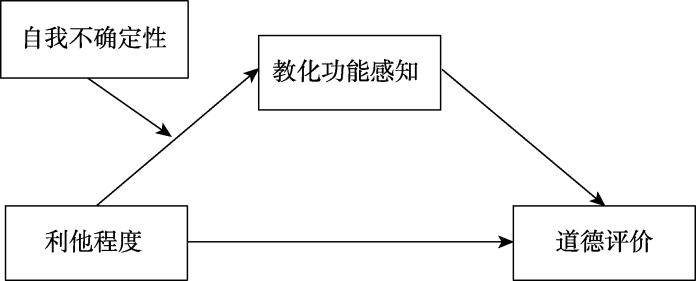
图1 有调节的中介模型
| 变量 | 1 | 2 | 3 | 4 | 5 |
|---|---|---|---|---|---|
| 1. 性别 | — | −0.001 | −0.17 | −0.26** | −0.21* |
| 2. 年龄 | 0.12 | — | 0.31*** | 0.29*** | 0.23* |
| 3. 教化功能 | −0.11 | 0.07 | — | 0.79*** | 0.73*** |
| 4. 行为道德性 | 0.20 | 0.06 | 0.50*** | — | 0.63*** |
| 5. 道德品质 | −0.01 | 0.11 | 0.56*** | 0.70*** | — |
表1 各变量的相关分析
| 变量 | 1 | 2 | 3 | 4 | 5 |
|---|---|---|---|---|---|
| 1. 性别 | — | −0.001 | −0.17 | −0.26** | −0.21* |
| 2. 年龄 | 0.12 | — | 0.31*** | 0.29*** | 0.23* |
| 3. 教化功能 | −0.11 | 0.07 | — | 0.79*** | 0.73*** |
| 4. 行为道德性 | 0.20 | 0.06 | 0.50*** | — | 0.63*** |
| 5. 道德品质 | −0.01 | 0.11 | 0.56*** | 0.70*** | — |
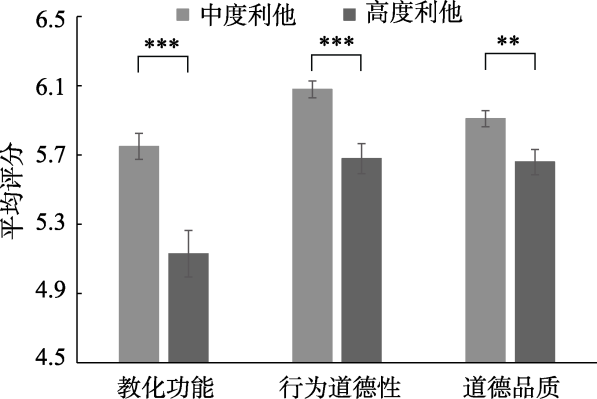
图2 利他程度在各因变量评分上的差异 注: 误差条表示标准误; **p < 0.01, ***p < 0.001.
| 变量 | 1 | 2 | 3 | 4 | 5 |
|---|---|---|---|---|---|
| 1. 性别 | — | 0.04 | −0.04 | −0.13 | −0.10 |
| 2. 年龄 | −0.09 | — | 0.16 | 0.09 | 0.003 |
| 3. 教化功能 | 0.07 | 0.23** | — | 0.74*** | 0.62*** |
| 4. 行为道德性 | 0.03 | 0.12 | 0.79*** | — | 0.86*** |
| 5. 道德品质 | 0.06 | 0.12 | 0.81*** | 0.87*** | — |
表2 各变量的相关分析
| 变量 | 1 | 2 | 3 | 4 | 5 |
|---|---|---|---|---|---|
| 1. 性别 | — | 0.04 | −0.04 | −0.13 | −0.10 |
| 2. 年龄 | −0.09 | — | 0.16 | 0.09 | 0.003 |
| 3. 教化功能 | 0.07 | 0.23** | — | 0.74*** | 0.62*** |
| 4. 行为道德性 | 0.03 | 0.12 | 0.79*** | — | 0.86*** |
| 5. 道德品质 | 0.06 | 0.12 | 0.81*** | 0.87*** | — |
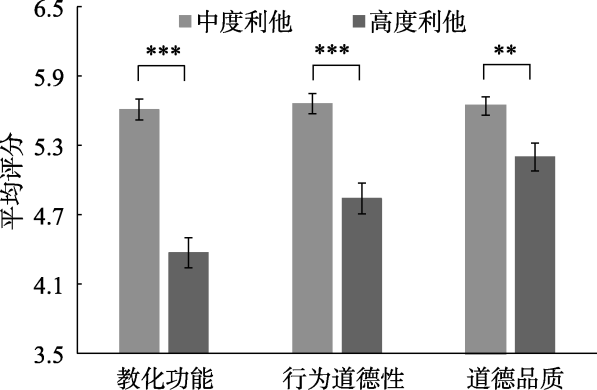
图3 利他程度在各因变量评分上的差异 注: 误差条表示标准误; **p < 0.01, ***p < 0.001.
| 变量 | 低教化功能组 | 控制组 | 高教化功能组 | F | η2 p |
|---|---|---|---|---|---|
| 中度利他组 | 3.30 ± 1.20 | 5.65 ± 0.95 | 5.94 ± 0.69 | 73.57*** | 0.32 |
| 高度利他组 | 3.40 ± 1.49 | 4.28 ± 1.70 | 5.52 ± 1.06 | 38.58*** | 0.20 |
| 总计 | 3.35 ± 1.35 | 4.96 ± 1.53 | 5.74 ± 0.91 | 102.70*** | 0.40 |
表3 教化功能感知的操作检验结果
| 变量 | 低教化功能组 | 控制组 | 高教化功能组 | F | η2 p |
|---|---|---|---|---|---|
| 中度利他组 | 3.30 ± 1.20 | 5.65 ± 0.95 | 5.94 ± 0.69 | 73.57*** | 0.32 |
| 高度利他组 | 3.40 ± 1.49 | 4.28 ± 1.70 | 5.52 ± 1.06 | 38.58*** | 0.20 |
| 总计 | 3.35 ± 1.35 | 4.96 ± 1.53 | 5.74 ± 0.91 | 102.70*** | 0.40 |
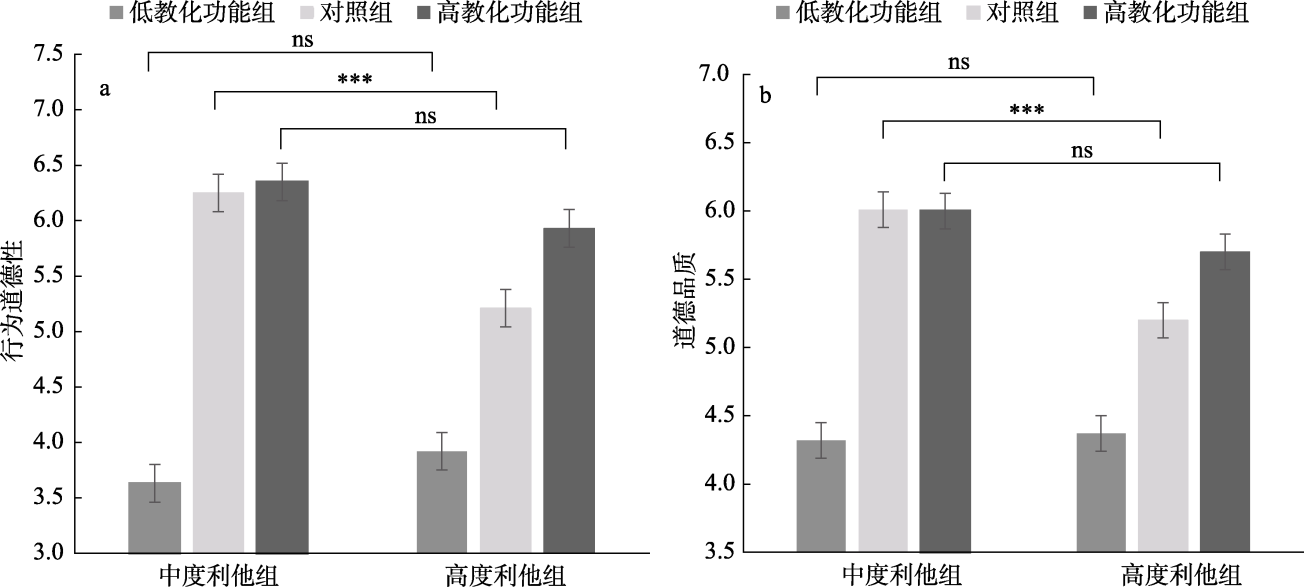
图4 利他程度和教化功能在行为道德性和道德品质上的差异 注: 误差条表示标准误; ***p < 0.001, ns = not significant.
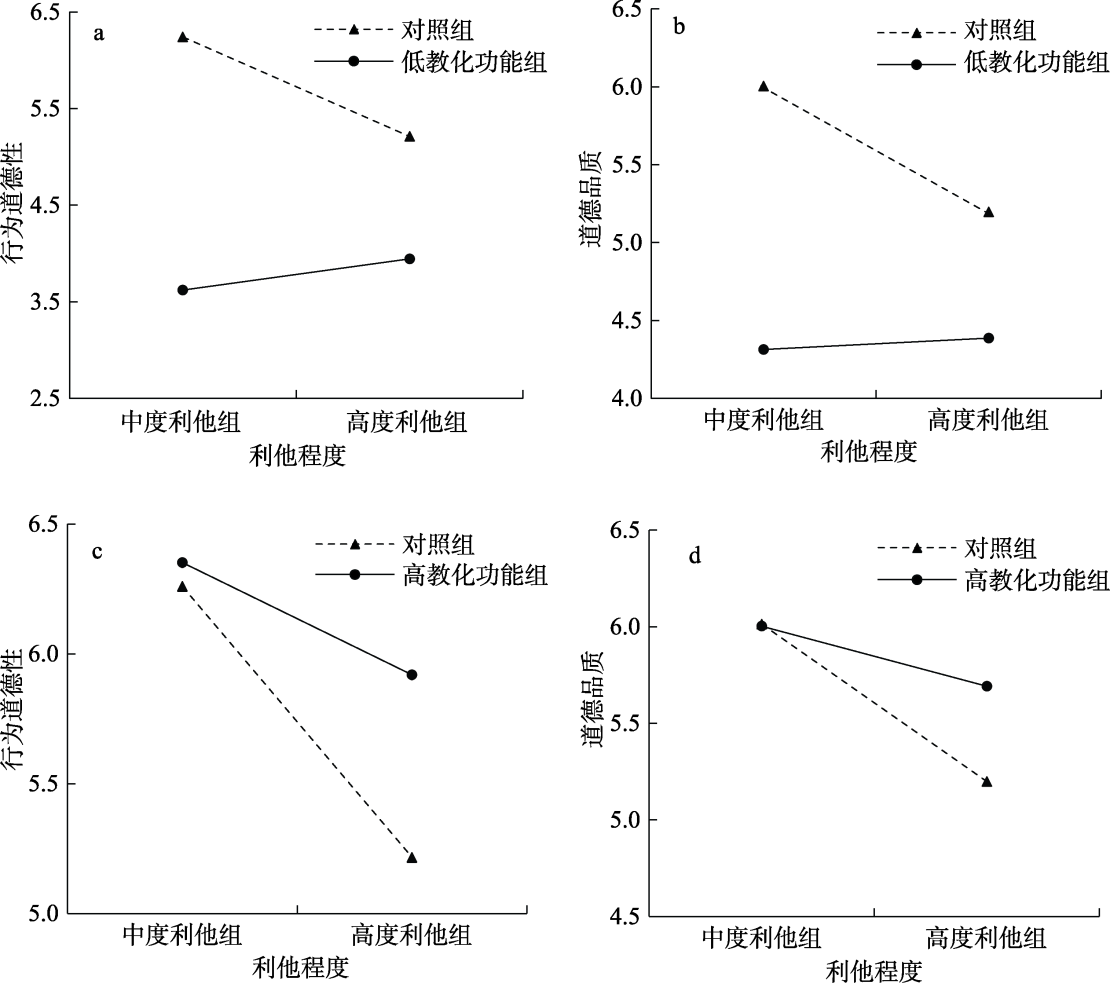
图5 教化功能对利他程度和道德评价的调节作用
| 变量 | 低教化功能组 | 控制组 | 高教化功能组 | F | η2 p |
|---|---|---|---|---|---|
| 中度利他组 | 3.32 ± 1.32 | 5.36 ± 1.16 | 5.83 ± 0.83 | 73.46*** | 0.28 |
| 高度利他组 | 3.47 ± 1.34 | 4.87 ± 1.52 | 5.42 ± 1.16 | 40.80*** | 0.18 |
| 总计 | 3.39 ± 1.33 | 5.13 ± 1.37 | 5.62 ± 1.02 | 109.93*** | 0.37 |
表4 教化功能感知的操作检验结果
| 变量 | 低教化功能组 | 控制组 | 高教化功能组 | F | η2 p |
|---|---|---|---|---|---|
| 中度利他组 | 3.32 ± 1.32 | 5.36 ± 1.16 | 5.83 ± 0.83 | 73.46*** | 0.28 |
| 高度利他组 | 3.47 ± 1.34 | 4.87 ± 1.52 | 5.42 ± 1.16 | 40.80*** | 0.18 |
| 总计 | 3.39 ± 1.33 | 5.13 ± 1.37 | 5.62 ± 1.02 | 109.93*** | 0.37 |
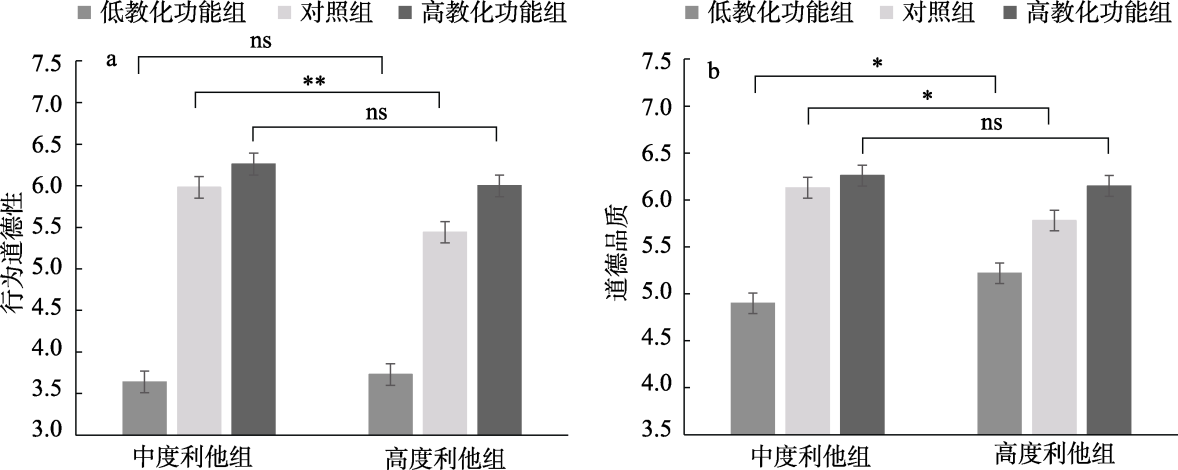
图6 利他程度和教化功能在行为道德性和道德品质上的差异
注: 误差条表示标准误; *p < 0.05, **p < 0.01, ns = not significant.
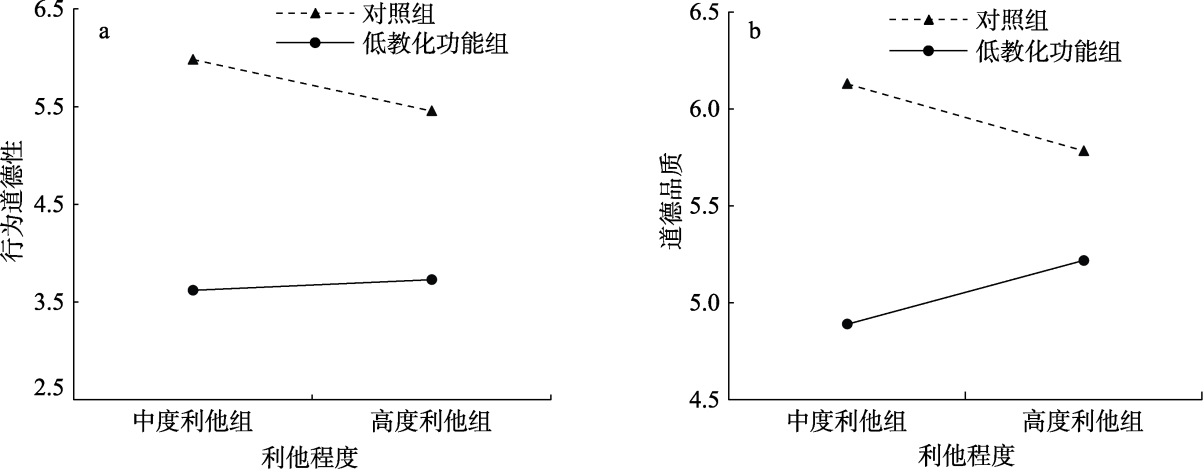
图7 教化功能对利他程度和道德评价的调节作用
| 变量 | 1 | 2 | 3 | 4 | 5 | 6 |
|---|---|---|---|---|---|---|
| 1. 性别 | — | −0.02 | −0.19*** | −0.18** | −0.12* | 0.14* |
| 2. 年龄 | −0.03 | — | 0.27** | 0.12* | 0.20*** | −0.42*** |
| 3. 教化功能 | −0.24** | 0.21** | — | 0.69*** | 0.64*** | −0.41*** |
| 4. 行为道德性 | −0.17* | 0.03 | 0.69*** | — | 0.79*** | −0.28*** |
| 5. 道德品质 | −0.11 | 0.07 | 0.56*** | 0.73*** | — | −0.31*** |
| 6. 自我不确定性 | 0.18* | −0.36*** | −0.40*** | −0.29*** | −0.33*** | — |
表5 各变量的相关分析
| 变量 | 1 | 2 | 3 | 4 | 5 | 6 |
|---|---|---|---|---|---|---|
| 1. 性别 | — | −0.02 | −0.19*** | −0.18** | −0.12* | 0.14* |
| 2. 年龄 | −0.03 | — | 0.27** | 0.12* | 0.20*** | −0.42*** |
| 3. 教化功能 | −0.24** | 0.21** | — | 0.69*** | 0.64*** | −0.41*** |
| 4. 行为道德性 | −0.17* | 0.03 | 0.69*** | — | 0.79*** | −0.28*** |
| 5. 道德品质 | −0.11 | 0.07 | 0.56*** | 0.73*** | — | −0.31*** |
| 6. 自我不确定性 | 0.18* | −0.36*** | −0.40*** | −0.29*** | −0.33*** | — |
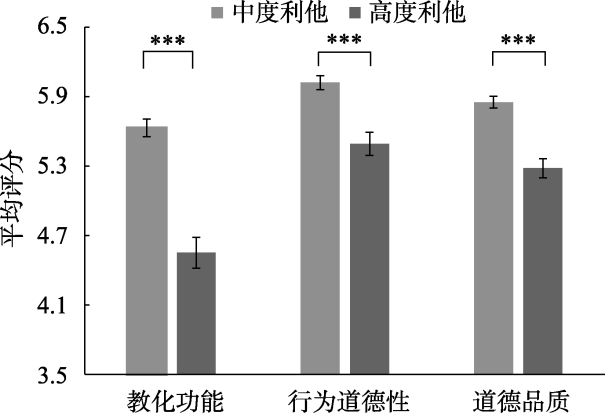
图8 利他程度在各因变量评分上的差异 注: 误差条表示标准误; ***p < 0.001.
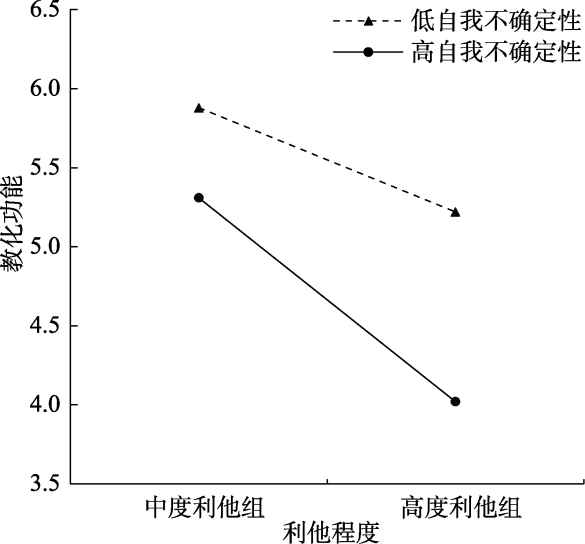
图9 自我不确定性对利他程度和教化功能的调节作用
| 变量 | 1 | 2 | 3 | 4 | 5 |
|---|---|---|---|---|---|
| 1. 性别 | — | −0.08 | −0.15* | −0.09 | −0.01 |
| 2. 年龄 | 0.01 | — | 0.11 | 0.10 | −0.02 |
| 3. 教化功能 | −0.09 | 0.09 | — | 0.50*** | 0.34*** |
| 4. 行为道德性 | 0.02 | 0.04 | 0.59*** | — | 0.85*** |
| 5. 道德品质 | 0.04 | 0.01 | 0.42*** | 0.81*** | — |
表6 中度利他组内各变量的相关分析
| 变量 | 1 | 2 | 3 | 4 | 5 |
|---|---|---|---|---|---|
| 1. 性别 | — | −0.08 | −0.15* | −0.09 | −0.01 |
| 2. 年龄 | 0.01 | — | 0.11 | 0.10 | −0.02 |
| 3. 教化功能 | −0.09 | 0.09 | — | 0.50*** | 0.34*** |
| 4. 行为道德性 | 0.02 | 0.04 | 0.59*** | — | 0.85*** |
| 5. 道德品质 | 0.04 | 0.01 | 0.42*** | 0.81*** | — |
| 变量 | 1 | 2 | 3 | 4 | 5 |
|---|---|---|---|---|---|
| 1. 性别 | — | 0.06 | −0.06 | −0.04 | −0.02 |
| 2. 年龄 | −0.12 | — | 0.10 | 0.05 | 0.02 |
| 3. 教化功能 | −0.25** | 0.10 | — | 0.62*** | 0.44*** |
| 4. 行为道德性 | −0.11 | 0.08 | 0.55*** | — | 0.86*** |
| 5. 道德品质 | −0.01 | −0.07 | 0.28*** | 0.71*** | — |
表7 高度利他组内各变量的相关分析
| 变量 | 1 | 2 | 3 | 4 | 5 |
|---|---|---|---|---|---|
| 1. 性别 | — | 0.06 | −0.06 | −0.04 | −0.02 |
| 2. 年龄 | −0.12 | — | 0.10 | 0.05 | 0.02 |
| 3. 教化功能 | −0.25** | 0.10 | — | 0.62*** | 0.44*** |
| 4. 行为道德性 | −0.11 | 0.08 | 0.55*** | — | 0.86*** |
| 5. 道德品质 | −0.01 | −0.07 | 0.28*** | 0.71*** | — |
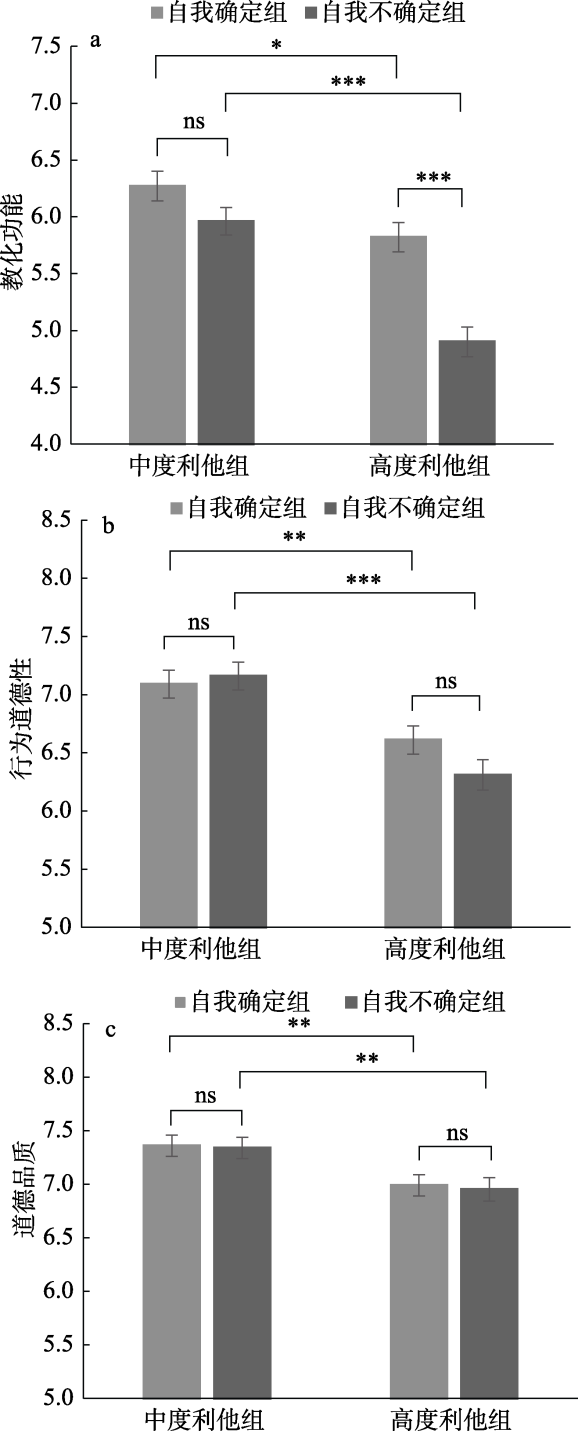
图10 利他程度和自我不确定性在各因变量评分上的差异
注: 误差条表示标准误; *p < 0.05, **p < 0.01, ***p < 0.001, ns = not significant.
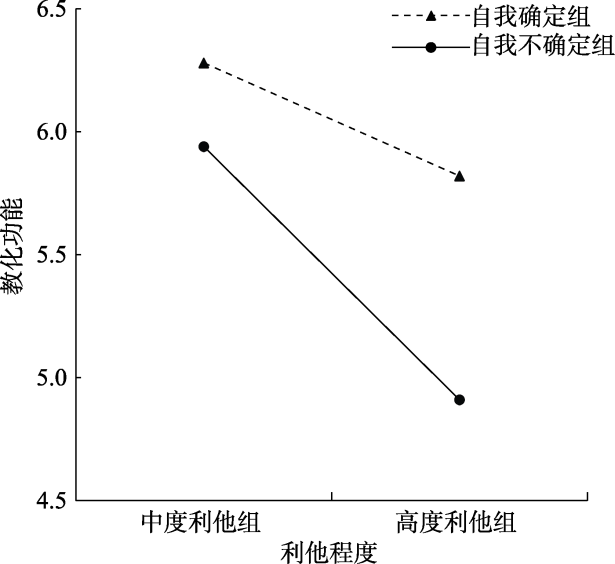
图11 自我不确定性对利他程度和教化功能的调节作用图
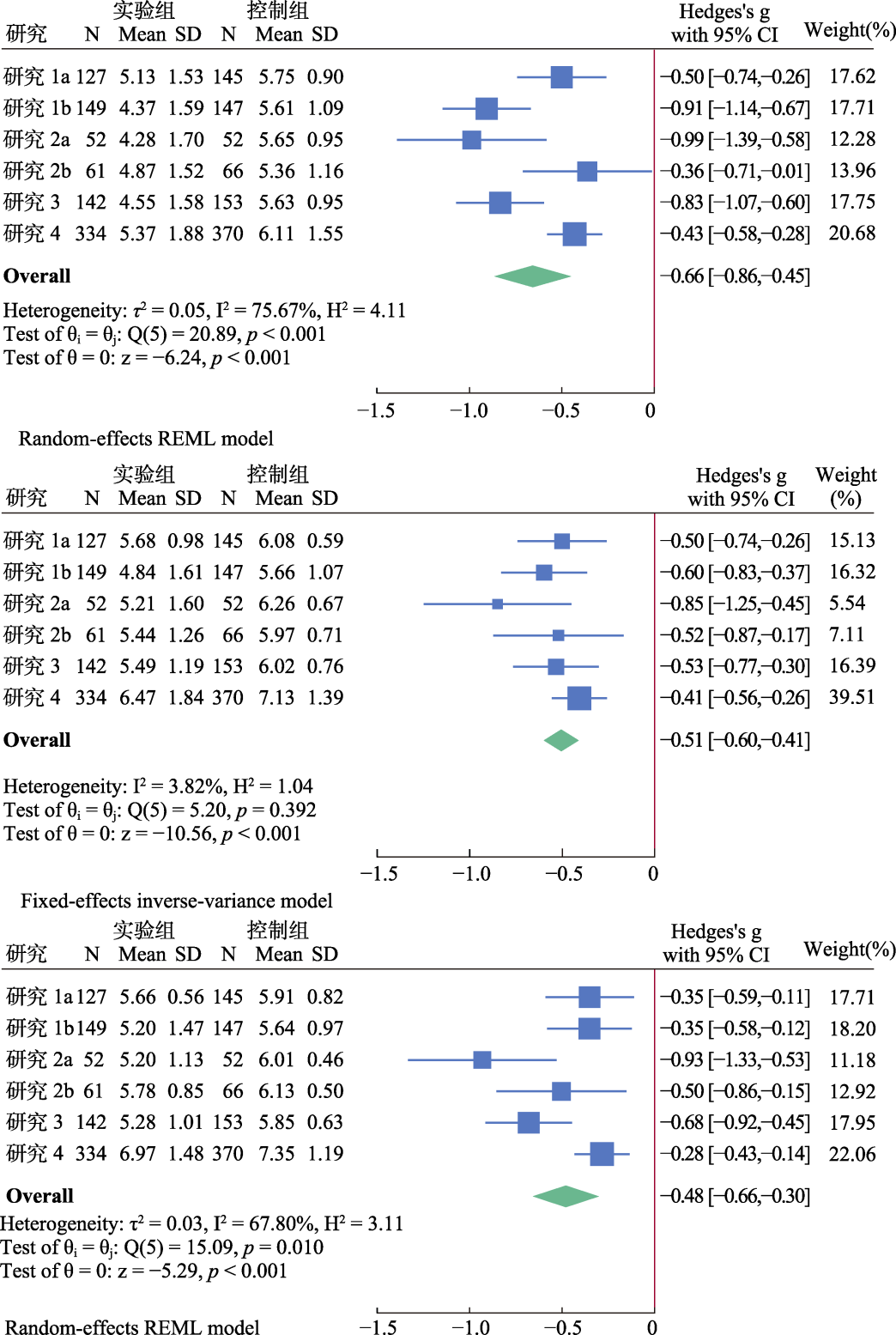
图12 元分析结果
| [1] |
Aguinis, H., Beaty, J. C., Boik, R. J., & Pierce, C. A. (2005). Effect size and power in assessing moderating effects of categorical variables using multiple regression: A 30-year review. Journal of Applied Psychology, 90(1), 94-107.
doi: 10.1037/0021-9010.90.1.94 pmid: 15641892 |
| [2] |
Anderson, R. A., Crockett, M. J., & Pizarro, D. A. (2020). A theory of moral praise. Trends in Cognitive Sciences, 24(9), 694-703.
doi: S1364-6613(20)30149-2 pmid: 32682732 |
| [3] |
Ashton, M. C., & Lee, K. (2009). The HEXACO-60: A short measure of the major dimensions of personality. Journal of Personality Assessment, 91(4), 340-345.
doi: 10.1080/00223890902935878 pmid: 20017063 |
| [4] | Bai, F., Wu, W., & Bao, S. (2019, July). Moral but dominant: When do-gooders get derogated. In Academy of Management Proceedings (Vol. 2019, No.1, p. 14563). Briarcliff Manor, NY 10510:Academy of Management. |
| [5] |
Berman, J. Z., & Silver, I. (2022). Prosocial behavior and reputation: When does doing good lead to looking good? Current Opinion in Psychology, 43, 102-107.
doi: 10.1016/j.copsyc.2021.06.021 URL |
| [6] |
Berry, Z., & Lucas, B. J. (2024). How much is enough? The relationship between prosocial effort and moral character judgments. Personality and Social Psychology Bulletin, 50(5), 659-678.
doi: 10.1177/01461672221135954 URL |
| [7] |
Bhogal, M. S., Farrelly, D., Galbraith, N., Manktelow, K., & Bradley, H. (2020). The role of altruistic costs in human mate choice. Personality and Individual Differences, 160, 109939.
doi: 10.1016/j.paid.2020.109939 URL |
| [8] |
Bocian, K., Baryla, W., Kulesza, W. M., Schnall, S., & Wojciszke, B. (2018). The mere liking effect: Attitudinal influences on attributions of moral character. Journal of Experimental Social Psychology, 79, 9-20.
doi: 10.1016/j.jesp.2018.06.007 URL |
| [9] |
Bolderdijk, J. W., Brouwer, C., & Cornelissen, G. (2018). When do morally motivated innovators elicit inspiration instead of irritation? Frontiers in Psychology, 8, 2362.
doi: 10.3389/fpsyg.2017.02362 URL |
| [10] |
Bykov, A. (2017). Altruism: New perspectives of research on a classical theme in sociology of morality. Current Sociology, 65(6), 797-813.
doi: 10.1177/0011392116657861 URL |
| [11] |
Campbell, J. D., Trapnell, P. D., Heine, S. J., Katz, I. M., Lavallee, L. F., & Lehman, D. R. (1996). Self-concept clarity: Measurement, personality correlates, and cultural boundaries. Journal of Personality and Social Psychology, 70(6), 141-156.
doi: 10.1037/0022-3514.70.1.141 URL |
| [12] |
Capraro, V., Jordan, J. J., & Tappin, B. M. (2021). Does observability amplify sensitivity to moral frames? Evaluating a reputation-based account of moral preferences. Journal of Experimental Social Psychology, 94, 104103.
doi: 10.1016/j.jesp.2021.104103 URL |
| [13] |
Carnes, N. C., Allmon, B., Alva, J., Cousar, K. A., & Varnam, Z. D. (2022). How morality signals, benefits, binds, and teaches. Journal of Experimental Social Psychology, 101, 104313.
doi: 10.1016/j.jesp.2022.104313 URL |
| [14] |
Chen, J., Zhang, R., Yuan, J., & She, S. (2022). Antisocial punishment in the game. Advances in Psychological Science, 30(2), 436-448.
doi: 10.3724/SP.J.1042.2022.00436 |
|
[陈璟, 张融, 袁佳琦, 佘升翔. (2022). 博弈中的反社会惩罚. 心理科学进展, 30(2), 436-448.]
doi: 10.3724/SP.J.1042.2022.00436 |
|
| [15] | Choi, E. U., & Hogg, M. A. (2020). Self-uncertainty and group identification: A meta-analysis. Group Processes & Intergroup Relations, 23(4), 483-501. |
| [16] |
Chung, M., & Saini, R. (2022). Consumer self-uncertainty increases price dependency. Journal of Business Research, 140, 40-48.
doi: 10.1016/j.jbusres.2021.11.054 URL |
| [17] |
Coombs, C. H., & Avrunin, G. S. (1977). Single-peaked functions and the theory of preference. Psychological Review, 84(2), 216-230.
doi: 10.1037/0033-295X.84.2.216 URL |
| [18] | Curry, O., S. (2016). Morality as cooperation:A problem- centred approach. In T. K. Shackelford & R. D. Hansen (Eds.), The evolution of morality (pp. 27-51). Cham: Springer International Publishing. |
| [19] |
Curry, O. S., Mullins, D. A., & Whitehouse, H. (2019). Is it good to cooperate? Testing the theory of morality-as- cooperation in 60 societies. Current Anthropology, 60(1), 47-69.
doi: 10.1086/701478 URL |
| [20] |
Dawes, C. T., Fowler, J. H., Johnson, T., McElreath, R., & Smirnov, O. (2007). Egalitarian motives in humans. Nature, 446(7137), 794-796.
doi: 10.1038/nature05651 |
| [21] |
De Cremer, D., & Sedikides, C. (2009). The whys and whens of personal uncertainty. Psychological Inquiry, 20(4), 218-220.
doi: 10.1080/10478400903333437 URL |
| [22] |
Ellemers, N., Van Der Toorn, J., Paunov, Y., & Van Leeuwen, T. (2019). The psychology of morality: A review and analysis of empirical studies published from 1940 through 2017. Personality and Social Psychology Review, 23(4), 332-366.
doi: 10.1177/1088868318811759 pmid: 30658545 |
| [23] |
Fritz, M. S., & MacKinnon, D. P. (2007). Required sample size to detect the mediated effect. Psychological Science, 18(3), 233-239.
doi: 10.1111/j.1467-9280.2007.01882.x pmid: 17444920 |
| [24] | Fu, P. (2023). Fu Peirong unscrambles the Analects (Rev. ed.). Beijing: Oriental Press. |
| [傅佩荣. (2023). 傅佩荣解读论语 (修订版). 北京: 东方出版社.] | |
| [25] |
Ge, X. (2023). Experimentally manipulating mediating processes: Why and how to examine mediation using statistical moderation analyses. Journal of Experimental Social Psychology, 109, 104507.
doi: 10.1016/j.jesp.2023.104507 URL |
| [26] |
Grant, A. M., & Schwartz, B. (2011). Too much of a good thing: The challenge and opportunity of the inverted U. Perspectives on Psychological Science, 6(1), 61-76.
doi: 10.1177/1745691610393523 pmid: 26162116 |
| [27] | Hayes, A. F. (2013). Introduction to mediation, moderation, and conditional process analysis: A regression-based approach. Guilford publications. |
| [28] | Hedges, L. V., & Tipton, E. (2010). Meta-analysis. In Steptoe, A. et al. (Ed.), Handbook of Behavioral Medicine: Methods and Applications (pp. 909-921). New York, NY: Springer New York. |
| [29] |
Ho, M. K., Cushman, F., Littman, M. L., & Austerweil, J. L. (2019). People teach with rewards and punishments as communication, not reinforcements. Journal of Experimental Psychology: General, 148(3), 520-549.
doi: 10.1037/xge0000569 URL |
| [30] | Hogg, M. A. (2007). Uncertainty-identity theory. Advances in Experimental Social Psychology, 39, 69-126. |
| [31] |
Hogg, M. A. (2009). Managing self-uncertainty through group identification. Psychological Inquiry, 20(4), 221-224.
doi: 10.1080/10478400903333452 URL |
| [32] | Hogg, M. A. (2021). Self-uncertainty and group identification: Consequences for social identity, group behavior, intergroup relations, and society. In B.Gawronski (Ed.), Advances in Experimental Social Psychology (Vol. 64, pp. 263-316). Academic Press. |
| [33] |
Jiao, L., Xu, Y., Tian, Y., Guo, Z., & Zhao, J. (2022). The hierarchies of good and evil personality traits. Acta Psychologica Sinica, 54(7), 850-866.
doi: 10.3724/SP.J.1041.2022.00850 |
|
[焦丽颖, 许燕, 田一, 郭震, 赵锦哲. (2022). 善恶人格的特质差序. 心理学报, 54(7), 850-866.]
doi: 10.3724/SP.J.1041.2022.00850 |
|
| [34] |
Johnson, S. G., & Park, S. Y. (2021). Moral signaling through donations of money and time. Organizational Behavior and Human Decision Processes, 165, 183-196.
doi: 10.1016/j.obhdp.2021.05.004 URL |
| [35] |
Kappes, A., Nussberger, A. M., Faber, N. S., Kahane, G., Savulescu, J., & Crockett, M. J. (2018). Uncertainty about the impact of social decisions increases prosocial behaviour. Nature Human Behaviour, 2(8), 573-580.
doi: 10.1038/s41562-018-0372-x pmid: 31209312 |
| [36] |
Kawamura, Y., & Kusumi, T. (2020). Altruism does not always lead to a good reputation: A normative explanation. Journal of Experimental Social Psychology, 90, 104021.
doi: 10.1016/j.jesp.2020.104021 URL |
| [37] |
Kawamura, Y., Ohtsubo, Y., & Kusumi, T. (2021). Effects of cost and benefit of prosocial behavior on reputation. Social Psychological and Personality Science, 12(4), 452-460.
doi: 10.1177/1948550620929163 URL |
| [38] |
Klein, N., & Epley, N. (2014). The topography of generosity: Asymmetric evaluations of prosocial actions. Journal of Experimental Psychology: General, 143(6), 2366-2379.
doi: 10.1037/xge0000025 URL |
| [39] | Macdonnell, R., & White, K. (2015). How construals of money versus time impact consumer charitable giving. Journal of Consumer Research, 42(4), 551-563. |
| [40] |
Malle, B. F. (2021). Moral judgments. Annual Review of Psychology, 72(1), 293-318.
doi: 10.1146/psych.2021.72.issue-1 URL |
| [41] |
Meng, X., & Moriguchi, Y. (2021). Neural basis for egalitarian sharing in five-to six-year-old children. Neuropsychologia, 154, 107787.
doi: 10.1016/j.neuropsychologia.2021.107787 URL |
| [42] | Miller, D. E. (2012). Utilitarianism and consequentialism. In Gaus, G. et al. (Ed.), The Routledge companion to social and political philosophy (pp. 329-341). Routledge. |
| [43] |
Noguti, V., & Bokeyar, A. L. (2014). Who am I? The relationship between self‐concept uncertainty and materialism. International Journal of Psychology, 49(5), 323-333.
doi: 10.1002/ijop.2014.49.issue-5 URL |
| [44] |
Pfattheicher, S., & Böhm, R. (2018). Honesty-humility under threat: Self-uncertainty destroys trust among the nice guys. Journal of Personality and Social Psychology, 114(1), 179-194.
doi: 10.1037/pspp0000144 pmid: 28263618 |
| [45] |
Pfattheicher, S., Nielsen, Y. A., & Thielmann, I. (2022). Prosocial behavior and altruism: A review of concepts and definitions. Current Opinion in Psychology, 44, 124-129.
doi: 10.1016/j.copsyc.2021.08.021 URL |
| [46] |
Pleasant, A., & Barclay, P. (2018). Why hate the good guy? Antisocial punishment of high cooperators is greater when people compete to be chosen. Psychological Science, 29(6), 868-876.
doi: 10.1177/0956797617752642 pmid: 29708860 |
| [47] |
Reed II, A., Kay, A., Finnel, S., Aquino, K., & Levy, E. (2016). I don’t want the money, I just want your time: How moral identity overcomes the aversion to giving time to prosocial causes. Journal of Personality and Social Psychology, 110(3), 435-457.
doi: 10.1037/pspp0000058 URL |
| [48] |
Schwartz, S. A., & Inbar, Y. (2023). Is it good to feel bad about littering? Conflict between moral beliefs and behaviors for everyday transgressions. Cognition, 236, 105437.
doi: 10.1016/j.cognition.2023.105437 URL |
| [49] | Seligman, M. E., & Csikszentmihalyi, M. (2014). Positive psychology:An introduction. In Csikszentmihalyi, M (Ed.), Flow and the foundations of positive psychology: The collected works of Mihaly Csikszentmihalyi (pp. 279-298). Dordrecht: Springer Netherlands. |
| [50] | Sun, Q. (2022). The effect of distributive fairness on cooperative behavior in social dilemmas: Tradeoffs between fairness and self-benefits [Unpublished doctorial dissertation]. East China Normal University. |
| [孙倩. (2022). 分配公平对社会困境中合作行为的影响: 公平与利益的权衡 (博士学位论文). 华东师范大学]. | |
| [51] |
Sun, S., Zhao, H., Pi, Q., & Zhang, H. (2025). The paradox in moral character judgement of highly altruistic individuals: Investigating the role of predictability and honesty‐humility. European Journal of Social Psychology, 55(4), 624-639.
doi: 10.1002/ejsp.v55.4 URL |
| [52] |
Sun, X., Han, L., Wang, M., Liu, S., & Shen, Y. (2023). Social exclusion with antisocial punishment in spatial public goods game. Physics Letters A, 474, 128837.
doi: 10.1016/j.physleta.2023.128837 URL |
| [53] |
Tai, K., Lin, K. J., Lam, C. K., & Liu, W. (2023). Biting the hand that feeds: A status-based model of when and why receiving help motivates social undermining. Journal of Applied Psychology, 108(1), 27-52.
doi: 10.1037/apl0000580 URL |
| [54] |
Tasimi, A., Dominguez, A., & Wynn, K. (2015). Do-gooder derogation in children: The social costs of generosity. Frontiers in Psychology, 6, 1036.
doi: 10.3389/fpsyg.2015.01036 pmid: 26257688 |
| [55] |
Tetlock, P. E. (2002). Social functionalist frameworks for judgment and choice: Intuitive politicians, theologians, and prosecutors. Psychological Review, 109(3), 451-471.
pmid: 12088240 |
| [56] | Tomasello, M. (2016). A natural history of human morality. Harvard University Press. |
| [57] |
Uhlmann, E. L., Pizarro, D. A., & Diermeier, D. (2015). A person-centered approach to moral judgment. Perspectives on Psychological Science, 10(1), 72-81.
doi: 10.1177/1745691614556679 pmid: 25910382 |
| [58] |
Van, den Bos, K. (2009). Making sense of life: The existential self-trying to deal with personal uncertainty. Psychological Inquiry, 20(4), 197-217.
doi: 10.1080/10478400903333411 URL |
| [59] |
Vonasch, A. J., Mofradidoost, R., & Gray, K. (2024). People reject free money and cheap deals because they infer phantom costs. Personality and Social Psychology Bulletin, 51(10), 2050-2067.
doi: 10.1177/01461672241235687 URL |
| [60] |
Vosgerau, J., Simonsohn, U., Nelson, L. D., & Simmons, J. P. (2019). 99% impossible: A valid, or falsifiable, internal meta-analysis. Journal of Experimental Psychology: General, 148(9), 1628-1639.
doi: 10.1037/xge0000663 URL |
| [61] |
Wu, S., Wang, Y., & Peng, K. (2024). More utilitarian and less rational? Social change and two types of individualism over the last 40 years in China. Acta Psychologica Sinica, 56(7), 911-925.
doi: 10.3724/SP.J.1041.2024.00911 |
|
[吴胜涛, 王予灵, 彭凯平. (2024). 理性式微、功利扩张?近40年中国社会两种个人主义的变迁. 心理学报, 56(7), 911-925.]
doi: 10.3724/SP.J.1041.2024.00911 |
|
| [62] |
Wu, X., Li, J., & Li, Y. (2022). The impact of uncertainty induced by the COVID-19 pandemic on intertemporal choice. Journal of Experimental Social Psychology, 103, 104397.
doi: 10.1016/j.jesp.2022.104397 URL |
| [63] | Wu, Y. (2021). How uncertainty impacts on the identity of extreme groups in the global crisis. Sociological Review of China, 9(2), 157-172. |
| [吴莹. (2021). 全球危机中不确定性如何影响极端群体认同的形成. 社会学评论, 9(2), 157-172.] | |
| [64] |
Yang, Q., Bi, C., Li, L., & Huang, X. (2017). Self-uncertainty: Concepts, structures, and theories. Advances in Psychological Science, 25(6), 1012-1024.
doi: 10.3724/SP.J.1042.2017.01012 URL |
|
[杨庆, 毕重增, 李林, 黄希庭. (2017). 自我不确定感:内涵、结构和理论. 心理科学进展, 25(6), 1012-1024.]
doi: 10.3724/SP.J.1042.2017.01012 |
|
| [65] |
Zhao, X., & Biernat, M. (2022). Status of immigrants’ country of origin and Americans’ assimilation expectations. Journal of Personality and Social Psychology, 122(3), 443-468.
doi: 10.1037/pspi0000370 URL |
| [1] | 王天鸿, 谢晓非. 众人拾柴火焰高:群体利他促进利他炫耀[J]. 心理学报, 2026, 58(5): 976-994. |
| [2] | 滕玥, 张昊天, 赵偲琪, 彭凯平, 胡晓檬. 多元文化经历提升人类对机器人的利他行为及心智知觉的中介作用[J]. 心理学报, 2024, 56(2): 146-160. |
| [3] | 杨焕, 卫旭华. 关系型人力资源管理实践对受益人利他行为的影响:基于道德补偿的视角[J]. 心理学报, 2022, 54(10): 1248-1261. |
| [4] | 费定舟;钱东海;黄旭辰. 利他行为的自我控制过程模型:自我损耗下的道德情绪的正向作用[J]. 心理学报, 2016, 48(9): 1175-1183. |
| [5] | 肖二平;张积家;王娟. 摩梭走访制下的阿注关系:是亲属还是朋友?[J]. 心理学报, 2015, 47(12): 1486-1498. |
| [6] | 任俊;李瑞雪;詹鋆;刘迪;林曼;彭年强. 好人可能做出坏行为的心理学解释 —— 基于自我控制资源损耗的研究证据[J]. 心理学报, 2014, 46(6): 841-851. |
| [7] | 凌文辁,杨海军,方俐洛. 企业员工的组织支持感[J]. 心理学报, 2006, 38(02): 281-287. |
| [8] | 徐芬,荆春燕,刘英,包雪华. 交往情景下个体对说谎的理解及其道德评价[J]. 心理学报, 2002, 34(01): 75-81. |
| [9] | 徐芬,傅根耀. 小学儿童对说谎及说真话的评价[J]. 心理学报, 1998, 30(4): 452-459. |
| 阅读次数 | ||||||
|
全文 |
|
|||||
|
摘要 |
|
|||||
