

ISSN 0439-755X
CN 11-1911/B
主办:中国心理学会
中国科学院心理研究所
出版:科学出版社
CN 11-1911/B
主办:中国心理学会
中国科学院心理研究所
出版:科学出版社
心理学报 ›› 2026, Vol. 58 ›› Issue (2): 350-361.doi: 10.3724/SP.J.1041.2026.0350 cstr: 32110.14.2026.0350
苏微1, 方晓义2, 侯娟1( )
)
收稿日期:2024-11-18
发布日期:2025-12-03
出版日期:2026-02-25
通讯作者:
侯娟, E-mail: daisyhoujuan@gmail.com基金资助:
SU Wei1, FANG Xiaoyi2, HOU Juan1()
Received:2024-11-18
Online:2025-12-03
Published:2026-02-25
摘要: 相似性是夫妻婚姻满意度的重要组成部分, 然而目前关于两者关系的研究存在矛盾的结论。那么夫妻究竟在哪些维度上相似? 相似性对婚姻满意度又有何影响呢? 本研究以638对中国夫妻为被试, 采用以夫妻为中心的方法(CCA), 通过轮廓水平相似性(PCS)和特质水平差异性(ADS)指标, 将主体效应、客体效应、相似性效应和差异性效应四者结合起来, 考察了不同婚姻阶段的个体、互动和原生家庭变量的相似性与婚姻满意度的关系。结果表明: (1)真实夫妻比随机配对夫妻更为相似; (2)相较于个体特质和互动方式, 夫妻在原生家庭维度上更加相似; (3)不同婚姻阶段的夫妻相似性对婚姻满意度的影响存在性别差异; (4)相似性虽然对婚姻满意度产生影响, 但是主体效应仍是婚姻满意度最大的预测源。
中图分类号:
苏微, 方晓义, 侯娟. (2026). 心相应, 爱相随: 夫妻相似性与婚姻满意度. 心理学报, 58(2), 350-361.
SU Wei, FANG Xiaoyi, HOU Juan. (2026). Hearts correspond, love follows: The relationship between couples’ similarity and marital satisfaction. Acta Psychologica Sinica, 58(2), 350-361.
| 年龄(岁) | 教育水平 | 收入(万元) | ||||
|---|---|---|---|---|---|---|
| M | SD | M | SD | M | SD | |
| 第一阶段(n = 109) | ||||||
| 丈夫 | 34.10 | 3.92 | 5.39 | 0.71 | 18.88 | 13.75 |
| 妻子 | 33.20 | 2.85 | 5.49 | 0.74 | 13.36 | 9.50 |
| 第二阶段(n = 190) | ||||||
| 丈夫 | 38.72 | 4.14 | 5.36 | 0.83 | 25.97 | 19.73 |
| 妻子 | 36.94 | 3.64 | 5.41 | 0.84 | 17.12 | 12.81 |
| 第三阶段(n = 144) | ||||||
| 丈夫 | 46.08 | 5.30 | 4.25 | 1.25 | 14.60 | 13.67 |
| 妻子 | 43.94 | 3.92 | 4.19 | 1.34 | 10.24 | 8.60 |
| 第四阶段(n = 195) | ||||||
| 丈夫 | 64.35 | 8.92 | 3.25 | 1.19 | 6.57 | 5.94 |
| 妻子 | 63.35 | 8.97 | 3.08 | 1.18 | 4.76 | 7.69 |
表1 人口统计学变量的描述性统计结果
| 年龄(岁) | 教育水平 | 收入(万元) | ||||
|---|---|---|---|---|---|---|
| M | SD | M | SD | M | SD | |
| 第一阶段(n = 109) | ||||||
| 丈夫 | 34.10 | 3.92 | 5.39 | 0.71 | 18.88 | 13.75 |
| 妻子 | 33.20 | 2.85 | 5.49 | 0.74 | 13.36 | 9.50 |
| 第二阶段(n = 190) | ||||||
| 丈夫 | 38.72 | 4.14 | 5.36 | 0.83 | 25.97 | 19.73 |
| 妻子 | 36.94 | 3.64 | 5.41 | 0.84 | 17.12 | 12.81 |
| 第三阶段(n = 144) | ||||||
| 丈夫 | 46.08 | 5.30 | 4.25 | 1.25 | 14.60 | 13.67 |
| 妻子 | 43.94 | 3.92 | 4.19 | 1.34 | 10.24 | 8.60 |
| 第四阶段(n = 195) | ||||||
| 丈夫 | 64.35 | 8.92 | 3.25 | 1.19 | 6.57 | 5.94 |
| 妻子 | 63.35 | 8.97 | 3.08 | 1.18 | 4.76 | 7.69 |
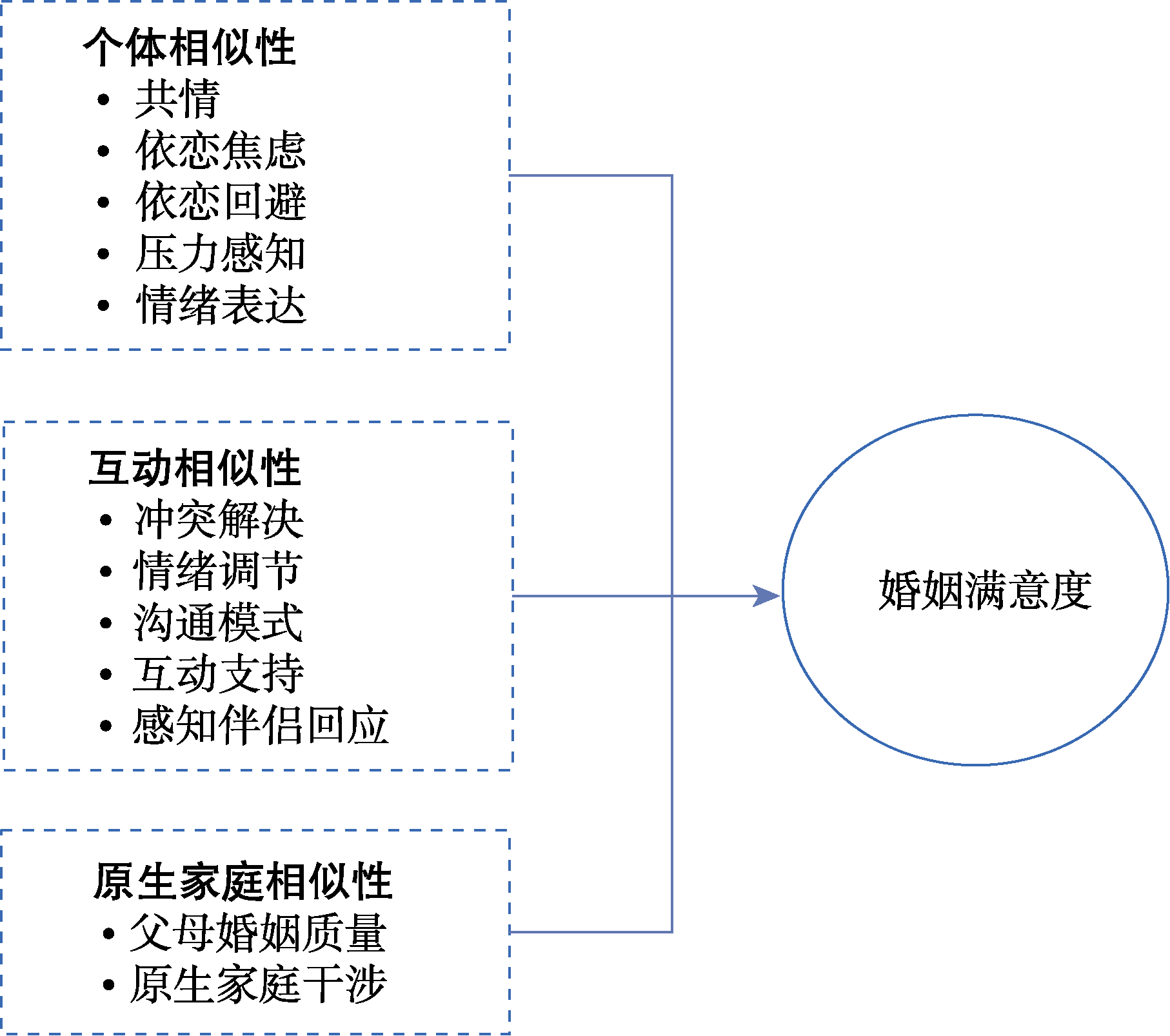
图1 变量选取示意图
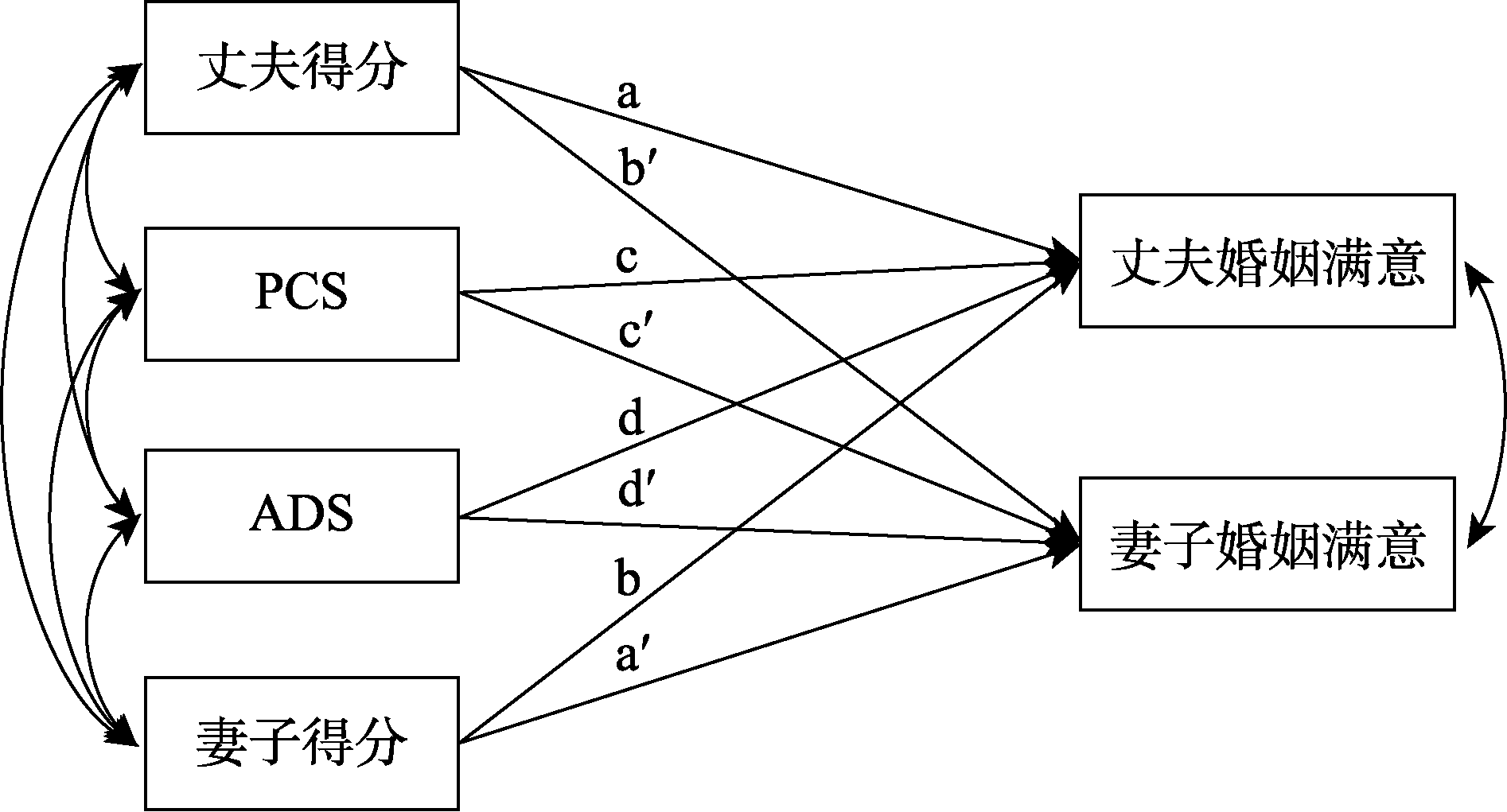
图2 主客体互倚模型
| 变量 | 丈夫 | 妻子 | t | d | ||
|---|---|---|---|---|---|---|
| M | SD | M | SD | |||
| 共情 | 4.06 | 0.48 | 3.97 | 0.50 | 3.80*** | 0.150 |
| 依恋焦虑 | 3.62 | 0.76 | 3.74 | 0.85 | −2.99** | 0.118 |
| 依恋回避 | 3.00 | 0.74 | 2.89 | 0.84 | 2.96** | 0.117 |
| 压力感知 | 2.48 | 0.53 | 2.53 | 0.52 | −1.99* | 0.078 |
| 情绪表达 | 4.41 | 0.95 | 4.94 | 1.00 | −9.84*** | 0.390 |
| 冲突解决 | 3.31 | 0.46 | 3.28 | 0.48 | 1.03 | 0.041 |
| 情绪调节 | 5.02 | 0.80 | 4.76 | 0.83 | 6.07*** | 0.241 |
| 沟通模式 | 3.50 | 0.52 | 3.57 | 0.59 | −3.48*** | 0.137 |
| 互动支持 | 3.48 | 0.72 | 3.48 | 0.80 | −0.12 | 0.005 |
| 感知伴侣回应 | 6.67 | 1.67 | 6.63 | 1.69 | 0.65 | 0.026 |
| 父母婚姻质量 | 1.66 | 0.55 | 1.74 | 0.54 | −4.47*** | 0.178 |
| 原生家庭干涉 | 2.09 | 1.31 | 2.09 | 1.28 | 0.17 | 0.007 |
| 婚姻满意度 | 6.30 | 1.37 | 6.03 | 1.52 | 5.75*** | 0.228 |
表2 描述性统计与t检验结果
| 变量 | 丈夫 | 妻子 | t | d | ||
|---|---|---|---|---|---|---|
| M | SD | M | SD | |||
| 共情 | 4.06 | 0.48 | 3.97 | 0.50 | 3.80*** | 0.150 |
| 依恋焦虑 | 3.62 | 0.76 | 3.74 | 0.85 | −2.99** | 0.118 |
| 依恋回避 | 3.00 | 0.74 | 2.89 | 0.84 | 2.96** | 0.117 |
| 压力感知 | 2.48 | 0.53 | 2.53 | 0.52 | −1.99* | 0.078 |
| 情绪表达 | 4.41 | 0.95 | 4.94 | 1.00 | −9.84*** | 0.390 |
| 冲突解决 | 3.31 | 0.46 | 3.28 | 0.48 | 1.03 | 0.041 |
| 情绪调节 | 5.02 | 0.80 | 4.76 | 0.83 | 6.07*** | 0.241 |
| 沟通模式 | 3.50 | 0.52 | 3.57 | 0.59 | −3.48*** | 0.137 |
| 互动支持 | 3.48 | 0.72 | 3.48 | 0.80 | −0.12 | 0.005 |
| 感知伴侣回应 | 6.67 | 1.67 | 6.63 | 1.69 | 0.65 | 0.026 |
| 父母婚姻质量 | 1.66 | 0.55 | 1.74 | 0.54 | −4.47*** | 0.178 |
| 原生家庭干涉 | 2.09 | 1.31 | 2.09 | 1.28 | 0.17 | 0.007 |
| 婚姻满意度 | 6.30 | 1.37 | 6.03 | 1.52 | 5.75*** | 0.228 |
| 变量 | 真实夫妻 | 随机夫妻 | t | d | ||||
|---|---|---|---|---|---|---|---|---|
| N | M | SD | N | M | SD | |||
| 共情 | 616 | 0.35 | 0.41 | 196073 | 0.26 | 0.38 | 5.60*** | 0.239 |
| 依恋焦虑 | 632 | 0.38 | 0.36 | 202149 | 0.29 | 0.33 | 6.43*** | 0.251 |
| 依恋回避 | 630 | 0.28 | 0.42 | 201363 | 0.18 | 0.35 | 6.04*** | 0.231 |
| 压力感知 | 620 | 0.18 | 0.36 | 199676 | 0.11 | 0.35 | 5.04*** | 0.191 |
| 情绪表达 | 603 | 0.26 | 0.43 | 193846 | 0.21 | 0.41 | 2.94** | 0.132 |
| 冲突解决 | 578 | 0.57 | 0.53 | 183241 | 0.52 | 0.55 | 2.38* | 0.103 |
| 情绪调节 | 593 | 0.26 | 0.51 | 189861 | 0.22 | 0.48 | 2.00* | 0.075 |
| 沟通模式 | 635 | 0.32 | 0.30 | 202413 | 0.23 | 0.28 | 7.51*** | 0.296 |
| 互动支持 | 614 | 0.23 | 0.34 | 196501 | 0.14 | 0.33 | 6.36*** | 0.243 |
| 感知伴侣回应 | 572 | 0.13 | 0.32 | 182683 | 0.07 | 0.30 | 4.20*** | 0.178 |
| 父母婚姻质量 | 347 | 0.58 | 0.79 | 111158 | 0.89 | 0.67 | −7.21*** | 0.386 |
| 原生家庭干涉 | 395 | −0.03 | 0.72 | 112061 | 0.08 | 0.43 | −2.98** | 0.149 |
表3 真实夫妻相似性与随机配对夫妻相似性的t检验结果
| 变量 | 真实夫妻 | 随机夫妻 | t | d | ||||
|---|---|---|---|---|---|---|---|---|
| N | M | SD | N | M | SD | |||
| 共情 | 616 | 0.35 | 0.41 | 196073 | 0.26 | 0.38 | 5.60*** | 0.239 |
| 依恋焦虑 | 632 | 0.38 | 0.36 | 202149 | 0.29 | 0.33 | 6.43*** | 0.251 |
| 依恋回避 | 630 | 0.28 | 0.42 | 201363 | 0.18 | 0.35 | 6.04*** | 0.231 |
| 压力感知 | 620 | 0.18 | 0.36 | 199676 | 0.11 | 0.35 | 5.04*** | 0.191 |
| 情绪表达 | 603 | 0.26 | 0.43 | 193846 | 0.21 | 0.41 | 2.94** | 0.132 |
| 冲突解决 | 578 | 0.57 | 0.53 | 183241 | 0.52 | 0.55 | 2.38* | 0.103 |
| 情绪调节 | 593 | 0.26 | 0.51 | 189861 | 0.22 | 0.48 | 2.00* | 0.075 |
| 沟通模式 | 635 | 0.32 | 0.30 | 202413 | 0.23 | 0.28 | 7.51*** | 0.296 |
| 互动支持 | 614 | 0.23 | 0.34 | 196501 | 0.14 | 0.33 | 6.36*** | 0.243 |
| 感知伴侣回应 | 572 | 0.13 | 0.32 | 182683 | 0.07 | 0.30 | 4.20*** | 0.178 |
| 父母婚姻质量 | 347 | 0.58 | 0.79 | 111158 | 0.89 | 0.67 | −7.21*** | 0.386 |
| 原生家庭干涉 | 395 | −0.03 | 0.72 | 112061 | 0.08 | 0.43 | −2.98** | 0.149 |
| 变量 | 第一阶段 | 第二阶段 | 第三阶段 | 第四阶段 | ||||||||
|---|---|---|---|---|---|---|---|---|---|---|---|---|
| n | M | SD | n | M | SD | n | M | SD | n | M | SD | |
| 个体维度 | − | 0.27 | 0.31 | − | 0.24 | 0.31 | − | 0.24 | 0.31 | − | 0.26 | 0.33 |
| 共情 | 107 | 0.30 | 0.32 | 185 | 0.30 | 0.33 | 137 | 0.32 | 0.29 | 190 | 0.29 | 0.35 |
| 依恋焦虑 | 109 | 0.37 | 0.26 | 190 | 0.34 | 0.27 | 143 | 0.29 | 0.25 | 191 | 0.32 | 0.30 |
| 依恋回避 | 109 | 0.32 | 0.31 | 188 | 0.23 | 0.31 | 142 | 0.21 | 0.34 | 192 | 0.22 | 0.33 |
| 压力感知 | 108 | 0.15 | 0.30 | 187 | 0.19 | 0.28 | 141 | 0.19 | 0.34 | 189 | 0.14 | 0.35 |
| 情绪表达 | 106 | 0.20 | 0.33 | 174 | 0.15 | 0.36 | 138 | 0.18 | 0.33 | 188 | 0.34 | 0.34 |
| 互动维度 | − | 0.29 | 0.30 | − | 0.26 | 0.32 | − | 0.22 | 0.31 | − | 0.25 | 0.33 |
| 冲突解决 | 107 | 0.55 | 0.34 | 177 | 0.48 | 0.37 | 133 | 0.41 | 0.37 | 177 | 0.39 | 0.40 |
| 情绪调节 | 107 | 0.29 | 0.38 | 185 | 0.26 | 0.40 | 136 | 0.17 | 0.37 | 170 | 0.13 | 0.40 |
| 沟通模式 | 109 | 0.25 | 0.26 | 188 | 0.29 | 0.24 | 143 | 0.28 | 0.25 | 195 | 0.31 | 0.26 |
| 互动支持 | 104 | 0.13 | 0.27 | 184 | 0.16 | 0.30 | 135 | 0.18 | 0.29 | 192 | 0.31 | 0.30 |
| 感知伴侣回应 | 104 | 0.19 | 0.27 | 180 | 0.12 | 0.29 | 134 | 0.07 | 0.29 | 155 | 0.10 | 0.30 |
| 原生家庭维度 | − | 0.34 | 0.44 | − | 0.29 | 0.45 | − | 0.28 | 0.48 | − | 0.09 | 0.55 |
| 父母婚姻质量 | 86 | 0.48 | 0.55 | 170 | 0.51 | 0.54 | 113 | 0.56 | 0.51 | 100 | 0.63 | 0.48 |
| 原生家庭干涉 | 86 | 0.21 | 0.33 | 165 | 0.06 | 0.36 | 91 | −0.01 | 0.45 | 78 | −0.44 | 0.63 |
表4 不同婚姻阶段夫妻相似性的描述性统计结果(PCS)
| 变量 | 第一阶段 | 第二阶段 | 第三阶段 | 第四阶段 | ||||||||
|---|---|---|---|---|---|---|---|---|---|---|---|---|
| n | M | SD | n | M | SD | n | M | SD | n | M | SD | |
| 个体维度 | − | 0.27 | 0.31 | − | 0.24 | 0.31 | − | 0.24 | 0.31 | − | 0.26 | 0.33 |
| 共情 | 107 | 0.30 | 0.32 | 185 | 0.30 | 0.33 | 137 | 0.32 | 0.29 | 190 | 0.29 | 0.35 |
| 依恋焦虑 | 109 | 0.37 | 0.26 | 190 | 0.34 | 0.27 | 143 | 0.29 | 0.25 | 191 | 0.32 | 0.30 |
| 依恋回避 | 109 | 0.32 | 0.31 | 188 | 0.23 | 0.31 | 142 | 0.21 | 0.34 | 192 | 0.22 | 0.33 |
| 压力感知 | 108 | 0.15 | 0.30 | 187 | 0.19 | 0.28 | 141 | 0.19 | 0.34 | 189 | 0.14 | 0.35 |
| 情绪表达 | 106 | 0.20 | 0.33 | 174 | 0.15 | 0.36 | 138 | 0.18 | 0.33 | 188 | 0.34 | 0.34 |
| 互动维度 | − | 0.29 | 0.30 | − | 0.26 | 0.32 | − | 0.22 | 0.31 | − | 0.25 | 0.33 |
| 冲突解决 | 107 | 0.55 | 0.34 | 177 | 0.48 | 0.37 | 133 | 0.41 | 0.37 | 177 | 0.39 | 0.40 |
| 情绪调节 | 107 | 0.29 | 0.38 | 185 | 0.26 | 0.40 | 136 | 0.17 | 0.37 | 170 | 0.13 | 0.40 |
| 沟通模式 | 109 | 0.25 | 0.26 | 188 | 0.29 | 0.24 | 143 | 0.28 | 0.25 | 195 | 0.31 | 0.26 |
| 互动支持 | 104 | 0.13 | 0.27 | 184 | 0.16 | 0.30 | 135 | 0.18 | 0.29 | 192 | 0.31 | 0.30 |
| 感知伴侣回应 | 104 | 0.19 | 0.27 | 180 | 0.12 | 0.29 | 134 | 0.07 | 0.29 | 155 | 0.10 | 0.30 |
| 原生家庭维度 | − | 0.34 | 0.44 | − | 0.29 | 0.45 | − | 0.28 | 0.48 | − | 0.09 | 0.55 |
| 父母婚姻质量 | 86 | 0.48 | 0.55 | 170 | 0.51 | 0.54 | 113 | 0.56 | 0.51 | 100 | 0.63 | 0.48 |
| 原生家庭干涉 | 86 | 0.21 | 0.33 | 165 | 0.06 | 0.36 | 91 | −0.01 | 0.45 | 78 | −0.44 | 0.63 |
| 变量 | 第一阶段(n = 109) | 第二阶段(n = 190) | 第三阶段(n = 144) | 第四阶段(n = 195) | ||||
|---|---|---|---|---|---|---|---|---|
| M | SD | M | SD | M | SD | M | SD | |
| 个体维度 | 0.78 | 0.57 | 0.81 | 0.61 | 0.81 | 0.61 | 0.64 | 0.54 |
| 共情 | 0.44 | 0.31 | 0.55 | 0.42 | 0.50 | 0.40 | 0.46 | 0.38 |
| 依恋焦虑 | 0.83 | 0.61 | 0.85 | 0.64 | 0.87 | 0.70 | 0.84 | 0.71 |
| 依恋回避 | 0.76 | 0.57 | 0.82 | 0.60 | 0.83 | 0.64 | 0.62 | 0.51 |
| 压力感知 | 0.56 | 0.40 | 0.59 | 0.47 | 0.57 | 0.42 | 0.46 | 0.35 |
| 情绪表达 | 1.30 | 0.93 | 1.27 | 0.93 | 1.29 | 0.87 | 0.83 | 0.77 |
| 互动维度 | 0.70 | 0.54 | 0.73 | 0.57 | 0.72 | 0.60 | 0.71 | 0.62 |
| 冲突解决 | 0.39 | 0.29 | 0.47 | 0.40 | 0.51 | 0.41 | 0.49 | 0.44 |
| 情绪调节 | 0.92 | 0.66 | 0.90 | 0.73 | 0.74 | 0.59 | 0.87 | 0.73 |
| 沟通模式 | 0.40 | 0.32 | 0.38 | 0.29 | 0.41 | 0.37 | 0.45 | 0.38 |
| 互动支持 | 0.65 | 0.52 | 0.60 | 0.46 | 0.69 | 0.56 | 0.55 | 0.47 |
| 感知伴侣回应 | 1.15 | 0.95 | 1.31 | 0.97 | 1.26 | 1.04 | 1.18 | 1.08 |
| 原生家庭维度 | 0.35 | 0.34 | 0.40 | 0.35 | 0.35 | 0.38 | 0.39 | 0.62 |
| 父母婚姻质量 | 0.33 | 0.32 | 0.34 | 0.30 | 0.32 | 0.28 | 0.33 | 0.33 |
| 原生家庭干涉 | 0.38 | 0.37 | 0.45 | 0.39 | 0.38 | 0.48 | 0.46 | 0.91 |
表5 不同婚姻阶段夫妻差异性的描述性统计结果(ADS)
| 变量 | 第一阶段(n = 109) | 第二阶段(n = 190) | 第三阶段(n = 144) | 第四阶段(n = 195) | ||||
|---|---|---|---|---|---|---|---|---|
| M | SD | M | SD | M | SD | M | SD | |
| 个体维度 | 0.78 | 0.57 | 0.81 | 0.61 | 0.81 | 0.61 | 0.64 | 0.54 |
| 共情 | 0.44 | 0.31 | 0.55 | 0.42 | 0.50 | 0.40 | 0.46 | 0.38 |
| 依恋焦虑 | 0.83 | 0.61 | 0.85 | 0.64 | 0.87 | 0.70 | 0.84 | 0.71 |
| 依恋回避 | 0.76 | 0.57 | 0.82 | 0.60 | 0.83 | 0.64 | 0.62 | 0.51 |
| 压力感知 | 0.56 | 0.40 | 0.59 | 0.47 | 0.57 | 0.42 | 0.46 | 0.35 |
| 情绪表达 | 1.30 | 0.93 | 1.27 | 0.93 | 1.29 | 0.87 | 0.83 | 0.77 |
| 互动维度 | 0.70 | 0.54 | 0.73 | 0.57 | 0.72 | 0.60 | 0.71 | 0.62 |
| 冲突解决 | 0.39 | 0.29 | 0.47 | 0.40 | 0.51 | 0.41 | 0.49 | 0.44 |
| 情绪调节 | 0.92 | 0.66 | 0.90 | 0.73 | 0.74 | 0.59 | 0.87 | 0.73 |
| 沟通模式 | 0.40 | 0.32 | 0.38 | 0.29 | 0.41 | 0.37 | 0.45 | 0.38 |
| 互动支持 | 0.65 | 0.52 | 0.60 | 0.46 | 0.69 | 0.56 | 0.55 | 0.47 |
| 感知伴侣回应 | 1.15 | 0.95 | 1.31 | 0.97 | 1.26 | 1.04 | 1.18 | 1.08 |
| 原生家庭维度 | 0.35 | 0.34 | 0.40 | 0.35 | 0.35 | 0.38 | 0.39 | 0.62 |
| 父母婚姻质量 | 0.33 | 0.32 | 0.34 | 0.30 | 0.32 | 0.28 | 0.33 | 0.33 |
| 原生家庭干涉 | 0.38 | 0.37 | 0.45 | 0.39 | 0.38 | 0.48 | 0.46 | 0.91 |
| 变量 | 主体效应(p) | 客体效应(p) | 相似性效应(p) | 差异性效应(p) | R2(p) |
|---|---|---|---|---|---|
| 个体维度 | 0.284 | 0.210 | 0.136 | 0.040 | 0.216 |
| 共情 | 0.194(0.098) | 0.067(0.523) | 0.257(0.039) | −0.031(0.760) | 0.126(0.076) |
| 依恋焦虑 | −0.366(0.000) | −0.231(0.024) | 0.132(0.107) | 0.055(0.643) | 0.262(0.001) |
| 依恋回避 | −0.423(0.000) | −0.453(0.000) | −0.080(0.229) | 0.005(0.950) | 0.451(0.000) |
| 压力感知 | −0.307(0.001) | −0.222(0.015) | 0.107(0.174) | 0.053(0.579) | 0.203(0.005) |
| 情绪表达 | 0.130(0.240) | 0.075(0.413) | −0.103(0.270) | −0.055(0.671) | 0.037(0.343) |
| 互动维度 | 0.325 | 0.197 | 0.091 | 0.072 | 0.290 |
| 冲突解决 | 0.035(0.731) | 0.172(0.081) | 0.110(0.241) | −0.120(0.254) | 0.068(0.145) |
| 情绪调节 | 0.125(0.220) | 0.055(0.651) | −0.232(0.009) | −0.139(0.194) | 0.092(0.089) |
| 沟通模式 | 0.342(0.000) | 0.337(0.000) | −0.035(0.666) | −0.027(0.756) | 0.349(0.000) |
| 互动支持 | 0.508(0.000) | 0.230(0.008) | −0.024(0.738) | 0.066(0.385) | 0.377(0.000) |
| 感知伴侣回应 | 0.617(0.000) | 0.192(0.045) | 0.056(0.448) | −0.008(0.900) | 0.566(0.000) |
| 原生家庭维度 | 0.255 | 0.125 | 0.140 | 0.093 | 0.092 |
| 父母婚姻质量 | −0.279(0.046) | 0.001(0.997) | −0.167(0.109) | −0.035(0.745) | 0.072(0.159) |
| 原生家庭干涉 | −0.231(0.128) | −0.248(0.010) | −0.112(0.171) | 0.150(0.351) | 0.111(0.045) |
| 全部变量 | 0.296 | 0.190 | 0.118 | 0.062 | 0.226 |
表6 婚姻第一阶段丈夫从主、客体效应、相似性效应和差异性效应预测婚姻满意度的标准化路径系数
| 变量 | 主体效应(p) | 客体效应(p) | 相似性效应(p) | 差异性效应(p) | R2(p) |
|---|---|---|---|---|---|
| 个体维度 | 0.284 | 0.210 | 0.136 | 0.040 | 0.216 |
| 共情 | 0.194(0.098) | 0.067(0.523) | 0.257(0.039) | −0.031(0.760) | 0.126(0.076) |
| 依恋焦虑 | −0.366(0.000) | −0.231(0.024) | 0.132(0.107) | 0.055(0.643) | 0.262(0.001) |
| 依恋回避 | −0.423(0.000) | −0.453(0.000) | −0.080(0.229) | 0.005(0.950) | 0.451(0.000) |
| 压力感知 | −0.307(0.001) | −0.222(0.015) | 0.107(0.174) | 0.053(0.579) | 0.203(0.005) |
| 情绪表达 | 0.130(0.240) | 0.075(0.413) | −0.103(0.270) | −0.055(0.671) | 0.037(0.343) |
| 互动维度 | 0.325 | 0.197 | 0.091 | 0.072 | 0.290 |
| 冲突解决 | 0.035(0.731) | 0.172(0.081) | 0.110(0.241) | −0.120(0.254) | 0.068(0.145) |
| 情绪调节 | 0.125(0.220) | 0.055(0.651) | −0.232(0.009) | −0.139(0.194) | 0.092(0.089) |
| 沟通模式 | 0.342(0.000) | 0.337(0.000) | −0.035(0.666) | −0.027(0.756) | 0.349(0.000) |
| 互动支持 | 0.508(0.000) | 0.230(0.008) | −0.024(0.738) | 0.066(0.385) | 0.377(0.000) |
| 感知伴侣回应 | 0.617(0.000) | 0.192(0.045) | 0.056(0.448) | −0.008(0.900) | 0.566(0.000) |
| 原生家庭维度 | 0.255 | 0.125 | 0.140 | 0.093 | 0.092 |
| 父母婚姻质量 | −0.279(0.046) | 0.001(0.997) | −0.167(0.109) | −0.035(0.745) | 0.072(0.159) |
| 原生家庭干涉 | −0.231(0.128) | −0.248(0.010) | −0.112(0.171) | 0.150(0.351) | 0.111(0.045) |
| 全部变量 | 0.296 | 0.190 | 0.118 | 0.062 | 0.226 |
| 变量 | 主体效应(p) | 客体效应(p) | 相似性效应(p) | 差异性效应(p) | R2(p) |
|---|---|---|---|---|---|
| 个体维度 | 0.324 | 0.158 | 0.127 | 0.057 | 0.233 |
| 共情 | 0.252(0.011) | −0.027(0.763) | 0.229(0.050) | 0.052(0.555) | 0.144(0.014) |
| 依恋焦虑 | −0.309(0.005) | −0.276(0.014) | 0.214(0.013) | 0.034(0.794) | 0.290(0.000) |
| 依恋回避 | −0.633(0.000) | −0.218(0.001) | −0.081(0.159) | 0.070(0.332) | 0.495(0.000) |
| 压力感知 | −0.339(0.002) | −0.211(0.007) | −0.047(0.541) | −0.083(0.360) | 0.220(0.011) |
| 情绪表达 | 0.089(0.357) | 0.059(0.589) | −0.064(0.534) | 0.044(0.739) | 0.017(0.650) |
| 互动维度 | 0.415 | 0.154 | 0.090 | 0.093 | 0.360 |
| 冲突解决 | 0.247(0.011) | 0.052(0.606) | 0.019(0.843) | 0.008(0.939) | 0.061(0.170) |
| 情绪调节 | 0.013(0.907) | 0.140(0.159) | −0.224(0.006) | −0.274(0.008) | 0.139(0.044) |
| 沟通模式 | 0.597(0.000) | 0.180(0.046) | 0.034(0.636) | −0.059(0.431) | 0.505(0.000) |
| 互动支持 | 0.543(0.000) | 0.253(0.001) | 0.085(0.300) | 0.105(0.158) | 0.449(0.000) |
| 感知伴侣回应 | 0.677(0.000) | 0.143(0.044) | 0.089(0.113) | −0.018(0.764) | 0.645(0.000) |
| 原生家庭维度 | 0.225 | 0.110 | 0.120 | 0.173 | 0.089 |
| 父母婚姻质量 | −0.149(0.222) | −0.045(0.748) | −0.174(0.140) | −0.161(0.072) | 0.066(0.217) |
| 原生家庭干涉 | −0.301(0.001) | −0.175(0.161) | −0.065(0.431) | 0.185(0.136) | 0.111(0.066) |
| 全部变量 | 0.346 | 0.148 | 0.110 | 0.091 | 0.262 |
表7 婚姻第一阶段妻子从主、客体效应、相似性效应和差异性效应预测婚姻满意度的标准化路径系数
| 变量 | 主体效应(p) | 客体效应(p) | 相似性效应(p) | 差异性效应(p) | R2(p) |
|---|---|---|---|---|---|
| 个体维度 | 0.324 | 0.158 | 0.127 | 0.057 | 0.233 |
| 共情 | 0.252(0.011) | −0.027(0.763) | 0.229(0.050) | 0.052(0.555) | 0.144(0.014) |
| 依恋焦虑 | −0.309(0.005) | −0.276(0.014) | 0.214(0.013) | 0.034(0.794) | 0.290(0.000) |
| 依恋回避 | −0.633(0.000) | −0.218(0.001) | −0.081(0.159) | 0.070(0.332) | 0.495(0.000) |
| 压力感知 | −0.339(0.002) | −0.211(0.007) | −0.047(0.541) | −0.083(0.360) | 0.220(0.011) |
| 情绪表达 | 0.089(0.357) | 0.059(0.589) | −0.064(0.534) | 0.044(0.739) | 0.017(0.650) |
| 互动维度 | 0.415 | 0.154 | 0.090 | 0.093 | 0.360 |
| 冲突解决 | 0.247(0.011) | 0.052(0.606) | 0.019(0.843) | 0.008(0.939) | 0.061(0.170) |
| 情绪调节 | 0.013(0.907) | 0.140(0.159) | −0.224(0.006) | −0.274(0.008) | 0.139(0.044) |
| 沟通模式 | 0.597(0.000) | 0.180(0.046) | 0.034(0.636) | −0.059(0.431) | 0.505(0.000) |
| 互动支持 | 0.543(0.000) | 0.253(0.001) | 0.085(0.300) | 0.105(0.158) | 0.449(0.000) |
| 感知伴侣回应 | 0.677(0.000) | 0.143(0.044) | 0.089(0.113) | −0.018(0.764) | 0.645(0.000) |
| 原生家庭维度 | 0.225 | 0.110 | 0.120 | 0.173 | 0.089 |
| 父母婚姻质量 | −0.149(0.222) | −0.045(0.748) | −0.174(0.140) | −0.161(0.072) | 0.066(0.217) |
| 原生家庭干涉 | −0.301(0.001) | −0.175(0.161) | −0.065(0.431) | 0.185(0.136) | 0.111(0.066) |
| 全部变量 | 0.346 | 0.148 | 0.110 | 0.091 | 0.262 |
| 变量 | 量表 | 参考文献 | 项目/ 维度数 | 几级计分 | 丈夫/妻子 Cronbach α系数 | |
|---|---|---|---|---|---|---|
| 个体 | 共情 | 夫妻人际反应指数问卷(Interpersonal Reactivity Index for Couples, IRI) | Péloquin & Lafontaine, 2010; Huang et al., 2025 | 13题; 2维度 | 5点计分 | 0.627 ~ 0.734; 0.606 ~ 0.735 |
| 依恋回避 依恋焦虑 | 亲密关系体验量表修订版(Experiences in Close Relationships- Revised Version, ECR-R) | Fraley et al., 2000; 鲁小华 等, 2006 | 36题; 2维度 | 7点计分 | 0.791 ~ 0.824; 0.836 ~ 0.852 | |
| 压力感知 | 中文版压力感知量表(Chinese Perceived Stress Scale, CPSS) | Cohen et al., 1983; 杨廷忠, 黄汉腾, 2003 | 14题; 2维度 | 5点计分 | 0.804 ~ 0.845; 0.796 ~ 0.828 | |
| 情绪表达 | 情感特质−表达量表(Trait Affection Given, TAS-G) | Horan & Booth- Butterfield, 2010 | 10题; 单维度 | 7点计分 | 0.826; 0.859 | |
| 互动 | 冲突解决 | 冲突及问题解决量表中的合作维度分量表(Conflict and Problem-Solving Scales, CPS) | Kerig, 1996; 李晓敏 等, 2016 | 9题; 单维度 | 4点计分 | 0.803; 0.795 |
| 情绪调节 | 中文版情绪调节策略问卷(Emotion Regulation Questionnaire, ERQ) | Gross & John, 2003; 王力 等, 2007 | 10题; 2维度 | 7点计分 | 0.721 ~ 0.830; 0.749 ~ 0.827 | |
| 沟通模式 | 简化版日常沟通问卷(The Primary Communication Inventory, PCI) | Navran, 1967; Li et al., 2023 | 19题; 2维度 | 5点计分 | 0.696 ~ 0.881; 0.779 ~ 0.906 | |
| 互动支持 | 亲密关系支持问卷(Support in Intimate Relationships Rating Scale, SIRRS) | Barry et al., 2009; 侯娟, 方晓义, 2015 | 25题; 4维度 | 5点计分 | 0.907 ~ 0.953; 0.917 ~ 0.957 | |
| 感知伴侣回应 | 伴侣反应性感知量表(Perceived Partner Responsiveness Scale, PPRS) | Reis & Carmichael, 2006; Lu et al., 2024 | 18题; 3维度 | 9点计分 | 0.847 ~ 0.974; 0.836 ~ 0.969 | |
| 原生家庭 | 父母婚姻质量 | 父母婚姻质量问卷 | 张锦涛, 2009 | 4题; 单维度 | 5点计分 | 0.587; 0.531 |
| 原生家庭干涉 | 原生家庭卷入量表 | 袁晓娇 等, | 9题; 2维度 | 4点计分 | 0.977 ~ 0.987; 0.974 ~ 0.984 | |
表S1 研究所涉及的量表
| 变量 | 量表 | 参考文献 | 项目/ 维度数 | 几级计分 | 丈夫/妻子 Cronbach α系数 | |
|---|---|---|---|---|---|---|
| 个体 | 共情 | 夫妻人际反应指数问卷(Interpersonal Reactivity Index for Couples, IRI) | Péloquin & Lafontaine, 2010; Huang et al., 2025 | 13题; 2维度 | 5点计分 | 0.627 ~ 0.734; 0.606 ~ 0.735 |
| 依恋回避 依恋焦虑 | 亲密关系体验量表修订版(Experiences in Close Relationships- Revised Version, ECR-R) | Fraley et al., 2000; 鲁小华 等, 2006 | 36题; 2维度 | 7点计分 | 0.791 ~ 0.824; 0.836 ~ 0.852 | |
| 压力感知 | 中文版压力感知量表(Chinese Perceived Stress Scale, CPSS) | Cohen et al., 1983; 杨廷忠, 黄汉腾, 2003 | 14题; 2维度 | 5点计分 | 0.804 ~ 0.845; 0.796 ~ 0.828 | |
| 情绪表达 | 情感特质−表达量表(Trait Affection Given, TAS-G) | Horan & Booth- Butterfield, 2010 | 10题; 单维度 | 7点计分 | 0.826; 0.859 | |
| 互动 | 冲突解决 | 冲突及问题解决量表中的合作维度分量表(Conflict and Problem-Solving Scales, CPS) | Kerig, 1996; 李晓敏 等, 2016 | 9题; 单维度 | 4点计分 | 0.803; 0.795 |
| 情绪调节 | 中文版情绪调节策略问卷(Emotion Regulation Questionnaire, ERQ) | Gross & John, 2003; 王力 等, 2007 | 10题; 2维度 | 7点计分 | 0.721 ~ 0.830; 0.749 ~ 0.827 | |
| 沟通模式 | 简化版日常沟通问卷(The Primary Communication Inventory, PCI) | Navran, 1967; Li et al., 2023 | 19题; 2维度 | 5点计分 | 0.696 ~ 0.881; 0.779 ~ 0.906 | |
| 互动支持 | 亲密关系支持问卷(Support in Intimate Relationships Rating Scale, SIRRS) | Barry et al., 2009; 侯娟, 方晓义, 2015 | 25题; 4维度 | 5点计分 | 0.907 ~ 0.953; 0.917 ~ 0.957 | |
| 感知伴侣回应 | 伴侣反应性感知量表(Perceived Partner Responsiveness Scale, PPRS) | Reis & Carmichael, 2006; Lu et al., 2024 | 18题; 3维度 | 9点计分 | 0.847 ~ 0.974; 0.836 ~ 0.969 | |
| 原生家庭 | 父母婚姻质量 | 父母婚姻质量问卷 | 张锦涛, 2009 | 4题; 单维度 | 5点计分 | 0.587; 0.531 |
| 原生家庭干涉 | 原生家庭卷入量表 | 袁晓娇 等, | 9题; 2维度 | 4点计分 | 0.977 ~ 0.987; 0.974 ~ 0.984 | |
| 变量 | 主体效应(p) | 客体效应(p) | 相似性效应(p) | 差异性效应(p) | R2(p) |
|---|---|---|---|---|---|
| 个体维度 | 0.382 | 0.228 | 0.126 | 0.041 | 0.278 |
| 共情 | 0.300(0.000) | 0.220(0.005) | 0.271(0.000) | −0.068(0.434) | 0.266(0.000) |
| 依恋焦虑 | −0.363(0.000) | −0.271(0.000) | 0.161(0.010) | 0.035(0.639) | 0.316(0.000) |
| 依恋回避 | −0.565(0.000) | −0.236(0.000) | −0.013(0.802) | 0.000(0.994) | 0.436(0.000) |
| 压力感知 | −0.392(0.000) | −0.296(0.000) | −0.122(0.040) | −0.061(0.408) | 0.265(0.000) |
| 情绪表达 | 0.292(0.000) | 0.117(0.156) | −0.061(0.350) | −0.039(0.653) | 0.106(0.032) |
| 互动维度 | 0.416 | 0.245 | 0.080 | 0.036 | 0.380 |
| 冲突解决 | 0.209(0.003) | 0.212(0.007) | −0.014(0.838) | −0.005(0.950) | 0.095(0.019) |
| 情绪调节 | 0.219(0.005) | 0.196(0.012) | −0.043(0.502) | −0.049(0.570) | 0.095(0.026) |
| 沟通模式 | 0.507(0.000) | 0.296(0.000) | −0.143(0.003) | −0.013(0.783) | 0.513(0.000) |
| 互动支持 | 0.502(0.000) | 0.310(0.000) | 0.057(0.192) | −0.035(0.574) | 0.516(0.000) |
| 感知伴侣回应 | 0.642(0.000) | 0.213(0.000) | 0.143(0.003) | 0.077(0.152) | 0.683(0.000) |
| 原生家庭维度 | 0.026 | 0.126 | 0.033 | 0.025 | 0.028 |
| 父母婚姻质量 | 0.015(0.898) | −0.216(0.048) | 0.007(0.935) | −0.020(0.806) | 0.047(0.184) |
| 原生家庭干涉 | −0.037(0.647) | −0.035(0.693) | −0.059(0.421) | −0.030(0.751) | 0.008(0.713) |
| 全部变量 | 0.337 | 0.218 | 0.091 | 0.036 | 0.279 |
表S2 婚姻第二阶段丈夫从主、客体效应、相似性效应和差异性效应预测婚姻满意度的标准化路径系数
| 变量 | 主体效应(p) | 客体效应(p) | 相似性效应(p) | 差异性效应(p) | R2(p) |
|---|---|---|---|---|---|
| 个体维度 | 0.382 | 0.228 | 0.126 | 0.041 | 0.278 |
| 共情 | 0.300(0.000) | 0.220(0.005) | 0.271(0.000) | −0.068(0.434) | 0.266(0.000) |
| 依恋焦虑 | −0.363(0.000) | −0.271(0.000) | 0.161(0.010) | 0.035(0.639) | 0.316(0.000) |
| 依恋回避 | −0.565(0.000) | −0.236(0.000) | −0.013(0.802) | 0.000(0.994) | 0.436(0.000) |
| 压力感知 | −0.392(0.000) | −0.296(0.000) | −0.122(0.040) | −0.061(0.408) | 0.265(0.000) |
| 情绪表达 | 0.292(0.000) | 0.117(0.156) | −0.061(0.350) | −0.039(0.653) | 0.106(0.032) |
| 互动维度 | 0.416 | 0.245 | 0.080 | 0.036 | 0.380 |
| 冲突解决 | 0.209(0.003) | 0.212(0.007) | −0.014(0.838) | −0.005(0.950) | 0.095(0.019) |
| 情绪调节 | 0.219(0.005) | 0.196(0.012) | −0.043(0.502) | −0.049(0.570) | 0.095(0.026) |
| 沟通模式 | 0.507(0.000) | 0.296(0.000) | −0.143(0.003) | −0.013(0.783) | 0.513(0.000) |
| 互动支持 | 0.502(0.000) | 0.310(0.000) | 0.057(0.192) | −0.035(0.574) | 0.516(0.000) |
| 感知伴侣回应 | 0.642(0.000) | 0.213(0.000) | 0.143(0.003) | 0.077(0.152) | 0.683(0.000) |
| 原生家庭维度 | 0.026 | 0.126 | 0.033 | 0.025 | 0.028 |
| 父母婚姻质量 | 0.015(0.898) | −0.216(0.048) | 0.007(0.935) | −0.020(0.806) | 0.047(0.184) |
| 原生家庭干涉 | −0.037(0.647) | −0.035(0.693) | −0.059(0.421) | −0.030(0.751) | 0.008(0.713) |
| 全部变量 | 0.337 | 0.218 | 0.091 | 0.036 | 0.279 |
| 变量 | 主体效应(p) | 客体效应(p) | 相似性效应(p) | 差异性效应(p) | R2(p) |
|---|---|---|---|---|---|
| 个体维度 | 0.381 | 0.215 | 0.093 | 0.072 | 0.263 |
| 共情 | 0.320(0.000) | 0.213(0.002) | 0.156(0.017) | −0.079(0.284) | 0.225(0.000) |
| 依恋焦虑 | −0.418(0.000) | −0.262(0.000) | 0.097(0.121) | −0.062(0.289) | 0.327(0.000) |
| 依恋回避 | −0.523(0.000) | −0.323(0.000) | −0.022(0.649) | −0.051(0.353) | 0.462(0.000) |
| 压力感知 | −0.442(0.000) | −0.183(0.003) | −0.124(0.040) | −0.039(0.549) | 0.242(0.000) |
| 情绪表达 | 0.201(0.005) | 0.092(0.254) | −0.066(0.360) | −0.128(0.114) | 0.059(0.106) |
| 互动维度 | 0.486 | 0.178 | 0.079 | 0.052 | 0.411 |
| 冲突解决 | 0.304(0.000) | 0.051(0.478) | 0.023(0.748) | 0.080(0.334) | 0.078(0.037) |
| 情绪调节 | 0.214(0.008) | 0.240(0.000) | −0.071(0.295) | −0.083(0.321) | 0.125(0.003) |
| 沟通模式 | 0.662(0.000) | 0.153(0.033) | −0.162(0.001) | −0.039(0.434) | 0.588(0.000) |
| 互动支持 | 0.542(0.000) | 0.258(0.000) | −0.022(0.654) | 0.016(0.731) | 0.511(0.000) |
| 感知伴侣回应 | 0.710(0.000) | 0.189(0.000) | 0.115(0.011) | 0.042(0.262) | 0.751(0.000) |
| 原生家庭维度 | 0.234 | 0.092 | 0.149 | 0.088 | 0.076 |
| 父母婚姻质量 | −0.332(0.003) | 0.064(0.584) | −0.169(0.032) | −0.100(0.196) | 0.100(0.026) |
| 原生家庭干涉 | −0.136(0.085) | 0.120(0.150) | −0.128(0.060) | −0.076(0.377) | 0.051(0.141) |
| 全部变量 | 0.400 | 0.179 | 0.096 | 0.066 | 0.293 |
表S3 婚姻第二阶段妻子从主、客体效应、相似性效应和差异性效应预测婚姻满意度的标准化路径系数
| 变量 | 主体效应(p) | 客体效应(p) | 相似性效应(p) | 差异性效应(p) | R2(p) |
|---|---|---|---|---|---|
| 个体维度 | 0.381 | 0.215 | 0.093 | 0.072 | 0.263 |
| 共情 | 0.320(0.000) | 0.213(0.002) | 0.156(0.017) | −0.079(0.284) | 0.225(0.000) |
| 依恋焦虑 | −0.418(0.000) | −0.262(0.000) | 0.097(0.121) | −0.062(0.289) | 0.327(0.000) |
| 依恋回避 | −0.523(0.000) | −0.323(0.000) | −0.022(0.649) | −0.051(0.353) | 0.462(0.000) |
| 压力感知 | −0.442(0.000) | −0.183(0.003) | −0.124(0.040) | −0.039(0.549) | 0.242(0.000) |
| 情绪表达 | 0.201(0.005) | 0.092(0.254) | −0.066(0.360) | −0.128(0.114) | 0.059(0.106) |
| 互动维度 | 0.486 | 0.178 | 0.079 | 0.052 | 0.411 |
| 冲突解决 | 0.304(0.000) | 0.051(0.478) | 0.023(0.748) | 0.080(0.334) | 0.078(0.037) |
| 情绪调节 | 0.214(0.008) | 0.240(0.000) | −0.071(0.295) | −0.083(0.321) | 0.125(0.003) |
| 沟通模式 | 0.662(0.000) | 0.153(0.033) | −0.162(0.001) | −0.039(0.434) | 0.588(0.000) |
| 互动支持 | 0.542(0.000) | 0.258(0.000) | −0.022(0.654) | 0.016(0.731) | 0.511(0.000) |
| 感知伴侣回应 | 0.710(0.000) | 0.189(0.000) | 0.115(0.011) | 0.042(0.262) | 0.751(0.000) |
| 原生家庭维度 | 0.234 | 0.092 | 0.149 | 0.088 | 0.076 |
| 父母婚姻质量 | −0.332(0.003) | 0.064(0.584) | −0.169(0.032) | −0.100(0.196) | 0.100(0.026) |
| 原生家庭干涉 | −0.136(0.085) | 0.120(0.150) | −0.128(0.060) | −0.076(0.377) | 0.051(0.141) |
| 全部变量 | 0.400 | 0.179 | 0.096 | 0.066 | 0.293 |
| 变量 | 主体效应(p) | 客体效应(p) | 相似性效应(p) | 差异性效应(p) | R2(p) |
|---|---|---|---|---|---|
| 个体维度 | 0.259 | 0.185 | 0.089 | 0.072 | 0.162 |
| 共情 | 0.302(0.000) | 0.304(0.001) | 0.004(0.957) | −0.011(0.900) | 0.218(0.001) |
| 依恋焦虑 | −0.065(0.455) | −0.093(0.217) | 0.170(0.025) | 0.102(0.239) | 0.050(0.152) |
| 依恋回避 | −0.448(0.000) | −0.310(0.000) | 0.150(0.029) | 0.009(0.881) | 0.376(0.000) |
| 压力感知 | −0.259(0.003) | 0.013(0.897) | 0.038(0.659) | −0.114(0.201) | 0.073(0.140) |
| 情绪表达 | 0.221(0.002) | 0.204(0.024) | 0.082(0.249) | −0.123(0.140) | 0.095(0.034) |
| 互动维度 | 0.438 | 0.196 | 0.084 | 0.055 | 0.357 |
| 冲突解决 | 0.294(0.000) | 0.065(0.468) | 0.018(0.827) | 0.004(0.962) | 0.092(0.045) |
| 情绪调节 | 0.322(0.000) | 0.186(0.036) | 0.096(0.259) | 0.113(0.139) | 0.188(0.002) |
| 沟通模式 | 0.449(0.000) | 0.278(0.000) | 0.095(0.174) | 0.089(0.147) | 0.456(0.000) |
| 互动支持 | 0.481(0.000) | 0.280(0.000) | −0.007(0.910) | −0.040(0.546) | 0.431(0.000) |
| 感知伴侣回应 | 0.644(0.000) | 0.170(0.039) | 0.203(0.001) | 0.031(0.635) | 0.618(0.000) |
| 原生家庭维度 | 0.225 | 0.036 | 0.058 | 0.094 | 0.060 |
| 父母婚姻质量 | −0.316(0.014) | 0.050(0.718) | −0.113(0.155) | −0.085(0.357) | 0.084(0.075) |
| 原生家庭干涉 | −0.134(0.245) | 0.021(0.862) | 0.003(0.972) | −0.102(0.367) | 0.036(0.377) |
| 全部变量 | 0.328 | 0.165 | 0.082 | 0.069 | 0.226 |
表S4 婚姻第三阶段丈夫从主、客体效应、相似性效应和差异性效应预测婚姻满意度的标准化路径系数
| 变量 | 主体效应(p) | 客体效应(p) | 相似性效应(p) | 差异性效应(p) | R2(p) |
|---|---|---|---|---|---|
| 个体维度 | 0.259 | 0.185 | 0.089 | 0.072 | 0.162 |
| 共情 | 0.302(0.000) | 0.304(0.001) | 0.004(0.957) | −0.011(0.900) | 0.218(0.001) |
| 依恋焦虑 | −0.065(0.455) | −0.093(0.217) | 0.170(0.025) | 0.102(0.239) | 0.050(0.152) |
| 依恋回避 | −0.448(0.000) | −0.310(0.000) | 0.150(0.029) | 0.009(0.881) | 0.376(0.000) |
| 压力感知 | −0.259(0.003) | 0.013(0.897) | 0.038(0.659) | −0.114(0.201) | 0.073(0.140) |
| 情绪表达 | 0.221(0.002) | 0.204(0.024) | 0.082(0.249) | −0.123(0.140) | 0.095(0.034) |
| 互动维度 | 0.438 | 0.196 | 0.084 | 0.055 | 0.357 |
| 冲突解决 | 0.294(0.000) | 0.065(0.468) | 0.018(0.827) | 0.004(0.962) | 0.092(0.045) |
| 情绪调节 | 0.322(0.000) | 0.186(0.036) | 0.096(0.259) | 0.113(0.139) | 0.188(0.002) |
| 沟通模式 | 0.449(0.000) | 0.278(0.000) | 0.095(0.174) | 0.089(0.147) | 0.456(0.000) |
| 互动支持 | 0.481(0.000) | 0.280(0.000) | −0.007(0.910) | −0.040(0.546) | 0.431(0.000) |
| 感知伴侣回应 | 0.644(0.000) | 0.170(0.039) | 0.203(0.001) | 0.031(0.635) | 0.618(0.000) |
| 原生家庭维度 | 0.225 | 0.036 | 0.058 | 0.094 | 0.060 |
| 父母婚姻质量 | −0.316(0.014) | 0.050(0.718) | −0.113(0.155) | −0.085(0.357) | 0.084(0.075) |
| 原生家庭干涉 | −0.134(0.245) | 0.021(0.862) | 0.003(0.972) | −0.102(0.367) | 0.036(0.377) |
| 全部变量 | 0.328 | 0.165 | 0.082 | 0.069 | 0.226 |
| 变量 | 主体效应(p) | 客体效应(p) | 相似性效应(p) | 差异性效应(p) | R2(p) |
|---|---|---|---|---|---|
| 个体维度 | 0.333 | 0.118 | 0.083 | 0.079 | 0.178 |
| 共情 | 0.474(0.000) | 0.083(0.285) | 0.070(0.399) | −0.034(0.681) | 0.273(0.000) |
| 依恋焦虑 | −0.219(0.003) | −0.118(0.194) | 0.051(0.550) | 0.114(0.197) | 0.075(0.076) |
| 依恋回避 | −0.559(0.000) | −0.156(0.029) | 0.116(0.070) | 0.066(0.377) | 0.389(0.000) |
| 压力感知 | −0.257(0.003) | −0.162(0.059) | −0.079(0.316) | −0.124(0.125) | 0.118(0.036) |
| 情绪表达 | 0.157(0.105) | 0.070(0.368) | 0.097(0.197) | −0.057(0.547) | 0.035(0.301) |
| 互动维度 | 0.485 | 0.125 | 0.077 | 0.031 | 0.350 |
| 冲突解决 | 0.213(0.017) | 0.110(0.184) | 0.048(0.560) | −0.021(0.815) | 0.067(0.096) |
表S5 婚姻第三阶段妻子从主、客体效应、相似性效应和差异性效应预测婚姻满意度的标准化路径系数
| 变量 | 主体效应(p) | 客体效应(p) | 相似性效应(p) | 差异性效应(p) | R2(p) |
|---|---|---|---|---|---|
| 个体维度 | 0.333 | 0.118 | 0.083 | 0.079 | 0.178 |
| 共情 | 0.474(0.000) | 0.083(0.285) | 0.070(0.399) | −0.034(0.681) | 0.273(0.000) |
| 依恋焦虑 | −0.219(0.003) | −0.118(0.194) | 0.051(0.550) | 0.114(0.197) | 0.075(0.076) |
| 依恋回避 | −0.559(0.000) | −0.156(0.029) | 0.116(0.070) | 0.066(0.377) | 0.389(0.000) |
| 压力感知 | −0.257(0.003) | −0.162(0.059) | −0.079(0.316) | −0.124(0.125) | 0.118(0.036) |
| 情绪表达 | 0.157(0.105) | 0.070(0.368) | 0.097(0.197) | −0.057(0.547) | 0.035(0.301) |
| 互动维度 | 0.485 | 0.125 | 0.077 | 0.031 | 0.350 |
| 冲突解决 | 0.213(0.017) | 0.110(0.184) | 0.048(0.560) | −0.021(0.815) | 0.067(0.096) |
| 变量 | 主体效应(p) | 客体效应(p) | 相似性效应(p) | 差异性效应(p) | R2(p) |
|---|---|---|---|---|---|
| 个体维度 | 0.205 | 0.131 | 0.106 | 0.058 | 0.114 |
| 共情 | 0.240(0.002) | 0.122(0.120) | 0.098(0.138) | −0.019(0.805) | 0.117(0.013) |
| 依恋焦虑 | 0.025(0.671) | 0.100(0.160) | 0.206 (0.002) | 0.033(0.634) | 0.048(0.082) |
| 依恋回避 | −0.405(0.000) | −0.160(0.012) | −0.028(0.643) | 0.015(0.815) | 0.243(0.000) |
| 压力感知 | −0.235(0.000) | −0.122(0.100) | 0.133(0.031) | −0.042(0.533) | 0.104(0.009) |
| 情绪表达 | 0.121(0.137) | 0.150(0.115) | 0.065(0.252) | −0.179(0.122) | 0.060(0.172) |
| 互动维度 | 0.365 | 0.122 | 0.051 | 0.029 | 0.214 |
| 冲突解决 | 0.252(0.001) | 0.058(0.410) | 0.033(0.642) | −0.025(0.745) | 0.083(0.028) |
| 情绪调节 | 0.249(0.000) | 0.057(0.466) | 0.023(0.717) | −0.006(0.944) | 0.070(0.037) |
| 沟通模式 | 0.367(0.000) | 0.203(0.001) | 0.003(0.968) | 0.085(0.104) | 0.229(0.000) |
| 互动支持 | 0.359(0.000) | 0.158(0.030) | 0.138(0.035) | 0.016(0.832) | 0.229(0.000) |
| 感知伴侣回应 | 0.596(0.000) | 0.134(0.059) | 0.059(0.303) | 0.014(0.858) | 0.461(0.000) |
| 原生家庭维度 | 0.264 | 0.100 | 0.044 | 0.119 | 0.081 |
| 父母婚姻质量 | −0.341(0.000) | 0.052(0.528) | −0.009(0.898) | −0.105(0.178) | 0.125(0.011) |
| 原生家庭干涉 | 0.187(0.253) | −0.148(0.378) | −0.078(0.236) | −0.133(0.185) | 0.036(0.389) |
| 全部变量 | 0.281 | 0.122 | 0.073 | 0.056 | 0.150 |
表S6 婚姻第四阶段丈夫从主、客体效应、相似性效应和差异性效应预测婚姻满意度的标准化路径系数
| 变量 | 主体效应(p) | 客体效应(p) | 相似性效应(p) | 差异性效应(p) | R2(p) |
|---|---|---|---|---|---|
| 个体维度 | 0.205 | 0.131 | 0.106 | 0.058 | 0.114 |
| 共情 | 0.240(0.002) | 0.122(0.120) | 0.098(0.138) | −0.019(0.805) | 0.117(0.013) |
| 依恋焦虑 | 0.025(0.671) | 0.100(0.160) | 0.206 (0.002) | 0.033(0.634) | 0.048(0.082) |
| 依恋回避 | −0.405(0.000) | −0.160(0.012) | −0.028(0.643) | 0.015(0.815) | 0.243(0.000) |
| 压力感知 | −0.235(0.000) | −0.122(0.100) | 0.133(0.031) | −0.042(0.533) | 0.104(0.009) |
| 情绪表达 | 0.121(0.137) | 0.150(0.115) | 0.065(0.252) | −0.179(0.122) | 0.060(0.172) |
| 互动维度 | 0.365 | 0.122 | 0.051 | 0.029 | 0.214 |
| 冲突解决 | 0.252(0.001) | 0.058(0.410) | 0.033(0.642) | −0.025(0.745) | 0.083(0.028) |
| 情绪调节 | 0.249(0.000) | 0.057(0.466) | 0.023(0.717) | −0.006(0.944) | 0.070(0.037) |
| 沟通模式 | 0.367(0.000) | 0.203(0.001) | 0.003(0.968) | 0.085(0.104) | 0.229(0.000) |
| 互动支持 | 0.359(0.000) | 0.158(0.030) | 0.138(0.035) | 0.016(0.832) | 0.229(0.000) |
| 感知伴侣回应 | 0.596(0.000) | 0.134(0.059) | 0.059(0.303) | 0.014(0.858) | 0.461(0.000) |
| 原生家庭维度 | 0.264 | 0.100 | 0.044 | 0.119 | 0.081 |
| 父母婚姻质量 | −0.341(0.000) | 0.052(0.528) | −0.009(0.898) | −0.105(0.178) | 0.125(0.011) |
| 原生家庭干涉 | 0.187(0.253) | −0.148(0.378) | −0.078(0.236) | −0.133(0.185) | 0.036(0.389) |
| 全部变量 | 0.281 | 0.122 | 0.073 | 0.056 | 0.150 |
| 变量 | 主体效应(p) | 客体效应(p) | 相似性效应(p) | 差异性效应(p) | R2(p) |
|---|---|---|---|---|---|
| 个体维度 | 0.248 | 0.062 | 0.102 | 0.061 | 0.104 |
| 共情 | 0.271(0.000) | 0.093(0.226) | 0.036(0.577) | −0.011(0.886) | 0.107(0.009) |
| 依恋焦虑 | 0.073(0.205) | −0.002(0.977) | 0.200(0.006) | 0.138(0.041) | 0.053(0.095) |
| 依恋回避 | −0.362(0.000) | −0.120(0.055) | −0.055(0.374) | 0.001(0.979) | 0.181(0.000) |
| 压力感知 | −0.290(0.000) | −0.011(0.882) | 0.061(0.353) | −0.104(0.162) | 0.097(0.044) |
| 情绪表达 | 0.245(0.005) | 0.083(0.263) | 0.159(0.023) | −0.050(0.601) | 0.082(0.024) |
| 互动维度 | 0.354 | 0.064 | 0.058 | 0.065 | 0.187 |
| 冲突解决 | 0.211(0.002) | 0.060(0.432) | 0.057(0.419) | −0.121(0.108) | 0.088(0.023) |
| 情绪调节 | 0.176(0.004) | 0.051(0.484) | 0.099(0.176) | 0.063(0.403) | 0.050(0.105) |
| 沟通模式 | 0.393(0.000) | 0.136(0.058) | −0.001(0.982) | 0.050(0.446) | 0.214(0.000) |
| 互动支持 | 0.403(0.000) | 0.056(0.478) | 0.126(0.048) | 0.062(0.438) | 0.210(0.000) |
| 感知伴侣回应 | 0.588(0.000) | 0.018(0.816) | 0.006(0.907) | −0.029(0.689) | 0.371(0.000) |
| 原生家庭维度 | 0.129 | 0.048 | 0.016 | 0.046 | 0.035 |
| 父母婚姻质量 | −0.214(0.007) | −0.069(0.281) | −0.015(0.814) | 0.026(0.671) | 0.058(0.089) |
| 原生家庭干涉 | 0.043(0.767) | 0.027(0.846) | −0.016(0.820) | −0.066(0.450) | 0.011(0.658) |
| 全部变量 | 0.272 | 0.061 | 0.069 | 0.060 | 0.127 |
表S7 婚姻第四阶段妻子从主、客体效应、相似性效应和差异性效应预测婚姻满意度的标准化路径系数
| 变量 | 主体效应(p) | 客体效应(p) | 相似性效应(p) | 差异性效应(p) | R2(p) |
|---|---|---|---|---|---|
| 个体维度 | 0.248 | 0.062 | 0.102 | 0.061 | 0.104 |
| 共情 | 0.271(0.000) | 0.093(0.226) | 0.036(0.577) | −0.011(0.886) | 0.107(0.009) |
| 依恋焦虑 | 0.073(0.205) | −0.002(0.977) | 0.200(0.006) | 0.138(0.041) | 0.053(0.095) |
| 依恋回避 | −0.362(0.000) | −0.120(0.055) | −0.055(0.374) | 0.001(0.979) | 0.181(0.000) |
| 压力感知 | −0.290(0.000) | −0.011(0.882) | 0.061(0.353) | −0.104(0.162) | 0.097(0.044) |
| 情绪表达 | 0.245(0.005) | 0.083(0.263) | 0.159(0.023) | −0.050(0.601) | 0.082(0.024) |
| 互动维度 | 0.354 | 0.064 | 0.058 | 0.065 | 0.187 |
| 冲突解决 | 0.211(0.002) | 0.060(0.432) | 0.057(0.419) | −0.121(0.108) | 0.088(0.023) |
| 情绪调节 | 0.176(0.004) | 0.051(0.484) | 0.099(0.176) | 0.063(0.403) | 0.050(0.105) |
| 沟通模式 | 0.393(0.000) | 0.136(0.058) | −0.001(0.982) | 0.050(0.446) | 0.214(0.000) |
| 互动支持 | 0.403(0.000) | 0.056(0.478) | 0.126(0.048) | 0.062(0.438) | 0.210(0.000) |
| 感知伴侣回应 | 0.588(0.000) | 0.018(0.816) | 0.006(0.907) | −0.029(0.689) | 0.371(0.000) |
| 原生家庭维度 | 0.129 | 0.048 | 0.016 | 0.046 | 0.035 |
| 父母婚姻质量 | −0.214(0.007) | −0.069(0.281) | −0.015(0.814) | 0.026(0.671) | 0.058(0.089) |
| 原生家庭干涉 | 0.043(0.767) | 0.027(0.846) | −0.016(0.820) | −0.066(0.450) | 0.011(0.658) |
| 全部变量 | 0.272 | 0.061 | 0.069 | 0.060 | 0.127 |
| [1] | Abe S., & Oshio A. (2018). Does marital duration moderate (dis) similarity effects of personality on marital satisfaction? Sage Open, 8(2). https://doi.org/10.1177/2158244018784985 |
| [2] |
Anderson C., Keltner D., & John O. P. (2003). Emotional convergence between people over time. Journal of Personality and Social Psychology, 84(5), 1054-1068. https://doi.org/10.1037/0022-3514.84.5.1054
URL pmid: 12757148 |
| [3] |
Arránz Becker O. (2013). Effects of similarity of life goals, values, and personality on relationship satisfaction and stability: Findings from a two-wave panel study. Personal Relationships, 20(3), 443-461. https://dx.doi.org/10.1111/j.1475-6811.2012.01417.x
doi: 10.1111/pere.2013.20.issue-3 URL |
| [4] |
Asendorpf J. B., & Wilpers S. (1998). Personality effects on social relationships. Journal of Personality and Social Psychology, 74(6), 1531-1544. https://doi.org/10.1037/0022-3514.74.6.1531
doi: 10.1037/0022-3514.74.6.1531 URL |
| [5] |
Auhagen A. E., & Hinde R. A. (1997). Individual characteristics and personal relationships. Personal Relationships, 4(1), 63-84. https://doi.org/10.1111/j.1475-6811.1997.tb00131.x
doi: 10.1111/pere.1997.4.issue-1 URL |
| [6] | Badr H., Acitelli L., Duck S., & Carl W. J. (2001). Weaving social support and relationships together. In B. R. Sarason & S. Duck (Eds.), Personal relationships: Implications for clinical and community psychology (pp. 1-14). John Wiley & Sons Ltd. |
| [7] |
Baumeister R. F., & Leary M. R. (1995). The need to belong: Desire for interpersonal attachments as a fundamental human motivation. Psychological Bulletin, 117(3), 497-529. https://doi.org/10.1037/0033-2909.117.3.497
URL pmid: 7777651 |
| [8] |
Ben-Ari A., & Lavee Y. (2005). Dyadic characteristics of individual attributes: Attachment, neuroticism, and their relation to marital quality and closeness. American Journal of Orthopsychiatry, 75(4), 621-631. https://doi.org/10.1037/0002-9432.75.4.621
doi: 10.1037/0002-9432.75.4.621 URL pmid: 16262519 |
| [9] |
Botwin M. D., Buss D. M., & Shackelford T. K. (1997). Personality and mate preferences: Five factors in mate selection and marital satisfaction. Journal of Personality, 65(1), 107-136. https://doi.org/10.1111/j.1467-6494.1997.tb00531.x
URL pmid: 9143146 |
| [10] |
Brauer K., Sendatzki R., Gander F., Ruch W., & Proyer R. T. (2022). Profile similarities among romantic partners’ character strengths and their associations with relationship- and life satisfaction. Journal of Research in Personality, 99, 104248. https://doi.org/10.1016/j.jrp.2022.104248
doi: 10.1016/j.jrp.2022.104248 URL |
| [11] |
Breton A., Lecuelle F., Chaussoy L., Heitz M., Leslie W., Anders R., ... Putois B. (2025). Gender inequality in managing childhood sleep: Which parent gets up at night? Children, 12(4), 491. https://doi.org/10.3390/children12040491
doi: 10.3390/children12040491 URL |
| [12] |
Bühler J. L., & Orth U. (2022). Rank-order stability of relationship satisfaction: A meta-analysis of longitudinal studies. Journal of Personality and Social Psychology, 123(5), 1138-1165. https://doi.org/10.1037/pspp0000430
doi: 10.1037/pspp0000430 URL |
| [13] |
Charles K. K., Hurst E., & Killewald A. (2013). Marital sorting and parental wealth. Demography, 50(1), 51-70. https://doi.org/10.1007/s13524-012-0144-6
doi: 10.1007/s13524-012-0144-6 URL pmid: 23001458 |
| [14] |
Chen F., Liu G., & Mair C. A. (2011). Intergenerational ties in context: Grandparents caring for grandchildren in China. Social Forces, 90(2), 571-594. https://doi.org/10.1093/sf/sor012
URL pmid: 22544978 |
| [15] |
Chopik W. J., & Lucas R. E. (2019). Actor, partner, and similarity effects of personality on global and experienced well-being. Journal of Research in Personality, 78, 249-261. https://doi.org/10.1016/j.jrp.2018.12.008
doi: 10.1016/j.jrp.2018.12.008 URL pmid: 31123370 |
| [16] |
Chu C., & Lowery B. S. (2023). Self-essentialist reasoning underlies the similarity-attraction effect. Journal of Personality and Social Psychology, 125(5), 1055-1071. https://doi.org/10.1037/pspi0000425
doi: 10.1037/pspi0000425 URL pmid: 37053416 |
| [17] |
Conradi H. J., Noordhof A., & Kamphuis J. H. (2021). Satisfying and stable couple relationships: Attachment similarity across partners can partially buffer the negative effects of attachment insecurity. Journal of Marital and Family Therapy, 47(3), 682-697. https://doi.org/10.1111/jmft.12477
doi: 10.1111/jmft.12477 URL pmid: 33493361 |
| [18] | Dempster A. P., Laird N. M., & Rubin D. B. (1977). Maximum likelihood from incomplete data via the EM algorithm. Journal of the Royal Statistical Society: Series B (Methodological), 39(1), 1-22. https://doi.org/10.1111/j.2517-6161.1977.tb01600.x |
| [19] | Dong Y. M. (2020). Is well-matched marriage happier:From the perspective of characteristic gaps between husband and wife. Journal of Anhui Agricultural University (Social Sciences Edition), 29(5), 83-90. https://doi.org/10.19747/j.cnki.1009-2463.2020.05.012 |
| [董艳敏. (2020). “门当户对”的婚姻更幸福吗——以夫妻双方个人特征差距为视角. 安徽农业大学学报(社会科学版), 29(5), 83-90. https://doi.org/10.19747/j.cnki.1009-2463.2020.05.012 ] | |
| [20] | Du Y., & Dong H. (2023). Trends in educational assortative marriages in China by Couple Hukou Status, 1960-2018: An urban-rural integration perspective. Population Research, (4), 98-113. |
| [杜永潇, 董浩. (2023). 城乡融合视角下中国婚姻匹配模式的差异与长期趋势: 1960-2018. 人口研究, (4), 98-113.] | |
| [21] |
Dyrenforth P. S., Kashy D. A., Donnellan M. B., & Lucas R. E. (2010). Predicting relationship and life satisfaction from personality in nationally representative samples from three countries: The relative importance of actor, partner, and similarity effects. Journal of Personality and Social Psychology, 99(4), 690-702. https://doi.org/10.1037/a0020385
doi: 10.1037/a0020385 URL pmid: 20718544 |
| [22] | Fehr B. (2008). Friendship formation. In S. Sprecher, A. Wenzel, & J. Harvey (Eds.), Handbook of relationship initiation (pp. 29-54). Psychology Press. |
| [23] |
Furler K., Gomez V., & Grob A. (2013). Personality similarity and life satisfaction in couples. Journal of Research in Personality, 47(4), 369-375. https://doi.org/10.1016/j.jrp.2013.03.002
doi: 10.1016/j.jrp.2013.03.002 URL |
| [24] |
Gattis K. S., Berns S., Simpson L. E., & Christensen A. (2004). Birds of a feather or strange birds? Ties among personality dimensions, similarity, and marital quality. Journal of Family Psychology, 18(4), 564-574. https://doi. org/10.1037/0893-3200.18.4.564
doi: 10.1037/0893-3200.18.4.564 pmid: 15598162 |
| [25] |
Gaunt R. (2006). Couple similarity and marital satisfaction: Are similar spouses happier? Journal of Personality, 74(5), 1401-1420. https://doi.org/10.1111/j.1467-6494.2006.00414.x
URL pmid: 16958707 |
| [26] |
Glick P. C. (1977). Updating the life cycle of the family. Journal of Marriage and the Family, 39(1), 5-13. https://doi.org/10.2307/351058
doi: 10.2307/351058 URL |
| [27] |
Gonzaga G. C., Campos B., & Bradbury T. (2007). Similarity, convergence, and relationship satisfaction in dating and married couples. Journal of Personality and Social Psychology, 93(1), 34-48. https://doi.org/10.1037/0022-3514.93.1.34
URL pmid: 17605587 |
| [28] |
Gorchoff S. M., John O. P., & Helson R. (2008). Contextualizing change in marital satisfaction during middle age: An 18-year longitudinal study. Psychological Science, 19(11), 1194-1200. https://doi.org/10.1111/j.1467-9280.2008.02222.x
doi: 10.1111/j.1467-9280.2008.02222.x URL pmid: 19076493 |
| [29] | Gottman J. M. (1994). What predicts divorce? The relationship between marital processes and marital outcomes. Lawrence Erlbaum Associates, Inc. |
| [30] | Gottman J. M. (1999). The marriage clinic: A scientifically based marital therapy. W.W. Norton & Co. |
| [31] |
Gray J. S., & Coons J. V. (2017). Trait and goal similarity and discrepancy in romantic couples. Personality and Individual Differences, 107, 1-5. https://doi.org/10.1016/j.paid.2016.11.024
doi: 10.1016/j.paid.2016.11.024 URL |
| [32] |
Großmann I., Hottung A., & Krohn-Grimberghe A. (2019). Machine learning meets partner matching: Predicting the future relationship quality based on personality traits. PloS One, 14(3), e0213569. https://doi.org/10.1371/journal.pone.0213569
doi: 10.1371/journal.pone.0213569 URL |
| [33] | Guo X. L. (2014). The influence of grandparenting on cognitive development among children: A longitudinal study. Chinese Journal of Clinical Psychology, 22(6), 1072-1076+1081. https://doi.org/10.16128/j.cnki.1005-3611.2014.06.026 |
| [郭筱琳. (2014). 隔代抚养对儿童言语能力、执行功能、心理理论发展的影响: 一年追踪研究. 中国临床心理学杂志, 22(6), 1072-1076+1081. https://doi.org/10.16128/j.cnki.1005-3611.2014.06.026 ] | |
| [34] | Hou J., Pan X. F., Ma M. J., Lan J., Ju X. Y., & Fang X. Y. (2019). The effect of parenting stress on marital quality in newborn baby parents: The mediating effect of spouse support. Studies of Psychology and Behavior, 17(1), 97-106. |
| [侯娟, 潘学飞, 马美静, 兰菁, 琚晓燕, 方晓义. (2019). 新生婴儿父母养育压力对婚姻质量的影响: 配偶支持的中介作用. 心理与行为研究, 17(1), 97-106.] | |
| [35] |
Karney B. R., & Bradbury T. N. (2020). Research on marital satisfaction and stability in the 2010s: Challenging conventional wisdom. Journal of Marriage and Family, 82(1), 100-116. https://doi.org/10.1111/jomf.12635
doi: 10.1111/jomf.12635 URL pmid: 34108739 |
| [36] |
Kellerman J., & Katz E. R. (1978). Attitudes toward the division of child-rearing responsibility. Sex Roles, 4(4), 505-512.
doi: 10.1007/BF00287195 URL |
| [37] | Li F. Y. (2017). The new meaning of well-matched marriage: Preference of today’s college girls in looking for their spouse. Journal of Shandong Women’s University, (3), 25-30. |
| [李芳英. (2017). “门当户对”的现代内涵——以新时期高校女生的择偶标准为例. 山东女子学院学报, (3), 25-30.] | |
| [38] | Li L., Huang X., Xiao J., Zheng Q., Shan X., He C., ... Duan X. (2022). Neural synchronization predicts marital satisfaction. Proceedings of the National Academy of Sciences of the United States of America, 119(34), e2202515119. https://doi.org/10.1073/pnas.2202515119 |
| [39] |
Luo S., Chen H., Yue G., Zhang G., Zhaoyang R., & Xu D. (2008). Predicting marital satisfaction from self, partner, and couple characteristics: Is it me, you, or us? Journal of Personality, 76(5), 1231-1266. https://doi.org/10.1111/j.1467-6494.2008.00520.x
doi: 10.1111/j.1467-6494.2008.00520.x URL pmid: 18665892 |
| [40] |
Luo S., & Klohnen E. C. (2005). Assortative mating and marital quality in newlyweds: A couple-centered approach. Journal of Personality and Social Psychology, 88(2), 304-326. https://doi.org/10.1037/0022-3514.88.2.304
URL pmid: 15841861 |
| [41] |
McCrae R. R. (2008). A note on some measures of profile agreement. Journal of Personality Assessment, 90(2), 105-109. https://doi.org/10.1080/00223890701845104
doi: 10.1080/00223890701845104 URL pmid: 18444102 |
| [42] | Mejía S. T., & Gonzalez R. (2017). Couples’ shared beliefs about aging and implications for future functional limitations. The Gerontologist, 57(Suppl.2), S149-S159. https://doi. org/10.1093/geront/gnx071 |
| [43] |
Murray S. L., Holmes J. G., Bellavia G., Griffin D. W., & Dolderman D. (2002). Kindred spirits? The benefits of egocentrism in close relationships. Journal of Personality and Social Psychology, 82(4), 563-581. https://doi.org/10.1037/0022-3514.82.4.563
URL pmid: 11999924 |
| [44] |
Norton R. (1983). Measuring marital quality: A critical look at the dependent variable. Journal of Marriage and Family, 45(1), 141-151. http://dx.doi.org/10.2307/351302
doi: 10.2307/351302 URL |
| [45] | Reis H. T., & Shaver P. (1988). Intimacy as an interpersonal process. In S. Duck, D. F. Hay, S. E. Hobfoll, W. Ickes, & B. M. Montgomery (Eds.), Handbook of personal relationships: Theory, research and interventions (pp. 367-389). John Wiley & Sons. |
| [46] |
Rogers K. H., Wood D., & Furr R. M. (2018). Assessment of similarity and self-other agreement in dyadic relationships: A guide to best practices. Journal of Social and Personal Relationships, 35(1), 112-134. https://doi.org/10.1177/0265407517712615
doi: 10.1177/0265407517712615 URL |
| [47] |
Ryan S., Franzetta K., Schelar E., & Manlove J. (2009). Family structure history: Links to relationship formation behaviors in young adulthood. Journal of Marriage and Family, 71(4), 935-953. https://doi.org/10.1111/j.1741-3737.2009.00645.x
doi: 10.1111/j.1741-3737.2009.00645.x URL pmid: 20890404 |
| [48] |
Shiota M. N., & Levenson R. W. (2007). Birds of a feather don't always fly farthest: Similarity in Big Five personality predicts more negative marital satisfaction trajectories in long-term marriages. Psychology and Aging, 22(4), 666-675. https://doi.org/10.1037/0882-7974.22.4.666
doi: 10.1037/0882-7974.22.4.666 URL pmid: 18179287 |
| [49] | Song Y., Liu S., & Liu Y. (2022). Family-of-origin triangulation and marital stability: A multiple mediation model. Social Behavior and Personality: An International Journal, 50(5), 1-10. https://doi.org/10.2224/sbp.11420 |
| [50] |
Štěrbová Z., Bártová K., Nováková L. M., Varella M. A. C., Havlíček J., & Valentova J. V. (2021). Relationship quality is influenced by actor and partner effects but not by similarity and discrepancy effects: A study of Brazilian and Czech populations. Personality and Individual Differences, 168(3), 110250. https://doi.org/10.1016/j.paid.2020.110250
doi: 10.1016/j.paid.2020.110250 URL |
| [51] | Tavakol Z., Moghadam Z. B., Nasrabadi A. N., Salehiniya H., & Rezaei E. (2017). A review of the factors associated with marital satisfaction. Galen Medical Journal, 6(3), e641-e641. https://doi.org/10.31661/gmj.v6i3.641 |
| [52] |
Thiessen D., Young R. K., & Delgado M. (1997). Social pressures for assortative mating. Personality and Individual Differences, 22(2), 157-164. https://doi.org/10.1016/S0191-8869(96)00181-X
doi: 10.1016/S0191-8869(96)00181-X URL |
| [53] |
Velotti P., Balzarotti S., Tagliabue S., English T., Zavattini G. C., & Gross J. J. (2016). Emotional suppression in early marriage: Actor, partner, and similarity effects on marital quality. Journal of Social and Personal Relationships, 33(3), 277-302. https://doi.org/10.1177/0265407515574466
doi: 10.1177/0265407515574466 URL |
| [54] |
Wang S., Kim K., & Boerner K. (2018). Personality similarity and marital quality among couples in later life. Personal Relationships, 25(4), 565-580. https://doi.org/10.1111/pere.12260
doi: 10.1111/pere.2018.25.issue-4 URL |
| [55] |
Wang X., Li Q., Chen Z., & Fang X. (2025). Stress perception and marital instability across the family life cycle: An actor-partner perspective. Family Process, 64(1), e70018. https://doi.org/10.1111/famp.70018
doi: 10.1111/famp.v64.1 URL |
| [56] | Wang Z. B., & Li C. H. (2014). Matching structure of marriages and subjective well-being: An empirical study of the micro data of the large samples in China. South China Population, 29(4), 10-22. |
| [王智波, 李长洪. (2014). 婚姻匹配结构与主观幸福感——来自中国大样本微观数据的实证研究. 南方人口 29( 4), 10-22.] | |
| [57] |
Watson D., Klohnen E. C., Casillas A., Nus Simms E., Haig J., & Berry D. S. (2004). Match makers and deal breakers: Analyses of assortative mating in newlywed couples. Journal of Personality, 72(5), 1029-1068. https://doi.org/10.1111/j.0022-3506.2004.00289.x
URL pmid: 15335336 |
| [58] |
Weidmann R., Schönbrodt F. D., Ledermann T., & Grob A. (2017). Concurrent and longitudinal dyadic polynomial regression analyses of Big Five traits and relationship satisfaction: Does similarity matter? Journal of Research in Personality, 70, 6-15. https://doi.org/10.1016/j.jrp.2017.04.003
doi: 10.1016/j.jrp.2017.04.003 URL |
| [59] | Wen Q., & Yang X. J. (2020). Does well-matched marriages make people happier? Economic Review, (2), 125-138. https://doi.org/10.19361/j.er.2020.02.08 |
| [文强, 杨小军. (2020). “门当户对”的婚姻更美满吗? 经济评论, (2), 125-138. https://doi.org/10.19361/j.er.2020.02.08 ] | |
| [60] | Wu L., Deng L. T., Liu X. J., Zhao Y. P., & Lin B. X. (2019). The influence of original family functioning on the quality of intimate relationship via co-dependence: A moderated mediation model. Journal of Psychological Science, 42(4), 898-904. https://doi.org/10.16719/j.cnki.1671-6981.20190419 |
| [毋嫘, 邓林涛, 柳杏娟, 赵亚萍, 林冰心. (2019). 原生家庭功能和共依附对亲密关系质量的影响:一个有调节的中介模型. 心理科学, 42(4), 898-904. https://doi.org/10.16719/j.cnki.1671-6981.20190419 ] | |
| [61] |
Yuan X. (2019). Family-of-origin triangulation and marital quality of Chinese couples: The mediating role of in-law relationships. Journal of Comparative Family Studies, 50(1), 98-112. https://doi.org/10.3138/jcfs.042-2017
doi: 10.3138/jcfs.042-2017 URL |
| [62] | Yuan X. J., & Fang X. Y. (2022). Interference from family of origin and divorce tendency: The mediating effect of marital quality and the moderating effect of spouse support. Chinese Journal of Clinical Psychology, 30(1), 99-103+ 110. https://doi.org/10.16128/j.cnki.1005-3611.2022.01.021 |
| [袁晓娇, 方晓义. (2022). 原生家庭干涉与夫妻离异倾向:婚姻质量的中介及伴侣支持的调节作用. 中国临床心理学杂志, 30(1), 99-103+110. https://doi.org/10.16128/j.cnki.1005-3611.2022.01.021 ] | |
| [63] | Yuan X. Y., Fang X. Y., Deng X. Y., & Lin L. Y. (2015). The relationship among in-law relations, partner support under conflicts with in-laws and marital quality. Studies of Psychology and Behavior, 13(2), 179-184. |
| [袁晓娇, 方晓义, 邓林园, 蔺秀云. (2015). 姻亲关系与姻亲冲突下伴侣支持与婚姻质量的关系. 心理与行为研究, 13(2), 179-184.] | |
| [64] | Zakhirehdari N., Navabinejad S., & Koraei A. (2019). The effectiveness of cognitive behavioral couple therapy on improving marriage performance and marital intimacy of couples. Medical Science, 23(97), 290-293. |
| [65] | Zhang R. (2020). The influence of marital quality of elderly couples on marital stability [Unpublished master's thesis]. Tianjin Normal University. https://doi.org/10.27363/d.cnki.gtsfu.2020.000837 |
| [张荣. (2020). 老年夫妻婚姻质量对婚姻稳性的影响(硕士学位论文). 天津师范大学. https://doi.org/10.27363/d.cnki.gtsfu.2020.000837 ] | |
| [66] | Zhou H., & Long L. R. (2004). Statistical remedies for common method biases. Advances in Psychological Science, 12(6), 942-950. |
| [周浩, 龙立荣. (2004). 共同方法偏差的统计检验与控制方法. 心理科学进展, 12(6), 942-950.] | |
| [67] |
Zou X., Lin X., Jiang Y., Su J., Qin S., & Han Z. R. (2020). The associations between mothers’ and grandmothers’ depressive symptoms, parenting stress, and relationship with children: An actor-partner interdependence mediation model. Family Process, 59(4), 1755-1772. https://doi.org/10.1111/famp.12502
doi: 10.1111/famp.v59.4 URL |
| [1] | 王爱君, 黄杰, 赵丹娜, 李欣, 张明. 刺激相似性对跨通道冲突中感觉主导效应的影响[J]. 心理学报, 2026, 58(4): 571-589. |
| [2] | 何宁, 王紫祎, 林嘉浩, 李梦, 游旭群. 叙述性信息对狭隘合作行为的影响机制[J]. 心理学报, 2025, 57(4): 513-525. |
| [3] | 侯娟, 贾可可, 方晓义. 近20年中国夫妻婚姻满意度发展趋势与社会变迁[J]. 心理学报, 2024, 56(7): 895-910. |
| [4] | 袁航, 罗思阳. 研究社会文化变迁的新视角——表征相似性分析:以老年人心理健康为例[J]. 心理学报, 2024, 56(7): 938-953. |
| [5] | 强袁嫣, 曹贤才, 王大华. 依恋内部工作模型与老年人婚姻满意度的关系:基于夫妻成对数据的分析[J]. 心理学报, 2023, 55(4): 600-611. |
| [6] | 陈嫣然, 梁正, 赵庆柏, 黄宇, 李松清, 于全磊, 周治金. 创造性思维中语义搜索过程:基于答案累积时间函数和语义相似性的量化分析[J]. 心理学报, 2022, 54(8): 881-891. |
| [7] | 晋向东, 张广玲, 曹晶, 谷传华, 魏华, 谢志鹏, 段朝辉. 强势品牌广告竞争的溢出效应[J]. 心理学报, 2018, 50(6): 678-692. |
| [8] | 韩尚锋, 李 玥, 刘燊, 徐强, 谭群, 张林. 美在观察者眼中:陌生面孔吸引力评价中 的晕轮效应与泛化效应[J]. 心理学报, 2018, 50(4): 363-376. |
| [9] | 叶婉青, 李晓彤, 王大华. 老年人对夫妻间负性事件的认知性情绪调节策略及其与婚姻满意度的关系:交叉滞后分析[J]. 心理学报, 2018, 50(4): 426-435. |
| [10] | 杨文静, 靳玉乐, 邱江, 张庆林. 问题先导下语义相似性和原型难度 对原型启发的影响[J]. 心理学报, 2018, 50(3): 260-269. |
| [11] | 宫秀双, 蒋晶. 撞衫对消费者产品处置意向的 影响及其心理机制[J]. 心理学报, 2018, 50(3): 337-348. |
| [12] | 李美佳, 庄丹琪, 彭华茂. 基于问题解决式的类比推理的老化:表面相似性和结构相似性的作用[J]. 心理学报, 2018, 50(11): 1282-1291. |
| [13] | 张剑心;汤旦;李莹丽;刘电芝. 反向对抗逻辑范式的创立与证实 ——人工语法PDP对抗逻辑的改进[J]. 心理学报, 2016, 48(9): 1130-1142. |
| [14] | 胡学平;孙继民;曹蕊;姚温青;王美珠. 实物形状的知觉相似性对视觉隐喻加工的影响[J]. 心理学报, 2014, 46(5): 607-620. |
| [15] | 林晓敏;白新文; 林琳. 团队心智模型相似性与正确性对团队创造力的影响[J]. 心理学报, 2014, 46(11): 1734-1747. |
| 阅读次数 | ||||||
|
全文 |
|
|||||
|
摘要 |
|
|||||
