

ISSN 0439-755X
CN 11-1911/B
主办:中国心理学会
中国科学院心理研究所
出版:科学出版社
CN 11-1911/B
主办:中国心理学会
中国科学院心理研究所
出版:科学出版社
心理学报 ›› 2026, Vol. 58 ›› Issue (2): 336-349.doi: 10.3724/SP.J.1041.2026.0336 cstr: 32110.14.2026.0336
罗铁勇, 刘翠珍( )
)
收稿日期:2025-01-16
发布日期:2025-12-03
出版日期:2026-02-25
通讯作者:
刘翠珍, E-mail: liucuizhen@snnu.edu.cn基金资助:
LUO Tieyong, LIU Cuizhen()
Received:2025-01-16
Online:2025-12-03
Published:2026-02-25
摘要:
人类生活在一个充满不确定性的世界中, 为了能够及时响应和处理周围信息的变化, 大脑会持续对周围环境产生预期。这些预期能够引导我们的感知和行动, 然而, 不成熟的预测也可能导致决策偏差。本研究通过5个实验探讨无效预期如何影响知觉判断及其后的信心估计。实验1、实验2和实验3分别探究了无效预期在高、中、低三种不同任务难度下对知觉判断和信心估计的影响。实验4引入无预测的基线条件以提供对照, 实验5通过分离预测和知觉判断的按键设置, 排除动作效应的干扰。4个实验均发现(实验3除外), 被试倾向于将知觉刺激判断为与预测一致, 这表明无效预期引起了知觉偏差。在元认知效率(即信心估计的准确性)上, 5个实验一致发现, 被试在匹配试次(预测刺激与知觉判断一致)中的表现显著优于不匹配试次, 表现出更高的元认知水平。综上, 无效预期虽然影响了初级的知觉判断导致了知觉偏差, 但却促进了更高级的元认知心理加工。
中图分类号:
罗铁勇, 刘翠珍. (2026). 无效预期诱发知觉偏差却提升元认知判断准确性. 心理学报, 58(2), 336-349.
LUO Tieyong, LIU Cuizhen. (2026). Invalid expectations induce perceptual bias yet enhance the accuracy of metacognitive judgments. Acta Psychologica Sinica, 58(2), 336-349.
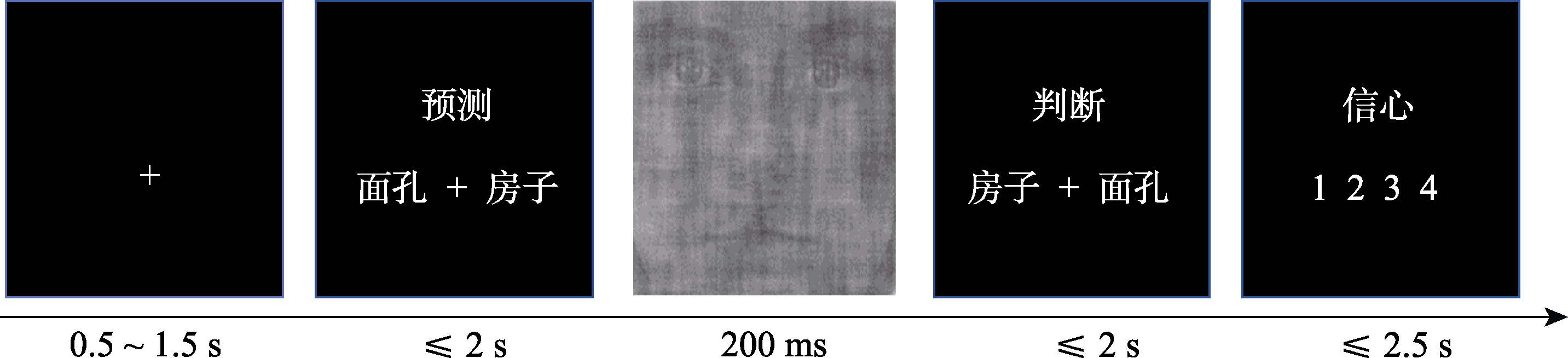
图1 实验流程图
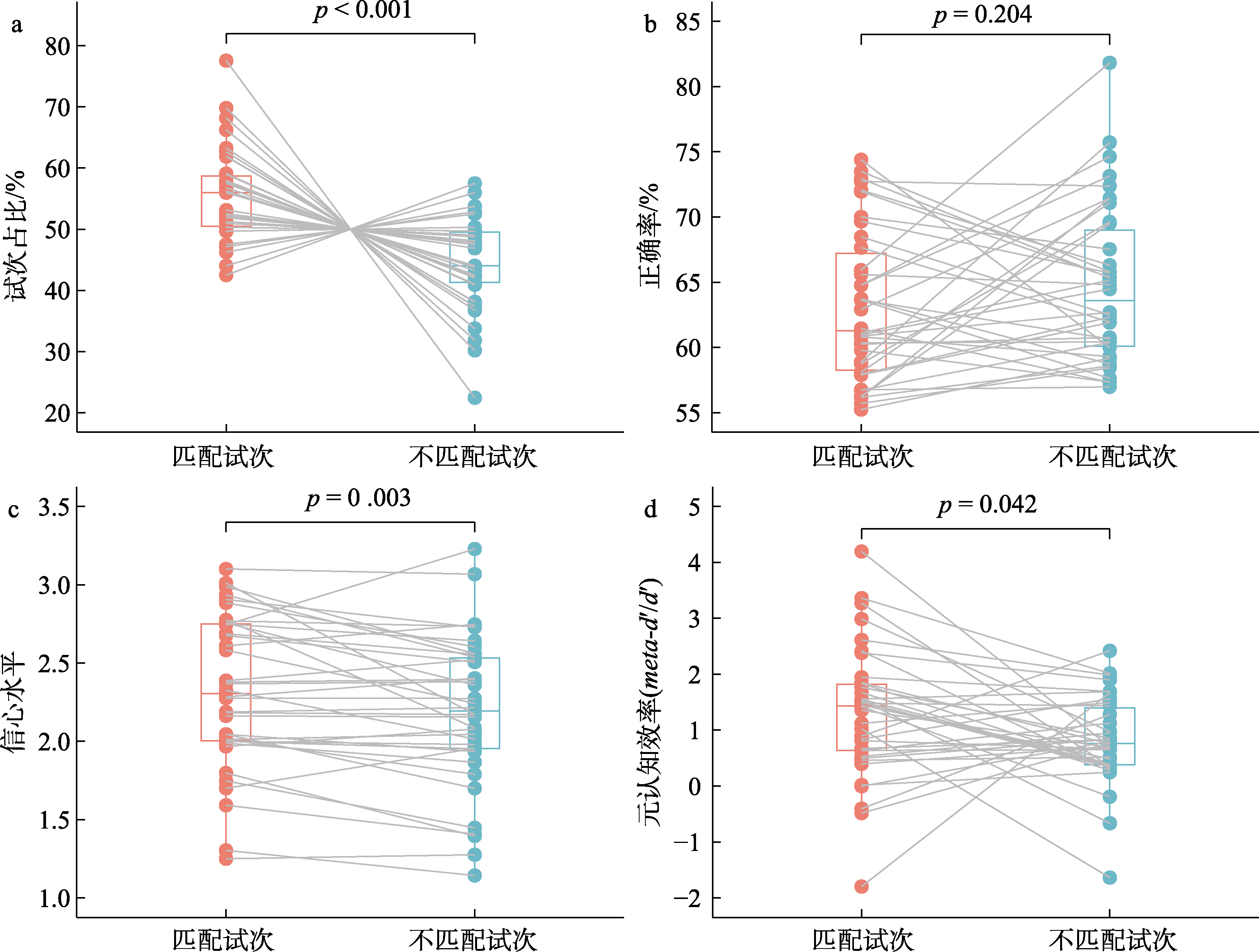
图2 实验1中被试在匹配试次和不匹配试次中的行为表现对比。(a)匹配试次占比显著高于不匹配试次占比。(b)被试在不匹配试次和匹配试次中的正确率没有显著差异。(c)被试在匹配试次上的信心水平显著高于不匹配试次。(d)被试在匹配试次上的元认知效率显著高于不匹配试次。每对点代表每个被试的值, 箱型中的上横杠线、中线、下横杠线分别代表上四分位数、中位数和下四分位数。彩图见电子版, 下同。
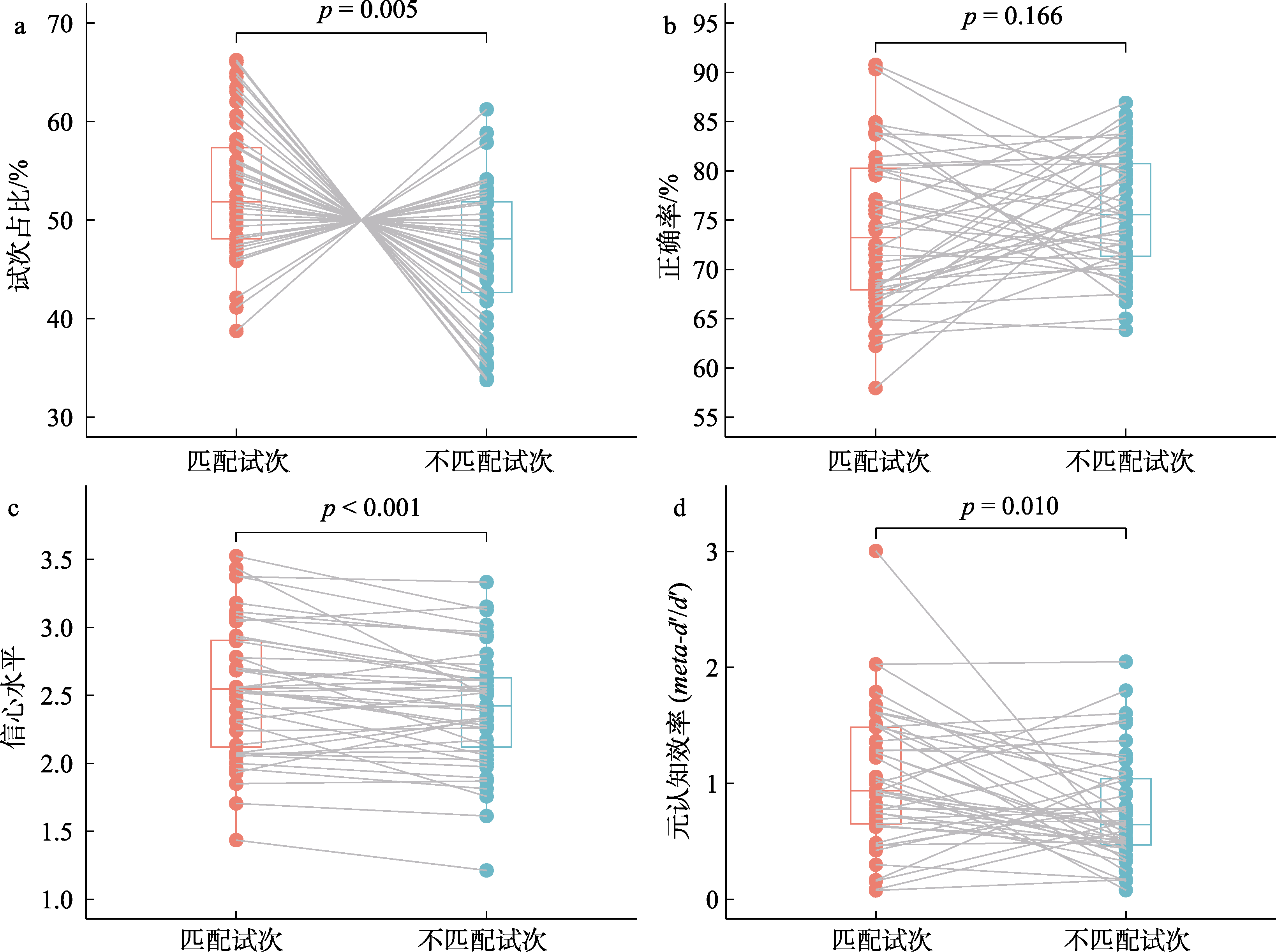
图3 实验2中被试在匹配试次和不匹配试次中的行为表现对比。(a)匹配试次占比显著高于不匹配试次占比。(b)被试在不匹配试次和匹配试次中的正确率没有显著差异。(c)被试在匹配试次上的信心水平显著高于不匹配试次。(d)被试在匹配试次上的元认知效率高于不匹配试次。
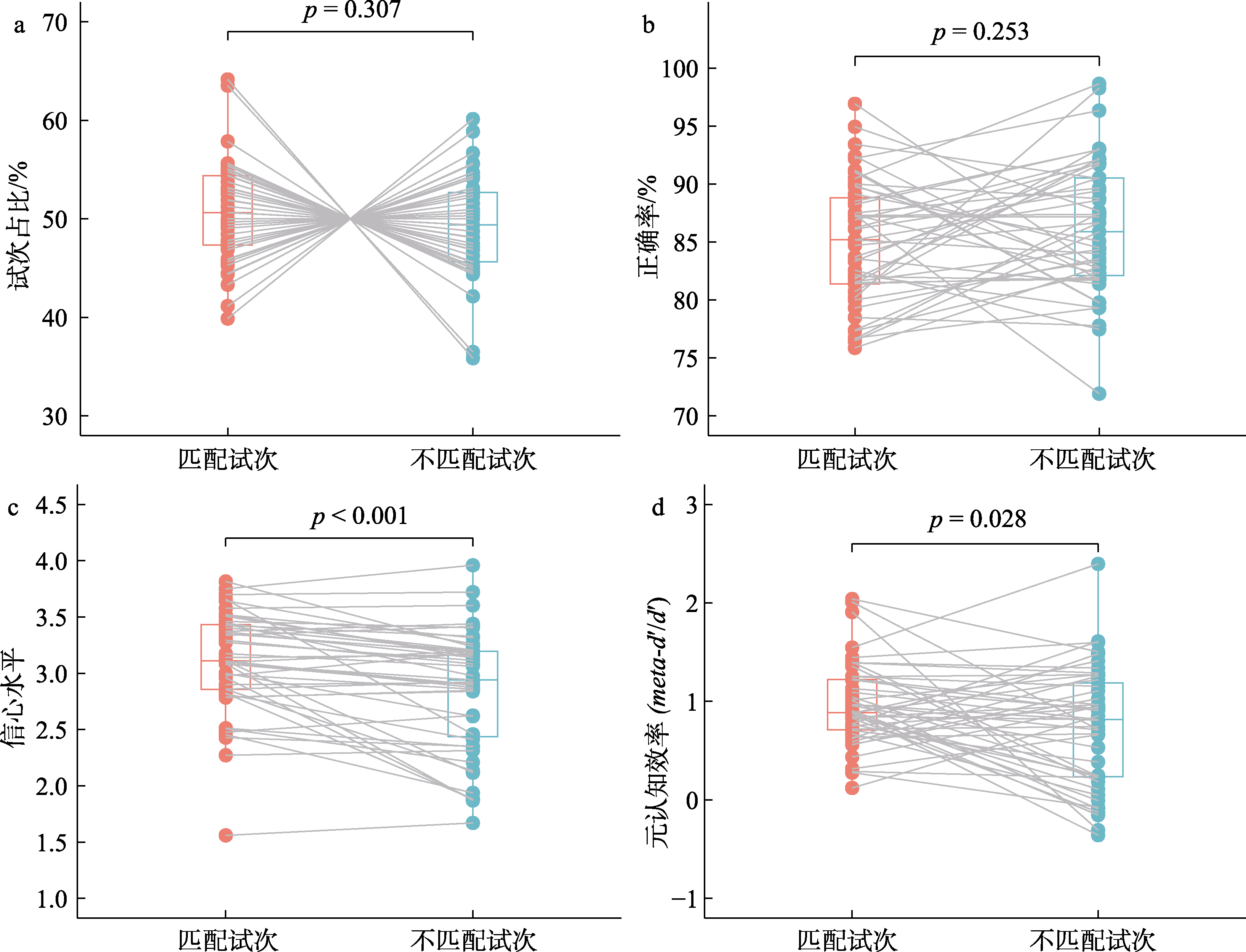
图4 实验3中被试在匹配试次和不匹配试次中的行为表现对比。(a)匹配试次占比与不匹配试次占比无显著差异。(b)被试在匹配试次和不匹配试次中的正确率没有显著差异。(c)被试在匹配试次上的信心水平显著高于不匹配试次。(d)被试在匹配试次上的元认知效率显著高于不匹配试次。
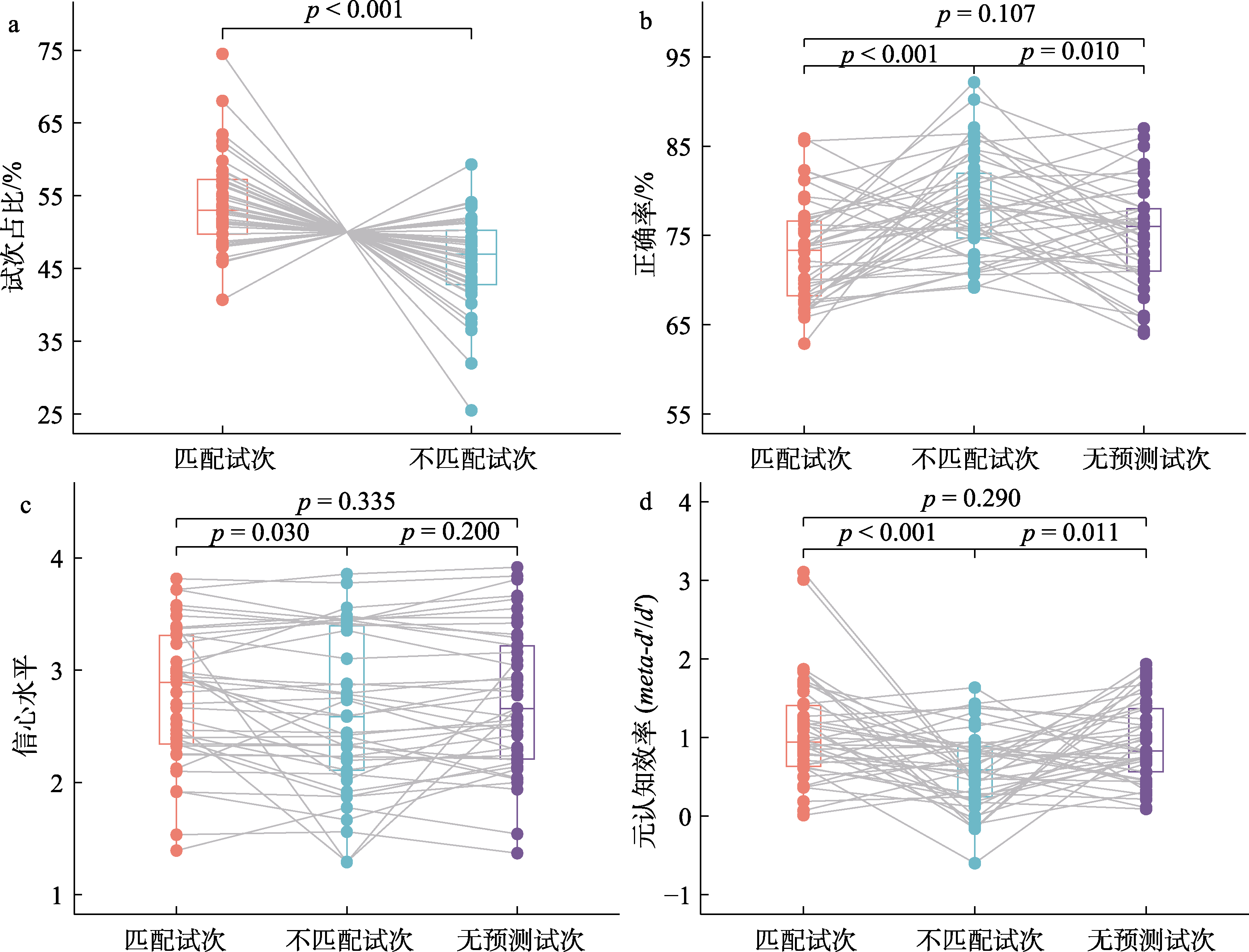
图5 实验4中被试在匹配试次、不匹配试次以及无预测试次中的行为表现对比。(a)匹配试次占比显著高于不匹配试次占比。(b)被试在不匹配试次中的正确率显著高于匹配试次和无预测试次, 匹配试次的正确率与无预测试次没有显著差异。(c)被试在匹配试次中的信心水平显著高于不匹配试次, 但两者都与无预测试次的信心水平没有显著差异。(d)被试在匹配试次中的元认知效率显著高于不匹配试次, 但与无预测试次没有显著差异, 不匹配试次的元认知效率显著低于无预测试次。
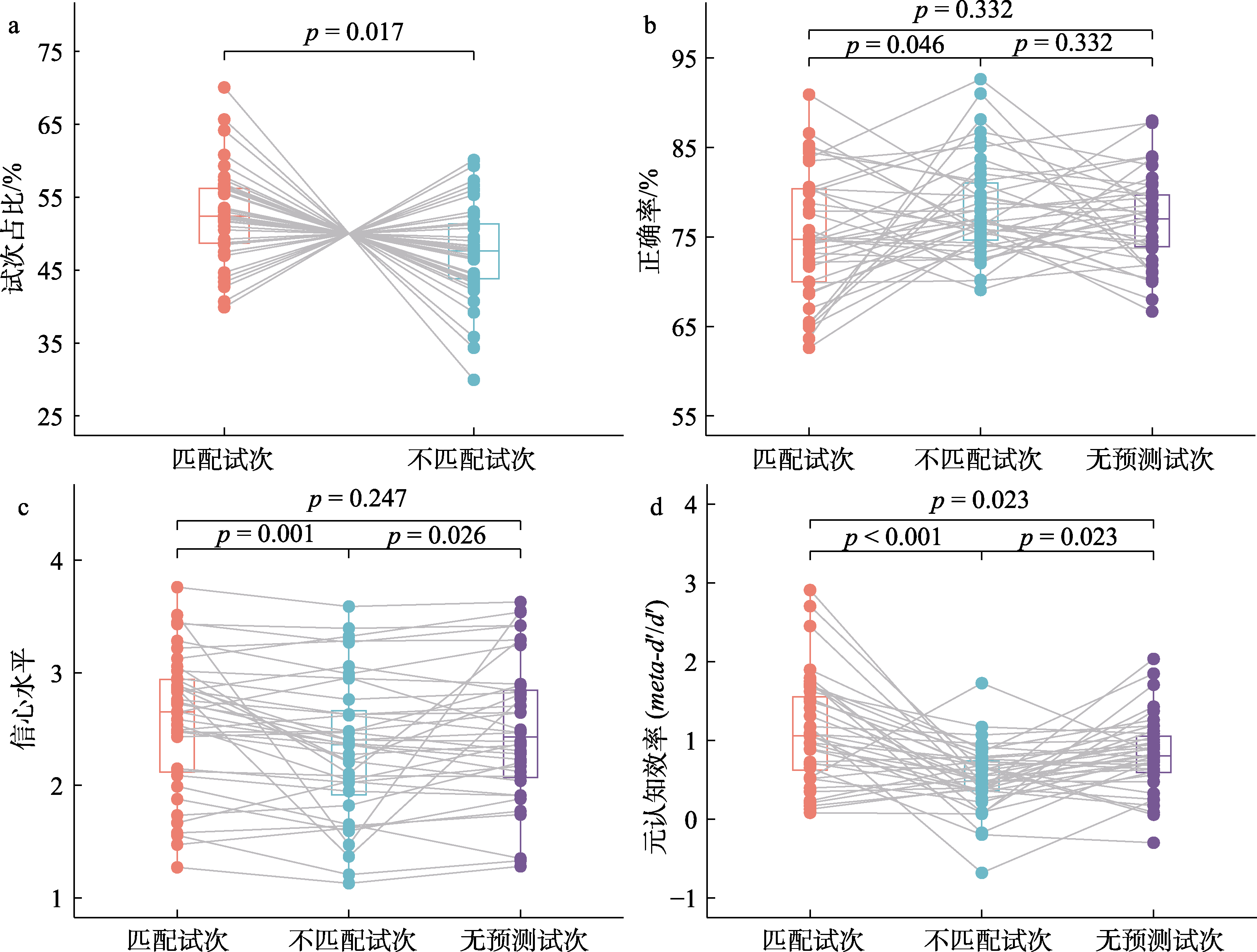
图6 实验5中被试在匹配试次、不匹配试次以及无预测试次中的行为表现对比。(a)匹配试次占比显著大于不匹配试次占比。(b)被试在不匹配试次中的正确率显著高于匹配试次, 但两者都与无预测试次的正确率没有显著差异。(c)被试在匹配试次中的信心水平显著高于不匹配试次, 但与无预测试次的信心水平没有显著差异, 不匹配试次中的信心水平显著低于无预测试次。(d)被试在匹配试次中的元认知效率显著高于不匹配试次和无预测试次, 不匹配试次中的元认知效率显著低于无预测试次。
| 实验1 | 实验2 | 实验3 | 实验4 | 实验5 | |
|---|---|---|---|---|---|
| Block1 | 0.63 ± 0.09 | 0.74 ± 0.09 | 0.82 ± 0.10 | 0.73 ± 0.11 | 0.78 ± 0.11 |
| Block2 | 0.63 ±0.09 | 0.75 ± 0.08 | 0.85 ± 0.07 | 0.74 ± 0.08 | 0.77 ± 0.09 |
| Block3 | 0.66 ± 0.08 | 0.76± 0.07 | 0.87 ± 0.07 | 0.75 ± 0.10 | 0.76 ± 0.08 |
| Block4 | 0.63 ± 0.09 | 0.73 ± 0.08 | 0.88 ± 0.05 | 0.76 ± 0.08 | 0.77 ± 0.07 |
| Block5 | 0.76 ± 0.10 | 0.75 ± 0.08 | |||
| Block6 | 0.76 ± 0.08 | 0.75 ± 0.09 | |||
| Block7 | 0.75 ± 0.09 | 0.78 ± 0.09 | |||
| Block8 | 0.76 ± 0.09 | 0.77 ± 0.07 |
表S1 实验1~5中被试在不同block中的平均正确率和标准差
| 实验1 | 实验2 | 实验3 | 实验4 | 实验5 | |
|---|---|---|---|---|---|
| Block1 | 0.63 ± 0.09 | 0.74 ± 0.09 | 0.82 ± 0.10 | 0.73 ± 0.11 | 0.78 ± 0.11 |
| Block2 | 0.63 ±0.09 | 0.75 ± 0.08 | 0.85 ± 0.07 | 0.74 ± 0.08 | 0.77 ± 0.09 |
| Block3 | 0.66 ± 0.08 | 0.76± 0.07 | 0.87 ± 0.07 | 0.75 ± 0.10 | 0.76 ± 0.08 |
| Block4 | 0.63 ± 0.09 | 0.73 ± 0.08 | 0.88 ± 0.05 | 0.76 ± 0.08 | 0.77 ± 0.07 |
| Block5 | 0.76 ± 0.10 | 0.75 ± 0.08 | |||
| Block6 | 0.76 ± 0.08 | 0.75 ± 0.09 | |||
| Block7 | 0.75 ± 0.09 | 0.78 ± 0.09 | |||
| Block8 | 0.76 ± 0.09 | 0.77 ± 0.07 |
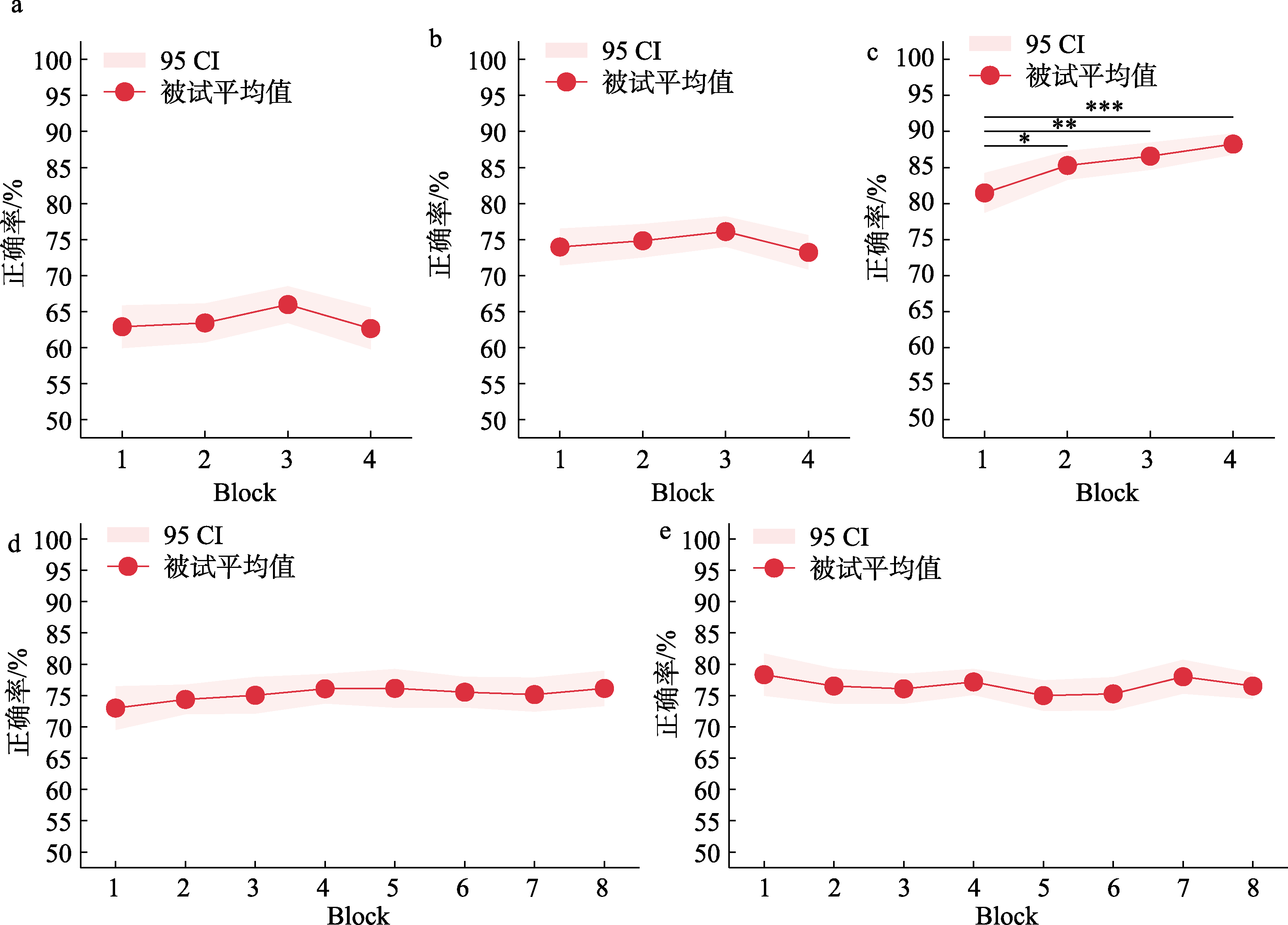
图S1 五个实验中, 被试在不同block中平均正确率的变化趋势。(a)实验1高任务难度下, 被试在不同block中的平均正确率; (b)实验2中等任务难度下, 被试在不同block中的平均正确率; (c)实验3低任务难度下, 被试在不同block中的平均正确率; (d)实验4中被试在不同block中的平均正确率; (e)实验5中被试在不同block中的平均正确率。每个圆点代表全部被试在该block中的平均正确率, 阴影部分表示95%置信区间。*表示p < 0.05, **表示p < 0.01, ***表示p < 0.001。
| 正确率−信心水平 | 正确率−元认知效率 | 信心水平−元认知效率 | |
|---|---|---|---|
| 实验1 | −0.06 | −0.13 | −0.07 |
| 实验2 | −0.02 | −0.08 | −0.10 |
| 实验3 | 0.42** | − 0.19 | 0.21 |
| 实验4 | 0.05 | −0.50*** | 0.35* |
| 实验5 | 0.44** | −0.27 | 0.10 |
表S2 实验1~5中, 被试的正确率、信心水平和元认知效率的相关
| 正确率−信心水平 | 正确率−元认知效率 | 信心水平−元认知效率 | |
|---|---|---|---|
| 实验1 | −0.06 | −0.13 | −0.07 |
| 实验2 | −0.02 | −0.08 | −0.10 |
| 实验3 | 0.42** | − 0.19 | 0.21 |
| 实验4 | 0.05 | −0.50*** | 0.35* |
| 实验5 | 0.44** | −0.27 | 0.10 |
| [1] |
Abaszadeh H., Amani M., & Pordanjani T. R. (2024). The relationship between motivational-cognitive variables, academic self-efficacy of students mediated by parent’s educational expectations, parent-child interaction, and teacher-student interaction. Learning and Motivation, 86, 101983.
doi: 10.1016/j.lmot.2024.101983 URL |
| [2] | Balsdon T., Mamassian P., & Wyart V. (2021). Separable neural signatures of confidence during perceptual decisions. eLife, 10, 68491. |
| [3] |
Botvinick M. M., Braver T. S., Barch D. M., Carter C. S., & Cohen J. D. (2001). Conflict monitoring and cognitive control. Psychological Review, 108(3), 624-652.
doi: 10.1037/0033-295x.108.3.624 pmid: 11488380 |
| [4] | Caziot B., & Mamassian P. (2021). Perceptual confidence judgments reflect self-consistency. Journal of Vision, 21(12), 8. |
| [5] |
Charles L., King J. R., & Dehaene S. (2014). Decoding the dynamics of action, intention, and error detection for conscious and subliminal stimuli. Journal of Neuroscience, 34(4), 1158-1170.
doi: 10.1523/JNEUROSCI.2465-13.2014 pmid: 24453309 |
| [6] |
Clark A. (2013). Whatever next? Predictive brains, situated agents, and the future of cognitive science. The Behavioral and Brain Sciences, 36(3), 181-204.
doi: 10.1017/S0140525X12000477 URL |
| [7] | Constant M., Pereira M., Faivre N., & Filevich E. (2023). Prior information differentially affects discrimination decisions and subjective confidence reports. Nature Communications, 14(1), 5473. |
| [8] |
Croson R., & Sundali J. (2005). The gambler's fallacy and the hot hand: Empirical data from casinos. Journal of Risk and Uncertainty, 30(3), 195-209.
doi: 10.1007/s11166-005-1153-2 URL |
| [9] |
Faul F., Erdfelder E., Lang A.-G., & Buchner A. (2007). G*Power 3: A flexible statistical power analysis program for the social, behavioral, and biomedical sciences. Behavior Research Methods, 39(2), 175-191.
doi: 10.3758/bf03193146 pmid: 17695343 |
| [10] | Festinger L. (1957). A theory of cognitive dissonance. Stanford University Press. |
| [11] |
Flavell J. H. (1979). Metacognition and cognitive monitoring: A new area of cognitive-developmental inquiry. American Psychologist, 34(10), 906-911.
doi: 10.1037/0003-066X.34.10.906 URL |
| [12] | Fleming S. M., & Dolan R. J. (2012). The neural basis of metacognitive ability. Philosophical Transactions of the Royal Society of London. Series B, Biological Sciences, 367( 1594), 1338-1349. |
| [13] |
Fleming S. M., & Lau H. C. (2014). How to measure metacognition. Frontiers in human neuroscience, 8, 443.
doi: 10.3389/fnhum.2014.00443 pmid: 25076880 |
| [14] |
Fleming S. M., van der Putten E. J., & Daw N. D. (2018). Neural mediators of changes of mind about perceptual decisions. Nature Neuroscience, 21, 617-624.
doi: 10.1038/s41593-018-0104-6 pmid: 29531361 |
| [15] |
Fleming S. M., Whiteley L., Hulme O. J., Sahani M., & Dolan R. J. (2010). Effects of category-specific costs on neural systems for perceptual decision-making. Journal of Neurophysiology, 103(6), 3238-3247.
doi: 10.1152/jn.01084.2009 pmid: 20357071 |
| [16] |
Hampton A. N., Adolphs R., Tyszka J. M., & O'Doherty J. P. (2007). Contributions of the amygdala to reward expectancy and choice signals in human prefrontal cortex. Neuron, 55(4), 545-555.
doi: 10.1016/j.neuron.2007.07.022 pmid: 17698008 |
| [17] |
Hertz U., Blakemore C., & Frith C. D. (2020). I haven’t a clue! Expectations based on repetitions and hints facilitate perceptual experience of ambiguous images. Journal of Experimental Psychology: Human Perception and Performance, 46(8), 831-846.
doi: 10.1037/xhp0000749 pmid: 32324029 |
| [18] |
Hu X., Zheng J., Su N., Fan T., Yang C., Yin Y., … Luo L. (2021). A Bayesian inference model for metamemory. Psychological Review, 128(5), 824-855.
doi: 10.1037/rev0000270 pmid: 34043396 |
| [19] |
Jazayeri M., & Movshon J. A. (2007). A new perceptual illusion reveals mechanisms of sensory decoding. Nature, 446, 912.
doi: 10.1038/nature05739 |
| [20] |
Jiang Y. J., Ma X. X., Jiang Y. T., Ren J. M., & Long Y. T. (2023). The effect of after-encoding rewards on agenda- based learning: The role of reward expectation and reward outcome. Acta Psychologica Sinica, 55(4), 542-555.
doi: 10.3724/SP.J.1041.2023.00542 URL |
|
[姜英杰, 马潇潇, 姜元涛, 任吉梅, 龙翼婷. (2023). 编码后奖赏影响基于议程的学习:奖赏预期和结果的作用. 心理学报, 55(4), 542-555.]
doi: 10.3724/SP.J.1041.2023.00542 |
|
| [21] |
Keller G. B., & Mrsic-Flogel T. D. (2018). Predictive processing: A canonical cortical computation. Neuron, 100(2), 424-435.
doi: S0896-6273(18)30857-2 pmid: 30359606 |
| [22] |
Kepecs A., Uchida N., Zariwala H. A., & Mainen Z. F. (2008). Neural correlates, computation and behavioural impact of decision confidence. Nature, 455(7210), 227-231.
doi: 10.1038/nature07200 |
| [23] |
Kiani R., & Shadlen M. N. (2009). Representation of confidence associated with a decision by neurons in the parietal cortex. Science, 324(5928), 759-764.
doi: 10.1126/science.1169405 pmid: 19423820 |
| [24] |
Kok P., Failing M. F., & de Lange F. P. (2014). Prior expectations evoke stimulus templates in the primary visual cortex. Journal of Cognitive Neuroscience, 26(7), 1546-1554.
doi: 10.1162/jocn_a_00562 pmid: 24392894 |
| [25] |
Leek M. R. (2001). Adaptive procedures in psychophysical research. Perception & Psychophysics, 63(8), 1279-1292.
doi: 10.3758/BF03194543 URL |
| [26] |
Liu C., & Yu R. (2024). Neural mechanisms underpinning metacognitive shifts driven by non-informative predictions. NeuroImage, 296, 120670.
doi: 10.1016/j.neuroimage.2024.120670 URL |
| [27] | Lundqvist D., Flykt A., & Öhman A. (1998). Karolinska Directed Emotional Faces (KDEF) [Database record]. APA PsycTests. |
| [28] | Luu L., & Stocker A. A. (2018). Post-decision biases reveal a self-consistency principle in perceptual inference. eLife, 7, 33334. |
| [29] | Macmillan N. A., & Creelman C. D. (2005). Detection theory: A user's guide (2nd ed.). Lawrence Erlbaum Associates Publishers. |
| [30] |
Maniscalco B., & Lau H. (2012). A signal detection theoretic approach for estimating metacognitive sensitivity from confidence ratings. Consciousness and Cognition, 21(1), 422-430.
doi: 10.1016/j.concog.2011.09.021 pmid: 22071269 |
| [31] | Maniscalco B., Peters M. A., & Lau H. (2016). Heuristic use of perceptual evidence leads to dissociation between performance and metacognitive sensitivity. Attention, Perception & Psychophysics, 78( 3), 923-937. |
| [32] |
Masson M. E. J. (2011). A tutorial on a practical Bayesian alternative to null-hypothesis significance testing. Behavior Research Methods, 43(3), 679-690.
doi: 10.3758/s13428-010-0049-5 pmid: 21302025 |
| [33] | Nelson T. O., & Narens L. (1990). Metamemory: A theoretical framework and new findings. Psychology of Learning and Motivation, 26, 125-173. |
| [34] |
Oskarsson A. T., Van Boven L., McClelland G. H., & Hastie R. (2009). What's next? Judging sequences of binary events. Psychological Bulletin, 135(2), 262-285.
doi: 10.1037/a0014821 pmid: 19254080 |
| [35] | Peters M. A. K., Thesen T., Ko Y. D., Maniscalco B., Carlson C., Davidson M., … Lau H. (2017). Perceptual confidence neglects decision-incongruent evidence in the brain. Nature Human Behavior, 1, 139. |
| [36] |
Posner M. I. (1980). Orienting of attention. Quarterly Journal of Experimental Psychology, 32(1), 3-25.
doi: 10.1080/00335558008248231 pmid: 7367577 |
| [37] |
Rahnev D., Lau H., & de Lange F. P. (2011). Prior expectation modulates the interaction between sensory and prefrontal regions in the human brain. Journal of Neuroscience, 31(29), 10741-10748.
doi: 10.1523/JNEUROSCI.1478-11.2011 pmid: 21775617 |
| [38] |
Sherman M. T., Seth A. K., Barrett A. B., & Kanai R. (2015). Prior expectations facilitate metacognition for perceptual decision. Consciousness and Cognition, 35, 53-65.
doi: 10.1016/j.concog.2015.04.015 pmid: 25973773 |
| [39] |
Sherman M. T., Seth A. K., & Kanai R. (2016). Predictions shape confidence in right inferior frontal gyrus. Journal of Neuroscience, 36(40), 10323-10336.
pmid: 27707969 |
| [40] |
Stein T., & Peelen M. V. (2015). Content-specific expectations enhance stimulus detectability by increasing perceptual sensitivity. Journal of Experimental Psychology: General, 144(6), 1089-1104.
doi: 10.1037/xge0000109 URL |
| [41] | Summerfield C., & de Lange F. P. (2014). Expectation in perceptual decision making: Neural and computational mechanisms. Nature Reviews. Neuroscience, 15(11), 745-756. |
| [42] | Sun F., Ni Y., Lu W., Su J., Wang S., & Wan X. (2025). Confidence bias prescribes the neurocomputational mechanism of decision-making. Cell Reports, 44(5), 115563. Advance online publication. |
| [43] |
Talluri B. C., Urai A. E., Tsetsos K., Usher M., & Donner T. H. (2018). Confirmation bias through selective overweighting of choice-consistent evidence. Current Biology, 28(19), 3128-3135.
doi: S0960-9822(18)30982-5 pmid: 30220502 |
| [44] | Thomas E. R., Rittershofer K., & Press C. (2023). Updating perceptual expectations as certainty diminishes. Cognition, 232, 105356. |
| [45] | Urai A. E., de Gee J. W., Tsetsos K., & Donner T. H. (2019). Choice history biases subsequent evidence accumulation. eLife, 8, 46331. |
| [46] |
Vlassova A., Donkin C., & Pearson J. (2014). Unconscious information changes decision accuracy but not confidence. Proceedings of the National Academy of Sciences of the United States of America, 111(45), 16214-16218.
doi: 10.1073/pnas.1403619111 pmid: 25349435 |
| [47] | von Neumann J., & Morgenstern O. (1944). Theory of games and economic behavior. Princeton University Press. |
| [48] |
Walkey F. H., McClure J., Meyer L. H., & Weir K. F. (2013). Low expectations equal no expectations: Aspirations, motivation, and achievement in secondary school. Contemporary Educational Psychology, 38(4), 306-315.
doi: 10.1016/j.cedpsych.2013.06.004 URL |
| [49] |
Yanagisawa H. (2016). A computational model of perceptual expectation effect based on neural coding principles. Journal of Sensory Studies, 31(5), 430-439.
doi: 10.1111/joss.2016.31.issue-5 URL |
| [50] | Yon D., de Lange F. P., & Press C. (2019). The predictive brain as a stubborn scientist. Trends in Cognitive Sciences, 23(1), 6-8. |
| [1] | 冉雅璇, 牛熠欣, 陈斯允. “多”反而少:元认知推断视角下支付渠道数量对个体捐赠的影响[J]. 心理学报, 2021, 53(4): 413-430. |
| [2] | 赵文博, 姜英杰, 王志伟, 胡竞元. 编码强度对字体大小效应的影响[J]. 心理学报, 2020, 52(10): 1156-1167. |
| [3] | 赵瑞瑛, 娄昊, 欧阳明昆, 张清芳. 自然情境下舌尖效应的认知年老化——日记研究[J]. 心理学报, 2019, 51(5): 598-611. |
| [4] | 汪涛,张琴,张辉,周玲,刘洪深. 如何削弱产品来源国效应*—— 产品信息呈现方式的影响研究[J]. 心理学报, 2012, 44(6): 841-852. |
| [5] | 史滋福,邱江,张庆林. 明确嵌套集合关系对贝叶斯推理的促进效应[J]. 心理学报, 2006, 38(06): 833-840. |
| [6] | 黎坚,张厚粲. 认知操作背景下在线元认知调节能力的特征[J]. 心理学报, 2006, 38(03): 342-348. |
| [7] | 李晓东,张向葵,沃建中. 小学三年级数学学优生与学困生解决比较问题的差异[J]. 心理学报, 2002, 34(04): 70-76. |
| [8] | 汪玲,郭德俊. 元认知的本质与要素[J]. 心理学报, 2000, 32(4): 458-463. |
| [9] | 张庆林,杨雄. 大学生解决四卡问题的叙述理由效应[J]. 心理学报, 1998, 30(3): 348-352. |
| [10] | 刘儒德. CAI下小学低年级学生的学习控制水平与元认知监控水平的关系[J]. 心理学报, 1997, 29(2): 166-171. |
| [11] | 陈英和,刘玉新. 小学生形成合取概念的策略训练及其迁移效果[J]. 心理学报, 1996, 28(4): 367-374. |
| [12] | 章凯,张必隐. 兴趣对文章理解的作用[J]. 心理学报, 1996, 28(3): 284-289. |
| [13] | 杨宁. 元认知研究的理论意义[J]. 心理学报, 1995, 27(3): 322-328. |
| 阅读次数 | ||||||
|
全文 |
|
|||||
|
摘要 |
|
|||||
