

ISSN 0439-755X
CN 11-1911/B
主办:中国心理学会
中国科学院心理研究所
出版:科学出版社
CN 11-1911/B
主办:中国心理学会
中国科学院心理研究所
出版:科学出版社
心理学报 ›› 2026, Vol. 58 ›› Issue (5): 903-917.doi: 10.3724/SP.J.1041.2026.0903 cstr: 32110.14.2026.0903
蒋家丽1,2, 章鹏1,2,3, 樊利芳1,2, 刘颖1,2, 卢柳柳1,2, 白学军1,2,3( )
)
收稿日期:2025-05-20
发布日期:2026-03-04
出版日期:2026-05-25
通讯作者:
白学军, E-mail: bxuejun@126.com基金资助:
JIANG Jiali1,2, ZHANG Peng1,2,3, FAN Lifang1,2, LIU Ying1,2, LU Liuliu1,2, BAI Xuejun1,2,3()
Received:2025-05-20
Online:2026-03-04
Published:2026-05-25
摘要:
为揭示稀缺感知和感知顺序对抑制控制的影响, 以及稀缺感知是即时性还是长时程影响抑制控制。研究1以272名大学生为被试, 结合问卷法与实验法探究稀缺感知与抑制控制的关系。结果发现:相比充裕感知, 稀缺感知下个体的抑制控制水平更低。研究2以101名大学生为被试, 创设情境使被试先后经历稀缺感知和充裕感知, 但经历两种感知的顺序不同。结果表明:相比经历由充裕感知到稀缺感知, 个体先经历稀缺感知后经历充裕感知时, 在充裕感知下Flanker任务的反应时会显著降低, 但感知顺序不影响抑制控制。研究3以126名大学生为被试(童年稀缺感知经历多与少者各63人), 同时诱发其当下体验稀缺感知和感知顺序, 结果显示:当下经历由充裕感知到稀缺感知时, 童年稀缺感知经历多者在稀缺感知状态下的抑制控制水平显著高于童年稀缺感知经历少者。这表明稀缺感知既会即刻影响抑制控制, 也会通过早期经验长时程塑造抑制控制。综上, 由“俭”入“奢”时, 充裕感知能更好地促进一般性认知加工行为表现; 而由“奢”入“俭”时, 稀缺感知会损害童年稀缺感知经历少者的抑制控制。研究结果进一步拓展了稀缺理论。
中图分类号:
蒋家丽, 章鹏, 樊利芳, 刘颖, 卢柳柳, 白学军. (2026). 由“俭”入“奢”与由“奢”入“俭”:稀缺感知顺序与童年稀缺经历对抑制控制的影响. 心理学报, 58(5), 903-917.
JIANG Jiali, ZHANG Peng, FAN Lifang, LIU Ying, LU Liuliu, BAI Xuejun. (2026). Transition from “frugality” to “luxury” and vice versa: Effects of transition order and childhood scarcity experience on inhibitory control. Acta Psychologica Sinica, 58(5), 903-917.
| 变量 | 抑制控制量表总分(β) | |
|---|---|---|
| 第一层 | 年龄 | -0.10 |
| 性别 | 0.08 | |
| R2 | 0.02 | |
| F | 1.53 | |
| 第二层 | 稀缺感知 | 0.45*** |
| R2 | 0.22 | |
| F | 16.86*** |
表1 稀缺感知对抑制控制的分层回归分析
| 变量 | 抑制控制量表总分(β) | |
|---|---|---|
| 第一层 | 年龄 | -0.10 |
| 性别 | 0.08 | |
| R2 | 0.02 | |
| F | 1.53 | |
| 第二层 | 稀缺感知 | 0.45*** |
| R2 | 0.22 | |
| F | 16.86*** |

图1 三个阶段的知觉游戏任务 注:a为阶段游戏任务中第一阶段的点数比较任务; b为第二阶段的形状匹配任务; c为第三阶段的点数估计任务。彩图见电子版, 下同
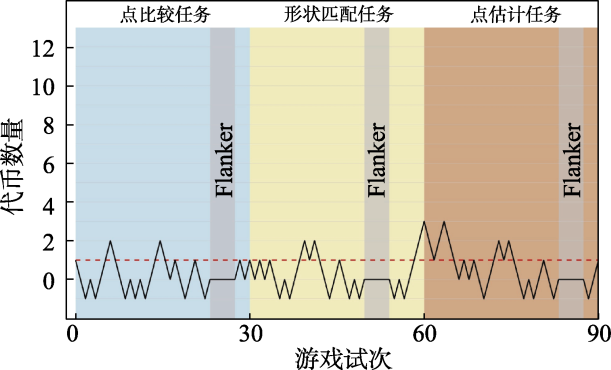
图2 稀缺感知条件下阶段游戏任务中代币数量的变化 注:红色虚线代表继续进入下一阶段的知觉游戏所需的阈值(1个代币)。不同的颜色代表阶段游戏中的不同任务。灰色部分代表被试需执行Flanker任务的时刻。所有被试在稀缺感知条件下都会获得相同的反馈模式, 下同。
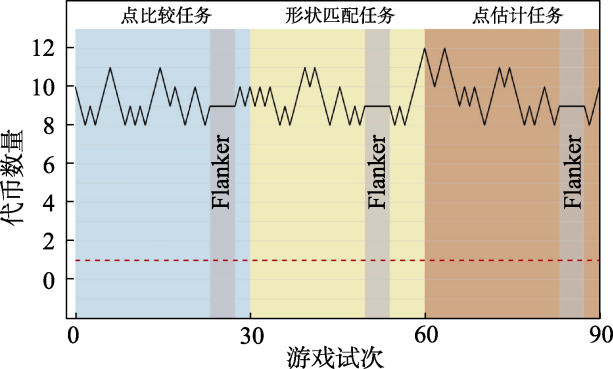
图3 充裕感知条件下在阶段游戏任务中代币数量的变化
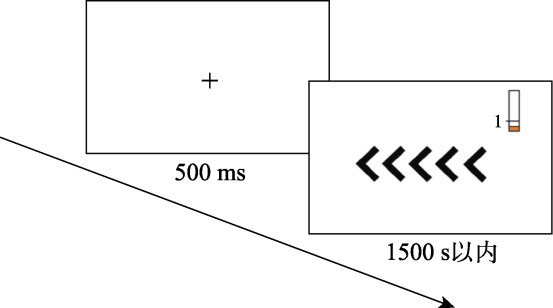
图4 Flanker任务 注:屏幕右的条形框是提示被试在先前阶段游戏中获得的代币数量(数字1代表进入下一阶段知觉游戏任务所需的最小代币数量), 以暗示被试正处于稀缺或充裕感知中; 橙色部分代表当前拥有的代币数量。
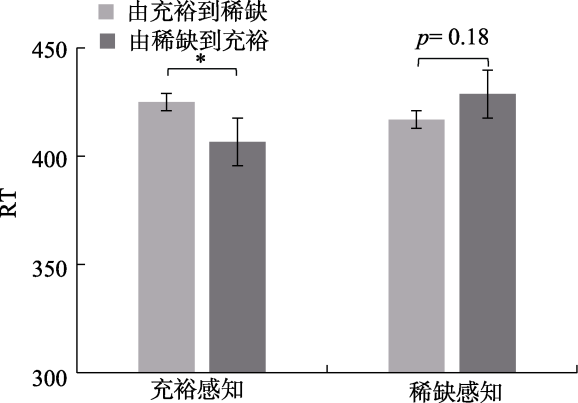
图5 不同感知顺序和感知类型下被试的任务表现 注:*代表p < 0.05, 下同。
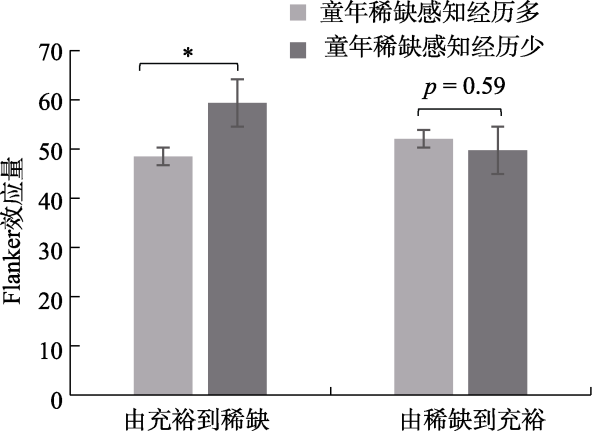
图6 童年稀缺感知经历多者与少者在当下面临不同感知顺序时的抑制控制水平
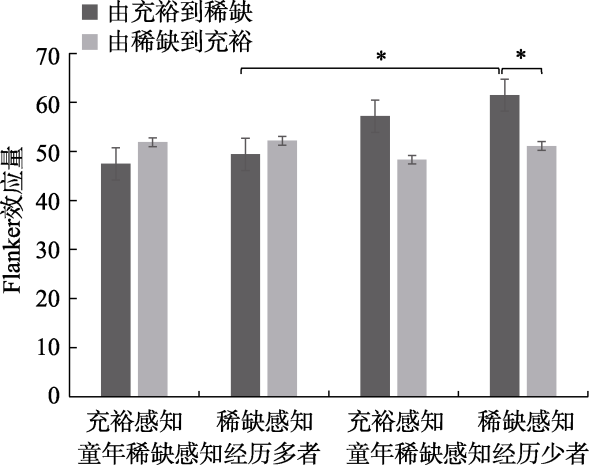
图7 童年稀缺感知经历调节感知类型和感知顺序对抑制控制的影响
| [1] |
Agneman, G., Falco, P., Joel, E., & Selejio, O. (2023). The material basis of cooperation: How scarcity reduces trusting behaviour. The Economic Journal, 133(652), 1265-1285.
doi: 10.1093/ej/ueac087 URL |
| [2] |
Araneda, R., Renier, L., Dricot, L., Decat, M., Ebner- Karestinos, D., Deggouj, N., & De Volder, A. G. (2018). A key role of the prefrontal cortex in the maintenance of chronic tinnitus: An fMRI study using a Stroop task. NeuroImage: Clinical, 17, 325-334.
doi: 10.1016/j.nicl.2017.10.029 URL |
| [3] |
Badre, D. (2025). Cognitive control. Annual Review of Psychology, 76, 167-195.
doi: 10.1146/psych.2025.76.issue-1 URL |
| [4] |
Belsky, J. (2010). Childhood experience and the development of reproductive strategies. Psicothema, 22, 28-34.
pmid: 20100424 |
| [5] |
Black, K. J., DePhillips, O. C., & Britt, T. W. (2025). I can afford to relax: Relating perceived income adequacy to recovery and health. Occupational Health Science, 9(1), 131-153.
doi: 10.1007/s41542-024-00200-3 pmid: 40124169 |
| [6] |
Camerer, C. F., Dreber, A., Holzmeister, F., Ho, T.-H., Huber, J., Johannesson, M., … Wu, H. (2018). Evaluating the replicability of social science experiments in Nature and Science between 2010 and 2015. Nature Human Behaviour, 2(9), 637-644.
doi: 10.1038/s41562-018-0399-z pmid: 31346273 |
| [7] |
Campbell, J. I. D., & Thompson, V. A. (2012). MorePower 6.0 for ANOVA with relational confidence intervals and Bayesian analysis. Behavior Research Methods, 44(4), 1255-1265.
doi: 10.3758/s13428-012-0186-0 pmid: 22437511 |
| [8] | Chancel, L., Piketty, T., Saez, E., & Zucman, G. (2022). World inequality report 2022. Harvard University Press. |
| [9] |
Chen, Y., Xu, M., & Wang, X. (2020). The cognitive neural network model of trust. Advances in Psychological Science, 28(5), 800-809.
doi: 10.3724/SP.J.1042.2020.00800 |
|
[陈瀛, 徐敏霞, 汪新建. (2020). 信任的认知神经网络模型. 心理科学进展, 28(5), 800-809.]
doi: 10.3724/SP.J.1042.2020.00800 |
|
| [10] |
Cohn-Schwartz, E., & Weinstein, G. (2020). Early-life food deprivation and cognitive performance among older Europeans. Maturitas, 141, 26-32.
doi: 10.1016/j.maturitas.2020.06.020 pmid: 33036699 |
| [11] |
De Almeida, F., Scott, I. J., Soro, J. C., Fernandes, D., Amaral, A. R., Catarino, M. L., Arêde, A., & Ferreira, M. B. (2024). Financial scarcity and cognitive performance: A meta- analysis. Journal of Economic Psychology, 101, Article 102702.
doi: 10.1016/j.joep.2024.102702 URL |
| [12] |
DeJoseph, M. L., Ellwood-Lowe, M. E., Miller-Cotto, D., Silverman, D., Shannon, K. A., Reyes, G., Rakesh, D., & Frankenhuis, W. E. (2024). The promise and pitfalls of a strength-based approach to child poverty and neurocognitive development: Implications for policy. Developmental Cognitive Neuroscience, 66, Article 101375.
doi: 10.1016/j.dcn.2024.101375 URL |
| [13] |
Diamond, A. (2013). Executive functions. Annual Review of Psychology, 64(1), 135-168.
doi: 10.1146/psych.2013.64.issue-1 URL |
| [14] |
Ellis, B. J., Abrams, L. S., Masten, A. S., Sternberg, R. J., Tottenham, N., & Frankenhuis, W. E. (2022). Hidden talents in harsh environments. Development and Psychopathology, 34(1), 95-113.
doi: 10.1017/S0954579420000887 URL |
| [15] |
Ellis, B. J., Bianchi, J., Griskevicius, V., & Frankenhuis, W. E. (2017). Beyond risk and protective factors: An adaptation-based approach to resilience. Perspectives on Psychological Science, 12(4), 561-587.
doi: 10.1177/1745691617693054 pmid: 28679332 |
| [16] |
Ellis, B. J., Figueredo, A. J., Brumbach, B. H., & Schlomer, G. L. (2009). Fundamental dimensions of environmental risk: The impact of harsh versus unpredictable environments on the evolution and development of life history strategies. Human Nature, 20(2), 204-268.
doi: 10.1007/s12110-009-9063-7 URL |
| [17] |
Evans, G. W., & Schamberg, M. A. (2009). Childhood poverty, chronic stress, and adult working memory. Proceedings of the National Academy of Sciences of the United States of America, 106(16), 6545-6549.
doi: 10.1073/pnas.0811910106 pmid: 19332779 |
| [18] |
Frankenhuis, W. E., & De Weerth, C. (2013). Does early-life exposure to stress shape or impair cognition? Current Directions in Psychological Science, 22(5), 407-412.
doi: 10.1177/0963721413484324 URL |
| [19] |
Gneezy, A., Imas, A., & Jaroszewicz, A. (2020). The impact of agency on time and risk preferences. Nature Communications, 11(1), Article 2665.
doi: 10.1038/s41467-020-16440-0 pmid: 32472056 |
| [20] |
González-Arango, F., Corredor, J., López-Ardila, M. A., Contreras-González, M. C., Herrera-Santofimio, J., & González, J. J. (2022). The duality of poverty: A replication of Mani et al. (2013) in Colombia. Theory and Decision, 92(1), 39-73.
doi: 10.1007/s11238-021-09836-x |
| [21] |
Griskevicius, V., Tybur, J. M., Delton, A. W., & Robertson, T. E. (2011). The influence of mortality and socioeconomic status on risk and delayed rewards: A life history theory approach. Journal of Personality and Social Psychology, 100(6), 1015-1026.
doi: 10.1037/a0022403 pmid: 21299312 |
| [22] |
Hawkins, M. A. W., Layman, H. M., Ganson, K. T., Tabler, J., Ciciolla, L., Tsotsoros, C. E., & Nagata, J. M. (2021). Adverse childhood events and cognitive function among young adults: Prospective results from the national longitudinal study of adolescent to adult health. Child Abuse & Neglect, 115, Article 105008.
doi: 10.1016/j.chiabu.2021.105008 URL |
| [23] | Huang, C., Tang, Y., Wang, L., Xie, D., Fan, C., & Gao, W. (2014). Development of the Executive Function Scale for Adolescents. Chinese Journal of Behavioral Medicine and Brain Science, 23(5), 463-465. |
| [黄春晖, 唐义诚, 王利刚, 谢东杰, 樊春雷, 高文斌. (2014). 青少年执行功能量表的编制. 中华行为医学与脑科学杂志, 23(5), 463-465.] | |
| [24] |
Huang, L., Li, X., Xu, F., & Li, F. (2023). Consequences of scarcity: The impact of perceived scarcity on executive functioning and its neural basis. Frontiers in Neuroscience, 17, Article 1158544.
doi: 10.3389/fnins.2023.1158544 URL |
| [25] |
Huijsmans, I., Ma, I., Micheli, L., Civai, C., Stallen, M., & Sanfey, A. G. (2019). A scarcity mindset alters neural processing underlying consumer decision making. Proceedings of the National Academy of Sciences, 116(24), 11699-11704.
doi: 10.1073/pnas.1818572116 URL |
| [26] |
Jiang, X., Zhou, C., Ao, N., Gu, W., Li, J., & Chen, Y. (2021). Scarcity mindset neuro network decoding with reward: A tree-based model and functional near-infrared spectroscopy study. Frontiers in Human Neuroscience, 15, Article 736415.
doi: 10.3389/fnhum.2021.736415 URL |
| [27] |
Lei, L., Wang, J., & Liu, W. (2020). The effect of scarcity on individuals’ psychology and behavior: An explanation from a more integrated perspective. Advances in Psychological Science, 28(5), 833-843
doi: 10.3724/SP.J.1042.2020.00833 |
|
[雷亮, 王菁煜, 柳武妹. (2020). 稀缺对个体心理和行为的影响:基于一个更加整合视角下的阐释. 心理科学进展, 28(5), 833-843.]
doi: 10.3724/SP.J.1042.2020.00833 |
|
| [28] | Li, W., Meng, J., & Cui, F. (2023). Scarcity mindset reduces empathic responses to others’ pain: The behavioral and neural evidence. Social Cognitive and Affective Neuroscience, 18(1), 1-10. |
| [29] | Lian, J., Kiely, K. M., Callaghan, B. L., Eramudugolla, R., Mortby, M., & Anstey, K. J. (2024). No association found: Adverse childhood experiences and cognitive impairment in older Australian adults. The Journal of Prevention of Alzheimer’ s Disease, 11(6), 1818-1825. |
| [30] |
Liang, S., Ye, D., & Liu, Y. (2021). The effect of perceived scarcity: Experiencing scarcity increases risk taking. The Journal of Psychology, 155(1), 59-89.
doi: 10.1080/00223980.2020.1822770 URL |
| [31] |
Ma, J., Yang, Y., Wan, Y., Shen, C., & Qiu, P. (2021). The influence of childhood adversities on mid to late cognitive function: From the perspective of life course. Plos One, 16(8), e0256297.
doi: 10.1371/journal.pone.0256297 URL |
| [32] |
Mani, A., Mullainathan, S., Shafir, E., & Zhao, J. (2013). Poverty impedes cognitive function. Science, 341(6149), 976-980.
doi: 10.1126/science.1238041 pmid: 23990553 |
| [33] |
Mani, A., Mullainathan, S., Shafir, E., & Zhao, J. (2020). Scarcity and cognitive function around payday: A conceptual and empirical analysis. Journal of the Association for Consumer Research, 5(4), 365-376.
doi: 10.1086/709885 URL |
| [34] |
Miller, G. A. (1956). The magical number seven, plus or minus two: Some limits on our capacity for processing information. Psychological Review, 63(2), 81-97.
doi: 10.1037/h0043158 URL |
| [35] |
Mittal, C., Griskevicius, V., Simpson, J. A., Sung, S., & Young, E. S. (2015). Cognitive adaptations to stressful environments: When childhood adversity enhances adult executive function. Journal of Personality and Social Psychology, 109(4), 604-621.
doi: 10.1037/pspi0000028 pmid: 26414842 |
| [36] |
Miyake, A., Friedman, N. P., Emerson, M. J., Witzki, A. H., Howerter, A., & Wager, T. D. (2000). The unity and diversity of executive functions and their contributions to complex “frontal lobe” tasks: A latent variable analysis. Cognitive Psychology, 41(1), 49-100.
doi: 10.1006/cogp.1999.0734 pmid: 10945922 |
| [37] |
Moffitt, T. E., Arseneault, L., Belsky, D., Dickson, N., Hancox, R. J., Harrington, H., … Caspi, A. (2011). A gradient of childhood self-control predicts health, wealth, and public safety. Proceedings of the National Academy of Sciences, 108(7), 2693-2698.
doi: 10.1073/pnas.1010076108 URL |
| [38] | Mullainathan, S., & Shafir, E. (). Scarcity: Why having too little means so much. NY: Henry Holt. |
| [39] | O’Donnell, M., Dev, A. S., Antonoplis, S., Baum, S. M., Benedetti, A. H., Brown, N. D., … Nelson, L. D.(2021). Empirical audit and review and an assessment of evidentiary value in research on the psychological consequences of scarcity. PNAS Proceedings of the National Academy of Sciences of the United States of America, 118(44), e2103313118. |
| [40] |
Ong, Q., Theseira, W., & Ng, I. Y. H. (2019). Reducing debt improves psychological functioning and changes decision-making in the poor. Proceedings of the National Academy of Sciences, 116(15), 7244-7249.
doi: 10.1073/pnas.1810901116 URL |
| [41] |
Rad, M. S., Ansarinia, M., & Shafir, E. (2023). Temporary self-deprivation can impair cognitive control: Evidence from the Ramadan fast. Personality and Social Psychology Bulletin, 49(3), 415-428.
doi: 10.1177/01461672211070385 URL |
| [42] |
Reutter, L. I., Stewart, M. J., Veenstra, G., Love, R., Raphael, D., & Makwarimba, E. (2009). “Who do they think we are, anyway?”: Perceptions of and responses to poverty stigma. Qualitative Health Research, 19(3), 297-311.
doi: 10.1177/1049732308330246 pmid: 19224874 |
| [43] | Roux, C., Goldsmith, K., & Bonezzi, A. (2015). On the psychology of scarcity: When reminders of resource scarcity promote selfish (and generous) behavior. Journal of Consumer Research, 42(4), 615-631. |
| [44] |
Seery, M. D. (2011). Challenge or threat? Cardiovascular indexes of resilience and vulnerability to potential stress in humans. Neuroscience & Biobehavioral Reviews, 35(7), 1603-1610.
doi: 10.1016/j.neubiorev.2011.03.003 URL |
| [45] |
Shah, A. K., Mullainathan, S., & Shafir, E. (2012). Some consequences of having too little. Science, 338(6107), 682-685.
doi: 10.1126/science.1222426 pmid: 23118192 |
| [46] |
Shah, A. K., Zhao, J., Mullainathan, S., & Shafir, E. (2018). Money in the mental lives of the poor. Social Cognition, 36(1), 4-19.
doi: 10.1521/soco.2018.36.1.4 URL |
| [47] |
Szaszi, B., Palfi, B., Neszveda, G., Taka, A., Szécsi, P., Blattman, C., Jamison, J. C., & Sheridan, M. (2023). Does alleviating poverty increase cognitive performance? Short- and long-term evidence from a randomized controlled trial. Cortex, 169, 81-94.
doi: 10.1016/j.cortex.2023.07.009 pmid: 37866061 |
| [48] | Van Der Veer, A., Madern, T., & Van Lenthe, F. J. (2024). Tunneling, cognitive load and time orientation and their relations with dietary behavior of people experiencing financial scarcity an AI-assisted scoping review elaborating on scarcity theory. International Journal of Behavioral Nutrition and Physical Activity, 21(1), Article 26. |
| [49] | Wang, Q., Liu, S., Wang, F., & Shi, W. (2024). How money scarcity influences individuals’ cognitive control. Sage Open, 14(2), 1-14. |
| [50] |
Wang, Y., Lin, Z., Hou, B., & Sun, S. (2017). The intrinsic mechanism of life history trade-offs: The mediating role of control striving. Acta Psychologica Sinica, 49(6), 783-793.
doi: 10.3724/SP.J.1041.2017.00783 URL |
| [王燕, 林镇超, 侯博文, 孙时进. (2017). 生命史权衡的内在机制:动机控制策略的中介作用. 心理学报, 49(6), 783-793.] | |
| [51] |
Zhang, L., Xu, M., Du, X., & Qiao, L. (2025). Impact of a scarcity mindset on proactive and reactive cognitive control: The role of motivation and cognitive ability. Psychophysiology, 62(3), e70001.
doi: 10.1111/psyp.v62.3 URL |
| [52] | Zhao, J., Tomm, B. M. (2018). Psychological responses to scarcity. In F. C. Worrell (Ed.), Oxford research encyclopedia of psychology (pp. 1–21). Oxford University Press. https://doi.org/10.1093/acrefore/9780190236557.013.41. |
| [53] | Zhou, H., & Long, L. (2004). Statistical remedies for common method biases. Advances in Psychological Science, 12(6), 945-950. |
| [周浩, 龙立荣. (2004). 共同方法偏差的统计检验与控制方法. 心理科学进展, 12(6), 945-950.] |
| [1] | 何全兴, 李兆岚, 杨海波. 物质成瘾患者和行为成瘾患者在纹状体和前额叶激活的异同:基于双系统模型的元分析[J]. 心理学报, 2025, 57(8): 1333-1348. |
| [2] | 金花, 贾丽娜, 阴晓娟, 严世振, 魏士琳, 陈俊涛. 错误信息持续影响效应的神经基础[J]. 心理学报, 2022, 54(4): 343-354. |
| [3] | 张环, 侯双, 王海曼, 廉宇煊, 杨海波. 他人在场条件下的社会分享型提取诱发遗忘[J]. 心理学报, 2020, 52(6): 716-729. |
| [4] | 陈洁佳, 周翊, 陈杰. 音乐训练与抑制控制的关系:来自ERPs的证据[J]. 心理学报, 2020, 52(12): 1365-1376. |
| [5] | 杨伟星, 张堂正, 李红霞, 张佳佳, 司继伟. 数学困难儿童估算策略运用的 中央执行负荷效应[J]. 心理学报, 2018, 50(5): 504-516. |
| [6] | 江荣焕, 李晓东. 比例推理的过度使用及其认知机制: 一项发展性的负启动研究[J]. 心理学报, 2017, 49(6): 745-758. |
| [7] | 刘豫;陈红;李书慧;罗念. 在线抑制控制训练对失败的限制性饮食者不健康食物选择的改善[J]. 心理学报, 2017, 49(2): 219-227. |
| [8] | 杨文静;刘培朵;崔茜;郝鑫;肖宵;张庆林. 自我参照对情绪性记忆定向遗忘的影响[J]. 心理学报, 2014, 46(2): 156-164. |
| [9] | 李富洪,曹碧华,肖风,李红. 抑制控制在极小概率目标搜索任务中的作用[J]. 心理学报, 2011, 43(05): 509-518. |
| [10] | 马晓清,冯廷勇,李宇,李红,. 从知觉分心任务看儿童类比推理能力的发展[J]. 心理学报, 2008, 40(09): 987-993. |
| [11] | 张婷,吴睿明,李红,Philip ,David ,Zelazo,张莉,廖渝,李小晶 . 不同维度的执行功能与早期心理理论的关系[J]. 心理学报, 2006, 38(01): 56-62. |
| 阅读次数 | ||||||
|
全文 |
|
|||||
|
摘要 |
|
|||||
