

ISSN 0439-755X
CN 11-1911/B
主办:中国心理学会
中国科学院心理研究所
出版:科学出版社
CN 11-1911/B
主办:中国心理学会
中国科学院心理研究所
出版:科学出版社
心理学报 ›› 2026, Vol. 58 ›› Issue (5): 887-902.doi: 10.3724/SP.J.1041.2026.0887 cstr: 32110.14.2026.0887
张宝山1( ), 陈彦羽2(), 王梦泽1
收稿日期:2025-05-06
发布日期:2026-03-04
出版日期:2026-05-25
通讯作者:
张宝山, E-mail: zhangbs@snnu.edu.cn;基金资助:
ZHANG Baoshan1(), CHEN Yanyu2(), WANG Mengze1
Received:2025-05-06
Online:2026-03-04
Published:2026-05-25
摘要:
近年来, 针对老年人的欺诈案件不断增多。部分诈骗分子利用刻板印象, 成功操纵了老年人的信任心理, 实施了诈骗行为。然而, 未有研究对刻板印象与老年人信任之间的关系进行系统探讨。基于此, 本文通过4个实验考察了孤独刻板印象与信任决策之间的关系及其内在机制。结果显示, 孤独刻板印象增加了老年人的信任水平(实验1)。相较于认知资源充足条件, 孤独刻板印象在认知资源不足时并未显著提高老年人的信任, 表明认知资源不足并非是孤独刻板印象影响信任的主要原因(实验2)。其次, 操纵动机的干预能够有效降低孤独刻板印象对信任的效应(实验3), 表明在孤独刻板印象对老年人信任的效应中, 追求情绪意义的动机可能发挥了重要作用。最后, 未来时间知觉在孤独刻板印象与信任的关系间起到中介作用, 进一步支持了社会情绪选择理论的预测, 表明孤独刻板印象引发了老年人的情绪动机转变, 从而促进信任水平的提升(实验4)。本研究拓展了对老年消极刻板印象内容及信任决策的相关研究, 为现实生活中减少老年人盲目信任问题提供了有意义的指导。
中图分类号:
张宝山, 陈彦羽, 王梦泽. (2026). 诱发孤独刻板印象情境中老年人信任的特征及机制. 心理学报, 58(5), 887-902.
ZHANG Baoshan, CHEN Yanyu, WANG Mengze. (2026). Characteristics and mechanisms of trust in older adults in situations inducing loneliness stereotypes. Acta Psychologica Sinica, 58(5), 887-902.
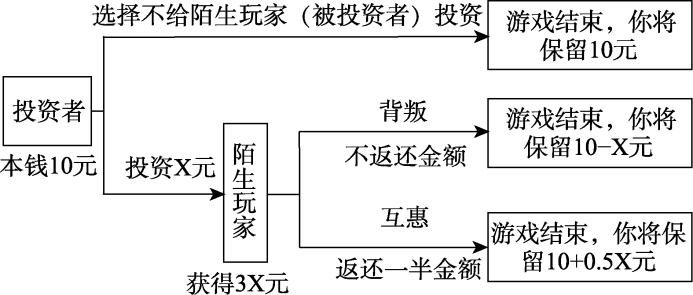
图1 游戏规则示意图
| 材料 | 控制组 | 刻板印象激活组 | ||
|---|---|---|---|---|
| 500 ms | 3000 ms | 500 ms | 3000 ms | |
| 不可信材料 | 2.43 ± 1.16 | 2.30 ± 1.11 | 2.87 ± 1.13 | 3.10 ± 1.16 |
| 可信材料 | 3.95 ± 1.52 | 4.00 ± 1.49 | 4.36 ± 1.26 | 4.67 ± 1.27 |
表1 不同呈现时间下材料可信度评分(M ± SD)
| 材料 | 控制组 | 刻板印象激活组 | ||
|---|---|---|---|---|
| 500 ms | 3000 ms | 500 ms | 3000 ms | |
| 不可信材料 | 2.43 ± 1.16 | 2.30 ± 1.11 | 2.87 ± 1.13 | 3.10 ± 1.16 |
| 可信材料 | 3.95 ± 1.52 | 4.00 ± 1.49 | 4.36 ± 1.26 | 4.67 ± 1.27 |
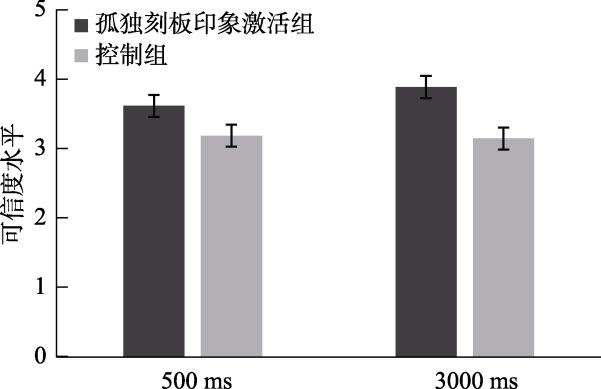
图2 不同呈现时间下组别对信任评价的影响
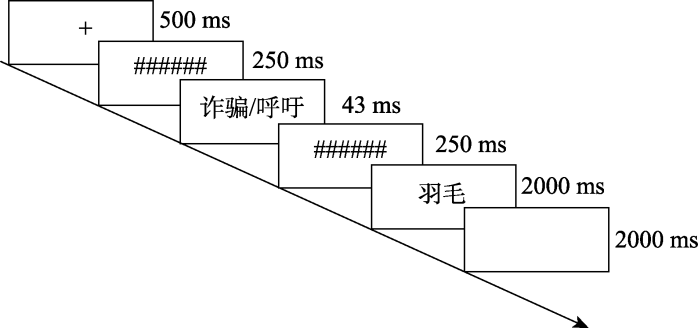
图3 无意识目标启动流程图
| 组别 | 孤独刻板印象激活组 | 控制组 | ||
|---|---|---|---|---|
| 目标未启动 | 目标启动 | 目标未启动 | 目标启动 | |
| 不可信材料 | ||||
| 可信度评价 | 3.16 ± 1.51 | 2.25 ± 1.20 | 1.89 ± 1.27 | 1.99 ± 0.93 |
| 投资金额 | 2.30 ± 2.56 | 0.88 ± 1.11 | 0.78 ± 1.31 | 0.68 ± 0.93 |
| 可信材料 | ||||
| 可信度评价 | 4.45 ± 1.37 | 3.58 ± 1.29 | 3.39 ± 1.74 | 3.38 ± 1.43 |
| 投资金额 | 3.74 ± 2.43 | 1.92 ± 1.59 | 1.74 ± 1.83 | 1.80 ± 1.70 |
表2 不同组别的信任水平(M ± SD)
| 组别 | 孤独刻板印象激活组 | 控制组 | ||
|---|---|---|---|---|
| 目标未启动 | 目标启动 | 目标未启动 | 目标启动 | |
| 不可信材料 | ||||
| 可信度评价 | 3.16 ± 1.51 | 2.25 ± 1.20 | 1.89 ± 1.27 | 1.99 ± 0.93 |
| 投资金额 | 2.30 ± 2.56 | 0.88 ± 1.11 | 0.78 ± 1.31 | 0.68 ± 0.93 |
| 可信材料 | ||||
| 可信度评价 | 4.45 ± 1.37 | 3.58 ± 1.29 | 3.39 ± 1.74 | 3.38 ± 1.43 |
| 投资金额 | 3.74 ± 2.43 | 1.92 ± 1.59 | 1.74 ± 1.83 | 1.80 ± 1.70 |
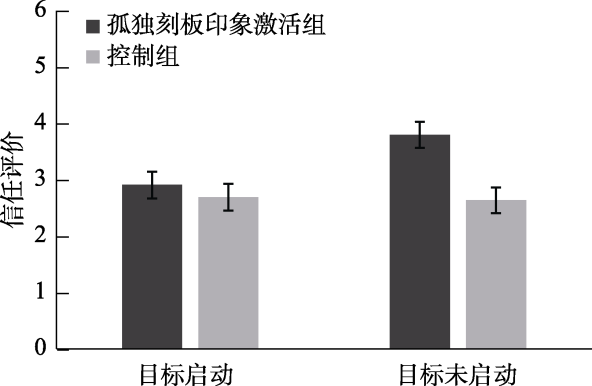
图4 不同目标情境下孤独刻板印象对信任评价的影响
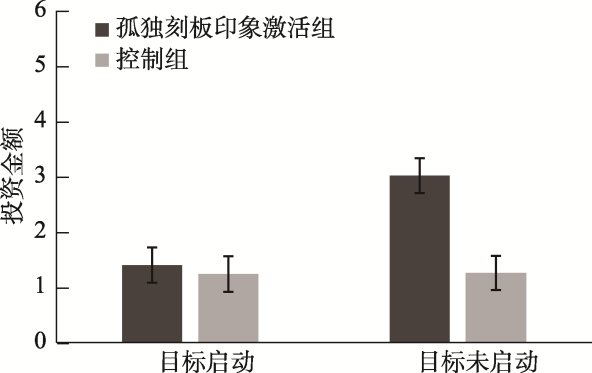
图5 不同目标情境下孤独刻板印象对投资金额的影响
| [1] |
Bailey, P. E., & Leon, T. (2019). A systematic review and meta-analysis of age-related differences in trust. Psychology and Aging, 34(5), 674-685.
doi: 10.1037/pag0000368 pmid: 31169379 |
| [2] |
Barber, S. J., & Tan, S. C. (2018). Ageism affects the future time perspective of older adults. GeroPsych, 31(3), 115-126.
doi: 10.1024/1662-9647/a000189 URL |
| [3] |
Bellucci, G., & Park, S. Q. (2024). Loneliness is associated with more trust but worse trustworthiness expectations. British Journal of Psychology, 115(4), 641-664.
doi: 10.1111/bjop.v115.4 URL |
| [4] |
Berg, J., Dickhaut, J., & McCabe, K. (1995). Trust, reciprocity, and social history. Games and Economic Behavior, 10(1), 122-142.
doi: 10.1006/game.1995.1027 URL |
| [5] |
Brothers, A., Gabrian, M., Wahl, H. W., & Diehl, M. (2016). Future time perspective and awareness of age-related change: Examining their role in predicting psychological well-being. Psychology and Aging, 31(6), 605-617.
doi: 10.1037/pag0000101 pmid: 27243764 |
| [6] | Burnes, D., Henderson, C. R., Jr., Sheppard, C., Zhao, R., Pillemer, K., & Lachs, M. S. (2017). Prevalence of financial fraud and scams among older adults in the United States: A systematic review and meta-analysis. American Journal of Public Health, 107(8), e13-e21. |
| [7] |
Carragher, D. J., Thomas, N. A., & Nicholls, M. E. (2018). Is trustworthiness lateralized in the face? Evidence from a trust game. Laterality: Asymmetries of Body, Brain and Cognition, 23(1), 20-38.
doi: 10.1080/1357650X.2017.1298120 URL |
| [8] |
Carstensen, L. L. (2021). Socioemotional selectivity theory: The role of perceived endings in human motivation. The Gerontologist, 61(8), 1188-1196.
doi: 10.1093/geront/gnab116 URL |
| [9] |
Castle, E., Eisenberger, N. I., Seeman, T. E., Moons, W. G., Boggero, I. A., Grinblatt, M. S., & Taylor, S. E. (2012). Neural and behavioral bases of age differences in perceptions of trust. Proceedings of the National Academy of Sciences, 109(51), 20848-20852.
doi: 10.1073/pnas.1218518109 URL |
| [10] |
Chen, Y. (2021). The current situation and risk factors of the fraud among older adults. Advances in Social Sciences, 10(6), 1438-1443.
doi: 10.12677/ASS.2021.106198 URL |
| [陈宇. (2021). 老年人受骗的现状及风险因素. 社会科学前沿, 10(6), 1438-1443.] | |
| [11] | China Consumers Association. (2023). Annual report on the status of consumer rights protection in China (2022). China Consumers Association. |
| [ 中国消费者协会. (2023). 中国消费者权益保护状况年度报告(2022). 中国消费者协会.] | |
| [12] |
DeLiema, M., Deevy, M., Lusardi, A., & Mitchell, O. S. (2020). Financial fraud among older Americans: Evidence and implications. The Journals of Gerontology: Series B, 75(4), 861-868.
doi: 10.1093/geronb/gby151 URL |
| [13] | Ding, J. R., Li, X. J., & Zou, Z. L. (2019). Reducing impulse buying by unconscious goal priming: The regulating effect of individual’s recent goal state. Journal of Psychological Science, 42(1), 130-136. |
| [丁健睿, 李雪姣, 邹枝玲. (2019). 利用无意识目标启动降低个体的冲动购买行为:个体目标状态的调节作用. 心理科学, 42(1), 130-136.] | |
| [14] |
Dubravac, M., & Meier, B. (2023). Cognitive load at encoding hurts memory selectivity. Quarterly Journal of Experimental Psychology, 76(7), 1515-1538.
doi: 10.1177/17470218221132846 URL |
| [15] |
Dykstra, P. A. (2009). Older adult loneliness: myths and realities. European Journal of Ageing, 6(2), 91-100.
doi: 10.1007/s10433-009-0110-3 pmid: 19517025 |
| [16] | English, T., & Carstensen, L. L. (2016). Socioemotional selectivity theory. In N. A. Pachana (Ed.), Encyclopedia of geropsychology (pp. 1-6). Springer. |
| [17] |
Fabre, L., & Lemaire, P. (2005). Age-related differences in automatic stimulus-response associations: Insights from young and older adults’ parity judgments. Psychonomic Bulletin & Review, 12(6), 1100-1105.
doi: 10.3758/BF03206450 URL |
| [18] |
Faul, F., Erdfelder, E., Buchner, A., & Lang, A. G. (2009). Statistical power analyses using G*Power 3.1: Tests for correlation and regression analyses. Behavior Research Methods, 41(4), 1149-1160.
doi: 10.3758/BRM.41.4.1149 pmid: 19897823 |
| [19] | FINRA Investor Education Foundation. (2015). Non- traditional costs of financial fraud. FINRA Foundation. https://www.finrafoundation.org/ |
| [20] |
Gable, P., & Harmon-Jones, E. (2010). The blues broaden, but the nasty narrows: Attentional consequences of negative affects low and high in motivational intensity. Psychological Science, 21(2), 211-215.
doi: 10.1177/0956797609359622 pmid: 20424047 |
| [21] |
Gross, J. J. (2001). Emotion regulation in adulthood: Timing is everything. Current Directions in Psychological Science, 10(6), 214-219.
doi: 10.1111/1467-8721.00152 URL |
| [22] | Hess, T., M. (2015). A prospect theory-based evaluation of dual-process influences on aging and decision making:Support for a contextual perspective. In T. M. Hess, J. Strough, & C. E. Löckenhoff (Eds.), Aging and decision making (pp. 189-212). Academic Press. |
| [23] |
Hoppmann, C. A., & Blanchard-Fields, F. (2010). Goals and everyday problem solving: Manipulating goal preferences in young and older adults. Developmental Psychology, 46(6), 1433-1443.
doi: 10.1037/a0020676 pmid: 20873926 |
| [24] |
Isaacowitz, D. M., Toner, K., Goren, D., & Wilson, H. R. (2008). Looking while unhappy: Mood-congruent gaze in young adults, positive gaze in older adults. Psychological Science, 19(9), 848-853.
doi: 10.1111/j.1467-9280.2008.02167.x pmid: 18947348 |
| [25] |
Kensinger, E. A., Brierley, B., Medford, N., Growdon, J. H., & Corkin, S. (2002). Effects of normal aging and Alzheimer's disease on emotional memory. Emotion, 2(2), 118-134.
pmid: 12899186 |
| [26] | Kornadt, A. E., & Rothermund, K. (2011). Contexts of aging: Assessing evaluative age stereotypes in different life domains. Journals of Gerontology Series B: Psychological Sciences and Social Sciences, 66(5), 547-556. |
| [27] |
Krendl, A. C., Ambady, N., & Kensinger, E. A. (2015). The dissociable effects of stereotype threat on older adults’ memory encoding and retrieval. Journal of Applied Research in Memory and Cognition, 4(2), 103-109.
pmid: 26029498 |
| [28] |
Kühnen, U. (2010). Manipulation checks as manipulation: Another look at the ease-of-retrieval heuristic. Personality and Social Psychology Bulletin, 36(1), 47-58.
doi: 10.1177/0146167209346746 pmid: 19875826 |
| [29] | Labouvie-Vief,, G., Grühn, D., & Studer, J. (2010). Dynamic integration of emotion and cognition:Equilibrium regulation in development and aging. In M. E. Lamb, A. M. Freund, & R. M. Lerner (Eds.), The handbook of life-span development, Vol. 2. Social and emotional development (pp. 79-115). John Wiley & Sons. |
| [30] |
Leppink, J., & Pérez-Fuster, P. (2019). Mental effort, workload, time on task, and certainty: Beyond linear models. Educational Psychology Review, 31(2), 421-438.
doi: 10.1007/s10648-018-09460-2 |
| [31] |
Levy, B., Ashman, O., & Dror, I. (2000). To be or not to be: The effects of aging stereotypes on the will to live. OMEGA-Journal of Death and Dying, 40(3), 409-420.
doi: 10.2190/Y2GE-BVYQ-NF0E-83VR URL |
| [32] | Li, T., & Fung, H. H. (2013). Age differences in trust: An investigation across 38 countries. Journals of Gerontology Series B: Psychological Sciences and Social Sciences, 68(3), 347-355. |
| [33] | Li, T., Xu, X., & Zhang, X. Y. (2018). Loneliness and consumption: An empirical investigation of the healthcare consumption of China’s elderly population. Economic Research Journal, 53(1), 124-137. |
| [李涛, 徐翔, 张旭妍. (2018). 孤独与消费——来自中国老年人保健消费的经验发现. 经济研究, 53(1), 124-137.] | |
| [34] |
Liu, P., Zhao, F., Zhang, B., & Dang, Q. (2017). Small change makes a big splash: The role of working self-concept in the effects of stereotype threat on memory. The Journal of Psychology, 151(7), 613-631.
doi: 10.1080/00223980.2017.1372340 URL |
| [35] |
Löckenhoff, C. E., De Fruyt, F., Terracciano, A., McCrae, R. R., De Bolle, M., Costa, P. T., Jr., ... Yik, M. (2009). Perceptions of aging across 26 cultures and their culture- level associates. Psychology and Aging, 24(4), 941-954.
doi: 10.1037/a0016901 pmid: 20025408 |
| [36] |
Lu, X. W., Guo, Z. B., Cheng, Y., Shen, J., Gui, W. J., & Zhang, L. (2023). Evaluation of facial trustworthiness in older adults: A positivity effect and its mechanism. Advances in Psychological Science, 31(8), 1496-1503.
doi: 10.3724/SP.J.1042.2023.01496 |
|
[陆晓伟, 郭治斌, 程雨, 沈洁, 贵文君, 张林. (2023). 老年人面孔信任评价的积极效应及其发生机制. 心理科学进展, 31(8), 1496-1503.]
doi: 10.3724/SP.J.1042.2023.01496 |
|
| [37] |
Lu, Y., Chen, C., Yin, X., & Zhang, X. (2021). Viewing time and facial trustworthiness perception: Giving it a second thought may not work for older adults. PsyCh Journal, 10(5), 805-815.
doi: 10.1002/pchj.v10.5 URL |
| [38] |
Ma, Y., Zhang, B., Zhang, X., & Hu, Y. (2023). Experiencing daily negative aging stereotypes and real-life cognitive functioning in older adults: A diary study. Psychology and Aging, 38(7), 725-739.
doi: 10.1037/pag0000774 URL |
| [39] |
Majerus, S., & D’Argembeau, A. (2011). Verbal short-term memory reflects the organization of long-term memory: Further evidence from short-term memory for emotional words. Journal of Memory and Language, 64(2), 181-197.
doi: 10.1016/j.jml.2010.10.003 URL |
| [40] |
Masi, C. M., Chen, H. Y., Hawkley, L. C., & Cacioppo, J. T. (2011). A meta-analysis of interventions to reduce loneliness. Personality and Social Psychology Review, 15(3), 219-266.
doi: 10.1177/1088868310377394 pmid: 20716644 |
| [41] | McDermott,, R. (2011). Internal and external validity. In J. N. Druckman, D. P. Green, J. H. Kuklinski, & A. Lupia (Eds.) Cambridge handbook of experimental political science (pp. 27-40). Cambridge University Press. |
| [42] | Menkin, J. A., Robles, T. F., Gruenewald, T. L., Tanner, E. K., & Seeman, T. E. (2017). Positive expectations regarding aging linked to more new friends in later life. Journals of Gerontology Series B: Psychological Sciences and Social Sciences, 72(5), 771-781. |
| [43] |
Moieni, M., Seeman, T. E., Robles, T. F., Lieberman, M. D., Okimoto, S., Lengacher, C., ... Eisenberger, N. I. (2021). Generativity and social well-being in older women: Expectations regarding aging matter. The Journals of Gerontology: Series B, 76(2), 289-294.
doi: 10.1093/geronb/gbaa022 URL |
| [44] |
Pan, W. J., Wen, F. F., & Zuo, B. (2018). Aging stereotype threat and it’s manipulations in psychological research. Advances in Psychological Science, 26(9), 1670-1679.
doi: 10.3724/SP.J.1042.2018.01670 |
|
[潘文静, 温芳芳, 佐斌. (2018). 老年刻板印象威胁及其研究操纵. 心理科学进展, 26(9), 1670-1679.]
doi: 10.3724/SP.J.1042.2018.01670 |
|
| [45] |
Pikhartova, J., Bowling, A., & Victor, C. (2016). Is loneliness in later life a self-fulfilling prophecy?. Aging & Mental Health, 20(5), 543-549.
doi: 10.1080/13607863.2015.1023767 URL |
| [46] |
Preacher, K. J., & Hayes, A. F. (2008). Asymptotic and resampling strategies for assessing and comparing indirect effects in multiple mediator models. Behavior Research Methods, 40(3), 879-891.
doi: 10.3758/brm.40.3.879 pmid: 18697684 |
| [47] |
Qualter, P., Vanhalst, J., Harris, R., Van Roekel, E., Lodder, G., Bangee, M., Maes, M., & Verhagen, M. (2015). Loneliness across the life span. Perspectives On Psychological Science, 10(2), 250-264.
doi: 10.1177/1745691615568999 pmid: 25910393 |
| [48] | Ratcliffe, J., Wigfield, A., & Alden, S. (2021). ‘A lonely old man’: empirical investigations of older men and loneliness, and the ramifications for policy and practice. Ageing & Society, 41(4), 794-814. |
| [49] |
Reed, A. E., & Carstensen, L. L. (2012). The theory behind the age-related positivity effect. Frontiers in Psychology, 3, 339.
doi: 10.3389/fpsyg.2012.00339 pmid: 23060825 |
| [50] |
Reed, A. E., Chan, L., & Mikels, J. A. (2014). Meta-analysis of the age-related positivity effect: Age differences in preferences for positive over negative information. Psychology and Aging, 29(1), 1-15.
doi: 10.1037/a0035194 pmid: 24660792 |
| [51] |
Rohr, M. K., John, D. T., Fung, H. H., & Lang, F. R. (2017). A three-component model of future time perspective across adulthood. Psychology and Aging, 32(7), 597-607.
doi: 10.1037/pag0000191 pmid: 29120197 |
| [52] |
Rossi-Arnaud, C., Spataro, P., & Geraci, L. (2018). Effects of stereotype threat and prior task success on older adults’ eyewitness memory. Journal of Applied Research in Memory and Cognition, 7(3), 422-431.
doi: 10.1037/h0101822 URL |
| [53] |
Schmader, T., Johns, M., & Forbes, C. (2008). An integrated process model of stereotype threat effects on performance. Psychological Review, 115(2), 336-356.
doi: 10.1037/0033-295X.115.2.336 pmid: 18426293 |
| [54] |
Shang, Y., Wu, Z., Du, X., Jiang, Y., Ma, B., & Chi, M. (2022). The psychology of the internet fraud victimization of older adults: A systematic review. Frontiers in Psychology, 13, 912242.
doi: 10.3389/fpsyg.2022.912242 URL |
| [55] |
Thielmann, I., & Hilbig, B. E. (2015). Trust: An integrative review from a person-situation perspective. Review of General Psychology, 19(3), 249-277.
doi: 10.1037/gpr0000046 URL |
| [56] |
Todorov, A., Pakrashi, M., & Oosterhof, N. N. (2009). Evaluating faces on trustworthiness after minimal time exposure. Social Cognition, 27(6), 813-833.
doi: 10.1521/soco.2009.27.6.813 URL |
| [57] |
Tornstam, L. (2007). Stereotypes of old people persist. A Swedish “facts on aging quiz” in a 23-year comparative perspective. International Journal of Ageing and Later Life, 2(1), 33-59.
doi: 10.3384/ijal.1652-8670.0721 URL |
| [58] | Wang, Y., & Luo, Y. J. (2005). Standardization and assessment of college students’ facial expression of emotion. Chinese Journal of Clinical Psychology, 13(4), 21-23. |
| [王妍, 罗跃嘉. (2005). 大学生面孔表情材料的标准化及其评定. 中国临床心理学杂志, 13(4), 21-23.] | |
| [59] | Wen, J., Yang, H., Zhang, Q., & Shao, J. (2022). Understanding the mechanisms underlying the effects of loneliness on vulnerability to fraud among older adults. Journal of Elder Abuse & Neglect, 34(1), 1-19. |
| [60] | Xing, T., Sun, F., Wang, K., Zhao, J., Wu, M., & Wu, J. (2020). Vulnerability to fraud among Chinese older adults: Do personality traits and loneliness matter?. Journal of Elder Abuse & Neglect, 32(1), 46-59. |
| [61] | Xu, L. L., Wu, P. P., & He, W. (2018). Meta-stereotype threat effects on intergroup relations among impoverished undergraduates: a moderated mediation model of intergroup anxiety and self-esteem. Psychological Development and Education, 34(4), 426-433. |
| [徐璐璐, 吴佩佩, 贺雯. (2018). 贫困大学生元刻板印象威胁对群际关系的影响: 群际焦虑的中介和自尊的调节作用. 心理发展与教育, 34(4), 426-433.] | |
| [62] | Yang, L., Li, X. M., & Su, H. T. (2023). The effect of unconscious goal priming of quit-smoking on impulsive decision-making in smokers. Chinese Journal of Clinical Psychology, 31(1), 58-62+68. |
| [杨玲, 李晓敏, 苏红婷. (2023). 无意识戒烟目标启动对吸烟者冲动决策的影响. 中国临床心理学杂志, 31(1), 58-62+68.] | |
| [63] | Yang, L. Y. (2006). Neural correlates of the cognitive processes in Chinese word recognition [Unpublished master's thesis]. Shantou University. |
| [杨凌云. (2006). 中文词汇识别认知过程的脑机制研究 (硕士学位论文). 汕头大学.] | |
| [64] |
Zebrowitz, L. A., Boshyan, J., Ward, N., Gutchess, A., & Hadjikhani, N. (2017). The older adult positivity effect in evaluations of trustworthiness: Emotion regulation or cognitive capacity? PLOS ONE, 12(1), e0169823.
doi: 10.1371/journal.pone.0169823 URL |
| [65] |
Zebrowitz, L. A., Franklin, R. G., Hillman, S., & Boc, H. (2013). Older and younger adults' first impressions from faces: similar in agreement but different in positivity. Psychology and Aging, 28(1), 202-212.
doi: 10.1037/a0030927 pmid: 23276216 |
| [66] |
Zhang, B., Jin, D., Ma, M., & Xu, R. (2022). The effect of aging stereotypes on the quality of medical decision- making and the mediating role of attribution bias. Acta Psychologica Sinica, 54(8), 951-963.
doi: 10.3724/SP.J.1041.2022.00951 URL |
|
[张宝山, 金豆, 马梦佳, 徐冉. (2022). 消极刻板印象对老年人医疗决策的影响及归因偏差的作用. 心理学报, 54(8), 951-963.]
doi: 10.3724/SP.J.1041.2022.00951 |
|
| [67] | Zhang, H. M., & Zhang, L., W. (2019). The influence of unconscious self-control goal priming on overcoming ego depletion. Journal of Psychological Science, 42(3), 563-569. |
| [张寒梦, 张力为. (2019). 无意识自我控制目标启动对自我损耗的补偿效应. 心理科学, 42(3), 563-569.] | |
| [68] | Zhang, L., Mou, Z. C., Liu, S., & Gao, F. (2017). Social support and gullibility of the elderly: A mediated moderation model. Studies of Psychology and Behavioral, 15(6), 766-773. |
| [张林, 牟忠琛, 刘燊, 高飞. (2017). 社会支持与老年人受骗倾向的关系:一个有中介的调节模型. 心理与行为研究, 15(6), 766-773.] |
| [1] | 孙一飞, 李秀兰, 杜峰, 齐玥. 隐私风险感知对自动驾驶汽车初始信任的影响:从业者与非从业者的差异化反应[J]. 心理学报, 2026, 58(7): 1279-1296. |
| [2] | 何从莲, 袁加锦. 情绪动机对人际情绪调节策略选择的影响:来自行为与超扫描的实验证据[J]. 心理学报, 2025, 57(9): 1589-1608. |
| [3] | 辛聪, 陈幼贞, 田蜜, 刘国雄. 7~11岁小学生前瞻记忆的自我参照效应及其认知机制[J]. 心理学报, 2025, 57(5): 775-791. |
| [4] | 张环, 秦锡权, 刘雨, 林琳, 吴捷. 不同强度趋近动机积极情绪对基于语义关联性错误记忆的影响及其神经机制[J]. 心理学报, 2025, 57(3): 349-362. |
| [5] | 高学德, 马号云. 中国民众普遍信任的动态变迁——基于年龄−时期−世代效应的分析[J]. 心理学报, 2025, 57(3): 463-478. |
| [6] | 范云歌, 马紫娟, 林玮诗, 张瑞, 王东方, 范方. 当代老年人精神赡养的内涵及其特征维度[J]. 心理学报, 2025, 57(12): 2131-2148. |
| [7] | 唐小飞, 王昌梅, 孙晓东, 张恩忠. 类人智能机器人信任对员工工作贡献意愿的影响: 基于人机关系信任的归维考察[J]. 心理学报, 2025, 57(11): 1933-1950. |
| [8] | 由姗姗, 齐玥, 陈俊廷, 骆磊, 张侃. 人与AI对智能家居机器人的安全信任及其影响因素[J]. 心理学报, 2025, 57(11): 1951-1972. |
| [9] | 陈斯允, 熊继伟, 彭凯平. “羊毛薅尽口味乏”:节俭心态如何影响食物预期享受与体验评估[J]. 心理学报, 2025, 57(1): 152-172. |
| [10] | 袁航, 罗思阳. 研究社会文化变迁的新视角——表征相似性分析:以老年人心理健康为例[J]. 心理学报, 2024, 56(7): 938-953. |
| [11] | 王晨, 陈为聪, 黄亮, 侯苏豫, 王益文. 机器人遵从伦理促进人机信任?决策类型反转效应与人机投射假说[J]. 心理学报, 2024, 56(2): 194-209. |
| [12] | 郑远霞, 钟敏, 辛聪, 刘国雄, 朱莉琪. 学龄前儿童对道德承诺者的信任判断[J]. 心理学报, 2024, 56(12): 1761-1772. |
| [13] | 赵富强, 祝含秋, 陈耘, 陈祝慧. 员工跨界何以影响上司支持:上司信任与向上建议寻求的作用[J]. 心理学报, 2024, 56(10): 1431-1447. |
| [14] | 李喆, 刘浙豫, 毛珂妤, 李婉婷, 李婷玉, 李晶. 3~6岁幼儿对智能语音助手在不同领域的知识性信任[J]. 心理学报, 2023, 55(9): 1411-1423. |
| [15] | 袁博, 王晓萍, 尹军, 李伟强. 跨情境的刺激泛化在面孔信任形成中的作用:基于直接互动与观察学习的视角[J]. 心理学报, 2023, 55(7): 1099-1114. |
| 阅读次数 | ||||||
|
全文 |
|
|||||
|
摘要 |
|
|||||
