

ISSN 0439-755X
CN 11-1911/B
主办:中国心理学会
中国科学院心理研究所
出版:科学出版社
CN 11-1911/B
主办:中国心理学会
中国科学院心理研究所
出版:科学出版社
心理学报 ›› 2025, Vol. 57 ›› Issue (9): 1499-1511.doi: 10.3724/SP.J.1041.2025.1499 cstr: 32110.14.2025.1499
• 研究报告 • 下一篇
杨明川1, 李贤卓2( ), 梁丹丹3,4()
收稿日期:2024-06-02
发布日期:2025-06-26
出版日期:2025-09-25
通讯作者:
李贤卓, E-mail: xli@nnu.edu.cn;基金资助:
YANG Mingchuan1, LI Xianzhuo2(), LIANG Dandan3,4()
Received:2024-06-02
Online:2025-06-26
Published:2025-09-25
摘要: 在领域一般性声学层面, 音乐和语言的音高加工经验已被证实存在双向迁移。然而, 在语言领域特异性层面, 这种双向迁移是否存在, 目前的研究尚不充分。本研究基于普通话T1-T2构造语言与音乐刺激连续统, 招募了普通话母语音乐人和非音乐人各30名, 采用范畴感知识别与区分任务, 考察: (1)音乐经验能否影响普通话母语音乐人的声调音位加工; (2)普通话母语音乐人的声调音位范畴感知模式能否影响精细化的音乐音高加工。结果显示: (1)普通话母语音乐人在整体上比非音乐人有更高的声调范畴感知程度, 在识别曲线斜率、范畴边界宽度、范畴间区分率、区分峰度上均有体现。更高的声调范畴感知程度源于更强的音乐加工能力。同时, 音乐人的范畴边界位置比非音乐人显著靠近阴平端; (2)普通话母语音乐人在音乐刺激的识别与区分曲线上均表现出范畴感知模式。研究表明, 音乐经验能够跨领域影响普通话母语音乐人的声调音位加工, 普通话母语音乐人的声调音位范畴感知模式能够跨领域迁移到音乐感知中。研究结果从声调范畴感知这一领域特异性角度证明普通话母语音乐人语言与音乐经验存在双向迁移, 支持“训练迁移效应”。
中图分类号:
杨明川, 李贤卓, 梁丹丹. (2025). 语言与音乐经验存在双向迁移: 基于普通话母语音乐人的范畴感知. 心理学报, 57(9), 1499-1511.
YANG Mingchuan, LI Xianzhuo, LIANG Dandan. (2025). Bidirectional transfer between language and musical experience: Based on the categorical perception in Mandarin-speaking musicians. Acta Psychologica Sinica, 57(9), 1499-1511.
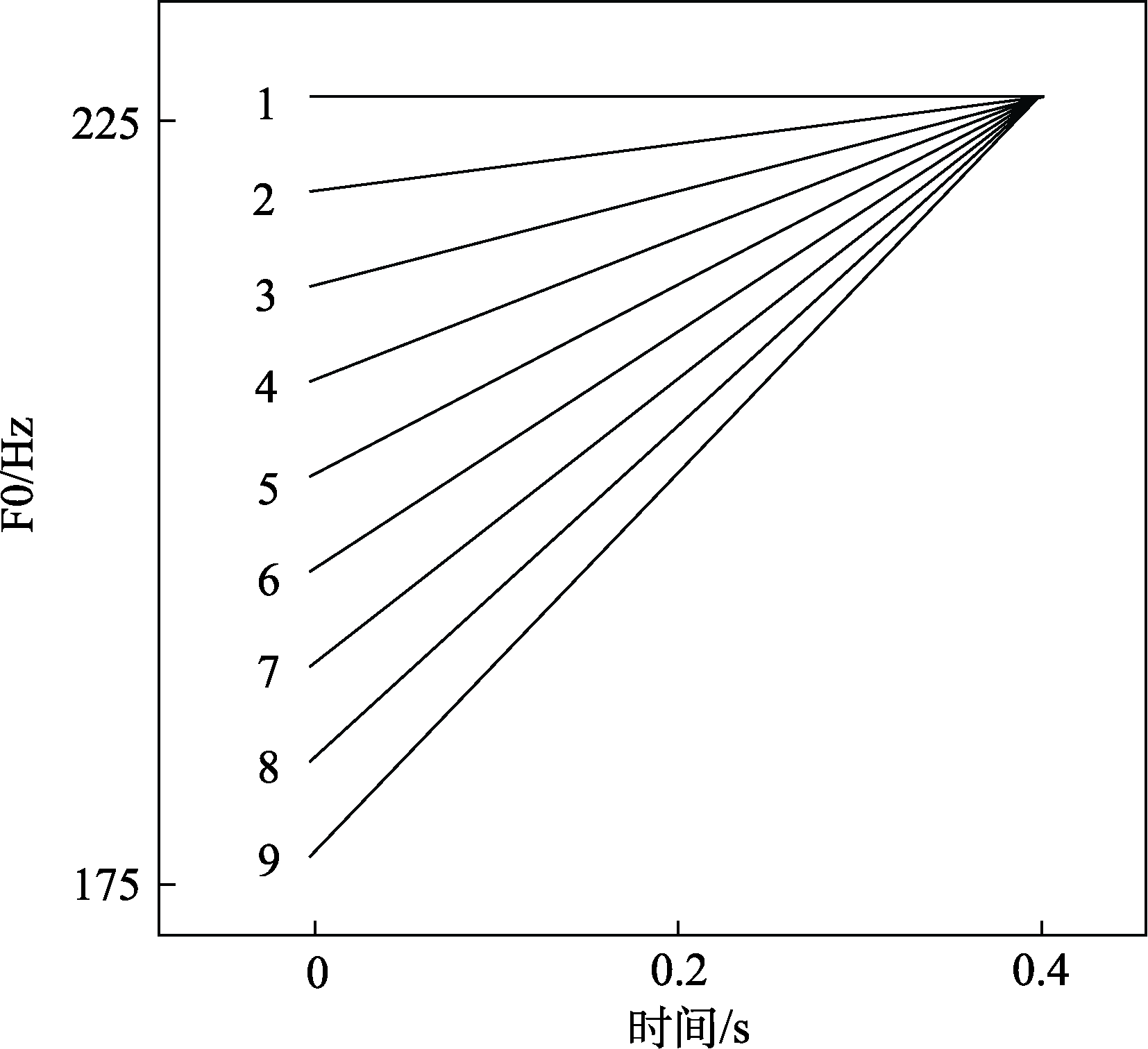
图1 T1-T2连续统音高模式示意图
| 刺激 | 起点音高(Hz) | 起点音高(ERB) | 步幅(Hz) | 步幅(ERB) |
|---|---|---|---|---|
| 1 | 225 | 6.229 | 6.63 | 0.12 |
| 2 | 218.37 | 6.104 | 6.52 | 0.12 |
| 3 | 211.85 | 5.980 | 6.41 | 0.12 |
| 4 | 205.44 | 5.856 | 6.30 | 0.12 |
| 5 | 199.14 | 5.732 | 6.19 | 0.12 |
| 6 | 192.95 | 5.607 | 6.09 | 0.12 |
| 7 | 186.87 | 5.483 | 5.98 | 0.12 |
| 8 | 180.88 | 5.359 | 5.88 | 0.12 |
| 9 | 175 | 5.235 |
表1 连续统各条刺激的起始音高参数
| 刺激 | 起点音高(Hz) | 起点音高(ERB) | 步幅(Hz) | 步幅(ERB) |
|---|---|---|---|---|
| 1 | 225 | 6.229 | 6.63 | 0.12 |
| 2 | 218.37 | 6.104 | 6.52 | 0.12 |
| 3 | 211.85 | 5.980 | 6.41 | 0.12 |
| 4 | 205.44 | 5.856 | 6.30 | 0.12 |
| 5 | 199.14 | 5.732 | 6.19 | 0.12 |
| 6 | 192.95 | 5.607 | 6.09 | 0.12 |
| 7 | 186.87 | 5.483 | 5.98 | 0.12 |
| 8 | 180.88 | 5.359 | 5.88 | 0.12 |
| 9 | 175 | 5.235 |
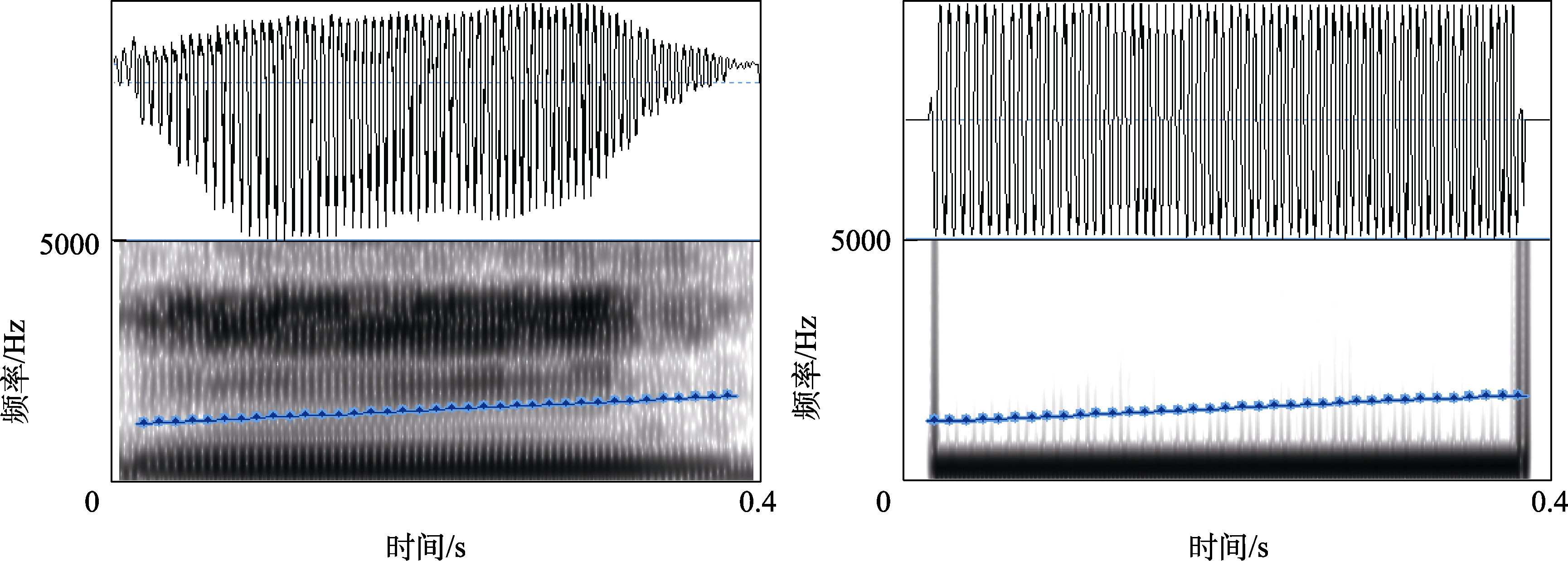
图2 语言连续统和音乐连续统中刺激 9的波形图和频谱图 (左上: 语音刺激波形图; 左下: 语音刺激频谱图; 右上: 音乐刺激波形图; 右下: 音乐刺激频谱图)
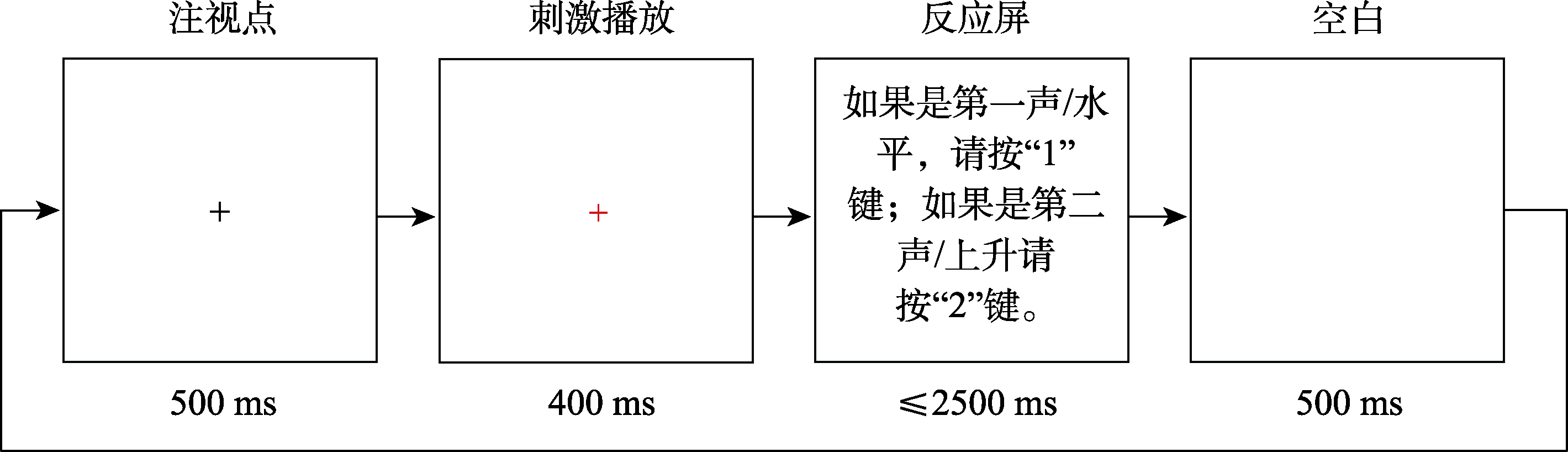
图3 识别任务流程图
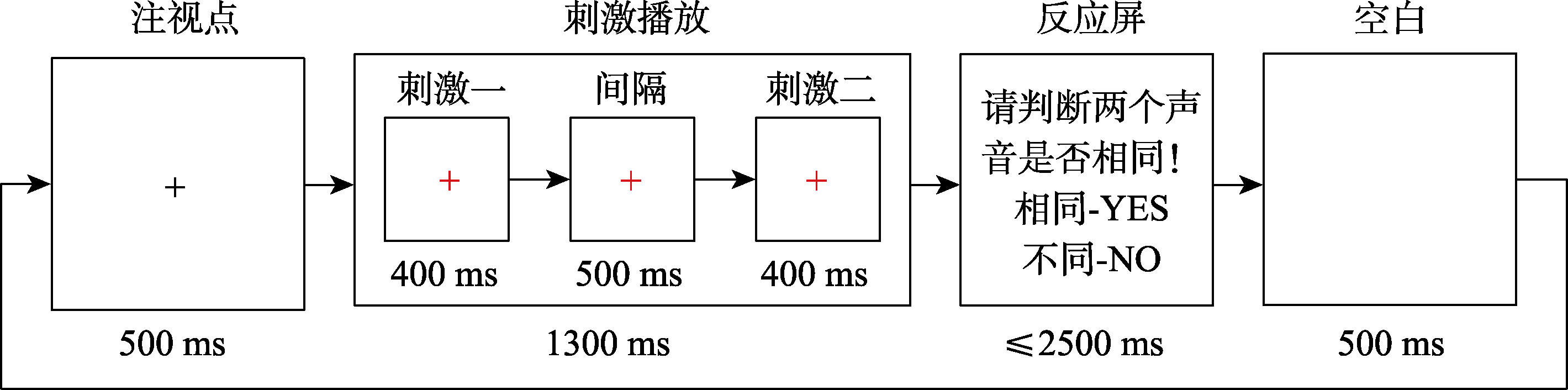
图4 区分任务流程图
| 组别 | 音乐刺激 | 语言刺激 | ||||
|---|---|---|---|---|---|---|
| 识别曲线斜率 | 范畴边界位置 | 范畴边界宽度 | 识别曲线斜率 | 范畴边界位置 | 范畴边界宽度 | |
| 音乐人 | −2.49(0.58) | 4.85(1.01) | 0.92(0.21) | −1.74(0.38) | 5.97(0.88) | 1.35(0.46) |
| 非音乐人 | −2.02(0.53) | 5.01(1.26) | 1.19(0.42) | −1.46(0.32) | 6.56(0.78) | 1.59(0.40) |
表2 音乐人与非音乐人识别任务指标
| 组别 | 音乐刺激 | 语言刺激 | ||||
|---|---|---|---|---|---|---|
| 识别曲线斜率 | 范畴边界位置 | 范畴边界宽度 | 识别曲线斜率 | 范畴边界位置 | 范畴边界宽度 | |
| 音乐人 | −2.49(0.58) | 4.85(1.01) | 0.92(0.21) | −1.74(0.38) | 5.97(0.88) | 1.35(0.46) |
| 非音乐人 | −2.02(0.53) | 5.01(1.26) | 1.19(0.42) | −1.46(0.32) | 6.56(0.78) | 1.59(0.40) |
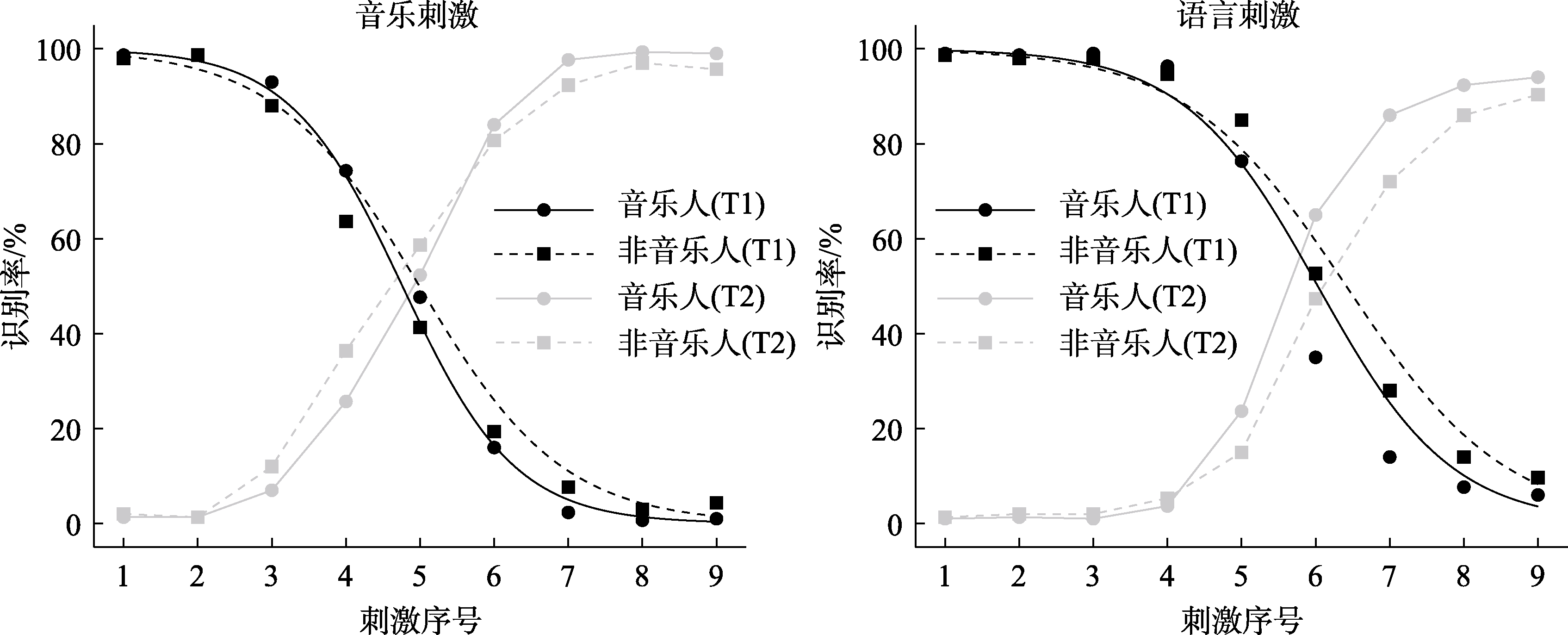
图5 音乐人与非音乐人识别曲线
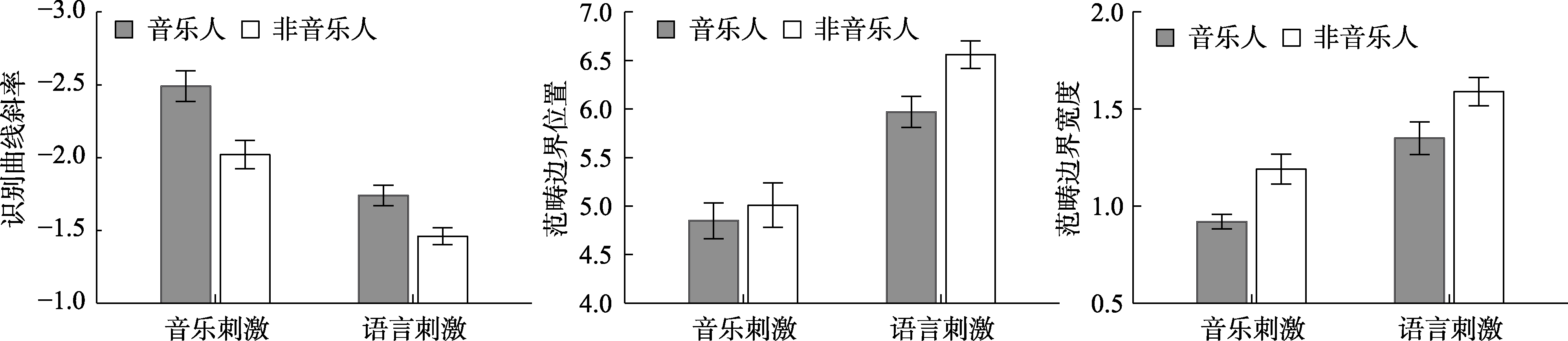
图6 音乐人与非音乐人识别任务各指标 注:误差线表示标准误
| 组别 | 音乐刺激 | 语言刺激 | ||||
|---|---|---|---|---|---|---|
| 范畴间区分率 | 范畴内区分率 | 区分峰度 | 范畴间区分率 | 范畴内区分率 | 区分峰度 | |
| 音乐人 | 0.74(0.09) | 0.63(0.06) | 0.12(0.11) | 0.71(0.11) | 0.62(0.04) | 0.09(0.11) |
| 非音乐人 | 0.67(0.08) | 0.59(0.05) | 0.08(0.09) | 0.65(0.09) | 0.60(0.07) | 0.05(0.11) |
表3 音乐人与非音乐人区分任务指标
| 组别 | 音乐刺激 | 语言刺激 | ||||
|---|---|---|---|---|---|---|
| 范畴间区分率 | 范畴内区分率 | 区分峰度 | 范畴间区分率 | 范畴内区分率 | 区分峰度 | |
| 音乐人 | 0.74(0.09) | 0.63(0.06) | 0.12(0.11) | 0.71(0.11) | 0.62(0.04) | 0.09(0.11) |
| 非音乐人 | 0.67(0.08) | 0.59(0.05) | 0.08(0.09) | 0.65(0.09) | 0.60(0.07) | 0.05(0.11) |
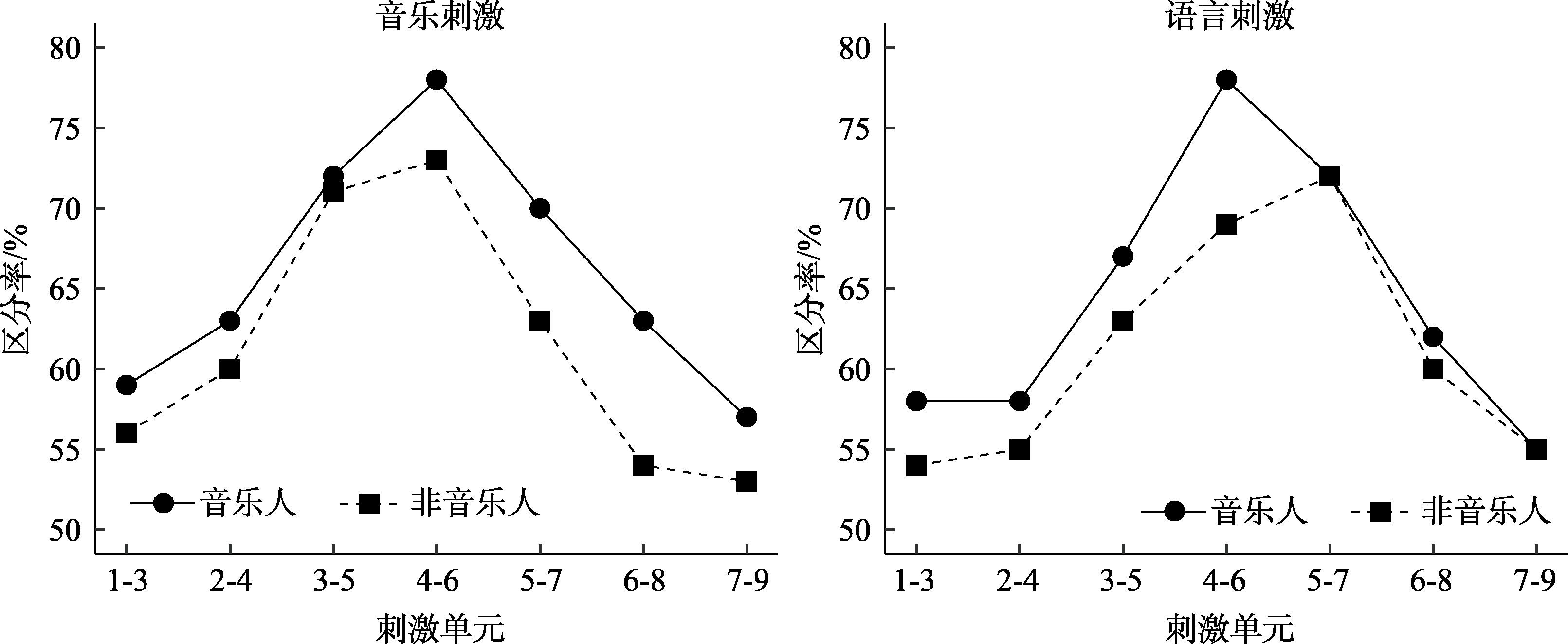
图7 音乐人与非音乐人区分曲线
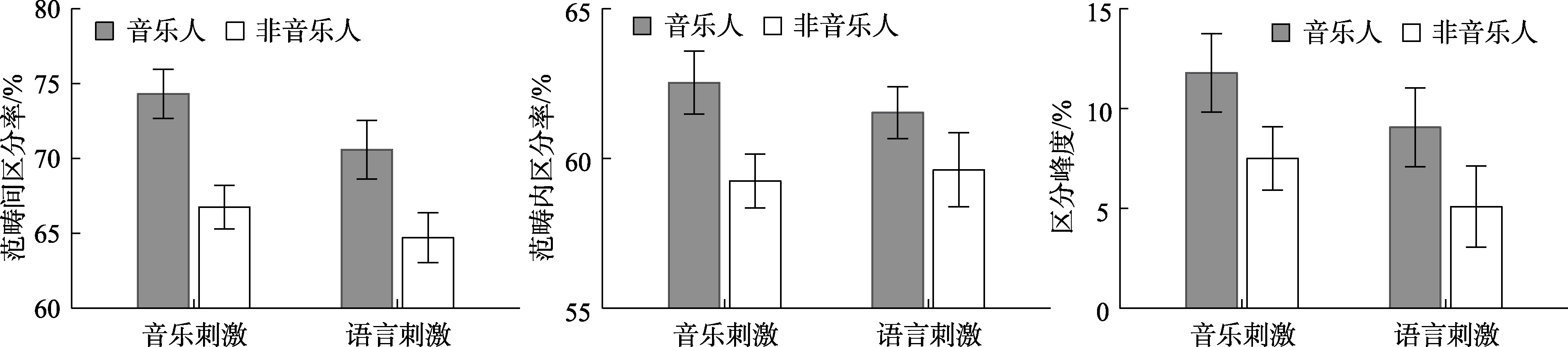
图8 音乐人与非音乐人区分任务各指标 注:误差线表示标准误

图9 音乐人回归分析结果 注:阴影代表拟合95%置信区间。
| [1] | Bakan, M. B. (2012). World music: Traditions and transformations (2nd ed.). New York, NY: McGraw-Hill. |
| [2] |
Besson, M., Chobert, J., & Marie, C. (2011). Transfer of training between music and speech: Common processing, attention, and memory. Frontiers in Psychology, 2, 94.
doi: 10.3389/fpsyg.2011.00094 pmid: 21738519 |
| [3] | Bidelman, G. M., Weiss, M. W., Moreno, S., & Alain, C. (2014). Coordinated plasticity in brainstem and auditory cortex contributes to enhanced categorical speech perception in musicians. The European Journal of Neuroscience, 40(4), 2662-2673. |
| [4] | Boersma, P., & van Heuven, V. (2001). Speak and unSpeak with Praat. Glot International, 5(9-10), 341-347. |
| [5] |
Chang, D., Hedberg, N., & Wang, Y. (2016). Effects of musical and linguistic experience on categorization of lexical and melodic tones. Journal of the Acoustical Society of America, 139(5), 2432-2447.
doi: 10.1121/1.4947497 pmid: 27250140 |
| [6] | Chen, F., & Peng, G. (2020). Reduced sensitivity to between- category information but preserved categorical perception of lexical tones in tone language speakers with congenital amusia. Frontiers in Psychology, 11, 581410. |
| [7] | Chen, F., Zhang, H., Wang, S., & Peng, G. (2019). Intrinsic cues and vowel categorical perception. Linguistic Sciences, 18(4), 410-425. |
|
[陈飞, 张昊, 王士元, 彭刚. (2019). 内部因素与元音范畴化感知. 语言科学, 18(4), 410-425.]
doi: 10.7509/j.linsci.201808.032304 |
|
| [8] | Chen, S., Zhu, Y., Wayland, R., & Yang, Y. (2020). How musical experience affects tone perception efficiency by musicians of tonal and non-tonal speakers? PloS One, 15(5), e0232514. |
| [9] |
Chobert, J., Marie, C., François, C., Schön, D., & Besson, M. (2011). Enhanced passive and active processing of syllables in musician children. Journal of Cognitive Neuroscience, 23(12), 3874-3887.
doi: 10.1162/jocn_a_00088 pmid: 21736456 |
| [10] | Cooper, A., & Wang, Y. (2012). The influence of linguistic and musical experience on Cantonese word learning. The Journal of the Acoustical Society of America, 131(6), 4756-4769. |
| [11] | Creel, S. C., Obiri-Yeboah, M., & Rose, S. (2023). Language- to-music transfer effects depend on the tone language: Akan vs. east Asian tone languages. Memory & Cognition, 51(7), 1624-1639. |
| [12] |
Faul, F., Erdfelder, E., Lang, A. G., & Buchner, A. (2007). G*Power 3: A flexible statistical power analysis program for the social, behavioral, and biomedical sciences. Behavior Research Methods, 39(2), 175-191.
doi: 10.3758/bf03193146 pmid: 17695343 |
| [13] |
Francis, A. L., Ciocca, V., & Ng, B. K. C. (2003). On the (non)categorical perception of lexical tones. Perception and Psychophysics, 65(7), 1029-1044.
pmid: 14674631 |
| [14] | Friederici, A. D. (2017). Language in our brain: The origins of a uniquely human capacity. Cambridge, MA: The MIT Press. |
| [15] |
Giuliano, R. J., Pfordresher, P. Q., Stanley, E. M., Narayana, S., & Wicha, N. Y. (2011). Native experience with a tone language enhances pitch discrimination and the timing of neural responses to pitch change. Frontiers in Psychology, 2, 146.
doi: 10.3389/fpsyg.2011.00146 pmid: 21886629 |
| [16] | Greenwood, D. D. (1961). Critical bandwidth and the frequency coordinates of the basilar membrane. Journal of the Acoustical Society of America, 33(10), 1344-1356. |
| [17] |
Griffiths, T. D., & Warren, J. D. (2002). The planum temporale as a computational hub. Trends in Neurosciences, 25(7), 348-353.
doi: 10.1016/s0166-2236(02)02191-4 pmid: 12079762 |
| [18] | Guo, J. (1993). An explication and investigation of Chinese tones and intonation. Beijing: Beijing Language Institute Press. |
| [郭锦桴. (1993). 汉语声调语调阐要与探索. 北京: 北京语言学院出版社.] | |
| [19] | Hao, Y. C. (2012). Second language acquisition of Mandarin Chinese tones by tonal and non-tonal language speakers. Journal of Phonetics, 40(2), 269-279. |
| [20] | Hu, A., Wang, M., Li, Y., Tang, Q., & Gu, F. (2020). Dong speakers outperform Mandarin speakers in behavioral pitch discrimination. The Journal of the Acoustical Society of America, 147(1), EL62-EL65. |
| [21] | Jiang, C., Hamm, J. P., Lim, V. K., Kirk, I. J., & Yang, Y. (2012). Impaired categorical perception of lexical tones in Mandarin-speaking congenital amusics. Memory and Cognition, 40(7), 1109-1121. |
| [22] | Levy, D. F., & Wilson, S. M. (2020). Categorical encoding of vowels in primary auditory cortex. Cerebral Cortex, 30(2), 618-627. |
| [23] |
Li, X., Xiao, R., & Liang, D. (2022). The cross-domain influence of tonal categorical perception and tonal complexity on musical pitch perception. Acta Psychologica Sinica, 54(9), 1021-1030.
doi: 10.3724/SP.J.1041.2022.01021 |
|
[李贤卓, 肖容, 梁丹丹. (2022). 声调范畴感知和声调复杂度对音乐音高感知的跨领域影响. 心理学报, 54(9), 1021-1030.]
doi: 10.3724/SP.J.1041.2022.01021 |
|
| [24] | Ma, J., Zhu, J., Yao, X., & Chen, Y. (2024). Categorical perception of lexical tones and stops in Mandarin-speaking musicians and nonmusicians. Sage Open, 14(1), 21582440241227703. |
| [25] |
Marie, C., Delogu, F., Lampis, G., Belardinelli, M. O., & Besson, M. (2011). Influence of musical expertise on segmental and tonal processing in mandarin Chinese. Journal of Cognitive Neuroscience, 23(10), 2701-2715.
doi: 10.1162/jocn.2010.21585 pmid: 20946053 |
| [26] |
Marques, C., Moreno, S., Castro, S. L., & Besson, M. (2007). Musicians detect pitch violation in a foreign language better than nonmusicians: Behavioral and electrophysiological evidence. Journal of Cognitive Neuroscience, 19(9), 1453-1463.
pmid: 17714007 |
| [27] | Nan, Y. (2017). The facilitation effect of music learning on speech processing. Advances in Psychological Science, 25(11), 1844-1853. |
|
[南云. (2017). 音乐学习对语言加工的促进作用. 心理科学进展, 25(11), 1844-1853.]
doi: 10.3724/SP.J.1042.2017.01844 |
|
| [28] |
Nan, Y., & Friederici, A. D. (2013). Differential roles of right temporal cortex and Broca's area in pitch processing: Evidence from music and Mandarin. Human Brain Mapping, 34(9), 2045-2054.
doi: 10.1002/hbm.22046 pmid: 22431306 |
| [29] |
Patel, A. D. (2003). Language, music, syntax and the brain. Nature Neuroscience, 6(7), 674-681.
doi: 10.1038/nn1082 pmid: 12830158 |
| [30] | Patel, A. D. (2008). Music, language, and the brain. New York, NY: Oxford University Press. |
| [31] |
Patel, A. D. (2014). Can nonlinguistic musical training change the way the brain processes speech? The expanded opera hypothesis. Hearing Research, 308, 98-108.
doi: 10.1016/j.heares.2013.08.011 pmid: 24055761 |
| [32] | Peng, G., Zheng, H. Y., Gong, T., Yang, R. X., Kong, J. P., & Wang, W. S. Y. (2010). The influence of language experience on categorical perception of pitch contours. Journal of Phonetics, 38(4), 616-624. |
| [33] | Peretz, I., Champod, A. S., & Hyde, K. (2003). Varieties of musical disorders——The Montreal battery of evaluation of amusia. Annals of the New York Academy of Sciences, 999, 58-75. |
| [34] | Pike, K. L. (1948). Tone languages. Ann Arbor, MI: University of Michigan Press. |
| [35] |
Poeppel, D., Phillips, C., Yellin, E., Rowley, H. A., Roberts, T. P. L., & Marantz, A. (1997). Processing of vowels in supratemporal auditory cortex. Neuroscience Letters, 221(2-3), 145-148.
pmid: 9121685 |
| [36] | Shen, X. S., & Lin, M. (1991). A perceptual study of Mandarin tones 2 and 3. Language and Speech, 34(2), 145-156. |
| [37] |
Tang, W., Xiong, W., Zhang, Y. X., Dong, Q., & Nan, Y. (2016). Musical experience facilitates lexical tone processing among mandarin speakers: Behavioral and neural evidence. Neuropsychologia, 91, 247-253.
doi: S0028-3932(16)30285-8 pmid: 27503769 |
| [38] | Wang, L. (1991). Fundamentals of phonology. Beijing: Language and Culture Press. |
| [王理嘉. (1991). 音系学基础. 北京: 语文出版社.] | |
| [39] | Wang, W. S. (1976). Language change. Annals of the New York Academy of Sciences, 280(1), 61-72. |
| [40] | Wang, Y., Liu, S., & Qing, W. (2016). Tonal patterns and categorical perception of Yinping and Yangping in Chongqing Mandarin: Implications to historical changing of Yinping and Shangsheng. Chinese Journal of Phonetics, (2), 18-27. |
| [王韫佳, 刘思维, 卿伟. (2016). 从范畴感知看重庆话阴平和阳平的调型——兼论重庆话阴平和上声演变的动因. 中国语音学报, (2), 18-27.] | |
| [41] | Wang, Y., & Qin, X. (2015). The identification and discrimination of tone2 and tone3 in Mandarin: The influence of experimental design on categorical perception of tones. Linguistic Sciences, 14(4), 337-352. |
|
[王韫佳, 覃夕航. (2015). 普通话单字调阳平和上声的辨认及区分——兼论实验设计对声调范畴感知结果的影响. 语言科学, 14(4), 337-352.]
doi: 10.7509/j.linsci.201504.029558 |
|
| [42] | Wang, Y., Wu, Q., & Liu, S. (2021). Categorical perception of similar-contour and dissimilar-contour tones in Beijing Mandarin of native and non-native speakers: An MMN study. Contemporary Linguistics, 23(3), 413-432. |
| [王韫佳, 吴倩, 刘思维. (2021). 母语和非母语者对北京话相似和相异调拱声调的范畴感知——基于MMN的研究. 当代语言学, 23(3), 413-432.] | |
| [43] | Wayland, R., Herrera, E., & Kaan, E. (2010). Effects of musical experience and training on pitch contour perception. Journal of Phonetics, 38(4), 654-662. |
| [44] |
Wong, P. C. M., Skoe, E., Russo, N. M., Dees, T., & Kraus, N. (2007). Musical experience shapes human brainstem encoding of linguistic pitch patterns. Nature Neuroscience, 10(4), 420-422.
doi: 10.1038/nn1872 pmid: 17351633 |
| [45] |
Wu, H., Ma, X., Zhang, L., Liu, Y., Zhang, Y., & Shu, H. (2015). Musical experience modulates categorical perception of lexical tones in native Chinese speakers. Frontiers in Psychology, 6, 436.
doi: 10.3389/fpsyg.2015.00436 pmid: 25918511 |
| [46] |
Xi, J., Zhang, L., Shu, H., Zhang, Y., & Li, P. (2010). Categorical perception of lexical tones in Chinese revealed by mismatch negativity. Neuroscience, 170(1), 223-231.
doi: 10.1016/j.neuroscience.2010.06.077 pmid: 20633613 |
| [47] |
Xu, Y., Gandour, J. T., & Francis, A. L. (2006). Effects of language experience and stimulus complexity on the categorical perception of pitch direction. Journal of the Acoustical Society of America, 120(2), 1063-1074.
pmid: 16938992 |
| [48] |
Yao, Y., & Chen, X. (2020). The effects of music training on categorical perception of Mandarin tones in 4- to 5-year-old children. Acta Psychologica Sinica, 52(4), 456-468.
doi: 10.3724/SP.J.1041.2020.00456 |
|
[姚尧, 陈晓湘. (2020). 音乐训练对4-5 岁幼儿普通话声调范畴感知能力的影响. 心理学报, 52(4), 456-468.]
doi: 10.3724/SP.J.1041.2020.00456 |
|
| [49] |
Yu, K., Wang, R., Li, L., & Li, P. (2014). Processing of acoustic and phonological information of lexical tones in Mandarin Chinese revealed by mismatch negativity. Frontiers in Human Neuroscience, 8, 729.
doi: 10.3389/fnhum.2014.00729 pmid: 25278863 |
| [50] | Zhang, L. (2010). On the influence of native language on the categorical perception of Chinese tones. TCSOL Studies, 38(2), 15-20. |
| [张林军. (2010). 母语经验对留学生汉语声调范畴化知觉的影响. 华文教学与研究, 38(2), 15-20.] | |
| [51] | Zhang, L., Xi, J., Xu, G., Shu, H., Wang, X., & Li, P. (2011). Cortical dynamics of acoustic and phonological processing in speech perception. PLoS One, 6(6), e20963. |
| [52] | Zhao, T. C., & Kuhl, P. K. (2015). Effect of musical experience on learning lexical tone categories. Journal of the Acoustical Society of America, 137(3), 1452-1463. |
| [53] | Zhu, J., Chen, X., & Yang, Y. (2021). Effects of amateur musical experience on categorical perception of lexical tones by native Chinese adults: An ERP study. Frontiers in Psychology, 12, 611189. |
| [1] | 焦丽颖, 李昌锦, 陈圳, 许恒彬, 许燕. 当AI“具有”人格:善恶人格角色对大语言模型道德判断的影响[J]. 心理学报, 2025, 57(6): 929-946. |
| [2] | 高承海, 党宝宝, 王冰洁, 吴胜涛. 人工智能的语言优势和不足:基于大语言模型与真实学生语文能力的比较[J]. 心理学报, 2025, 57(6): 947-966. |
| [3] | 章彦博, 黄峰, 莫柳铃, 刘晓倩, 朱廷劭. 基于大语言模型的自杀意念文本数据增强与识别技术[J]. 心理学报, 2025, 57(6): 987-1000. |
| [4] | 简尽涵, 张军恒, 晏碧华, 姬鸣. 空间语言交互在不同视角下的多线索影响机制[J]. 心理学报, 2025, 57(6): 1013-1040. |
| [5] | 华山, 姜欣桐, 高扬震宇, 穆妍, 杜忆. 音乐训练与音乐素养对共情能力的影响[J]. 心理学报, 2025, 57(4): 544-558. |
| [6] | 周临舒, 张雨青, 蔡丹超. 音乐训练促进音高与时间维度在听觉工作记忆中的交互[J]. 心理学报, 2025, 57(10): 1701-1714. |
| [7] | 任维聪, 杨婷, 王汉林. 语言符号与知觉符号表征对外语词汇习得的影响比较:来自行为与脑电的实验证据[J]. 心理学报, 2024, 56(5): 542-554. |
| [8] | 喻艳玲, 谢瑞波, 伍新春, 夏月, 王振梁, 阮世芳. 小学低年级儿童元语言意识与阅读流畅性的关系:汉字识别和词汇知识的中介效应[J]. 心理学报, 2023, 55(6): 941-953. |
| [9] | 张航, 王婷, 冯晓慧, 韦义平, 张积家. 铜鼓经验对壮族鼓手的节奏知觉和执行功能的影响[J]. 心理学报, 2023, 55(11): 1762-1779. |
| [10] | 吴梅红. 老龄化对F0轮廓线索在汉语言语识别去掩蔽作用的影响[J]. 心理学报, 2023, 55(1): 94-105. |
| [11] | 李贤卓, 肖容, 梁丹丹. 声调范畴感知和声调复杂度对音乐音高感知的跨领域影响[J]. 心理学报, 2022, 54(9): 1021-1030. |
| [12] | 杨集梅, 柴洁余, 邱天龙, 全小山, 郑茂平. 共情与中国民族音乐情绪识别的关系:来自ERP的证据[J]. 心理学报, 2022, 54(10): 1181-1192. |
| [13] | 伍丽梅, 张积家, 孟乐, 张小林, 黄楠芯, 张金桥. 语言演变差异与族群/方言名称对族群信息加工的影响——以广东三大汉语方言为例[J]. 心理学报, 2021, 53(9): 944-959. |
| [14] | 骆方, 姜力铭, 田雪涛, 肖梦格, 马彦珍, 张生. 小学生羞怯特质预测及语言风格模型构建[J]. 心理学报, 2021, 53(2): 155-169. |
| [15] | 张政华, 韩梅, 张放, 李卫君. 音乐训练促进诗句韵律整合加工的神经过程[J]. 心理学报, 2020, 52(7): 847-860. |
| 阅读次数 | ||||||
|
全文 |
|
|||||
|
摘要 |
|
|||||
