

ISSN 0439-755X
CN 11-1911/B
主办:中国心理学会
中国科学院心理研究所
出版:科学出版社
CN 11-1911/B
主办:中国心理学会
中国科学院心理研究所
出版:科学出版社
心理学报 ›› 2025, Vol. 57 ›› Issue (9): 1512-1528.doi: 10.3724/SP.J.1041.2025.1512 cstr: 32110.14.2025.1512
向颖1,2, 贺斐4, 冯琳琳1,2, 龙梦灵5, 白学军1,2,3, 梁菲菲1,2,3( )
)
收稿日期:2024-10-31
发布日期:2025-06-26
出版日期:2025-09-25
通讯作者:
梁菲菲, E-mail: feifeiliang_329@126.com基金资助:
XIANG Ying1,2, HE Fei4, FENG Linlin1,2, LONG Mengling5, BAI Xuejun1,2,3, LIANG Feifei1,2,3()
Received:2024-10-31
Online:2025-06-26
Published:2025-09-25
摘要: 基于读者的词汇习得效果分组, 比较两组被试在阅读中的眼动控制模式, 探讨高效词汇习得是否和特定的认知加工策略相关。构造两类假字作为新词, 操纵新词义符和语境所提示的语义是否一致, 形成两个实验条件:语义透明和语义不透明。将新词插入6个句子以构建新词表征, 随后测试正字法知识的习得程度。116名大学生作为被试, 根据正字法测试结果分为高效组和低效组。结果发现:第一, 高效组在阅读中对新词及其语境投入的注视时间显著长于低效组, 且随着学习的深入, 高效组更大程度地调整新词和语境加工的认知资源分配, 新词相对注视时间逐步下降, 语境相对注视时间逐步增加。第二, 仅高效组表现出稳定的语义透明度效应, 表明高效组在新词习得中采用了亚词汇语义解码策略。上述发现支持聚焦−充实模型, 表明阅读中的词汇习得效果和特定的认知加工策略相关。
中图分类号:
向颖, 贺斐, 冯琳琳, 龙梦灵, 白学军, 梁菲菲. (2025). 中文阅读伴随词汇学习:高效与低效组的认知加工策略比较. 心理学报, 57(9), 1512-1528.
XIANG Ying, HE Fei, FENG Linlin, LONG Mengling, BAI Xuejun, LIANG Feifei. (2025). Processing strategies in focus: How highly-efficient and less-efficient learners navigate novel word learning in Chinese reading. Acta Psychologica Sinica, 57(9), 1512-1528.
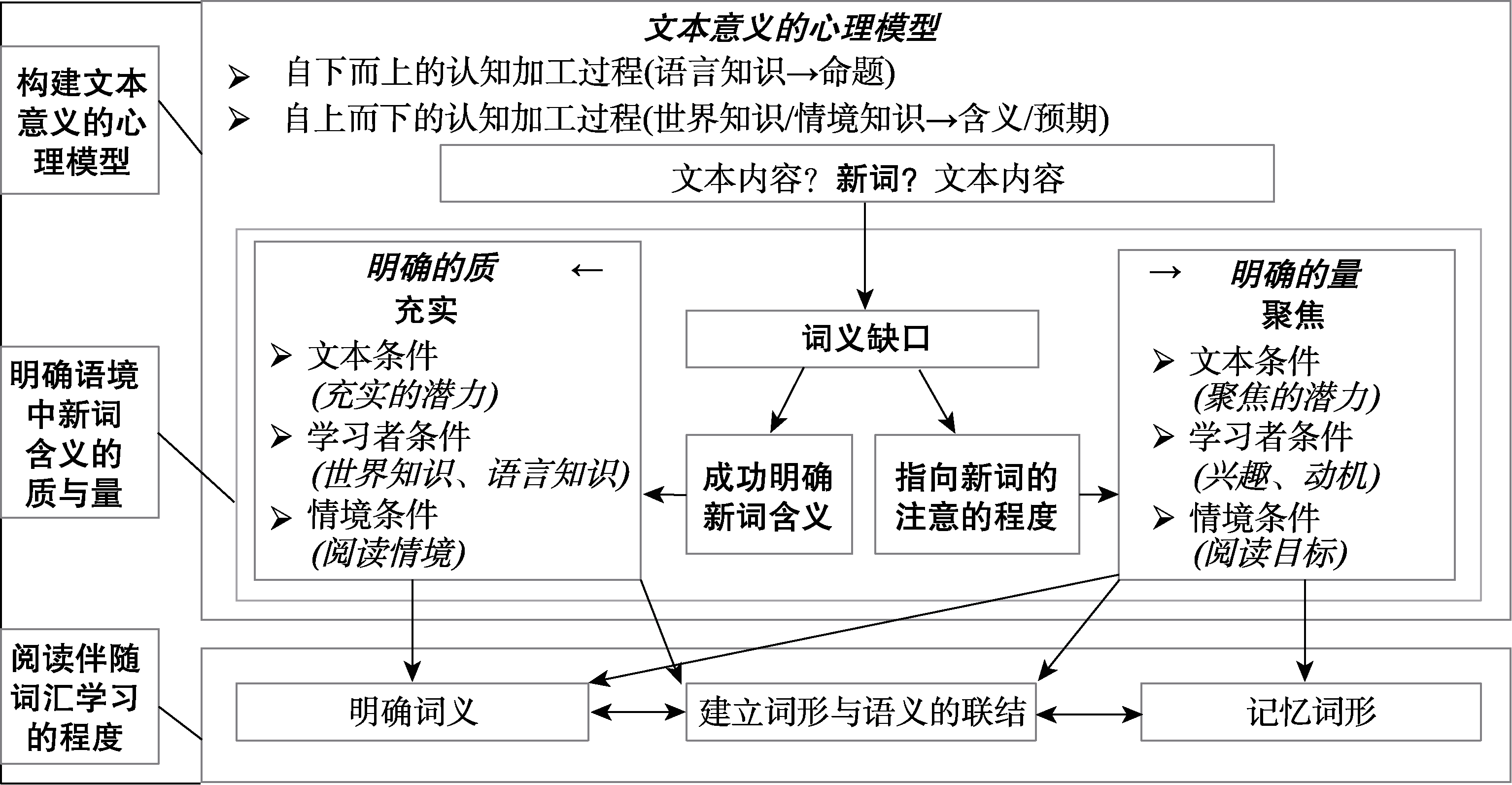
图1 聚焦−充实模型(Rieder, 2002)
| 实验条件 | 语义透明度 | 右部件熟悉性 | 假字笔画数 |
|---|---|---|---|
| 语义透明 | 4.64(0.23) | 2.43(0.86) | 8.88(1.55) |
| 语义不透明 | 1.22(0.35) | 2.73(1.14) | 8.38(1.06) |
表1 新词基本参数情况
| 实验条件 | 语义透明度 | 右部件熟悉性 | 假字笔画数 |
|---|---|---|---|
| 语义透明 | 4.64(0.23) | 2.43(0.86) | 8.88(1.55) |
| 语义不透明 | 1.22(0.35) | 2.73(1.14) | 8.38(1.06) |
| 句子 编号 | 例句 |
|---|---|
| 1 | 全身长着白毛的新生  /坺都是胖乎乎的样子,很招人喜欢。 /坺都是胖乎乎的样子,很招人喜欢。 |
| 2 | 长大后,变黑的爪子和尾巴就是  /坺最特别的地方。 /坺最特别的地方。 |
| 3 | 雪地上的四个独特的爪印是发现  /坺活动轨迹的主要线索。 /坺活动轨迹的主要线索。 |
| 4 | 探险家说,灵活的四肢足以保证  /坺在树枝间安全爬行。 /坺在树枝间安全爬行。 |
| 5 | 靠闻气味找到食物是幼小  /坺天生就有的强大本领。 /坺天生就有的强大本领。 |
| 6 | 寒潮来临,群居的弱小雌性  /坺经常会挤在一起取暖。 /坺经常会挤在一起取暖。 |
表2 实验句材料举例
| 句子 编号 | 例句 |
|---|---|
| 1 | 全身长着白毛的新生 /坺都是胖乎乎的样子,很招人喜欢。 |
| 2 | 长大后,变黑的爪子和尾巴就是 /坺最特别的地方。 |
| 3 | 雪地上的四个独特的爪印是发现 /坺活动轨迹的主要线索。 |
| 4 | 探险家说,灵活的四肢足以保证 /坺在树枝间安全爬行。 |
| 5 | 靠闻气味找到食物是幼小 /坺天生就有的强大本领。 |
| 6 | 寒潮来临,群居的弱小雌性 /坺经常会挤在一起取暖。 |
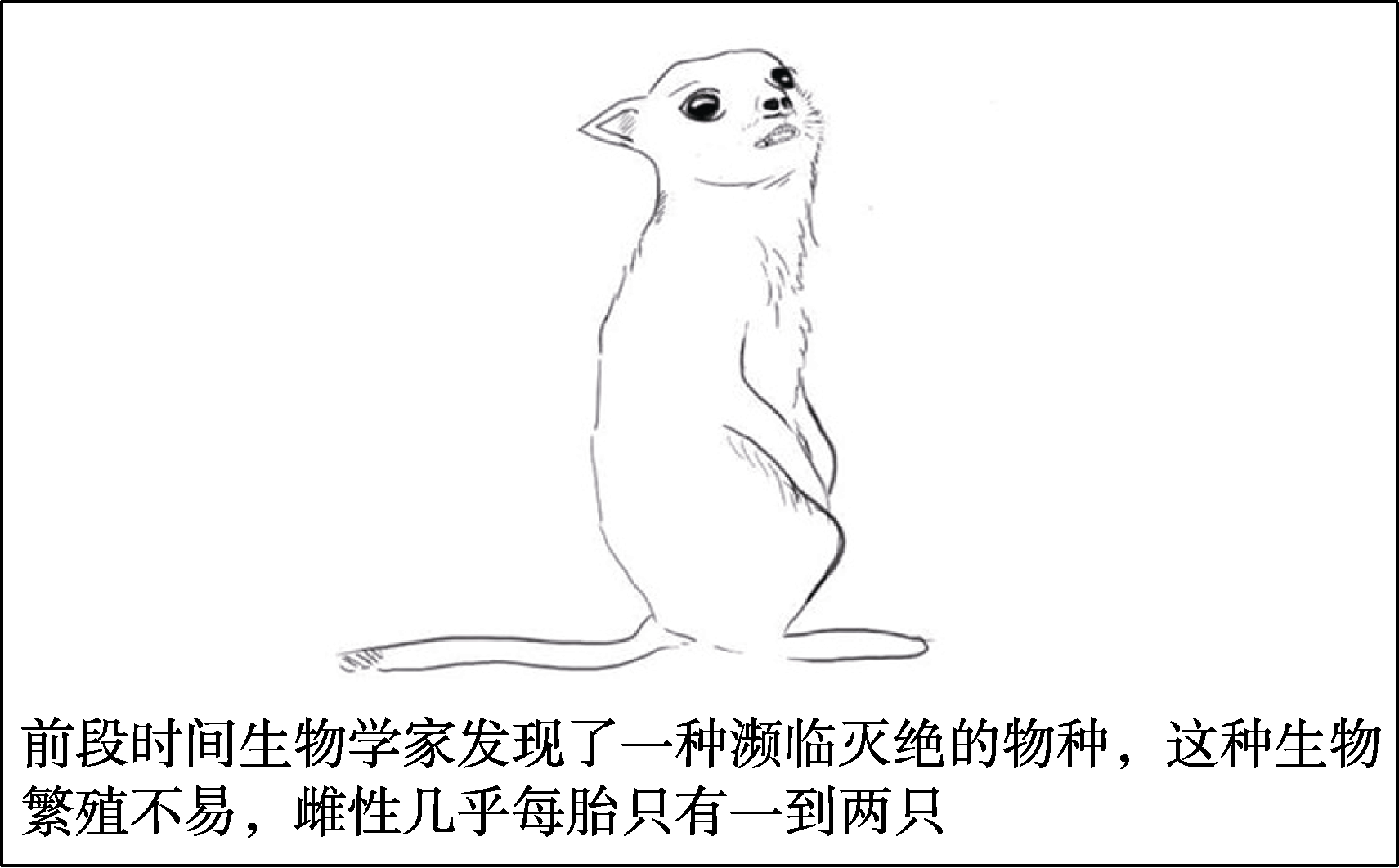
图2 语义激活材料举例
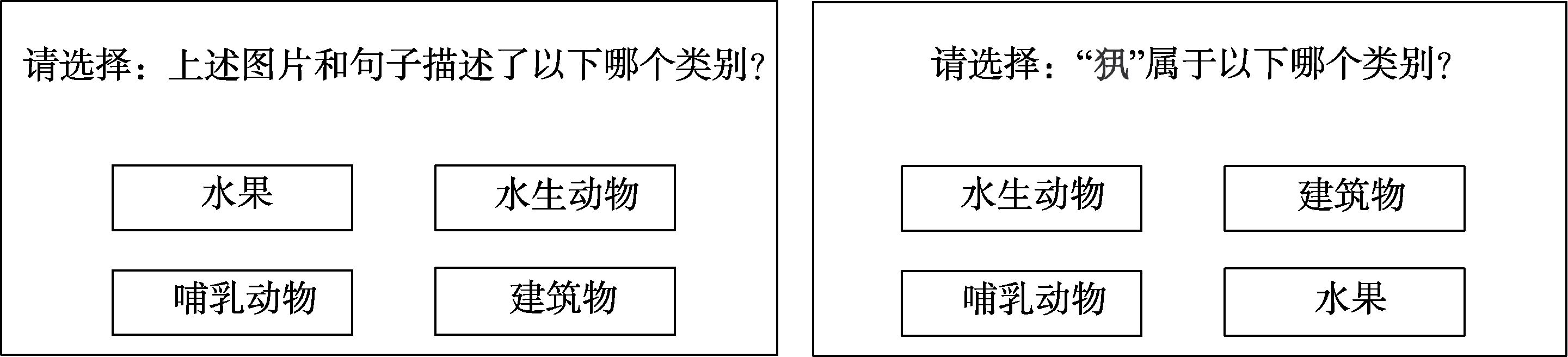
图3 语义类别选择题举例
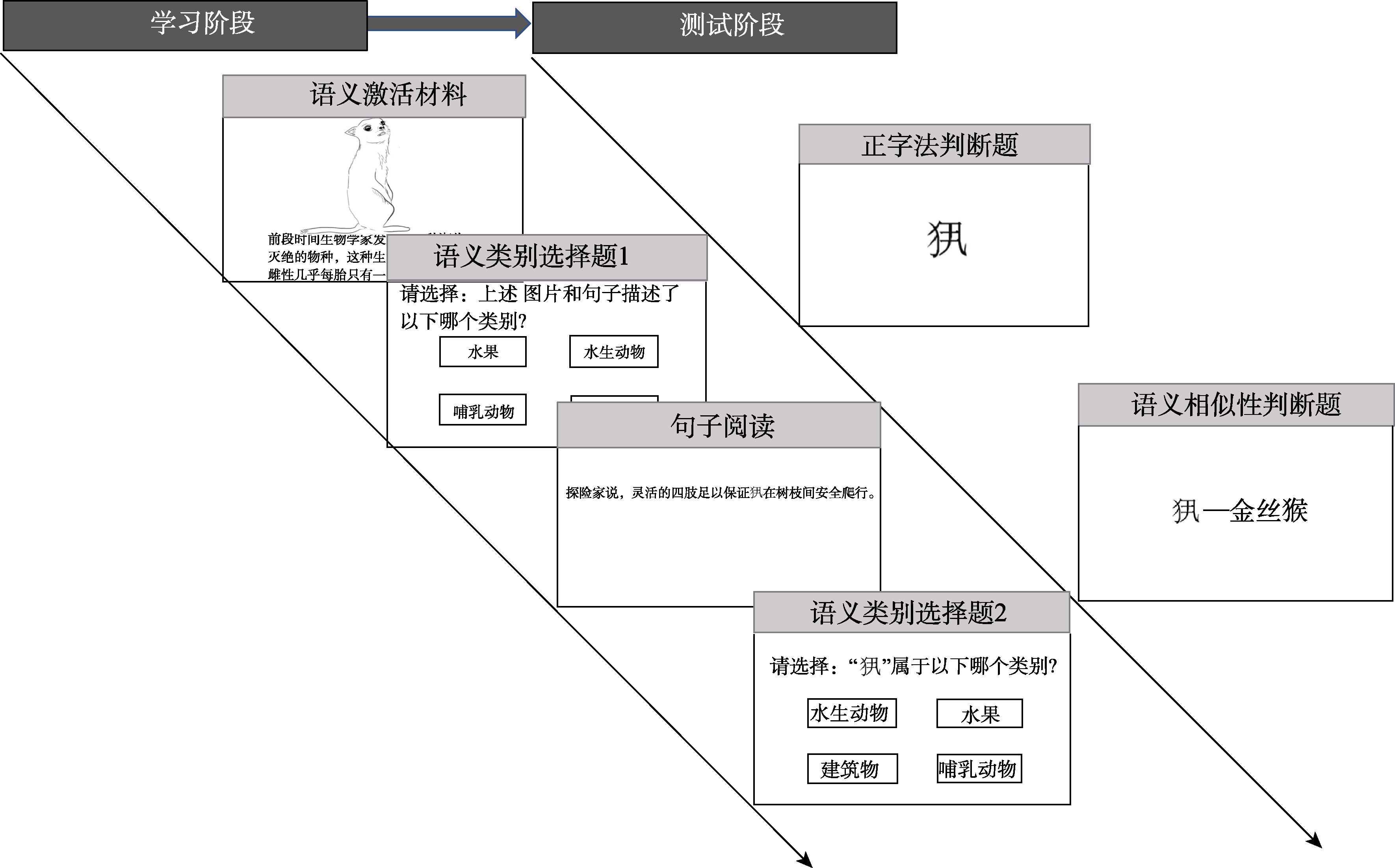
图4 实验流程
| 学习 次数 | 首次注视时间 | 凝视 时间 | 回视路径时间 | 回视出 概率 | 重读 时间 | 总注视 时间 | 总注视 次数 | 句子阅读时间 | 句子注视次数 | 注视时间比率 | 注视次数比率 |
|---|---|---|---|---|---|---|---|---|---|---|---|
| 1 | −0.009 | 0.10 | 0.22* | 0.31* | 0.61** | 0.61** | 0.59** | 0.45** | 0.40** | 0.36** | 0.32** |
| 2 | −0.006 | 0.03 | 0.09 | 0.04 | 0.25* | 0.36** | 0.40** | 0.38** | 0.34** | −0.006 | −0.05 |
| 3 | 0.12 | 0.15 | 0.10 | 0.19 | 0.49** | 0.53** | 0.47** | 0.40** | 0.35** | 0.07 | 0.04 |
| 4 | −0.05 | 0.05 | 0.22* | 0.22 | −0.07 | 0.28** | 0.39** | 0.36** | 0.34** | −0.13 | −0.07 |
| 5 | 0.14 | 0.14 | 0.07 | 0.17 | 0.07 | 0.34** | 0.26** | 0.37** | 0.35** | −0.07 | −0.14 |
| 6 | −0.08 | −0.04 | 0.08 | 0.30** | 0.26** | 0.20* | 0.22* | 0.39** | 0.36** | −0.23* | −0.25** |
表3 正字法辨别力指数与各眼动指标的相关系数汇总
| 学习 次数 | 首次注视时间 | 凝视 时间 | 回视路径时间 | 回视出 概率 | 重读 时间 | 总注视 时间 | 总注视 次数 | 句子阅读时间 | 句子注视次数 | 注视时间比率 | 注视次数比率 |
|---|---|---|---|---|---|---|---|---|---|---|---|
| 1 | −0.009 | 0.10 | 0.22* | 0.31* | 0.61** | 0.61** | 0.59** | 0.45** | 0.40** | 0.36** | 0.32** |
| 2 | −0.006 | 0.03 | 0.09 | 0.04 | 0.25* | 0.36** | 0.40** | 0.38** | 0.34** | −0.006 | −0.05 |
| 3 | 0.12 | 0.15 | 0.10 | 0.19 | 0.49** | 0.53** | 0.47** | 0.40** | 0.35** | 0.07 | 0.04 |
| 4 | −0.05 | 0.05 | 0.22* | 0.22 | −0.07 | 0.28** | 0.39** | 0.36** | 0.34** | −0.13 | −0.07 |
| 5 | 0.14 | 0.14 | 0.07 | 0.17 | 0.07 | 0.34** | 0.26** | 0.37** | 0.35** | −0.07 | −0.14 |
| 6 | −0.08 | −0.04 | 0.08 | 0.30** | 0.26** | 0.20* | 0.22* | 0.39** | 0.36** | −0.23* | −0.25** |
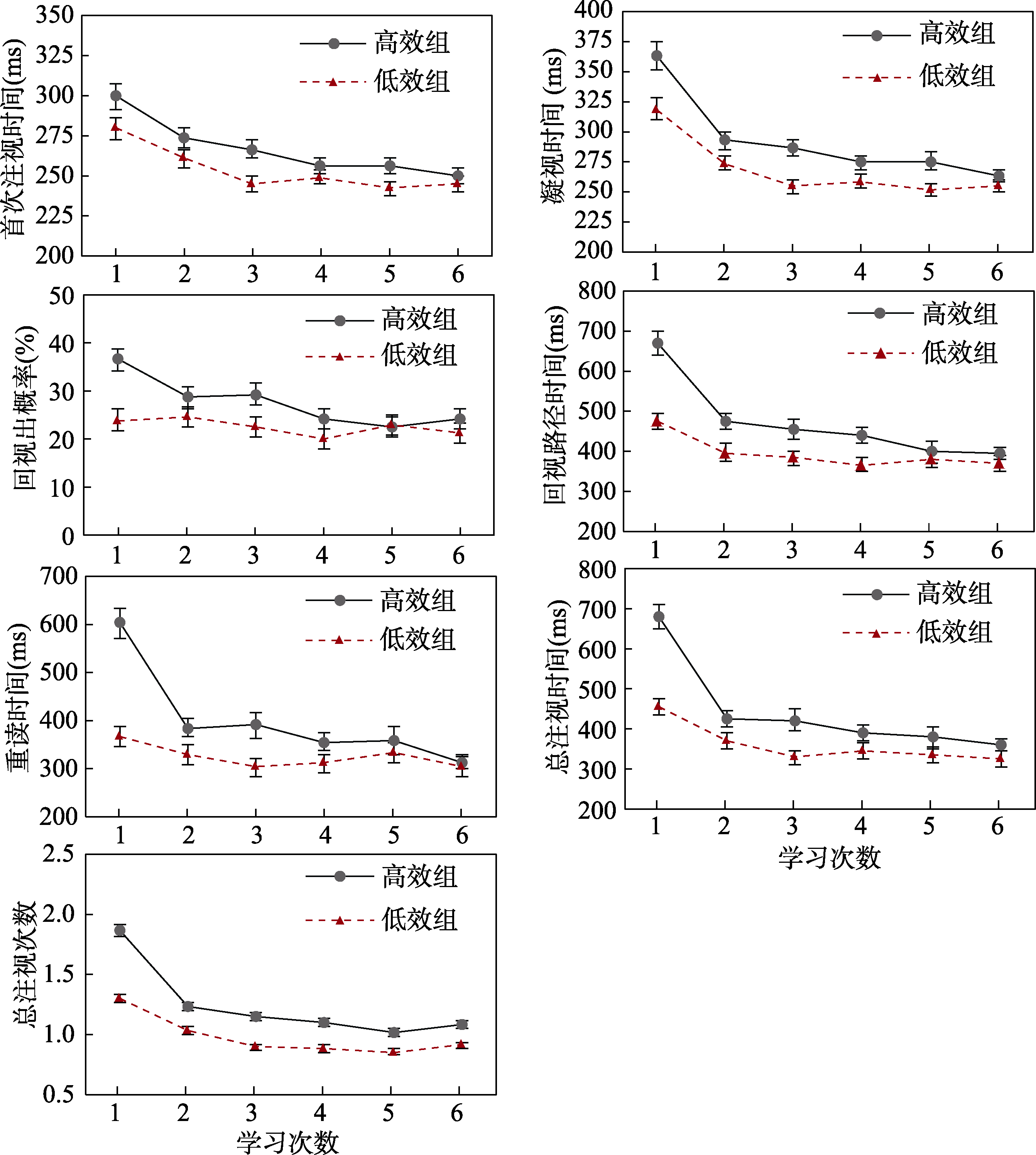
图5 高、低效组在新词上的眼动注视模式比较
| 眼动指标 | 变量 | b | SE | t/z | p | 95% CI |
|---|---|---|---|---|---|---|
| 首次注视时间 | 截距 | 5.56 | 0.02 | 347.71 | < 0.001 | [5.53, 5.59] |
| 组别 | −0.06 | 0.02 | −2.31 | 0.02 | [−0.10, −0.008] | |
| 学习次数 | −0.03 | 0.005 | −5.17 | < 0.001 | [−0.04, −0.02] | |
| 组别×学习次数 | 0.005 | 0.008 | 0.60 | 0.55 | [−0.01, 0.02] | |
| 凝视时间 | 截距 | 5.62 | 0.03 | 212.01 | < 0.001 | [5.57, 5.68] |
| 组别 | −0.09 | 0.05 | −1.92 | 0.06 | [−0.18, 0.002] | |
| 学习次数 | −0.03 | 0.005 | −6.05 | < 0.001 | [−0.04, −0.02] | |
| 组别×学习次数 | 0.009 | 0.008 | 1.16 | 0.25 | [−0.006, 0.02] | |
| 回视路径时间 | 截距 | 6.03 | 0.03 | 191.02 | < 0.001 | [5.96, 6.09] |
| 组别 | −0.28 | 0.04 | −7.25 | < 0.001 | [−0.36, −0.21] | |
| 学习次数 | −0.06 | 0.009 | −6.18 | < 0.001 | [−0.08, −0.04] | |
| 组别×学习次数 | 0.05 | 0.01 | 3.43 | < 0.001 | [0.02, 0.07] | |
| 回视出概率 | 截距 | −0.84 | 0.14 | −6.09 | < 0.001 | [−1.10, −0.57] |
| 组别 | −0.59 | 0.22 | −2.72 | 0.006 | [−1.01, −0.17] | |
| 学习次数 | −0.10 | 0.03 | −3.21 | 0.001 | [−0.16, −0.04] | |
| 组别×学习次数 | 0.10 | 0.04 | 2.35 | 0.02 | [0.02, 0.18] | |
| 重读时间 | 截距 | 5.90 | 0.04 | 155.69 | < 0.001 | [5.83, 5.98] |
| 组别 | −0.41 | 0.06 | −6.79 | < 0.001 | [−0.53, −0.29] | |
| 学习次数 | −0.07 | 0.01 | −6.09 | < 0.001 | [−0.09, −0.04] | |
| 组别×学习次数 | 0.07 | 0.02 | 3.66 | < 0.001 | [0.03, 0.10] | |
| 总注视次数 | 截距 | 1.46 | 0.07 | 21.36 | < 0.001 | [1.33, 1.60] |
| 组别 | −0.48 | 0.11 | −4.47 | < 0.001 | [−0.69, −0.27] | |
| 学习次数 | −0.10 | 0.01 | −7.27 | < 0.001 | [−0.13, −0.07] | |
| 组别×学习次数 | 0.06 | 0.02 | 3.53 | < 0.001 | [0.03, 0.10] | |
| 总注视时间 | 截距 | 6.02 | 0.04 | 161.23 | < 0.001 | [5.94, 6.09] |
| 组别 | −0.29 | 0.06 | −4.93 | < 0.001 | [−0.40, −0.17] | |
| 学习次数 | −0.07 | 0.008 | −8.66 | < 0.001 | [−0.08, −0.05] | |
| 组别×学习次数 | 0.04 | 0.01 | 4.03 | < 0.001 | [0.02, 0.06] |
表4 高、低效组在新词上的眼动指标混合线性模型分析结果
| 眼动指标 | 变量 | b | SE | t/z | p | 95% CI |
|---|---|---|---|---|---|---|
| 首次注视时间 | 截距 | 5.56 | 0.02 | 347.71 | < 0.001 | [5.53, 5.59] |
| 组别 | −0.06 | 0.02 | −2.31 | 0.02 | [−0.10, −0.008] | |
| 学习次数 | −0.03 | 0.005 | −5.17 | < 0.001 | [−0.04, −0.02] | |
| 组别×学习次数 | 0.005 | 0.008 | 0.60 | 0.55 | [−0.01, 0.02] | |
| 凝视时间 | 截距 | 5.62 | 0.03 | 212.01 | < 0.001 | [5.57, 5.68] |
| 组别 | −0.09 | 0.05 | −1.92 | 0.06 | [−0.18, 0.002] | |
| 学习次数 | −0.03 | 0.005 | −6.05 | < 0.001 | [−0.04, −0.02] | |
| 组别×学习次数 | 0.009 | 0.008 | 1.16 | 0.25 | [−0.006, 0.02] | |
| 回视路径时间 | 截距 | 6.03 | 0.03 | 191.02 | < 0.001 | [5.96, 6.09] |
| 组别 | −0.28 | 0.04 | −7.25 | < 0.001 | [−0.36, −0.21] | |
| 学习次数 | −0.06 | 0.009 | −6.18 | < 0.001 | [−0.08, −0.04] | |
| 组别×学习次数 | 0.05 | 0.01 | 3.43 | < 0.001 | [0.02, 0.07] | |
| 回视出概率 | 截距 | −0.84 | 0.14 | −6.09 | < 0.001 | [−1.10, −0.57] |
| 组别 | −0.59 | 0.22 | −2.72 | 0.006 | [−1.01, −0.17] | |
| 学习次数 | −0.10 | 0.03 | −3.21 | 0.001 | [−0.16, −0.04] | |
| 组别×学习次数 | 0.10 | 0.04 | 2.35 | 0.02 | [0.02, 0.18] | |
| 重读时间 | 截距 | 5.90 | 0.04 | 155.69 | < 0.001 | [5.83, 5.98] |
| 组别 | −0.41 | 0.06 | −6.79 | < 0.001 | [−0.53, −0.29] | |
| 学习次数 | −0.07 | 0.01 | −6.09 | < 0.001 | [−0.09, −0.04] | |
| 组别×学习次数 | 0.07 | 0.02 | 3.66 | < 0.001 | [0.03, 0.10] | |
| 总注视次数 | 截距 | 1.46 | 0.07 | 21.36 | < 0.001 | [1.33, 1.60] |
| 组别 | −0.48 | 0.11 | −4.47 | < 0.001 | [−0.69, −0.27] | |
| 学习次数 | −0.10 | 0.01 | −7.27 | < 0.001 | [−0.13, −0.07] | |
| 组别×学习次数 | 0.06 | 0.02 | 3.53 | < 0.001 | [0.03, 0.10] | |
| 总注视时间 | 截距 | 6.02 | 0.04 | 161.23 | < 0.001 | [5.94, 6.09] |
| 组别 | −0.29 | 0.06 | −4.93 | < 0.001 | [−0.40, −0.17] | |
| 学习次数 | −0.07 | 0.008 | −8.66 | < 0.001 | [−0.08, −0.05] | |
| 组别×学习次数 | 0.04 | 0.01 | 4.03 | < 0.001 | [0.02, 0.06] |
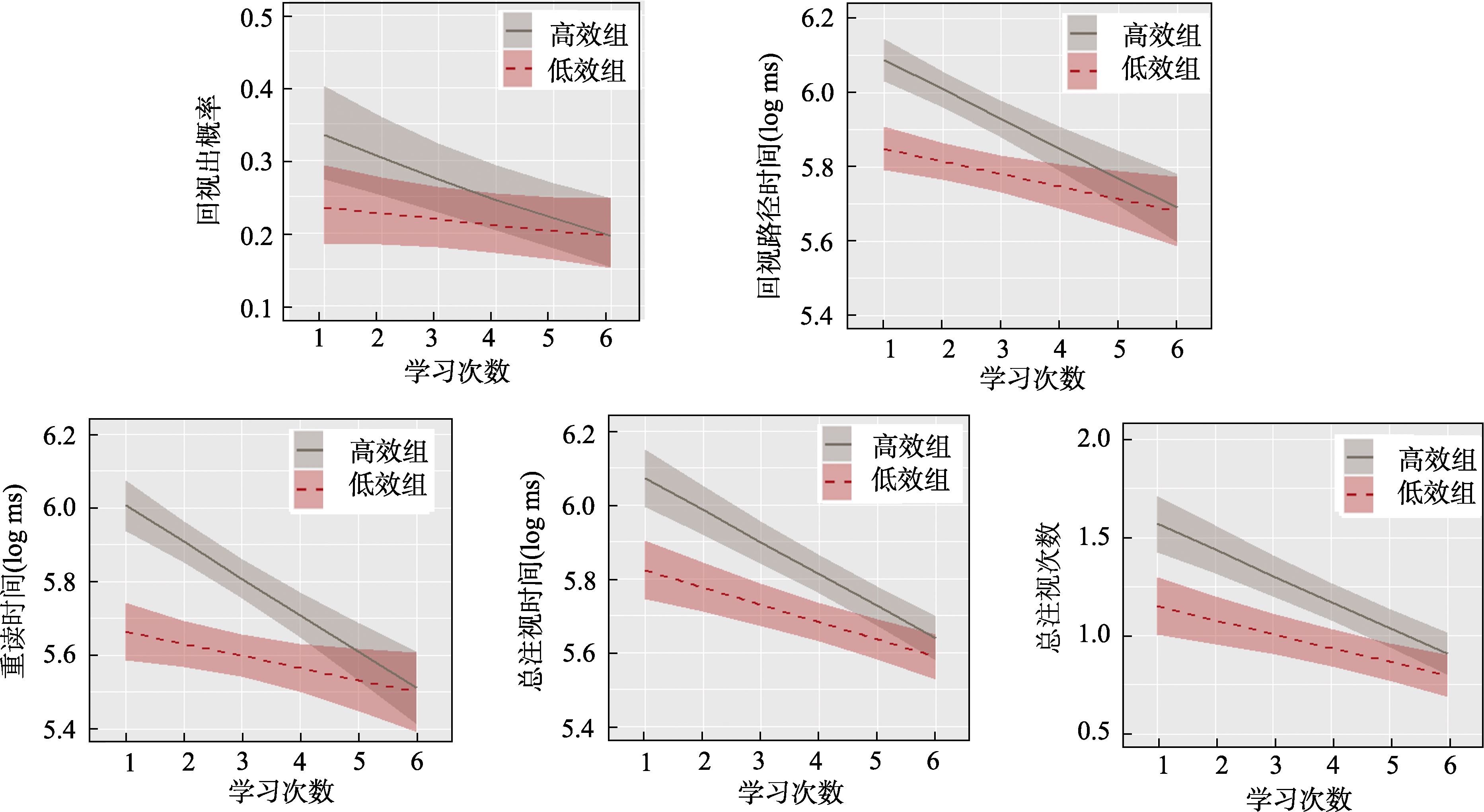
图6 高、低效组的熟悉性效应比较
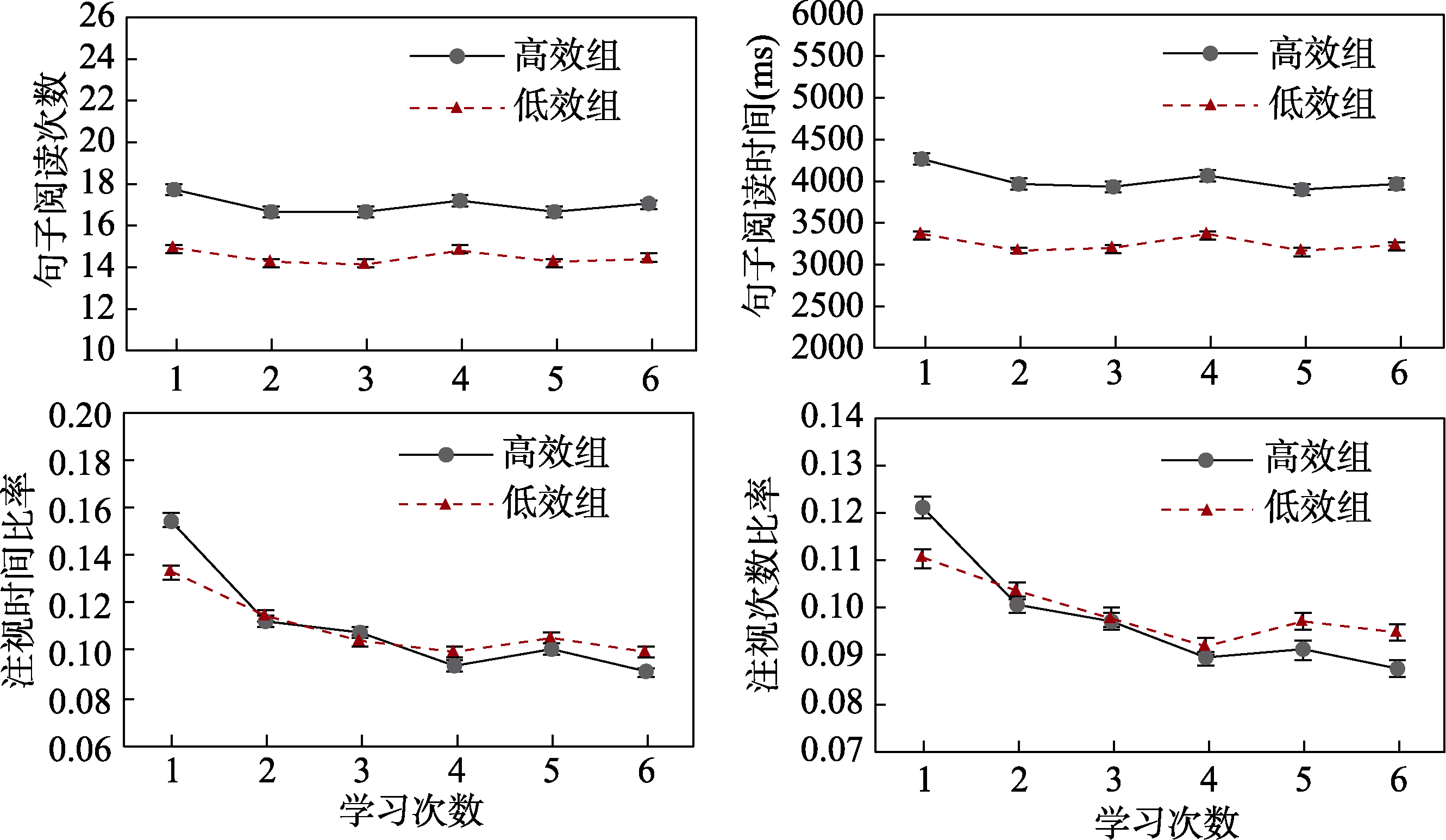
图7 高、低效组的在句子以及新词在句子中的相对加工指标上的差异
| 眼动指标 | 变量 | b | SE | t | p | 95% CI |
|---|---|---|---|---|---|---|
| 句子阅读时间 | 截距 | 8.11 | 0.04 | 200.63 | < 0.001 | [8.03, 8.19] |
| 组别 | −0.23 | 0.06 | −3.97 | < 0.001 | [−0.34, −0.12] | |
| 学习次数 | −0.009 | 0.008 | −1.16 | 0.25 | [−0.02, 0.006] | |
| 组别×学习次数 | 0.006 | 0.004 | 1.42 | 0.16 | [−0.002, 0.01] | |
| 句子阅读次数 | 截距 | 15.93 | 0.43 | 37.28 | < 0.001 | [15.09, 16.76] |
| 组别 | −2.65 | 0.23 | −11.67 | < 0.001 | [−3.10, −2.21] | |
| 学习次数 | −0.07 | 0.14 | −0.48 | 0.63 | [−0.35, 0.21] | |
| 组别×学习次数 | 0.04 | 0.20 | 0.22 | 0.83 | [−0.34, 0.43] | |
| 注视时间比率 | 截距 | 0.14 | 0.005 | 28.26 | < 0.001 | [0.13, 0.15] |
| 组别 | −0.02 | 0.007 | −2.33 | 0.02 | [−0.03, −0.003] | |
| 学习次数 | −0.008 | 0.001 | −7.31 | < 0.001 | [−0.01, −0.006] | |
| 组别×学习次数 | 0.005 | 0.001 | 3.78 | < 0.001 | [0.002, 0.007] | |
| 注视次数比率 | 截距 | 0.11 | 0.003 | 35.72 | < 0.001 | [0.11, 0.12] |
| 组别 | −0.008 | 0.004 | −2.04 | 0.04 | [−0.02, −0.0003] | |
| 学习次数 | −0.004 | 0.0007 | −5.91 | < 0.001 | [−0.006, −0.003] | |
| 组别×学习次数 | 0.003 | 0.0006 | 5.10 | < 0.001 | [0.002, 0.004] |
表5 高、低效组在句子以及新词在句子中的相对加工指标的混合线性模型分析结果
| 眼动指标 | 变量 | b | SE | t | p | 95% CI |
|---|---|---|---|---|---|---|
| 句子阅读时间 | 截距 | 8.11 | 0.04 | 200.63 | < 0.001 | [8.03, 8.19] |
| 组别 | −0.23 | 0.06 | −3.97 | < 0.001 | [−0.34, −0.12] | |
| 学习次数 | −0.009 | 0.008 | −1.16 | 0.25 | [−0.02, 0.006] | |
| 组别×学习次数 | 0.006 | 0.004 | 1.42 | 0.16 | [−0.002, 0.01] | |
| 句子阅读次数 | 截距 | 15.93 | 0.43 | 37.28 | < 0.001 | [15.09, 16.76] |
| 组别 | −2.65 | 0.23 | −11.67 | < 0.001 | [−3.10, −2.21] | |
| 学习次数 | −0.07 | 0.14 | −0.48 | 0.63 | [−0.35, 0.21] | |
| 组别×学习次数 | 0.04 | 0.20 | 0.22 | 0.83 | [−0.34, 0.43] | |
| 注视时间比率 | 截距 | 0.14 | 0.005 | 28.26 | < 0.001 | [0.13, 0.15] |
| 组别 | −0.02 | 0.007 | −2.33 | 0.02 | [−0.03, −0.003] | |
| 学习次数 | −0.008 | 0.001 | −7.31 | < 0.001 | [−0.01, −0.006] | |
| 组别×学习次数 | 0.005 | 0.001 | 3.78 | < 0.001 | [0.002, 0.007] | |
| 注视次数比率 | 截距 | 0.11 | 0.003 | 35.72 | < 0.001 | [0.11, 0.12] |
| 组别 | −0.008 | 0.004 | −2.04 | 0.04 | [−0.02, −0.0003] | |
| 学习次数 | −0.004 | 0.0007 | −5.91 | < 0.001 | [−0.006, −0.003] | |
| 组别×学习次数 | 0.003 | 0.0006 | 5.10 | < 0.001 | [0.002, 0.004] |

图8 高、低效组与学习次数在新词与句子相对加工指标上的交互作用
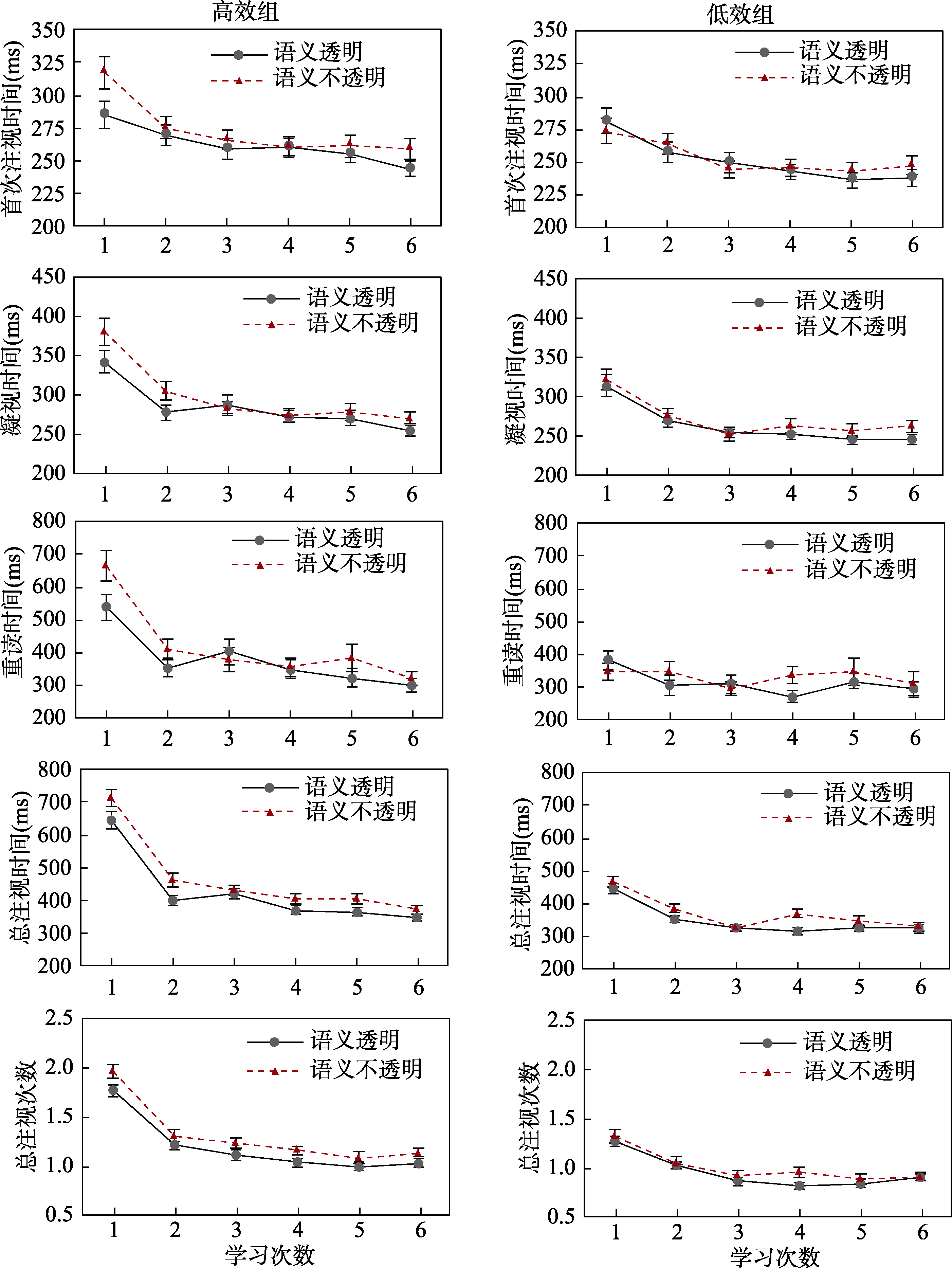
图9 高效组和低效组对透明和不透明新词的注视情况
| 眼动指标 | 变量 | b | SE | t | p | 95% CI |
|---|---|---|---|---|---|---|
| 首次注视时间 | 截距 | 5.59 | 0.02 | 279.48 | < 0.001 | [5.55, 5.63] |
| 语义透明度 | 0.04 | 0.03 | 1.15 | 0.25 | [−0.03, 0.11] | |
| 学习次数 | −0.03 | 0.007 | −4.10 | < 0.001 | [−0.04, −0.01] | |
| 透明度×学习次数 | −0.006 | 0.009 | −0.69 | 0.49 | [−0.02, 0.01] | |
| 凝视时间 | 截距 | 5.66 | 0.04 | 145.11 | < 0.001 | [5.58, 5.74] |
| 语义透明度 | 0.08 | 0.04 | 2.15 | 0.03 | [0.007, 0.15] | |
| 学习次数 | −0.03 | 0.007 | −5.10 | < 0.001 | [−0.05, −0.02] | |
| 透明度×学习次数 | −0.01 | 0.01 | −1.25 | 0.21 | [−0.03, 0.007] | |
| 重读时间 | 截距 | 6.10 | 0.05 | 125.90 | < 0.001 | [6.00, 6.19] |
| 语义透明度 | 0.22 | 0.08 | 2.72 | 0.007 | [0.06, 0.38] | |
| 学习次数 | −0.10 | 0.01 | −7.01 | < 0.001 | [−0.13, −0.07] | |
| 透明度×学习次数 | −0.04 | 0.02 | −1.65 | 0.10 | [−0.08, 0.007] | |
| 总注视次数 | 截距 | 1.72 | 0.06 | 27.57 | < 0.001 | [1.60, 1.84] |
| 语义透明度 | 0.17 | 0.07 | 2.62 | 0.009 | [0.04, 0.31] | |
| 学习次数 | −0.13 | 0.02 | −6.99 | < 0.001 | [−0.17, −0.10] | |
| 透明度×学习次数 | −0.01 | 0.02 | −0.87 | 0.39 | [−0.05, 0.02] | |
| 总注视时间 | 截距 | 6.19 | 0.03 | 178.26 | < 0.001 | [6.12, 6.26] |
| 语义透明度 | 0.10 | 0.04 | 2.39 | 0.02 | [0.02, 0.18] | |
| 学习次数 | −0.09 | 0.01 | −8.83 | < 0.001 | [−0.11, −0.07] | |
| 透明度×学习次数 | −0.006 | 0.01 | −0.60 | 0.55 | [−0.03, 0.01] |
表6 高效组在新词上的眼动指标的混合线性模型分析结果
| 眼动指标 | 变量 | b | SE | t | p | 95% CI |
|---|---|---|---|---|---|---|
| 首次注视时间 | 截距 | 5.59 | 0.02 | 279.48 | < 0.001 | [5.55, 5.63] |
| 语义透明度 | 0.04 | 0.03 | 1.15 | 0.25 | [−0.03, 0.11] | |
| 学习次数 | −0.03 | 0.007 | −4.10 | < 0.001 | [−0.04, −0.01] | |
| 透明度×学习次数 | −0.006 | 0.009 | −0.69 | 0.49 | [−0.02, 0.01] | |
| 凝视时间 | 截距 | 5.66 | 0.04 | 145.11 | < 0.001 | [5.58, 5.74] |
| 语义透明度 | 0.08 | 0.04 | 2.15 | 0.03 | [0.007, 0.15] | |
| 学习次数 | −0.03 | 0.007 | −5.10 | < 0.001 | [−0.05, −0.02] | |
| 透明度×学习次数 | −0.01 | 0.01 | −1.25 | 0.21 | [−0.03, 0.007] | |
| 重读时间 | 截距 | 6.10 | 0.05 | 125.90 | < 0.001 | [6.00, 6.19] |
| 语义透明度 | 0.22 | 0.08 | 2.72 | 0.007 | [0.06, 0.38] | |
| 学习次数 | −0.10 | 0.01 | −7.01 | < 0.001 | [−0.13, −0.07] | |
| 透明度×学习次数 | −0.04 | 0.02 | −1.65 | 0.10 | [−0.08, 0.007] | |
| 总注视次数 | 截距 | 1.72 | 0.06 | 27.57 | < 0.001 | [1.60, 1.84] |
| 语义透明度 | 0.17 | 0.07 | 2.62 | 0.009 | [0.04, 0.31] | |
| 学习次数 | −0.13 | 0.02 | −6.99 | < 0.001 | [−0.17, −0.10] | |
| 透明度×学习次数 | −0.01 | 0.02 | −0.87 | 0.39 | [−0.05, 0.02] | |
| 总注视时间 | 截距 | 6.19 | 0.03 | 178.26 | < 0.001 | [6.12, 6.26] |
| 语义透明度 | 0.10 | 0.04 | 2.39 | 0.02 | [0.02, 0.18] | |
| 学习次数 | −0.09 | 0.01 | −8.83 | < 0.001 | [−0.11, −0.07] | |
| 透明度×学习次数 | −0.006 | 0.01 | −0.60 | 0.55 | [−0.03, 0.01] |
| 眼动指标 | 变量 | b | SE | t | p | 95% CI |
|---|---|---|---|---|---|---|
| 首次注视时间 | 截距 | 5.53 | 0.02 | 270.81 | < 0.001 | [5.49, 5.57] |
| 语义透明度 | −0.01 | 0.03 | −0.36 | 0.72 | [−0.08, 0.05] | |
| 学习次数 | −0.02 | 0.006 | −3.69 | < 0.001 | [−0.03, −0.01] | |
| 透明度×学习次数 | 0.008 | 0.009 | 0.87 | 0.38 | [−0.009, 0.02] | |
| 凝视时间 | 截距 | 5.61 | 0.02 | 235.54 | < 0.001 | [5.56, 5.65] |
| 语义透明度 | −0.005 | 0.04 | −0.15 | 0.88 | [−0.08, 0.07] | |
| 学习次数 | −0.03 | 0.007 | −4.55 | < 0.001 | [−0.05, −0.02] | |
| 透明度×学习次数 | 0.008 | 0.009 | 0.87 | 0.39 | [−0.01, 0.03] | |
| 重读时间 | 截距 | 5.71 | 0.04 | 130.53 | < 0.001 | [5.62, 5.79] |
| 语义透明度 | 0.02 | 0.08 | 0.28 | 0.78 | [−0.14, 0.19] | |
| 学习次数 | −0.03 | 0.01 | −2.57 | 0.01 | [−0.06, −0.008] | |
| 透明度×学习次数 | 0.002 | 0.02 | 0.07 | 0.95 | [−0.04, 0.05] | |
| 总注视次数 | 截距 | 1.23 | 0.06 | 20.42 | < 0.001 | [1.11, 1.35] |
| 语义透明度 | 0.07 | 0.05 | 1.20 | 0.23 | [−0.04, 0.17] | |
| 学习次数 | −0.07 | 0.01 | −6.03 | < 0.001 | [−0.09, −0.05] | |
| 透明度×学习次数 | −0.003 | 0.01 | −0.25 | 0.81 | [−0.03, 0.02] | |
| 总注视时间 | 截距 | 5.88 | 0.04 | 153.93 | < 0.001 | [5.80, 5.95] |
| 语义透明度 | 0.05 | 0.04 | 1.34 | 0.18 | [−0.02, 0.12] | |
| 学习次数 | −0.05 | 0.008 | −6.20 | < 0.001 | [−0.06, −0.03] | |
| 透明度×学习次数 | −0.002 | 0.01 | −0.21 | 0.83 | [−0.02, 0.02] |
表7 低效组在新词上的眼动指标的混合线性模型分析结果
| 眼动指标 | 变量 | b | SE | t | p | 95% CI |
|---|---|---|---|---|---|---|
| 首次注视时间 | 截距 | 5.53 | 0.02 | 270.81 | < 0.001 | [5.49, 5.57] |
| 语义透明度 | −0.01 | 0.03 | −0.36 | 0.72 | [−0.08, 0.05] | |
| 学习次数 | −0.02 | 0.006 | −3.69 | < 0.001 | [−0.03, −0.01] | |
| 透明度×学习次数 | 0.008 | 0.009 | 0.87 | 0.38 | [−0.009, 0.02] | |
| 凝视时间 | 截距 | 5.61 | 0.02 | 235.54 | < 0.001 | [5.56, 5.65] |
| 语义透明度 | −0.005 | 0.04 | −0.15 | 0.88 | [−0.08, 0.07] | |
| 学习次数 | −0.03 | 0.007 | −4.55 | < 0.001 | [−0.05, −0.02] | |
| 透明度×学习次数 | 0.008 | 0.009 | 0.87 | 0.39 | [−0.01, 0.03] | |
| 重读时间 | 截距 | 5.71 | 0.04 | 130.53 | < 0.001 | [5.62, 5.79] |
| 语义透明度 | 0.02 | 0.08 | 0.28 | 0.78 | [−0.14, 0.19] | |
| 学习次数 | −0.03 | 0.01 | −2.57 | 0.01 | [−0.06, −0.008] | |
| 透明度×学习次数 | 0.002 | 0.02 | 0.07 | 0.95 | [−0.04, 0.05] | |
| 总注视次数 | 截距 | 1.23 | 0.06 | 20.42 | < 0.001 | [1.11, 1.35] |
| 语义透明度 | 0.07 | 0.05 | 1.20 | 0.23 | [−0.04, 0.17] | |
| 学习次数 | −0.07 | 0.01 | −6.03 | < 0.001 | [−0.09, −0.05] | |
| 透明度×学习次数 | −0.003 | 0.01 | −0.25 | 0.81 | [−0.03, 0.02] | |
| 总注视时间 | 截距 | 5.88 | 0.04 | 153.93 | < 0.001 | [5.80, 5.95] |
| 语义透明度 | 0.05 | 0.04 | 1.34 | 0.18 | [−0.02, 0.12] | |
| 学习次数 | −0.05 | 0.008 | −6.20 | < 0.001 | [−0.06, −0.03] | |
| 透明度×学习次数 | −0.002 | 0.01 | −0.21 | 0.83 | [−0.02, 0.02] |
| [1] | Apel, K. (2009). The acquisition of mental orthographic representations for reading and spelling development. Communication Disorders Quarterly, 31(1), 42-52. |
| [2] |
Bai, X. J., Ma, J., Li, X., Lian, K. Y., Tan, K., Yang, Y., & Liang, F. F. (2019). The efficiency and improvement of novel word’s learning in Chinese children with developmental dyslexia during natural reading. Acta Psychologica Sinica, 51(4), 471-483.
doi: 10.3724/SP.J.1041.2019.00471 |
|
[白学军, 马杰, 李馨, 连坤予, 谭珂, 杨宇, 梁菲菲. (2019). 发展性阅读障碍儿童的新词习得及其改善. 心理学报, 51(4), 471-483.]
doi: 10.3724/SP.J.1041.2019.00471 |
|
| [3] | Barr, D. J., Levy, R., Scheepers, C., & Tily, H. J. (2013). Random effects structure for confirmatory hypothesis testing: Keep it maximal. Journal of Memory and Language, 68(3), 255-278. |
| [4] | Bates, D., Mächler, M., Bolker, B., & Walker, S. (2015). Fitting linear mixed-effects models using lme4. Journal of Statistical Software, 67(1), 1-48. |
| [5] | Bisson, M. J., van Heuven, W. J., Conklin, K., & Tunney, R. J. (2013). Incidental acquisition of foreign language vocabulary through brief multi-modal exposure. PLOS ONE, 8(4), e60912. |
| [6] | Blythe, H. I., Liang, F. F., Zang, C. L., Wang, J. X., Yan, G. L., Bai, X. J., & Liversedge, S. P. (2012). Inserting spaces into Chinese text helps readers to learn new words: An eye movement study. Journal of Memory and Language, 67(2), 241-254. |
| [7] |
Borovsky, A., Elman, J., & Kutas, M. (2012). Once is enough: N400 indexes semantic integration of novel word meanings from a single exposure in context. Language Learning and Development, 8(3), 278-302.
doi: 10.1080/15475441.2011.614893 pmid: 23125559 |
| [8] |
Borovsky, A., Kutas, M., & Elman, J. (2010). Learning to use words: Event-related potentials index single-shot contextual word learning. Cognition, 116(2), 289-296.
doi: 10.1016/j.cognition.2010.05.004 pmid: 20621846 |
| [9] |
Bowey, J. A., & Muller, D. (2005). Phonological recoding and rapid orthographic learning in third-graders' silent reading: A critical test of the self-teaching hypothesis. Journal of Experimental Child Psychology, 92(3), 203-219.
pmid: 16095604 |
| [10] | Castles, A., & Nation, K. (2006). How does orthographic learning happen? In S. Andrews (Ed.), From inkmarks to ideas: Challenges and controversies about word recognition and reading (pp. 151-179). Psychology Press. |
| [11] | Chambrè, S. J., Ehri, L. C., & Ness, M. (2020). Phonological decoding enhances orthographic facilitation of vocabulary learning in first graders. Reading and Writing, 33(5), 1133-1162. |
| [12] | Chen, T. X., & Feng, Y. L. (2020). Nontransparent compound character learning in L2 Chinese: Does radical awareness always work? Sage Open, 10(4), 1-10. |
| [13] | Dutilh, G., Vandekerckhove, J., Tuerlinckx, F., & Wagenmakers, E. J. (2009). A diffusion model decomposition of the practice effect. Psychonomic Bulletin & Review, 16(6), 1026-1036. |
| [14] | Eskenazi, M. A., & Nix, B. (2021). Individual differences in the desirable difficulty effect during lexical acquisition. Journal of Experimental Psychology: Learning, Memory, and Cognition, 47(1), 45-52. |
| [15] | Eskenazi, M. A., Swischuk, N. K., Folk, J. R., & Abraham, A. N. (2018). Uninformative contexts support word learning for high-skill spellers. Journal of Experimental Psychology: Learning, Memory, and Cognition, 44(12), 2019-2025. |
| [16] | He, F., Liang, F. F., & Bai, X. J. (2025). Semantic radical transparency significantly affects incidental vocabulary learning of Chinese: Evidence from eye-movement tracking. Reading and Writing, https://doi.org/10.1007/s11145-025-10651-x |
| [17] | Ho, C., Yau, P., & Au, A. (2003). Development of orthographic knowledge and its relationship with reading and spelling among Chinese kindergarten and primary school children. In C. McBride-Chang & H.-C. Chen (Eds.), Reading development in Chinese children (pp. 51-71). Westport, CT: Praeger. |
| [18] | Hulme, R. C., Barsky, D., & Rodd, J. M. (2019). Incidental learning and long‐term retention of new word meanings from stories: The effect of number of exposures. Language Learning, 69(1), 18-43. |
| [19] |
Joseph, H., & Nation, K. (2018). Examining incidental word learning during reading in children: The role of context. Journal of Experimental Child Psychology, 166, 190-211.
doi: S0022-0965(16)30239-9 pmid: 28942127 |
| [20] |
Joseph, H. S. S. L., Wonnacott, E., Forbes, P., & Nation, K. (2014). Becoming a written word: Eye movements reveal order of acquisition effects following incidental exposure to new words during silent reading. Cognition, 133(1), 238-248.
doi: 10.1016/j.cognition.2014.06.015 pmid: 25058413 |
| [21] | Kamienkowski, J. E., Carbajal, M. J., Bianchi, B., Sigman, M., & Shalom, D. E. (2018). Cumulative repetition effects across multiple readings of a word: Evidence from eye movements. Discourse Processes, 55(3), 256-271. |
| [22] | Liang, F. F., Blythe, H. I., Bai, X. J., Yan, G. L., Li, X., Zang, C. L., & Liversedge, S. P. (2017). The role of character positional frequency on Chinese word learning during natural reading. PLOS ONE, 12(11), e0187656. |
| [23] | Liang, F. F., Ma, J., Bai, X. J., & Liversedge, S. P. (2021). Initial landing position effects on Chinese word learning in children and adults. Journal of Memory and Language, 116(4), 104183. |
| [24] |
Liang, F. F., Ma, J., Li, X., Lian, K. Y., Tan, K., & Bai, X. J. (2019). Saccadic targeting deficits of Chinese children with developmental dyslexia: Evidence from novel word learning in reading. Acta Psychologica Sinica, 51(7), 805-815.
doi: 10.3724/SP.J.1041.2019.00805 |
|
[梁菲菲, 马杰, 李馨, 连坤予, 谭珂, 白学军. (2019). 发展性阅读障碍儿童阅读中的眼跳定位缺陷:基于新词学习的实验证据. 心理学报, 51(7), 805-815.]
doi: 10.3724/SP.J.1041.2019.00805 |
|
| [25] | Liang, F. F., Xiang, Y., Feng, L. L., Bai, X. J., & Liversedge, S. P. (2025). Sub-lexical semantic decoding on incidental novel word learning during natural Chinese reading. Cognitive Psychology, in revision. |
| [26] | Liang, F. F., Zhang, P., Zhang, Q. H., Wang, Y. S., & Bai, X. J. (2017). Different performance of word learning capability between children and adults in natural reading: Evidence from eye movements. Journal of Psychological Science, 40(4), 863-869. |
| [梁菲菲, 章鹏, 张琪涵, 王永胜, 白学军. (2017). 自然阅读中儿童和成人新词学习能力的差异比较:基于眼动的证据. 心理科学, 40(4), 863-869.] | |
| [27] | McKeown, M. G. (1985). The acquisition of word meaning from context by children of high and low ability. Reading Research Quarterly, 20(4), 482-496. |
| [28] | Meteyard, L., & Davies, R. A. I. (2020). Best practice guidance for linear mixed-effects models in psychological science. Journal of Memory and Language, 112, 104092. |
| [29] | Murre, J. M. (2014). S-shaped learning curves. Psychonomic Bulletin & Review, 21(2), 344-356. |
| [30] | Nagy, W. E., & Herman, P. A. (1987). Breadth and depth of vocabulary knowledge:Implications for acquisition and instruction. In M. G. McKeown & M. E. Curtis (Eds.), The nature of vocabulary acquisition (pp. 19-35). Hillsdale, NJ: Erlbaum. |
| [31] | Nagy, W. E., & Scott, J. A. (2000). Vocabulary processes. In M. L. Kamil, P. B. Mosenthal, P. D. Pearson, & R. Barr (Eds.), Handbook of reading research (Vol. 3, pp. 269-284). Lawrence Erlbaum Associates Publishers. |
| [32] |
Nation, K., Angell, P., & Castles, A. (2007). Orthographic learning via self-teaching in children learning to read English: Effects of exposure, durability, and context. Journal of Experimental Child Psychology, 96(1), 71-84.
pmid: 16904123 |
| [33] | Nelson, J. R., Balass, M., & Perfetti, C. A. (2005). Differences between written and spoken input in learning new words. Written Language and Literacy, 8(2), 25-44. |
| [34] | Perfetti, C. A., Wlotko, E. W., & Hart, L. A. (2005). Word learning and individual differences in word learning reflected in event-related potentials. Journal of Experimental Psychology: Learning, Memory, and Cognition, 31(6), 1281-1292. |
| [35] |
Reichle, E. D., Liversedge, S. P., Drieghe, D., Blythe, B. I., Joseph, H. S. S. L., White, S. J., & Rayner, K. (2013). Using E-Z Reader to examine the concurrent development of eye-movement control and reading skill. Developmental Review, 33(2), 110-149.
pmid: 24058229 |
| [36] | Rieder, A. (2002). A cognitive view of incidental vocabulary acquisition: From text meaning to word meaning. Views, 11(1&2), 53-71. |
| [37] |
Share, D. L. (2004). Orthographic learning at a glance: On the time course and developmental onset of self-teaching. Journal of Experimental Child Psychology, 87(4), 267-298.
pmid: 15050455 |
| [38] | Share, D. L. (2008). On the Anglocentricities of current reading research and practice: The perils of overreliance on an “outlier” orthography. Psychological Bulletin, 134(4), 584-615. |
| [39] | Shu, H., & Anderson, R. C. (1997). Role of radical awareness in the character and word acquisition of Chinese children. Reading Research Quarterly, 32(1), 78-89. |
| [40] |
Tamura, N., Castles, A., & Nation, K. (2017). Orthographic learning, fast and slow: Lexical competition effects reveal the time course of word learning in developing readers. Cognition, 163, 93-102.
doi: S0010-0277(17)30060-4 pmid: 28314178 |
| [41] | Taylor, J. N., & Perfetti, C. A. (2016). Eye movements reveal readers’ lexical quality and reading experience. Reading and Writing, 29(6), 1069-1103. |
| [42] |
Tversky, A., & Kahneman, D. (1974). Judgment under uncertainty: Heuristics and biases. Science, 185(4157), 1124-1131.
doi: 10.1126/science.185.4157.1124 pmid: 17835457 |
| [43] |
Uchihara, T., Webb, S., & Yanagisawa, A. (2019). The effects of repetition on incidental vocabulary learning: A meta- analysis of correlational studies. Language Learning, 69(3), 559-599.
doi: 10.1111/lang.12343 |
| [44] | van Viersen, S., Protopapas, A., Georgiou, G. K., Parrila, R., Ziaka, L., & de Jong, P. F. (2022). Lexicality effects on orthographic learning in beginning and advanced readers of Dutch: An eye-tracking study. Quarterly Journal of Experimental Psychology, 75(6), 1135-1154. |
| [45] |
Wang, J., & Zhang, J. J. (2016). The effects of category consistency and neighborhood size of the semantic radical on the semantic processing of Chinese character. Acta Psychologica Sinica, 48(11), 1390-1400.
doi: 10.3724/SP.J.1041.2016.01390 |
| [王娟, 张积家. (2016). 义符的类别一致性和家族大小影响形声字的语义加工. 心理学报, 48(11), 1390-1400.] | |
| [46] | Wang, J., Zhang, J. J., & Hu, H. Z. (2015). The developmental study of semantic radicals’ consistency awareness of primary school children. Journal of Psychological Science, 38(5), 1136-1140. |
| [王娟, 张积家, 胡鸿志. (2015). 小学生义符一致性意识的发展研究. 心理科学, 38(5), 1136-1140.] | |
| [47] | Wang, X. X., Ma, X., Tao, Y., Tao, Y. C., & Li, H. (2018). How semantic radicals in Chinese characters facilitate hierarchical category-based induction. Scientific Reports, 8(1), 5577. |
| [48] |
Weighall, A. R., Henderson, L. M., Barr, D. J., Cairney, S. A., & Gaskell, M. G. (2017). Eye-tracking the time-course of novel word learning and lexical competition in adults and children. Brain and Language, 167, 13-27.
doi: S0093-934X(15)30161-9 pmid: 27562102 |
| [49] | Zang, C. L., Zhang, M. M., Bai, X. J., Yan, G. L., Angele, B., & Liversedge, S. P. (2018). Skipping of the very-high- frequency structural particle de in Chinese reading. Quarterly Journal of Experimental Psychology, 71(1), 1-10. |
| [50] | Zhou, L., Peng, G., Zheng, H. Y., Su, I. F., & Wang, W. S. Y. (2013). Sub-lexical phonological and semantic processing of semantic radicals: A primed naming study. Reading and Writing, 26(6), 967-989. |
| [1] | 吴楣, 梁熙, 时嘉惠, 王争艳. 6个月婴儿社会评价的个体差异初探[J]. 心理学报, 2025, 57(4): 559-572. |
| [2] | 王娟, 马雪梅, 李兵兵, 张积家. 汉字形声字识别中义符和声符的家族效应[J]. 心理学报, 2019, 51(8): 857-868. |
| [3] | 王丹, 王婷, 秦松, 张积家. 部件启动范式下可成字部件的位置效应[J]. 心理学报, 2019, 51(2): 163-176. |
| [4] | 王斌, 李智睿, 伍丽梅, 张积家. 具身模拟在汉语肢体动作动词理解中的作用[J]. 心理学报, 2019, 51(12): 1291-1305. |
| [5] | 章玉祉, 张积家. 任务性质、家族大小和词类一致性对义符语法信息激活的影响 *[J]. 心理学报, 2019, 51(10): 1091-1101. |
| [6] | 刘湍丽, 白学军. 部分线索对记忆提取的影响:认知抑制能力的作用[J]. 心理学报, 2017, 49(9): 1158-1171. |
| [7] | 朱祖德, 段懿行, 王穗苹. 个体差异对工作记忆训练迁移效果的调节[J]. 心理学报, 2017, 49(8): 1022-1030. |
| [8] | 章玉祉, 张积家. 义符启动范式下家族大小和类别一致性 对义符语义激活的影响[J]. 心理学报, 2017, 49(8): 1041-1052. |
| [9] | 张积家;章玉祉. 义符启动范式下义符的语义和语法激活的时间进程[J]. 心理学报, 2016, 48(9): 1070-1081. |
| [10] | 王娟;张积家. 义符的类别一致性和家族大小影响形声字的语义加工[J]. 心理学报, 2016, 48(11): 1390-1400. |
| [11] | 王雨晴;游旭群;焦健;谌鹏飞. 观点采择:基于自我的推理及其个体差异[J]. 心理学报, 2015, 47(8): 1039-1049. |
| [12] | 张积家;王娟;印丛. 声符和义符在形声字语音、语义提取中的作用[J]. 心理学报, 2014, 46(7): 885-900. |
| [13] | 陈新葵,张积家. 义符熟悉性对低频形声字词汇通达的影响[J]. 心理学报, 2012, 44(7): 882-895. |
| [14] | 刘玲,李荆广,宋宜颖,刘嘉. COMT基因对注意控制神经基础的调控效应:影像遗传学研究的元分析[J]. 心理学报, 2012, 44(4): 446-458. |
| [15] | 张璇,杨玉芳. 工作记忆广度对语篇理解中重读效应的影响[J]. 心理学报, 2010, 42(07): 727-734. |
| 阅读次数 | ||||||
|
全文 |
|
|||||
|
摘要 |
|
|||||
