

ISSN 1671-3710
CN 11-4766/R
主办:中国科学院心理研究所
出版:科学出版社
CN 11-4766/R
主办:中国科学院心理研究所
出版:科学出版社
心理科学进展 ›› 2026, Vol. 34 ›› Issue (4): 687-709.doi: 10.3724/SP.J.1042.2026.0687 cstr: 32111.14.2026.0687
吕艳奇, 韦庆旺( )
)
收稿日期:2025-09-01
出版日期:2026-04-15
发布日期:2026-03-02
通讯作者:
韦庆旺, E-mail: weiqingwang@ruc.edu.cn基金资助:
LYU Yanqi, WEI Qingwang()
Received:2025-09-01
Online:2026-04-15
Published:2026-03-02
摘要:
基于中庸实践思维体系和心理健康双因素模型, 运用三水平元分析方法探讨中庸思维与心理健康的关系及其调节因素。检索2025年4月30日之前的文献, 最终纳入56篇探讨中庸思维与积极心理健康关系的文献, 共60个独立样本, 139个效应量, 35410名被试, 以及43篇探讨中庸思维与消极心理健康关系的文献, 共45个独立样本, 136个效应量, 35596名被试。结果发现, 中庸思维与积极心理健康指标显著正相关(r = 0.24), 与消极心理健康指标显著负相关(r = −0.21), 二者均为中等水平效应量; 中庸思维与心理弹性、工作满意度、工作幸福感的相关高于其与生活满意度的相关; 中庸思维和幸福感、安适感、积极情绪的相关与其和生活满意度的相关无显著差异。使用中庸信念−价值量表、中庸意见表达量表以及中庸价值取向量表测得的效应量彼此差异较小, 且与中庸实践自评量表测得的效应量差异显著。结合元分析的结果, 对中庸思维的理论内涵、测量方式, 及其与心理健康的关系进行了讨论, 指出从超越二元对立的“执中致和”视角理解中庸思维与心理健康所具有的理论建构意义。
中图分类号:
吕艳奇, 韦庆旺. (2026). 执中致和:中庸思维与心理健康关系的三水平元分析. 心理科学进展 , 34(4), 687-709.
LYU Yanqi, WEI Qingwang. (2026). Holding balance brings harmony: A three-level meta-analysis of the relationship between Zhongyong thinking and mental health. Advances in Psychological Science, 34(4), 687-709.
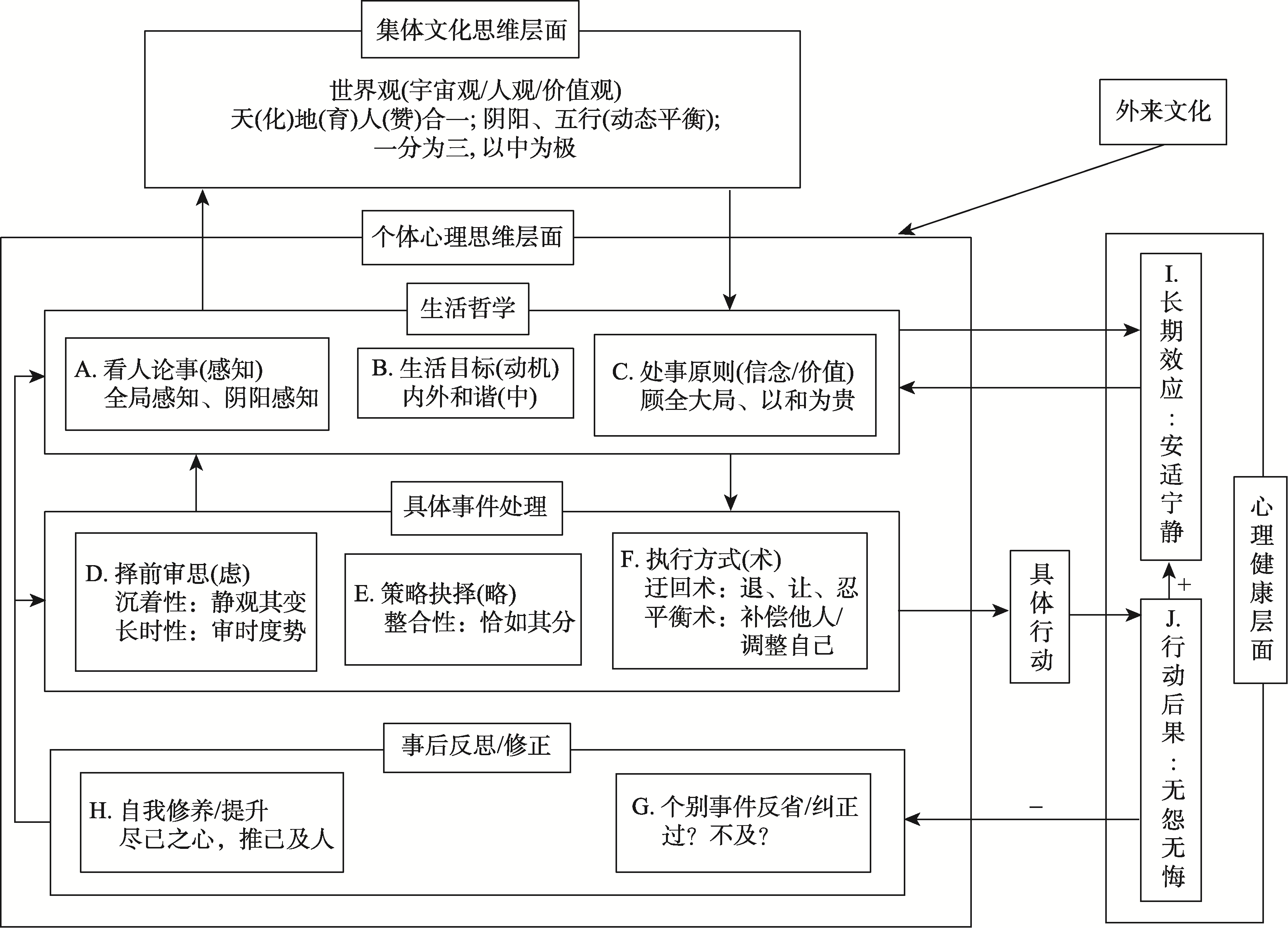
图1 中庸实践思维体系构念图(杨中芳, 2014)
| 量表名称 | 编制特征 | 维度 |
|---|---|---|
| 中庸信念/价值量表 (黄金兰 等, | 测量价值取向, 自上而下编制, 处理二元关系, 采用迫选法, 共9题。 | 拔高视野:中庸思维中有关用全局及阴阳感知来理解及处理人、事的内容。 |
| 自我收敛:对事要沉着应付、不过激, 对人则要退、忍、让的信念/价值。 | ||
| 中庸思维量表(中庸意见表达量表, 吴家辉, 林以正, | 测量实践经验, 自上而下编制, 处理二元关系, 不用迫选法, 共13题。 | 多方思考:主要在测量个人在意见表达的情境中从不同角度与想法进行思考的程度。 |
| 整合性:测量个人将外在信息与内在想法进行整合的程度。 | ||
| 和谐性:测量个人在意见表达时, 以不偏激以及和谐的方式最为行动准则的程度。 | ||
| 中庸实践自评量表(杨中芳, 阳中华 等, | 测量实践经验, 自上而下编制, 少部分处理二元关系, 不用迫选法, 共25题。 | 沉着克制:在事件发生时, 能控制住自己的情绪, 不随便发火, 等把情况摸清楚后再反应。 |
| 多方慎思:在事件发生后, 能谨慎地从不同的角度把事情细看明白、梳理清楚后再去想要如何处理。 | ||
| 事后反省:指在处理过事件后, 能回头去评价自己的行为是否恰当, 并思考要如何改进。 | ||
| 迷惘委曲:是指因对中庸信念/价值的误解或误行所造成的迷乱及怨悔的不良心理反应及情绪。 | ||
| 中庸价值取向量表(杜旌, 姚菊花, | 测量实践经验, 自下而上编制, 处理二元关系, 不用迫选法, 共8题。 | 单一维度。 |
表1 常见中庸思维量表概览
| 量表名称 | 编制特征 | 维度 |
|---|---|---|
| 中庸信念/价值量表 (黄金兰 等, | 测量价值取向, 自上而下编制, 处理二元关系, 采用迫选法, 共9题。 | 拔高视野:中庸思维中有关用全局及阴阳感知来理解及处理人、事的内容。 |
| 自我收敛:对事要沉着应付、不过激, 对人则要退、忍、让的信念/价值。 | ||
| 中庸思维量表(中庸意见表达量表, 吴家辉, 林以正, | 测量实践经验, 自上而下编制, 处理二元关系, 不用迫选法, 共13题。 | 多方思考:主要在测量个人在意见表达的情境中从不同角度与想法进行思考的程度。 |
| 整合性:测量个人将外在信息与内在想法进行整合的程度。 | ||
| 和谐性:测量个人在意见表达时, 以不偏激以及和谐的方式最为行动准则的程度。 | ||
| 中庸实践自评量表(杨中芳, 阳中华 等, | 测量实践经验, 自上而下编制, 少部分处理二元关系, 不用迫选法, 共25题。 | 沉着克制:在事件发生时, 能控制住自己的情绪, 不随便发火, 等把情况摸清楚后再反应。 |
| 多方慎思:在事件发生后, 能谨慎地从不同的角度把事情细看明白、梳理清楚后再去想要如何处理。 | ||
| 事后反省:指在处理过事件后, 能回头去评价自己的行为是否恰当, 并思考要如何改进。 | ||
| 迷惘委曲:是指因对中庸信念/价值的误解或误行所造成的迷乱及怨悔的不良心理反应及情绪。 | ||
| 中庸价值取向量表(杜旌, 姚菊花, | 测量实践经验, 自下而上编制, 处理二元关系, 不用迫选法, 共8题。 | 单一维度。 |
| 数据库 | 编号 | 检索策略 | 数量 |
|---|---|---|---|
| 万方 | S1 | 摘要:(“中庸”) | 12123 |
| S2 | 摘要:(“心理健康” OR “抑郁” OR “焦虑” OR “情感” OR “情绪” OR “幸福感” OR “满意度” OR “自尊” OR “心理弹性” OR “心理韧性”) | 2329928 | |
| S3 | S1 AND S2 | 745 | |
| 知网 | S1 | 篇关摘:“中庸” | 1731 |
| S2 | 篇关摘:“心理健康” + “抑郁” + “焦虑” + “情感” + “情绪” + “幸福感” + “满意度” + “自尊” + “心理弹性” + “心理韧性” + “压力” | 1905771 | |
| S3 | S1 AND S2 | 975 | |
| 维普 | S1 | 摘要 = “中庸” | 11319 |
| S2 | 摘要 = “心理健康” OR “抑郁” OR “焦虑” OR “情感” OR “情绪”OR “幸福感” OR “满意度” OR “自尊” OR “心理弹性” OR “心理韧性” | 1669110 | |
| S3 | S1 AND S2 | 403 | |
| 人大硕博论文库 | S1 | “中庸” | 12 |
| 华艺数位台湾学术文献数据库 | S1 | “zhongyong” OR “zhong yong” OR “zhong-yong” OR “中庸” | 248 |
| APA PsycINFO | S1 | AB (“zhongyong” OR “zhong yong” OR “zhong-yong” OR “doctrine of mean” OR “moderation thinking”) | 55 |
| S2 | AB (“mental health” OR “psychological health” OR “well being” OR “well-being” OR “life satisfaction” OR “quality of life” OR “happiness” OR “anxiety” OR “distress” OR “depression” OR “self-esteem” OR “self-worth” OR “self-efficacy” OR “emotions” OR “affect” OR “mood”) | 1251366 | |
| S3 | S1 AND S2 | 21 | |
| Web of Science | S1 | TS=(“zhongyong” OR “zhong yong” OR “zhong-yong” OR “doctrine of mean” OR “moderation thinking”) | 453 |
| S2 | TS=(“mental health” OR “psychological health” OR “well being” OR “well-being” OR “life satisfaction” OR “quality of life” OR “happiness” OR “stress” OR “anxiety” OR “distress” OR “depression” OR “self-esteem” OR “self-worth” OR “self-efficacy” OR “emotions” OR “affect” OR “mood”) | 9593376 | |
| S3 | S1 AND S2 | 86 | |
| Scopus | S1 | TITLE-ABS-KEY (“zhongyong” OR “zhong yong” OR “zhong-yong” OR “doctrine of mean” OR “moderation thinking”) | 179 |
| S2 | TITLE-ABS-KEY (“mental health” OR “psychological health” OR “well being” OR “well-being” OR “life satisfaction” OR “happiness” OR “anxiety” OR “distress” OR “depression “ OR “self-esteem” OR “self-worth” OR “self-efficacy” OR “emotions” OR “affect” OR “mood”) | 8261830 | |
| S3 | S1 AND S2 | 50 | |
| Springer Online Journals | S1 | (“zhongyong” OR “zhong yong” OR “zhong-yong” OR “doctrine of mean” OR “moderation thinking”) AND (“mental health” OR “psychological health” OR “well being” OR “well-being” OR “life satisfaction” OR “happiness” OR “anxiety” OR “distress” OR “depression “ OR “self-esteem” OR “self-worth” OR “self-efficacy” OR “emotions” OR “affect” OR “mood” | 1145 |
| S2 | within Article | 411 | |
| ProQuest Dissertations and Theses Global | S1 | summary (“zhongyong” OR “zhong yong” OR “zhong-yong” OR “doctrine of mean” OR “moderation thinking” OR “中庸”) AND summary (“mental health” OR “psychological health” OR “well being” OR “well-being” OR “life satisfaction” OR “quality of life” OR “happiness” OR “anxiety” OR “distress” OR “depression” OR “self-esteem” OR “self-worth” OR “self-efficacy” OR “emotions” OR “affect” OR “mood”) | 26 |
附表1 数据库检索策略
| 数据库 | 编号 | 检索策略 | 数量 |
|---|---|---|---|
| 万方 | S1 | 摘要:(“中庸”) | 12123 |
| S2 | 摘要:(“心理健康” OR “抑郁” OR “焦虑” OR “情感” OR “情绪” OR “幸福感” OR “满意度” OR “自尊” OR “心理弹性” OR “心理韧性”) | 2329928 | |
| S3 | S1 AND S2 | 745 | |
| 知网 | S1 | 篇关摘:“中庸” | 1731 |
| S2 | 篇关摘:“心理健康” + “抑郁” + “焦虑” + “情感” + “情绪” + “幸福感” + “满意度” + “自尊” + “心理弹性” + “心理韧性” + “压力” | 1905771 | |
| S3 | S1 AND S2 | 975 | |
| 维普 | S1 | 摘要 = “中庸” | 11319 |
| S2 | 摘要 = “心理健康” OR “抑郁” OR “焦虑” OR “情感” OR “情绪”OR “幸福感” OR “满意度” OR “自尊” OR “心理弹性” OR “心理韧性” | 1669110 | |
| S3 | S1 AND S2 | 403 | |
| 人大硕博论文库 | S1 | “中庸” | 12 |
| 华艺数位台湾学术文献数据库 | S1 | “zhongyong” OR “zhong yong” OR “zhong-yong” OR “中庸” | 248 |
| APA PsycINFO | S1 | AB (“zhongyong” OR “zhong yong” OR “zhong-yong” OR “doctrine of mean” OR “moderation thinking”) | 55 |
| S2 | AB (“mental health” OR “psychological health” OR “well being” OR “well-being” OR “life satisfaction” OR “quality of life” OR “happiness” OR “anxiety” OR “distress” OR “depression” OR “self-esteem” OR “self-worth” OR “self-efficacy” OR “emotions” OR “affect” OR “mood”) | 1251366 | |
| S3 | S1 AND S2 | 21 | |
| Web of Science | S1 | TS=(“zhongyong” OR “zhong yong” OR “zhong-yong” OR “doctrine of mean” OR “moderation thinking”) | 453 |
| S2 | TS=(“mental health” OR “psychological health” OR “well being” OR “well-being” OR “life satisfaction” OR “quality of life” OR “happiness” OR “stress” OR “anxiety” OR “distress” OR “depression” OR “self-esteem” OR “self-worth” OR “self-efficacy” OR “emotions” OR “affect” OR “mood”) | 9593376 | |
| S3 | S1 AND S2 | 86 | |
| Scopus | S1 | TITLE-ABS-KEY (“zhongyong” OR “zhong yong” OR “zhong-yong” OR “doctrine of mean” OR “moderation thinking”) | 179 |
| S2 | TITLE-ABS-KEY (“mental health” OR “psychological health” OR “well being” OR “well-being” OR “life satisfaction” OR “happiness” OR “anxiety” OR “distress” OR “depression “ OR “self-esteem” OR “self-worth” OR “self-efficacy” OR “emotions” OR “affect” OR “mood”) | 8261830 | |
| S3 | S1 AND S2 | 50 | |
| Springer Online Journals | S1 | (“zhongyong” OR “zhong yong” OR “zhong-yong” OR “doctrine of mean” OR “moderation thinking”) AND (“mental health” OR “psychological health” OR “well being” OR “well-being” OR “life satisfaction” OR “happiness” OR “anxiety” OR “distress” OR “depression “ OR “self-esteem” OR “self-worth” OR “self-efficacy” OR “emotions” OR “affect” OR “mood” | 1145 |
| S2 | within Article | 411 | |
| ProQuest Dissertations and Theses Global | S1 | summary (“zhongyong” OR “zhong yong” OR “zhong-yong” OR “doctrine of mean” OR “moderation thinking” OR “中庸”) AND summary (“mental health” OR “psychological health” OR “well being” OR “well-being” OR “life satisfaction” OR “quality of life” OR “happiness” OR “anxiety” OR “distress” OR “depression” OR “self-esteem” OR “self-worth” OR “self-efficacy” OR “emotions” OR “affect” OR “mood”) | 26 |
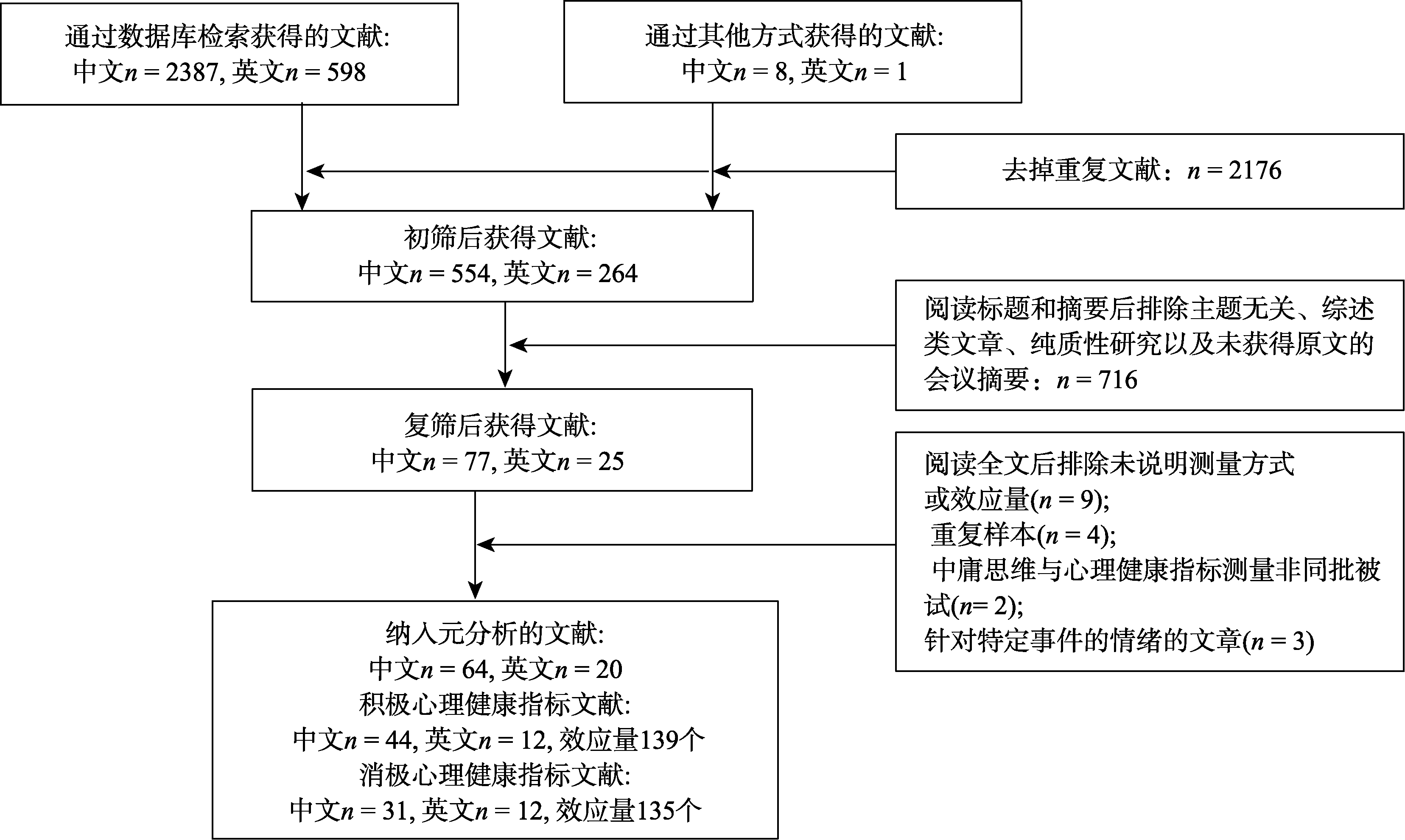
图2 文献筛选流程图
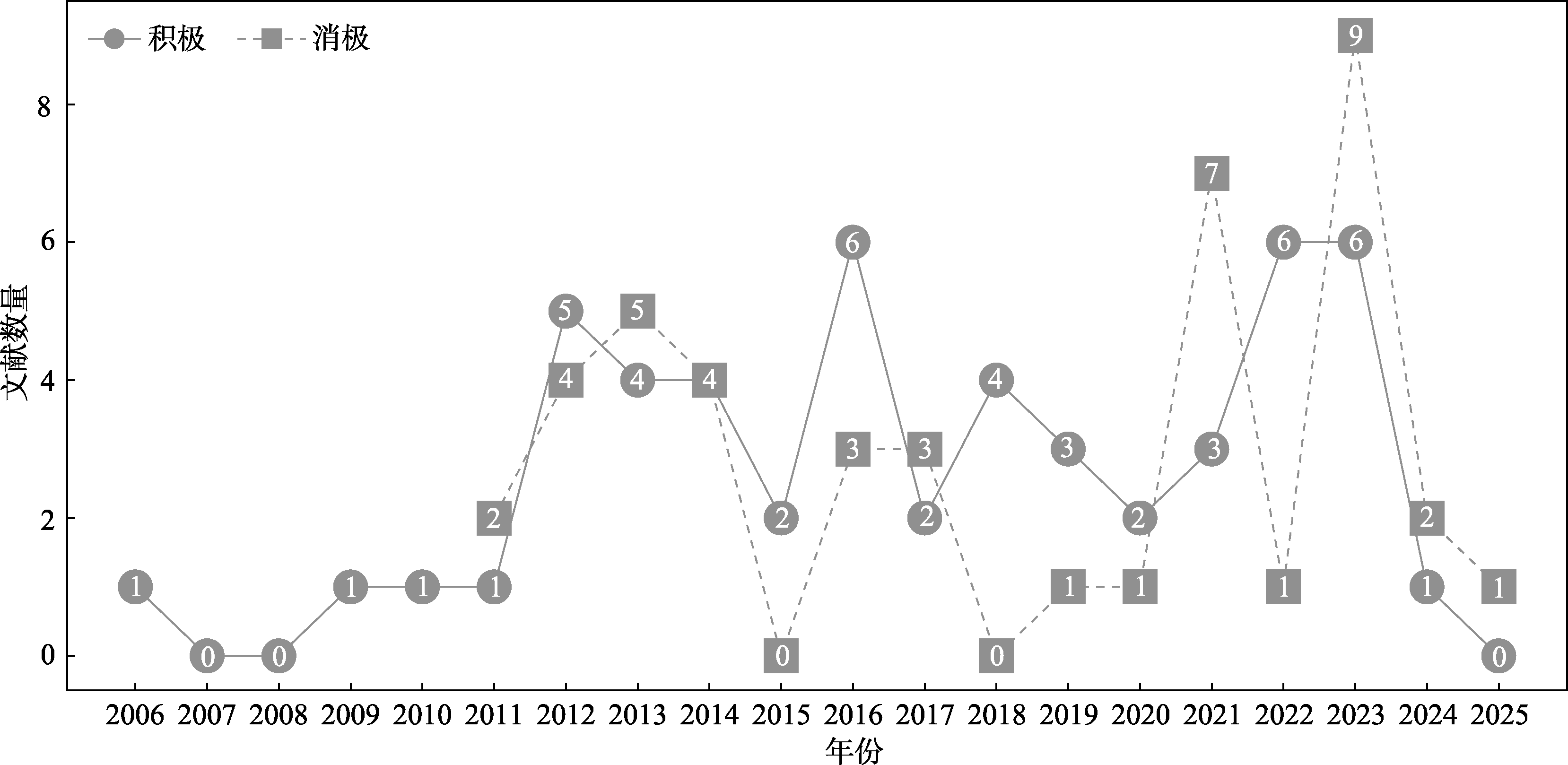
图3 历年纳入的中庸思维与积极、消极心理健康关系的文献数量
| 第一作者 | 年份 | 文献类型 | N | 被试类型 | 平均年龄 | 女性比% | 平均学历 | 心理健康测量 | 中庸测量 | 研究质量 |
|---|---|---|---|---|---|---|---|---|---|---|
| 蔡斌坤 | 2022 | 学位论文 | 599 | 员工 | 28 | 57.3 | 3.5 | EF | ZYH | 5 |
| 陈佩儀 | 2021 | CSSCI | 2256 | 本科生 | 18.39 | 66.0 | 4 | DP | ZYW | 9 |
| 谌影 | 2010 | 学位论文 | 185 | 员工 | 27.64 | 46.7 | 3.82 | JS | ZYZ | 6 |
| 程云菲 | 2013 | 学位论文 | 8202 | 本科生 | 21.1 | 62.3 | 4 | SC, DP, AX | ZYW | 7 |
| 邓传忠 | 2008 | 学位论文 | 88, | 本科生 | 20.4 | 67 | 4 | CHA, LS, DP | ZYH | 7 |
| 53 | 本科生 | 20.38 | 75.5 | 4 | CHA, LS, DP | ZYH | 2 | |||
| 丁倩 | 2019 | CSSCI | 490 | 本科生 | 21.06 | 58.6 | 4 | LL | ZYW | 9 |
| 杜旌 | 2016 | CSSCI | 325 | 员工 | 30 | 51 | 3.35 | WH | ZYD | 6 |
| 范雅媛 | 2017 | 学位论文 | 200 | 本科生 | 21.6 | 62 | 4 | FRS, PA, NA, PoM | ZYH | 6 |
| 房加帅 | 2024 | CSSCI | 320 | 员工 | 37.01 | 94.1 | 3.9 | CP | ZYD | 9 |
| 方羚 | 2024 | 普通期刊 | 219 | 运动员 | NA | 38.8 | NA | LS | ZYLQM | 7 |
| 高瞻 | 2013 | 北大核心 | 112 | 抑郁症患者 | 31.41 | 70.5 | 2.61 | NMH, DP, AX | ZYH, ZYW | 4 |
| 高瞻 | 2013 | 北大核心 | 112 | 抑郁症患者 | 31.41 | 70.5 | 2.61 | DP, AX | ZYH | 4 |
| 高旭繁 | 2013 | TSSCI | 422 | 本科生及居民 | 28.29 | 62.1 | 3.6 | CHA | ZYW | 9 |
| 巩萱萱 | 2023 | 北大核心 | 603 | 本科生 | 20.52 | 27.7 | 4 | BN | ZYW | 9 |
| 郭侃 | 2012 | 会议论文 | 369 | 本科生 | 20.14 | 29.5 | 4 | PA, NA | ZYH | 5 |
| 郭轶 | 2016 | 普通期刊 | 300 | 抑郁症患者 | 32.7 | 64.7 | 1.5 | DP, PA, NA | ZYW | 6 |
| 郭轶 | 2016 | 普通期刊 | 270 | 抑郁症患者 | 32.5 | 68.9 | 1.4 | DP | ZYW | 7 |
| 郭子瑞 | 2023 | 学位论文 | 299 | 员工 | 33.16 | 37.2 | 3.07 | WH | ZYD | 7 |
| 胡炫炫 | 2021 | 学位论文 | 378 | 员工 | 31.5 | 48.2 | 3.65 | EX | ZYW | 6 |
| 黄敏儿 | 2014 | CSSCI | 431 | 本科生 | 18.95 | 56.8 | 4 | PoM | ZYH, ZYW | 3 |
| 黄金兰 | 2012 | TSSCI | 206 | 本科生 | 20.56 | 33 | 4 | LS, CHA, PoM, DP, PA, NA | ZYH | 5 |
| 黄思成 | 2021 | 北大核心 | 2251 | 本科生 | 18.38 | 33.7 | 4 | AX | ZYW | 9 |
| 姜晟 | 2023 | 学位论文 | 1538 | 本科生和硕士生 | 19.4 | 61.6 | 4 | NA | ZYW | 7 |
| 姜平 | 2019 | CSSCI | 433 | 员工 | 24.84 | 48.3 | 1.97 | JS | ZYD | 9 |
| 李姣 | 2016 | 学位论文 | 130 | 本科生 | 19.17 | 49.2 | 4 | HA, LS, PA, NA | ZYW | 4 |
| 李鹏 | 2017 | 学位论文 | 362 | 教师 | NA | 67.1 | NA | BN | ZYW | 7 |
| 李启明 | 2016 | 普通期刊 | 526 | 本科生和硕士生 | 20.16 | 56.7 | 4.26 | RS | ZYW | 5 |
| 李爽 | 2021 | CSSCI | 299 | 员工 | 35.57 | 35.8 | 3.47 | PC | ZYW | 6 |
| 廖晨均 | 2012 | 学位论文 | 756 | 本科生 | 20 | 53.8 | 4 | HA | ZYW | 5 |
| 林玮芳 | 2013 | TSSCI | 63, | 本科生 | 20.62, | 22.2 | 4 | CHA | ZYW | 8 |
| 300 | 本科生 | 20.59 | 44 | 4 | CHA, PoM, LS, HA | ZYH | 8 | |||
| 林玮芳 | 2014 | SSCI | 178 | 本科生 | 20.69 | 50 | 4 | PA, NA, LS, PoM | ZYH | 7 |
| 林晓康 | 2024 | 普通期刊 | 1736 | 初中生 | 12.5 | 54.6 | 1 | NA | ZYW | 8 |
| 刘坤艳 | 2022 | 学位论文 | 373 | 初中生 | 13 | 50.4 | 1 | PMH, RS | ZYW | 6 |
| 刘俊 | 2011 | 学位论文 | 947 | 本科生 | 19.5 | 52.2 | 4 | HA, LS, PA, NA | ZYLJ | 7 |
| 刘亚楠 | 2022 | CSSCI | 190 | 员工 | 30.23 | 45.3 | NA | LS | SDD | 8 |
| 麦文玲 | 2017 | 学位论文 | 238 | 本科生与居民 | 33.7 | 59.7 | 3.8 | LS, PoM, NMH, DP, AX | ZYW, ZYH | 5 |
| 祁佳慧 | 2023 | 学位论文 | 124 | 学生 | NA | 76.6 | 4 | DP, NA | ZYW | 0 |
| 乔诗慧 | 2018 | 学位论文 | 379 | 员工 | 30.6 | 45.9 | 4.2 | PA | ZYD | 7 |
| 谭冬雪 | 2012 | 学位论文 | 345 | 本科生 | 23.19 | 49.3 | 4 | PA, NA, PoM | ZYH | 6 |
| 陶颖 | 2019 | 学位论文 | 306 | 员工 | 29.5 | 50.7 | 3.97 | JS | ZYW | 6 |
| 孙 旭 | 2014 | CSSCI | 72 | 居民 | 27.8 | 42 | 4.04 | NA | ZYW | 7 |
| 田立法 | 2015 | CSSCI | 726 | 员工 | 31 | 51.2 | 3.1 | JS | ZYD | 7 |
| 田晓雪 | 2021 | 学位论文 | 146 | 本科生 | 20.15 | 66.4 | 4 | AX | ZYW | 7 |
| 王炜辰 | 2012 | 学位论文 | 616 | 员工 | NA | 54.4 | 4.07 | WH | ZYW | 6 |
| 吴家辉 | 2006 | 普通期刊 | 107 | 本科生 | 19.6 | 57.9 | 4 | LS | ZYW | 7 |
| 徐嘉 | 2019 | 普通期刊 | 309 | 本科生 | 20.15 | 47.9 | 4 | PC, HA | ZYW | 6 |
| 徐榕辰 | 2018 | 学位论文 | 414 | 员工 | 32.8 | 51 | 3.97 | HA, PoM | ZYH | 5 |
| 杨贤传 | 2018 | 北大核心 | 447 | 员工 | 28.7 | 62.3 | 2.93 | JS | ZYD | 8 |
| 杨艳 | 2023 | 学位论文 | 635 | 员工 | 31.25 | 55.3 | 4.03 | NA | ZYH | 5 |
| 阳中华 | 2012 | 学位论文 | 780 | 家长 | 43 | 48.6 | NA | NMH, DP, AX, LS | ZYY, ZYH | 3 |
| 401 | 高中生 | 15.8 | 60.3 | 2 | NMH, DP, AX, LS | ZYY, ZYH | 3 | |||
| 杨中芳 | 2014 | CSSCI | 307 | 员工 | 30.7 | NA | 3.6 | JS, EX, PoM, LS | ZYH, ZYY | 6 |
| 尹俊 | 2022 | CSSCI | 137 | 员工 | 27.4 | 100 | 3 | FAS | ZYW | 6 |
| 于芍盈 | 2021 | 学位论文 | 312 | 员工 | 30 | 99.4 | 3.92 | PC | ZYH | 4 |
| 袁源 | 2024 | 学位论文 | 1698 | 居民 | 42.1 | 50 | 2.59 | RLS | ZYW | 5 |
| 曾维希 | 2013 | 普通期刊 | 369 | 本科生 | 20.14 | 29.5 | 4 | PA, NA | ZYW | 6 |
| 张光曦 | 2015 | CSSCI | 290 | 员工 | 26 | 37.9 | 3 | JS | ZYW | 5 |
| 张佳文 | 2023 | 普通期刊 | 1051 | 本科生 | 21 | 68.6 | 4 | EX | ZYW | 7 |
| 张悦 | 2023 | 学位论文 | 450 | 员工 | 29.4 | 44.2 | 4.66 | BN | ZYW | 5 |
| 张珍 | 2006 | 学位论文 | 186 | 员工 | NA | 54.8 | 3.93 | JS | ZYS | 2 |
| 赵舒禾 | 2013 | TSSCI | 313 | 士兵 | 23.31 | 8.3 | NA | LS, AX | ZYW | 9 |
| 郑杰仁 | 2016 | 学位论文 | 741 | 本科生和硕士生 | 20 | 66.4 | 4 | LS, HA | ZYW | 5 |
| 周玲玲 | 2023 | 学位论文 | 740 | 员工 | 37.77 | 57.7 | 3.75 | JS | ZYW | 5 |
| 周诗思 | 2022 | 学位论文 | 1341 | 本科生 | 20.5 | 70.4 | 4 | RS | ZYW | 6 |
| 朱迪 | 2014 | 学位论文 | 376 | 居民 | 33.6 | 43.9 | 2.6 | HA | ZYW | 5 |
| Chou, L. | 2014 | SSCI | 394 | 员工 | 28 | 49.5 | NA | JS, EX | ZYH | 6 |
| Cui, L. | 2022 | SSCI | 431 | 本科生 | 18.95 | 57 | 4 | PoM | ZYW | 6 |
| 477 | 本科生 | 20.4 | 48.6 | 4 | PoM, PA, NA | ZYW | 6 | |||
| He, Y. | 2021 | SSCI | 501 | 本科生 | 19.13 | 48.5 | 4 | DP | ZYLQM | 9 |
| Hou, Y. | 2020 | SSCI | 3943 | 本科生 | 23.12 | 61.7 | 4 | DP, AX | ZYW | 9 |
| Lan, X. | 2021 | SSCI | 1759 | 初中生 | 12.61 | 51.1 | 1 | PA, NA, LS | ZYW | 8 |
| Li, X. | 2023 | SSCI | 1192 | 本科生 | 19 | 79.9 | 4 | AX | ZYW | 9 |
| Liu, L. | 2023 | SSCI | 431 | 员工 | 26.24 | 33.2 | 4.5 | PMH | ZYW | 9 |
| Meng, L. | 2024 | SSCI | 1099 | 高中生 | 16 | 59 | 2 | RS, PA, NA | ZYW | 5 |
| Qu, Y. | 2018 | SSCI | 291 | 员工 | 29.67 | 40.2 | JS, ES | ZYZ | 6 | |
| Song, K. | 2025 | SSCI | 561 | 居民 | 70.2 | 49 | 1.12 | DP | ZYW | 9 |
| Wang, S. | 2021 | SSCI | 201 | 居民 | 30.73 | 53.7 | NA | AX | ZYW | 8 |
| Wei, H. | 2021 | SSCI | 874 | 初中生和高中生 | 14.07 | 48.5 | 1.5 | AX | ZYW | 7 |
| Wei, J. | 2020 | SSCI | 249 | 员工 | 30.07 | 43.8 | 4.21 | JS | ZYW | 8 |
| Xu, Y. | 2024 | 预印本 | 891 | 初中生 | 13.75 | 42.1 | 1 | SI | ZYW | 5 |
| Yang, C. | 2023 | SSCI | 415 | 员工 | 29.04 | 60 | 3.24 | SE | ZYW | 9 |
| Yang, X. | 2016 | SSCI | 8178 | 本科生 | 21.1 | 61.3 | 4 | AX, DP, ES, LS | ZYW | 9 |
| Yao, Z. | 2024 | SCI | 173 | 本科生 | 22.57 | NA | 4 | RS | ZYH | 6 |
| Yuan, Q. | 2023 | 普通期刊 | 301 | 员工 | 33.16 | 36.5 | 3.37 | EX | ZYW | 5 |
| Zhang, J. | 2023 | SSCI | 456 | 本科生 | 20.3 | 54.6 | 4 | LS | ZYW | 7 |
| Zhou, S. | 2022 | SSCI | 1356 | 本科生 | 20 | 70.4 | 4 | RS, PA | ZYW | 9 |
附表2 纳入元分析的原始研究基本信息
| 第一作者 | 年份 | 文献类型 | N | 被试类型 | 平均年龄 | 女性比% | 平均学历 | 心理健康测量 | 中庸测量 | 研究质量 |
|---|---|---|---|---|---|---|---|---|---|---|
| 蔡斌坤 | 2022 | 学位论文 | 599 | 员工 | 28 | 57.3 | 3.5 | EF | ZYH | 5 |
| 陈佩儀 | 2021 | CSSCI | 2256 | 本科生 | 18.39 | 66.0 | 4 | DP | ZYW | 9 |
| 谌影 | 2010 | 学位论文 | 185 | 员工 | 27.64 | 46.7 | 3.82 | JS | ZYZ | 6 |
| 程云菲 | 2013 | 学位论文 | 8202 | 本科生 | 21.1 | 62.3 | 4 | SC, DP, AX | ZYW | 7 |
| 邓传忠 | 2008 | 学位论文 | 88, | 本科生 | 20.4 | 67 | 4 | CHA, LS, DP | ZYH | 7 |
| 53 | 本科生 | 20.38 | 75.5 | 4 | CHA, LS, DP | ZYH | 2 | |||
| 丁倩 | 2019 | CSSCI | 490 | 本科生 | 21.06 | 58.6 | 4 | LL | ZYW | 9 |
| 杜旌 | 2016 | CSSCI | 325 | 员工 | 30 | 51 | 3.35 | WH | ZYD | 6 |
| 范雅媛 | 2017 | 学位论文 | 200 | 本科生 | 21.6 | 62 | 4 | FRS, PA, NA, PoM | ZYH | 6 |
| 房加帅 | 2024 | CSSCI | 320 | 员工 | 37.01 | 94.1 | 3.9 | CP | ZYD | 9 |
| 方羚 | 2024 | 普通期刊 | 219 | 运动员 | NA | 38.8 | NA | LS | ZYLQM | 7 |
| 高瞻 | 2013 | 北大核心 | 112 | 抑郁症患者 | 31.41 | 70.5 | 2.61 | NMH, DP, AX | ZYH, ZYW | 4 |
| 高瞻 | 2013 | 北大核心 | 112 | 抑郁症患者 | 31.41 | 70.5 | 2.61 | DP, AX | ZYH | 4 |
| 高旭繁 | 2013 | TSSCI | 422 | 本科生及居民 | 28.29 | 62.1 | 3.6 | CHA | ZYW | 9 |
| 巩萱萱 | 2023 | 北大核心 | 603 | 本科生 | 20.52 | 27.7 | 4 | BN | ZYW | 9 |
| 郭侃 | 2012 | 会议论文 | 369 | 本科生 | 20.14 | 29.5 | 4 | PA, NA | ZYH | 5 |
| 郭轶 | 2016 | 普通期刊 | 300 | 抑郁症患者 | 32.7 | 64.7 | 1.5 | DP, PA, NA | ZYW | 6 |
| 郭轶 | 2016 | 普通期刊 | 270 | 抑郁症患者 | 32.5 | 68.9 | 1.4 | DP | ZYW | 7 |
| 郭子瑞 | 2023 | 学位论文 | 299 | 员工 | 33.16 | 37.2 | 3.07 | WH | ZYD | 7 |
| 胡炫炫 | 2021 | 学位论文 | 378 | 员工 | 31.5 | 48.2 | 3.65 | EX | ZYW | 6 |
| 黄敏儿 | 2014 | CSSCI | 431 | 本科生 | 18.95 | 56.8 | 4 | PoM | ZYH, ZYW | 3 |
| 黄金兰 | 2012 | TSSCI | 206 | 本科生 | 20.56 | 33 | 4 | LS, CHA, PoM, DP, PA, NA | ZYH | 5 |
| 黄思成 | 2021 | 北大核心 | 2251 | 本科生 | 18.38 | 33.7 | 4 | AX | ZYW | 9 |
| 姜晟 | 2023 | 学位论文 | 1538 | 本科生和硕士生 | 19.4 | 61.6 | 4 | NA | ZYW | 7 |
| 姜平 | 2019 | CSSCI | 433 | 员工 | 24.84 | 48.3 | 1.97 | JS | ZYD | 9 |
| 李姣 | 2016 | 学位论文 | 130 | 本科生 | 19.17 | 49.2 | 4 | HA, LS, PA, NA | ZYW | 4 |
| 李鹏 | 2017 | 学位论文 | 362 | 教师 | NA | 67.1 | NA | BN | ZYW | 7 |
| 李启明 | 2016 | 普通期刊 | 526 | 本科生和硕士生 | 20.16 | 56.7 | 4.26 | RS | ZYW | 5 |
| 李爽 | 2021 | CSSCI | 299 | 员工 | 35.57 | 35.8 | 3.47 | PC | ZYW | 6 |
| 廖晨均 | 2012 | 学位论文 | 756 | 本科生 | 20 | 53.8 | 4 | HA | ZYW | 5 |
| 林玮芳 | 2013 | TSSCI | 63, | 本科生 | 20.62, | 22.2 | 4 | CHA | ZYW | 8 |
| 300 | 本科生 | 20.59 | 44 | 4 | CHA, PoM, LS, HA | ZYH | 8 | |||
| 林玮芳 | 2014 | SSCI | 178 | 本科生 | 20.69 | 50 | 4 | PA, NA, LS, PoM | ZYH | 7 |
| 林晓康 | 2024 | 普通期刊 | 1736 | 初中生 | 12.5 | 54.6 | 1 | NA | ZYW | 8 |
| 刘坤艳 | 2022 | 学位论文 | 373 | 初中生 | 13 | 50.4 | 1 | PMH, RS | ZYW | 6 |
| 刘俊 | 2011 | 学位论文 | 947 | 本科生 | 19.5 | 52.2 | 4 | HA, LS, PA, NA | ZYLJ | 7 |
| 刘亚楠 | 2022 | CSSCI | 190 | 员工 | 30.23 | 45.3 | NA | LS | SDD | 8 |
| 麦文玲 | 2017 | 学位论文 | 238 | 本科生与居民 | 33.7 | 59.7 | 3.8 | LS, PoM, NMH, DP, AX | ZYW, ZYH | 5 |
| 祁佳慧 | 2023 | 学位论文 | 124 | 学生 | NA | 76.6 | 4 | DP, NA | ZYW | 0 |
| 乔诗慧 | 2018 | 学位论文 | 379 | 员工 | 30.6 | 45.9 | 4.2 | PA | ZYD | 7 |
| 谭冬雪 | 2012 | 学位论文 | 345 | 本科生 | 23.19 | 49.3 | 4 | PA, NA, PoM | ZYH | 6 |
| 陶颖 | 2019 | 学位论文 | 306 | 员工 | 29.5 | 50.7 | 3.97 | JS | ZYW | 6 |
| 孙 旭 | 2014 | CSSCI | 72 | 居民 | 27.8 | 42 | 4.04 | NA | ZYW | 7 |
| 田立法 | 2015 | CSSCI | 726 | 员工 | 31 | 51.2 | 3.1 | JS | ZYD | 7 |
| 田晓雪 | 2021 | 学位论文 | 146 | 本科生 | 20.15 | 66.4 | 4 | AX | ZYW | 7 |
| 王炜辰 | 2012 | 学位论文 | 616 | 员工 | NA | 54.4 | 4.07 | WH | ZYW | 6 |
| 吴家辉 | 2006 | 普通期刊 | 107 | 本科生 | 19.6 | 57.9 | 4 | LS | ZYW | 7 |
| 徐嘉 | 2019 | 普通期刊 | 309 | 本科生 | 20.15 | 47.9 | 4 | PC, HA | ZYW | 6 |
| 徐榕辰 | 2018 | 学位论文 | 414 | 员工 | 32.8 | 51 | 3.97 | HA, PoM | ZYH | 5 |
| 杨贤传 | 2018 | 北大核心 | 447 | 员工 | 28.7 | 62.3 | 2.93 | JS | ZYD | 8 |
| 杨艳 | 2023 | 学位论文 | 635 | 员工 | 31.25 | 55.3 | 4.03 | NA | ZYH | 5 |
| 阳中华 | 2012 | 学位论文 | 780 | 家长 | 43 | 48.6 | NA | NMH, DP, AX, LS | ZYY, ZYH | 3 |
| 401 | 高中生 | 15.8 | 60.3 | 2 | NMH, DP, AX, LS | ZYY, ZYH | 3 | |||
| 杨中芳 | 2014 | CSSCI | 307 | 员工 | 30.7 | NA | 3.6 | JS, EX, PoM, LS | ZYH, ZYY | 6 |
| 尹俊 | 2022 | CSSCI | 137 | 员工 | 27.4 | 100 | 3 | FAS | ZYW | 6 |
| 于芍盈 | 2021 | 学位论文 | 312 | 员工 | 30 | 99.4 | 3.92 | PC | ZYH | 4 |
| 袁源 | 2024 | 学位论文 | 1698 | 居民 | 42.1 | 50 | 2.59 | RLS | ZYW | 5 |
| 曾维希 | 2013 | 普通期刊 | 369 | 本科生 | 20.14 | 29.5 | 4 | PA, NA | ZYW | 6 |
| 张光曦 | 2015 | CSSCI | 290 | 员工 | 26 | 37.9 | 3 | JS | ZYW | 5 |
| 张佳文 | 2023 | 普通期刊 | 1051 | 本科生 | 21 | 68.6 | 4 | EX | ZYW | 7 |
| 张悦 | 2023 | 学位论文 | 450 | 员工 | 29.4 | 44.2 | 4.66 | BN | ZYW | 5 |
| 张珍 | 2006 | 学位论文 | 186 | 员工 | NA | 54.8 | 3.93 | JS | ZYS | 2 |
| 赵舒禾 | 2013 | TSSCI | 313 | 士兵 | 23.31 | 8.3 | NA | LS, AX | ZYW | 9 |
| 郑杰仁 | 2016 | 学位论文 | 741 | 本科生和硕士生 | 20 | 66.4 | 4 | LS, HA | ZYW | 5 |
| 周玲玲 | 2023 | 学位论文 | 740 | 员工 | 37.77 | 57.7 | 3.75 | JS | ZYW | 5 |
| 周诗思 | 2022 | 学位论文 | 1341 | 本科生 | 20.5 | 70.4 | 4 | RS | ZYW | 6 |
| 朱迪 | 2014 | 学位论文 | 376 | 居民 | 33.6 | 43.9 | 2.6 | HA | ZYW | 5 |
| Chou, L. | 2014 | SSCI | 394 | 员工 | 28 | 49.5 | NA | JS, EX | ZYH | 6 |
| Cui, L. | 2022 | SSCI | 431 | 本科生 | 18.95 | 57 | 4 | PoM | ZYW | 6 |
| 477 | 本科生 | 20.4 | 48.6 | 4 | PoM, PA, NA | ZYW | 6 | |||
| He, Y. | 2021 | SSCI | 501 | 本科生 | 19.13 | 48.5 | 4 | DP | ZYLQM | 9 |
| Hou, Y. | 2020 | SSCI | 3943 | 本科生 | 23.12 | 61.7 | 4 | DP, AX | ZYW | 9 |
| Lan, X. | 2021 | SSCI | 1759 | 初中生 | 12.61 | 51.1 | 1 | PA, NA, LS | ZYW | 8 |
| Li, X. | 2023 | SSCI | 1192 | 本科生 | 19 | 79.9 | 4 | AX | ZYW | 9 |
| Liu, L. | 2023 | SSCI | 431 | 员工 | 26.24 | 33.2 | 4.5 | PMH | ZYW | 9 |
| Meng, L. | 2024 | SSCI | 1099 | 高中生 | 16 | 59 | 2 | RS, PA, NA | ZYW | 5 |
| Qu, Y. | 2018 | SSCI | 291 | 员工 | 29.67 | 40.2 | JS, ES | ZYZ | 6 | |
| Song, K. | 2025 | SSCI | 561 | 居民 | 70.2 | 49 | 1.12 | DP | ZYW | 9 |
| Wang, S. | 2021 | SSCI | 201 | 居民 | 30.73 | 53.7 | NA | AX | ZYW | 8 |
| Wei, H. | 2021 | SSCI | 874 | 初中生和高中生 | 14.07 | 48.5 | 1.5 | AX | ZYW | 7 |
| Wei, J. | 2020 | SSCI | 249 | 员工 | 30.07 | 43.8 | 4.21 | JS | ZYW | 8 |
| Xu, Y. | 2024 | 预印本 | 891 | 初中生 | 13.75 | 42.1 | 1 | SI | ZYW | 5 |
| Yang, C. | 2023 | SSCI | 415 | 员工 | 29.04 | 60 | 3.24 | SE | ZYW | 9 |
| Yang, X. | 2016 | SSCI | 8178 | 本科生 | 21.1 | 61.3 | 4 | AX, DP, ES, LS | ZYW | 9 |
| Yao, Z. | 2024 | SCI | 173 | 本科生 | 22.57 | NA | 4 | RS | ZYH | 6 |
| Yuan, Q. | 2023 | 普通期刊 | 301 | 员工 | 33.16 | 36.5 | 3.37 | EX | ZYW | 5 |
| Zhang, J. | 2023 | SSCI | 456 | 本科生 | 20.3 | 54.6 | 4 | LS | ZYW | 7 |
| Zhou, S. | 2022 | SSCI | 1356 | 本科生 | 20 | 70.4 | 4 | RS, PA | ZYW | 9 |
| 心理健康 效价指标 | k | 效应值及95%置信区间 | R均值 | t | df | p | 抽样 误差(%) | 研究内 方差(%) | 研究间 方差(%) | ||
|---|---|---|---|---|---|---|---|---|---|---|---|
| 点估计 | 下限 | 上限 | |||||||||
| 积极 | 139 | 0.25 | 0.20 | 0.29 | 0.24 | 10.58 | 138 | <0.001 | 5.1 | 43.1 | 51.8 |
| 消极 | 136 | −0.21 | −0.26 | −0.17 | −0.21 | −9.23 | 135 | <0.001 | 6.0 | 25.0 | 69.0 |
表2 主效应和异质性检验结果
| 心理健康 效价指标 | k | 效应值及95%置信区间 | R均值 | t | df | p | 抽样 误差(%) | 研究内 方差(%) | 研究间 方差(%) | ||
|---|---|---|---|---|---|---|---|---|---|---|---|
| 点估计 | 下限 | 上限 | |||||||||
| 积极 | 139 | 0.25 | 0.20 | 0.29 | 0.24 | 10.58 | 138 | <0.001 | 5.1 | 43.1 | 51.8 |
| 消极 | 136 | −0.21 | −0.26 | −0.17 | −0.21 | −9.23 | 135 | <0.001 | 6.0 | 25.0 | 69.0 |
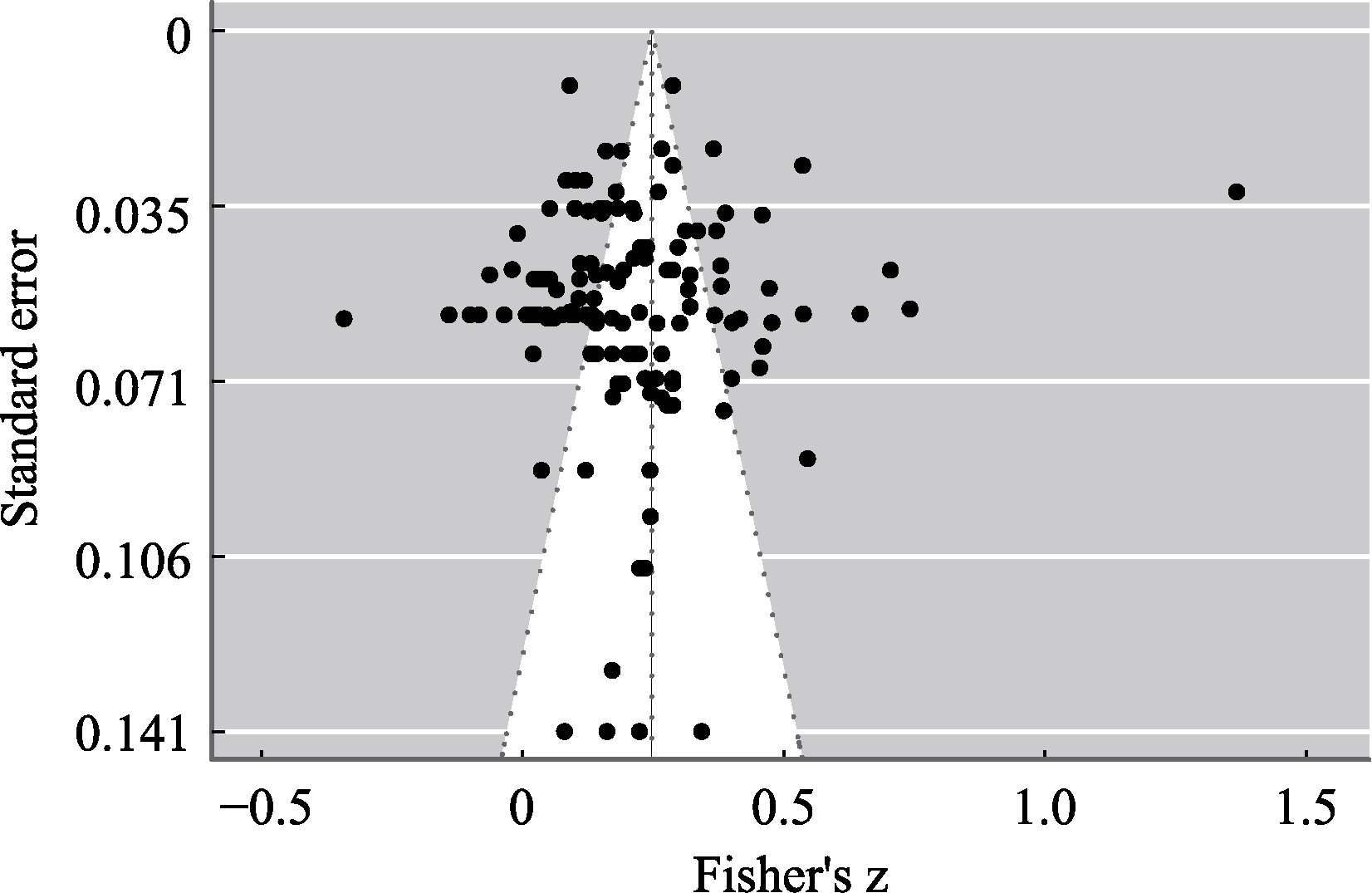
图4 中庸思维与积极心理健康效应量漏斗图
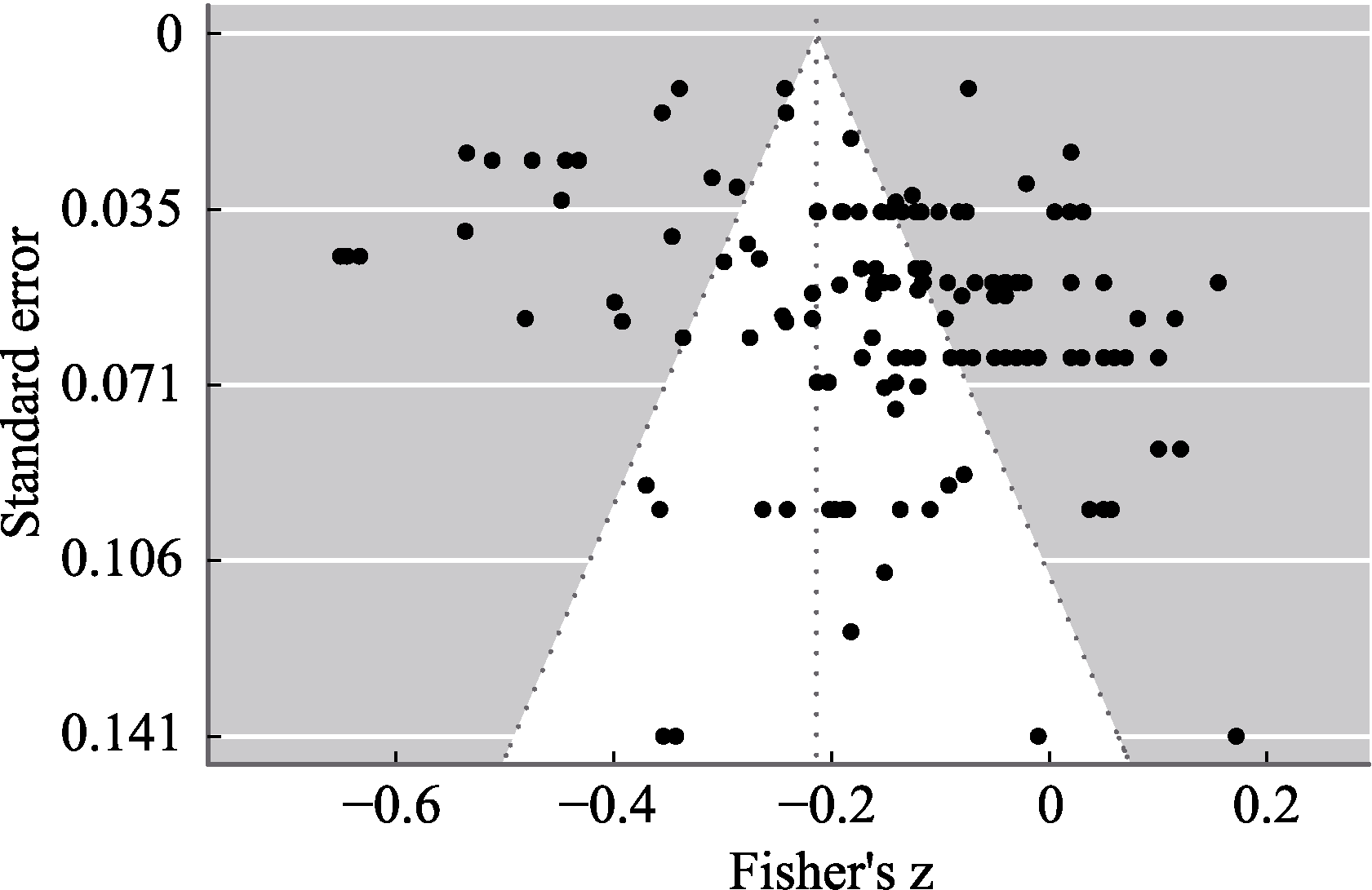
图5 中庸思维与消极心理健康效应量漏斗图
| 调节变量 | k | 截距(95% CI) | β (95% CI) | r均值 | F | p |
|---|---|---|---|---|---|---|
| 女性比 | 123 | 0.25(0.21, 0.30)*** | 0.00(−0.00, 0.00) | 0.25 | 0.43(1, 121) | 0.512 |
| 平均年龄 | 133 | 0.24(0.19, 0.29)*** | −0.00(−0.01, 0.01) | 0.24 | 0.35(1, 131) | 0.557 |
| 平均年龄(平方) | 133 | 0.24(0.19, 0.29)*** | −0.00(−0.00, 0.00) | 0.24 | 0.42(1, 131) | 0.521 |
| 平均年龄(立方) | 133 | 0.24(0.19, 0.29)*** | −0.00(−0.00, 0.00) | 0.24 | 0.48(1, 131) | 0.489 |
| 平均学历 | 127 | 0.25(0.20, 0.30)*** | 0.03(−0.03, 0.10) | 0.24 | 1.32(1, 125) | 0.253 |
| 平均学历(平方) | 127 | 0.25(0.20, 0.30)*** | 0.01(−0.00, 0.02) | 0.24 | 2.33(1, 125) | 0.129 |
| 平均学历(立方) | 127 | 0.25(0.20, 0.30)*** | 0.00(−0.00, 0.00) | 0.24 | 3.27(1, 125) | 0.073 |
| 发表年份 | 139 | 0.24(0.20, 0.29)*** | 0.01(−0.00, 0.02) | 0.24 | 2.41(1, 137) | 0.123 |
| 文献得分 | 139 | 0.24(0.20, 0.29)*** | 0.02(−0.00, 0.04) | 0.24 | 3.41(1, 137) | 0.067 |
| 发表状态 | 139 | 0.23(0.16, 0.30)*** | −0.03(−0.07, 0.12) | 0.23 | 0.37(1, 137) | 0.544 |
| 样本地区 | ||||||
| 大陆 | 93 | 0.26(0.21, 0.32)*** | 0.26 | 1.12(1, 137) | 0.292 | |
| 台湾 | 46 | 0.21(0.12, 0.30)*** | −0.06(−0.16, 0.05) | 0.20 | ||
| 被试身份 | ||||||
| 初中生、高中生 | 13 | 0.22(0.06, 0.38)** | 0.22 | 0.74(3, 134) | 0.533 | |
| 本科生、研究生 | 54 | 0.26(0.19, 0.33)*** | 0.04(−0.14, 0.22) | 0.25 | ||
| 员工 | 47 | 0.27(0.20, 0.35)*** | 0.05(−0.13, 0.23) | 0.27 | ||
| 居民 | 24 | 0.15(0.00, 0.30)* | −0.07(−0.29, 0.15) | 0.15 | ||
| 积极心理健康测量指标 | ||||||
| 生活满意度 | 43 | 0.17(0.11, 0.23)*** | 0.17 | 2.20(6, 118) | 0.047 | |
| 工作满意度 | 19 | 0.26(0.18, 0.34)*** | 0.09(−0.01, 0.18) | 0.25 | ||
| 幸福感 | 14 | 0.21(0.12, 0.30)*** | 0.03(−0.07, 0.14) | 0.20 | ||
| 工作幸福感 | 5 | 0.35(0.19, 0.52)*** | 0.18(0.01, 0.36)* | 0.34 | ||
| 安适感 | 22 | 0.20(0.13, 0.28)*** | 0.03(−0.05, 0.11) | 0.20 | ||
| 积极情感 | 15 | 0.29(0.21, 0.38)*** | 0.12(0.03, 0.22)* | 0.29 | ||
| 心理弹性 | 7 | 0.34(0.21, 0.47)*** | 0.17(0.03, 0.31)* | 0.33 | ||
| 中庸思维测量类型 | ||||||
| 中庸意见表达 | 45 | 0.25(0.19, 0.31)*** | 0.24 | 1.80(10, 119) | 0.067 | |
| 中庸意见表达−多方思考 | 6 | 0.18(0.08, 0.28)*** | −0.07(−0.17, 0.03) | 0.18 | ||
| 中庸意见表达−整合性 | 6 | 0.20(0.10, 0.30)*** | −0.05(−0.15, 0.05) | 0.20 | ||
| 中庸意见表达−和谐性 | 6 | 0.23(0.13, 0.33)*** | −0.02(−0.12, 0.08) | 0.23 | ||
| 中庸信念价值 | 31 | 0.18(0.11, 0.25)*** | −0.07(−0.15, 0.01) | 0.18 | ||
| 中庸信念价值−拔高视野 | 7 | 0.14(0.05, 0.24)** | −0.11(−0.21, −0.01)* | 0.14 | ||
| 中庸信念价值−自我收敛 | 7 | 0.14(0.05, 0.24)** | −0.11(−0.21, −0.01)* | 0.14 | ||
| 中庸价值取向 | 7 | 0.38(0.25, 0.51)*** | 0.13(−0.01, 0.28) | 0.36 | ||
| 中庸实践自评−事后反省 | 5 | 0.13(0.02, 0.24)* | −0.12(−0.23, −0.00)* | 0.13 | ||
| 中庸实践自评−沉着克制 | 5 | 0.06(−0.05, 0.17) | −0.19(−0.30, −0.07)** | 0.06 | ||
| 中庸实践自评−慎思熟虑 | 5 | 0.15(0.05, 0.26)** | −0.10(−0.21, 0.02) | 0.15 |
表3 中庸思维与积极心理健康关系的单变量调节效应检验
| 调节变量 | k | 截距(95% CI) | β (95% CI) | r均值 | F | p |
|---|---|---|---|---|---|---|
| 女性比 | 123 | 0.25(0.21, 0.30)*** | 0.00(−0.00, 0.00) | 0.25 | 0.43(1, 121) | 0.512 |
| 平均年龄 | 133 | 0.24(0.19, 0.29)*** | −0.00(−0.01, 0.01) | 0.24 | 0.35(1, 131) | 0.557 |
| 平均年龄(平方) | 133 | 0.24(0.19, 0.29)*** | −0.00(−0.00, 0.00) | 0.24 | 0.42(1, 131) | 0.521 |
| 平均年龄(立方) | 133 | 0.24(0.19, 0.29)*** | −0.00(−0.00, 0.00) | 0.24 | 0.48(1, 131) | 0.489 |
| 平均学历 | 127 | 0.25(0.20, 0.30)*** | 0.03(−0.03, 0.10) | 0.24 | 1.32(1, 125) | 0.253 |
| 平均学历(平方) | 127 | 0.25(0.20, 0.30)*** | 0.01(−0.00, 0.02) | 0.24 | 2.33(1, 125) | 0.129 |
| 平均学历(立方) | 127 | 0.25(0.20, 0.30)*** | 0.00(−0.00, 0.00) | 0.24 | 3.27(1, 125) | 0.073 |
| 发表年份 | 139 | 0.24(0.20, 0.29)*** | 0.01(−0.00, 0.02) | 0.24 | 2.41(1, 137) | 0.123 |
| 文献得分 | 139 | 0.24(0.20, 0.29)*** | 0.02(−0.00, 0.04) | 0.24 | 3.41(1, 137) | 0.067 |
| 发表状态 | 139 | 0.23(0.16, 0.30)*** | −0.03(−0.07, 0.12) | 0.23 | 0.37(1, 137) | 0.544 |
| 样本地区 | ||||||
| 大陆 | 93 | 0.26(0.21, 0.32)*** | 0.26 | 1.12(1, 137) | 0.292 | |
| 台湾 | 46 | 0.21(0.12, 0.30)*** | −0.06(−0.16, 0.05) | 0.20 | ||
| 被试身份 | ||||||
| 初中生、高中生 | 13 | 0.22(0.06, 0.38)** | 0.22 | 0.74(3, 134) | 0.533 | |
| 本科生、研究生 | 54 | 0.26(0.19, 0.33)*** | 0.04(−0.14, 0.22) | 0.25 | ||
| 员工 | 47 | 0.27(0.20, 0.35)*** | 0.05(−0.13, 0.23) | 0.27 | ||
| 居民 | 24 | 0.15(0.00, 0.30)* | −0.07(−0.29, 0.15) | 0.15 | ||
| 积极心理健康测量指标 | ||||||
| 生活满意度 | 43 | 0.17(0.11, 0.23)*** | 0.17 | 2.20(6, 118) | 0.047 | |
| 工作满意度 | 19 | 0.26(0.18, 0.34)*** | 0.09(−0.01, 0.18) | 0.25 | ||
| 幸福感 | 14 | 0.21(0.12, 0.30)*** | 0.03(−0.07, 0.14) | 0.20 | ||
| 工作幸福感 | 5 | 0.35(0.19, 0.52)*** | 0.18(0.01, 0.36)* | 0.34 | ||
| 安适感 | 22 | 0.20(0.13, 0.28)*** | 0.03(−0.05, 0.11) | 0.20 | ||
| 积极情感 | 15 | 0.29(0.21, 0.38)*** | 0.12(0.03, 0.22)* | 0.29 | ||
| 心理弹性 | 7 | 0.34(0.21, 0.47)*** | 0.17(0.03, 0.31)* | 0.33 | ||
| 中庸思维测量类型 | ||||||
| 中庸意见表达 | 45 | 0.25(0.19, 0.31)*** | 0.24 | 1.80(10, 119) | 0.067 | |
| 中庸意见表达−多方思考 | 6 | 0.18(0.08, 0.28)*** | −0.07(−0.17, 0.03) | 0.18 | ||
| 中庸意见表达−整合性 | 6 | 0.20(0.10, 0.30)*** | −0.05(−0.15, 0.05) | 0.20 | ||
| 中庸意见表达−和谐性 | 6 | 0.23(0.13, 0.33)*** | −0.02(−0.12, 0.08) | 0.23 | ||
| 中庸信念价值 | 31 | 0.18(0.11, 0.25)*** | −0.07(−0.15, 0.01) | 0.18 | ||
| 中庸信念价值−拔高视野 | 7 | 0.14(0.05, 0.24)** | −0.11(−0.21, −0.01)* | 0.14 | ||
| 中庸信念价值−自我收敛 | 7 | 0.14(0.05, 0.24)** | −0.11(−0.21, −0.01)* | 0.14 | ||
| 中庸价值取向 | 7 | 0.38(0.25, 0.51)*** | 0.13(−0.01, 0.28) | 0.36 | ||
| 中庸实践自评−事后反省 | 5 | 0.13(0.02, 0.24)* | −0.12(−0.23, −0.00)* | 0.13 | ||
| 中庸实践自评−沉着克制 | 5 | 0.06(−0.05, 0.17) | −0.19(−0.30, −0.07)** | 0.06 | ||
| 中庸实践自评−慎思熟虑 | 5 | 0.15(0.05, 0.26)** | −0.10(−0.21, 0.02) | 0.15 |
| 变量 | k | 截距/β (95% CI) | t | p | F | p |
|---|---|---|---|---|---|---|
| 调节变量:积极心理健康测量指标 + 中庸思维测量类型 | 2.33(16, 100) | 0.006 | ||||
| 截距 | 0.22(0.16, 0.27) | 7.95 | <0.001 | |||
| 幸福感 | 14 | 0.03(−0.04, 0.10) | 0.95 | 0.346 | ||
| 工作满意度 | 19 | 0.07(0.01, 0.14) | 2.12 | 0.037 | ||
| 积极情感 | 15 | 0.01(−0.05, 0.07) | 0.30 | 0.768 | ||
| 安适感 | 22 | 0.02(−0.03, 0.07) | 0.72 | 0.471 | ||
| 心理弹性 | 7 | 0.13(0.04, 0.22) | 3.00 | 0.003 | ||
| 工作幸福感 | 5 | 0.15(−0.00, 0.31) | 1.93 | 0.056 | ||
| 中庸意见表达−多方思考 | 6 | −0.08 (−0.17, 0.01) | −1.83 | 0.070 | ||
| 中庸意见表达−整合性 | 6 | −0.03(−0.12, 0.06) | −0.71 | 0.477 | ||
| 中庸意见表达−和谐性 | 6 | −0.06(−0.15, 0.02) | −1.44 | 0.152 | ||
| 中庸信念价值 | 31 | −0.06(−0.12, 0.01) | −1.71 | 0.091 | ||
| 中庸信念价值−拔高视野 | 7 | −0.11(−0.19, −0.02) | −2.51 | 0.014 | ||
| 中庸信念价值−自我收敛 | 7 | −0.11(−0.19, −0.02) | −2.47 | 0.015 | ||
| 中庸价值取向 | 7 | 0.02(−0.10, 0.14) | 0.34 | 0.733 | ||
| 中庸实践自评−事后反省 | 5 | −0.12(−0.21, −0.02) | −2.43 | 0.017 | ||
| 中庸实践自评−沉着克制 | 5 | −0.19(−0.28, −0.09) | −3.85 | <0.001 | ||
| 中庸实践自评−慎思熟虑 | 5 | −0.10(−0.19, 0.00) | −1.98 | 0.051 | ||
表4 中庸思维与积极心理健康关系的多变量调节效应检验
| 变量 | k | 截距/β (95% CI) | t | p | F | p |
|---|---|---|---|---|---|---|
| 调节变量:积极心理健康测量指标 + 中庸思维测量类型 | 2.33(16, 100) | 0.006 | ||||
| 截距 | 0.22(0.16, 0.27) | 7.95 | <0.001 | |||
| 幸福感 | 14 | 0.03(−0.04, 0.10) | 0.95 | 0.346 | ||
| 工作满意度 | 19 | 0.07(0.01, 0.14) | 2.12 | 0.037 | ||
| 积极情感 | 15 | 0.01(−0.05, 0.07) | 0.30 | 0.768 | ||
| 安适感 | 22 | 0.02(−0.03, 0.07) | 0.72 | 0.471 | ||
| 心理弹性 | 7 | 0.13(0.04, 0.22) | 3.00 | 0.003 | ||
| 工作幸福感 | 5 | 0.15(−0.00, 0.31) | 1.93 | 0.056 | ||
| 中庸意见表达−多方思考 | 6 | −0.08 (−0.17, 0.01) | −1.83 | 0.070 | ||
| 中庸意见表达−整合性 | 6 | −0.03(−0.12, 0.06) | −0.71 | 0.477 | ||
| 中庸意见表达−和谐性 | 6 | −0.06(−0.15, 0.02) | −1.44 | 0.152 | ||
| 中庸信念价值 | 31 | −0.06(−0.12, 0.01) | −1.71 | 0.091 | ||
| 中庸信念价值−拔高视野 | 7 | −0.11(−0.19, −0.02) | −2.51 | 0.014 | ||
| 中庸信念价值−自我收敛 | 7 | −0.11(−0.19, −0.02) | −2.47 | 0.015 | ||
| 中庸价值取向 | 7 | 0.02(−0.10, 0.14) | 0.34 | 0.733 | ||
| 中庸实践自评−事后反省 | 5 | −0.12(−0.21, −0.02) | −2.43 | 0.017 | ||
| 中庸实践自评−沉着克制 | 5 | −0.19(−0.28, −0.09) | −3.85 | <0.001 | ||
| 中庸实践自评−慎思熟虑 | 5 | −0.10(−0.19, 0.00) | −1.98 | 0.051 | ||
| 调节变量 | k | 截距 (95% CI) | β (95% CI) | r均值 | F | p |
|---|---|---|---|---|---|---|
| 女性比 | 131 | −0.21(−0.26, −0.17)*** | 0.00(−0.00, 0.01) | −0.21 | 0.72(1, 129) | 0.399 |
| 平均年龄 | 133 | −0.22(−0.27, −0.17)*** | 0.00(−0.00, 0.01) | −0.21 | 0.07(1, 131) | 0.799 |
| 平均年龄(平方) | 133 | −0.22(−0.27, −0.17)*** | 0.00(−0.00, 0.00) | −0.21 | 0.01(1, 131) | 0.941 |
| 平均年龄(立方) | 133 | −0.22(−0.27, −0.17)*** | −0.00(−0.00, 0.00) | −0.22 | 0.01(1, 131) | 0.928 |
| 平均学历 | 111 | −0.22(−0.27, −0.17)*** | −0.00(−0.05, 0.05) | −0.22 | 0.00(1, 109) | 0.965 |
| 平均学历(平方) | 111 | −0.22(−0.27, −0.17)*** | −0.00(−0.01, 0.01) | −0.22 | 0.05(1, 109) | 0.832 |
| 平均学历(立方) | 111 | −0.22(−0.27, −0.17)*** | −0.00(−0.00, 0.00) | −0.22 | 0.09(1, 109) | 0.764 |
| 发表年份 | 136 | −0.19(−0.24, −0.14)*** | −0.01(−0.02, −0.00)** | −0.19 | 6.98(1, 134) | 0.009 |
| 文献得分 | 136 | −0.20(−0.25, −0.15)*** | −0.01(−0.03, 0.01) | −0.20 | 0.76(1, 134) | 0.385 |
| 发表状态 | 136 | −0.19(−0.26, −0.12)*** | −0.05(−0.14, 0.04) | −0.18 | 1.11(1, 134) | 0.293 |
| 样本地区 | ||||||
| 大陆 | 102 | −0.23(−0.28, −0.18)*** | −0.22 | 1.57(1, 134) | 0.213 | |
| 台湾 | 34 | −0.15(−0.26, −0.04)** | 0.08(−0.04, 0.20) | −0.15 | ||
| 被试身份 | ||||||
| 初中生、高中生 | 23 | −0.19(−0.32, −0.06)** | −0.19 | 0.42(4, 131) | 0.798 | |
| 本科生、研究生 | 37 | −0.24(−0.31, −0.17)*** | −0.05(−0.20, 0.09) | −0.24 | ||
| 企业员工 | 16 | −0.21(−0.33, −0.09)*** | −0.02(−0.19, 0.15) | −0.21 | ||
| 居民 | 44 | −0.16(−0.28, −0.03)* | 0.03(−0.14, 0.21) | −0.15 | ||
| 心理疾病患者 | 16 | −0.21(−0.36, −0.05)* | −0.02(−0.22, 0.18) | −0.20 | ||
| 消极心理健康测量指标 | ||||||
| 抑郁 | 42 | −0.25(−0.32, −0.18)*** | −0.25 | 1.05(5, 130) | 0.393 | |
| 焦虑 | 31 | −0.20(−0.27, −0.13)*** | 0.05(0.00, 0.10)* | −0.20 | ||
| 综合消极心理健康 | 22 | −0.21(−0.29, −0.13)*** | 0.05(−0.01, 0.10) | −0.20 | ||
| 消极情感 | 21 | −0.21(−0.28, −0.14)*** | 0.04(−0.05, 0.13) | −0.21 | ||
| 情绪耗竭 | 9 | −0.22(−0.36, −0.08)** | 0.04(−0.12, 0.19) | −0.21 | ||
| 倦怠 | 8 | −0.17(−0.34, 0.00) | 0.08(−0.11, 0.27) | −0.17 | ||
| 中庸思维测量类型 | ||||||
| 中庸意见表达 | 41 | −0.22(−0.27, −0.18)*** | −0.22 | 3.73(9, 122) | < 0.001 | |
| 中庸意见表达−多方思考 | 7 | −0.18(−0.26, −0.09)*** | 0.05(−0.04, 0.14) | −0.17 | ||
| 中庸意见表达−整合性 | 7 | −0.19(−0.28, −0.11)*** | 0.03(−0.06, 0.12) | −0.19 | ||
| 中庸意见表达−和谐性 | 7 | −0.20(−0.29, −0.11)*** | 0.03(−0.06, 0.11) | −0.20 | ||
| 中庸信念价值 | 21 | −0.21(−0.28, −0.14)*** | 0.01(−0.06, 0.09) | −0.21 | ||
| 中庸信念价值−拔高视野 | 14 | −0.17(−0.21, −0.09)*** | 0.06(−0.02, 0.14) | −0.16 | ||
| 中庸信念价值−自我收敛 | 14 | −0.16(−0.23, −0.08)*** | 0.07(−0.01, 0.15) | −0.15 | ||
| 中庸实践自评−事后反省 | 7 | −0.01(−0.10, 0.09) | 0.22(0.13, 0.31)*** | −0.01 | ||
| 中庸实践自评−沉着克制 | 7 | −0.17(−0.26, −0.08)*** | 0.05(−0.04, 0.15) | −0.17 | ||
| 中庸实践自评−慎思熟虑 | 7 | −0.09(−0.18, 0.00) | 0.14(0.05, 0.23)** | −0.09 |
表5 中庸思维与消极心理健康关系的单变量调节效应检验
| 调节变量 | k | 截距 (95% CI) | β (95% CI) | r均值 | F | p |
|---|---|---|---|---|---|---|
| 女性比 | 131 | −0.21(−0.26, −0.17)*** | 0.00(−0.00, 0.01) | −0.21 | 0.72(1, 129) | 0.399 |
| 平均年龄 | 133 | −0.22(−0.27, −0.17)*** | 0.00(−0.00, 0.01) | −0.21 | 0.07(1, 131) | 0.799 |
| 平均年龄(平方) | 133 | −0.22(−0.27, −0.17)*** | 0.00(−0.00, 0.00) | −0.21 | 0.01(1, 131) | 0.941 |
| 平均年龄(立方) | 133 | −0.22(−0.27, −0.17)*** | −0.00(−0.00, 0.00) | −0.22 | 0.01(1, 131) | 0.928 |
| 平均学历 | 111 | −0.22(−0.27, −0.17)*** | −0.00(−0.05, 0.05) | −0.22 | 0.00(1, 109) | 0.965 |
| 平均学历(平方) | 111 | −0.22(−0.27, −0.17)*** | −0.00(−0.01, 0.01) | −0.22 | 0.05(1, 109) | 0.832 |
| 平均学历(立方) | 111 | −0.22(−0.27, −0.17)*** | −0.00(−0.00, 0.00) | −0.22 | 0.09(1, 109) | 0.764 |
| 发表年份 | 136 | −0.19(−0.24, −0.14)*** | −0.01(−0.02, −0.00)** | −0.19 | 6.98(1, 134) | 0.009 |
| 文献得分 | 136 | −0.20(−0.25, −0.15)*** | −0.01(−0.03, 0.01) | −0.20 | 0.76(1, 134) | 0.385 |
| 发表状态 | 136 | −0.19(−0.26, −0.12)*** | −0.05(−0.14, 0.04) | −0.18 | 1.11(1, 134) | 0.293 |
| 样本地区 | ||||||
| 大陆 | 102 | −0.23(−0.28, −0.18)*** | −0.22 | 1.57(1, 134) | 0.213 | |
| 台湾 | 34 | −0.15(−0.26, −0.04)** | 0.08(−0.04, 0.20) | −0.15 | ||
| 被试身份 | ||||||
| 初中生、高中生 | 23 | −0.19(−0.32, −0.06)** | −0.19 | 0.42(4, 131) | 0.798 | |
| 本科生、研究生 | 37 | −0.24(−0.31, −0.17)*** | −0.05(−0.20, 0.09) | −0.24 | ||
| 企业员工 | 16 | −0.21(−0.33, −0.09)*** | −0.02(−0.19, 0.15) | −0.21 | ||
| 居民 | 44 | −0.16(−0.28, −0.03)* | 0.03(−0.14, 0.21) | −0.15 | ||
| 心理疾病患者 | 16 | −0.21(−0.36, −0.05)* | −0.02(−0.22, 0.18) | −0.20 | ||
| 消极心理健康测量指标 | ||||||
| 抑郁 | 42 | −0.25(−0.32, −0.18)*** | −0.25 | 1.05(5, 130) | 0.393 | |
| 焦虑 | 31 | −0.20(−0.27, −0.13)*** | 0.05(0.00, 0.10)* | −0.20 | ||
| 综合消极心理健康 | 22 | −0.21(−0.29, −0.13)*** | 0.05(−0.01, 0.10) | −0.20 | ||
| 消极情感 | 21 | −0.21(−0.28, −0.14)*** | 0.04(−0.05, 0.13) | −0.21 | ||
| 情绪耗竭 | 9 | −0.22(−0.36, −0.08)** | 0.04(−0.12, 0.19) | −0.21 | ||
| 倦怠 | 8 | −0.17(−0.34, 0.00) | 0.08(−0.11, 0.27) | −0.17 | ||
| 中庸思维测量类型 | ||||||
| 中庸意见表达 | 41 | −0.22(−0.27, −0.18)*** | −0.22 | 3.73(9, 122) | < 0.001 | |
| 中庸意见表达−多方思考 | 7 | −0.18(−0.26, −0.09)*** | 0.05(−0.04, 0.14) | −0.17 | ||
| 中庸意见表达−整合性 | 7 | −0.19(−0.28, −0.11)*** | 0.03(−0.06, 0.12) | −0.19 | ||
| 中庸意见表达−和谐性 | 7 | −0.20(−0.29, −0.11)*** | 0.03(−0.06, 0.11) | −0.20 | ||
| 中庸信念价值 | 21 | −0.21(−0.28, −0.14)*** | 0.01(−0.06, 0.09) | −0.21 | ||
| 中庸信念价值−拔高视野 | 14 | −0.17(−0.21, −0.09)*** | 0.06(−0.02, 0.14) | −0.16 | ||
| 中庸信念价值−自我收敛 | 14 | −0.16(−0.23, −0.08)*** | 0.07(−0.01, 0.15) | −0.15 | ||
| 中庸实践自评−事后反省 | 7 | −0.01(−0.10, 0.09) | 0.22(0.13, 0.31)*** | −0.01 | ||
| 中庸实践自评−沉着克制 | 7 | −0.17(−0.26, −0.08)*** | 0.05(−0.04, 0.15) | −0.17 | ||
| 中庸实践自评−慎思熟虑 | 7 | −0.09(−0.18, 0.00) | 0.14(0.05, 0.23)** | −0.09 |
| 变量 | k | 截距/β (95% CI) | t | p | F | p |
|---|---|---|---|---|---|---|
| 调节变量:发表年份 + 中庸思维测量类型 | 3.80(10, 121) | < 0.001 | ||||
| 截距 | −0.19(−0.25, −0.14) | −7.00 | < 0.001 | |||
| 发表年份 | 136 | −0.01(−0.02, 0.00) | −2.02 | 0.046 | ||
| 中庸意见表达−多方思考 | 7 | 0.04(−0.05, 0.13) | 0.90 | 0.370 | ||
| 中庸意见表达−整合性 | 7 | 0.02(−0.06, 0.11) | 0.51 | 0.612 | ||
| 中庸意见表达−和谐性 | 7 | 0.02(−0.07, 0.10) | 0.37 | 0.714 | ||
| 中庸信念价值 | 21 | −0.01(−0.09, 0.06) | −0.36 | 0.723 | ||
| 中庸信念价值−拔高视野 | 14 | 0.04(−0.05, 0.12) | 0.85 | 0.397 | ||
| 中庸信念价值−自我收敛 | 14 | 0.05(−0.04, 0.13) | 1.10 | 0.273 | ||
| 中庸实践自评−事后反省 | 7 | 0.19(0.10, 0.29) | 3.95 | < 0.001 | ||
| 中庸实践自评−沉着克制 | 7 | 0.03(−0.07, 0.12) | 0.56 | 0.577 | ||
| 中庸实践自评−慎思熟虑 | 7 | 0.11(0.01, 0.21) | 2.27 | 0.025 | ||
表6 中庸思维与消极心理健康关系的多变量调节效应检验
| 变量 | k | 截距/β (95% CI) | t | p | F | p |
|---|---|---|---|---|---|---|
| 调节变量:发表年份 + 中庸思维测量类型 | 3.80(10, 121) | < 0.001 | ||||
| 截距 | −0.19(−0.25, −0.14) | −7.00 | < 0.001 | |||
| 发表年份 | 136 | −0.01(−0.02, 0.00) | −2.02 | 0.046 | ||
| 中庸意见表达−多方思考 | 7 | 0.04(−0.05, 0.13) | 0.90 | 0.370 | ||
| 中庸意见表达−整合性 | 7 | 0.02(−0.06, 0.11) | 0.51 | 0.612 | ||
| 中庸意见表达−和谐性 | 7 | 0.02(−0.07, 0.10) | 0.37 | 0.714 | ||
| 中庸信念价值 | 21 | −0.01(−0.09, 0.06) | −0.36 | 0.723 | ||
| 中庸信念价值−拔高视野 | 14 | 0.04(−0.05, 0.12) | 0.85 | 0.397 | ||
| 中庸信念价值−自我收敛 | 14 | 0.05(−0.04, 0.13) | 1.10 | 0.273 | ||
| 中庸实践自评−事后反省 | 7 | 0.19(0.10, 0.29) | 3.95 | < 0.001 | ||
| 中庸实践自评−沉着克制 | 7 | 0.03(−0.07, 0.12) | 0.56 | 0.577 | ||
| 中庸实践自评−慎思熟虑 | 7 | 0.11(0.01, 0.21) | 2.27 | 0.025 | ||
| 中庸思维角色 | 文献 | 路径关系 |
|---|---|---|
| 中介 | 刘坤艳, | 父母中庸思维-子女中庸思维-子女心理韧性-心理健康 |
| 阳中华, | 家庭功能-中庸思维-心理健康 | |
| Hou, | 父母教养方式-中庸思维-情绪困扰 | |
| LiX, 2023 | 家庭适应性-中庸思维-焦虑 | |
| MengL, 2024 | 特质化正念-中庸思维-主观幸福感 | |
| 自变量 | 陈佩儀, | 中庸思维-消极认知情绪调节策略-抑郁 |
| 丁倩, | 中庸思维-社会支持-孤独-网络成瘾 | |
| 范雅媛, | 中庸思维-认知重评-情绪/幸福感/友谊满意度 | |
| 中庸思维-认知重评-回应性-朋友的情绪/幸福感/友谊满意度 | ||
| 高瞻, | 中庸思维自我收敛-情绪调节灵活性-抑郁 | |
| 巩萱萱, | 中庸思维-消极认知情绪调节-学习倦怠 | |
| 郭轶, | 中庸思维-应对效能-抑郁 | |
| 黄敏儿, | 中庸思维-情绪调节灵活性-社会支持感 | |
| 黄思成, | 中庸思维-消极认知情绪调节-焦虑/攻击性 | |
| 姜晟, | 中庸思维-认知重评/负性情绪-情绪性进食 | |
| 李姣, | 中庸思维-金钱态度-幸福感 | |
| 李启明, | 中庸思维-心理弹性-社会适应(完全中介) | |
| 李爽, | 中庸思维-工作压力-决策惰性(反:加重堕性) | |
| 廖晨均, | 中庸思维-人际关系-幸福感 | |
| 刘坤艳, | 父母中庸思维-子女中庸思维-子女心理韧性-心理健康(完全中介) | |
| 谭冬雪, | 中庸思维-情绪调节-个体适应 | |
| 谭冬雪, | 中庸思维-情绪控制价值-个体适应 | |
| 徐嘉, | 中庸思维-心理资本-主观幸福感(完全中介) | |
| 尹俊, | 中庸思维-工作家庭平衡行为-家庭/家庭成员满意度 | |
| 周玲玲, | 中庸思维-工作不安全感-竞争态度-工作满意度 | |
| 朱迪, | 中庸思维-人际关系-幸福感(完全中介) | |
| 范雅媛, | 中庸思维-认知重评-幸福感等指标 | |
| HeY, 2021 | 中庸思维-反刍-抑郁 | |
| LiuL, 2023 | 中庸思维-网络闲逛-心理健康 | |
| Yuan, | 中庸思维-网络潜水-情绪耗竭 | |
| ZhouS, 2022 | 中庸思维-认知重评-积极情绪 | |
| 调节 | 曾维希, | 认知重评-情绪调节 |
| 邓传忠, | 拿捏行为-心理适应 | |
| 郭侃, | 情绪调节-正负性情绪 | |
| 郭轶, | 沉思-负性情绪 | |
| 李鹏, | 情绪劳动-工作倦怠 | |
| 刘俊, | 应对方式-主观幸福感 | |
| 孙旭, | 坏心情-组织公民行为/任务绩效行为 | |
| 田晓雪, | 贫穷感-焦虑 | |
| 杨中芳, | 压力源-工作幸福感 | |
| 张佳文, | 情绪劳动表层扮演-情绪耗竭 | |
| 张悦, | 情绪智力-职业倦怠 | |
| ChouL, 2014 | 压力-工作满意度 | |
| CuiL, 2022 | 表达抑制-消极情感/感知社会支持 | |
| LanX, 2021 | 同伴依恋-青少年适应情况 | |
| WangS, 2022 | 新冠疫情-冲动购买 | |
| WeiH, 2021 | 焦虑-网络霸凌 | |
| WeiJ, 2020 | 创业自我效能-工作满意度 | |
| XuY, 2024 | 累积家庭风险-非自杀性自伤 |
附表3 中庸思维与心理健康路径关系总结
| 中庸思维角色 | 文献 | 路径关系 |
|---|---|---|
| 中介 | 刘坤艳, | 父母中庸思维-子女中庸思维-子女心理韧性-心理健康 |
| 阳中华, | 家庭功能-中庸思维-心理健康 | |
| Hou, | 父母教养方式-中庸思维-情绪困扰 | |
| LiX, 2023 | 家庭适应性-中庸思维-焦虑 | |
| MengL, 2024 | 特质化正念-中庸思维-主观幸福感 | |
| 自变量 | 陈佩儀, | 中庸思维-消极认知情绪调节策略-抑郁 |
| 丁倩, | 中庸思维-社会支持-孤独-网络成瘾 | |
| 范雅媛, | 中庸思维-认知重评-情绪/幸福感/友谊满意度 | |
| 中庸思维-认知重评-回应性-朋友的情绪/幸福感/友谊满意度 | ||
| 高瞻, | 中庸思维自我收敛-情绪调节灵活性-抑郁 | |
| 巩萱萱, | 中庸思维-消极认知情绪调节-学习倦怠 | |
| 郭轶, | 中庸思维-应对效能-抑郁 | |
| 黄敏儿, | 中庸思维-情绪调节灵活性-社会支持感 | |
| 黄思成, | 中庸思维-消极认知情绪调节-焦虑/攻击性 | |
| 姜晟, | 中庸思维-认知重评/负性情绪-情绪性进食 | |
| 李姣, | 中庸思维-金钱态度-幸福感 | |
| 李启明, | 中庸思维-心理弹性-社会适应(完全中介) | |
| 李爽, | 中庸思维-工作压力-决策惰性(反:加重堕性) | |
| 廖晨均, | 中庸思维-人际关系-幸福感 | |
| 刘坤艳, | 父母中庸思维-子女中庸思维-子女心理韧性-心理健康(完全中介) | |
| 谭冬雪, | 中庸思维-情绪调节-个体适应 | |
| 谭冬雪, | 中庸思维-情绪控制价值-个体适应 | |
| 徐嘉, | 中庸思维-心理资本-主观幸福感(完全中介) | |
| 尹俊, | 中庸思维-工作家庭平衡行为-家庭/家庭成员满意度 | |
| 周玲玲, | 中庸思维-工作不安全感-竞争态度-工作满意度 | |
| 朱迪, | 中庸思维-人际关系-幸福感(完全中介) | |
| 范雅媛, | 中庸思维-认知重评-幸福感等指标 | |
| HeY, 2021 | 中庸思维-反刍-抑郁 | |
| LiuL, 2023 | 中庸思维-网络闲逛-心理健康 | |
| Yuan, | 中庸思维-网络潜水-情绪耗竭 | |
| ZhouS, 2022 | 中庸思维-认知重评-积极情绪 | |
| 调节 | 曾维希, | 认知重评-情绪调节 |
| 邓传忠, | 拿捏行为-心理适应 | |
| 郭侃, | 情绪调节-正负性情绪 | |
| 郭轶, | 沉思-负性情绪 | |
| 李鹏, | 情绪劳动-工作倦怠 | |
| 刘俊, | 应对方式-主观幸福感 | |
| 孙旭, | 坏心情-组织公民行为/任务绩效行为 | |
| 田晓雪, | 贫穷感-焦虑 | |
| 杨中芳, | 压力源-工作幸福感 | |
| 张佳文, | 情绪劳动表层扮演-情绪耗竭 | |
| 张悦, | 情绪智力-职业倦怠 | |
| ChouL, 2014 | 压力-工作满意度 | |
| CuiL, 2022 | 表达抑制-消极情感/感知社会支持 | |
| LanX, 2021 | 同伴依恋-青少年适应情况 | |
| WangS, 2022 | 新冠疫情-冲动购买 | |
| WeiH, 2021 | 焦虑-网络霸凌 | |
| WeiJ, 2020 | 创业自我效能-工作满意度 | |
| XuY, 2024 | 累积家庭风险-非自杀性自伤 |
| (*为纳入元分析的文献) | |
| [1] | *蔡斌坤. (2022). 自我效能感和员工主动拖延行为的关系:有调节的链式中介模型 [硕士学位论文]. 中国人民大学, 北京. |
| [2] | *陈佩儀, 陈瑜, 杨雪岭. (2021). 中庸思维对大学生抑郁症状的影响机制:消极认知情绪调节策略的中介作用. 心理与行为研究, 19(4), 571-576. |
| [3] | *谌影. (2010). 领导风格与员工工作满意度的关系: 中庸思维的调节作用 [硕士学位论文]. 北京大学. |
| [4] | *程云菲. (2013). 中国大学生中庸思维的现况调查及其与情绪问题的关系研究 [硕士学位论文]. 南方医科大学, 广州. |
| [5] | *邓传忠. (2008). 中庸思维对拿捏行为与心理适应的调节效果 [硕士学位论文]. 台湾大学, 台北. |
| [6] | *丁倩, 张永欣, 魏华, 胡伟. (2019). 中庸思维与大学生网络成瘾:社会支持和孤独感的序列中介作用. 心理与行为研究, 17(4), 553-560. |
| [7] |
杜健. (2020). 自我概念一致性与幸福感间的关系: 文化的调节作用. 心理科学进展, 28(10), 1751-1761.
doi: 10.3724/SP.J.1042.2020.01751 |
| [8] | *杜旌, 刘芳. (2014). 平衡与和谐之美:中庸价值取向对员工幸福感影响实证研究. 珞珈管理评论, (1), 27-37. |
| [9] | 杜旌, 冉曼曼, 曹平. (2014). 中庸价值取向对员工变革行为的情景依存作用, 心理学报, 46(1), 113-114. |
| [10] | 杜旌, 姚菊花. (2015). 中庸结构内涵及其与集体主义关系的研究. 管理学报, 12(5), 638-646. |
| [11] | 段锦云, 凌斌. (2011). 中国背景下员工建言行为结构及中庸思维对其的影响. 心理学报, 43(10), 1185-1197. |
| [12] | *范雅媛. (2017). 中庸与情绪调节对个人与人际适应之影响:对偶分析观点 [硕士学位论文]. 台湾大学, 台北. |
| [13] | *房加帅, 饶培亚. (2024). 中庸思维对幼儿园园长课程领导力的影响——心理资本和学习投入的链式中介效应. 现代基础教育研究, 56(4), 125-133. |
| [14] | *方羚. (2024). 冬季项目运动员压力知觉, 中庸实践思维及主观幸福感关系初探. 冰雪运动, 46(2), 32-38. |
| [15] |
高爽, 张向葵, 徐晓林. (2015). 大学生自尊与心理健康的元分析——以中国大学生为样本. 心理科学进展, 23(9), 1499-1507.
doi: 10.3724/SP.J.1042.2015.01499 |
| [16] | *高旭繁. (2013). 通往华人幸福之路:性格特质与文化价值的双重作用. 本土心理学研究, (39), 165-214. |
| [17] | 高瞻, 蔡华玲, 唐淦琦, 许律琴. (2013). 中庸思维与抑郁症状之关系. 中国健康心理学杂志, 21(9), 1298-1300. |
| [18] | *高瞻, 李炳洁, 唐淦琦, 林建龙. (2013). 中庸核心价值对抑郁严重度的影响. 中国民康医学, 25(15), 4-7. |
| [19] | *高瞻, 李新天, 许律琴, 李炳洁. (2013). 抑郁患者情绪调节灵活性的作用. 中国健康心理学杂志, 21(9), 1294-1296. |
| [20] | *巩萱萱. (2023). 大学生中庸思维与学习倦怠的关系:消极认知情绪调节的中介作用. 中国健康心理学杂志, 31(11), 1735-1739. |
| [21] | *郭侃, 李媛, 曾维希. (2012, 7月). 大学生情绪调节对情绪状态的影响——中庸思维的调节作用. 维护心身健康, 提高生命质量国际学术研讨会, 大连. |
| [22] | 郭侃, 曾维希. (2012). 大学生中庸思维在情绪调节和情绪间的作用. 中国健康心理学杂志, 20(7), 1101-1103. |
| [23] | *郭轶, 李雪晶, 钟婵, 黄新英. (2016). 抑郁症患者中庸思维、反应方式和情绪的关系. 神经疾病与精神卫生, 16(2), 166-168. |
| [24] | *郭轶, 李雪晶, 黄新英, 钟婵. (2016). 抑郁症患者应对效能在中庸思维和心理健康间的中介作用. 四川精神卫生, 29(1), 23-25. |
| [25] | *郭子瑞. (2023). 团队成员中庸思维对工作幸福感的影响机制研究 [硕士学位论文]. 河北经贸大学, 石家庄. |
| [26] | *胡炫炫. (2021). 辱虐管理对员工创新行为的影响机制——中庸思维的调节效应 [硕士学位论文]. 阜阳师范大学. |
| [27] | *黄敏儿, 唐淦琦, 易晓敏, 孙莎莎. (2014). 中庸致和:情绪调节灵活性的作用. 中国社会心理学评论, (2), 88-112. |
| [28] | *黄金兰, 林以正, 杨中芳. (2012). 中庸信念-价值量表之修订. 本土心理学研究, (38), 3-41. |
| [29] | 黄金兰, 钟育君, 林以正. (2014). 见林或见树?——整体处理与中庸的关联性. 中国社会心理学评论, (2), 49-65. |
| [30] | *黄思成, 王优, 杨雪岭. (2021). 大学生中庸思维与焦虑的关系:认知情绪调节与攻击性的链式中介效应. 中国健康心理学杂志, 29(12), 1896-1899. |
| [31] | *姜晟. (2023). 中庸思维对情绪性进食的影响:有调节的链式中介模型 [硕士学位论文]. 广州大学. |
| [32] | *姜平, 张丽华, 秦歌. (2019). 关系视角下悖论领导行为的有效性研究. 当代财经, (8), 71-81. |
| [33] | *赖裕霖. (2022). 情绪智力量表之编制 [硕士学位论文]. 中原大学, 桃园. |
| [34] | *李姣.(2016). 中庸之道, 幸福之本:中庸思维视角下的幸福探究 [硕士学位论文]. 曲阜师范大学. |
| [35] | *李鹏. (2017). 中小学教师情绪劳动、工作压力、中庸思维、工作倦怠的关系研究 [硕士学位论文]. 天津师范大学. |
| [36] | 李启明. (2011). 中庸实践思维、心理弹性与社会适应的关系 [硕士学位论文]. 华中科技大学, 武汉. |
| [37] | 李启明, 陈志霞. (2014). 中庸实践思维的结构和测量. 心理研究, 7(1), 23-28. |
| [38] | *李启明, 陈志霞. (2016). 中庸思维对社会适应的影响:心理弹性和情绪调节的中介作用. 人类工效学, 22(1), 11-15. |
| [39] | *李爽, 康钰晴, 许正权. (2021). 决策者中庸思维对决策惰性的影响. 软科学, 35(5), 104-110. |
| [40] | 李松, 冉光明, 张琪, 胡天强. (2019). 中国背景下自我效能感与心理健康的元分析. 心理发展与教育, 35(6), 759-768. |
| [41] | *李原. (2014). 压力性生活事件对在职者主观幸福感的影响: 中庸思维的调节作用. 中国社会心理学评论, (8), 184-194. |
| [42] | *廖晨均. (2012). 中庸思维在人际关系、冲突解决策略与幸福感之相关研究 [硕士学位论文]. 暨南国际大学, 南投. |
| [43] | 廖友国. (2014). 中国人应对方式与心理健康关系的元分析. 中国临床心理学杂志, 22(5), 897-900. |
| [44] | *林玮芳, 邓传忠, 林以正, 黄金兰. (2013). 进退有据:中庸对拿捏行为与心理适应之关系的调节效果. 本土心理学研究, (40), 45-84. |
| [45] | *林玮芳, 黄金兰, 林以正. (2014). 来得早不如来得巧:中庸与阴阳转折的时机. 中国社会心理学评论, (7), 89-107. |
| [46] |
*林晓康, 袁希文, 姜晟. (2024). 中庸思维对初中生情绪性进食的影响: 认知重评和负性情绪的链式中介作用. 心理月刊, 19(20), 44-46.
doi: 10.19738/j.cnki.psy.2024.20.014 |
| [47] | 林以正. (2014). 外柔内刚的中庸之道:实践具自主性的折衷原则. 中国社会心理学评论, (7), 221-235. |
| [48] | 刘昌. (2019). 中庸之可能与不可能:兼论中庸心理实证研究之困境. 南京师大学报(社会科学版), (5), 65-74. |
| [49] | *刘俊. (2011). 大学生中庸思维与应对方式、主观幸福感的相关研究 [硕士学位论文], 福建师范大学, 福州. |
| [50] | *刘坤艳. (2022). 父母中庸思维与子女心理健康:子女中庸思维和心理韧性的链式中介作用 [硕士学位论文], 中国人民大学, 北京. |
| [51] | 刘文, 于增艳, 林丹华. (2019). 儿童青少年心理弹性与心理健康关系的元分析. 心理与行为研究, 17(1), 31-37. |
| [52] | *刘亚楠, 张迅, 刘亚蕊, 朱澄铨, 苏芮莹. (2022). 三达德:中庸的德性意涵及其测量. 中国社会心理学评论, (2), 136-159, 260, 261. |
| [53] | 罗榛, 金灿灿. (2016). 中国背景下情绪智力与心理健康关系的元分析. 心理发展与教育, 32(5), 623-630. |
| [54] | *祁佳慧. (2023). 心理位移书写法对抑郁大学生的干预效果及作用机制 [硕士学位论文]. 华中师范大学, 武汉. |
| [55] | *乔诗慧. (2018). 中庸思维对员工创造力过程投入的影响机理研究 [硕士学位论文]. 华中科技大学, 武汉. |
| [56] | *麦文玲. (2017). 中庸与心理健康的关系:自我疼惜的调节效果 [硕士学位论文]. 中原大学, 桃园. |
| [57] | 庞朴. (1980). “中庸”平议. 中国社会科学, (1), 75-100. |
| [58] | 彭文会, 黄希庭. (2015). 基于中庸-和谐的人际幸福感. 西南大学学报 (社会科学版), 41(2), 73-79. |
| [59] | 邵爱国. (2003). 中庸之道的管理智慧及其现代价值 [硕士学位论文]. 苏州大学. |
| [60] | *孙旭, 严鸣, 储小平. (2014). 坏心情与工作行为: 中庸思维跨层次的调节作用. 心理学报, 46(11), 1704-1718. |
| [61] | *谭冬雪. (2012). 中庸与个体适应:情绪调节与情绪控制价值的中介作用 [硕士学位论文]. 中山大学, 广州. |
| [62] | *陶颖. (2019). 中庸思维与创新行为研究 [硕士学位论文]. 南京邮电大学. |
| [63] | *田立法. (2015). 支持型人力资源管理系统与员工帮助行为: 个体层面心理机制的检验. 中央财经大学学报, (3), 92-100. |
| [64] | *田晓雪. (2021). 贫穷感对风险决策的影响:焦虑情绪与中庸思维的作用 [硕士学位论文]. 湖南师范大学, 长沙. |
| [65] | 王飞雪, 刘思思. (2014). 中庸思维对自我一致性和自我矛盾冲突感的影响. 中国社会心理学评论, (7), 131-152. |
| [66] | *王炜辰. (2012). 银行员工领导-成员交换与其工作幸福感的关系 [硕士学位论文]. 天津师范大学. |
| [67] | 韦庆旺. (2022). 中庸思维发微:在“一分为三”下寻找“中道”. 见杨中芳. (主编). 华人本土心理学30年: 本土研究取径及理论 (pp.271-299). 台北:五南图书出版股份有限公司. |
| [68] | 韦庆旺, 郭政. (2014). 走向存在幸福感:中庸思维与生活平衡. 中国社会心理学评论, (7), 236-255. |
| [69] | 韦庆旺, 韩悦. (2022). 中国人的中庸思维. 见许燕, 杨宜音 (主编). 社会心理研究(下) (pp. 1053-1088). 上海: 华东师范大学出版社. |
| [70] | 韦庆旺, 鄢玉婷. (2014). “一分为三”框架下的中庸界定:兼从方法论角度评当前中庸心理学研究. 中国社会心理学评论, (2), 275-303, 6. |
| [71] | *吴家辉. (2006). 中庸让我生活得更好: 中庸思维对生活满意度之影响. 华人心理学报, (7), 163-176. |
| [72] | *吴家辉, 林以正. (2005). 中庸思维量表的编制. 本土心理学研究, 24, 247-299. |
| [73] | 辛杰, 屠云峰. (2020). 中国文化背景下的中庸型领导: 概念, 维度与测量. 西南大学学报 (社会科学版), 46(4), 58-66. |
| [74] | *徐嘉. (2019). 中庸思维在“大学生心理健康教育”课程中的应用探索. 科教文汇(上旬刊), 8, 139-140. |
| [75] | *徐榕辰. (2018). 不当督导对幸福感之影响 -以中庸思维及辩证思维为调节变数 [硕士学位论文]. 中原大学, 桃园. |
| [76] | 徐圆圆. (2012). 大学生中庸自我结构、测量及其与冲突应对策略的相关研究 [硕士学位论文]. 苏州大学. |
| [77] | *杨程云. (2018). 大学生中庸思维与情绪智力的关系:自我意识的中介作用 [硕士学位论文]. 天津师范大学. |
| [78] | *杨贤传, 张磊. (2018). 中庸价值取向与员工创新行为——一个有调节的中介模型. 技术经济与管理研究, (2), 54-58. |
| [79] | *杨艳. (2023). 不合规任务对员工工作退缩行为的影响:消极情绪的中介作用和中庸思维的调节作用 [硕士学位论文]. 云南师范大学, 昆明. |
| [80] | *阳中华. (2012). 中庸实践思维与家庭功能和心理健康关系研究 [博士学位论文]. 中南大学, 长沙. |
| [81] | 阳中华, 周家秀, 周甄会. (2014). 中庸思维对心理健康影响之初探. 中国社会心理学评论, (8), 136-146. |
| [82] | 杨中芳. (1997). 如何研究中国人:心理学本土化论文集. 台北: 桂冠图书公司. |
| [83] | 杨中芳. (2001). 中国人的世界观:中庸实践思维初探. 如何理解中国人 (pp.269-287). 台北:远流出版公司. |
| [84] | 杨中芳. (2004). “中庸”实践思维研究:迈向建构一个全新心理学知识体系. 人格与社会心理学论丛(一) (pp.1-15). 北京:北京大学出版社. |
| [85] | 杨中芳. (2008). 中庸实践思维研究——迈向建构一套本土心理学知识体系. 本土心理研究取径论丛 (pp.435-478). 台北:远流出版公司. |
| [86] | 杨中芳. (2009). 传统文化与社会科学结合之实例:中庸的社会心理学研究. 中国人民大学学报, (3), 53-60. |
| [87] | 杨中芳. (2010). 中庸实践思维体系探讨的初步进展. 本土心理学研究, (34), 3-96. |
| [88] | 杨中芳. (2014). 中庸社会心理学研究的构念化:兼本辑导读. 中国社会心理学评论, (7), 1-17. |
| [89] | 杨中芳. (2022). 中庸心理学研究:缘起、现状及展望. 见杨中芳. (主编). 华人本土心理学30年:本土研究取径及理论 (pp.155-231). 台北:五南图书出版有限公司. |
| [90] |
杨中芳. (2023). 从疫情控制看中庸行动我的应急灵活性. 心理学报, 55(3), 355-373.
doi: 10.3724/SP.J.1041.2023.00355 |
| [91] | *杨中芳, 丁宇, 林升栋, 林玮芳. (2014). 中庸思维在工作压力源与员工幸福感之间的作用: 兼作海峡两岸比较. 中国社会心理学评论, (8), 147-183. |
| [92] | 杨中芳, 林升栋. (2014). “中庸信念/价值量表”到底在测什么? 中国社会心理学评论, (8), 59-77. |
| [93] | 杨中芳, 韦庆旺. (2024). 华人本土心理学与中国心理学自主知识体系建构——杨中芳教授专访. 苏州大学学报教育科学版, 12(3), 86-94. |
| [94] | 杨中芳, 阳中华, 丁宇. (2014). “中庸构念图”之建构效度再检验. 中国社会心理学评论, (7), 18-42. |
| [95] | 杨中芳, 赵志裕. (1997, 5月29-31日). 中庸实践思维初探. 第四届华人心理与行为科际学术研讨会, 台北. |
| [96] | *尹俊, 文秋香, 郎艺. (2022). 中庸思维对女性管理者应对角色冲突的影响——基于12个幼儿园的纵向追踪调研. 南京师大学报(社会科学版), (1), 112-121. |
| [97] | *于芍盈. (2021). 护理人员的情绪劳务研究:专业知觉、心理资本、与中庸思维的探讨 [硕士学位论文]. 中原大学, 桃园. |
| [98] | *袁源. (2024). 夫妻间中庸思维、民主型教养方式和婚姻满意度的关系:基于主客体互倚模型的研究 [硕士学位论文]. 郑州大学. |
| [99] | *曾维希, 郭侃, 李媛. (2013). 认知重评如何调节情绪:中庸思维的中介作用. 电子科技大学学报(社科版), 15(2), 91-94. |
| [100] | 张德胜, 金耀基, 陈海文, 陈健民, 杨中芳, 赵志裕, 伊莎白. (2001). 论中庸理性: 工具理性, 价值理性和沟通理性之外. 社会学研究, 2, 33-48. |
| [101] | *张光曦, 古昕宇. (2015). 中庸思维与员工创造力. 科研管理, 36(增刊), 251-257. |
| [102] |
*张佳文, 马林, 梁玉峰, 马世超. (2023). 情绪劳动与高校心理服务人员情绪耗竭:中庸思维的调节效应. 心理月刊, 18(18), 80-82.
doi: 10.19738/j.cnki.psy.2023.18.022 |
| [103] | 张迅. (2022). 中庸境域的内涵、测量及其与主观幸福感的相关研究 [硕士学位论文]. 郑州大学. |
| [104] | *张悦. (2023). 知识型员工情绪智力对工作绩效的影响:职业倦怠的中介作用和中庸思维的调节作用 [硕士学位论文]. 哈尔滨工程大学. |
| [105] |
张亚利, 李森, 俞国良. (2019). 自尊与社交焦虑的关系: 基于中国学生群体的元分析. 心理科学进展, 27(6), 1005-1018.
doi: 10.3724/SP.J.1042.2019.01005 |
| [106] | *张珍. (2006). 企业员工的行为中庸化与其工作满意度、工作绩效的关系 [硕士学位论文]. 首都师范大学, 北京. |
| [107] | *赵舒禾, 陈秉华. (2013). 不执着量表在台湾之中文化信、效度分析及其与心理健康之关系. 教育心理学报, 45(1), 121-139. |
| [108] | 赵志裕. (2000). 中庸思维的测量. 香港社会科学学报, (18), 33-35. |
| [109] | *郑杰仁. (2016). 择前审思对五大人格与幸福感关系的调节作用之探索 [硕士学位论文]. 中山医学大学, 台中. |
| [110] | *朱迪. (2014). 城镇化居民幸福感的影响因素研究 [硕士学位论文]. 苏州大学. |
| [111] | *周玲玲. (2023). 中庸思维对工作满意度和组织公民行为的影响:工作不安全感和竞争态度的链式中介作用[硕士学位论文]. 中国人民大学, 北京. |
| [112] |
Assink, M., & Wibbelink, C. J. (2016). Fitting three-level meta-analytic models in R: A step-by-step tutorial. The Quantitative Methods for Psychology, 12(3), 154-174.
doi: 10.20982/tqmp.12.3.p154 URL |
| [113] | Card, N. A. (2012). Applied meta-analysis for social science research. Guilford Press. |
| [114] | Cheung, M. W. L. (2015). Meta-analysis: A structural equation modeling approach. John Wiley & Sons. |
| [115] |
*Chou, L. F., Chu, C. C., Yeh, H. C., & Chen, J. (2014). Work stress and employee well‐being: The critical role of Zhong‐Yong. Asian Journal of Social Psychology, 17(2), 115-127.
doi: 10.1111/ajsp.2014.17.issue-2 URL |
| [116] |
Cicchetti, D. V. (1994). Guidelines, criteria, and rules of thumb for evaluating normed and standardized assessment instruments in psychology. Psychological Assessment, 6(4), 284-290.
doi: 10.1037/1040-3590.6.4.284 URL |
| [117] | Cooper,, H., Hedges, L. V., & Valentine, J. C. (Eds.). (2019). The handbook of research synthesis and meta-analysis. Russell Sage Foundation. |
| [118] |
*Cui, L., Tang, G., & Huang, M. (2022). Expressive suppression, confucian Zhong Yong thinking, and psychosocial adjustment among Chinese young adults. Asian Journal of Social Psychology, 25(4), 715-730.
doi: 10.1111/ajsp.v25.4 URL |
| [119] | Dodell-Feder, D., & Tamir, D. I. (2018). Fiction reading has a small positive impact on social cognition: A meta-analysis. Journal of Expeimental Psychology: General, 147(11), 1713. |
| [120] |
Emmer, C., Dorn, J., & Mata, J. (2024). The immediate effect of discrimination on mental health: A meta-analytic review of the causal evidence. Psychological Bulletin, 150(3), 215-252.
doi: 10.1037/bul0000419 pmid: 38330346 |
| [121] |
Fletcher, D., & Sarkar, M. (2013). Psychological resilience: A review and critique of definitions, concepts, and theory. European Psychologist, 18(1), 12-23.
doi: 10.1027/1016-9040/a000124 URL |
| [122] | Franco, A., Malhotra, N., & Simonovits, G. (2014). Publication bias in the social sciences:Unlocking the file drawer. Science, 345(6203), 1502-1505. |
| [123] |
Gignac, G. E., & Szodorai, E. T. (2016). Effect size guidelines for individual differences researchers. Personality and Individual Differences, 102, 74-78.
doi: 10.1016/j.paid.2016.06.069 URL |
| [124] |
Greenspoon, P. J., & SakloFske, D. H. (2001). Toward an integration of subjective well-being and psychopathology. Social Indicators Research, 54(1), 81-108.
doi: 10.1023/A:1007219227883 |
| [125] |
*He, Y., & Li, T. (2021). Mediating model of college students' Chinese Zhongyong culture thinking mode and depressive symptoms. Psychology Research and Behavior Management, 14, 1555-1566.
doi: 10.2147/PRBM.S327496 pmid: 34629912 |
| [126] | *Hou, Y., Xiao, R., Yang, X., Chen, Y., Peng, F., Zhou, S.,... Zhang, X. (2020). Parenting style and emotional distress among Chinese college students: A potential mediating role of the Zhongyong thinking style. Frontiers in Psychology, 11, Article 1774. https://doi.org/10.3389/fpsyg.2020.01774 |
| [127] | Hox, J., Moerbeek, M., & Van de Schoot, R. (2017). Multilevel analysis: Techniques and applications. Routledge. |
| [128] | Hunter, J. E., & Schmidt, F. L. (2004). Methods of meta-analysis: Correcting error and bias in research findings. Sage. |
| [129] | Kepes, S., Banks, G. C., McDaniel, M., & Whetzel, D. L. (2012). Publication bias in the organizational sciences. Organizational Research Methods, 15(4), 624-662. |
| [130] |
Keyes, C. L. (2005). Mental illness and/or mental health? Investigating axioms of the complete state model of health. Journal of Consulting and Clinical Psychology, 73(3), 539-548.
doi: 10.1037/0022-006X.73.3.539 pmid: 15982151 |
| [131] |
Krys, K., Haas, B. W., Igou, E. R., Kosiarczyk, A., Kocimska-Bortnowska, A., Kwiatkowska, A.,... Bond, M. H. (2023). Introduction to a culturally sensitive measure of well-being: Combining life satisfaction and interdependent happiness across 49 different cultures. Journal of Happiness Studies, 24(2), 607-627.
doi: 10.1007/s10902-022-00588-1 |
| [132] |
*Lan, X., Ma, C., & Ma, Y. (2021). A person-centered investigation of adolescent psychosocial and academic adjustment: The role of peer attachment and Zhong-Yong thinking. Child Indicators Research, 14(4), 1479-1500.
doi: 10.1007/s12187-021-09807-2 |
| [133] |
Lau, J., Ioannidis, J. P., Terrin, N., Schmid, C. H., & Olkin, I. (2006). The case of the misleading funnel plot. BMJ, 333(7568), 597-600.
doi: 10.1136/bmj.333.7568.597 URL |
| [134] |
Lee, Y. C., Lin, Y. C., Huang, C. L., & Fredrickson, B. L. (2013). The construct and measurement of peace of mind. Journal of Happiness Studies, 14(2), 571-590.
doi: 10.1007/s10902-012-9343-5 URL |
| [135] | *Li, X., Guan, X., Wang, J., Zhang, Y., Ma, M., Pu, T.,... Ahmed, M. Z. (2023). The effect of pre-service teachers’ family adaptation on anxiety: A moderated mediating effect. Sustainability, 15(14), Article 10796. https://doi.org/10.3390/su151410796 |
| [136] |
Lin, W. F., Lin, Y. C., Huang, C. L., & Chen, L. H. (2014). We can make it better: "we" moderates the relationship between a compromising style in interpersonal conflict and well-being. Journal of Happiness Studies, 17(1), 41-57.
doi: 10.1007/s10902-014-9582-8 URL |
| [137] |
*Liu, L., & Zhang, C. (2023). Cyberloafing at the workplace: Effect of Zhong-Yong thinking on mental health and mindfulness as a moderating role. Chinese Management Studies, 17(3), 529-544.
doi: 10.1108/CMS-09-2021-0381 URL |
| [138] |
Ning, B., Omar, R., Ye, Y., Ting, H., & Ning, M. (2022). The role of Zhong-Yong thinking in business and management research: A review and future research agenda. Asia Pacific Business Review, 27(2), 150-157.
doi: 10.1080/13602381.2021.1857956 URL |
| [139] |
*Meng, L., Huang, J., Qiu, C., Liu, Y., & Niu, J. (2024). The structural relations of dispositional mindfulness, Zhongyong, resilience, and subjective well-being among Chinese high school students. Current Psychology, 43(1), 502-514.
doi: 10.1007/s12144-023-04345-2 |
| [140] |
Oishi, S., Tsutsui, Y., Eggleston, C., & Galinha, I. C. (2014). Are maximizers unhappier than satisficers? A comparison between Japan and the USA. Journal of Research in Personality, 49, 14-20.
doi: 10.1016/j.jrp.2013.12.001 URL |
| [141] |
Pan, W., & Sun, L. Y. (2018). A self-regulation model of Zhong Yong thinking and employee adaptive performance. Management and Organization Review, 14(1), 135-159.
doi: 10.1017/mor.2017.33 URL |
| [142] |
Peterson, R., & Brown, S. (2005). On the use of beta coefficients in meta-analysis. The Journal of Applied Psychology, 90, 175-181.
doi: 10.1037/0021-9010.90.1.175 URL |
| [143] |
Polanin, J. R., Espelage, D. L., Grotpeter, J. K., Spinney, E., Ingram, K. M., Valido, A.,... Robinson, L. (2021). A meta-analysis of longitudinal partial correlations between school violence and mental health, school performance, and criminal or delinquent acts. Psychological Bulletin, 147(2), 115-133.
doi: 10.1037/bul0000314 pmid: 33271024 |
| [144] |
*Qu, Y., Wu, W., Tang, F., Si, H., & Xia, Y. (2018). Why do I conform to your ideas? The role of coworkers’ regulatory focus in explaining the influence of Zhongyong on harmony voice. Chinese Management Studies, 12(2), 346-368.
doi: 10.1108/CMS-03-2017-0056 URL |
| [145] |
Rodgers, M. A., & Pustejovsky, J. E. (2021). Evaluating meta-analytic methods to detect selective reporting in the presence of dependent effect sizes. Psychological Methods, 26(2), 141-160.
doi: 10.1037/met0000300 URL |
| [146] | *Song, K., Ang, C. S., Gu, Z. H., He, D., Chan, N. N., Niu, G. F.,... Zhou, Z. K. (2025). The roles of meaning in life and Zhong-Yong thinking in the association between social isolation and depression in Chinese older adults: A moderated mediation model. Educational Gerontology, https://doi.org/10.1080/03601277.2025.2479662 |
| [147] |
Sterne, J. A., & Harbord, R. M. (2004). Funnel plots in meta-analysis. The Stata Journal, 4(2), 127-141.
doi: 10.1177/1536867X0400400204 URL |
| [148] |
Suldo, S. M., & Shaffer, E. J. (2008). Looking beyond psychopathology: The dual-factor model of mental health in youth. School Psychology Review, 37(1), 52-68.
doi: 10.1080/02796015.2008.12087908 URL |
| [149] |
Van den Noortgate, W., López-López, J. A., Marín-Martínez, F., & Sánchez-Meca, J. (2013). Three-level meta-analysis of dependent effect sizes. Behavior Research Methods, 45(2), 576-594.
doi: 10.3758/s13428-012-0261-6 pmid: 23055166 |
| [150] | Viechtbauer, W. (2010). Conducting meta-analyses in R with the metafor package. Journal of Statistical Software, 36(3), 1-48. |
| [151] | *Wang, S., Liu, Y., Du, Y., & Wang, X. (2021). Effect of the COVID-19 pandemic on consumers' impulse buying: The moderating role of moderate thinking. International Journal of Environmental Research and Public Health, 18(21), Article 11116. https://doi.org/10.3390/ijerph182111116 |
| [152] |
*Wei, H., Ding, H., Huang, F., & Zhu, L. (2022). Parents’ phubbing and cyberbullying perpetration among adolescents: The mediation of anxiety and the moderation of Zhong-yong thinking. International Journal of Mental Health and Addiction, 20(5), 2609-2622.
doi: 10.1007/s11469-021-00535-w |
| [153] | *Wei, J., Chen, Y., Zhang, Y., & Zhang, J. (2020). How does entrepreneurial self-efficacy influence innovation behavior? Exploring the mechanism of job satisfaction and Zhongyong thinking. Frontiers in Psychology, 11, Article 708. https://doi.org/10.3389/fpsyg.2020.00708 |
| [154] | *Xu, Y., Yang, B., & Guo, C. (2024). Cumulative family risk and non-suicidal self-injury among Chinese adolescents: A longitudinal moderated mediation model. Research Square. https://doi.org/10.21203/rs.3.rs-4201540/v1 |
| [155] | *Yang, C., Chen, Y., Chen, A., & Ahmed, S. J. (2023). The integrated effects of leader-member exchange social comparison on job performance and OCB in the Chinese context. Frontiers in Psychology, 14, Article 1094509. https://doi.org/10.3389/fpsyg.2023.1094509 |
| [156] |
*Yang, X., Zhang, P., Zhao, J., Zhao, J., Wang, J., Chen, Y.,... Zhang, X. (2016). Confucian culture still matters: The benefits of Zhongyong Thinking (Doctrine of the Mean) for mental health. Journal of Cross-Cultural Psychology, 47(8), 1097-1113.
doi: 10.1177/0022022116658260 URL |
| [157] | *Yao, Z. F., Yang, M. H., Yang, C. T., Chang, Y. H., & Hsieh, S. (2024). The role of attitudes towards contradiction in psychological resilience: The cortical mechanism of conflicting resolution networks. Scientific Reports, 14(1), 1669. |
| [158] |
*Yuan, Q., & Liu, C. (2023). Understanding lurking behavior on enterprise social media: The perspective of the transactional model of stress. International Journal of Sociology and Social Policy, 43(9/10), 893-913.
doi: 10.1108/IJSSP-12-2022-0304 URL |
| [159] |
*Zhang, J., Deng, H., Liu, T., & Mu, S. (2023). Self-experience consistency and life satisfaction: The mediating role of the need for relatedness and the moderating role of Zhong-yong thinking. Humanities and Social Sciences Communications, 10(1), 1-7.
doi: 10.1057/s41599-022-01483-z |
| [160] | Zheng, W., Yu, A., Li, D., Fang, P., & Peng, K. (2021). Cultural differences in mixed emotions: The role of dialectical thinking. Frontiers in Psychology, 11, Article 538793. https://doi.org/10.3389/fpsyg.2020.538793 |
| [161] | Zhou, Z., Hu, L., Sun, C., Li, M., Guo, F., & Zhao, Q. (2019). The effect of Zhongyong thinking on remote association thinking: An EEG study. Frontiers in Psychology, 10, Article 207. https://doi.org/10.3389/fpsyg.2019.00207 |
| [162] | *Zhou, S., & Li, X. (2022). Zhongyong thinking style and resilience capacity in Chinese undergraduates: The chain mediating role of cognitive reappraisal and positive affect. Frontiers in Psychology, 13, Article 814039. https://doi.org/10.3389/fpsyg.2022.814039 |
| [1] | 任维聪, 范俊龙, 张志杰. 抑郁个体注意偏向的双重特征:一项三水平元分析[J]. 心理科学进展, 2026, 34(4): 666-686. |
| [2] | 范伟, 程颖. 悲伤与亲社会行为关系的三水平元分析[J]. 心理科学进展, 2026, 34(1): 83-96. |
| [3] | 张露, 王子谦, 张清芳. 词汇获得年龄效应的认知机制: 三水平元分析[J]. 心理科学进展, 2025, 33(7): 1199-1220. |
| [4] | 朱霖, 李睿, 任志洪. 重大公共卫生事件中心理援助热线的挑战与应对[J]. 心理科学进展, 2025, 33(7): 1246-1256. |
| [5] | 薛笑然, 崔伟, 张丽. 空间导航能力性别差异的三水平元分析[J]. 心理科学进展, 2025, 33(5): 843-862. |
| [6] | 沈殷琪, 蔡怡, 吴继霞. 第三方干预对亲社会行为的影响:一项三水平元分析[J]. 心理科学进展, 2025, 33(12): 2121-2137. |
| [7] | 何承林, 舒跃育, 郑剑虹, 黄泽娇, 宋欢. 原型情景:心理传记疗法实践的关键理论节点[J]. 心理科学进展, 2025, 33(10): 1821-1836. |
| [8] | 赵子卿, 余锦婷, 陈嘉彦, 王芸茹, 黄佳, 陈楚侨. 精神病临床高危人群的症状和功能改变:一项系统综述和三水平元分析[J]. 心理科学进展, 2025, 33(1): 42-61. |
| [9] | 文思雁, 于旭晨, 金磊, 宫俊如, 张晓函, 孙敬林, 张杉, 吕厚超. 儿童青少年家庭功能障碍与心理健康关系的三水平元分析[J]. 心理科学进展, 2024, 32(5): 771-789. |
| [10] | 孟现鑫, 陈怡静, 王馨怡, 袁加锦, 俞德霖. 学校联结与抑郁的关系:一项三水平元分析[J]. 心理科学进展, 2024, 32(2): 246-263. |
| [11] | 徐荣华, 丁毅, 张跃, 郭永玉. 系统合理信念维护心理健康:缓和作用与拓展[J]. 心理科学进展, 2024, 32(2): 386-397. |
| [12] | 诸彦含, 贺彬, 孙蕾. 状态权力感对亲社会行为的影响:一项三水平元分析[J]. 心理科学进展, 2024, 32(11): 1786-1799. |
| [13] | 李小保, 于旭晨, 吕厚超. 平衡时间洞察力与心理健康的关系:作用机制与理论框架[J]. 心理科学进展, 2024, 32(1): 138-150. |
| [14] | 王鲁晓, 辛自强. 债务的心理和行为后果及其机制[J]. 心理科学进展, 2024, 32(1): 177-188. |
| [15] | 薛秋, 尹可丽. 集体仪式的替代品:世俗中的同步动作及其机制[J]. 心理科学进展, 2023, 31(7): 1303-1317. |
| 阅读次数 | ||||||
|
全文 |
|
|||||
|
摘要 |
|
|||||
