

ISSN 1671-3710
CN 11-4766/R
主办:中国科学院心理研究所
出版:科学出版社
CN 11-4766/R
主办:中国科学院心理研究所
出版:科学出版社
心理科学进展 ›› 2026, Vol. 34 ›› Issue (1): 83-96.doi: 10.3724/SP.J.1042.2026.0083 cstr: 32111.14.2026.0083
范伟1,2( ), 程颖1
收稿日期:2024-12-22
出版日期:2026-01-15
发布日期:2025-11-10
通讯作者:
范伟, E-mail: fanwei@hunnu.edu.cn基金资助:
FAN Wei1,2(), CHENG Ying1
Received:2024-12-22
Online:2026-01-15
Published:2025-11-10
摘要: 作为人类最基本的情感体验之一, 悲伤对亲社会行为的影响机制在学界长期存在争议。传统观点多强调其消极作用, 但实证研究结果却存在明显分歧。为厘清这一争议并揭示研究结果不一致的原因, 本研究采用随机效应模型, 对近50年来41项研究(70个效应量, 总样本量为10173人)进行三水平元分析。结果发现, 悲伤与亲社会行为之间存在微弱但显著的正相关(r = 0.13, 95% CI [0.08, 0.18]), 年龄阶段显著调节该效应, 而性别、诱发方式等因素无显著影响; p曲线(p-curve)分析证实了该效应的真实性, 排除了出版偏倚或p hacking的可能。研究突破了传统对悲伤的负面认知, 揭示悲伤情绪蕴含的亲社会转化潜能, 为情绪干预提供了新视角。
中图分类号:
范伟, 程颖. (2026). 悲伤与亲社会行为关系的三水平元分析. 心理科学进展 , 34(1), 83-96.
FAN Wei, CHENG Ying. (2026). The relationship between sadness and prosocial behavior: A three-level meta-analysis. Advances in Psychological Science, 34(1), 83-96.
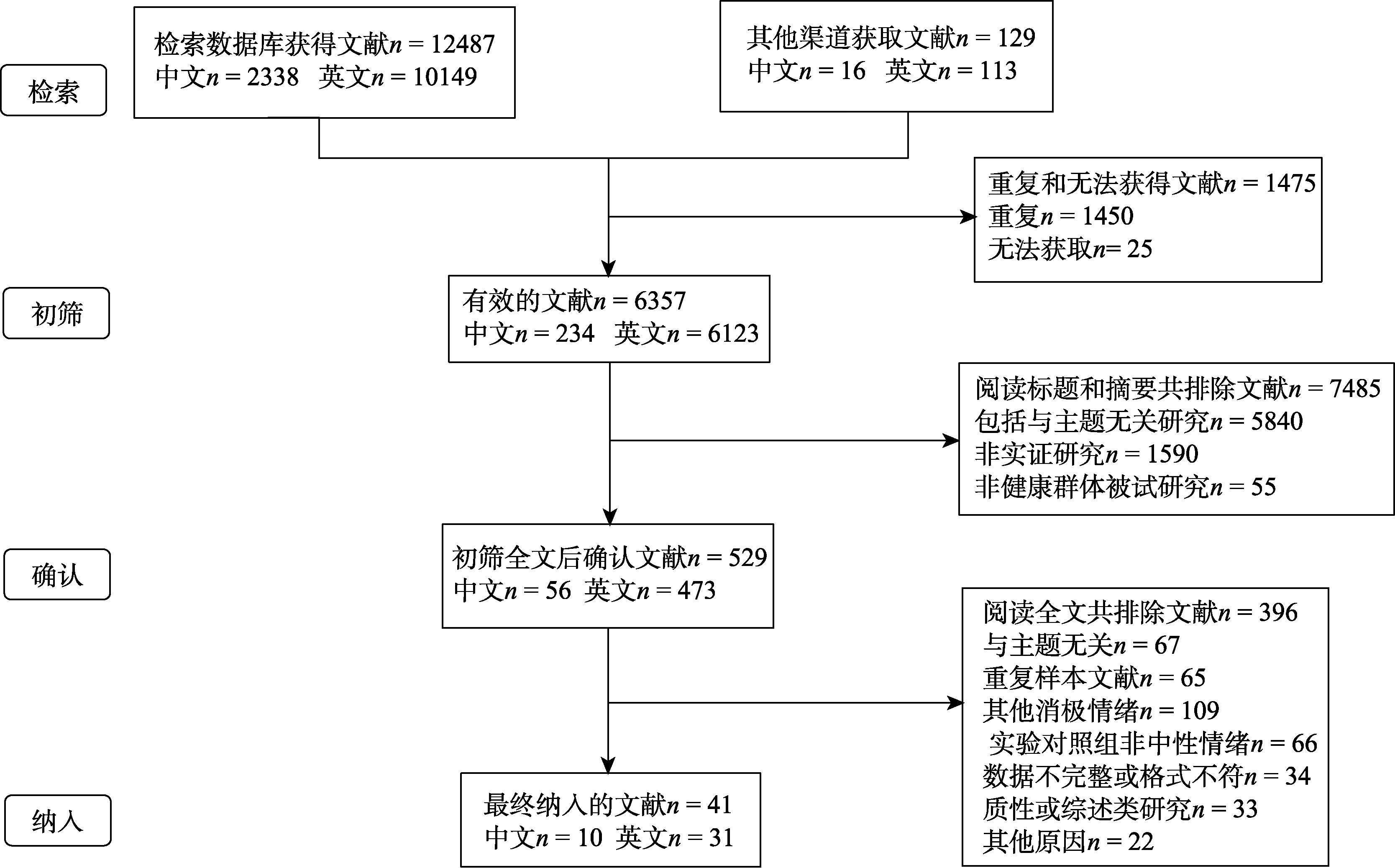
图1 PRISMA文献筛选流程图
 |
表1 悲伤与亲社会行为关系的随机模型分析
| |
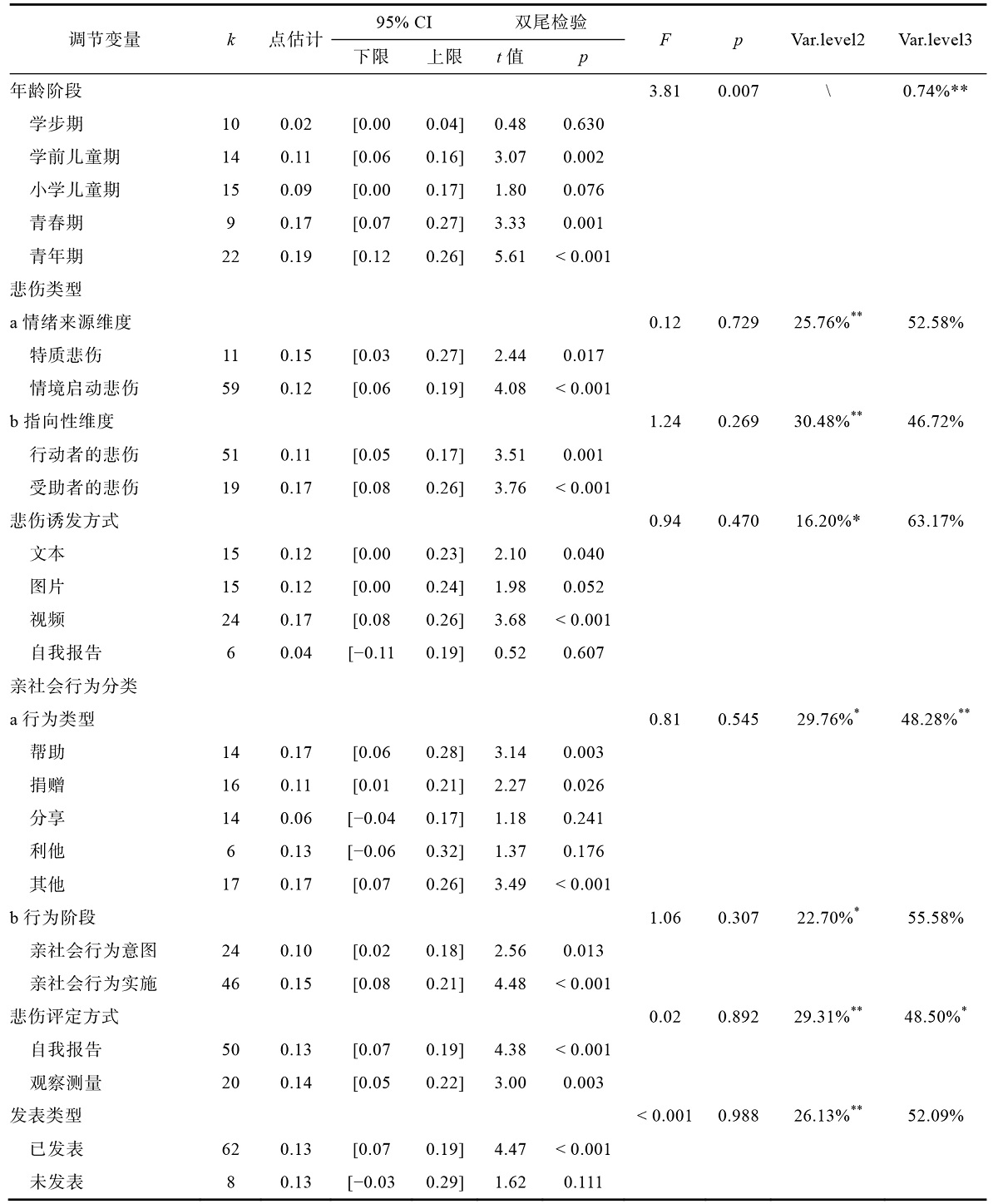 |
表2 悲伤与亲社会行为关系的调节效应检验(随机效应模型)
| |
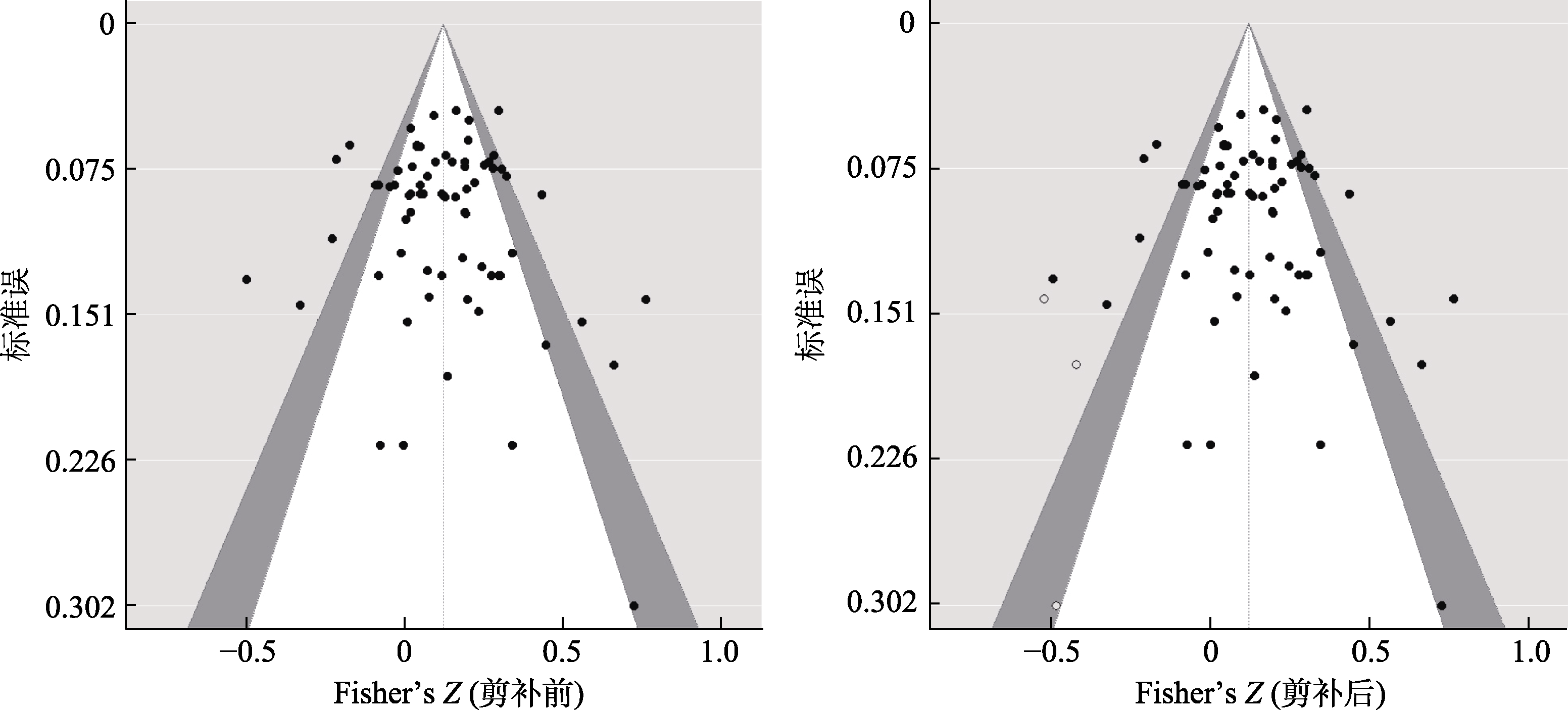
图2 悲伤与亲社会行为的关系(漏斗图)

图3 悲伤与亲社会行为关系研究的p曲线
| 作者(发表年份) | 样本 数目 | IDV | 出版 状态 | 年龄 阶段 | 男性 比例 | 悲伤 类型 | 亲社会 行为分类 | 悲伤诱发方式 | 悲伤评 定方式 | r值 |
|---|---|---|---|---|---|---|---|---|---|---|
| 邓华强, | 52 | 20 | UP | Y | 0.46 | S/A | H/B | V | SR | 0.643 |
| 刘晨波, | 60 | 20 | UP | E | 0.50 | S/A | S/B | V | SR | −0.460 |
| 罗爱霞, | 129 | 20 | UP | A | 0.49 | S/A | A/B | V | SR | 0.017 |
| 马秀娟, 王冬燕, | 108 | 20 | P | Y | 0.27 | S/R | O/B | P | OB | 0.020 |
| 谢晔, 周军, | 62 | 20 | P | Y | 0.45 | T/A | D/W | V | SR | 0.294 |
| 行娜娜, | 404 | 20 | UP | A | 0.46 | T/A | O/B | O | SR | 0.203 |
| 徐丽, | 185 | 20 | UP | A | 0.49 | S/R | A/B | T | SR | 0.190 |
| 徐丽, | 185 | 20 | UP | A | 0.49 | S/R | A/B | T | OB | 0.027 |
| 徐丽, | 164 | 20 | UP | A | 0.46 | S/R | A/B | T | SR | 0.314 |
| 徐丽, | 164 | 20 | UP | A | 0.46 | T/A | A/W | S | OB | 0.073 |
| 张振铭, | 52 | 20 | P | Y | 0.42 | T/R | S/B | P | SR | 0.197 |
| 朱丹, 李丹, | 217 | 20 | P | A | 0.54 | S/R | O/W | T | SR | 0.131 |
| 朱丹, 李丹, | 217 | 20 | P | A | 0.54 | S/R | O/B | P | SR | 0.276 |
| 朱晶晶 等, | 205 | 20 | UP | T | 0.46 | T/A | O/B | O | SR | −0.210 |
| Chiarella & Poulin-Dubois, | 71 | 80 | P | T | 0.51 | S/A | H/W | S | SR | 0.182 |
| Chiarella & Poulin-Dubois, | 64 | 80 | P | P | 无 | S/A | H/W | S | SR | 0.074 |
| Cialdini & Kenrick, | 53 | 91 | P | E | 无 | S/A | S/B | I | SR | 0.080 |
| Cialdini & Kenrick, | 33 | 91 | P | E | 无 | S/A | S/B | I | SR | 0.136 |
| Cialdini & Kenrick, | 14 | 91 | P | A | 无 | S/A | S/B | I | SR | 0.620 |
| Debono et al., | 278 | 91 | P | Y | 0.55 | S/A | O/B | O | SR | 0.200 |
| Denham et al., | 39 | 91 | P | P | 0.54 | T/A | O/W | V | OB | 0.420 |
| Dickerson & Quas, | 251 | 91 | P | E | 0.51 | S/A | O/B | T | SR | 0.050 |
| Dickerson & Quas, | 251 | 91 | P | E | 0.51 | S/A | S/B | T | OB | 0.040 |
| Donohue et al., | 147 | 91 | P | T | 0.58 | S/A | H/W | P | OB | −0.030 |
| Donohue et al., | 147 | 91 | P | T | 0.58 | S/R | C/B | P | OB | 0.050 |
| Donohue et al., | 147 | 91 | P | T | 0.58 | T/R | H/B | P | OB | −0.080 |
| Donohue et al., | 147 | 91 | P | T | 0.58 | S/A | C/B | P | OB | −0.090 |
| Edwards et al., | 256 | 91 | P | T | 0.55 | S/A | S/B | O | SR | −0.170 |
| Edwards et al., | 256 | 91 | P | T | 0.55 | S/A | O/B | S | OB | 0.040 |
| Eisenberg et al., | 132 | 91 | P | P | 0.52 | S/A | H/B | V | SR | 0.120 |
| Eisenberg et al., | 132 | 91 | P | P | 0.52 | S/R | H/W | T | SR | 0.060 |
| Eisenberg et al., | 132 | 91 | P | P | 0.52 | S/R | D/W | V | SR | 0.020 |
| Eisenberg et al., | 132 | 91 | P | P | 0.52 | S/A | D/B | T | OB | 0.050 |
| Eisenberg et al., | 62 | 91 | P | Y | 0.48 | S/A | H/B | V | OB | 0.290 |
| Gunderson et al., | 498 | 91 | P | Y | 0.52 | T/A | D/W | P | OB | 0.291 |
| Gunderson et al., | 498 | 91 | P | Y | 0.52 | S/A | D/B | P | SR | 0.164 |
| Gunderson et al., | 151 | 91 | P | Y | 0.63 | S/A | D/W | P | SR | 0.219 |
| Guo et al., | 50 | 20 | P | P | 无 | S/A | S/B | V | SR | −0.317 |
| Guo et al., | 48 | 20 | P | P | 无 | S/A | S/B | V | SR | 0.231 |
| Holmgren et al., | 199 | 91 | P | E | 0.51 | T/A | P/W | V | OB | 0.150 |
| Holmgren et al., | 199 | 91 | P | E | 0.51 | S/R | P/W | V | SR | 0.100 |
| Ibanez & Roussel, | 84 | 71 | P | Y | 0.52 | S/A | D/B | R | SR | −0.222 |
| Jang, | 199 | 91 | P | Y | 0.49 | S/R | D/B | P | OB | 0.190 |
| Xu, | 139 | 20 | P | Y | 0.46 | S/A | A/B | T | SR | 0.196 |
| Manucia et al., | 24 | 91 | P | Y | 无 | S/A | H/W | R | SR | 0.330 |
| Manucia et al., | 24 | 91 | P | Y | 无 | S/A | H/W | T | SR | −0.075 |
| Miller et al., | 74 | 91 | P | P | 0.46 | T/A | H/W | V | OB | 0.330 |
| Miller et al., | 74 | 91 | P | P | 0.46 | S/R | C/B | V | OB | −0.010 |
| Miller et al., | 180 | 91 | P | P | 0.53 | S/R | H/W | V | SR | 0.300 |
| Mistry-Patel et al., | 176 | 91 | P | T | 3.35 | S/A | O/W | O | SR | −0.020 |
| Mistry-Patel et al., | 66 | 91 | P | P | 无 | S/A | O/B | O | SR | 0.240 |
| Newton et al., | 35 | 91 | P | T | 0.46 | S/A | S/B | S | SR | 0.580 |
| Randall Ahn et al., 1988 | 62 | 91 | P | P | 0.53 | S/R | O/B | V | OB | 0.270 |
| Randall Ahn et al., 1988 | 62 | 91 | P | P | 0.53 | S/A | S/W | V | OB | 0.120 |
| Randall Ahn et al., 1988 | 62 | 91 | P | P | 0.53 | T/A | H/W | V | OB | −0.080 |
| Rosenhan et al., | 24 | 91 | P | E | 无 | S/A | D/B | R | OR | −0.002 |
| Rotenberg & Eisenberg, | 108 | 80 | P | E | 无 | S/A | P/B | T | SR | 0.190 |
| Guo & Wu, | 144 | 20 | P | P | 0.50 | S/A | S/B | V | SR | 0.044 |
| Saunders et al., | 345 | 91 | P | Y | 无 | S/A | D/B | P | SR | 0.022 |
| Schwartz & Loewenstein, | 450 | 89 | P | Y | 0.48 | S/A | S/B | V | SR | 0.093 |
| Sette et al., | 127 | 76 | P | P | 0.47 | S/R | O/B | T | OB | 0.130 |
| Sette et al., | 127 | 76 | P | P | 0.47 | S/A | O/B | T | SR | 0.160 |
| Shepelenko et al., | 45 | 39 | P | Y | 0.41 | S/A | D/B | P | SR | 0.012 |
| Shepelenko et al., | 45 | 39 | P | Y | 0.41 | S/A | D/W | P | OB | 0.510 |
| Shteynberg et al. | 181 | 91 | P | Y | 0.48 | S/R | D/B | V | SR | 0.275 |
| Shteynberg et al. | 190 | 91 | P | Y | 0.47 | S/A | D/W | V | SR | 0.248 |
| Shteynberg et al. | 198 | 91 | P | Y | 0.55 | S/A | S/W | V | OB | 0.263 |
| Small & Verrochi, | 100 | 91 | P | Y | 0.50 | S/R | D/B | P | SR | 0.005 |
| Song et al., | 131 | 80 | P | E | 0.51 | S/A | O/B | V | SR | 0.410 |
| Weiß et al., | 106 | 67 | P | Y | 0.26 | S/A | S/W | P | SR | 0.192 |
附表1 纳入分析的原始研究的基本资料
| 作者(发表年份) | 样本 数目 | IDV | 出版 状态 | 年龄 阶段 | 男性 比例 | 悲伤 类型 | 亲社会 行为分类 | 悲伤诱发方式 | 悲伤评 定方式 | r值 |
|---|---|---|---|---|---|---|---|---|---|---|
| 邓华强, | 52 | 20 | UP | Y | 0.46 | S/A | H/B | V | SR | 0.643 |
| 刘晨波, | 60 | 20 | UP | E | 0.50 | S/A | S/B | V | SR | −0.460 |
| 罗爱霞, | 129 | 20 | UP | A | 0.49 | S/A | A/B | V | SR | 0.017 |
| 马秀娟, 王冬燕, | 108 | 20 | P | Y | 0.27 | S/R | O/B | P | OB | 0.020 |
| 谢晔, 周军, | 62 | 20 | P | Y | 0.45 | T/A | D/W | V | SR | 0.294 |
| 行娜娜, | 404 | 20 | UP | A | 0.46 | T/A | O/B | O | SR | 0.203 |
| 徐丽, | 185 | 20 | UP | A | 0.49 | S/R | A/B | T | SR | 0.190 |
| 徐丽, | 185 | 20 | UP | A | 0.49 | S/R | A/B | T | OB | 0.027 |
| 徐丽, | 164 | 20 | UP | A | 0.46 | S/R | A/B | T | SR | 0.314 |
| 徐丽, | 164 | 20 | UP | A | 0.46 | T/A | A/W | S | OB | 0.073 |
| 张振铭, | 52 | 20 | P | Y | 0.42 | T/R | S/B | P | SR | 0.197 |
| 朱丹, 李丹, | 217 | 20 | P | A | 0.54 | S/R | O/W | T | SR | 0.131 |
| 朱丹, 李丹, | 217 | 20 | P | A | 0.54 | S/R | O/B | P | SR | 0.276 |
| 朱晶晶 等, | 205 | 20 | UP | T | 0.46 | T/A | O/B | O | SR | −0.210 |
| Chiarella & Poulin-Dubois, | 71 | 80 | P | T | 0.51 | S/A | H/W | S | SR | 0.182 |
| Chiarella & Poulin-Dubois, | 64 | 80 | P | P | 无 | S/A | H/W | S | SR | 0.074 |
| Cialdini & Kenrick, | 53 | 91 | P | E | 无 | S/A | S/B | I | SR | 0.080 |
| Cialdini & Kenrick, | 33 | 91 | P | E | 无 | S/A | S/B | I | SR | 0.136 |
| Cialdini & Kenrick, | 14 | 91 | P | A | 无 | S/A | S/B | I | SR | 0.620 |
| Debono et al., | 278 | 91 | P | Y | 0.55 | S/A | O/B | O | SR | 0.200 |
| Denham et al., | 39 | 91 | P | P | 0.54 | T/A | O/W | V | OB | 0.420 |
| Dickerson & Quas, | 251 | 91 | P | E | 0.51 | S/A | O/B | T | SR | 0.050 |
| Dickerson & Quas, | 251 | 91 | P | E | 0.51 | S/A | S/B | T | OB | 0.040 |
| Donohue et al., | 147 | 91 | P | T | 0.58 | S/A | H/W | P | OB | −0.030 |
| Donohue et al., | 147 | 91 | P | T | 0.58 | S/R | C/B | P | OB | 0.050 |
| Donohue et al., | 147 | 91 | P | T | 0.58 | T/R | H/B | P | OB | −0.080 |
| Donohue et al., | 147 | 91 | P | T | 0.58 | S/A | C/B | P | OB | −0.090 |
| Edwards et al., | 256 | 91 | P | T | 0.55 | S/A | S/B | O | SR | −0.170 |
| Edwards et al., | 256 | 91 | P | T | 0.55 | S/A | O/B | S | OB | 0.040 |
| Eisenberg et al., | 132 | 91 | P | P | 0.52 | S/A | H/B | V | SR | 0.120 |
| Eisenberg et al., | 132 | 91 | P | P | 0.52 | S/R | H/W | T | SR | 0.060 |
| Eisenberg et al., | 132 | 91 | P | P | 0.52 | S/R | D/W | V | SR | 0.020 |
| Eisenberg et al., | 132 | 91 | P | P | 0.52 | S/A | D/B | T | OB | 0.050 |
| Eisenberg et al., | 62 | 91 | P | Y | 0.48 | S/A | H/B | V | OB | 0.290 |
| Gunderson et al., | 498 | 91 | P | Y | 0.52 | T/A | D/W | P | OB | 0.291 |
| Gunderson et al., | 498 | 91 | P | Y | 0.52 | S/A | D/B | P | SR | 0.164 |
| Gunderson et al., | 151 | 91 | P | Y | 0.63 | S/A | D/W | P | SR | 0.219 |
| Guo et al., | 50 | 20 | P | P | 无 | S/A | S/B | V | SR | −0.317 |
| Guo et al., | 48 | 20 | P | P | 无 | S/A | S/B | V | SR | 0.231 |
| Holmgren et al., | 199 | 91 | P | E | 0.51 | T/A | P/W | V | OB | 0.150 |
| Holmgren et al., | 199 | 91 | P | E | 0.51 | S/R | P/W | V | SR | 0.100 |
| Ibanez & Roussel, | 84 | 71 | P | Y | 0.52 | S/A | D/B | R | SR | −0.222 |
| Jang, | 199 | 91 | P | Y | 0.49 | S/R | D/B | P | OB | 0.190 |
| Xu, | 139 | 20 | P | Y | 0.46 | S/A | A/B | T | SR | 0.196 |
| Manucia et al., | 24 | 91 | P | Y | 无 | S/A | H/W | R | SR | 0.330 |
| Manucia et al., | 24 | 91 | P | Y | 无 | S/A | H/W | T | SR | −0.075 |
| Miller et al., | 74 | 91 | P | P | 0.46 | T/A | H/W | V | OB | 0.330 |
| Miller et al., | 74 | 91 | P | P | 0.46 | S/R | C/B | V | OB | −0.010 |
| Miller et al., | 180 | 91 | P | P | 0.53 | S/R | H/W | V | SR | 0.300 |
| Mistry-Patel et al., | 176 | 91 | P | T | 3.35 | S/A | O/W | O | SR | −0.020 |
| Mistry-Patel et al., | 66 | 91 | P | P | 无 | S/A | O/B | O | SR | 0.240 |
| Newton et al., | 35 | 91 | P | T | 0.46 | S/A | S/B | S | SR | 0.580 |
| Randall Ahn et al., 1988 | 62 | 91 | P | P | 0.53 | S/R | O/B | V | OB | 0.270 |
| Randall Ahn et al., 1988 | 62 | 91 | P | P | 0.53 | S/A | S/W | V | OB | 0.120 |
| Randall Ahn et al., 1988 | 62 | 91 | P | P | 0.53 | T/A | H/W | V | OB | −0.080 |
| Rosenhan et al., | 24 | 91 | P | E | 无 | S/A | D/B | R | OR | −0.002 |
| Rotenberg & Eisenberg, | 108 | 80 | P | E | 无 | S/A | P/B | T | SR | 0.190 |
| Guo & Wu, | 144 | 20 | P | P | 0.50 | S/A | S/B | V | SR | 0.044 |
| Saunders et al., | 345 | 91 | P | Y | 无 | S/A | D/B | P | SR | 0.022 |
| Schwartz & Loewenstein, | 450 | 89 | P | Y | 0.48 | S/A | S/B | V | SR | 0.093 |
| Sette et al., | 127 | 76 | P | P | 0.47 | S/R | O/B | T | OB | 0.130 |
| Sette et al., | 127 | 76 | P | P | 0.47 | S/A | O/B | T | SR | 0.160 |
| Shepelenko et al., | 45 | 39 | P | Y | 0.41 | S/A | D/B | P | SR | 0.012 |
| Shepelenko et al., | 45 | 39 | P | Y | 0.41 | S/A | D/W | P | OB | 0.510 |
| Shteynberg et al. | 181 | 91 | P | Y | 0.48 | S/R | D/B | V | SR | 0.275 |
| Shteynberg et al. | 190 | 91 | P | Y | 0.47 | S/A | D/W | V | SR | 0.248 |
| Shteynberg et al. | 198 | 91 | P | Y | 0.55 | S/A | S/W | V | OB | 0.263 |
| Small & Verrochi, | 100 | 91 | P | Y | 0.50 | S/R | D/B | P | SR | 0.005 |
| Song et al., | 131 | 80 | P | E | 0.51 | S/A | O/B | V | SR | 0.410 |
| Weiß et al., | 106 | 67 | P | Y | 0.26 | S/A | S/W | P | SR | 0.192 |
| (*元分析用到的参考文献) | |
| [1] | *邓华强. (2018). 悲伤与愤怒情绪诱发对助人决策的影响: 人际责任归因的作用 [硕士学位论文]. 四川师范大学, 成都. |
| [2] |
丁凤琴, 赵虎英. (2018). 感恩的个体主观幸福感更强?——一项元分析. 心理科学进展, 26(10), 1749-1763.
doi: 10.3724/SP.J.1042.2018.01749 |
| [3] | 傅静琪, 阴山燕, 李丹霓, 许灵杰, 赵腾云. (2022). 自我关注对亲社会行为的影响:有调节的中介模型. 心理学进展, 12(11), 3730-3739. |
| [4] |
郭英, 田鑫, 胡东, 白书琳, 周蜀溪. (2023). 羞愧对亲社会行为影响的三水平元分析. 心理科学进展, 31(3), 371-385.
doi: 10.3724/SP.J.1042.2023.00371 |
| [5] | 衡书鹏, 赵换方, 熊建萍, 周宗奎. (2020). 网络募捐中求助者的面部表情对捐助意愿的影响:有中介的调节模型. 心理与行为研究, 18(1), 92-99. |
| [6] | *刘晨波. (2019). 负性情绪对儿童亲社会行为的影响——共情与情绪调节能力的作用 [硕士学位论文]. 华东师范大学, 上海. |
| [7] | *罗爱霞. (2022). 悲伤助长说谎:情绪理解能力和情绪自我意识水平的调节作用 [硕士学位论文]. 贵州师范大学, 成都. |
| [8] | *马秀娟, 王冬燕. (2023). 医学生疼痛移情与亲社会倾向的关系:注意偏向的调节作用. 中华行为医学与脑科学杂志, 32(7), 634-640. |
| [9] |
汤明, 李伟强, 刘福会, 袁博. (2019). 内疚与亲社会行为的关系: 来自元分析的证据. 心理科学进展, 27(5), 773-788.
doi: 10.3724/SP.J.1042.2019.00773 |
| [10] | *谢晔, 周军. (2012). 情绪和框架效应对个体捐赠决策影响的实验研究. 心理科学, 35(4), 951-956. |
| [11] | *行娜娜. (2011). 初中生的移情及其在亲社会行为中的作用研究 [硕士学位论文]. 中国政法大学, 北京. |
| [12] | *徐丽. (2019). 悲伤共情影响青少年和成人亲社会说谎的发展研究 [博士学位论文]. 华东师范大学, 上海. |
| [13] | 杨昭宁, 顾子贝, 王杜娟, 谭旭运, 王晓明. (2017). 愤怒和悲伤情绪对助人决策的影响: 人际责任归因的作用. 心理学报, 49(3), 393-403. |
| [14] | *张振铭. (2024). 口罩遮挡条件下面部情绪识别对亲社会行为的影响:状态共情的中介作用 [硕士学位论文]. 中国人民解放军陆军军医大学, 重庆. |
| [15] | *朱丹, 李丹. (2005). 初中学生道德推理、移情反应、亲社会行为及其相互关系的比较研究. 心理科学, 28(5), 1231-1234. |
| [16] | *朱晶晶, 张珍珍, 李燕. (2024). 母亲抑郁与幼儿社会适应:母亲的悲伤反应与亲子冲突的中介作用. 心理发展与教育, 40(5), 675-686. |
| [17] |
诸彦含, 贺彬, 孙蕾. (2024). 状态权力感对亲社会行为的影响:一项三水平元分析. 心理科学进展, 32(11), 1786-1799.
doi: 10.3724/SP.J.1042.2024.01786 |
| [18] | Asgary A., & Penfold G. (2011). Willingness to donate to victims of a hypothetical future earthquake disaster in Vancouver. International Journal of Business and Social Science, 2(16), 64-71. |
| [19] | Ajzen I. (1991). The theory of planned behavior. Organizational Behavior and Human Decision Processes, 50(2), 179-211. |
| [20] | Albouy J. (2017). Emotions and prosocial behaviours: A study of the effectiveness of shocking charity campaigns. Research and Applications in Marketing, 32(2), 4-25. |
| [21] | Assink M., & Wibbelink C. J. (2016). Fitting three-level meta-analytic models in R: A step-by-step tutorial. The Quantitative Methods for Psychology, 12(3), 154-174. |
| [22] |
Bastin C., Harrison B. J., Davey C. G., Moll J., & Whittle S. (2016). Feelings of shame, embarrassment and guilt and their neural correlates: A systematic review. Neuroscience and Biobehavioral Reviews, 71, 455-471.
doi: S0149-7634(15)30287-6 pmid: 27687818 |
| [23] | Batson C. D. (1987). Prosocial motivation: Is it ever truly altruistic? In Berkowitz, L. (Ed.), Advances in experimental social psychology (Vol. 20, pp. 65-122). Academic Press. |
| [24] | Bekkali S., Youssef G. J., Donaldson P. H., Albein Urios N., Hyde C., & Enticott P. G. (2020). Is the putative mirror neuron system associated with empathy? A systematic review and meta-analysis. Neuropsychology Review, 31(1), 1-44. |
| [25] |
Brown A. J. L. (1997). Analysis of HIV-1 env gene sequences reveals evidence for a low effective number in the viral population. Proceedings of the National Academy of Sciences of the United States of America, 94(5), 1862-1865.
pmid: 9050870 |
| [26] | Burt C. D., & Strongman K. (2005). Use of images in charity advertising: Improving donations and compliance rates. International Journal of Organisational Behaviour, 8(8), 571-580. |
| [27] |
Button K. S., Ioannidis J. P., Mokrysz C., Nosek B. A., Flint J., Robinson E. S., & Munafò M. R. (2013). Power failure: Why small sample size undermines the reliability of neuroscience. Nature Reviews Neuroscience, 14(5), 365-376.
doi: 10.1038/nrn3475 pmid: 23571845 |
| [28] | Card N. A. (2012). Applied meta-analysis for social science research. New York: Guilford Press. |
| [29] | Carlo G., & Randall B. A. (2002). The development of a measure of prosocial behaviors for late adolescents. Journal of Youth and Adolescence, 31(1), 31-44. |
| [30] | Carlson M., & Miller N. (1987). Explanation of the relation between negative mood and helping. Psychological Bulletin, 102(1), 91-108. |
| [31] | Carver C. S., & White T. L. (1994). Behavioral inhibition, behavioral activation, and affective responses to impending reward and punishment. Journal of Personality and Social Psychology, 67(2), 319-333. |
| [32] |
Cheung M. W. L. (2019). A guide to conducting a meta- analysis with non-independent effect sizes. Neuropsychology review, 29(4), 387-396.
doi: 10.1007/s11065-019-09415-6 pmid: 31446547 |
| [33] | *Chiarella S. S., & Poulin-Dubois D. (2015). “Aren't you supposed to be sad?” Infants do not treat a stoic person as an unreliable emoter. Infant Behavior and Development, 38(1), 57-66. |
| [34] | Chiou W. B., Chang M. H., & Chen C. L. (2009). The moderating role of personal relevance on differential priming of anxiety and sadness on perceived travel risk: A replication. Psychological reports, 104(2), 500-508. |
| [35] | Cialdini R. B., & Fultz J. (1990). Interpreting the negative mood-helping literature via “mega”-analysis: A contrary view. Psychological Bulletin, 107(2), 210-214. |
| [36] |
*Cialdini R. B., & Kenrick D. T. (1976). Altruism as hedonism: A social development perspective on the relationship of negative mood state and helping. Journal of Personality and Social Psychology, 34(5), 907-914.
pmid: 993985 |
| [37] |
Crone E. A., & Dahl R. E. (2012). Understanding adolescence as a period of social-affective engagement and goal flexibility. Nature Reviews Neuroscience, 13(9), 636-650.
doi: 10.1038/nrn3313 pmid: 22903221 |
| [38] | Cui F., Huang X., Jing Y., Luo Y., Liu J., & Gu R. (2022). How resource sharing resists scarcity: The role of cognitive empathy and its neurobiological mechanisms. Cerebral Cortex, 32(23), 5623-5636. |
| [39] |
Cutler J., Nitschke J. P., Lamm C., & Lockwood P. L. (2021). Older adults across the globe exhibit increased prosocial behavior but also greater in-group preferences. Nature Aging, 1(10), 880-888.
doi: 10.1038/s43587-021-00118-3 pmid: 37118329 |
| [40] | *Debono A., Corley N., & Muraven M. (2020). Why am I left out? Interpretations of exclusion affect antisocial and prosocial behaviors. The American Journal of Psychology, 133(1), 63-79. |
| [41] | *Denham S. A., Renwick S. M., & Holt R. W. (1991). Working and playing together: Prediction of preschool social-emotional competence from mother-child interaction. Child Development, 62(2), 242-249. |
| [42] |
DiBartolo P. M., & Grills A. E. (2006). Who is best at predicting children's anxiety in response to a social evaluative task? A comparison of child, parent, and teacher reports. Journal of anxiety Disorders, 20(5), 630-645.
doi: 10.1016/j.janxdis.2005.06.003 pmid: 16112539 |
| [43] | *Dickerson K. L., & Quas J. A. (2021). Emotional awareness, empathy, and generosity in high-risk youths. Journal of Experimental Child Psychology, 208(1), 105151. |
| [44] | Dodell-Feder D., & Tamir D. I. (2018). Fiction reading has a small positive impact on social cognition: A meta-analysis. Journal of Experimental Psychology: General, 147(11), 1713-1727. |
| [45] |
*Donohue M. R., Camacho M. C., Drake J. E., Schwarzlose R. F., Brady R. G., Hoyniak C. P.,... Luby J. (2024). Less attention to emotional faces is associated with low empathy and prosociality in 12-to 20-month old infants. Infancy, 29(2), 113-136.
doi: 10.1111/infa.12569 pmid: 38173191 |
| [46] | Duval S., & Tweedie R. (2000). A nonparametric “trim and fill” method of accounting for publication bias in meta- analysis. Journal of the American Statistical Association, 95(449), 89-98. |
| [47] |
*Edwards A., Eisenberg N., Spinrad T. L., Reiser M., Eggum‐Wilkens N. D., & Liew J. (2015). Predicting sympathy and prosocial behavior from young children's dispositional sadness. Social Development, 24(1), 76-94.
pmid: 25663753 |
| [48] | Egger M., Smith G. D., Schneider M., & Minder C. (1997). Bias in meta-analysis detected by a simple, graphical test. British Medical Journal, 315(7109), 629-634. |
| [49] |
*Eisenberg N., Fabes R. A., Miller P. A., Fultz J., Shell R., Mathy R. M., & Reno R. R. (1989). Relation of sympathy and personal distress to prosocial behavior: A multimethod study. Journal of Personality and Social Psychology, 57(1), 55-66.
pmid: 2754604 |
| [50] | Erikson E. H. (1959). Identity and the life cycle: Selected papers. International Universities Press. |
| [51] |
Fredrickson B. L. (2001). The role of positive emotions in positive psychology: The broaden-and-build theory of positive emotions. American Psychologist, 56(3), 218-226.
doi: 10.1037//0003-066x.56.3.218 pmid: 11315248 |
| [52] |
Gaesser B., & Schacter D. L. (2014). Episodic simulation and episodic memory can increase intentions to help others. Proceedings of the National Academy of Sciences of the United States of America, 111(12), 4415-4420.
doi: 10.1073/pnas.1402461111 pmid: 24616532 |
| [53] | Gignac G. E., & Szodorai E. T. (2016). Effect size guidelines for individual differences researchers. Personality and Individual Differences, 102(1), 74-78. |
| [54] | Gray J. A. (1982). Précis of the neuropsychology of anxiety: An enquiry into the functions of the septo-hippocampal system. Behavioral and Brain Sciences, 5(3), 469-534. |
| [55] |
Gross J. J., & Barrett L. F. (2011). Emotion generation and emotion regulation: One or two depends on your point of view. Emotion Review, 3(1), 8-16.
pmid: 21479078 |
| [56] | *Gunderson C. A., Baker A., Pence A. D., & Ten Brinke L. (2023). Interpersonal consequences of deceptive expressions of sadness. Personality and Social Psychology Bulletin, 49(1), 97-109. |
| [57] | *Guo R., He Z., & Wu Z. (2019). Emotion makes a difference: Induced sadness reduces preschool boys' sharing behavior. Evolution and Human Behavior, 40(2), 148-155. |
| [58] | *Guo R., & Wu Z. (2021). Empathy as a buffer: How empathy moderates the emotional effects on Preschoolers' sharing. British Journal of Psychology, 112(2), 412-432. |
| [59] |
Hein G., Morishima Y., Leiberg S., Sul S., & Fehr E. (2016). The brain’s functional network architecture reveals human motives. Science, 351(6277), 1074-1078.
doi: 10.1126/science.aac5082 |
| [60] | Higgins J. P., Thompson S. G., Deeks J. J., & Altman D. G. (2003). Measuring inconsistency in meta-analyses. British Medical Journal, 327(7414), 557-560. |
| [61] | Hofstede G. (1983). National cultures in four dimensions: A Research-Based Theory of Cultural Differences among Nations. International Studies of Management & Organization, 13(1-2), 46-74. |
| [62] | *Holmgren R. A., Eisenberg N., & Fabes R. A. (1998). The relations of children's situational empathy-related emotions to dispositional prosocial behaviour. International Journal of Behavioral Development, 22(1), 169-193. |
| [63] |
Hyde J. S. (2005). The gender similarities hypothesis. American Psychologist, 60(6), 581-592.
doi: 10.1037/0003-066X.60.6.581 pmid: 16173891 |
| [64] | *Ibanez L., & Roussel S. (2021). The effects of induced emotions on environmental preferences and behavior: An experimental study. PLoS One, 16(9), e0258045. |
| [65] | *Jang H. (2022). Cuteness mediates the effect of happy facial expressions on empathy and charitable donations. International Review on Public and Nonprofit Marketing, 19(4), 675-689. |
| [66] | Keltner D., & Haidt J. (1999). Social functions of emotions at four levels of analysis. Cognition & Emotion, 13(5), 505-521. |
| [67] | Kemp E., Kennett-Hensel P. A., & Kees J. (2013). Pulling on the heartstrings: Examining the effects of emotions and gender in persuasive appeals. Journal of Advertising, 42(1), 69-79. |
| [68] | Kepes S., & Thomas M. A. (2018). Assessing the robustness of meta-analytic results in information systems: Publication bias and outliers. European Journal of Information Systems, 27(1), 90-123. |
| [69] |
Knapp G., & Hartung J. (2003). Improved tests for a random effects meta-regression with a single covariate. Statistics in Medicine, 22(17), 2693-2710.
doi: 10.1002/sim.1482 pmid: 12939780 |
| [70] |
Konstantopoulos S. (2011). Fixed effects and variance components estimation in three-level meta-analysis. Research Synthesis Methods, 2(1), 61-76.
doi: 10.1002/jrsm.35 pmid: 26061600 |
| [71] |
Lecours S., Philippe F., Arseneault S., Boucher M.-È., & Ahoundova L. (2013). Alexithymia, cognitive complexity, and defensive avoidance of emotion in a situation of experimentally induced sadness. Journal of the American Psychoanalytic Association, 61(3), 573-578.
doi: 10.1177/0003065113490024 pmid: 23720028 |
| [72] | Lerner J. S., & Keltner D. (2000). Beyond valence: Toward a model of emotion-specific influences on judgement and choice. Cognition and Emotion, 14(4), 473-493. |
| [73] | Lipsey M. W., & Wilson D. B. (2001). Practical meta-analysis. SAGE Publications. |
| [74] | Lockwood P. L., Seara-Cardoso A., & Viding E. (2014). Emotion regulation moderates the association between empathy and prosocial behavior. PLoS One, 9(5), e96555. |
| [75] | *Manucia G. K., Baumann D. J., & Cialdini R. B. (1984). Mood influences on helping: Direct effects or side effects? Journal of Personality and Social Psychology, 46(2), 357-364. |
| [76] |
McHugh M. L. (2012). Interrater reliability: The kappa statistic. Biochemia Medica, 22(3), 276-282.
pmid: 23092060 |
| [77] |
*Miller J. G., Nuselovici J. N., & Hastings P. D. (2016). Nonrandom acts of kindness: Parasympathetic and subjective empathic responses to sadness predict children's prosociality. Child Development, 87(6), 1679-1690.
doi: 10.1111/cdev.12629 pmid: 28262932 |
| [78] | *Miller P. A., Eisenberg N., Fabes R. A., & Shell R. (1996). Relations of moral reasoning and vicarious emotion to young children's prosocial behavior toward peers and adults. Developmental Psychology, 32(2), 210-220. |
| [79] | *Mistry-Patel S., Nyman-Mallis T., Dollar J. M., Gagne J. R., & Brooker R. J. (2024). Cognitive control moderates associations between domains of temperamental reactivity and preschoolers' social behaviors. Developmental Psychobiology, 66(1), e22545. |
| [80] |
Nelissen R. M., & Zeelenberg M. (2009). When guilt evokes self-punishment: Evidence for the existence of a Dobby effect. Emotion, 9(1), 118-122.
doi: 10.1037/a0014540 pmid: 19186924 |
| [81] | *Newton E. K., Goodman M., & Thompson R. A. (2014). Why do some toddlers help a stranger? Origins of individual differences in prosocial behavior. Infancy, 19(2), 214-226. |
| [82] | Orth U., Clark D. A., Donnellan M. B., & Robins R. W. (2021). Testing prospective effects in longitudinal research: Comparing seven competing cross-lagged models. Journal of Personality and Social Psychology, 120(4), 1013-1034. |
| [83] |
Orth U., Erol R. Y., & Luciano E. C. (2018). Development of self-esteem from age 4 to 94 years: A meta-analysis of longitudinal studies. Psychological Bulletin, 144(10), 1045-1080.
doi: 10.1037/bul0000161 pmid: 30010349 |
| [84] | Page M. J., McKenzie J. E., Bossuyt P. M., Boutron I., Hoffmann T. C., Mulrow C. D.,... Moher D. (2021). The PRISMA 2020 statement: An updated guideline for reporting systematic reviews. British Medical Journal, 372, Article n71. |
| [85] |
Penner L. A., Dovidio J. F., Piliavin J. A., & Schroeder D. A. (2005). Prosocial behavior: Multilevel perspectives. Annual Review of Psychology, 56, 365-392.
pmid: 15709940 |
| [86] |
Peterson R. A., & Brown S. P. (2005). On the use of beta coefficients in meta-analysis. Journal of Applied Psychology, 90(1), 175-181.
doi: 10.1037/0021-9010.90.1.175 pmid: 15641898 |
| [87] | Raudenbush S. W., & Bryk A. S. (2002). Hierarchical linear models: Applications and data analysis methods (2nd ed.). SAGE Publications. |
| [88] | Roberts W., & Strayer J. (1996). Empathy, emotional expressiveness, and prosocial behavior. Child Development, 67(2), 449-470. |
| [89] | Rodgers M. A., & Pustejovsky J. E. (2021). Evaluating meta-analytic methods to detect selective reporting in the presence of dependent effect sizes. Psychological Methods, 26(2), 141-160. |
| [90] |
*Rosenhan D. L., Underwood B., & Moore B. (1974). Affect moderates self-gratification and altruism. Journal of Personality and Social Psychology, 30(4), 546-552.
pmid: 4455774 |
| [91] |
*Rotenberg K. J., & Eisenberg N. (1997). Developmental differences in the understanding of and reaction to others' inhibition of emotional expression. Developmental Psychology, 33(3), 526-527.
pmid: 9149931 |
| [92] | Rothstein H. (2006). The institutional origins of risk: A new agenda for risk research. Health, Risk & Society, 8(3), 215-221. |
| [93] | Rothstein, H. R., Sutton A. J., & Borenstein M. (2005). Publication bias in meta-analysis: Prevention, assessment, and adjustments. In Borenstein, M., Sutton, A. J., & Rothstein, H. R. (Eds.), Publication bias in meta-analysis (Vol. 1, pp. 1-7). Wiley-Blackwell. |
| [94] | Rubin D. C., Boals A., & Berntsen D. (2008). Memory in posttraumatic stress disorder: Properties of voluntary and involuntary, traumatic and nontraumatic autobiographical memories in people with and without posttraumatic stress disorder symptoms. Journal of Experimental Psychology: General, 137(4), 591-614. |
| [95] | *Saunders T. J., Taylor A. H., & Atkinson Q. D. (2016). No evidence that a range of artificial monitoring cues influence online donations to charity in an MTurk sample. Royal Society Open Science, 3(10), 150710. |
| [96] | *Schwartz D., & Loewenstein G. (2017). The chill of the moment: Emotions and proenvironmental behavior. Journal of Public Policy and Marketing, 36(2), 255-268. |
| [97] | *Sette S., Colasante T., Zava F., Baumgartner E., & Malti T. (2018). Preschoolers’ anticipation of sadness for excluded peers, sympathy, and prosocial behavior. The Journal of Genetic Psychology: Research and Theory on Human Development, 179(1), 286-296. |
| [98] | *Shepelenko A., Shepelenko P., Obukhova A., Kosonogov V., & Shestakova A. (2024). The relationship between charitable giving and emotional facial expressions: Results from affective computing. Heliyon, 10(2), e25428. |
| [99] |
*Shteynberg G., Hirsh J. B., Apfelbaum E. P., Larsen J. T., Galinsky A. D., & Roese N. J. (2014). Feeling more together: Group attention intensifies emotion. Emotion, 14(6), 1102-1114.
doi: 10.1037/a0037697 pmid: 25151520 |
| [100] | Simonsohn U., Nelson L. D., & Simmons J. P. (2014). P-curve: A key to the file-drawer. Journal of Experimental Psychology: General, 143(2), 534-557. |
| [101] | *Small D. A., & Verrochi N. M. (2009). The face of need: Facial emotion expression on charity advertisements. Journal of Marketing Research, 46(6), 777-787. |
| [102] | *Song J. H., Colasante T., & Malti T. (2018). Helping yourself helps others: Linking children's emotion regulation to prosocial behavior through sympathy and trust. Emotion, 18(4), 518-527. |
| [103] |
Stamkou E., van Kleef G. A., Fischer A. H., & Kret M. E. (2016). Are the powerful really blind to the feelings of others? How hierarchical concerns shape attention to emotions. Personality and Social Psychology Bulletin, 42(6), 755-768.
doi: 10.1177/0146167216636632 pmid: 27036499 |
| [104] |
Stanovich K. E., & West R. F. (2000). Individual differences in reasoning: Implications for the rationality debate? Behavioral and Brain Sciences, 23(5), 645-726.
doi: 10.1017/s0140525x00003435 pmid: 11301544 |
| [105] | Super D. E. (1953). A Theory of Vocational Development. American Psychologist (American Psychological Association), 8(5), 185-190. |
| [106] | Tangney, J. P. E., & Fischer K. W. (Eds.). (1995). Self-conscious emotions: The psychology of shame, guilt, embarrassment, and pride.Guilford Press. |
| [107] | Van Kleef G. A., & Lelieveld G. J. (2022). Moving the self and others to do good: The emotional underpinnings of prosocial behavior. Current Opinion in Psychology, 44, 80-88. |
| [108] | Viechtbauer W. (2010). Conducting meta-analyses in R with the Metafor Package. Journal of Statistical Software, 36(3), 1-48. |
| [109] |
Webb T. L., Miles E., & Sheeran P. (2012). Dealing with feeling: A meta-analysis of the effectiveness of strategies derived from the process model of emotion regulation. Psychological Bulletin, 138(4), 775-808.
doi: 10.1037/a0027600 pmid: 22582737 |
| [110] | *Weiß M., Hein G., & Hewig J. (2021). Between joy and sympathy: Smiling and sad recipient faces increase prosocial behavior in the dictator game. International Journal of Environmental Research and Public Health, 18(11), 6172-6185. |
| [111] | Wolfgang M. J., Cha S. H., Sidhaye A., Chohnan S., Cline G., Shulman G. I., & Lane M. D. (2007). Regulation of hypothalamic malonyl-CoA by central glucose and leptin. Proceedings of the National Academy of Sciences, 104(49), 19285-19290. |
| [112] | *Xu L., Chen G., & Li B. (2019). Sadness empathy facilitates prosocial lying. Social Behavior and Personality: An International Journal, 47(9), e8371. |
| [113] | Zaki J., & Mitchell J. P. (2013). Intuitive prosociality. Current Directions in Psychological Science, 22(6), 466-470. |
| [1] | 张露, 王子谦, 张清芳. 词汇获得年龄效应的认知机制: 三水平元分析[J]. 心理科学进展, 2025, 33(7): 1199-1220. |
| [2] | 薛笑然, 崔伟, 张丽. 空间导航能力性别差异的三水平元分析[J]. 心理科学进展, 2025, 33(5): 843-862. |
| [3] | 沈殷琪, 蔡怡, 吴继霞. 第三方干预对亲社会行为的影响:一项三水平元分析[J]. 心理科学进展, 2025, 33(12): 2121-2137. |
| [4] | 刘楠, 邱钰婷, 董志强, 李爱梅. 抚育动机何以促进亲社会行为?基于进化适应性的认知−能量机制及助推[J]. 心理科学进展, 2025, 33(11): 1854-1869. |
| [5] | 赵子卿, 余锦婷, 陈嘉彦, 王芸茹, 黄佳, 陈楚侨. 精神病临床高危人群的症状和功能改变:一项系统综述和三水平元分析[J]. 心理科学进展, 2025, 33(1): 42-61. |
| [6] | 李俊朋, 周临舒, 江俊, 王丹妮, 蒋存梅. 音乐对亲社会行为的影响及其作用机制[J]. 心理科学进展, 2024, 32(7): 1179-1194. |
| [7] | 文思雁, 于旭晨, 金磊, 宫俊如, 张晓函, 孙敬林, 张杉, 吕厚超. 儿童青少年家庭功能障碍与心理健康关系的三水平元分析[J]. 心理科学进展, 2024, 32(5): 771-789. |
| [8] | 袁悦, 吴志明, 谢秋实. 时间压力对个体工作结果的作用效果: 基于元分析的证据[J]. 心理科学进展, 2024, 32(3): 465-485. |
| [9] | 孟现鑫, 陈怡静, 王馨怡, 袁加锦, 俞德霖. 学校联结与抑郁的关系:一项三水平元分析[J]. 心理科学进展, 2024, 32(2): 246-263. |
| [10] | 诸彦含, 贺彬, 孙蕾. 状态权力感对亲社会行为的影响:一项三水平元分析[J]. 心理科学进展, 2024, 32(11): 1786-1799. |
| [11] | 陈斯允, 徐惠琪, 李诗颖, 牛小曼, 许丽颖. 俭以养德?节俭对亲社会行为的双刃剑效应及其理论解释[J]. 心理科学进展, 2024, 32(10): 1680-1696. |
| [12] | 许销冰, 程兰萍, 孙洪杰. 时间拟人化倾向及其对亲社会行为的影响[J]. 心理科学进展, 2023, 31(9): 1569-1582. |
| [13] | 郭英, 田鑫, 胡东, 白书琳, 周蜀溪. 羞愧对亲社会行为影响的三水平元分析[J]. 心理科学进展, 2023, 31(3): 371-385. |
| [14] | 从欣蕊, 武泽宇, 曼祖拉·艾山江, 姜云鹏, 刘妍, 吴瑕. 动作电子游戏对不同注意子网络的影响——来自元分析的证据[J]. 心理科学进展, 2023, 31(10): 1843-1855. |
| [15] | 方杰, 温忠麟, 欧阳劲樱, 蔡保贞. 国内调节效应的方法学研究[J]. 心理科学进展, 2022, 30(8): 1703-1714. |
| 阅读次数 | ||||||
|
全文 |
|
|||||
|
摘要 |
|
|||||
