

ISSN 1671-3710
CN 11-4766/R
主办:中国科学院心理研究所
出版:科学出版社
CN 11-4766/R
主办:中国科学院心理研究所
出版:科学出版社
心理科学进展 ›› 2026, Vol. 34 ›› Issue (1): 60-82.doi: 10.3724/SP.J.1042.2026.0060 cstr: 32111.14.2026.0060
张楠1,2, 李旭奎2( )
)
收稿日期:2024-12-30
出版日期:2026-01-15
发布日期:2025-11-10
通讯作者:
李旭奎, E-mail: lixukui@ouc.edu.cn基金资助:
ZHANG Nan1,2, LI Xukui2()
Received:2024-12-30
Online:2026-01-15
Published:2025-11-10
摘要: 大量研究证明简单言语加工任务中存在无关言语效应, 但与之相比, 在更复杂的言语加工任务中, 该效应是否依然存在、效应有多大、干扰来源是什么、作用路径是什么, 以及影响该效应的调节变量有哪些等问题, 目前尚未得到解决。本研究使用随机效应模型对检索后获得的30个研究(113个独立效应量)进行元分析。结果发现, 剔除异常值后, 无关言语可显著干扰个体在复杂言语加工任务中的表现, 但整体效应量较小; 无关言语效应受受试年龄群体、无关言语可理解性、响度、可预测性、无意义言语类型及复杂言语加工任务类型的调节, 且无关言语可理解性与受试年龄群体、复杂言语加工任务类型、任务语言单位、任务言语所属文字系统分别存在交互作用。此外, 相比语音干扰假说, 语义干扰假说的合理性更强; 而关于无关言语效应的作用路径, 过程干扰假说的合理性得到了一定支持。后续研究应进一步探索复杂言语加工任务中无关言语效应的其他潜在调节变量的影响, 以便为当今社会多媒体教学背景下利用音频、视频等现代教育技术辅助语言学习带来启发, 为学习环境的设计与优化、减少背景噪音对个体的干扰提供思路, 并为针对认知缺陷人群开发更有效的干预与治疗方法提供理论指导和支持。
中图分类号:
张楠, 李旭奎. (2026). 复杂言语加工任务中无关言语效应的元分析. 心理科学进展 , 34(1), 60-82.
ZHANG Nan, LI Xukui. (2026). A meta-analysis of the irrelevant speech effect in complex language processing tasks. Advances in Psychological Science, 34(1), 60-82.

图1 文献纳入和排除过程
| 模型 | 独立效应值数量 | 合并效应值 | 95%置信区间 | 渐进 | 异质性检验 | |||||
|---|---|---|---|---|---|---|---|---|---|---|
| 上限 | 下限 | Z | p | Q | df | p | I2 (%) | |||
| 固定效应 | 117 | 0.12 | 0.12 | 0.13 | 183.47 | 0.000 | 6491.11 | 116 | 0.000 | 98.21 |
| 随机效应 | 117 | 0.25 | 0.22 | 0.27 | 20.17 | 0.000 | ||||
表1 原始数据的异质性检验
| 模型 | 独立效应值数量 | 合并效应值 | 95%置信区间 | 渐进 | 异质性检验 | |||||
|---|---|---|---|---|---|---|---|---|---|---|
| 上限 | 下限 | Z | p | Q | df | p | I2 (%) | |||
| 固定效应 | 117 | 0.12 | 0.12 | 0.13 | 183.47 | 0.000 | 6491.11 | 116 | 0.000 | 98.21 |
| 随机效应 | 117 | 0.25 | 0.22 | 0.27 | 20.17 | 0.000 | ||||
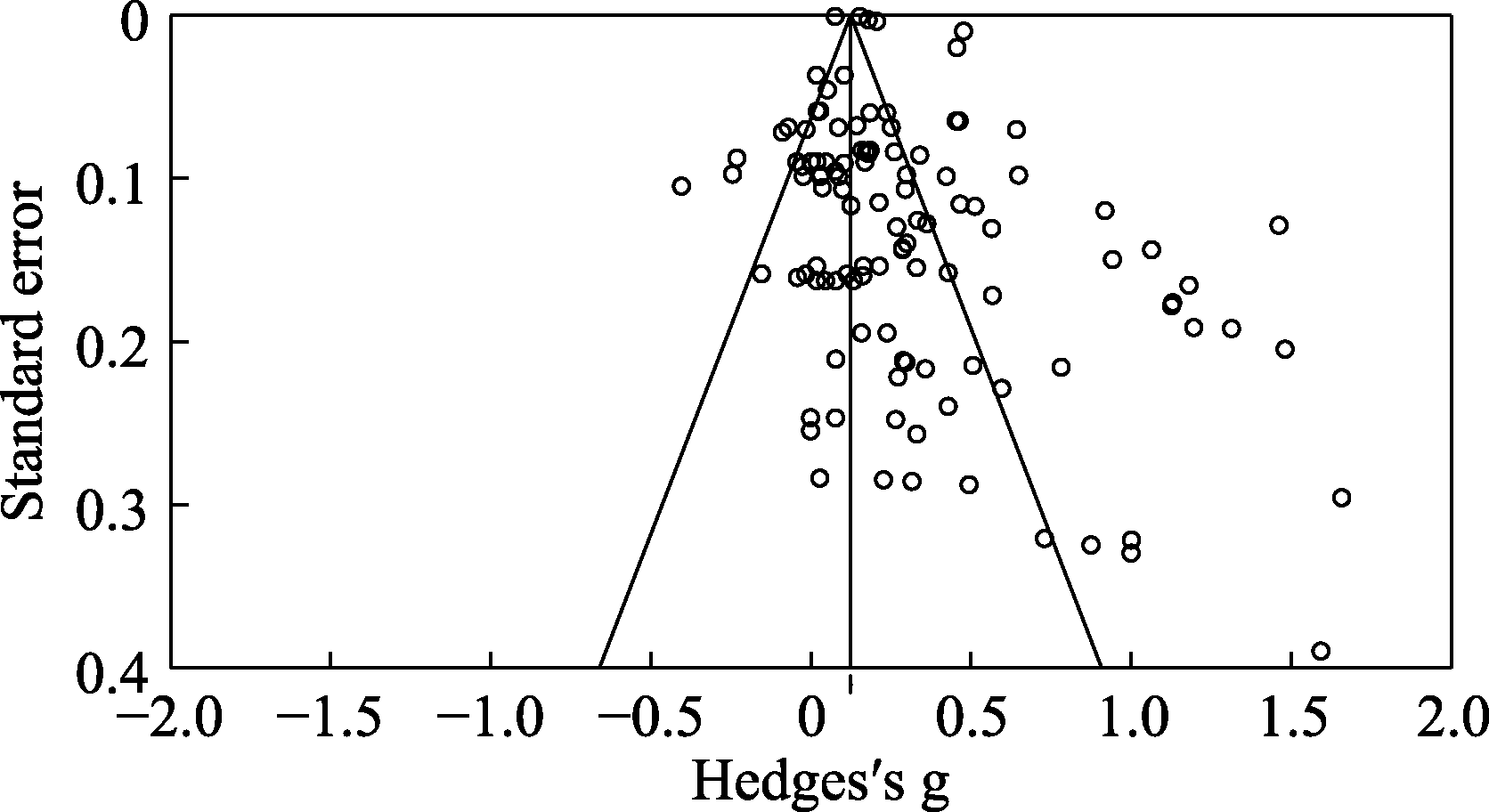
图2 漏斗图
| 影响因素 | 分组 | k | g | SE | p | 95%置信区间 | 组间效应 | |||
|---|---|---|---|---|---|---|---|---|---|---|
| 下限 | 上限 | Q | p | |||||||
| 受试特征 | ||||||||||
| 年龄群体 | 儿童 | 5 | 0.58 | 0.22 | 0.007 | 0.16 | 1.00 | 18.12 | 0.000 | |
| 成年人 | 89 | 0.30 | 0.03 | 0.000 | 0.23 | 0.36 | ||||
| 老年人 | 2 | 0.01 | 0.06 | 0.863 | −0.11 | 0.14 | ||||
| 无关言语特征 | ||||||||||
| 可理解性 | 有意义言语 | 66 | 0.38 | 0.03 | 0.000 | 0.32 | 0.44 | 57.35 | 0.000 | |
| 无意义言语 | 47 | 0.12 | 0.02 | 0.000 | 0.09 | 0.15 | ||||
| 响度 | 高(> = 65dB) | 39 | 0.29 | 0.02 | 0.000 | 0.25 | 0.33 | 10.01 | 0.002 | |
| 低(< 65dB) | 27 | 0.14 | 0.04 | 0.001 | 0.05 | 0.22 | ||||
| 文本体裁 | 叙事类 | 23 | 0.42 | 0.05 | 0.000 | 0.33 | 0.51 | 0.27 | 0.606 | |
| 信息类 | 14 | 0.47 | 0.09 | 0.000 | 0.29 | 0.65 | ||||
| 可预测性 | 半对话 | 2 | 0.57 | 0.12 | 0.000 | 0.33 | 0.81 | 6.14 | 0.046 | |
| 独白 | 29 | 0.46 | 0.05 | 0.000 | 0.37 | 0.55 | ||||
| 正常对话 | 5 | 0.31 | 0.06 | 0.000 | 0.20 | 0.42 | ||||
| 语言单位 | 字词层面 | 6 | 0.28 | 0.08 | 0.001 | 0.12 | 0.44 | 1.58 | 0.454 | |
| 句子层面 | 5 | 0.41 | 0.16 | 0.009 | 0.10 | 0.72 | ||||
| 段篇层面 | 45 | 0.39 | 0.04 | 0.000 | 0.32 | 0.46 | ||||
| −词表 | 6 | 0.28 | 0.08 | 0.001 | 0.12 | 0.44 | 1.54 | 0.214 | ||
| −非词表 | 50 | 0.39 | 0.03 | 0.000 | 0.32 | 0.46 | ||||
| 无意义言语类型 | 外语 | 31 | 0.13 | 0.02 | 0.000 | 0.09 | 0.16 | 26.95 | 0.000 | |
| 倒序言语 | 2 | 0.13 | 0.20 | 0.524 | −0.27 | 0.52 | ||||
| 频谱背景言语 | 7 | −0.10 | 0.05 | 0.074 | −0.20 | 0.01 | ||||
| 语音结构规则言语 | 4 | 0.77 | 0.21 | 0.000 | 0.37 | 1.17 | ||||
| 语音片段重组噪声 | 3 | 0.02 | 0.09 | 0.860 | −0.17 | 0.20 | ||||
| 复杂言语加工任务特征 | ||||||||||
| 任务类型 | 言语识别 | 19 | 0.22 | 0.08 | 0.005 | 0.07 | 0.37 | 11.16 | 0.004 | |
| 言语记忆 | 14 | 0.63 | 0.12 | 0.000 | 0.39 | 0.87 | ||||
| 言语理解 | 78 | 0.22 | 0.01 | 0.000 | 0.19 | 0.24 | ||||
| 任务语言单位 | 字词层面 | 32 | 0.38 | 0.07 | 0.000 | 0.25 | 0.51 | 5.56 | 0.062 | |
| 句子层面 | 56 | 0.22 | 0.02 | 0.000 | 0.19 | 0.25 | ||||
| 段篇层面 | 21 | 0.21 | 0.04 | 0.000 | 0.12 | 0.30 | ||||
| 任务言语所属文字系统 | 表音 | 46 | 0.23 | 0.03 | 0.000 | 0.17 | 0.29 | 0.74 | 0.391 | |
| 表意 | 67 | 0.26 | 0.02 | 0.000 | 0.23 | 0.29 | ||||
表2 潜在调节变量的亚组分析
| 影响因素 | 分组 | k | g | SE | p | 95%置信区间 | 组间效应 | |||
|---|---|---|---|---|---|---|---|---|---|---|
| 下限 | 上限 | Q | p | |||||||
| 受试特征 | ||||||||||
| 年龄群体 | 儿童 | 5 | 0.58 | 0.22 | 0.007 | 0.16 | 1.00 | 18.12 | 0.000 | |
| 成年人 | 89 | 0.30 | 0.03 | 0.000 | 0.23 | 0.36 | ||||
| 老年人 | 2 | 0.01 | 0.06 | 0.863 | −0.11 | 0.14 | ||||
| 无关言语特征 | ||||||||||
| 可理解性 | 有意义言语 | 66 | 0.38 | 0.03 | 0.000 | 0.32 | 0.44 | 57.35 | 0.000 | |
| 无意义言语 | 47 | 0.12 | 0.02 | 0.000 | 0.09 | 0.15 | ||||
| 响度 | 高(> = 65dB) | 39 | 0.29 | 0.02 | 0.000 | 0.25 | 0.33 | 10.01 | 0.002 | |
| 低(< 65dB) | 27 | 0.14 | 0.04 | 0.001 | 0.05 | 0.22 | ||||
| 文本体裁 | 叙事类 | 23 | 0.42 | 0.05 | 0.000 | 0.33 | 0.51 | 0.27 | 0.606 | |
| 信息类 | 14 | 0.47 | 0.09 | 0.000 | 0.29 | 0.65 | ||||
| 可预测性 | 半对话 | 2 | 0.57 | 0.12 | 0.000 | 0.33 | 0.81 | 6.14 | 0.046 | |
| 独白 | 29 | 0.46 | 0.05 | 0.000 | 0.37 | 0.55 | ||||
| 正常对话 | 5 | 0.31 | 0.06 | 0.000 | 0.20 | 0.42 | ||||
| 语言单位 | 字词层面 | 6 | 0.28 | 0.08 | 0.001 | 0.12 | 0.44 | 1.58 | 0.454 | |
| 句子层面 | 5 | 0.41 | 0.16 | 0.009 | 0.10 | 0.72 | ||||
| 段篇层面 | 45 | 0.39 | 0.04 | 0.000 | 0.32 | 0.46 | ||||
| −词表 | 6 | 0.28 | 0.08 | 0.001 | 0.12 | 0.44 | 1.54 | 0.214 | ||
| −非词表 | 50 | 0.39 | 0.03 | 0.000 | 0.32 | 0.46 | ||||
| 无意义言语类型 | 外语 | 31 | 0.13 | 0.02 | 0.000 | 0.09 | 0.16 | 26.95 | 0.000 | |
| 倒序言语 | 2 | 0.13 | 0.20 | 0.524 | −0.27 | 0.52 | ||||
| 频谱背景言语 | 7 | −0.10 | 0.05 | 0.074 | −0.20 | 0.01 | ||||
| 语音结构规则言语 | 4 | 0.77 | 0.21 | 0.000 | 0.37 | 1.17 | ||||
| 语音片段重组噪声 | 3 | 0.02 | 0.09 | 0.860 | −0.17 | 0.20 | ||||
| 复杂言语加工任务特征 | ||||||||||
| 任务类型 | 言语识别 | 19 | 0.22 | 0.08 | 0.005 | 0.07 | 0.37 | 11.16 | 0.004 | |
| 言语记忆 | 14 | 0.63 | 0.12 | 0.000 | 0.39 | 0.87 | ||||
| 言语理解 | 78 | 0.22 | 0.01 | 0.000 | 0.19 | 0.24 | ||||
| 任务语言单位 | 字词层面 | 32 | 0.38 | 0.07 | 0.000 | 0.25 | 0.51 | 5.56 | 0.062 | |
| 句子层面 | 56 | 0.22 | 0.02 | 0.000 | 0.19 | 0.25 | ||||
| 段篇层面 | 21 | 0.21 | 0.04 | 0.000 | 0.12 | 0.30 | ||||
| 任务言语所属文字系统 | 表音 | 46 | 0.23 | 0.03 | 0.000 | 0.17 | 0.29 | 0.74 | 0.391 | |
| 表意 | 67 | 0.26 | 0.02 | 0.000 | 0.23 | 0.29 | ||||
| 受试年龄群体 | 无关言语可理解性 | 效应量 | SE | 95%置信区间 | p | |
|---|---|---|---|---|---|---|
| 下限 | 上限 | |||||
| 儿童 | 有意义言语 | 1.01 | 0.10 | 0.80 | 1.21 | 0.000 |
| 无意义言语 | 0.25 | 0.13 | −0.01 | 0.50 | ||
| 成年人 | 有意义言语 | 0.38 | 0.04 | 0.31 | 0.46 | 0.001 |
| 无意义言语 | 0.17 | 0.05 | 0.06 | 0.27 | ||
| 老年人 | 有意义言语 | 0.02 | 0.09 | −0.16 | 0.20 | 0.888 |
| 无意义言语 | 0.00 | 0.09 | −0.17 | 0.18 | ||
表3 无关言语可理解性与受试特征的交互作用
| 受试年龄群体 | 无关言语可理解性 | 效应量 | SE | 95%置信区间 | p | |
|---|---|---|---|---|---|---|
| 下限 | 上限 | |||||
| 儿童 | 有意义言语 | 1.01 | 0.10 | 0.80 | 1.21 | 0.000 |
| 无意义言语 | 0.25 | 0.13 | −0.01 | 0.50 | ||
| 成年人 | 有意义言语 | 0.38 | 0.04 | 0.31 | 0.46 | 0.001 |
| 无意义言语 | 0.17 | 0.05 | 0.06 | 0.27 | ||
| 老年人 | 有意义言语 | 0.02 | 0.09 | −0.16 | 0.20 | 0.888 |
| 无意义言语 | 0.00 | 0.09 | −0.17 | 0.18 | ||
| 任务特征 | 无关言语可理解性 | 效应量 | se | 95%置信区间 | p | |
|---|---|---|---|---|---|---|
| 下限 | 上限 | |||||
| 任务类型 | ||||||
| 言语理解 | 有意义言语 | 0.39 | 0.04 | 0.32 | 0.45 | 0.000 |
| 无意义言语 | 0.08 | 0.02 | 0.05 | 0.12 | ||
| 言语记忆 | 有意义言语 | 0.59 | 0.08 | 0.43 | 0.74 | 0.998 |
| 无意义言语 | 0.59 | 0.22 | 0.16 | 1.02 | ||
| 言语识别 | 有意义言语 | 0.31 | 0.09 | 0.13 | 0.48 | 0.203 |
| 无意义言语 | 0.12 | 0.12 | −0.12 | 0.35 | ||
| 任务语言单位 | ||||||
| 字词 | 有意义言语 | 0.37 | 0.06 | 0.25 | 0.50 | 0.722 |
| 无意义言语 | 0.33 | 0.11 | 0.10 | 0.55 | ||
| 句子 | 有意义言语 | 0.43 | 0.04 | 0.35 | 0.51 | 0.000 |
| 无意义言语 | 0.08 | 0.02 | 0.04 | 0.12 | ||
| 段篇 | 有意义言语 | 0.28 | 0.06 | 0.16 | 0.40 | 0.001 |
| 无意义言语 | 0.05 | 0.03 | −0.01 | 0.12 | ||
| 任务言语所属的文字系统 | ||||||
| 表意文字 | 有意义言语 | 0.46 | 0.04 | 0.38 | 0.54 | 0.000 |
| 无意义言语 | 0.14 | 0.02 | 0.10 | 0.17 | ||
| 表音文字 | 有意义言语 | 0.29 | 0.04 | 0.21 | 0.36 | 0.050 |
| 无意义言语 | 0.06 | 0.04 | −0.02 | 0.15 | ||
表4 无关言语可理解性与任务特征的交互作用
| 任务特征 | 无关言语可理解性 | 效应量 | se | 95%置信区间 | p | |
|---|---|---|---|---|---|---|
| 下限 | 上限 | |||||
| 任务类型 | ||||||
| 言语理解 | 有意义言语 | 0.39 | 0.04 | 0.32 | 0.45 | 0.000 |
| 无意义言语 | 0.08 | 0.02 | 0.05 | 0.12 | ||
| 言语记忆 | 有意义言语 | 0.59 | 0.08 | 0.43 | 0.74 | 0.998 |
| 无意义言语 | 0.59 | 0.22 | 0.16 | 1.02 | ||
| 言语识别 | 有意义言语 | 0.31 | 0.09 | 0.13 | 0.48 | 0.203 |
| 无意义言语 | 0.12 | 0.12 | −0.12 | 0.35 | ||
| 任务语言单位 | ||||||
| 字词 | 有意义言语 | 0.37 | 0.06 | 0.25 | 0.50 | 0.722 |
| 无意义言语 | 0.33 | 0.11 | 0.10 | 0.55 | ||
| 句子 | 有意义言语 | 0.43 | 0.04 | 0.35 | 0.51 | 0.000 |
| 无意义言语 | 0.08 | 0.02 | 0.04 | 0.12 | ||
| 段篇 | 有意义言语 | 0.28 | 0.06 | 0.16 | 0.40 | 0.001 |
| 无意义言语 | 0.05 | 0.03 | −0.01 | 0.12 | ||
| 任务言语所属的文字系统 | ||||||
| 表意文字 | 有意义言语 | 0.46 | 0.04 | 0.38 | 0.54 | 0.000 |
| 无意义言语 | 0.14 | 0.02 | 0.10 | 0.17 | ||
| 表音文字 | 有意义言语 | 0.29 | 0.04 | 0.21 | 0.36 | 0.050 |
| 无意义言语 | 0.06 | 0.04 | −0.02 | 0.15 | ||
| 言语记忆的类型 | k | 效应量 | SE | 95%置信区间 | p | |
|---|---|---|---|---|---|---|
| 下限 | 上限 | |||||
| 系列回忆 | 2 | 0.51 | 0.10 | 0.31 | 0.71 | 0.401 |
| 自由回忆 | 5 | 0.65 | 0.14 | 0.38 | 0.92 | |
表5 两种言语记忆任务对比
| 言语记忆的类型 | k | 效应量 | SE | 95%置信区间 | p | |
|---|---|---|---|---|---|---|
| 下限 | 上限 | |||||
| 系列回忆 | 2 | 0.51 | 0.10 | 0.31 | 0.71 | 0.401 |
| 自由回忆 | 5 | 0.65 | 0.14 | 0.38 | 0.92 | |
| 作者与发表年份 | 实验 序号 | 样本量 | 无关言语特征 | 复杂言语加工任务特征 | 受试 特征 | 支持的 假说 | 效果量 | 文献质量 | |||||||
|---|---|---|---|---|---|---|---|---|---|---|---|---|---|---|---|
| 总体 | 有意义言语 | 无意义 言语 | 类型 | 语言 单位 | 文字 系统 | 年龄 群体 | |||||||||
| 可理 解性 | 响度/划分 | 文本 体裁 | 可预 测性 | 语言 单位 | 类型 | ||||||||||
| Beaman et al., | 42 | 有意义 | 字词 | 言语识别(词汇识别) | 字词 | 表音 | 成年人 | 0.33 | |||||||
| Halin, | 28 | 有意义 | 60dB/低 | 对话 | 言语理解 (篇章阅读理解) | 段篇 | 表音 | 成年人 | 0.43 | ||||||
| Halin, Marsh, Hellman et al., | 32 | 有意义 | 65dB/高 | 叙事类 | 独白 | 段篇 | 言语理解 (篇章阅读理解) | 段篇 | 表音 | 0.36 | |||||
| Halin, Marsh, Haga et al., | 1 | 31 | 有意义 | 65dB/高 | 叙事类 | 独白 | 段篇 | 言语理解(语义勘误) | 段篇 | 表音 | 成年人 | 0.24 | |||
| 有意义 | 65dB/高 | 叙事类 | 独白 | 段篇 | 言语识别(拼写勘误) | 段篇 | 表音 | 成年人 | 0.36 | ||||||
| 2 | 29 | 有意义 | 65dB/高 | 叙事类 | 独白 | 段篇 | 言语理解(语义勘误) | 段篇 | 表音 | 成年人 | 0.27 | ||||
| 有意义 | 65dB/高 | 叙事类 | 独白 | 段篇 | 言语识别(拼写勘误) | 段篇 | 表音 | 成年人 | 0.27 | ||||||
| Hyönä & Ekholm, | 1 | 42 | 有意义 | 80~85 dB/(未纳入响度分析—非耳机播放, 下同) | 叙事类 | 独白 | 段篇 | 言语理解 (句子阅读理解) | 句子 | 表音 | 0.09 | ||||
| 无意义 | / | 外语 | 言语理解 (句子阅读理解) | 句子 | 表音 | −0.07 | |||||||||
| 2 | 36 | 有意义 | / | 段篇 | 言语理解 (句子阅读理解) | 句子 | 表音 | 过程干扰 | 0.30 | ||||||
| 有意义 | / | 段篇 | 言语理解 (句子阅读理解) | 句子 | 表音 | 过程干扰 | 0.29 | ||||||||
| 3 | 35 | 有意义 | / | 信息类 | 独白 | 段篇 | 言语理解 (句子阅读理解) | 句子 | 表音 | 过程干扰 | 0.17 | ||||
| 有意义 | / | 段篇 | 言语理解 (句子阅读理解) | 句子 | 表音 | 过程干扰 | 0.26 | ||||||||
| 4 | 36 | 有意义 | / | 段篇 | 言语理解 (句子阅读理解) | 句子 | 表音 | 过程干扰 | 0.16 | ||||||
| 有意义 | / | 段篇 | 言语理解 (句子阅读理解) | 句子 | 表音 | 过程干扰 | 0.19 | ||||||||
| Kattner, | 1 | 50 | 无意义 | 60 dB/低 | 外语 | 言语识别(词汇识别) | 字词 | 表音 | 成年人 | −0.04 | |||||
| Leist et al., | 2 | 107 | 无意义 | 60 dB/低 | 外语 | 言语记忆(单词记忆) | 字词 | 表音 | 0.25 | ||||||
| MacDermid et al., | 1 | 60 | 有意义 | 70 dB/高 | 字词 | 言语记忆(单词记忆) | 字词 | 表音 | 成年人 | 0.57 | |||||
| 2 | 88 | 有意义 | 70 dB/高 | 字词 | 言语识别(真假词判断) | 字词 | 表音 | 成年人 | 0.30 | ||||||
| 3 | 88 | 有意义 | 70 dB/高 | 字词 | 言语理解 (单词情感倾向判断) | 字词 | 表音 | 成年人 | 0.10 | ||||||
| 4 | 88 | 有意义 | 70 dB/高 | 字词 | / | 字词 | 表音 | 成年人 | 0.04 | ||||||
| Mama et al., | 20 | 有意义 | 85dB/高 | 言语记忆(单词记忆) | 字词 | 表音 | 成年人 | 1.00 | |||||||
| Marsh et al., | 1 | 38 | 有意义 | 69分贝/高 | 对话 | 言语理解(信息搜寻) | 表音 | 成年人 | 语义干扰 | 0.11 | |||||
| 有意义 | 69分贝/高 | 半对话 | 言语理解(信息搜寻) | 表音 | 成年人 | 语义干扰 | 0.57 | ||||||||
| 2 | 38 | 有意义 | 69分贝/高 | 对话 | 言语理解(信息搜寻) | 表音 | 成年人 | 0.16 | |||||||
| 有意义 | 69分贝/高 | 半对话 | 言语理解(信息搜寻) | 表音 | 成年人 | 0.57 | |||||||||
| Marsh et al., | 1 | 24 | 有意义 | 65−70 dB/高 | 信息类 | 独白 | 段篇 | 言语记忆(单词记忆) | 字词 | 表音 | 成年人 | 语义干扰、过程干扰 | 0.50 | ||
| 有意义 | 65−70 dB/高 | 信息类 | 独白 | 段篇 | 言语记忆(单词记忆) | 字词 | 表音 | 成年人 | 语义干扰、过程干扰 | 0.32 | |||||
| 无意义 | 65−70 dB/高 | 倒序言语 | 言语记忆(单词记忆) | 字词 | 表音 | 成年人 | 语音干扰、过程干扰 | 0.23 | |||||||
| 无意义 | 65−70 dB/高 | 倒序言语 | 言语记忆(单词记忆) | 字词 | 表音 | 成年人 | 语音干扰、过程干扰 | 0.03 | |||||||
| 2 | 20 | 有意义 | 信息类 | 独白 | 段篇 | 言语记忆(单词记忆) | 字词 | 表音 | 成年人 | 过程干扰 | 0.73 | ||||
| 有意义 | 言语记忆(单词记忆) | 字词 | 表音 | 成年人 | 过程干扰 | 1.00 | |||||||||
| 有意义 | 言语记忆(单词记忆) | 字词 | 表音 | 成年人 | 过程干扰 | 0.88 | |||||||||
| Meinhardt‐Injac et al., 2015 | 21 | 无意义 | 65 dB/高 | 段篇 | 外语 | 言语理解(词义分类) | 字词 | 表音 | 儿童 | 0.60 | |||||
| 25 | 无意义 | 65 dB/高 | 段篇 | 外语 | 言语理解(词义分类) | 字词 | 表音 | 儿童 | 0.16 | ||||||
| Meng et al., | 30 | 有意义 | 58~70 dB/(未纳入响度分析) | 叙事类 | 独白 | 段篇 | 言语理解 (语义接受性判断) | 句子 | 表意 | 成年人 | 语义干扰、过程干扰 | 1.66 | |||
| 无意义 | 同上 | 外语 | 言语理解 (语义接受性判断) | 句子 | 表意 | 成年人 | 0.33 | ||||||||
| 有意义 | 同上 | 叙事类 | 独白 | 段篇 | 言语识别(非字校对) | 句子 | 表意 | 成年人 | 0.00 | ||||||
| 无意义 | 同上 | 外语 | 言语识别(非字校对) | 句子 | 表意 | 成年人 | 0.00 | ||||||||
| Samper et al., | 4 | 81 | 有意义 | 字词 | 言语记忆(单词记忆) | 字词 | 表音 | 成年人 | 0.43 | ||||||
| van de Poll et al., 2019 | 57 | 有意义 | 55dB/(未纳入响度分析—非耳机播放) | 段篇 | / | 段篇 | 表音 | 成年人 | 语义干扰 | 0.11 | |||||
| Vasilev et al., | 1 | 40 | 有意义 | 59~61 dB/低 | 言语理解 (句子阅读理解) | 句子 | 表音 | 成年人 | 语义干扰 | 0.09 | |||||
| 无意义 | 59~61 dB/低 | 外语 | 言语理解 (句子阅读理解) | 句子 | 表音 | 成年人 | 0.03 | ||||||||
| 无意义 | 59~61 dB/低 | 频谱背景言语 | 言语理解 (句子阅读理解) | 句子 | 表音 | 成年人 | −0.02 | ||||||||
| 2 | 48 | 有意义 | 59~61 dB/低 | 言语理解 (段落阅读理解) | 段篇 | 表音 | 成年人 | 语义干扰 | 0.15 | ||||||
| 无意义 | 59~61 dB/低 | 外语 | 言语理解 (段落阅读理解) | 段篇 | 表音 | 成年人 | 0.03 | ||||||||
| 无意义 | 59~61 dB/低 | 频谱背景言语 | 言语理解 (段落阅读理解) | 段篇 | 表音 | 成年人 | 0.02 | ||||||||
| 3 | 48 | 有意义 | 59~61 dB/低 | 句子 | 言语理解 (段落阅读理解) | 段篇 | 表音 | 成年人 | 0.05 | ||||||
| Vasilev et al., | 3 | 208 | 有意义 | 句子 | 言语理解 (段落阅读理解) | 段篇 | 表音 | 成年人 | 语义干扰 | 0.10 | |||||
| Yan et al., | 42 | 有意义 | 58~66 dB/低 | 信息类 | 段篇 | 言语理解 (句子阅读理解) | 句子 | 表意 | 成年人 | 语义干扰 | 0.78 | ||||
| 无意义 | 58~66 dB/低 | 语音片段重组噪声 | 言语理解 (句子阅读理解) | 句子 | 表意 | 成年人 | −0.02 | ||||||||
| Zang et al., | 90 | 有意义 | 58~70 dB/(未纳入响度分析) | 叙事类 | 独白 | 段篇 | 言语理解 (句子阅读理解) | 句子 | 表意 | 成年人 | 语义干扰、过程干扰 | 0.11 | |||
| 无意义 | 58~70 dB/(未纳入响度分析) | 外语 | 言语理解 (句子阅读理解) | 句子 | 表意 | 成年人 | 过程干扰 | 0.02 | |||||||
| Zhang et al., | 30 | 有意义 | 54.9 dB/低 | / | / | 句子 | 言语理解 (篇章阅读理解) | 段篇 | 表音 | / | 1.48 | ||||
| 郭惠兰 等, | 28 | 有意义 | 56.3~78.3dB (未纳入响度分析) | 信息类 | 段篇 | 言语理解 (句子阅读理解) | 句子 | 表意 | 成年人 | 0.24 | |||||
| 有意义 | 56.3~78.3dB (未纳入响度分析) | 信息类 | 段篇 | 言语理解 (句子阅读理解) | 句子 | 表意 | 成年人 | 0.19 | |||||||
| 何立媛 等, | 25 | 有意义 | 64.0~66.3dB/高 | 对话 | 句子 | 言语理解 (篇章阅读理解) | 段篇 | 表意 | 成年人 | 0.30 | |||||
| 有意义 | 64.0~66.3dB/高 | 对话 | 句子 | 言语理解 (篇章阅读理解) | 段篇 | 表意 | 成年人 | 0.42 | |||||||
| 何立媛 等, | 24 | 有意义 | 45dB/低 | 叙事类 | 独白 | 段篇 | 言语理解 (篇章阅读理解) | 段篇 | 表意 | 老年人 | 语义干扰 | 0.02 | |||
| 24 | 无意义 | 45dB/低 | 外语 | 言语理解 (篇章阅读理解) | 段篇 | 表意 | 老年人 | 0.00 | |||||||
| 27 | 有意义 | 45dB/低 | 叙事类 | 独白 | 段篇 | 言语理解 (篇章阅读理解) | 段篇 | 表意 | 成年人 | 语义干扰 | 0.34 | ||||
| 27 | 无意义 | 45dB/低 | 外语 | 言语理解 (篇章阅读理解) | 段篇 | 表意 | 成年人 | 0.18 | |||||||
| 孟珠, | 1 | 60 | 有意义 | 58~70 dB (不纳入, 下同) | 叙事类 | 独白 | 段篇 | 言语理解 (句子阅读理解) | 句子 | 表意 | 成年人 | 语义干扰、过程干扰 | 0.65 | ||
| 有意义 | 58~70 dB | 叙事类 | 独白 | 段篇 | 言语理解 (句子阅读理解) | 句子 | 表意 | 成年人 | 语义干扰、过程干扰 | 0.64 | |||||
| 有意义 | 58~70 dB | 言语理解 (句子阅读理解) | 句子 | 表意 | 成年人 | 语义干扰、过程干扰 | 0.46 | ||||||||
| 有意义 | 58~70 dB | 言语理解 (句子阅读理解) | 句子 | 表意 | 成年人 | 语义干扰、过程干扰 | 0.46 | ||||||||
| 无意义 | 58~70 dB | 外语 | 言语理解 (句子阅读理解) | 句子 | 表意 | 成年人 | −0.03 | ||||||||
| 无意义 | 58~70 dB | 外语 | 言语理解 (句子阅读理解) | 句子 | 表意 | 成年人 | −0.01 | ||||||||
| 2 | 30 | 有意义 | 58~70 dB (不纳入, 下同) | 叙事类 | 独白 | 段篇 | 言语理解 (句子语义合理性判断) | 句子 | 表意 | 成年人 | 过程干扰 | 1.18 | |||
| 无意义 | 58~70 dB | 外语 | 言语理解 (句子语义合理性判断) | 句子 | 表意 | 成年人 | 过程干扰 | 0.17 | |||||||
| 有意义 | 58~70 dB | 叙事类 | 独白 | 段篇 | 言语识别(错字校对) | 句子 | 表意 | 成年人 | 过程干扰 | 0.05 | |||||
| 无意义 | 58~70 dB | 外语 | 言语识别(错字校对) | 句子 | 表意 | 成年人 | 过程干扰 | −0.04 | |||||||
| 3 | 32 | 有意义 | 58~72dB (不纳入, 下同) | 信息类 | 独白 | 段篇 | 言语理解 (字对意义一致性判断) | 字词 | 表意 | 成年人 | 过程干扰 | 2.72a | |||
| 无意义 | 58~72dB | 语音结构规则言语 | 言语理解 (字对意义一致性判断) | 字词 | 表意 | 成年人 | 过程干扰 | 0.27 | |||||||
| 无意义 | 58~72dB | 频谱背景言语 | 言语理解 (字对意义一致性判断) | 字词 | 表意 | 成年人 | 过程干扰 | 0.00 | |||||||
| 有意义 | 58~72dB | 信息类 | 独白 | 段篇 | 言语识别 (字对声母一致性判断) | 字词 | 表意 | 成年人 | 过程干扰 | 2.60a | |||||
| 无意义 | 58~72dB | 语音结构规则言语 | 言语识别 (字对声母一致性判断) | 字词 | 表意 | 成年人 | 过程干扰 | 2.59a | |||||||
| 无意义 | 58~72dB | 频谱背景言语 | 言语识别 (字对声母一致性判断) | 字词 | 表意 | 成年人 | 过程干扰 | 0.08 | |||||||
| 4 | 64 | 有意义 | 58~72dB (不纳入, 下同) | 信息类 | 独白 | 段篇 | 言语理解 (句子阅读理解) | 句子 | 表意 | 成年人 | 过程干扰 | 1.32 | |||
| 无意义 | 58~72dB | 语音结构规则言语 | 言语理解 (句子阅读理解) | 句子 | 表意 | 成年人 | 过程干扰 | 0.51 | |||||||
| 无意义 | 58~72dB | 频谱背景言语 | 言语理解 (句子阅读理解) | 句子 | 表意 | 成年人 | 过程干扰 | −0.24 | |||||||
| 5 | 32 | 有意义 | 58~72dB (不纳入, 下同) | 信息类 | 独白 | 段篇 | 言语理解 (句子阅读理解) | 句子 | 表意 | 成年人 | 过程干扰 | 2.30a | |||
| 无意义 | 58~72dB | 语音结构规则言语 | 言语理解 (句子阅读理解) | 句子 | 表意 | 成年人 | 过程干扰 | 1.13 | |||||||
| 无意义 | 58~72dB | 频谱背景言语 | 言语理解 (句子阅读理解) | 句子 | 表意 | 成年人 | 过程干扰 | −0.15 | |||||||
| 有意义 | 58~72dB | 信息类 | 独白 | 段篇 | 言语识别 (字对声母一致性判断) | 句子 | 表意 | 成年人 | 过程干扰 | 1.20 | |||||
| 无意义 | 58~72dB | 语音结构规则言语 | 言语识别 (字对声母一致性判断) | 句子 | 表意 | 成年人 | 过程干扰 | 1.13 | |||||||
| 无意义 | 58~72dB | 频谱背景言语 | 言语识别 (字对声母一致性判断) | 句子 | 表意 | 成年人 | 过程干扰 | −0.23 | |||||||
| 慕德芳 等, | 38 | 无意义 | 外语 | 言语记忆(汉字记忆) | 字词 | 表意 | 成年人 | 0.47 | |||||||
| 无意义 | 外语 | 言语记忆(汉字记忆) | 字词 | 表意 | 成年人 | 0.92 | |||||||||
| 无意义 | 外语 | 言语记忆(汉字记忆) | 字词 | 表意 | 成年人 | 1.46 | |||||||||
| 吴三美 等, | 1 | 48 | 有意义 | 60dB/低 | 信息类 | 段篇 | 言语理解 (句子阅读理解) | 句子 | 表意 | 成年人 | 0.21 | ||||
| 无意义 | 60dB/低 | 外语 | 言语理解 (句子阅读理解) | 句子 | 表意 | 成年人 | −0.09 | ||||||||
| 2 | 48 | 有意义 | 60dB/低 | 信息类 | 段篇 | 言语理解 (句子阅读理解) | 句子 | 表意 | 成年人 | 语义干扰 | 1.60 | ||||
| 无意义 | 60dB/低 | 外语 | 言语理解 (句子阅读理解) | 句子 | 表意 | 成年人 | −0.40 | ||||||||
| 3 | 39 | 有意义 | 60dB/低 | 信息类 | 段篇 | 言语理解 (篇章阅读理解) | 段篇 | 表意 | 成年人 | 语义干扰 | 0.29 | ||||
| 无意义 | 60dB/低 | 外语 | 言语理解 (篇章阅读理解) | 段篇 | 表意 | 成年人 | 0.08 | ||||||||
| 闫国利, 孟珠, | 18 | 有意义 | 58~66 dB/低 | 信息类 | 段篇 | 言语理解 (句子阅读理解) | 句子 | 表意 | 成年人 | 语义干扰、过程干扰 | 0.13 | ||||
| 无意义 | 58~66 dB/低 | 语音片段重组噪声 | 言语理解 (句子阅读理解) | 句子 | 表意 | 成年人 | 0.02 | ||||||||
| 有意义 | 58~66 dB/低 | 信息类 | 段篇 | 言语识别(错字校对) | 句子 | 表意 | 成年人 | 语义干扰、过程干扰 | 0.08 | ||||||
| 无意义 | 58~66 dB/低 | 语音片段重组噪声 | 言语识别(错字校对) | 句子 | 表意 | 成年人 | 0.05 | ||||||||
| 俞锦旺 等, | 1 | 42 | 有意义 | 75dB/高 | 叙事类 | 独白 | 段篇 | 言语识别(真假词判断) | 字词 | 表意 | 成年人 | 语义干扰 | 0.33 | ||
| 有意义 | 75dB/高 | 叙事类 | 独白 | 段篇 | 言语识别(真假词判断) | 字词 | 表意 | 成年人 | 语义干扰 | 0.22 | |||||
| 无意义 | 75dB/高 | 外语 | 言语识别(真假词判断) | 字词 | 表意 | 成年人 | 0.17 | ||||||||
| 无意义 | 75dB/高 | 外语 | 言语识别(真假词判断) | 字词 | 表意 | 成年人 | 0.02 | ||||||||
| 2 | 44 | 有意义 | 75dB/高 | 叙事类 | 独白 | 段篇 | 言语理解 (词汇语义范畴判断) | 字词 | 表意 | 成年人 | 语义干扰 | 0.51 | |||
| 有意义 | 75dB/高 | 叙事类 | 独白 | 段篇 | 言语理解 (词汇语义范畴判断) | 字词 | 表意 | 成年人 | 语义干扰 | 0.30 | |||||
| 无意义 | 75dB/高 | 外语 | 言语理解 (词汇语义范畴判断) | 字词 | 表意 | 成年人 | 0.29 | ||||||||
| 无意义 | 75dB/高 | 外语 | 言语理解 (词汇语义范畴判断) | 字词 | 表意 | 成年人 | 0.08 | ||||||||
| 张苏媛, | 1 | 204 | 有意义 | 65dB/高 | 叙事类 | 独白 | 段篇 | 言语理解 (句子阅读理解) | 句子 | 表意 | 语义干扰 | 0.46 | |||
| 无意义 | 65dB/高 | 外语 | 言语理解 (句子阅读理解) | 句子 | 表意 | 语音干扰 | 0.08 | ||||||||
| 无意义 | 65dB/高 | 外语 | 言语理解 (句子阅读理解) | 句子 | 表意 | 语音干扰 | 0.18 | ||||||||
| 2 | 216 | 有意义 | 65dB/高 | 叙事类 | 独白 | 段篇 | 言语理解 (句子阅读理解) | 句子 | 表意 | 语义干扰 | 0.48 | ||||
| 无意义 | 65dB/高 | 外语 | 言语理解 (句子阅读理解) | 句子 | 表意 | 语音干扰 | 0.15 | ||||||||
| 无意义 | 65dB/高 | 外语 | 言语理解 (句子阅读理解) | 句子 | 表意 | 语音干扰 | 0.21 | ||||||||
| 张苏媛 等, | 36 | 有意义 | 65dB/高 | 叙事类 | 独白 | 段篇 | 言语理解 (句子阅读理解) | 句子 | 表意 | 儿童 | 语义干扰 | 0.94 | |||
| 有意义 | 65dB/高 | 叙事类 | 独白 | 段篇 | 言语理解 (句子阅读理解) | 句子 | 表意 | 儿童 | 语义干扰 | 1.07 | |||||
| 无意义 | 65dB/高 | 外语 | 言语理解 (句子阅读理解) | 句子 | 表意 | 儿童 | 0.13 | ||||||||
附表1 原始数据编码表
| 作者与发表年份 | 实验 序号 | 样本量 | 无关言语特征 | 复杂言语加工任务特征 | 受试 特征 | 支持的 假说 | 效果量 | 文献质量 | |||||||
|---|---|---|---|---|---|---|---|---|---|---|---|---|---|---|---|
| 总体 | 有意义言语 | 无意义 言语 | 类型 | 语言 单位 | 文字 系统 | 年龄 群体 | |||||||||
| 可理 解性 | 响度/划分 | 文本 体裁 | 可预 测性 | 语言 单位 | 类型 | ||||||||||
| Beaman et al., | 42 | 有意义 | 字词 | 言语识别(词汇识别) | 字词 | 表音 | 成年人 | 0.33 | |||||||
| Halin, | 28 | 有意义 | 60dB/低 | 对话 | 言语理解 (篇章阅读理解) | 段篇 | 表音 | 成年人 | 0.43 | ||||||
| Halin, Marsh, Hellman et al., | 32 | 有意义 | 65dB/高 | 叙事类 | 独白 | 段篇 | 言语理解 (篇章阅读理解) | 段篇 | 表音 | 0.36 | |||||
| Halin, Marsh, Haga et al., | 1 | 31 | 有意义 | 65dB/高 | 叙事类 | 独白 | 段篇 | 言语理解(语义勘误) | 段篇 | 表音 | 成年人 | 0.24 | |||
| 有意义 | 65dB/高 | 叙事类 | 独白 | 段篇 | 言语识别(拼写勘误) | 段篇 | 表音 | 成年人 | 0.36 | ||||||
| 2 | 29 | 有意义 | 65dB/高 | 叙事类 | 独白 | 段篇 | 言语理解(语义勘误) | 段篇 | 表音 | 成年人 | 0.27 | ||||
| 有意义 | 65dB/高 | 叙事类 | 独白 | 段篇 | 言语识别(拼写勘误) | 段篇 | 表音 | 成年人 | 0.27 | ||||||
| Hyönä & Ekholm, | 1 | 42 | 有意义 | 80~85 dB/(未纳入响度分析—非耳机播放, 下同) | 叙事类 | 独白 | 段篇 | 言语理解 (句子阅读理解) | 句子 | 表音 | 0.09 | ||||
| 无意义 | / | 外语 | 言语理解 (句子阅读理解) | 句子 | 表音 | −0.07 | |||||||||
| 2 | 36 | 有意义 | / | 段篇 | 言语理解 (句子阅读理解) | 句子 | 表音 | 过程干扰 | 0.30 | ||||||
| 有意义 | / | 段篇 | 言语理解 (句子阅读理解) | 句子 | 表音 | 过程干扰 | 0.29 | ||||||||
| 3 | 35 | 有意义 | / | 信息类 | 独白 | 段篇 | 言语理解 (句子阅读理解) | 句子 | 表音 | 过程干扰 | 0.17 | ||||
| 有意义 | / | 段篇 | 言语理解 (句子阅读理解) | 句子 | 表音 | 过程干扰 | 0.26 | ||||||||
| 4 | 36 | 有意义 | / | 段篇 | 言语理解 (句子阅读理解) | 句子 | 表音 | 过程干扰 | 0.16 | ||||||
| 有意义 | / | 段篇 | 言语理解 (句子阅读理解) | 句子 | 表音 | 过程干扰 | 0.19 | ||||||||
| Kattner, | 1 | 50 | 无意义 | 60 dB/低 | 外语 | 言语识别(词汇识别) | 字词 | 表音 | 成年人 | −0.04 | |||||
| Leist et al., | 2 | 107 | 无意义 | 60 dB/低 | 外语 | 言语记忆(单词记忆) | 字词 | 表音 | 0.25 | ||||||
| MacDermid et al., | 1 | 60 | 有意义 | 70 dB/高 | 字词 | 言语记忆(单词记忆) | 字词 | 表音 | 成年人 | 0.57 | |||||
| 2 | 88 | 有意义 | 70 dB/高 | 字词 | 言语识别(真假词判断) | 字词 | 表音 | 成年人 | 0.30 | ||||||
| 3 | 88 | 有意义 | 70 dB/高 | 字词 | 言语理解 (单词情感倾向判断) | 字词 | 表音 | 成年人 | 0.10 | ||||||
| 4 | 88 | 有意义 | 70 dB/高 | 字词 | / | 字词 | 表音 | 成年人 | 0.04 | ||||||
| Mama et al., | 20 | 有意义 | 85dB/高 | 言语记忆(单词记忆) | 字词 | 表音 | 成年人 | 1.00 | |||||||
| Marsh et al., | 1 | 38 | 有意义 | 69分贝/高 | 对话 | 言语理解(信息搜寻) | 表音 | 成年人 | 语义干扰 | 0.11 | |||||
| 有意义 | 69分贝/高 | 半对话 | 言语理解(信息搜寻) | 表音 | 成年人 | 语义干扰 | 0.57 | ||||||||
| 2 | 38 | 有意义 | 69分贝/高 | 对话 | 言语理解(信息搜寻) | 表音 | 成年人 | 0.16 | |||||||
| 有意义 | 69分贝/高 | 半对话 | 言语理解(信息搜寻) | 表音 | 成年人 | 0.57 | |||||||||
| Marsh et al., | 1 | 24 | 有意义 | 65−70 dB/高 | 信息类 | 独白 | 段篇 | 言语记忆(单词记忆) | 字词 | 表音 | 成年人 | 语义干扰、过程干扰 | 0.50 | ||
| 有意义 | 65−70 dB/高 | 信息类 | 独白 | 段篇 | 言语记忆(单词记忆) | 字词 | 表音 | 成年人 | 语义干扰、过程干扰 | 0.32 | |||||
| 无意义 | 65−70 dB/高 | 倒序言语 | 言语记忆(单词记忆) | 字词 | 表音 | 成年人 | 语音干扰、过程干扰 | 0.23 | |||||||
| 无意义 | 65−70 dB/高 | 倒序言语 | 言语记忆(单词记忆) | 字词 | 表音 | 成年人 | 语音干扰、过程干扰 | 0.03 | |||||||
| 2 | 20 | 有意义 | 信息类 | 独白 | 段篇 | 言语记忆(单词记忆) | 字词 | 表音 | 成年人 | 过程干扰 | 0.73 | ||||
| 有意义 | 言语记忆(单词记忆) | 字词 | 表音 | 成年人 | 过程干扰 | 1.00 | |||||||||
| 有意义 | 言语记忆(单词记忆) | 字词 | 表音 | 成年人 | 过程干扰 | 0.88 | |||||||||
| Meinhardt‐Injac et al., 2015 | 21 | 无意义 | 65 dB/高 | 段篇 | 外语 | 言语理解(词义分类) | 字词 | 表音 | 儿童 | 0.60 | |||||
| 25 | 无意义 | 65 dB/高 | 段篇 | 外语 | 言语理解(词义分类) | 字词 | 表音 | 儿童 | 0.16 | ||||||
| Meng et al., | 30 | 有意义 | 58~70 dB/(未纳入响度分析) | 叙事类 | 独白 | 段篇 | 言语理解 (语义接受性判断) | 句子 | 表意 | 成年人 | 语义干扰、过程干扰 | 1.66 | |||
| 无意义 | 同上 | 外语 | 言语理解 (语义接受性判断) | 句子 | 表意 | 成年人 | 0.33 | ||||||||
| 有意义 | 同上 | 叙事类 | 独白 | 段篇 | 言语识别(非字校对) | 句子 | 表意 | 成年人 | 0.00 | ||||||
| 无意义 | 同上 | 外语 | 言语识别(非字校对) | 句子 | 表意 | 成年人 | 0.00 | ||||||||
| Samper et al., | 4 | 81 | 有意义 | 字词 | 言语记忆(单词记忆) | 字词 | 表音 | 成年人 | 0.43 | ||||||
| van de Poll et al., 2019 | 57 | 有意义 | 55dB/(未纳入响度分析—非耳机播放) | 段篇 | / | 段篇 | 表音 | 成年人 | 语义干扰 | 0.11 | |||||
| Vasilev et al., | 1 | 40 | 有意义 | 59~61 dB/低 | 言语理解 (句子阅读理解) | 句子 | 表音 | 成年人 | 语义干扰 | 0.09 | |||||
| 无意义 | 59~61 dB/低 | 外语 | 言语理解 (句子阅读理解) | 句子 | 表音 | 成年人 | 0.03 | ||||||||
| 无意义 | 59~61 dB/低 | 频谱背景言语 | 言语理解 (句子阅读理解) | 句子 | 表音 | 成年人 | −0.02 | ||||||||
| 2 | 48 | 有意义 | 59~61 dB/低 | 言语理解 (段落阅读理解) | 段篇 | 表音 | 成年人 | 语义干扰 | 0.15 | ||||||
| 无意义 | 59~61 dB/低 | 外语 | 言语理解 (段落阅读理解) | 段篇 | 表音 | 成年人 | 0.03 | ||||||||
| 无意义 | 59~61 dB/低 | 频谱背景言语 | 言语理解 (段落阅读理解) | 段篇 | 表音 | 成年人 | 0.02 | ||||||||
| 3 | 48 | 有意义 | 59~61 dB/低 | 句子 | 言语理解 (段落阅读理解) | 段篇 | 表音 | 成年人 | 0.05 | ||||||
| Vasilev et al., | 3 | 208 | 有意义 | 句子 | 言语理解 (段落阅读理解) | 段篇 | 表音 | 成年人 | 语义干扰 | 0.10 | |||||
| Yan et al., | 42 | 有意义 | 58~66 dB/低 | 信息类 | 段篇 | 言语理解 (句子阅读理解) | 句子 | 表意 | 成年人 | 语义干扰 | 0.78 | ||||
| 无意义 | 58~66 dB/低 | 语音片段重组噪声 | 言语理解 (句子阅读理解) | 句子 | 表意 | 成年人 | −0.02 | ||||||||
| Zang et al., | 90 | 有意义 | 58~70 dB/(未纳入响度分析) | 叙事类 | 独白 | 段篇 | 言语理解 (句子阅读理解) | 句子 | 表意 | 成年人 | 语义干扰、过程干扰 | 0.11 | |||
| 无意义 | 58~70 dB/(未纳入响度分析) | 外语 | 言语理解 (句子阅读理解) | 句子 | 表意 | 成年人 | 过程干扰 | 0.02 | |||||||
| Zhang et al., | 30 | 有意义 | 54.9 dB/低 | / | / | 句子 | 言语理解 (篇章阅读理解) | 段篇 | 表音 | / | 1.48 | ||||
| 郭惠兰 等, | 28 | 有意义 | 56.3~78.3dB (未纳入响度分析) | 信息类 | 段篇 | 言语理解 (句子阅读理解) | 句子 | 表意 | 成年人 | 0.24 | |||||
| 有意义 | 56.3~78.3dB (未纳入响度分析) | 信息类 | 段篇 | 言语理解 (句子阅读理解) | 句子 | 表意 | 成年人 | 0.19 | |||||||
| 何立媛 等, | 25 | 有意义 | 64.0~66.3dB/高 | 对话 | 句子 | 言语理解 (篇章阅读理解) | 段篇 | 表意 | 成年人 | 0.30 | |||||
| 有意义 | 64.0~66.3dB/高 | 对话 | 句子 | 言语理解 (篇章阅读理解) | 段篇 | 表意 | 成年人 | 0.42 | |||||||
| 何立媛 等, | 24 | 有意义 | 45dB/低 | 叙事类 | 独白 | 段篇 | 言语理解 (篇章阅读理解) | 段篇 | 表意 | 老年人 | 语义干扰 | 0.02 | |||
| 24 | 无意义 | 45dB/低 | 外语 | 言语理解 (篇章阅读理解) | 段篇 | 表意 | 老年人 | 0.00 | |||||||
| 27 | 有意义 | 45dB/低 | 叙事类 | 独白 | 段篇 | 言语理解 (篇章阅读理解) | 段篇 | 表意 | 成年人 | 语义干扰 | 0.34 | ||||
| 27 | 无意义 | 45dB/低 | 外语 | 言语理解 (篇章阅读理解) | 段篇 | 表意 | 成年人 | 0.18 | |||||||
| 孟珠, | 1 | 60 | 有意义 | 58~70 dB (不纳入, 下同) | 叙事类 | 独白 | 段篇 | 言语理解 (句子阅读理解) | 句子 | 表意 | 成年人 | 语义干扰、过程干扰 | 0.65 | ||
| 有意义 | 58~70 dB | 叙事类 | 独白 | 段篇 | 言语理解 (句子阅读理解) | 句子 | 表意 | 成年人 | 语义干扰、过程干扰 | 0.64 | |||||
| 有意义 | 58~70 dB | 言语理解 (句子阅读理解) | 句子 | 表意 | 成年人 | 语义干扰、过程干扰 | 0.46 | ||||||||
| 有意义 | 58~70 dB | 言语理解 (句子阅读理解) | 句子 | 表意 | 成年人 | 语义干扰、过程干扰 | 0.46 | ||||||||
| 无意义 | 58~70 dB | 外语 | 言语理解 (句子阅读理解) | 句子 | 表意 | 成年人 | −0.03 | ||||||||
| 无意义 | 58~70 dB | 外语 | 言语理解 (句子阅读理解) | 句子 | 表意 | 成年人 | −0.01 | ||||||||
| 2 | 30 | 有意义 | 58~70 dB (不纳入, 下同) | 叙事类 | 独白 | 段篇 | 言语理解 (句子语义合理性判断) | 句子 | 表意 | 成年人 | 过程干扰 | 1.18 | |||
| 无意义 | 58~70 dB | 外语 | 言语理解 (句子语义合理性判断) | 句子 | 表意 | 成年人 | 过程干扰 | 0.17 | |||||||
| 有意义 | 58~70 dB | 叙事类 | 独白 | 段篇 | 言语识别(错字校对) | 句子 | 表意 | 成年人 | 过程干扰 | 0.05 | |||||
| 无意义 | 58~70 dB | 外语 | 言语识别(错字校对) | 句子 | 表意 | 成年人 | 过程干扰 | −0.04 | |||||||
| 3 | 32 | 有意义 | 58~72dB (不纳入, 下同) | 信息类 | 独白 | 段篇 | 言语理解 (字对意义一致性判断) | 字词 | 表意 | 成年人 | 过程干扰 | 2.72a | |||
| 无意义 | 58~72dB | 语音结构规则言语 | 言语理解 (字对意义一致性判断) | 字词 | 表意 | 成年人 | 过程干扰 | 0.27 | |||||||
| 无意义 | 58~72dB | 频谱背景言语 | 言语理解 (字对意义一致性判断) | 字词 | 表意 | 成年人 | 过程干扰 | 0.00 | |||||||
| 有意义 | 58~72dB | 信息类 | 独白 | 段篇 | 言语识别 (字对声母一致性判断) | 字词 | 表意 | 成年人 | 过程干扰 | 2.60a | |||||
| 无意义 | 58~72dB | 语音结构规则言语 | 言语识别 (字对声母一致性判断) | 字词 | 表意 | 成年人 | 过程干扰 | 2.59a | |||||||
| 无意义 | 58~72dB | 频谱背景言语 | 言语识别 (字对声母一致性判断) | 字词 | 表意 | 成年人 | 过程干扰 | 0.08 | |||||||
| 4 | 64 | 有意义 | 58~72dB (不纳入, 下同) | 信息类 | 独白 | 段篇 | 言语理解 (句子阅读理解) | 句子 | 表意 | 成年人 | 过程干扰 | 1.32 | |||
| 无意义 | 58~72dB | 语音结构规则言语 | 言语理解 (句子阅读理解) | 句子 | 表意 | 成年人 | 过程干扰 | 0.51 | |||||||
| 无意义 | 58~72dB | 频谱背景言语 | 言语理解 (句子阅读理解) | 句子 | 表意 | 成年人 | 过程干扰 | −0.24 | |||||||
| 5 | 32 | 有意义 | 58~72dB (不纳入, 下同) | 信息类 | 独白 | 段篇 | 言语理解 (句子阅读理解) | 句子 | 表意 | 成年人 | 过程干扰 | 2.30a | |||
| 无意义 | 58~72dB | 语音结构规则言语 | 言语理解 (句子阅读理解) | 句子 | 表意 | 成年人 | 过程干扰 | 1.13 | |||||||
| 无意义 | 58~72dB | 频谱背景言语 | 言语理解 (句子阅读理解) | 句子 | 表意 | 成年人 | 过程干扰 | −0.15 | |||||||
| 有意义 | 58~72dB | 信息类 | 独白 | 段篇 | 言语识别 (字对声母一致性判断) | 句子 | 表意 | 成年人 | 过程干扰 | 1.20 | |||||
| 无意义 | 58~72dB | 语音结构规则言语 | 言语识别 (字对声母一致性判断) | 句子 | 表意 | 成年人 | 过程干扰 | 1.13 | |||||||
| 无意义 | 58~72dB | 频谱背景言语 | 言语识别 (字对声母一致性判断) | 句子 | 表意 | 成年人 | 过程干扰 | −0.23 | |||||||
| 慕德芳 等, | 38 | 无意义 | 外语 | 言语记忆(汉字记忆) | 字词 | 表意 | 成年人 | 0.47 | |||||||
| 无意义 | 外语 | 言语记忆(汉字记忆) | 字词 | 表意 | 成年人 | 0.92 | |||||||||
| 无意义 | 外语 | 言语记忆(汉字记忆) | 字词 | 表意 | 成年人 | 1.46 | |||||||||
| 吴三美 等, | 1 | 48 | 有意义 | 60dB/低 | 信息类 | 段篇 | 言语理解 (句子阅读理解) | 句子 | 表意 | 成年人 | 0.21 | ||||
| 无意义 | 60dB/低 | 外语 | 言语理解 (句子阅读理解) | 句子 | 表意 | 成年人 | −0.09 | ||||||||
| 2 | 48 | 有意义 | 60dB/低 | 信息类 | 段篇 | 言语理解 (句子阅读理解) | 句子 | 表意 | 成年人 | 语义干扰 | 1.60 | ||||
| 无意义 | 60dB/低 | 外语 | 言语理解 (句子阅读理解) | 句子 | 表意 | 成年人 | −0.40 | ||||||||
| 3 | 39 | 有意义 | 60dB/低 | 信息类 | 段篇 | 言语理解 (篇章阅读理解) | 段篇 | 表意 | 成年人 | 语义干扰 | 0.29 | ||||
| 无意义 | 60dB/低 | 外语 | 言语理解 (篇章阅读理解) | 段篇 | 表意 | 成年人 | 0.08 | ||||||||
| 闫国利, 孟珠, | 18 | 有意义 | 58~66 dB/低 | 信息类 | 段篇 | 言语理解 (句子阅读理解) | 句子 | 表意 | 成年人 | 语义干扰、过程干扰 | 0.13 | ||||
| 无意义 | 58~66 dB/低 | 语音片段重组噪声 | 言语理解 (句子阅读理解) | 句子 | 表意 | 成年人 | 0.02 | ||||||||
| 有意义 | 58~66 dB/低 | 信息类 | 段篇 | 言语识别(错字校对) | 句子 | 表意 | 成年人 | 语义干扰、过程干扰 | 0.08 | ||||||
| 无意义 | 58~66 dB/低 | 语音片段重组噪声 | 言语识别(错字校对) | 句子 | 表意 | 成年人 | 0.05 | ||||||||
| 俞锦旺 等, | 1 | 42 | 有意义 | 75dB/高 | 叙事类 | 独白 | 段篇 | 言语识别(真假词判断) | 字词 | 表意 | 成年人 | 语义干扰 | 0.33 | ||
| 有意义 | 75dB/高 | 叙事类 | 独白 | 段篇 | 言语识别(真假词判断) | 字词 | 表意 | 成年人 | 语义干扰 | 0.22 | |||||
| 无意义 | 75dB/高 | 外语 | 言语识别(真假词判断) | 字词 | 表意 | 成年人 | 0.17 | ||||||||
| 无意义 | 75dB/高 | 外语 | 言语识别(真假词判断) | 字词 | 表意 | 成年人 | 0.02 | ||||||||
| 2 | 44 | 有意义 | 75dB/高 | 叙事类 | 独白 | 段篇 | 言语理解 (词汇语义范畴判断) | 字词 | 表意 | 成年人 | 语义干扰 | 0.51 | |||
| 有意义 | 75dB/高 | 叙事类 | 独白 | 段篇 | 言语理解 (词汇语义范畴判断) | 字词 | 表意 | 成年人 | 语义干扰 | 0.30 | |||||
| 无意义 | 75dB/高 | 外语 | 言语理解 (词汇语义范畴判断) | 字词 | 表意 | 成年人 | 0.29 | ||||||||
| 无意义 | 75dB/高 | 外语 | 言语理解 (词汇语义范畴判断) | 字词 | 表意 | 成年人 | 0.08 | ||||||||
| 张苏媛, | 1 | 204 | 有意义 | 65dB/高 | 叙事类 | 独白 | 段篇 | 言语理解 (句子阅读理解) | 句子 | 表意 | 语义干扰 | 0.46 | |||
| 无意义 | 65dB/高 | 外语 | 言语理解 (句子阅读理解) | 句子 | 表意 | 语音干扰 | 0.08 | ||||||||
| 无意义 | 65dB/高 | 外语 | 言语理解 (句子阅读理解) | 句子 | 表意 | 语音干扰 | 0.18 | ||||||||
| 2 | 216 | 有意义 | 65dB/高 | 叙事类 | 独白 | 段篇 | 言语理解 (句子阅读理解) | 句子 | 表意 | 语义干扰 | 0.48 | ||||
| 无意义 | 65dB/高 | 外语 | 言语理解 (句子阅读理解) | 句子 | 表意 | 语音干扰 | 0.15 | ||||||||
| 无意义 | 65dB/高 | 外语 | 言语理解 (句子阅读理解) | 句子 | 表意 | 语音干扰 | 0.21 | ||||||||
| 张苏媛 等, | 36 | 有意义 | 65dB/高 | 叙事类 | 独白 | 段篇 | 言语理解 (句子阅读理解) | 句子 | 表意 | 儿童 | 语义干扰 | 0.94 | |||
| 有意义 | 65dB/高 | 叙事类 | 独白 | 段篇 | 言语理解 (句子阅读理解) | 句子 | 表意 | 儿童 | 语义干扰 | 1.07 | |||||
| 无意义 | 65dB/高 | 外语 | 言语理解 (句子阅读理解) | 句子 | 表意 | 儿童 | 0.13 | ||||||||
| (*元分析用到的参考文献) | |
| [1] |
陈丽君, 黄美林, 蒋销柳, 汪新建. (2023). 听古典音乐真的会变聪明吗?基于广义莫扎特效应的元分析. 心理科学进展, 31(12), 2232-2262.
doi: 10.3724/SP.J.1042.2023.02232 |
| [2] | 陈天序, 李晓萌. (2022). 语素意识、语音解码及听力理解对成人英语学习者阅读理解的作用. 外语教学与研究, 54(2), 227-238. |
| [3] |
程士静, 何文广. (2020). 语义认知的习得、发展和老化及其神经机制. 心理科学进展, 28(7), 1156-1163.
doi: 10.3724/SP.J.1042.2020.01156 |
| [4] | *郭惠兰, 宋子明, 张煜婧, 闫国利. (2017). 新闻广播背景音对大学生阅读效率影响的眼动研究. 心理研究, 10(4), 15-21. |
| [5] | *何立媛, 黄有玉, 王梦轩, 孟珠, 闫国利. (2015). 不同背景音对中文篇章阅读影响的眼动研究. 心理科学, 38(6), 1290-1295. |
| [6] | *何立媛, 田雪, 李悦, 沈凤丹, 王永胜, 吴捷. (2021). 无关言语影响老年人阅读过程的眼动研究. 心理与行为研究, 19(3), 375-381. |
| [7] | 李爱华. (2003). 音乐用于辅助英语词汇记忆教学的研究与实践. 中国高教研究, 5, 93+96. |
| [8] | 刘妮娜, 吴舒沁, 闫国利. (2023). 小学生难易数学应用题解答过程中的无关背景音效应. 心理科学, 46(5), 1098-1105. |
| [9] | 刘思耘, 周倩, 贾会宾, 赵庆柏. (2016). 不相关言语对视觉觉察的影响. 心理学报, 48(7), 770-782. |
| [10] | 毛东兴. (2009). 听觉响度感知特征的研究. 见 2009年声频工程学术交流年会论文集 (第2版, pp. 11-13). 同济大学声学研究所. |
| [11] |
孟珠, 闫国利. (2018). 阅读任务中无关言语效应的作用机制: 干扰基于内容还是过程? 心理科学进展, 26(2), 262-269.
doi: 10.3724/SP.J.1042.2018.00262 |
| [12] | *孟珠. (2020). 文本阅读中无关言语效应的作用机制 [博士学位论文]. 天津师范大学. |
| [13] | *慕德芳, 宋耀武, 高江峰. (2013). 无关言语对汉字短时记忆系列回忆的影响. 心理学报, 45(6), 626-635. |
| [14] | 裴正薇, 丁言仁. (2013). 音乐能力影响中国大学生英语语音能力的实证研究. 外语界, 1, 36-44. |
| [15] | 彭聃龄. (2004). 汉语信息加工及其认知神经机制的研究—20年研究工作的回顾. 当代语言学, 6(4), 302-320, 379. |
| [16] | 孙亚楠, 刘源, 南云. (2009). 音乐对情绪的影响及其脑机制的相关研究. 自然科学进展, 19(1), 45-49. |
| [17] | 王宁. (2015). 汉字构形学导论. 商务印书馆. |
| [18] |
*吴三美, 田良苏, 陈家侨, 陈广耀, 王敬欣. (2021). 中文阅读中无关言语效应的认知机制探究: 眼动证据. 心理学报, 53(7), 729-745.
doi: 10.3724/SP.J.1041.2021.00729 |
| [19] | 薛紫炫, 耿立波, 杨亦鸣. (2021). 噪声条件下听觉言语感知的研究进展. 听力学及言语疾病杂志, 29(4), 455-459. |
| [20] | *闫国利, 孟珠. (2018). 无关言语对阅读的干扰基于内容还是过程?—来自眼动研究的证据. 心理科学, 41(1), 2-7. |
| [21] |
杨志刚, 张亭亭, 宋耀武, 李量. (2014). 听觉信息掩蔽的亚成分:基于行为和脑成像研究的证明. 心理科学进展, 22(3), 400-408.
doi: 10.3724/SP.J.1042.2014.00400 |
| [22] |
余俊橙, 李秋实, 胡敏, 易明. (2023). 背景音乐类型对大学生阅读效果的影响机制: 来自眼动追踪的证据. 图书情报工作, 67(15), 67-79.
doi: 10.13266/j.issn.0252-3116.2023.15.007 |
| [23] | *俞锦旺, 孟珠, 秦钊, 邓志洲, 赵绍晨, 闫国利. (2020). 中文词汇加工过程中的无关言语效应. 心理与行为研究, 18(5), 611-617. |
| [24] | *张苏媛, 兰泽波, 张水, 孟珠, 闫国利. (2021). 无关言语对一年级小学生阅读影响的眼动研究. 心理与行为研究, 19(4), 433-438. |
| [25] | *张苏媛. (2022). 1-5年级小学生阅读中无关言语效应的发展研究 [博士学位论文]. 天津师范大学. |
| [26] | 张秀芹, 张倩. (2017). 不同体裁读后续写对协同的影响差异研究. 外语界, (03), 90-96. |
| [27] | 郑昊敏, 温忠麟, 吴艳. (2011). 心理学常用效应量的选用与分析. 心理科学进展, 19(12), 1868-1878. |
| [28] |
钟毅平, 张文洁, 李亚蕾, 范伟. (2018). 时间压力对错误记忆的影响: 情绪的调节作用. 心理学报, 50(9), 929-939.
doi: 10.3724/SP.J.1041.2018.00929 |
| [29] | Baddeley, A. D., & Hitch G. J. (1974). Working memory. In G. H.Bower (Ed.), The psychology of learning and motivation: Vol. 8: Advances in research and theory (pp. 47-89). Academic Press. |
| [30] |
Balsamo L. M., Xu B., & Gaillard W. D. (2006). Language lateralization and the role of the fusiform gyrus in semantic processing in young children. NeuroImage, 31(3), 1306-1314.
pmid: 16545581 |
| [31] |
Barker B. A., & Elliott E. M. (2019). The role of talker familiarity in auditory distraction. Experimental Psychology, 66(1), 1-11.
doi: 10.1027/1618-3169/a000425 pmid: 30777512 |
| [32] |
*Beaman C. P., Hanczakowski M., & Jones D. M. (2014). The effects of distraction on metacognition and metacognition on distraction: Evidence from recognition memory. Frontiers in Psychology, 5, 439.
doi: 10.3389/fpsyg.2014.00439 pmid: 24860543 |
| [33] |
Begg C. B., & Mazumdar M. (1994). Operating characteristics of a rank correlation test for publication bias. Biometrics, 50(4), 1088-1101.
pmid: 7786990 |
| [34] |
Bell R., Buchner A., & Mund I. (2008). Age-related differences in irrelevant-speech effects. Psychology and Aging, 23(2), 377-391.
doi: 10.1037/0882-7974.23.2.377 pmid: 18573011 |
| [35] | Binder J. R., Desai R. H., Graves W. W., & Conant L. L. (2009). Where is the semantic system? A critical review and meta-analysis of 120 functional neuroimaging studies. Cerebral Cortex, 19(12), 2767-2796. |
| [36] | Boyle R., & Coltheart V. (1996). Effects of irrelevant sounds on phonological coding in reading comprehension and short term memory. The Quarterly Journal of Experimental Psychology Section A, 49(2), 398-416. |
| [37] | Braat-Eggen E., Reinten J., Hornikx M., & Kohlrausch A. (2020). The influence of background speech on a writing task in an open-plan study environment. Building and Environment, 169, 106586. |
| [38] | Broadbent D. E. (1971). Decision and stress. Academic Press. |
| [39] | Broadbent D. E. (1978). The current state of noise research: Reply to Poulton. Psychological Bulletin, 85(5), 1052-1067. |
| [40] | Buchner A., Rothermund K., Wentura D., & Mehl B. (2004). Valence of distractor words increases the effects of irrelevant speech on serial recall. Memory & Cognition, 32(5), 722-731. |
| [41] |
Burke D. M., & Shafto M. A. (2004). Aging and language production. Current Directions in Psychological Science, 13(1), 21-24.
doi: 10.1111/j.0963-7214.2004.01301006.x pmid: 18414600 |
| [42] |
Cabeza R. (2002). Hemispheric asymmetry reduction in older adults: The HAROLD model. Psychology and Aging, 17(1), 85-100.
doi: 10.1037//0882-7974.17.1.85 pmid: 11931290 |
| [43] |
Caplan D., DeDe G., Waters G., Michaud J., & Tripodis Y. (2011). Effects of age, speed of processing, and working memory on comprehension of sentences with relative clauses. Psychology and Aging, 26(2), 439-450.
doi: 10.1037/a0021837 pmid: 21480714 |
| [44] | Cauchard F., Cane J. E., & Weger U. W. (2012). Influence of background speech and music in interrupted reading: An eye‐tracking study. Applied Cognitive Psychology, 26(3), 381-390. |
| [45] | Cohen J. (1969). Statistical power analysis for the behavioral sciences. Academic Press. |
| [46] | Colle H. A. (1980). Auditory encoding in visual short-term recall: Effects of noise intensity and spatial location. Journal of Verbal Learning and Verbal Behavior, 19(6), 722-735. |
| [47] | Colle H. A., & Welsh A. (1976). Acoustic masking in primary memory. Journal of Verbal Learning and Verbal Behavior, 15(1), 17-31. |
| [48] | Collins A. M., & Loftus E. F. (1975). A spreading- activation theory of semantic processing. Psychological Review, 82(6), 407-428. |
| [49] | Conrad R., & Hull A. J. (1964). Information, acoustic confusion and memory span. British Journal of Psychology, 55(4), 429-432. |
| [50] | Cowan N. (1995). Attention and memory: An integrated framework. Oxford University Press. |
| [51] | DeDe G., & Flax J. K. (2016). Language comprehension in aging. In H. H. Wright (Ed.), Cognition, language and aging (pp. 107-133). John Benjamins Publishing Company. |
| [52] |
Dolcos F., & McCarthy G. (2006). Brain systems mediating cognitive interference by emotional distraction. Journal of Neuroscience, 26(7), 2072-2079.
doi: 10.1523/JNEUROSCI.5042-05.2006 pmid: 16481440 |
| [53] | Egeland J., Lund O., Kowalik-Gran I., Aarlien A. K., & Söderlund G. B. W. (2023). Effects of auditory white noise stimulation on sustained attention and response time variability. Frontiers in Psychology, 14, 1301771. |
| [54] | Eimer, M., Nattkemper D., Schröger E., & Prinz W. (1996). Involuntary attention. In O. Neumann & A. F. Sanders (Eds.), Handbook of perception and action: Vol. 3: Attention (pp. 155-184). Elsevier. |
| [55] |
Emberson L. L., Lupyan G., Goldstein M. H., & Spivey M. J. (2010). Overheard cell-phone conversations: When less speech is more distracting. Psychological Science, 21(10), 1383-1388.
doi: 10.1177/0956797610382126 pmid: 20817912 |
| [56] | Farley L. A., Neath I., Allbritton D. W., & Surprenant A. M. (2007). Irrelevant speech effects and sequence learning. Memory & Cognition, 35(1), 156-165. |
| [57] |
Graesser A. C., & McNamara D. S. (2011). Computational analyses of multilevel discourse comprehension. Topics in Cognitive Science, 3(2), 371-398.
doi: 10.1111/j.1756-8765.2010.01081.x pmid: 25164300 |
| [58] | Guerra G., Tijms J., Vaessen A., Tierney A., Dick F., & Bonte M. (2021). Loudness and intelligibility of irrelevant background speech differentially hinder children’s short story reading. Mind Brain and Education, 15(1), 77-87. |
| [59] |
Guerreiro M. J. S., Murphy D. R., & van Gerven P. W. M. (2010). The role of sensory modality in age-related distraction: A critical review and a renewed view. Psychological Bulletin, 136(6), 975-1022
doi: 10.1037/a0020731 pmid: 21038938 |
| [60] |
*Halin N. (2016). Distracted while reading? Changing to a hard-to-read font shields against the effects of environmental noise and speech on text memory. Frontiers in Psychology, 7, 1196.
doi: 10.3389/fpsyg.2016.01196 pmid: 27555834 |
| [61] | *Halin N., Marsh J. E., Haga A., Holmgren M., & Sörqvist P. (2014). Effects of speech on proofreading: Can task-engagement manipulations shield against distraction? Journal of Experimental Psychology. Applied, 20(1), 69-80. |
| [62] | *Halin N., Marsh J. E., Hellman A., Hellström I., & Sörqvist P. (2014). A shield against distraction. Journal of Applied Research in Memory and Cognition, 3(1), 31-36. |
| [63] | Hannon B., & Daneman M. (2001). A new tool for measuring and understanding individual differences in the component processes of reading comprehension. Journal of Educational Psychology, 93(1), 103-128. |
| [64] | Hasher L., & Zacks R. T. (1988). Working memory, comprehension, and aging: A review and a new view. In G. H. Bower (Ed.), Psychology of learning and motivation: Vol. 22: Advances in research and theory (pp. 193-225). Elsevier. |
| [65] | He J., Frances C., Creemers A., & Brehm L. (2024). Effects of irrelevant unintelligible and intelligible background speech on spoken language production. Quarterly Journal of Experimental Psychology, 77(8), 1745-1769. |
| [66] |
Hebb D. O. (1955). Drives and the C.N.S. (conceptual nervous system). Psychological Review. 62(4), 243-254.
pmid: 14395368 |
| [67] |
Hughes R. W. (2014). Auditory distraction: A duplex-mechanism account: Duplex-mechanism account of auditory distraction. PsyCh Journal, 3(1), 30-41.
doi: 10.1002/pchj.44 pmid: 26271638 |
| [68] |
Hughes R. W., Hurlstone M. J., Marsh J. E., Vachon F., & Jones D. M. (2013). Cognitive control of auditory distraction: Impact of task difficulty, foreknowledge, and working memory capacity supports duplex-mechanism account. Journal of Experimental Psychology: Human Perception and Performance, 39(2), 539-553.
doi: 10.1037/a0029064 pmid: 22731996 |
| [69] | *Hyönä J., & Ekholm M. (2016). Background speech effects on sentence processing during reading: An eye movement study. PLoS ONE, 11(3), Article e0152133. |
| [70] | Jones D. (1995). The fate of the unattended stimulus: Irrelevant speech and cognition. Applied Cognitive Psychology, 9(7), S23-S38. |
| [71] | Jones D. M., & Macken W. J. (1993). Irrelevant tones produce an irrelevant speech effect: Implications for phonological coding in working memory. Journal of Experimental Psychology: Learning, Memory, and Cognition, 19(2), 369-381. |
| [72] | Jones D. M., Miles C., & Page J. (1990). Disruption of proofreading by irrelevant speech: Effects of attention, arousal or memory? Applied Cognitive Psychology, 4(2), 89-108. |
| [73] | Jones D., Madden C., & Miles C. (1992). Privileged access by irrelevant speech to short-term memory: The role of changing state. The Quarterly Journal of Experimental Psychology Section A, 44(4), 645-669. |
| [74] | Kahneman D. (1973). Attention and effort. Prentice-Hall. |
| [75] | Kane M. J., Bleckley M. K., Conway A. R., & Engle R. W. (2001). A controlled-attention view of working-memory capacity. Journal of Experimental Psychology: General, 130(2), 169-183. |
| [76] | *Kattner F. (2025). False memories through auditory distraction: When irrelevant speech produces memory intrusions in the absence of semantic interference. Quarterly Journal of Experimental Psychology, 78(1), 65-84. https://doi.org/10.1177/17470218241235654 |
| [77] |
Kattner F., & Meinhardt H. (2020). Dissociating the disruptive effects of irrelevant music and speech on serial recall of tonal and verbal sequences. Frontiers in Psychology, 11, 346.
doi: 10.3389/fpsyg.2020.00346 pmid: 32194487 |
| [78] | Kintsch W. (1998). Comprehension: A paradigm for cognition. Cambridge University Press. |
| [79] |
LaPointe L. L., Heald G. R., Stierwalt J. A., Kemker B. E., & Maurice T. (2007). Effects of auditory distraction on cognitive processing of young adults. Journal of Attention Disorders, 10(4), 398-409.
pmid: 17449839 |
| [80] | Lecumberri M. L. G., Cooke M., & Cutler A. (2010). Non-native speech perception in adverse conditions: A review. Speech Communication, 52(11), 864-886. |
| [81] | *Leist L., Breuer C., Yadav M., Fremerey S., Fels J., Raake A., … Klatte M. (2022). Differential effects of task-irrelevant monaural and binaural classroom scenarios on children’s and adults’ speech perception, listening comprehension, and visual-verbal short-term memory. International Journal of Environmental Research and Public Health, 19(23), 15998. |
| [82] | Leist L., Lachmann T., Schlittmeier S. J., Georgi M., & Klatte M. (2023). Irrelevant speech impairs serial recall of verbal but not spatial items in children and adults. Memory & cognition, 51(2), 307-320. |
| [83] | Ljung R., Sorqvist P., & Hygge S. (2009). Effects of road traffic noise and irrelevant speech on children’s reading and mathematical performance. Noise and Health, 11(45), 194-198. |
| [84] | *MacDermid A. E., Duggan V. A., Miller B. L., Neath I., & Surprenant A. M. (2023). Irrelevant speech, changing state, and order information. Memory & Cognition, 51(8), 1836-1848. |
| [85] |
*Mama Y., Fostick L., & Icht M. (2018). The impact of different background noises on the production effect. Acta Psychologica, 185, 235-242.
doi: S0001-6918(17)30540-1 pmid: 29559082 |
| [86] | Marsh J. E., Hughes R. W., & Jones D. M. (2008). Auditory distraction in semantic memory: A process-based approach. Journal of Memory and Language, 58(3), 682-700. |
| [87] |
Marsh J. E., Hughes R. W., & Jones D. M. (2009). Interference by process, not content, determines semantic auditory distraction. Cognition, 110(1), 23-38.
doi: 10.1016/j.cognition.2008.08.003 pmid: 19081558 |
| [88] | *Marsh J. E., Ljung R., Jahncke H., MacCutcheon D., Pausch F., Ball L. J., & Vachon F. (2018). Why are background telephone conversations distracting? Journal of Experimental Psychology: Applied, 24(2), 222-235. |
| [89] | *Marsh J. E., Perham N., Sörqvist P., & Jones D. M. (2014). Boundaries of semantic distraction: Dominance and lexicality act at retrieval. Memory & Cognition, 42(8), 1285-1301. |
| [90] | Martin R. C., Wogalter M. S., & Forlano J. G. (1988). Reading comprehension in the presence of unattended speech and music. Journal of Memory and Language, 27(4), 382-398. |
| [91] | McNamara D. S., Graesser A. C., McCarthy P. M., & Cai Z. (2014). Automated evaluation of text and discourse with Coh-Metrix. Cambridge University Press. |
| [92] | *Meinhardt‐Injac B., Schlittmeier S., Klatte M., Otto A., Persike M., & Imhof M. (2015). Auditory distraction by meaningless irrelevant speech: A developmental study. Applied Cognitive Psychology, 29(2), 217-225. |
| [93] | *Meng Z., Lan Z., Yan G., Marsh J. E., & Liversedge S. P. (2020). Task demands modulate the effects of speech on text processing. Journal of Experimental Psychology: Learning, Memory, and Cognition, 46(10), 1892-1905. |
| [94] | Morrison A. B., Rosenbaum G. M., Fair D., & Chein J. M. (2016). Variation in strategy use across measures of verbal working memory. Memory & Cognition, 44(6), 922-936. |
| [95] |
Murphy D. R., Bailey H., Pearson M., & Albert G. (2018). The irrelevant speech effect among younger and older adults: The influence of background noises on reading comprehension. Experimental Aging Research, 44(2), 162-178.
doi: 10.1080/0361073X.2017.1422561 pmid: 29319421 |
| [96] | Neath I. (2000). Modeling the effects of irrelevant speech on memory. Psychonomic Bulletin & Review, 7(3), 403-423. |
| [97] | Neely C. B., & Lecompte D. C. (1999). The importance of semantic similarity to the irrelevant speech effect. Memory & Cognition, 27(1), 37-44. |
| [98] | Norris D., Baddeley A. D., & Page M. P. A. (2004). Retroactive effects of irrelevant speech on serial recall from short-term memory. Journal of Experimental Psychology: Learning, Memory, and Cognition, 30(5), 1093-1105. |
| [99] | Oliver G., Gullberg M., Hellwig F., Mitterer H., & Indefrey P. (2012). Acquiring L2 sentence comprehension: A longitudinal study of word monitoring in noise. Bilingualism: Language and Cognition, 15(4), 841-857. |
| [100] |
Oswald C. J. P., Tremblay S., & Jones D. M. (2000). Disruption of comprehension by the meaning of irrelevant sound. Memory, 8(5), 345-350.
pmid: 11045242 |
| [101] | Paulesu E., Frith C. D., & Frackowiak R. S. J. (1993). The neural correlates of the verbal component of working memory. Nature, 362(6418), 342-345. |
| [102] | Perfetti, C. A., Zhang S., & Berent I. (1992). Reading in English and Chinese: Evidence for a “universal” phonological principle. In R. Frost & L. Katz (Eds.), Advances in Psychology: Vol. 94: Orthography, phonology, morphology, and meaning (pp. 227-248). North-Holland. |
| [103] |
Perham N., Banbury S. P., & Jones D. M. (2007). Reduction in auditory distraction by retrieval strategy. Memory, 15(4), 465-473.
pmid: 17469024 |
| [104] |
Pessoa L. (2008). On the relationship between emotion and cognition. Nature Reviews Neuroscience, 9(2), 148-158.
doi: 10.1038/nrn2317 pmid: 18209732 |
| [105] | Radun J., Maula H., Tervahartiala I.-K., Rajala V., Schlittmeier S., & Hongisto V. (2024). The effects of irrelevant speech on physiological stress, cognitive performance, and subjective experience - Focus on heart rate variability. International Journal of Psychophysiology, 200, 112352. |
| [106] |
Rausch V. H., Bauch E. M., & Bunzeck N. (2014). White noise improves learning by modulating activity in dopaminergic midbrain regions and right superior temporal sulcus. Journal of Cognitive Neuroscience, 26(7), 1469-1480.
doi: 10.1162/jocn_a_00537 pmid: 24345178 |
| [107] | Rayner K., Pollatsek A., Ashby J., & Clifton C., Jr. (2012). Psychology of reading (2nd ed.). Psychology Press. |
| [108] |
Röer J. P., Bell R., Marsh J. E., & Buchner A. (2015). Age equivalence in auditory distraction by changing and deviant speech sounds. Psychology and Aging, 30(4), 849-855.
doi: 10.1037/pag0000055 pmid: 26523691 |
| [109] | Ross C. A. (2021). Examining the effects of background noise on contextualized word learning. [Unpublished doctoral dissertation]. Sacred Heart University. |
| [110] | Salamé P., & Baddeley A. (1982). Disruption of short-term memory by unattended speech: Implications for the structure of working memory. Journal of Verbal Learning and Verbal Behavior, 21(2), 150-164. |
| [111] | Salamé P., & Baddeley A. (1989). Effects of background music on phonological short-term memory. The Quarterly Journal of Experimental Psychology Section A, 41(1), 107-122. |
| [112] | Salamé P., & Baddeley A. (1990). The effects of irrelevant speech on immediate free recall. Bulletin of the Psychonomic Society, 28(6), 540-542. |
| [113] |
*Samper J. R., Morrison A., & Chein J. (2021). Doubts about the role of rehearsal in the irrelevant sound effect. Experimental Psychology, 68(5), 229-242.
doi: 10.1027/1618-3169/a000527 pmid: 34911357 |
| [114] | Schwarz H., Schlittmeier S., Otto A., Persike M., Klatte M., Imhof M., & Meinhardt-Injac B. (2015). Age differences in the irrelevant sound effect: A serial recognition paradigm. Psihologija, 48(1), 35-43. |
| [115] |
Shafto M. A., & Tyler L. K. (2014). Language in the aging brain: The network dynamics of cognitive decline and preservation. Science, 346(6209), 583-587.
doi: 10.1126/science.1254404 pmid: 25359966 |
| [116] | Shi L.-F. (2009). Normal-hearing English-as-a-second-language listeners’ recognition of English words in competing signals. International Journal of Audiology, 48(5), 260-270. |
| [117] |
Sörqvist P., Nöstl A., & Halin N. (2012). Disruption of writing processes by the semanticity of background speech. Scandinavian Journal of Psychology, 53(2), 97-102.
doi: 10.1111/j.1467-9450.2011.00936.x pmid: 22283509 |
| [118] | Sweller J. (1988). Cognitive load during problem solving: Effects on learning. Cognitive Science, 12(2), 257-285. |
| [119] |
Tan L. H., Liu H.-L., Perfetti C. A., Spinks J. A., Fox P. T., & Gao J.-H. (2001). The neural system underlying chinese logograph reading. NeuroImage, 13(5), 836-846.
doi: 10.1006/nimg.2001.0749 pmid: 11304080 |
| [120] | Tan L. H., Spinks J. A., Eden G. F., Perfetti C. A., & Siok W. T. (2005). Reading depends on writing, in Chinese. Proceedings of the National Academy of Sciences, 102(24), 8801-8805. |
| [121] |
van de Poll M. K., & Sorqvist P.(2016). Effects of task interruption and background speech on word processed writing. Applied Cognitive Psychology, 30(3), 430-439.
pmid: 27818574 |
| [122] | *van de Poll M. K., & Sjodin L., & Nilsson M. E.(2019). Disruption of writing by background speech: Does sound source location and number of voices matter? Applied Cognitive Psychology, 33(4), 537-543. |
| [123] |
Vasilev M. R., Kirkby J. A., & Angele B. (2018). Auditory distraction during reading: A Bayesian meta-analysis of a continuing controversy. Perspectives on Psychological Science, 13(5), 567-597.
doi: 10.1177/1745691617747398 pmid: 29958067 |
| [124] | *Vasilev M. R., Hitching L., & Tyrrell S. (2024). What makes background music distracting? Investigating the role of song lyrics using self-paced reading. Journal of Cognitive Psychology, 36(1), 138-164. |
| [125] |
*Vasilev M. R., Liversedge S. P., Rowan D., Kirkby J. A., & Angele B. (2019). Reading is disrupted by intelligible background speech: Evidence from eye-tracking. Journal of Experimental Psychology: Human Perception and Performance, 45(11), 1484-1512.
doi: 10.1037/xhp0000680 pmid: 31436455 |
| [126] |
Vøllestad J., Nielsen M. B., & Nielsen G. H. (2012). Mindfulness‐ and acceptance‐based interventions for anxiety disorders: A systematic review and meta‐analysis. British Journal of Clinical Psychology, 51(3), 239-260.
doi: 10.1111/j.2044-8260.2011.02024.x pmid: 22803933 |
| [127] | *Yan G., Meng Z., Liu N., He L., & Paterson K. B. (2018). Effects of irrelevant background speech on eye movements during reading. Quarterly Journal of Experimental Psychology, 71(6), 1270-1275. |
| [128] | *Zang C., Wang S., Guan Y., Meng Z., Zhang M., & Liversedge S. P. (2024). Does meaningful background speech modulate predictability effects during Chinese reading? Journal of Cognitive Psychology, 37(6), 616-629. https://doi.org/10.1080/20445911.2024.2352902 |
| [129] | *Zhang Y., Ou D., Chen C., Qu G., Kang S., & Zhan M. (2023). Effects of speech intelligibility and work modality on scientific reading productivity in open-plan offices. Building and Environment, 244, 110734. |
| [1] | 范伟, 程颖. 悲伤与亲社会行为关系的三水平元分析[J]. 心理科学进展, 2026, 34(1): 83-96. |
| [2] | 孙路闻, 周月, 蒋重清. 群际共情偏差的脑功能网络:基于fMRI研究的元分析[J]. 心理科学进展, 2025, 33(8): 1306-1320. |
| [3] | 张露, 王子谦, 张清芳. 词汇获得年龄效应的认知机制: 三水平元分析[J]. 心理科学进展, 2025, 33(7): 1199-1220. |
| [4] | 李莹, 翟一惠, 郝守彬, 戴雅杏, 马晓博, 李甜甜, 王悦. 二语具身效应及其影响因素:基于元分析的证据[J]. 心理科学进展, 2025, 33(7): 1221-1233. |
| [5] | 薛笑然, 崔伟, 张丽. 空间导航能力性别差异的三水平元分析[J]. 心理科学进展, 2025, 33(5): 843-862. |
| [6] | 张婷雨, 林佳佳, 孙翠翠. 社会排斥与创造力关系的元分析[J]. 心理科学进展, 2025, 33(4): 632-646. |
| [7] | 卫旭华, 焦文颖. 权力接近−抑制行为理论:基于元分析的理论拓展[J]. 心理科学进展, 2025, 33(2): 274-290. |
| [8] | 张子健, 陈继文, 彭顺, 吴佳慧, 王思倩. 中国内地学生学习投入的变迁(2006~2024年)[J]. 心理科学进展, 2025, 33(12): 2069-2082. |
| [9] | 陈丽君, 靳悦鑫, 曾涵菡, 蒋销柳. 孤独症谱系障碍儿童语音情绪识别的障碍:韵律、语义还是整合困难?——基于三水平元分析的探究[J]. 心理科学进展, 2025, 33(12): 2083-2104. |
| [10] | 顾溢鹏, 刘劲原, 张亚利, 李伟贺. 家庭亲密度与幸福感的关系:系统综述和元分析[J]. 心理科学进展, 2025, 33(12): 2105-2120. |
| [11] | 沈殷琪, 蔡怡, 吴继霞. 第三方干预对亲社会行为的影响:一项三水平元分析[J]. 心理科学进展, 2025, 33(12): 2121-2137. |
| [12] | 梁英, 赵何钧, 赵宝旭, 岳云帆, 何宁. 基于计划行为理论预测生育意愿:一项三水平元分析[J]. 心理科学进展, 2025, 33(11): 1926-1941. |
| [13] | 赵子卿, 余锦婷, 陈嘉彦, 王芸茹, 黄佳, 陈楚侨. 精神病临床高危人群的症状和功能改变:一项系统综述和三水平元分析[J]. 心理科学进展, 2025, 33(1): 42-61. |
| [14] | 苏涛, 曾浩文, 钟晓琳, 马文聪, 陈修德. 祸福相依:自恋型领导对下属效能双面效应的元分析[J]. 心理科学进展, 2024, 32(9): 1463-1487. |
| [15] | 唐甜, 王雨, 巩芳颍, 石可, 李喜, 刘伟, 陈宁. 家庭教养方式与中国青少年积极发展的关系:系列元分析[J]. 心理科学进展, 2024, 32(8): 1302-1314. |
| 阅读次数 | ||||||
|
全文 |
|
|||||
|
摘要 |
|
|||||
