

ISSN 1671-3710
CN 11-4766/R
主办:中国科学院心理研究所
出版:科学出版社
CN 11-4766/R
主办:中国科学院心理研究所
出版:科学出版社
心理科学进展 ›› 2026, Vol. 34 ›› Issue (4): 710-725.doi: 10.3724/SP.J.1042.2026.0710 cstr: 32111.14.2026.0710
高飞1, 蔡厚德2( )
)
收稿日期:2025-03-28
出版日期:2026-04-15
发布日期:2026-03-02
通讯作者:
蔡厚德, E-mail: caihoude@163.com基金资助:
GAO Fei1, CAI Houde2()
Received:2025-03-28
Online:2026-04-15
Published:2026-03-02
摘要:
大脑的视觉系统通过背侧与腹侧通路加工物体的视觉信息。腹侧通路主要负责“是什么” (what)的物体视觉识别加工, 背侧通路主要负责“在哪里” (where)的物体视空间与运动加工。但是, 背-腹通路存在多重交互的神经连接, 提示视觉物体表征加工中存在两者的功能相互作用。一方面, 腹侧通路并不能单独计算物体的整体形状, 背侧通路对物体整体形状的表征信息有必要与腹侧通路表征的物体局部特征信息汇合, 以支持不变性的物体视觉信息加工; 另一方面, 在目标导向的思想和行为中, 背侧通路需要实时提取和保持来自腹侧通路的物体视觉信息, 以实现适应性的物体视觉信息加工。前者是一种主要受特征驱动(自下而上)的功能整合, 而后者是一种主要受任务驱动(自上而下)的功能整合。未来还需深入研究注意对背侧通路表征物体整体形状的影响、物体熟悉性调节整体形状与局部特征整合的机制、视觉工作记忆如何抵抗干扰以保持对目标导向刺激的加工机制、内生记忆信息对适应性视觉物体表征的影响, 以及背-腹通路的发育机制及其对两者相互作用的影响等。
中图分类号:
高飞, 蔡厚德. (2026). 视觉物体表征加工中背-腹通路的相互作用. 心理科学进展 , 34(4), 710-725.
GAO Fei, CAI Houde. (2026). Dorsal-ventral pathway interactions in visual object representation. Advances in Psychological Science, 34(4), 710-725.
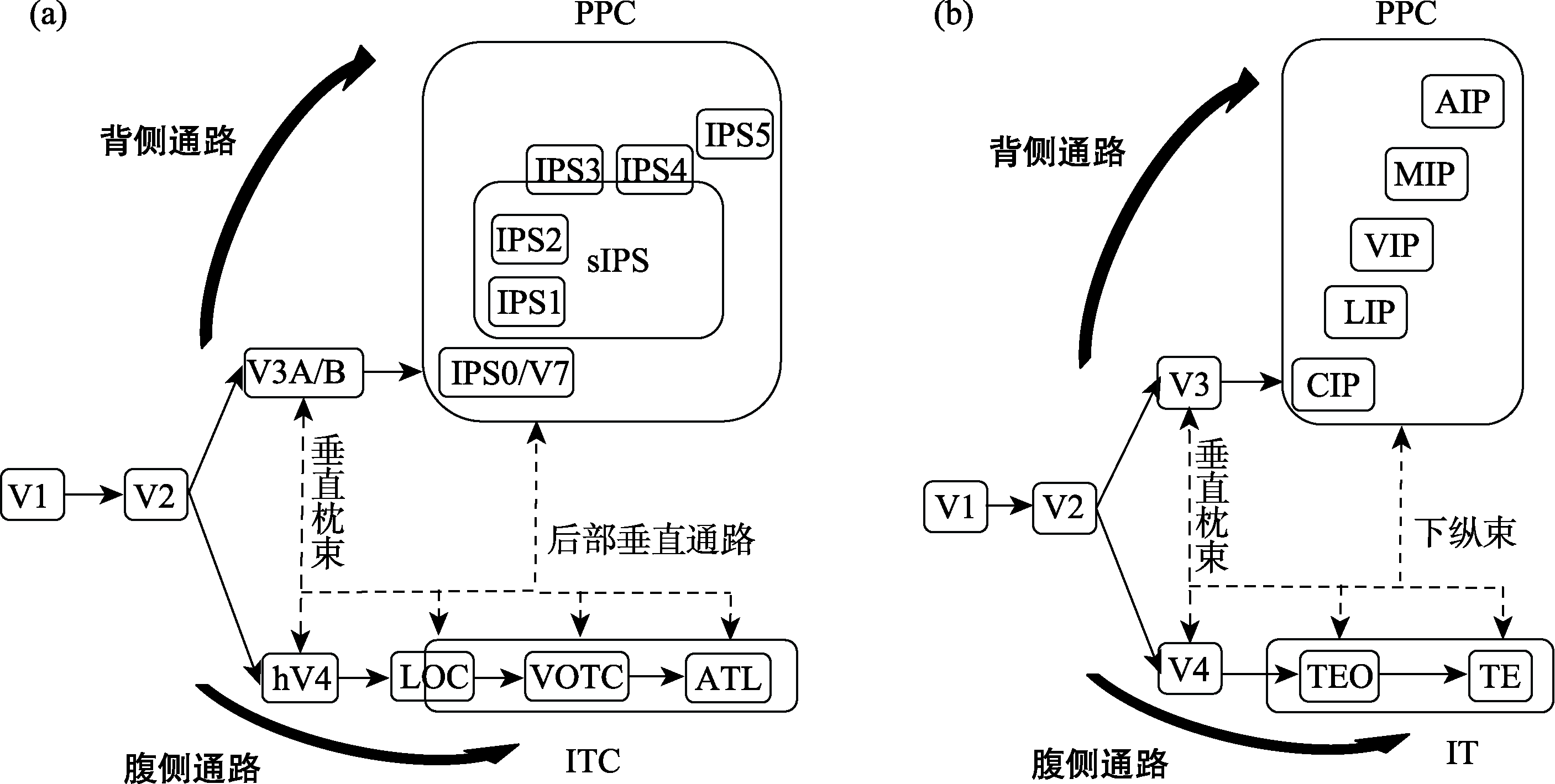
图1 (a)人脑的背-腹通路; (b)猴脑的背-腹通路。
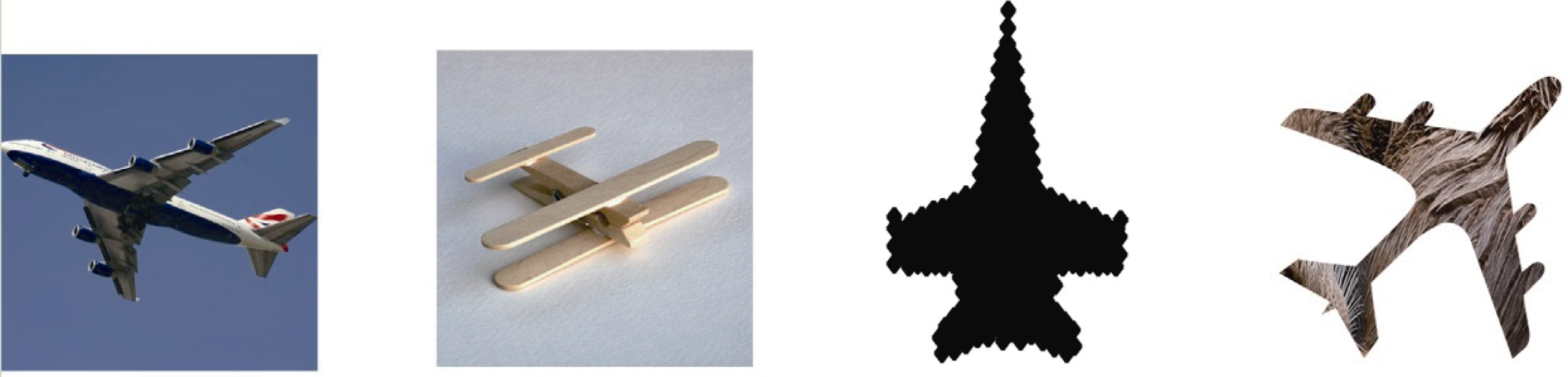
图2 具有相同整体形状的飞机。尽管这四架飞机具有完全不同的局部特征,但它们的空间排列相同,这使得我们可以产生相同的整体形状感知,且都将其识别为飞机。资料来源:Ayzenberg & Behrmann, 2022a。
| [1] |
Ai, H., Cui, Y., & Chen, N. (2023). A “Bandwidth” in cortical representations of multiple faces. Cerebral Cortex, 33(18), 10028-10035.
doi: 10.1093/cercor/bhad262 URL |
| [2] |
Alizadeh, A.-M., Van Dromme, I., Verhoef, B.-E., & Janssen, P. (2018). Caudal intraparietal sulcus and three-dimensional vision: A combined functional magnetic resonance imaging and single-cell study. Neuroimage, 166, 46-59.
doi: 10.1016/j.neuroimage.2017.10.045 URL |
| [3] |
Arsenovic, A., Ischebeck, A., & Zaretskaya, N. (2022). Dissociation between attention-dependent and spatially specific illusory shape responses within the topographic areas of the posterior parietal cortex. Journal of Neuroscience, 42(43), 8125-8135.
doi: 10.1523/JNEUROSCI.0723-22.2022 pmid: 36150890 |
| [4] |
Ayzenberg, V., & Behrmann, M. (2022a). Does the brain's ventral visual pathway compute object shape? Trends in Cognitive Sciences, 26(12), 1119-1132.
doi: 10.1016/j.tics.2022.09.019 URL |
| [5] |
Ayzenberg, V., & Behrmann, M. (2022b). The dorsal visual pathway represents object-centered spatial relations for object recognition. The Journal of Neuroscience, 42(23), 4693-4710.
doi: 10.1523/JNEUROSCI.2257-21.2022 URL |
| [6] |
Ayzenberg, V., & Behrmann, M. (2023a). An expanded neural framework for shape perception. Trends in Cognitive Sciences, 27(3), 212-213.
doi: 10.1016/j.tics.2022.12.001 URL |
| [7] |
Ayzenberg, V., & Behrmann, M. (2023b). The where, what, and how of object recognition. Trends in Cognitive Sciences, 27(4), 335-336.
doi: 10.1016/j.tics.2023.01.006 URL |
| [8] |
Ayzenberg, V., & Behrmann, M. (2024). Development of visual object recognition. Nature Reviews Psychology, 3(2), 73-90.
doi: 10.1038/s44159-023-00266-w |
| [9] | Ayzenberg, V., Blauch, N. M., & Behrmann, M. (2023). Using deep neural networks to address the how of object recognition. PsyArXiv. https://osf.io/preprints/psyarxiv/6gjvp_v1 |
| [10] | Ayzenberg, V., Chen, Y., Yousif, S. R., & Lourenco, S. F. (2019). Skeletal representations of shape in human vision: Evidence for a pruned medial axis model. Journal of Vision, 19(6), 1-21. |
| [11] |
Ayzenberg, V., Kamps, F. S., Dilks, D. D., & Lourenco, S. F. (2022). Skeletal representations of shape in the human visual cortex. Neuropsychologia, 164, 108092.
doi: 10.1016/j.neuropsychologia.2021.108092 URL |
| [12] | Ayzenberg, V., & Lourenco, S. (2022). Perception of an object’s global shape is best described by a model of skeletal structure in human infants. Elife, 11, e74943. |
| [13] | Ayzenberg, V., & Lourenco, S. F. (2019). Skeletal descriptions of shape provide unique perceptual information for object recognition. Scientific Reports, 9(1), 9359. |
| [14] | Ayzenberg, V., Simmons, C., & Behrmann, M. (2023). Temporal asymmetries and interactions between dorsal and ventral visual pathways during object recognition. Cerebral Cortex Communications, 4(1), 1-12. |
| [15] |
Baker, N., Garrigan, P., Phillips, A., & Kellman, P. J. (2023). Configural relations in humans and deep convolutional neural networks. Frontiers in Artificial Intelligence, 5, 961595.
doi: 10.3389/frai.2022.961595 URL |
| [16] | Baker, N., Lu, H., Erlikhman, G., & Kellman, P. J. (2018). Deep convolutional networks do not classify based on global object shape. PLOS Computational Biology, 14(12), e1006613. |
| [17] |
Berryhill, M. E., & Olson, I. R. (2008). The right parietal lobe is critical for visual working memory. Neuropsychologia, 46(7), 1767-1774.
doi: 10.1016/j.neuropsychologia.2008.01.009 pmid: 18308348 |
| [18] |
Bettencourt, K. C., & Xu, Y. (2016a). Decoding the content of visual short-term memory under distraction in occipital and parietal areas. Nature Neuroscience, 19(1), 150-157.
doi: 10.1038/nn.4174 |
| [19] |
Bettencourt, K. C., & Xu, Y. (2016b). Understanding location- and feature-based processing along the human intraparietal sulcus. Journal of Neurophysiology, 116(3), 1488-1497.
doi: 10.1152/jn.00404.2016 URL |
| [20] |
Borra, E., & Luppino, G. (2017). Functional anatomy of the macaque temporo-parieto-frontal connectivity. Cortex, 97, 306-326.
doi: S0010-9452(16)30351-3 pmid: 28041615 |
| [21] | Bracci, S., Daniels, N., & Op de Beeck, H. (2017). Task context overrules object-and category-related representational content in the human parietal cortex. Cerebral Cortex, 27(1), 310-321. |
| [22] | Brown, T. I., Rissman, J., Chow, T. E., Uncapher, M. R., & Wagner, A. D. (2018). Differential medial temporal lobe and parietal cortical contributions to real-world autobiographical episodic and autobiographical semantic memory. Scientific Reports, 8(1), 6190. |
| [23] |
Budisavljevic, S., Dell'Acqua, F., & Castiello, U. (2018). Cross-talk connections underlying dorsal and ventral stream integration during hand actions. Cortex, 103, 224-239.
doi: S0010-9452(18)30069-8 pmid: 29660652 |
| [24] |
Bullock, D., Takemura, H., Caiafa, C. F., Kitchell, L., McPherson, B., Caron, B., & Pestilli, F. (2019). Associative white matter connecting the dorsal and ventral posterior human cortex. Brain Structure Function, 224(8), 2631-2660.
doi: 10.1007/s00429-019-01907-8 |
| [25] |
Chen, J., Snow, J. C., Culham, J. C., & Goodale, M. A. (2018). What role does “Elongation” play in “Tool-Specific” activation and connectivity in the dorsal and ventral visual streams? Cerebral Cortex, 28(4), 1117-1131.
doi: 10.1093/cercor/bhx017 URL |
| [26] |
Christophel, T. B., Iamshchinina, P., Yan, C., Allefeld, C., & Haynes, J.-D. (2018). Cortical specialization for attended versus unattended working memory. Nature Neuroscience, 21(4), 494-496.
doi: 10.1038/s41593-018-0094-4 pmid: 29507410 |
| [27] |
Ciesielski, K. T. R., Stern, M. E., Diamond, A., Khan, S., Busa, E. A., Goldsmith, T. E.,... Rosen, B. R. (2019). Maturational changes in human dorsal and ventral visual networks. Cerebral Cortex, 29(12), 5131-5149.
doi: 10.1093/cercor/bhz053 |
| [28] |
Collins, E., Freud, E., Kainerstorfer, J. M., Cao, J., & Behrmann, M. (2019). Temporal dynamics of shape processing differentiate contributions of dorsal and ventral visual pathways. Journal of Cognitive Neuroscience, 31(6), 821-836.
doi: 10.1162/jocn_a_01391 pmid: 30883289 |
| [29] |
Conci, M., Töllner, T., Leszczynski, M., & Müller, H. J. (2011). The time-course of global and local attentional guidance in Kanizsa-figure detection. Neuropsychologia, 49(9), 2456-2464.
doi: 10.1016/j.neuropsychologia.2011.04.023 pmid: 21549722 |
| [30] |
Destler, N., Singh, M., & Feldman, J. (2019). Shape discrimination along morph-spaces. Vision Research, 158, 189-199.
doi: S0042-6989(19)30067-7 pmid: 30878276 |
| [31] |
Doerig, A., Sommers, R. P., Seeliger, K., Richards, B., Ismael, J., Lindsay, G. W.,... Kietzmann, T. C. (2023). The neuroconnectionist research programme. Nature Reviews Neuroscience, 24, 431-450.
doi: 10.1038/s41583-023-00705-w |
| [32] |
Felleman, D. J., Burkhalter, A., & Van Essen, D. C. (1997). Cortical connections of areas V3 and VP of macaque monkey extrastriate visual cortex. Journal of Comparative Neurology, 379(1), 21-47.
pmid: 9057111 |
| [33] |
Fitzgerald, J. K., Freedman, D. J., & Assa, J. A. (2011). Generalized associative representations in parietal cortex. Nature Neuroscience, 14(8), 1075-1079.
doi: 10.1038/nn.2878 pmid: 21765425 |
| [34] |
Freedman, D. J., & Ibos, G. (2018). An integrative framework for sensory, motor, and cognitive functions of the posterior parietal cortex. Neuron, 97(6), 1219-1234.
doi: S0896-6273(18)30069-2 pmid: 29566792 |
| [35] |
Freud, E., & Behrmann, M. (2020). Altered large-scale organization of shape processing in visual agnosia. Cortex, 129, 423-435.
doi: S0010-9452(20)30198-2 pmid: 32574843 |
| [36] |
Freud, E., Behrmann, M., & Snow, J. C. (2020). What does dorsal cortex contribute to perception? Open Mind, 4, 40-56.
doi: 10.1162/opmi_a_00033 URL |
| [37] | Freud, E., Culham, J. C., Plaut, D. C., & Behrmann, M. (2017). The large-scale organization of shape processing in the ventral and dorsal pathways. Elife, 6, e27576. |
| [38] |
Freud, E., Ganel, T., Shelef, I., Hammer, M. D., Avidan, G., & Behrmann, M. (2017). Three-dimensional representations of objects in dorsal cortex are dissociable from those in ventral cortex. Cerebral Cortex, 27(1), 422-434.
doi: 10.1093/cercor/bhv229 URL |
| [39] |
Freud, E., Plaut, D. C., & Behrmann, M. (2016). ‘What’ is happening in the dorsal visual pathway. Trends in Cognitive Sciences, 20(10), 773-784.
doi: S1364-6613(16)30120-6 pmid: 27615805 |
| [40] |
Garcea, F. E., Chen, Q., Vargas, R., Narayan, D. A., & Mahon, B. Z. (2018). Task- and domain-specific modulation of functional connectivity in the ventral and dorsal object-processing pathways. Brain Structure and Function, 223(6), 2589-2607.
doi: 10.1007/s00429-018-1641-1 |
| [41] |
Gillebert, C. R., Mantini, D., Thijs, V., Sunaert, S., Dupont, P., & Vandenberghe, R. (2011). Lesion evidence for the critical role of the intraparietal sulcus in spatial attention. Brain, 134(6), 1694-1709.
doi: 10.1093/brain/awr085 URL |
| [42] | Goldstein-Marcusohn, Y., Asaad, R., Asaad, L., & Freud, E. (2024). The large-scale organization of shape processing in the ventral and dorsal pathways is dissociable from attention. Cerebral Cortex, 34(6), bhae221. |
| [43] |
Goodale, M. A., Jakobson, L. S., Milner, A. D., Perrett, D. I., Benson, P. J., & Hietanen, J. K. (1994). The nature and limits of orientation and pattern processing supporting visuomotor control in a visual form agnosic. Journal of Cognitive Neuroscience, 6(1), 46-56.
doi: 10.1162/jocn.1994.6.1.46 pmid: 23962329 |
| [44] |
Goodale, M. A., Meenan, J. P., Bülthoff, H. H., Nicolle, D. A., Murphy, K. J., & Racicot, C. I. (1994). Separate neural pathways for the visual analysis of object shape in perception and prehension. Current Biology, 4(7), 604-610.
pmid: 7953534 |
| [45] |
Goodale, M. A., & Milner, A. D. (2023). Shape perception does not require dorsal stream processing. Trends in Cognitive Sciences, 27(4), 333-334.
doi: 10.1016/j.tics.2022.12.007 pmid: 36801161 |
| [46] |
Grill-Spector, K., Kushnir, T., Edelman, S., Avidan, G., Itzchak, Y., & Malach, R. (1999). Differential processing of objects under various viewing conditions in the human lateral occipital complex. Neuron, 24(1), 187-203.
doi: 10.1016/s0896-6273(00)80832-6 pmid: 10677037 |
| [47] | Grüner, M., Goller, F., & Ansorge, U. (2021). Simple shapes guide visual attention based on their global outline or global orientation contingent on search goals. Journal of Experimental Psychology: Human Perception and Performance, 47(11), 1493. |
| [48] | Guo, C., Lee, M., Leclerc, G., Dapello, J., Rao, Y., Madry, A., & Dicarlo, J. (2022). Adversarially trained neural representations are already as robust as biological neural representations. International Conference on Machine Learning, 162, 8072-8081. |
| [49] |
Hammarrenger, B., Leporé, F., Lippé, S., Labrosse, M., Guillemot, J.-P., & Roy, M.-S. (2003). Magnocellular and parvocellular developmental course in infants during the first year of life. Documenta Ophthalmologica, 107(3), 225-233.
pmid: 14711154 |
| [50] |
Holzinger, Y., Ullman, S., Harari, D., Behrmann, M., & Avidan, G. (2019). Minimal recognizable configurations elicit category-selective responses in higher order visual cortex. Journal of Cognitive Neuroscience, 31(9), 1354-1367.
doi: 10.1162/jocn_a_01420 pmid: 31059350 |
| [51] |
Humphreys, G. F., Jackson, R. L., & Lambon Ralph, M. A. (2020). Overarching principles and dimensions of the functional organization in the inferior parietal cortex. Cerebral Cortex, 30(11), 5639-5653.
doi: 10.1093/cercor/bhaa133 URL |
| [52] |
Humphreys, G. F., Jung, J., & Lambon Ralph, M. A. (2022). The convergence and divergence of episodic and semantic functions across lateral parietal cortex. Cerebral Cortex, 32(24), 5664-5681.
doi: 10.1093/cercor/bhac044 URL |
| [53] |
Humphreys, G. F., Ralph, M. A. L., & Simons, J. S. (2021). A unifying account of angular gyrus contributions to episodic and semantic cognition. Trends in Neurosciences, 44(6), 452-463.
doi: 10.1016/j.tins.2021.01.006 pmid: 33612312 |
| [54] |
Ibos, G., & Freedman, D. J. (2016). Interaction between spatial and feature attention in posterior parietal cortex. Neuron, 91(4), 931-943.
doi: S0896-6273(16)30410-X pmid: 27499082 |
| [55] | Jagadeesh, A. V., & Gardner, J. L. (2022). Texture-like representation of objects in human visual cortex. Proceedings of the National Academy of Sciences, 119(17), e2115302119. |
| [56] |
Janssen, P., Srivastava, S., Ombelet, S., & Orban, G. A. (2008). Coding of shape and position in macaque lateral intraparietal area. Journal of Neuroscience, 28(26), 6679-6690.
doi: 10.1523/JNEUROSCI.0499-08.2008 pmid: 18579742 |
| [57] |
Jarvers, C., & Neumann, H. (2023). Shape-selective processing in deep networks: Integrating the evidence on perceptual integration. Frontiers in Computer Science, 5, 1113609.
doi: 10.3389/fcomp.2023.1113609 URL |
| [58] | Jitsuishi, T., & Yamaguchi, A. (2020). Identification of a distinct association fiber tract “IPS-FG” to connect the intraparietal sulcus areas and fusiform gyrus by white matter dissection and tractography. Scientific Reports, 10(1), 15475. |
| [59] |
Kastner, S., Chen, Q., Jeong, S. K., & Mruczek, R. E. B. (2017). A brief comparative review of primate posterior parietal cortex: A novel hypothesis on the human toolmaker. Neuropsychologia, 105, 123-134.
doi: S0028-3932(17)30038-6 pmid: 28159617 |
| [60] |
Katsuki, F., & Constantinidis, C. (2014). Bottom-up and top-down attention: Different processes and overlapping neural systems. The Neuroscientist, 20(5), 509-521.
doi: 10.1177/1073858413514136 URL |
| [61] |
Klaver, P., Lichtensteiger, J., Bucher, K., Dietrich, T., Loenneker, T., & Martin, E. (2008). Dorsal stream development in motion and structure-from-motion perception. Neuroimage, 39(4), 1815-1823.
pmid: 18096410 |
| [62] |
Kleineberg, N. N., Dovern, A., Binder, E., Grefkes, C., Eickhoff, S. B., Fink, G. R., & Weiss, P. H. (2018). Action and semantic tool knowledge - Effective connectivity in the underlying neural networks. Human Brain Mapping, 39(9), 3473-3486.
doi: 10.1002/hbm.24188 pmid: 29700893 |
| [63] |
Konen, C. S., & Kastner, S. (2008). Two hierarchically organized neural systems for object information in human visual cortex. Nature Neuroscience, 11(2), 224-231.
doi: 10.1038/nn2036 pmid: 18193041 |
| [64] |
Kravitz, D. J., Saleem, K. S., Baker, C. I., Ungerleider, L. G., & Mishkin, M. (2013). The ventral visual pathway: an expanded neural framework for the processing of object quality. Trends in Cognitive Sciences, 17(1), 26-49.
doi: 10.1016/j.tics.2012.10.011 pmid: 23265839 |
| [65] |
Kuhnke, P., Chapman, C. A., Cheung, V. K. M., Turker, S., Graessner, A., Martin, S.,... Hartwigsen, G. (2023). The role of the angular gyrus in semantic cognition: A synthesis of five functional neuroimaging studies. Brain Structure Function, 228(1), 273-291.
doi: 10.1007/s00429-022-02493-y |
| [66] | Lawrence, S. J. D., Norris, D. G., & De Lange, F. P. (2019). Dissociable laminar profiles of concurrent bottom-up and top-down modulation in the human visual cortex. eLife, 8, e44422. |
| [67] |
Lefco, R. W., Brissenden, J. A., Noyce, A. L., Tobyne, S. M., & Somers, D. C. (2020). Gradients of functional organization in posterior parietal cortex revealed by visual attention, visual short-term memory, and intrinsic functional connectivity. Neuroimage, 219, 117029.
doi: 10.1016/j.neuroimage.2020.117029 URL |
| [68] |
Lerner, Y., Hendler, T., & Malach, R. (2002). Object-completion effects in the human lateral occipital complex. Cerebral Cortex, 12(2), 163-177.
doi: 10.1093/cercor/12.2.163 pmid: 11739264 |
| [69] |
Lescroart, M. D., & Biederman, I. (2013). Cortical representation of medial axis structure. Cerebral Cortex, 23(3), 629-637.
doi: 10.1093/cercor/bhs046 URL |
| [70] |
Lima, B., Florentino, M. M., Fiorani, M., Soares, J. G. M., Schmidt, K. E., Neuenschwander, S.,... Gattass, R. (2023). Cortical maps as a fundamental neural substrate for visual representation. Progress in Neurobiology, 224, 102424.
doi: 10.1016/j.pneurobio.2023.102424 URL |
| [71] | Liu, L., Wang, F., Zhou, K., Ding, N., & Luo, H. (2017). Perceptual integration rapidly activates dorsal visual pathway to guide local processing in early visual areas. PLOS Biology, 15(11), e2003646. |
| [72] | Long, B., Yu, C.-P., & Konkle, T. (2018). Mid-level visual features underlie the high-level categorical organization of the ventral stream. Proceedings of the National Academy of Sciences, 115(38), E9015-E9024. |
| [73] |
Long, N. M., & Kuhl, B. A. (2018). Bottom-up and top-down factors differentially influence stimulus representations across large-scale attentional networks. Journal of Neuroscience, 38(10), 2495-2504.
doi: 10.1523/JNEUROSCI.2724-17.2018 pmid: 29437930 |
| [74] | Mahon, B., Z. (2023). Higher order visual object representations:A functional analysis of their role in perception and action. In G. G. Brown, B. Crosson, K. Y. Haaland, & T. Z. King (Eds.), APA handbook of neuropsychology, Volume 2: Neuroscience and neuromethods. (pp. 113-138): American Psychological Association. |
| [75] | Maurer,, D., & Lewis, T. L. (2018). Visual systems. In R. Gibb & B. Kolb (Eds.), The neurobiology of brain and behavioral development (pp. 213-233). London: Academic Press. |
| [76] |
Medina, J., Jax, S. A., & Coslett, H. B. (2020). Impairments in action and perception after right intraparietal damage. Cortex, 122, 288-299.
doi: S0010-9452(19)30055-3 pmid: 30879643 |
| [77] |
Milner, A. D. (2017). How do the two visual streams interact with each other? Experimental Brain Research, 235(5), 1297-1308.
doi: 10.1007/s00221-017-4917-4 pmid: 28255843 |
| [78] | Milner,, D., & Goodale, M. A. (2006). Disorders of spatial perception and the visual control of action. In D. Milner & M. A. Goodale (Eds.), The visual brain in action (2nd ed., pp. 87-120). Oxford: Oxford University Press. |
| [79] | Natu, V. S., Rosenke, M., Wu, H., Querdasi, F. R., Kular, H., Lopez-Alvarez, N.,... Grill-Spector, K. (2021). Infants’ cortex undergoes microstructural growth coupled with myelination during development. Communications Biology, 4(1), 1191. |
| [80] |
Nestmann, S., Karnath, H.-O., & Rennig, J. (2022). The role of ventral stream areas for viewpoint-invariant object recognition. Neuroimage, 251, 119021.
doi: 10.1016/j.neuroimage.2022.119021 URL |
| [81] |
Nestmann, S., Wiesen, D., Karnath, H.-O., & Rennig, J. (2021). Temporo-parietal brain regions are involved in higher order object perception. Neuroimage, 234, 117982.
doi: 10.1016/j.neuroimage.2021.117982 URL |
| [82] |
Oğlin, V., Orhun, Ö., Quiñones-Hinojosa, A., Middlebrooks, E. H., Çevik, O. M., Usseli, M. İ.,... Bozkurt, B. (2024). Topographic anatomy of the lateral surface of the parietal lobe and its relationship with white matter tracts. Frontiers in Neuroanatomy, 18, 1458989.
doi: 10.3389/fnana.2024.1458989 URL |
| [83] |
Olmos-Solis, K., van Loon, A. M., & Olivers, C. N. L. (2021). Content or status: Frontal and posterior cortical representations of object category and upcoming task goals in working memory. Cortex, 135, 61-77.
doi: 10.1016/j.cortex.2020.11.011 pmid: 33360761 |
| [84] |
Rademaker, R. L., Chunharas, C., & Serences, J. T. (2019). Coexisting representations of sensory and mnemonic information in human visual cortex. Nature Neuroscience, 22(8), 1336-1344.
doi: 10.1038/s41593-019-0428-x pmid: 31263205 |
| [85] |
Ramanan, S., Piguet, O., & Irish, M. (2018). Rethinking the role of the angular gyrus in remembering the past and imagining the future: The contextual integration model. The Neuroscientist, 24(4), 342-352.
doi: 10.1177/1073858417735514 URL |
| [86] |
Regev, T. I., Winawer, J., Gerber, E. M., Knight, R. T., & Deouell, L. Y. (2018). Human posterior parietal cortex responds to visual stimuli as early as peristriate occipital cortex. European Journal of Neuroscience, 48(12), 3567-3582.
doi: 10.1111/ejn.14164 pmid: 30240547 |
| [87] |
Reynolds, G. D. (2015). Infant visual attention and object recognition. Behavioural Brain Research, 285, 34-43.
doi: 10.1016/j.bbr.2015.01.015 pmid: 25596333 |
| [88] | Rezanejad, M., Downs, G., Wilder, J., Walther, D. B., Jepson, A., Dickinson, S., & Siddiqi, K. (2019, June 16-20). Scene categorization from contours: Medial axis based salience measures [Paper presentation]. IEEE/CVF Conference on Computer Vision and Pattern Recognition, Long Beach, California, United States. |
| [89] |
Riddle, J., Hwang, K., Cellier, D., Dhanani, S., & D'Esposito, M. (2019). Causal evidence for the role of neuronal oscillations in top-down and bottom-up attention. Journal of Cognitive Neuroscience, 31(5), 768-779.
doi: 10.1162/jocn_a_01376 pmid: 30726180 |
| [90] |
Riddoch, M. J., Humphreys, G. W., Akhtar, N., Allen, H., Bracewell, R. M., & Schofield, A. J. (2008). A tale of two agnosias: Distinctions between form and integrative agnosia. Cognitive Neuropsychology, 25(1), 56-92.
doi: 10.1080/02643290701848901 pmid: 18340604 |
| [91] |
Ritz, H., & Shenhav, A. (2024). Orthogonal neural encoding of targets and distractors supports multivariate cognitive control. Nature Human Behaviour, 8(5), 945-961.
doi: 10.1038/s41562-024-01826-7 pmid: 38459265 |
| [92] | Roumazeilles, L., Eichert, N., Bryant, K. L., Folloni, D., Sallet, J., Vijayakumar, S.,... Mars, R. B. (2020). Longitudinal connections and the organization of the temporal cortex in macaques, great apes, and humans. PLOS Biology, 18(7), e3000810. |
| [93] |
Schneider, D., Beste, C., & Wascher, E. (2012). On the time course of bottom-up and top-down processes in selective visual attention: An EEG study. Psychophysiology, 49(11), 1660-1671.
doi: 10.1111/psyp.2012.49.issue-11 URL |
| [94] | Seideman, J. A., Stanford, T. R., & Salinas, E. (2022). A conflict between spatial selection and evidence accumulation in area LIP. Nature Communications, 13(1), 4463. |
| [95] |
Sereno, A. B., & Maunsell, J. H. R. (1998). Shape selectivity in primate lateral intraparietal cortex. Nature, 395(6701), 500-503.
doi: 10.1038/26752 |
| [96] |
Sestieri, C., Shulman, G. L., & Corbetta, M. (2017). The contribution of the human posterior parietal cortex to episodic memory. Nature Reviews Neuroscience, 18(3), 183-192.
doi: 10.1038/nrn.2017.6 pmid: 28209980 |
| [97] |
Sheremata, S. L., Somers, D. C., & Shomstein, S. (2018). Visual short-term memory activity in parietal lobe reflects cognitive processes beyond attentional selection. Journal of Neuroscience, 38(6), 1511-1519.
doi: 10.1523/JNEUROSCI.1716-17.2017 pmid: 29311140 |
| [98] |
Srihasam, K., Vincent, J. L., & Livingstone, M. S. (2014). Novel domain formation reveals proto-architecture in inferotemporal cortex. Nature Neuroscience, 17(12), 1776-1783.
doi: 10.1038/nn.3855 pmid: 25362472 |
| [99] | Stiles,, J., Akshoomoff, N. A., & Haist, F. (2020). The development of visuospatial processing. In J. Rubenstein & P. Rakic (Eds.), Neural circuit and cognitive development: Comprehensive Developmental Neuroscience (2nd ed., pp. 359-393). Cambridge, MA: Academic Press. |
| [100] |
Takemura, H., Kaneko, T., Sherwood, C. C., Johnson, G. A., Axer, M., Hecht, E. E.,... Leopold, D. A. (2024). A prominent vertical occipital white matter fasciculus unique to primate brains. Current Biology, 34(16), 3632-3643.
doi: 10.1016/j.cub.2024.06.034 URL |
| [101] |
Takemura, H., Pestilli, F., & Weiner, K. S. (2019). Comparative neuroanatomy: Integrating classic and modern methods to understand association fibers connecting dorsal and ventral visual cortex. Neuroscience Research, 146, 1-12.
doi: S0168-0102(18)30324-9 pmid: 30389574 |
| [102] |
Taylor, J. M., & Xu, Y. (2022). Identifying the neural loci mediating conscious object orientation perception using fMRI MVPA. Cognitive Neuropsychology, 39(1-2), 64-67.
doi: 10.1080/02643294.2022.2040973 URL |
| [103] |
Taylor, J. M., & Xu, Y. (2024). Using fMRI to examine nonlinear mixed selectivity tuning to task and category in the human brain. Imaging Neuroscience, 2, 1-21.
doi: 10.1162/imag_a_00344 URL |
| [104] | Theys, T., Romero, M. C., van Loon, J., & Janssen, P. (2015). Shape representations in the primate dorsal visual stream. Frontiers in Computational Neuroscience, 9(43), 1-9. |
| [105] |
Theys, T., Srivastava, S., van Loon, J., Goffin, J., & Janssen, P. (2012). Selectivity for three-dimensional contours and surfaces in the anterior intraparietal area. Journal of Neurophysiology, 107(3), 995-1008.
doi: 10.1152/jn.00248.2011 pmid: 22090458 |
| [106] |
Thomas, C., Kveraga, K., Huberle, E., Karnath, H.-O., & Bar, M. (2012). Enabling global processing in simultanagnosia by psychophysical biasing of visual pathways. Brain, 135(5), 1578-1585.
doi: 10.1093/brain/aws066 URL |
| [107] |
Tseng, P., Hsu, T.-Y., Muggleton, N. G., Tzeng, O., J. L., Hung, D. L., & Juan, C.-H. (2010). Posterior parietal cortex mediates encoding and maintenance processes in change blindness. Neuropsychologia, 48(4), 1063-1070.
doi: 10.1016/j.neuropsychologia.2009.12.005 pmid: 20005882 |
| [108] |
Ullman, S., Assif, L., Fetaya, E., & Harari, D. (2016). Atoms of recognition in human and computer vision. Proceedings of the National Academy of Sciences, 113(10), 2744-2749.
doi: 10.1073/pnas.1513198113 URL |
| [109] | van Loon, A. M., Olmos-Solis, K., Fahrenfort, J. J., & Olivers, C. N. L. (2018). Current and future goals are represented in opposite patterns in object-selective cortex. Elife, 7, e38677. |
| [110] |
Vaziri-Pashkam, M., Taylor, J. S. H., & Xu, Y. (2019). Spatial frequency tolerant visual object representations in the human ventral and dorsal visual processing pathways. Journal of Cognitive Neuroscience, 31(1), 49-63.
doi: 10.1162/jocn_a_01335 pmid: 30188780 |
| [111] |
Vaziri-Pashkam, M., & Xu, Y. (2017). Goal-directed visual processing differentially impacts human ventral and dorsal visual representations. Journal of Neuroscience, 37(36), 8767-8782.
doi: 10.1523/JNEUROSCI.3392-16.2017 pmid: 28821655 |
| [112] |
Vaziri-Pashkam, M., & Xu, Y. (2019). An information-driven 2-pathway characterization of occipitotemporal and posterior parietal visual object representations. Cerebral Cortex, 29(5), 2034-2050.
doi: 10.1093/cercor/bhy080 |
| [113] |
Vinci-Booher, S., Caron, B., Bullock, D., James, K., & Pestilli, F. (2022). Development of white matter tracts between and within the dorsal and ventral streams. Brain Structure and Function, 227(4), 1457-1477.
doi: 10.1007/s00429-021-02414-5 |
| [114] |
Wang, R., Janini, D., & Konkle, T. (2022). Mid-level feature differences support early animacy and object size distinctions: Evidence from electroencephalography decoding. Journal of Cognitive Neuroscience, 34(9), 1670-1680.
doi: 10.1162/jocn_a_01883 pmid: 35704550 |
| [115] |
Wang, W., Zhou, T., Chen, L., & Huang, Y. (2023). A subcortical magnocellular pathway is responsible for the fast processing of topological properties of objects: A transcranial magnetic stimulation study. Human Brain Mapping, 44(4), 1617-1628.
doi: 10.1002/hbm.v44.4 URL |
| [116] |
Wilder, J., Rezanejad, M., Dickinson, S., Siddiqi, K., Jepson, A., & Walther, D. B. (2019). Local contour symmetry facilitates scene categorization. Cognition, 182, 307-317.
doi: S0010-0277(18)30250-6 pmid: 30415132 |
| [117] |
Wurm, M. F., & Caramazza, A. (2022). Two ‘what’pathways for action and object recognition. Trends in Cognitive Sciences, 26(2), 103-116.
doi: 10.1016/j.tics.2021.10.003 URL |
| [118] |
Xu, Y. (2010). The neural fate of task-irrelevant features in object-based processing. Journal of Neuroscience, 30(42), 14020-14028.
doi: 10.1523/JNEUROSCI.3011-10.2010 pmid: 20962223 |
| [119] |
Xu, Y. (2018a). The posterior parietal cortex in adaptive visual processing. Trends in Neurosciences, 41(11), 806-822.
doi: 10.1016/j.tins.2018.07.012 URL |
| [120] |
Xu, Y. (2018b). A tale of two visual systems: Invariant and adaptive visual information representations in the primate brain. Annual Review of Vision Science, 4(1), 311-336.
doi: 10.1146/vision.2018.4.issue-1 URL |
| [121] |
Xu, Y. (2020). Revisit once more the sensory storage account of visual working memory. Visual Cognition, 28(5-8), 433-446.
doi: 10.1080/13506285.2020.1818659 pmid: 33841024 |
| [122] |
Xu, Y. (2023a). Global object shape representations in the primate brain. Trends in Cognitive Sciences, 27(3), 210-211.
doi: 10.1016/j.tics.2022.11.004 URL |
| [123] |
Xu, Y. (2023b). Parietal-driven visual working memory representation in occipito-temporal cortex. Current Biology, 33(20), 4516-4523.
doi: 10.1016/j.cub.2023.08.080 URL |
| [124] | Xu, Y. (2024). The human posterior parietal cortices orthogonalize the representation of different streams of information concurrently coded in visual working memory. PLOS Biology, 22(11), e3002915. |
| [125] | Xu,, Y., & Jeong, S. K. (2015). The contribution of human superior intraparietal sulcus to visual short-term memory and perception. In P. Jolicoeur, C. Lefebvre, & J. Martinez-Trujillo (Eds.), Mechanisms of sensory working memory: attention performance XXV (pp. 33-42). New York: Academic Press. |
| [126] |
Xu, Y., & Vaziri-Pashkam, M. (2022). Understanding transformation tolerant visual object representations in the human brain and convolutional neural networks. Neuroimage, 263, 119635.
doi: 10.1016/j.neuroimage.2022.119635 URL |
| [127] | Yang, H., He, C., Han, Z., & Bi, Y. (2020). Domain-specific functional coupling between dorsal and ventral systems during action perception. Scientific Reports, 10(1), 21200. |
| [128] |
Yu, Q., & Shim, W. M. (2017). Occipital, parietal, and frontal cortices selectively maintain task-relevant features of multi-feature objects in visual working memory. Neuroimage, 157, 97-107.
doi: S1053-8119(17)30454-8 pmid: 28559190 |
| [129] | Zachariou, V., Nikas, C. V., Safiullah, Z. N., Gotts, S. J., & Ungerleider, L. G. (2017). Spatial mechanisms within the dorsal visual pathway contribute to the configural processing of faces. Cerebral Cortex, 27(8), 4124-4138. |
| [130] | Zador, A. M. (2019). A critique of pure learning and what artificial neural networks can learn from animal brains. Nature Communications, 10(1), 3770. |
| [1] | 游贝贝, 顾怀飞, 文宏伟. 认知功能和中央执行网络对疼痛心理韧性的作用和预测机制[J]. 心理科学进展, 2026, 34(4): 583-596. |
| [2] | 陈曦梅, 李为, 陈红. 基于奖赏−抑制双系统模型饮食失调的神经机制[J]. 心理科学进展, 2026, 34(4): 597-607. |
| [3] | 张秋霞, 陈伟海. 前额叶−海马−内侧隔核环路的theta-gamma相位幅值耦合: 跨脑区协同与工作记忆调控机制[J]. 心理科学进展, 2026, 34(3): 499-514. |
| [4] | 董耀华, 汤煜尧, 张丹丹. 经颅交流电刺激在心理学研究中的应用[J]. 心理科学进展, 2026, 34(2): 239-250. |
| [5] | 周兴攀, 刘沛菡, 吴奇, 雷怡. 体味传递情绪: 情绪体味影响情绪交流的作用机制及其生物学意义[J]. 心理科学进展, 2026, 34(2): 299-312. |
| [6] | 高可翔, 汤煜尧, 张岳瑶, 张丹丹. 内隐情绪调节的认知神经机制[J]. 心理科学进展, 2026, 34(1): 108-122. |
| [7] | 苑墨桐, 蔡雨霏, 孙宏伟, 李妍妍, 王亮. 幻觉的神经和计算机制[J]. 心理科学进展, 2025, 33(12): 2156-2167. |
| [8] | 王慧, 韩卓. 孤独症儿童社交沟通障碍的神经生理机制:基于亲子同步性的视角[J]. 心理科学进展, 2025, 33(9): 1483-1497. |
| [9] | 郭亚彤, 胡静怡, 雷旭. 高密度静息态EEG数据的开放获取:现状、挑战与展望[J]. 心理科学进展, 2025, 33(9): 1575-1591. |
| [10] | 孙路闻, 周月, 蒋重清. 群际共情偏差的脑功能网络:基于fMRI研究的元分析[J]. 心理科学进展, 2025, 33(8): 1306-1320. |
| [11] | 胡静怡, 白朵, 雷旭. 静息态EEG/MEG的非周期性成分: 分析流程、应用进展和未来前景[J]. 心理科学进展, 2025, 33(8): 1321-1339. |
| [12] | 朱霖, 李睿, 任志洪. 重大公共卫生事件中心理援助热线的挑战与应对[J]. 心理科学进展, 2025, 33(7): 1246-1256. |
| [13] | 刘佳丽, 赵海潮, 何清华. 自我中心与非自我中心空间参考系转换的神经机制[J]. 心理科学进展, 2025, 33(6): 1027-1035. |
| [14] | 雷旭, 翁琳曼, 喻婧. 清醒静息过程的记忆巩固: 来自脑电和功能磁共振的证据[J]. 心理科学进展, 2025, 33(5): 729-743. |
| [15] | 杨营凯, 夏海硕, 聂号雨. 食物抑制控制训练改变饮食行为的认知神经机制[J]. 心理科学进展, 2025, 33(5): 744-752. |
| 阅读次数 | ||||||
|
全文 |
|
|||||
|
摘要 |
|
|||||
