

ISSN 0439-755X
CN 11-1911/B
主办:中国心理学会
中国科学院心理研究所
出版:科学出版社
CN 11-1911/B
主办:中国心理学会
中国科学院心理研究所
出版:科学出版社
心理学报 ›› 2026, Vol. 58 ›› Issue (5): 827-839.doi: 10.3724/SP.J.1041.2026.0827 cstr: 32110.14.2026.0827
郭芮巧1,+, 李雯瑞2,+, 郭雪3, 赵娜4, 雷鸣5, 刘强1( )
)
收稿日期:2025-03-18
发布日期:2026-03-04
出版日期:2026-05-25
通讯作者:
刘强, E-mail: lq780614@163.com作者简介:+郭芮巧和李雯瑞为共同一作
基金资助:
GUO Ruiqiao1,+, LI Wenrui2,+, GUO Xue3, ZHAO Na4, LEI Ming5, LIU Qiang1()
Received:2025-03-18
Online:2026-03-04
Published:2026-05-25
摘要:
尽管经颅交流电刺激(transcranial Alternating Current Stimulation, tACS)可通过调节认知资源提升工作记忆(working memory, WM)表现, 但其效果在现有研究中并不一致。本研究发现, tACS刺激施加于任务的时机是决定WM调控效果的关键调节变量。通过两项严格设计的实验, 我们揭示tACS对WM调控效果受刺激与任务的时序影响:在实验1中, 相比于假刺激, 练习前施加theta频段tACS (4 Hz, 右顶叶)显著提升记忆数量且保持精度不变; 而于练习后施加刺激, 个体对任务的数量−精度权衡策略已形成, 在心理惯性的影响下该策略得以延续, 即与假刺激相比, tACS刺激选择性提高记忆精度而不改变数量。实验2进一步发现, 刺激时序对权衡策略的影响不会迁移到新任务中, 即被试在第一个任务中形成的策略在新任务中会被打破:面对新场景, 个体会根据任务特点与自身资源总量形成新的策略, 表明认知资源的灵活再分配。因此, 我们得出结论:tACS刺激对WM的调控效果取决于刺激施加的时机, 若在练习前施加, 则主要影响记忆数量; 若在练习后施加, 则主要影响记忆精度; 但已形成的调控效果不会迁移到新任务中。
中图分类号:
郭芮巧, 李雯瑞, 郭雪, 赵娜, 雷鸣, 刘强. (2026). 经颅交流电刺激的刺激时机对工作记忆调控效果的影响. 心理学报, 58(5), 827-839.
GUO Ruiqiao, LI Wenrui, GUO Xue, ZHAO Na, LEI Ming, LIU Qiang. (2026). The impact of tACS stimulation timing on the modulation of working memory. Acta Psychologica Sinica, 58(5), 827-839.

图1 实验流程图。刺激呈现时左右两边各4个色块, 色块之间颜色各不相同, 左右两边的颜色也不重复。被试只需记忆箭头指向一侧的色块。彩图见电子版, 下同。
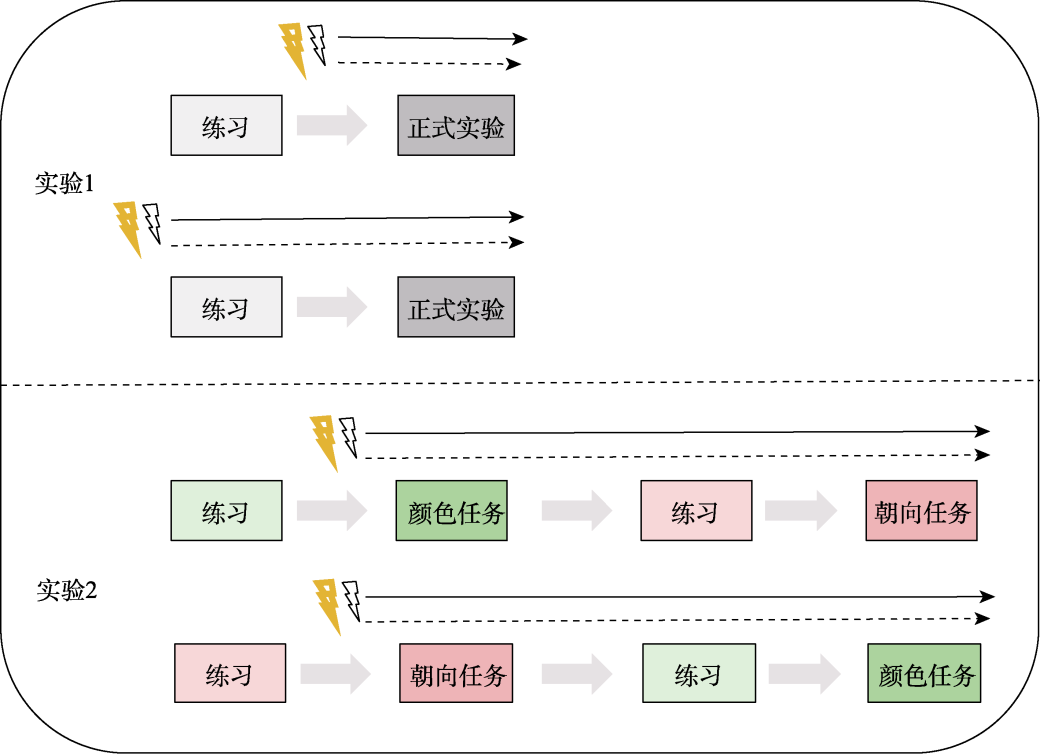
图2 实验1和实验2中tACS刺激与任务先后顺序的流程图。实验1中一半被试参加先刺激组, 一半被试参加后刺激组。每组被试都要完成真假刺激条件, 时间间隔一周。实验2中一半被试先参加颜色任务, 一半被试先参加朝向任务, 每个被试都要完成真假刺激条件, 且时间间隔一周。黄色的闪电表示真刺激, 黑色的闪电表示假刺激。实线长箭头表示真刺激的作用时间段, 虚线长箭头表示假刺激的作用时间段。
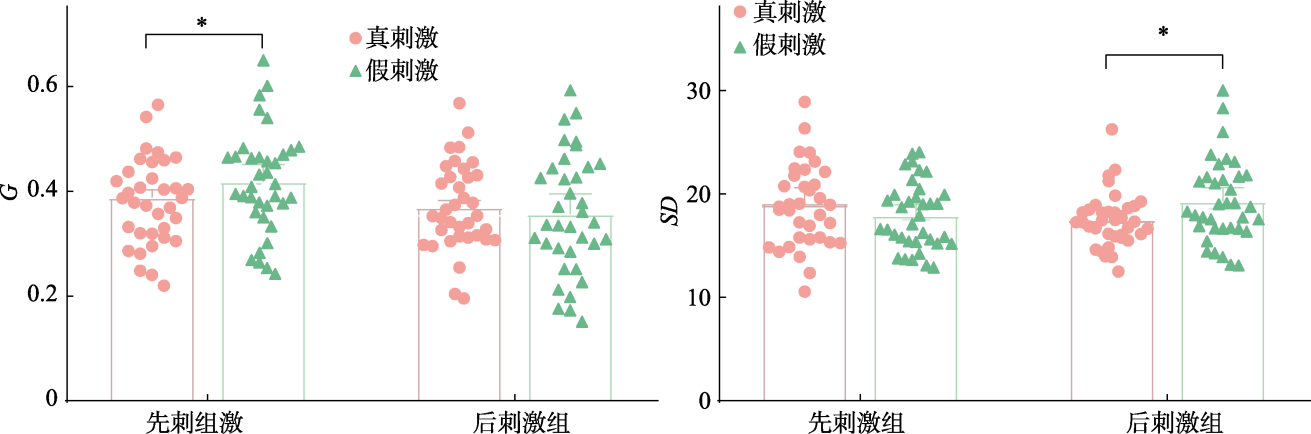
图3 左图为先刺激组和后刺激组的猜测率G结果(合并了左右视野的数据)。右图为先刺激组和后刺激组的精度SD结果。 注:更大的G值意味着较低的工作记忆数量, 更高的SD值意味着较差的工作记忆精度。在G和SD结果中, 无论先刺激还是后刺激组, 圆形都是真刺激条件, 三角形都是假刺激条件。
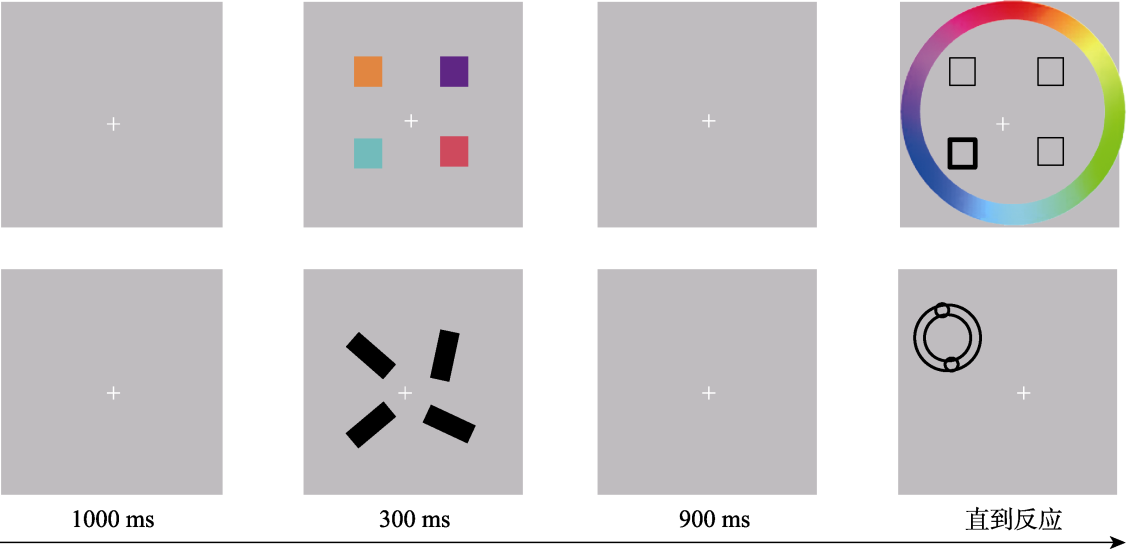
图4 颜色和朝向回忆报告任务流程图。颜色任务中, 在4个位置上有4种各不相同的颜色
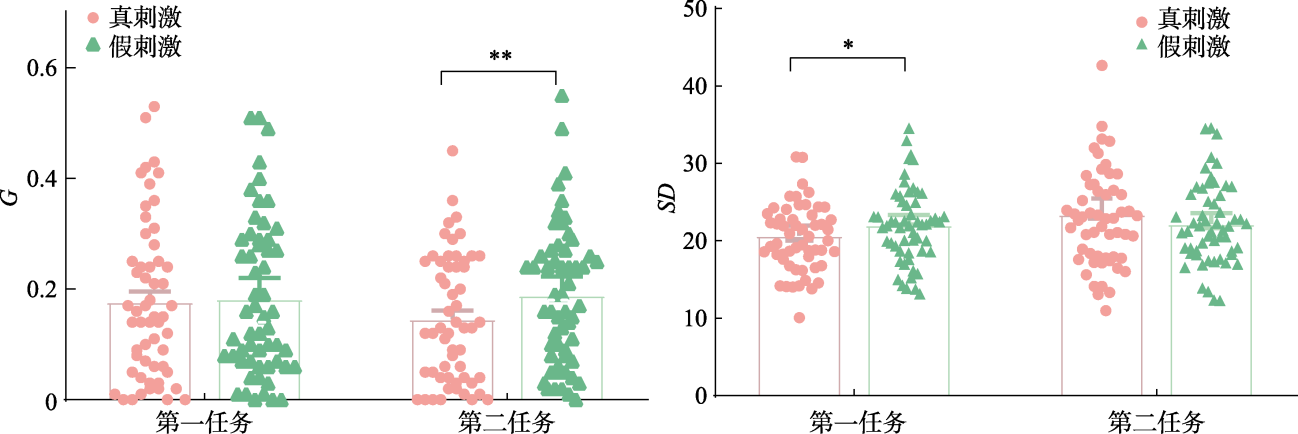
图5 实验2中两个任务的猜测率G (左)与精度SD (右)结果。第一任务表示被试完成的第一个任务, 第二任务表示被试完成的第二个任务。 注:第一任务和第二任务图中, 无论G还是SD, 圆形都是真刺激条件, 三角形都是假刺激条件
| [1] |
Alós-Ferrer, C., Hügelschäfer, S., & Li, J. (2016). Inertia and decision making. Frontiers in Psychology, 7, 169. https://doi.org/10.3389/fpsyg.2016.00169
doi: 10.3389/fpsyg.2016.00169 URL pmid: 26909061 |
| [2] |
Antal, A., Boros, K., Poreisz, C., Chaieb, L., Terney, D., & Paulus, W. (2008). Comparatively weak after-effects of transcranial alternating current stimulation (tACS) on cortical excitability in humans. Brain Stimulation, 1(2), 97-105. https://doi.org/10.1016/j.brs.2007.10.001
doi: 10.1016/j.brs.2007.10.001 URL pmid: 20633376 |
| [3] |
Antal, A., & Paulus, W. (2013). Transcranial alternating current stimulation (tACS). Frontiers in Human Neuroscience, 7, 317. https://doi.org/10.3389/fnhum.2013.00317
doi: 10.3389/fnhum.2013.00317 URL pmid: 23825454 |
| [4] |
Axmacher, N., Henseler, M. M., Jensen, O., Weinreich, I., Elger, C. E., & Fell, J. (2010). Cross-frequency coupling supports multi-item working memory in the human hippocampus. Proceedings of the National Academy of Sciences, 107(7), 3228-3233. https://doi.org/10.1073/pnas.0911531107
doi: 10.1073/pnas.0911531107 URL |
| [5] |
Baddeley, A. (2012). Working memory: Theories, models, and controversies. Annual Review of Psychology, 63(1), 1-29. https://doi.org/10.1146/annurev-psych-120710-100422
doi: 10.1146/psych.2012.63.issue-1 URL |
| [6] |
Barton, B., Ester, E. F., & Awh, E. (2009). Discrete resource allocation in visual working memory. Journal of Experimental Psychology: Human Perception and Performance, 35(5), 1359-1367. https://doi.org/10.1037/a0015792
doi: 10.1037/a0015792 URL pmid: 19803642 |
| [7] |
Bays, P. M., & Husain, M. (2008). Dynamic shifts of limited working memory resources in human vision. Science, 321(5890), 851-854. https://doi.org/10.1126/science.1158023
doi: 10.1126/science.1158023 URL pmid: 18687968 |
| [8] |
Bender, M., Romei, V., & Sauseng, P. (2019). Slow theta tACS of the right parietal cortex enhances contralateral visual working memory capacity. Brain Topography, 32(3), 477-481. https://doi.org/10.1007/s10548-019-00702-2
doi: 10.1007/s10548-019-00702-2 URL pmid: 30694422 |
| [9] |
Biel, A. L., Sterner, E., Röll, L., & Sauseng, P. (2022). Modulating verbal working memory with fronto‐parietal transcranial electric stimulation at theta frequency: Does it work? European Journal of Neuroscience, 55(2), 405-425. https://doi.org/10.1111/ejn.15563
doi: 10.1111/ejn.v55.2 URL |
| [10] | Cohen, J. (1988). Statistical power analysis for the behavioral sciences (2nd ed.). Hillsdale, NJ: Lawrence Erlbaum Associates. |
| [11] |
Danner, U. N., Aarts, H., & de Vries, N. K. (2008). Habit vs. intention in the prediction of future behaviour: The role of frequency, context stability and mental accessibility of past behaviour. British Journal of Social Psychology, 47(2), 245-265. https://doi.org/10.1348/014466607X230876
doi: 10.1348/014466607X230876 URL |
| [12] |
Ding, J., Zhang, Y., Liang, P., & Li, X. (2023). Modulation of working memory capacity on predictive processing during language comprehension. Language, Cognition and Neuroscience, 38(8), 1133-1152.
doi: 10.1080/23273798.2023.2212819 URL |
| [13] |
Elyamany, O., Leicht, G., Herrmann, C. S., & Mulert, C. (2021). Transcranial alternating current stimulation (tACS): From basic mechanisms towards first applications in psychiatry. European Archives of Psychiatry and Clinical Neuroscience, 271(1), 135-156. https://doi.org/10.1007/s00406-020-01209-9
doi: 10.1007/s00406-020-01209-9 URL pmid: 33211157 |
| [14] |
Ericsson, K. A., & Kintsch, W. (1995). Long-term working memory. Psychological Review, 102(2), 211-245. https://doi.org/10.1037/0033-295x.102.2.211
URL pmid: 7740089 |
| [15] |
Guo, X., Li, Z., Zhang, L., & Liu, Q. (2021). Modulation of visual working memory performance via different theta frequency stimulations. Brain Sciences, 11(10), 1358. https://doi.org/10.3390/brainsci11101358
doi: 10.3390/brainsci11101358 URL |
| [16] |
Haggar, P., Whitmarsh, L., & Skippon, S. M. (2019). Habit discontinuity and student travel mode choice. Transportation Research Part F: Traffic Psychology and Behaviour, 64, 1-13. https://doi.org/10.1016/j.trf.2019.04.022
doi: 10.1016/j.trf.2019.04.022 URL |
| [17] |
Jaušovec, N., Jaušovec, K., & Pahor, A. (2014). The influence of theta transcranial alternating current stimulation (tACS) on working memory storage and processing functions. Acta Psychologica, 146, 1-6. https://doi.org/10.1016/j.actpsy.2013.11.011
doi: 10.1016/j.actpsy.2013.11.011 URL pmid: 24361739 |
| [18] |
Jensen, O., & Lisman, J. E. (1998). An oscillatory short-term memory buffer model can account for data on the Sternberg task. The Journal of Neuroscience, 18(24), 10688-10699. https://doi.org/10.1523/jneurosci.18-24-10688.1998
doi: 10.1523/JNEUROSCI.18-24-10688.1998 URL |
| [19] |
Jensen, O., & Lisman, J. E. (2005). Hippocampal sequence- encoding driven by a cortical multi-item working memory buffer. Trends in Neurosciences, 28(2), 67-72. https://doi.org/10.1016/j.tins.2004.12.001
URL pmid: 15667928 |
| [20] |
Jensen, O., & Mazaheri, A. (2010). Shaping functional architecture by oscillatory alpha activity: Gating by inhibition. Frontiers in Human Neuroscience, 4, 186. https://doi.org/10.3389/fnhum.2010.00186
doi: 10.3389/fnhum.2010.00186 URL pmid: 21119777 |
| [21] |
Jones, K. T., Arciniega, H., & Berryhill, M. E. (2019). Replacing tDCS with theta tACS provides selective, but not general WM benefits. Brain Research, 1720, 146324.
doi: 10.1016/j.brainres.2019.146324 URL |
| [22] |
Kleinert, M.-L., Szymanski, C., & Müller, V. (2017). Frequency-unspecific effects of θ-tACS related to a visuospatial working memory Task. Frontiers in Human Neuroscience, 11, 367.
doi: 10.3389/fnhum.2017.00367 URL |
| [23] |
Lee, J., & Park, S. (2005). Working memory impairments in schizophrenia: A meta-analysis. Journal of Abnormal Psychology, 114(4), 599-611. https://doi.org/10.1037/0021-843X.114.4.599
doi: 10.1037/0021-843X.114.4.599 URL pmid: 16351383 |
| [24] |
Lega, B., Burke, J., Jacobs, J., & Kahana, M. J. (2016). Slow-theta-to-gamma phase-amplitude coupling in human hippocampus supports the formation of new episodic memories. Cerebral Cortex, 26(1), 268-278. https://doi.org/10.1093/cercor/bhu232
doi: 10.1093/cercor/bhu232 URL |
| [25] |
Liu, C.-L., & Zhou, R.-L. (2013). Effects of working memory training on cognition and brain plasticity. Advances in Psychological Science, 20(7), 1003-1011. https://doi.org/10.3724/sp.j.1042.2012.01003
doi: 10.3724/SP.J.1042.2012.01003 URL |
| [刘春雷, 周仁来. (2013). 工作记忆训练对认知功能和大脑神经系统的影响. 心理科学进展, 20(7), 1003-1011.] | |
| [26] |
Long, F., Ye, C., Li, Z., Tian, Y., & Liu, Q. (2020). Negative emotional state modulates visual working memory in the late consolidation phase. Cognition and Emotion, 34(8), 1646-1663. https://doi.org/10.1080/02699931.2020.1795626
doi: 10.1080/02699931.2020.1795626 URL |
| [27] |
Nissim, N. R., McAfee, D. C., Edwards, S., Prato, A., Lin, J. X., Lu, Z., Coslett, H. B., & Hamilton, R. H. (2023). Efficacy of transcranial alternating current stimulation in the enhancement of working memory performance in healthy adults: A systematic meta-analysis. Neuromodulation: Technology at the Neural Interface, 26(4), 728-737. https://doi.org/10.1016/j.neurom.2022.12.014
doi: 10.1016/j.neurom.2022.12.014 URL |
| [28] |
Nitsche, M. A., Cohen, L. G., Wassermann, E. M., Priori, A., Lang, N., Antal, A., Paulus, W., Hummel, F., Boggio, P. S., Fregni, F., & Pascual-Leone, A. (2008). Transcranial direct current stimulation: State of the art 2008. Brain Stimulation, 1(3), 206-223. https://doi.org/10.1016/j.brs.2008.06.004
doi: 10.1016/j.brs.2008.06.004 URL pmid: 20633386 |
| [29] |
Ouellette, J. A., & Wood, W. (1998). Habit and intention in everyday life: The multiple processes by which past behavior predicts future behavior. Psychological Bulletin, 124(1), 54-74.
doi: 10.1037/0033-2909.124.1.54 URL |
| [30] | Paßmann, S., Baselgia, S., Kasten, F. H., Herrmann, C. S., & Rasch, B. (2024). Differential online and offline effects of theta-tACS on memory encoding and retrieval. Cognitive, Affective, & Behavioral Neuroscience, 24(5), 894-911. https://doi.org/10.3758/s13415-024-01204-w |
| [31] |
Peich, M.-C., Husain, M., & Bays, P. M. (2013). Age-related decline of precision and binding in visual working memory. Psychology and Aging, 28(3), 729-743. https://doi.org/10.1037/a0033236
doi: 10.1037/a0033236 URL |
| [32] |
Pupíková, M., Maceira-Elvira, P., Harquel, S., Šimko, P., Popa, T., Gajdoš, M., … Rektorová, I. (2024). Physiology-inspired bifocal fronto-parietal tACS for working memory enhancement. Heliyon, 10(18), e37427. https://doi.org/10.1016/j.heliyon.2024.e37427
doi: 10.1016/j.heliyon.2024.e37427 URL |
| [33] |
Riecke, L., Formisano, E., Herrmann, C. S., & Sack, A. T. (2015). 4-Hz transcranial alternating current stimulation phase modulates hearing. Brain Stimulation, 8(4), 777-783. https://doi.org/10.1016/j.brs.2015.04.004
doi: 10.1016/j.brs.2015.04.004 URL pmid: 25981160 |
| [34] |
Ruhnau, P., Neuling, T., Fuscá, M., Herrmann, C. S., Demarchi, G., & Weisz, N. (2016). Eyes wide shut: Transcranial alternating current stimulation drives alpha rhythm in a state dependent manner. Scientific Reports, 6(1), 27138. https://doi.org/10.1038/srep27138
doi: 10.1038/srep27138 URL |
| [35] |
Samuelson, W., & Zeckhauser, R. (1988). Status quo bias in decision making. Journal of Risk and Uncertainty, 1(1), 7-59. https://doi.org/10.1007/BF00055564
doi: 10.1007/BF00055564 URL |
| [36] |
Sawilowsky, S. S. (2009). New effect size rules of thumb. Journal of Modern Applied Statistical Methods, 8(2), 597-599. https://doi.org/10.22237/jmasm/1257035100
doi: 10.22237/jmasm/1257035100 URL |
| [37] |
Schneegans, S., & Bays, P. M. (2017). Neural architecture for feature binding in visual working memory. The Journal of Neuroscience, 37(14), 3913-3925. https://doi.org/10.1523/JNEUROSCI.3493-16.2017
doi: 10.1523/JNEUROSCI.3493-16.2017 URL |
| [38] |
Shiffrin, R. M., & Schneider, W. (1977). Controlled and automatic human information processing: II. Perceptual learning, automatic attending and a general theory. Psychological Review, 84(2), 127-190. https://doi.org/10.1037/0033-295x.84.2.127
doi: 10.1037/0033-295X.84.2.127 URL |
| [39] |
Spitzer, B., & Blankenburg, F. (2011). Stimulus-dependent EEG activity reflects internal updating of tactile working memory in humans. Proceedings of the National Academy of Sciences, 108(20), 8444-8449. https://doi.org/10.1073/pnas.1104189108
doi: 10.1073/pnas.1104189108 URL |
| [40] |
Sreeraj, V. S., Shivakumar, V., Sowmya, S., Bose, A., Nawani, H., Narayanaswamy, J. C., & Venkatasubramanian, G. (2019). Online theta frequency transcranial alternating current stimulation for cognitive remediation in schizophrenia: A case report and review of literature. The Journal of ECT, 35(2), 139-143. https://doi.org/10.1097/yct.0000000000000523
doi: 10.1097/YCT.0000000000000523 URL |
| [41] | Suchow, J. W., Brady, T. F., Fougnie, D., & Alvarez, G. A. (2013). Modeling visual working memory with the MemToolbox. Journal of Vision, 13(10), 9-9. https://doi.org/10.1167/13.10.9 |
| [42] |
Sweller, J., van Merrienboer, J. J. G., & Paas, F. G. W. C.(1998). Cognitive architecture and instructional design. Educational Psychology Review, 10(3), 251-296.
doi: 10.1023/A:1022193728205 |
| [43] |
Tavakoli, A. V., & Yun, K. (2017). Transcranial alternating current stimulation (tACS) mechanisms and protocols. Frontiers in Cellular Neuroscience, 11, 214. https://doi.org/10.3389/fncel.2017.00214
doi: 10.3389/fncel.2017.00214 URL pmid: 28928634 |
| [44] | Tseng, P., Lu, K. C., & Juan, C.-H. (2018). The critical role of phase difference in theta oscillation between bilateral parietal cortices for visuospatial working memory. Scientific Reports, 8(1), 349. |
| [45] |
Vogel, E. K., McCollough, A. W., & Machizawa, M. G. (2005). Neural measures reveal individual differences in controlling access to working memory. Nature, 438(7067), 500-503. https://doi.org/10.1038/nature04171
doi: 10.1038/nature04171 URL |
| [46] |
Wang, S., Itthipuripat, S., & Ku, Y. (2019). Electrical stimulation over human posterior parietal cortex selectively enhances the capacity of visual short-term memory. The Journal of Neuroscience, 39(3), 528-536. https://doi.org/10.1523/JNEUROSCI.1959-18.2018
doi: 10.1523/JNEUROSCI.1959-18.2018 URL |
| [47] |
Wolinski, N., Cooper, N. R., Sauseng, P., & Romei, V. (2018). The speed of parietal theta frequency drives visuospatial working memory capacity. PLOS Biology, 16(3), e2005348. https://doi.org/10.1371/journal.pbio.2005348
doi: 10.1371/journal.pbio.2005348 URL |
| [48] |
Ye, C., Hu, Z., Li, H., Ristaniemi, T., Liu, Q., & Liu, T. (2017). A two-phase model of resource allocation in visual working memory. Journal of Experimental Psychology: Learning, Memory, and Cognition, 43(10), 1557-1566. https://doi.org/10.1037/xlm0000376
doi: 10.1037/xlm0000376 URL |
| [49] |
Ye, C., Sun, H.-J., Xu, Q., Liang, T., Zhang, Y., & Liu, Q. (2019). Working memory capacity affects trade-off between quality and quantity only when stimulus exposure duration is sufficient: Evidence for the two-phase model. Scientific Reports, 9(1), 8727. https://doi.org/10.1038/s41598-019-44998-3
doi: 10.1038/s41598-019-44998-3 URL pmid: 31217521 |
| [50] |
Zhang, D.-W., Moraidis, A., & Klingberg, T. (2022). Individually tuned theta HD-tACS improves spatial performance. Brain Stimulation, 15(6), 1439-1447. https://doi.org/10.1016/j.brs.2022.10.009
doi: 10.1016/j.brs.2022.10.009 URL |
| [51] |
Zhang, S. Y., & Li, X., B. (2022). The application of different frequencies of transcranial alternating current stimulation in mental disorders. Advances in Psychological Science, 30(9), 2053-2066. https://doi.org/10.3724/sp.j.1042.2022.02053
doi: 10.3724/SP.J.1042.2022.02053 URL |
|
[张思源, 李雪冰. (2022). 不同频率经颅交流电刺激在精神疾病中的应用. 心理科学进展, 30(9), 2053-2066.]
doi: 10.3724/SP.J.1042.2022.02053 |
|
| [52] |
Zhang, W., & Luck, S. J. (2008). Discrete fixed-resolution representations in visual working memory. Nature, 453(7192), 233-235. https://doi.org/10.1038/nature06860
doi: 10.1038/nature06860 URL |
| [53] | Zhang, X., Wang, W., Duan, H., Zhao, Y., Kan, Y., & Hu, W. (2019). Effect of working memory on insight and analytic problem solving. Journal of Psychological Science, 42(4), 777-783. |
| [54] |
Zokaei, N., Burnett Heyes, S., Gorgoraptis, N., Budhdeo, S., & Husain, M. (2015). Working memory recall precision is a more sensitive index than span. Journal of Neuropsychology, 9(2), 319-329. https://doi.org/10.1111/jnp.12052
doi: 10.1111/jnp.12052 URL pmid: 25208525 |
| [1] | 任国防, 丁晓伟, 张颖超, 王盛元. 空间位置比非空间特征更难从工作记忆中移除[J]. 心理学报, 2026, 58(6): 1028-1041. |
| [2] | 王俊博, 赵娜, 李子媛, 刘强. 负性面孔的工作记忆离线态存储不影响在线态存储[J]. 心理学报, 2025, 57(8): 1323-1332. |
| [3] | 李子媛, 任国防, 袁子昕, 喻青青, 伍越, 刘强. 视觉工作记忆离线态表征具有稳固性优势[J]. 心理学报, 2025, 57(5): 739-748. |
| [4] | 连浩敏, 张倩, 谷雪敏, 李寿欣. 持续性视觉注意对视觉工作记忆项目优先加工的影响[J]. 心理学报, 2025, 57(2): 191-206. |
| [5] | 周临舒, 张雨青, 蔡丹超. 音乐训练促进音高与时间维度在听觉工作记忆中的交互[J]. 心理学报, 2025, 57(10): 1701-1714. |
| [6] | 周详, 张婧婧, 白博仁, 翟宏堃, 崔虞馨, 祖冲. “三心二意”胜过“一心一意”: 媒体多任务提升低工作记忆容量者创造力[J]. 心理学报, 2024, 56(8): 1031-1046. |
| [7] | 李子媛, 雷鸣, 刘强. 视觉工作记忆离线态表征的生成机制[J]. 心理学报, 2024, 56(4): 412-420. |
| [8] | 牛惠, 胡艳梅, 郑旭涛, 姜英杰, 刘佳. 奖赏对工作记忆提取准确性的促进及其机制[J]. 心理学报, 2024, 56(4): 435-446. |
| [9] | 张引, 李月, 梁腾飞, 陈江涛, 刘强. 自动激活的长时联结表征对工作记忆的促进效应[J]. 心理学报, 2024, 56(10): 1328-1339. |
| [10] | 庞超, 陈颜璋, 王莉, 杨喜端, 贺雅, 李芷莹, 欧阳小钰, 傅世敏, 南威治. 客体信息在视觉工作记忆编码和维持阶段的不同注意选择模式[J]. 心理学报, 2023, 55(9): 1397-1410. |
| [11] | 李海峰, 林世卿, 万博温. 价值导向的注意刷新及其机制[J]. 心理学报, 2023, 55(8): 1234-1242. |
| [12] | 董天天, 徐璐璐, 贺雯. 积极总是好的吗?积极元刻板印象对工作记忆的影响及其机制[J]. 心理学报, 2023, 55(8): 1344-1357. |
| [13] | 陈悦源, 方卫宁, 郭北苑, 鲍海峰. 作业中断对任务绩效的影响及心理疲劳的调节作用[J]. 心理学报, 2023, 55(1): 22-35. |
| [14] | 王强强, 张琦, 石文典, 王志伟, 章鹏程. 数字空间表征的在线建构:来自干扰情境中数字SNARC效应的证据[J]. 心理学报, 2022, 54(7): 761-771. |
| [15] | 贾世伟, 齐丛丛, 陈乐乐, 任衍具. 工作记忆负荷对反馈加工过程的影响: 来自脑电研究的证据[J]. 心理学报, 2022, 54(3): 248-258. |
| 阅读次数 | ||||||
|
全文 |
|
|||||
|
摘要 |
|
|||||
