

ISSN 0439-755X
CN 11-1911/B
主办:中国心理学会
中国科学院心理研究所
出版:科学出版社
CN 11-1911/B
主办:中国心理学会
中国科学院心理研究所
出版:科学出版社
心理学报 ›› 2026, Vol. 58 ›› Issue (5): 809-826.doi: 10.3724/SP.J.1041.2026.0809 cstr: 32110.14.2026.0809
任如月, 刘煜, 兰继军, 李苑( ), 游旭群()
收稿日期:2024-12-12
发布日期:2026-03-04
出版日期:2026-05-25
通讯作者:
游旭群, E-mail: youxuqun@snnu.edu.cn;基金资助:
REN Ruyue, LIU Yu, LAN Jijun, LI Yuan(), YOU Xuqun()
Received:2024-12-12
Online:2026-03-04
Published:2026-05-25
摘要:
变化盲视是诱发交通驾驶人因失误的主要原因之一, 对公共安全构成严重威胁。本研究采用运动方向瞬态诱导变化盲视的实验方法, 通过3个实验系统考察了注意和记忆表征对交通场景图像转向中变化盲视的影响。实验1操纵场景的运动速度、运动路线和变化类型, 其中运动速度可能通过加剧转向瞬间的注意资源竞争影响变化探测, 发现快速运动仅在转向条件下显著加剧变化盲视, 而在直行条件下无显著影响。实验2控制运动速度, 操纵运动时间(变化前)、运动路线和变化类型, 其中原始场景呈现时长可能通过增加记忆表征精度来影响变化探测, 发现更长的记忆表征编码时间可在有限范围内缓解变化盲视。实验3控制运动速度与运动时间, 操纵场景期望水平下的运动路线与变化类型, 通过路线转向方向的概率分布建立先验预期, 发现个体对高期望条件下的目标变化表现出更好的探测绩效。结论:交通场景转向中的变化盲视是注意资源竞争与记忆表征有限性共同作用的结果, 而期望可能内源性地调节注意分配和记忆表征的有效构建, 进而影响变化盲视的发生。研究结果支持并拓展了变化盲视的注意−表征理论。
中图分类号:
任如月, 刘煜, 兰继军, 李苑, 游旭群. (2026). 注意和记忆表征对交通场景图像转向中变化盲视的影响. 心理学报, 58(5), 809-826.
REN Ruyue, LIU Yu, LAN Jijun, LI Yuan, YOU Xuqun. (2026). The effects of attention and memory representations on change blindness during global motion direction transients in traffic-scene images. Acta Psychologica Sinica, 58(5), 809-826.
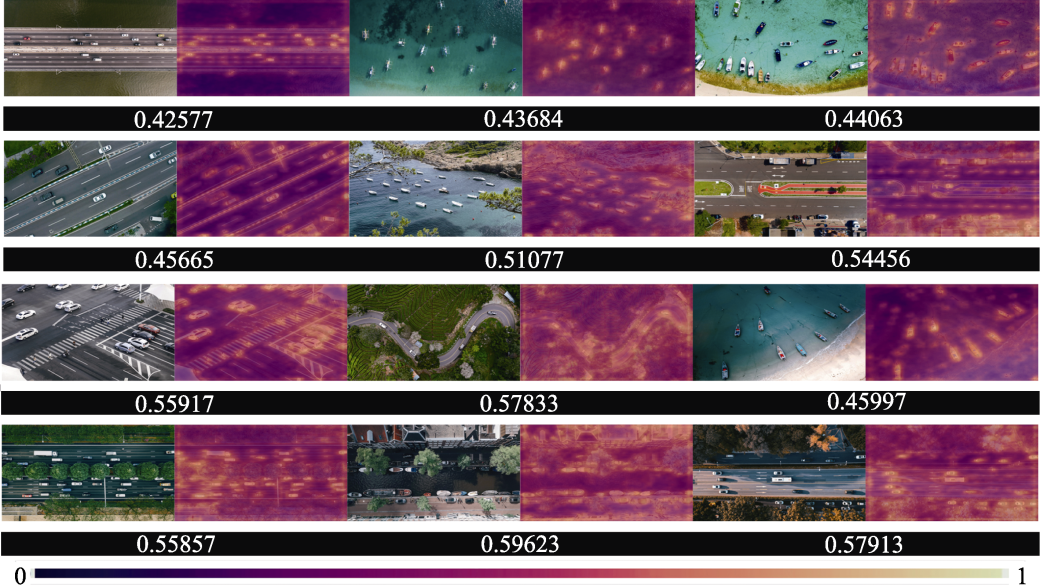
图1 本研究交通场景复杂度可视化结果部分示意图 注:左侧为输入图像, 右侧为预测的复杂度热度图, 下方数字代表ICNet预测的复杂度分数。彩图见电子版, 下同。
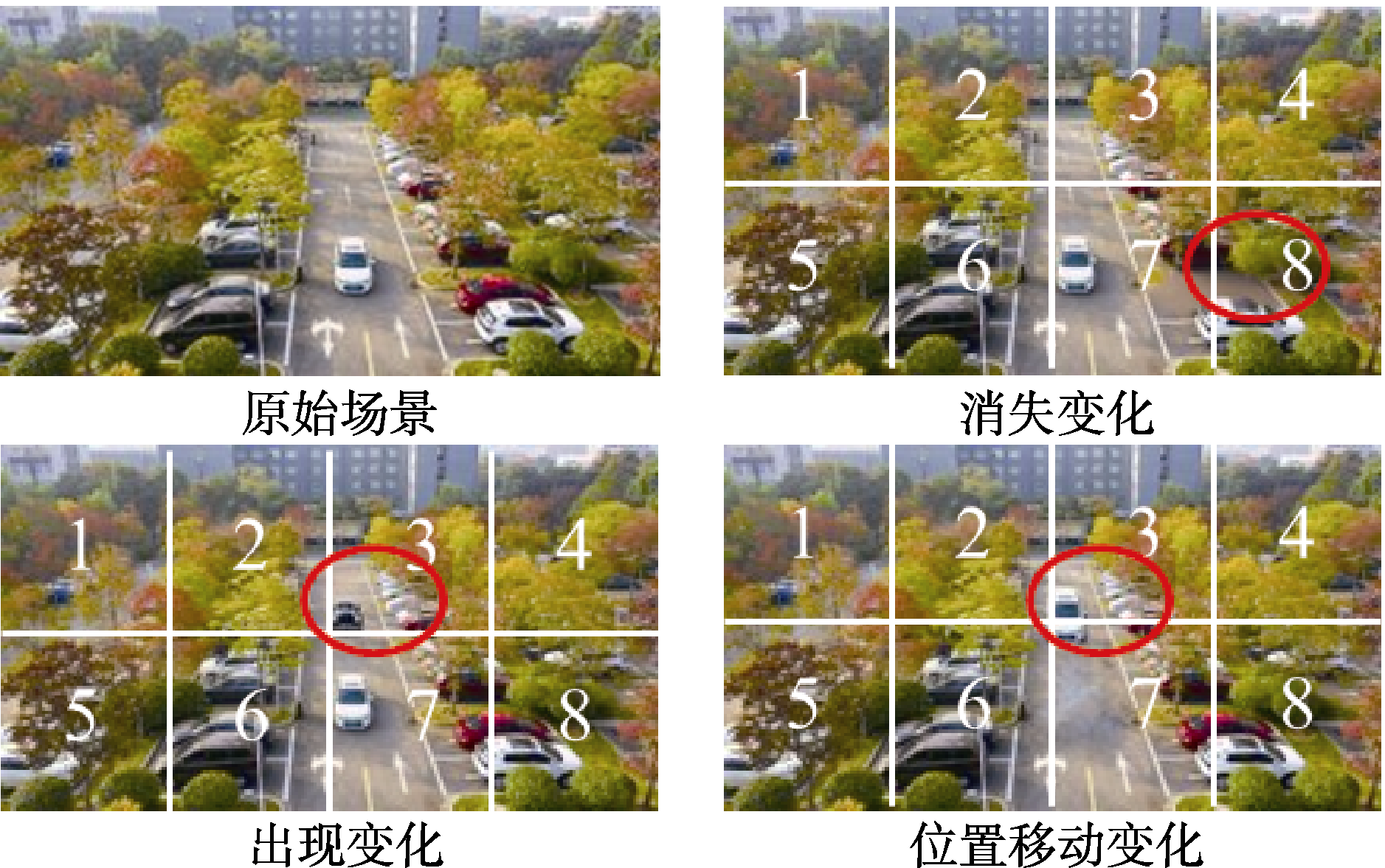
图2 交通场景的变化类型示意图 注:图像变化后被划分为8个区域, 分别对应小键盘上的1~8按键。
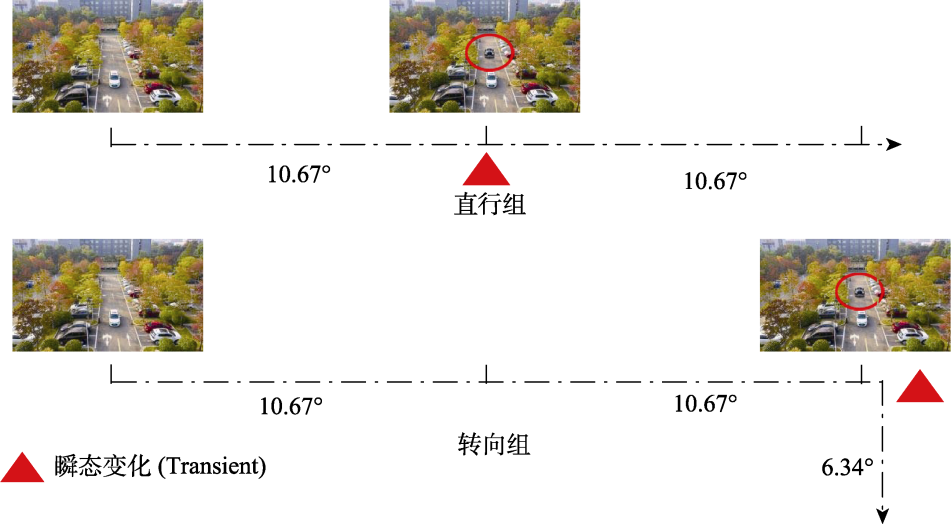
图3 实验1转向组/直行组运动路线示意图 注:图像运动到▲位置时, 场景发生瞬变, 下同。
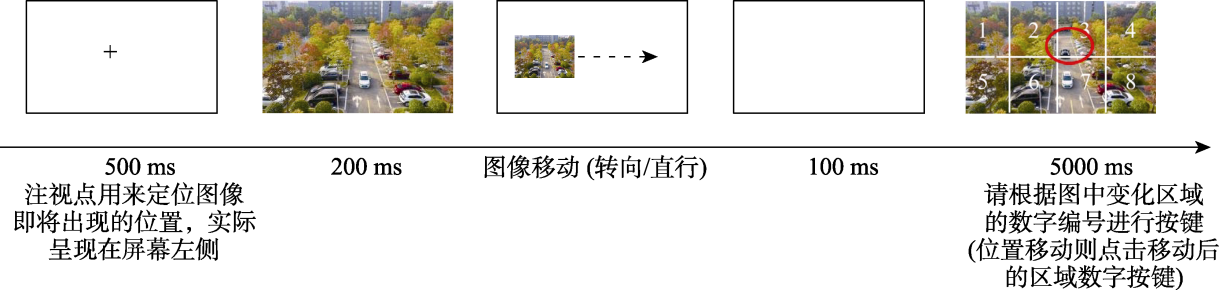
图4 实验流程图
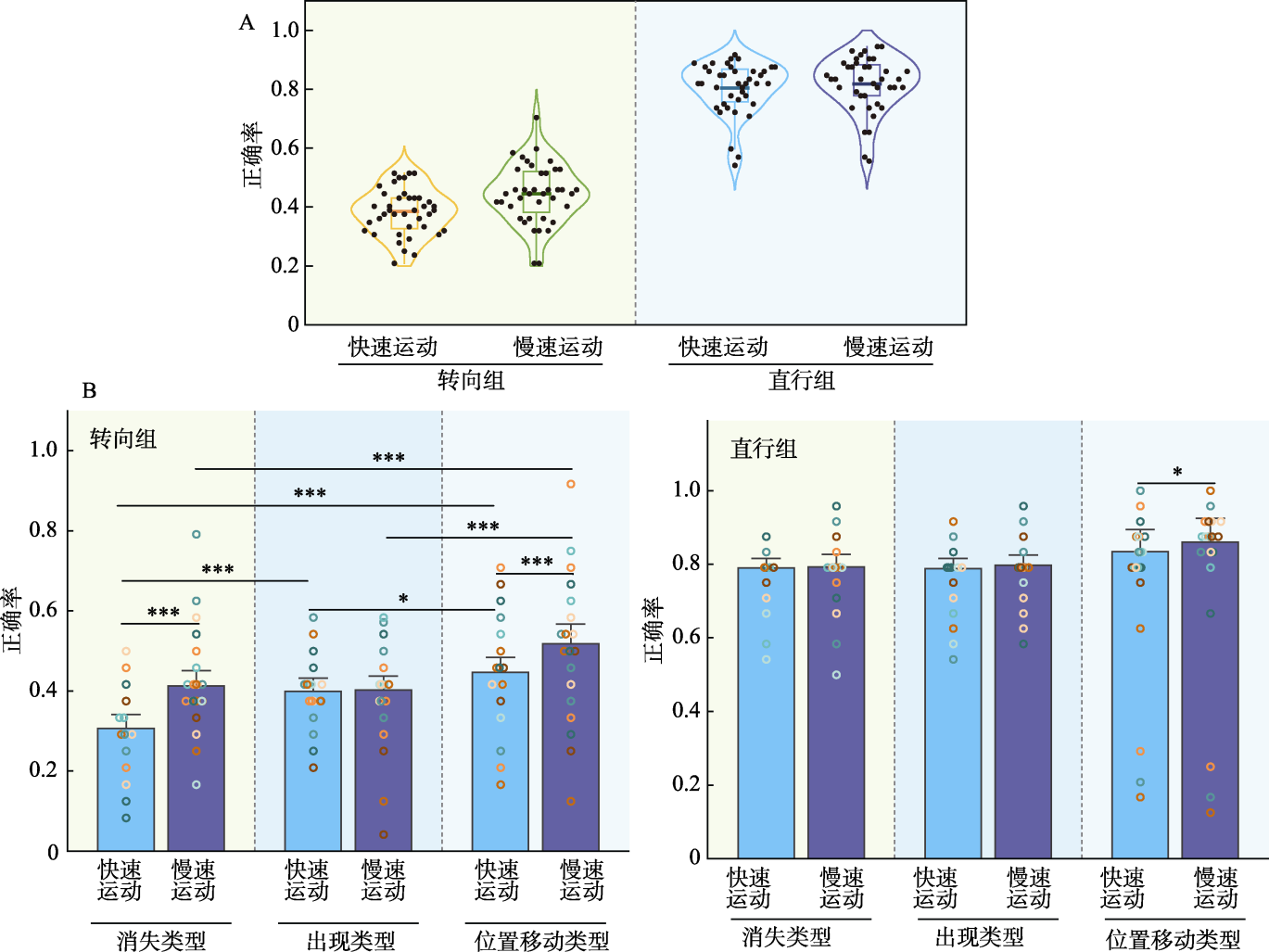
图5 A:不同运动路线下运动速度对变化探测正确率的箱型−小提琴图。B:转向组与直行组中, 运动速度和变化类型对变化探测正确率的影响。注:*p < 0.05, **p < 0.01, ***p < 0.001, 下同。
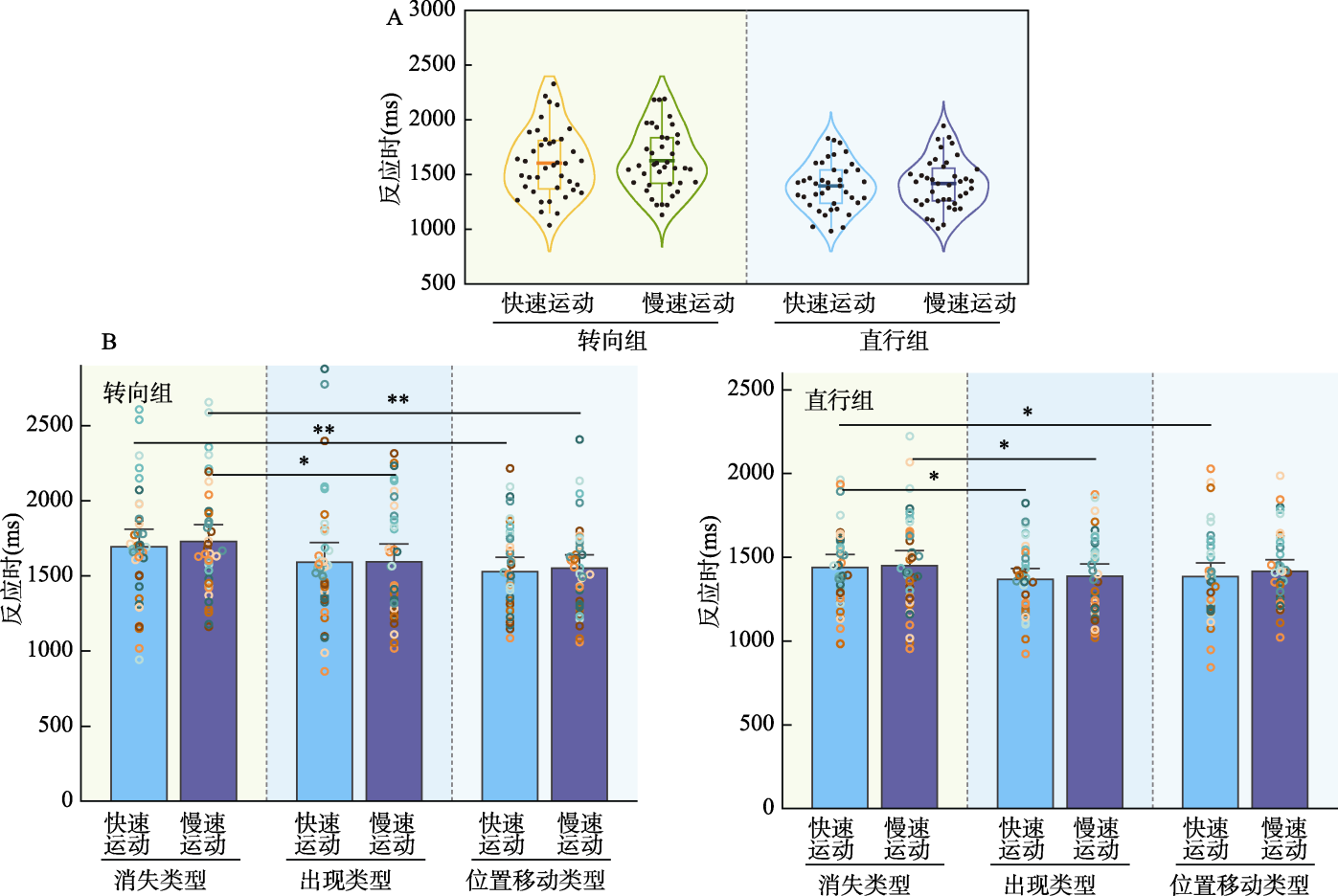
图6 A:不同运动路线下运动速度对变化探测正确时的反应时的箱型−小提琴图。B:转向组与直行组中, 运动速度和变化类型对变化探测正确时的反应时的影响。
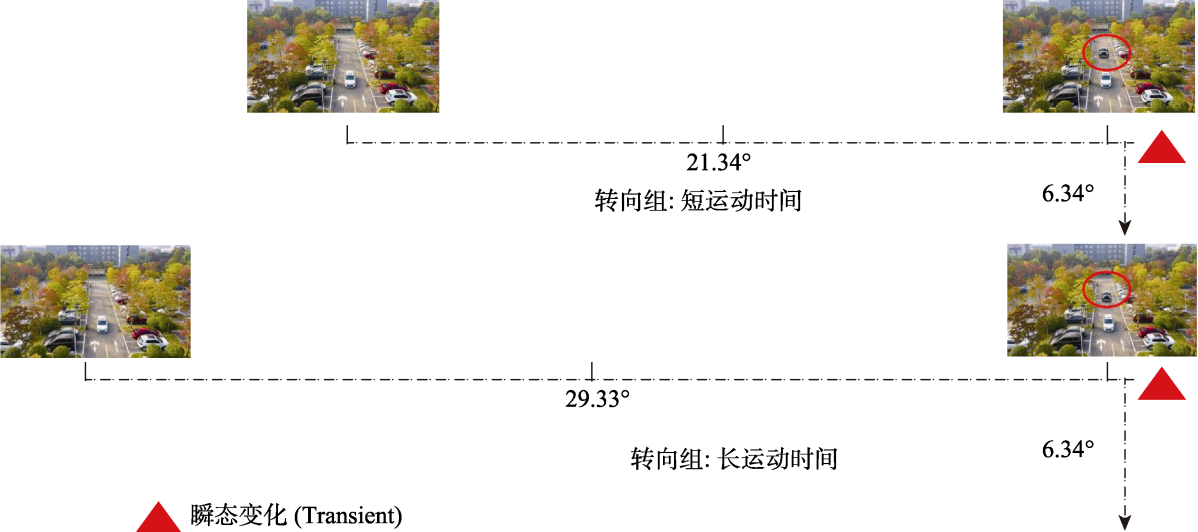
图7 实验2转向组短运动时间/长运动时间运动路线示意图
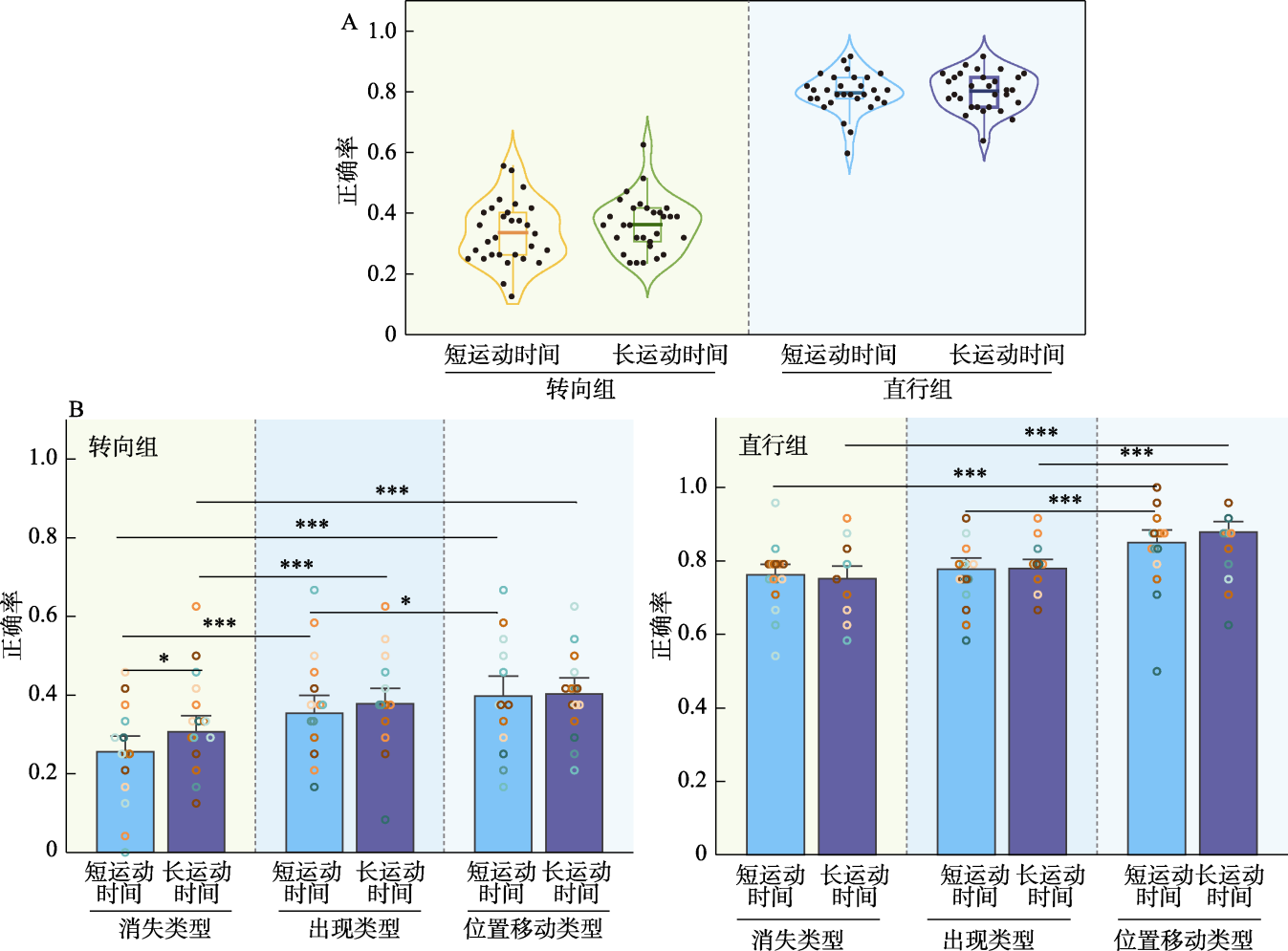
图8 A:不同运动路线下运动时间对变化探测正确率的箱型−小提琴图。B:转向组与直行组中, 运动时间和变化类型对变化探测正确率的影响。
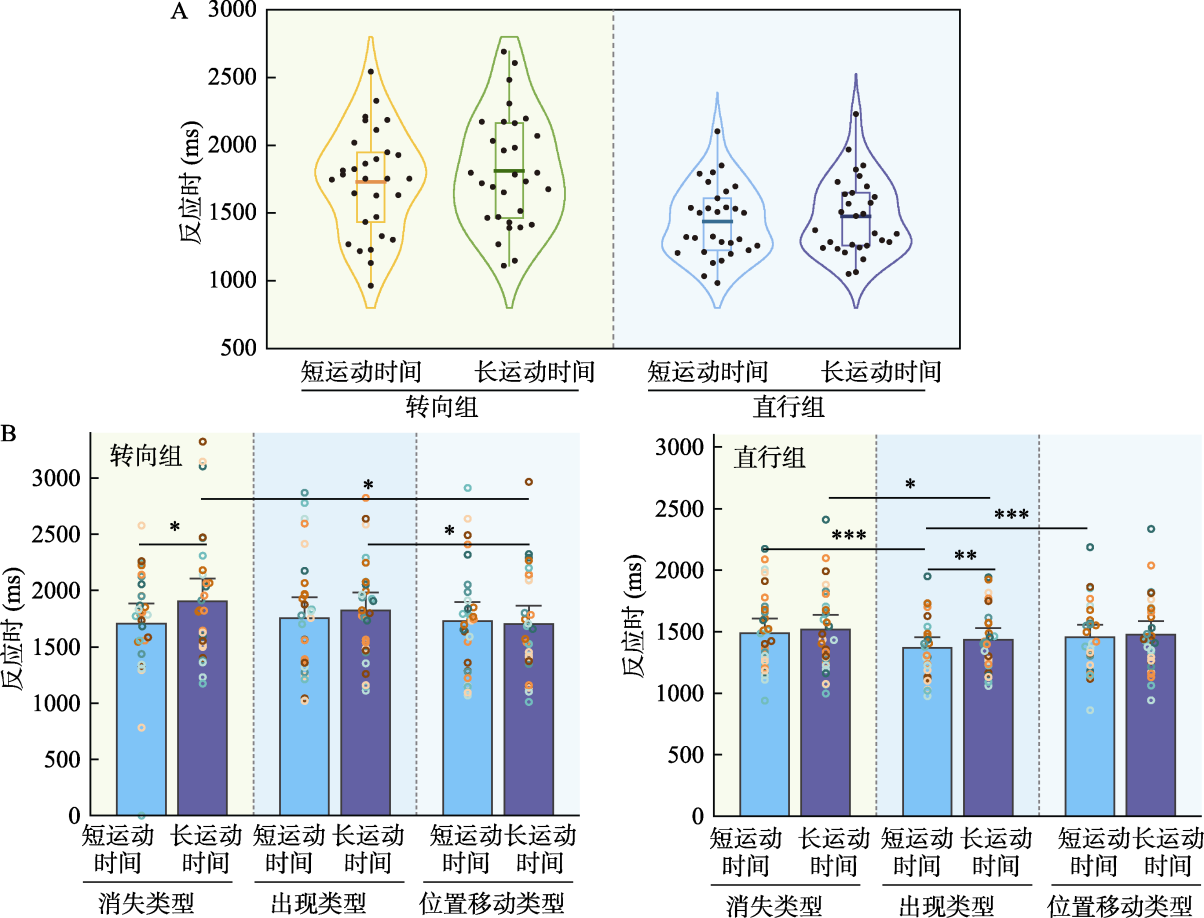
图9 A:不同运动路线下运动时间对变化探测正确时的反应时的箱型−小提琴图。B:转向组与直行组中, 运动时间和变化类型对变化探测正确时的反应时的影响。
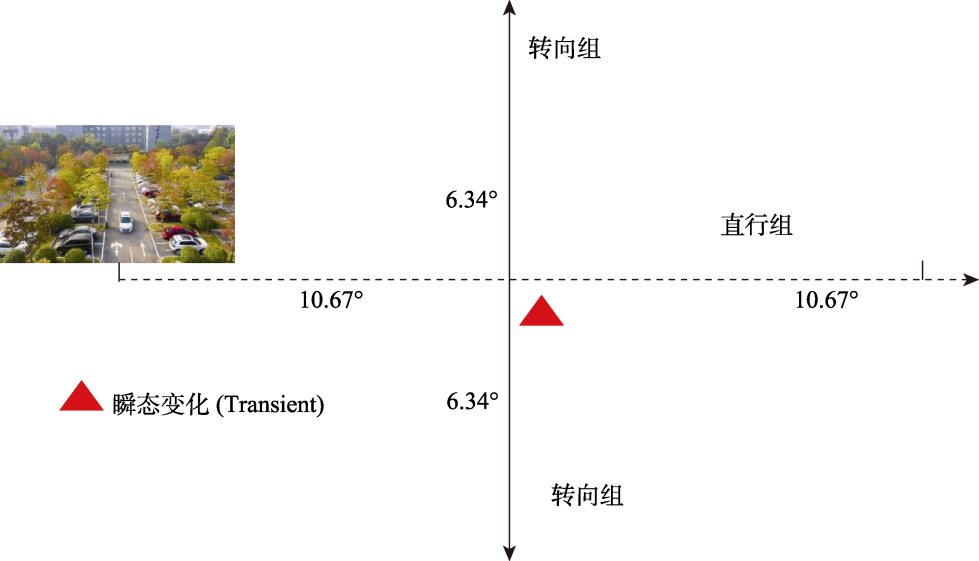
图10 实验3运动路线示意图
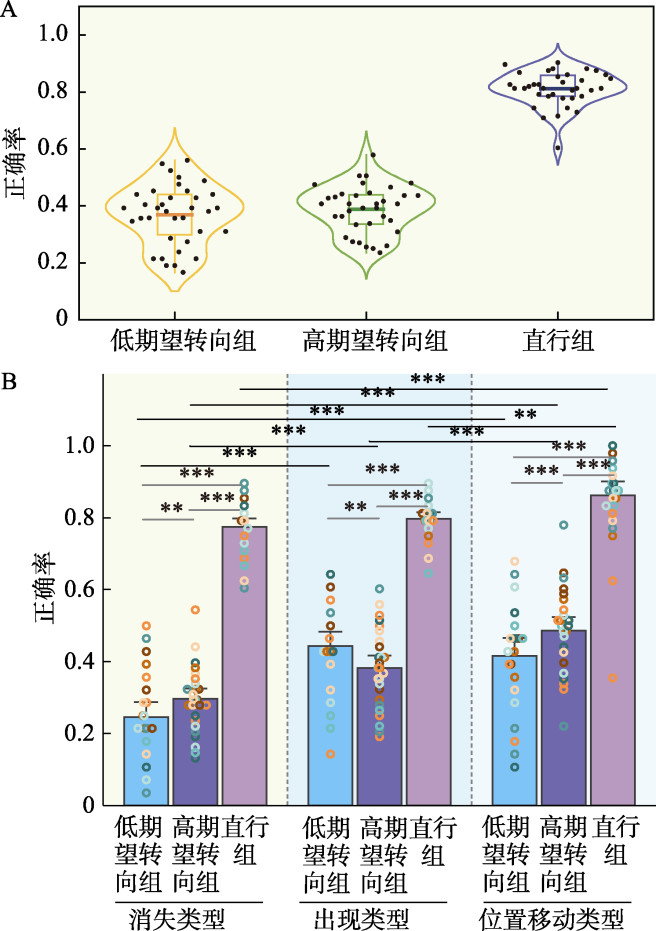
图11 A:不同运动路线下变化探测正确率的箱型−小提琴图。B:运动路线和变化类型对变化探测正确率的影响。
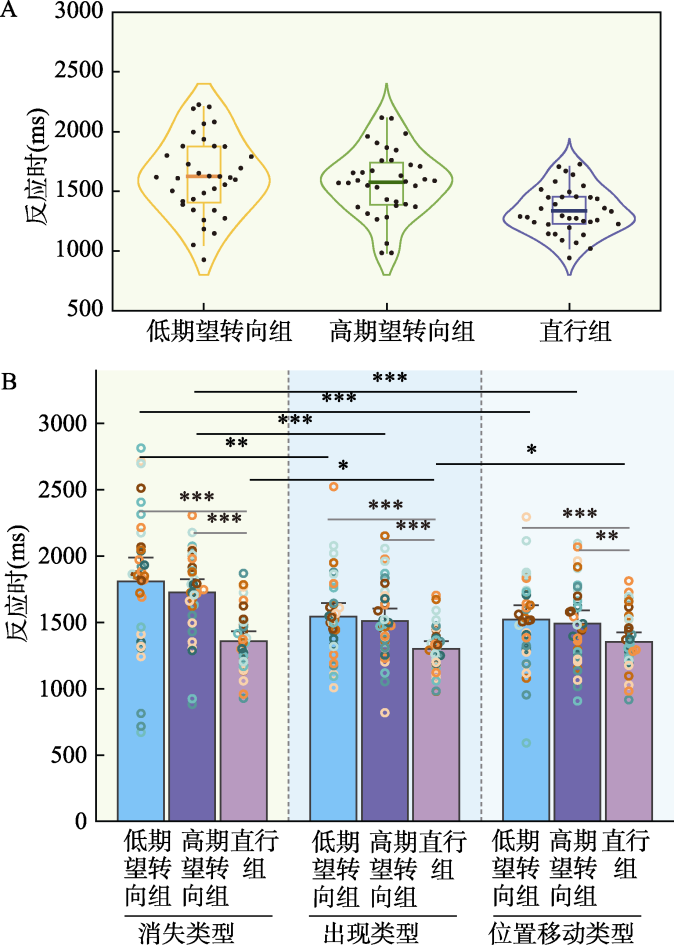
图12 A:不同运动路线下变化探测正确时的反应时的箱型−小提琴图。B:运动路线和变化类型对变化探测正确时的反应时的影响。
| [1] |
Abrams, R. A., & Christ, S. E. (2003). Motion onset captures attention. Psychological Science, 14(5), 427-432. https://doi.org/10.1111/1467-9280.01458
doi: 10.1111/1467-9280.01458 URL pmid: 12930472 |
| [2] |
Awh, E., & Vogel, E. K. (2008). The bouncer in the brain. Nature Neuroscience, 11(1), 5-6. https://doi.org/10.1038/nn0108-5
doi: 10.1038/nn0108-5 URL pmid: 18160954 |
| [3] | Bays, P. M., Catalao, R. F., & Husain, M. (2009). The precision of visual working memory is set by allocation of a shared resource. Journal of Vision, 9(10), 1-11. https://doi.org/10.1167/9.10.7 |
| [4] |
Beanland, V., Filtness, A. J., & Jeans, R. (2017). Change detection in urban and rural driving scenes: Effects of target type and safety relevance on change blindness. Accident Analysis & Prevention, 100, 111-122. https://doi.org/10.1016/j.aap.2017.01.011
doi: 10.1016/j.aap.2017.01.011 URL |
| [5] |
Beanland, V., Fitzharris, M., Young, K. L., & Lenné, M. G. (2013). Driver inattention and driver distraction in serious casualty crashes: Data from the Australian national crash in-depth study. Accident Analysis & Prevention, 54, 99-107. https://doi.org/10.1016/j.aap.2012.12.043
doi: 10.1016/j.aap.2012.12.043 URL |
| [6] |
Beck, M. R., Peterson, M. S., & Angelone, B. L. (2007). The roles of encoding, retrieval, and awareness in change detection. Memory & Cognition, 35(4), 610-620. https://doi.org/10.3758/BF03193299
doi: 10.3758/BF03193299 URL |
| [7] |
Berggren, N., & Eimer, M. (2019). The roles of relevance and expectation for the control of attention in visual search. Journal of Experimental Psychology: Human Perception and Performance, 45(9), 1191-1205. https://doi.org/10.1037/xhp0000666
doi: 10.1037/xhp0000666 URL pmid: 31157535 |
| [8] |
Bonneh, Y. S., Cooperman, A., & Sagi, D. (2001). Motion- induced blindness in normal observers. Nature, 411(6839), 798-801. https://doi.org/10.1038/35081073
doi: 10.1038/35081073 URL |
| [9] |
Brockmole, J. R., & Henderson, J. M. (2005). Object appearance, disappearance, and attention prioritization in real-world scenes. Psychonomic Bulletin & Review, 12(6), 1061-1067. https://doi.org/10.3758/BF03206444
doi: 10.3758/BF03206444 URL |
| [10] |
Chun, M. M., & Potter, M. C. (1995). A two-stage model for multiple target detection in rapid serial visual presentation. Journal of Experimental Psychology: Human Perception and Performance, 21(1), 109-127. https://doi.org/10.1037/0096-1523.21.1.109
doi: 10.1037/0096-1523.21.1.109 URL |
| [11] |
Cohen-Dallal, H., Markus, O., & Pertzov, Y. (2023). Adaptive visual working memory: Expecting a delayed estimation task enhances visual working memory precision. Journal of Experimental Psychology: Human Perception and Performance, 49(1), 7-21. https://doi.org/10.1037/xhp0001066
doi: 10.1037/xhp0001066 URL |
| [12] |
Cole, G. G., & Kuhn, G. (2010). Attentional capture by object appearance and disappearance. Quarterly Journal of Experimental Psychology, 63(1), 147-159. https://doi.org/10.1080/17470210902853522
doi: 10.1080/17470210902853522 URL |
| [13] |
Donaldson, M. J., & Yamamoto, N. (2016). Detection of object onsets and offsets: Does the primacy of onset persist even with bias for detecting offset? Attention, Perception, & Psychophysics, 78(7), 1901-1915. https://doi.org/10.3758/s13414-016-1185-5
doi: 10.3758/s13414-016-1185-5 URL |
| [14] |
Faul, F., Erdfelder, E., Lang, A. G., & Buchner, A. (2007). G*Power 3: A flexible statistical power analysis program for the social, behavioral, and biomedical sciences. Behavior Research Methods, 39(2), 175-191. https://doi.org/10.3758/bf03193146
doi: 10.3758/bf03193146 URL pmid: 17695343 |
| [15] | Feng, T., Zhai, Y., Yang, J., Liang, J., Fan, D. P., Zhang, J., ... Tao, D. (2022). IC9600: A benchmark dataset for automatic image complexity assessment. IEEE Transactions on Pattern Analysis and Machine Intelligence, 45(7), 8577-8593. https://doi.org/10.1109/TPAMI.2022.3232328 |
| [16] |
Franconeri, S. L., & Simons, D. J. (2003). Moving and looming stimuli capture attention. Perception & Psychophysics, 65(7), 999-1010. https://doi.org/10.3758/BF03194829
doi: 10.3758/BF03194829 URL |
| [17] |
Galpin, A., Underwood, G., & Crundall, D. (2009). Change blindness in driving scenes. Transportation Research Part F: Traffic Psychology and Behaviour, 12(2), 179-185. https://doi.org/10.1016/j.trf.2008.11.002
doi: 10.1016/j.trf.2008.11.002 URL |
| [18] |
Gao, Z., Ding, X., Yang, T., Liang, J., & Shui, R. (2013). Coarse-to-fine construction for high-resolution representation in visual working memory. PLOS ONE, 8(2), e57913. https://doi.org/10.1371/journal.pone.0057913
doi: 10.1371/journal.pone.0057913 URL |
| [19] |
Gilchrist, A. L., & Cowan, N. (2014). A two-stage search of visual working memory: Investigating speed in the change-detection paradigm. Attention, Perception, & Psychophysics, 76(7), 2031-2050. https://doi.org/10.3758/s13414-014-0704-5
doi: 10.3758/s13414-014-0704-5 URL |
| [20] |
Henderson, J. M., & Hollingworth, A. (2003). Global transsaccadic change blindness during scene perception. Psychological Science, 14(5), 493-497. https://doi.org/10.1111/1467-9280.02459
doi: 10.1111/1467-9280.02459 URL pmid: 12930482 |
| [21] |
Hollingworth, A. (2003). Failures of retrieval and comparison constrain change detection in natural scenes. Journal of Experimental Psychology: Human Perception and Performance, 29(2), 388-403. https://doi.org/10.1037/0096-1523.29.2.388
doi: 10.1037/0096-1523.29.2.388 URL |
| [22] |
Kondyli, V., Bhatt, M., Levin, D., & Suchan, J. (2023). How do drivers mitigate the effects of naturalistic visual complexity? On attentional strategies and their implications under a change blindness protocol. Cognitive Research: Principles and Implications, 8(1), 54-84. https://doi.org/10.1186/s41235-023-00501-1
doi: 10.1186/s41235-023-00501-1 URL |
| [23] |
Kvasova, D., Coll, L., Stewart, T., & Soto-Faraco, S. (2024). Crossmodal semantic congruence guides spontaneous orienting in real-life scenes. Psychological Research, 88(7), 2138-2148. https://doi.org/10.1007/s00426-024-02018-8
doi: 10.1007/s00426-024-02018-8 URL |
| [24] |
Martens, M. H. (2011). Change detection in traffic: Where do we look and what do we perceive? Transportation Research Part F: Traffic Psychology and Behaviour, 14(3), 240-250. https://doi.org/10.1016/j.trf.2011.01.004
doi: 10.1016/j.trf.2011.01.004 URL |
| [25] | Milders, M., Hay, J., Sahraie, A., & Niedeggen, M. (2004). Central inhibition ability modulates attention-induced motion blindness. Cognition, 94(2), B23-B33. https://doi.org/10.1016/j.cognition.2004.06.003 |
| [26] | Murphy, S., & Andalis, J. (2013). Unconscious priming: Masked primes facilitate change detection and change identification performance. International Journal of Psychological Studies, 5(1), 45-54. https://doi.org/10.5539/ijps.v5n1p45 |
| [27] |
Nishiyama, M., & Kawaguchi, J. (2014). Visual long-term memory and change blindness: Different effects of pre-and post-change information on one-shot change detection using meaningless geometric objects. Consciousness and Cognition, 30, 105-117. https://doi.org/10.1016/j.concog.2014.09.001
doi: 10.1016/j.concog.2014.09.001 URL pmid: 25282403 |
| [28] |
Raymond, J. E., Shapiro, K. L., & Arnell, K. M. (1992). Temporary suppression of visual processing in an RSVP task: An attentional blink? Journal of Experimental Psychology: Human Perception and Performance, 18(3), 849-860. https://doi.org/10.1037/0096-1523.18.3.849
doi: 10.1037/0096-1523.18.3.849 URL |
| [29] |
Rensink, R. A. (2018). To have seen or not to have seen: A look at Rensink, O’Regan, and Clark (1997). Perspectives on Psychological Science, 13(2), 230-235. https://doi.o rg/10.1177/1745691617707269https://doi.org/10.1177/1745691617707269
pmid: 29592637 |
| [30] |
Rensink, R. A. (2002). Change detection. Annual Review of Psychology, 53(1), 245-277. https://doi.org/10.1146/annurev.psych.53.100901.135125
doi: 10.1146/psych.2002.53.issue-1 URL |
| [31] |
Rensink, R. A., O’Regan, J. K., & Clark, J. J. (1997). To see or not to see: The need for attention to perceive changes in scenes. Psychological Science, 8(5), 368-373. https://doi.org/10.1111/j.1467-9280.1997.tb00427.x
doi: 10.1111/j.1467-9280.1997.tb00427.x URL |
| [32] |
Roth, N., McLaughlin, J., Obermayer, K., & Rolfs, M. (2024). Gaze behavior reveals expectations of potential scene changes. Psychological Science, 35(12), 1350-1363. https://doi.org/10.1177/09567976241279198
doi: 10.1177/09567976241279198 URL pmid: 39570640 |
| [33] | Shen, M., Dong, Y., Zhou, J., Ma, F., & Zhang, H. (2010). The flash-lag effect: Latency difference is not the cause. Chinese Journal of Applied Psychology, 16(1), 3-11. |
| [沈模卫, 董一胜, 周吉帆, 马飞, 张海琦. (2010). 闪光滞后效应并非知觉延迟差异所致. 应用心理学, 16(1), 3-11.] | |
| [34] |
Simons, D. J. (2011). Change blindness, representations, and embodied cognition: Comment on “Embodied cognition and the perception-action link” by Bridgeman and Tseng. Physics of Life Reviews, 8(1), 86-87. https://doi.org/10.1016/j.plrev.2011.01.009
doi: 10.1016/j.plrev.2011.01.009 URL |
| [35] |
Simons, D. J., & Levin, D. T. (1997). Change blindness. Trends in Cognitive Sciences, 1(7), 261-267. https://doi.org/10.1016/S1364-6613(97)01080-2
doi: 10.1016/S1364-6613(97)01080-2 URL pmid: 21223921 |
| [36] |
Simons, D. J., & Rensink, R. A. (2005). Change blindness: Past, present, and future. Trends in Cognitive Sciences, 9(1), 16-20. https://doi.org/10.1016/j.tics.2004.11.006
URL pmid: 15639436 |
| [37] |
Steelman, K. S., McCarley, J. S., & Wickens, C. D. (2013). Great expectations: Top-down attention modulates the costs of clutter and eccentricity. Journal of Experimental Psychology: Applied, 19(4), 403-419. https://doi.org/10.1037/a0034546
doi: 10.1037/a0034546 URL |
| [38] |
Suchow, J. W., & Alvarez, G. A. (2011). Motion silences awareness of visual change. Current Biology, 21(2), 140-143. https://doi.org/10.1016/j.cub.2010.12.019
doi: 10.1016/j.cub.2010.12.019 URL pmid: 21215632 |
| [39] |
Theeuwes, J. (2010). Top-down and bottom-up control of visual selection. Acta Psychologica, 135(2), 77-99. https://doi.org/10.1016/j.actpsy.2010.02.006
doi: 10.1016/j.actpsy.2010.02.006 URL pmid: 20507828 |
| [40] |
Tombu, M., & Seiffert, A. E. (2008). Attentional costs in multiple-object tracking. Cognition, 108(1), 1-25. https://doi.org/10.1016/j.cognition.2007.12.014
doi: 10.1016/j.cognition.2007.12.014 URL pmid: 18281028 |
| [41] |
Türkan, B. N., Amado, S., Ercan, E. S., & Perçinel, I. (2016). Comparison of change detection performance and visual search patterns among children with/without ADHD: Evidence from eye movements. Research in Developmental Disabilities, 49-50, 205-215. https://doi.org/10.1016/j.ridd.2015.12.002
doi: 10.1016/j.ridd.2015.12.002 URL pmid: 26707929 |
| [42] |
Van Pelt, J., Lowe, B. G., Robinson, J. E., Donaldson, M. J., Johnston, P., & Yamamoto, N. (2025). An event-related potential study of onset primacy in visual change detection. Attention, Perception, & Psychophysics, 87(4), 1219-1229. https://doi.org/10.3758/s13414-025-03027-4
doi: 10.3758/s13414-025-03027-4 URL |
| [43] |
Wallisch, P., Mackey, W. E., Karlovich, M. W., & Heeger, D. J. (2023). The visible gorilla: Unexpected fast—not physically salient—Objects are noticeable. Proceedings of the National Academy of Sciences, 120(22), e2214930120. https://doi.org/10.1073/pnas.2214930120
doi: 10.1073/pnas.2214930120 URL |
| [44] |
Wood, K., & Simons, D. J. (2019). Now or never: Noticing occurs early in sustained inattentional blindness. Royal Society Open Science, 6(11), 191333. http://dx.doi.org/10.1098/rsos.191333
doi: 10.1098/rsos.191333 URL |
| [45] |
Wright, R. D., Pellaers, A. C., & Dekergommeaux, R. T. (2024). Detecting multiple simultaneous and sequential feature changes. Frontiers in Cognition, 3, 1436351. https://doi.org/10.3389/fcogn.2024.1436351
doi: 10.3389/fcogn.2024.1436351 URL |
| [46] |
Wu, Q., & Flombaum, J. I. (2024). The motion-silencing illusion depends on object-centered representation. Psychological Science, 35(5), 504-516. https://doi.org/10.1177/09567976241235104
doi: 10.1177/09567976241235104 URL pmid: 38564652 |
| [47] |
Yantis, S., & Jonides, J. (1984). Abrupt visual onsets and selective attention: Evidence from visual search. Journal of Experimental Psychology: Human Perception and Performance, 10(5), 601-621. https://doi.org/10.1037/0096-1523.10.5.601
doi: 10.1037/0096-1523.10.5.601 URL |
| [48] | Yao, R. (2013). The flick of the wrist and the wave of the wand: Low-level mechanisms for inducing change blindness [Unpublished doctorial dissertation]. University of Illinois at Urbana-Champaign. |
| [49] |
Yao, R., Wood, K., & Simons, D. J. (2019). As if by magic: An abrupt change in motion direction induces change blindness. Psychological Science, 30(3), 436-443. https://doi.org/10.1177/0956797618822969
doi: 10.1177/0956797618822969 URL pmid: 30730789 |
| [50] | You, X., & Song, X. (2009). Hemispheric specialization effects in visual image generation. Acta Psychologica Sinica, 41(10), 911-921. https://doi.org/10.3724/SP.J.1041.2009.00911 |
| [游旭群, 宋晓蕾. (2009). 视觉表象产生的大脑半球专门化效应. 心理学报, 41(10), 911-921.] | |
| [51] |
You, X., Zhang, Y., & Liu, D. (2008). The allocation of attention in judgment of categorical spatial relations on simulation scenes. Acta Psychologica Sinica, 40(7), 759-765.
doi: 10.3724/SP.J.1041.2008.00759 URL |
| [游旭群, 张媛, 刘登攀. (2008). 仿真场景下类别空间关系判断中的注意分配. 心理学报, 40(7), 759-765.] | |
| [52] |
Zhang, W., & Luck, S. J. (2008). Discrete fixed-resolution representations in visual working memory. Nature, 453(7192), 233-235. https://doi.org/10.1038/nature06860
doi: 10.1038/nature06860 URL |
| [53] |
Zhao, N., Chen, W., Xuan, Y., Mehler, B., Reimer, B., & Fu, X. (2014). Drivers’ and non-drivers’ performance in a change detection task with static driving scenes: Is there a benefit of experience? Ergonomics, 57(7), 998-1007. https://doi.org/10.1080/00140139.2014.909952
doi: 10.1080/00140139.2014.909952 URL pmid: 24787715 |
| [54] |
Zuanazzi, A., & Noppeney, U. (2020). The intricate interplay of spatial attention and expectation: A multisensory perspective. Multisensory Research, 33(4-5), 383-416. https://doi.org/10.1163/22134808-20201482
doi: 10.1163/22134808-20201482 URL |
| [1] | 王达, 杨志豪, 梅高兴. 社会性注意的同类别和跨类别序列依赖效应[J]. 心理学报, 2026, 58(7): 1312-1324. |
| [2] | 吴莹莹, 张雅婷, 武星妍, 王振兴, 陈兰清, 谢涵颖. 不同人际交往能力青少年的情绪注意偏向[J]. 心理学报, 2026, 58(5): 866-886. |
| [3] | 吴瑕, 李依薇, 孙晓雅, 陈瀛, 姜云鹏, 陈岩. 认知控制与显著性加工在类别注意选择中的分工与协同机制——来自fMRI的证据[J]. 心理学报, 2026, 58(4): 603-617. |
| [4] | 梁星杰, 陈慧芳, 王璐瑶, 孙彦良. 意识状态调节节律性时间注意: 来自行为、分层漂移扩散模型与脑电指标的证据[J]. 心理学报, 2026, 58(3): 450-466. |
| [5] | 陈杰, 蔡佳慧, 兰雅迪, 李雯婕. 生物运动信息对听障个体注意网络功能的影响[J]. 心理学报, 2025, 57(7): 1139-1153. |
| [6] | 王慧媛, 高玉林, 张明. 意义关联的同位置成本现象: 基于非靶特征及可能靶子位置的抑制[J]. 心理学报, 2025, 57(7): 1154-1169. |
| [7] | 连浩敏, 张倩, 谷雪敏, 李寿欣. 持续性视觉注意对视觉工作记忆项目优先加工的影响[J]. 心理学报, 2025, 57(2): 191-206. |
| [8] | 冯彪, 张栋桓, 陈伟, 曾灵, 吴潇悦, 黄君琳, 郑希付. 知觉还是概念?先前学习经验对恐惧泛化路径的调节[J]. 心理学报, 2025, 57(12): 2100-2115. |
| [9] | 周临舒, 张雨青, 蔡丹超. 音乐训练促进音高与时间维度在听觉工作记忆中的交互[J]. 心理学报, 2025, 57(10): 1701-1714. |
| [10] | 杨鑫超, 陈燕铃, 郑俊猛, 张荣祥, 牟晓, 徐强. 工作记忆负荷对社交焦虑个体注意偏向的调节作用: 来自稳态视觉诱发电位的证据[J]. 心理学报, 2025, 57(10): 1729-1744. |
| [11] | 庞超, 陈颜璋, 王莉, 杨喜端, 贺雅, 李芷莹, 欧阳小钰, 傅世敏, 南威治. 客体信息在视觉工作记忆编码和维持阶段的不同注意选择模式[J]. 心理学报, 2023, 55(9): 1397-1410. |
| [12] | 李海峰, 林世卿, 万博温. 价值导向的注意刷新及其机制[J]. 心理学报, 2023, 55(8): 1234-1242. |
| [13] | 高玉林, 唐晓雨, 刘思宇, 王爱君, 张明. 内源性空间线索有效性对老年人视听觉整合的影响[J]. 心理学报, 2023, 55(5): 671-684. |
| [14] | 卓利楠, 曾祥玉, 吴冰, 牛荣荣, 于萍, 王玮文. 内侧前额皮层−伏隔核环路在决策冲动中的作用:基于动物模型的研究[J]. 心理学报, 2023, 55(4): 556-571. |
| [15] | 尹华站, 张丽, 刘鹏玉, 李丹. 负性情绪的动机维度对时距知觉的影响:注意控制和注意偏向的中介作用[J]. 心理学报, 2023, 55(12): 1917-1931. |
| 阅读次数 | ||||||
|
全文 |
|
|||||
|
摘要 |
|
|||||
