

ISSN 0439-755X
CN 11-1911/B
主办:中国心理学会
中国科学院心理研究所
出版:科学出版社
CN 11-1911/B
主办:中国心理学会
中国科学院心理研究所
出版:科学出版社
心理学报 ›› 2026, Vol. 58 ›› Issue (5): 793-808.doi: 10.3724/SP.J.1041.2026.0793 cstr: 32110.14.2026.0793
• 研究报告 • 下一篇
祁培, 李晶( )
)
收稿日期:2025-07-05
发布日期:2026-03-04
出版日期:2026-05-25
通讯作者:
李晶, E-mail: lij@njnu.edu.cn基金资助:
QI Pei, LI Jing()
Received:2025-07-05
Online:2026-03-04
Published:2026-05-25
摘要:
本研究通过3个实验, 探讨了空间协作任务中个体空间参照系表征的规律以及促进参照系整合的条件。在每项实验中, 被试先进行空间场景的协作学习, 再单独进行相对方向判断任务。实验1的学习中被试与协作伙伴的位置夹角为45°, 实验2中两者夹角为135°, 实验3的夹角与实验2相同, 但中途伙伴提前离场。结果发现:(1)空间协作任务中的参照系表征形式有多种, 单一参照系表征以及多参照系表征都可能出现; (2)空间协作中的参照系整合受到协作伙伴位置的调节, 与站在身侧相比, 和伙伴近似面对面的角度更有利于被试完成参照系整合; (3)当协作伙伴减少在场时间时, 被试仍可完成参照系整合, 只是与伙伴全程在场的情况相较, 伙伴在复原阶段后的离开促使被试形成了更深刻的伙伴视角表征。
中图分类号:
祁培, 李晶. (2026). 基于协作任务的空间参照系整合表现. 心理学报, 58(5), 793-808.
QI Pei, LI Jing. (2026). Integration of spatial frame of reference systems in collaborative tasks. Acta Psychologica Sinica, 58(5), 793-808.
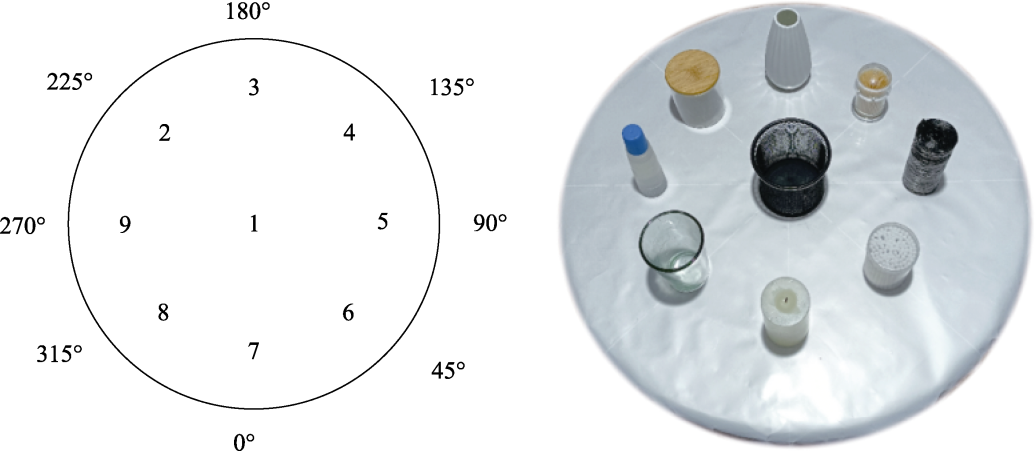
图1 实验场景结构与实景图
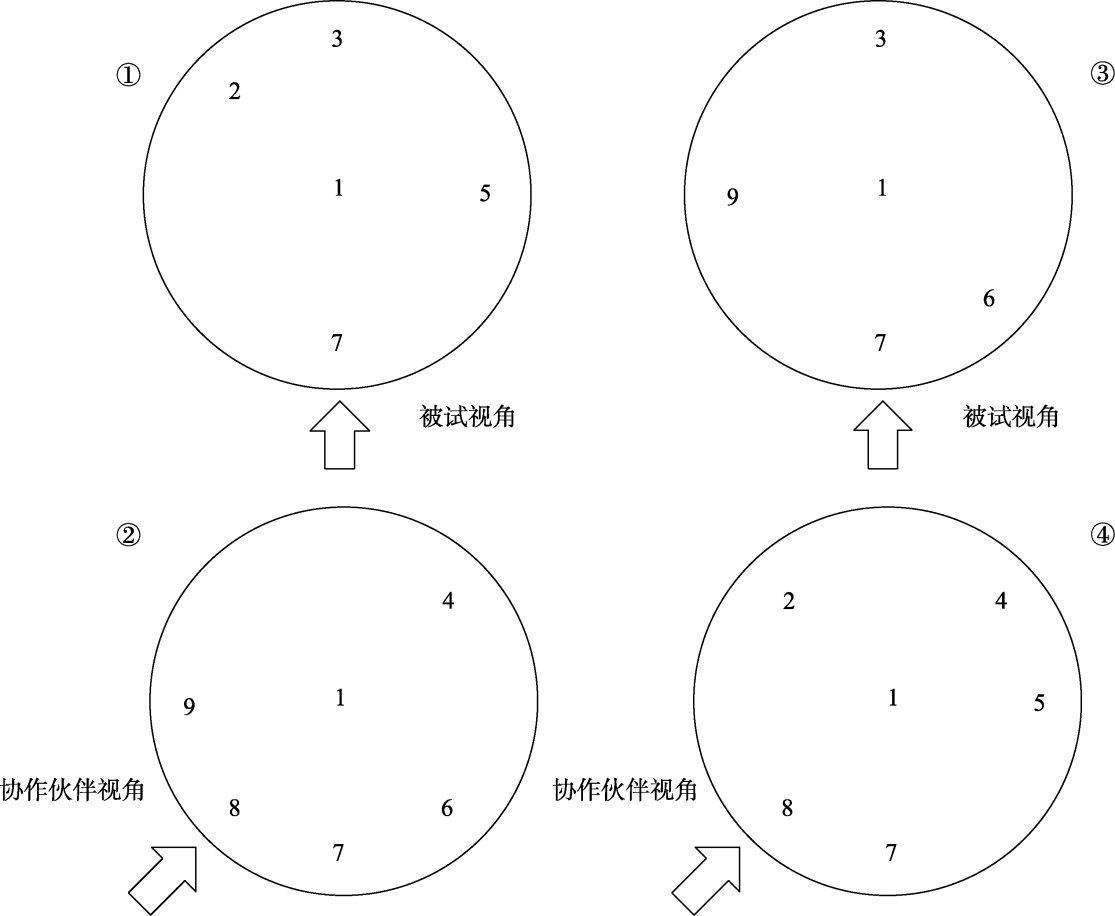
图2 实验1学习场景示意图

图3 测试阶段任务流程
| 想象朝向 | 0° | 45° | 90° | 135° | 180° | 225° | 270° | 315° |
|---|---|---|---|---|---|---|---|---|
| 指向误差 | 13.07(6.19) | 20.72(9.56) | 17.28(7.58) | 21.18(9.58) | 18.55(11.64) | 26.58(13.04) | 17.26(7.34) | 16.44(5.49) |
| 反应时 | 13.55(5.54) | 18.27(9.99) | 17.70(10.10) | 22.58(15.50) | 17.37(7.86) | 19.95(8.99) | 16.38(8.77) | 16.35(7.55) |
表1 实验1各想象朝向下的指向误差(度)和反应时(秒)的平均数M与标准差(SD)
| 想象朝向 | 0° | 45° | 90° | 135° | 180° | 225° | 270° | 315° |
|---|---|---|---|---|---|---|---|---|
| 指向误差 | 13.07(6.19) | 20.72(9.56) | 17.28(7.58) | 21.18(9.58) | 18.55(11.64) | 26.58(13.04) | 17.26(7.34) | 16.44(5.49) |
| 反应时 | 13.55(5.54) | 18.27(9.99) | 17.70(10.10) | 22.58(15.50) | 17.37(7.86) | 19.95(8.99) | 16.38(8.77) | 16.35(7.55) |
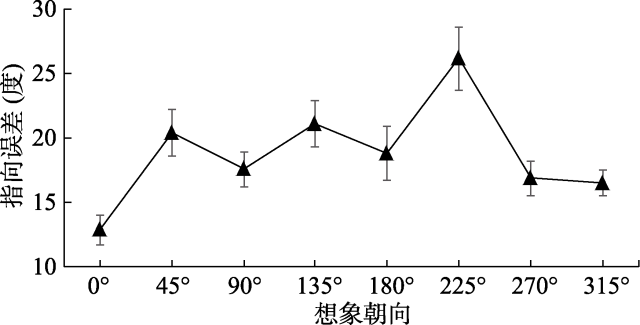
图4 实验1中不同想象朝向条件下的指向误差(误差线为±1SE, 下同)
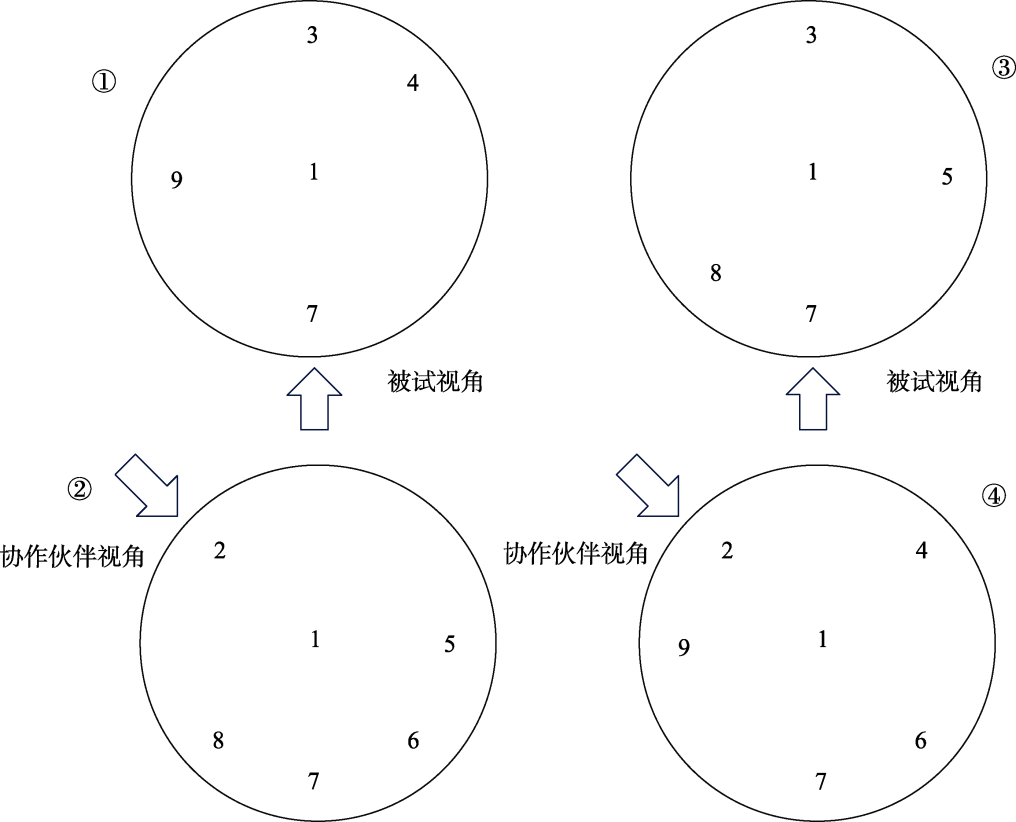
图5 实验2学习场景示意图
| 想象朝向 | 0° | 45° | 90° | 135° | 180° | 225° | 270° | 315° |
|---|---|---|---|---|---|---|---|---|
| 指向误差 | 12.08(7.74) | 18.18(9.04) | 18.04(8.44) | 21.24(13.26) | 15.37(7.21) | 18.14(9.27) | 16.94(8.93) | 15.45(6.19) |
| 反应时 | 12.88(2.95) | 17.00(5.43) | 17.90(6.24) | 20.74(8.28) | 17.16(6.29) | 20.18(8.00) | 16.59(4.88) | 16.47(6.28) |
表2 实验2各想象朝向下的指向误差(度)和反应时(秒)的平均数M与标准差(SD)
| 想象朝向 | 0° | 45° | 90° | 135° | 180° | 225° | 270° | 315° |
|---|---|---|---|---|---|---|---|---|
| 指向误差 | 12.08(7.74) | 18.18(9.04) | 18.04(8.44) | 21.24(13.26) | 15.37(7.21) | 18.14(9.27) | 16.94(8.93) | 15.45(6.19) |
| 反应时 | 12.88(2.95) | 17.00(5.43) | 17.90(6.24) | 20.74(8.28) | 17.16(6.29) | 20.18(8.00) | 16.59(4.88) | 16.47(6.28) |
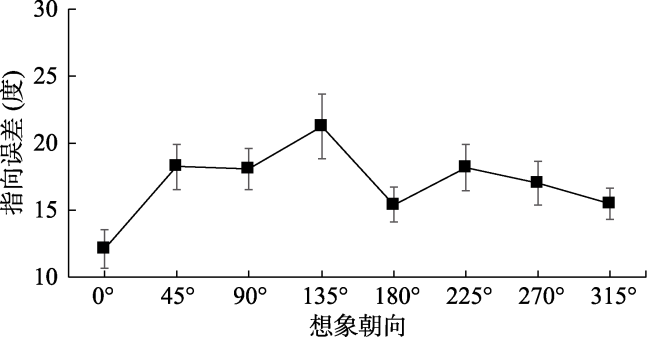
图6 实验2中不同想象朝向条件下的指向误差
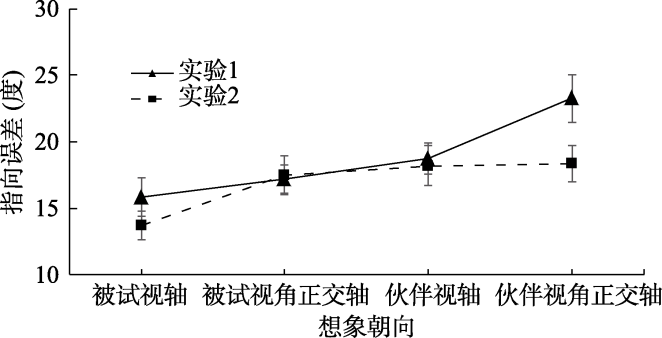
图7 实验1与实验2中4类想象朝向轴条件下的指向误差
| 想象朝向 | 0° | 45° | 90° | 135° | 180° | 225° | 270° | 315° |
|---|---|---|---|---|---|---|---|---|
| 指向误差 | 13.12(5.64) | 18.43(8.78) | 18.88(7.46) | 20.94(15.87) | 18.81(10.32) | 19.29(8.44) | 16.28(7.23) | 14.53(5.48) |
| 反应时 | 16.34(7.93) | 20.58(10.05) | 18.81(7.33) | 22.23(10.00) | 20.94(8.62) | 23.79(9.31) | 18.19(7.37) | 18.68(8.08) |
表3 实验3各想象朝向下的指向误差(度)和反应时(秒)的平均数M与标准差(SD)
| 想象朝向 | 0° | 45° | 90° | 135° | 180° | 225° | 270° | 315° |
|---|---|---|---|---|---|---|---|---|
| 指向误差 | 13.12(5.64) | 18.43(8.78) | 18.88(7.46) | 20.94(15.87) | 18.81(10.32) | 19.29(8.44) | 16.28(7.23) | 14.53(5.48) |
| 反应时 | 16.34(7.93) | 20.58(10.05) | 18.81(7.33) | 22.23(10.00) | 20.94(8.62) | 23.79(9.31) | 18.19(7.37) | 18.68(8.08) |
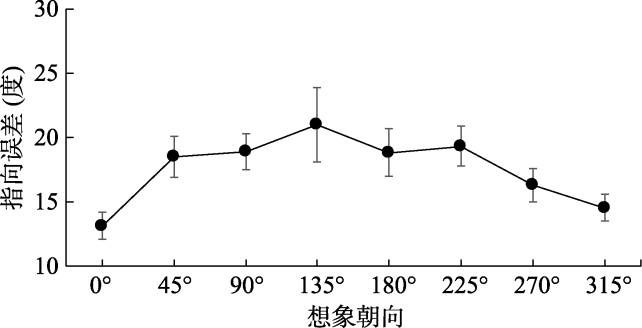
图8 实验3中不同想象朝向条件下的指向误差
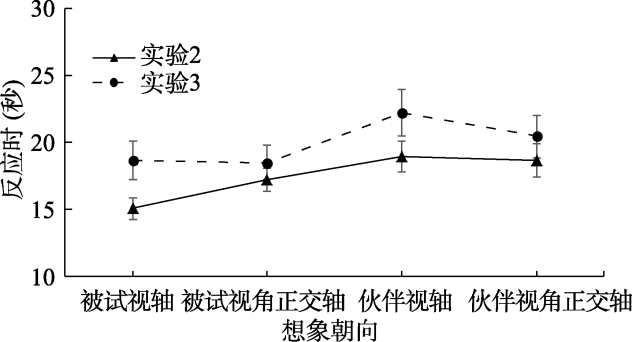
图9 实验2与实验3中4类想象朝向轴条件下的反应时
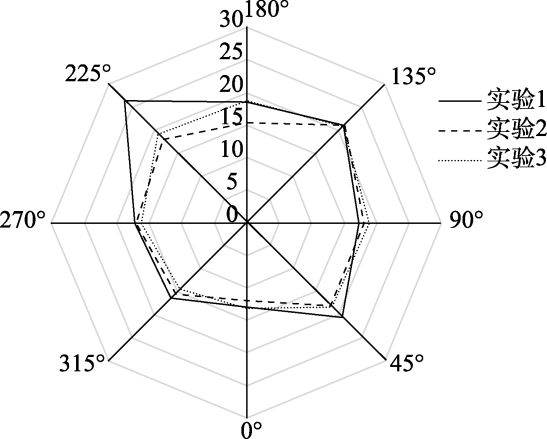
图10 三个实验中不同想象朝向条件下的指向误差比较(单位:度)
| [1] |
Christou, C. G., & Bülthoff, H. H. (1999). View dependence in scene recognition after active learning. Memory & Cognition, 27(6), 996-1007.
doi: 10.3758/BF03201230 URL |
| [2] |
Dou, Y., & Li, J. (2024). The spontaneity of Level-1 visual perspective taking: Under the condition of multiple avatars. Acta Psychologica Sinica, 56(4), 421-434.
doi: 10.3724/SP.J.1041.2024.00421 |
|
[豆艳, 李晶. (2024). 多对象情境中一级视觉视角采择的自发性表现. 心理学报, 56(4), 421-434.]
doi: 10.3724/SP.J.1041.2024.00421 |
|
| [3] |
Furlanetto, T., Cavallo, A., Manera, V., Tversky, B., & Becchio, C. (2013). Through your eyes: Incongruence of gaze and action increases spontaneous perspective taking. Frontiers in Human Neuroscience, 7, 455.
doi: 10.3389/fnhum.2013.00455 pmid: 23964228 |
| [4] | Freundlieb, M., Kovács, Á. M., & Sebanz, N. (2016). When do humans spontaneously adopt another’s visuospatial perspective? Journal of Experimental Psychology: Human Perception & Performance, 42(3), 401-412. |
| [5] | Freundlieb, M., Sebanz, N., Kovács, Á. M., Gauthier, I., & Enns, J. T. (2017). Out of your sight, out of my mind: Knowledge about another person’s visual access modulates spontaneous visuospatial perspective-taking. Journal of Experimental Psychology: Human Perception & Performance, 43(6), 1065-1072. |
| [6] |
Galati, A., & Avraamides, M. N. (2015). Social and representational cues jointly influence spatial perspective- taking. Cognitive Science, 39(4), 739-765.
doi: 10.1111/cogs.2015.39.issue-4 URL |
| [7] | Galati, A., Michael, C., Mello, C., Greenauer, N. M., & Avraamides, M. N. (2013). The conversational partner’s perspective affects spatial memory and descriptions. Journal of Memory & Language, 68(2), 140-159. |
| [8] |
Greenauer, N., & Waller, D. (2008). Intrinsic array structure is neither necessary nor sufficient for nonegocentric coding of spatial layouts. Psychonomic Bulletin & Review, 15(5), 1015-1021.
doi: 10.3758/PBR.15.5.1015 URL |
| [9] | Hatzipanayioti, A., & Avraamides, M. N. (2021). Alignment effects in spatial perspective taking from an external vantage point. Brain Sciences, 11(2), 204. |
| [10] |
Hegarty, M., Richardson, A. E., Montello, D. R., Lovelace, K., & Subbiah., I. (2002). Development of a self-report measure of environmental spatial ability. Intelligence, 30, 425-447.
doi: 10.1016/S0160-2896(02)00116-2 URL |
| [11] |
Holmes, C. A., Newcombe, N., S., & Shipley, T. F. (2018). Move to learn: Integrating spatial information from multiple viewpoints. Cognition, 178, 7-25.
doi: S0010-0277(18)30121-5 pmid: 29758479 |
| [12] |
Kelly, J. W., Costabile, K. A., & Cherep, L. A. (2018). Social effects on reference frame selection. Psychonomic Bulletin & Review, 25(6), 2339-2345.
doi: 10.3758/s13423-018-1429-6 |
| [13] | Klatzky, R., L. (1998). Allocentric and egocentric spatial representations:Definitions, distinctions, and interconnections. In: FreksaC., HabelC., WenderK. F. (eds.) Spatial cognition. Lecture notes in artificial intelligence 1404 (pp. 1-18). Berlin: Springer-Verlag. |
| [14] |
Kuhn, G., Vacaityte, I., D’Souza, A. D. C., Millett, A. C., & Cole, G. G. (2018). Mental states modulate gaze following, but not automatically. Cognition, 180, 1-9.
doi: S0010-0277(18)30146-X pmid: 29981964 |
| [15] |
Li, X., Mou, W., & McNamara, T. P. (2009). Intrinsic orientation and study viewpoint in recognizing spatial structure of a shape. Psychonomic Bulletin & Review, 16, 518-523.
doi: 10.3758/PBR.16.3.518 URL |
| [16] | Li, J., & Su, W. (2015). The limited effect of coincident orientation on the choice of intrinsic axis. Perceptual & Motor Skills, 120(3), 895-905. |
| [17] | Li, J., Wang, Q., Xie, N., & Qi, P. (2026). Multi-perspective spatial memory representation in the presence of others. Cognitive Processing. https://doi.org/10.1007/s10339-025-01327-z |
| [18] |
Li, J. & Zhang, K. (2011). The effect of orientation coincidence of objects on intrinsic frame of reference system in symmetrical scene. Acta Psychologica Sinica, 43(3), 221-228.
doi: 10.3724/SP.J.1041.2011.00221 URL |
| [李晶, 张侃. (2011). 对称场景中朝向一致性对内在参照系的影响. 心理学报, 43(3), 221-228.] | |
| [19] |
Mou, W., Fan, Y., McNamara, T. P., & Owen, C. B. (2008). Intrinsic frames of reference and egocentric viewpoints in scene recognition. Cognition, 106(2), 750-769.
pmid: 17540353 |
| [20] | Mou, W., & McNamara, T. P. (2002). Intrinsic frames of reference in spatial memory. Journal of Experimental Psychology: Learning, Memory, & Cognition, 28(1), 162-170. |
| [21] | Mou, W., Zhao, M., & McNamara, T. P. (2007). Layout geometry in the selection of intrinsic frames of reference from multiple viewpoints. Journal of Experimental Psychology: Learning, Memory, & Cognition, 33, 145-154. |
| [22] | Mou, W., Liu, X., & McNamara, T. P. (2009). Layout geometry in encoding and retrieval of spatial memory. Journal of Experimental Psychology: Human Perception & Performance, 35(1), 83-93. |
| [23] |
Salm-Hoogstraeten, S. V., & Müsseler, J. (2021). Human cognition in interaction with robots: Taking the robot’s perspective into account. Human Factors, 63(8), 1396-1407.
doi: 10.1177/0018720820933764 URL |
| [24] | Schafer, W., & Bowman, D. (2004). Evaluating the effects of frame of reference on spatial collaboration using desktop collaborative virtual environments. Virtual Reality, 7, 164-174. |
| [25] | Schober, M., F. (2009). Spatial dialogue between partners with mismatched abilities. In K.R.Coventry, T.Tenbrink, & J. A.Bateman (Eds.), Spatial language and dialogue (pp. 23-39). Oxford: Oxford University Press. |
| [26] |
Shelton, A. L., & McNamara, T. P. (2001). Systems of spatial reference in human memory. Cognitive Psychology, 43, 274-310.
pmid: 11741344 |
| [27] |
Shelton, A. L., & McNamara, T. P. (2004). Spatial memory and perspective taking. Memory & Cognition, 32(3), 416-426.
doi: 10.3758/BF03195835 URL |
| [28] |
Simons, D. J., & Wang, R. F. (1998). Perceiving real-world viewpoint changes. Psychological Science, 9(4), 315-320.
doi: 10.1111/1467-9280.00062 URL |
| [29] |
Sjolund, L. A., Erdman, M., & Kelly, J. W. (2014). Collaborative inhibition in spatial memory retrieval. Memory & Cognition, 42(6), 876-885.
doi: 10.3758/s13421-014-0407-0 URL |
| [30] |
Song, X., & Dong, M. (2023). A multidimensional representation model of interpersonal collaboration: From the perspective of cognitive representation. Advances in Psychological Science, 31(7), 1288-1302.
doi: 10.3724/SP.J.1042.2023.01288 |
|
[宋晓蕾, 董梅梅. (2023). 人际协同的多重表征模型——基于认知表征的视角. 心理科学进展, 31(7), 1288-1302.]
doi: 10.3724/SP.J.1042.2023.01288 |
|
| [31] |
Song, X., Li, Y., & Zhang, K. (2024). Regional differences of large-scale spatial orientation ability in virtual environment. Acta Psychologica Sinica, 56(1), 1-14.
doi: 10.3724/SP.J.1041.2024.00001 |
|
[宋晓蕾, 李宜倩, 张凯歌. (2024). 虚拟环境中大尺度空间定向能力的地域差异. 心理学报, 56(1), 1-14.]
doi: 10.3724/SP.J.1041.2024.00001 |
|
| [32] | Street, W. N., & Wang, R. F. (2014). Differentiating spatial memory from spatial transformations. Journal of Experimental Psychology: Learning, Memory, & Cognition, 40(2), 602-608. |
| [33] | Tinti, C., Chiesa, S., Cavaglià, R., Dalmasso, S., Pia, L., & Schmidt, S. (2018). On my right or on your left? Spontaneous spatial perspective taking in blind people. Consciousness & Cognition, 62, 1-8. |
| [34] |
Valiquette, C. M., McNamara, T. P., & Smith, K. (2003). Locomotion, incidental learning, and the selection of spatial reference systems. Memory & Cognition, 31(3), 479-489.
doi: 10.3758/BF03194405 URL |
| [35] |
Wang, Y., Yu, X., Dou, Y., McNamara, T. P., & Li, J. (2021). Mental representations of recently learned nested environments. Psychological Research, 85(8), 2922-2934.
doi: 10.1007/s00426-020-01447-5 pmid: 33211160 |
| [36] |
Ward, E., Ganis, G., McDonough, K. L., & Bach, P. (2020). Perspective taking as virtual navigation? Perceptual simulation of what others see reflects their location in space but not their gaze. Cognition, 199, 104241.
doi: 10.1016/j.cognition.2020.104241 URL |
| [37] |
Xie, C., Liu, Q., Li, A., Tao, W., & Sun, H. (2009). Frame of reference in the mental representation of objects layout. Acta Psychologica Sinica, 41(5), 414-423.
doi: 10.3724/SP.J.1041.2009.00414 URL |
| [谢超香, 刘强, 黎安娟, 陶维东, 孙弘进. (2009). 空间场景表征中的参照系选取. 心理学报, 41(5), 414-423.] | |
| [38] | Xie, N. (2020). The representation of spatial scenes in perspective taking condition [Unpublished master’s thesis]. Nanjing Normal University. |
| [谢宁. (2020). 视角采择情境下的空间场景表征 (硕士学位论文). 南京师范大学.] | |
| [39] | Xiao, C., Fan, Y., Xu, L., & Zhou, R. (2019). Human-centered human-robot natural spatial language interaction. Chinese Journal of Applied Psychology, 25(4), 319-331. |
| [肖承丽, 范丫, 徐刘飞, 周仁来. (2019). 以人为中心的人-机器人自然空间语言交互. 应用心理学, 25(4), 319-331.] | |
| [40] |
Xiao, C., Sui, Y., Xiao, S., & Zhou, R. (2021). A new perspective on spatial interaction research: The effects of multiple social factors. Advances in Psychological Science, 29(5), 796-805.
doi: 10.3724/SP.J.1042.2021.00796 |
|
[肖承丽, 隋雨檠, 肖苏衡, 周仁来. (2021). 空间交互研究新视角:多重社会因素的影响. 心理科学进展, 29(5), 796-805.]
doi: 10.3724/SP.J.1042.2021.00796 |
|
| [41] | Xu, Z. (2017). The effect of different visibility of perspective taking target on the automatic perspective taking. [Unpublished master’s thesis]. Zhejiang University. |
| [徐阵雁. (2017). 观点采择对象的可视性对自动观点采择的影响 (硕士学位论文). 浙江大学.] | |
| [42] | Zhao, M., & Mou, W. (2005). Orientation specificity of spatial representation in multi-view learning. Acta Psychologica Sinica, 37(3), 308-313. |
| [赵民涛, 牟炜民. (2005). 多视点学习条件下空间表征的朝向特异性. 心理学报, 37(3), 308-313.] | |
| [43] | Zhou, J., Peng, Y., Li, Y., Deng, X., & Chen, H. (2022). Spontaneous perspective taking of an invisible person. Journal of Experimental Psychology: Human Perception & Performance, 48(11), 1186-1200. |
| [44] | Zhou, R., & Zhang, K. (2005). Direction judgments based on integrating reference frames in imagination. Chinese Journal of Ergonomics, 11(2), 7-9+12. |
| [周荣刚, 张侃. (2005). 基于参照系整合的想象空间方位转化判断. 人类工效学, 11(2), 7-9+12. ] |
| [1] | 简尽涵, 张军恒, 晏碧华, 姬鸣. 空间语言交互在不同视角下的多线索影响机制[J]. 心理学报, 2025, 57(6): 1013-1040. |
| [2] | 宋晓蕾, 李宜倩, 张凯歌. 虚拟环境中大尺度空间定向能力的地域差异[J]. 心理学报, 2024, 56(1): 1-14. |
| [3] | 谢超香,刘强,黎安娟,陶维东,孙弘进. 空间场景表征中的参照系选取 [J]. 心理学报, 2009, 41(05): 414-423. |
| [4] | 赵民涛,牟炜民. 多视点学习条件下空间表征的朝向特异性[J]. 心理学报, 2005, 37(03): 308-313. |
| 阅读次数 | ||||||
|
全文 |
|
|||||
|
摘要 |
|
|||||
