

ISSN 0439-755X
CN 11-1911/B
主办:中国心理学会
中国科学院心理研究所
出版:科学出版社
CN 11-1911/B
主办:中国心理学会
中国科学院心理研究所
出版:科学出版社
心理学报 ›› 2026, Vol. 58 ›› Issue (4): 618-633.doi: 10.3724/SP.J.1041.2026.0618 cstr: 32110.14.2026.0618
侯春娜1( ), 马一升1, 伍麟2(), 刘志军3
收稿日期:2025-02-11
发布日期:2026-01-16
出版日期:2026-04-25
通讯作者:
伍麟, E-mail: wlin@whu.edu.cn;基金资助:
HOU Chunna1(), MA Yisheng1, WU Lin2(), LIU Zhijun3
Received:2025-02-11
Online:2026-01-16
Published:2026-04-25
摘要:
研究基于特质归因理论, 采用反向相关图像分类技术考察了面孔引发社会排斥的心理表征内容及特质推断模式。以中国大学生为被试, 研究1通过启动社会排斥情境后执行双图像迫选任务, 发现被排斥者的面孔心理表征包含可信性与支配性特质信息, 鼻子和嘴巴(可信性)、眉毛(支配性)是核心诊断信息区域。研究2 客观测量和主观评估一致表明, 低可信、低支配心理表征是社会排斥的典型特质特征, 在社会排斥的特质推断过程中均发挥关键作用。其中低可信性作用权重更大, 有力支持可信性优先假说。研究揭示了面孔心理表征在社会排斥过程中的作用, 把可信性优先机制从言语材料扩展到面孔刺激, 为理解高级社会认知层面的排斥过程提供了新的理论依据。
中图分类号:
侯春娜, 马一升, 伍麟, 刘志军. (2026). 面孔社会排斥的心理表征及推断模式. 心理学报, 58(4), 618-633.
HOU Chunna, MA Yisheng, WU Lin, LIU Zhijun. (2026). The mental representation and inference patterns of facial social exclusion. Acta Psychologica Sinica, 58(4), 618-633.

图1 RCIC备择式面孔刺激对的生成示意图

图2 社会排斥与社会接纳的RCIC分析效果图示 注:(a)心理表征的可视化图像; (b)群体分类图像; (c)群体分类图像有效面孔区域3D热图, 其中红色表示暗像素, 蓝色表示亮像素。彩图见电子版, 下同。
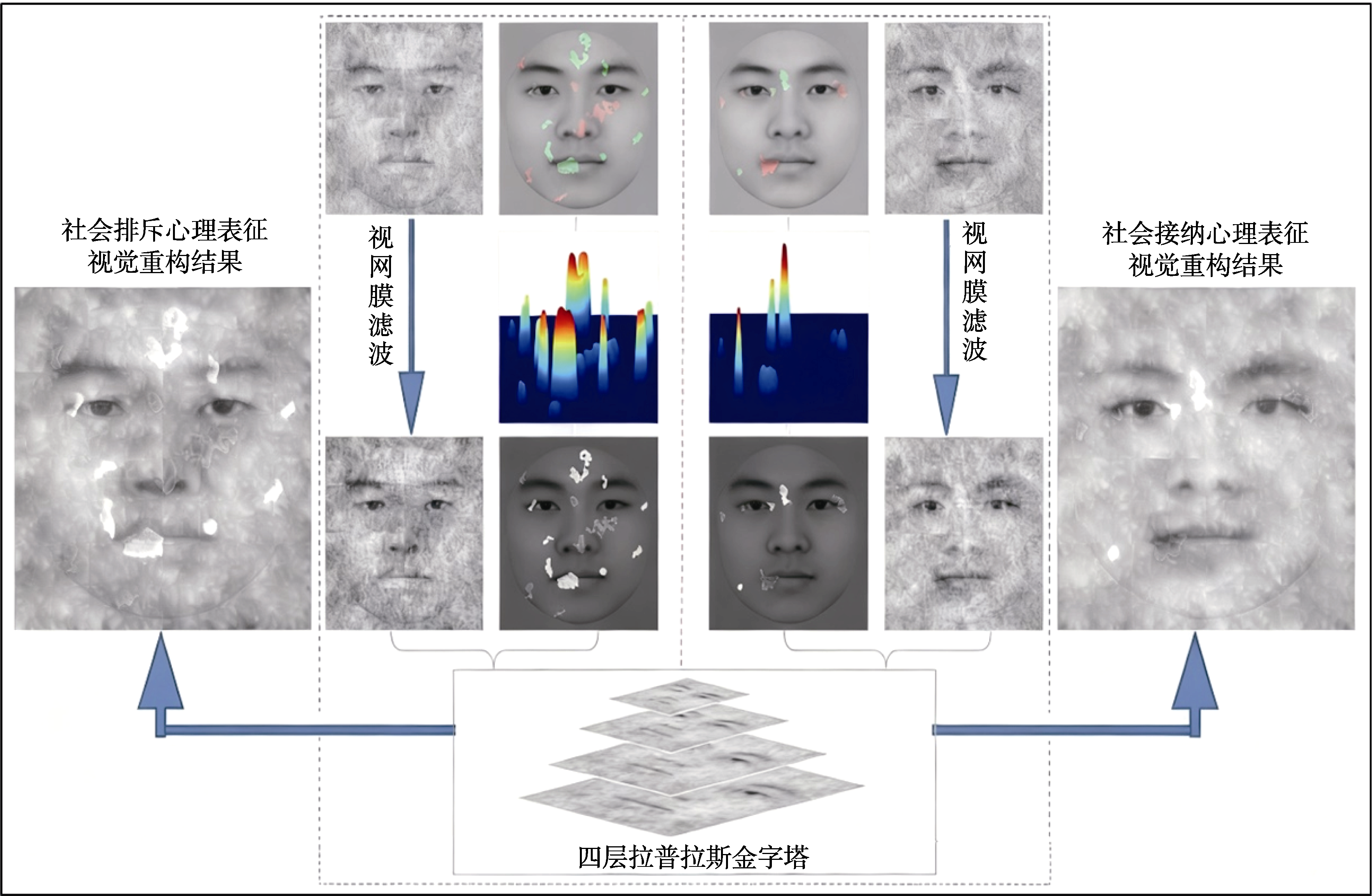
图3 社会排斥心理及社会接纳心理表征的视觉重构示意图
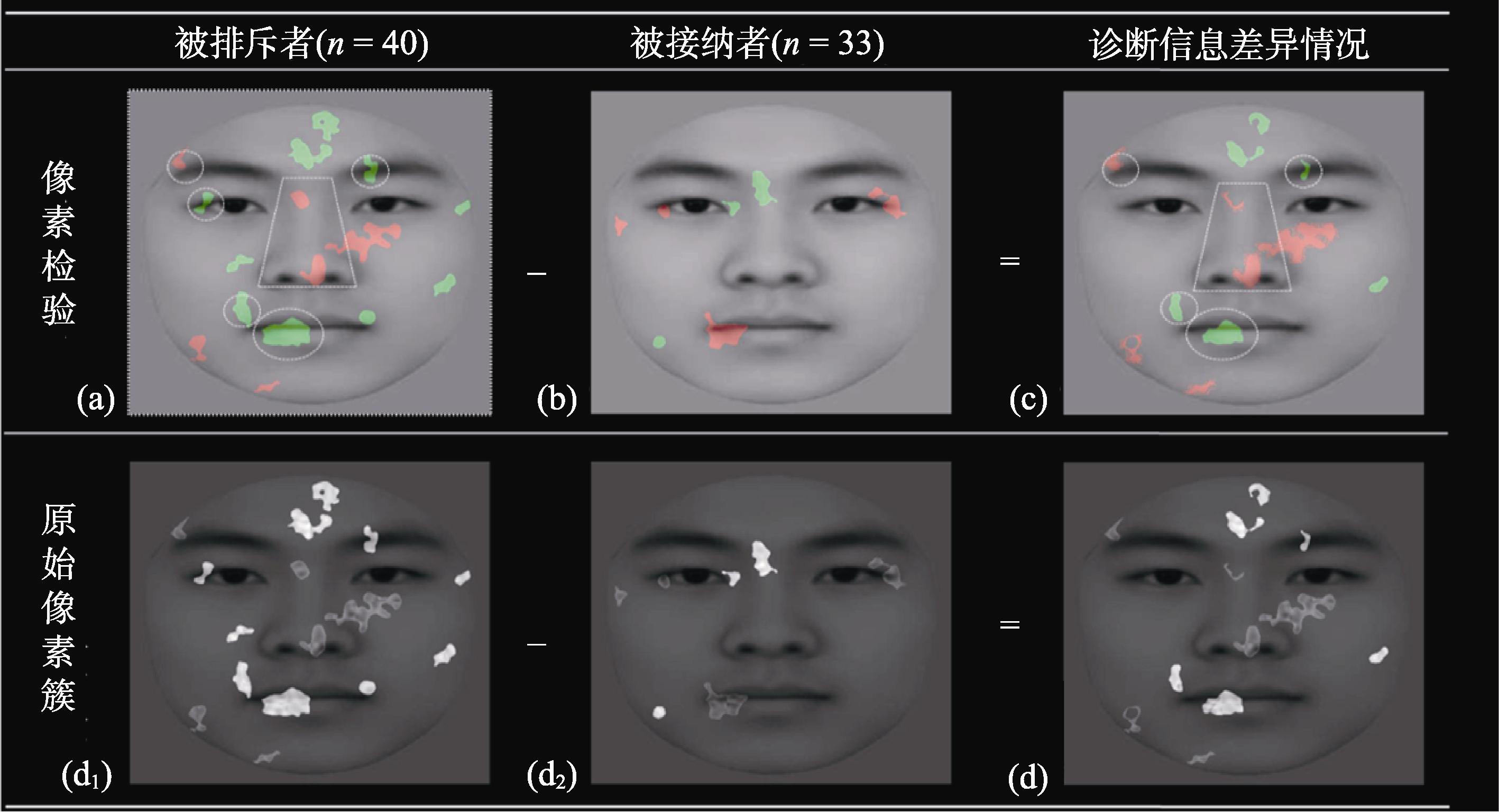
图4 像素检验结果及诊断信息差异情况
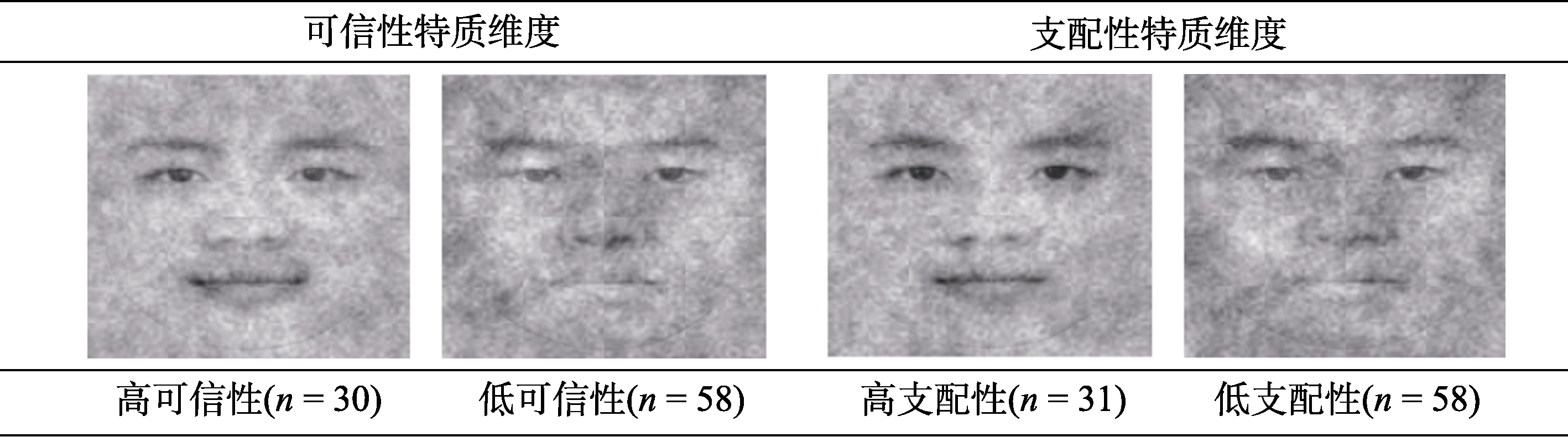
图5 四种特质类型的面孔心理表征形象
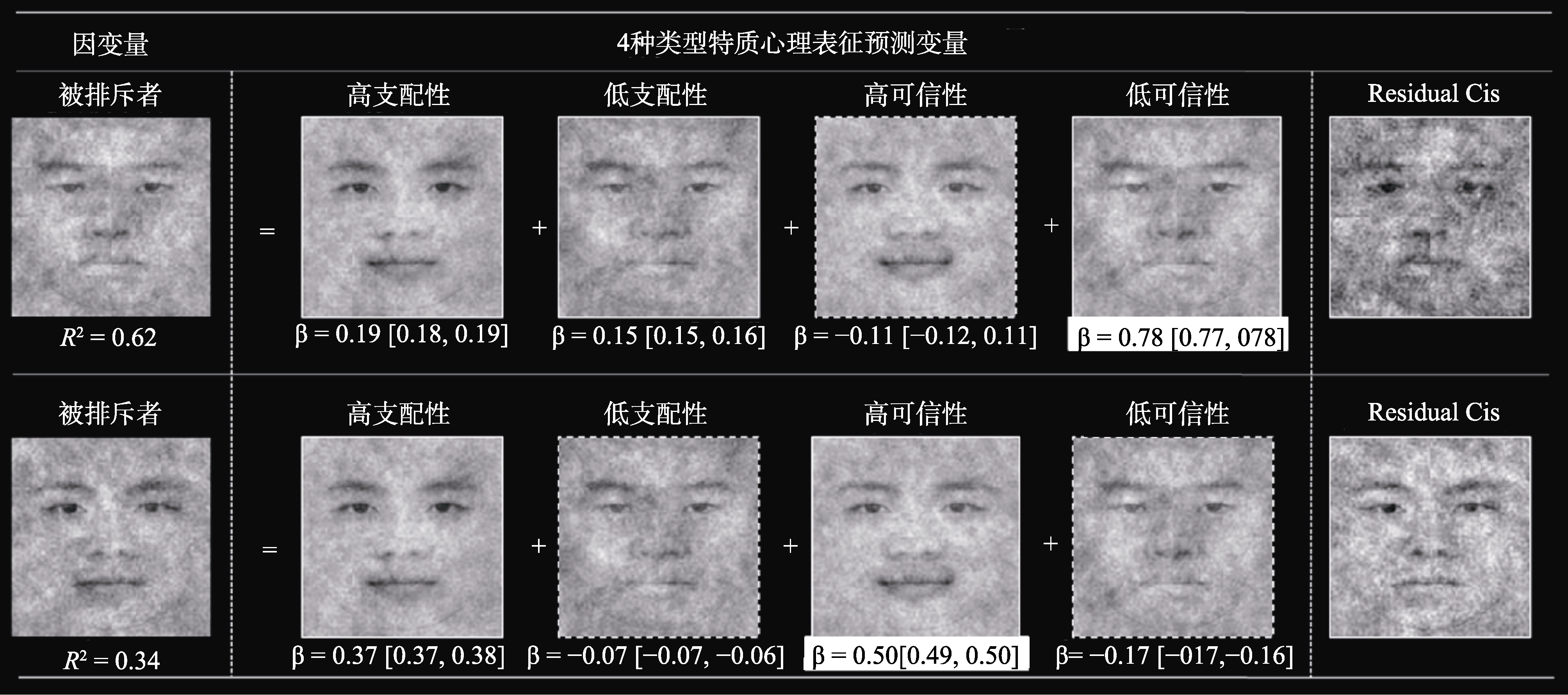
图6 不同单一特质对社会排斥心理表征的像素回归预测情况
| 单一特质维度 | 社会排斥 | 社会接纳 | 低可信性 | 低支配性 | 高可信性 | 高支配性 |
|---|---|---|---|---|---|---|
| 低可信性 | 0.82*** | 0.08 | — | |||
| 低支配性 | 0.76*** | −0.09 | 0.78*** | — | ||
| 高可信性 | 0.02 | 0.92*** | 0.03 | −0.15 | — | |
| 高支配性 | −0.10 | 0.17* | −0.06 | −0.06 | 0.15 | — |
表1 社会排斥与社会接纳心理表征与单一特质评估的相关情况(n=153)
| 单一特质维度 | 社会排斥 | 社会接纳 | 低可信性 | 低支配性 | 高可信性 | 高支配性 |
|---|---|---|---|---|---|---|
| 低可信性 | 0.82*** | 0.08 | — | |||
| 低支配性 | 0.76*** | −0.09 | 0.78*** | — | ||
| 高可信性 | 0.02 | 0.92*** | 0.03 | −0.15 | — | |
| 高支配性 | −0.10 | 0.17* | −0.06 | −0.06 | 0.15 | — |
| 预测变量 | 社会排斥心理表征 | 社会接纳心理表征 | ||||||
|---|---|---|---|---|---|---|---|---|
| β | SE | Beta | t | β | SE | Beta | t | |
| 截距 | −1.33 | 0.031 | −42.82*** | 2.76 | 0.027 | 103.86*** | ||
| 低可信性 | 0.21 | 0.028 | 0.54 | 7.41*** | 0.03 | 0.024 | 0.05 | 1.03 |
| 低支配性 | 0.16 | 0.033 | 0.35 | 4.75*** | 0.00 | 0.028 | 0.00 | 0.03 |
| 高可信性 | 0.03 | 0.018 | 0.07 | 1.49 | 0.44 | 0.016 | 0.92 | 28.13*** |
| 高支配性 | −0.03 | 0.021 | −0.06 | −1.30 | 0.02 | 0.018 | 0.04 | 1.38 |
| R = 0.84 R2 = 0.71 Adj R2 = 0.70 | R = 0.93 R2 = 0.86 Adj R2 = 0.85 | |||||||
表2 单一特质类型对社会排斥及社会接纳的回归预测情况(n=153)
| 预测变量 | 社会排斥心理表征 | 社会接纳心理表征 | ||||||
|---|---|---|---|---|---|---|---|---|
| β | SE | Beta | t | β | SE | Beta | t | |
| 截距 | −1.33 | 0.031 | −42.82*** | 2.76 | 0.027 | 103.86*** | ||
| 低可信性 | 0.21 | 0.028 | 0.54 | 7.41*** | 0.03 | 0.024 | 0.05 | 1.03 |
| 低支配性 | 0.16 | 0.033 | 0.35 | 4.75*** | 0.00 | 0.028 | 0.00 | 0.03 |
| 高可信性 | 0.03 | 0.018 | 0.07 | 1.49 | 0.44 | 0.016 | 0.92 | 28.13*** |
| 高支配性 | −0.03 | 0.021 | −0.06 | −1.30 | 0.02 | 0.018 | 0.04 | 1.38 |
| R = 0.84 R2 = 0.71 Adj R2 = 0.70 | R = 0.93 R2 = 0.86 Adj R2 = 0.85 | |||||||
| [1] |
Blais C., Roy C., Fiset D., Arguin M., & Gosselin F. (2012). The eyes are not the window to basic emotions. Neuropsychologia, 50(12), 2830-2838.
doi: 10.1016/j.neuropsychologia.2012.08.010 pmid: 22974675 |
| [2] |
Casini E., Glemser C., Premoli M., Preti E., & Richetin J. (2022). The mediating role of emotion regulation strategies on the association between rejection sensitivity, aggression, withdrawal, and prosociality. Emotion, 22(7), 1505-1516.
doi: 10.1037/emo0000908 URL |
| [3] | Chattalas M. J. (2005). The effects of national stereotypes on country of origin-based product evaluations. New York: City University of New York. |
| [4] |
Chen F., Guo T., & Wang J. (2024). Divergent effects of warmth and competence social rejection: An explanation based on the need-threat model. Journal of Personality and Social Psychology, 126(3), 461-476.
doi: 10.1037/pspi0000440 URL |
| [5] |
Chen L., Zeng S., & Su Y. (2023). The influence of social exclusion on adolescents' social withdrawal behavior: The moderating role of connectedness to nature. Journal of Environmental Psychology, 87, 101951.
doi: 10.1016/j.jenvp.2022.101951 URL |
| [6] | Chen Z., Du J., Xiang M., Zhang Y., & Zhang S. (2017). Social exclusion leads to attentional bias to emotional social information: Evidence from eye movement. PLOS ONE, 12(10), e0186313. |
| [7] |
Cuddy A. J., Fiske S. T., Kwan V. S., Glick P., Demoulin S., Leyens J. P.,... Ziegler R. (2009). Stereotype content model across cultures: Towards universal similarities and some differences. British Journal of Social Psychology, 48(1), 1-33.
doi: 10.1348/014466608X314935 URL |
| [8] |
Dickerson K. L., & Quas J. A. (2024). Compensatory prosocial behavior in high-risk adolescents observing social exclusion: The effects of emotion feedback. Journal of Experimental Child Psychology, 241, 105840.
doi: 10.1016/j.jecp.2023.105840 URL |
| [9] |
Dotsch R., & Todorov A. (2012). Reverse correlating social face perception. Social Psychological and Personality Science, 3(5), 562-571.
doi: 10.1177/1948550611430272 URL |
| [10] |
Dotsch R., Wigboldus D., Langner O., & van Knippenberg A. (2008). Ethnic out-group faces are biased in the prejudiced mind. Psychological Science, 19(10), 978-980.
doi: 10.1111/j.1467-9280.2008.02186.x pmid: 19000205 |
| [11] |
Faul F., Erdfelder E., Lang A. G., & Buchner A. (2007). G*Power 3: A flexible statistical power analysis program for the social, behavioral, and biomedical sciences. Behavior Research Methods, 39(2), 175-191.
doi: 10.3758/bf03193146 pmid: 17695343 |
| [12] |
Fiske S. T. (2015). Intergroup biases: A focus on stereotype content. Current Opinion in Behavioral Sciences, 3, 45-50.
pmid: 27453920 |
| [13] |
Fiske S. T., Cuddy A. J., & Glick P. (2007). Universal dimensions of social cognition: Warmth and competence. Trends in Cognitive Sciences, 11(2), 77-83.
doi: 10.1016/j.tics.2006.11.005 pmid: 17188552 |
| [14] | Giacomin M., Tskhay K. O., & Rule N. O. (2022). Gender stereotypes explain different mental prototypes of male and female leaders. The Leadership Quarterly, 33(6), 101578. |
| [15] | Gunaydin G., & DeLong J. E. (2015). Reverse correlating love: Highly passionate women idealize their partner’s facial appearance. PLOS ONE, 10(3), e0121094. |
| [16] |
Hales A. H., Wesselmann E. D., & Williams K. D. (2016). Prayer, self-affirmation, and distraction improve recovery from short-term ostracism. Journal of Experimental Social Psychology, 64, 8-20.
doi: 10.1016/j.jesp.2016.01.002 URL |
| [17] | Higgins J. P. T., Thompson S. G., Deeks J. J., & Altman D. G. (2003). Measuring inconsistency in meta-analyses. BMJ, 327(7414), 557-560. |
| [18] | Hou C. N. (2017). Faces: The evolutionary code of intergroup trust. Beijing: Science Press. |
| [侯春娜. (2017). 面孔: 群际信任的进化密码. 北京: 科学出版社] | |
| [19] |
Hou C. N., & Liu Z. J. (2019). Visualization of mental representation: Noise-based reverse correlation image classification technology. Advances in Psychological Science, 27(3), 465-474.
doi: 10.3724/SP.J.1042.2019.00465 URL |
|
[侯春娜, 刘志军. (2019). 心理表征的可视化途径: 基于噪音的反向相关图像分类技术. 心理科学进展, 27(3), 465-474.]
doi: 10.3724/SP.J.1042.2019.00465 |
|
| [20] | Hussey I., Alsalti T., Bosco F., Elson M., & Arslan R. (2025). An aberrant abundance of Cronbach’s alpha values at. 70. Advances in Methods and Practices in Psychological Science, 8(1), 25152459241287123. |
| [21] |
Jack R. E., & Schyns P. G. (2017). Toward a social psychophysics of face communication. Annual Review of Psychology, 68(1), 269-297.
doi: 10.1146/psych.2017.68.issue-1 URL |
| [22] |
Koo T. K., & Li M. Y. (2016). A guideline of selecting and reporting intraclass correlation coefficients for reliability research. Journal of Chiropractic Medicine, 15(2), 155-163.
doi: 10.1016/j.jcm.2016.02.012 pmid: 27330520 |
| [23] | Liu Z. J. (2021). A study on the facial compensatory effect of stereotype in intergroup cognition. Beijing: Social Sciences Academic Press. |
| [刘志军. (2021). 群际认知的刻板印象:面孔补偿效应. 北京: 社会科学文献出版社] | |
| [24] |
Ma F., Xu F., & Luo X. (2015). Children’s and adults’ judgments of facial trustworthiness: The relationship to facial attractiveness. Perceptual and Motor Skills, 121(1), 179-198.
doi: 10.2466/27.22.PMS.121c10x1 URL |
| [25] | Mo C., Cristofori I., Lio G., Gomez A., Duhamel J. R., Qu C., & Sirigu A. (2022). Culture-free perceptual invariant for trustworthiness. PLOS ONE, 17(2), e0263348. |
| [26] | Okazawa G., Sha L., Purcell B. A., & Kiani R. (2018). Psychophysical reverse correlation reflects both sensory and decision-making processes. Nature Communications, 9(1), 3479. |
| [27] |
Oliveira M., Garcia-Marques T., & Dotsch R. (2019). Combining traits into a face: A reverse correlation approach. Social Cognition, 37(5), 516-545.
doi: 10.1521/soco.2019.37.5.516 |
| [28] |
Oosterhof N. N., & Todorov A. (2008). The functional basis of face evaluation. Proceedings of the National Academy of Sciences, 105(32), 11087-11092.
doi: 10.1073/pnas.0805664105 URL |
| [29] |
Over H., & Uskul A. K. (2016). Culture moderates children’s responses to ostracism situations. Journal of Personality and Social Psychology, 110(5), 710-724
doi: 10.1037/pspi0000050 URL |
| [30] |
Park J., & Baumeister R. F. (2015). Social exclusion causes a shift toward prevention motivation. Journal of Experimental Social Psychology, 56, 153-159.
doi: 10.1016/j.jesp.2014.09.011 URL |
| [31] |
Rudert S. C., Keller M. D., Hales A. H., Walker M., & Greifeneder R. (2020). Who gets ostracized? A personality perspective on risk and protective factors of ostracism. Journal of Personality and Social Psychology, 118(6), 1247-1268.
doi: 10.1037/pspp0000271 pmid: 31599628 |
| [32] |
Rudert S. C., Reutner L., Greifeneder R., & Walker M. (2017). Faced with exclusion: Perceived facial warmth and competence influence moral judgments of social exclusion. Journal of Experimental Social Psychology, 68, 101-112.
doi: 10.1016/j.jesp.2016.06.005 URL |
| [33] | Schmitz M., Vanbeneden A., & Yzerbyt V. (2024). The many faces of compensation: The similarities and differences between social and facial models of perception. PLOS ONE, 19(2), e0297887. |
| [34] |
Sekuler A. B., Gaspar C. M., Gold J. M., & Bennett P. J. (2004). Inversion leads to quantitative, not qualitative, changes in face processing. Current Biology, 14(5), 391-396.
pmid: 15028214 |
| [35] |
Sofer C., Dotsch R., Oikawa M., Oikawa H., Wigboldus D. H., & Todorov A. (2017). For your local eyes only: Culture-specific face typicality influences perceptions of trustworthiness. Perception, 46(8), 914-928.
doi: 10.1177/0301006617691786 pmid: 28152651 |
| [36] | Soto F. A., Escobar K., & Salan J. (2020). Adaptation aftereffects reveal how categorization training changes the encoding of face identity. Journal of Vision, 20(10), 18, 1-24. |
| [37] |
Sutherland C. A., Oldmeadow J. A., & Young A. W. (2016). Integrating social and facial models of person perception: Converging and diverging dimensions. Cognition, 157, 257-267.
doi: S0010-0277(16)30229-3 pmid: 27689511 |
| [38] |
Sutherland C. A., Rhodes G., Burton N. S., & Young A. W. (2020). Do facial first impressions reflect a shared social reality?. British Journal of Psychology, 111(2), 215-232.
doi: 10.1111/bjop.12390 pmid: 30924928 |
| [39] |
Syrjämäki A. H., & Hietanen J. K. (2020). Social inclusion, but not exclusion, delays attentional disengagement from direct gaze. Psychological Research, 84(4), 1126-1138.
doi: 10.1007/s00426-018-1108-2 pmid: 30324264 |
| [40] |
Todorov A., Olivola C. Y., Dotsch R., & Mende-Siedlecki P. (2015). Social attributions from faces: Determinants, consequences, accuracy, and functional significance. Annual Review of Psychology, 66(1), 519-545.
doi: 10.1146/psych.2015.66.issue-1 URL |
| [41] | Todorov A., & Oosterhof N. N. (2011). Modeling social perception of faces. IEEE Signal Processing Magazine, 28(2), 117-122. |
| [42] |
Todorov A., Pakrashi M., & Oosterhof N.N. (2009). Evaluating faces on trustworthiness after minimal time exposure. Social Cognition, 27(6), 813-833.
doi: 10.1521/soco.2009.27.6.813 URL |
| [43] |
Todorov A., Said C. P., Engell A. D., & Oosterhof N. N. (2008). Understanding evaluation of faces on social dimensions. Trends in Cognitive Sciences, 12(12), 455-460.
doi: 10.1016/j.tics.2008.10.001 pmid: 18951830 |
| [44] | Vandewouw M. M., Choi E., Hammill C., Arnold P., Schachar R., Lerch J. P., … Taylor M. J. (2020). Emotional face processing across neurodevelopmental disorders: A dynamic faces study in children with autism spectrum disorder, attention deficit hyperactivity disorder and obsessive-compulsive disorder. Translational Psychiatry, 10(1), 375. |
| [45] | Wang Q., Hoi S. P., Wang Y., Song C., Li T., Lam C. M., … Yi L. (2020). Out of mind, out of sight? Investigating abnormal face scanning in autism spectrum disorder using gaze‐contingent paradigm. Developmental Science, 23(1), e12856. |
| [46] |
Wesselmann E. D., Bagg D., & Williams K. D. (2009). “I Feel Your Pain”: The effects of observing ostracism on the ostracism detection system. Journal of Experimental Social Psychology, 45(6), 1308-1311.
doi: 10.1016/j.jesp.2009.08.003 URL |
| [47] |
Wirth J. H., & Wesselmann E. D. (2018). Investigating how ostracizing others affects one’s self-concept. Self and Identity, 17(4), 394-406.
doi: 10.1080/15298868.2017.1385519 URL |
| [48] |
Wyer N. A., & Schenke K. C. (2016). Just you and i: The role of social exclusion in the formation of interpersonal relationships. Journal of Experimental Social Psychology, 65, 20-25.
doi: 10.1016/j.jesp.2016.02.007 URL |
| [1] | 陈子龙, 季琭妍. 多面孔情绪变异性的自动加工:来自视觉失匹配成分的证据[J]. 心理学报, 2025, 57(9): 1553-1571. |
| [2] | 王俊博, 赵娜, 李子媛, 刘强. 负性面孔的工作记忆离线态存储不影响在线态存储[J]. 心理学报, 2025, 57(8): 1323-1332. |
| [3] | 冯俊业, 王哲, 孙宇浩. 面孔身份匹配的多图像优势依赖面孔表征的形成[J]. 心理学报, 2025, 57(10): 1689-1700. |
| [4] | 孟现鑫, 罗怡, 韩晨媛, 吴国伟, 常姣, 袁加锦, 千坤, 傅小兰. 社会接纳调节社会排斥对情绪冲突适应的影响[J]. 心理学报, 2024, 56(5): 577-593. |
| [5] | 李庆功, 方溦, 胡超, 石德君, 胡晓晴, 傅根跃, 王乾东. 灰姑娘能变成白雪公主吗?感知到的信任对他人面孔表征的影响[J]. 心理学报, 2023, 55(9): 1518-1528. |
| [6] | 王妹, 程思, 李宜伟, 李红, 张丹丹. 背外侧前额叶在安慰剂效应中的作用:社会情绪调节研究[J]. 心理学报, 2023, 55(7): 1063-1073. |
| [7] | 王哲, 倪昊, 封丹, 严璘璘, 孙宇浩. 面孔熟悉过程中部件加工与整体加工的区域异步性和眼睛区域特异性[J]. 心理学报, 2023, 55(6): 861-876. |
| [8] | 靳娟娟, 邵蕾, 黄潇潇, 张亚利, 俞国良. 社会排斥与攻击的关系:一项元分析[J]. 心理学报, 2023, 55(12): 1979-1996. |
| [9] | 汪海玲, 陈恩光, 连玉净, 李晶晶, 王丽薇. 面孔宽高比的自动加工[J]. 心理学报, 2023, 55(11): 1745-1761. |
| [10] | 孙博, 曾宪卿, 许恺煜, 谢韵婷, 傅世敏. 情绪面孔的意识神经相关物及其无意识自动加工:来自事件相关电位的证据[J]. 心理学报, 2022, 54(8): 867-880. |
| [11] | 王哲, 陈亚春, 刘万鹏, 孙宇浩. 眼睛区域构型信息与特征信息的跨维共变增益效应及其加工特异性[J]. 心理学报, 2022, 54(3): 236-247. |
| [12] | 张妮, 刘文, 刘方, 郭鑫. 8~12岁儿童抑郁与认知重评的关系:悲伤面孔注意偏向的中介作用[J]. 心理学报, 2022, 54(1): 25-39. |
| [13] | 田欣然, 侯文霞, 欧玉晓, 易冰, 陈文锋, 尚俊辰. 基于合成平均刺激的平均表征机制——来自平均面孔吸引力的证据[J]. 心理学报, 2021, 53(7): 714-728. |
| [14] | 雷怡, 夏琦, 莫志凤, 李红. 面孔可爱度和客观熟悉度对婴儿面孔注意偏向效应的影响[J]. 心理学报, 2020, 52(7): 811-822. |
| [15] | 丁小斌, 王睿, 康铁君, 刘建邑, 周嘉宁. 他人面孔情绪知觉中自我参照与母亲参照的一致性:来自ERP的证据[J]. 心理学报, 2020, 52(6): 694-705. |
| 阅读次数 | ||||||
|
全文 |
|
|||||
|
摘要 |
|
|||||
