

ISSN 0439-755X
CN 11-1911/B
主办:中国心理学会
中国科学院心理研究所
出版:科学出版社
CN 11-1911/B
主办:中国心理学会
中国科学院心理研究所
出版:科学出版社
心理学报 ›› 2025, Vol. 57 ›› Issue (8): 1333-1348.doi: 10.3724/SP.J.1041.2025.1333 cstr: 32110.14.2025.1333
何全兴1, 李兆岚1, 杨海波1,2,3( )
)
收稿日期:2024-06-12
发布日期:2025-05-22
出版日期:2025-08-25
通讯作者:
杨海波, E-mail: yanghaibo@tjnu.edu.cn基金资助:
HE Quanxing1, LI Zhaolan1, YANG Haibo1,2,3()
Received:2024-06-12
Online:2025-05-22
Published:2025-08-25
摘要:
尽管物质成瘾患者和行为成瘾患者在反思系统和冲动系统存在异常激活模式, 但尚不清楚两者异常激活模式是否存在相似和差异。针对这一问题, 本研究采用激活似然估计(activation likelihood estimation, ALE), 对物质成瘾患者和行为成瘾患者在抑制控制和奖赏相关任务下的神经激活数据进行定量分析。经过文献检索和筛选后, 本研究共纳入102项功能核磁共振技术(fMRI)研究。元分析结果发现:(1)在抑制控制任务中, 物质成瘾患者的背外侧前额叶皮层激活降低, 行为成瘾患者相应脑区激活增强。(2)在奖赏加工相关任务中, 两组患者的纹状体激活均增强。这些结果表明, 在冲动系统上, 物质成瘾患者和行为成瘾患者存在共同激活特征; 而在反思系统上, 物质成瘾患者功能受损, 行为成瘾患者则可能出现补偿性激活。总之, 本研究揭示了物质成瘾患者和行为成瘾患者在冲动系统和反思系统存在共同的异常激活特征; 同时, 两者也表现出各自独特的神经激活模式。
中图分类号:
何全兴, 李兆岚, 杨海波. (2025). 物质成瘾患者和行为成瘾患者在纹状体和前额叶激活的异同:基于双系统模型的元分析. 心理学报, 57(8), 1333-1348.
HE Quanxing, LI Zhaolan, YANG Haibo. (2025). Dual-system perspectives: A meta-analytic comparison of striatal and prefrontal cortex activation patterns in substance addiction versus behavioral addiction. Acta Psychologica Sinica, 57(8), 1333-1348.
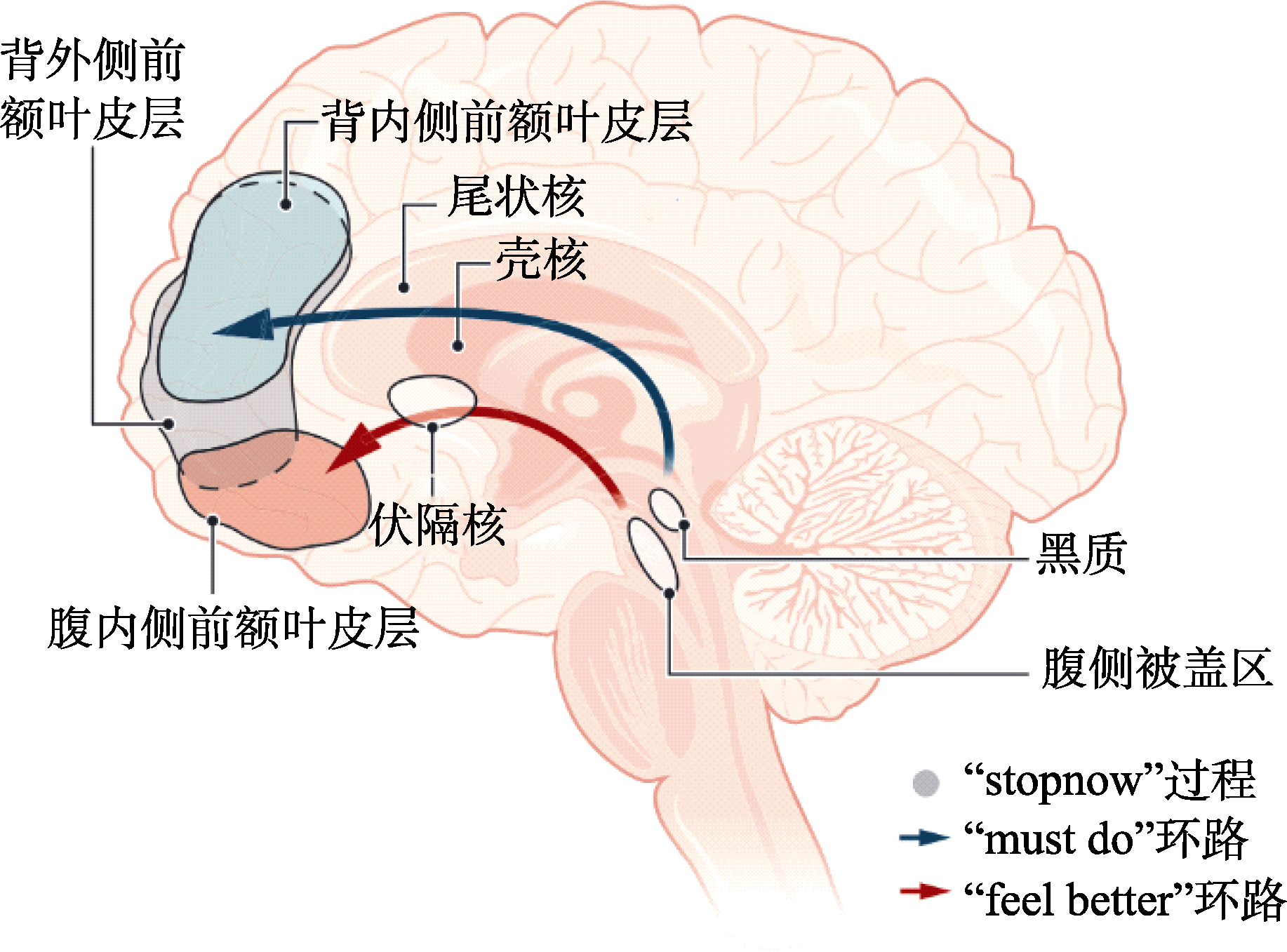
图1 成瘾发展的两个关键阶段:“feels better”和“must do”。“feels better”环路通过腹侧纹状体; “must do”环路通过背侧纹状体。执行功能的调节作用通过“stop now”环路实现, 该环路主要涉及背外侧前额叶皮层, 对于抑制冲动行为和成瘾行为至关重要。
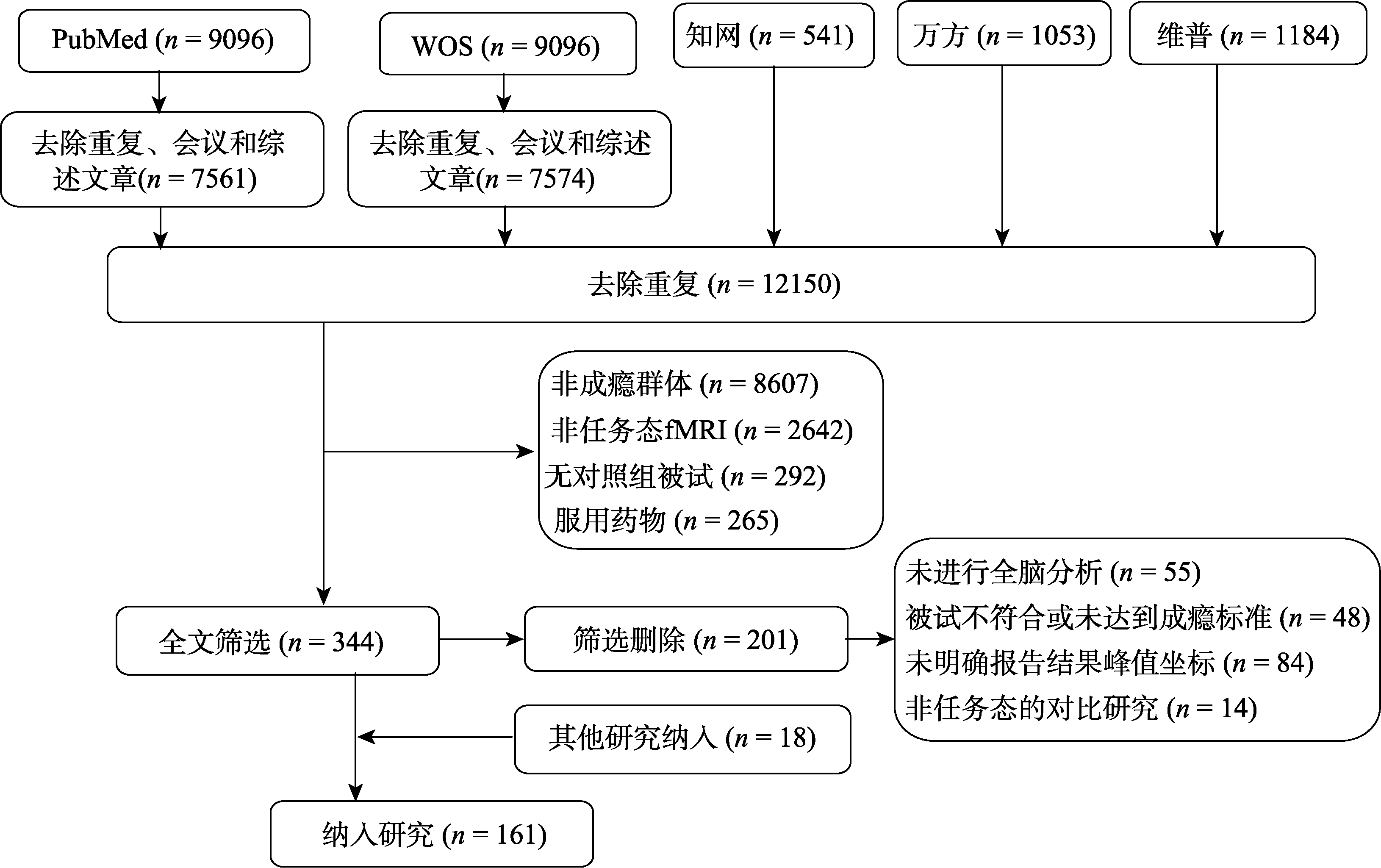
图2 文献筛选流程图 注:共有161篇文章符合“2.2 文章筛选和编码筛选标准”。在这些文献中, 我们进一步筛选出102篇, 作为本文的分析对象, 这些研究涵盖了奖赏相关任务和抑制相关任务两大类,本研究使用的文章已呈现在附录。所有研究的文献清单可通过以下链接获取:https://osf.io/7gkz6/
| 作者 | 成瘾组 | 成瘾组平均年龄(M ± SD) | 对照组 | 对照组平均年龄(M ± SD) | 成瘾物类型 | 任务 | ||
|---|---|---|---|---|---|---|---|---|
| 男 | 女 | 男 | 女 | |||||
| 抑制控制 | ||||||||
| Ahmadi et al., (2013) | 12 | 23 | 18.97 ± 0.45 | 31 | 25 | 18.80 ± 0.97 | 酒精 | Go/no-go |
| Ceceli, King, et al., (2023) | 31 | 9 | 40.90 ± 9.20 | 15 | 9 | 41.70 ± 11.30 | 海洛因 | Stop signal task |
| Ceceli, Parvaz, et al., ( | 24 | 4 | 44.07 ± 8.18 | 21 | 5 | 42.66 ± 7.05 | 可卡因 | Stop signal task |
| Cyr et al., (2019) | 17 | 11 | 19.30 ± 2 | 17 | 15 | 18.90 ± 2.70 | 大麻 | Simon task |
| Czapla et al., ( | 17 | 2 | 51.21 ± 7.36 | 17 | 4 | 41.95 ± 9.99 | 酒精 | Go/no-go |
| Fu et al., (2008) | 28 | 33.39 ± 5.98 | 15 | 29.59 ± 6.94 | 海洛因 | Go/no-go | ||
| Gerhardt et al., (2021) | 13 | 2 | 47 ± 12.30 | 9 | 6 | 41.90 ± 14.40 | 酒精 | Simon-task & Go-/no-no & Stop-signal tsk |
| Hester et al., (2013) | 13 | 2 | 38.20 | 13 | 2 | 42.70 | 可卡因 | Go/no-go |
| Jan et al., ( | 7 | 0 | 38.30 ± 5.60 | 7 | 3 | 32.30 ± 8.70 | 冰毒 | Stroop |
| Kalhan et al., (2022) | 10 | 10 | 24.30 ± 4.70 | 10 | 10 | 23.70 ± 4.30 | 尼古丁 | Stop-Signal Task |
| Kober et al., ( | 20 | 26.65 ± 9.81 | 20 | 29.20 ± 10.06 | 大麻 | Stroop color-word interference task | ||
| Li et al., (2008) | 15 | 37.70 ± 6.80 | 15 | 36.60 ± 6 | 可卡因 | Stop signal task | ||
| Li et al., (2009) | 18 | 6 | 38.70 ± 8.30 | 18 | 6 | 35.50 ± 5.90 | 酒精 | Stop signal task |
| Ma et al., (2015) | 12 | 1 | 37.40 ± 5.30 | 7 | 3 | 35.20 ± 7.30 | 可卡因 | Easy no-go |
| Moeller et al., (2012) | 28 | 5 | 44.20 ± 6.30 | 17 | 3 | 39.80 ± 5 | 可卡因 | Stroop |
| Moeller et al., (2014) | 28 | 5 | 18 | 2 | 39.60 ± 5.50 | 可卡因 | Stroop | |
| Morein-Zamir et al., (2013) | 30 | 2 | 34.53 ± 7.81 | 26 | 15 | 31.68 ± 8.49 | 兴奋剂依赖 | Stop-Signal Task |
| Müller-Oehring et al., (2019) | 10 | 8 | 49.60 ± 11 | 17 | 4 | 50.30 ± 9.50 | 酒精 | Addiction-Stroop color match-to- sample task |
| Nestor et al., (2011) | 5 | 5 | 33.50 ± 9.30 | 11 | 7 | 36.40 ± 10.40 | 冰毒 | Color-world Stroop |
| Schulte et al., ( | 18 | 51 ± 6.60 | 17 | 50 ± 14.90 | 酒精 | Stroop match-to-sample task | ||
| Stein et al., (2021) | 10 | 3 | 45.62 ± 10.01 | 9 | 5 | 37.71 ±12.82 | 酒精 | Go/no-go |
| Zerekidze et al., (2023) | 14 | 4 | 32.40 ± 7.40 | 14 | 7 | 27.60 ± 3.50 | 冰毒 | Stroop |
| 富丽萍等人(2008) | 30 | 33 ± 6 | 18 | 29 ± 7 | 海洛因 | Go/no-go | ||
| 奖赏加工 | ||||||||
| Blaine et al., (2020) | 28 | 16 | 33 ± 11 | 23 | 20 | 32 ± 10 | 酒精 | Cue-reactivity task |
| Conti et al., (2024) | 14 | 9 | 11 | 8 | 尼古丁 | Decision-making task | ||
| Dakhili et al., (2022) | 53 | 32.12 ± 5.89 | 23 | 31.17 ± 5.69 | 冰毒 | Cue-reactivity task | ||
| Dennis et al., (2020) | 29 | 10 | - | 28 | 18 | 35 ± 11.80 | 酒精 | Probabilistic delay discounting task |
| Filbey et al., (2013) | 46 | 13 | 23.49 ± 6.37 | 5 | 22 | 30.32 ± 10.09 | 大麻 | Monetary incentive delay task |
| Forbes et al., (2014) | 15 | 9 | 27.20 ± 4.90 | 14 | 10 | 27.20 ± 3.70 | 酒精 | Monetary reward task |
| Gilman & Hommer et al., (2008) | 12 | 41.83 ± 8.39 | 12 | 38.08 ± 6.97 | 酒精 | Visual stimulation task | ||
| Gilman et al., (2015) | 12 | 6 | 30.50 ± 5.06 | 12 | 6 | 30.67 ± 7.10 | 酒精 | Risk-taking task |
| Goudriaan et al., (2010) | 10 | - | 17 | 34.70 ± 9.70 | 尼古丁 | Cue-reactivity task | ||
| Grodin et al., (2016) | 11 | 6 | 32.25 ± 6.94 | 9 | 8 | 27.72 ± 4.25 | 酒精 | Monetary incentive delay task |
| Heinz et al., (2007) | 6 | 6 | 39 ± 7 | 6 | 6 | 40 ± 8 | 酒精 | Cue-reactivity task |
| Hong et al., (2017) | 15 | 39.90 ± 4.90 | 15 | 39.20 ± 5.20 | 尼古丁 | Cue-reactivity task | ||
| Huang et al., (2018) | 28 | 31.68 ± 7.06 | 27 | 33.93 ± 7.21 | 冰毒 | Cue-reactivity task | ||
| Huang et al., (2023) | 25 | 7 | 40.25 ± 8.82 | 13 | 8 | 40.58 ± 10.84 | 海洛因 | Cue-reactivity task |
| Jia et al., (2011) | 12 | 8 | 38.60 ± 9.29 | 12 | 8 | 35.25 ± 10.19 | 可卡因 | Monetary incentive delay task |
| Li et al., (2012) | 24 | 32.80 ± 6.60 | 20 | 35 ± 7 | 海洛因 | Cue-reactivity task | ||
| Luo et al., ( | 20 | 15 | 34.10 ± 7.90 | 23 | 13 | 31.30 ± 7.10 | 尼古丁 | Modified monetary incentive |
| May et al., (2024) | 18 | 28 | 35.09 ± 8.42 | 32 | 58 | 33.51 ± 11.47 | 苯丙胺 | Monetary incentive delay |
| Moeller et al., (2018) | 28 | 9 | 18 | 8 | 43.10 ± 7.20 | 可卡因 | Drug-choice task | |
| Monterosso et al., (2007) | 8 | 4 | 33.80 ± 8.10 | 12 | 5 | 29.70 ± 7.20 | 冰毒 | Delay discounting task |
| Schulte et al., (2017) | 18 | 8 | 49.90 ± 9.50 | 17 | 9 | 49.10 ± 11 | 酒精 | Cue-reactivity task |
| Seo et al., (2016) | 29 | 8 | 37.20 ± 7.90 | 23 | 14 | 34.30 ± 8.60 | 酒精 | Cue-reactivity task |
| Sjoerds et al., (2014) | 16 | 14 | 46.50 ± 8.50 | 11 | 4 | 46.80 ± 10 | 酒精 | Cue-reactivity task |
| Tapert et al., (2003) | 9 | 6 | 16.96 ± 0.78 | 9 | 6 | 16.35± 1.02 | 酒精 | Alcoholic beverage pictures task |
| Wesley et al., (2014) | 20 | 5 | 34.70 ± 20.90 | 13 | 12 | 39.90 ± 22.20 | 可卡因 | Two cross-commodity temporal decision-making tasks |
| Wrase et al., ( | 16 | 42.38 ± 7.52 | 16 | 39.94 ± 8.59 | 酒精 | Cue-reactivity task | ||
| Yip et al., (2014) | 20 | 26.65 ± 2.19 | 20 | 29.20 ± 2.25 | 大麻 | Monetary incentive delay | ||
| Zhou et al., (2019) | 18 | 22.94 ± 2.71 | 44 | 23.20 ± 4.32 | 大麻 | Cue-reactivity task | ||
| Zühlsdorff et al., (2023) | 19 | 1 | 34.30 ± 6.90 | 17 | 1 | 31.20 ± 4.70 | 可卡因 | Probabilistic reversal learning |
| 李强 等(2013) | 18 | 34.60 ± 6.80 | 20 | 35 ± 7 | 海洛因 | 线索渴求诱导 | ||
表1 物质成瘾纳入分析文章基本信息
| 作者 | 成瘾组 | 成瘾组平均年龄(M ± SD) | 对照组 | 对照组平均年龄(M ± SD) | 成瘾物类型 | 任务 | ||
|---|---|---|---|---|---|---|---|---|
| 男 | 女 | 男 | 女 | |||||
| 抑制控制 | ||||||||
| Ahmadi et al., (2013) | 12 | 23 | 18.97 ± 0.45 | 31 | 25 | 18.80 ± 0.97 | 酒精 | Go/no-go |
| Ceceli, King, et al., (2023) | 31 | 9 | 40.90 ± 9.20 | 15 | 9 | 41.70 ± 11.30 | 海洛因 | Stop signal task |
| Ceceli, Parvaz, et al., ( | 24 | 4 | 44.07 ± 8.18 | 21 | 5 | 42.66 ± 7.05 | 可卡因 | Stop signal task |
| Cyr et al., (2019) | 17 | 11 | 19.30 ± 2 | 17 | 15 | 18.90 ± 2.70 | 大麻 | Simon task |
| Czapla et al., ( | 17 | 2 | 51.21 ± 7.36 | 17 | 4 | 41.95 ± 9.99 | 酒精 | Go/no-go |
| Fu et al., (2008) | 28 | 33.39 ± 5.98 | 15 | 29.59 ± 6.94 | 海洛因 | Go/no-go | ||
| Gerhardt et al., (2021) | 13 | 2 | 47 ± 12.30 | 9 | 6 | 41.90 ± 14.40 | 酒精 | Simon-task & Go-/no-no & Stop-signal tsk |
| Hester et al., (2013) | 13 | 2 | 38.20 | 13 | 2 | 42.70 | 可卡因 | Go/no-go |
| Jan et al., ( | 7 | 0 | 38.30 ± 5.60 | 7 | 3 | 32.30 ± 8.70 | 冰毒 | Stroop |
| Kalhan et al., (2022) | 10 | 10 | 24.30 ± 4.70 | 10 | 10 | 23.70 ± 4.30 | 尼古丁 | Stop-Signal Task |
| Kober et al., ( | 20 | 26.65 ± 9.81 | 20 | 29.20 ± 10.06 | 大麻 | Stroop color-word interference task | ||
| Li et al., (2008) | 15 | 37.70 ± 6.80 | 15 | 36.60 ± 6 | 可卡因 | Stop signal task | ||
| Li et al., (2009) | 18 | 6 | 38.70 ± 8.30 | 18 | 6 | 35.50 ± 5.90 | 酒精 | Stop signal task |
| Ma et al., (2015) | 12 | 1 | 37.40 ± 5.30 | 7 | 3 | 35.20 ± 7.30 | 可卡因 | Easy no-go |
| Moeller et al., (2012) | 28 | 5 | 44.20 ± 6.30 | 17 | 3 | 39.80 ± 5 | 可卡因 | Stroop |
| Moeller et al., (2014) | 28 | 5 | 18 | 2 | 39.60 ± 5.50 | 可卡因 | Stroop | |
| Morein-Zamir et al., (2013) | 30 | 2 | 34.53 ± 7.81 | 26 | 15 | 31.68 ± 8.49 | 兴奋剂依赖 | Stop-Signal Task |
| Müller-Oehring et al., (2019) | 10 | 8 | 49.60 ± 11 | 17 | 4 | 50.30 ± 9.50 | 酒精 | Addiction-Stroop color match-to- sample task |
| Nestor et al., (2011) | 5 | 5 | 33.50 ± 9.30 | 11 | 7 | 36.40 ± 10.40 | 冰毒 | Color-world Stroop |
| Schulte et al., ( | 18 | 51 ± 6.60 | 17 | 50 ± 14.90 | 酒精 | Stroop match-to-sample task | ||
| Stein et al., (2021) | 10 | 3 | 45.62 ± 10.01 | 9 | 5 | 37.71 ±12.82 | 酒精 | Go/no-go |
| Zerekidze et al., (2023) | 14 | 4 | 32.40 ± 7.40 | 14 | 7 | 27.60 ± 3.50 | 冰毒 | Stroop |
| 富丽萍等人(2008) | 30 | 33 ± 6 | 18 | 29 ± 7 | 海洛因 | Go/no-go | ||
| 奖赏加工 | ||||||||
| Blaine et al., (2020) | 28 | 16 | 33 ± 11 | 23 | 20 | 32 ± 10 | 酒精 | Cue-reactivity task |
| Conti et al., (2024) | 14 | 9 | 11 | 8 | 尼古丁 | Decision-making task | ||
| Dakhili et al., (2022) | 53 | 32.12 ± 5.89 | 23 | 31.17 ± 5.69 | 冰毒 | Cue-reactivity task | ||
| Dennis et al., (2020) | 29 | 10 | - | 28 | 18 | 35 ± 11.80 | 酒精 | Probabilistic delay discounting task |
| Filbey et al., (2013) | 46 | 13 | 23.49 ± 6.37 | 5 | 22 | 30.32 ± 10.09 | 大麻 | Monetary incentive delay task |
| Forbes et al., (2014) | 15 | 9 | 27.20 ± 4.90 | 14 | 10 | 27.20 ± 3.70 | 酒精 | Monetary reward task |
| Gilman & Hommer et al., (2008) | 12 | 41.83 ± 8.39 | 12 | 38.08 ± 6.97 | 酒精 | Visual stimulation task | ||
| Gilman et al., (2015) | 12 | 6 | 30.50 ± 5.06 | 12 | 6 | 30.67 ± 7.10 | 酒精 | Risk-taking task |
| Goudriaan et al., (2010) | 10 | - | 17 | 34.70 ± 9.70 | 尼古丁 | Cue-reactivity task | ||
| Grodin et al., (2016) | 11 | 6 | 32.25 ± 6.94 | 9 | 8 | 27.72 ± 4.25 | 酒精 | Monetary incentive delay task |
| Heinz et al., (2007) | 6 | 6 | 39 ± 7 | 6 | 6 | 40 ± 8 | 酒精 | Cue-reactivity task |
| Hong et al., (2017) | 15 | 39.90 ± 4.90 | 15 | 39.20 ± 5.20 | 尼古丁 | Cue-reactivity task | ||
| Huang et al., (2018) | 28 | 31.68 ± 7.06 | 27 | 33.93 ± 7.21 | 冰毒 | Cue-reactivity task | ||
| Huang et al., (2023) | 25 | 7 | 40.25 ± 8.82 | 13 | 8 | 40.58 ± 10.84 | 海洛因 | Cue-reactivity task |
| Jia et al., (2011) | 12 | 8 | 38.60 ± 9.29 | 12 | 8 | 35.25 ± 10.19 | 可卡因 | Monetary incentive delay task |
| Li et al., (2012) | 24 | 32.80 ± 6.60 | 20 | 35 ± 7 | 海洛因 | Cue-reactivity task | ||
| Luo et al., ( | 20 | 15 | 34.10 ± 7.90 | 23 | 13 | 31.30 ± 7.10 | 尼古丁 | Modified monetary incentive |
| May et al., (2024) | 18 | 28 | 35.09 ± 8.42 | 32 | 58 | 33.51 ± 11.47 | 苯丙胺 | Monetary incentive delay |
| Moeller et al., (2018) | 28 | 9 | 18 | 8 | 43.10 ± 7.20 | 可卡因 | Drug-choice task | |
| Monterosso et al., (2007) | 8 | 4 | 33.80 ± 8.10 | 12 | 5 | 29.70 ± 7.20 | 冰毒 | Delay discounting task |
| Schulte et al., (2017) | 18 | 8 | 49.90 ± 9.50 | 17 | 9 | 49.10 ± 11 | 酒精 | Cue-reactivity task |
| Seo et al., (2016) | 29 | 8 | 37.20 ± 7.90 | 23 | 14 | 34.30 ± 8.60 | 酒精 | Cue-reactivity task |
| Sjoerds et al., (2014) | 16 | 14 | 46.50 ± 8.50 | 11 | 4 | 46.80 ± 10 | 酒精 | Cue-reactivity task |
| Tapert et al., (2003) | 9 | 6 | 16.96 ± 0.78 | 9 | 6 | 16.35± 1.02 | 酒精 | Alcoholic beverage pictures task |
| Wesley et al., (2014) | 20 | 5 | 34.70 ± 20.90 | 13 | 12 | 39.90 ± 22.20 | 可卡因 | Two cross-commodity temporal decision-making tasks |
| Wrase et al., ( | 16 | 42.38 ± 7.52 | 16 | 39.94 ± 8.59 | 酒精 | Cue-reactivity task | ||
| Yip et al., (2014) | 20 | 26.65 ± 2.19 | 20 | 29.20 ± 2.25 | 大麻 | Monetary incentive delay | ||
| Zhou et al., (2019) | 18 | 22.94 ± 2.71 | 44 | 23.20 ± 4.32 | 大麻 | Cue-reactivity task | ||
| Zühlsdorff et al., (2023) | 19 | 1 | 34.30 ± 6.90 | 17 | 1 | 31.20 ± 4.70 | 可卡因 | Probabilistic reversal learning |
| 李强 等(2013) | 18 | 34.60 ± 6.80 | 20 | 35 ± 7 | 海洛因 | 线索渴求诱导 | ||
| 作者 | 成瘾组 | 成瘾组平均年龄(M ± SD) | 对照组 | 对照组平均年龄(M ± SD) | 成瘾物 类型 | 任务 | ||
|---|---|---|---|---|---|---|---|---|
| 男 | 女 | 男 | 女 | |||||
| 抑制控制 | ||||||||
| Ding et al., 2014) | 14 | 3 | 16.41 ± 3.20 | 14 | 3 | 16.29 ± 2.95 | IGD | Go/no-go |
| Dong et al., (2012) | 12 | 23.60 ± 3.50 | 12 | 24.20 ± 3.10 | IGD | Stroop | ||
| Dong et al., (2017) | 18 | 21 ± 2.83 | 21 | 22 ± 2.45 | IGD | Color-word interference Stroop task | ||
| Dong et al., ( | 15 | 23.80 ± 3.70 | 15 | 24.10 ± 3.30 | IGD | Stroop | ||
| Ko et al., (2014) | 26 | 24.58 ± 3.23 | 23 | 24.35 ± 2.12 | IGD | Go/no-go | ||
| Lee et al., (2015) | 18 | 13.60 ± 0.90 | 18 | 13.40 ± 1 | IGD | Stroop match-to-sample task | ||
| Liu et al., (2014) | 11 | 23.45 ± 2.34 | 11 | 22.45 ± 1.70 | IGD | Go/no-go | ||
| Luijten et al., ( | 18 | 20.83 ± 3.05 | 16 | 21.38 ± 3.03 | PG | Go/no-go & Stroop | ||
| Shen et al., ( | 10 | 18 | - | 10 | 20 | - | PMVG | Stroop |
| Wang, Yang, Zheng, Li, Wei et al., ( | 15 | 22.60 ± 2.25 | 25 | 23 ± 2.50 | IGD | Stop signal task | ||
| Zhang, Lin, et al., (2016) | 19 | 22.20 ± 3.10 | 21 | 22.80 ± 2.40 | IGD | Stroop | ||
| 周于等人(2018) | 8 | 2 | 15.60 ± 3.10 | 8 | 2 | 15.30 ± 2.90 | IGD | Stroop |
| 奖赏加工 | ||||||||
| Balodis et al., (2012) | 10 | 4 | 35.80 ± 11.70 | 10 | 4 | 37.10 ± 11.30 | PG | Monetary incentive delay task |
| Choi et al., (2012) | 15 | 27.93 ± 3.59 | 15 | 26.60 ± 4.29 | PG | Monetary incentive task | ||
| Crockford et al., (2005) | 10 | 39.30 ± 7.60 | 10 | 39.20 ± 8.30 | PG | Cue-reactivity task | ||
| Dong et al., (2011) | 14 | 23.40 ± 3.30 | 13 | 24.10 ± 3.20 | 网络成瘾 | Guessing task | ||
| Dong et al., (2017) | 18 | 21 ± 2.83 | 21 | 22 ± 2.45 | IGD | Guessing task | ||
| Dong, Hu, & Lin (2013) | 16 | 21.40 ± 3.10 | 15 | 22.10 ± 3.60 | 网络成瘾 | Reality-simulated guessing task | ||
| Dong, Hu, Lin, et al., (2013) | 16 | 21.40 ± 3.10 | 15 | 22.10 ± 3.60 | 网络成瘾 | Continuous win/ losses | ||
| Gelskov et al., (2016) | 14 | 29.43 ± 6.05 | 15 | 29.87 ± 6.06 | PG | Gambling task | ||
| Goudriaan et al., (2010) | 17 | 35.30 ± 9.40 | 17 | 34.70 ± 9.70 | PG | Cue-reactivity task | ||
| Kim et al., (2014) | 15 | 13.87 ± 0.83 | 15 | 13.87 ± 0.83 | 网络成瘾 | Right-left discrimination test | ||
| Kim et al., (2017) | 18 | 22.20 ± 2 | 20 | 21.20 ± 2.20 | IGD | The feedback type | ||
| Ko et al., (2009) | 10 | 22 | 10 | 22.70 | IGD | Cue-reactivity task | ||
| Ko et al., (2013) | 15 | 24.67 ± 3.11 | 15 | 24.47 ± 2.83 | IGD | Cue-reactivity task | ||
| Lei et al., (2022) | 45 | 20.82 ± 1.37 | 42 | 21.29 ± 1.52 | IGD | Reward-related prediction-error task | ||
| Limbrick-Oldfield et al., (2017) | 19 | 31 | 19 | 28 | PG | Cue-reactivity task | ||
| Lin et al., (2015) | 19 | 22.20 ± 3.08 | 21 | 22.80 ± 2.35 | IGD | Probability discounting task | ||
| Liu et al., (2016) | 11 | 8 | 21.40 ± 1 | 11 | 8 | 20.80 ± 1.10 | IGD | Internet game video task |
| Liu, Yip, et al., ( | 39 | 22.64 ± 2.12 | 23 | 23.09 ± 2.13 | IGD | Cue-reactivity task | ||
| Liu, Xue, et al., ( | 41 | 21.93 ± 1.88 | 27 | 22.74 ± 2.35 | IGD | The cups task | ||
| Lorenz et al., (2013) | 8 | 25 ± 7.40 | 9 | 24.80 ± 6.90 | PMVG | Dot probe paradigm | ||
| Miedl et al., (2012) | 15 | 1 | 35 ± 2 | 15 | 1 | 38 ± 2 | PG | Delay discounting Probabilistic discounting |
| Miedl et al., (2015) | 15 | 36.70 ± 5.80 | 15 | 36.80 ± 5.60 | PG | Monetary-choice task | ||
| Power et al., (2012) | 13 | 42.40 ± 10.80 | 13 | 41 ± 11 | PG | Iowa gambling task | ||
| Schmidt et al., (2021) | 25 | 27.90 ± 9.30 | 28 | 26.80 ± 5.80 | PG | Monetary incentive delay task | ||
| Seok et al., (2015) | 15 | 22.20 ± 3.07 | 15 | 22.47 ± 2.53 | 网络成瘾 | Financial decision-making task | ||
| Sescousse et al., (2013) | 18 | 34.10 ± 11.60 | 20 | 31 ± 7.30 | PG | Incentive delay task | ||
| Sun et al., (2012) | 10 | 20.40 ± 1.51 | 10 | 20.30 ± 0.68 | IGD | Cue-reactivity task | ||
| Wang, Hu, et al., (2017) | 18 | 22.10 ± 3.20 | 21 | 23.10 ± 2 | IGD | Delay discounting task | ||
| Wang, Wu, et al., (2017) | 27 | 3 | 21.07 ± 1.34 | 26 | 4 | 21.45 ± 1.32 | IGD | Cue-reactivity task |
| Wang, Yang, Zheng, Li, Qi, et al., ( | 27 | 22.52 ± 2.33 | 26 | 23.23 ± 2.37 | IGD | Timeline of the roulette task | ||
| Zhang, Yao, et al., (2016) | 40 | 21.95 ± 1.84 | 19 | 22.89 ± 2.23 | IGD | Cue-reactivity video task | ||
| Zhang et al., (2023) | 24 | 6 | 21.13 ± 2.33 | 33 | 19 | 21.44 ± 2.07 | IGD | Playing an online game |
| Zhang, Hu, et al., (2020) | 29 | 25 | 36 | 21 | IGD | Card-guessing task | ||
| Zheng et al., (2023) | 33 | 26 | 41 | 23 | IGD | Delay discounting task | ||
| Zhou et al., (2021) | 10 | 11 | 21.29 ± 1.52 | 15 | 8 | 21.61 ± 1.95 | IGD | Cue-reactivity task |
| Zühlsdorff et al., (2023) | 16 | 2 | 33.60 ± 8 | 17 | 1 | 31.20 ± 4.70 | PG | Probabilistic reversal learning |
| 丁伟娜等人(2013) | 14 | 3 | 16.41 ± 3.20 | 14 | 3 | 16.29 ± 2.95 | IGD | 概率性猜牌任务 |
表2 行为成瘾纳入分析文章基本信息
| 作者 | 成瘾组 | 成瘾组平均年龄(M ± SD) | 对照组 | 对照组平均年龄(M ± SD) | 成瘾物 类型 | 任务 | ||
|---|---|---|---|---|---|---|---|---|
| 男 | 女 | 男 | 女 | |||||
| 抑制控制 | ||||||||
| Ding et al., 2014) | 14 | 3 | 16.41 ± 3.20 | 14 | 3 | 16.29 ± 2.95 | IGD | Go/no-go |
| Dong et al., (2012) | 12 | 23.60 ± 3.50 | 12 | 24.20 ± 3.10 | IGD | Stroop | ||
| Dong et al., (2017) | 18 | 21 ± 2.83 | 21 | 22 ± 2.45 | IGD | Color-word interference Stroop task | ||
| Dong et al., ( | 15 | 23.80 ± 3.70 | 15 | 24.10 ± 3.30 | IGD | Stroop | ||
| Ko et al., (2014) | 26 | 24.58 ± 3.23 | 23 | 24.35 ± 2.12 | IGD | Go/no-go | ||
| Lee et al., (2015) | 18 | 13.60 ± 0.90 | 18 | 13.40 ± 1 | IGD | Stroop match-to-sample task | ||
| Liu et al., (2014) | 11 | 23.45 ± 2.34 | 11 | 22.45 ± 1.70 | IGD | Go/no-go | ||
| Luijten et al., ( | 18 | 20.83 ± 3.05 | 16 | 21.38 ± 3.03 | PG | Go/no-go & Stroop | ||
| Shen et al., ( | 10 | 18 | - | 10 | 20 | - | PMVG | Stroop |
| Wang, Yang, Zheng, Li, Wei et al., ( | 15 | 22.60 ± 2.25 | 25 | 23 ± 2.50 | IGD | Stop signal task | ||
| Zhang, Lin, et al., (2016) | 19 | 22.20 ± 3.10 | 21 | 22.80 ± 2.40 | IGD | Stroop | ||
| 周于等人(2018) | 8 | 2 | 15.60 ± 3.10 | 8 | 2 | 15.30 ± 2.90 | IGD | Stroop |
| 奖赏加工 | ||||||||
| Balodis et al., (2012) | 10 | 4 | 35.80 ± 11.70 | 10 | 4 | 37.10 ± 11.30 | PG | Monetary incentive delay task |
| Choi et al., (2012) | 15 | 27.93 ± 3.59 | 15 | 26.60 ± 4.29 | PG | Monetary incentive task | ||
| Crockford et al., (2005) | 10 | 39.30 ± 7.60 | 10 | 39.20 ± 8.30 | PG | Cue-reactivity task | ||
| Dong et al., (2011) | 14 | 23.40 ± 3.30 | 13 | 24.10 ± 3.20 | 网络成瘾 | Guessing task | ||
| Dong et al., (2017) | 18 | 21 ± 2.83 | 21 | 22 ± 2.45 | IGD | Guessing task | ||
| Dong, Hu, & Lin (2013) | 16 | 21.40 ± 3.10 | 15 | 22.10 ± 3.60 | 网络成瘾 | Reality-simulated guessing task | ||
| Dong, Hu, Lin, et al., (2013) | 16 | 21.40 ± 3.10 | 15 | 22.10 ± 3.60 | 网络成瘾 | Continuous win/ losses | ||
| Gelskov et al., (2016) | 14 | 29.43 ± 6.05 | 15 | 29.87 ± 6.06 | PG | Gambling task | ||
| Goudriaan et al., (2010) | 17 | 35.30 ± 9.40 | 17 | 34.70 ± 9.70 | PG | Cue-reactivity task | ||
| Kim et al., (2014) | 15 | 13.87 ± 0.83 | 15 | 13.87 ± 0.83 | 网络成瘾 | Right-left discrimination test | ||
| Kim et al., (2017) | 18 | 22.20 ± 2 | 20 | 21.20 ± 2.20 | IGD | The feedback type | ||
| Ko et al., (2009) | 10 | 22 | 10 | 22.70 | IGD | Cue-reactivity task | ||
| Ko et al., (2013) | 15 | 24.67 ± 3.11 | 15 | 24.47 ± 2.83 | IGD | Cue-reactivity task | ||
| Lei et al., (2022) | 45 | 20.82 ± 1.37 | 42 | 21.29 ± 1.52 | IGD | Reward-related prediction-error task | ||
| Limbrick-Oldfield et al., (2017) | 19 | 31 | 19 | 28 | PG | Cue-reactivity task | ||
| Lin et al., (2015) | 19 | 22.20 ± 3.08 | 21 | 22.80 ± 2.35 | IGD | Probability discounting task | ||
| Liu et al., (2016) | 11 | 8 | 21.40 ± 1 | 11 | 8 | 20.80 ± 1.10 | IGD | Internet game video task |
| Liu, Yip, et al., ( | 39 | 22.64 ± 2.12 | 23 | 23.09 ± 2.13 | IGD | Cue-reactivity task | ||
| Liu, Xue, et al., ( | 41 | 21.93 ± 1.88 | 27 | 22.74 ± 2.35 | IGD | The cups task | ||
| Lorenz et al., (2013) | 8 | 25 ± 7.40 | 9 | 24.80 ± 6.90 | PMVG | Dot probe paradigm | ||
| Miedl et al., (2012) | 15 | 1 | 35 ± 2 | 15 | 1 | 38 ± 2 | PG | Delay discounting Probabilistic discounting |
| Miedl et al., (2015) | 15 | 36.70 ± 5.80 | 15 | 36.80 ± 5.60 | PG | Monetary-choice task | ||
| Power et al., (2012) | 13 | 42.40 ± 10.80 | 13 | 41 ± 11 | PG | Iowa gambling task | ||
| Schmidt et al., (2021) | 25 | 27.90 ± 9.30 | 28 | 26.80 ± 5.80 | PG | Monetary incentive delay task | ||
| Seok et al., (2015) | 15 | 22.20 ± 3.07 | 15 | 22.47 ± 2.53 | 网络成瘾 | Financial decision-making task | ||
| Sescousse et al., (2013) | 18 | 34.10 ± 11.60 | 20 | 31 ± 7.30 | PG | Incentive delay task | ||
| Sun et al., (2012) | 10 | 20.40 ± 1.51 | 10 | 20.30 ± 0.68 | IGD | Cue-reactivity task | ||
| Wang, Hu, et al., (2017) | 18 | 22.10 ± 3.20 | 21 | 23.10 ± 2 | IGD | Delay discounting task | ||
| Wang, Wu, et al., (2017) | 27 | 3 | 21.07 ± 1.34 | 26 | 4 | 21.45 ± 1.32 | IGD | Cue-reactivity task |
| Wang, Yang, Zheng, Li, Qi, et al., ( | 27 | 22.52 ± 2.33 | 26 | 23.23 ± 2.37 | IGD | Timeline of the roulette task | ||
| Zhang, Yao, et al., (2016) | 40 | 21.95 ± 1.84 | 19 | 22.89 ± 2.23 | IGD | Cue-reactivity video task | ||
| Zhang et al., (2023) | 24 | 6 | 21.13 ± 2.33 | 33 | 19 | 21.44 ± 2.07 | IGD | Playing an online game |
| Zhang, Hu, et al., (2020) | 29 | 25 | 36 | 21 | IGD | Card-guessing task | ||
| Zheng et al., (2023) | 33 | 26 | 41 | 23 | IGD | Delay discounting task | ||
| Zhou et al., (2021) | 10 | 11 | 21.29 ± 1.52 | 15 | 8 | 21.61 ± 1.95 | IGD | Cue-reactivity task |
| Zühlsdorff et al., (2023) | 16 | 2 | 33.60 ± 8 | 17 | 1 | 31.20 ± 4.70 | PG | Probabilistic reversal learning |
| 丁伟娜等人(2013) | 14 | 3 | 16.41 ± 3.20 | 14 | 3 | 16.29 ± 2.95 | IGD | 概率性猜牌任务 |
| cluster | 体积/mm3 | ALE值/×10-3 | Z值 | X | Y | Z | BA区 | 脑区 | Cluster贡献研究数量 | FSN |
|---|---|---|---|---|---|---|---|---|---|---|
| 物质抑制增强(k = 13) | ||||||||||
| 1 | 400 | 10.36 | 3.72 | 4 | 50 | −2 | 32 | 右 前扣带回 | 2 | 4 < FSN <27 |
| 2 | 368 | 13.40 | 4.31 | −12 | −40 | −16 | 左 前叶 | 2 | 4 < FSN < 27 | |
| 物质抑制降低(k = 20) | ||||||||||
| 1 | 472 | 15.26 | 4.20 | 60 | 10 | 22 | 9 | 右 额下回 | 2 | > 20 |
| 2 | 472 | 18.17 | 4.70 | −54 | 14 | 38 | 8 | 左 额中回 | 3 | 6 < FSN < 40 |
| 3 | 464 | 14.72 | 4.09 | 32 | −14 | 56 | 6 | 右 中央前回 | 3 | 6 < FSN < 40 |
| 4 | 392 | 14.53 | 4.06 | 54 | 4 | −26 | 21 | 右 颞中回 | 2 | 6 < FSN < 20 |
| 5 | 352 | 15.30 | 4.21 | −44 | 8 | −28 | 38 | 左 颞上回 | 2 | 6 < FSN < 20 |
| 6 | 352 | 16.84 | 4.49 | −12 | −12 | −8 | 丘脑底核 | 2 | 6 < FSN < 20 | |
| 7 | 352 | 14.06 | 3.96 | 44 | 0 | 48 | 6 | 右 中央前回 额中回 | 2 | > 20 |
| 8 | 304 | 12.68 | 3.68 | 18 | 34 | 24 | 32 | 右 扣带回 | 2 | < 6 |
| 12.67 | 3.68 | 18 | 32 | 28 | 9 | 右 额中回 | ||||
| 9 | 256 | 14.66 | 4.08 | −60 | −28 | 26 | 40 | 左 顶下小叶 | 2 | < 6 |
| 10 | 256 | 12.40 | 3.63 | −32 | −60 | 44 | 39 | 左 角回 | 2 | < 6 |
| 11.68 | 3.50 | −30 | −62 | 48 | 19 | 左 楔前叶 | ||||
| 行为抑制增强(k = 9) | ||||||||||
| 1 | 568 | 13.47 | 4.76 | 30 | 32 | 28 | 9 | 右 额中回 | 2 | > 31 |
| 2 | 336 | 9.48 | 4.00 | −16 | −12 | 54 | 6 | 左 额中回 | 2 | 3 < FSN < 31 |
表3 物质成瘾和行为成瘾抑制控制激活差异
| cluster | 体积/mm3 | ALE值/×10-3 | Z值 | X | Y | Z | BA区 | 脑区 | Cluster贡献研究数量 | FSN |
|---|---|---|---|---|---|---|---|---|---|---|
| 物质抑制增强(k = 13) | ||||||||||
| 1 | 400 | 10.36 | 3.72 | 4 | 50 | −2 | 32 | 右 前扣带回 | 2 | 4 < FSN <27 |
| 2 | 368 | 13.40 | 4.31 | −12 | −40 | −16 | 左 前叶 | 2 | 4 < FSN < 27 | |
| 物质抑制降低(k = 20) | ||||||||||
| 1 | 472 | 15.26 | 4.20 | 60 | 10 | 22 | 9 | 右 额下回 | 2 | > 20 |
| 2 | 472 | 18.17 | 4.70 | −54 | 14 | 38 | 8 | 左 额中回 | 3 | 6 < FSN < 40 |
| 3 | 464 | 14.72 | 4.09 | 32 | −14 | 56 | 6 | 右 中央前回 | 3 | 6 < FSN < 40 |
| 4 | 392 | 14.53 | 4.06 | 54 | 4 | −26 | 21 | 右 颞中回 | 2 | 6 < FSN < 20 |
| 5 | 352 | 15.30 | 4.21 | −44 | 8 | −28 | 38 | 左 颞上回 | 2 | 6 < FSN < 20 |
| 6 | 352 | 16.84 | 4.49 | −12 | −12 | −8 | 丘脑底核 | 2 | 6 < FSN < 20 | |
| 7 | 352 | 14.06 | 3.96 | 44 | 0 | 48 | 6 | 右 中央前回 额中回 | 2 | > 20 |
| 8 | 304 | 12.68 | 3.68 | 18 | 34 | 24 | 32 | 右 扣带回 | 2 | < 6 |
| 12.67 | 3.68 | 18 | 32 | 28 | 9 | 右 额中回 | ||||
| 9 | 256 | 14.66 | 4.08 | −60 | −28 | 26 | 40 | 左 顶下小叶 | 2 | < 6 |
| 10 | 256 | 12.40 | 3.63 | −32 | −60 | 44 | 39 | 左 角回 | 2 | < 6 |
| 11.68 | 3.50 | −30 | −62 | 48 | 19 | 左 楔前叶 | ||||
| 行为抑制增强(k = 9) | ||||||||||
| 1 | 568 | 13.47 | 4.76 | 30 | 32 | 28 | 9 | 右 额中回 | 2 | > 31 |
| 2 | 336 | 9.48 | 4.00 | −16 | −12 | 54 | 6 | 左 额中回 | 2 | 3 < FSN < 31 |

图3 物质成瘾(上)和行为成瘾(下)抑制控制激活。黄色表示激活增强, 蓝色表示激活降低。彩图见电子版, 下同。
| cluster | 体积/mm3 | ALE值/×10-3 | Z值 | X | Y | Z | BA区 | 脑区 | Cluster贡献研究数量 | FSN |
|---|---|---|---|---|---|---|---|---|---|---|
| 物质奖赏增强(k = 36) | ||||||||||
| 1 | 736 | 18.54 | 4.44 | −12 | 14 | −14 | 左 尾状核、壳核 | 3 | < 11 | |
| 物质奖赏降低(k = 28) | ||||||||||
| 1 | 696 | 13.87 | 3.94 | 26 | −84 | −6 | 18 | 右 舌回 | 3 | < 9 |
| 13.62 | 3.90 | 34 | −84 | −6 | 18 | 右 枕中回 | ||||
| 行为奖赏增强(k = 43) | ||||||||||
| 1 | 1232 | 18.17 | 4.53 | −10 | 0 | 2 | 左 豆状核 丘脑 尾状核 | 5 | 13 < FSN < 57 | |
| 17.18 | 4.37 | −8 | 4 | −6 | ||||||
表4 物质成瘾和行为成瘾奖赏加工激活差异
| cluster | 体积/mm3 | ALE值/×10-3 | Z值 | X | Y | Z | BA区 | 脑区 | Cluster贡献研究数量 | FSN |
|---|---|---|---|---|---|---|---|---|---|---|
| 物质奖赏增强(k = 36) | ||||||||||
| 1 | 736 | 18.54 | 4.44 | −12 | 14 | −14 | 左 尾状核、壳核 | 3 | < 11 | |
| 物质奖赏降低(k = 28) | ||||||||||
| 1 | 696 | 13.87 | 3.94 | 26 | −84 | −6 | 18 | 右 舌回 | 3 | < 9 |
| 13.62 | 3.90 | 34 | −84 | −6 | 18 | 右 枕中回 | ||||
| 行为奖赏增强(k = 43) | ||||||||||
| 1 | 1232 | 18.17 | 4.53 | −10 | 0 | 2 | 左 豆状核 丘脑 尾状核 | 5 | 13 < FSN < 57 | |
| 17.18 | 4.37 | −8 | 4 | −6 | ||||||

图4 物质成瘾(上)和行为成瘾(下)奖赏加工激活。红色表示激活增强, 蓝色表示激活降低。
| [1] | Acar F., Seurinck R., Eickhoff S. B., & Moerkerke B. (2018). Assessing robustness against potential publication bias in Activation Likelihood Estimation (ALE) meta-analyses for fMRI. PloS One, 13(11), e0208177. |
| [2] | Aziz-Safaie T., Müller V. I., Langner R., Eickhoff S. B., & Cieslik E. C. (2024). The effect of task complexity on the neural network for response inhibition: An ALE meta- analysis. Neuroscience and Biobehavioral Reviews, 158, 105544. |
| [3] |
Brand M. (2022). Can internet use become addictive? Science, 376(6595), 798-799.
doi: 10.1126/science.abn4189 pmid: 35587961 |
| [4] | Brand M., Wegmann E., Stark R., Müller A., Wölfling K., Robbins T. W., & Potenza M. N. (2019). The Interaction of Person-Affect-Cognition-Execution (I-PACE) model for addictive behaviors: Update, generalization to addictive behaviors beyond internet-use disorders, and specification of the process character of addictive behaviors. Neuroscience & Biobehavioral Reviews, 104, 1-10. |
| [5] | Brand M., Young K. S., Laier C., Wölfling K., & Potenza M. N. (2016). Integrating psychological and neurobiological considerations regarding the development and maintenance of specific Internet-use disorders: An Interaction of Person- Affect-Cognition-Execution (I-PACE) model. Neuroscience & Biobehavioral Reviews, 71, 252-266. |
| [6] | Ceceli A. O., Bradberry C. W., & Goldstein R. Z. (2022). The neurobiology of drug addiction: Cross-species insights into the dysfunction and recovery of the prefrontal cortex. Neuropsychopharmacology, 47(1), 276-291. |
| [7] | Ceceli A. O., Parvaz M. A., King S., Schafer M., Malaker P., Sharma A., Alia-Klein N., & Goldstein R. Z. (2023). Altered prefrontal signaling during inhibitory control in a salient drug context in cocaine use disorder. Cerebral Cortex, 33(3), 597-611. |
| [8] | Cohen J. R., Gallen C. L., Jacobs E. G., Lee T. G., & D’Esposito M. (2014). Quantifying the reconfiguration of intrinsic networks during working memory. PloS One, 9(9), e106636. |
| [9] |
Czapla M., Baeuchl C., Simon J. J., Richter B., Kluge M., Friederich H.-C., Mann K., Herpertz S. C., & Loeber S. (2017). Do alcohol-dependent patients show different neural activation during response inhibition than healthy controls in an alcohol-related fMRI go/no-go-task? Psychopharmacology, 234(6), 1001-1015.
doi: 10.1007/s00213-017-4541-9 pmid: 28161772 |
| [10] |
Dong G. H., Shen Y., Huang J., & Du X. (2013). Impaired error-monitoring function in people with Internet addiction disorder: An event-related fMRI study. European Addiction Research, 19(5), 269-275.
doi: 10.1159/000346783 pmid: 23548798 |
| [11] |
Eickhoff S. B., Laird A. R., Fox P. M., Lancaster J. L., & Fox P. T. (2017). Implementation errors in the GingerALE Software: Description and recommendations. Human Brain Mapping, 38(1), 7-11.
doi: 10.1002/hbm.23342 pmid: 27511454 |
| [12] |
Eickhoff S. B., Nichols T. E., Laird A. R., Hoffstaedter F., Amunts K., Fox P. T., Bzdok D., & Eickhoff C. R. (2016). Behavior, Sensitivity, and power of activation likelihood estimation characterized by massive empirical simulation. NeuroImage, 137, 70-85.
doi: 10.1016/j.neuroimage.2016.04.072 pmid: 27179606 |
| [13] | Fascher M., Nowaczynski S., & Muehlhan M. (2024). Substance use disorders are characterised by increased voxel-wise intrinsic measures in sensorimotor cortices: An ALE meta-analysis. Neuroscience and Biobehavioral Reviews, 162, 105712. |
| [14] |
Fascher M., Nowaczynski S., Spindler C., Strobach T., & Muehlhan M. (2024). Neural underpinnings of response inhibition in substance use disorders: Weak meta-analytic evidence for a widely used construct. Psychopharmacology, 241(1), 1-17.
doi: 10.1007/s00213-023-06498-1 pmid: 37987836 |
| [15] |
Hannah R., & Aron A. R. (2021). Towards real-world generalizability of a circuit for action-stopping. Nature Reviews Neuroscience, 22(9), 538-552.
doi: 10.1038/s41583-021-00485-1 pmid: 34326532 |
| [16] | He J. B., Nie Y. F., Zhou Z. K., & Chai Y. (2017). Are both neural mechanisms of Internet gaming and heroin addicts the same? Research evidence based on MRI. Advances in Psychological Science, 25(8), 1327-1336. |
|
[贺金波, 聂余峰, 周宗奎, 柴瑶. (2017). 网络游戏成瘾与海洛因成瘾存在相同的神经机制吗?——基于MRI的证据. 心理科学进展. 25(8), 1327-1336.]
doi: 10.3724/SP.J.1042.2017.01327 |
|
| [17] |
Herbet G., & Duffau H. (2020). Revisiting the functional anatomy of the human brain: Toward a meta-networking theory of cerebral functions. Physiological Reviews, 100(3), 1181-1228.
doi: 10.1152/physrev.00033.2019 pmid: 32078778 |
| [18] |
Hu C. P., Di X., Li J. W., Sui J., & Peng K. P. (2015). Meta-analysis of neuroimaging studies. Advances in Psychological Science, 23(7), 1118-1129.
doi: 10.3724/SP.J.1042.2015.01118 |
|
[胡传鹏, 邸新, 李佳蔚, 隋洁, 彭凯平. (2015). 神经成像数据的元分析. 心理科学进展, 23(7), 1118-1129.]
doi: 10.3724/SP.J.1042.2015.01118 |
|
| [19] |
Igelström K. M., & Graziano M. S. A. (2017). The inferior parietal lobule and temporoparietal junction: A network perspective. Neuropsychologia, 105, 70-83.
doi: S0028-3932(17)30001-5 pmid: 28057458 |
| [20] |
Jan R. K., Lin J. C., McLaren D. G., Kirk I. J., Kydd R. R., & Russell B. R. (2014). The effects of methylphenidate on cognitive control in active methamphetamine dependence using functional magnetic resonance imaging. Frontiers in Psychiatry, 5, 20.
doi: 10.3389/fpsyt.2014.00020 pmid: 24639656 |
| [21] |
Kanayama G., Rogowska J., Pope H. G., Gruber S. A., & Yurgelun-Todd D. A. (2004). Spatial working memory in heavy cannabis users: A functional magnetic resonance imaging study. Psychopharmacology, 176(3-4), 239-247.
pmid: 15205869 |
| [22] |
Kober H., DeVito E. E., DeLeone C. M., Carroll K. M., & Potenza M. N. (2014). Cannabis abstinence during treatment and one-year follow-up: Relationship to neural activity in men. Neuropsychopharmacology, 39(10), 2288-2298.
doi: 10.1038/npp.2014.82 pmid: 24705568 |
| [23] |
Kober H., Lacadie C. M., Wexler B. E., Malison R. T., Sinha R., & Potenza M. N. (2016). Brain activity during cocaine craving and gambling urges: An fMRI study. Neuropsychopharmacology, 41(2), 628-637.
doi: 10.1038/npp.2015.193 pmid: 26119472 |
| [24] | Koob G. F., & Le Moal M. (2008). Addiction and the brain antireward system. Annual Review of Psychology, 59(1), 29-53. |
| [25] | Kubit B., & Jack A. I. (2013). Rethinking the role of the rTPJ in attention and social cognition in light of the opposing domains hypothesis: Findings from an ALE-based meta- analysis and resting-state functional connectivity. Frontiers in Human Neuroscience, 7. https://doi.org/10.1016/j.neubiorev.2021.04.028 |
| [26] | Le T. M., Potvin S., Zhornitsky S., & Li C.-S. R. (2021). Distinct patterns of prefrontal cortical disengagement during inhibitory control in addiction: A meta-analysis based on population characteristics. Neuroscience & Biobehavioral Reviews, 127, 255-269. |
| [27] | Lesieur H. R., & Blume S. B. (1987). The South Oaks Gambling Screen (SOGS): A new instrument for the identification of pathological gamblers. The American Journal of Psychiatry, 144(9), 1184-1188. |
| [28] |
Liu J. C., Ran G. M., & Zhang Q. (2022). The neural activities of different emotion carriers and their similarities and differences: A meta-analysis of functional neuroimaging studies. Advances in Psychological Science, 30(3), 536-555.
doi: 10.3724/SP.J.1042.2022.00536 |
|
[刘俊材, 冉光明, 张琪. (2022). 不同情绪载体的神经活动及其异同——脑成像研究的ALE元分析. 心理科学进展. 30(3), 536-555.]
doi: 10.3724/SP.J.1042.2022.00536 |
|
| [29] |
Liu L., Yip S. W., Zhang J.-T., Wang L.-J., Shen Z.-J., Liu B., … Fang X.-Y. (2017). Activation of the ventral and dorsal striatum during cue reactivity in Internet gaming disorder. Addiction Biology, 22(3), 791-801.
doi: 10.1111/adb.12338 pmid: 26732520 |
| [30] |
Luijten M., Meerkerk G.-J., Franken I. H. A., van de Wetering B. J. M., & Schoenmakers T. M. (2015). An fMRI study of cognitive control in problem gamers. Psychiatry Research, 231(3), 262-268.
doi: 10.1016/j.pscychresns.2015.01.004 pmid: 25670645 |
| [31] | Luijten M., Schellekens A. F., Kühn S., Machielse M. W. J., & Sescousse G. (2017). Disruption of reward processing in addiction: An image-based meta-analysis of functional magnetic resonance imaging studies. JAMA Psychiatry, 74(4), 387-398. |
| [32] |
Lundqvist T. (2010). Imaging cognitive deficits in drug abuse. Current Topics in Behavioral Neurosciences, 3, 247-275.
doi: 10.1007/7854_2009_26 pmid: 21161756 |
| [33] | Luo S., Ainslie G., Giragosian L., & Monterosso J. R. (2011). Striatal hyposensitivity to delayed rewards among cigarette smokers. Drug and Alcohol Dependence, 116(1-3), 18-23. |
| [34] | Mei B., Tao Q., Dang J., Niu X., Sun J., Zhang M., … Cheng J. (2024). Meta-analysis of structural and functional abnormalities in behavioral addictions. Addictive Behaviors, 157, 108088. |
| [35] | Menon V., & D’Esposito M. (2022). The role of PFC networks in cognitive control and executive function. Neuropsychopharmacology, 47(1), 90-103. |
| [36] |
Noël X., Brevers D., & Bechara A. (2013). A neurocognitive approach to understanding the neurobiology of addiction. Current Opinion in Neurobiology, 23(4), 632-638.
doi: 10.1016/j.conb.2013.01.018 pmid: 23395462 |
| [37] | Page M. J., McKenzie J. E., Bossuyt P. M., Boutron I., Hoffmann T. C., Mulrow C. D., … Moher D. (2021). The PRISMA 2020 statement: An updated guideline for reporting systematic reviews. International Journal of Surgery, 88, 105906. |
| [38] | Picó-Pérez M., Costumero V., Verdejo-Román J., Albein-Urios N., Martínez-González J. M., Soriano-Mas C., Barrós-Loscertales A., & Verdejo-Garcia A. (2022). Brain networks alterations in cocaine use and gambling disorders during emotion regulation. Journal of Behavioral Addictions, 11(2), 373-385. |
| [39] | Qiu Z., & Wang J. (2021a). A voxel-wise meta-analysis of task-based functional MRI studies on impaired gain and loss processing in adults with addiction. Journal of Psychiatry & Neuroscience: JPN, 46(1), E128-E146. |
| [40] | Qiu Z., & Wang J. (2021b). Altered neural activities during response inhibition in adults with addiction: A voxel-wise meta-analysis. Psychological Medicine, 51(3), 387-399. |
| [41] | Robinson T. E., & Berridge K. C. (1993). The neural basis of drug craving: An incentive-sensitization theory of addiction. Brain Research Reviews, 18(3), 247-291. |
| [42] | Robinson T. E., & Berridge K. C. (2025). The incentive- sensitization theory of addiction 30 years on. Annual Review of Psychology, 76(1), 29-58. |
| [43] |
Romanczuk-Seiferth N., Koehler S., Dreesen C., Wüstenberg T., & Heinz A. (2015). Pathological gambling and alcohol dependence: Neural disturbances in reward and loss avoidance processing. Addiction Biology, 20(3), 557-569.
doi: 10.1111/adb.12144 pmid: 24754423 |
| [44] |
Schulte T., Müller-Oehring E. M., Sullivan E. V., & Pfefferbaum A. (2012). Synchrony of corticostriatal- midbrain activation enables normal inhibitory control and conflict processing in recovering alcoholic men. Biological Psychiatry, 71(3), 269-278.
doi: 10.1016/j.biopsych.2011.10.022 pmid: 22137506 |
| [45] | Shen X., Li Z., Sheng J., Zhou X., & Wang J. (2023). Functional MRI of inhibitory control processing in problematic mobile video gamers. Psychiatry Research, 325, 115220. |
| [46] |
Starcke K., Antons S., Trotzke P., & Brand M. (2018). Cue-reactivity in behavioral addictions: A meta-analysis and methodological considerations. Journal of Behavioral Addictions, 7(2), 227-238.
doi: 10.1556/2006.7.2018.39 pmid: 29788752 |
| [47] | Sulpizio S., Del Maschio N., Fedeli D., & Abutalebi J. (2020). Bilingual language processing: A meta-analysis of functional neuroimaging studies. Neuroscience & Biobehavioral Reviews, 108, 834-853. |
| [48] | Tolomeo S., & Yu R. (2022). Brain network dysfunctions in addiction: A meta-analysis of resting-state functional connectivity. Translational Psychiatry, 12(1), 41. |
| [49] | Turel O., & Qahri-Saremi H. (2016). Problematic use of social networking sites: Antecedents and consequence from a dual-system theory perspective. Journal of Management Information Systems, 33(4), 1087-1116. |
| [50] | Turkeltaub P. E., Eden G. F., Jones K. M., & Zeffiro T. A. (2002). Meta-analysis of the functional neuroanatomy of single-word reading: Method and validation. NeuroImage, 16(3, Part A), 765-780. |
| [51] | van Holst R. J., van Holstein M., van den Brink W., Veltman D. J., & Goudriaan A. E. (2012). Response inhibition during cue reactivity in problem gamblers: An fMRI study. PLoS One, 7(3), e30909. |
| [52] | Volkow N. D., Chang L., Wang G. J., Fowler J. S., Leonido-Yee M., Franceschi D., … Miller E. N. (2001). Association of dopamine transporter reduction with psychomotor impairment in methamphetamine abusers. The American Journal of Psychiatry, 158(3), 377-382. |
| [53] |
von Deneen K. M., Hussain H., Waheed J., Xinwen W., Yu D., & Yuan K. (2022). Comparison of frontostriatal circuits in adolescent nicotine addiction and internet gaming disorder. Journal of Behavioral Addictions, 11(1), 26-39.
doi: 10.1556/2006.2021.00086 pmid: 35049521 |
| [54] |
Wang L., Yang G., Zheng Y., Li Z., Qi Y., Li Q., & Liu X. (2021). Enhanced neural responses in specific phases of reward processing in individuals with Internet gaming disorder. Journal of Behavioral Addictions, 10(1), 99-111.
doi: 10.1556/2006.2021.00003 pmid: 33570505 |
| [55] | Worhunsky P. D., Malison R. T., Rogers R. D., & Potenza M. N. (2014). Altered neural correlates of reward and loss processing during simulated slot-machine fMRI in pathological gambling and cocaine dependence. Drug and Alcohol Dependence, 145, 77-86. |
| [56] |
Wrase J., Schlagenhauf F., Kienast T., Wüstenberg T., Bermpohl F., Kahnt T., … Heinz A. (2007). Dysfunction of reward processing correlates with alcohol craving in detoxified alcoholics. NeuroImage, 35(2), 787-794.
doi: 10.1016/j.neuroimage.2006.11.043 pmid: 17291784 |
| [57] |
Yan H., Xiao S., Fu S., Gong J., Qi Z., Chen G., … Wang Y. (2023). Functional and structural brain abnormalities in substance use disorder: A multimodal meta-analysis of neuroimaging studies. Acta Psychiatrica Scandinavica, 147(4), 345-359.
doi: 10.1111/acps.13539 pmid: 36807120 |
| [58] | Yan W.-S., Chen R.-T., Liu M.-M., & Zheng D.-H. (2021). Monetary reward discounting, inhibitory control, and trait impulsivity in young adults with internet gaming disorder and nicotine dependence. Frontiers in Psychiatry, 12, 628933. |
| [59] | Yao Y.-W., Liu L., Ma S.-S., Shi X.-H., Zhou N., Zhang J.-T., & Potenza M. N. (2017). Functional and structural neural alterations in Internet gaming disorder: A systematic review and meta-analysis. Neuroscience & Biobehavioral Reviews, 83, 313-324. |
| [60] |
Yuan J., Yu H., Yu M., Liang X., Huang C., He R., … Xiang B. (2022). Altered spontaneous brain activity in major depressive disorder: An activation likelihood estimation meta-analysis. Journal of Affective Disorders, 314, 19-26.
doi: 10.1016/j.jad.2022.06.014 pmid: 35750093 |
| [61] |
Zeng X., Han X., Gao F., Sun Y., & Yuan Z. (2023). Abnormal structural alterations and disrupted functional connectivity in behavioral addiction: A meta-analysis of VBM and fMRI studies. Journal of Behavioral Addictions, 12(3), 599-612.
doi: 10.1556/2006.2023.00025 pmid: 37505987 |
| [62] |
Zou Z., Wang H., d’Oleire Uquillas F., Wang X., Ding J., & Chen H. (2017). Definition of substance and non-substance addiction. Advances in Experimental Medicine and Biology, 1010, 21-41.
doi: 10.1007/978-981-10-5562-1_2 pmid: 29098666 |
| [1] | 林荣茂, 余巧华, 胡添祥, 张九妹, 叶玉珊, 连榕. 敬畏感与亲社会行为关系的三水平和结构方程模型元分析[J]. 心理学报, 2025, 57(4): 631-651. |
| [2] | 陆嘉琦, 李雨斯, 何贵兵. 双相障碍患者的风险决策偏好:来自三水平元分析的证据[J]. 心理学报, 2025, 57(1): 100-124. |
| [3] | 苑明亮, 伍俊辉, 金淑娴, 林靓, 寇彧, Paul A. M. Van Lange. 中国社会陌生人之间合作行为的变迁:基于社会困境研究的元分析(1999~2019)[J]. 心理学报, 2024, 56(9): 1159-1175. |
| [4] | 王祥坤, 辛自强, 侯友. 我国大中学生道德推脱水平的变迁及宏观成因[J]. 心理学报, 2024, 56(7): 859-875. |
| [5] | 侯娟, 贾可可, 方晓义. 近20年中国夫妻婚姻满意度发展趋势与社会变迁[J]. 心理学报, 2024, 56(7): 895-910. |
| [6] | 尹华站, 肖春花, 夏安妮, 袁中静, 崔晓冰, 李丹. 基本情绪对时距知觉的影响: 来自三水平元分析和网络元分析的证据[J]. 心理学报, 2024, 56(12): 1676-1690. |
| [7] | 孟现鑫, 俞德霖, 陈怡静, 张玲, 傅小兰. 儿童期创伤与共情的关系:一项三水平元分析[J]. 心理学报, 2023, 55(8): 1285-1300. |
| [8] | 李超平, 孟雪, 胥彦, 蓝媛美. 家庭支持型主管行为对员工的影响与作用机制:基于元分析的证据[J]. 心理学报, 2023, 55(2): 257-271. |
| [9] | 靳娟娟, 邵蕾, 黄潇潇, 张亚利, 俞国良. 社会排斥与攻击的关系:一项元分析[J]. 心理学报, 2023, 55(12): 1979-1996. |
| [10] | 孙亚茹, 刘泽军, 段亚杰, 陈宁, 刘伟. 协作如何减少记忆错误:一项元分析研究[J]. 心理学报, 2023, 55(11): 1780-1792. |
| [11] | 陈必忠, 黄璇, 牛更枫, 孙晓军, 蔡志慧. 学步期至青年期社交焦虑的发展轨迹和稳定性:一项基于纵向研究的三水平元分析[J]. 心理学报, 2023, 55(10): 1637-1652. |
| [12] | 廖友国, 陈建文, 张妍, 彭聪. 儿童青少年同伴侵害与内化问题的双向关系: 纵向研究的元分析[J]. 心理学报, 2022, 54(7): 828-849. |
| [13] | 蓝媛美, 李超平, 王佳燕, 孟雪. 员工跨界行为的收益与代价:元分析的证据[J]. 心理学报, 2022, 54(6): 665-683. |
| [14] | 金花, 贾丽娜, 阴晓娟, 严世振, 魏士琳, 陈俊涛. 错误信息持续影响效应的神经基础[J]. 心理学报, 2022, 54(4): 343-354. |
| [15] | 辛素飞, 梁鑫, 盛靓, 赵智睿. 我国内地教师主观幸福感的变迁(2002~2019):横断历史研究的视角[J]. 心理学报, 2021, 53(8): 875-889. |
| 阅读次数 | ||||||
|
全文 |
|
|||||
|
摘要 |
|
|||||
