

ISSN 0439-755X
CN 11-1911/B
主办:中国心理学会
中国科学院心理研究所
出版:科学出版社
CN 11-1911/B
主办:中国心理学会
中国科学院心理研究所
出版:科学出版社
心理学报 ›› 2025, Vol. 57 ›› Issue (8): 1349-1362.doi: 10.3724/SP.J.1041.2025.1349 cstr: 32110.14.2025.1349
邢淑芬1, 贾琳琳1, 俞美硕1, 王坤1, 高鑫2( )
)
收稿日期:2023-07-21
发布日期:2025-05-22
出版日期:2025-08-25
通讯作者:
高鑫, E-mail: gaoxin@mail.hebtu.edu.cn基金资助:
XING Shufen1, JIA Linlin1, YU Meishuo1, WANG Kun1, GAO Xin2()
Received:2023-07-21
Online:2025-05-22
Published:2025-08-25
摘要: 睡眠不足和节律紊乱是儿童青少年普遍存在的睡眠问题, 也是导致内化问题产生的重要风险因素。本研究以3197名四到九年级学生(49.7%女生)为研究对象, 采用睡眠日志法考察了夜间睡眠时长、睡眠中点和周末补偿睡眠三个睡眠时间参数与儿童青少年内化问题的关系, 同时检验学段和消极情绪性的调节作用。结果发现, 夜间睡眠时长与初中生和高消极情绪性小学生的内化问题呈U型关系, 最佳睡眠时长的逆转阈限分别是9.09小时和10.39小时; 睡眠中点越晚高消极情绪性初中生内化问题越多; 周末补偿睡眠与低消极情绪性初中生内化问题呈U型关系, 最佳周末补偿睡眠的逆转阈限为1.10小时, 与高消极情绪性初中生的内化问题呈线性关系。本研究结果为儿童青少年科学的睡眠安排提供科学依据, 也提示儿童青少年的作息安排应考虑其发展阶段和气质特征。
中图分类号:
邢淑芬, 贾琳琳, 俞美硕, 王坤, 高鑫. (2025). 睡眠时间参数对儿童青少年内化问题的影响:学段和消极情绪性的调节作用. 心理学报, 57(8), 1349-1362.
XING Shufen, JIA Linlin, YU Meishuo, WANG Kun, GAO Xin. (2025). Relationships of sleep parameters to internalizing problems in children and adolescents: The moderating roles of grade and negative emotionality. Acta Psychologica Sinica, 57(8), 1349-1362.
| 研究变量 | 总体(N = 3197) | 小学生(N = 1812) | 初中生(N = 1385) | ||||||
|---|---|---|---|---|---|---|---|---|---|
| M | SD | Range | M | SD | Range | M | SD | Range | |
| 睡眠时长 | 8.84 | 0.84 | [5.49, 12.19] | 9.24 | 0.66 | [5.68, 12.19] | 8.33 | 0.76 | [5.49, 11.98] |
| 睡眠中点 | 2.58 | 0.43 | [0.84, 4.31] | 2.54 | 0.39 | [1.00, 4.20] | 2.63 | 0.47 | [0.84, 4.31] |
| 周末补偿睡眠 | 0.93 | 1.18 | [−3.85, 5.71] | 0.72 | 1.03 | [−3.12, 5.71] | 1.21 | 1.30 | [−3.85, 5.71] |
| 消极情绪性 | 2.82 | 0.90 | [1.00, 5.00] | 2.71 | 0.89 | [1.00, 5.00] | 2.96 | 0.91 | [1.00, 5.00] |
| 内化问题 | 0.37 | 0.35 | [0.00, 1.79] | 0.35 | 0.33 | [0.00, 1.79] | 0.40 | 0.38 | [0.00, 1.79] |
表1 研究变量的描述性统计
| 研究变量 | 总体(N = 3197) | 小学生(N = 1812) | 初中生(N = 1385) | ||||||
|---|---|---|---|---|---|---|---|---|---|
| M | SD | Range | M | SD | Range | M | SD | Range | |
| 睡眠时长 | 8.84 | 0.84 | [5.49, 12.19] | 9.24 | 0.66 | [5.68, 12.19] | 8.33 | 0.76 | [5.49, 11.98] |
| 睡眠中点 | 2.58 | 0.43 | [0.84, 4.31] | 2.54 | 0.39 | [1.00, 4.20] | 2.63 | 0.47 | [0.84, 4.31] |
| 周末补偿睡眠 | 0.93 | 1.18 | [−3.85, 5.71] | 0.72 | 1.03 | [−3.12, 5.71] | 1.21 | 1.30 | [−3.85, 5.71] |
| 消极情绪性 | 2.82 | 0.90 | [1.00, 5.00] | 2.71 | 0.89 | [1.00, 5.00] | 2.96 | 0.91 | [1.00, 5.00] |
| 内化问题 | 0.37 | 0.35 | [0.00, 1.79] | 0.35 | 0.33 | [0.00, 1.79] | 0.40 | 0.38 | [0.00, 1.79] |
| 变量 | 1 | 2 | 3 | 4 | 5 | 6 | 7 | 8 | 9 |
|---|---|---|---|---|---|---|---|---|---|
| 1 性别 | 1 | 0.03 | 0.02 | 0.03 | −0.03 | 0.04 | 0.05* | 0.08** | 0.17*** |
| 2 母亲受教育程度 | 0.05* | 1 | 0.63*** | 0.01 | 0.04 | −0.06 | −0.04 | −0.01 | −0.07** |
| 3 父亲受教育程度 | −0.001 | 0.62*** | 1 | 0.02 | 0.03 | −0.05 | −0.03 | −0.02 | −0.09** |
| 4 午休时长 | 0.01 | −0.03 | −0.03 | 1 | −0.02 | −0.04 | −0.04 | −0.01 | 0.01 |
| 5 夜间睡眠时长 | −0.01 | 0.05* | 0.01 | −0.01 | 1 | −0.39*** | 0.26*** | −0.14*** | −0.17*** |
| 6 睡眠中点 | 0.03 | 0.03 | 0.04 | 0.02 | −0.38*** | 1 | 0.48*** | 0.16*** | 0.22*** |
| 7 周末补偿睡眠 | 0.09*** | 0.01 | 0.01 | 0.05* | 0.26*** | 0.31*** | 1 | 0.06* | 0.11*** |
| 8 消极情绪性 | 0.06** | −0.01 | 0.01 | 0.01 | −0.09*** | 0.11*** | −0.01 | 1 | 0.44*** |
| 9 内化问题 | 0.05* | −0.04 | −0.06* | −0.01 | −0.13*** | 0.07** | −0.02 | 0.47*** | 1 |
表2 各变量的相关系数统计结果
| 变量 | 1 | 2 | 3 | 4 | 5 | 6 | 7 | 8 | 9 |
|---|---|---|---|---|---|---|---|---|---|
| 1 性别 | 1 | 0.03 | 0.02 | 0.03 | −0.03 | 0.04 | 0.05* | 0.08** | 0.17*** |
| 2 母亲受教育程度 | 0.05* | 1 | 0.63*** | 0.01 | 0.04 | −0.06 | −0.04 | −0.01 | −0.07** |
| 3 父亲受教育程度 | −0.001 | 0.62*** | 1 | 0.02 | 0.03 | −0.05 | −0.03 | −0.02 | −0.09** |
| 4 午休时长 | 0.01 | −0.03 | −0.03 | 1 | −0.02 | −0.04 | −0.04 | −0.01 | 0.01 |
| 5 夜间睡眠时长 | −0.01 | 0.05* | 0.01 | −0.01 | 1 | −0.39*** | 0.26*** | −0.14*** | −0.17*** |
| 6 睡眠中点 | 0.03 | 0.03 | 0.04 | 0.02 | −0.38*** | 1 | 0.48*** | 0.16*** | 0.22*** |
| 7 周末补偿睡眠 | 0.09*** | 0.01 | 0.01 | 0.05* | 0.26*** | 0.31*** | 1 | 0.06* | 0.11*** |
| 8 消极情绪性 | 0.06** | −0.01 | 0.01 | 0.01 | −0.09*** | 0.11*** | −0.01 | 1 | 0.44*** |
| 9 内化问题 | 0.05* | −0.04 | −0.06* | −0.01 | −0.13*** | 0.07** | −0.02 | 0.47*** | 1 |
| 预测变量 | 小学 | 初中 | ||||||
|---|---|---|---|---|---|---|---|---|
| B | SE | t | ΔR2 | B | SE | t | ΔR2 | |
| 第一层 | ||||||||
| 性别 | 0.03 | 0.02 | 1.84 | 0.01* | 0.14*** | 0.02 | 6.49 | 0.04*** |
| 母亲受教育程度 | — | — | — | −0.02 | 0.01 | −1.21 | ||
| 父亲受教育程度 | −0.02* | 0.01 | −2.08 | −0.02 | 0.01 | −1.64 | ||
| 第二层 | ||||||||
| 睡眠时长 | −0.05*** | 0.01 | −4.24 | 0.23*** | −0.01 | 0.02 | −0.86 | 0.22*** |
| 睡眠时长 | 0.01* | 0.01 | 2.13 | 0.02*** | 0.01 | 3.47 | ||
| 睡眠中点 | −0.01 | 0.01 | −0.93 | 0.03* | 0.01 | 2.22 | ||
| 周末补眠 | 0.01 | 0.01 | 0.51 | 0.02 | 0.01 | 1.41 | ||
| 周末补眠 | 0.01 | 0.01 | 1.23 | 0.01 | 0.01 | 0.90 | ||
| 消极情绪性 | 0.15*** | 0.01 | 20.32 | 0.15*** | 0.01 | 16.34 | ||
| 第三层 | ||||||||
| 睡眠时长×消极情绪性 | −0.03*** | 0.01 | −3.11 | 0.01* | −0.02 | 0.02 | −1.21 | 0.01*** |
| 睡眠时长2×消极情绪性 | 0.01* | 0.01 | 1.99 | −0.01 | 0.01 | −0.89 | ||
| 睡眠中点×消极情绪性 | −0.02 | 0.01 | −1.83 | 0.03* | 0.01 | 2.25 | ||
| 周末补眠×消极情绪性 | −0.01 | 0.01 | −0.74 | 0.02 | 0.01 | 1.70 | ||
| 周末补眠2×消极情绪性 | 0.002 | 0.01 | 0.35 | −0.01* | 0.01 | −2.57 | ||
表3 睡眠时长、睡眠中点、周末补偿睡眠和消极情绪性对内化问题的回归分析
| 预测变量 | 小学 | 初中 | ||||||
|---|---|---|---|---|---|---|---|---|
| B | SE | t | ΔR2 | B | SE | t | ΔR2 | |
| 第一层 | ||||||||
| 性别 | 0.03 | 0.02 | 1.84 | 0.01* | 0.14*** | 0.02 | 6.49 | 0.04*** |
| 母亲受教育程度 | — | — | — | −0.02 | 0.01 | −1.21 | ||
| 父亲受教育程度 | −0.02* | 0.01 | −2.08 | −0.02 | 0.01 | −1.64 | ||
| 第二层 | ||||||||
| 睡眠时长 | −0.05*** | 0.01 | −4.24 | 0.23*** | −0.01 | 0.02 | −0.86 | 0.22*** |
| 睡眠时长 | 0.01* | 0.01 | 2.13 | 0.02*** | 0.01 | 3.47 | ||
| 睡眠中点 | −0.01 | 0.01 | −0.93 | 0.03* | 0.01 | 2.22 | ||
| 周末补眠 | 0.01 | 0.01 | 0.51 | 0.02 | 0.01 | 1.41 | ||
| 周末补眠 | 0.01 | 0.01 | 1.23 | 0.01 | 0.01 | 0.90 | ||
| 消极情绪性 | 0.15*** | 0.01 | 20.32 | 0.15*** | 0.01 | 16.34 | ||
| 第三层 | ||||||||
| 睡眠时长×消极情绪性 | −0.03*** | 0.01 | −3.11 | 0.01* | −0.02 | 0.02 | −1.21 | 0.01*** |
| 睡眠时长2×消极情绪性 | 0.01* | 0.01 | 1.99 | −0.01 | 0.01 | −0.89 | ||
| 睡眠中点×消极情绪性 | −0.02 | 0.01 | −1.83 | 0.03* | 0.01 | 2.25 | ||
| 周末补眠×消极情绪性 | −0.01 | 0.01 | −0.74 | 0.02 | 0.01 | 1.70 | ||
| 周末补眠2×消极情绪性 | 0.002 | 0.01 | 0.35 | −0.01* | 0.01 | −2.57 | ||
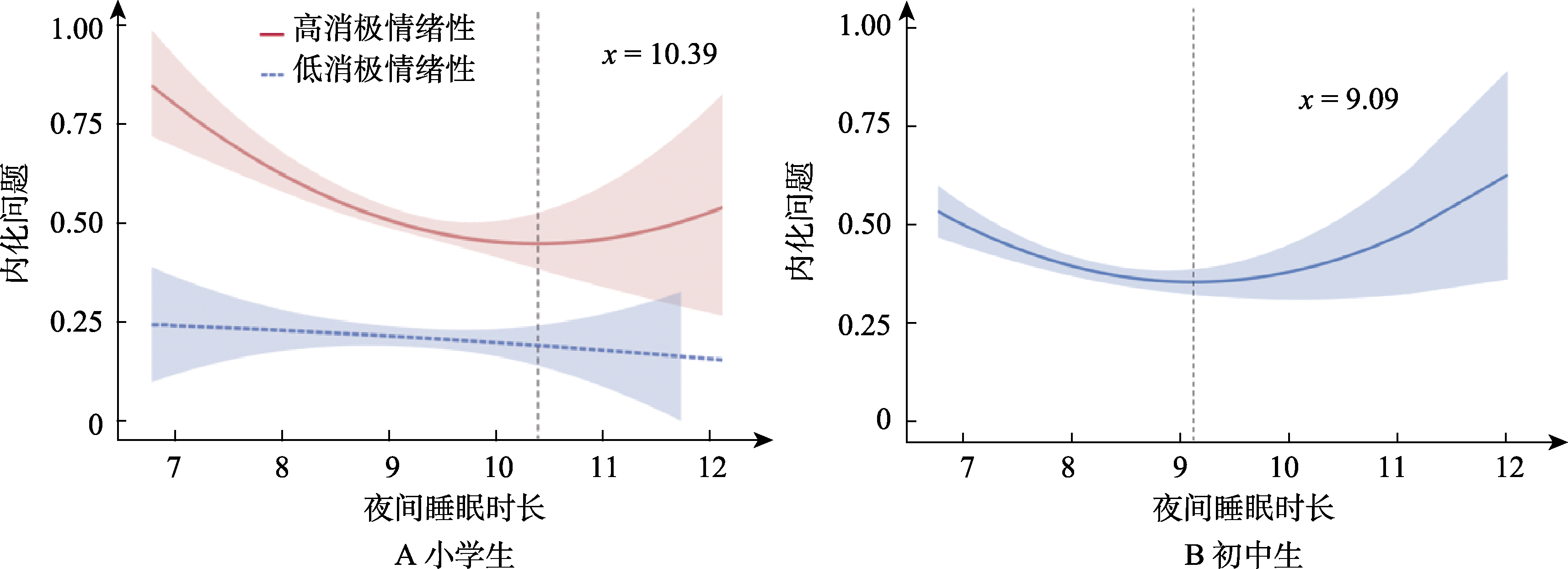
图1 夜间睡眠时长对学生内化问题的预测作用
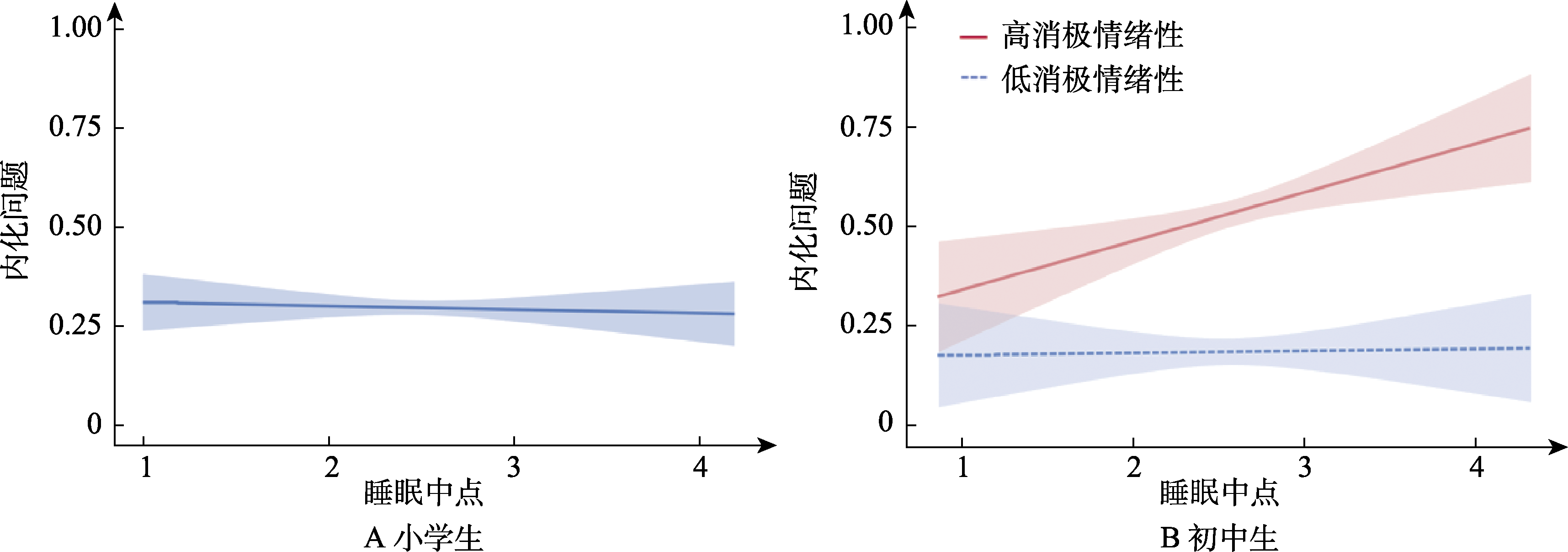
图2 睡眠中点对学生内化问题的预测作用
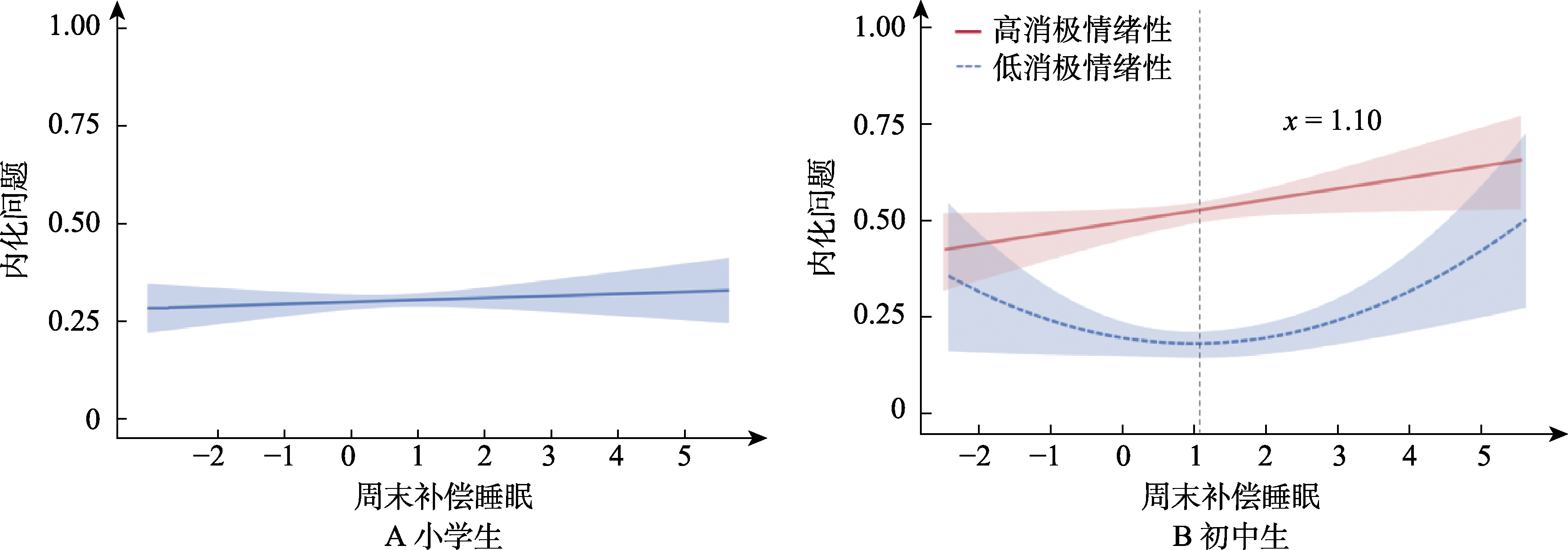
图3 周末补偿睡眠对学生内化问题的预测作用
| [1] | Achenbach T. M. (1991). Manual for the youth self-report and 1991 profile. Burlington, VT:University of Vermont, Department of Psychiatry. |
| [2] |
Allen S. L., Howlett M. D., Coulombe J. A., & Corkum P. V. (2016). ABCs of SLEEPING: A review of the evidence behind pediatric sleep practice recommendations. Sleep Medicine Reviews, 29, 1-14. https://doi.org/10.1016/j.smrv.2015.08.006
doi: 10.1016/j.smrv.2015.08.006 URL pmid: 26551999 |
| [3] |
Bauducco S., Richardson C., & Gradisar M. (2020). Chronotype, circadian rhythms and mood. Current Opinion in Psychology, 34, 77-83. https://doi.org/10.1016/j.copsyc.2019.09.002
doi: S2352-250X(19)30159-9 URL pmid: 31786494 |
| [4] |
Belsky J., & Pluess M. (2009). Beyond diathesis stress: Differential susceptibility to environmental influences. Psychological Bulletin, 135(6), 885-908.
doi: 10.1037/a0017376 pmid: 19883141 |
| [5] |
Ben Simon E., Vallat R., Barnes C. M., & Walker M. P. (2020). Sleep loss and the socio-emotional brain. Trends in Cognitive Sciences, 24(6), 435-450. https://doi.org/10.1016/j.tics.2020.02.003
doi: S1364-6613(20)30055-3 URL pmid: 32299657 |
| [6] |
Bernier A., Carlson S. M., Bordeleau S., & Carrier J. (2010). Relations between physiological and cognitive regulatory systems: Infant sleep regulation and subsequent executive functioning. Child Development, 81(6), 1739-1752. https://doi.org/10.1111/j.1467-8624.2010.01507.x
doi: 10.1111/j.1467-8624.2010.01507.x URL pmid: 21077861 |
| [7] | Bessot N., Langeard A., Dosseville F., Quarck G., & Freret T. (2023). Chronotype influence on the effects of COVID-19 lockdown on sleep and psychological status in France. Journal of Sleep Research, 32(4) Article e13864. https://doi.org/10.1111/jsr.13864 |
| [8] | Boon M. E., van Hooff M. L. M., Vink J. M., & Geurts S. A. E. (2023). The effect of fragmented sleep on emotion regulation ability and usage. Cognition & Emotion, 37(6), 1132-1143. https://doi.org/10.1080/02699931.2023.2224957 |
| [9] |
Borbély A. A., Daan S., Wirz-Justice A., & Deboer T. (2016). The two-process model of sleep regulation: A reappraisal. Journal of Sleep Research, 25(2), 131-143. https://doi.org/10.1111/jsr.12371
doi: 10.1111/jsr.12371 URL pmid: 26762182 |
| [10] |
Chen Y. J., Huang H. Z., Zhi K. Y., Zhang S. X., Lin Q. Y., Wang Q. Y., & An W. (2020). Relationship between chronotype and depression and its mechanism. Advances in Psychological Science, 28(10), 1713-1722. https://dx.doi.org/10.3724/SP.J.1042.2020.01713
doi: 10.3724/SP.J.1042.2020.01713 URL |
|
[陈永进, 黄惠珍, 支愧云, 张尚贤, 林秋韵, 王庆娅, 安蔚. (2020). 睡眠时型与抑郁的关系及其机制. 心理科学进展, 28(10), 1713-1722. https://dx.doi.org/10.3724/SP.J.1042.2020.01713 ]
doi: 10.3724/SP.J.1042.2020.01713 URL |
|
| [11] | Chiu W. H., Yang H. J., & Kuo P. H. (2017). Chronotype preference matters for depression in youth. Chronobiology International, 34(7), 933-941. https://doi.org/10.1080/07420528.2017.1327441 |
| [12] | Cremone A., de Jong D. M., Kurdziel L. B. F., Desrochers P., Sayer A., LeBourgeois M. K., Spencer R. M. C., & McDermott J. M. (2018). Sleep tight, act right: Negative affect, sleep and behavior problems during early childhood. Child Development, 89(2), e42-e59. https://doi.org/10.1111/cdev.12717 |
| [13] |
de Souza C. M., & Hidalgo M. P. (2014). Midpoint of sleep on school days is associated with depression among adolescents. Chronobiology International, 31(2), 199-205. https://doi.org/10.3109/07420528.2013.838575
doi: 10.3109/07420528.2013.838575 URL pmid: 24156519 |
| [14] | Dong L., Xie Y., & Zou X. (2022). Association between sleep duration and depression in US adults: A cross- sectional study. Journal of Affective Disorders, 296, 183-188. https://doi.org/10.1016/j.jad.2021.09.075 |
| [15] | Ellis L. K., & Rothbart M. K. (2001). Revision of the Early Adolescent Temperament Questionnaire. Poster presented at the biennial meeting of the Society for Research in Child Development, Minneapolis, MN. |
| [16] |
El-Sheikh M., Gillis B. T., Saini E. K., Erath S. A., & Buckhalt J. A. (2022). Sleep and disparities in child and adolescent development. Child Development Perspectives, 16(4), 200-207. https://doi.org/10.1111/cdep.12465
doi: 10.1111/cdep.12465 URL pmid: 36337834 |
| [17] | Fischer D., Klerman E. B., & Phillips A. J. (2021). Measuring sleep regularity: Theoretical properties and practical usage of existing metrics. Sleep, 44(10), zsab103. https://doi.org/10.1093/sleep/zsab103 |
| [18] |
Furusawa M., Okubo Y., Kuroda R., Umekage T., Nagashima S., & Suwazono Y. (2015). Relationship between morningness-eveningness typology and cumulative fatigue or depression among Japanese male workers. Industrial Health, 53(4), 361-367. https://doi.org/10.2486/indhealth.2013-0068
doi: 10.2486/indhealth.2013-0068 URL pmid: 26051287 |
| [19] |
Goodnight J. A., Bates J. E., Staples A. D., Pettit G. S., & Dodge K. A. (2007). Temperamental resistance to control increases the association between sleep problems and externalizing behavior development. Journal of Family Psychology, 21(1), 39-48. https://doi.org/10.1037/0893-3200.21.1.39
doi: 10.1037/0893-3200.21.1.39 URL pmid: 17371108 |
| [20] | Guerlich K., Gruszfeld D., Czech-Kowalska J., Ferré N., Closa-Monasterolo R., Martin F., … Grote V. (2021). Sleep duration and problem behaviour in 8-year-old children in the Childhood Obesity Project. European Child & Adolescent Psychiatry, 31(3), 519-527. https://doi.org/10.1007/s00787-021-01731-8 |
| [21] | Guldner S., Sarvasmaa A. S., Lemaître H., Massicotte J., Vulser H., Miranda R., … Garavan H. (2023). Longitudinal associations between adolescent catch-up sleep, white-matter maturation and internalizing problems. Developmental Cognitive Neuroscience, 59, 101193. https://doi.org/10.1016/j.dcn.2022.101193 |
| [22] | Haans R. F. J., Pieters C., & He Z.-L. (2015). Thinking about U: Theorizing and testing U- and inverted U-shaped relationships in strategy research. Strategic Management Journal, 37(7), 1177-1195. https://doi.org/10.1002/smj.2399 |
| [23] | Hartz K., & Williford A. (2015). Child negative emotionality and caregiver sensitivity across context: Links with children's kindergarten behaviour problems. Infant and Child Development, 24(2), 107-129. https://doi.org/10.1002/icd.1887 |
| [24] | Hirshkowitz M., Whiton K., Albert S. M., Alessi C., Bruni O., DonCarlos L., … Ware J. C. (2015). National Sleep Foundation’s updated sleep duration recommendations: Final report. Sleep Health, 1(4), 233-243. https://doi.org/10.1016/j.sleh.2015.10.004 |
| [25] | Hoyniak C. P., Vogel A. C., Puricelli A., Luby J. L., & Whalen D. J. (2024). Day-to-day bidirectional associations between sleep and emotion states in early childhood: Importance of end-of-day mood for sleep quality. Sleep Health, 10(3), 264-271. https://doi.org/10.1016/j.sleh.2023.12.007 |
| [26] | Huang X. Z., Guo L. T., Tang G. Z., & Liu X. H. (2005). Reliability and validity of the 1991 version of the Self-rating Scale for adolescents. Journal of Sichuan University (Medical Science Edition), 36(4), 580-582. |
| [黄雪竹, 郭兰婷, 唐光政, 刘协和. (2005). 青少年自评量表1991版本信度和效度研究. 四川大学学报(医学版), 36(4), 580-582.] | |
| [27] | James S., & Hale L. (2016). Sleep duration and child well-being: A nonlinear association. Journal of Clinical Child & Adolescent Psychology, 46(2), 258-268. https://doi.org/10.1080/15374416.2016.1204920 |
| [28] |
Kandola A., Ashdown-Franks G., Hendrikse J., Sabiston C. M., & Stubbs B. (2019). Physical activity and depression: Towards understanding the antidepressant mechanisms of physical activity. Neuroscience and Biobehavioral Reviews, 107, 525-539. https://doi.org/10.1016/j.neubiorev.2019.09.040
doi: S0149-7634(19)30564-0 URL pmid: 31586447 |
| [29] | Kang S. G., Lee Y. J., Kim S. J., Lim W., Lee H. J., Park Y. M., … Hong J. P. (2014). Weekend catch-up sleep is independently associated with suicide attempts and self-injury in Korean adolescents. Comprehensive Psychiatry, 55(2), 319-325. https://doi.org/10.1016/j.comppsych.2013.08.023 |
| [30] | Kim C. W., Choi M. K., Im H. J., Kim O. H., Lee H. J., Song J., Kang J. H., & Park K. H. (2012). Weekend catch-up sleep is associated with decreased risk of being overweight among fifth-grade students with short sleep duration. Journal of Sleep Research, 21(5), 546-551. https://doi.org/10.1111/j.1365-2869.2012.01013.x |
| [31] |
Kim K. M., Han S. M., Min I. K., Heo K., Kim W.-J., & Chu M. K. (2021). Weekend catch-up sleep and depression: Results from a nationally representative sample in Korea. Sleep Medicine, 87, 62-68. https://doi.org/10.1016/j.sleep.2021.02.058
doi: 10.1016/j.sleep.2021.02.058 URL pmid: 34520972 |
| [68] | [姚力宁, 高金帆, 贺立竞, 高鑫, 崔慧欣, 邢淑芬. (2019). 睡眠时间参数对学前儿童问题行为的影响: 消极情绪性的调节作用. 心理发展与教育, 35(6), 710-718. https://doi.org/10.16187/j.cnki.issn1001-4918.2019.06.08 ] |
| [69] | Yoo S. S., Gujar N., Hu P., Jolesz F. A., & Walker M. P. (2007). The human emotional brain without sleep--A prefrontal amygdala disconnect. Current Biology, 17(20), R877-R878. https://doi.org/10.1016/j.cub.2007.08.007 |
| [70] | Zhang J. S., Shen L. X., Gao N., & Yan C. H. (2008). The revision and application of the revision of the Early Adolescent Temperament Questionnaire. Chinese Mental Health Journal, 22(6), 439-443. |
| [张劲松, 沈理笑, 高宁, 颜崇淮. (2008). 青少年早期气质问卷-修订版的修订与应用. 中国心理卫生杂志, 22(6), 439-443.] | |
| [71] |
Zhai L., Zhang H., & Zhang D. (2015). Sleep duration and depression among adults: A meta-analysis of prospective studies. Depression and Anxiety, 32(9), 664-670. https://doi.org/10.1002/da.22386
doi: 10.1002/da.22386 URL pmid: 26047492 |
| [72] |
Zheng Y., Bao J., Tang L., Chen C., Guo W., Li K., Zhang R., & Wu J. (2024). Association between weekend catch-up sleep and depression of the United States population from 2017 to 2018: A cross-sectional study. Sleep Medicine, 119, 9-16. https://doi.org/10.1016/j.sleep.2024.04.012
doi: 10.1016/j.sleep.2024.04.012 URL pmid: 38631161 |
| [73] | Zhu M. Q., Oliveros H., Marín C., Mora-Plazas M., & Villamor E. (2023). Is the association of chronotype with adolescent behavior problems mediated through social jetlag? Chronobiology International, 40(7), 864-873. https://doi.org/10.1080/07420528.2023.2216790 |
| [74] | Zhu M. Q., Oliveros H., Marín C., Mora-Plazas M., & Villamor E. (2024). Middle childhood and adolescence sleep duration and behavior problems in adolescence. Development and Psychopathology, 36(1), 338-348. https://doi.org/10.1017/S0954579422001237 |
| [32] | Koo D. L., Yang K. I., Kim J. H., Kim D., Sunwoo J. S., Hwangbo Y., Lee H. R., & Hong S. B. (2021). Association between morningness-eveningness, sleep duration, weekend catch-up sleep and depression among Korean high-school students. Journal of Sleep Research, 30(1), e13063. https://doi.org/10.1111/jsr.13063 |
| [33] | Kouros C. D., Keller P. S., Martín-Piñón O., & El-Sheikh M. (2022). Bidirectional associations between nightly sleep and daily happiness and negative mood in adolescents. Child Development, 93(5), e547-e562. https://doi.org/10.1111/cdev.13798 |
| [34] |
Lemoine P., Zawieja P., & Ohayon M. M. (2013). Associations between morningness/eveningness and psychopathology: An epidemiological survey in three in-patient psychiatric clinics. Journal of Psychiatric Research, 47(8), 1095-1098. https://doi.org/10.1016/j.jpsychires.2013.04.001
doi: 10.1016/j.jpsychires.2013.04.001 URL pmid: 23628386 |
| [35] |
Li D., Wang L., Yang Y., Hu Y., Wang Y., Tian Y., & Wang F. (2022). Associations of long-term exposure to ambient air pollution and road traffic noise with sleep health in UK Biobank. Journal of Affective Disorders, 310, 1-9. https://doi.org/10.1016/j.jad.2022.04.136
doi: 10.1016/j.jad.2022.04.136 URL pmid: 35513113 |
| [36] | Lind J. T., & Mehlum H. (2010). With or without U? The appropriate test for a U-shaped relationship. Oxford Bulletin of Economics and Statistics, 72(1), 109-118. https://doi.org/10.1111/j.1468-0084.2009.00569.x |
| [37] | Liu B.-P., Wang X.-T., Liu Z.-Z., Wang Z.-Y., An D., Wei Y.-X., Jia C.-X., & Liu X. (2020). Depressive symptoms are associated with short and long sleep duration: A longitudinal study of Chinese adolescents. Journal of Affective Disorders, 263, 267-273. https://doi.org/10.1016/j.jad.2019.11.113 |
| [38] |
Liu X. (2024). Emotion dysregulation mediates the relationship between sleep problems and externalizing symptoms in early adolescents: A four-wave longitudinal study. Journal of Affective Disorders, 363, 221-229. https://doi.org/10.1016/j.jad.2024.07.058
doi: 10.1016/j.jad.2024.07.058 URL pmid: 39025439 |
| [39] | Ma Y., Zhou Q., & Xing S. (2015). Family rearing environment and children’s development: The differential susceptibility hypothesis. Advances in Psychological Science, 23(11), 1931-1941. https://doi.org/10.3724/SP.J.1042.2015.01931 |
|
[马园园, 周荃, 邢淑芬. (2015). 家庭养育环境与儿童发展:差别易感性假说. 心理科学进展, 23(11), 1931-1941. https://doi.org/10.3724/SP.J.1042.2015.01931 ]
doi: 10.3724/SP.J.1042.2015.01931 URL |
|
| [40] | Malheiros L. E., da Costa B. G., Lopes M. V., Martins da Costa R., Chaput J. P., & Silva K. S. (2023). Association of sleep timing and sleep variability with health-related outcomes in a sample of Brazilian adolescents. Behavioral Sleep Medicine, 22(2), 129-139. Advance online publication. https://doi.org/10.1080/15402002.2023.2207699 |
| [41] |
Meldrum R. C., Barnes J. C., & Hay C. (2015). Sleep deprivation, low self-control, and delinquency: A test of the strength model of self-control. Journal of Youth and Adolescence, 44(2), 465-477. https://doi.org/10.1007/s10964-013-0024-4
doi: 10.1007/s10964-013-0024-4 URL pmid: 24085558 |
| [42] |
Meltzer L. J., Montgomery-Downs H. E., Insana S. P., & Walsh C. M. (2012). Use of actigraphy for assessment in pediatric sleep research. Sleep Medicine Reviews, 16(5), 463-475. https://doi.org/10.1016/j.smrv.2011.10.002
doi: 10.1016/j.smrv.2011.10.002 URL pmid: 22424706 |
| [43] | Meltzer L. J., Williamson A. A., & Mindell J. A. (2021). Pediatric sleep health: It matters, and so does how we define it. Sleep Medicine Reviews, 57, 101425. https://doi.org/10.1016/j.smrv.2021.101425 |
| [44] |
Mikkelsen S. S., Tolstrup J. S., Flachs E. M., Mortensen E. L., Schnohr P., & Flensborg-Madsen T. (2010). A cohort study of leisure time physical activity and depression. Preventive Medicine, 51(6), 471-475. https://doi.org/10.1016/j.ypmed.2010.09.008
doi: 10.1016/j.ypmed.2010.09.008 URL pmid: 20858516 |
| [45] | Oh Y. H., Kim H., Kong M., Oh B., & Moon J. H. (2019). Association between weekend catch-up sleep and health- related quality of life of Korean adults. Medicine, 98(13), e14966. https://doi.org/10.1097/md.0000000000014966 |
| [46] | Palmer S. (2006). Problems increase when children stop counting sheep. Early Years Educator, 8(3), 36-38. https://doi.org/10.12968/eyed.2006.8.3.21308 |
| [47] |
Pasch K. E., Laska M. N., Lytle L. A., & Moe S. G. (2010). Adolescent sleep, risk behaviors, and depressive symptoms: Are they linked?. American Journal of Health Behavior, 34(2), 237-248. https://doi.org/10.5993/ajhb.34.2.11
doi: 10.5993/ajhb.34.2.11 URL pmid: 19814603 |
| [48] |
Philbrook L. E., Hinnant J. B., Elmore-Staton L., Buckhalt J. A., & El-Sheikh M. (2017). Sleep and cognitive functioning in childhood: Ethnicity, socioeconomic status, and sex as moderators. Developmental Psychology, 53(7), 1276-1285. https://doi.org/10.1037/dev0000319
doi: 10.1037/dev0000319 URL pmid: 28414509 |
| [49] | Prabhat A., Kumar A., & Bhardwaj S. K. (2022). Prolonged lockdown due to COVID-19 alters sleep-wake timings and negatively affects self-esteem, personality, depression and anxiety in college-going Indian students. Sleep and Vigilance, 6(1), 199-210. https://doi.org/10.1007/s41782-022-00200-9 |
| [50] | Randler C. (2014). Sleep, sleep timing and chronotype in animal behaviour. Animal Behaviour, 94, 161-166. https://doi.org/10.1016/j.anbehav.2014.05.001 |
| [51] |
Randler C., Vollmer C., Kalb N., & Itzek-Greulich H. (2019). Breakpoints of time in bed, midpoint of sleep, and social jetlag from infancy to early adulthood. Sleep Medicine, 57, 80-86. https://doi.org/10.1016/j.sleep.2019.01.023
doi: S1389-9457(18)30474-X URL pmid: 30921684 |
| [52] |
Ricci C., Poulain T., Rothenbacher D., & Genuneit J. (2021). The associations between media use, midpoint of sleep, and sleep quality in German preschoolers: A mediation analysis based on the Ulm SPATZ Health Study. Nature and Science of Sleep, 13, 1025-1035. https://doi.org/10.2147/nss.s307821
doi: 10.2147/NSS.S307821 URL pmid: 34262374 |
| [53] |
Roberts R. E., & Duong H. T. (2017). Is there an association between short sleep duration and adolescent anxiety disorders? Sleep Medicine, 30, 82-87. https://doi.org/10.1016/j.sleep.2016.02.007
doi: S1389-9457(16)00060-5 URL pmid: 28215269 |
| [54] | Roenneberg T., Wirz-Justice A., & Merrow M. (2003). Life between clocks: Daily temporal patterns of human chronotypes. Journal of Biological Rhythms, 18(1), 80-90. https://doi.org/10.1177/0748730402239679 |
| [55] |
Rothbart M. K., Ahadi S. A., Hershey K. L., & Fisher P. (2001). Investigations of temperament at three to seven years: The Children's Behavior Questionnaire. Child Development, 72(5), 1394-1408. https://doi.org/10.1111/1467-8624.00355
doi: 10.1111/1467-8624.00355 URL pmid: 11699677 |
| [56] | Rothbart, M. K., & Rueda M. R. (2005). The development of effortful control. In U.Mayr, E.Awh, & S. W.Keele (Eds.), Developing individuality in the human brain: A tribute to Michael I. Posner (pp. 167-188). Washington, DC: American Psychological Association. |
| [57] | Saper C. B., Cano G., & Scammell T. E. (2005). Homeostatic, circadian, and emotional regulation of sleep. The Journal of Comparative Neurology, 493(1), 92-98. https://doi.org/10.1002/cne.20770 |
| [58] |
Short M. A., Blunden S., Rigney G., Matricciani L., Coussens S., M Reynolds C., & Galland B. (2018). Cognition and objectively measured sleep duration in children: A systematic review and meta-analysis. Sleep Health, 4(3), 292-300. https://doi.org/10.1016/j.sleh.2018.02.004
doi: S2352-7218(18)30013-5 URL pmid: 29776624 |
| [59] | Siegel J. M. (2022). Sleep function: An evolutionary perspective. The Lancet Neurology, 21(10), 937-946. https://doi.org/10.1016/S1474-4422(22)00210-1 |
| [60] | Sivertsen B., Harvey A. G., Reichborn-Kjennerud T., Ystrom E., & Hysing M. (2021). Sleep problems and depressive symptoms in toddlers and 8-year-old children: A longitudinal study. Journal of Sleep Research, 30(1), e13150. https://doi.org/10.1111/jsr.13150 |
| [61] |
Sletten T. L., Weaver M. D., Foster R. G., Gozal D., Klerman E. B., Rajaratnam S. M. W., … Czeisler C. A. (2023). The importance of sleep regularity: A consensus statement of the National Sleep Foundation sleep timing and variability panel. Sleep Health, 9(6), 801-820. https://doi.org/10.1016/j.sleh.2023.07.016
doi: 10.1016/j.sleh.2023.07.016 URL pmid: 37684151 |
| [62] | Tang Y., Wan Y., Xu S., Zhang S., Hao J., & Tao F. (2021). Nonlinear relationship between sleep duration and non- suicidal self-injurious behaviour among Chinese adolescents. BMC Psychiatry, 21(1), 521. https://doi.org/10.1186/s12888-021-03539-x |
| [63] |
Troxel W. M., Trentacosta C. J., Forbes E. E., & Campbell S. B. (2013). Negative emotionality moderates associations among attachment, toddler sleep, and later problem behaviors. Journal of Family Psychology, 27(1), 127-136. https://doi.org/10.1037/a0031149
doi: 10.1037/a0031149 URL pmid: 23421840 |
| [64] |
Turnbull K., Reid G. J., & Morton J. B. (2013). Behavioral sleep problems and their potential impact on developing executive function in children. Sleep, 36(7), 1077-1084. https://doi.org/10.5665/sleep.2814
URL pmid: 23814345 |
| [65] | Wang Y. H., Wang J., Chen S. H., Li J. Q., Lu Q. D., Vitiello M. V., … Bao Y. P. (2020). Association of longitudinal patterns of habitual sleep duration with risk of cardiovascular events and all-cause mortality. JAMA Network Open, 3(5), e205246. https://doi.org/10.1001/jamanetworkopen.2020.5246 |
| [66] |
Watson N. F., Badr M. S., Belenky G., Bliwise D. L., Buxton O. M., Buysse D., … Heald J. L. (2015). Recommended amount of sleep for a healthy adult: A joint consensus statement of the American Academy of Sleep Medicine and Sleep Research Society. Sleep, 38(6), 843-844. https://doi.org/10.5665/sleep.4716
doi: 10.5665/sleep.4716 URL pmid: 26039963 |
| [67] | Williams S., Leader G., Mannion A., & Chen J. (2015). An investigation of anxiety in children and adolescents with autism spectrum disorder. Research in Autism Spectrum Disorders, 10, 30-40. https://doi.org/10.1016/j.rasd.2014.10.017 |
| [68] | Yao L. N., Gao J. F., He L. J., Gao X., Cui H. X., & Xing S. F. (2019). Sleep time parameters and preschoolers’ problem behaviors: The moderating role of negative emotionality. Psychological Development and Education, 35(6), 710-718. https://doi.org/10.16187/j.cnki.issn1001-4918.2019.06.08 |
| [1] | 廖友国, 陈建文, 张妍, 彭聪. 儿童青少年同伴侵害与内化问题的双向关系: 纵向研究的元分析[J]. 心理学报, 2022, 54(7): 828-849. |
| [2] | 段文婷, 孙启武, 王铭, 吴才智, 陈真珍. 青少年早期亲社会行为倾向、内化问题和外化问题发展级联的个体内分析[J]. 心理学报, 2022, 54(7): 813-827. |
| [3] | 邢淑芬, 李倩倩, 高鑫, 马园园, 傅锐. 不同睡眠时间参数对学前儿童执行功能的差异化影响[J]. 心理学报, 2018, 50(11): 1269-1281. |
| [4] | 郭海英;陈丽华; 叶枝;潘瑾;林丹华. 流动儿童同伴侵害的特点及与内化问题的循环作用关系:一项追踪研究[J]. 心理学报, 2017, 49(3): 336-348. |
| 阅读次数 | ||||||
|
全文 |
|
|||||
|
摘要 |
|
|||||
