

ISSN 0439-755X
CN 11-1911/B
主办:中国心理学会
中国科学院心理研究所
出版:科学出版社
CN 11-1911/B
主办:中国心理学会
中国科学院心理研究所
出版:科学出版社
心理学报 ›› 2025, Vol. 57 ›› Issue (8): 1363-1377.doi: 10.3724/SP.J.1041.2025.1363 cstr: 32110.14.2025.1363
罗晓慧, 胡月琴( ), 刘红云()
收稿日期:2025-03-24
发布日期:2025-05-22
出版日期:2025-08-25
通讯作者:
胡月琴, E-mail: yueqinhu@bnu.edu.cn基金资助:
LUO Xiaohui, HU Yueqin(), LIU Hongyun()
Received:2025-03-24
Online:2025-05-22
Published:2025-08-25
摘要:
近年来, 抑郁预测的重要性日渐凸显。以往研究主要在个体间水平考察抑郁的风险因素, 本研究聚焦个体内水平, 结合压力这一关键因素以及日常压力过程模型, 构建压力过程对抑郁状态的动态预测模型。收集356名大学生7天(每天5次)的生态瞬时评估数据, 采用多层决策树的机器学习算法, 发现:(1)含忧虑消极情绪、压力源和反刍的模型能准确预测个体后续(3小时后)有无抑郁状态; (2)不含情绪的预测模型中, 整合当前和预期压力应对、反刍、身体不适感和主观压力感受也能实现对抑郁状态的有效预测; (3)压力过程的多个成分会累积作用于个体, 共同预测后续的抑郁状态; (4)压力过程的累积均值和偏离值动态指标对抑郁状态预测有重要贡献。研究从动态视角开发抑郁状态的实时预警工具, 揭示多种压力过程因素协同预测的复杂组合和影响路径, 深化压力过程对抑郁状态复杂预测模式的理解。
中图分类号:
罗晓慧, 胡月琴, 刘红云. (2025). 压力过程对抑郁状态的动态预测:基于多层决策树. 心理学报, 57(8), 1363-1377.
LUO Xiaohui, HU Yueqin, LIU Hongyun. (2025). Dynamic prediction of depressive states using stress processes: A multilevel decision tree approach. Acta Psychologica Sinica, 57(8), 1363-1377.
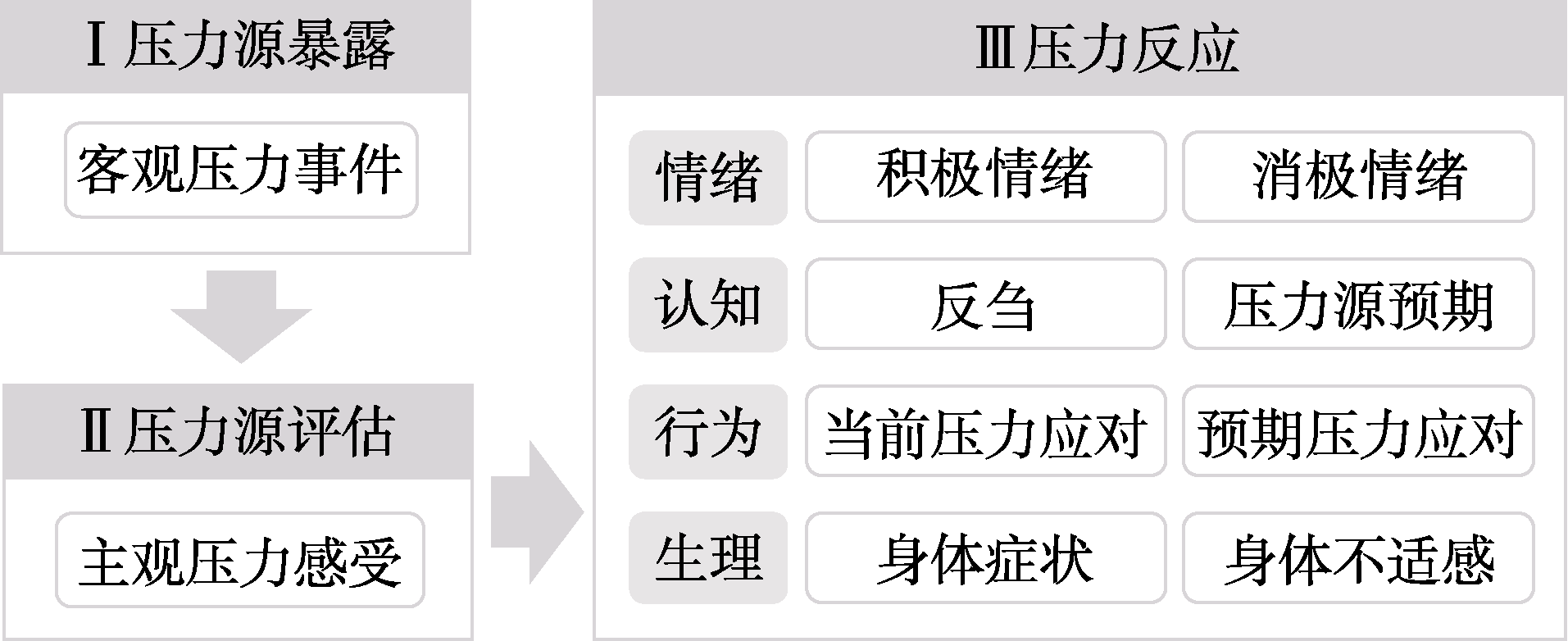
图1 与抑郁状态存在动态关联的日常压力过程
| 变量 | M (SD) | ICC | 1 | 2 | 3 | 4 | 5 | 6 | 7 | 8 | 9 | 10 | 11 | 12 | 13 |
|---|---|---|---|---|---|---|---|---|---|---|---|---|---|---|---|
| 1 压力源暴露 | 1.26 (1.03) | 0.63 | − | 0.50*** | −0.01 | 0.12*** | 0.21*** | 0.16*** | −0.16*** | 0.19*** | −0.13*** | 0.33*** | 0.23*** | 0.18*** | 0.07*** |
| 2 主观压力评估 | 3.59 (1.25) | 0.52 | 0.67*** | − | −0.11*** | 0.21*** | 0.29*** | 0.23*** | −0.32*** | 0.33*** | −0.24*** | 0.25*** | 0.32*** | 0.31*** | 0.08*** |
| 3 积极情绪 | 2.82 (1.00) | 0.70 | −0.10 | −0.29*** | − | −0.05*** | −0.11*** | −0.05*** | 0.16*** | −0.10*** | 0.12*** | −0.10*** | −0.15*** | −0.17*** | −0.06*** |
| 4 消极情绪(恐惧) | 1.46 (0.69) | 0.63 | 0.39*** | 0.55*** | −0.11*** | − | 0.43*** | 0.15*** | −0.12*** | 0.14*** | −0.12*** | 0.13*** | 0.17*** | 0.31*** | 0.09*** |
| 5 消极情绪(忧虑) | 1.71 (0.75) | 0.56 | 0.42*** | 0.60*** | −0.22*** | 0.90*** | − | 0.21*** | −0.18*** | 0.20*** | −0.16*** | 0.18*** | 0.24*** | 0.39*** | 0.10*** |
| 6 反刍 | 3.59 (1.45) | 0.69 | 0.41*** | 0.66*** | −0.16*** | 0.50*** | 0.56*** | − | −0.14*** | 0.14*** | −0.10*** | 0.14*** | 0.16*** | 0.20*** | 0.08*** |
| 7 压力源预期 | 4.58 (1.05) | 0.53 | −0.32*** | −0.61*** | 0.53*** | −0.49*** | −0.54*** | −0.51*** | − | −0.20*** | 0.43*** | −0.12*** | −0.19*** | −0.19*** | −0.07*** |
| 8 当前压力应对 | 3.23 (1.18) | 0.53 | 0.40*** | 0.63*** | −0.13*** | 0.58*** | 0.61*** | 0.57*** | −0.47*** | − | −0.32*** | 0.14*** | 0.21*** | 0.20*** | 0.06*** |
| 9 预期压力应对 | 4.80 (1.00) | 0.51 | −0.34*** | −0.58*** | 0.48*** | −0.50*** | −0.54*** | −0.48*** | 0.94*** | −0.50*** | − | −0.10*** | −0.17*** | −0.16*** | −0.07*** |
| 10 身体症状 | 0.91 (0.95) | 0.61 | 0.57*** | 0.51*** | −0.24*** | 0.46*** | 0.53*** | 0.38*** | −0.34*** | 0.41*** | −0.36*** | − | 0.55*** | 0.22*** | 0.06*** |
| 11 身体不适感 | 19.71 (16.59) | 0.58 | 0.44*** | 0.60*** | −0.25*** | 0.56*** | 0.61*** | 0.45*** | −0.39*** | 0.52*** | −0.39*** | 0.72*** | − | 0.27*** | 0.07*** |
| 12 抑郁状态(t) | 1.70 (0.75) | 0.65 | 0.41*** | 0.58*** | −0.24*** | 0.87*** | 0.90*** | 0.55*** | −0.55*** | 0.61*** | −0.56*** | 0.51*** | 0.59*** | − | 0.13*** |
| 13 抑郁状态(t + 1) | 0.54 (0.36) | 0.50 | 0.34*** | 0.51*** | −0.19*** | 0.62*** | 0.71*** | 0.50*** | −0.47*** | 0.57*** | −0.47*** | 0.39*** | 0.48*** | 0.81*** | − |
表1 压力过程与抑郁状态的描述统计和相关分析
| 变量 | M (SD) | ICC | 1 | 2 | 3 | 4 | 5 | 6 | 7 | 8 | 9 | 10 | 11 | 12 | 13 |
|---|---|---|---|---|---|---|---|---|---|---|---|---|---|---|---|
| 1 压力源暴露 | 1.26 (1.03) | 0.63 | − | 0.50*** | −0.01 | 0.12*** | 0.21*** | 0.16*** | −0.16*** | 0.19*** | −0.13*** | 0.33*** | 0.23*** | 0.18*** | 0.07*** |
| 2 主观压力评估 | 3.59 (1.25) | 0.52 | 0.67*** | − | −0.11*** | 0.21*** | 0.29*** | 0.23*** | −0.32*** | 0.33*** | −0.24*** | 0.25*** | 0.32*** | 0.31*** | 0.08*** |
| 3 积极情绪 | 2.82 (1.00) | 0.70 | −0.10 | −0.29*** | − | −0.05*** | −0.11*** | −0.05*** | 0.16*** | −0.10*** | 0.12*** | −0.10*** | −0.15*** | −0.17*** | −0.06*** |
| 4 消极情绪(恐惧) | 1.46 (0.69) | 0.63 | 0.39*** | 0.55*** | −0.11*** | − | 0.43*** | 0.15*** | −0.12*** | 0.14*** | −0.12*** | 0.13*** | 0.17*** | 0.31*** | 0.09*** |
| 5 消极情绪(忧虑) | 1.71 (0.75) | 0.56 | 0.42*** | 0.60*** | −0.22*** | 0.90*** | − | 0.21*** | −0.18*** | 0.20*** | −0.16*** | 0.18*** | 0.24*** | 0.39*** | 0.10*** |
| 6 反刍 | 3.59 (1.45) | 0.69 | 0.41*** | 0.66*** | −0.16*** | 0.50*** | 0.56*** | − | −0.14*** | 0.14*** | −0.10*** | 0.14*** | 0.16*** | 0.20*** | 0.08*** |
| 7 压力源预期 | 4.58 (1.05) | 0.53 | −0.32*** | −0.61*** | 0.53*** | −0.49*** | −0.54*** | −0.51*** | − | −0.20*** | 0.43*** | −0.12*** | −0.19*** | −0.19*** | −0.07*** |
| 8 当前压力应对 | 3.23 (1.18) | 0.53 | 0.40*** | 0.63*** | −0.13*** | 0.58*** | 0.61*** | 0.57*** | −0.47*** | − | −0.32*** | 0.14*** | 0.21*** | 0.20*** | 0.06*** |
| 9 预期压力应对 | 4.80 (1.00) | 0.51 | −0.34*** | −0.58*** | 0.48*** | −0.50*** | −0.54*** | −0.48*** | 0.94*** | −0.50*** | − | −0.10*** | −0.17*** | −0.16*** | −0.07*** |
| 10 身体症状 | 0.91 (0.95) | 0.61 | 0.57*** | 0.51*** | −0.24*** | 0.46*** | 0.53*** | 0.38*** | −0.34*** | 0.41*** | −0.36*** | − | 0.55*** | 0.22*** | 0.06*** |
| 11 身体不适感 | 19.71 (16.59) | 0.58 | 0.44*** | 0.60*** | −0.25*** | 0.56*** | 0.61*** | 0.45*** | −0.39*** | 0.52*** | −0.39*** | 0.72*** | − | 0.27*** | 0.07*** |
| 12 抑郁状态(t) | 1.70 (0.75) | 0.65 | 0.41*** | 0.58*** | −0.24*** | 0.87*** | 0.90*** | 0.55*** | −0.55*** | 0.61*** | −0.56*** | 0.51*** | 0.59*** | − | 0.13*** |
| 13 抑郁状态(t + 1) | 0.54 (0.36) | 0.50 | 0.34*** | 0.51*** | −0.19*** | 0.62*** | 0.71*** | 0.50*** | −0.47*** | 0.57*** | −0.47*** | 0.39*** | 0.48*** | 0.81*** | − |
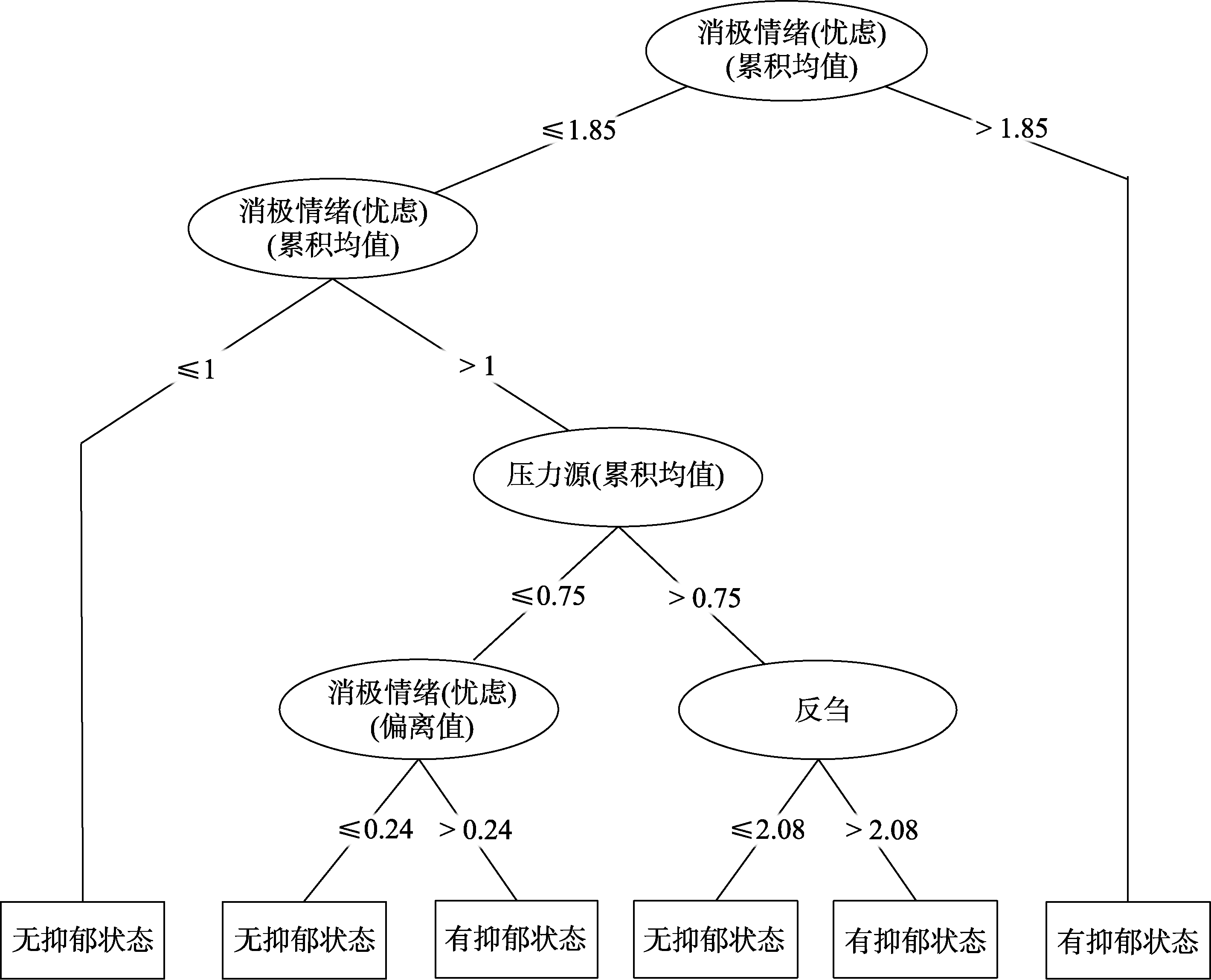
图2 压力过程(t)对抑郁状态(t + 1)的动态预测模型I 注:所有分区变量的参数不稳定性(parameter instability)检验的p值均小于0.001。
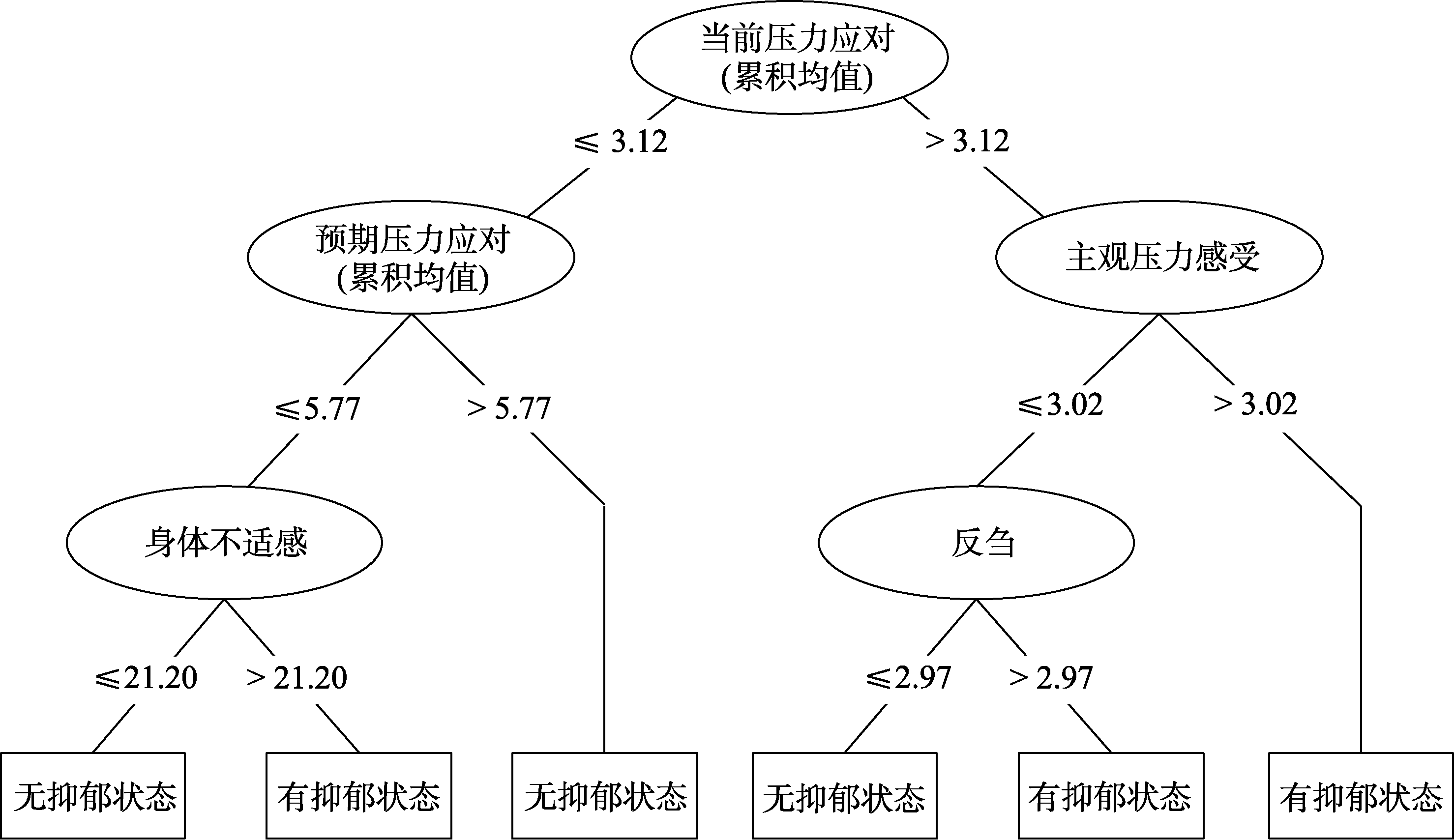
图3 压力过程(t)对抑郁状态(t + 1)的动态预测模型Ⅱ 注:预测变量中不含积极和消极情绪及其动态特征, 所有分区变量的参数不稳定性检验的p值均小于0.001。
| [1] |
Aan het Rot, M., Hogenelst K., & Schoevers R. A. (2012). Mood disorders in everyday life: A systematic review of experience sampling and ecological momentary assessment studies. Clinical Psychology Review, 32(6), 510-523.
doi: 10.1016/j.cpr.2012.05.007 pmid: 22721999 |
| [2] | Abramson L. Y., Metalsky G. I., & Alloy L. B. (1989). Hopelessness depression: A theory-based subtype of depression. Psychological Review, 96(2), 358-372. |
| [3] | Almeida D. M. (2024). The time is now for integrative multilayered stress research and mitigation. Frontiers in Science, 2, 1389481. |
| [4] |
Almeida D. M., Marcusson-Clavertz D., Conroy D. E., Kim J., Zawadzki M. J., Sliwinski M. J., & Smyth J. M. (2020). Everyday stress components and physical activity: Examining reactivity, recovery and pileup. Journal of Behavioral Medicine, 43(1), 108-120.
doi: 10.1007/s10865-019-00062-z pmid: 31140032 |
| [5] | Asare K. O., Moshe I., Terhorst Y., Vega J., Hosio S., Baumeister H.,... Ferreira D. (2022). Mood ratings and digital biomarkers from smartphone and wearable data differentiates and predicts depression status: A longitudinal data analysis. Pervasive and Mobile Computing, 83, 101621. |
| [6] |
Baker M. R., Nguyen-Feng V. N., Nilakanta H., & Frazier P. A. (2020). Childhood maltreatment predicts daily stressor exposure in college students but not perceived stress or stress reactivity. Journal of Counseling Psychology, 67(1), 79-89.
doi: 10.1037/cou0000359 pmid: 31144850 |
| [7] | Beck, A. T. (2002). Cognitive models of depression. In R. L.Leahy & E. T.Dowd (Eds.), Clinical advances in cognitive psychotherapy: Theory and application (pp. 29-61). Springer Publishing Company. |
| [8] |
Ben-Zeev D., Brenner C. J., Begale M., Duffecy J., Mohr D. C., & Mueser K. T. (2014). Feasibility, acceptability, and preliminary efficacy of a smartphone intervention for schizophrenia. Schizophrenia Bulletin, 40(6), 1244-1253.
doi: 10.1093/schbul/sbu033 pmid: 24609454 |
| [9] | Blanke E. S., Neubauer A. B., Houben M., Erbas Y., & Brose A. (2022). Why do my thoughts feel so bad? Getting at the reciprocal effects of rumination and negative affect using dynamic structural equation modeling. Emotion, 22(8), 1773-1786. |
| [10] | Bolger N., & Laurenceau J. P. (2013). Intensive longitudinal methods: An introduction to diary and experience sampling research. Guilford Press. |
| [11] |
Brosschot J. F., Gerin W., & Thayer J. F. (2006). The perseverative cognition hypothesis: A review of worry, prolonged stress-related physiological activation, and health. Journal of Psychosomatic Research, 60(2), 113-124.
doi: 10.1016/j.jpsychores.2005.06.074 pmid: 16439263 |
| [12] |
Charles S. T., Piazza J. R., Mogle J., Sliwinski M. J., & Almeida D. M. (2013). The wear and tear of daily stressors on mental health. Psychological Science, 24(5), 733-741.
doi: 10.1177/0956797612462222 pmid: 23531486 |
| [13] |
Cohen S., Kamarck T., & Mermelstein R. (1983). A global measure of perceived stress. Journal of Health and Social Behavior, 24(4), 385-396.
pmid: 6668417 |
| [14] |
Connolly S. L., & Alloy L. B. (2017). Rumination interacts with life stress to predict depressive symptoms: An ecological momentary assessment study. Behaviour Research and Therapy, 97, 86-95.
doi: S0005-7967(17)30140-7 pmid: 28734979 |
| [15] |
Connolly S. L., & Alloy L. B. (2018). Negative event recall as a vulnerability for depression: Relationship between momentary stress-reactive rumination and memory for daily life stress. Clinical Psychological Science, 6(1), 32-47.
doi: 10.1177/2167702617729487 pmid: 29552424 |
| [16] | Cooke E. M., Schuurman N. K., & Zheng Y. (2022). Examining the within- and between-person structure of a short form of the positive and negative affect schedule: A multilevel and dynamic approach. Psychological Assessment, 34(12), 1126-1137. |
| [17] | Czyz E. K., Koo H. J., Al-Dajani N., King C. A., & Nahum- Shani I. (2023). Predicting short-term suicidal thoughts in adolescents using machine learning: Developing decision tools to identify daily level risk after hospitalization. Psychological Medicine, 53(7), 2982-2991. |
| [18] | De Girolamo G., Barattieri di San Pietro C., Bulgari V., Dagani J., Ferrari C., Hotopf M.,... Zarbo C. (2020). The acceptability of real-time health monitoring among community participants with depression: A systematic review and meta-analysis of the literature. Depression and Anxiety, 37(9), 885-897. |
| [19] | De la Barrera, U., Arrigoni F., Monserrat C., Montoya-Castilla I., & Gil-Gómez J. A. (2024). Using ecological momentary assessment and machine learning techniques to predict depressive symptoms in emerging adults. Psychiatry Research, 332, 115710. |
| [20] |
Dong J., Wei W., Wu K., Ni N., Wang C., Fu Y., & Peng X. (2020). The application of machine learning in depression. Advances in Psychological Science, 28(2), 266-274.
doi: 10.3724/SP.J.1042.2020.00266 |
|
[董健宇, 韦文棋, 吴珂, 妮娜, 王粲霏, 付莹, 彭歆. (2020). 机器学习在抑郁症领域的应用. 心理科学进展, 28(2), 266-274.]
doi: 10.3724/SP.J.1042.2020.00266 |
|
| [21] | Eisele G., Vachon H., Lafit G., Kuppens P., Houben M., Myin-Germeys I., & Viechtbauer W. (2022). The effects of sampling frequency and questionnaire length on perceived burden, compliance, and careless responding in experience sampling data in a student population. Assessment, 29(2), 136-151. |
| [22] |
Flook L. (2011). Gender differences in adolescents’ daily interpersonal events and well-being. Child Development, 82(2), 454-461.
doi: 10.1111/j.1467-8624.2010.01521.x pmid: 21410907 |
| [23] | Fokkema M., Edbrooke-Childs J., & Wolpert M. (2021). Generalized linear mixed-model (GLMM) trees: A flexible decision-tree method for multilevel and longitudinal data. Psychotherapy Research, 31(3), 329-341. |
| [24] |
Fokkema M., Smits N., Zeileis A., Hothorn T., & Kelderman H. (2018). Detecting treatment-subgroup interactions in clustered data with generalized linear mixed-effects model trees. Behavior Research Methods, 50(5), 2016-2034.
doi: 10.3758/s13428-017-0971-x pmid: 29071652 |
| [25] |
Fokkema M., & Zeileis A. (2024). Subgroup detection in linear growth curve models with generalized linear mixed model (GLMM) trees. Behavior Research Methods, 56, 6759-6780.
doi: 10.3758/s13428-024-02389-1 pmid: 38811518 |
| [26] | Fuller-Tyszkiewicz M., Karvounis T., Pemberton R., Hartley-Clark L., & Richardson B. (2017). Determinants of depressive mood states in everyday life: An experience sampling study. Motivation and Emotion, 41, 510-521. |
| [27] |
Goldring M. R., & Bolger N. (2021). Physical effects of daily stressors are psychologically mediated, heterogeneous, and bidirectional. Journal of Personality and Social Psychology, 121(3), 722-746.
doi: 10.1037/pspp0000396 pmid: 34807700 |
| [28] | Groen R. N., Snippe E., Bringmann L. F., Simons C. J. P., Hartmann J. A., Bos E. H., & Wichers M. (2019). Capturing the risk of persisting depressive symptoms: A dynamic network investigation of patients’ daily symptom experiences. Psychiatry Research, 271, 640-648. |
| [29] |
Hammen C. L. (2005). Stress and depression. Annual Review of Clinical Psychology, 1, 293-319.
pmid: 17716090 |
| [30] | Hammen C. L. (2015). Stress and depression: Old questions, new approaches. Current Opinion in Psychology, 4, 80-85. |
| [31] | Horwitz A. G., Kentopp S. D., Cleary J., Ross K., Wu Z., Sen S., & Czyz E. K. (2023). Using machine learning with intensive longitudinal data to predict depression and suicidal ideation among medical interns over time. Psychological Medicine, 53(12), 5778-5785. |
| [32] | Hu J., & Szymczak S. (2023). A review on longitudinal data analysis with random forest. Briefings in Bioinformatics, 24(2), bbad002. |
| [33] | Jeronimus, B. F. (2019). Dynamic system perspectives on anxiety and depression. In Kunnen, E. S., De Ruiter, N. M., Jeronimus, B. F., & Van der Gaag, M. A (Eds.), Psychosocial development in adolescence: Insights from the dynamic systems approach (pp. 100-126). Routledge. |
| [34] |
Jimenez A., McMahon T. P., Watson D., & Naragon-Gainey K. (2022). Dysphoria and well-being in daily life: Development and validation of ecological momentary assessment scales. Psychological Assessment, 34(6), 546-557.
doi: 10.1037/pas0001117 pmid: 35175076 |
| [35] | Kahn J. H., & Garrison A. M. (2009). Emotional self- disclosure and emotional avoidance: Relations with symptoms of depression and anxiety. Journal of Counseling Psychology, 56(4), 573-584. |
| [36] | Kang J. E., Graham-Engeland J. E., Scott S., Smyth J. M., & Sliwinski M. J. (2023). The relationship between loneliness and the experiences of everyday stress and stressor-related emotion. Stress and Health, 40(2), e3294. |
| [37] | Kiang L., & Buchanan C. M. (2014). Daily stress and emotional well-being among Asian American adolescents: Same-day, lagged, and chronic associations. Developmental Psychology, 50(2), 611-621. |
| [38] | Kramer A. C., Neubauer A. B., Scott S. B., Schmiedek F., Sliwinski M. J., & Smyth J. M. (2022). Stressor anticipation and subsequent affective well-being: A link potentially explained by perseverative cognitions. Emotion, 22(8), 1787-1800. |
| [39] |
Larsen R. J., & Kasimatis M. (1991). Day-to-day physical symptoms: Individual differences in the occurrence, duration, and emotional concomitants of minor daily illnesses. Journal of Personality, 59(3), 387-423.
doi: 10.1111/j.1467-6494.1991.tb00254.x pmid: 1960638 |
| [40] |
Long E. E., Young J. F., & Hankin B. L. (2018). Temporal dynamics and longitudinal co-occurrence of depression and different anxiety syndromes in youth: Evidence for reciprocal patterns in a 3-year prospective study. Journal of Affective Disorders, 234, 20-27.
doi: S0165-0327(17)31988-2 pmid: 29522939 |
| [41] |
Löwe B., Kroenke K., & Gräfe K. (2005). Detecting and monitoring depression with a two-item questionnaire (PHQ-2). Journal of Psychosomatic Research, 58(2), 163-171.
doi: 10.1016/j.jpsychores.2004.09.006 pmid: 15820844 |
| [42] | Luo X., Ma J., & Hu Y. (2025). A dynamic bidirectional system of stress processes: Feedback loops between stressors, psychological distress, and physical symptoms. Health Psychology, 44(2), 154-165. |
| [43] | Macdonald J., & Morley I. (2001). Shame and non-disclosure: A study of the emotional isolation of people referred for psychotherapy. British Journal of Medical Psychology, 74(1), 1-21. |
| [44] |
Merz E. L., & Roesch S. C. (2011). Modeling trait and state variation using multilevel factor analysis with PANAS daily diary data. Journal of Research in Personality, 45(1), 2-9.
pmid: 21516166 |
| [45] | Moritz S., & Bartz-Beielstein T. (2017). imputeTS: Time series missing value imputation in R. The R Journal, 9(1), 207-218. |
| [46] |
Moshe I., Terhorst Y., Philippi P., Domhardt M., Cuijpers P., Cristea I.,... Sander L. B. (2021). Digital interventions for the treatment of depression: A meta-analytic review. Psychological Bulletin, 147(8), 749-786.
doi: 10.1037/bul0000334 pmid: 34898233 |
| [47] |
Nahum-Shani I., Smith S. N., Spring B. J., Collins L. M., Witkiewitz K., Tewari A., & Murphy S. A. (2018). Just- in-time adaptive interventions (JITAIs) in mobile health: Key components and design principles for ongoing health behavior support. Annals of Behavioral Medicine, 52(6), 446-462.
doi: 10.1007/s12160-016-9830-8 pmid: 27663578 |
| [48] |
Neubauer A. B., Smyth J. M., & Sliwinski M. J. (2018). When you see it coming: Stressor anticipation modulates stress effects on negative affect. Emotion, 18(3), 342-354.
doi: 10.1037/emo0000381 pmid: 29154583 |
| [49] | Nezlek J. B., & Gable S. L. (2001). Depression as a moderator of relationships between positive daily events and day-to-day psychological adjustment. Personality and Social Psychology Bulletin, 27(12), 1692-1704. |
| [50] |
Nolen-Hoeksema S., Wisco B. E., & Lyubomirsky S. (2008). Rethinking rumination. Perspectives on Psychological Science, 3(5), 400-424.
doi: 10.1111/j.1745-6924.2008.00088.x pmid: 26158958 |
| [51] |
O'Hara R. E., Armeli S., Boynton M. H., Boynton M. H., & Tennen H.(2014). Emotional stress-reactivity and positive affect among college students: The role of depression history. Emotion, 14(1), 193-202.
doi: 10.1037/a0034217 pmid: 24274764 |
| [52] | Pannicke B., Kaiser T., Reichenberger J., & Blechert J. (2021). Networks of stress, affect and eating behaviour: Anticipated stress coping predicts goal-congruent eating in young adults. International Journal of Behavioral Nutrition and Physical Activity, 18, 1-14. |
| [53] | Parrish B. P., Cohen L. H., & Laurenceau J. P. (2011). Prospective relationship between negative affective reactivity to daily stress and depressive symptoms. Journal of Social and Clinical Psychology, 30(3), 270-296. |
| [54] | R Core Team. (2021). R: A language and environment for statistical computing. Available at: . |
| [55] | Rackoff G. N., & Newman M. G. (2020). Reduced positive affect on days with stress exposure predicts depression, anxiety disorders, and low trait positive affect 7 years later. Journal of Abnormal Psychology, 129(8), 799-809. |
| [56] | Revelle W. R. (2017). psych: Procedures for personality and psychological research. Software. |
| [57] | Riley W. T. (2015). Theoretical models to inform technology- based health behavior interventions.In Riley, W. T (Ed.), Behavioral healthcare and technology: Using science- based innovations to transform practice (pp. 13-23). Oxford University Press. |
| [58] | Robin X., Turck N., Hainard A., Tiberti N., Lisacek F., Sanchez J. C., & Müller M. (2011). pROC: An open- source package for R and S+ to analyze and compare ROC curves. BMC Bioinformatics, 12, 1-8. |
| [59] | Sau A., & Bhakta I. (2019). Screening of anxiety and depression among seafarers using machine learning technology. Informatics in Medicine Unlocked, 16, 100228. |
| [60] |
Shiffman S., Stone A. A., & Hufford M. R. (2008). Ecological momentary assessment. Annual Review of Clinical Psychology, 4, 1-32.
pmid: 18509902 |
| [61] | Shin J., & Bae S. M. (2023). A systematic review of location data for depression prediction. International Journal of Environmental Research and Public Health, 20(11), 5984. |
| [62] |
Smyth J. M., Sliwinski M. J., Zawadzki M. J., Scott S. B., Conroy D. E., Lanza S. T.,... Almeida D. M. (2018). Everyday stress response targets in the science of behavior change. Behaviour Research and Therapy, 101, 20-29.
doi: S0005-7967(17)30199-7 pmid: 29031538 |
| [63] | Smyth J. M., Zawadzki M. J., Marcusson-Clavertz D., Scott S. B., Johnson J. A., Kim J.,... Almeida D. M. (2023). Computing components of everyday stress responses: Exploring conceptual challenges and new opportunities. Perspectives on Psychological Science, 18(1), 110-124. |
| [64] | Starr L. R., Santee A. C., Chang K. K., & DeLap G. A. L. (2024). Everyday emotion, naturalistic life stress, and the prospective prediction of adolescent depression. Anxiety, Stress, and Coping, 37(4), 487-500. |
| [65] | Thompson E. R. (2007). Development and validation of an internationally reliable short-form of the positive and negative affect schedule (PANAS). Journal of Cross- cultural Psychology, 38(2), 227-242. |
| [66] | Van Genugten C. R., Schuurmans J., Lamers F., Riese H., Penninx B. W., Schoevers R. A.,... Smit J. H. (2020). Experienced burden of and adherence to smartphone-based ecological momentary assessment in persons with affective disorders. Journal of Clinical Medicine, 9(2), 322-335. |
| [67] | Vrshek-Schallhorn, S., Ditcheva M., & Corneau G. (2020). Stress in depression. In HarknessK. L., & HaydenE. P (Eds.), The Oxford handbook of stress and mental health (pp. 97-126). Oxford University Press. |
| [68] |
Watkins E. R. (2008). Constructive and unconstructive repetitive thought. Psychological Bulletin, 134(2), 163-206.
doi: 10.1037/0033-2909.134.2.163 pmid: 18298268 |
| [69] | Watkins E. R., & Roberts H. (2020). Reflecting on rumination: Consequences, causes, mechanisms and treatment of rumination. Behaviour Research and Therapy, 127, 103573. |
| [70] |
Wichers M. (2014). The dynamic nature of depression: A new micro-level perspective of mental disorder that meets current challenges. Psychological Medicine, 44(7), 1349-1360.
doi: 10.1017/S0033291713001979 pmid: 23942140 |
| [71] | World Health Organization. (2023). Available online: https://www.who.int/news-room/fact-sheets/detail/depression. |
| [72] |
Wu C., & Wang Z. (2024). The dynamic features of emotion dysregulation in major depressive disorder: An emotion dynamics perspective. Advances in Psychological Science, 32(2), 364-388.
doi: 10.3724/SP.J.1042.2024.00364 |
|
[吴朝毅, 王振. (2024). 抑郁症情绪失调的动态特征:情绪动力学的视角. 心理科学进展, 32(2), 364-388.]
doi: 10.3724/SP.J.1042.2024.00364 |
|
| [73] | Zawadzki M. J., Hussain M., & Kho C. (2022). Comparing multidimensional facets of stress with social, emotional, and physical well-being using ecological momentary assessment among a Hispanic sample. Stress and Health, 38(2), 375-387. |
| [74] | Zeileis A., Hothorn T., & Hornik K. (2008). Model-based recursive partitioning. Journal of Computational and Graphical Statistics, 17(2), 492-514. |
| [75] |
Zhang W., Xi M., Yin T., Wang C., & Si S. (2023). Prediction of depression onset and development based on network analysis. Advances in Psychological Science, 31(11), 2129-2141.
doi: 10.3724/SP.J.1042.2023.02129 |
|
[张伟霞, 席敏, 阴甜甜, 王成, 司书宾. (2023). 基于网络分析的抑郁症产生与演变预测. 心理科学进展, 31(11), 2129-2141.]
doi: 10.3724/SP.J.1042.2023.02129 |
| [1] | 李雨桐, 李璇, 岳泽明, 李亚红, 隋雪. 抑郁倾向个体对言语情绪信息的加工偏向[J]. 心理学报, 2025, 57(6): 1041-1055. |
| [2] | 李喜, 张畅, 于睿泽, 殷一珈, 周同, 刘伟, 陈宁. 童年期情感虐待与欺凌受害在青少年抑郁症状发展中的联合作用:序列中介还是增强调节[J]. 心理学报, 2025, 57(6): 1056-1069. |
| [3] | 孙岩, 王艺锦, 侯沛雨, 冯雪, 兰帆. 抑郁倾向对自我关注重评和情境关注重评影响的脑网络研究[J]. 心理学报, 2025, 57(2): 232-246. |
| [4] | 郭筱琳, 张艺凡, 关岳琳, 罗良. 亲子孝道观念冲突与青少年子女抑郁的关系[J]. 心理学报, 2025, 57(1): 58-70. |
| [5] | 杨之旭, 彭海云, 辛素飞. 疫情后期青少年的抑郁和焦虑变迁趋势及其潜在因果:一项追踪研究[J]. 心理学报, 2024, 56(4): 482-496. |
| [6] | 吴政宇, 王飞, 王德文, 刘正奎. 高原之上的忧郁: 海拔高度与抑郁风险的关系[J]. 心理学报, 2024, 56(12): 1773-1787. |
| [7] | 谢慧, 林轩怡, 胡婉柔, 胡晓晴. 情绪调节促进负性社会反馈的遗忘:来自行为和脑电的证据[J]. 心理学报, 2023, 55(6): 905-919. |
| [8] | 肖家乐, 申子姣, 李晓燕, 林丹华. 同伴侵害变化轨迹及其与抑郁情绪和外化问题的关系:共同增强还是风险易感[J]. 心理学报, 2023, 55(6): 978-993. |
| [9] | 李彧, 位东涛, 邱江. 抑郁症的人格类型及其脑功能连接基础[J]. 心理学报, 2023, 55(5): 740-751. |
| [10] | 徐健捷, 张一一, 林德堃, 车俐颖, 宋漫漫, 韩卓. 亲子依恋与儿童抑郁症状的关系:儿童对环境的生物敏感性的作用及父母差异[J]. 心理学报, 2023, 55(3): 469-480. |
| [11] | 郝子雨, 李欢欢, 林亦轩. 抑郁症自杀未遂者的痛苦逃避与背外侧前额叶−脑岛有效连接特征[J]. 心理学报, 2023, 55(12): 1966-1978. |
| [12] | 曹衍淼, 方惠慈, 朱欣悦, 纪林芹, 张文新. BDNF基因、同伴关系与青少年早期抑郁:基于动态发展视角[J]. 心理学报, 2023, 55(10): 1620-1636. |
| [13] | 王文超, 原昊, 伍新春. 灾后中小学生创伤后应激障碍和抑郁症状的共存模式[J]. 心理学报, 2022, 54(12): 1503-1516. |
| [14] | 张妮, 刘文, 刘方, 郭鑫. 8~12岁儿童抑郁与认知重评的关系:悲伤面孔注意偏向的中介作用[J]. 心理学报, 2022, 54(1): 25-39. |
| [15] | 莫李澄, 郭田友, 张岳瑶, 徐锋, 张丹丹. 激活右腹外侧前额叶提高抑郁症患者对社会疼痛的情绪调节能力:一项TMS研究[J]. 心理学报, 2021, 53(5): 494-504. |
| 阅读次数 | ||||||
|
全文 |
|
|||||
|
摘要 |
|
|||||
