

ISSN 1671-3710
CN 11-4766/R
主办:中国科学院心理研究所
出版:科学出版社
CN 11-4766/R
主办:中国科学院心理研究所
出版:科学出版社
心理科学进展 ›› 2019, Vol. 27 ›› Issue (8): 1363-1383.doi: 10.3724/SP.J.1042.2019.01363 cstr: 32111.14.2019.01363
胥彦1, 李超平1,2( )
)
收稿日期:2019-01-11
出版日期:2019-07-26
发布日期:2019-06-25
基金资助:
XU Yan1, LI Chaoping1,2()
Received:2019-01-11
Online:2019-07-26
Published:2019-06-25
摘要:
采用元分析方法探讨领导风格与敬业度的关系。经筛选, 共有148篇文献162个独立样本符合元分析标准(N = 84836)。元分析结果发现, 授权型领导、伦理型领导、变革型领导、领导-成员交换、真实型领导、交易型领导、服务型领导以及家长式领导与敬业度之间均呈显著的正相关关系, 且对敬业度的解释力递减; 不同的敬业度量表对领导-成员交换、真实型领导与敬业度之间的关系有显著的调节作用, UWES为中等正相关, 其他量表为高等正相关; 不同的研究设计对伦理型领导与敬业度的关系调节作用显著, 横截面研究设计测得的相关程度比纵向研究高; 文化背景能够显著调节变革型领导、领导-成员交换、真实型领导、伦理型领导、服务型领导以及交易型领导与敬业度之间的关系, 除服务型领导外, 东方文化背景下的相关系数均比西方文化背景下高。
中图分类号:
胥彦, 李超平. (2019). 领导风格与敬业度关系的元分析. 心理科学进展 , 27(8), 1363-1383.
XU Yan, LI Chaoping. (2019). The relationship between leadership styles and engagement: A meta-analysis. Advances in Psychological Science, 27(8), 1363-1383.
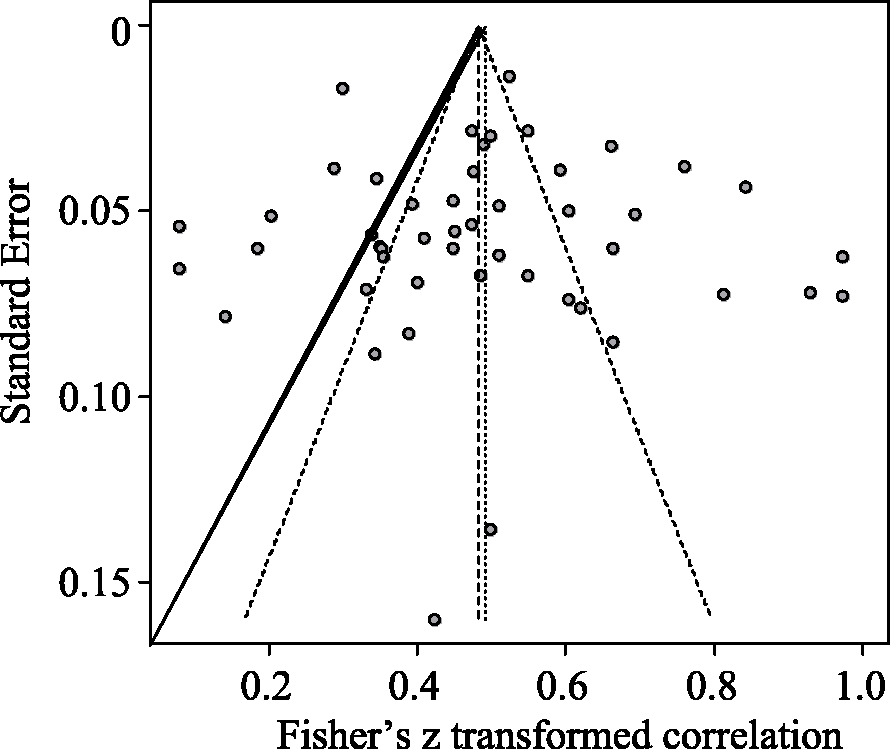
图1 变革型领导与敬业度关系各效应值分布的漏斗图
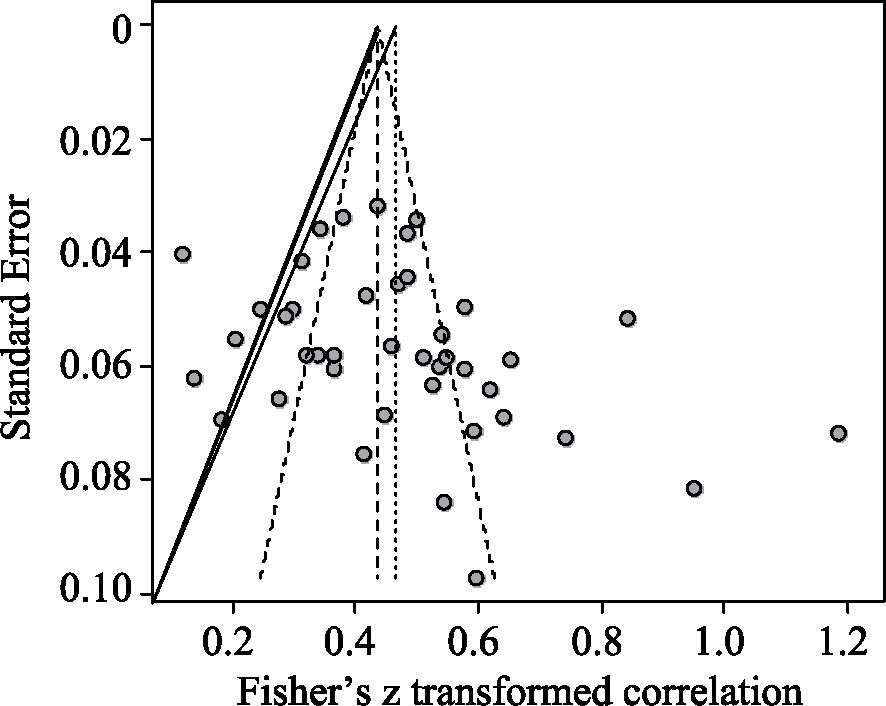
图2 领导-成员交换与敬业度关系各效应值分布的漏斗图
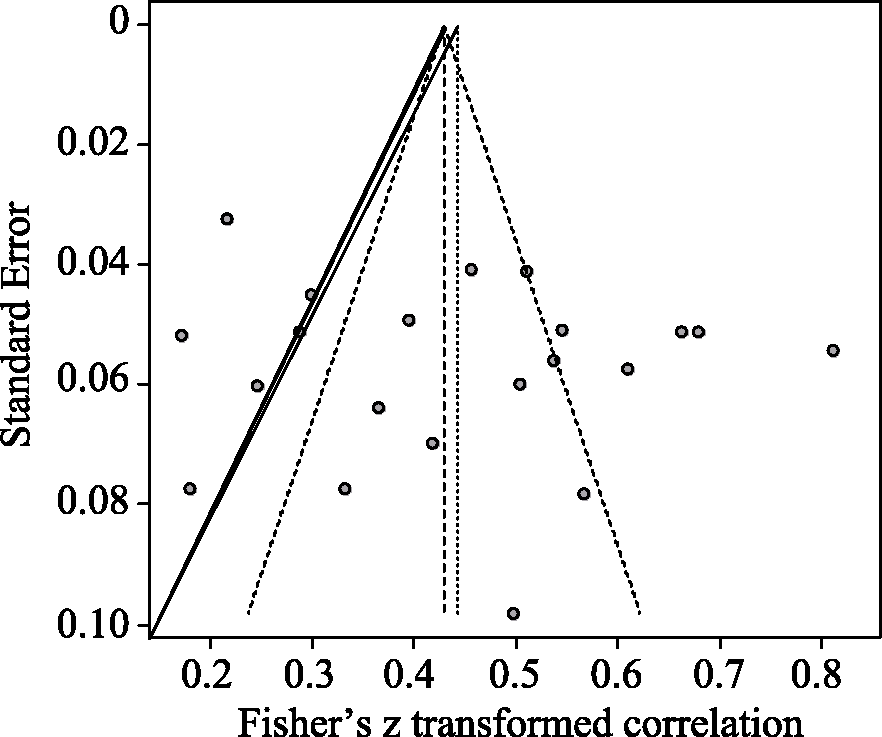
图3 真实型领导与敬业度关系各效应值分布的漏斗图
| 自变量 | Egger's回归系数检验 | Begg秩相关检验 | |||||
|---|---|---|---|---|---|---|---|
| intercept | SE | t | df | p | Z | p | |
| TL | 0.25 | 1.16 | 0.22 | 48 | 0.830 | -0.41 | 0.682 |
| LMX | 4.26 | 1.91 | 2.23 | 41 | 0.032 | 2.48 | 0.013 |
| AL | 2.36 | 2.91 | 0.81 | 20 | 0.428 | -0.08 | 0.933 |
| EL | 0.03 | 3.71 | 0.01 | 9 | 0.993 | 0.70 | 0.484 |
| SL | 4.64 | 2.29 | 2.02 | 6 | 0.089 | -0.247 | 0.805 |
| TAL | -2.80 | 1.73 | -1.61 | 4 | 0.181 | -0.94 | 0.348 |
| EML | -1.43 | 2.48 | -0.58 | 4 | 0.594 | -1.69 | 0.091 |
| PAL | 1.10 | 2.47 | 0.44 | 4 | 0.679 | 0.18 | 0.851 |
表2 发表偏差检验结果
| 自变量 | Egger's回归系数检验 | Begg秩相关检验 | |||||
|---|---|---|---|---|---|---|---|
| intercept | SE | t | df | p | Z | p | |
| TL | 0.25 | 1.16 | 0.22 | 48 | 0.830 | -0.41 | 0.682 |
| LMX | 4.26 | 1.91 | 2.23 | 41 | 0.032 | 2.48 | 0.013 |
| AL | 2.36 | 2.91 | 0.81 | 20 | 0.428 | -0.08 | 0.933 |
| EL | 0.03 | 3.71 | 0.01 | 9 | 0.993 | 0.70 | 0.484 |
| SL | 4.64 | 2.29 | 2.02 | 6 | 0.089 | -0.247 | 0.805 |
| TAL | -2.80 | 1.73 | -1.61 | 4 | 0.181 | -0.94 | 0.348 |
| EML | -1.43 | 2.48 | -0.58 | 4 | 0.594 | -1.69 | 0.091 |
| PAL | 1.10 | 2.47 | 0.44 | 4 | 0.679 | 0.18 | 0.851 |
| 自变量 | ZCOR | 95% CI | Z | p |
|---|---|---|---|---|
| TL | 0.48 | [0.43; 0.53] | 18.76 | < 0.0001 |
| LMX | 0.46 | [0.41; 0.51] | 17.02 | < 0.0001 |
| AL | 0.45 | [0.37; 0.53] | 11.28 | < 0.0001 |
| EL | 0.50 | [0.42; 0.58] | 11.43 | < 0.0001 |
| SL | 0.40 | [0.29; 0.51] | 6.87 | < 0.0001 |
| TAL | 0.43 | [0.33; 0.53] | 8.21 | < 0.0001 |
| EML | 0.61 | [0.47; 0.76] | 8.32 | < 0.0001 |
| PAL | 0.28 | [0.20; 0.35] | 7.27 | < 0.0001 |
表3 主效应检验结果
| 自变量 | ZCOR | 95% CI | Z | p |
|---|---|---|---|---|
| TL | 0.48 | [0.43; 0.53] | 18.76 | < 0.0001 |
| LMX | 0.46 | [0.41; 0.51] | 17.02 | < 0.0001 |
| AL | 0.45 | [0.37; 0.53] | 11.28 | < 0.0001 |
| EL | 0.50 | [0.42; 0.58] | 11.43 | < 0.0001 |
| SL | 0.40 | [0.29; 0.51] | 6.87 | < 0.0001 |
| TAL | 0.43 | [0.33; 0.53] | 8.21 | < 0.0001 |
| EML | 0.61 | [0.47; 0.76] | 8.32 | < 0.0001 |
| PAL | 0.28 | [0.20; 0.35] | 7.27 | < 0.0001 |
| 研究变量 | 1 | 2 | 3 | 4 | 5 | 6 | 7 | 8 | 9 | |
|---|---|---|---|---|---|---|---|---|---|---|
| 1 | TL | 1 | ||||||||
| k, N | ||||||||||
| 2 | LMX | 0.64a | 1 | |||||||
| k, N | 20, 4591 | |||||||||
| 3 | AL | 0.67a | 0.62a | 1 | ||||||
| k, N | 10, 2397 | 4, 1468 | ||||||||
| 4 | EL | 0.63a | 0.65a | 0.85 | 1 | |||||
| k, N | 20, 3717 | 18, 4052 | 2, 440 | |||||||
| 5 | SL | 0.47a | 0.59a | 0.61 | 0.38 | 1 | ||||
| k, N | 5, 774 | 4, 938 | 1, 1132 | 2, 1486 | ||||||
| 6 | TAL | 0.21 | 0.46 | 0.37a | 0.61a | 0.11 | 1 | |||
| k, N | 3, 601 | 1, 345 | 4, 770 | 13, 2232 | 1, 207 | |||||
| 7 | EML | 0.73 | 0.62 | — | 0.53 | 0.86 | 0.34 | 1 | ||
| k, N | 3, 469 | 3, 1068 | 1, 259 | 1, 199 | 2, 394 | |||||
| 8 | PAL | 0.56 | 0.39 | 0.58 | — | 0.70 | 0.49 | — | 1 | |
| 4, 976 | 2, 868 | 1, 256 | 2, 1132 | 3, 688 | ||||||
| 9 | EE | 0.48 | 0.46 | 0.45 | 0.50 | 0.40 | 0.43 | 0.61 | 0.28 | 1 |
表4 研究变量间的相关矩阵
| 研究变量 | 1 | 2 | 3 | 4 | 5 | 6 | 7 | 8 | 9 | |
|---|---|---|---|---|---|---|---|---|---|---|
| 1 | TL | 1 | ||||||||
| k, N | ||||||||||
| 2 | LMX | 0.64a | 1 | |||||||
| k, N | 20, 4591 | |||||||||
| 3 | AL | 0.67a | 0.62a | 1 | ||||||
| k, N | 10, 2397 | 4, 1468 | ||||||||
| 4 | EL | 0.63a | 0.65a | 0.85 | 1 | |||||
| k, N | 20, 3717 | 18, 4052 | 2, 440 | |||||||
| 5 | SL | 0.47a | 0.59a | 0.61 | 0.38 | 1 | ||||
| k, N | 5, 774 | 4, 938 | 1, 1132 | 2, 1486 | ||||||
| 6 | TAL | 0.21 | 0.46 | 0.37a | 0.61a | 0.11 | 1 | |||
| k, N | 3, 601 | 1, 345 | 4, 770 | 13, 2232 | 1, 207 | |||||
| 7 | EML | 0.73 | 0.62 | — | 0.53 | 0.86 | 0.34 | 1 | ||
| k, N | 3, 469 | 3, 1068 | 1, 259 | 1, 199 | 2, 394 | |||||
| 8 | PAL | 0.56 | 0.39 | 0.58 | — | 0.70 | 0.49 | — | 1 | |
| 4, 976 | 2, 868 | 1, 256 | 2, 1132 | 3, 688 | ||||||
| 9 | EE | 0.48 | 0.46 | 0.45 | 0.50 | 0.40 | 0.43 | 0.61 | 0.28 | 1 |
| 领导风格 | LMX | TL | AL | TL | EL | TL | SL | TL | TAL | TL | EML | TL | PAL | TL |
|---|---|---|---|---|---|---|---|---|---|---|---|---|---|---|
| 相对权重 | 47 | 53 | 45 | 55 | 53 | 47 | 37 | 63 | 43 | 57 | 69 | 31 | 17 | 83 |
| R2 | 0.27 | 0.26 | 0.30 | 0.27 | 0.34 | 0.38 | 0.23 | |||||||
表5 相对权重分析结果
| 领导风格 | LMX | TL | AL | TL | EL | TL | SL | TL | TAL | TL | EML | TL | PAL | TL |
|---|---|---|---|---|---|---|---|---|---|---|---|---|---|---|
| 相对权重 | 47 | 53 | 45 | 55 | 53 | 47 | 37 | 63 | 43 | 57 | 69 | 31 | 17 | 83 |
| R2 | 0.27 | 0.26 | 0.30 | 0.27 | 0.34 | 0.38 | 0.23 | |||||||
| 调节变量 | 领导风格 | 类别 | k | N | r | 95%CI | Qw | I2 | QB | df |
|---|---|---|---|---|---|---|---|---|---|---|
| 敬业度 测量工具 | TL | UWES | 41 | 18073 | 0.42 | [0.39:0.44] | 1258.90 | 91.3 | 1.73 | 1 |
| other | 9 | 9807 | 0.46 | [0.40; 0.52] | 261.56 | 94.3 | ||||
| LMX | UWES | 30 | 12475 | 0.42 | [0.38; 0.45] | 244.23 | 86.5 | 4.58* | 1 | |
| other | 13 | 3840 | 0.54 | [0.44; 0.64] | 598.82 | 96.7 | ||||
| AL | UWES | 16 | 5227 | 0.38 | [0.35; 0.41] | 908.17 | 88.2 | 24.30** | 2 | |
| other | 5 | 1675 | 0.46 | [0.42; 0.51] | 95.54 | 81.2 | ||||
| 研究设计 | TL | 横向 | 46 | 27184 | 0.43 | [0.40; 0.45] | 1538.86 | 92.3 | 1.61 | 1 |
| 纵向 | 4 | 431 | 0.32 | [0.15; 0.47] | 16.78 | 70.2 | ||||
| EL | 横向 | 8 | 3898 | 0.51 | [0.46; 0.56] | 107.53 | 88.8 | 6.95** | 1 | |
| 纵向 | 3 | 1693 | 0.34 | [0.22; 0.46] | 14.52 | 86.2 | ||||
| 文化背景 | TL | 东方 | 23 | 9313 | 0.47 | [0.44; 0.50] | 734.28 | 90.5 | 23.13*** | 1 |
| 西方 | 27 | 18185 | 0.35 | [0.31; 0.39] | 651.82 | 91.7 | ||||
| LMX | 东方 | 33 | 10938 | 0.49 | [0.44; 0.54] | 793.9 | 94.5 | 12.23*** | 1 | |
| 西方 | 10 | 5377 | 0.36 | [0.31; 0.41] | 45.95 | 80.4 | ||||
| AL | 东方 | 17 | 6751 | 0.44 | [0.42; 0.47] | 771.00 | 90.4 | 31.18*** | 1 | |
| 西方 | 5 | 1118 | 0.30 | [0.26; 0.34] | 430.85 | 87.0 | ||||
| EL | 东方 | 6 | 3040 | 0.51 | [0.46; 0.56] | 105.78 | 90.5 | 5.52* | 1 | |
| 西方 | 5 | 2551 | 0.40 | [0.32; 0.48] | 23.99 | 83.3 | ||||
| SL | 东方 | 4 | 776 | 0.31 | [0.24; 0.37] | 1.91 | 0 | 4.42* | 1 | |
| 西方 | 4 | 1772 | 0.45 | [0.33; 0.56] | 23.14 | 87.0 | ||||
| TAL | 东方 | 3 | 1446 | 0.49 | [0.45; 0.53] | 0.06 | 0 | 7.93** | 1 | |
| 西方 | 3 | 540 | 0.29 | [0.15; 0.43] | 8.17 | 63.3 |
表6 调节效应检验结果
| 调节变量 | 领导风格 | 类别 | k | N | r | 95%CI | Qw | I2 | QB | df |
|---|---|---|---|---|---|---|---|---|---|---|
| 敬业度 测量工具 | TL | UWES | 41 | 18073 | 0.42 | [0.39:0.44] | 1258.90 | 91.3 | 1.73 | 1 |
| other | 9 | 9807 | 0.46 | [0.40; 0.52] | 261.56 | 94.3 | ||||
| LMX | UWES | 30 | 12475 | 0.42 | [0.38; 0.45] | 244.23 | 86.5 | 4.58* | 1 | |
| other | 13 | 3840 | 0.54 | [0.44; 0.64] | 598.82 | 96.7 | ||||
| AL | UWES | 16 | 5227 | 0.38 | [0.35; 0.41] | 908.17 | 88.2 | 24.30** | 2 | |
| other | 5 | 1675 | 0.46 | [0.42; 0.51] | 95.54 | 81.2 | ||||
| 研究设计 | TL | 横向 | 46 | 27184 | 0.43 | [0.40; 0.45] | 1538.86 | 92.3 | 1.61 | 1 |
| 纵向 | 4 | 431 | 0.32 | [0.15; 0.47] | 16.78 | 70.2 | ||||
| EL | 横向 | 8 | 3898 | 0.51 | [0.46; 0.56] | 107.53 | 88.8 | 6.95** | 1 | |
| 纵向 | 3 | 1693 | 0.34 | [0.22; 0.46] | 14.52 | 86.2 | ||||
| 文化背景 | TL | 东方 | 23 | 9313 | 0.47 | [0.44; 0.50] | 734.28 | 90.5 | 23.13*** | 1 |
| 西方 | 27 | 18185 | 0.35 | [0.31; 0.39] | 651.82 | 91.7 | ||||
| LMX | 东方 | 33 | 10938 | 0.49 | [0.44; 0.54] | 793.9 | 94.5 | 12.23*** | 1 | |
| 西方 | 10 | 5377 | 0.36 | [0.31; 0.41] | 45.95 | 80.4 | ||||
| AL | 东方 | 17 | 6751 | 0.44 | [0.42; 0.47] | 771.00 | 90.4 | 31.18*** | 1 | |
| 西方 | 5 | 1118 | 0.30 | [0.26; 0.34] | 430.85 | 87.0 | ||||
| EL | 东方 | 6 | 3040 | 0.51 | [0.46; 0.56] | 105.78 | 90.5 | 5.52* | 1 | |
| 西方 | 5 | 2551 | 0.40 | [0.32; 0.48] | 23.99 | 83.3 | ||||
| SL | 东方 | 4 | 776 | 0.31 | [0.24; 0.37] | 1.91 | 0 | 4.42* | 1 | |
| 西方 | 4 | 1772 | 0.45 | [0.33; 0.56] | 23.14 | 87.0 | ||||
| TAL | 东方 | 3 | 1446 | 0.49 | [0.45; 0.53] | 0.06 | 0 | 7.93** | 1 | |
| 西方 | 3 | 540 | 0.29 | [0.15; 0.43] | 8.17 | 63.3 |
| [1] | 包桂秋 . (2017). 道德式领导与护士核心自我评价对合同制护士工作投入的影响研究. 护理管理杂志, 17( 2), 87-89. |
| [2] | 陈佩, 杨付, 石伟 . (2016). 公仆型领导:概念、测量、影响因素与实施效果. 心理科学进展, 24( 1), 143-157. |
| [3] | 陈世民, 孙配贞, 段鑫星 . (2017). 中国文化背景下魅力型领导对关系绩效的影响:尽责性与工作投入的链式中介作用. 中国临床心理学杂志, 25( 4), 747-749. |
| [4] | 陈文晶, 时勘 . (2014). 中国管理者交易型领导的结构与测量. 管理学报, 11( 10), 1453-1459. |
| [5] | 储成祥, 毛慧琴, 江芮澜 . (2012). 领导行为、组织支持和员工敬业度的关系——以通信企业为例. 北京邮电大学学报(社会科学版), 14( 5), 91-99. |
| [6] | 邓志华, 陈维政, 黄丽, 胡冬梅 . (2012). 服务型领导与家长式领导对员工态度和行为影响的比较研究. 经济与管理研究, 7, 101-110. |
| [7] | 丁凤琴, 赵虎英 . (2018). 感恩的个体主观幸福感更强? ——一项元分析. 心理科学进展, 26( 10), 1749-1764. |
| [8] | 董霞, 高燕, 马建峰 . (2018). 服务型领导对员工主动性顾客服务绩效的影响——基于社会交换与社会学习理论双重视角. 旅游学刊, 33( 6), 61-72. |
| [9] | 方振邦( 主编 ). (2011). 管理学基础(第二版). 北京: 中国人民大学出版社. |
| [10] | 冯彩玲, 杨锡雨 . (2018). 交易型领导对工作绩效的影响——工作投入的中介作用. 鲁东大学学报(自然科学版), 34( 2), 178-183. |
| [11] | 何洁, 丁宁宁, 王冬冬 . (2015). 承诺型人力资源管理实践对员工敬业度的影响: 自我决定与社会交换的整合视角. 中国人力资源开发, ( 13), 58-63. |
| [12] | 何立, 凌文辁 . (2010). 领导风格对员工工作绩效的作用: 组织认同和工作投入的影响. 企业经济, ( 11), 65-68. |
| [13] | 胡少楠, 王詠 . (2014). 工作投入的概念、测量、前因与后效. 心理科学进展, 22( 12), 1975-1984. |
| [14] | 黄昱方, 张璇 . (2016). 角色清晰对员工敬业度的影响研究: 一个被中介的调节模型. 中国人力资源开发, (5), 76-84. |
| [15] | 霍苑渊 . (2008). 员工敬业度的构成维度及其影响因素研究:基于两个典型企业中的调查(硕士学位论文). 浙江大学, 杭州. |
| [16] | 简浩贤, 徐云飞, 曹曼, 赵曙明 . (2017). 基于组织认同视角的包容性领导与员工敬业度关系研究. 管理学报, 14( 11), 1624-1630. |
| [17] | 李超平, 毛凯贤 . (2018). 变革型领导对新员工敬业度的影响: 认同视角下的研究. 管理评论, 30( 7), 136-147. |
| [18] | 李超平, 时勘 . (2005). 变革型领导的结构与测量. 心理学报, 37( 6), 803-811. |
| [19] | 李栋华 . (2018). 家长式领导风格对员工离职倾向的影响研究——以员工敬业度为中介变量(硕士学位论文). 首都经济贸易大学, 北京. |
| [20] | 李衎, 宋欢欢, 孙媛媛, 俞蔚巍, 郝海霞, 高伟, 杨濮瑞 . (2017). Picc专科护士工作投入与其感知护士长变革型领导的相关性. 现代临床护理, 16( 2), 1-4. |
| [21] | 李燚, 魏峰 . (2010). 领导理论的演化和前沿进展. 管理学报, 7( 4), 517-524. |
| [22] | 李永鑫, 周海龙, 田艳辉 . (2014). 真实型领导影响员工工作投入的多重中介效应. 心理科学, 37( 3), 716-722. |
| [23] | 梁建 . (2014). 道德领导与员工建言:一个调节-中介模型的构建与检验. 心理学报, 46( 2), 252-264. |
| [24] | 刘层层 . (2013). 领导成员交换关系、心理授权与员工敬业度关系的实证研究(硕士学位论文). 西南财经大学, 成都. |
| [25] | 刘光辉, 谢义忠 . (2013). 论变革型领导与核心自我评价对员工工作积极性的影响. 湖南科技大学学报(社会科学版), 16( 2), 89-92. |
| [26] | 刘慧慧 . (2017). 领导成员交换与感知组织支持对员工工作投入的影响研究(硕士学位论文). 华侨大学, 厦门. |
| [27] | 刘金栋, 郑向敏 . (2012). 变革型领导和交易型领导理论研究综述. 企业活力, ( 10), 87-92. |
| [28] | 路红, 孙桂芳, 刘毅 . (2014). 德行领导对工作投入的影响. 广州大学学报(自然科学版), 13( 4), 91-95. |
| [29] | 陆欣欣, 涂乙冬 . (2015). 工作投入的短期波动. 心理科学进展, 23( 2), 268-279. |
| [30] | 马玉 . (2016). 大五人格特质对员工敬业度的影响研究--领导成员交换关系的中介作用. 中外企业家, 9( 25), 152-154. |
| [31] | 毛晋平, 谭美金 . (2015). 变革型领导风格对中小学教师工作投入的影响: 心理资本的中介和调节作用. 教师教育研究, 27( 5), 14-22. |
| [32] | 毛晋平, 周卓钊, 吴逸飞 . (2017). 变革型领导、真诚型领导与中小学教师工作投入关系的比较研究. 教师教育研究, 29( 2), 48-54. |
| [33] | 孟慧, 宋继文, 艾亦非, 陈晓茹 . (2014). 中国道德领导的结构与测量初探. 管理学报, 11( 8), 1101-1108. |
| [34] | 彭伟, 朱晴雯, 陈奎庆 . (2017). 基于效忠主管和权力距离影响的包容型领导与员工工作投入关系研究. 管理学报, 14( 5), 686-694. |
| [35] | 乔红晓, 张鹏涛 . (2013). 诚信领导对教师工作投入的影响--教师职业认同的中介作用. 管理学家(学术版), ( 5), 62-70. |
| [36] | 任孝鹏, 王辉 . (2005). 领导-部属交换(lmx)的回顾与展望. 心理科学进展, 13( 6), 86-95. |
| [37] | 孙健敏, 陆欣欣 . (2017). 伦理型领导的概念界定与测量. 心理科学进展, 25( 1), 121-132. |
| [38] | 孙维, 王怀明 . (2013). 家长式领导与员工敬业度:领导公正感的作用. 广西财经学院学报, ( 6), 73-79. |
| [39] | 唐春勇, 陈冰, 赵曙明 . (2018). 中国文化情境下包容性领导对员工敬业度的影响. 经济与管理研究, 39( 3), 110-120. |
| [40] | 唐贵瑶, 李鹏程, 李骥 . (2012). 国外授权型领导研究前沿探析与未来展望. 外国经济与管理, 34( 9), 73-80. |
| [41] | 唐汉瑛, 龙立荣, 周如意 . (2015). 谦卑领导行为与下属工作投入:有中介的调节模型. 管理科学, 28( 3), 77-89. |
| [42] | 万鹏宇, 冯志远, 徐奥, 黄霞妮, 徐明津, 杨新国 . (2016). 真诚领导和工作投入对税务系统基层公务员离职倾向影响. 中国职业医学, 43( 5), 564-567. |
| [43] | 王聪颖, 杨东涛 . (2014). 基于信任氛围感知与个体主义作用视角的诚信型领导对员工工作态度的影响. 管理学报, 11( 4), 533-540. |
| [44] | 王冬冬, 钱智超 . (2017). 领导成员交换差异与新生代员工敬业度的关系研究. 科学学与科学技术管理, 38( 4), 174-182. |
| [45] | 王海雯, 张淑华 . (2018). 情绪劳动策略与工作满意度关系的元分析. 心理科学进展, 26( 4), 599-613. |
| [46] | 王辉, 牛雄鹰, Law K.S ,(2004). 领导-部属交换的多维结构及对工作绩效和情境绩效的影响. 心理学报, 36( 2), 179-185. |
| [47] | 王羽, 周启帆, 史占彪 . (2017). 公务员工作投入与心理幸福感的关系:有中介的调节模型. 中国临床心理学杂志, 25( 6), 1109-1113. |
| [48] | 王桢 . (2012). 团队内工作投入的人际传导机制. 心理科学进展, 20( 10), 1531-1537. |
| [49] | 王桢, 陈乐妮, 李旭培 . (2015). 变革型领导与工作投入: 基于情感视角的调节中介模型. 管理评论, 27( 9), 120-129. |
| [50] | 王桢, 李旭培 . (2013). 变革型领导和情绪劳动策略: 工作投入的中介作用. 管理学家(学术版), ( 9), 21-30. |
| [51] | 王震, 孙健敏, 赵一君 . (2012). 中国组织情境下的领导有效性: 对变革型领导、领导-部属交换和破坏型领导的元分析. 心理科学进展, 20( 2), 174-190. |
| [52] | 王震, 宋萌, 孙健敏 . (2014). 真实型领导:概念、测量、形成与作用. 心理科学进展, 22( 3), 458-473. |
| [53] | 魏蕾, 时勘 . (2010). 家长式领导与员工工作投入: 心理授权的中介作用. 心理与行为研究, 8( 2), 88-93. |
| [54] | 吴鹏, 刘华山 . (2014). 道德推理与道德行为关系的元分析. 心理学报, 46( 8), 1192-1207. |
| [55] | 肖潇 . (2018). 领导-成员交换关系对产业工人敬业度的影响——被中介的调节效应研究(硕士学位论文). 华中农业大学, 武汉. |
| [56] | 谢义忠, 吴萍 . (2017). 变革型领导、社会交换关系对员工工作场景中主观幸福感的影响. 软科学, 31( 2), 61-65. |
| [57] | 胥彦, 李超平 . (2018). 服务型领导如何影响员工建言?领导信任和消极归因的作用. 中国人力资源开发, 35( 12), 6-17. |
| [58] | 胥彦, 李超平 . (2019). 追踪研究在组织行为学中的应用. 心理科学进展, 27( 4), 1-11. |
| [59] | 徐佳妮, 于德华, 孙蔚, 杨震, 李文秀, 刘薇群, 丁燕华 . (2012). 基于领导风格的医院员工工作敬业度及其影响因素分析. 中国医院, 16( 2), 23-25. |
| [60] | 徐振亭, 曲怡颖, 罗瑾琏 . (2018). 自我牺牲型领导对员工工作投入的跨层次影响研究. 科学学与科学技术管理, 39( 11), 142-157. |
| [61] | 薛丁铭, 李永鑫 . (2017). 包容型领导对幼儿园教师工作投入的影响. 学前教育研究, ( 7), 11-19. |
| [62] | 姚春序, 刘艳林 . (2013). 魅力型领导与下属工作投入:双维认同构念的中介机制. 心理科学, 36( 4), 942-948. |
| [63] | 杨红明 . (2017). 挑战性工作要求对变革型领导的“替代”:科研人员敬业度作用的间接调节模型. 科技进步与对策, 34( 7), 88-93. |
| [64] | 杨克俭, 闫晓飞, 罗正学 . (2017). 辱虐管理与临床护士工作投入和团队满意度之间的关系. 职业与健康, 33( 4), 506-508. |
| [65] | 杨书, 李婷婷, 刘新 . (2007). 应用漏斗图识别发表性偏倚的效率研究. 成都医学院学报, 2( 1), 33-34. |
| [66] | 杨婷婷, 钟建安 . (2013). 组织内社会交换关系与工作投入:心理资本的中介效应. 人类工效学, 19( 1), 51-54. |
| [67] | 袁凌, 李静, 李健 . (2016). 差序式领导对员工创新行为的影响——领导创新期望的调节作用. 科技进步与对策, 33( 10), 110-115. |
| [68] | 赵安安, 高尚仁 . (2005). 台湾地区华人企业家族式领导风格与员工压力之关联性研究. 应用心理学研究, 27, 111-131. |
| [69] | 张洁, 郑一宁 . (2015). 护士长诚信领导行为对护士工作投入的影响. 中国护理管理, 15( 5), 555-558. |
| [70] | 张洁, 郑一宁 . (2016). 护士长诚信领导、护理组织文化与护士工作投入的关系研究. 中华护理杂志, 51( 9), 1054-1058. |
| [71] | 张静, 宋继文, 郑晓明, 倪丹 . (2018). 基于调节性中介模型的领导与下属特质正念对工作投入的影响研究. 管理学报, ( 11), 1629-1637. |
| [72] | 张轶文, 甘怡群 . (2005). 中文版utrecht工作投入量表(uwes)的信效度检验. 中国临床心理学杂志, 13( 3), 268-270. |
| [73] | 张征, 古银华 . (2017). 下属-主管匹配对企业研发人员工作投入的影响机制研究. 科技进步与对策, 34( 4), 134-139. |
| [74] | 周浩, 龙立荣 . (2005). 恩威并施, 以德服人——家长式领导研究述评. 心理科学进展, 13( 2), 227-238. |
| [75] | 郑伯壎, 周丽芳, 樊景立 . (2000). 家长式领导量表: 三元模式的建构与测量. 本土心理学研究, 14, 3-64. |
| [76] | 朱莉 . (2014). 领导风格与员工敬业度的关系研究. 齐鲁师范学院学报, 29( 1), 88-91. |
| [77] | 钟定国, 卢丹 . (2014). 家长式领导行为对员工工作投入的影响作用——基于领导成员交换的中介作用. 西安工业大学学报, 34( 1), 57-63. |
| [78] | 钟鑫, 徐亚雄, 廖银燕 . (2015). 领导-成员交换对员工敬业度的影响研究——基于金融服务业一线员工的数据. 中国劳动, ( 16), 90-95. |
| [79] | Adil A., &Kamal A, (2016). Impact of psychological capital and authentic leadership on work engagement and job related affective well-being. Pakistan Journal of Psychological Research,31(1), 1-21. |
| [80] | Agarwal U. A., Datta S., Blake-Beard S., & Bhargava S . (2013). Linking lmx, innovative work behaviour and turnover intentions: The mediating role of work engagement. Career Development International,17(3), 208-230. |
| [81] | Alfes K., Shantz A. D., Truss C., & Soane E. C . (2013). The link between perceived human resource management practices, engagement and employee behaviour: A moderated mediation model. The International Journal of Human Resource Management,24(2), 330-351. |
| [82] |
Aryee S., Walumbwa F. O., Zhou Q., & Hartnell C. A . (2012). Transformational leadership, innovative behavior and task performance: Test of mediation and moderation processes. Human Performance,25(1), 1-25.
doi: 10.1080/08959285.2011.631648 |
| [83] | Avolio B., &Bass B.M . (1995). Individual consideration viewed at multiple levels of analysis: A multi-level framework for examining the diffusion of transformational leadership. Leadership Quarterly,6(2), 199-218. |
| [84] | AvolioB. J. & W.L . (2005). Authentic leadership development: Getting to the root of positive forms of leadership, The Leadership Quarterly, 16( 3), 315-338. |
| [85] | Aw V. K., &Ayoko O.B . (2017). The impact of followers’ conflict behaviors on teams’ transformational leadership, team member exchange and engagement. International Journal of Conflict Management,28(4), 509-532. |
| [86] | Babcock-Roberson M., &Strickland O.J . (2010). The relationship between charismatic leadership, work engagement, and organizational citizenship behaviors. Journal of Psychology,144(3), 313-326. |
| [87] | Bae S. H., Song J. H., Park S., & Kim H. K . (2013). Influential factors for teachers’ creativity: Mutual impacts of leadership, work engagement, and knowledge creation practices. Performance Improvement Quarterly,26(3), 33-58. |
| [88] |
Bakker A . (2014). Daily fluctuations in work engagement: An overview and current directions. European Psychologist,19(4), 227-236.
doi: 10.1027/1016-9040/a000160 |
| [89] | Bakker A., & Albrecht. S . (2018). Work engagement: Current trends. Career Development International,23(1), 4-11. |
| [90] | Bakker A., &Demerouti E, (2007). The job demands- resources model: State of the art. Journal of Managerial Psychology,22(3), 309-328. |
| [91] | Bakker A. B., Demerouti E., & Sanz-Vergel A. I . (2014). Burnout and work engagement: The JD-R approach. Annual Review of Organizational Psychology and Organizational Behavior,1(1), 389-411. |
| [92] |
Bakker A., &Xanthopoulou D, (2013). Creativity and charisma among female leaders: The role of resources and work engagement. International Journal of Human Resource Management,24(14), 2760-2779.
doi: 10.1080/09585192.2012.751438 |
| [93] | Bamford M., Wong C. A., & Laschinger H . (2013). The influence of authentic leadership and areas of worklife on work engagement of registered nurses. Journal of Nursing Management,21(3), 529-540. |
| [94] | Bao Y., Li C., & Zhao H . (2018). Servant leadership and engagement: A dual mediation model. Journal of Managerial Psychology,33(6), 406-417. |
| [95] | Bass B. M. (1985).Leadership and performance beyond expectations. New York: Free Press. |
| [96] | Bass B . (1995). Theory of transformational leadership redux. Leadership Quarterly,6(4), 463-478. |
| [97] | Bass B., &Avolio B.J . (1995). Multifactor leadership questionnaire for research. Mind Garden, Inc, Palo Alto, CA. |
| [98] | Bass B. I., Cigularov K. P., Chen P. Y., Henry K. L., Tomazic R. G., & Li Y . (2016). The effects of student violence against school employees on employee burnout and work engagement: The roles of perceived school unsafety and transformational leadership. International Journal of Stress Management,23(3), 318-336. |
| [99] | Baxter L . (2013). Supportive Leadership, Employee Engagement and Occupational Safety: A Field Study (Unpublished doctorial dissertation). The University of Tennessee, Knoxville. |
| [100] | Besieux T., Baillien E., Verbeke A. L., & Euwema M. C . (2018). What goes around comes around: The mediation of corporate social responsibility in the relationship between transformational leadership and employee engagement. Economic and Industrial Democracy,39(2), 249-271. |
| [101] | Bhatnagar & . (2012). Management of innovation: role of psychological empowerment, work engagement and turnover intention in the indian context. The International Journal of Human Resource Management,23(5), 928-951. |
| [102] | Bono J. E., Foldes H. J., Vinson G., & Muros J. P . (2007). Workplace emotions: The role of supervision and leadership. Journal of Applied Psychology,92(5), 1357-1367. |
| [103] | Breevaart K &Bakker A.B . (2018). Daily job demands and employee work engagement: The role of daily transformational leadership behavior. Journal of Occupational Health Psychology,23(3), 338-349. |
| [104] | Breevaart K., Bakker A. B., Demerouti E., & Derks D . (2016). Who takes the lead? A multi-source diary study on leadership, work engagement, and job performance. Journal of Organizational Behavior,37(3), 309-325. |
| [105] | Breevaart K., Bakker A. B., Demerouti E., & van der Heuvel , M. (2015). Leader-member exchange, work engagement, and job performance. Journal of Managerial Psychology,30(7), 754-770. |
| [106] | Breevaart K., Bakker A. B., Hetland J., Demerouti E., Olsen O. K., & Espevik R . (2014). Daily transactional and transformational leadership and daily employee engagement. Journal of Occupational and Organizational Psychology,87(1), 138-157. |
| [107] | Brunetto Y., Xerri M., Trinchero E., Farr-Wharton R., Shacklock K., & Borgonovi E . (2015). Public-private sector comparisons of nurses’ work harassment using set: Italy and australia. Public Management Review,18(10), 1479-1503. |
| [108] | Bormann K . (2017). Linking daily ethical leadership to followers’ daily behaviour: The roles of daily work engagement and previous abusive supervision. European Journal of Work and Organizational Psychology, 26( 4), 590-600. |
| [109] | Brown M. E., Treviño L. K., & Harrison D. A . (2005). Ethical leadership: A social learning perspective for construct development and testing. Organizational Behavior and Human Decision Processes,97 2), 117-134. |
| [110] | Bui H. T. M., Zeng Y., & Higgs M . (2017). The role of person-job fit in the relationship between transformational leadership and job engagement. Journal of Managerial Psychology,32(5), 373-386. |
| [111] | Burch T., &Guarana C.L . (2015). The comparative influences of transformational leadership and leader-member exchange on follower engagement. Journal of Leadership Studies,8(3), 6-25. |
| [112] | Cai D., Cai Y., Sun Y., &Ma J, (2018). Linking empowering leadership and employee work engagement: The effects of person-job fit, person-group fit, and proactive personality. Frontiers in Psychology, 9, 1304. |
| [113] | Caniëls M. C. J., Semeijn J. H., Renders I. H. M . (2018). Mind the mindset! The interaction of proactive personality, transformational leadership and growth mindset for engagement at work. Career Development International,23(1), 48-66. |
| [114] | Chan D. (1998). The conceptualization and analysis of change over time: An integrative approach incorporating longitudinal mean and covariance structures analysis (LMACS) and multiple indicator latent growth modeling (MLGM). Organizational Research Methods,1(4), 421-483. |
| [115] | Chughtai A . (2018). Examining the effects of servant leadership on life satisfaction. Applied Research in Quality of Life,13(4), 873-889. |
| [116] | Chughtai A., Byrne M., & Flood B . (2015). Linking ethical leadership to employee well-being: The role of trust in supervisor. Journal of Business Ethics,128(3), 653-663. |
| [117] |
Christian M. S., Garza A. S., & Slaughter J. E . (2011). Work engagement: A quantitative review and test of its relations with task and contextual performance. Personnel Psychology,64(1), 89-136.
doi: 10.1111/j.1744-6570.2010.01203.x |
| [118] | Clugston M., Howell J. P., & Dorfman P. W . (2000). Does cultural socialization predict multiple bases and foci of commitment? Journal of Management,26(1), 5-30. |
| [119] | Crizelle E., Jolandie V., de Beer L., & Lelani B-L . (2016). The mediating effect of leader-member exchange between strengths use and work engagement, Journal of Psychology in Africa,26(1), 22-28. |
| [120] | Day D., &Dragoni L, (2015). Leadership development: An outcome-oriented review based on time and levels of analyses. Annual Review of Organizational Psychology & Organizational Behavior, 2, 133-156. |
| [121] | de Clercq D., Bouckenooghe D., Raja U., & Matsyborska G . (2014). Servant leadership and work engagement: The contingency effects of leader-follower social capital. Human Resource Development Quarterly,25(2), 183-212. |
| [122] | deVilliers J.R., &Stander M.W . (2011). Psychological empowerment, work engagement and turnover intention: The role of leader relations and role clarity in a financial institution. Journal of Psychology in Africa,21(3), 405-412. |
| [123] |
deSousa M. J.C., &Dierendonck D, (2014). Servant leadership and engagement in a merge process under high uncertainty. Journal of Organizational Change Management,27(6), 877-899.
doi: 10.1108/JOCM-07-2013-0133 |
| [124] | Demirtas O. (2015). Ethical leadership influence at organizations: Evidence from the field. Journal of Business Ethics,126(2), 273-284. |
| [125] | Demirtas O., Hannah S. T., Gok K., Arslan A., & Capar N . (2017). The moderated influence of ethical leadership, via meaningful work, on followers’ engagement, organizational identification, and envy. Journal of Business Ethics,145(1), 183-199. |
| [126] |
denHartog D.N., &Belschak F.D . (2012). When does transformational leadership enhance employee proactive behavior? The role of autonomy and role breadth self-efficacy. Journal of Applied Psychology,97(1), 194-202.
doi: 10.1037/a0024903 |
| [127] |
denHartog D.N., &Belschak F.D . (2012). Work engagement and machiavellianism in the ethical leadership process. Journal of Business Ethics,107(1), 35-47.
doi: 10.1007/s10551-012-1296-4 |
| [128] | Dienesch R &Liden R, (1986). Leader-member exchange model of leadership: A critique and further development. Academy of Management Review,11(3), 618-634. |
| [129] | Dinh J. E., Lord R. G., Gardner W. L., Meuser J. D., Liden R. C., & Hu J . (2014). Leadership theory and research in the new millennium: Current theoretical trends and changing perspectives. The Leadership Quarterly,25 1), 36-62. |
| [130] | Duval S &Tweedie R, (2000). Trim and fill: A simple funnel-plot-based method of testing and adjusting for publication bias in meta-analysis. Biometrics,56(2), 455-463. |
| [131] | Eagly A. H., Johannesen-Schmidt M. C., &van Engen M. L. (2003). Transformational, transactional, and laissez-faire leadership styles: A meta-analysis comparing women and men. Psychological Bulletin,129(4), 569-591. |
| [132] | Eisenberg N. & Miller P. A. .(1987). Empathy, sympathy,and altruism:Empirical and conceptual links. In N. Eisenberg & J. Strayer (Eds.), Cambridge studies in social and emotional development. Empathy and its development (pp. 292-316). New York: Cambridge University Press. |
| [133] | Enwereuzor I. K., Ugwu L. I., & Eze O. A . (2018). How transformational leadership influences work engagement among nurses: Does person-Job fit matter? Western Journal of Nursing Research,40(3), 346-366. |
| [134] | Epitropaki O &Martin R, (2005). The moderating role of individual differences in the relation between transformational/transactional leadership perceptions and organizational identification. Leadership Quarterly,16(4), 569-589. |
| [135] | Espinoza-Parra S., Molero F., & Fuster-Ruizdeapodaca M. J . (2015) Transformational leadership and job satisfaction of police officers (carabineros) in Chile: The mediating effects of group identification and work engagement. Revista de Psicología Social,30(3), 439-467. |
| [136] | García-Sierra R &Fernández-Castro J, (2018). Relationships between leadership, structural empowerment and engagement in nurses. Journal of Advanced Nursing,74 12), 1-11. |
| [137] | Ghadi M. Y., Fernando M., Caputi P . (2013). Transformational leadership and work engagement: The mediating effect of meaning in work. Leadership & Organization Development Journal,34(6), 532-550. |
| [138] | Giallonardo L. M., Wong C. A., & Iwasiw C. L . (2010). Authentic leadership of preceptors: Predictor of new graduate nurses’ work engagement and job satisfaction. Journal of Nursing Management,18(8), 993-1003. |
| [139] |
Gillet N., Fouquereau E., Bonnaud-Antignac A., Mokounkolo R., & Colombat P . (2013). The mediating role of organizational justice in the relationship between transformational leadership and nurses’ quality of work life: A cross-sectional questionnaire survey. International Journal of Nursing Studies,50(10), 1359-1367.
doi: 10.1016/j.ijnurstu.2012.12.012 |
| [140] | Goswami A., Nair P., Beehr T., & Grossenbacher M . (2016). The relationship of leaders’ humor and employees’ work engagement mediated by positive emotions. Leadership & Organization Development Journal,37(8), 1083-1099. |
| [141] | Graen G., &Uhl-Bien M, (1995). Relationship-based Approach to Leadership: Development of leader-member exchange (LMX) theory of leadership over 25 years: Applying a Multi-Level-Multi-Domain perspective. Leadership Quarly,6 2), 219-247. |
| [142] | Gutermann D., Lehmann-Willenbrock N., Boer D., Born M., & Voelpel S. C . (2017). How leaders affect followers’ work engagement and performance: Integrating leader? Member exchange and crossover theory. British Journal of Management,28(2), 299-314. |
| [143] | Hamilton F &Bean C.J . (2005). The importance of context, beliefs and values in leadership development. Business Ethics: A European Review,14(4), 336-347. |
| [144] |
Hansen A., Byrne Z., & Kiersch C . (2014). How interpersonal leadership relates to employee engagement. Journal of Managerial Psychology,29(8), 953-972.
doi: 10.1108/JMP-11-2012-0343 |
| [145] | Hawkes A. J., Biggs A., & Hegerty E . (2017). Work engagement: investigating the role of transformational leadership, job resources, and recovery. The Journal of Psychology,151(6), 509-531. |
| [146] | Higgins J., Thompson S., Deeks J., & Altman D . (2002). Statistical heterogeneity in systematic reviews of clinical trials: A critical appraisal of guidelines and practice. Journal of Health Services Research & Policy,7(1), 51-61. |
| [147] | Hoch J. E., Bommer W. H., Dulebohn J. H., & Wu D . (2018). Do ethical, authentic, and servant leadership explain variance above and beyond transformational leadership? A meta-analysis. Journal of Management,44(2), 501-529. |
| [148] | Hofstede G., Hofstede G. J &Minkov M, (2010). Cultures and Organizations: Software of the Mind (Rev. 3rd ed.). New York: McGraw-Hill. |
| [149] | Horn D., Mathis C. J., Robinson S. L., & Randle N . (2015). Is charismatic leadership effective when workers are pressured to be good citizens? The Journal of Psychology,149(8), 751-774. |
| [150] | Hsieh C-C &Wang D-S, (2015). Does supervisor- perceived authentic leadership influence employee work engagement through employee-perceived authentic leadership and employee trust? The International Journal of Human Resource Management,26(18), 2329-2348. |
| [151] | Huertas-Valdivia I., Llorens-Montes F. J., & Ruiz-Moreno A . (2018). Achieving engagement among hospitality employees: A serial mediation model. International Journal of Contemporary Hospitality Management,30(1), 217-241. |
| [152] | Jeung C-W. (2011). The concept of employee engagement: A comprehensive review from a positive organizational behavior perspective. Performance Improvement Quarterly,24(2), 49-69. |
| [153] | *Jiang H &Men R.L . (2017). Creating an engaged workforce: The impact of authentic leadership, transparent organizatiolal communication, and work-life enrichment. Communication Research,44(2), 225-243. |
| [154] | Jihye O., Daeyeon C., Doo H. L . (2018). Authentic leadership and work engagement: The mediating effect of practicing core values. Leadership & Organization Development Journal,39(2), 276-290. |
| [155] | Johnson J . (2000). A heuristic method for estimating the relative weight of predictor variables in multiple regression. Multivariate Behavioral Research,35 (1), 1-19. |
| [156] | Joo B-K., Lim D. H., & Kim S . (2016). Enhancing work engagement: The roles of psychological capital, authentic leadership, and work empowerment. Leadership & Organization Development Journal,37(8), 1117-1134. |
| [157] | Judge T., &Piccolo R.F . (2004). Transformational and transactional leadership: A meta-analytic test of their relative validity. Journal of Applied Psychology,89(5), 755-768. |
| [158] | Tanskanen J., Mäkelä L., & Viitala R . (2019). Linking managerial coaching and leader-member exchange on work engagement and performance. Journal of Happiness Studies,20(4), 1217-1240. |
| [159] | Kahn W . (1990). Psychological conditions of personal engagement and disengagement at work. Academy of Management Journal,33(4), 692-724. |
| [160] | Khan M., Malik, M. F . (2017). “My leader’s group is my group.” Leader-member exchange and employees’ behaviours. European Business Review,29(5), 551-571. |
| [161] | Kim M-S.,Koo D-W., (2017). Linking lmx, engagement, innovative behavior, and job performance in hotel employees. International Journal of Contemporary Hospitality Management,38(2), 242-258. |
| [162] | Kirkman B., Chen G., Farh J., Chen Z., & Lowe K.B . (2009). Individual power distance orientation and follower reactions to transformational leaders: A cross-level, cross-cultural examination. Academy of Management Journal,52(4), 744-764. |
| [163] | Kopperud K. H., Martinsen Ø., & Humborstad S. W . (2014). Engaging leaders in the eyes of the beholder: On the relationship between transformational leadership, work engagement, service climate, and self-other agreement. Journal of Leadership & Organizational Studies,21(1), 29-42. |
| [164] | Kovjanic S., Schuh S. C., & Jonas K . (2013). Transformational leadership and performance: An experimental investigation of the mediating effects of basic needs satisfaction and work engagement. Journal of Occupational & Organizational Psychology,86(4), 543-555. |
| [165] | LeBreton J., &Tonidandel S, (2008). Multivariate relative importance: Extending relative weight analysis to multivariate criterion spaces. Journal of Applied Psychology,93 2), 329-345. |
| [166] | Lebrón M., Tabak F., Shkoler O., & Rabenu E . (2018). Counterproductive work behaviors toward organization and leader-member exchange: The mediating roles of emotional exhaustion and work engagement. Organization Management Journal, 15( 4), 1-15. |
| [167] | Lee M. C. C., Idris M. A., & Delfabbro P. H . (2017). The linkages between hierarchical culture and empowering leadership and their effects on employees' work engagement: Work meaningfulness as a mediator. International Journal of Stress Management,24(4), 392-415. |
| [168] | Li H., Chen T., & Cao G . (2017). How high-commitment work systems enhance employee creativity: A mediated moderation model. Social Behavior & Personality An International Journal,45(9), 1437-1450. |
| [169] | Li X &Frenkel S, (2016). Where hukou status matters: Analyzing the linkage between supervisor perceptions of hr practices and employee work engagement. The International Journal of Human Resource Management, 28( 17), 2375-2402. |
| [170] |
Li X., Sanders K., & Frenkel S . (2012). How leader-member exchange, work engagement and HRM consistency explain Chinese luxury hotel employees’ job performance. International Journal of Hospitality Management,31(4), 1059-1066.
doi: 10.1016/j.ijhm.2012.01.002 |
| [171] |
Li W. D., Fay D., Frese M., Harms P. D., & Gao X . (2014). Reciprocal relationship between proactive personality and work characteristics: A latent change score approach. Journal of Applied Psychology,99(5), 948-965.
doi: 10.1037/a0036169 |
| [172] | Li W-D., & Arvey R. D., & Song Z . (2011). The influence of general mental ability, self-esteem and family socioeconomic status on leadership role occupancy and leader advancement: The moderating role of gender. The Leadership Quarterly,22(3), 520-534. |
| [173] | Liao F-Y., Yang L-Q., Wang M., Drown D., & Shi J . (2013). Team-member exchange and work engagement: Does personality make a difference? Journal of Business & Psychology, 28(1), 63-77. |
| [174] | Liao H., Liu D., Loi R . (2010). Looking at both sides of the social exchange coin: A social cognitive perspective on the joint effects of relationship quality and differentiation on creativity. Academy of Management Journal,53(5), 1090-1109. |
| [175] | Liao-Holbrook F. (2013). Integrating leader fairness and leader-member exchange in predicting work engagement: A contingency approach. Dissertations and Theses,924. |
| [176] | Liden R., Maslyn J.M . (1998). Multidimensionality of leader-member exchange: An empirical assessment through scale development. Journal of Management,24(1), 43-72. |
| [177] | Liu Y., Fuller B., Hester K., Bennett R. J., & Dickerson M. S . (2018). Linking authentic leadership to subordinate behaviors. Leadership & Organization Development Journal,39(2), 218-233. |
| [178] | Mauno S., Ruokolainen M., Kinnunen U., & de Bloom J . (2016). Emotional labour and work engagement among nurses: Examining perceived compassion, leadership and work ethic as stress buffers. Journal of Advanced Nursing, 72( 5), 1169-1181. |
| [179] | Mcardle J . (2009). Latent variable modeling of differences and changes with longitudinal data. Annual Review of Psychology,60(1), 577-605. |
| [180] | Mehmood Q., Nawab S., &Hamstra, M. R. W ., (2016). Does authentic leadership predict employee work engagement and in-role performance? Considering the role of learning goal orientation. Journal of Personnel Psychology,15(3), 139-142. |
| [181] | Mencl J., Wefald A. J., & van Ittersum K. W . (2016). Transformational leader attributes: Interpersonal skills, engagement, and well-being. Leadership & Organization Development Journal,37(5), 635-657. |
| [182] | Meng F., &Wu J.N . (2015). Merit pay fairness, leader-member exchange, and job engagement: Evidence from mainland china. Review of Public Personnel Administration, 35( 1), 47-69. |
| [183] | Mitonga-monga J., Flotman A-P., & Cilliers F . (2016). Workplace ethics culture and work engagement: The mediating effect of ethical leadership in a developing world context. Journal of Psychology in Africa,26(4), 326-333. |
| [184] | Öge E., Çetin M., & Top S . (2018). The effects of paternalistic leadership on workplace loneliness, work family conflict and work engagement among air traffic controllers in Turkey. Journal of Air Transport Management,66, 25-35. |
| [185] | Park Y., Song J. H., & Lim D. H . (2016). Organizational justice and work engagement: The mediating effect of self-leadership. Leadership & Organization Development Journal,37(6), 711-729. |
| [186] | Park J. G., Kim J. S., Yoon S. W., & Joo B-K . (2017). The effects of empowering leadership on psychological well-being and job engagement: The mediating role of psychological capital. Leadership & Organization Development Journal,38(3), 350-367. |
| [187] | PearceC. L. & J.A . Eds.) (2003). Shared leadership: Reframing the hows and whys of leadership.Thousand Oaks, CA:SAGE Publications. |
| [188] | Pitariu A., &Ployhart R.E . (2010). Explaining change: Theorizing and testing dynamic mediated longitudinal relationships. Journal of Management,36(2), 405-429. |
| [189] | Popli S &Rizvi I.A . (2017). Leadership style and service orientation: The catalytic role of employee engagement. Journal of Service Theory and Practice,27(1), 292-310. |
| [190] | Prochazka J., GilovaH., &Vaculik M, (2017), The relationship between transformational leadership and engagement: Self-efficacy as a mediator. Journal of Leadership Studies,11(2), 22-33. |
| [191] |
Qin Q., Wen B., Ling Q., Zhou S., & Tong M . (2014). How and when the effect of ethical leadership occurs? A multilevel analysis in the Chinese hospitality industry. International Journal of Contemporary Hospitality Management,26(6), 974-1001.
doi: 10.1108/IJCHM-02-2013-0073 |
| [192] | Radstaak M &Hennes A, (2017). Leader-member exchange fosters work engagement: The mediating role of job crafting. SA Journal of Industrial Psychology/SA Tydskrif vir Bedryfsielkunde, 43( 0), a1458. |
| [193] | Reina-Tamayo A. M., Bakker A. B., & Derks D . (2017). Episodic demands, resources, and engagement: An experience-sampling study. Journal of Personnel Psychology,6(3), 125-136. |
| [194] | Rich B. L., LePine J. A., & Crawford E. R . (2010). Job engagement: Antecedents and effects on job performance. Academy of Management Journal,53(3), 617-635. |
| [195] | Rothstein H. R., Sutton A. J., & Borenstein M . (2005). Publication bias in meta-analysis. In H. R. Rothstein,A. J. Sutton, & M. Borenstein (Eds.),Publication bias in meta-analysis: Prevention, Assessment and Adjustments(pp. 1-7). Chichester: John Wiley & Sons, Ltd. |
| [196] | Runhaar P. R., Konermann J., & Sanders K . (2013). Teachers' organizational citizenship behaviour: Considering the roles of their work engagement, autonomy and leader-member exchange. Teaching & Teacher Education,30(1), 99-108. |
| [197] | Saeed S & RiasatAli P.D . (2018). Exploring authentic leadership in relation to work engagement in public and private sector universities. Journal of Applied Environmental and Biological Sciences,8(2), 59-67. |
| [198] | Sagie A &Aycan Z, (2003). A cross-cultural analysis of participative decision-making in organizations. Human Relations,56(4), 453-473. |
| [199] | Sahu S., Pathardikar A., & Kumar A . (2018). Transformational leadership and turnover: Mediating effects of employee engagement, employer branding, and psychological attachment. Leadership & Organization Development Journal,39(1), 82-99. |
| [200] | Saks A . (2006). Antecedents and consequences of employee engagement. Journal of Managerial Psychology,21(7), 600-619. |
| [201] | Salancik G., &Pfeffer J, (1978). A social information processing approach to job attitudes and task design. Administrative Science Quarterly,23(2), 224-253. |
| [202] |
Salanova M., Lorente L., Chambel M. J., & Martínez I. M . (2011). Linking transformational leadership to nurses’ extra-role performance: The mediating role of self-efficacy and work engagement. Journal of Advanced Nursing,67(10), 2256-2266.
doi: 10.1111/j.1365-2648.2011.05652.x |
| [203] | Sarti D. (2014). Leadership styles to engage employees: Evidence from human service organizations in Italy. Journal of Workplace Learning,26(3/4), 202-216. |
| [204] | Scandura T &Graen G.B . (1984). Moderating effects of initial leader-member exchange status on the effects of a leadership intervention. Journal of Applied Psychology,69(3), 428-436. |
| [205] | Schaufeli W. B., Bakker A. B., & Salanova M . (2006). The measurement of work engagement with a short questionnaire: A cross-national study. Educational and Psychological Measurement,66(4), 701-716. |
| [206] |
Schaufeli W. B., Salanova M., González-Romá V., & Bakker A. B . (2002). The measurement of engagement and burnout: A two sample confirmatory factor analytic approach. Journal of Happiness Studies,3(1), 71-92.
doi: 10.1023/A:1015630930326 |
| [207] | Schmitt A., den Hartog D. N., & Belschak F. D . (2016). Transformational leadership and proactive work behaviour: A moderated mediation model including work engagement and job strain. Journal of Occupational & Organizational Psychology,89(3), 588-610. |
| [208] | Shirom A. (2003). Feeling vigorous at work? The construct of vigor and the study of positive affect in organizations. Research in Occupational Stress & Well Being,3(6), 135-164. |
| [209] | Shokory S., &Suradi N. R.M . (2018). Transformational Leadership and its impact on extra-role performance of project team members: The mediating role of work engagement. Academy of Strategic Management Journal,17(5), 1-6. |
| [210] | Shreya G &Rajib D, (2017). Employee service innovative behavior: The roles of leader-member exchange (LMX), work engagement, and job autonomy. International Journal of Manpower,38(2), 242-258. |
| [211] | Shu C-Y.,Lazatkhan L.,., (2017). Effect of leader-member exchange on employee envy and work behavior moderated by self-esteem and neuroticism. Journal of Work and Organizational Psychology,33(1), 69-81. |
| [212] |
Song J. H., Bae S. H., Park S., & Kim H. K . (2013). Influential factors for knowledge creation practices of cte teachers: Mutual impact of perceived school support, transformational leadership, and work engagement. Asia Pacific Education Review,14(4), 467-482.
doi: 10.1007/s12564-013-9283-8 |
| [213] | Song J. H., Kolb J. A., Lee U. H., & Kim H. K . (2012). Role of transformational leadership in effective organizational knowledge creation practices: mediating effects of employees’ work engagement. Human Resource Development Quarterly,23(1), 65-101. |
| [214] | Sousa M &Dierendonck D, (2017). Servant leadership and the effect of the interaction between humility, action, and hierarchical power on follower engagement. Journal of Business Ethics,141(1), 13-25. |
| [215] | Strom D. L., Sears K. L., & Kelly K. M . (2014). Work engagement: The roles of organizational justice and leadership style in predicting engagement among employees. Journal of Leadership & Organizational Studies,21(1), 71-82. |
| [216] | Swati C &Archana S, (2013). The influence of leader-member exchange relations on employee engagement and work role performance. International Journal of Organization Theory and Behavior,16(4), 465-493. |
| [217] | Swati D., & Archana D ., (2014). Psychological capital, LMX, employee engagement & work role performance. The Indian Journal of Industrial Relationships,50(2), 342-356. |
| [218] | Sylvie V-H., Muser C., & Janneck M . (2012). Transformational leadership, work engagement, and occupational success. Career Development International,17(7), 663-682. |
| [219] | Tekleab A. G., Sims H. P. Jr., Yun S., Tesluk P. E., & Cox J . (2007). Are we on the same page? effects of self-awareness of empowering and transformational leadership. Journal of Leadership & Organizational Studies,14(3), 185-201. |
| [220] | Tepper B. J., Carr J. C., Breaux D. M., Geider S., Hu C., Lockhart D., & HUA Wei . (2009). Abusive supervision, intentions to quit, and employees' workplace deviance: A power/dependence analysis. Organizational Behavior and Human Decision Processes.109( 2), 156-167. |
| [221] | Tims M &Bakker A.B . (2010). Job crafting: Towards a new model of individual job redesign. SA Journal of Industrial Psychology,36(2), 1-9. |
| [222] | Tims M., Bakker A. B., & Xanthopoulou D . (2011). Do transformational leaders enhance their followers’ daily work engagement? The Leadership Quarterly,22(1), 121-131. |
| [223] | Trinchero E., Borgonovi E., & Farr-Wharton B . (2014). Leader-member exchange, affective commitment, engagement, wellbeing, and intention to leave: Public versus private sector Italian nurses. Public Money & Management,34(6), 381-388. |
| [224] | vanAssen M.F . (2016). Exploring the impact of higher management’s leadership styles on lean management. Total Quality Management & Business Excellence,( 3), 1-30. |
| [225] | van Dierendonck D., Stam D., Boersma P., de Windt N., & Alkema J . (2014). Same difference? Exploring the differential mechanisms linking servant leadership and transformational leadership to follower outcomes. The Leadership Quarterly,25(3), 544-562. |
| [226] | Walumbwa F. O., Avolio B. J., Gardner W. L., Wernsing T. S., & Peterson S. J . (2008). Authentic leadership: Development and validation of a theory-based measure. Journal of Management,34(1), 89-126. |
| [227] | Walumbwa F. O., Wang P., Wang H., Schaubroeck J., & Avolio B. J . (2010). Psychological processes linking authentic leadership to follower behaviors. The Leadership Quarterly,21(5), 901-914. |
| [228] | Wang D-S &Hsieh C-C, (2013). The effect of authentic leadership on employee trust and employee engagement. Social Behavior and Personality: An International Journal,41(4), 613-624. |
| [229] | Wang Z., Li C., & Li X . (2017). Resilience, leadership and work engagement: The mediating role of positive affect. Social Indicators Research,132(2), 699-708. |
| [230] | Washington R . (2007). Empirical relationships among servant, transformational, and transactional leadership: Similarities, differences, and correlations with job satisfaction and organizational commitment. Dissertations & Theses - Gradworks,96(9), 813-819. |
| [231] | Wei F., Li Y., Zhang Y., & Liu S . (2016). The interactive effect of authentic leadership and leader competency on followers’ job performance: The mediating role of work engagement. Journal of Business Ethics, 153( 3), 763-773. |
| [232] | Weiss M., Razinskas S., Backmann J., & Hoegl M . (2018). Authentic leadership and leaders' mental well-being: An experience sampling study. Leadership Quarterly,29(2), 309-321. |
| [233] | Wefald A. J., Mills M. J., Smith M. R., & Downey R. G . (2012). A comparison of three job engagement measures: Examining their factorial and criterion-related validity. Applied Psychology Health & Well-being,4(1), 67-90. |
| [234] | Wefald A. J., Reichard R. J., & Serrano S. A . (2011). Fitting engagement into a nomological network: The relationship of engagement to leadership and personality. Journal of Leadership & Organizational Studies,18(4), 522-537. |
| [235] | Zhu W., He H., Treviño L. K., Chao M. M., & Wang W . (2015). Ethical leadership and follower voice and performance: The role of follower identifications and entity morality beliefs. The Leadership Quarterly,26(5), 702-718. |
| [236] | Woods S., &West M, (2010). The psychology of work and organizations. London (UK): CENGAGE. |
| [237] | Zhang X &Bartol K.M . (2010). Linking empowering leadership and employee creativity: The influence of psychological empowerment, intrinsic motivation, and creative process engagement. Academy of Management Journal,53(1), 107-128. |
| [238] | Zhu W., Avolio B. J., & Walumbwa F. O . (2009). Moderating role of follower characteristics with transformational leadership and follower work engagement. Group & Organization Management,34(5), 590-619. |
| [1] | 卫旭华, 焦文颖. 权力接近−抑制行为理论:基于元分析的理论拓展[J]. 心理科学进展, 2025, 33(2): 274-290. |
| [2] | 赵子卿, 余锦婷, 陈嘉彦, 王芸茹, 黄佳, 陈楚侨. 精神病临床高危人群的症状和功能改变:一项系统综述和三水平元分析[J]. 心理科学进展, 2025, 33(1): 42-61. |
| [3] | 苏涛, 曾浩文, 钟晓琳, 马文聪, 陈修德. 祸福相依:自恋型领导对下属效能双面效应的元分析[J]. 心理科学进展, 2024, 32(9): 1463-1487. |
| [4] | 唐甜, 王雨, 巩芳颍, 石可, 李喜, 刘伟, 陈宁. 家庭教养方式与中国青少年积极发展的关系:系列元分析[J]. 心理科学进展, 2024, 32(8): 1302-1314. |
| [5] | 孟现鑫, 颜晨, 俞德霖, 高树玲, 傅小兰. 童年创伤与网络成瘾关系的三水平元分析[J]. 心理科学进展, 2024, 32(7): 1087-1103. |
| [6] | 吴佳桧, 傅海伦. 成就目标定向与学业成绩关系的元分析:自我效能感、学习投入的中介作用[J]. 心理科学进展, 2024, 32(7): 1104-1125. |
| [7] | 文思雁, 于旭晨, 金磊, 宫俊如, 张晓函, 孙敬林, 张杉, 吕厚超. 儿童青少年家庭功能障碍与心理健康关系的三水平元分析[J]. 心理科学进展, 2024, 32(5): 771-789. |
| [8] | 袁悦, 吴志明, 谢秋实. 时间压力对个体工作结果的作用效果: 基于元分析的证据[J]. 心理科学进展, 2024, 32(3): 465-485. |
| [9] | 尹奎, 迟志康, 董念念, 李培凯, 赵景. 团队反思与团队资源开发、利用及团队结果的关系:一项元分析[J]. 心理科学进展, 2024, 32(2): 228-245. |
| [10] | 孟现鑫, 陈怡静, 王馨怡, 袁加锦, 俞德霖. 学校联结与抑郁的关系:一项三水平元分析[J]. 心理科学进展, 2024, 32(2): 246-263. |
| [11] | 韩志伟, 程延园, 任志帅, 王丹阳, 李国静. 工作连通行为与工作−生活冲突的元分析:基于工作−家庭资源模型的视角[J]. 心理科学进展, 2024, 32(12): 2031-2049. |
| [12] | 诸彦含, 贺彬, 孙蕾. 状态权力感对亲社会行为的影响:一项三水平元分析[J]. 心理科学进展, 2024, 32(11): 1786-1799. |
| [13] | 蒋建武, 龙晗寰, 胡洁宇. 工作场所人工智能应用对员工影响的元分析[J]. 心理科学进展, 2024, 32(10): 1621-1639. |
| [14] | 刘红艳, 周泳含, 陈艳霞. 次优食品营销干预策略的有效性探究:来自元分析的证据[J]. 心理科学进展, 2024, 32(10): 1640-1658. |
| [15] | 康丹, 文敏, 张颖杰. 儿童精细动作技能与数学能力的关系:一项元分析[J]. 心理科学进展, 2023, 31(8): 1443-1459. |
| 阅读次数 | ||||||
|
全文 |
|
|||||
|
摘要 |
|
|||||
