


1 问题提出
在组织中, 下属做出非伦理行为可能出自利他动机。例如, 下属通过撒谎来保护自己的领导, 隐瞒可能损害领导声誉的信息等(Liu, 2020; Tang et al., 2022)。这类行为被称为亲领导非伦理行为(Unethical Pro-supervisor Behavior, UPSB; Johnson & Umphress, 2019), 指下属维护领导利益但违反法律法规或社会道德规范的行为。虽然UPSB具有利他属性, 但使企业付出不可估量的代价(Bryant & Merritt, 2021), 如妨碍企业及时纠偏, 降低外部声誉(Mesdaghinia et al., 2019)。鉴于下属UPSB的潜在负面影响, 学界与业界均需迫切关注其防范或应对机制。
以往研究对UPSB的影响因素做了大量探讨, 发现领导认同(Johnson & Umphress, 2019)、领导风格(Bryant & Merritt, 2021; Liu, 2020; 颜爱民, 曾莎莎, 2018; 钟熙, 王甜, 2019)、上下级关系(程垦 等, 2021; 付博 等, 2021)均会诱发UPSB。此外, UPSB的后果研究也能为应对UPSB提供启发, 这是因为积极后果具有正强化效应, 激发下属继续实施UPSB; 相反, 消极后果则会降低下属未来实施UPSB的意愿。尽管如此, 学界对UPSB的后果(尤其是领导反应)还知之甚少, 限制了学界与业界对UPSB的有效应对。本研究认为, 领导反应是治理下属UPSB的关键因素。第一, 下属UPSB的直接对象是领导(Liu, 2020; Mesdaghinia et al., 2019; 程垦 等, 2021; 付博 等, 2021), 目的是为了使领导受益, 因而, 下属更在意领导对UPSB的反应并据此决定后续是否从事该行为。第二, 领导通常具有一定的资源分配权力(如奖惩), 决定下属在工作中的收获与发展, 从而塑造了下属的态度与行动(高良谋, 王磊, 2013)。鉴于此, 本研究旨在探究领导对下属UPSB的反应机制及其如何影响下属后续UPSB变化。
为揭示领导对下属UPSB的反应机制, 本研究引入“报”视角。“报”作为中国情境下人际交往的重要基础, 为领导−下属互动提供解释依据。“报”既强调互动双方“有来有往”的交互补偿(翟学伟, 2007), 又涵盖了积极“报”和消极“报” (杨国枢, 余安邦, 1993)。因为UPSB兼具“亲领导”和“非伦理”双重属性, 所以作为获益者的领导既可能会给予下属正面的资源性“报”, 也可能会对下属实施负面的惩罚性“报”。究竟何种“报”会占据上风, 这受到道德机制和伦理规范的影响(刘兆明, 1992), 如领导的正直程度。高正直的领导格外关注下属UPSB的“非伦理”属性, 不会为了一己私利而违反道德准则, 故对下属UPSB进行消极评价和回应(Yang et al., 2019), 实施具有惩罚性质的消极“报”, 由此降低了下属继续做出UPSB的可能性。相反, 低正直的领导会模糊UPSB的“非伦理”属性, 关注“亲领导”属性, 故对下属UPSB做出积极“报”, 从而增加了下属继续做出UPSB的可能性。鉴于此, 本研究以领导“报”为切入点, 考察领导对下属UPSB的反应以及此种反应对下属后续UPSB的影响, 以启发学界与业界如何应对UPSB (具体研究模型见图1)。
图1
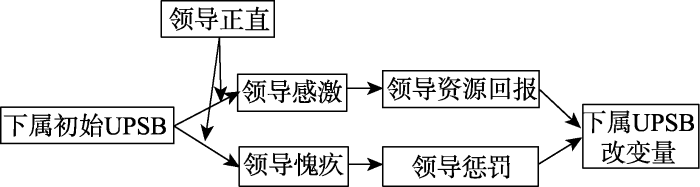
1.1 “报”文化
“报”是中国社会关系的重要基础, 通常在封闭系统中进行, 以使报答对象更明确, 报答互动过程更稳定(翟学伟, 2007)。在性质上, “报”既是一种心理过程(观念、认知与意向), 又可以外化为具体行为。在效价上, “报”分为积极的“报” (奖励性)与消极的“报” (惩罚性) (翟学伟, 2007)。积极“报”指受者得到施者的恩惠后, 产生回报心理并设法用实际行动进行回报(杨国枢, 余安邦, 1993); 消极“报”指受者遭受施者的不良对待后, 用一种消极的心理信号或实际行动进行回击, 试图制止、制裁施者的不良行为, 以使自己问心无愧(刘兆明, 1992)。领导−下属二元系统是地位不平等、身份不独立的两个主体之间的互动, 这种互动模式为“报”的运作提供了可能性。在此情境下, 拥有正式权威的领导既可给予下属好处(积极“报”), 也可对下属施以惩罚(消极“报”)。其中, 积极“报”既包括工具性资源回报(如晋升机会、奖金分配等), 也包括情感性资源回报(如认可、关怀等), 统称为领导资源回报(王忠军 等, 2011)。消极“报”在组织中最常见的形式是惩罚, 包括权变惩罚与非权变惩罚。权变惩罚指根据下属过失情况而权变实施惩罚, 非权变惩罚指无缘无故、不加选择地惩罚下属(Podsakoff, 1982; Podsakoff et al., 1984)。本研究关注领导在下属做出UPSB后实施的惩罚措施, 属于权变惩罚。
中国的“报”与西方的“社会交换”在文化背景、主导逻辑与内容形式上存在区别(Rockstuhl et al., 2012; 朱苏丽 等, 2015)。第一, “报”是个体依据由远及近的差序关系而决定的(翟学伟, 2007)。大部分领导−下属之间的“报”发生在差序格局中的熟人关系圈层, 如领导对熟人下属进行“提拔”或“栽培” (杨联陞, 2009)。然而, 基于熟人关系的“报”在西方社会可能被视为“徇私”。在西方社会, 领导与下属以能力、信赖为基础, 发生单纯交换行为:当事人会在获得回报的预期下, 维持与他人的交换关系(Blau, 1964)。第二, 西方的社会交换理论强调理性计算(投入−回报)在社会互动中的主导作用(Blau, 1964; Cropanzano & Mitchell, 2005), 而中国的“报”则刻画了一个情理交融、人情主导的互动过程(王震 等, 2018)。在情理交融下, “报”持续运作的力量更多是靠私情(相比于理性), 即“报”理论更适合解释领导−下属互动过程中“情绪”现象的产生。第三, 社会交换理论将交换形式分为低质量的交换关系(基于契约)与高质量的交换关系(基于尊重或喜爱) (Blau, 1964), 这意味消极交换与积极交换被视为一个维度的两极。中国的“报”的内容形式分为积极的“报” (奖励性)与消极的“报” (惩罚性) (翟学伟, 2007), 上述两种“报”是独立且共存的运作体系, 形成一个对立统一的矛盾体。综上, “报”理论更适合解释中国情境下具有差序关系格局、以情感为核心主导的、积极“报”−消极“报”共现的领导−下属互动机制。
1.2 积极“报”还是消极“报”:领导对下属UPSB的反应
“报”是一个从心理报答到行为报答的过程。个体先产生报答心理(如情感态度), 继而驱动实际报答行为。上述过程具有积极“报”与消极“报”两种形式(翟学伟, 2007; 邹文篪 等, 2012)。领导究竟对下属UPSB实施积极“报”还是消极“报”?刘兆明(1992)提出, 中国人的“报”受到道德规范的指引; 文崇一(1982)也指出, 受“报”影响的交换行为, 与道德规范、道德标准有密切关系, 即伦理规范和道德标准会影响实施者“报”的方式。因此, 作为“报”的实施者, 领导的道德品质(即领导正直)会影响“报”的方向, 并指引领导采取何种行为来回应下属UPSB。鉴于此, 本研究选择领导正直作为调节变量, 揭示领导对下属UPSB的“报”过程的权变作用。
1.2.1 积极“报”视角下领导对UPSB的反应
在心理层面上, 积极“报”表现为:个体用一些积极友好的心理态度来回报施恩者的友好对待, 实现礼尚往来。上述过程主要由个体的“感激”心理主导(刘兆明, 1992; Bartlett & DeSteno, 2006)。感激(Gratitude)是个体接受来自他人的好处后所产生的一种积极情绪(Spence et al., 2014), 通常由具体事件(如使个体受益的行为)或对事件的归因引起(Greenbaum et al., 2020)。因此, 低正直的领导更加关注UPSB中的“亲领导”初衷, 将其视为下属对自己的一种友好恩惠, 从而用感激来积极地回报下属。相反, 高正直的领导因为秉持道德规范(Peng & Wei, 2019; Ma & Tsui, 2015; Martin et al., 2013), 不支持罔顾道德规范而使自己受益的行径, 故不会对做出UPSB的下属表达感激。
H1a:领导正直调节下属初始UPSB与领导感激之间的关系。当领导正直水平较低(vs.高)时, UPSB与领导感激的关系更强(vs.弱)。
H1b:领导感激与领导资源回报呈正相关。
领导资源回报增加下属后续的UPSB。深受“上尊下卑”传统思想的影响, 中国社会历来看重来自上位者的恩惠。倘若上位者对下位者给予某种恩惠或好处, 则会在下位者心目中留下积极烙印, 使下位者对上位者产生强烈的回馈义务(翟学伟, 2007)。在领导−下属互动情境下, 当下属得到了领导的关怀照顾与福利奖赏时, 会产生回报义务感(Zhang et al., 2015)。在此情况下, 下属会尽一切可能来回馈领导, 即使此类行为可能有违道德规范, 但只要能够使领导获益, 下属依旧会义无反顾地执行(钟熙, 王甜, 2019)。此外, 奖励某种行为, 能够使此种行为得到进一步加强。在下属做出UPSB后, 若领导为下属提供资源回馈, 这将使下属认为UPSB被默许、鼓励以及带来奖赏。在此种理解下, 下属为了继续获得奖赏, 会“理直气壮”地做出更多UPSB。据此, 提出以下假设:
H1c:领导资源回报与下属UPSB改变量(后续UPSB减去初始UPSB)呈正相关, 即领导资源回报促进下属UPSB的增加。
整合上述假设, 领导正直调节“下属初始UPSB—领导感激—领导资源回报—下属UPSB改变量”的链式中介关系。当下属做了UPSB后, 低正直的领导由于低道德要求而蒙蔽自己的伦理判断, 内心的受益感知重于道德标准, 从而产生感激之情。在感激之情的驱动下, 领导将更多资源回馈给下属。领导的资源回报释放了“默认”、“许可”甚至“鼓励”下属UPSB的信号, 使下属做出后续UPSB。相反, 高正直的领导更加看重道德准则(Shao, 2019), 即使下属UPSB有利于领导, 但只要该下属违反了道德规范, 领导不会做出损人利己之举, 从而减少了对下属的资源回报。当下属做出UPSB却没得到领导积极报答时, 便会意识到纯粹考虑领导利益的“徇私”行为得不到领导的认可, 故后续工作中减少UPSB。据此, 提出以下假设:
H1d:领导正直调节下属初始UPSB经由领导感激、领导资源回报对下属UPSB改变量的间接影响。当领导正直水平较低(vs.高)时, 上述关系更强(vs.弱)。
1.2.2 消极“报”视角下领导对UPSB的反应
高正直的领导将道德规范(而非个人私利)视为行事准则, 故更加关注下属UPSB中的“非伦理”特征, 认为自己的道德自我概念因下属过失而受到威胁, 从而对下属实施消极“报”。消极“报”是个体遭受他人的不良对待后, 用一种消极的心理信号(如愧疚)进行回馈, 试图制止甚至制裁不良行为(刘兆明, 1992)。消极“报”过程主要由个体的愧疚心理主导(Greenbaum et al., 2020; Rothschild et al., 2012; Barclay et al., 2005)。愧疚(Guilty)是一种因非伦理行为的负面影响而体验到的消极情绪(Greenbaum et al., 2020), 伴随一种改正非伦理行为的动力(Tangney et al., 1996; Grant & Wrzesniewski, 2010)。愧疚心理呼应了消极“报”观点, 即个体为达到问心无愧的目的而试图制止或提醒他人改变非伦理行为。据此, 本研究认为, 高正直的领导更加重视行为是否合乎道德规范, 容易因为下属UPSB而感到道德尊严受损, 从而产生消极“报”心理并用一种“愧疚”的情绪信号回报给下属, 以警示或遏制下属的非伦理行为。
即使没有实施非伦理行为, 当个体从他人非伦理行为中获益或与行为实施者有直接联系时, 也会产生愧疚(Rothschild et al., 2012; Barclay et al., 2005; Brockner et al., 1986; Krehbiel & Cropanzano, 2000; Weiss et al., 1999)。虽然领导没有做出非伦理行为, 但下属UPSB是为了领导的利益, 会将领导牵扯进非伦理事件之中。当高正直的领导作为非伦理行为的受益方时, 更会因此而产生愧疚。此外, 在职场上, 领导有义务和能力制止下属的非伦理行为; 高正直的领导会因自己没能有效控制下属的UPSB而认为自己失职, 从而产生愧疚。相反, 低正直的领导对伦理规范的重视程度不高, 更少因为下属UPSB而感到愧疚。
H2a:领导正直调节下属初始UPSB与领导愧疚之间的关系。当领导正直水平较高(vs.低)时, UPSB与领导愧疚的关系更强(vs.弱)。
愧疚是一种因为非伦理行为而产生的内心消极感受, 为了缓解这种消极感受, 个体通常需要解决愧疚产生的根源, 即改正非伦理行为(Greenbaum et al., 2020)。当领导因为下属的UPSB而感到愧疚时, 会做出积极的纠正行为(Ghorbani et al., 2013; Grant & Wrzesniewski, 2010), 以此做出偿还(Behrendt & Ben Ari, 2012; Ilies et al., 2013), 或者恢复自己在他人心中的印象/形象(Stearns & Parrott, 2012)。在组织中, 权变惩罚是领导纠正下属非伦理或过失行为的重要手段之一。据此, 感到愧疚的领导会产生一种想要改正、规范下属行为的动力, 而惩罚下属可以帮领导达成这一目的, 实现自我心灵救赎或恢复自身形象。这也呼应了消极“报”的观点, 领导为达到问心无愧, 用惩罚措施来回应下属UPSB。据此, 提出以下假设:
H2b:领导愧疚与领导惩罚呈正相关。
H2c:领导惩罚与下属UPSB改变量(后续UPSB减去初始UPSB)呈负相关, 即领导惩罚导致下属后续UPSB的减少。
整合上述假设, 领导正直调节“下属初始UPSB—领导愧疚—领导惩罚—下属UPSB改变量”的链式中介关系。当下属做出UPSB后, 高正直的领导更加在意下属行为是否符合道德标准, 而且不会为不良行为寻找狡辩理由(Bryant & Merritt, 2021)。据此, 当下属做出UPSB后, 高正直的领导更容易为此感到愧疚。愧疚将驱动领导去改正、规范下属的不良行径, 从而对下属实施惩罚。领导惩罚释放出一种“反对”和“阻止”下属UPSB的信号, 让下属意识到过失行为(Athota et al., 2017), 使下属的后续行为符合组织规范(张正堂 等, 2018), 减少UPSB。相反, 低正直的领导容易忽略道德规范, 忽视下属UPSB的“非伦理”特性, 更加关注该行为对领导自己的影响(如受益), 从而更少感到愧疚, 也较少因此而惩罚下属, 这使得上述领导反应不能有效减少下属后续UPSB。据此, 提出以下假设:
H2d:领导正直调节下属初始UPSB经由领导愧疚、领导惩罚对下属UPSB改变量的间接影响。当领导正直水平较高(vs.低)时, 上述关系更强(vs.弱)。
2 研究1:情景实验
2.1 被试和程序
研究1采用领导−下属配对情景模拟实验。首先, 招募120名具有实习经历、学习过领导力课程内容的商科生(年龄为19~21岁, 男性51人)扮演领导角色。在实验前一周, 邀请这批被试填写领导正直问卷(Moorman et al., 2013), 依据正直得分进行分组, 将平均分以上的被试划分到高正直组(n = 60), 将平均分以下的被试划分到低正直组(n = 60)。为了形成领导−下属配对样本, 本研究继续招募120名具有企业实习经历的被试(年龄为18~21岁, 男性55人)扮演下属角色。领导扮演者与下属扮演者在实验室的两个不同房间(隔音效果较好, 配有电脑与智能手机)内进行办公。被试双方通过智能手机中的微信软件进行交流。
实验材料改编自Fehr等(2019)的亲组织非伦理行为情景材料。情景设定为:一家杀虫剂公司运营部门的采购专员需要决定是否采购一种非常便宜的原材料, 该材料会给购买者带来健康风险或经济损失, 但公司无需为此承担法律责任。采购该原材料能够降低成本, 提高利润率, 从而使部门经理(领导角色)在绩效考核时被评为优秀, 年终获得更多提成, 甚至更快晋升到业务总监职位。
在熟悉情景信息后, 领导与下属扮演者均将收到UPSB的实验操纵材料。在接受UPSB操纵材料后, 领导扮演者需要填答心理测量问卷(感激与愧疚)并根据填答感受给下属扮演者发送微信信息。实验者向领导扮演者提供了参考信息句子(包括惩罚和回报)并告知其可在与下属微信沟通过程中使用这些句子信息(但不限于此)。在微信互动沟通环节结束后, 邀请下属填写问卷, 报告感知的领导惩罚和资源回报。最后, 邀请下属扮演者决定下个季度是否仍然采购该原材料(对购买者有潜在风险但有利于领导的考核与晋升)的决定。
2.2 实验操纵与测量
初始UPSB的操纵:UPSB的操纵材料以一封邮件的形式呈现给被试。其中, 领导扮演者阅读的操纵材料是以下属名义发送的一封邮件, 而下属扮演者阅读的操纵材料是以原材料供应商名义发送的一封邮件。邮件内容依据亲领导非伦理量表题目进行改编(Johnson & Umphress, 2019)。
高程度UPSB的操纵材料(邮件)指明, 该下属为了帮助部门经理在绩效考核时被评为优秀并尽快晋升到业务总监职位, 做了采购该原材料的决定。该邮件内容还描述了下属隐瞒了一些可能会损害部门经理形象和声誉的负面信息, 强调该下属将部门经理的利益放在第一位。
低程度UPSB的操纵材料(邮件)指明, 该下属表示做合乎道德的事情是他/她一直坚持的事, 即使这是以牺牲部门经理利益为代价, 所以没有采购该原材料。该邮件内容还强调该下属在面对隐瞒负面信息和夸大事实这些情况时的道德表现, 强调该下属会将道德准则放在第一位。
后续UPSB的测量:参考Fehr等(2019)的研究, 本研究邀请下属扮演者评价是否仍然采购该原材料。具体题项包括:“我决定继续使用该原材料, 因为这样做有利于张经理”、“只要有这种原材料, 我继续采购并使用”、“我尽可能长时间的使用这种原材料” (1 = 极不可能做出, 5 = 极可能做出)。
UPSB改变量的测量:后续UPSB分数与初始UPSB分数的差值作为UPSB改变量的测量指标。
2.3 研究结果
2.3.1 操纵有效性检验
被试在接受实验操纵后, 填答UPSB量表(Johnson & Umphress, 2019; 6题)。独立样本t检验结果显示, 高UPSB操纵组(M = 3.83, SD = 0.57)中的领导扮演者在该量表上的得分高于低UPSB操纵组(M = 1.41, SD = 0.42), t(118) = 26.64, p < 0.001。高UPSB操纵组(M = 3.75, SD = 0.57)中下属扮演者在该量表上的得分高于低UPSB操纵组(M = 2.24, SD = 0.67), t(118) = 13.27, p < 0.001。
为了检验正直的启动效果, 我们参考卫旭华和邹意(2020)的研究, 邀请被试评估造句所用词语与正直的关联程度。独立样本t检验结果显示, 高领导正直被试组(M = 4.58, SD = 0.530)在该量表上的得分高于低UPSB被试组(M = 2.58,SD = 1.14), t(118) = 12.33, p < 0.001。
2.3.2 描述性统计与相关分析结果
本研究的描述性统计分析结果如表1所示。结果表明, 初始UPSB与领导感激(r = 0.46, p < 0.001)和愧疚呈显著正相关(r = 0.50, p < 0.001); 领导正直与下属UPSB改变量呈显著负相关(r = −0.24, p < 0.01); 领导资源回报与下属UPSB改变量不相关(r = 0.14, ns.); 领导惩罚与下属UPSB改变量呈显著负相关(r = −0.73, p < 0.001)。
表1 各变量描述性统计分析结果
| 变量 | 1 | 2 | 3 | 4 | 5 | 6 | 7 |
|---|---|---|---|---|---|---|---|
| 1. 下属初始UPSB | |||||||
| 2. 领导愧疚 | 0.50*** | ||||||
| 3. 领导感激 | 0.46*** | 0.11 | |||||
| 4. 领导正直 | 0.00 | 0.19* | −0.15 | ||||
| 5. 领导资源回报 | 0.43*** | −0.05 | 0.66*** | −0.19* | |||
| 6. 领导惩罚 | 0.51*** | 0.69*** | −0.03 | 0.23* | −0.09 | ||
| 7. 下属UPSB改变量 | −0.62*** | −0.66*** | −0.02 | −0.24** | 0.14 | −0.73*** | |
| 均值 | 0.50 | 3.08 | 2.90 | 0.50 | 1.33 | 1.23 | 1.41 |
| 标准差 | 0.50 | 1.13 | 1.10 | 0.50 | 1.16 | 1.45 | 0.97 |
注:N = 120, ***p < 0.001, **p < 0.01, *p < 0.05。
2.3.3 假设检验结果
如表2显示, 下属初始UPSB正向影响领导感激(b = 0.46, t = 6.01, p < 0.001), 领导感激正向影响领导资源回报(b = 0.50, t = 7.23, p < 0.001), 领导资源回报正向影响下属UPSB改变量(b = 0.30, t = 3.73, p < 0.001)。下属初始UPSB正向影响领导愧疚(b = 0.50, t = 6.44, p < 0.001), 领导愧疚正向影响领导惩罚(b = 0.49, t = 6.64, p < 0.001), 领导惩罚却负向影响下属UPSB改变量(b = −0.29, t = −3.84, p < 0.001)。
表2 路径分析结果
| 变量 | 中介变量 | 因变量 | |||
|---|---|---|---|---|---|
| 领导感激 | 领导愧疚 | 领导资源回报 | 领导惩罚 | 下属UPSB改变量 | |
| 自变量 | |||||
| 下属初始UPSB | 0.46*** | 0.50*** | 0.20** | 0.26*** | −0.52*** |
| 中介变量 | |||||
| 领导感激 | 0.50*** | 0.02 | |||
| 领导愧疚 | 0.49*** | −0.17+ | |||
| 领导资源回报 | 0.30*** | ||||
| 领导惩罚 | −0.29*** | ||||
| 调节变量 | |||||
| 领导正直 | −0.15 | 0.19* | −0.11 | 0.14* | −0.08 |
| 领导正直下属初始UPSB | −0.22** | 0.22** | −0.19** | 0.22** | −0.04 |
| R2 | 0.28*** | 0.33*** | 0.50*** | 0.57*** | 0.70*** |
注:N = 120, ***p < 0.001, **p < 0.01, *p < 0.05, + p < 0.10。
图2
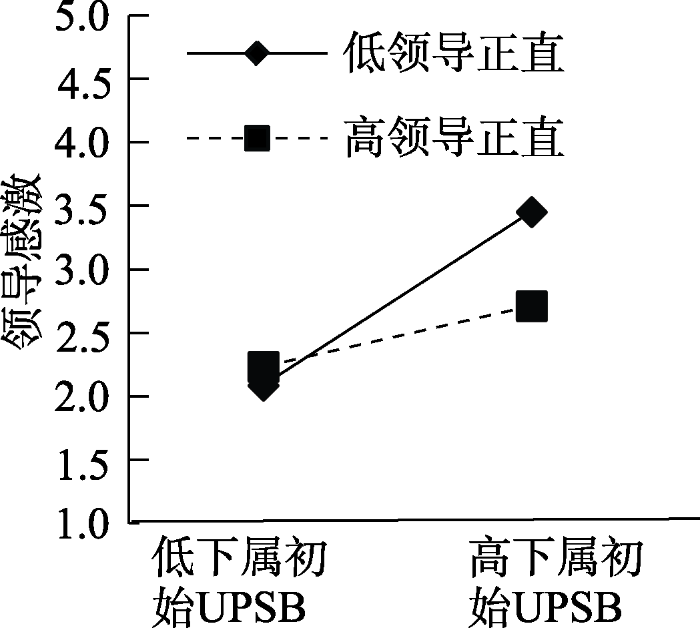
H1b的检验结果。表2显示, 领导感激正向影响领导资源回报(b = 0.50, t = 7.23, p < 0.001), 支持了H1b。
H1c的检验结果。领导资源回报正向预测下属UPSB改变量(b = 0.30, t = 3.73, p < 0.001)。因此, H1c得到支持。
表3 条件间接效应值及差值
| 模型 | 领导正直 | ||
|---|---|---|---|
| 高分组(+1 SD) | 低分组(−1 SD) | 两组差值 | |
| 下属初始UPSB→领导感激→领导资源回报→ 下属UPSB改变量 | 0.04 95% CI [0.01, 0.09] | 0.07** 95% CI [0.03, 0.13] | −0.03* 95% CI [−0.07, −0.01] |
| 下属初始UPSB→领导愧疚→领导惩罚→ 下属UPSB改变量 | −0.10** 95% CI [−0.18, −0.04] | −0.07** 95% CI [−0.13, −0.03] | −0.03* 95% CI [−0.07, −0.01] |
注:N = 120, ***p < 0.001, **p < 0.01, *p < 0.05。CI = confidence interval。
图3
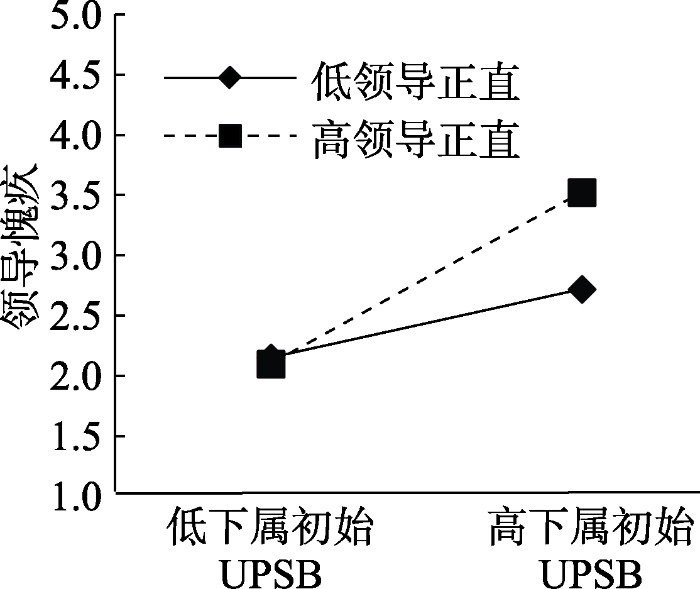
H2b的检验结果。表2显示, 领导愧疚正向影响领导惩罚(b = 0.49, t = 6.64, p < 0.001), 支持了H2b。
H2c的检验结果。领导惩罚负向预测下属UPSB改变量(b = −0.29, t = −3.84, p < 0.001)。因此, H2c得到支持。
H2d的检验结果。表3显示, 与低正直的领导相比(b = −0.07, 95% CI [−0.13, −0.03], p = 0.006), 高正直的领导下(b = −0.10, 95% CI [−0.18, −0.04], p = 0.004)下属初始UPSB经由领导愧疚与领导惩罚对下属UPSB改变量产生更强的抑制作用。因此, H2d得到支持。
需要说明的是, 本研究还邀请下属扮演者填写领导惩罚和领导资源回报量表(1 = 非常不同意, 5 = 非常同意)。为了使测量契合实验情境, 本研究设置了引导语:“在收到来自张经理的微信后, 请根据您对微信内容的理解, 评价您多大程度上同意下列句子描述的内容”。领导惩罚的测量例题包括“张经理直接批评了我” (Cronbach's α = 0.90)。领导资源回报的测量例题包括“张经理会在绩效考核上给我良好评价” (Cronbach's α = 0.95)。基于上述量表得分, 本研究再次进行回归分析, 研究假设再次得到支持。
3 研究2:问卷调查
3.1 数据收集与样本描述
依据以往研究(如Matta et al., 2015)的做法, 研究助理在社交软件(微信)中发布招募信息, 邀请研究被试与其上司共同参与本次调查。为了保证样本的质量, 招募的被试必须具有正式的全职工作身份以及能够提供有效的工作身份证明信息。共有356对上下级同意参加本次调研。在调研前, 研究助理搜集了每个被试的工号, 每个工号对应一份问卷, 以供后续的数据配对。在正式调研时, 将问卷发送给被试, 要求被试当天完成填答。本研究分4个时点进行数据搜集, 每个时点之间间隔2周。在时点1 (T1), 请员工填写人口统计等信息、UPSB、领导−成员交换与领导正直问卷, 本阶段共收回有效问卷323份。在时点2 (T2), 邀请领导报告其对员工的感激、愧疚情绪, 本阶段工回收有效问卷305份。在时点3 (T3), 邀请领导报告其对员工的资源回报和惩罚, 本阶段共收回290份问卷。在时点4 (T4), 邀请员工再次报告UPSB。本研究最终回收有效配对问卷277份, 有效回收率为77%。员工样本中, 男性占35%; 年龄主要集中在21~30岁, 占89%; 本科占85%, 专科占9%, 研究生占2%; 与现任领导共事3~5年占52%, 3年以下占20%。领导样本中, 男性占65%; 年龄主要集中在31~40岁; 本科生占47%; 研究生占25%。
3.2 变量测量
量表采用李克特5点计分, 从1到5表示“完全不同意”到“完全同意”。
下属初始UPSB:本研究采用Johnson和Umphress (2019)的量表, 共6个题项, 例题如“由于需要, 我向其他人隐瞒了可能对我领导有害的信息” (Cronbach's = 0.92)。
领导正直:本研究采用Moorman等(2013)的量表, 共16个题项, 例题如“我的上司(领导)有明确的道德准则” (Cronbach's α = 0.95)。
领导感激:本研究采用Spence等(2014)的5题项量表, 例题如“我很感激该员工能够为我的利益着想” (Cronbach's α = 0.86)。
领导资源回报:本研究采用王忠军(2009)的量表, 共13个题项, 例题如“有培训与发展的机会, 我会优先考虑该员工”, “我对待该员工坦诚友善” (Cronbach's α = 0.93)。
领导惩罚:本研究采用Podsakoff等(1984)的量表, 共5个题项。在测量领导惩罚时加入了引导语“当下属为了维护您的利益而做出不道德行为(如, 隐瞒可能危害您的信息, 隐瞒有害您声誉的信息, 夸大您的表现或歪曲事实来美化您的形象)时, 您做出了以下行为吗?”例题如“我会直接批评该员工”, “我会直接告诉该员工不要做出不道德行为” (Cronbach's α = 0.90)。
下属UPSB改变量:在第四阶段, 本研究继续采用Johnson和Umphress (2019)的量表(Cronbach's α = 0.91) 测量UPSB。下属UPSB改变量为第四阶段UPSB量表得分减去初始UPSB量表得分后的值。
控制变量:本研究控制了领导手下任职时间(选项“1”到“5”分别为“1年以下、1~5年、6~10年、11~15年、15年以上”)、领导−成员交换与数据来源企业。首先, 下属在领导手下任职时间会影响下属是否做出对领导有益的不道德行为(Li et al., 2022)。其次, 以往研究表明, 领导−成员交换关系会影响下属UPSB (Bryant & Merritt, 2021), 这是由于UPSB的对象是“领导”, 而下属与领导的关系是影响下属做出有益领导行为的重要影响因素。领导−成员交换关系采用Wang等(2005)的7题项量表进行测量, 例题如“一般来说, 我很清楚我的领导是否满意我的工作表现” (Cronbach’s α = 0.90)。
3.3 分析策略
首先, 本研究进行验证性因素分析, 检验各变量的结构效度与区分效度。为了检验研究假设, 采用Mplus 8.0进行路径分析。在检验有调节的中介效应时, 依据Bauer等(2006)的方法, 估计了领导正直在均值加/减一个标准差时的有条件间接效应值, 并采用重抽样技术(bootstrap抽样数 = 5000)计算效应值的95% CI。
3.4 研究结果
3.4.1 验证性因素分析结果
本研究采用验证性因子分析对下属初始UPSB、领导正直、领导感激、领导愧疚、领导资源回报、领导惩罚以及下属第四阶段UPSB七个变量之间的区分效度进行检验。七因子假设模型的各项拟合度指标较好(χ²/df = 1.19, RMSEA = 0.03, SRMR = 0.04, TLI = 0.97, CFI = 0.97), 明显优于其他竞争模型(∆χ² ≥ 350.15, ∆df ≥ 6, ps < 0.001)。
3.4.2 描述性统计与相关分析结果
本研究的描述性统计分析结果如表4所示。结果表明, 下属初始UPSB与领导感激(r = 0.53, p < 0.001)、领导愧疚(r = 0.47, p < 0.001)、领导资源回报呈显著正相关(r = 0.52, p < 0.001), 与领导惩罚正相关(r = 0.41, p < 0.001)。领导感激与领导资源回报呈显著正相关(r = 0.58, p < 0.001), 领导资源回报与下属UPSB改变量不相关(r = −0.10, ns.)。领导愧疚与领导惩罚呈显著正相关(r = 0.56, p < 0.001), 领导惩罚与下属UPSB改变量呈显著负相关(r = −0.47, p < 0.001)。
表4 各变量描述性统计分析结果
| 变量 | 1 | 2 | 3 | 4 | 5 | 6 | 7 | 8 | 9 | 10 | 11 | 12 |
|---|---|---|---|---|---|---|---|---|---|---|---|---|
| 1.性别 | ||||||||||||
| 2.年龄 | −0.09 | |||||||||||
| 3.受教育程度 | 0.05 | −0.29*** | ||||||||||
| 4.领导手下任职时间 | −0.10 | 0.64*** | −0.16** | |||||||||
| 5.领导−成员交换 | 0.18** | −0.00 | −0.03 | 0.02 | ||||||||
| 6.下属初始UPSB | 0.04 | −0.06 | 0.05 | −0.04 | 0.25*** | |||||||
| 7.领导正直 | −0.03 | 0.10 | 0.01 | 0.17** | 0.19** | 0.23*** | ||||||
| 8.领导感激 | −0.01 | −0.09 | 0.03 | −0.05 | 0.28*** | 0.53*** | 0.30*** | |||||
| 9.领导愧疚 | 0.02 | 0.00 | 0.01 | 0.05 | 0.23*** | 0.47*** | 0.37*** | 0.30** | ||||
| 10.领导资源回报 | −0.17** | −0.10 | 0.06 | −0.05 | 0.21*** | 0.52*** | 0.34*** | 0.58*** | 0.31** | |||
| 11.领导惩罚 | −0.05 | −0.05 | −0.01 | −0.01 | 0.20** | 0.41*** | 0.31*** | 0.22** | 0.56*** | 0.30*** | ||
| 12.下属UPSB改变量 | −0.12 | 0.02 | 0.02 | −0.02 | −0.15* | −0.72*** | −0.14* | −0.24*** | −0.43*** | −0.10 | −0.47*** | |
| 均值 | 1.65 | 2.10 | 2.87 | 1.33 | 3.63 | 2.66 | 3.60 | 3.48 | 3.36 | 3.13 | 3.20 | 0.23 |
| 标准差 | 0.48 | 0.56 | 0.47 | 1.58 | 0.60 | 0.98 | 0.74 | 0.73 | 0.80 | 0.73 | 0.74 | 1.12 |
注:N = 277, ***p < 0.001, **p < 0.01, *p < 0.05。
3.4.3 假设检验结果
路径分析结果见表5。
表5 路径分析结果
| 变量 | 中介变量 | 因变量 | |||
|---|---|---|---|---|---|
| 领导感激 | 领导愧疚 | 领导资源回报 | 领导惩罚 | 下属UPSB改变量 | |
| 控制变量 | |||||
| 性别 | −0.07 | −0.01 | −0.28*** | −0.14 | −0.09 |
| 年龄 | −0.07 | −0.04 | −0.06 | −0.09 | 0.06 |
| 受教育程度 | −0.03 | 0.00 | 0.03 | −0.05 | 0.08 |
| 领导手下任职时间 | −0.01 | 0.01 | −0.01 | −0.01 | −0.04 |
| 领导成员交换关系 | 0.13* | 0.14 | 0.03 | 0.10 | 0.09 |
| 自变量 | |||||
| 下属初始UPSB | 0.36*** | 0.29*** | 0.23*** | 0.13** | −0.96*** |
| 中介变量 | |||||
| 领导感激 | 0.36*** | −0.04 | 0.05 | ||
| 领导愧疚 | 0.03 | 0.36*** | −0.09 | ||
| 领导资源回报 | 0.61*** | ||||
| 领导惩罚 | −0.37*** | ||||
| 调节变量 | |||||
| 领导正直 | 0.13* | 0.31*** | 0.13* | 0.16** | 0.02 |
| 领导正直×下属初始UPSB | −0.20** | 0.18** | −0.15** | 0.18** | 0.12* |
| R2 | 0.37*** | 0.31*** | 0.48*** | 0.39*** | 0.69*** |
注:N = 277, ***p < 0.001, **p < 0.01, *p < 0.05。
H1a的检验结果。表5所示, 领导正直在下属初始UPSB与领导感激之间起显著负向调节作用(b = −0.20, t = −3.36, p = 0.001)。简单斜率分析显示, 当领导正直水平低时, 下属初始UPSB对领导感激的影响更强(b = 0.51, t = 8.16, p <0.001); 当领导正直水平高时, 下属初始UPSB对领导感激的影响更弱(b = 0.22, t = 3.79, p < 0.001)。因此, H1a得到支持。
H1b的检验结果。表5所示, 领导感激正向影响领导资源回报(b = 0.36, t = 5.60, p < 0.001), 支持了H1b。
H1c的检验结果。表5所示, 领导资源回报正向预测下属UPSB改变量(b = 0.61, t = 8.44, p < 0.001)。因此, H1c得到支持。
H1d的检验结果。表6所示, 与高正直的领导相比(b = 0.04, 95% CI [0.02,0.08], p = 0.004), 低正直的领导下(b = 0.10, 95% CI [0.06,0.17], p < 0.001) 下属初始UPSB经由领导感激与领导资源回报对下属UPSB改变量产生更强影响。因此, H1d得到支持。
表6 条件间接效应值及其差值
| 模型 | 领导正直 | ||
|---|---|---|---|
| 高分组(+1SD) | 低分组(−1SD) | 两组差值 | |
| 下属初始UPSB→领导感激→领导资源回报→ 下属UPSB改变量 | 0.04** 95% CI [0.02, 0.08] | 0.10*** 95% CI [0.06, 0.17] | −0.06** 95% CI [−0.11, −0.03] |
| 下属初始UPSB→领导愧疚→领导惩罚→ 下属UPSB改变量 | −0.06*** 95% CI [−0.10, −0.03] | −0.02 95% CI [−0.05, −0.00] | −0.04* 95% CI [−0.08, −0.01] |
注:N = 277, ***p < 0.001, **p < 0.01, *p < 0.05。CI = confidence interval。
H2a的检验结果。表5所示, 领导正直在下属初始UPSB与领导愧疚之间起显著正向调节作用(b = 0.18, t = 2.86, p = 0.004)。简单斜率分析显示, 当领导正直水平高时, 下属初始UPSB对领导愧疚的影响更强 (b = 0.43, t = 8.07, p < 0.001); 当领导正直水平低时, 下属初始UPSB对领导愧疚的影响更弱(b = 0.16, t = 2.11, p = 0.035)。因此, H2a得到支持。
H2b的检验结果。表5所示, 领导愧疚正向影响领导惩罚(b = 0.36, t = 6.46, p < 0.001), 支持了H2b。
H2c的检验结果。表5所示, 领导惩罚负向预测下属UPSB改变量(b = −0.37, t = −5.35, p < 0.001)。因此, H2c得到支持。
H2d的检验结果。表6所示, 与低正直的领导相比(b = −0.02, 95% CI [−0.05, −0.00], p = 0.07), 高正直的领导下(b = −0.06, 95% CI [−0.10, −0.03], p < 0.001)下属初始UPSB经由领导愧疚与领导惩罚对下属UPSB改变量产生更强的抑制作用。因此, H2d得到支持。
4 研究3:日记调查
4.1 数据收集与样本描述
研究3采用经验取样法, 收集每日的下属UPSB、领导感激、领导愧疚、领导资源回报、领导惩罚行为, 以捕捉这些变量的动态变化。在正式调研之前, 我们对研究内容、测量工具、样本信息与分析方法的进行了预注册(具体信息参见
在日记调查之前, 本研究收集了样本的人口统计学变量、领导正直、领导成员交换关系等个体间变量数据。在正式日记调查期间, 研究助理在每个工作日分4个时点向领导−员工发放调查问卷。具体而言, 9点~10点:员工报告当日上午的UPSB; 11点~12点:领导报告其对员工的感激与愧疚; 14点~ 15点:领导报告其对员工的资源回报与惩罚行为; 16点~17点:员工再次报告当日下午的UPSB。本研究共发放问卷110份, 回收问卷 90份, 有效回收率为81.8%。依据徐姗等(2022), 本研究采纳连续回答2天以上问卷的样本, 最终包含 87份个体间样本和733份个体内有效数据。其中, 员工样本中, 男性占46.9%; 平均年龄31.70岁(SD = 5.49); 本科占54.8%, 专科占34.4%, 研究生占2.3%; 与现任领导共事年限平均为4.03 (SD = 3.93)。领导样本中, 男性占46.7%; 平均年龄39.42岁(SD = 5.37); 本科生占67.8%; 研究生占4.3%。
4.2 变量测量
研究3的测量量表、计分方式与研究2保持一致, 各变量的信度见表7。
表7 各变量描述性统计分析结果
| 变量 | 1 | 2 | 3 | 4 | 5 | 6 | 7 | 8 | 9 |
|---|---|---|---|---|---|---|---|---|---|
| 个体内水平 | |||||||||
| 1. 性别 | |||||||||
| 2. 年龄 | −0.10** | ||||||||
| 3. 受教育程度 | −0.11** | 0.27*** | |||||||
| 4. 下属初始UPSB | 0.06 | −0.03 | −0.04 | (0.89) | |||||
| 5. 领导感激 | −0.03 | 0.10** | 0.23*** | 0.40*** | (0.86) | ||||
| 6. 领导愧疚 | −0.01 | 0.04 | 0.06 | 0.36*** | 0.12** | (0.85) | |||
| 7. 领导资源回报 | −0.01 | 0.01 | 0.15*** | 0.34*** | 0.55*** | 0.05 | (0.94) | ||
| 8. 领导惩罚 | 0.10** | −0.03 | 0.10* | 0.35*** | 0.06 | 0.55*** | 0.04 | (0.85) | |
| 9. 下属UPSB改变量 | −0.07 | 0.14*** | 0.17*** | −0.67*** | −0.08* | −0.33*** | 0.11** | −0.48*** | (0.88) |
| 均值 | 0.53 | 31.70 | 2.51 | 3.62 | 3.54 | 3.63 | 3.53 | 3.56 | −0.01 |
| 标准差 | 0.50 | 5.49 | 0.68 | 0.84 | 0.90 | 0.93 | 0.82 | 0.87 | 1.17 |
| 个体间水平 | |||||||||
| 1. 领导手下任职时间 | |||||||||
| 2. 领导−成员交换 | −0.20 | (0.89) | |||||||
| 3. 领导正直 | 0.10 | 0.03 | (0.95) | ||||||
| 均值 | 4.15 | 3.48 | 3.31 | ||||||
| 标准差 | 3.99 | 0.80 | 0.88 |
注:N (个体内层面) = 733, N (个体间层面) = 87, ***p < 0.001, **p < 0.01, *p < 0.05, 括号中为各变量的信度系数。
4.3 分析策略
首先, 本研究采用Mplus 8.0对各研究变量进行验证性因素分析, 并运用SPSS 23.0对数据进行描述性统计分析。为了检验研究假设, 采用Mplus 8.0进行多层次路径分析。在检验有调节的中介效应时, 依据Bauer等(2006)的方法, 估计了在领导正直在均值加/减一个标准差时的有条件间接效应值, 并计算效应值的95% CI。
4.4 研究结果
4.4.1 验证性因素分析结果
本研究采用验证性因子分析对每日初始UPSB、领导正直、领导感激、领导愧疚、领导资源回报、领导惩罚以及每日后续UPSB七个变量之间的区分效度进行检验。七因子假设模型的各项拟合度指标较好(χ²/df = 1.19, RMSEA = 0.03, SRMR (个体内/个体间) = 0.03/0.05, TLI = 0.97, CFI = 0.97), 明显优于其他竞争模型(∆χ² ≥ 350.15, ∆df ≥ 6, p < 0.001)。
4.4.2 描述性统计与相关分析结果
本研究的描述性统计分析结果如表7所示。结果表明, 下属初始UPSB与领导感激(r = 0.40, p < 0.001)、领导愧疚(r = 0.36, p < 0.001)、领导资源回报呈显著正相关(r = 0.34, p < 0.001), 与领导惩罚正相关(r = 0.35, p < 0.001)。领导感激与领导资源回报呈显著正相关(r = 0.55, p < 0.001), 领导资源回报与下属UPSB改变量呈显著正相关(r = 0.11, p < 0.01)。领导愧疚与领导惩罚呈显著正相关(r = 0.55, p < 0.001), 领导惩罚与下属UPSB改变量呈显著负相关(r = −0.48, p < 0.001)。
在检验假设之前, 本研究检验了下属初始UPSB、领导感激、领导愧疚、领导资源回报、领导惩罚以及下属UPSB改变量在个体内层次和个体间层次的变异。下属初始UPSB、领导感激、领导愧疚、领导资源回报、领导惩罚以及下属UPSB改变量在个体内变异量分别为0.42、0.47、0.56、0.42、0.47和0.91且均达到显著水平(p < 0.001), 个体内占总变异量方差分别为60.29%、58.81%、63.50%、62.89%、61.53%、66.69%, 表明上述变量在个体内存在显著的变异性。
4.4.3 假设检验结果
多层次路径分析结果见表8。
表8 多层次路径分析结果
| 变量 | 中介变量 | 因变量 | |||
|---|---|---|---|---|---|
| 领导感激 | 领导愧疚 | 领导资源回报 | 领导惩罚 | 下属UPSB改变量 | |
| 控制变量 | |||||
| 性别 | −0.01 | −0.01 | 0.06 | 0.17 | −0.13 |
| 年龄 | −0.02 | 0.00 | −0.01 | −0.00 | 0.02 |
| 受教育程度 | 0.14 | −0.00 | 0.11 | 0.14 | 0.23 |
| 领导手下任职时间 | 0.03 | 0.02 | −0.00 | 0.01 | 0.01 |
| 领导成员交换关系 | 0.00 | 0.14 | 0.11 | 0.11 | 0.07 |
| 自变量 | |||||
| 下属初始UPSB | 0.37*** | 0.28*** | 0.14** | 0.19*** | |
| 中介变量 | |||||
| 领导感激 | 0.33*** | −0.27*** | |||
| 领导愧疚 | 0.33*** | −0.10* | |||
| 领导资源回报 | 0.31*** | ||||
| 领导惩罚 | −0.53*** | ||||
| 调节变量 | |||||
| 领导正直 | −0.02 | 0.25** | −0.05 | 0.26*** | −0.11 |
| 领导正直×下属初始UPSB | −0.33*** | 0.24*** | −0.16*** | 0.17*** | |
| Pseudo R2 | 17.72% | 9.73% | 21.80% | 24.20% | 17.64% |
注:N (个体内层面) = 733, N (个体间层面) = 87, ***p < 0.001, **p < 0.01, *p < 0.05。Pseudo R2 = (零模型中变量的方差−假设模型中变量方差)/ 零模型中变量的方差。
H1a的检验结果。表8所示, 领导正直在下属初始UPSB与领导感激之间起显著负向调节作用(b = −0.33, t = −6.96, p < 0.001)。简单斜率分析显示, 当领导正直水平低时, 下属初始UPSB对领导感激的影响更强(b = 0.67, t = 14.42, p < 0.001); 当领导正直水平高时, 下属初始UPSB对领导感激的影响更弱(b = 0.07, t = 1.02, p = 0.308)。因此, H1a得到支持。
H1b的检验结果。表8所示, 领导感激正向影响领导资源回报(b = 0.33, t = 7.64, p < 0.001), 支持了H1b。
H1c的检验结果。表8所示, 领导资源回报正向预测下属UPSB改变量(b = 0.31, t =3.72, p < 0.001)。因此, H1c得到支持。
H1d的检验结果。表9所示, 与高正直的领导相比(b = 0.01, 95% CI [−0.01, 0.02], p =0.32), 低正直的领导下(b = 0.07, 95% CI [0.02,0.11], p =0.004)下属初始UPSB经由领导感激与领导资源回报对下属UPSB改变量产生更强影响。因此, H1d得到支持。
表9 条件间接效应值及其差值
| 模型 | 领导正直 | ||
|---|---|---|---|
| 高分组(+1SD) | 低分组(−1SD) | 两组差值 | |
| 下属初始UPSB→领导感激→领导资源回报→ 下属UPSB改变量 | 0.01 95% CI [−0.01, 0.02] | 0.07** 95% CI [0.02, 0.11] | −0.06** 95% CI [−0.11, −0.02] |
| 下属初始UPSB→领导愧疚→领导惩罚→ 下属UPSB改变量 | −0.09*** 95% CI [−0.11, −0.07] | −0.01 95% CI [−0.04, 0.02] | −0.08*** 95% CI [−0.11, −0.04] |
注:N (个体内层面) = 733, N (个体间层面) = 87, ***p < 0.001, **p < 0.01, *p < 0.05。CI = confidence interval。
H2a的检验结果。表8所示, 领导正直在下属初始UPSB与领导愧疚之间起显著正向调节作用(b = 0.24, t = 4.32, p < 0.001)。简单斜率分析显示, 当领导正直水平高时, 下属初始UPSB对领导愧疚的影响更强 (b = 0.49, t = 12.98, p < 0.001); 当领导正直水平低时, 下属初始UPSB对领导愧疚的影响更弱(b = 0.06, t = 0.76, p = 0.449)。因此, H2a得到支持。
H2b的检验结果。表8所示, 领导愧疚正向影响领导惩罚(b = 0.33, t = 12.05, p < 0.001), 支持了H2b。
H2c的检验结果。表8所示, 领导惩罚负向预测下属UPSB改变量(b = −0.53, t = −10.00, p < 0.001)。因此, H2c得到支持。
H2d的检验结果。表9所示, 与低正直的领导相比(b = −0.01, 95% CI [−0.04, 0.02], p =0.46), 高正直的领导下(b = −0.09, 95% CI [−0.11, −0.07], p < 0.001)下属初始UPSB经由领导愧疚与领导惩罚对下属UPSB改变量产生更强的抑制作用。因此, H2d得到支持。
5 讨论
通过层层递进、相互补充的3个研究, 本文发现领导反应(感激驱动的资源回报与愧疚驱动的惩罚)在下属UPSB持续与消退中发挥关键作用。当领导正直水平较低时, 下属初始UPSB诱发领导感激之情与资源回报, 进而带来下属后续UPSB增量; 然而, 当领导正直水平较高时, 下属初始UPSB诱发领导愧疚之情与惩罚行为, 进而导致下属后续UPSB减少。
5.1 理论意义
本研究响应了“探讨UPSB后果变量”的研究呼吁(Liu, 2020; Tang et al., 2022), 从领导奖惩反应视角考察UPSB的后果变量, 回答了“当下属做出UPSB后, 领导如何感受、回报这类行为”。相比于前因机制, UPSB的后果研究还处于起步阶段。新近两项研究开始关注非伦理行为塑造领导反应(Zhan & Liu, 2022; Zhang et al., 2022), 但还存在两个议题有待推进:(1)反应机制聚焦于领导对下属的绩效评价, 忽略了领导行为反应, 不足以解释领导对下属UPSB的反应全貌; (2)这两项研究得出两种矛盾的结论。例如, Zhang等(2022)发现下属非伦理行为与绩效评价具有负向关系, 因为领导将下属非伦理行为归因于下属道德品质缺陷。然而, 一些研究呈现相反结论。Zhan和Liu (2022)、Fehr等(2019)发现下属亲组织非伦理行为与绩效评价具有正向关系。本文认为, 仅从积极或消极视角来解读UPSB与领导反应的关系, 尚不足以揭示两者间真正的关系规律。从整合视角来看, 领导的积极反应与消极反应可能同时存在。考虑到中国情境下人际互动规则具有本土特性(王震 等, 2018), 本研究采用“报”理论(翟学伟, 2007)来揭示领导对下属UPSB的双重反应机制, 既弥合以往研究的矛盾与争论, 亦响应了“从本土化理论视角研究中国管理问题”的呼吁(贾良定 等, 2015)。结果表明, 下属UPSB既会得到领导的积极“报” (领导资源回报), 也可能得到领导的消极“报” (领导惩罚)。因此, 本研究有效整合了领导积极“报”和消极“报”两种反应方式, 较为全面、均衡地揭示了下属UPSB的后果机制。
本研究揭示了领导对下属UPSB做出积极“报”和消极“报”的心理机制, 有助于学界打开下属UPSB与领导反应之间“机制黑箱”。正如前文所论, 虽然一些研究初步揭示了领导对非伦理行为的反应(Zhang et al., 2022), 但缺乏进一步解释并验证其中的心理机制。本研究揭示了领导的两种矛盾情绪体验(感激与愧疚)在下属UPSB与领导反应之间的传导(中介)机制:一方面, 领导会因为下属UPSB“维护了自身利益”而对下属抱有感激之情, 感激将进一步驱动领导做出积极“报”, 即领导资源回报; 另一方面, 领导也可能会因为下属UPSB的“非伦理”属性而产生愧疚之情, 愧疚将进一步引导领导做出消极“报”, 即领导惩罚。上述结果揭示了领导对于下属UPSB的复杂情绪体验, 响应了Tang等(2022)的观点, 即非伦理行为的获益者(领导)会存在复杂的情绪体验。
通过建构下属UPSB对领导反应的影响模型, 本研究回答了“当下属做出UPSB后, 组织如何应对此类行为的继续发生”, 推进了UPSB的治理策略研究。以往研究探讨了大量下属UPSB的影响因素(颜爱民, 曾莎莎, 2018; 钟熙, 王甜, 2019), 如组织认同、领导认同(Johnson & Umphress, 2019)、上下级关系(程垦 等, 2021)和感知领导支持(Li et al., 2022)。然而, 这些研究忽视了一个问题, 即何种情况下下属会选择继续做出UPSB, 以及何种情况会导致下属未来减少此类行为。除影响因素外, 行为后果也是UPSB是否继续发生的重要决定条件之一。回应这个问题对于解决UPSB带来的“道德困境”具有重要意义。基于领导对下属UPSB的反应机制, 本研究揭示了领导对下属UPSB的资源回报或惩罚决定了下属后续UPSB的发生。结果表明, 领导资源回报(积极“报”)诱发下属继续做出UPSB, 而领导惩罚(消极“报”)使下属减少后续UPSB。上述机制揭开了UPSB的发生规律, 为理解或发展UPSB的治理理论提供了新的视角。
本研究在“报”文化框架下, 引入领导正直的调节作用, 试图揭示领导对下属UPSB实施积极“报”或消极“报”的权变机制。在澄清领导对下属UPSB的双重(矛盾)反应机制的基础上, 本研究进一步澄清何种领导对下属UPSB实施积极“报” (领导感恩与资源回报), 何种领导对下属UPSB实施消极“报” (领导愧疚与惩罚)。领导正直是领导对下属UPSB的“报”方式抉择的一个重要决定因素。本研究发现, 当下属做出初始UPSB时, 低正直的领导给予积极“报” (领导感恩与资源回报), 而高正直的领导给予消极“报” (领导愧疚与惩罚)。上述发现与以往研究观点较为一致, 即印证了领导正直是一种积极有效的领导风格, 在约束下属的非伦理行为方面具有重要作用(Veetikazhi et al., 2021)。综上, 领导正直为破解领导对下属UPSB的悖论式“报”反应提供了重要视角, 推进学界从权变视角理解下属UPSB与领导反应之间的机理。
5.2 实践意义
本研究发现, 领导的道德品质能够有效预防下属UPSB, 即高正直的领导通过消极“报”能够有效阻断UPSB, 达到防范UPSB的目的。因此, 本研究构建的领导对UPSB的反应机制, 有助于深刻理解领导应该如何应对UPSB, 指导领导采取相应措施塑造下属正确的工作行为。首先, 本研究提出一种策略组合——领导道德水平与自身“报”行为的有效搭配。组织如何提升领导道德水平、道德价值观和道德行为是首要任务, 可以通过营造组织伦理氛围或制定规章制度, 使领导端正自己对待UPSB的态度。其次, 领导应该明确认识到自己对UPSB的回应会影响该行为的后续发生, 并采用一些指导方式引导下属以符合伦理的行为方式来帮助他人; 同时, 要摆明态度与立场, 指导下属减少一些模棱两可的非伦理行为。在必要的时候, 领导可以采取合理惩罚措施干预下属非伦理行为, 以期向下属传递正确的道德规范与行为准则, 从而减少下属的UPSB。最后, 组织在招聘或晋升阶段, 可以开展道德测评, 了解候选人(领导)的正直程度, 选拔出一些高道德品质的领导与员工。另外, 鉴于道德品质的可塑性, 组织可以针对在职人员开展一些道德培训项目, 如进行伦理法律法规的培训、职业道德合规培训等, 使其树立正确的道德观。综上, 通过选出高正直领导与高道德下属, 或提升领导、下属的道德水平, 可以治理下属的UPSB。
5.3 不足与展望
本研究存在一些不足之处。本研究仅从领导视角考虑下属UPSB的影响, 未来研究可以在此基础上, 同时从组织、领导和下属等多个因素来探讨UPSB的防范策略。例如, 从组织层面, 可以考查组织的伦理氛围或关系型人力资源管理实践对UPSB的作用, 因为已有研究也证明了这些因素对于个体非伦理行为的预测作用(Halbusi et al., 2020; 钟鑫 等, 2022)。从下属层面, 未来研究可从下属道德特质视角探讨UPSB的防范机制, 因为研究证实了道德认同对下属非伦理行为的权变影响(Nawfel & Yang, 2021)。此外, 本研究仅考察了领导正直的权变作用, 忽视了其他领导特质的作用, 如领导的道德耦合(moral decoupling) (Fehr et al., 2019)、安全基地型领导(谭春平, 吴靳, 2022)与人际情绪管理(邹艳春 等, 2022)。
虽然本研究提出并检验了领导积极“报”和消极“报”的作用机制, 但仅考察了领导资源回报和领导惩罚的中介作用, 还可能存在其他积极“报”和消极“报”在UPSB的发生机制中起传递作用。例如, 领导对下属的回避行为可能是一种消极“报”形式, 能够抑制下属的UPSB。另外, “报”的主体不仅包含领导, 还包含下属, 所以未来研究还可以考虑下属对领导的“报”。假如下属为了积极回报领导而做出UPSB, 那么, 如何制止下属的此种积极“报”是未来研究议题之一。最后, 尽管本研究从领导反应视角揭示了UPSB的后续发生机制, 未来研究也可通过第三方对UPSB的态度和行为反应来防范、应对UPSB。例如, 第三方的归因很可能会影响其对个体UPSB的态度和反应, 从而进一步影响UPSB在组织中的传播。当第三方将个体UPSB归为被迫做出时, 更可能会原谅行为者, 产生宽恕或者援助等建设性反应。然而, 当第三方将个体UPSB归为主动做出时, 会对行为者产生消极态度和行为。建议未来研究可以深入挖掘。
参考文献
To punish first and reward second: Values determine how reward and punishment affect risk-taking behavior
Exploring the role of emotions in injustice perceptions and retaliation
Although organizational justice scholars often describe unfairness as an emotionally laden experience, the role of emotion is underresearched. In a study of individuals who experienced being laid off (N = 173), the authors found that outcome favorability interacts with both procedural and interactional justice to predict participants' emotions. The pattern of interaction differed for inward-focused (i.e., shame and guilt) and outward-focused (i.e., anger and hostility) negative emotions. Attributions of blame mediated the relationship between fairness perceptions and outward-focused negative emotion. Outward-focused emotion mediated the relationship between fairness perceptions and retaliation.Copyright 2005 APA, all rights reserved.
Gratitude and prosocial behavior: Helping when it costs you.
The ability of the emotion gratitude to shape costly prosocial behavior was examined in three studies employing interpersonal emotion inductions and requests for assistance. Study 1 demonstrated that gratitude increases efforts to assist a benefactor even when such efforts are costly (i.e., hedonically negative), and that this increase differs from the effects of a general positive affective state. Additionally, mediational analyses revealed that gratitude, as opposed to simple awareness of reciprocity norms, drove helping behavior. Furthering the theory that gratitude mediates prosocial behavior, Study 2 replicated the findings of Study 1 and demonstrated gratitude's ability to function as an incidental emotion by showing it can increase assistance provided to strangers. Study 3 revealed that this incidental effect dissipates if one is made aware of the true cause of the emotional state. Implications of these findings for the role of gratitude in building relationships are discussed.
Conceptualizing and testing random indirect effects and moderated mediation in multilevel models: New procedures and recommendations
DOI:10.1037/1082-989X.11.2.142
PMID:16784335
[本文引用: 3]

The authors propose new procedures for evaluating direct, indirect, and total effects in multilevel models when all relevant variables are measured at Level 1 and all effects are random. Formulas are provided for the mean and variance of the indirect and total effects and for the sampling variances of the average indirect and total effects. Simulations show that the estimates are unbiased under most conditions. Confidence intervals based on a normal approximation or a simulated sampling distribution perform well when the random effects are normally distributed but less so when they are nonnormally distributed. These methods are further developed to address hypotheses of moderated mediation in the multilevel context. An example demonstrates the feasibility and usefulness of the proposed methods.
The positive side of negative emotion: The role of guilt and shame in coping with interpersonal conflict
DOI:10.1177/0022002712445746
URL
[本文引用: 1]
Two studies examined the effects of guilt and shame on coping with situations of interpersonal conflict. The first study used quantitative self-report measures to evaluate the relationship between guilt-proneness and shame-proneness and conflict coping style. The second study content-analyzed participants’ narrative reports of interpersonal conflicts to evaluate the distinguishing characteristics of guilt versus shame, and the causal relationship between state guilt and shame and styles of coping with conflict. Findings highlight the characteristics of guilt and shame that may explain their differential influence on coping. Theoretical contributions and applications for conflict resolution and mediation are discussed.
Layoffs, equity theory, and work performance: Further evidence of the impact of survivor guilt
DOI:10.2307/256193 URL [本文引用: 1]
Unethical pro- organizational behavior and positive leader-employee relationships
DOI:10.1007/s10551-019-04211-x [本文引用: 4]
How does supervisor-subordinate guanxi influence unethical pro- supervisor behavior? A study based on the chinese cultural context
上下级关系如何影响亲上级非伦理行为?——基于中国文化情境的研究
The effects of differences in explanations, employee attributions, type of infraction, and discipline severity on perceived fairness of employee discipline
DOI:10.1002/(ISSN)1936-4490 URL [本文引用: 1]
Social exchange theory: An interdisciplinary review
DOI:10.1177/0149206305279602
URL
[本文引用: 1]
Social exchange theory (SET) is one the most influential conceptual paradigms in organizational behavior. Despite its usefulness, theoretical ambiguities within SET remain. As a consequence, tests of the model, as well as its applications, tend to rely on an incompletely specified set of ideas. The authors address conceptual difficulties and highlight areas in need of additional research. In so doing, they pay special attention to four issues: (a) the roots of the conceptual ambiguities, (b) norms and rules of exchange, (c) nature of the resources being exchanged, and (d) social exchange relationships.
The role of moral decoupling in the causes and consequences of unethical pro-organizational behavior
DOI:10.1016/j.obhdp.2019.05.007 URL [本文引用: 4]
The formation and prevention of unethical pro-Supervisor behavior from the perspective of chinese bao culture
中国 “报” 文化视角下亲领导非伦理行为的形成与防范研究
Does favoritism leadership style is effective? ——Cultural adaptability analysis and theoretical extension of the chaxu leadership
偏私的领导风格是否有效?——基于差序式领导的文化适应性分析与理论延展
Guilt, shame, and reparative behavior: The effect of psychological proximity
DOI:10.1007/s10551-012-1350-2 URL [本文引用: 1]
I won’t let you down… or will I? core self-evaluations, other-orientation, anticipated guilt and gratitude, and job performance
DOI:10.1037/a0017974
PMID:20085409
[本文引用: 2]
Although core self-evaluations have been linked to higher job performance, research has shown variability in the strength of this relationship. We propose that high core self-evaluations are more likely to increase job performance for other-oriented employees, who tend to anticipate feelings of guilt and gratitude. We tested these hypotheses across 3 field studies using different operationalizations of both performance and other-orientation (prosocial motivation, agreeableness, and duty). In Study 1, prosocial motivation strengthened the association between core self-evaluations and the performance of professional university fundraisers. In Study 2, agreeableness strengthened the association between core self-evaluations and supervisor ratings of initiative among public service employees. In Study 3, duty strengthened the association between core self-evaluations and the objective productivity of call center employees, and this moderating relationship was mediated by feelings of anticipated guilt and gratitude. We discuss implications for theory and research on personality and job performance.Copyright 2009 APA, all rights reserved.
Moral emotions: A review and research agenda for management scholarship
DOI:10.1002/job.v41.2 URL [本文引用: 4]
Linking ethical leadership and ethical climate to employees' ethical behavior: The moderating role of person-organization fit.
DOI:10.1108/PR-09-2019-0522
URL
[本文引用: 1]
With the growing demand for ethical standards in the prevailing business environment, ethical leadership has been under increasingly more focus. Based on the social exchange theory and social learning theory, this study scrutinized the impact of ethical leadership on the presentation of ethical conduct by employees through the ethical climate. Notably, this study scrutinised the moderating function of the person-organisation fit (P-O fit) in relation of ethical climate and the ethical conduct of employees.
Guilty and helpful: An emotion-based reparatory model of voluntary work behavior
DOI:10.1037/a0034162
PMID:24041120
[本文引用: 1]
This study proposes a dynamic reparatory model of voluntary work behavior. We test the hypothesis that when people are made aware of their high level of negative behavior at work (i.e., counterproductive work behavior) and are informed that their behavior is counternormative and undesirable, the knowledge that they violated social norms induces guilt. This guilt, in turn, results in compensatory behavior that is positive in nature (i.e., organizational citizenship behavior). We report results from a field experiment involving normative feedback about employees' counterproductive work behavior to support this model. The findings indicate that undesirable behaviors in the workplace can be redressed by making employees aware of the negative consequences of these behaviors.(c) 2013 APA, all rights reserved.
Building the confidence of Chinese management theory - a cross-level dialogue process theory from individual, team to academic community
构建中国管理学理论自信之路——从个体、团队到学术社区的跨层次对话过程理论
To help my supervisor: Identification, moral identity, and unethical pro-supervisor behavior
DOI:10.1007/s10551-018-3836-z
[本文引用: 7]
Under some circumstances, individuals are willing to engage in unethical behaviors that benefit another entity. In this research we advance the unethical pro-organizational behavior construct by showing that individuals also have the potential to behave unethically to benefit their supervisors. Previous research has not examined if employees engage in unethical acts to benefit an entity that is separate from oneself and if they will conduct these acts to benefit a supervisor. Our research helps to address these gaps. We also demonstrate that unethical behavior to benefit a supervisor, what we term unethical pro-supervisor behavior, is more likely to occur if individuals are more (versus less) identified with their organization or supervisor. That is, feeling a sense of oneness with one's organization or supervisor can result in employees engaging in unethical behavior to help their supervisor. Further, this positive relationship is weakened if the employee possesses higher levels of moral identity. We test our hypotheses with a two-part laboratory study, a field study, and a time-lagged field study. Theoretical and practical implications of this work are discussed.
Procedural justice, outcome favorability and emotion
DOI:10.1023/A:1007670909889 URL [本文引用: 1]
When supervisor support backfires: The link between perceived supervisor support and unethical pro-supervisor behavior
DOI:10.1007/s10551-021-04797-1 [本文引用: 2]
The concept of Bao and its significance in organizational research
In C. Freksa, C. Habel, & K. F. Wender (Eds.),
报的概念及其在组织研究上的意义
见: 杨国枢, 宇安邦 (主编).
Emotional responses to work-family conflict: An examination of gender role orientation working men and women
DOI:10.1037/0021-9010.93.1.207
PMID:18211146
[本文引用: 2]
The present study tested the effect of work-family conflict on emotions and the moderating effects of gender role orientation. On the basis of a multilevel design, the authors found that family-interfering-with- work was positively related to guilt, and gender role orientation interacted with both types of conflict (work-interfering-with-family and family-interfering-with-work) to predict guilt. Specifically, in general, traditional individuals experienced more guilt from family-interfering-with-work, and egalitarian individuals experienced more guilt from work-interfering-with-family. Additionally, a higher level interaction indicated that traditional men tended to experience a stronger relationship between family-interfering-with-work and guilt than did egalitarian men or women of either gender role orientation.2008 APA
Traditional Chinese philosophies and contemporary leadership
DOI:10.1016/j.leaqua.2014.11.008 URL [本文引用: 1]
DOI:10.1016/j.leaqua.2013.02.004 URL [本文引用: 1]
Does seeing “eye to eye” affect work engagement and organizational citizenship behavior? A role theory perspective on LMX agreement
DOI:10.5465/amj.2014.0106 URL [本文引用: 1]
Why moral followers quit: Examining the role of leader bottom-line mentality and unethical pro-leader behavior
DOI:10.1007/s10551-018-3812-7
[本文引用: 2]
Many business leaders vigorously and single-mindedly pursue bottom-line outcomes with the hope of producing superior results for themselves and their companies. Our study investigated two drawbacks of such leader bottom-line mentality (BLM, i.e., an exclusive focus on bottom-line outcomes at the expense of other priorities). First, based on leaders' power over followers, we hypothesized that leader BLM promotes unethical pro-leader behaviors (UPLB, i.e., behaviors that are intended to benefit the leader, but violate ethical norms) among followers. Second, based on cognitive dissonance theory, we hypothesized that UPLB, and leader BLM via UPLB, increase turnover intention among employees with a strong moral identity. Data collected from 153 employees of various organizations supported our hypotheses. In particular, leader BLM was positively related to followers' UPLB. Further, for employees with a stronger (rather than weaker) moral identity: (1) UPLB was positively related to turnover intention; and (2) leader BLM was related to turnover intention via UPLB.
Perceived leader integrity: Supporting the construct validity and utility of a multi-dimensional measure in two samples
DOI:10.1016/j.leaqua.2013.02.003 URL [本文引用: 3]
The role of moral identity in auditor's ethical decision making
How and when does leader behavioral integrity influence employee voice? The roles of team independence climate and corporate ethical values
DOI:10.1007/s10551-019-04114-x [本文引用: 1]
Determinants of a supervisor's use of rewards and punishmens: A literature review and suggestions for further research
DOI:10.1016/0030-5073(82)90242-2 URL [本文引用: 1]
Situational moderators of leader reward and punishment behaviors: Fact or fiction
One assumption shared by many contemporary models of leadership is that situational variables moderate the relationships between leader behaviors and subordinate responses. Recently, however, R. J. House and J. L. Baetz (1979 in B. Staw & L. Cummings, Eds., Research in Organizational Behavior (Vol. 1), Greenwich, Connecticut, JAI Press) have suggested that the effects of some leader traits and behaviors may be relatively invariant; that is, have the same effects in a variety of situations. One possible class of leader behaviors which may have relatively consistent effects across situations are those known as leader reward and punishment behaviors. The first goal of the research reported here was to increase our understanding of the relationships between leader contingent and noncontingent reward and punishment behaviors and subordinate responses. Contingent reward behavior was found to have the most pronounced relationships with subordinate performance and satisfaction, followed by noncontingent punishment behavior. Neither leader noncontingent reward nor contingent punishment behavior were found to be related to either subordinate performance or satisfaction, with the exception that noncontingent reward behavior was negatively related to subordinates' satisfaction with work. The second goal of the research was to examine the effects of a variety of potential moderators on the relationships between leader reward and punishment behaviors and subordinate responses. The results of this study suggest that the relationships between leader reward and punishment behaviors and subordinates' performance are relatively free of moderating effects.
Leader-member exchange (LMX) and culture: A meta- analysis of correlates of LMX across 23 countries
DOI:10.1037/a0029978
PMID:22985117
[本文引用: 1]
This study extends leader-member exchange (LMX) research by meta-analyzing the role of national culture in moderating relationships between LMX and its correlates. Results based on 282 independent samples (N = 68,587) from 23 countries and controlling for extreme response style differences indicate that (a) relationships of LMX with organizational citizenship behavior, justice perceptions, job satisfaction, turnover intentions, and leader trust are stronger in horizontal-individualistic (e.g., Western) contexts than in vertical-collectivistic (e.g., Asian) contexts; and (b) national culture does not affect relationships of LMX with task performance, organizational commitment, and transformational leadership. These findings highlight that although members are universally sensitive to how their leaders treat them, members' responses in Asian contexts may also be influenced by collective interests and role-based obligations.(c) 2012 APA, all rights reserved.
A dual-motive model of scapegoating: Displacing blame to reduce guilt or increase control
DOI:10.1037/a0027413
PMID:22545745
[本文引用: 2]
The authors present a model that specifies 2 psychological motives underlying scapegoating, defined as attributing inordinate blame for a negative outcome to a target individual or group, (a) maintaining perceived personal moral value by minimizing feelings of guilt over one's responsibility for a negative outcome and (b) maintaining perceived personal control by obtaining a clear explanation for a negative outcome that otherwise seems inexplicable. Three studies supported hypotheses derived from this dual-motive model. Framing a negative outcome (environmental destruction or climate change) as caused by one's own harmful actions (value threat) or unknown sources (control threat) both increased scapegoating, and these effects occurred indirectly through feelings of guilt and perceived personal control, respectively (Study 1), and were differentially moderated by affirmations of moral value and personal control (Study 2). Also, scapegoating in response to value threat versus control threat produced divergent, theoretically specified effects on self-perceptions and behavioral intentions (Study 3).2012 APA, all rights reserved
Moral anger as a dilemma? An investigation on how leader moral anger influences follower trust
DOI:10.1016/j.leaqua.2018.10.002 URL [本文引用: 1]
Helpful today, but not tomorrow? Feeling grateful as a predictor of daily organizational citizenship behaviors
When feeling bad makes you look good: Guilt, shame, and person perception
DOI:10.1080/02699931.2012.675879
PMID:22471849
[本文引用: 1]
In two studies, we examined how expressions of guilt and shame affected person perception. In the first study, participants read an autobiographical vignette in which the writer did something wrong and reported feeling either guilt, shame, or no emotion. The participants then rated the writer's motivations, beliefs, and traits, as well as their own feelings toward the writer. The person expressing feelings of guilt or shame was perceived more positively on a number of attributes, including moral motivation and social attunement, than the person who reported feeling no emotion. In the second study, the writer of the vignette reported experiencing (or not experiencing) cognitive and motivational aspects of guilt or shame. Expressing a desire to apologise (guilt) or feelings of worthlessness (private shame) resulted in more positive impressions than did reputational concerns (public shame) or a lack of any of these feelings. Our results indicate that verbal expressions of moral emotions such as guilt and shame influence perception of moral character as well as likeability.
A study on the impact of secure-base leadership on employee helping behavior
安全基地型领导对员工帮助行为的影响研究
Feeling proud but guilty? Unpacking the paradoxical nature of unethical pro-organizational behavior
DOI:10.1016/j.obhdp.2020.03.004 URL [本文引用: 1]
Admired and disgusted? Third parties’ paradoxical emotional reactions and behavioral consequences towards others’ unethical pro-organizational behavior
DOI:10.1111/peps.v75.1 URL [本文引用: 4]
Are shame, guilt, and embarrassment distinct emotions?
DOI:10.1037//0022-3514.70.6.1256
PMID:8667166
[本文引用: 1]
182 undergraduates described personal embarrassment, shame, and guilt experiences and rated these experiences on structural and phenomenological dimensions. Contrary to popular belief, shame was no more likely than guilt to be experienced in "public" situations; all 3 emotions typically occurred in social contexts, but a significant proportion of shame and guilt events occurred when respondents were alone. Analyses of participants' phenomenological ratings clearly demonstrated that shame, guilt, and embarrassment are not merely different terms for the same affective experience. In particular, embarrassment was a relatively distant neighbor of shame and guilt, and the differences among the 3 could not be explained simply by intensity of affect or by degree of moral transgression. Finally, participants generally were their own harshest critics in each type of event, evaluating themselves more negatively than they believed others did.
Moral person and moral manager: How executives develop a reputation for ethical leadership
DOI:10.2307/41166057 URL [本文引用: 1]
Unethical employee behaviour: A review and typology
Leader-member exchange as a mediator of the relationship between transformational leadership and followers' performance and organizational citizenship behavior
DOI:10.5465/amj.2005.17407908 URL [本文引用: 1]
How does leader’s behavioral integrity affect follower’s loyalty? An investigation based on traditional Chinese “Bao” culture
“说话算话”的领导让下属更效忠: 中国传统“报”文化视角下的领导言行一致与下属忠诚
Operation mechanism and effects of supervisor-subordinate guanxi in Chinese organizations
组织中主管-下属关系的运作机制与效果
When is the concealment between close colleagues terminated? The boundary condition of the effect of guanxi on whistle-blowing intention
亲亲相隐何时休?关系对揭发意向影响的边界
Effects of justice conditions on discrete emotions
DOI:10.1037/0021-9010.84.5.786 URL [本文引用: 1]
Best practice recommendations for scale construction in organizational research: The development and initial validation of the character strength inventory (CSI)
DOI:10.1002/job.v38.5 URL [本文引用: 1]
Gain or Loss? Examining the double- edged sword effect of challenge demand on work-family enrichment
DOI:10.3724/SP.J.1041.2022.01234 URL [本文引用: 1]
“增益”还是“损耗”?挑战性工作要求对工作-家庭增益的“双刃剑”影响
DOI:10.3724/SP.J.1041.2022.01234
[本文引用: 1]
基于资源保存理论和不确定管理理论, 采用日记研究法收集81个样本10个工作日的数据, 从静态和动态两个视角, 通过明晰挑战性工作要求的不同属性(每日水平、平均水平、日间变动、波动变化), 全面检验了挑战性工作要求对工作-家庭增益的影响。研究结果表明:(1)在静态模型中, 挑战性工作要求通过工作专注度(增益路径)和放松(损耗路径)作用于工作-家庭增益, 且在个体间的平均水平模型中, 放松的中介作用更为显著; (2)在动态模型中, 挑战性工作要求的日间变动和波动变化, 均通过减少员工工作专注度和放松, 进而降低工作-家庭增益。最后, 本研究讨论了管理者应重视挑战性工作要求的双刃剑作用等实践启示。
The antecedents of unethical pro-supervisor behavior: The influence of transformational leadership
亲领导非伦理行为的成因:来自变革型领导的影响
Feeling energized: A multilevel model of spiritual leadership, leader integrity, relational energy, and job performance
DOI:10.1007/s10551-017-3713-1
[本文引用: 1]
Past research suggests that spiritual leadership plays a pivotal role in enhancing employee job performance, yet we have little understanding of how and when spiritual leadership enhances employee job performance. The present study explores how and when spiritual leadership promotes job performance by examining relational energy as a mediator and leader integrity and relational energy differentiation as boundary conditions. We tested the theoretical model with data gathered across three phases over 12 months from 497 employees and their supervisors in 108 groups. Results showed that the positive relationship between spiritual leadership and job performance was mediated by relational energy. Moreover, we found that leader integrity amplified the mediated relationship between spiritual leadership and employee job performance via relational energy. In contrast, relational energy differentiation weakened this mediated relationship.
What drives leader integrity?
The dimension of Bao’s work in China
报的运作方位
Impact of employee pro-organizational unethical behavior on performance evaluation rated by supervisor: A moderated mediation model of supervisor bottom-line mentality
DOI:10.1108/CMS-07-2020-0299
URL
[本文引用: 2]
The topic of employees’ unethical pro-organizational behavior (UPB) has attracted more and more interest in both practice and academic fields. However, previous studies have mainly investigated the antecedents of UPB and little research has discussed the outcome variables. This study aims to provide a comprehensive understanding of the effect mechanism of UPB on employee performance evaluation rated by a supervisor through a leader-member exchange (LMX) and the moderating role of supervisor bottom-line mentality (BLM).
When will an unethical follower receive poor performance ratings? It depends on the leader’s moral characteristics
Putting non-work ties to work: The case of guanxi in supervisor-subordinate relationships
DOI:10.1016/j.leaqua.2014.04.008 URL [本文引用: 1]
An empirical study on the effects of leadership non-contingent punishment on employee organizational identification
领导非权变惩罚行为对员工组织认同影响的实证研究
The relationship between self-sacrificial leadership and unethical pro-supervisor behavior
自我牺牲型领导对员工亲领导非伦理行为的影响
Beyond the instrumental exchange, the family-like employee- organization relationship in Chinese firms: Theory building and empirical investigation
超越工具性交换: 中国企业员工-组织类亲情交换关系的理论建构与实证研究
Give a plum in return for a peach: A review of reciprocity theory of organizational behavior
DOI:10.3724/SP.J.1042.2012.01879 URL [本文引用: 1]
“投桃报李”——互惠理论的组织行为学研究述评
DOI:10.3724/SP.J.1042.2012.01879
[本文引用: 1]
互惠是一种存在于各种社会文化中的人际交往规范。组织行为学中许多研究都是通过互惠理论来解释变量之间的内部作用机制。文章回顾并讨论了互惠的涵义, 不同互惠类型的特点及互惠的测量方式。此外, 还论述了不同类型互惠对社会交换方式产生的影响。依据现有的互惠研究成果, 分析了互惠发挥影响的内在作用机制是通过:互惠各方的价值观、互惠过程中各方感知到的风险、各方冲突的程度这三种途径来实现的。最后, 根据现有互惠理论的研究成果提出该领域的未来发展应从研究设计和研究内容两方面进行扩展。
How to manage subordinates' emotions? The strategies and influences of leader interpersonal emotion management
如何管理下属情绪?领导者人际情绪管理的策略与影响


