

ISSN 0439-755X
CN 11-1911/B
主办:中国心理学会
中国科学院心理研究所
出版:科学出版社
CN 11-1911/B
主办:中国心理学会
中国科学院心理研究所
出版:科学出版社
心理学报 ›› 2026, Vol. 58 ›› Issue (7): 1343-1356.doi: 10.3724/SP.J.1041.2026.1343 cstr: 32110.14.2026.1343
刘淑娟, 谭丽柔, 齐芸, 胡帅, 王小娟( ), 杨剑峰()
收稿日期:2023-09-19
发布日期:2026-05-15
出版日期:2026-07-25
通讯作者:
王小娟, E-mail: wangxj@snnu.edu.cn;基金资助:
LIU Shujuan, TAN Lirou, QI Yun, HU Shuai, WANG Xiaojuan(), YANG Jianfeng()
Received:2023-09-19
Online:2026-05-15
Published:2026-07-25
摘要:
左侧顶下叶(IPL)是语音范畴感知的重要脑区, 它同样参与了汉语声调感知, 但是对其功能认识还没有得到一致的结论。本研究使用功能性近红外光谱(fNIRS)技术对左侧IPL参与声调感知进行功能定位(实验1), 然后使用经颅磁刺激(TMS)技术对左侧IPL进行虚拟损伤(实验2), 建立左侧IPL与声调范畴感知的因果联系。实验1发现左侧IPL背侧通道不仅对声调范畴敏感, 范畴间比范畴内刺激对诱发了更强的氧合血红蛋白(HbO)浓度变化; 还对声学间隔敏感, 小声学间隔比大声学间隔刺激对诱发了更强的HbO浓度变化。实验2分别虚拟损伤左侧IPL的背侧和腹侧通道, 发现当左侧IPL背侧通道虚拟受损后, 该通道对声调范畴的敏感性消失, 而左侧IPL腹侧通道和前运动皮层通道对声学特征变得敏感。但是当左侧IPL腹侧通道虚拟受损后, 仅左侧额下回通道出现了功能代偿性地对声调范畴敏感。结果表明左侧IPL背侧在汉语声调范畴感知中起到重要作用, 而腹侧区域在语音感知的神经生理模型背侧通路中起着门控作用。研究结果从声调语言的角度丰富了语音感知加工的神经生理模型, 阐明了背侧/腹侧语音加工通路在范畴感知中的协作机制。
中图分类号:
刘淑娟, 谭丽柔, 齐芸, 胡帅, 王小娟, 杨剑峰. (2026). 顶下叶在汉语声调感知中的作用:fNIRS导航的TMS研究. 心理学报, 58(7), 1343-1356.
LIU Shujuan, TAN Lirou, QI Yun, HU Shuai, WANG Xiaojuan, YANG Jianfeng. (2026). fNIRS-guided TMS technique reveals a critical role of the left inferior parietal lobule in Chinese tone perception. Acta Psychologica Sinica, 58(7), 1343-1356.
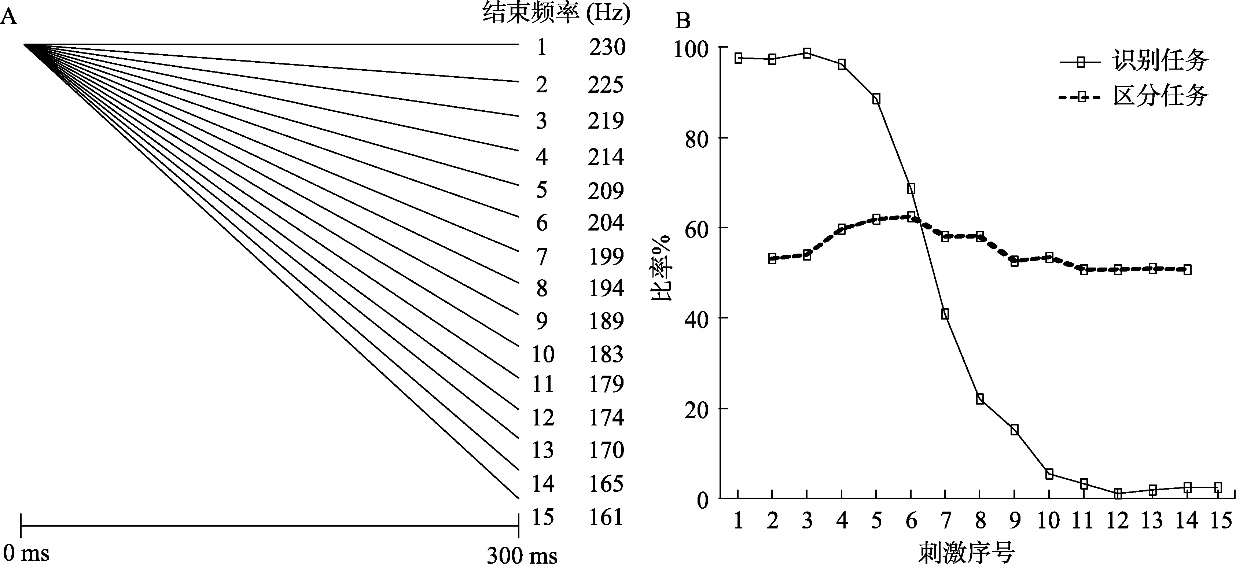
图1 声调连续体的音高模式图(A); 及识别任务和区分任务结果图(B), 在识别任务, 纵坐标为识别为一声的百分比, 在区分任务为区分分数, 刺激对应比率是对该刺激相邻两个刺激组成的比较单元的区分分数。
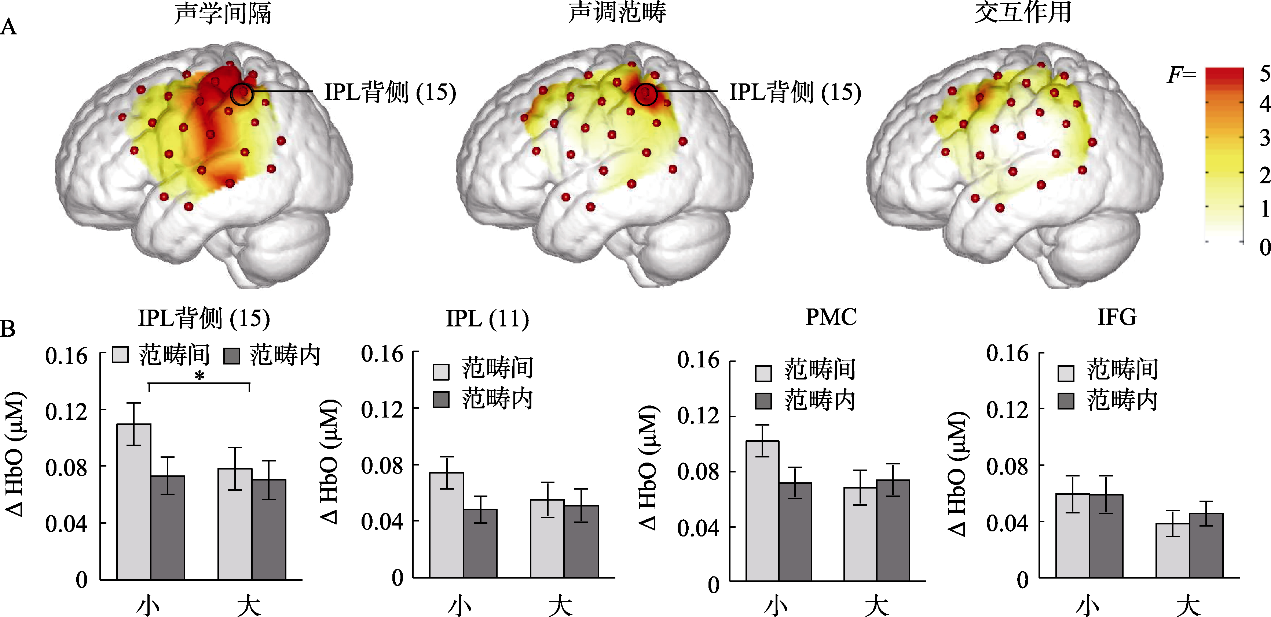
图2 fNIRS结果在脑区激活的F值热力图(A)上清晰显示出IPL对声学间隔和声调范畴效应敏感; 进一步在不同条件下的HbO浓度变化(B)也显示出IPL背侧在声调范畴感知中的作用。*p < 0.05。彩图见电子版, 下同。
| 变异来源 | df | IPL背侧(15) | IPL腹侧(11) | PMC | IFG | |||||||||
|---|---|---|---|---|---|---|---|---|---|---|---|---|---|---|
| F | p | η2p | F | p | η2p | F | p | η2p | F | p | η2p | |||
| 声学间隔 | (1, 59) | 4.66 | 0.035 | 0.07 | 4.94 | 0.030 | 0.08 | 0.61 | 0.439 | 0.01 | 1.75 | 0.191 | 0.03 | |
| 声调范畴 | (1, 59) | 1.45 | 0.233 | 0.02 | 1.50 | 0.225 | 0.02 | 1.78 | 0.187 | 0.03 | 5.13 | 0.027 | 0.08 | |
| TMS刺激位点 | (1, 59) | 1.21 | 0.276 | 0.02 | 2.93 | 0.092 | 0.05 | 1.75 | 0.191 | 0.03 | 3.14 | 0.082 | 0.05 | |
| 声学×范畴 | (1, 59) | 1.86 | 0.177 | 0.03 | 4.64 | 0.035 | 0.07 | 2.60 | 0.112 | 0.04 | 1.98 | 0.165 | 0.03 | |
| TMS×声学 | (1, 59) | 7.66 | 0.008 | 0.11 | 6.96 | 0.011 | 0.11 | 8.81 | 0.004 | 0.13 | 0.11 | 0.737 | 0.00 | |
| TMS×范畴 | (1, 59) | 0.08 | 0.779 | 0.00 | 1.80 | 0.185 | 0.03 | 0.90 | 0.346 | 0.02 | 6.08 | 0.017 | 0.09 | |
| TMS×声学×范畴 | (1, 59) | 0.12 | 0.728 | 0.00 | 0.34 | 0.562 | 0.01 | 1.15 | 0.288 | 0.02 | 0.34 | 0.563 | 0.01 | |
表1 四个感兴趣脑区的2×2×2方差分析结果
| 变异来源 | df | IPL背侧(15) | IPL腹侧(11) | PMC | IFG | |||||||||
|---|---|---|---|---|---|---|---|---|---|---|---|---|---|---|
| F | p | η2p | F | p | η2p | F | p | η2p | F | p | η2p | |||
| 声学间隔 | (1, 59) | 4.66 | 0.035 | 0.07 | 4.94 | 0.030 | 0.08 | 0.61 | 0.439 | 0.01 | 1.75 | 0.191 | 0.03 | |
| 声调范畴 | (1, 59) | 1.45 | 0.233 | 0.02 | 1.50 | 0.225 | 0.02 | 1.78 | 0.187 | 0.03 | 5.13 | 0.027 | 0.08 | |
| TMS刺激位点 | (1, 59) | 1.21 | 0.276 | 0.02 | 2.93 | 0.092 | 0.05 | 1.75 | 0.191 | 0.03 | 3.14 | 0.082 | 0.05 | |
| 声学×范畴 | (1, 59) | 1.86 | 0.177 | 0.03 | 4.64 | 0.035 | 0.07 | 2.60 | 0.112 | 0.04 | 1.98 | 0.165 | 0.03 | |
| TMS×声学 | (1, 59) | 7.66 | 0.008 | 0.11 | 6.96 | 0.011 | 0.11 | 8.81 | 0.004 | 0.13 | 0.11 | 0.737 | 0.00 | |
| TMS×范畴 | (1, 59) | 0.08 | 0.779 | 0.00 | 1.80 | 0.185 | 0.03 | 0.90 | 0.346 | 0.02 | 6.08 | 0.017 | 0.09 | |
| TMS×声学×范畴 | (1, 59) | 0.12 | 0.728 | 0.00 | 0.34 | 0.562 | 0.01 | 1.15 | 0.288 | 0.02 | 0.34 | 0.563 | 0.01 | |
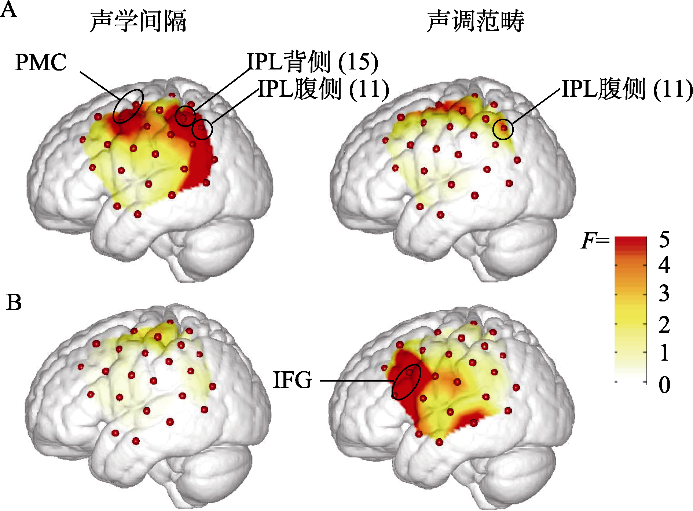
图3 fNIRS结果的F值热力图显示TMS虚拟损伤IPL背侧(A)与腹侧(B)通道时, 对声学间隔和声调范畴敏感的脑区不同。
| 变异 来源 | df | 正确率 | IPL背侧(15) | IPL腹侧(11) | PMC | IFG | ||||||||||
|---|---|---|---|---|---|---|---|---|---|---|---|---|---|---|---|---|
| F | p | η2 p | F | p | η2 p | F | p | η2 p | F | p | η2 p | F | p | η2 p | ||
| 声学间隔 | (1, 30) | 20.50 | 0.000 | 0.41 | 4.67 | 0.039 | 0.13 | 1.07 | 0.310 | 0.03 | 2.99 | 0.094 | 0.09 | 2.39 | 0.133 | 0.07 |
| 声调范畴 | (1, 30) | 333.82 | 0.000 | 0.92 | 7.29 | 0.011 | 0.20 | 4.15 | 0.051 | 0.12 | 1.70 | 0.202 | 0.05 | 0.19 | 0.668 | 0.01 |
| 声学×范畴 | (1, 30) | 11.91 | 0.002 | 0.28 | 2.37 | 0.134 | 0.07 | 1.87 | 0.181 | 0.06 | 3.74 | 0.063 | 0.11 | 0.15 | 0.698 | 0.01 |
附表1 实验1行为正确率和各脑区HbO浓度变化的方差分析结果
| 变异 来源 | df | 正确率 | IPL背侧(15) | IPL腹侧(11) | PMC | IFG | ||||||||||
|---|---|---|---|---|---|---|---|---|---|---|---|---|---|---|---|---|
| F | p | η2 p | F | p | η2 p | F | p | η2 p | F | p | η2 p | F | p | η2 p | ||
| 声学间隔 | (1, 30) | 20.50 | 0.000 | 0.41 | 4.67 | 0.039 | 0.13 | 1.07 | 0.310 | 0.03 | 2.99 | 0.094 | 0.09 | 2.39 | 0.133 | 0.07 |
| 声调范畴 | (1, 30) | 333.82 | 0.000 | 0.92 | 7.29 | 0.011 | 0.20 | 4.15 | 0.051 | 0.12 | 1.70 | 0.202 | 0.05 | 0.19 | 0.668 | 0.01 |
| 声学×范畴 | (1, 30) | 11.91 | 0.002 | 0.28 | 2.37 | 0.134 | 0.07 | 1.87 | 0.181 | 0.06 | 3.74 | 0.063 | 0.11 | 0.15 | 0.698 | 0.01 |
| 变异 来源 | df | 正确率 | IPL背侧(15) | IPL腹侧(11) | PMC | IFG | ||||||||||
|---|---|---|---|---|---|---|---|---|---|---|---|---|---|---|---|---|
| F | p | η2 p | F | p | η2 p | F | p | η2 p | F | p | η2 p | F | p | η2 p | ||
| 声学间隔 | (1, 30) | 33.61 | 0.000 | 0.53 | 11.31 | 0.002 | 0.27 | 13.79 | 0.001 | 0.31 | 7.18 | 0.012 | 0.19 | 1.67 | 0.206 | 0.05 |
| 声调范畴 | (1, 30) | 97.04 | 0.000 | 0.76 | 1.88 | 0.180 | 0.06 | 4.54 | 0.041 | 0.13 | 3.81 | 0.060 | 0.11 | 0.02 | 0.895 | 0.00 |
| 声学×范畴 | (1, 30) | 4.27 | 0.047 | 0.12 | 0.41 | 0.527 | 0.01 | 1.05 | 0.313 | 0.03 | 3.43 | 0.074 | 0.10 | 1.88 | 0.181 | 0.06 |
附表2 TMS刺激IPL背侧(15)后行为正确率和各脑区HbO浓度变化的方差分析结果
| 变异 来源 | df | 正确率 | IPL背侧(15) | IPL腹侧(11) | PMC | IFG | ||||||||||
|---|---|---|---|---|---|---|---|---|---|---|---|---|---|---|---|---|
| F | p | η2 p | F | p | η2 p | F | p | η2 p | F | p | η2 p | F | p | η2 p | ||
| 声学间隔 | (1, 30) | 33.61 | 0.000 | 0.53 | 11.31 | 0.002 | 0.27 | 13.79 | 0.001 | 0.31 | 7.18 | 0.012 | 0.19 | 1.67 | 0.206 | 0.05 |
| 声调范畴 | (1, 30) | 97.04 | 0.000 | 0.76 | 1.88 | 0.180 | 0.06 | 4.54 | 0.041 | 0.13 | 3.81 | 0.060 | 0.11 | 0.02 | 0.895 | 0.00 |
| 声学×范畴 | (1, 30) | 4.27 | 0.047 | 0.12 | 0.41 | 0.527 | 0.01 | 1.05 | 0.313 | 0.03 | 3.43 | 0.074 | 0.10 | 1.88 | 0.181 | 0.06 |
| 变异 来源 | df | 正确率 | IPL背侧(15) | IPL腹侧(11) | PMC | IFG | ||||||||||
|---|---|---|---|---|---|---|---|---|---|---|---|---|---|---|---|---|
| F | p | η2 p | F | p | η2 p | F | p | η2 p | F | p | η2 p | F | p | η2 p | ||
| 声学间隔 | (1, 29) | 59.68 | 0.000 | 0.67 | 0.20 | 0.657 | 0.01 | 0.08 | 0.786 | 0.00 | 2.34 | 0.137 | 0.07 | 0.41 | 0.528 | 0.01 |
| 声调范畴 | (1, 29) | 119.46 | 0.000 | 0.80 | 0.30 | 0.591 | 0.01 | 0.01 | 0.942 | 0.00 | 0.06 | 0.815 | 0.00 | 13.09 | 0.001 | 0.31 |
| 声学×范畴 | (1, 29) | 0.59 | 0.449 | 0.02 | 2.04 | 0.164 | 0.07 | 4.59 | 0.041 | 0.14 | 0.15 | 0.697 | 0.01 | 0.36 | 0.552 | 0.01 |
附表3 TMS刺激IPL腹侧(11)后行为正确率和各脑区HbO浓度变化的方差分析结果
| 变异 来源 | df | 正确率 | IPL背侧(15) | IPL腹侧(11) | PMC | IFG | ||||||||||
|---|---|---|---|---|---|---|---|---|---|---|---|---|---|---|---|---|
| F | p | η2 p | F | p | η2 p | F | p | η2 p | F | p | η2 p | F | p | η2 p | ||
| 声学间隔 | (1, 29) | 59.68 | 0.000 | 0.67 | 0.20 | 0.657 | 0.01 | 0.08 | 0.786 | 0.00 | 2.34 | 0.137 | 0.07 | 0.41 | 0.528 | 0.01 |
| 声调范畴 | (1, 29) | 119.46 | 0.000 | 0.80 | 0.30 | 0.591 | 0.01 | 0.01 | 0.942 | 0.00 | 0.06 | 0.815 | 0.00 | 13.09 | 0.001 | 0.31 |
| 声学×范畴 | (1, 29) | 0.59 | 0.449 | 0.02 | 2.04 | 0.164 | 0.07 | 4.59 | 0.041 | 0.14 | 0.15 | 0.697 | 0.01 | 0.36 | 0.552 | 0.01 |
| 变异来源 | 简单简单效应 | df | F | p | η2 p |
|---|---|---|---|---|---|
| 声学间隔 | (1, 59) | 88.52 | 0.000 | 0.60 | |
| 声调范畴 | (1, 59) | 211.88 | 0.000 | 0.78 | |
| TMS刺激位点 | (1, 59) | 2.22 | 0.141 | 0.04 | |
| 声学×范畴 | (1, 59) | 1.42 | 0.238 | 0.02 | |
| TMS×声学 | (1, 59) | 0.42 | 0.520 | 0.01 | |
| TMS×范畴 | (1, 59) | 0.11 | 0.738 | 0.00 | |
| TMS×声学×范畴 | (1, 59) | 4.43 | 0.040 | 0.07 | |
| TMS刺激位点: 小声学间隔范畴间 | (1, 59) | 1.05 | 0.309 | 0.02 | |
| TMS刺激位点: 小声学间隔范畴内 | (1, 59) | 0.06 | 0.800 | 0.00 | |
| TMS刺激位点: 大声学间隔范畴间 | (1, 59) | 0.24 | 0.623 | 0.00 | |
| TMS刺激位点: 大声学间隔范畴内 | (1, 59) | 2.15 | 0.148 | 0.04 |
附表4 行为正确率的2 × 2 × 2方差分析结果
| 变异来源 | 简单简单效应 | df | F | p | η2 p |
|---|---|---|---|---|---|
| 声学间隔 | (1, 59) | 88.52 | 0.000 | 0.60 | |
| 声调范畴 | (1, 59) | 211.88 | 0.000 | 0.78 | |
| TMS刺激位点 | (1, 59) | 2.22 | 0.141 | 0.04 | |
| 声学×范畴 | (1, 59) | 1.42 | 0.238 | 0.02 | |
| TMS×声学 | (1, 59) | 0.42 | 0.520 | 0.01 | |
| TMS×范畴 | (1, 59) | 0.11 | 0.738 | 0.00 | |
| TMS×声学×范畴 | (1, 59) | 4.43 | 0.040 | 0.07 | |
| TMS刺激位点: 小声学间隔范畴间 | (1, 59) | 1.05 | 0.309 | 0.02 | |
| TMS刺激位点: 小声学间隔范畴内 | (1, 59) | 0.06 | 0.800 | 0.00 | |
| TMS刺激位点: 大声学间隔范畴间 | (1, 59) | 0.24 | 0.623 | 0.00 | |
| TMS刺激位点: 大声学间隔范畴内 | (1, 59) | 2.15 | 0.148 | 0.04 |
| 变异 来源 | df | 正确率 | IPL背侧(15) | IPL腹侧(11) | PMC | IFG | |||||||||||
|---|---|---|---|---|---|---|---|---|---|---|---|---|---|---|---|---|---|
| F | p | η2 p | F | p | η2 p | F | p | η2 p | F | p | η2 p | F | p | η2 p | |||
| 声学间隔 | (1, 89) | 109.23 | 0.000 | 0.55 | 0.07 | 0.790 | 0.00 | 1.29 | 0.259 | 0.01 | 0.37 | 0.544 | 0.00 | 0.02 | 0.879 | 0.00 | |
| 声调范畴 | (1, 89) | 443.44 | 0.000 | 0.83 | 6.34 | 0.014 | 0.07 | 4.28 | 0.042 | 0.05 | 3.46 | 0.066 | 0.04 | 4.60 | 0.035 | 0.05 | |
| TMS刺激位点 | (2, 89) | 3.10 | 0.050 | 0.07 | 1.39 | 0.253 | 0.03 | 2.50 | 0.088 | 0.05 | 1.99 | 0.142 | 0.04 | 3.22 | 0.045 | 0.07 | |
| 声学×范畴 | (1, 89) | 9.49 | 0.003 | 0.10 | 4.14 | 0.045 | 0.04 | 6.27 | 0.014 | 0.07 | 6.25 | 0.014 | 0.07 | 1.80 | 0.183 | 0.02 | |
| TMS×声学 | (2, 89) | 4.34 | 0.016 | 0.09 | 8.35 | 0.000 | 0.16 | 5.61 | 0.005 | 0.11 | 5.69 | 0.005 | 0.11 | 2.17 | 0.121 | 0.05 | |
| TMS×范畴 | (2, 89) | 1.78 | 0.175 | 0.04 | 1.10 | 0.338 | 0.02 | 1.23 | 0.297 | 0.03 | 0.50 | 0.609 | 0.01 | 3.73 | 0.028 | 0.08 | |
| TMS×声学×范畴 | (2, 89) | 4.82 | 0.010 | 0.10 | 0.29 | 0.748 | 0.01 | 0.16 | 0.855 | 0.00 | 1.04 | 0.356 | 0.02 | 0.25 | 0.781 | 0.01 | |
附表5 行为正确率和4个感兴趣脑区的3 × 2 × 2方差分析结果
| 变异 来源 | df | 正确率 | IPL背侧(15) | IPL腹侧(11) | PMC | IFG | |||||||||||
|---|---|---|---|---|---|---|---|---|---|---|---|---|---|---|---|---|---|
| F | p | η2 p | F | p | η2 p | F | p | η2 p | F | p | η2 p | F | p | η2 p | |||
| 声学间隔 | (1, 89) | 109.23 | 0.000 | 0.55 | 0.07 | 0.790 | 0.00 | 1.29 | 0.259 | 0.01 | 0.37 | 0.544 | 0.00 | 0.02 | 0.879 | 0.00 | |
| 声调范畴 | (1, 89) | 443.44 | 0.000 | 0.83 | 6.34 | 0.014 | 0.07 | 4.28 | 0.042 | 0.05 | 3.46 | 0.066 | 0.04 | 4.60 | 0.035 | 0.05 | |
| TMS刺激位点 | (2, 89) | 3.10 | 0.050 | 0.07 | 1.39 | 0.253 | 0.03 | 2.50 | 0.088 | 0.05 | 1.99 | 0.142 | 0.04 | 3.22 | 0.045 | 0.07 | |
| 声学×范畴 | (1, 89) | 9.49 | 0.003 | 0.10 | 4.14 | 0.045 | 0.04 | 6.27 | 0.014 | 0.07 | 6.25 | 0.014 | 0.07 | 1.80 | 0.183 | 0.02 | |
| TMS×声学 | (2, 89) | 4.34 | 0.016 | 0.09 | 8.35 | 0.000 | 0.16 | 5.61 | 0.005 | 0.11 | 5.69 | 0.005 | 0.11 | 2.17 | 0.121 | 0.05 | |
| TMS×范畴 | (2, 89) | 1.78 | 0.175 | 0.04 | 1.10 | 0.338 | 0.02 | 1.23 | 0.297 | 0.03 | 0.50 | 0.609 | 0.01 | 3.73 | 0.028 | 0.08 | |
| TMS×声学×范畴 | (2, 89) | 4.82 | 0.010 | 0.10 | 0.29 | 0.748 | 0.01 | 0.16 | 0.855 | 0.00 | 1.04 | 0.356 | 0.02 | 0.25 | 0.781 | 0.01 | |
| [1] | Al-Fahad, R., Yeasin, M., & Bidelman, G.M. (2020). Decoding of single-trial EEG reveals unique states of functional brain connectivity that drive rapid speech categorization decisions. Journal of Neural Engineering, 17(1), 016045. |
| [2] | Alho, J., Green, B. M., May, P., J. C., Sams, M., Tiitinen, H., Rauschecker, J. P., & Jääskeläinen, I. P. (2016). Early-latency categorical speech sound representations in the left inferior frontal gyrus. Neuroimage, 129, 214-223. |
| [3] | Brigadoi, S., Ceccherini, L., Cutini, S., Scarpa, F., Scatturin, P., Selb, J.,... Cooper, R. J. (2014). Motion artifacts in functional near-infrared spectroscopy: A comparison of motion correction techniques applied to real cognitive data. Neuroimage, 85(Pt. 1), 181-191. |
| [4] | Buchsbaum, B. R., Hickok, G., & Humphries, C. (2001). Role of left posterior superior temporal gyrus in phonological processing for speech perception and production. Cognitive Science, 25(5), 663-678. |
| [5] | Buchsbaum, B. R., Olsen, R. K., Koch, P., & Berman, K. F. (2005). Human dorsal and ventral auditory streams subserve rehearsal-based and echoic processes during verbal working memory. Neuron, 48(4), 687-697. |
| [6] | Caplan, D., Gow, D., & Makris, N. (1995). Analysis of lesions by MRI in stroke patients with acoustic-phonetic processing deficits. Neurology, 45(2), 293-298. |
| [7] | Caspers, S., Geyer, S., Schleicher, A., Mohlberg, H., Amunts, K., & Zilles, K. (2006). The human inferior parietal cortex: Cytoarchitectonic parcellation and interindividual variability. Neuroimage, 33(2), 430-448. |
| [8] | Chien, P.-J., Friederici, A. D., Hartwigsen, G., & Sammler, D. (2020). Neural correlates of intonation and lexical tone in tonal and non-tonal language speakers. Human Brain Mapping, 41(7), 1842-1858. |
| [9] | Chien, P.-J., Friederici, A. D., Hartwigsen, G., & Sammler, D. (2021). Intonation processing increases task-specific fronto-temporal connectivity in tonal language speakers. Human Brain Mapping, 42(1), 161-174. |
| [10] | Cohen, J. (1992). A power primer. Psychological Bulletin, 112(1), 155-159. |
| [11] | Correia, J. M., Jansma, B. M. B., & Bonte, M. (2015). Decoding articulatory features from fMRI responses in dorsal speech regions. Journal of Neuroscience, 35(45), 15015-15025. |
| [12] | Faul, F., Erdfelder, E., Buchner, A., & Lang, A. G. (2009). Statistical power analyses using G*Power 3.1: Tests for correlation and regression analyses. Behavior Research Methods, 41(4), 1149-1160. |
| [13] | Feng, G., Gan, Z., Llanos, F., Meng, D., Wang, S., Wong, P. C. M., & Chandrasekaran, B. (2021). A distributed dynamic brain network mediates linguistic tone representation and categorization. Neuroimage, 224, 117410. |
| [14] | Feng, G., Gan, Z., Wang, S., Wong, P. C. M., & Chandrasekaran, B. (2018). Task-general and acoustic-invariant neural representation of speech categories in the human brain. Cerebral Cortex, 28(9), 3241-3254. |
| [15] | Gandour, J., Dzemidzic, M., Wong, D., Lowe, M., Tong, Y., Hsieh, L.,... Lurito, J. (2003). Temporal integration of speech prosody is shaped by language experience: An fMRI study. Brain and Language, 84(3), 318-336. |
| [16] | Gandour, J., Tong, Y., Wong, D., Talavage, T., Dzemidzic, M., Xu, Y.,... Lowe, M. (2004). Hemispheric roles in the perception of speech prosody. Neuroimage, 23(1), 344-357. |
| [17] | Hartwigsen, G., Weigel, A., Schuschan, P., Siebner, H. R., Weise, D., Classen, J., & Saur, D. (2016). Dissociating parieto-frontal networks for phonological and semantic word decisions: A condition-and-perturb TMS study. Cerebral Cortex, 26(6), 2590-2601. |
| [18] | Hickok, G., Houde, J., & Rong, F. (2011). Sensorimotor integration in speech processing: Computational basis and neural organization. Neuron, 69(3), 407-422. |
| [19] | Hickok, G., & Poeppel, D. (2007). The cortical organization of speech processing. Nature Reviews Neuroscience, 8(5), 393-402. |
| [20] | Hsieh, L., Gandour, J., Wong, D., & Hutchins, G. D. (2001). Functional heterogeneity of inferior frontal gyrus is shaped by linguistic experience. Brain and Language, 76(3), 227-252. |
| [21] | Huang, Y. Z., Edwards, M. J., Rounis, E., Bhatia, K. P., & Rothwell, J. C. (2005). Theta burst stimulation of the human motor cortex. Neuron, 45(2), 201-206. |
| [22] | Huppert, T. J., Diamond, S. G., Franceschini, M. A., & Boas, D. A. (2009). HomER: A review of time-series analysis methods for near-infrared spectroscopy of the brain. Applied Optics, 48(10), 280-298. |
| [23] | Igelström, K. M., Webb, T. W., & Graziano, M. S. A. (2015). Neural processes in the human temporoparietal cortex separated by localized independent component analysis. Journal of Neuroscience, 35(25), 9432-9445. |
| [24] | Joanisse, M. F., Zevin, J. D., & McCandliss, B. D. (2007). Brain mechanisms implicated in the preattentive categorization of speech sounds revealed using fMRI and a short-interval habituation trial paradigm. Cerebral Cortex, 17(9), 2084-2093. |
| [25] | Klein, D., Zatorre, R. J., Milner, B., & Zhao, V. (2001). A cross-linguistic PET study of tone perception in mandarin Chinese and English speakers. Neuroimage, 13(4), 646-653. |
| [26] | Kwok, V. P. Y., Dan, G., Yakpo, K., Matthews, S., & Tan, L. H. (2016). Neural systems for auditory perception of lexical tones. Journal of Neurolinguistics, 37, 34-40. |
| [27] | Kwok, V. P. Y., Matthews, S., Yakpo, K., & Tan, L. H. (2019). Neural correlates and functional connectivity of lexical tone processing in reading. Brain and Language, 196, 104662. |
| [28] | Kwok, V. P. Y., Wang, T., Chen, S., Yakpo, K., Zhu, L., Fox, P. T., & Tan, L. H. (2015). Neural signatures of lexical tone reading. Human Brain Mapping, 36(1), 304-312. |
| [29] | Lawrence, R. J., Wiggins, I. M., Anderson, C. A., Davies- Thompson, J., & Hartley, D. E. H. (2018). Cortical correlates of speech intelligibility measured using functional near- infrared spectroscopy (fNIRS). Hearing Research, 370, 53-64. |
| [30] | Li, Y., Tang, C., Lu, J., Wu, J., & Chang, E. F. (2021). Human cortical encoding of pitch in tonal and non-tonal languages. Nature Communications, 12(1), 1161. |
| [31] | Liang, B., & Du, Y. (2018). The functional neuroanatomy of lexical tone perception: An activation likelihood estimation meta-analysis. Frontiers in Neuroscience, 12, 495. |
| [32] | Liang, B., Li, Y., Zhao, W., & Du, Y. (2023). Bilateral human laryngeal motor cortex in perceptual decision of lexical tone and voicing of consonant. Nature Communications, 14(1), 4710. |
| [33] | Luo, H., Ni, J. T., Li, Z. H., Li, X. O., Zhang, D. R., Zeng, F. G., & Chen, L. (2006). Opposite patterns of hemisphere dominance for early auditory processing of lexical tones and consonants. Proceedings of the National Academy of Sciences of the United States of America, 103(51), 19558-19563. |
| [34] | Mahmud, M. S., Yeasin, M., & Bidelman, G. M. (2021). Data-driven machine learning models for decoding speech categorization from evoked brain responses. Journal of Neural Engineering, 18(4), 046012. |
| [35] | Michaelis, K., Miyakoshi, M., Norato, G., Medvedev, A. V., & Turkeltaub, P. E. (2021). Motor engagement relates to accurate perception of phonemes and audiovisual words, but not auditory words. Communications Biology, 4(1), 108. |
| [36] | Murakami, T., Kell, C. A., Restle, J., Ugawa, Y., & Ziemann, U. (2015). Left dorsal speech stream components and their contribution to phonological processing. Journal of Neuroscience, 35(4), 1411-1422. |
| [37] | Osnes, B., Hugdahl, K., & Specht, K. (2011). Effective connectivity analysis demonstrates involvement of premotor cortex during speech perception. Neuroimage, 54(3), 2437-2445. |
| [38] | Peng, G., Zheng, H. Y., Gong, T., Yang, R. X., Kong, J. P., & Wang, W. S. Y. (2010). The influence of language experience on categorical perception of pitch contours. Journal of Phonetics, 38(4), 616-624. |
| [39] | Pinti, P., Tachtsidis, I., Hamilton, A., Hirsch, J., Aichelburg, C., Gilbert, S., & Burgess, P. W. (2020). The present and future use of functional near-infrared spectroscopy (fNIRS) for cognitive neuroscience. Annals of the New York Academy of Sciences, 1464(1), 5-29. |
| [40] | Preisig, B. C., Riecke, L., & Hervais-Adelman, A. (2022). Speech sound categorization: The contribution of non-auditory and auditory cortical regions. Neuroimage, 258, 119375. |
| [41] | Rauschecker, J. P., & Scott, S. K. (2009). Maps and streams in the auditory cortex: Nonhuman primates illuminate human speech processing. Nature Neuroscience, 12(6), 718-724. |
| [42] | Rogalsky, C., Basilakos, A., Rorden, C., Pillay, S., LaCroix, A. N., Keator, L.,... Hickok, G. (2022). The neuroanatomy of speech processing: A large-scale lesion study. Journal of Cognitive Neuroscience, 34(8), 1355-1375. |
| [43] | Saur, D., Kreher, B. W., Schnell, S., Kümmerer, D., Kellmeyer, P., Vry, M. S.,... Weiller, C. (2008). Ventral and dorsal pathways for language. Proceedings of the National Academy of Sciences of the United States of America, 105(46), 18035-18040. |
| [44] | Shen, G., & Froud, K. (2016). Categorical perception of lexical tones by English learners of Mandarin Chinese. The Journal of the Acoustical Society of America, 140(6), 4396-4403. |
| [45] | Si, X., Zhou, W., & Hong, B. (2017). Cooperative cortical network for categorical processing of Chinese lexical tone. Proceedings of the National Academy of Sciences of the United States of America, 114(46), 12303-12308. |
| [46] | Stoeckel, M. C., & Binkofski, F. (2010). The role of ipsilateral primary motor cortex in movement control and recovery from brain damage. Experimental Neurology, 221(1), 13-17. |
| [47] | Tian, F. H., Lin, Z.-J., & Liu, H. L. (2013). EasyTopo: A toolbox for rapid diffuse optical topography based on a standard template of brain atlas. Proceedings of the Society of Photo-Optical Instrumentation Engineers, 8578, 458-467. |
| [48] | Valbret, H., Moulines, E., & Tubach, J. P. (1992). Voice transformation using PSOLA technique. Speech Communication, 11(2-3), 175-187. |
| [49] | Wan, N., Hancock, A. S., Moon, T. K., & Gillam, R. B. (2018). A functional near-infrared spectroscopic investigation of speech production during reading. Human Brain Mapping, 39(3), 1428-1437. |
| [50] | Wang, J., Fan, L., Zhang, Y., Liu, Y., Jiang, D., Zhang, Y.,... Jiang, T. (2012). Tractography-based parcellation of the human left inferior parietal lobule. Neuroimage, 63(2), 641-652. |
| [51] | Wang, Y., Sereno, J. A., Jongman, A., & Hirsch, J. (2003). fMRI evidence for cortical modification during learning of Mandarin lexical tone. Journal of Cognitive Neuroscience, 15(7), 1019-1027. |
| [52] | Wild, C. J., Yusuf, A., Wilson, D. E., Peelle, J. E., Davis, M. H., & Johnsrude, I. S. (2012). Effortful listening: The processing of degraded speech depends critically on attention. Journal of Neuroscience, 32(40), 14010-14021. |
| [53] | Wong, P. C. M., Parsons, L. M., Martinez, M., & Diehl, R. L. (2004). The role of the insular cortex in pitch pattern perception: The effect of linguistic contexts. Journal of Neuroscience, 24(41), 9153-9160. |
| [54] | Wong, P. C. M., Perrachione, T. K., & Parrish, T. B. (2007). Neural characteristics of successful and less successful speech and word learning in adults. Human Brain Mapping, 28(10), 995-1006. |
| [55] | Xi, J., Zhang, L., Shu, H., Zhang, Y., & Li, P. (2010). Categorical perception of lexical tones in Chinese revealed by mismatch negativity. Neuroscience, 170(1), 223-231. |
| [56] | Xu, Y., Gandour, J. T., & Francis, A. L. (2006). Effects of language experience and stimulus complexity on the categorical perception of pitch direction. Journal of the Acoustical Society of America, 120(2), 1063-1074. |
| [57] | Yang, J., Gates, K. M., Molenaar, P., & Li, P. (2015). Neural changes underlying successful second language word learning: An fMRI study. Journal of Neurolinguistics, 33, 29-49. |
| [58] | Yang, Q., & Chen, Y. (2022). Phonological competition in Mandarin spoken word recognition. Language, Cognition and Neuroscience, 37(7), 820-843. |
| [59] | Ye, J. C., Tak, S., Jang, K. E., Jung, J., & Jang, J. (2009). NIRS-SPM: Statistical parametric mapping for near-infrared spectroscopy. Neuroimage, 44(2), 428-447. |
| [60] | Yu, K., Wang, R., Li, L., & Li, P. (2014). Processing of acoustic and phonological information of lexical tones in Mandarin Chinese revealed by mismatch negativity. Frontiers in Human Neuroscience, 8, 729. |
| [61] | Zhang, L., Xi, J., Wu, H., Shu, H., & Li, P. (2012). Electrophysiological evidence of categorical perception of Chinese lexical tones in attentive condition. Neuroreport, 23(1), 35-39. |
| [62] | Zhang, L., Xi, J., Xu, G. Q., Shu, H., Wang, X., & Li, P. (2011). Cortical dynamics of acoustic and phonological processing in speech perception. Plos One, 6(6), e20963. |
| [63] | Zhao, R., Wang, X., & Yang, J. (2016). The role of tone in Chinese syllable perception. Acta Psychologica Sinica, 48(8), 915-923. |
| [赵荣, 王小娟, 杨剑峰. (2016). 声调在汉语音节感知中的作用. 心理学报, 48(8), 915-923.] | |
| [64] | Zinszer, B. D., Chen, P., Wu, H., Shu, H., & Li, P. (2015). Second language experience modulates neural specialization for first language lexical tones. Journal of Neurolinguistics, 33, 50-66. |
| [1] | 任梦梦, 李琎, 钟毅平, 杨莉君. 社会规范类型对亲环境行为的影响:道德认同的调节作用及其fNIRS证据[J]. 心理学报, 2026, 58(6): 1197-1212. |
| [2] | 杨明川, 李贤卓, 梁丹丹. 语言与音乐经验存在双向迁移: 基于普通话母语音乐人的范畴感知[J]. 心理学报, 2025, 57(9): 1499-1511. |
| [3] | 张环, 秦锡权, 刘雨, 林琳, 吴捷. 不同强度趋近动机积极情绪对基于语义关联性错误记忆的影响及其神经机制[J]. 心理学报, 2025, 57(3): 349-362. |
| [4] | 张俐娟, 江妍雪, 马建平, 崔博洋, 张锦坤. 提取难度对困难材料提取练习效应的促进作用:来自行为和fNIRS的证据[J]. 心理学报, 2025, 57(3): 363-379. |
| [5] | 陈发坤, 陈甜, 蔡文琦, 王小娟, 杨剑峰. 左侧额中回参与汉字视觉空间分析的fNIRS证据[J]. 心理学报, 2023, 55(5): 685-695. |
| [6] | 李贤卓, 肖容, 梁丹丹. 声调范畴感知和声调复杂度对音乐音高感知的跨领域影响[J]. 心理学报, 2022, 54(9): 1021-1030. |
| [7] | 杨婉晴, 肖容, 梁丹丹. 2~4岁普通话儿童前注意阶段的声调感知机制[J]. 心理学报, 2020, 52(6): 730-741. |
| [8] | 姚尧, 陈晓湘. 音乐训练对4~5岁幼儿普通话声调范畴感知能力的影响[J]. 心理学报, 2020, 52(4): 456-468. |
| [9] | 肖容, 梁丹丹, 李善鹏. 汉语普通话声调感知的老年化效应:来自ERP的证据[J]. 心理学报, 2020, 52(1): 1-11. |
| [10] | 吴柏周, 李杰, 何虎, 侯友, 贾缨琪, 冯慎行. 色觉疲劳、语义饱和对颜色范畴知觉的即时影响[J]. 心理学报, 2019, 51(2): 196-206. |
| [11] | 谢书书, 张积家, 朱君. 颜色范畴知觉效应发生在大脑两半球:来自纳西族和汉族的证据[J]. 心理学报, 2019, 51(11): 1229-1243. |
| [12] | 李杰, 何虎, 吴柏周, 侯友, 曹亢, 阿如罕. 不同熟练度双语者的颜色范畴知觉效应:来自行为和ERP的证据[J]. 心理学报, 2018, 50(11): 1259-1268. |
| [13] | 赵荣;王小娟;杨剑峰. 声调在汉语音节感知中的作用[J]. 心理学报, 2016, 48(8): 915-923. |
| [14] | 白学军;张琪涵;章鹏;周菘;刘颖;宋星;彭国慧. 基于fNIRS的运动执行与运动想象脑激活模式比较[J]. 心理学报, 2016, 48(5): 495-508. |
| [15] | 郑秋晨. 汉语元音对声调感知边界的影响[J]. 心理学报, 2014, 46(9): 1223-1231. |
| 阅读次数 | ||||||
|
全文 |
|
|||||
|
摘要 |
|
|||||
