

ISSN 0439-755X
CN 11-1911/B
主办:中国心理学会
中国科学院心理研究所
出版:科学出版社
CN 11-1911/B
主办:中国心理学会
中国科学院心理研究所
出版:科学出版社
心理学报 ›› 2026, Vol. 58 ›› Issue (5): 853-865.doi: 10.3724/SP.J.1041.2026.0853 cstr: 32110.14.2026.0853
姜勃帆1, 陈启杨2, 崔楠楠3, 吴岩1( )
)
收稿日期:2025-04-01
发布日期:2026-03-04
出版日期:2026-05-25
通讯作者:
吴岩, E-mail:wuy399@nenu.edu.cn作者简介:姜勃帆和陈启杨同为第一作者。
基金资助:
JIANG Bofan1, CHEN Qiyang2, CUI Nannan3, WU Yan1()
Received:2025-04-01
Online:2026-03-04
Published:2026-05-25
摘要:
结合眼动技术和不一致觉察范式, 本研究探讨了三、五年级儿童阅读理解监控能力的发展, 以及文本相关性、词汇知识和语素意识在其中的调节作用。结果发现:1)三、五年级儿童均能有效监控文本内容, 表现为不一致条件下的凝视时间、第二次阅读时间和回视路径时间均显著长于一致条件; 2)文本相关性未能调节理解监控过程, 但相关的文本内容提升了三年级儿童的阅读效率; 3)词汇知识能够调节儿童的理解监控, 词汇知识丰富的儿童对不一致信息的修复速度更快。语素意识虽未直接发挥作用, 但可以通过词汇知识间接影响理解监控能力。研究结果表明, 三年级儿童已表现出一定的理解监控能力, 且这种能力的提高与词汇知识和语素意识密切相关。
中图分类号:
姜勃帆, 陈启杨, 崔楠楠, 吴岩. (2026). 三、五年级儿童阅读理解监控能力的发展及其调节因素. 心理学报, 58(5), 853-865.
JIANG Bofan, CHEN Qiyang, CUI Nannan, WU Yan. (2026). The development of reading comprehension monitoring ability and its moderating factors among third and fifth grade children. Acta Psychologica Sinica, 58(5), 853-865.
| 实验条件 | 例句 | 整句合理性 | 句子理解难度 | ||
|---|---|---|---|---|---|
| 教师 | 儿童 | 三年级 | 五年级 | ||
| 一致相关 | 到家后妈妈把新买的葡萄放在/果盘上了。 | 3.53(0.51) | 3.20(0.35) | 3.45(0.28) | 3.52(0.30) |
| 不一致相关 | 到家后妈妈把新买的果盘放在/葡萄上了。 | 1.34(0.27) | 1.60(0.38) | 2.55(0.50) | 2.41(0.50) |
| 一致不相关 | 到家后妈妈把新买的葡萄放在/纸巾上了。 | 3.08(0.56) | 3.07(0.45) | 3.26(0.29) | 3.32(0.36) |
| 不一致不相关 | 到家后妈妈把新买的纸巾放在/葡萄上了。 | 1.29(0.27) | 1.58(0.33) | 2.53(0.50) | 2.33(0.58) |
表1 实验材料样例以及句子合理性和理解难度评价结果
| 实验条件 | 例句 | 整句合理性 | 句子理解难度 | ||
|---|---|---|---|---|---|
| 教师 | 儿童 | 三年级 | 五年级 | ||
| 一致相关 | 到家后妈妈把新买的葡萄放在/果盘上了。 | 3.53(0.51) | 3.20(0.35) | 3.45(0.28) | 3.52(0.30) |
| 不一致相关 | 到家后妈妈把新买的果盘放在/葡萄上了。 | 1.34(0.27) | 1.60(0.38) | 2.55(0.50) | 2.41(0.50) |
| 一致不相关 | 到家后妈妈把新买的葡萄放在/纸巾上了。 | 3.08(0.56) | 3.07(0.45) | 3.26(0.29) | 3.32(0.36) |
| 不一致不相关 | 到家后妈妈把新买的纸巾放在/葡萄上了。 | 1.29(0.27) | 1.58(0.33) | 2.53(0.50) | 2.33(0.58) |
| 词语类型 | 样例 | 笔画 | 平均字频 | 词频 | 熟悉度 | 相关程度 |
|---|---|---|---|---|---|---|
| 核心词 | 葡萄 | 17.63(3.96) | 4.59(0.73) | 3.13(0.71) | 1.08(0.31) | —— |
| 语义相关词 | 果盘 | 16.08(4.27) | 4.81(0.57) | 2.91(0.70) | 1.05(0.24) | 3.32(1.05) |
| 语义无关词 | 纸巾 | 16.04(4.09) | 4.69(0.71) | 3.02(0.80) | 1.03(0.18) | 2.14(1.26) |
表2 三种类型关键词的相关属性
| 词语类型 | 样例 | 笔画 | 平均字频 | 词频 | 熟悉度 | 相关程度 |
|---|---|---|---|---|---|---|
| 核心词 | 葡萄 | 17.63(3.96) | 4.59(0.73) | 3.13(0.71) | 1.08(0.31) | —— |
| 语义相关词 | 果盘 | 16.08(4.27) | 4.81(0.57) | 2.91(0.70) | 1.05(0.24) | 3.32(1.05) |
| 语义无关词 | 纸巾 | 16.04(4.09) | 4.69(0.71) | 3.02(0.80) | 1.03(0.18) | 2.14(1.26) |
| 条件 | 三年级 | 五年级 | ||||
|---|---|---|---|---|---|---|
| GD | SRT | RPD | GD | SRT | RPD | |
| 一致相关 | 387(231) | 470(311) | 856(569) | 365(198) | 427(292) | 854(581) |
| 一致不相关 | 397(240) | 482(314) | 892(591) | 378(226) | 452(301) | 842(565) |
| 不一致相关 | 403(240) | 554(358) | 1066(713) | 398(216) | 454(285) | 956(602) |
| 不一致不相关 | 428(241) | 539(338) | 1149(714) | 379(224) | 463(286) | 942(576) |
表3 三、五年级儿童四种条件下各眼动指标的均值和标准差
| 条件 | 三年级 | 五年级 | ||||
|---|---|---|---|---|---|---|
| GD | SRT | RPD | GD | SRT | RPD | |
| 一致相关 | 387(231) | 470(311) | 856(569) | 365(198) | 427(292) | 854(581) |
| 一致不相关 | 397(240) | 482(314) | 892(591) | 378(226) | 452(301) | 842(565) |
| 不一致相关 | 403(240) | 554(358) | 1066(713) | 398(216) | 454(285) | 956(602) |
| 不一致不相关 | 428(241) | 539(338) | 1149(714) | 379(224) | 463(286) | 942(576) |
| 自变量 | 凝视时间 | 第二次阅读时间 | 回视路径时间 | ||||||||||
|---|---|---|---|---|---|---|---|---|---|---|---|---|---|
| β | SE | t | p | β | SE | t | p | β | SE | t | p | ||
| 截距 | 2.519 | 0.012 | 207.52 | <0.001 | 2.572 | 0.012 | 230.22 | <0.001 | 2.867 | 0.017 | 171.76 | <0.001 | |
| 一般认知能力 | −0.001 | 0.002 | −0.67 | 0.508 | 0.000 | 0.001 | 0.24 | 0.809 | 0.002 | 0.002 | 0.84 | 0.405 | |
| 一致性 | 0.023 | 0.009 | 2.63 | 0.012 | 0.046 | 0.012 | 3.75 | <0.001 | 0.082 | 0.012 | 6.60 | <0.001 | |
| 语义相关性 | 0.005 | 0.008 | 0.68 | 0.503 | 0.014 | 0.014 | 0.10 | 0.320 | 0.018 | 0.012 | 1.40 | 0.168 | |
| 年级 | −0.022 | 0.023 | −0.94 | 0.349 | −0.066 | 0.022 | −3.00 | 0.004 | −0.058 | 0.029 | −2.00 | 0.048 | |
| 相关性:一致性 | −0.006 | 0.017 | −0.35 | 0.729 | −0.020 | 0.030 | −0.66 | 0.510 | 0.009 | 0.018 | 0.53 | 0.600 | |
| 相关性:年级 | −0.037 | 0.014 | −2.71 | 0.009 | 0.018 | 0.027 | 0.67 | 0.502 | −0.037 | 0.018 | −2.00 | 0.049 | |
| 一致性:年级 | −0.009 | 0.013 | −0.68 | 0.498 | −0.029 | 0.023 | −1.23 | 0.220 | −0.042 | 0.016 | −2.59 | 0.010 | |
| 相关性:一致性:年级 | −0.052 | 0.031 | −1.68 | 0.097 | 0.003 | 0.056 | 0.05 | 0.958 | −0.031 | 0.035 | −0.86 | 0.395 | |
表4 理解监控的年级差异以及相关性在其中的调节作用
| 自变量 | 凝视时间 | 第二次阅读时间 | 回视路径时间 | ||||||||||
|---|---|---|---|---|---|---|---|---|---|---|---|---|---|
| β | SE | t | p | β | SE | t | p | β | SE | t | p | ||
| 截距 | 2.519 | 0.012 | 207.52 | <0.001 | 2.572 | 0.012 | 230.22 | <0.001 | 2.867 | 0.017 | 171.76 | <0.001 | |
| 一般认知能力 | −0.001 | 0.002 | −0.67 | 0.508 | 0.000 | 0.001 | 0.24 | 0.809 | 0.002 | 0.002 | 0.84 | 0.405 | |
| 一致性 | 0.023 | 0.009 | 2.63 | 0.012 | 0.046 | 0.012 | 3.75 | <0.001 | 0.082 | 0.012 | 6.60 | <0.001 | |
| 语义相关性 | 0.005 | 0.008 | 0.68 | 0.503 | 0.014 | 0.014 | 0.10 | 0.320 | 0.018 | 0.012 | 1.40 | 0.168 | |
| 年级 | −0.022 | 0.023 | −0.94 | 0.349 | −0.066 | 0.022 | −3.00 | 0.004 | −0.058 | 0.029 | −2.00 | 0.048 | |
| 相关性:一致性 | −0.006 | 0.017 | −0.35 | 0.729 | −0.020 | 0.030 | −0.66 | 0.510 | 0.009 | 0.018 | 0.53 | 0.600 | |
| 相关性:年级 | −0.037 | 0.014 | −2.71 | 0.009 | 0.018 | 0.027 | 0.67 | 0.502 | −0.037 | 0.018 | −2.00 | 0.049 | |
| 一致性:年级 | −0.009 | 0.013 | −0.68 | 0.498 | −0.029 | 0.023 | −1.23 | 0.220 | −0.042 | 0.016 | −2.59 | 0.010 | |
| 相关性:一致性:年级 | −0.052 | 0.031 | −1.68 | 0.097 | 0.003 | 0.056 | 0.05 | 0.958 | −0.031 | 0.035 | −0.86 | 0.395 | |
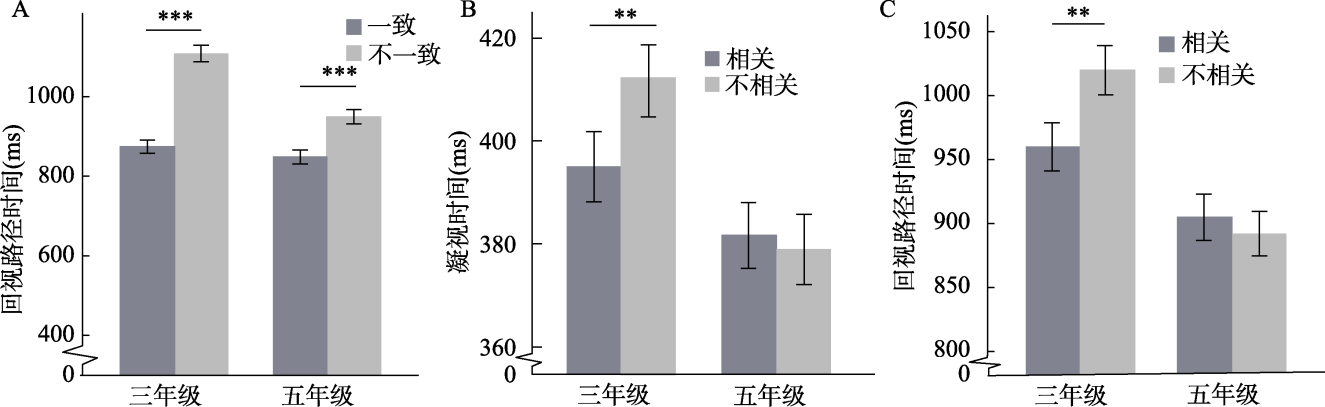
图1 语义一致性效应和相关性效应在年级间的差异。回视路径时间上语义一致性效应在三、五年级儿童间的差异(A), 凝视时间上相关性效应在三、五年级儿童间的差异(B), 回视路径时间上相关性效应在三、五年级儿童间的差异(C)。**p < 0.01, ***p < 0.001, 误差线为标准误。
| 自变量 | 凝视时间 | 第二次阅读时间 | 回视路径时间 | ||||||||||
|---|---|---|---|---|---|---|---|---|---|---|---|---|---|
| β | SE | t | p | β | SE | t | p | β | SE | t | p | ||
| 截距 | 2.520 | 0.012 | 217.28 | <0.001 | 2.574 | 0.011 | 235.95 | <0.001 | 2.868 | 0.016 | 173.86 | <0.001 | |
| 一般认知能力 | −0.000 | 0.002 | −0.09 | 0.932 | 0.001 | 0.002 | 0.67 | 0.502 | 0.002 | 0.002 | 1.19 | 0.236 | |
| 语义相关性 | 0.006 | 0.008 | 0.79 | 0.435 | 0.014 | 0.013 | 1.04 | 0.307 | 0.019 | 0.008 | 2.04 | 0.045 | |
| 年级 | 0.032 | 0.026 | 1.23 | 0.223 | −0.022 | 0.025 | −0.88 | 0.381 | −0.018 | 0.034 | −0.52 | 0.604 | |
| 一致性 | 0.027 | 0.009 | 2.62 | 0.011 | 0.047 | 0.012 | 3.86 | <0.001 | 0.083 | 0.012 | 6.66 | <0.001 | |
| 语素意识 | −0.003 | 0.006 | −0.43 | 0.670 | 0.001 | 0.007 | 0.09 | 0.926 | 0.005 | 0.008 | 0.58 | 0.566 | |
| 词汇知识 | −0.029 | 0.008 | −3.44 | <0.001 | −0.026 | 0.008 | −3.12 | 0.002 | −0.025 | 0.011 | −2.22 | 0.029 | |
| 语素意识:语义相关性 | −0.004 | 0.005 | −0.76 | 0.477 | −0.007 | 0.011 | −0.69 | 0.493 | −0.003 | 0.005 | −0.53 | 0.596 | |
| 词汇知识:语义相关性 | −0.010 | 0.005 | −1.90 | 0.064 | 0.009 | 0.009 | 0.97 | 0.336 | −0.010 | 0.006 | −1.56 | 0.123 | |
| 一致性:语义相关性 | −0.004 | 0.017 | −0.25 | 0.805 | −0.007 | 0.025 | −0.27 | 0.782 | 0.010 | 0.016 | 0.58 | 0.559 | |
| 语素意识:一致性 | 0.002 | 0.004 | 0.470 | 0.639 | −0.000 | 0.008 | −0.02 | 0.986 | 0.012 | 0.005 | 2.13 | 0.037 | |
| 词汇知识:一致性 | −0.003 | 0.005 | −0.72 | 0.473 | −0.007 | 0.008 | −0.91 | 0.364 | −0.013 | 0.005 | −2.29 | 0.022 | |
| 语素意识:相关性:一致性 | 0.001 | 0.010 | 0.11 | 0.910 | −0.028 | 0.017 | −1.66 | 0.107 | −0.014 | 0.010 | −1.36 | 0.200 | |
| 词汇知识:相关性:一致性 | −0.006 | 0.011 | −0.57 | 0.572 | 0.015 | 0.018 | 0.83 | 0.412 | 0.005 | 0.011 | 0.44 | 0.660 | |
表5 语义相关性、词汇知识和语素意识对阅读理解监控的调节作用
| 自变量 | 凝视时间 | 第二次阅读时间 | 回视路径时间 | ||||||||||
|---|---|---|---|---|---|---|---|---|---|---|---|---|---|
| β | SE | t | p | β | SE | t | p | β | SE | t | p | ||
| 截距 | 2.520 | 0.012 | 217.28 | <0.001 | 2.574 | 0.011 | 235.95 | <0.001 | 2.868 | 0.016 | 173.86 | <0.001 | |
| 一般认知能力 | −0.000 | 0.002 | −0.09 | 0.932 | 0.001 | 0.002 | 0.67 | 0.502 | 0.002 | 0.002 | 1.19 | 0.236 | |
| 语义相关性 | 0.006 | 0.008 | 0.79 | 0.435 | 0.014 | 0.013 | 1.04 | 0.307 | 0.019 | 0.008 | 2.04 | 0.045 | |
| 年级 | 0.032 | 0.026 | 1.23 | 0.223 | −0.022 | 0.025 | −0.88 | 0.381 | −0.018 | 0.034 | −0.52 | 0.604 | |
| 一致性 | 0.027 | 0.009 | 2.62 | 0.011 | 0.047 | 0.012 | 3.86 | <0.001 | 0.083 | 0.012 | 6.66 | <0.001 | |
| 语素意识 | −0.003 | 0.006 | −0.43 | 0.670 | 0.001 | 0.007 | 0.09 | 0.926 | 0.005 | 0.008 | 0.58 | 0.566 | |
| 词汇知识 | −0.029 | 0.008 | −3.44 | <0.001 | −0.026 | 0.008 | −3.12 | 0.002 | −0.025 | 0.011 | −2.22 | 0.029 | |
| 语素意识:语义相关性 | −0.004 | 0.005 | −0.76 | 0.477 | −0.007 | 0.011 | −0.69 | 0.493 | −0.003 | 0.005 | −0.53 | 0.596 | |
| 词汇知识:语义相关性 | −0.010 | 0.005 | −1.90 | 0.064 | 0.009 | 0.009 | 0.97 | 0.336 | −0.010 | 0.006 | −1.56 | 0.123 | |
| 一致性:语义相关性 | −0.004 | 0.017 | −0.25 | 0.805 | −0.007 | 0.025 | −0.27 | 0.782 | 0.010 | 0.016 | 0.58 | 0.559 | |
| 语素意识:一致性 | 0.002 | 0.004 | 0.470 | 0.639 | −0.000 | 0.008 | −0.02 | 0.986 | 0.012 | 0.005 | 2.13 | 0.037 | |
| 词汇知识:一致性 | −0.003 | 0.005 | −0.72 | 0.473 | −0.007 | 0.008 | −0.91 | 0.364 | −0.013 | 0.005 | −2.29 | 0.022 | |
| 语素意识:相关性:一致性 | 0.001 | 0.010 | 0.11 | 0.910 | −0.028 | 0.017 | −1.66 | 0.107 | −0.014 | 0.010 | −1.36 | 0.200 | |
| 词汇知识:相关性:一致性 | −0.006 | 0.011 | −0.57 | 0.572 | 0.015 | 0.018 | 0.83 | 0.412 | 0.005 | 0.011 | 0.44 | 0.660 | |
| 变量 | M | SD | 1 | 2 | 3 | 4 | 5 | 6 |
|---|---|---|---|---|---|---|---|---|
| 一般认知能力 | 42.4 | 7.27 | — | |||||
| 词汇知识 | 735 | 173 | 0.321*** | — | ||||
| 语素意识 | 7.79 | 2.05 | 0.110 | 0.372*** | — | |||
| 凝视时间 | 351 | 90 | −0.138 | −0.369*** | −0.146 | — | ||
| 第二次阅读时间 | 409 | 118 | −0.088 | −0.426*** | −0.233* | 0.399*** | — | |
| 回视路径时间 | 861 | 287 | −0.044 | −0.262** | 0.012 | 0.478*** | 0.623*** | — |
表6 各变量的均值、标准差及彼此之间的相关系数
| 变量 | M | SD | 1 | 2 | 3 | 4 | 5 | 6 |
|---|---|---|---|---|---|---|---|---|
| 一般认知能力 | 42.4 | 7.27 | — | |||||
| 词汇知识 | 735 | 173 | 0.321*** | — | ||||
| 语素意识 | 7.79 | 2.05 | 0.110 | 0.372*** | — | |||
| 凝视时间 | 351 | 90 | −0.138 | −0.369*** | −0.146 | — | ||
| 第二次阅读时间 | 409 | 118 | −0.088 | −0.426*** | −0.233* | 0.399*** | — | |
| 回视路径时间 | 861 | 287 | −0.044 | −0.262** | 0.012 | 0.478*** | 0.623*** | — |
| [1] |
Abdel-Khalek, A. M. (2005). Reliability and factorial validity of the standard progressive matrices among Kuwaiti children ages 8 to 15 years. Perceptual and Motor Skills, 101(2), 409-412
pmid: 16383072 |
| [2] |
Bai, X., Yan, G., Zang, C., Liversedge, S. P., & Rayner, K. (2008). Reading spaced and unspaced Chinese text: Evidence from eye movements. Journal of Experimental Psychology: Human Perception and Performance, 34(5), 1277-1287.
doi: 10.1037/0096-1523.34.5.1277 URL |
| [3] |
Baker, L. (1984). Spontaneous versus instructed use of multiple standards for evaluating comprehension: Effects of age, reading proficiency, and type of standard. Journal of Experimental Child Psychology, 38(2), 289-311.
doi: 10.1016/0022-0965(84)90127-9 URL |
| [4] | Baker,, L. (1985). How do we know when we don’t understand? Standards for evaluating text comprehension. In D. Forrest-Pressley, G. MacKinnon, & T. Waller (Eds.), Metacognition, cognition and human performance (pp. 155-205). New York, NY: Academic. |
| [5] |
Barr, D. J., Levy, R., Scheepers, C., & Tily, H. J. (2013). Random effects structure for confirmatory hypothesis testing: Keep it maximal. Journal of Memory and Language, 68(3), 255-278
doi: 10.1016/j.jml.2012.11.001 URL |
| [6] | Bates, D., Mächler, M., Bolker, B., & Walker, S. (2014). Fitting linear mixed-effects models using lme4. Journal of Statistical Software, 67(1), 1-48. |
| [7] | Bicknell, K., & Levy, R. (2011). Why readers regress to previous words: A statistical analysis. Paper presented at the 33rd annual conference of the Cognitive Science Society, Boston, MA. |
| [8] | Blythe, H., I., & Joseph, H. S. S. L. (2011). Children’s eye-movements during reading. In S.P. Liversedge, I. Gilchrist & S. Everling (Eds.), The Oxford handbook of eye-movements. (pp.645-651). Oxford University Press. |
| [9] | Brown, V. A. (2021). An introduction to linear mixed-effects modeling in R. Advances in Methods and Practices in Psychological Science, 4(1), 1-19. |
| [10] |
Cain, K., & Oakhill, J. (2006). Profiles of children with specific reading comprehension difficulties. British Journal of Educational Psychology, 76(4), 683-696.
doi: 10.1348/000709905X67610 URL |
| [11] |
Cain, K., Oakhill, J., & Bryant, P. (2004). Children’s reading comprehension ability: Concurrent prediction by working memory, verbal ability, and component skills. Journal of Educational Psychology, 96(1), 31-42.
doi: 10.1037/0022-0663.96.1.31 URL |
| [12] |
Camblin, C. C., Gordon, P. C., & Swaab, T. Y. (2007). The interplay of discourse congruence and lexical association during sentence processing: Evidence from ERPs and eye tracking. Journal of Memory and Language, 56(1), 103-128.
pmid: 17218992 |
| [13] |
Cartwright, K. B., Lee, S. A., Taboada Barber, A., DeWyngaert, L. U., Lane, A. B., & Singleton, T. (2020). Contributions of executive function and cognitive intrinsic motivation to university students’ reading comprehension. Reading Research Quarterly, 55(3), 345-369.
doi: 10.1002/rrq.273 |
| [14] | Chen, B. R. (2011). The development of Chinese lexical awareness in primary school children: A study of the characteristics and role in reading comprehension [Unpublished master’s thesis]. Shaanxi Normal University, Xi'an. |
| [陈泊蓉. (2011). 小学中高年级儿童汉语语素意识的发展特点及其与阅读理解的关系 (硕士学位论文). 陕西师范大学, 西安. ]. | |
| [15] | Chen, X., Hao, M. L., Geva, E., Zhu, J., & Shu, H. (2009). The role of compound awareness in Chinese children's vocabulary acquisition and character reading. Reading & Writing, 22, 615-631. |
| [16] |
Cheng, Y., Zhang, J., Li, H., Wu, X., Liu, H., Dong, Q., ... Sun, P. (2017). Growth of compounding awareness predicts reading comprehension in young Chinese students: A longitudinal study from Grade 1 to Grade 2. Reading Research Quarterly, 52(1), 91-104.
doi: 10.1002/rrq.2017.52.issue-1 URL |
| [17] |
Connor, C. M., Radach, R., Vorstius, C., Day, S. L., McLean, L., & Morrison, F. J. (2015). Individual differences in fifth graders’ literacy and academic language predict comprehension monitoring development: An eye-movement study. Scientific Studies of Reading, 19(2), 114-134.
doi: 10.1080/10888438.2014.943905 URL |
| [18] |
Cui, N., Wang, Y., Luo, J., & Wu, Y. (2024). The role of executive functions in 9-to 12-year-old children’s sentence processing: An eye-movement study. Journal of Research in Reading, 47(2), 201-219.
doi: 10.1111/jrir.v47.2 URL |
| [19] |
Cutting, L. E., Materek, A., Cole, C., A. S., Levine, T. M., & Mahone, E. M. (2009). Effects of fluency, oral language, and executive function on reading comprehension performance. Annals of Dyslexia, 59(1), 34-54.
doi: 10.1007/s11881-009-0022-0 pmid: 19396550 |
| [20] |
Cutting, L. E., & Scarborough, H. S. (2006). Prediction of reading comprehension: Relative contributions of word recognition, language proficiency, and other cognitive skills can depend on how comprehension is measured. Scientific Studies of Reading, 10(3), 277-299
doi: 10.1207/s1532799xssr1003_5 URL |
| [21] |
Del Giudice, M. (2014). Middle childhood: An evolutionary-developmental synthesis. Child Development Perspectives, 8(4), 193-200.
doi: 10.1111/cdep.12084 URL |
| [22] |
Ehri, L. C. (2014). Orthographic mapping in the acquisition of sight word reading, spelling memory, and vocabulary learning. Scientific Studies of Reading, 18(1), 5-21.
doi: 10.1080/10888438.2013.819356 URL |
| [23] |
Eilers, S., Tiffin-Richards, S. P., & Schroeder, S. (2018). Individual differences in children’s pronoun processing during reading: Detection of incongruence is associated with higher reading fluency and more regressions. Journal of Experimental Child Psychology, 173, 250-267.
doi: S0022-0965(17)30477-0 pmid: 29753908 |
| [24] |
Faul, F., Erdfelder, E., Buchner, A., & Lang, A.-G. (2009). Statistical power analyses using G*Power 3.1: Tests for correlation and regression analyses. Behavior Research Methods, 41(4), 1149-1160.
doi: 10.3758/BRM.41.4.1149 pmid: 19897823 |
| [25] | Florit, E., De Carli, P., Rodà, A., Cain, K., & Mason, L. (2025). Reading from paper, computers, and tablets in the first grade: The role of comprehension monitoring. Computers & Education Open, 8, Article 100243. |
| [26] |
Fong, Y. C., & Ho, C. S. H. (2017). What are the contributing cognitive linguistic skills for early Chinese listening comprehension? Learning and Individual Differences, 59, 78-85.
doi: 10.1016/j.lindif.2017.08.001 URL |
| [27] |
Garner, R. (1980). Monitoring of understanding: An investigation of good and poor readers’ awareness of induced miscomprehension of text. Journal of Reading Behavior, 12(1), 55-64.
doi: 10.1080/10862968009547352 URL |
| [28] | Gombert, J. E. (1992). Metalinguistic development (pp. 176-178). University of ChicagoPress. (Original work published 1990). |
| [29] |
Hessel, A. K., Nation, K., & Murphy, V. A. (2021). Comprehension monitoring during reading: An eye-tracking study with children learning English as an additional language. Scientific Studies of Reading, 25(2), 159-178.
doi: 10.1080/10888438.2020.1740227 URL |
| [30] | Hudson, N, Scheff, J, Tarsha, M, Cutting, L. E. (2016). Reading comprehension and executive function neurobiological findings. Perspectives on Language and Literacy, 42(2), 23-29. |
| [31] |
Inhoff, A. W., & Liu, W. (1998). The perceptual span and oculomotor activity during the reading of Chinese sentences. Journal of Experimental Psychology: Human Perception and Performance, 24(1), 20-34.
doi: 10.1037/0096-1523.24.1.20 URL |
| [32] |
Jin, Z., & Song, Y. (2022). The influence of morphological awareness, vocabulary knowledge, and syntactic knowledge on Korean-Chinese children’s Chinese reading comprehension. Chinese Language Education and Research, 38, 21-32.
doi: 10.24285/CLER.2022.11.38.21 URL |
| [33] |
Kendeou, P., Papadopoulos, T. C., & Spanoudis, G. (2012). Processing demands of reading comprehension tests in young readers. Learning and Instruction, 22(5), 354-367.
doi: 10.1016/j.learninstruc.2012.02.001 URL |
| [34] | Kendeou, P., Van Den Broek, P., Helder, A., & Karlsson, J. (2014). A cognitive view of reading comprehension: Implications for reading difficulties. Learning Disabilities Research & Practice, 29(1), 10-16. |
| [35] |
Kendeou, P., van den Broek, P., White, M. J., & Lynch, J. S. (2009). Predicting reading comprehension in early elementary school: The independent contributions of oral language and decoding skills. Journal of Educational Psychology, 101(4), 765-778.
doi: 10.1037/a0015956 URL |
| [36] |
Kieffer, M. J., Vukovic, R. K., & Berry, D. (2013). Roles of attention shifting and inhibitory control in fourth-grade reading comprehension. Reading Research Quarterly, 48(4), 333-348.
doi: 10.1002/rrq.54 URL |
| [37] |
Kim, Y.-S., Wagner, R. K., & Lopez, D. (2012). Developmental relations between reading fluency and reading comprehension: A longitudinal study from Grade 1 to Grade 2. Journal of Experimental Child Psychology, 113(1), 93-111.
doi: 10.1016/j.jecp.2012.03.002 URL |
| [38] |
Kim, Y.-S. G. (2017). Why the simple view of reading is not simplistic: Unpacking Component Skills of reading using a direct and indirect effect model of reading (DIER). Scientific Studies of Reading, 21(4), 310-333.
doi: 10.1080/10888438.2017.1291643 URL |
| [39] |
Kim, Y.-S. G. (2019). Toward integrative reading science: The direct and indirect effects model of reading (DIER). Journal of Learning Disabilities, 53(6), 469-491.
doi: 10.1177/0022219420908239 URL |
| [40] |
Kim, Y.-S. G., Vorstius, C., & Radach, R. (2018). Does online comprehension monitoring make a unique contribution to reading comprehension in beginning readers? Evidence from eye movements. Scientific Studies of Reading, 22(5), 367-383.
doi: 10.1080/10888438.2018.1457680 URL |
| [41] | Kinnunen,, R., & Vauras, M. (2010). Tracking online metacognition:Monitoring and regulating comprehension in reading. In A. Efklides & P. Misailidi (Eds.), Trends and prospects in metacognition research (pp. 209-258). New York, NY: Springer. |
| [42] |
Kintsch, W. (1988). The role of knowledge in discourse comprehension: A construction-integration model. Psychological Review, 95(2), 163-182.
doi: 10.1037/0033-295x.95.2.163 pmid: 3375398 |
| [43] |
Li, X., Liu, P., & Rayner, K. (2015). Saccade target selection in Chinese reading. Psychonomic Bulletin & Review, 22(2), 524-530.
doi: 10.3758/s13423-014-0693-3 URL |
| [44] |
Liu, Y., & Liu, D. (2020). Morphological awareness and orthographic awareness link Chinese writing to reading comprehension. Reading and Writing, 33(7), 1701-1720.
doi: 10.1007/s11145-019-10009-0 |
| [45] |
Markman, E. M. (1979). Realizing that you don’t understand: Elementary school children’s awareness of inconsistencies. Child Development, 50(3), 643-655.
pmid: 498843 |
| [46] |
McBride-Chang, C., Wagner, R. K., Muse, A., Chow, B. W.-Y., & Shu, H. (2005). The role of morphological awareness in children’s vocabulary acquisition in English. Applied Psycholinguistics, 26(3), 415-436.
doi: 10.1017/S014271640505023X URL |
| [47] |
McNamara, D. S. (2001). Reading both high-coherence and low-coherence texts: Effects of text sequence and prior knowledge. Canadian Journal of Experimental Psychology, 55(1), 51-62.
doi: 10.1037/h0087352 URL |
| [48] |
McNamara, D. S., Kintsch, E., Songer, N. B., & Kintsch, W. (1996). Are good texts always better? Interactions of text coherence, background knowledge, and levels of understanding in learning from text. Cognition and Instruction, 14(1), 1-43.
doi: 10.1207/s1532690xci1401_1 URL |
| [49] | Moats, L.C. (2005). How spelling supports reading. American Educator, 29, 12-43. |
| [50] |
Oakhill, J., Hartt, J., & Samols, D. (2005). Levels of comprehension monitoring and working memory in good and poor comprehenders. Reading and Writing, 18(7-9), 657-686.
doi: 10.1007/s11145-005-3355-z URL |
| [51] |
Qiu, C., Hatton, R., & Hou, M. (2020). Variations in Raven’s Progressive Matrices scores among Chinese children and adolescents. Personality and Individual Differences, 164, 110064.
doi: 10.1016/j.paid.2020.110064 URL |
| [52] |
Quinn, J. M., Wagner, R. K., Petscher, Y., & Lopez, D. (2015). Developmental relations between vocabulary knowledge and reading comprehension: A latent change score modeling study. Child Development, 86(1), 159-175.
doi: 10.1111/cdev.12292 pmid: 25201552 |
| [53] |
Rapp, D. N., & Van Den Broek, P. (2005). Dynamic text comprehension: An integrative view of reading. Current Directions in Psychological Science, 14(5), 276-279.
doi: 10.1111/j.0963-7214.2005.00380.x URL |
| [54] | Raven, J. C. (1960). Guide to the standard progressive matrices: Sets A, B, C, D and E. H.K. Lewis. |
| [55] |
Rayner, K. (1998). Eye movements in reading and information processing: 20 years of research. Psychological Bulletin, 124(3), 372-422.
doi: 10.1037/0033-2909.124.3.372 pmid: 9849112 |
| [56] | Rayner, K., Pollatsek, S., Ashby, J., & Clifton, C. (2012). Psychology of reading (2nd ed.). New York, NY: Psychology Press. |
| [57] |
Rayner, K., & Schotter, E. R. (2014). Semantic preview benefit in reading English: The effect of initial letter capitalization. Journal of Experimental Psychology: Human Perception and Performance, 40(6), 1617-1628.
doi: 10.1037/a0036763 URL |
| [58] |
Vorstius, C., Radach, R., Mayer, M., & Lonigan, C. (2013). Monitoring local comprehension monitoring in sentence reading. School Psychology Review, 42(2), 191-206.
doi: 10.1080/02796015.2013.12087484 URL |
| [59] | Wang, X, Tao, B. (1996). The scale and assessment of vocabulary for primary school. Shanghai Educational Press. (in Chinese). |
| [王孝玲, 陶保平. (1996). 小学生识字量测试题库及评价量表. 上海教育出版社.] | |
| [60] |
Warren, T., & McConnell, K. (2007). Investigating effects of selectional restriction violations and plausibility violation severity on eye-movements in reading. Psychonomic Bulletin & Review, 14(4), 770-775.
doi: 10.3758/BF03196835 URL |
| [61] |
Zargar, E., Adams, A. M., & Connor, M. D. (2019). The relations between children's comprehension monitoring and their reading comprehension and vocabulary knowledge: an eye-movement study. Reading and Writing, 33(3), 511-545
doi: 10.1007/s11145-019-09966-3 |
| [62] | Zhang, Y., Dong, Q., Shu, H., & Wu, Y. (2017). The roles of phonological awareness, naming speed, and morphological awareness in Chinese reading development. Psychological Development and Education, 33(4), 401-409. |
| [63] |
Zwaan, R. A., & Radvansky, G. A. (1998). Situation models in language comprehension and memory. Psychological Bulletin, 123(2), 162-185.
doi: 10.1037/0033-2909.123.2.162 pmid: 9522683 |
| [1] | 郭存, 谢瑞波, 喻艳玲, 夏月, 王振梁, 伍新春. 小学中高年级儿童复合语素意识、词语结构意识与词汇知识的关系:交叉滞后研究[J]. 心理学报, 2024, 56(11): 1488-1498. |
| [2] | 程亚华, 沈岚岚, 李宜逊, 伍新春, 李虹, 王铁群, 程芳. 家庭阅读环境对学龄儿童汉字识别、口语词汇知识与阅读理解的影响:一个发展级联模型[J]. 心理学报, 2024, 56(1): 83-92. |
| [3] | 赵英, 伍新春, 陈红君, 孙鹏, 王淏蘭. 语素意识与快速命名对汉语儿童阅读能力的影响:跨学段的中介效应分析[J]. 心理学报, 2024, 56(1): 70-82. |
| [4] | 程亚华, 冯瑶, 李宜逊, 马嘉琪, 沈岚岚, 张文建, 伍新春, 冯秋迪. 小学儿童口语词汇知识的发展轨迹及其对阅读能力的预测:一个潜变量增长模型[J]. 心理学报, 2023, 55(7): 1074-1086. |
| [5] | 喻艳玲, 谢瑞波, 伍新春, 夏月, 王振梁, 阮世芳. 小学低年级儿童元语言意识与阅读流畅性的关系:汉字识别和词汇知识的中介效应[J]. 心理学报, 2023, 55(6): 941-953. |
| [6] | 周怡彤, 谢瑞波, 伍新春, 阮世芳, 夏月, 喻艳玲, 王振梁. 小学低年级儿童语音意识和语素意识对阅读理解的影响:阅读流畅性的中介作用[J]. 心理学报, 2023, 55(6): 930-940. |
| [7] | 夏月, 谢瑞波, 王振梁, 阮世芳, 伍新春. 小学低年级汉语儿童语素意识、汉字识别和词汇知识的发展关系——交叉滞后研究[J]. 心理学报, 2022, 54(8): 905-916. |
| [8] | 李利平, 伍新春, 程亚华. 小学低段汉字识别和听写的发展轨迹:语素意识的预测作用[J]. 心理学报, 2020, 52(5): 623-632. |
| [9] | 陈红君, 赵英, 伍新春, 孙鹏, 谢瑞波, 冯杰. 小学儿童词汇知识与阅读理解的关系:交叉滞后研究[J]. 心理学报, 2019, 51(8): 924-934. |
| [10] | 程亚华, 王健, 伍新春. 小学低年级儿童汉语语素意识在阅读理解中的 作用:字词阅读流畅性的中介效应[J]. 心理学报, 2018, 50(4): 413-425. |
| [11] | 程亚华, 伍新春, 刘红云, 李虹. 小学低年级儿童口语词汇知识的发展轨迹及其影响因素[J]. 心理学报, 2018, 50(2): 206-215. |
| [12] | 赵英;程亚华;伍新春;阮氏芳. 汉语儿童语素意识与词汇知识的双向关系:一项追踪研究[J]. 心理学报, 2016, 48(11): 1434-1444. |
| [13] | 李利平; 伍新春;周宁宁;程亚华; 阮氏芳. 汉语儿童读词者的认知特征及其影响因素[J]. 心理学报, 2016, 48(10): 1270-1281. |
| 阅读次数 | ||||||
|
全文 |
|
|||||
|
摘要 |
|
|||||
