

ISSN 1671-3710
CN 11-4766/R
主办:中国科学院心理研究所
出版:科学出版社
CN 11-4766/R
主办:中国科学院心理研究所
出版:科学出版社
心理科学进展 ›› 2026, Vol. 34 ›› Issue (8): 1330-1350.doi: 10.3724/SP.J.1042.2026.1330 cstr: 32111.14.2026.1330
海深洋1, 杨波1, 郭腾飞2, 辛钊阳3, 刘鎏1, 傅安国4,5( )
)
收稿日期:2025-11-26
出版日期:2026-08-15
发布日期:2026-06-03
通讯作者:
傅安国, E-mail: anguofu@ynnu.edu.cn基金资助:
HAI Shenyang1, YANG Bo1, GUO Tengfei2, XIN Zhaoyang3, LIU Liu1, FU Anguo4,5()
Received:2025-11-26
Online:2026-08-15
Published:2026-06-03
摘要:
面对日益激烈的人才竞争和高速变化的商业环境, 企业亟需构建以人为本、以优势为核心的人力资源管理新模式。领导优势使用研究虽取得一些研究进展, 但其概念内涵尚未形成统一的界定, 其前因后果仍未进行充分探讨。本研究将对领导优势使用的概念内涵、形成机制和多层次影响机制进行全面探讨。首先, 本研究基于领导力社会建构理论的视角, 挖掘领导优势使用的独特内涵、结构并开发本土化测量工具。其次, 采用模糊集定性比较分析法系统解构组织、领导者和追随者多个层面的因素的组态效应对领导优势使用的影响, 对其前因机制形成多层次理解。接下来, 采用经验取样法, 追踪分析领导优势使用→自我反馈→效能提升→下一阶段领导优势使用这一演变过程, 更全面地揭示领导优势使用的动态增益机制。最后, 基于领导力过程模型, 探讨领导优势使用对团队和个体层面关键工作产出的影响机制和边界条件, 揭示其在组织“用好人才”与“留住人才”过程中的有效性, 构建领导优势使用的多层次影响效应框架。本研究对领导优势使用的理论体系做出有力拓展, 为领导力本土化研究贡献新见解, 同时也为企业构建以优势为核心的人才管理新模式提供决策借鉴。
中图分类号:
海深洋, 杨波, 郭腾飞, 辛钊阳, 刘鎏, 傅安国. (2026). 领导优势使用的内涵、形成与多层次作用机制. 心理科学进展 , 34(8), 1330-1350.
HAI Shenyang, YANG Bo, GUO Tengfei, XIN Zhaoyang, LIU Liu, FU Anguo. (2026). The conceptualization, antecedents, and multilevel effects of leader strengths use. Advances in Psychological Science, 34(8), 1330-1350.
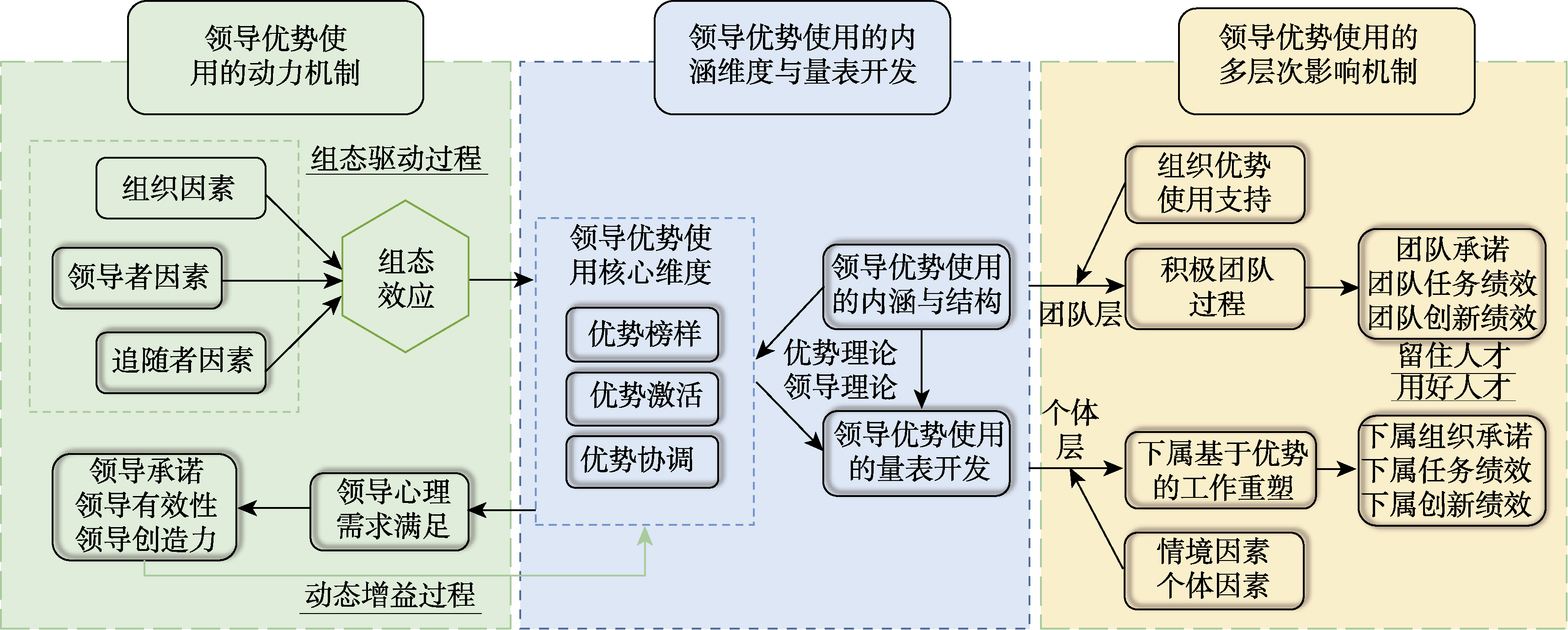
图1 整体研究框架
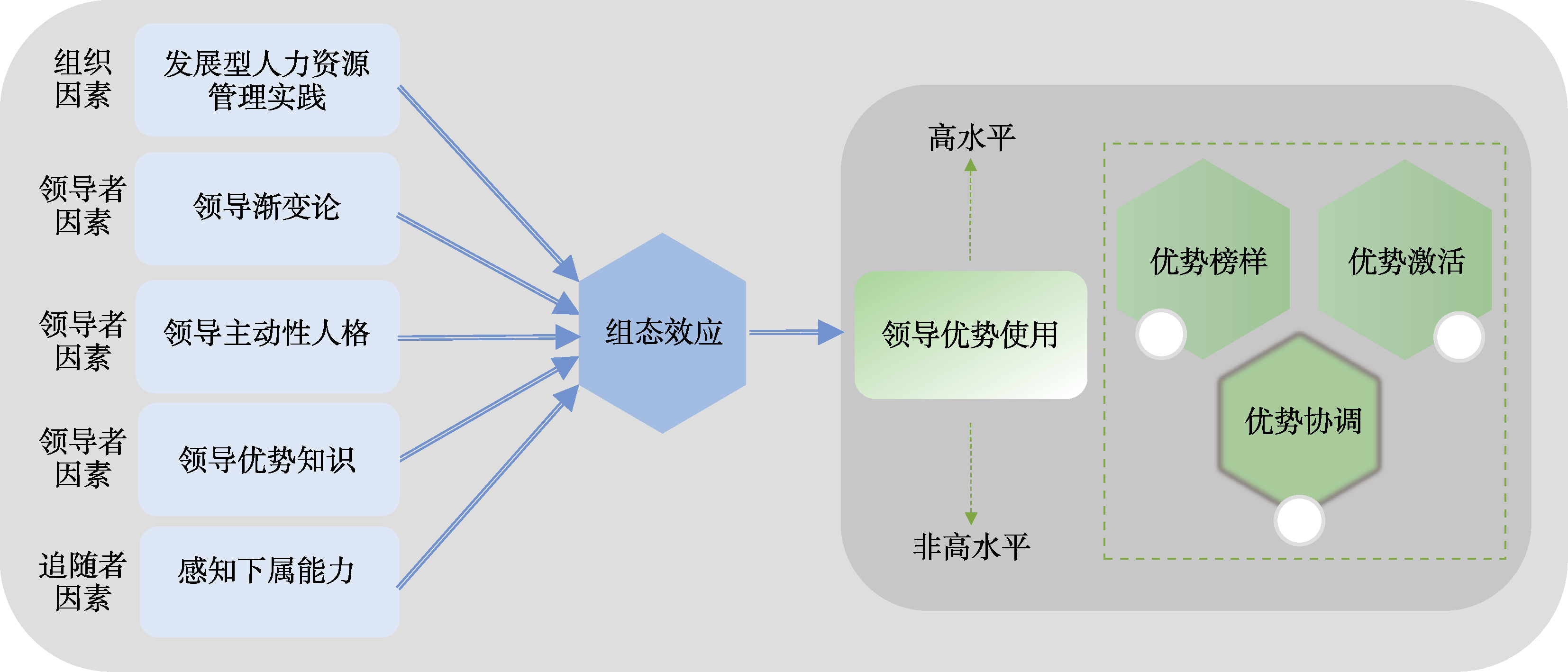
图2 领导优势使用的前因组态效应模型
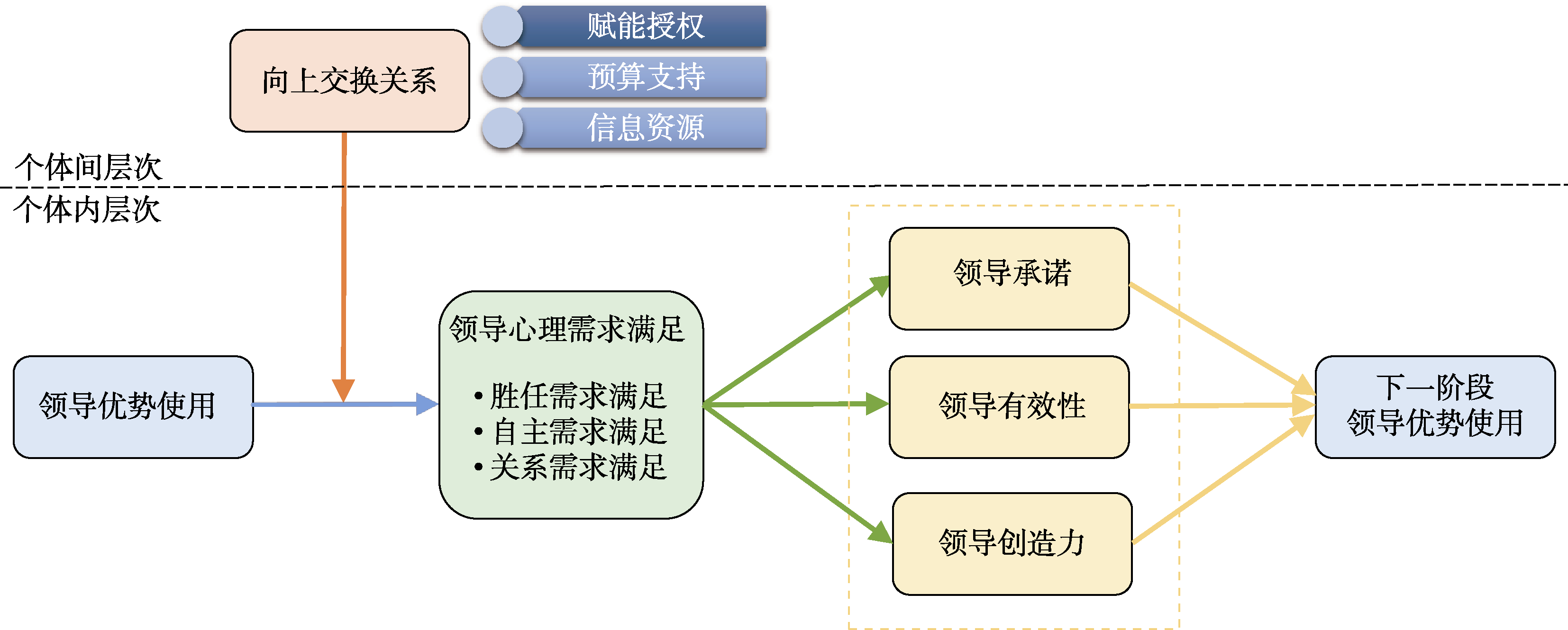
图3 领导优势使用的动态增益机制模型
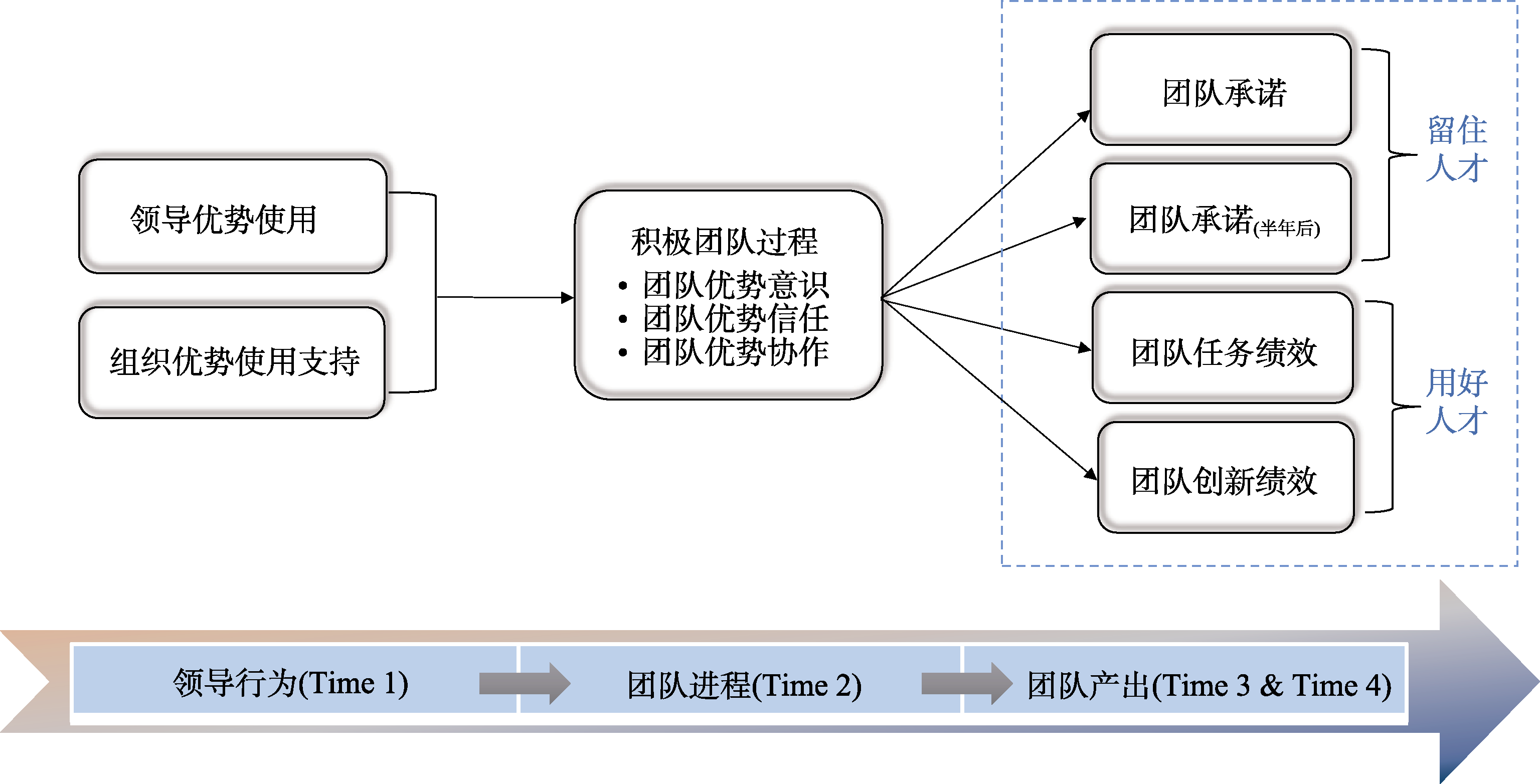
图4 领导优势使用对团队层面工作产出的作用机制
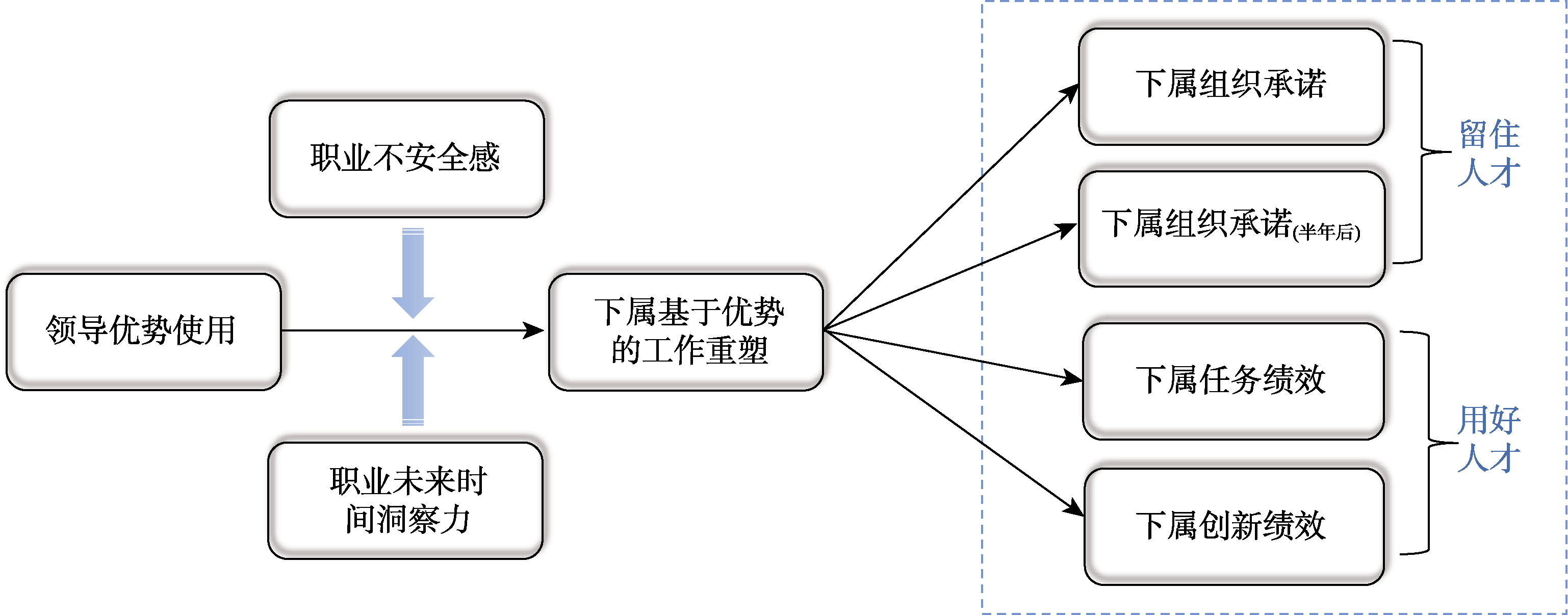
图5 领导优势使用对个体层面工作产出的作用机制
| [1] |
李超平, 毛凯贤. (2018). 服务型领导影响工作繁荣的动态双向机制. 心理科学进展, 26(10), 1734-1748.
doi: 10.3724/SP.J.1042.2018.01734 |
| [2] |
李树文, 罗瑾琏. (2020). 领导—下属情绪评价能力一致与员工建言: 内部人身份感知与性别相似性的作用. 心理学报, 52(9), 1121-1131.
doi: 10.3724/SP.J.1041.2020.01121 |
| [3] | 林新奇, 丁贺. (2018). 优势理论在人力资源管理中的应用研究. 中国人力资源开发, 35(1), 102-111. |
| [4] |
林新奇, 栾宇翔, 赵锴, 赵国龙. (2022). 领导风格与员工创新绩效关系的元分析: 基于自我决定视角. 心理科学进展, 30(4), 781-801.
doi: 10.3724/SP.J.1042.2022.00781 |
| [5] |
刘贝妮, 张志学. (2023). 团队何以愈挫弥坚?领导正念对团队韧性形成的影响. 心理科学进展, 31(7), 1146-1159.
doi: 10.3724/SP.J.1042.2023.01146 |
| [6] |
刘智强, 许玉平, 许建伟, 周蓉, 龙立荣. (2023). 创新期望差距与团队突破性创新: 自我调节理论视角. 心理学报, 55(2), 272-285.
doi: 10.3724/SP.J.1041.2023.00272 |
| [7] |
罗萍, 施俊琦, 朱燕妮, 房俨然. (2020). 个性化工作协议对员工主动性职业行为和创造力的影响. 心理学报, 52(1), 81-92.
doi: 10.3724/SP.J.1041.2020.00081 |
| [8] |
佘卓霖, 李全, 杨百寅, 杨斌. (2021). 工作狂领导对团队绩效的双刃剑作用机制. 心理学报, 53(9), 1018-1031.
doi: 10.3724/SP.J.1041.2021.01018 |
| [9] |
史燕伟, 谢菊兰, 王雅妮, 张南. (2023). 数字化工作重塑及其对工作绩效的促进作用: 基于人-任务-技术匹配视角. 心理科学进展, 31(7), 1133-1145.
doi: 10.3724/SP.J.1042.2023.01133 |
| [10] | 唐春勇, 李亚莉, 赵曙明. (2021). 发展型人力资源管理实践研究: 概念内涵、量表开发及检验. 南开管理评论, 24(4), 85-97. |
| [11] | 唐春勇, 周昂, 邓婷, 赖彦钊. (2023). 发展型人力资源管理实践对员工主动变革行为的影响机制: 中庸思维的调节作用. 科技进步与对策, 41(9), 119-129. |
| [12] |
田喜洲, 刘美玲. (2017). 基于个体优势的工作重塑. 心理科学进展, 25(9), 1579-1596.
doi: 10.3724/SP.J.1042.2017.01579 |
| [13] | 王墨耘, 傅小兰. (2003). 内隐人格理论的实体论-渐变论维度研究述评. 心理科学进展, 11(2), 153-159. |
| [14] | 魏昕, 张志学. (2018). 团队的和谐型创新激情: 前因、结果及边界条件. 管理世界, 34(7), 100-113. |
| [15] | 谢小云, 左玉涵, 胡琼晶. (2021). 数字化时代的人力资源管理: 基于人与技术交互的视角. 管理世界, 37(1), 200-216. |
| [16] | 易明, 王圣慧, 罗瑾琏, 胡文安. (2021). 木秀于林, 风必摧之?下属绩效影响领导授权行为的机制与边界条件. 南开管理评论, 24(6), 117-130. |
| [17] | 杨陈, 杨付, 景熠, 唐明凤. (2018). 谦卑型领导如何改善员工绩效: 心理需求满足的中介作用和工作单位结构的调节作用. 南开管理评论, 21(2), 121-134. |
| [18] |
尹奎, 迟志康, 董念念, 李培凯, 赵景. (2024). 团队反思与团队资源开发、利用及团队结果的关系: 一项元分析. 心理科学进展, 32(2), 228-245.
doi: 10.3724/SP.J.1042.2024.00228 |
| [19] | 张建平, 张光磊, 刘善仕, 周国林, 李建玲. (2023). 团队情境中资质过剩感的积极效应: 综合组成型和汇编型方式的视角. 心理科学进展, 31(10), 1828-1842. |
| [20] | 张志学, 华中生, 谢小云. (2024). 数智时代人机协同的研究现状与未来方向. 管理工程学报, 38(3), 1-13. |
| [21] |
张志学, 施俊琦, 刘军. (2016). 组织行为与领导力研究的进展与前沿. 心理科学进展, 24(3), 317-326.
doi: 10.3724/SP.J.1042.2016.00317 |
| [22] | 赵曙明, 陈嘉茜, 赵宜萱, 陈万思. (2023). 中国人力资源管理演进与展望:基于《中国人力资源开发》创刊40年(1984-2023)的文献整合研究. 中国人力资源开发, 40(12), 96-109. |
| [23] |
周空, 周萱, 应雪晴. (2023). 从想法产生到想法执行: 团队绩效薪酬对团队创新的影响机制. 心理科学进展, 31(6), 944.
doi: 10.3724/SP.J.1042.2023.00944 |
| [24] |
Amabile, T. M., & Pratt, M. G. (2016). The dynamic componential model of creativity and innovation in organizations: Making progress, making meaning. Research in Organizational Behavior, 36, 157-183.
doi: 10.1016/j.riob.2016.10.001 URL |
| [25] |
Anthony, C., Bechky, B. A., & Fayard, A. L. (2023). “Collaborating” with AI: Taking a system view to explore the future of work. Organization Science, 34(5), 1672-1694.
doi: 10.1287/orsc.2022.1651 URL |
| [26] |
Antonakis, J., Day, D. V., & Schyns, B. (2012). Leadership and individual differences: At the cusp of a renaissance. The Leadership Quarterly, 23(4), 643-650.
doi: 10.1016/j.leaqua.2012.05.002 URL |
| [27] |
Babalola, M. T., Qu, Y. (E.), Ali, M., Pathki, C. S. R., Usman, M., & Muchiri, M. (2023). An uncertainty management perspective on the antecedents of leader self-serving behavior. Journal of Organizational Behavior, 44(8), 1164-1182.
doi: 10.1002/job.v44.8 URL |
| [28] | Bakker, A. B., Hetland, J., Olsen, O. K., & Espevik, R. (2019). Daily strengths use and employee well-being: The moderating role of personality. Journal of Occupational and Organizational Psychology, 92(1), 144-168. |
| [29] |
Bakker, A. B., & van Woerkom, M. (2018). Strengths use in organizations: A positive approach of occupational health. Canadian Psychology, 59(1), 38-46.
doi: 10.1037/cap0000120 URL |
| [30] |
Banks, G. C. (2023). Eight puzzles of leadership science. The Leadership Quarterly, 34(4), 101710.
doi: 10.1016/j.leaqua.2023.101710 URL |
| [31] |
Bateman, T. S., & Crant, J. M. (1993). The proactive component of organizational behavior: A measure and correlates. Journal of Organizational Behavior, 14(2), 103-118.
doi: 10.1002/job.v14:2 URL |
| [32] | Breevaart, K., van Woerkom, M., Wang, J., & Planken, N. (2025). Strengths-based leadership: A critical review to guide future research. Journal of Leadership & Organizational Studies, 32(4), 429-448. |
| [33] | Buckingham, M. (2010). Go put your strengths to work: 6 powerful steps to achieve outstanding results. Free Press. |
| [34] | Burkus, D. (2011). Building the strong organization: Exploring the role of organizational design in strengths-based leadership. Journal of Strategic Leadership, 3(1), 54-66. |
| [35] |
Cable, D. M., Gino, F., & Staats, B. R. (2013). Breaking them in or eliciting their best? Reframing socialization around newcomers’ authentic self-expression. Administrative Science Quarterly, 58(1), 1-36.
doi: 10.1177/0001839213477098 URL |
| [36] |
Carton, A. M. (2022). The science of leadership: A theoretical model and research agenda. Annual Review of Organizational Psychology and Organizational Behavior, 9(1), 61-93.
doi: 10.1146/orgpsych.2022.9.issue-1 URL |
| [37] |
Cerasoli, C. P., Nicklin, J. M., & Nassrelgrgawi, A. S. (2016). Performance, incentives, and needs for autonomy, competence, and relatedness: A meta-analysis. Motivation and Emotion, 40(6), 781-813.
doi: 10.1007/s11031-016-9578-2 URL |
| [38] |
Chen, Y. F., Crant, J. M., Wang, N., Kou, Y., Qin, Y., Yu, J., & Sun, R. (2021). When there is a will there is a way: The role of proactive personality in combating COVID-19. Journal of Applied Psychology, 106(2), 199-213.
doi: 10.1037/apl0000865 URL |
| [39] |
Chi, N.-W., Tu, M.-H., & Wu, I.-H. (2023). Why and when proactive helping does not lead to future help: The roles of psychological need satisfaction and interpersonal competence. Journal of Vocational Behavior, 140, 103824.
doi: 10.1016/j.jvb.2022.103824 URL |
| [40] |
Chiu, C.-Y., Wu, C.-H., Bartram, A., Parker, S. K., & Lee, C. (2023). Is leader proactivity enough: Importance of leader competency in shaping team role breadth efficacy and proactive performance. Journal of Vocational Behavior, 143, 103865.
doi: 10.1016/j.jvb.2023.103865 URL |
| [41] |
Cole, M. S., Walter, F., & Bruch, H. (2008). Affective mechanisms linking dysfunctional behavior to performance in work teams: A moderated mediation study. Journal of Applied Psychology, 93(5), 945-958.
doi: 10.1037/0021-9010.93.5.945 pmid: 18808218 |
| [42] | DeRue, D. S., & Ashford, S. J. (2010). Who will lead and who will follow? A social process of leadership identity construction in organizations. Academy of Management Review, 35(4), 627-647. |
| [43] |
Ding, H., Liu, J., & Yu, E. (2023). How and when do strengths work? The effect of strengths-based leadership on follower career satisfaction. Personnel Review, 53(6), 1392-1407.
doi: 10.1108/PR-07-2022-0485 URL |
| [44] | Ding, H., Yu, E., & Li, Y. (2020). Strengths-based leadership and its impact on task performance: A preliminary study. South African Journal of Business Management, 51(1), 1832. |
| [45] | Dweck, C. S. (1999). Self-theories: Their role in motivation, personality, and development. Psychology Press. |
| [46] |
Fairhurst, G. T., & Grant, D. (2010). The social construction of leadership: A sailing guide. Management Communication Quarterly, 24(2), 171-210.
doi: 10.1177/0893318909359697 URL |
| [47] |
Fan, X., Wang, D., Wang, F., & Kraimer, M. L. (2024). When leaders are forced to stay: The indirect effects of leaders’ reluctant staying on subordinates’ performance. Journal of Organizational Behavior, 45(3), 459-476.
doi: 10.1002/job.v45.3 URL |
| [48] |
Fiske, S. T., Cuddy, A. J. C., & Glick, P. (2007). Universal dimensions of social cognition: Warmth and competence. Trends in Cognitive Sciences, 11(2), 77-83.
doi: 10.1016/j.tics.2006.11.005 pmid: 17188552 |
| [49] |
Foulk, T. A., Lanaj, K., & Krishnan, S. (2019). The virtuous cycle of daily motivation: Effects of daily strivings on work behaviors, need satisfaction, and next-day strivings. Journal of Applied Psychology, 104(5), 755-775.
doi: 10.1037/apl0000385 URL |
| [50] | Ghielen, S. T. S., van Woerkom, M., & Meyers, M. C. (2018). Promoting positive outcomes through strengths interventions: A literature review. The Journal of Positive Psychology, 13(6), 573-585. |
| [51] |
Govindji, R., & Linley, P.A. (2007). Strengths use, self-concordance and well-being: Implications for strengths coaching and coaching psychologists. International Coaching Psychology Review, 2(2), 143-153.
doi: 10.53841/bpsicpr.2007.2.2.143 URL |
| [52] |
Gürbüz, S., Bakker, A. B., & Brouwers, E. P. (2025). Shaping work, shaping success: How HR practices drive task performance via proactive behaviors and work engagement. Human Resource Management Journal, 36(1), 106-120.
doi: 10.1111/hrmj.v36.1 URL |
| [53] |
Hai, S., & Park, I. J. (2024a). Linking the perceived strength supports both from organization and supervisor to performances: The roles of strengths-based climate and meaningful task. Journal of Career Assessment, 32(1), 101-124.
doi: 10.1177/10690727231179195 URL |
| [54] |
Hai, S., & Park, I. J. (2024b). How and when does the career future time perspective motivate service performance? The International Journal of Human Resource Management, 35(6), 1193-1224.
doi: 10.1080/09585192.2023.2266678 URL |
| [55] | Hai, S., & Park, I. J. (2025). The bright side of supervisors’ strengths use: Dynamic relations with work-related flow, team trust and performance. Personnel Review, 54(6), 1457-1477. |
| [56] | Herdman, A. K., Yang, B., & Arthur, J. B. (2017). Leader-upward exchange quality and team performance: A multilevel investigation of the mediating role of empowering leadership. Journal of Management, 43(7), 2119-2143. |
| [57] |
Hughes, D. J., Lee, A., Tian, A. W., Newman, A., & Legood, A. (2018). Leadership, creativity, and innovation: A critical review and practical recommendations. The Leadership Quarterly, 29(5), 549-569
doi: 10.1016/j.leaqua.2018.03.001 URL |
| [58] |
Jiang, J., Dong, Y., Hu, H., Liu, Q., & Guan, Y. (2022). Leaders’ response to employee overqualification: An explanation of the curvilinear moderated relationship. Journal of Occupational and Organizational Psychology, 95(2), 459-494.
doi: 10.1111/joop.v95.2 URL |
| [59] |
Kelemen, T. K., Matthews, S. H., & Breevaart, K. (2020). Leading day-to-day: A review of the daily causes and consequences of leadership behaviors. The Leadership Quarterly, 31(1), 101344.
doi: 10.1016/j.leaqua.2019.101344 URL |
| [60] |
Kersten, A., Scholz, F., van Woerkom, M., Krabbenborg, M., & Smeets, L. (2025). A strengths-based human resource management approach to neurodiversity: A multi-actor qualitative study. Human Resource Management, 64(1), 229-245.
doi: 10.1002/hrm.v64.1 URL |
| [61] |
Kilroy, J., Dundon, T., & Townsend, K. (2023). Embedding reciprocity in human resource management: A social exchange theory of the role of frontline managers. Human Resource Management Journal, 33(2), 511-531.
doi: 10.1111/hrmj.v33.2 URL |
| [62] |
Kirkman, B. L., Chen, G., Farh, J.-L., Chen, Z. X., & Lowe, K. B. (2009). Individual power distance orientation and follower reactions to transformational leaders: A cross-level, cross-cultural examination. Academy of Management Journal, 52(4), 744-764.
doi: 10.5465/amj.2009.43669971 URL |
| [63] | Klein, H. J., Molloy, J. C., & Brinsfield, C. T. (2012). Reconceptualizing workplace commitment to redress a stretched construct: Revisiting assumptions and removing confounds. Academy of Management Review, 37(1), 130-151. |
| [64] |
Kooij, D. T., van Woerkom, M., Wilkenloh, J., Dorenbosch, L., & Denissen, J. J. A. (2017). Job crafting towards strengths and interests: The effects of a job crafting intervention on person-job fit and the role of age. Journal of Applied Psychology, 102(6), 971-981.
doi: 10.1037/apl0000194 pmid: 28277726 |
| [65] |
Koseoglu, G., Liu, Y., & Shalley, C. E.(2017). Working with creative leaders: Exploring the relationship between supervisors’ and subordinates’ creativity. The Leadership Quarterly, 28(6), 798-811.
doi: 10.1016/j.leaqua.2017.03.002 URL |
| [66] |
Kukenberger, M. R., Mathieu, J. E., & Ruddy, T. (2015). A cross-level test of empowerment and process influences on members’ informal learning and team commitment. Journal of Management, 41(3), 987-1016.
doi: 10.1177/0149206312443559 URL |
| [67] |
Kuvaas, B. (2008). An exploration of how the employee- organization relationship affects the linkage between perception of developmental human resource practices and employee outcomes. Journal of Management Studies, 45(1), 1-25.
doi: 10.1111/joms.2008.45.issue-1 URL |
| [68] |
Lam, W., Lee, C., Taylor, M. S., & Zhao, H. H. (2018). Does proactive personality matter in leadership transitions? Effects of proactive personality on new leader identification and responses to new leaders and their change agendas. Academy of Management Journal, 61(1), 245-263.
doi: 10.5465/amj.2014.0503 URL |
| [69] | Lanaj, K., Johnson, R. E., & Barnes, C. M. (2016). Daily self-control demands and emotional exhaustion: The benefits of value-congruent goal pursuit. Journal of Applied Psychology, 101(11), 1544-1556. |
| [70] | Lanvin, B., & Monteiro, F. (Eds.). (2023). The Global Talent Competitiveness Index 2023: What a difference ten years make, what to expect for the next decade. INSEAD. |
| [71] |
Lewis, K. (2003). Measuring transactive memory systems in the field: Scale development and validation. Journal of Applied Psychology, 88(4), 587-604.
pmid: 12940401 |
| [72] |
Li, G., Rubenstein, A. L., Lin, W., Wang, M., & Chen, X. (2018). The curvilinear effect of benevolent leadership on team performance: The mediating role of team action processes and the moderating role of team commitment. Personnel Psychology, 71(3), 369-397.
doi: 10.1111/peps.2018.71.issue-3 URL |
| [73] | Li, Y., Zhang, X., & Wang, L. (2023). Serving while being energized (strained)? A dual-path model linking servant leadership to leader psychological strain and job performance. Journal of Management, 48(7), 1652-1676. |
| [74] |
Liden, R. C., Wayne, S. J., Meuser, J. D., Hu, J., Wu, J., & Liao, C. (2015). Servant leadership: Validation of a short form of the SL-28. The Leadership Quarterly, 26(2), 254-269.
doi: 10.1016/j.leaqua.2014.12.002 URL |
| [75] |
Liden, R. C., Wayne, S. J., Zhao, H., & Henderson, D. (2008). Servant leadership: Development of a multidimensional measure and multilevel assessment. The Leadership Quarterly, 19(2), 161-177.
doi: 10.1016/j.leaqua.2008.01.006 URL |
| [76] |
Lin, S.-H. (J.), Scott, B. A., & Matta, F. K. (2019). The dark side of transformational leader behaviors for leaders themselves: A conservation of resources perspective. Academy of Management Journal, 62(5), 1556-1582.
doi: 10.5465/amj.2016.1255 URL |
| [77] |
Marescaux, E., De Winne, S., & Forrier, A. (2019). Developmental HRM, employee well‐being and performance: The moderating role of developing leadership. European Management Review, 16(2), 317-331.
doi: 10.1111/emre.12168 |
| [78] |
Matsuo, M. (2022). The role of supervisor support for strengths use in promoting perceived employability and career satisfaction. Personnel Review, 51(5), 1587-1603.
doi: 10.1108/PR-01-2021-0026 URL |
| [79] |
Mayer, R. C., Davis, J. H., & Schoorman, F. D. (1995). An integrative model of organizational trust. Academy of Management Review, 20(3), 709-734.
doi: 10.2307/258792 URL |
| [80] |
Meyers, M. C., van Woerkom, M., & Bauwens, R. (2023). Stronger together: A multilevel study of collective strengths use and team performance. Journal of Business Research, 159, 113728.
doi: 10.1016/j.jbusres.2023.113728 URL |
| [81] |
Meyers, M. C., van Woerkom, M., de Reuver, R. S. M., Bakk, Z., & Oberski, D. L. (2015). Enhancing psychological capital and personal growth initiative: Working on strengths or deficiencies? Journal of Counseling Psychology, 62(1), 50-62.
doi: 10.1037/cou0000050 pmid: 25602607 |
| [82] | Moore, S., Oswald, A. J., & Boehm, J. K. (2023). Workplace wellbeing and firm performance. The Wellbeing Research Centre, University of Oxford. |
| [83] |
Mubashar, T., & Harzer, C. (2023). It takes two to tango: Linking signature strengths use and organizational support for strengths use with organizational outcomes. Journal of Occupational and Organizational Psychology, 96(4), 897-918.
doi: 10.1111/joop.v96.4 URL |
| [84] |
Mumford, M. D., Fichtel, M., England, S., & Newbold, T. R. (2023). Leader thinking, follower thinking: Leader impacts on follower creative performance. Annual Review of Organizational Psychology and Organizational Behavior, 10(1), 413-440.
doi: 10.1146/orgpsych.2023.10.issue-1 URL |
| [85] |
Ogunfowora, B. (2014). It’s all a matter of consensus: Leader role modeling strength as a moderator of the links between ethical leadership and employee outcomes. Human Relations, 67(12), 1467-1490.
doi: 10.1177/0018726714521646 URL |
| [86] |
Ogunfowora, B., Maerz, A., & Varty, C. T. (2021). How do leaders foster morally courageous behavior in employees? Leader role modeling, moral ownership, and felt obligation. Journal of Organizational Behavior, 42(4), 483-503.
doi: 10.1002/job.v42.4 URL |
| [87] | O’Leary-Kelly, A. M. (1998). The influence of group feedback on individual group member response. In G. R. Ferris (Ed.), Research in personnel and human resources management (Vol. 16, pp. 255-294). Elsevier Science/JAI Press. |
| [88] |
Owens, B. P., & Hekman, D. R. (2012). Modeling how to grow: An inductive examination of humble leader behaviors, contingencies, and outcomes. Academy of Management Journal, 55(4), 787-818.
doi: 10.5465/amj.2010.0441 URL |
| [89] |
Park, I. J., Han, K., & Ryu, K. (2021). Development and validation of a career future time perspective scale. Journal of Career Development, 48(5), 701-714.
doi: 10.1177/0894845319887810 URL |
| [90] |
Pletneva, L. (2023). Turning work into a refuge: Job crafting as coping with personal, grief-inducing events. Academy of Management Journal, 67(4), 1055-1083.
doi: 10.5465/amj.2022.0604 URL |
| [91] | Rath, T., & Conchie, B. (2008). Strengths based leadership: Great leaders, teams, and why people follow. Gallup Press. |
| [92] | Ryan, R. M., & Deci, E. L. (2017). Self-Determination theory: Basic psychological needs in motivation, development, and wellness. Guilford Press. |
| [93] |
Salas-Vallina, A., Alegre, J., & López-Cabrales, Á. (2021). The challenge of increasing employees’ well-being and performance: How human resource management practices and engaging leadership work together toward reaching this goal. Human Resource Management, 60(3), 333-347.
doi: 10.1002/hrm.v60.3 URL |
| [94] |
Sauer, S. J. (2011). Taking the reins: The effects of new leader status and leadership style on team performance. Journal of Applied Psychology, 96(3), 574-587.
doi: 10.1037/a0022741 pmid: 21319878 |
| [95] |
Spurk, D., Hofer, A., Hirschi, A., De Cuyper, N., & De Witte, H. (2022). Conceptualizing career insecurity: Toward a better understanding and measurement of a multidimensional construct. Personnel Psychology, 75(2), 253-294.
doi: 10.1111/peps.v75.2 URL |
| [96] |
Taneva, S. K., & Peng, Y. (2023). Fostering successful ageing at work: The role of cognitive job crafting, work certainty and perceived remaining time at work. Journal of Occupational and Organizational Psychology, 97(2), 381-402.
doi: 10.1111/joop.v97.2 URL |
| [97] |
Tangirala, S., Green, S. G., & Ramanujam, R. (2007). In the shadow of the boss's boss: Effects of supervisors' upward exchange relationships on employees. Journal of Applied Psychology, 92(2), 309-320.
pmid: 17371080 |
| [98] | Tobias, V. Y., Runhaar, P., & van Woerkom, M. (2025). Towards strengths-based professional learning: A multiple case study of the implementation of strengths-based human resource management practices in schools. Professional Development in Education. Advance online publication. https://doi.org/10.1080/19415257.2025.2510649 |
| [99] |
Tsai, C. Y., Kim, J., Jin, F., Jun, M., Cheong, M., & Yammarino, F. J. (2022). Polynomial regression analysis and response surface methodology in leadership research. The Leadership Quarterly, 33(1), 101592.
doi: 10.1016/j.leaqua.2021.101592 URL |
| [100] |
Tuncdogan, A., Acar, O. A., & Stam, D. (2017). Individual differences as antecedents of leader behavior: Towards an understanding of multi-level outcomes. The Leadership Quarterly, 28(1), 40-64.
doi: 10.1016/j.leaqua.2016.10.011 URL |
| [101] |
van Knippenberg, D. (2017). Team innovation. Annual Review of Organizational Psychology and Organizational Behavior, 4(1), 211-233.
doi: 10.1146/orgpsych.2017.4.issue-1 URL |
| [102] |
van Woerkom, M., Bakker, A. B., & Nishii, L. H. (2016). Accumulative job demands and support for strength use: Fine-tuning the job demands-resources model using conservation of resources theory. Journal of Applied Psychology, 101(1), 141-150.
doi: 10.1037/apl0000033 pmid: 26121090 |
| [103] |
van Woerkom, M., Bauwens, R., Gürbüz, S., & Brouwers, E. (2024). Enhancing person-job fit: Who needs a strengths- based leader to fit their job?. Journal of Vocational Behavior, 154, 104044.
doi: 10.1016/j.jvb.2024.104044 URL |
| [104] |
van Woerkom, M., & Kroon, B. (2020). The effect of strengths-based performance appraisal on perceived supervisor support and the motivation to improve performance. Frontiers in Psychology, 11, 1883.
doi: 10.3389/fpsyg.2020.01883 pmid: 32903861 |
| [105] |
van Woerkom, M., Meyers, M. C., & Bakker, A. B. (2022). Considering strengths use in organizations as a multilevel construct. Human Resource Management Review, 32(3), 100767.
doi: 10.1016/j.hrmr.2020.100767 URL |
| [106] |
Wang, J., van Woerkom, M., Breevaart, K., Bakker, A. B., & Xu, S. (2023). Strengths-based leadership and employee work engagement: A multi-source study. Journal of Vocational Behavior, 142, 103859.
doi: 10.1016/j.jvb.2023.103859 URL |
| [107] |
Wang, L., Owens, B. P., Li, J. J., & Shi, L. (2018). Exploring the affective impact, boundary conditions, and antecedents of leader humility. Journal of Applied Psychology, 103(9), 1019-1038.
doi: 10.1037/apl0000314 pmid: 29781636 |
| [108] |
Yang, C., Tang, C., & Xu, N. (2025). Enhancing sustainable employability through developmental HR practices: The mediating role of proactive career behaviors and moderating role of person-vocation fit. Journal of Vocational Behavior, 162, 104123.
doi: 10.1016/j.jvb.2025.104123 URL |
| [109] |
Zhang, C., Zhang, J., Zhan, X., Zheng, Y., & Yang, G. (2025). Strengths use in the workplace and its effects on individual work outcomes: A meta-analysis. Applied Psychology, 74(5), e70036.
doi: 10.1111/apps.v74.5 URL |
| [110] |
Zhang, F., Wang, B., Qian, J., & Parker, S. K. (2021). Job crafting towards strengths and job crafting towards interests in overqualified employees: Different outcomes and boundary effects. Journal of Organizational Behavior, 42(5), 587-603.
doi: 10.1002/job.v42.5 URL |
| [111] |
Zhang, M. J., Zhang, Y., & Law, K. S. (2022). Paradoxical leadership and innovation in work teams: The multilevel mediating role of ambidexterity and leader vision as a boundary condition. Academy of Management Journal, 65(5), 1652-1679.
doi: 10.5465/amj.2017.1265 URL |
| [112] |
Zhang, X., & Bartol, K. M. (2010). Linking empowering leadership and employee creativity: The influence of psychological empowerment, intrinsic motivation, and creative process engagement. Academy of Management Journal, 53(1), 107-128.
doi: 10.5465/amj.2010.48037118 URL |
| [113] | Zhang, X., & Chen, Z. (2018). Linking strengths self-awareness to proactive behavior at work: The mediating role of strengths use and the moderating role of psychological safety. Journal of Career Development, 45(4), 321-340. |
| [1] | 王海江, 邹浩云, 何宇恒. 薪酬倒挂与组织社会化:一个多视角整合的框架[J]. 心理科学进展, 2026, 34(4): 608-625. |
| [2] | 宋一晓, 曾铭灼, 苏涛. 机会抑或威胁? 人与AI协作系统对员工工作效能影响的元分析[J]. 心理科学进展, 2026, 34(3): 461-486. |
| [3] | 苏涛, 曾浩文, 钟晓琳, 马文聪, 陈修德. 祸福相依:自恋型领导对下属效能双面效应的元分析[J]. 心理科学进展, 2024, 32(9): 1463-1487. |
| [4] | 白新文, 齐舒婷, 王琢钧, 任思羽, 孙文. 夙敌之争影响决策者创新识别的双刃剑效应及其认知深度和广度机制[J]. 心理科学进展, 2024, 32(12): 1961-1979. |
| [5] | 张戌凡, 张文牮. 团队成长心态如何影响团队创新?基于注意力“配置”和“构型”的研究视角[J]. 心理科学进展, 2023, 31(8): 1389-1410. |
| [6] | 高中华, 徐燕. 智能制造师徒关系理论构建及对团队双元创新的驱动机制[J]. 心理科学进展, 2023, 31(8): 1411-1428. |
| [7] | 周空, 周萱, 应雪晴. 从想法产生到想法执行:团队绩效薪酬对团队创新的影响机制[J]. 心理科学进展, 2023, 31(6): 944-957. |
| [8] | 肖素芳, 徐正丽. 领导纳谏内涵及其对工作行为的影响:基于调节焦点理论的视角[J]. 心理科学进展, 2023, 31(5): 697-708. |
| [9] | 杨蕾, 陈维扬, 白宝玉, 钟年. 累积文化演化的内在机制:实验证据[J]. 心理科学进展, 2023, 31(5): 866-886. |
| [10] | 杨朦晰, 林钰莹, 陈万思, 陈璇, 鲍红莹, 李欣宇. 领导者底线心智对团队创新的双刃剑效应[J]. 心理科学进展, 2023, 31(3): 361-370. |
| [11] | 刘薇, 沈晓玲. 团队行动中反思与团队创新关系研究的动态视角——认知与情绪的双元路径[J]. 心理科学进展, 2022, 30(8): 1759-1769. |
| [12] | 曾伏娥, 陈文彬, 何琼. 消费者新产品采纳的特征[J]. 心理科学进展, 2022, 30(6): 1350-1366. |
| [13] | 王佳燕, 蓝媛美, 李超平. 二元工作压力与员工创新关系的元分析[J]. 心理科学进展, 2022, 30(4): 761-780. |
| [14] | 林新奇, 栾宇翔, 赵锴, 赵国龙. 领导风格与员工创新绩效关系的元分析:基于自我决定视角[J]. 心理科学进展, 2022, 30(4): 781-801. |
| [15] | 时慧颖, 汤洁, 刘萍萍. 眼睛效应不稳定与感知规范:一个新视角[J]. 心理科学进展, 2022, 30(12): 2718-2734. |
| 阅读次数 | ||||||
|
全文 |
|
|||||
|
摘要 |
|
|||||
