

ISSN 1671-3710
CN 11-4766/R
主办:中国科学院心理研究所
出版:科学出版社
CN 11-4766/R
主办:中国科学院心理研究所
出版:科学出版社
心理科学进展 ›› 2026, Vol. 34 ›› Issue (8): 1309-1329.doi: 10.3724/SP.J.1042.2026.1309 cstr: 32111.14.2026.1309
陈慧1, 丰超2( )
)
收稿日期:2025-10-28
出版日期:2026-08-15
发布日期:2026-06-03
通讯作者:
丰超, E-mail: chaofeng@nuaa.edu.cn基金资助:
CHEN Hui1, FENG Chao2()
Received:2025-10-28
Online:2026-08-15
Published:2026-06-03
摘要:
数智时代, 员工-AI协作成为重要的工作模式。在此背景下, 探究员工-AI如何协作, 为何会采取不同协作模式, 不同协作模式会带来何种影响以及如何进行干预成为重要研究问题。为此, 本研究针对员工-AI协作的类型、前因和后果开展了一系列探索。首先, 基于能动性和交互度双重维度将员工-AI协作模式划分为增强型、共生型、辅助型和替代型四类, 并开发相应量表。其次, 基于社会技术系统理论, 从“员工-AI-任务-组织”四方面识别员工-AI协作的影响因素, 并从组态研究视角探究四方面因素的协同效应。最后, 基于认知-情感系统理论, 引入认知和情感双重机制, 并提出四种针对性干预措施, 以揭示不同员工-AI协作模式影响员工工作绩效和工作幸福感的作用机理。本研究将拓展员工-AI协作研究, 为实现员工与AI高效协同提供重要参考。
中图分类号:
陈慧, 丰超. (2026). 当员工遇见AI:员工-AI协作的构念测量、前因组态与影响机制. 心理科学进展 , 34(8), 1309-1329.
CHEN Hui, FENG Chao. (2026). When employee meets AI: Research on employee-AI collaboration’s construct measurement, antecedent configuration and influence mechanism. Advances in Psychological Science, 34(8), 1309-1329.
| 术语 | 内涵 | 学者 |
|---|---|---|
| Human-Agent Joint Activity 人机联合活动 | 由相互协调的一群参与者执行的一组扩展的动作, 至少涉及四个基本要求:所有参与者必须(1)签订协议, 即基本契约, 参与者需要一起工作; (2)在他们的行动中可以相互预测; (3)相互指导; (4)保持共同点 | Klein et al. ( |
| Human-automated planner collaboration 人-自主体合作 | 人和自主机器以协调同步的努力解决基于共享概念的问题 | Cummings & Bruni ( |
| Human-AI Teams 人-AI团队 | 人-AI团队是两个或多个主体的混合实体(每个主体至少有一个是人类或人工智能), 他们相互依赖并执行共享任务, 以实现相同的有价值的目标 | McNeese et al. ( |
| Human-AI collaboration 人-AI协作 | 构建人类与AI协同增效的关系网络, 通过智能体间的动态互动实现集体智慧的涌现 | Kong et al. ( |
| Human-AI Cooperation 人-AI合作 | 人和AI对任务有相同的执行功能性, 但表现有差异, 人类需要选择由谁执行任务, 以解决问题, 而结果的最终责任由人类承担 | Kazuo & Seiji ( |
| Hybrid Intelligence 混合智能 | 人类和人工智能的结合, 做出有意义的决策, 执行适当的行动, 实现人类或人工智能无法单独完成的复杂目标, 并通过相互学习不断改进 | Dellermann et al. ( |
表1 人-AI协作内涵
| 术语 | 内涵 | 学者 |
|---|---|---|
| Human-Agent Joint Activity 人机联合活动 | 由相互协调的一群参与者执行的一组扩展的动作, 至少涉及四个基本要求:所有参与者必须(1)签订协议, 即基本契约, 参与者需要一起工作; (2)在他们的行动中可以相互预测; (3)相互指导; (4)保持共同点 | Klein et al. ( |
| Human-automated planner collaboration 人-自主体合作 | 人和自主机器以协调同步的努力解决基于共享概念的问题 | Cummings & Bruni ( |
| Human-AI Teams 人-AI团队 | 人-AI团队是两个或多个主体的混合实体(每个主体至少有一个是人类或人工智能), 他们相互依赖并执行共享任务, 以实现相同的有价值的目标 | McNeese et al. ( |
| Human-AI collaboration 人-AI协作 | 构建人类与AI协同增效的关系网络, 通过智能体间的动态互动实现集体智慧的涌现 | Kong et al. ( |
| Human-AI Cooperation 人-AI合作 | 人和AI对任务有相同的执行功能性, 但表现有差异, 人类需要选择由谁执行任务, 以解决问题, 而结果的最终责任由人类承担 | Kazuo & Seiji ( |
| Hybrid Intelligence 混合智能 | 人类和人工智能的结合, 做出有意义的决策, 执行适当的行动, 实现人类或人工智能无法单独完成的复杂目标, 并通过相互学习不断改进 | Dellermann et al. ( |
| 视角 | 作者 | 类型 | 研究类型/方法 | 量表 |
|---|---|---|---|---|
| 能动性 | Cummings & Bruni ( | 完全人工操作 混合但以人为主 平等分工 混合但以自动化为主 全自动执行 | 情景实验 | 无 |
| Raisch & Krakowski ( | 自动化 增强 | 理论论文 | 无 | |
| Guo et al. ( | 自动化 增强 | 实地问卷调查 | 6题项 5题项 | |
| Gama & Magistretti ( | 替代 强化 揭示 | 综述论文 | 无 | |
| Huang & Rust ( | 机械智能 分析智能 直觉智能 同理心智能 | 理论论文 | 无 | |
| 王欣等( | 协助者 替代者 | 情景实验 | 单题项操纵检验 | |
| 蒋建武等( | 辅助智能 增强智能 管理智能 自主智能 | 元分析 | 无 | |
| 交互度 | Sowa et al. ( | 分离 互补 相依 混合 | 质性研究 | 无 |
| Makarius et al. ( | 仿真 自治 增强 共生 自动化 放大 | 理论论文 | 无 | |
| 李晓曼和陈丽( | 人机增强型 人机阻滞型 | 实地问卷调查 | 3题项 3题项 | |
| Gomez et al. ( | AI优先协助 AI跟随协助 二次协助 请求驱动的AI协助 AI引导的对话式用户参与 用户引导型交互调整 委派 | 综述论文 | 无 |
表2 员工-AI协作分类与测量
| 视角 | 作者 | 类型 | 研究类型/方法 | 量表 |
|---|---|---|---|---|
| 能动性 | Cummings & Bruni ( | 完全人工操作 混合但以人为主 平等分工 混合但以自动化为主 全自动执行 | 情景实验 | 无 |
| Raisch & Krakowski ( | 自动化 增强 | 理论论文 | 无 | |
| Guo et al. ( | 自动化 增强 | 实地问卷调查 | 6题项 5题项 | |
| Gama & Magistretti ( | 替代 强化 揭示 | 综述论文 | 无 | |
| Huang & Rust ( | 机械智能 分析智能 直觉智能 同理心智能 | 理论论文 | 无 | |
| 王欣等( | 协助者 替代者 | 情景实验 | 单题项操纵检验 | |
| 蒋建武等( | 辅助智能 增强智能 管理智能 自主智能 | 元分析 | 无 | |
| 交互度 | Sowa et al. ( | 分离 互补 相依 混合 | 质性研究 | 无 |
| Makarius et al. ( | 仿真 自治 增强 共生 自动化 放大 | 理论论文 | 无 | |
| 李晓曼和陈丽( | 人机增强型 人机阻滞型 | 实地问卷调查 | 3题项 3题项 | |
| Gomez et al. ( | AI优先协助 AI跟随协助 二次协助 请求驱动的AI协助 AI引导的对话式用户参与 用户引导型交互调整 委派 | 综述论文 | 无 |
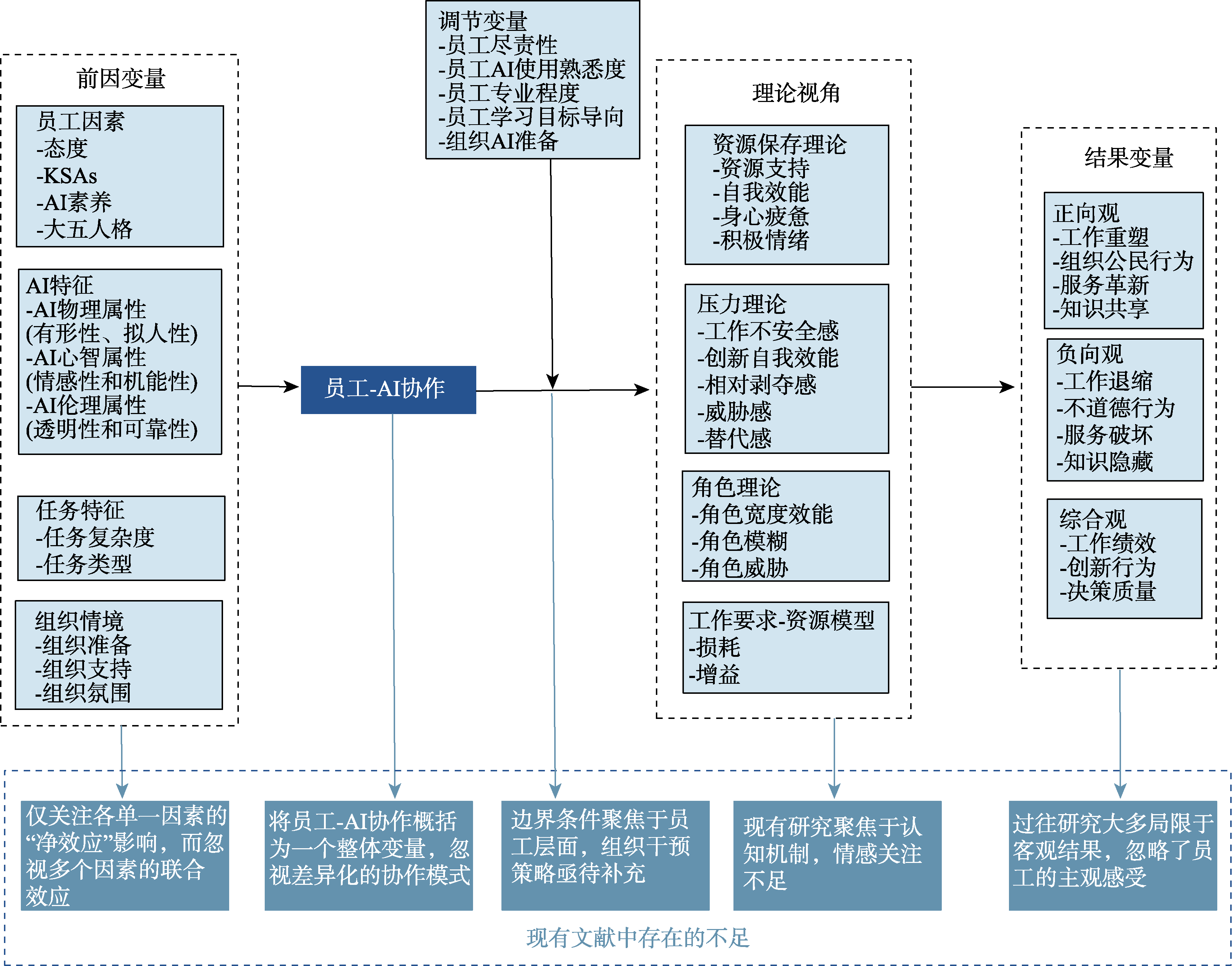
图1 员工-AI协作现有文献总结框架图
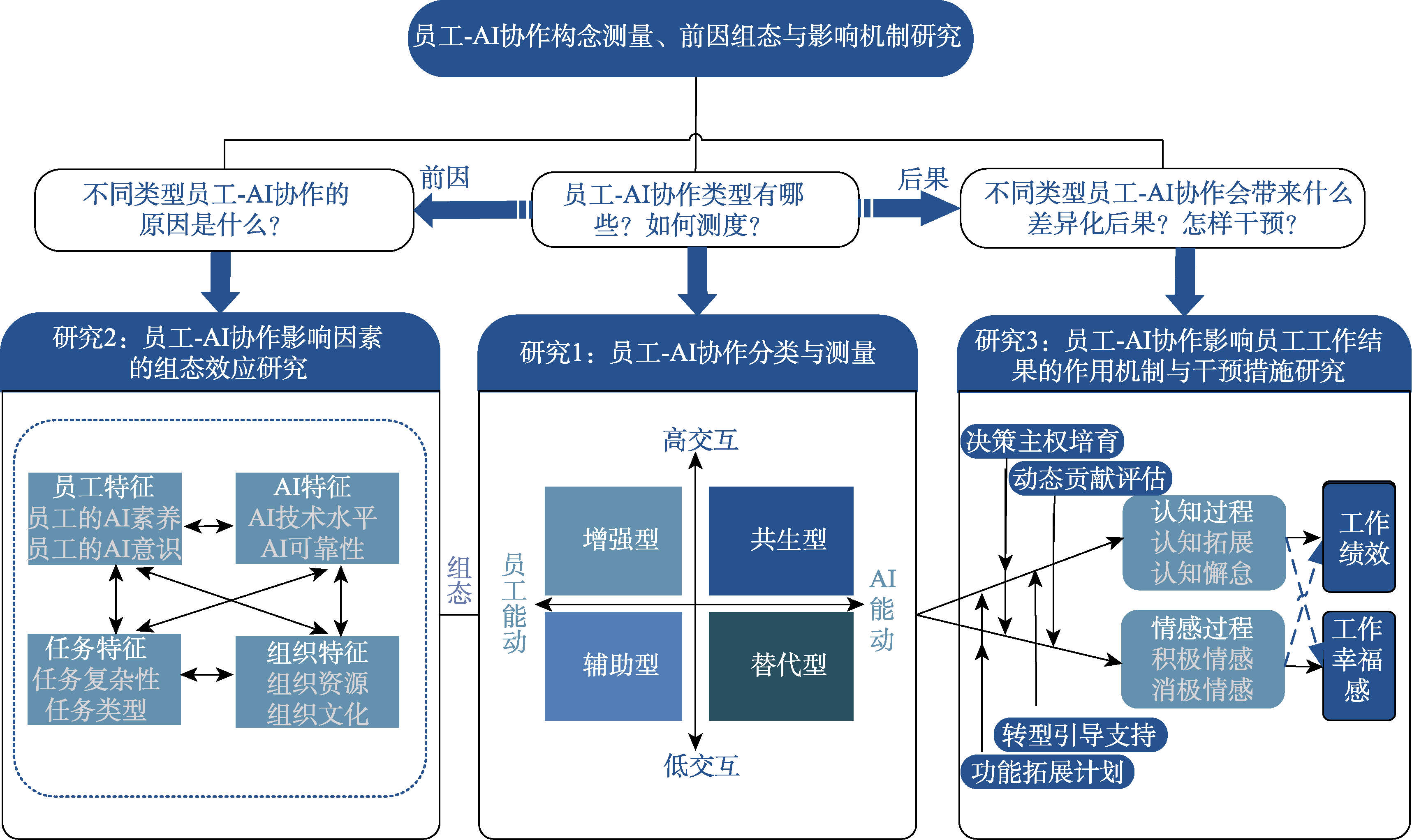
图2 本研究整体框架
| 研究内容 | 样本选择标准和范围 | 数据主要获取方法 | 主要收集的数据 | 主要分析方法 |
|---|---|---|---|---|
| 研究1: 员工-AI协作的分类与测量 | • 量表开发阶段不划定行业范围, 招募来自不同行业背景、具有丰富AI协作经验的员工 • 量表验证阶段聚焦于高端制造业 | • 文献分析 • 德尔菲法 • 深度访谈 • 问卷调查 | • 员工-AI协作的测量条目 | • 编码 • 因子分析 |
| 研究2: 员工-AI协作影响因素的组态效应研究 | • 不限定行业范围, 在见数平台进行大规模问卷发放 | • 线上问卷调查 | • 员工、AI、任务和组织的各方面特征数据 • 员工-AI协作模式 | • fsQCA分析 |
| 研究3: 员工-AI协作影响员工工作结果的作用机制研究 | • 实验室实验采用高校学生样本 • 实地调研聚焦于智能制造企业 | • 实验室眼动追踪和脑电实验 • 实地问卷调查、二手数据、行为日志 | • 眼动追踪和脑电实验数据(注视时间比、瞳孔直径变化率、扫视路径熵值、θ波、γ波、α波不对称性) •员工-AI协作模式 •认知和情感过程 •管理干预措施 •工作绩效 •工作幸福感 | • 多模态数据分析 • 方差分析 • 文本分析 • OLS回归分析 |
表3 各研究数据主要获取方法与分析方法
| 研究内容 | 样本选择标准和范围 | 数据主要获取方法 | 主要收集的数据 | 主要分析方法 |
|---|---|---|---|---|
| 研究1: 员工-AI协作的分类与测量 | • 量表开发阶段不划定行业范围, 招募来自不同行业背景、具有丰富AI协作经验的员工 • 量表验证阶段聚焦于高端制造业 | • 文献分析 • 德尔菲法 • 深度访谈 • 问卷调查 | • 员工-AI协作的测量条目 | • 编码 • 因子分析 |
| 研究2: 员工-AI协作影响因素的组态效应研究 | • 不限定行业范围, 在见数平台进行大规模问卷发放 | • 线上问卷调查 | • 员工、AI、任务和组织的各方面特征数据 • 员工-AI协作模式 | • fsQCA分析 |
| 研究3: 员工-AI协作影响员工工作结果的作用机制研究 | • 实验室实验采用高校学生样本 • 实地调研聚焦于智能制造企业 | • 实验室眼动追踪和脑电实验 • 实地问卷调查、二手数据、行为日志 | • 眼动追踪和脑电实验数据(注视时间比、瞳孔直径变化率、扫视路径熵值、θ波、γ波、α波不对称性) •员工-AI协作模式 •认知和情感过程 •管理干预措施 •工作绩效 •工作幸福感 | • 多模态数据分析 • 方差分析 • 文本分析 • OLS回归分析 |
| 交互度 | 能动性 | |
|---|---|---|
| 以员工能动性为核心 | 以AI能动性为核心 | |
| 高交互 | 增强型员工-AI协作 (Augmentation employee-AI collaboration) | 共生型员工-AI协作 (Symbiosis employee-AI collaboration) |
| 定义:员工作为任务的核心行动者, AI作为智能伙伴, 通过高频次双向交互的知识传递、认知拓展和决策支持, 持续增强员工专业能力的协作模式 | 定义:员工与AI构成一个紧密耦合的联合认知系统, 相互依存, 互补共生, 共同优化任务和决策的协作模式 | |
| 典型例子: AI辅助临床决策 营销分析工具推荐策略 | 典型例子: 医生与达芬奇手术机器人实时配合 设计师与AI反复迭代创作 | |
| 相关构念: 增强模式(Raisch & Krakowski, 人机增强型交互(李晓曼, 陈丽, | 相关构念: 人机深度融合(王红卫 等, 人机共存(Jia et al., 混合智能(Dellermann et al., | |
| 低交互 | 辅助型员工-AI协作 (Assistance employee-AI collaboration) | 替代型员工-AI协作 (Substitution employee-AI collaboration) |
| 定义:员工作为任务的核心行动者, AI作为被动工具, 通过低频单向交互响应具体、明确的指令, 不参与员工的认知决策或能力进化过程的协作模式 | 定义:AI通过自主感知、决策与执行独立完成原本由员工承担的任务, 员工仅保留最低限度的监督权或系统控制权, 交互频率极低的协作模式 | |
| 典型例子: 与文本校对工具协作 与客服机器人协作 | 典型例子: 自动化仓储系统情境下的员工-AI协作 自动驾驶系统的员工-AI协作 | |
| 相关构念: 辅助工具(Shneiderman et al., 辅助智能(蒋建武 等, AI辅助(王欣 等, | 相关构念: 自动化模式(Raisch & Krakowski, AI替代(王欣 等, 自主智能(蒋建武 等, | |
表4 员工-AI协作的构念模型
| 交互度 | 能动性 | |
|---|---|---|
| 以员工能动性为核心 | 以AI能动性为核心 | |
| 高交互 | 增强型员工-AI协作 (Augmentation employee-AI collaboration) | 共生型员工-AI协作 (Symbiosis employee-AI collaboration) |
| 定义:员工作为任务的核心行动者, AI作为智能伙伴, 通过高频次双向交互的知识传递、认知拓展和决策支持, 持续增强员工专业能力的协作模式 | 定义:员工与AI构成一个紧密耦合的联合认知系统, 相互依存, 互补共生, 共同优化任务和决策的协作模式 | |
| 典型例子: AI辅助临床决策 营销分析工具推荐策略 | 典型例子: 医生与达芬奇手术机器人实时配合 设计师与AI反复迭代创作 | |
| 相关构念: 增强模式(Raisch & Krakowski, 人机增强型交互(李晓曼, 陈丽, | 相关构念: 人机深度融合(王红卫 等, 人机共存(Jia et al., 混合智能(Dellermann et al., | |
| 低交互 | 辅助型员工-AI协作 (Assistance employee-AI collaboration) | 替代型员工-AI协作 (Substitution employee-AI collaboration) |
| 定义:员工作为任务的核心行动者, AI作为被动工具, 通过低频单向交互响应具体、明确的指令, 不参与员工的认知决策或能力进化过程的协作模式 | 定义:AI通过自主感知、决策与执行独立完成原本由员工承担的任务, 员工仅保留最低限度的监督权或系统控制权, 交互频率极低的协作模式 | |
| 典型例子: 与文本校对工具协作 与客服机器人协作 | 典型例子: 自动化仓储系统情境下的员工-AI协作 自动驾驶系统的员工-AI协作 | |
| 相关构念: 辅助工具(Shneiderman et al., 辅助智能(蒋建武 等, AI辅助(王欣 等, | 相关构念: 自动化模式(Raisch & Krakowski, AI替代(王欣 等, 自主智能(蒋建武 等, | |
| 员工-AI协作模式 | 示例题项 |
|---|---|
| 增强型员工-AI协作 | 1. 我依赖AI提供信息支持, 但不会让它替代我的专业判断 2. AI提供的数据和分析, 为我做出关键决策提供了有力的依据 3. 通过与AI的协作, 我的专业能力得到了显著提升 … |
| 共生型员工-AI协作 | 1. 我与AI共同制定任务解决方案, 而非单方面执行它的建议 2. AI会根据我的反馈动态调整其输出策略 3. 在复杂任务中, 我和AI的角色分工会随情境灵活变化 … |
| 辅助型员工-AI协作 | 1. 我仅通过简单指令(如点击按钮)触发AI执行固定任务 2. 我将AI视为一个功能更强大的工具, 类似于计算器或搜索引擎, 而非一个协作伙伴 3. 我使用AI时不需要深度思考或调整其工作逻辑 … |
| 替代型员工-AI协作 | 1. AI独立完成了原本由我负责的大部分工作 2. AI在任务执行中无需我的实时干预 3. 我的角色从执行者转变为AI系统的监督者 … |
表5 员工-AI协作模式与示例题项
| 员工-AI协作模式 | 示例题项 |
|---|---|
| 增强型员工-AI协作 | 1. 我依赖AI提供信息支持, 但不会让它替代我的专业判断 2. AI提供的数据和分析, 为我做出关键决策提供了有力的依据 3. 通过与AI的协作, 我的专业能力得到了显著提升 … |
| 共生型员工-AI协作 | 1. 我与AI共同制定任务解决方案, 而非单方面执行它的建议 2. AI会根据我的反馈动态调整其输出策略 3. 在复杂任务中, 我和AI的角色分工会随情境灵活变化 … |
| 辅助型员工-AI协作 | 1. 我仅通过简单指令(如点击按钮)触发AI执行固定任务 2. 我将AI视为一个功能更强大的工具, 类似于计算器或搜索引擎, 而非一个协作伙伴 3. 我使用AI时不需要深度思考或调整其工作逻辑 … |
| 替代型员工-AI协作 | 1. AI独立完成了原本由我负责的大部分工作 2. AI在任务执行中无需我的实时干预 3. 我的角色从执行者转变为AI系统的监督者 … |
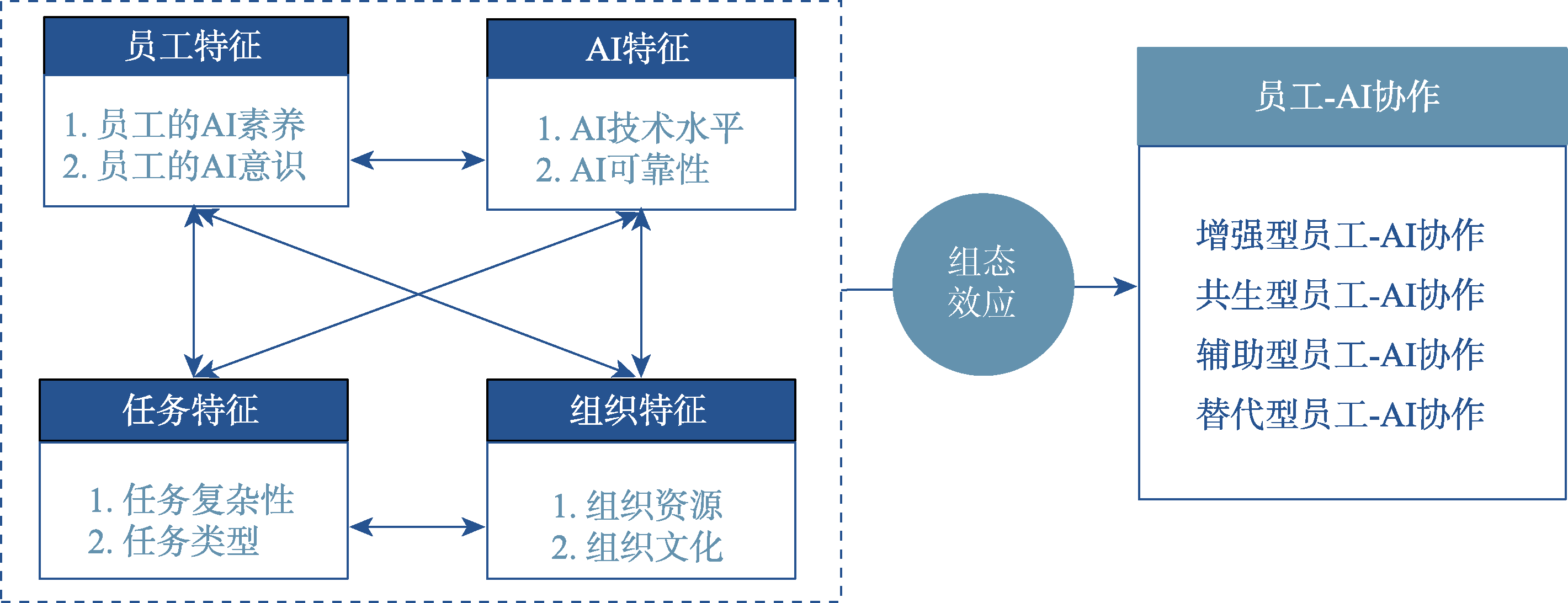
图3 员工-AI协作的组态研究框架
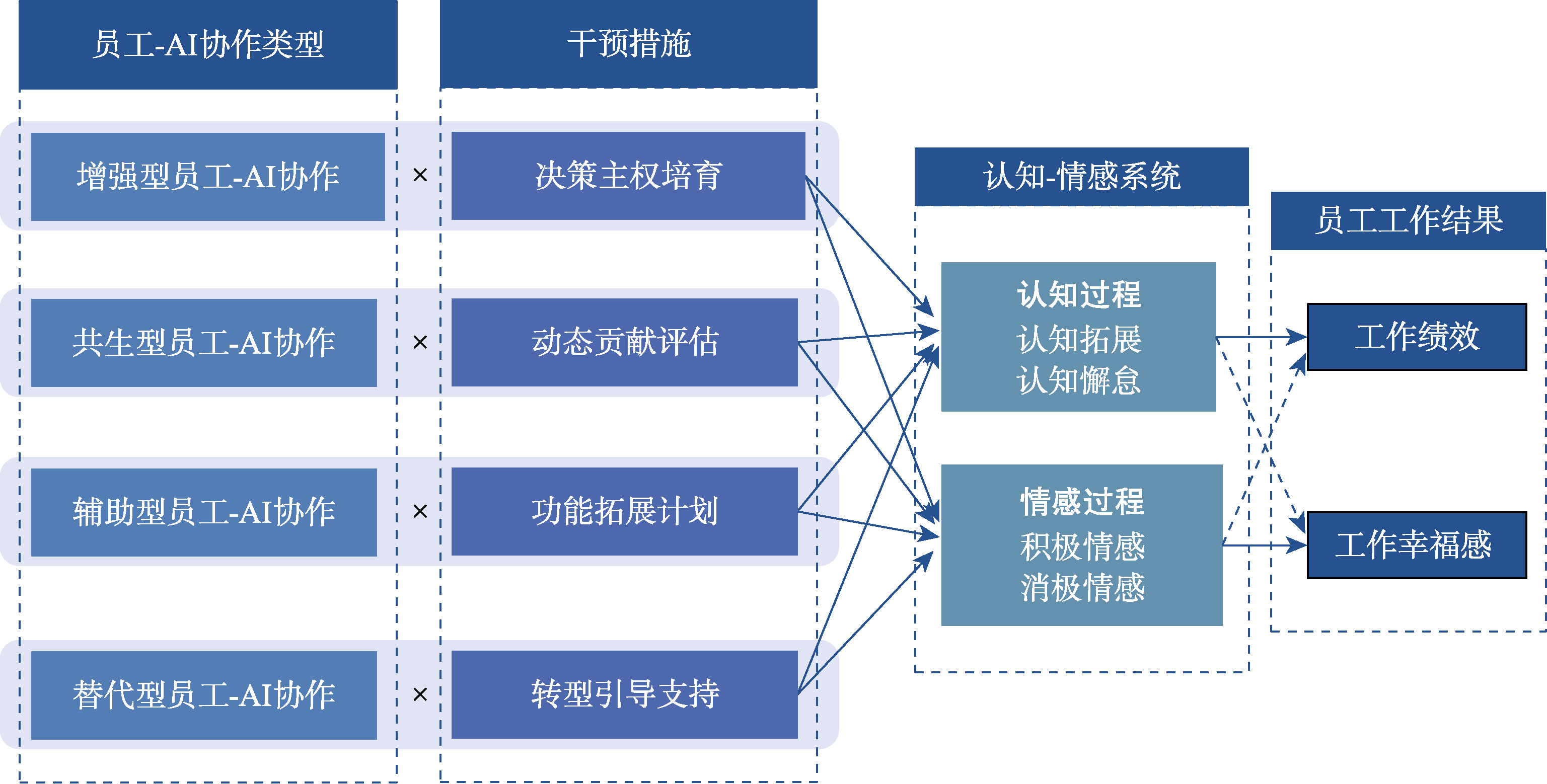
图4 员工-AI协作影响员工工作结果的研究模型
| [1] | 丁耀鹏. (2025). 主体性审视:AI与哲学发展的共在视界. 东南学术, 1, 107-115. |
| [2] | 杜运周, 贾良定. (2017). 组态视角与定性比较分析(QCA):管理学研究的一条新道路. 管理世界, 6, 155-167. |
| [3] | 桂橙林, 赵旭宏, 张鹏程, 刘智强, 周蓉. (2024). 数智化背景下员工AI意识对其创新绩效的影响机制. 中国人力资源开发, 41(8), 6-22. |
| [4] | 韩明燕, 赵静幽. (2025). 员工-AI合作对创新行为的非线性影响研究. 科研管理. https://link.cnki.net/urlid/11.1567.G3.20250421.0832.002 |
| [5] | 韩明燕, 赵静幽, 李志. (2024). 员工-AI合作与越轨创新:一个被调节的双路径模型. 外国经济与管理, 46(10), 89-104. |
| [6] | 何江, 闫淑敏. (2024). 人机劳动分工:生成逻辑、模式类型与作用机制. 南开管理评论, 27(6), 88-99. |
| [7] | 何勤, 刘明泽, 李鑫悦. (2024). 人工智能会引发员工的知识隐藏行为吗?——基于相对剥夺感的理论视角. 外国经济与管理, 46(10), 55-70. |
| [8] | 黄炎一, 刘智强, 杨静. (2025). 人智协同对创意产业工作者的极化影响. 中国工业经济, (1), 156-173. |
| [9] |
蒋建武, 龙晗寰, 胡洁宇. (2024). 工作场所人工智能应用对员工影响的元分析. 心理科学进展, 32(10), 1621-1639.
doi: 10.3724/SP.J.1042.2024.01621 |
| [10] | 李晓曼, 陈丽. (2024). 人机交互对工作创新行为的影响机制研究——来自智慧电厂的证据. 外国经济与管理, 46(10), 105-120. |
| [11] | 李燕萍, 陶娜娜. (2022). 员工人工智能技术采纳多层动态影响模型:一个文献综述. 中国人力资源开发, 39(1), 35-56. |
| [12] | 罗映宇, 朱国玮, 钱无忌, 吴月燕, 黄静, 杨智. (2023). 人工智能时代的算法厌恶:研究框架与未来展望. 管理世界, 39(10), 205-233. |
| [13] | 沈培, 李建清. (2021). 行动者网络理论的研究热点和前沿趋势. 自然辩证法通讯, 43(11), 117-126. |
| [14] | 唐小飞, 孙炳, 张恩忠, 梅发贵. (2021). 类人智能机器人社会价值替代与风险态度研究. 南开管理评论, 24(6), 4-15. |
| [15] | 王欣, 朱虹, 姜帝, 夏少昂, 肖春曲. (2021). 人工智能产品“协助者”与“替代者”形象对消费者评价的影响. 南开管理评论, 24(6), 39-49+139+50-51. |
| [16] | 王振源, 姚明辉. (2022). 工作场所人机协作对员工影响的研究述评. 外国经济与管理, 44(9), 86-102. |
| [17] |
王红卫, 李珏, 刘建国, 樊瑛, 马靓, 霍红, … 丁烈云. (2023). 人机融合复杂社会系统研究. 中国管理科学, 31(7), 1-21.
doi: 10.16381/j.cnki.issn1003-207x.2023.07.001 |
| [18] |
翁智刚, 陈潇潇, 张小妹, 张琚. (2025). 面向新型人机关系的社会临场感. 心理科学进展, 33(1), 146-162.
doi: 10.3724/SP.J.1042.2025.0146 |
| [19] | 吴小龙, 肖静华, 吴记. (2023). 当创意遇到智能:人与AI协同的产品创新案例研究. 管理世界, 39(5), 112-126+ 144+127. |
| [20] | 谢小云, 左玉涵, 胡琼晶. (2021). 数字化时代的人力资源管理:基于人与技术交互的视角. 管理世界, 37(1), 200-216+13. |
| [21] | 殷杰. (2024). 生成式人工智能的主体性问题. 中国社会科学, (8), 124-145+207. |
| [22] |
尹萌, 牛雄鹰. (2024). 与AI“共舞”:系统化视角下的AI-员工协作. 心理科学进展, 32(1), 162-176.
doi: 10.3724/SP.J.1042.2024.00162 |
| [23] |
张恒, 高中华, 李慧玲. (2023). 增益还是损耗:人工智能技术应用对员工创新行为的“双刃剑”效应. 科技进步与对策, 40(18), 1-11.
doi: 10.6049/kjjbydc.2023030249 |
| [24] | 张亚莉, 李辽辽, 丁振斌. (2024). 组织管理中的人工智能决策:述评与展望. 外国经济与管理, 46(10), 18-38. |
| [25] | 张志学, 贺伟. (2024). 人与人工智能的研究及其对组织管理的意义. 外国经济与管理, 46(10), 3-17. |
| [26] | 张志学, 高雅琪, 梁宇畅, 李涵, 李航涛, 汤明月. (2024). 人机协同时代的机遇——开展现象驱动的组织管理研究. 经济管理学刊, 3(4), 65-94. |
| [27] |
赵希男, 陈俊领, 孙晨曦. (2025). 基于个体优势识别的“长效-多方位”系统评析方法构建. 中国管理科学, 33(6), 116-128.
doi: 10.16381/j.cnki.issn1003-207x.2022.0473 |
| [28] |
Anthony, C., Bechky, B. A., & Fayard, A. L. (2023). “Collaborating” with AI: Taking a system view to explore the future of work. Organization Science, 34(5), 1672-1694.
doi: 10.1287/orsc.2022.1651 URL |
| [29] |
Bankins, S., Ocampo, A. C., Marrone, M., Restubog, S. L. D., & Woo, S. E. (2024). A multilevel review of artificial intelligence in organizations: Implications for organizational behavior research and practice. Journal of Organizational Behavior, 45(2), 159-182.
doi: 10.1002/job.v45.2 URL |
| [30] |
Cao, L., Chen, C., Dong, X., Wang, M., & Qin, X. (2023). The dark side of AI identity: Investigating when and why AI identity entitles unethical behavior. Computers in Human Behavior, 143, 107669.
doi: 10.1016/j.chb.2023.107669 URL |
| [31] |
Chowdhury, S., Dey, P., Joel-Edgar, S., Bhattacharya, S., Rodriguez-Espindola, O., Abadie, A., & Truong, L. (2023). Unlocking the value of artificial intelligence in human resource management through AI capability framework. Human Resource Management Review, 33(1), 100899.
doi: 10.1016/j.hrmr.2022.100899 URL |
| [32] |
Cummings, M. L., & Bruni, S. (2010). Human-automated planner collaboration in complex resource allocation decision support systems. Intelligent Decision Technologies, 4(2), 101-114.
doi: 10.3233/IDT-2010-0072 URL |
| [33] | Davenport, T. H., & Ronanki, R. (2018). Artificial intelligence for the real world. Harvard Business Review, 96(1), 108-116. |
| [34] | Day, G. S., & Schoemaker, P. J. (2006). Leading the vigilant organization. Strategy & Leadership, 34(5), 4-10. |
| [35] | Dellermann, D., Ebel, P., Söllner, M., & Leimeister, J. M. (2019). Hybrid intelligence. Business & Information Systems Engineering, 61, 637-643. |
| [36] |
Dutta, D., Mishra, S. K., & Tyagi, D. (2023). Augmented employee voice and employee engagement using artificial intelligence-enabled chatbots: A field study. The International Journal of Human Resource Management, 34(12), 2451-2480.
doi: 10.1080/09585192.2022.2085525 URL |
| [37] |
Filieri, R., Lin, Z., Li, Y., Lu, X., & Yang, X. (2022). Customer emotions in service robot encounters: A hybrid machine-human intelligence approach. Journal of Service Research, 25(4), 614-629.
doi: 10.1177/10946705221103937 URL |
| [38] | Filippelli, S., Popescu, I. A., Verteramo, S., Tani, M., & Corvello, V. (2026). Generative AI and employee well-being: Exploring the emotional, social, and cognitive impacts of adoption. Journal of Innovation & Knowledge, 11, 100844. |
| [39] |
Fügener, A., Grahl, J., Gupta, A., & Ketter, W. (2022). Cognitive challenges in human-artificial intelligence collaboration: Investigating the path toward productive delegation. Information Systems Research, 33(2), 678-696.
doi: 10.1287/isre.2021.1079 URL |
| [40] |
Gama, F., & Magistretti, S. (2025). Artificial intelligence in innovation management: A review of innovation capabilities and a taxonomy of AI applications. Journal of Product Innovation Management, 42(1), 76-111.
doi: 10.1111/jpim.v42.1 URL |
| [41] | Giddens, A. (1984). The constitution of society: Outline of the theory of structuration. University of California Press. |
| [42] |
Glikson, E., & Woolley, A. W. (2020). Human trust in artificial intelligence: Review of empirical research. Academy of Management Annals, 14(2), 627-660.
doi: 10.5465/annals.2018.0057 URL |
| [43] |
Gomez, C., Cho, S. M., Ke, S., Huang, C.-M., & Unberath, M. (2025). Human-AI collaboration is not very collaborative yet: A taxonomy of interaction patterns in AI-assisted decision making from a systematic review. Frontiers in Computer Science, 6, 1521066.
doi: 10.3389/fcomp.2024.1521066 URL |
| [44] | Guha, A., Bressgott, T., Grewal, D., Mahr, D., Wetzels, M., & Schweiger, E. (2023). How artificiality and intelligence affect voice assistant evaluations. Journal of the Academy of Marketing Science, 51(4), 843-866. |
| [45] | Guo, M., Gu, M., & Huo, B. (2025). The impacts of automation and augmentation AI use on physicians’ performance: An ambidextrous perspective. International Journal of Operations & Production Management, 45(1), 114-151. |
| [46] |
Hinkin, T. R. (1998). A brief tutorial on the development of measures for use in survey questionnaires. Organizational Research Methods, 1(1), 104-121.
doi: 10.1177/109442819800100106 URL |
| [47] |
Huang, M. H., & Rust, R. T. (2018). Artificial intelligence in service. Journal of Service Research, 21(2), 155-172.
doi: 10.1177/1094670517752459 URL |
| [48] |
Jia, N., Luo, X., Fang, Z., & Liao, C. (2024). When and how artificial intelligence augments employee creativity. Academy of Management Journal, 67(1), 5-32.
doi: 10.5465/amj.2022.0426 URL |
| [49] |
Jussupow, E., Spohrer, K., Heinzl, A., & Gawlitza, J. (2021). Augmenting medical diagnosis decisions? An investigation into physicians’ decision-making process with artificial intelligence. Information Systems Research, 32(3), 713-735.
doi: 10.1287/isre.2020.0980 URL |
| [50] |
Kazuo, O., & Seiji, Y. (2020). Empirical evaluations of framework for adaptive trust calibration in human-AI cooperation. IEEE Access, 8, 220335-220351.
doi: 10.1109/Access.6287639 URL |
| [51] | Klein, G., Woods, D. D., Bradshaw, J. M., Hoffman, R. R., & Feltovich, P. J. (2004). Ten challenges for making automation a “team player” in joint human-agent activity. IEEE Intelligent Systems, 19(6), 91-95. |
| [52] |
Kilic, E., & Kitapci, H. (2023). Cognitive job crafting: An intervening mechanism between intrinsic motivation and affective well-being. Management Research Review, 46(7), 1043-1058.
doi: 10.1108/MRR-08-2021-0605 URL |
| [53] |
Kong, H., Yin, Z., Baruch, Y., & Yuan, Y. (2023). The impact of trust in AI on career sustainability: The role of employee-AI collaboration and protean career orientation. Journal of Vocational Behavior, 146, 103928.
doi: 10.1016/j.jvb.2023.103928 URL |
| [54] | Latour, B. (2005). Reassembling the social: An introduction to actor-network-theory. Oxford University Press. |
| [55] | Leavitt, H. J. (1965). Applied organizational change in industry:Structural, technological and humanistic approaches. In J. G.March (Ed.), Handbook of organisation (pp. 1144-1170). Rand McNally and Company. Chicago, Illinois. |
| [56] |
Lee, J. D., & See, K. A. (2004). Trust in automation: Designing for appropriate reliance. Human Factors, 46(1), 50-80.
doi: 10.1518/hfes.46.1.50_30392 pmid: 15151155 |
| [57] |
Leonardi, P. M. (2011). When flexible routines meet flexible technologies: Affordance, constraint, and the imbrication of human and material agencies. MIS Quarterly, 35(1), 147-167.
doi: 10.2307/23043493 URL |
| [58] |
Liang, X., Guo, G., Shu, L., Gong, Q., & Luo, P. (2022). Investigating the double-edged sword effect of AI awareness on employee’s service innovative behavior. Tourism Management, 92, 104564.
doi: 10.1016/j.tourman.2022.104564 URL |
| [59] |
Makarius, E. E., Mukherjee, D., Fox, J. D., & Fox, A. K. (2020). Rising with the machines: A sociotechnical framework for bringing artificial intelligence into the organization. Journal of Business Research, 120, 262-273.
doi: 10.1016/j.jbusres.2020.07.045 URL |
| [60] | Marois, A., & Lafond, D. (2022). Augmenting cognitive work: A review of cognitive enhancement methods and applications for operational domains. Cognition, Technology & Work, 24(4), 589-608. |
| [61] |
McNeese, N. J., Demir, M., Cooke, N. J., & Myers, C. (2018). Teaming with a synthetic teammate: Insights into human-autonomy teaming. Human Factors, 60(2), 262-273.
doi: 10.1177/0018720817743223 pmid: 29185818 |
| [62] |
Miller, T. (2019). Explanation in artificial intelligence: Insights from the social sciences. Artificial Intelligence, 267, 1-38.
doi: 10.1016/j.artint.2018.07.007 |
| [63] |
Mischel, W., & Shoda, Y. (1995). A cognitive-affective system theory of personality: Reconceptualizing situations, dispositions, dynamics, and invariance in personality structure. Psychological Review, 102(2), 246-268.
doi: 10.1037/0033-295x.102.2.246 pmid: 7740090 |
| [64] |
Orlikowski, W. J. (2000). Using technology and constituting structures: A practice lens for studying technology in organizations. Organization Science, 11(4), 404-428.
doi: 10.1287/orsc.11.4.404.14600 URL |
| [65] |
Parasuraman, R., & Manzey, D. H. (2010). Complacency and bias in human use of automation: An attentional integration. Human Factors, 52(3), 381-410.
pmid: 21077562 |
| [66] |
Qiu, H., Li, M., Bai, B., Wang, N., & Li, Y. (2022). The impact of AI-enabled service attributes on service hospitableness: The role of employee physical and psychological workload. International Journal of Contemporary Hospitality Management, 34(4), 1374-1398.
doi: 10.1108/IJCHM-08-2021-0960 URL |
| [67] |
Raisch, S., & Krakowski, S. (2021). Artificial intelligence and management: The automation-augmentation paradox. Academy of Management Review, 46(1), 192-210.
doi: 10.5465/amr.2018.0072 URL |
| [68] |
Seeber, I., Bittner, E., Briggs, R. O., De Vreede, T., De Vreede, G.-J., Elkins, A., … Söllner, M. (2020). Machines as teammates: A research agenda on AI in team collaboration. Information & Management, 57(2), 103174.
doi: 10.1016/j.im.2019.103174 URL |
| [69] | Shneiderman, B., Plaisant, C., Cohen, M., Jacobs, S., & Elmqvist, N. (2017). Designing the user interface: Strategies for effective human-computer interaction (6th ed.). Pearson. |
| [70] |
Sowa, K., Przegalinska, A., & Ciechanowski, L. (2021). Cobots in knowledge work. Journal of Business Research, 125, 135-142.
doi: 10.1016/j.jbusres.2020.11.038 URL |
| [71] |
Spreitzer, G. M. (1995). Psychological empowerment in the workplace: Dimensions, measurement, and validation. Academy of Management Journal, 38(5), 1442-1465.
doi: 10.2307/256865 URL |
| [72] | Srivastava, A., Pandey, A., Sharma, D., & Ghosh, K. (2025). Apathy under the surface: Theorizing quiet quitting’s impact on organizational learning. Development and Learning in Organizations: An International Journal, 39(2), 15-17. |
| [73] |
Tang, P., Koopman, J., McClean, S. T., Zhang, J. H., Li, C. H., De Cremer, D., Lu, Y., & Ng, C. T. S. (2022). When conscientious employees meet intelligent machines: An integrative approach inspired by complementarity theory and role theory. Academy of Management Journal, 65(3), 1019-1054.
doi: 10.5465/amj.2020.1516 URL |
| [74] | Wang, W. G., Gao, G. D., & Agarwal, R. (2024). Friend or foe? Teaming between artificial intelligence and workers with variation in experience. Management Science, 70(9), 5753-5775. |
| [75] | Wilson, H. J., & Daugherty, P. R. (2018). Collaborative intelligence: Humans and AI are joining forces. Harvard Business Review, 96(4), 114-123. |
| [76] |
Wu, S., Liu, Y., Ruan, M., Chen, S., & Xie, X. (2025). Human-generative AI collaboration enhances task performance but undermines human’s intrinsic motivation. Scientific Reports, 15, 15105.
doi: 10.1038/s41598-025-98385-2 |
| [77] |
Yam, K. C., Tang, P. M., Jackson, J. C., Su, R., & Gray, K. (2023). The rise of robots increases job insecurity and maladaptive workplace behaviors: Multimethod evidence. Journal of Applied Psychology, 108(5), 850-870.
doi: 10.1037/apl0001045 URL |
| [78] |
Yin, M., Jiang, S., & Niu, X. (2024). Can AI really help? The double-edged sword effect of AI assistant on employees’ innovation behavior. Computers in Human Behavior, 150, 107987.
doi: 10.1016/j.chb.2023.107987 URL |
| [79] |
Zheng, X., Zhu, W., Zhao, H., & Zhang, C. (2015). Employee well-being in organizations: Theoretical model, scale development, and cross-cultural validation. Journal of Organizational Behavior, 36(5), 621-644.
doi: 10.1002/job.v36.5 URL |
| [1] | 宋潇潇, 凌小蝶, 谷慧敏, 马双. 生成式人工智能个性化推荐对旅游信息决策的影响[J]. 心理科学进展, 2026, 34(9): 1590-1605. |
| [2] | 刘笑辰, 邓凌霏, 吴羡娇, 吴宁. 从“负能”到“赋能”:AIGC“污染”的作用机理及干预策略[J]. 心理科学进展, 2026, 34(7): 1109-1126. |
| [3] | 舒跃育, 李春江, 任笑笑, 谢霞, 张银霞, 宋欢. 人工智能在心理传记学中的应用可能、挑战与启示[J]. 心理科学进展, 2026, 34(7): 1284-1298. |
| [4] | 李纯青, 郝日艳, 刘伟. 人机共生体验的形成机制与作用效果[J]. 心理科学进展, 2026, 34(6): 932-952. |
| [5] | 唐伟, 钟文瑞, 雷震, 张丹丹. 人工智能代理对道德决策的影响[J]. 心理科学进展, 2026, 34(6): 1084-1096. |
| [6] | 田雪涛, 周文杰, 骆方, 乔志宏, 丰怡. 生成式大语言模型赋能心理测量学:优势、挑战与应用[J]. 心理科学进展, 2026, 34(3): 404-423. |
| [7] | 宋一晓, 曾铭灼, 苏涛. 机会抑或威胁? 人与AI协作系统对员工工作效能影响的元分析[J]. 心理科学进展, 2026, 34(3): 461-486. |
| [8] | 程佳琳, 李劲松. AI赋能视角下极限目标设置的驱动机制及其影响效应[J]. 心理科学进展, 2026, 34(10): 1733-1748. |
| [9] | 曹文蕊, 刘贝妮, 张山杉, 田宗霖. 当顾客被算法赋权:零工工作者应对顾客不当行为的动态机制与干预[J]. 心理科学进展, 2026, 34(10): 1749-1767. |
| [10] | 万千一, 温斯情, 马早明, 胡波. 大学生AI素养与自我效能关系的贝叶斯元分析[J]. 心理科学进展, 2026, 34(10): 1779-1794. |
| [11] | 武靖宇, 金鑫. 算法介导下的情感趋同:生成式人工智能情感传染机制[J]. 心理科学进展, 2026, 34(1): 123-133. |
| [12] | 李研, 陈维, 武瑞娟. AI技术背景下虚拟影响者营销效应及其作用机制[J]. 心理科学进展, 2025, 33(8): 1425-1442. |
| [13] | 宗树伟, 杨付, 龙立荣, 韩翼. 促进还是抑制?生成式人工智能建议采纳对创造力的双刃剑效应[J]. 心理科学进展, 2025, 33(6): 905-915. |
| [14] | 解煜彬, 周荣刚. 新型人机关系下的人机双向信任[J]. 心理科学进展, 2025, 33(6): 916-932. |
| [15] | 谭美丽, 殷向洲, 张光磊, 熊普臻. 工作场所人工智能角色划分:对员工心理与行为的影响及应对策略[J]. 心理科学进展, 2025, 33(6): 933-947. |
| 阅读次数 | ||||||
|
全文 |
|
|||||
|
摘要 |
|
|||||
