

ISSN 1671-3710
CN 11-4766/R
主办:中国科学院心理研究所
出版:科学出版社
CN 11-4766/R
主办:中国科学院心理研究所
出版:科学出版社
心理科学进展 ›› 2026, Vol. 34 ›› Issue (3): 424-440.doi: 10.3724/SP.J.1042.2026.0424 cstr: 32111.14.2026.0424
谢宇1( ), 郑弘欣1, 刘怡资1, 禹红刚2, 杨成赫2
收稿日期:2025-06-28
出版日期:2026-03-15
发布日期:2026-01-07
通讯作者:
谢宇, E-mail: xiey@ahnu.edu.cn基金资助:
XIE Yu1(), ZHENG Hongxin1, LIU Yizi1, YU Honggang2, YANG Chenghe2
Received:2025-06-28
Online:2026-03-15
Published:2026-01-07
摘要:
抑郁症是一种常见的精神障碍, 严重影响患者的社会功能和生活质量。近年来, 大模型凭借其强大的语义理解和多模态数据处理能力, 在抑郁症早期筛查与辅助诊断中展现出显著优势。构建抑郁症筛查和诊断大模型通常包括: 数据准备、模型选择、模型训练和模型评估四个步骤。大模型在抑郁症筛查与诊断中, 主要通过情境化语义表征、注意力机制、多模态行为捕捉及生成式预测等关键技术实现。但当前研究仍存在算法偏见、诊断特异性、幻觉现象、隐私安全及伦理问题等挑战。未来应加强大模型心理干预的整合应用, 聚焦临床转化路径, 构建更为精细、动态且具备文化适应性的抑郁症数字表型, 实现心理健康服务的数智化转型。
中图分类号:
谢宇, 郑弘欣, 刘怡资, 禹红刚, 杨成赫. (2026). 大模型在抑郁症筛查与诊断中的应用. 心理科学进展 , 34(3), 424-440.
XIE Yu, ZHENG Hongxin, LIU Yizi, YU Honggang, YANG Chenghe. (2026). The application of foundation models in depression screening and diagnosis. Advances in Psychological Science, 34(3), 424-440.
| 维度 | 大模型 | 传统量表 | 机器学习 |
|---|---|---|---|
| 数据来源 | 海量的多模态数据 | 标准化问题的主观报告 | 结构化或非结构化数据 |
| 评估效度 | 高 | 高 | 中 |
| 评估效率 | 极高 | 低 | 高 |
| 可及性 | 极高 | 中 | 高 |
| 评估客观性 | 高 | 低 | 中 |
| 可解释性 | 低 | 高 | 中 |
| 部署成本 | 高 | 低 | 中 |
| 个性化 | 高 | 弱 | 中 |
表1 大模型、传统量表和机器学习的比较
| 维度 | 大模型 | 传统量表 | 机器学习 |
|---|---|---|---|
| 数据来源 | 海量的多模态数据 | 标准化问题的主观报告 | 结构化或非结构化数据 |
| 评估效度 | 高 | 高 | 中 |
| 评估效率 | 极高 | 低 | 高 |
| 可及性 | 极高 | 中 | 高 |
| 评估客观性 | 高 | 低 | 中 |
| 可解释性 | 低 | 高 | 中 |
| 部署成本 | 高 | 低 | 中 |
| 个性化 | 高 | 弱 | 中 |
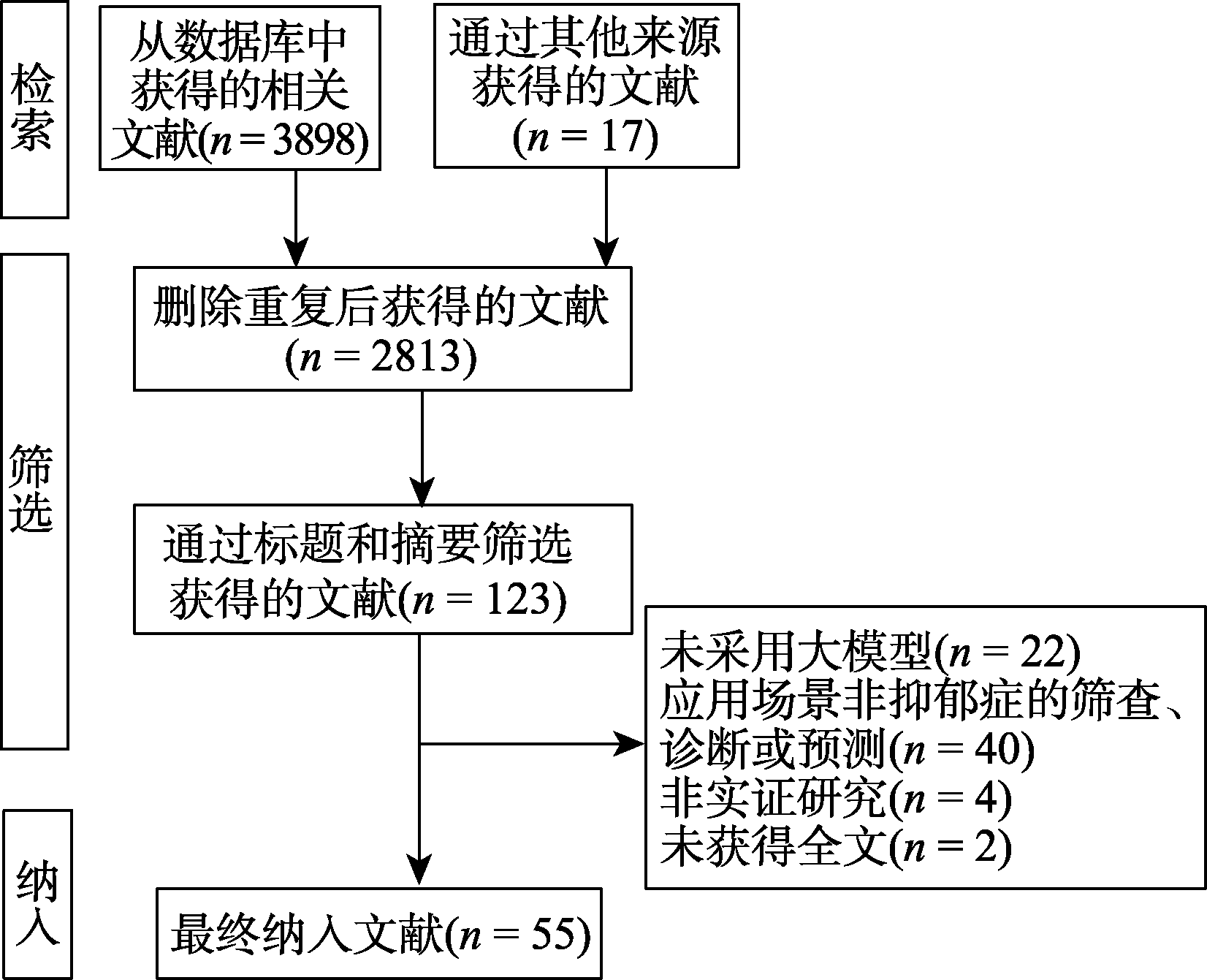
图1 文献筛选流程图
| 序号 | 研究 | 国家 | 样本量 | 研究对象 | 数据类型 | 基础大模型 | 性能评估方法 |
|---|---|---|---|---|---|---|---|
| 1 | 张冬瑜 等, 2025 | 中国 | 11431 | 社交媒体帖子 | 文本数据、图像数据 | GPT-3.5-Turbo、Flan-T5 | 准确率、F1分数 |
| 2 | Al Masud et al., | 孟加拉 | 1602 | 大学生 | 文本数据 | BERT | 准确率、召回率、精确率、F1分数 |
| 3 | Bendebane et al., | 阿尔及利亚 | 26280 | 社交媒体帖子 | 文本数据 | BERT | 准确率、召回率、精确率、F1分数 |
| 4 | Beniwal & Saraswat, | 印度 | 10295 | 社交媒体帖子 | 文本数据、图像数据 | BERT | 准确率、召回率、精确率、F1分数 |
| 5 | Carstensen et al., | 美国 | 105 | 参与抑郁症筛查的 患者 | 文本数据 | Llama 3、 Gemma 2 | 准确率 |
| 6 | Danner et al., | 英国 | 464 | 心理学专业学生 | 文本数据、图像数据、语音数据 | BERT、GPT-3.5、ChatGPT-4 | 精确率、召回率、F1 分数 |
| 7 | Elyoseph et al., | 以色列 | 2460 | 心理健康专业人士 和普通大众 | 文本数据 | ChatGPT-3.5、 ChatGPT-4、 Claude、Bard | 单因素方差分析、最小显著差异法 |
| 8 | El-Ramly et al., | 埃及 | 7000 | 社交媒体帖子 | 文本数据 | BERT | 准确率、精确率、召回率、F1分数 |
| 9 | Englhardt et al., | 美国 | 90 | 参与研究的学生 | 行为数据 | GPT-3.5、 GPT-4、PaLM 2 | 准确率、事实性、忠实度 |
| 10 | Farruque et al., | 加拿大 | 4567 | 社交媒体帖子 | 文本数据 | BERT | 准确率、召回率、F1 分数 |
| 11 | Gao et al., | 中国 | 9799 | 抑郁症患者和健康人群 | 基因数据 | BERT | 准确率、精确率、召回率、F1分数、AUC |
| 12 | Gerczuk et al., | 德国 | 143 | 抑郁症患者和健康人群 | 语音数据、文本数据 | Wav2vec | MAE、相关系数、Gini指数 |
| 13 | Gu et al., | 中国 | 1339 | 患有抑郁症或可能存在抑郁症状的患者 | 文本数据 | ChatGLM3 | BLEU-2、ROUGE-L、METEOR、DIST-2 |
| 14 | Guo & Guo, | 中国 | 524 | 医生和患者的咨询对话 | 文本数据 | EmoLLM | 准确率、精确率、召回率、F1分数 |
| 15 | Gupta et al., | 印度 | 542 | 抑郁症患者的对话记录 | 语音数据 | ViT | 准确率、精确率、召回率、F1分数 |
| 16 | Hur et al., | 美国 | 467 | 线上招募被试 | 文本数据 | GPT-3.5、GPT-4 | 相关性系数、RMSE |
| 17 | Jain et al., | 印度 | 13826 | 社交媒体帖子 | 文本数据 | GPT-2、 GPT-Neo-125M | 准确率、精确率、召回率、F1分数 |
| 18 | Jarvers et al., | 德国 | 53 | 青少年 | 文本数据 | BERT、ChatGPT | 准确率、召回率、F1分数 |
| 19 | Jiang et al., | 美国 | 73 | 线上招募的被试 | 语音数据、视频数据、文本数据 | DinoV2、 WavLM、 LLAMA-65B | 准确率、AUC |
| 20 | Jin et al., | 中国 | 20 | 成年人 | 文本数据 | ChatGPT | 相关系数、AUC |
| 21 | Juarto, | 印尼 | 82715 | 社交媒体帖子 | 文本数据 | BERT | 精确率、召回率、F1分数 |
| 22 | Kerasiotis et al., | 希腊 | 3553 | 社交媒体帖子 | 文本数据 | BERT | 精确率、召回率、F1分数 |
| 23 | Kifayathullah et al., | 印度 | / | 社交媒体帖子 | 文本数据 | GPT-4o mini | 准确率 |
| 24 | Leow et al., | 马来 西亚 | 26370 | 社交媒体帖子 | 文本数据 | BERT、BART | 准确率、精确率、召回率、F1分数 |
| 25 | Lorenzoni et al., | 加拿大 | 189 | 临床访谈文本 | 文本数据 | GPT-4 | 准确率、精确率、召回率、F1分数 |
| 26 | Lorge et al., | 英国 | 100 | 成年抑郁症患者 | 文本数据 | GPT-3.5、BERT | 精确率、召回率、F1分数 |
| 27 | McCoy et al., | 美国 | 15000 | 电子病例 | 文本数据 | GPT-4o | 相关系数、召回率、特异性 |
| 28 | Meng et al., | 美国 | 43967 | 电子病例 | 文本数据 | BRLTM | AUC |
| 29 | Nadeem et al., | 印度 | 232047 | 社交媒体帖子 | 文本数据 | GPT-3.5、GPT-4、Google Bard | 准确率、精确率、召回率、F1分数 |
| 30 | Nushida et al., | 日本 | 60 | 社交媒体帖子 | 文本数据 | GPT-4o | 准确率、精确率、召回率、F1分数 |
| 31 | Ogunleye et al., | 英国 | 13804 | 社交媒体帖子 | 文本数据 | BERT | 准确率、精确率、召回率、F1分数 |
| 32 | Oh et al., | 韩国 | 140467 | 社交媒体帖子 | 文本数据 | BERT | 准确率、精确率、召回率、特异性、F1分数 |
| 33 | Ohse et al., | 德国 | 82 | 参与访谈的被试 | 文本数据 | BERT Llama2-13B GPT-3.5、GPT-4 | 精确率、召回率、特异性、F1分数 |
| 34 | Priyadarshana et al., 2024 | 日本 | / | 对话文本和社交媒体帖子 | 文本数据 | Llama、GPT-3、GPT-4 | 召回率 |
| 35 | Qasim et al., | 墨西哥 | 24000 | 社交媒体帖子 | 文本数据 | BERT | 精确率、召回率、F1分数 |
| 36 | Rabie et al., | 埃及 | 5500 | 社交媒体帖子 | 文本数据 | BERT | 准确率、精确率、召回率和F1分数 |
| 37 | Raj et al., | 斐济 | 7732 | 社交媒体帖子 | 文本数据 | BERT | 准确率、精确率、召回率、F1分数、AUC |
| 38 | Rizwan et al., | 巴基 斯坦 | 73355 | 社交媒体帖子 | 文本数据 | ESG、ESD、 XDL、ABV | 准确率、精确度、召回率、特异性、F1分数 |
| 39 | Sadeghi et al., | 德国 | 275 | 参与访谈的个体 | 文本数据 | GPT-3.5-Turbo、DepRoBERTa | RMSE、MAE |
| 40 | Sadeghi et al., | 德国 | 275 | 参与访谈的个体 | 文本数据 | GPT-3.5-Turbo、DepRoBERTa | RMSE、MAE |
| 41 | Saraswat & Beniwal, | 印度 | 16632 | 社交媒体帖子 | 文本数据 | BERT、LSTM、GRU | 准确率、召回率、精确率、F1分数 |
| 42 | Senn et al., | 美国 | 189 | 参与访谈的个体 | 文本数据 | BERT | 准确率、精确率、召回率、F1分数 |
| 43 | Shah et al., | 巴基 斯坦 | 40000 | 社交媒体帖子 | 文本数据 | GPT-3.5、LLaMA2 | 准确率、召回率、精确率、F1分数 |
| 44 | Shen & Paik, | 日本 | 1600000 | 推特用户 | 文本数据 | BERT, CNN, LSTM, | 准确率, 精确率, 召回率, F1分数 |
| 45 | Shin et al., | 韩国 | 91 | 写日记的APP用户 | 文本数据 | GPT-3.5和GPT-4 | 准确率、召回率、精确率、F1分数、特异性 |
| 46 | Sood, | 美国 | 1415 | 参与访谈的个体 | 文本数据 | BERT | 精确率、召回率、灵敏度和F1分数 |
| 47 | Tao et al., | 中国 | 139 | 抑郁症与焦虑症患者 | 语音数据、文本数据 | ChatGPT | 准确率、召回率、精确率、F1分数 |
| 48 | Verma et al., | 印度 | 35622 | 社交媒体帖子 | 文本数据 | BERT | 准确率、召回率、精确率、F1分数 |
| 49 | Wang & Zhang, | 中国 | / | 抑郁症患者 | 文本数据、图像数据 | BERT、ViT | 准确率、精确率、召回率、F1 分数 |
| 50 | Wang et al., | 中国 | / | 抑郁症患者 | 文本数据 | BERT | 安全性、可用性、流畅性 |
| 51 | Xin & Zakaria, | 马来西亚 | 46022 | 社交媒体用户及心理健康语料库用户 | 文本数据 | BERT | 准确率、召回率、精确率和F1分数 |
| 55 | Xu et al., | 中国 | 1160 | 门诊患者 | 语音数据、文本数据 | Qwen2 | 准确率、精确率、召回率、F1分数、AUC |
| 53 | Yang, Cao, et al., | 中国 | 189 | 临床访谈的受试者 | 语音数据、文本数据 | EfficientNet-B7、BiLSTM | F1值、准确率、精确率和召回率 |
| 54 | Zhang et al., | 中国 | 1339 | 抑郁症患者的对话记录 | 文本数据 | ChatGLM-6B | BLEU-2、ROUGE-L、METEOR、DIST-2、准确率、召回率、F1分数 |
| 55 | Zhang & Guo, | 中国 | 189 | 临床访谈的受试者 | 文本数据 | T5、BERT | 准确率、精确率、召回率、F1分数、MAE |
附表1 大模型在抑郁症筛查和诊断中的应用
| 序号 | 研究 | 国家 | 样本量 | 研究对象 | 数据类型 | 基础大模型 | 性能评估方法 |
|---|---|---|---|---|---|---|---|
| 1 | 张冬瑜 等, 2025 | 中国 | 11431 | 社交媒体帖子 | 文本数据、图像数据 | GPT-3.5-Turbo、Flan-T5 | 准确率、F1分数 |
| 2 | Al Masud et al., | 孟加拉 | 1602 | 大学生 | 文本数据 | BERT | 准确率、召回率、精确率、F1分数 |
| 3 | Bendebane et al., | 阿尔及利亚 | 26280 | 社交媒体帖子 | 文本数据 | BERT | 准确率、召回率、精确率、F1分数 |
| 4 | Beniwal & Saraswat, | 印度 | 10295 | 社交媒体帖子 | 文本数据、图像数据 | BERT | 准确率、召回率、精确率、F1分数 |
| 5 | Carstensen et al., | 美国 | 105 | 参与抑郁症筛查的 患者 | 文本数据 | Llama 3、 Gemma 2 | 准确率 |
| 6 | Danner et al., | 英国 | 464 | 心理学专业学生 | 文本数据、图像数据、语音数据 | BERT、GPT-3.5、ChatGPT-4 | 精确率、召回率、F1 分数 |
| 7 | Elyoseph et al., | 以色列 | 2460 | 心理健康专业人士 和普通大众 | 文本数据 | ChatGPT-3.5、 ChatGPT-4、 Claude、Bard | 单因素方差分析、最小显著差异法 |
| 8 | El-Ramly et al., | 埃及 | 7000 | 社交媒体帖子 | 文本数据 | BERT | 准确率、精确率、召回率、F1分数 |
| 9 | Englhardt et al., | 美国 | 90 | 参与研究的学生 | 行为数据 | GPT-3.5、 GPT-4、PaLM 2 | 准确率、事实性、忠实度 |
| 10 | Farruque et al., | 加拿大 | 4567 | 社交媒体帖子 | 文本数据 | BERT | 准确率、召回率、F1 分数 |
| 11 | Gao et al., | 中国 | 9799 | 抑郁症患者和健康人群 | 基因数据 | BERT | 准确率、精确率、召回率、F1分数、AUC |
| 12 | Gerczuk et al., | 德国 | 143 | 抑郁症患者和健康人群 | 语音数据、文本数据 | Wav2vec | MAE、相关系数、Gini指数 |
| 13 | Gu et al., | 中国 | 1339 | 患有抑郁症或可能存在抑郁症状的患者 | 文本数据 | ChatGLM3 | BLEU-2、ROUGE-L、METEOR、DIST-2 |
| 14 | Guo & Guo, | 中国 | 524 | 医生和患者的咨询对话 | 文本数据 | EmoLLM | 准确率、精确率、召回率、F1分数 |
| 15 | Gupta et al., | 印度 | 542 | 抑郁症患者的对话记录 | 语音数据 | ViT | 准确率、精确率、召回率、F1分数 |
| 16 | Hur et al., | 美国 | 467 | 线上招募被试 | 文本数据 | GPT-3.5、GPT-4 | 相关性系数、RMSE |
| 17 | Jain et al., | 印度 | 13826 | 社交媒体帖子 | 文本数据 | GPT-2、 GPT-Neo-125M | 准确率、精确率、召回率、F1分数 |
| 18 | Jarvers et al., | 德国 | 53 | 青少年 | 文本数据 | BERT、ChatGPT | 准确率、召回率、F1分数 |
| 19 | Jiang et al., | 美国 | 73 | 线上招募的被试 | 语音数据、视频数据、文本数据 | DinoV2、 WavLM、 LLAMA-65B | 准确率、AUC |
| 20 | Jin et al., | 中国 | 20 | 成年人 | 文本数据 | ChatGPT | 相关系数、AUC |
| 21 | Juarto, | 印尼 | 82715 | 社交媒体帖子 | 文本数据 | BERT | 精确率、召回率、F1分数 |
| 22 | Kerasiotis et al., | 希腊 | 3553 | 社交媒体帖子 | 文本数据 | BERT | 精确率、召回率、F1分数 |
| 23 | Kifayathullah et al., | 印度 | / | 社交媒体帖子 | 文本数据 | GPT-4o mini | 准确率 |
| 24 | Leow et al., | 马来 西亚 | 26370 | 社交媒体帖子 | 文本数据 | BERT、BART | 准确率、精确率、召回率、F1分数 |
| 25 | Lorenzoni et al., | 加拿大 | 189 | 临床访谈文本 | 文本数据 | GPT-4 | 准确率、精确率、召回率、F1分数 |
| 26 | Lorge et al., | 英国 | 100 | 成年抑郁症患者 | 文本数据 | GPT-3.5、BERT | 精确率、召回率、F1分数 |
| 27 | McCoy et al., | 美国 | 15000 | 电子病例 | 文本数据 | GPT-4o | 相关系数、召回率、特异性 |
| 28 | Meng et al., | 美国 | 43967 | 电子病例 | 文本数据 | BRLTM | AUC |
| 29 | Nadeem et al., | 印度 | 232047 | 社交媒体帖子 | 文本数据 | GPT-3.5、GPT-4、Google Bard | 准确率、精确率、召回率、F1分数 |
| 30 | Nushida et al., | 日本 | 60 | 社交媒体帖子 | 文本数据 | GPT-4o | 准确率、精确率、召回率、F1分数 |
| 31 | Ogunleye et al., | 英国 | 13804 | 社交媒体帖子 | 文本数据 | BERT | 准确率、精确率、召回率、F1分数 |
| 32 | Oh et al., | 韩国 | 140467 | 社交媒体帖子 | 文本数据 | BERT | 准确率、精确率、召回率、特异性、F1分数 |
| 33 | Ohse et al., | 德国 | 82 | 参与访谈的被试 | 文本数据 | BERT Llama2-13B GPT-3.5、GPT-4 | 精确率、召回率、特异性、F1分数 |
| 34 | Priyadarshana et al., 2024 | 日本 | / | 对话文本和社交媒体帖子 | 文本数据 | Llama、GPT-3、GPT-4 | 召回率 |
| 35 | Qasim et al., | 墨西哥 | 24000 | 社交媒体帖子 | 文本数据 | BERT | 精确率、召回率、F1分数 |
| 36 | Rabie et al., | 埃及 | 5500 | 社交媒体帖子 | 文本数据 | BERT | 准确率、精确率、召回率和F1分数 |
| 37 | Raj et al., | 斐济 | 7732 | 社交媒体帖子 | 文本数据 | BERT | 准确率、精确率、召回率、F1分数、AUC |
| 38 | Rizwan et al., | 巴基 斯坦 | 73355 | 社交媒体帖子 | 文本数据 | ESG、ESD、 XDL、ABV | 准确率、精确度、召回率、特异性、F1分数 |
| 39 | Sadeghi et al., | 德国 | 275 | 参与访谈的个体 | 文本数据 | GPT-3.5-Turbo、DepRoBERTa | RMSE、MAE |
| 40 | Sadeghi et al., | 德国 | 275 | 参与访谈的个体 | 文本数据 | GPT-3.5-Turbo、DepRoBERTa | RMSE、MAE |
| 41 | Saraswat & Beniwal, | 印度 | 16632 | 社交媒体帖子 | 文本数据 | BERT、LSTM、GRU | 准确率、召回率、精确率、F1分数 |
| 42 | Senn et al., | 美国 | 189 | 参与访谈的个体 | 文本数据 | BERT | 准确率、精确率、召回率、F1分数 |
| 43 | Shah et al., | 巴基 斯坦 | 40000 | 社交媒体帖子 | 文本数据 | GPT-3.5、LLaMA2 | 准确率、召回率、精确率、F1分数 |
| 44 | Shen & Paik, | 日本 | 1600000 | 推特用户 | 文本数据 | BERT, CNN, LSTM, | 准确率, 精确率, 召回率, F1分数 |
| 45 | Shin et al., | 韩国 | 91 | 写日记的APP用户 | 文本数据 | GPT-3.5和GPT-4 | 准确率、召回率、精确率、F1分数、特异性 |
| 46 | Sood, | 美国 | 1415 | 参与访谈的个体 | 文本数据 | BERT | 精确率、召回率、灵敏度和F1分数 |
| 47 | Tao et al., | 中国 | 139 | 抑郁症与焦虑症患者 | 语音数据、文本数据 | ChatGPT | 准确率、召回率、精确率、F1分数 |
| 48 | Verma et al., | 印度 | 35622 | 社交媒体帖子 | 文本数据 | BERT | 准确率、召回率、精确率、F1分数 |
| 49 | Wang & Zhang, | 中国 | / | 抑郁症患者 | 文本数据、图像数据 | BERT、ViT | 准确率、精确率、召回率、F1 分数 |
| 50 | Wang et al., | 中国 | / | 抑郁症患者 | 文本数据 | BERT | 安全性、可用性、流畅性 |
| 51 | Xin & Zakaria, | 马来西亚 | 46022 | 社交媒体用户及心理健康语料库用户 | 文本数据 | BERT | 准确率、召回率、精确率和F1分数 |
| 55 | Xu et al., | 中国 | 1160 | 门诊患者 | 语音数据、文本数据 | Qwen2 | 准确率、精确率、召回率、F1分数、AUC |
| 53 | Yang, Cao, et al., | 中国 | 189 | 临床访谈的受试者 | 语音数据、文本数据 | EfficientNet-B7、BiLSTM | F1值、准确率、精确率和召回率 |
| 54 | Zhang et al., | 中国 | 1339 | 抑郁症患者的对话记录 | 文本数据 | ChatGLM-6B | BLEU-2、ROUGE-L、METEOR、DIST-2、准确率、召回率、F1分数 |
| 55 | Zhang & Guo, | 中国 | 189 | 临床访谈的受试者 | 文本数据 | T5、BERT | 准确率、精确率、召回率、F1分数、MAE |
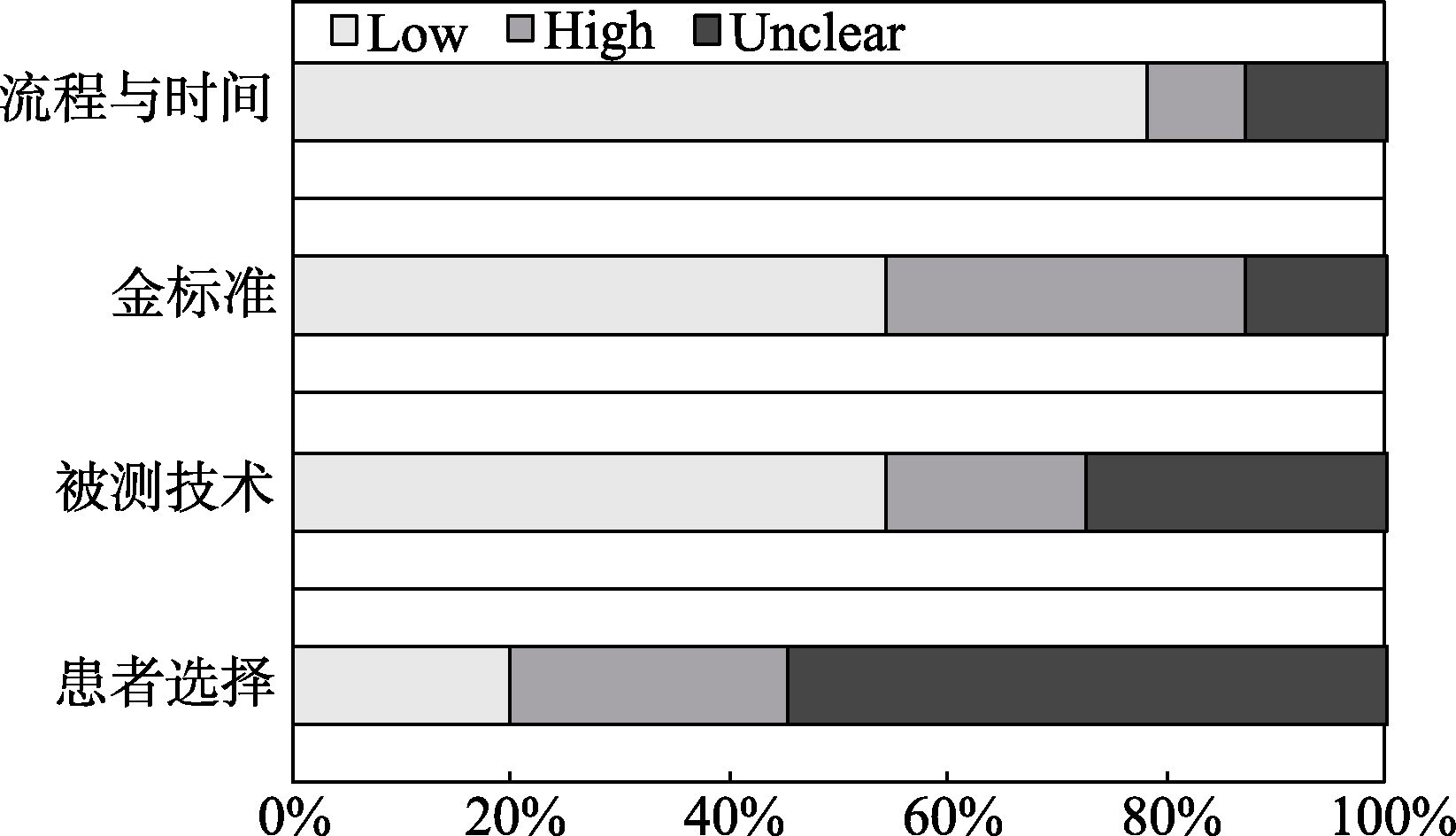
图2 文献质量评估图
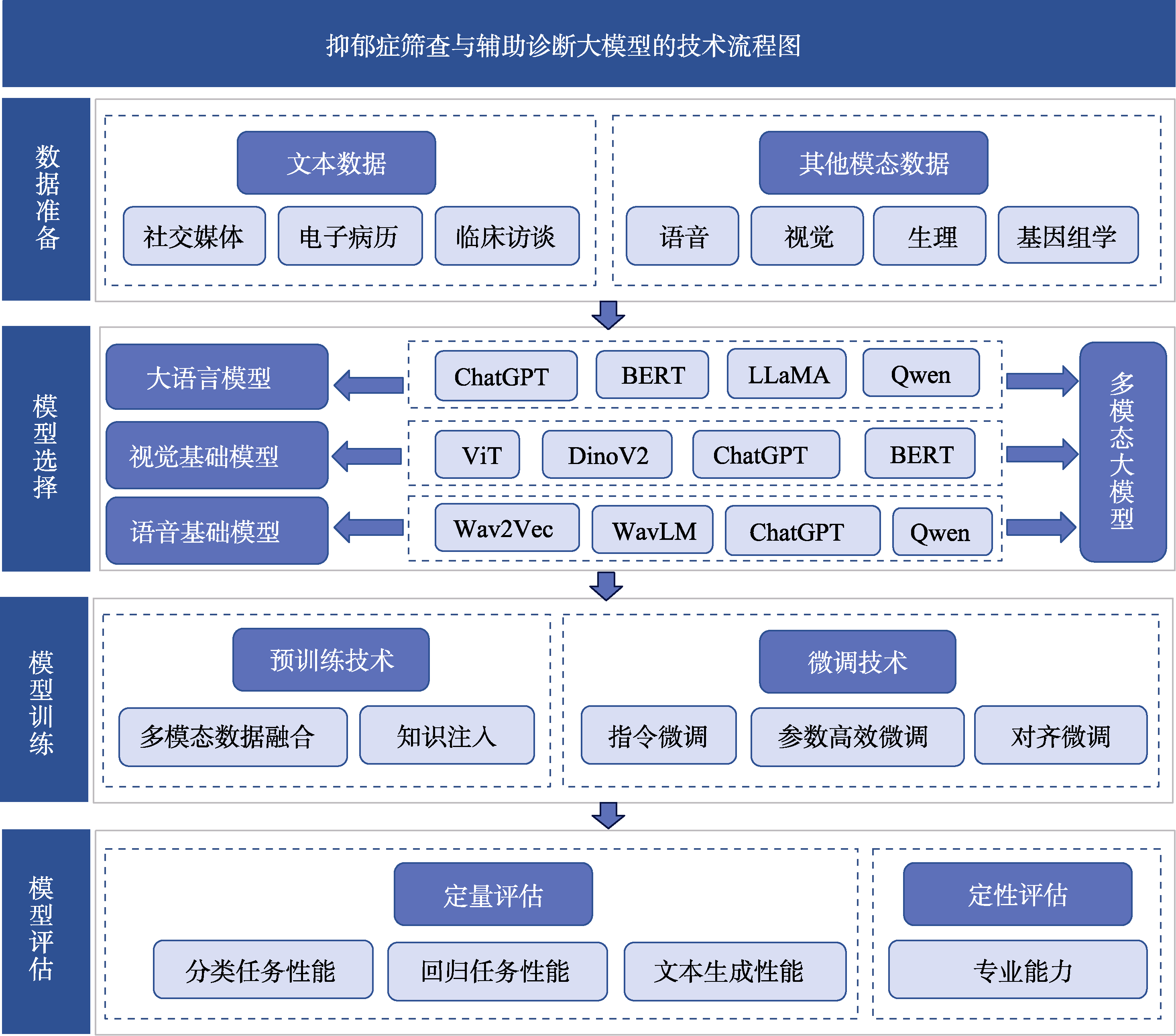
图3 建立抑郁症筛查和诊断大模型技术流程图
| 技术术语 | 定义 | 在抑郁症研究中的应用价值 |
|---|---|---|
| 预训练 | 在海量语料上, 采用自监督学习范式对模型进行初始训练, 学习通用的语言表征。 | 为模型赋予了理解人类语言的底层能力, 是识别抑郁症语言模式的基础。 |
| 微调 | 利用特定任务的有标注数据集进行监督学习, 使模型适应特定领域的应用。 | 将通用大模型特化为抑郁症筛查和诊断领域的专用模型。 |
| 指令微调 | 通过“指令−输出”对数据集进行训练, 使模型学会泛化地遵循人类指令的能力。 | 提升模型执行复杂临床任务指令的能力。 |
| 参数高效微调 | 仅训练模型的一小部分参数, 以极低的计算和存储成本实现对下游任务的适应。 | 大幅降低了针对抑郁症定制模型的资源门槛, 使得快速迭代和部署成为可能。 |
| 对齐微调 | 使模型的输出与人类的偏好、价值观和社会规范对齐, 常采用基于人类反馈的强化学习等技术。 | 保障模型在临床应用中的安全性与伦理性, 避免生成有害、偏颇或不负责任的诊断建议。 |
| 适配器 | 在预训练模型各层中插入小型、可训练的模块, 微调时仅更新这些模块的参数。 | 提供了一种模块化的模型定制方案, 可为不同评估任务训练专用适配器。 |
| 低秩适应 | 通过在模型权重矩阵旁注入可训练的低秩矩阵来模拟参数更新, 从而以少量参数实现高效微调。 | 兼顾了微调性能与计算效率, 是目前为特定临床语境快速定制模型的主流高效方法之一。 |
| 思维链 | 通过在提示中加入逐步推理的示例, 引导模型在回答复杂问题时生成推理过程。 | 提升模型在复杂诊断任务中的推理能力和结果的可解释性。 |
表2 大模型在抑郁症筛查与诊断应用中的关键技术概念解释
| 技术术语 | 定义 | 在抑郁症研究中的应用价值 |
|---|---|---|
| 预训练 | 在海量语料上, 采用自监督学习范式对模型进行初始训练, 学习通用的语言表征。 | 为模型赋予了理解人类语言的底层能力, 是识别抑郁症语言模式的基础。 |
| 微调 | 利用特定任务的有标注数据集进行监督学习, 使模型适应特定领域的应用。 | 将通用大模型特化为抑郁症筛查和诊断领域的专用模型。 |
| 指令微调 | 通过“指令−输出”对数据集进行训练, 使模型学会泛化地遵循人类指令的能力。 | 提升模型执行复杂临床任务指令的能力。 |
| 参数高效微调 | 仅训练模型的一小部分参数, 以极低的计算和存储成本实现对下游任务的适应。 | 大幅降低了针对抑郁症定制模型的资源门槛, 使得快速迭代和部署成为可能。 |
| 对齐微调 | 使模型的输出与人类的偏好、价值观和社会规范对齐, 常采用基于人类反馈的强化学习等技术。 | 保障模型在临床应用中的安全性与伦理性, 避免生成有害、偏颇或不负责任的诊断建议。 |
| 适配器 | 在预训练模型各层中插入小型、可训练的模块, 微调时仅更新这些模块的参数。 | 提供了一种模块化的模型定制方案, 可为不同评估任务训练专用适配器。 |
| 低秩适应 | 通过在模型权重矩阵旁注入可训练的低秩矩阵来模拟参数更新, 从而以少量参数实现高效微调。 | 兼顾了微调性能与计算效率, 是目前为特定临床语境快速定制模型的主流高效方法之一。 |
| 思维链 | 通过在提示中加入逐步推理的示例, 引导模型在回答复杂问题时生成推理过程。 | 提升模型在复杂诊断任务中的推理能力和结果的可解释性。 |
| 社交媒体数据 | 电子病历数据 | 临床访谈数据 | 多模态数据 | |
|---|---|---|---|---|
| 数据规模 | 极高 | 中等 | 低 | 低 |
| 数据质量 | 低 | 较高 | 高 | 较高 |
| 临床诊断相关性 | 中等 | 高 | 极高 | 极高 |
| 采集与处理成本 | 低 | 中等 | 高 | 极高 |
| 模型实现复杂度 | 中等 | 较高 | 较高 | 极高 |
表3 不同数据类型的比较
| 社交媒体数据 | 电子病历数据 | 临床访谈数据 | 多模态数据 | |
|---|---|---|---|---|
| 数据规模 | 极高 | 中等 | 低 | 低 |
| 数据质量 | 低 | 较高 | 高 | 较高 |
| 临床诊断相关性 | 中等 | 高 | 极高 | 极高 |
| 采集与处理成本 | 低 | 中等 | 高 | 极高 |
| 模型实现复杂度 | 中等 | 较高 | 较高 | 极高 |
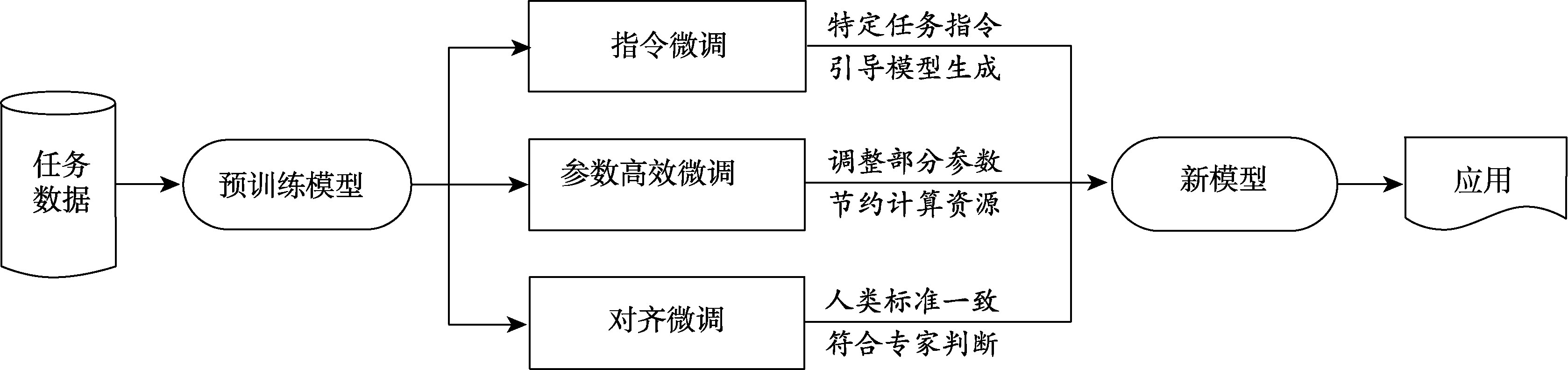
图4 大模型训练流程
| 指标类型 | 具体指标 | 指标说明 | 测试方法 | 评分范围 |
|---|---|---|---|---|
| 分类任务性能 | 准确率(ACC) | 正确识别抑郁与非抑郁个体的比例 | (TP + TN) / (TP + TN + FP + FN) | 0%-100% |
| 精确率(PPV) | 预测为抑郁的个体中, 实际为抑郁的比例 | TP / (TP + FP) | 0%-100% | |
| 召回率(SEN) | 实际为抑郁的个体中, 被成功识别为抑郁的比例 | TP / (TP + FN) | 0%-100% | |
| F1分数(F1) | 精确率和召回率的调和平均值 | 2 × (PPV × SEN) / (PPV + SEN) | 0-1 | |
| AUC | ROC曲线下面积, 评估分类器整体区分能力 | 通过ROC曲线计算 | 0.5-1 | |
| 回归任务性能 | 平均绝对误差(MAE) | 预测的抑郁得分与真实抑郁得分之差绝对值的平均数 | (1/n) Σ | yᵢ - ŷᵢ | | ≥0 |
| 均方根误差(RMSE) | 预测的抑郁得分与真实抑郁得分之差平方的均值的平方根 | √[(1/n) Σ (yᵢ - ŷᵢ)²] | ≥0 | |
| 相关系数(r) | 预测的抑郁得分与真实抑郁得分之间的线性相关强度 | 皮尔逊或斯皮尔曼相关 | −1到+1 | |
| 文本生成性能 | 双语评估替换指标(BLEU) | 衡量生成文本与参考文本的表面相似度 | 与参考文本比较 | 0-1 |
| 面向召回率的摘要评估辅助指标(ROUGE) | 衡量生成文本对参考文本信息的覆盖程度 | 与参考文本比较 | 0-1 | |
| 显式词序匹配翻译评估度量(METEOR) | 综合精确率、召回率、同义词与语序 | 词对齐与映射 | 0-1 | |
| 不同n元语法比例(DIST-n) | 衡量生成文本中独特n-gram的比例 | 独特n-gram占比 | 0-1 | |
| 专业能力 | 模型输出的临床质量与准确性 | 输出的清晰度、相关性、一致性 | 访谈、问卷 | 定性评价 |
| 临床应用的实用性与用户接受度 | 在真实场景中的可行性与用户采纳意愿 | 访谈、问卷 | 定性评价 |
表4 大模型在抑郁症筛查与诊断任务中的性能评估指标
| 指标类型 | 具体指标 | 指标说明 | 测试方法 | 评分范围 |
|---|---|---|---|---|
| 分类任务性能 | 准确率(ACC) | 正确识别抑郁与非抑郁个体的比例 | (TP + TN) / (TP + TN + FP + FN) | 0%-100% |
| 精确率(PPV) | 预测为抑郁的个体中, 实际为抑郁的比例 | TP / (TP + FP) | 0%-100% | |
| 召回率(SEN) | 实际为抑郁的个体中, 被成功识别为抑郁的比例 | TP / (TP + FN) | 0%-100% | |
| F1分数(F1) | 精确率和召回率的调和平均值 | 2 × (PPV × SEN) / (PPV + SEN) | 0-1 | |
| AUC | ROC曲线下面积, 评估分类器整体区分能力 | 通过ROC曲线计算 | 0.5-1 | |
| 回归任务性能 | 平均绝对误差(MAE) | 预测的抑郁得分与真实抑郁得分之差绝对值的平均数 | (1/n) Σ | yᵢ - ŷᵢ | | ≥0 |
| 均方根误差(RMSE) | 预测的抑郁得分与真实抑郁得分之差平方的均值的平方根 | √[(1/n) Σ (yᵢ - ŷᵢ)²] | ≥0 | |
| 相关系数(r) | 预测的抑郁得分与真实抑郁得分之间的线性相关强度 | 皮尔逊或斯皮尔曼相关 | −1到+1 | |
| 文本生成性能 | 双语评估替换指标(BLEU) | 衡量生成文本与参考文本的表面相似度 | 与参考文本比较 | 0-1 |
| 面向召回率的摘要评估辅助指标(ROUGE) | 衡量生成文本对参考文本信息的覆盖程度 | 与参考文本比较 | 0-1 | |
| 显式词序匹配翻译评估度量(METEOR) | 综合精确率、召回率、同义词与语序 | 词对齐与映射 | 0-1 | |
| 不同n元语法比例(DIST-n) | 衡量生成文本中独特n-gram的比例 | 独特n-gram占比 | 0-1 | |
| 专业能力 | 模型输出的临床质量与准确性 | 输出的清晰度、相关性、一致性 | 访谈、问卷 | 定性评价 |
| 临床应用的实用性与用户接受度 | 在真实场景中的可行性与用户采纳意愿 | 访谈、问卷 | 定性评价 |
| [1] | 陈露, 张思拓, 俞凯. (2023). 跨模态语言大模型: 进展及展望. 中国科学基金, 37(5), 776-785. |
| [2] |
陈晓红, 刘浏, 袁依格, 王俊普, 李大元, 邱建华. (2024). 医疗大模型技术及应用发展研究. 中国工程科学, 26(6), 77-88.
doi: 10.15302/J-SSCAE-2024.07.020 |
| [3] |
董健宇, 韦文棋, 吴珂, 妮娜, 王粲霏, 付莹, 彭歆. (2020). 机器学习在抑郁症领域的应用. 心理科学进展, 28(2), 266-274.
doi: 10.3724/SP.J.1042.2020.00266 |
| [4] | 张冬瑜, 庄沐霖, 靳森源, 刘馨月. (2025). 基于隐喻信息和指令调优的心理疾病检测. 数据分析与知识发现, https://doi.org/10.11925/infotech.2096-3467.2024.0450 |
| [5] | Abdulai, A. F., & Hung, L. (2023). Will ChatGPT undermine ethical values in nursing education, research, and practice. Nursing Inquiry, 30(3), e12556. |
| [6] |
Akhlaghi, H., Freeman, S., Vari, C., McKenna, B., Braitberg, G., Karro, J., & Tahayori, B. (2024). Machine learning in clinical practice: Evaluation of an artificial intelligence tool after implementation. Emergency Medicine Australasia, 36(1), 118-124.
doi: 10.1111/emm.v36.1 URL |
| [7] |
Al Masud, G. H., Shanto, R. I., Sakin, I., & Kabir, M. R. (2025). Effective depression detection and interpretation: Integrating machine learning, deep learning, language models, and explainable AI. Array, 25, 100375.
doi: 10.1016/j.array.2025.100375 URL |
| [8] | American Psychiatric Association. (2013). Diagnostic and statistical manual of mental disorders (5th ed.). https://doi.org/10.1176/appi.books.9780890425596 |
| [9] |
Badcock, P. B., Davey, C. G., Whittle, S., Allen, N. B., & Friston, K. J. (2017). The depressed brain: An evolutionary systems theory. Trends in Cognitive Sciences, 21(3), 182-194.
doi: S1364-6613(17)30005-0 pmid: 28161288 |
| [10] |
Beck, A. T. (2008). The evolution of the cognitive model of depression and its neurobiological correlates. American Journal of Psychiatry, 165(8), 969-977.
doi: 10.1176/appi.ajp.2008.08050721 pmid: 18628348 |
| [11] | Bendebane, L., Laboudi, Z., Saighi, A., & Bouziane, S. E. (2025). Fine-tuning the BERT model to predict depression and anxiety using multi-labeled Twitter data. 2025 4th International Conference on Sentiment Analysis and Deep Learning (ICSADL) (pp.586-591). https://doi.org/10.1109/ICSADL65848.2025.10932995 |
| [12] |
Beniwal, R., & Saraswat, P. (2024). A hybrid BERT-CNN approach for depression detection on social media using multimodal data. The Computer Journal, 67(7), 2453-2472.
doi: 10.1093/comjnl/bxae018 URL |
| [13] | Berrezueta-Guzman, S., Kandil, M., Martín-Ruiz, M. L., Pau de la Cruz, I., & Krusche, S. (2024). Future of ADHD care: Evaluating the efficacy of ChatGPT in therapy enhancement. Healthcare, 12(6), 683. |
| [14] | Blease, C., & Torous, J. (2023). ChatGPT and mental healthcare: Balancing benefits with risks of harms. BMJ Mental Health, 26(1), e300884. |
| [15] |
Blease, C., Worthen, A., & Torous, J. (2024). Psychiatrists’ experiences and opinions of generative artificial intelligence in mental healthcare: An online mixed methods survey. Psychiatry Research, 333, 115724.
doi: 10.1016/j.psychres.2024.115724 URL |
| [16] | Bommasani, R., Hudson, D. A., Adeli, E., Altman, R., Arora, S., von Arx, S., ... Liang, P. (2021). On the opportunities and risks of foundation models. ArXiv. https://doi.org/10.48550/arXiv.2108.07258 |
| [17] |
Buyukdura, J. S., McClintock, S. M., & Croarkin, P. E. (2011). Psychomotor retardation in depression: Biological underpinnings, measurement, and treatment. Progress in Neuro-Psychopharmacology and Biological Psychiatry, 35(2), 395-409.
doi: 10.1016/j.pnpbp.2010.10.019 URL |
| [18] | Carstensen, C., Small, N., Bhaskar, J., Lopez, B., Shrestha, A., & Rundensteiner, E. A. (2024). MInDS: Using large language models to screen for depression. 2024 IEEE MIT Undergraduate Research Technology Conference (URTC) (pp.1-5). https://doi.org/10.1109/URTC65039.2024.10937571 |
| [19] |
Clark, A. (2013). Whatever next? Predictive brains, situated agents, and the future of cognitive science. Behavioral and Brain Sciences, 36(3), 181-204.
doi: 10.1017/S0140525X12000477 pmid: 23663408 |
| [20] | Cohen, I. G. (2023). What should ChatGPT mean for bioethics? The American Journal of Bioethics, 23(10), 8-16. |
| [21] | Danner, M., Hadzic, B., Gerhardt, S., Ludwig, S., Uslu, I., Shao, P., ... Rätsch, M. (2023). Advancing mental health diagnostics: GPT-based method for depression detection. 2023 62nd Annual Conference of the Society of Instrument and Control Engineers (SICE) (pp.1290-1296). https://doi.org/10.23919/SICE59929.2023.10354236 |
| [22] |
D’Souza, R. F., Amanullah, S., Mathew, M., & Surapaneni, K. M. (2023). Appraising the performance of ChatGPT in psychiatry using 100 clinical case vignettes. Asian Journal of Psychiatry, 89, 103770.
doi: 10.1016/j.ajp.2023.103770 URL |
| [23] | El-Ramly, M., Abu-Elyazid, H., Mo’men, Y., Alshaer, G., Adib, N., Eldeen, K. A., & El-Shazly, M. (2021). CairoDep: Detecting depression in Arabic posts using BERT transformers. 2021 Tenth International Conference on Intelligent Computing and Information Systems (ICICIS) (pp. 207-212). https://doi.org/10.1109/ICICIS52592.2021.9694178 |
| [24] | Elyoseph, Z., Gur, T., Haber, Y., Simon, T., Angert, T., Navon, Y., ... Asman, O. (2024a). An ethical perspective on the democratization of mental health with generative AI. JMIR Mental Health, 11, e58011. |
| [25] | Elyoseph, Z., Levkovich, I., & Shinan-Altman, S. (2024b). Assessing prognosis in depression: comparing perspectives of AI models, mental health professionals and the general public. Family Medicine and Community Health, 12(Suppl. 1), e002583. |
| [26] | Englhardt, Z., Ma, C., Morris, M. E., Chang, C. C., Xu, X. O., Qin, L., ... Iyer, V. (2024). From classification to clinical insights: Towards analyzing and reasoning about mobile and behavioral health data with large language models. Proceedings of the ACM on Interactive, Mobile, Wearable and Ubiquitous Technologies, 8(2), 1-25. |
| [27] |
Farruque, N., Goebel, R., Sivapalan, S., & Zaïane, O. R. (2024). Depression symptoms modelling from social media text: An LLM driven semi-supervised learning approach. Language Resources and Evaluation, 58(3), 1013-1041.
doi: 10.1007/s10579-024-09720-4 |
| [28] |
Flint, J. (2023). The genetic basis of major depressive disorder. Molecular psychiatry, 28(6), 2254-2265.
doi: 10.1038/s41380-023-01957-9 pmid: 36702864 |
| [29] |
Friston, K. (2005). A theory of cortical responses. Philosophical Transactions of the Royal Society B: Biological Sciences, 360(1456), 815-836.
doi: 10.1098/rstb.2005.1622 URL |
| [30] | Gao, J., Zeng, M., Li, Y., Wang, F., Zheng, R., Liu, J., ... Li, M. (2024). DP-BERT: A pre-trained deep language model for depression prediction using microarray data. 2024 IEEE International Conference on Bioinformatics and Biomedicine (BIBM) (pp.919-924). https://doi.org/10.1109/BIBM62325.2024.10822456 |
| [31] | Gerczuk, M., Triantafyllopoulos, A., Amiriparian, S., Kathan, A., Bauer, J., Berking, M., & Schuller, B. W. (2023). Zero-shot personalization of speech foundation models for depressed mood monitoring. Patterns, 4(11), 100873. |
| [32] | Gu, Y., Zhou, Y., Chen, Q., Zhou, N., Zhou, J., Zhou, A., & He, L. (2024). Enhancing depression-diagnosis-oriented chat with psychological state tracking. ArXiv. https://doi.org/10.48550/arXiv.2403.09717 |
| [33] | Guo, Y., & Guo, Y. (2024). A knowledge graph and large language model-based framework for depression detection. 2024 International Conference on Image Processing, Computer Vision and Machine Learning (ICICML) (pp. 670-673). https://doi.org/10.1109/ICICML63543.2024.10958051 |
| [34] |
Gupta, A. K., Dhamaniya, A., & Gupta, P. (2024). RADIANCE: Reliable and interpretable depression detection from speech using transformer. Computers in Biology and Medicine, 183, 109325.
doi: 10.1016/j.compbiomed.2024.109325 URL |
| [35] |
Haque, O. S., & Waytz, A. (2012). Dehumanization in medicine: Causes, solutions, and functions. Perspectives on Psychological Science, 7(2), 176-186.
doi: 10.1177/1745691611429706 pmid: 26168442 |
| [36] |
He, L., Chan, J. C. W., & Wang, Z. (2021). Automatic depression recognition using CNN with attention mechanism from videos. Neurocomputing, 422, 165-175.
doi: 10.1016/j.neucom.2020.10.015 URL |
| [37] | Hur, J. K., Heffner, J., Feng, G. W., Joormann, J., & Rutledge, R. B. (2024). Language sentiment predicts changes in depressive symptoms. Proceedings of the National Academy of Sciences, 121(39), e2321321121. |
| [38] |
Insel, T. R., & Cuthbert, B. N. (2015). Brain disorders? precisely. Science, 348(6234), 499-500.
doi: 10.1126/science.aab2358 URL |
| [39] | Jain, B., Goyal, G., & Sharma, M. (2024). Evaluating emotional detection and classification capabilities of GPT-2 and GPT-Neo using textual data. 2024 14th International Conference on Cloud Computing, Data Science & Engineering (Confluence) (pp. 12-18). https://doi.org/10.1109/Confluence60223.2024.10463396 |
| [40] |
Jarvers, I., Ecker, A., Donabauer, P., Kampa, K., Weißenbacher, M., Schleicher, D., ... Ludwig, B. (2024). MINI-KID interviews with adolescents: A corpus-based language analysis of adolescents with depressive disorders and the possibilities of continuation using Chat GPT. Frontiers in Psychiatry, 15, 1425820.
doi: 10.3389/fpsyt.2024.1425820 URL |
| [41] |
Jiang, Z., Seyedi, S., Griner, E., Abbasi, A., Rad, A. B., Kwon, H., ... Clifford, G. D. (2024). Multimodal mental health digital biomarker analysis from remote interviews using facial, vocal, linguistic, and cardiovascular patterns. IEEE Journal of Biomedical and Health Informatics, 28(3), 1680-1691.
doi: 10.1109/JBHI.2024.3352075 URL |
| [42] | Jin, Z., Bi, D., Hu, J., & Zhao, K. (2024). Evaluating the efficacy of AI-based interactive assessments using large language models for depression screening. MedRxiv. https://doi.org/10.1101/2024.07.19.24310543 |
| [43] | Joyce, D. W., Kormilitzin, A., Smith, K. A., & Cipriani, A. (2023). Explainable artificial intelligence for mental health through transparency and interpretability for understandability. NPJ Digital Medicine, 6(1), 6. |
| [44] | Juarto, B. (2024). Sentiment analysis for mental health using boosting, bagging, and DeBERTa from social media data. 2024 IEEE International Conference on Control & Automation, Electronics, Robotics, Internet of Things, and Artificial Intelligence (CERIA) (pp.1-6). https://doi.org/10.1109/CERIA64726.2024.10915163 |
| [45] |
Kendall, K. M., Van Assche, E., Andlauer, T. F. M., Choi, K. W., Luykx, J. J., Schulte, E. C., & Lu, Y. (2021). The genetic basis of major depression. Psychological Medicine, 51(13), 2217-2230.
doi: 10.1017/S0033291721000441 URL |
| [46] | Kerasiotis, M., Ilias, L., & Askounis, D. (2024). Depression detection in social media posts using transformer-based models and auxiliary features. Social Network Analysis and Mining, 14(1), 196. |
| [47] | Kifayathullah, M., Sekar, R., R, A., & K, V. (2025). Personalized mental health assistance: Integrating emotion prediction with GPT-based chatbot. 2025 IEEE International Students' Conference on Electrical, Electronics and Computer Science (SCEECS) (pp. 1-6). https://doi.org/10.1109/SCEECS64059.2025.10940203 |
| [48] |
King, C. A., Knox, M. S., Henninger, N., Nguyen, T. A., Ghaziuddin, N., Maker, A., & Hanna, G. L. (2006). Major depressive disorder in adolescents: Family psychiatric history predicts severe behavioral disinhibition. Journal of Affective Disorders, 90(2-3), 111-121.
pmid: 16352346 |
| [49] |
Kube, T., Schwarting, R., Rozenkrantz, L., Glombiewski, J. A., & Rief, W. (2020). Distorted cognitive processes in major depression: A predictive processing perspective. Biological Psychiatry, 87(5), 388-398.
doi: S0006-3223(19)31550-1 pmid: 31515055 |
| [50] | Leow, J. J. D., Chua, H. N., Jasser, M. B., Issa, B., & Wong, R. T. K. 2025). Comparison of depression detection between LLMs and zero-shot learning using DAD dataset. 2025 21st IEEE International Colloquium on Signal Processing & Its Applications (CSPA) (pp.295-300). https://doi.org/10.1109/CSPA64953.2025.10933098 |
| [51] | Liu, X. Q., Wang, X., & Zhang, H. R. (2024). Large multimodal models assist in psychiatry disorders prevention and diagnosis of students. World Journal of Psychiatry, 14(10), 1415. |
| [52] | Long, Y., Ma, Z., Mei, Y., & Su, Z. (2024). AffirmativeAI: Towards LGBTQ+ friendly audit frameworks for large language models. ArXiv. https://doi.org/10.48550/arXiv.2405.04652 |
| [53] | Lorenzoni, G., Velmovitsky, P. E., Alencar, P., & Cowan, D. (2024). GPT-4 on clinic depression assessment: An LLM- based pilot study. 2024 IEEE International Conference on Big Data (BigData) (pp.5043-5049). https://doi.org/10.1109/BigData62323.2024.10825184 |
| [54] |
Lorge, I., Joyce, D. W., Taylor, N., Nevado-Holgado, A., Cipriani, A., & Kormilitzin, A. (2025). Detecting the clinical features of difficult-to-treat depression using synthetic data from large language models. Computers in Biology and Medicine, 194, 110246.
doi: 10.1016/j.compbiomed.2025.110246 URL |
| [55] | Ma, Z., Mei, Y., & Su, Z. 2023, November 11-15). Understanding the benefits and challenges of using large language model-based conversational agents for mental well-being support [Paper presentation]. American Medical Informatics Association 2023 Annual Symposium, New Orleans, LA, United States. |
| [56] |
MacKenzie, L. E., Uher, R., & Pavlova, B. (2019). Cognitive performance in first-degree relatives of individuals with vs without major depressive disorder: A meta-analysis. JAMA Psychiatry, 76(3), 297-305.
doi: 10.1001/jamapsychiatry.2018.3672 pmid: 30586133 |
| [57] |
McCoy, T. H., Castro, V. M., & Perlis, R. H. (2025). Estimating depression severity in narrative clinical notes using large language models. Journal of Affective Disorders, 381, 270-274.
doi: 10.1016/j.jad.2025.04.014 pmid: 40187432 |
| [58] |
Meng, Y., Speier, W., Ong, M. K., & Arnold, C. W. (2021). Bidirectional representation learning from transformers using multimodal electronic health record data to predict depression. IEEE Journal of Biomedical and Health Informatics, 25(8), 3121-3129.
doi: 10.1109/JBHI.2021.3063721 URL |
| [59] | Menne, F., Dörr, F., Schräder, J., Tröger, J., Habel, U., König, A., & Wagels, L. (2024). The voice of depression: Speech features as biomarkers for major depressive disorder. BMC Psychiatry, 24(1), 794. |
| [60] |
Mennen, A. C., Norman, K. A., & Turk-Browne, N. B. (2019). Attentional bias in depression: Understanding mechanisms to improve training and treatment. Current Opinion in Psychology, 29, 266-273.
doi: S2352-250X(19)30001-6 pmid: 31521030 |
| [61] | Mittermaier, M., Raza, M. M., & Kvedar, J. C. (2023). Bias in AI-based models for medical applications: Challenges and mitigation strategies. NPJ Digital Medicine, 6(1), 113. |
| [62] |
Nadeem, M., Sohail, S. S., Madsen, D. Ø., Alzahrani, A. A., Del Ser, J., & Muhammad, K. (2025). A multi-modal assessment framework for comparison of specialized deep learning and general-purpose large language models. IEEE Transactions on Big Data, 11(3), 1001-1012.
doi: 10.1109/TBDATA.2025.3536937 URL |
| [63] | Nushida, T., Kang, X., Matsumoto, K., Yoshida, M., & Zhou, J. (2025). An automated depression diagnosis system utilizing a knowledge base created with GPT. 2025 IEEE 17th International Conference on Computer Research and Development (ICCRD) (pp.329-333). https://doi.org/10.1109/ICCRD64588.2025.10963224 |
| [64] | Ogunleye, B., Sharma, H., & Shobayo, O. (2024). Sentiment informed sentence BERT-Ensemble algorithm for depression detection. Big Data and Cognitive Computing, 8(9), 112. |
| [65] | Oh, J., Kim, M., Park, H., & Oh, H. (2023). Are you depressed? Analyze user utterances to detect depressive emotions using DistilBERT. Applied Sciences, 13(10), 6223. |
| [66] | Ohse, J., Hadžić, B., Mohammed, P., Peperkorn, N., Danner, M., Yorita, A., ... Shiban, Y. (2024). Zero-Shot Strike: Testing the generalisation capabilities of out-of-the-box LLM models for depression detection. Computer Speech & Language, 88, 101663. |
| [67] |
Omar, M., Soffer, S., Charney, A. W., Landi, I., Nadkarni, G. N., & Klang, E. (2024). Applications of large language models in psychiatry: A systematic review. Frontiers in Psychiatry, 15, 1422807.
doi: 10.3389/fpsyt.2024.1422807 URL |
| [68] |
Palmer, A., & Schwan, D. (2022). Beneficent dehumanization: Employing artificial intelligence and carebots to mitigate shame‐induced barriers to medical care. Bioethics, 36(2), 187-193.
doi: 10.1111/bioe.v36.2 URL |
| [69] |
Perlis, R. H., Goldberg, J. F., Ostacher, M. J., & Schneck, C. D. (2024). Clinical decision support for bipolar depression using large language models. Neuropsychopharmacology, 49(9), 1412-1416.
doi: 10.1038/s41386-024-01841-2 pmid: 38480911 |
| [70] | Priyadarshana, Y. H. P. P., Liang, Z., & Piumarta, I. (2024). Transferring large language models for depression detection through multi-party conversation analysis. 2024 IEEE International Conference on E-health Networking, Application & Services (HealthCom) (p. 1). https://doi.org/10.1109/HealthCom60970.2024.10880743 |
| [71] | Qasim, A., Mehak, G., Hussain, N., Gelbukh, A., & Sidorov, G. (2025). Detection of depression severity in social media text using transformer-based models. Information, 16(2), 114. |
| [72] |
Rabie, E. M., Hashem, A. F., & Alsheref, F. K. (2025). Recognition model for major depressive disorder in Arabic user-generated content. Beni-Suef University Journal of Basic and Applied Sciences, 14(1), 1-16.
doi: 10.1186/s43088-024-00590-x |
| [73] | Raj, A., Ali, Z., Chaudhary, S., Bali, K. K., & Sharma, A. (2024). Depression detection using BERT on social media platforms. 2024 IEEE International Conference on Artificial Intelligence in Engineering and Technology (IICAIET) (PP.228-233). https://doi.org/10.1109/IICAIET62352.2024.10730329 |
| [74] |
Rizwan, M., Mushtaq, M. F., Akram, U., Mehmood, A., Ashraf, I., & Sahelices, B. (2022). Depression classification from tweets using small deep transfer learning language models. IEEE Access, 10, 129176-129189.
doi: 10.1109/ACCESS.2022.3223049 URL |
| [75] |
Sabour, S., Zhang, W., Xiao, X., Zhang, Y., Zheng, Y., Wen, J., ... Huang, M. (2023). A chatbot for mental health support: Exploring the impact of Emohaa on reducing mental distress in China. Frontiers in Digital Health, 5, 1133987.
doi: 10.3389/fdgth.2023.1133987 URL |
| [76] | Sadeghi, M., Egger, B., Agahi, R., Richer, R., Capito, K., & Rupp, L. H. (2023). Exploring the capabilities of a language model-only approach for depression detection in text data. 2023 IEEE EMBS International Conference on Biomedical and Health Informatics (BHI) (pp.1-5). |
| [77] | Sadeghi, M., Richer, R., Egger, B., Schindler-Gmelch, L., Rupp, L. H., Rahimi, F., ... Eskofier, B. M. (2024). Harnessing multimodal approaches for depression detection using large language models and facial expressions. NPJ Mental Health Research, 3(1), 66. |
| [78] | Saraswat, P., & Beniwal, R. (2024). BERT-based RNN for effective detection of depression with severity levels from text data. 2024 IEEE Symposium on Wireless Technology & Applications (ISWTA) (pp.52-56). https://doi.org/10.1109/ISWTA62130.2024.10651873 |
| [79] | Schuller, B. W. (2018). Speech emotion recognition: Two decades in a nutshell, benchmarks, and ongoing trends. Communications of the ACM, 61(5), 90-99. |
| [80] | Senn, S., Tlachac, M., Flores, R., & Rundensteiner, E. (2022). Ensembles of BERT for depression classification. 2022 44th Annual International Conference of the IEEE Engineering in Medicine & Biology Society (EMBC) (pp. 4691-4694). https://doi.org/10.1109/EMBC48229.2022.9871120 |
| [81] |
Shah, S. M., Gillani, S. A., Baig, M., S. A., Saleem, M. A., & Siddiqui, M. H. (2025). Advancing depression detection on social media platforms through fine-tuned large language models. Online Social Networks and Media, 46, 100311.
doi: 10.1016/j.osnem.2025.100311 URL |
| [82] |
Sharma, A., Lin, I. W., Miner, A. S., Atkins, D. C., & Althoff, T. (2023). Human-AI collaboration enables more empathic conversations in text-based peer-to-peer mental health support. Nature Machine Intelligence, 5(1), 46-57.
doi: 10.1038/s42256-022-00593-2 |
| [83] | Shen, Z., & Paik, I. (2023). Predicting depression on Twitter with word embedding by pretrained language model. 2023 12th International Conference on Awareness Science and Technology (iCAST) (pp.247-252). https://doi.org/10.1109/iCAST57874.2023.10359279 |
| [84] | Shin, D., Kim, H., Lee, S., Cho, Y., & Jung, W. (2024). Using large language models to detect depression from user-generated diary text data as a novel approach in digital mental health screening: Instrument validation study. Journal of Medical Internet Research, 26, e54617. |
| [85] |
Smith, K. M., Renshaw, P. F., & Bilello, J. (2013). The diagnosis of depression: Current and emerging methods. Comprehensive Psychiatry, 54(1), 1-6.
doi: 10.1016/j.comppsych.2012.06.006 pmid: 22901834 |
| [86] | Sood, P. (2024). Harnessing large language models for mental health: From sentiment analysis to depression screening [Unpublished master's thesis]. Stevens Institute of Technology. |
| [87] |
Stasak, B., Epps, J., & Goecke, R. (2019). Automatic depression classification based on affective read sentences: Opportunities for text-dependent analysis. Speech Communication, 115, 1-14.
doi: 10.1016/j.specom.2019.10.003 |
| [88] | Tao, Y., Yang, M., Shen, H., Yang, Z., Weng, Z., & Hu, B. (2023). Classifying anxiety and depression through LLMs virtual interactions: A case study with ChatGPT. 2023 IEEE International Conference on Bioinformatics and Biomedicine (BIBM) (pp.2259-2264). https://doi.org/10.1109/BIBM58861.2023.10385305 |
| [89] |
Taylor, N., Kormilitzin, A., Lorge, I., Nevado-Holgado, A., Cipriani, A., & Joyce, D. W. (2024). Model development for bespoke large language models for digital triage assistance in mental health care. Artificial Intelligence in Medicine, 157, 102988.
doi: 10.1016/j.artmed.2024.102988 URL |
| [90] | Teferra, B. G., Rueda, A., Pang, H., Valenzano, R., Samavi, R., Krishnan, S., & Bhat, V. (2024). Screening for depression using natural language processing: Literature review. Interactive Journal of Medical Research, 13(1), e55067. |
| [91] | Tlachac, M. L., Reisch, M., & Heinz, M. (2023). Mobile communication log time series to detect depressive symptoms. 2023 45th Annual International Conference of the IEEE Engineering in Medicine & Biology Society (EMBC) (pp.1-4). https://doi.org/10.1109/EMBC40787.2023.10341154 |
| [92] | Townson, S. (2023). Manage AI bias instead of trying to eliminate it. MIT Sloan Management Review, 64(2), 1-3. |
| [93] | Vaswani, A., Shazeer, N., Parmar, N., Uszkoreit, J., Jones, L., Gomez, A. N., ... Polosukhin, I. (2017). Attention is all you need. ArXiv. https://doi.org/10.48550/arXiv.1706.03762 |
| [94] | Verma, S., Vishal, Joshi, R. C., Dutta, M. K., Jezek, S., & Burget, R. (2023). AI-enhanced mental health diagnosis: Leveraging transformers for early detection of depression tendency in textual data. 2023 15th International Congress on Ultra Modern Telecommunications and Control Systems and Workshops (ICUMT) (pp. 56-61). https://doi.org/10.1109/ICUMT61075.2023.10333301 |
| [95] | Wang, L., & Zhang, Q. (2024). Dual-diagnostic method for depression patients based on BERT model and ViT model for audio and text analysis. 2024 IEEE 2nd International Conference on Image Processing and Computer Applications (ICIPCA) (pp.1-6). https://doi.org/10.1109/ICIPCA61593.2024.10709143 |
| [96] | Wang, X., Liu, K., & Wang, C. (2023). Knowledge-enhanced pre-training large language model for depression diagnosis and treatment. 2023 IEEE 9th International Conference on Cloud Computing and Intelligent Systems (CCIS) (pp.532-536). https://doi.org/10.1109/CCIS59572.2023.10263217 |
| [97] |
Wei, Y., Guo, L., Lian, C., & Chen, J. (2023). ChatGPT: Opportunities, risks and priorities for psychiatry. Asian Journal of Psychiatry, 90, 103808.
doi: 10.1016/j.ajp.2023.103808 URL |
| [98] |
Whiting, P. F., Rutjes, A. W., Westwood, M. E., Mallett, S., Deeks, J. J., Reitsma, J. B.,...QUADAS-2 Group. (2011). QUADAS-2: A revised tool for the quality assessment of diagnostic accuracy studies. Annals of Internal Medicine, 155(8), 529-536.
doi: 10.7326/0003-4819-155-8-201110180-00009 pmid: 22007046 |
| [99] | World Health Organization. (2017). Depression and other common mental disorders: Global health estimates. https://coilink.org/20.500.12592/thw4fb |
| [100] | Wu, W., Zhang, C., & Woodland, P. C. (2023). Self- supervised representations in speech-based depression detection. 2023 IEEE International Conference on Acoustics, Speech and Signal Processing (ICASSP) (pp.1-5). https://doi.org/10.1109/ICASSP49357.2023.10094910 |
| [101] |
Xin, C., & Zakaria, L. Q. (2024). Integrating Bert with CNN and Bilstm for explainable detection of depression in social media contents. IEEE Access, 12, 161203-161212.
doi: 10.1109/ACCESS.2024.3488081 URL |
| [102] |
Xu, S., Yan, Y., Ding, Y., Li, F., Zhang, S., Tang, H., ... Chen, J. (2025). Identifying psychiatric manifestations in outpatients with depression and anxiety: A large language model-based approach. Npj Mental Health Research, 4(1), 63. https://doi.org/10.1038/s44184-025-00175-1
doi: 10.1038/s44184-025-00175-1 URL |
| [103] |
Yang, B., Cao, M., Zhu, X., Wang, S., Yang, C., Ni, R., & Liu, X. (2024). MMPF: Multimodal purification fusion for automatic depression detection. IEEE Transactions on Computational Social Systems, 11(6), 7421-7434.
doi: 10.1109/TCSS.2024.3411616 URL |
| [104] | Yang, K., Zhang, T., Kuang, Z., Xie, Q., Huang, J., & Ananiadou, S. (2024). MentaLLaMA: Interpretable mental health analysis on social media with large language models ACM Web Conference 2024, 4489-4500. |
| [105] |
Zhang, J., & Guo, Y. (2024). Multilevel depression status detection based on fine-grained prompt learning. Pattern Recognition Letters, 178, 167-173.
doi: 10.1016/j.patrec.2024.01.005 URL |
| [106] |
Zhang, L., Zhao, J., He, L., Jia, J., & Meng, X. (2023). An improved global-local fusion network for depression detection telemedicine framework. IEEE Internet of Things Journal, 10(22), 20230-20240.
doi: 10.1109/JIOT.2023.3283616 URL |
| [107] | Zhang, X., Cui, W., Wang, J., & Li, Y. (2024). Chat, summary and diagnosis:A LLM-enhanced conversational agent for interactive depression detection. 2024 4th International Conference on Industrial Automation, Robotics and Control Engineering (IARCE) (pp. 343-348). |
| [108] | Zhao, W. X., Zhou, K., Li, J., Tang, T., Wang, X., Hou, Y., ... Wen, J. R. (2023). A survey of large language models. ArXiv. https://doi.org/10.48550/arXiv.2303.18223 |
| [109] |
Zhou, X., Jin, K., Shang, Y., & Guo, G. (2018). Visually interpretable representation learning for depression recognition from facial images. IEEE Transactions on Affective Computing, 11(3), 542-552.
doi: 10.1109/T-AFFC.5165369 URL |
| [1] | 张昊天. 道德化:人们如何赋予中性事物以道德意味?[J]. 心理科学进展, 2026, 34(2): 348-363. |
| [2] | 王慧, 韩卓. 孤独症儿童社交沟通障碍的神经生理机制:基于亲子同步性的视角[J]. 心理科学进展, 2025, 33(9): 1483-1497. |
| [3] | 单晓龙, 陈华富, 段旭君. 孤独症谱系障碍多模态磁共振脑影像模式识别[J]. 心理科学进展, 2025, 33(4): 548-564. |
| [4] | 温秀娟, 马毓璟, 谭斯祺, 李芸, 刘文华. 身体还是认知努力的损害?抑郁症努力奖赏动机评估及计算模型应用[J]. 心理科学进展, 2025, 33(1): 107-122. |
| [5] | 丁颖, 汪紫滢, 李卫东. 抑郁症疼痛加工的行为特点及神经机制[J]. 心理科学进展, 2024, 32(8): 1315-1327. |
| [6] | 车强燕, 孙韵琳, 靳佳, 朱春燕, 汪凯, 叶榕, 余凤琼. 神经反馈增强积极情绪在抑郁症治疗中的应用[J]. 心理科学进展, 2024, 32(2): 342-363. |
| [7] | 吴朝毅, 王振. 抑郁症情绪失调的动态特征:情绪动力学的视角[J]. 心理科学进展, 2024, 32(2): 364-385. |
| [8] | 刘文华, 温秀娟, 陈灵, 杨瑞, 胡逸儒. 奖励期待和结果评估的脑电成分在精神疾病研究中的应用[J]. 心理科学进展, 2023, 31(5): 783-799. |
| [9] | 卜晓鸥, 王耀, 杜亚雯, 王沛. 机器学习在发展性阅读障碍儿童早期筛查中的应用[J]. 心理科学进展, 2023, 31(11): 2092-2105. |
| [10] | 张伟霞, 席敏, 阴甜甜, 王成, 司书宾. 基于网络分析的抑郁症产生与演变预测[J]. 心理科学进展, 2023, 31(11): 2129-2141. |
| [11] | 陈祥和, 李文秀, 刘波, 殷荣宾. 骨源性因子ucOCN在运动抗抑郁中的作用机制[J]. 心理科学进展, 2022, 30(2): 375-388. |
| [12] | 袁玉琢, 骆方. 人工智能辅助的自闭症早期患者的筛查与诊断[J]. 心理科学进展, 2022, 30(10): 2303-2320. |
| [13] | 黄观澜, 周晓璐. 抑郁症患者的语言使用模式[J]. 心理科学进展, 2021, 29(5): 838-848. |
| [14] | 秦浩方, 黄蓉, 贾世伟. 反馈相关负波:一种抑郁症的生物标记物[J]. 心理科学进展, 2021, 29(3): 404-413. |
| [15] | 邸天琪, 黄昱静, 高军. 催产素对产后抑郁症患者母性行为的调节作用[J]. 心理科学进展, 2020, 28(3): 456-464. |
| 阅读次数 | ||||||
|
全文 |
|
|||||
|
摘要 |
|
|||||
