

ISSN 1671-3710
CN 11-4766/R
主办:中国科学院心理研究所
出版:科学出版社
CN 11-4766/R
主办:中国科学院心理研究所
出版:科学出版社
心理科学进展 ›› 2025, Vol. 33 ›› Issue (12): 2105-2120.doi: 10.3724/SP.J.1042.2025.2105 cstr: 32111.14.2025.2105
顾溢鹏, 刘劲原, 张亚利( ), 李伟贺
收稿日期:2025-04-14
出版日期:2025-12-15
发布日期:2025-10-27
通讯作者:
张亚利, E-mail: zhangyali531@hebtu.edu.cn基金资助:
GU Yipeng, LIU Jinyuan, ZHANG Yali(), LI Weihe
Received:2025-04-14
Online:2025-12-15
Published:2025-10-27
摘要: 诸多研究分析了家庭亲密度与幸福感的关系, 但研究结果却并不一致。本研究对42项研究(共45个独立样本)使用随机效应模型进行了元分析。结果显示, 家庭亲密度与幸福感存在高相关(r = 0.35, 95% CI [0.30, 0.40]), 二者的相关强度受幸福感测量工具、个体主义指数以及取样年份的调节, 但不受性别、年龄、家庭亲密度测量工具、研究设计类型的调节。该结果支持了依恋理论和基本心理需要理论, 澄清了其与环状模型间的争论, 表明幸福感会随着家庭亲密度水平的提高而直线增加。
中图分类号:
顾溢鹏, 刘劲原, 张亚利, 李伟贺. (2025). 家庭亲密度与幸福感的关系:系统综述和元分析. 心理科学进展 , 33(12), 2105-2120.
GU Yipeng, LIU Jinyuan, ZHANG Yali, LI Weihe. (2025). The relationship between family cohesion and well-being: A systematic review and meta-analysis. Advances in Psychological Science, 33(12), 2105-2120.
| 问卷名称 | 第一作者 | 年份 | 题目数 | 维度 | 计分方式 |
|---|---|---|---|---|---|
| FES | Moos | 1981 | 9 | 单维度 | 2点计分(1~2) |
| FACES-II | Olson | 1982 | 16 | 单维度 | 5点计分(1~5) |
| FACES-IV | Olson | 2011 | 10 | 平衡的亲密度、失衡的亲密度 | 5点计分(1~5) |
表1 主要的家庭亲密度测量工具
| 问卷名称 | 第一作者 | 年份 | 题目数 | 维度 | 计分方式 |
|---|---|---|---|---|---|
| FES | Moos | 1981 | 9 | 单维度 | 2点计分(1~2) |
| FACES-II | Olson | 1982 | 16 | 单维度 | 5点计分(1~5) |
| FACES-IV | Olson | 2011 | 10 | 平衡的亲密度、失衡的亲密度 | 5点计分(1~5) |
| 问卷名称 | 第一作者 | 年份 | 题目数 | 维度 | 计分方式 |
|---|---|---|---|---|---|
| SWB | Diener | 1984 | 5 | 生活满意度 | 7点计分(1~7) |
| 1985 | 12 | 积极和消极情感 | 5点计分(1~5) | ||
| PWB | Ryff | 1995 | 84 | 自我接纳、积极关系、生活目标感、环境控制感、独立 自主、个人成长 | 6点计分(1~6) |
| GWB | Fazio | 1977 | 33 | 对健康的担心、精力、对生活的满足和兴趣、忧郁或愉 快的心境、对情感和行为的控制、松驰与紧张 | 6点计分(1~6) |
| ASWBS | 张兴贵 | 2004 | 36 | 友谊、家庭、学校、环境、学业、自由满意度 | 5点计分(1~5) |
表2 主要的幸福感测量工具
| 问卷名称 | 第一作者 | 年份 | 题目数 | 维度 | 计分方式 |
|---|---|---|---|---|---|
| SWB | Diener | 1984 | 5 | 生活满意度 | 7点计分(1~7) |
| 1985 | 12 | 积极和消极情感 | 5点计分(1~5) | ||
| PWB | Ryff | 1995 | 84 | 自我接纳、积极关系、生活目标感、环境控制感、独立 自主、个人成长 | 6点计分(1~6) |
| GWB | Fazio | 1977 | 33 | 对健康的担心、精力、对生活的满足和兴趣、忧郁或愉 快的心境、对情感和行为的控制、松驰与紧张 | 6点计分(1~6) |
| ASWBS | 张兴贵 | 2004 | 36 | 友谊、家庭、学校、环境、学业、自由满意度 | 5点计分(1~5) |
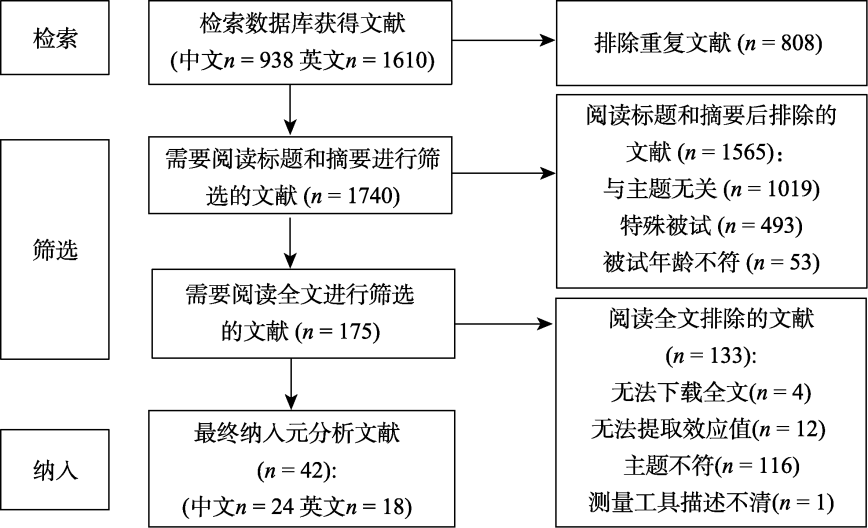
图1 文献筛选流程图
| 研究 | 取样年份 | 取样地域 | 个体主义指数 | r值 | 被试数 | 男性比 | 年龄 | 研究设计 | 质量评价 | 测量工具 | |
|---|---|---|---|---|---|---|---|---|---|---|---|
| 家庭亲密度 | 幸福感 | ||||||||||
| Erus et al., | 2023 | 土耳其 | 46 | 0.41 | 308 | 0.14 | 大学生 | 纵向 | 高 | 其他 | 其他 |
| 李姗姗, | 2022 | 中国 | 43 | 0.42 | 960 | 0.49 | 中学生 | 横断 | 高 | FACES-II | PWB |
| 秦懿昭 等, | 2022 | 中国 | 43 | 0.54 | 250 | 0.53 | 大学生 | 横断 | 中 | FACES-II | 其他 |
| 王莹滟 等, | 2021 | 中国 | 43 | 0.55 | 3965 | 0.48 | 中学生 | 横断 | 高 | FACES-II | 其他 |
| 杨芝琦, | 2021 | 中国 | 43 | 0.73 | 623 | 0.51 | 中学生 | 横断 | 高 | FACES-II | ASWBS |
| Galián & Ato, | 2021 | 西班牙 | 67 | 0.23 | 347 | 0.22 | 大学生 | 横断 | 高 | FACES-IV | PWB |
| Raposo & Francisco, | 2021 | 葡萄牙 | 59 | 0.34 | 723 | 0.40 | 中学生 | 横断 | 高 | 其他 | 其他 |
| Qi et al., | 2021 | 中国 | 43 | 0.25 | 612 | 0.37 | 大学生 | 横断 | 高 | FACES-IV | 其他 |
| Qi et al., | 2020 | 中国 | 43 | 0.61 | 332 | 0.45 | 大学生 | 横断 | 高 | FACES-IV | PWB |
| Chan, | 2020 | 中国 | 43 | 0.20 | 109 | 0.59 | 小学生 | 横断 | 高 | 其他 | 其他 |
| Finkelstein & Grebelsky- Lichtman, 2022 | 2020 | 以色列 | 56 | 0.38 | 230 | 0.36 | 中学生 | 横断 | 高 | 其他 | 其他 |
| Xiang et al., | 2020 | 中国 | 43 | 0.38 | 2784 | 0.43 | 中学生 | 横断 | 高 | FES | SWB |
| Dost-Gözkan, | 2019 | 土耳其 | 46 | 0.56 | 1097 | 0.38 | 中学生 | 横断 | 高 | FES | 其他 |
| Shah et al., | 2019 | 美国 | 60 | 0.36 | 481 | 0.51 | 中学生 | 横断 | 高 | FES | 其他 |
| Seryjová Juhová et al., | 2019 | 捷克 | 70 | 0.12 | 2836 | 0.43 | 中学生 | 横断 | 高 | 其他 | 其他 |
| 2010 | 捷克 | 70 | 0.10 | 893 | 0.47 | 中学生 | 横断 | 高 | 其他 | 其他 | |
| 1995 | 捷克 | 70 | 0.09 | 833 | 0.53 | 中学生 | 横断 | 高 | 其他 | 其他 | |
| 杨远远, | 2018 | 中国 | 43 | 0.31 | 1048 | 0.51 | 中学生 | 横断 | 高 | FACES-II | 其他 |
| 刘海燕, | 2018 | 中国 | 43 | 0.40 | 874 | 0.51 | 大学生 | 横断 | 中 | FACES-II | 其他 |
| 罗希, | 2018 | 中国 | 43 | 0.28 | 1518 | 0.62 | 中学生 | 横断 | 高 | FES | GWB |
| 史梦薇 等, | 2018 | 中国 | 43 | 0.46 | 630 | 0.21 | 大学生 | 横断 | 中 | FACES-II | 其他 |
| Fosco et al., | 2018 | 美国 | 60 | 0.29 | 151 | 0.38 | 中学生 | 横断 | 高 | FES | 其他 |
| Fosco et al., | 1998 | 美国 | 60 | 0.27 | 792 | 0.51 | 中学生 | 纵向 | 高 | 其他 | 其他 |
| 魏秀蓉, | 2017 | 中国 | 43 | 0.47 | 978 | 0.50 | 中学生 | 横断 | 高 | FACES-II | 其他 |
| 殷蕾, | 2017 | 中国 | 43 | 0.48 | 335 | 0.46 | 中学生 | 横断 | 中 | FACES-II | PWB |
| 祝翠平, | 2017 | 中国 | 43 | 0.48 | 103 | 0.46 | 中学生 | 横断 | 中 | FACES-II | ASWBS |
| 肖长根, 肖景, | 2016 | 中国 | 43 | 0.27 | 320 | 0.48 | 大学生 | 横断 | 高 | FACES-II | GWB |
| 柴志叶, | 2015 | 中国 | 43 | 0.45 | 576 | 0.59 | 中学生 | 横断 | 高 | FACES-II | PWB |
| Brajsa-Zganec et al., | 2015 | 克罗地亚 | 42 | 0.31 | 411 | 0.20 | 大学生 | 横断 | 高 | 其他 | 其他 |
| Rahal & Fosco, | 2015 | 美国 | 60 | 0.53 | 150 | 0.39 | 中学生 | 横断 | 高 | FES | PWB |
| 孙蕊, | 2014 | 中国 | 43 | 0.32 | 437 | 0.37 | 大学生 | 横断 | 高 | FACES-II | SWB |
| 王丽霞, | 2014 | 中国 | 43 | 0.16 | 456 | 0.33 | 大学生 | 横断 | 高 | FACES-II | SWB |
| 刘洋, 许红芝, | 2013 | 中国 | 43 | 0.27 | 574 | 0.42 | 大学生 | 横断 | 中 | FACES-II | ASWBS |
| Turner, | 2013 | 南非 | 23 | 0.13 | 187 | 0.47 | 中学生 | 横断 | 中 | 其他 | 其他 |
| 李文华 等, | 2012 | 中国 | 43 | 0.50 | 100 | 0.50 | 大学生 | 横断 | 中 | FACES-II | GWB |
| Boer & Abubakar, | 2012 | 肯尼亚等 | 无 | 0.15 | 760 | 0.38 | 大学生 | 横断 | 高 | 其他 | 其他 |
| Hamama & Arazi, | 2010 | 以色列 | 56 | 0.26 | 111 | 0.51 | 小学生 | 横断 | 高 | 其他 | 其他 |
| Krieger, | 2009 | 美国 | 60 | 0.52 | 234 | 0 | 大学生 | 横断 | 中 | FACES-IV | 其他 |
| 崔向军 等, | 2008 | 中国 | 43 | 0.35 | 950 | 0.49 | 中学生 | 横断 | 中 | FES | PWB |
| Crespo et al., | 2006 | 新西兰 | 69 | 0.35 | 713 | 0.51 | 中学生 | 纵向 | 高 | FACES-II | PWB |
| 杨绍清, | 2004 | 中国 | 43 | 0.35 | 223 | 0.48 | 中学生 | 横断 | 中 | FES | 其他 |
| Manzi et al., | 2002 | 意大利 | 53 | 0.05 | 119 | 0.48 | 中学生 | 横断 | 高 | 其他 | 其他 |
| 2002 | 英国 | 76 | 0.02 | 104 | 0.34 | 中学生 | 横断 | 高 | 其他 | 其他 | |
| 余小芳, 雷良忻, | 2002 | 中国 | 43 | 0.19 | 267 | 0.49 | 大学生 | 横断 | 中 | FACES-II | GWB |
| Rutledge et al., | 1992 | 美国 | 60 | 0.30 | 196 | 0.52 | 大学生 | 横断 | 高 | FES | GWB |
表3 纳入分析的原始研究的基本资料
| 研究 | 取样年份 | 取样地域 | 个体主义指数 | r值 | 被试数 | 男性比 | 年龄 | 研究设计 | 质量评价 | 测量工具 | |
|---|---|---|---|---|---|---|---|---|---|---|---|
| 家庭亲密度 | 幸福感 | ||||||||||
| Erus et al., | 2023 | 土耳其 | 46 | 0.41 | 308 | 0.14 | 大学生 | 纵向 | 高 | 其他 | 其他 |
| 李姗姗, | 2022 | 中国 | 43 | 0.42 | 960 | 0.49 | 中学生 | 横断 | 高 | FACES-II | PWB |
| 秦懿昭 等, | 2022 | 中国 | 43 | 0.54 | 250 | 0.53 | 大学生 | 横断 | 中 | FACES-II | 其他 |
| 王莹滟 等, | 2021 | 中国 | 43 | 0.55 | 3965 | 0.48 | 中学生 | 横断 | 高 | FACES-II | 其他 |
| 杨芝琦, | 2021 | 中国 | 43 | 0.73 | 623 | 0.51 | 中学生 | 横断 | 高 | FACES-II | ASWBS |
| Galián & Ato, | 2021 | 西班牙 | 67 | 0.23 | 347 | 0.22 | 大学生 | 横断 | 高 | FACES-IV | PWB |
| Raposo & Francisco, | 2021 | 葡萄牙 | 59 | 0.34 | 723 | 0.40 | 中学生 | 横断 | 高 | 其他 | 其他 |
| Qi et al., | 2021 | 中国 | 43 | 0.25 | 612 | 0.37 | 大学生 | 横断 | 高 | FACES-IV | 其他 |
| Qi et al., | 2020 | 中国 | 43 | 0.61 | 332 | 0.45 | 大学生 | 横断 | 高 | FACES-IV | PWB |
| Chan, | 2020 | 中国 | 43 | 0.20 | 109 | 0.59 | 小学生 | 横断 | 高 | 其他 | 其他 |
| Finkelstein & Grebelsky- Lichtman, 2022 | 2020 | 以色列 | 56 | 0.38 | 230 | 0.36 | 中学生 | 横断 | 高 | 其他 | 其他 |
| Xiang et al., | 2020 | 中国 | 43 | 0.38 | 2784 | 0.43 | 中学生 | 横断 | 高 | FES | SWB |
| Dost-Gözkan, | 2019 | 土耳其 | 46 | 0.56 | 1097 | 0.38 | 中学生 | 横断 | 高 | FES | 其他 |
| Shah et al., | 2019 | 美国 | 60 | 0.36 | 481 | 0.51 | 中学生 | 横断 | 高 | FES | 其他 |
| Seryjová Juhová et al., | 2019 | 捷克 | 70 | 0.12 | 2836 | 0.43 | 中学生 | 横断 | 高 | 其他 | 其他 |
| 2010 | 捷克 | 70 | 0.10 | 893 | 0.47 | 中学生 | 横断 | 高 | 其他 | 其他 | |
| 1995 | 捷克 | 70 | 0.09 | 833 | 0.53 | 中学生 | 横断 | 高 | 其他 | 其他 | |
| 杨远远, | 2018 | 中国 | 43 | 0.31 | 1048 | 0.51 | 中学生 | 横断 | 高 | FACES-II | 其他 |
| 刘海燕, | 2018 | 中国 | 43 | 0.40 | 874 | 0.51 | 大学生 | 横断 | 中 | FACES-II | 其他 |
| 罗希, | 2018 | 中国 | 43 | 0.28 | 1518 | 0.62 | 中学生 | 横断 | 高 | FES | GWB |
| 史梦薇 等, | 2018 | 中国 | 43 | 0.46 | 630 | 0.21 | 大学生 | 横断 | 中 | FACES-II | 其他 |
| Fosco et al., | 2018 | 美国 | 60 | 0.29 | 151 | 0.38 | 中学生 | 横断 | 高 | FES | 其他 |
| Fosco et al., | 1998 | 美国 | 60 | 0.27 | 792 | 0.51 | 中学生 | 纵向 | 高 | 其他 | 其他 |
| 魏秀蓉, | 2017 | 中国 | 43 | 0.47 | 978 | 0.50 | 中学生 | 横断 | 高 | FACES-II | 其他 |
| 殷蕾, | 2017 | 中国 | 43 | 0.48 | 335 | 0.46 | 中学生 | 横断 | 中 | FACES-II | PWB |
| 祝翠平, | 2017 | 中国 | 43 | 0.48 | 103 | 0.46 | 中学生 | 横断 | 中 | FACES-II | ASWBS |
| 肖长根, 肖景, | 2016 | 中国 | 43 | 0.27 | 320 | 0.48 | 大学生 | 横断 | 高 | FACES-II | GWB |
| 柴志叶, | 2015 | 中国 | 43 | 0.45 | 576 | 0.59 | 中学生 | 横断 | 高 | FACES-II | PWB |
| Brajsa-Zganec et al., | 2015 | 克罗地亚 | 42 | 0.31 | 411 | 0.20 | 大学生 | 横断 | 高 | 其他 | 其他 |
| Rahal & Fosco, | 2015 | 美国 | 60 | 0.53 | 150 | 0.39 | 中学生 | 横断 | 高 | FES | PWB |
| 孙蕊, | 2014 | 中国 | 43 | 0.32 | 437 | 0.37 | 大学生 | 横断 | 高 | FACES-II | SWB |
| 王丽霞, | 2014 | 中国 | 43 | 0.16 | 456 | 0.33 | 大学生 | 横断 | 高 | FACES-II | SWB |
| 刘洋, 许红芝, | 2013 | 中国 | 43 | 0.27 | 574 | 0.42 | 大学生 | 横断 | 中 | FACES-II | ASWBS |
| Turner, | 2013 | 南非 | 23 | 0.13 | 187 | 0.47 | 中学生 | 横断 | 中 | 其他 | 其他 |
| 李文华 等, | 2012 | 中国 | 43 | 0.50 | 100 | 0.50 | 大学生 | 横断 | 中 | FACES-II | GWB |
| Boer & Abubakar, | 2012 | 肯尼亚等 | 无 | 0.15 | 760 | 0.38 | 大学生 | 横断 | 高 | 其他 | 其他 |
| Hamama & Arazi, | 2010 | 以色列 | 56 | 0.26 | 111 | 0.51 | 小学生 | 横断 | 高 | 其他 | 其他 |
| Krieger, | 2009 | 美国 | 60 | 0.52 | 234 | 0 | 大学生 | 横断 | 中 | FACES-IV | 其他 |
| 崔向军 等, | 2008 | 中国 | 43 | 0.35 | 950 | 0.49 | 中学生 | 横断 | 中 | FES | PWB |
| Crespo et al., | 2006 | 新西兰 | 69 | 0.35 | 713 | 0.51 | 中学生 | 纵向 | 高 | FACES-II | PWB |
| 杨绍清, | 2004 | 中国 | 43 | 0.35 | 223 | 0.48 | 中学生 | 横断 | 中 | FES | 其他 |
| Manzi et al., | 2002 | 意大利 | 53 | 0.05 | 119 | 0.48 | 中学生 | 横断 | 高 | 其他 | 其他 |
| 2002 | 英国 | 76 | 0.02 | 104 | 0.34 | 中学生 | 横断 | 高 | 其他 | 其他 | |
| 余小芳, 雷良忻, | 2002 | 中国 | 43 | 0.19 | 267 | 0.49 | 大学生 | 横断 | 中 | FACES-II | GWB |
| Rutledge et al., | 1992 | 美国 | 60 | 0.30 | 196 | 0.52 | 大学生 | 横断 | 高 | FES | GWB |
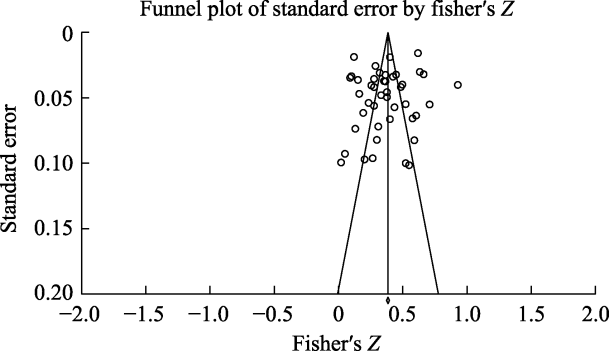
图2 漏斗图
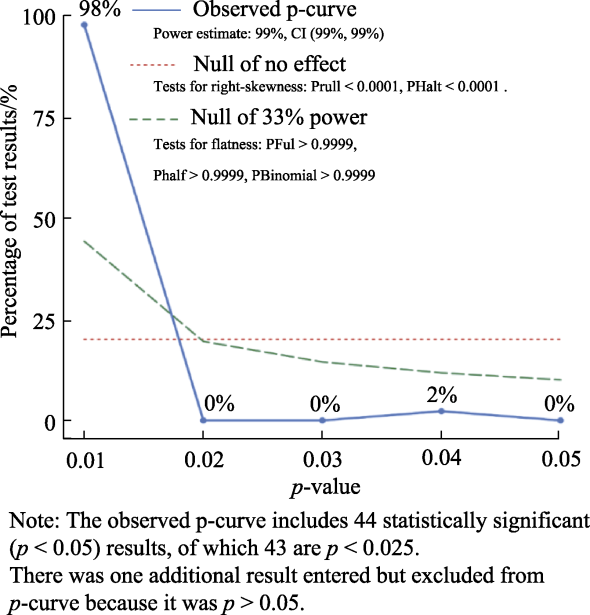
图3 p-curve曲线
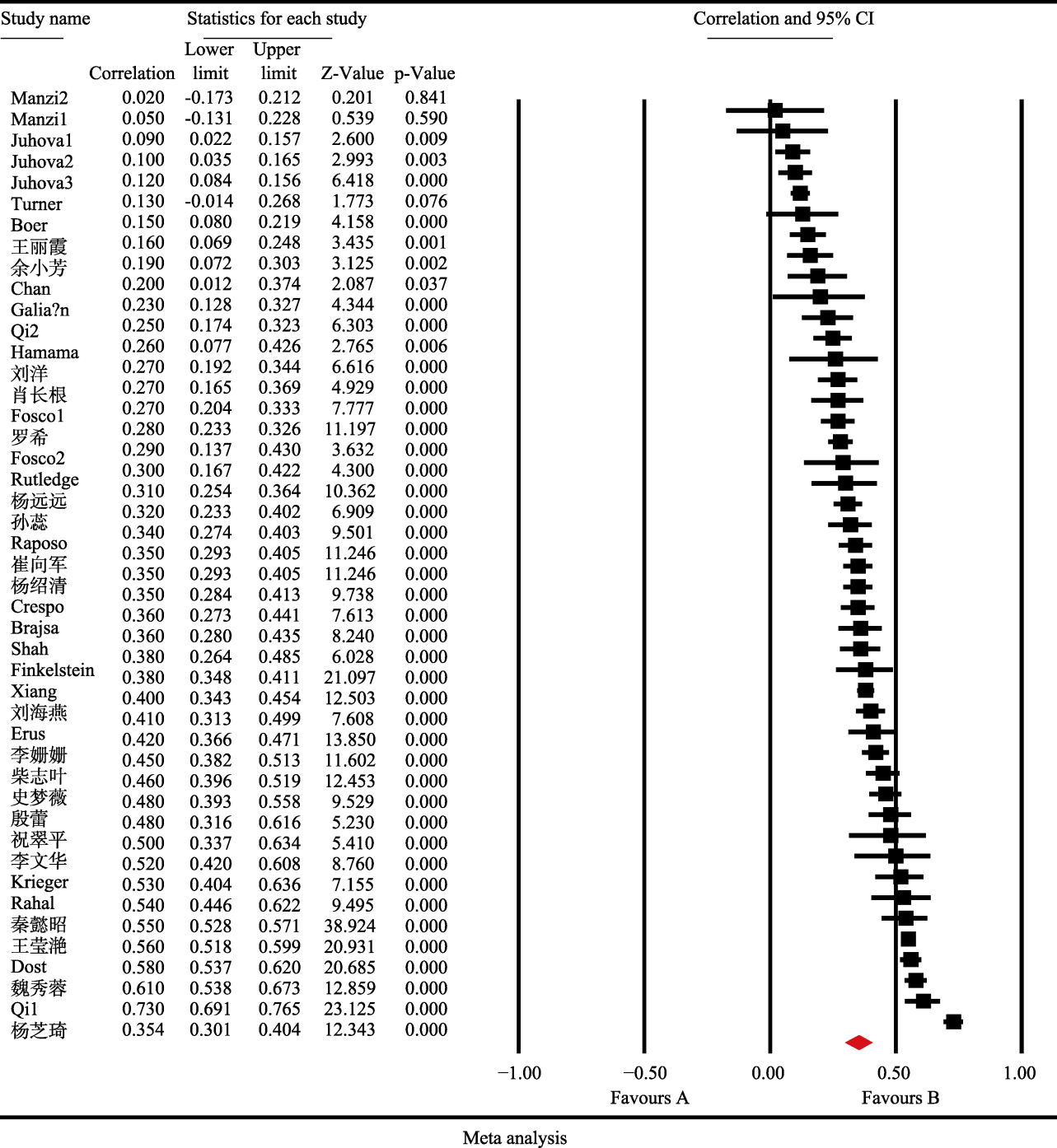
图4 森林图
| 调节变量 | 异质性检验 | 类别 | k | 95%置信区间 | 双侧检验z | ||||
|---|---|---|---|---|---|---|---|---|---|
| Q | df | p | 估计值 | 下限 | 上限 | ||||
| 年龄阶段 | 0.02 | 1 | 0.90 | 大学生 | 17 | 0.35 | 0.29 | 0.42 | 9.56 |
| 中学生 | 26 | 0.36 | 0.29 | 0.43 | 9.03 | ||||
| 家庭亲密度测量工具 | 3.38 | 2 | 0.19 | FACES-II | 18 | 0.43 | 0.35 | 0.49 | 10.33 |
| FACES-IV | 4 | 0.42 | 0.21 | 0.59 | 3.72 | ||||
| FES | 8 | 0.35 | 0.31 | 0.39 | 15.25 | ||||
| 幸福感测量工具 | 9.11 | 3 | 0.03 | ASWBS | 3 | 0.52 | 0.10 | 0.78 | 2.39 |
| GWB | 5 | 0.29 | 0.22 | 0.36 | 7.73 | ||||
| PWB | 8 | 0.43 | 0.36 | 0.50 | 10.45 | ||||
| SWB | 3 | 0.29 | 0.16 | 0.42 | 4.16 | ||||
| 设计类型 | 0.13 | 1 | 0.72 | 横断 | 42 | 0.35 | 0.30 | 0.41 | 11.62 |
| 纵向 | 3 | 0.34 | 0.26 | 0.41 | 8.03 | ||||
表4 分类变量调节效应分析结果
| 调节变量 | 异质性检验 | 类别 | k | 95%置信区间 | 双侧检验z | ||||
|---|---|---|---|---|---|---|---|---|---|
| Q | df | p | 估计值 | 下限 | 上限 | ||||
| 年龄阶段 | 0.02 | 1 | 0.90 | 大学生 | 17 | 0.35 | 0.29 | 0.42 | 9.56 |
| 中学生 | 26 | 0.36 | 0.29 | 0.43 | 9.03 | ||||
| 家庭亲密度测量工具 | 3.38 | 2 | 0.19 | FACES-II | 18 | 0.43 | 0.35 | 0.49 | 10.33 |
| FACES-IV | 4 | 0.42 | 0.21 | 0.59 | 3.72 | ||||
| FES | 8 | 0.35 | 0.31 | 0.39 | 15.25 | ||||
| 幸福感测量工具 | 9.11 | 3 | 0.03 | ASWBS | 3 | 0.52 | 0.10 | 0.78 | 2.39 |
| GWB | 5 | 0.29 | 0.22 | 0.36 | 7.73 | ||||
| PWB | 8 | 0.43 | 0.36 | 0.50 | 10.45 | ||||
| SWB | 3 | 0.29 | 0.16 | 0.42 | 4.16 | ||||
| 设计类型 | 0.13 | 1 | 0.72 | 横断 | 42 | 0.35 | 0.30 | 0.41 | 11.62 |
| 纵向 | 3 | 0.34 | 0.26 | 0.41 | 8.03 | ||||
| (*标记文献为纳入元分析的文献) | |
| [1] | * 柴志叶. (2017). 高中生家庭功能、自尊和心理幸福感的关系研究 [硕士学位论文]. 河北师范大学, 石家庄. |
| [2] | * 崔向军, 崔建强, 许春梅, 杨绍清. (2010). 城镇初中生幸福感特点及其与家庭环境的关系. 中国健康心理学杂志, 18(4), 449-451. https://doi.org/10.13342/j.cnki.cjhp.2010.04.032 |
| [3] | * 李姗姗. (2024). 家庭功能对初中生心理幸福感的影响:个人成长主动性的中介作用及干预 [硕士学位论文]. 云南师范大学, 昆明. |
| [4] | * 李文华, 王丽萍, 苑杰. (2014). 大学生主观幸福感与家庭亲密度和适应性的关系. 中国健康心理学杂志, 22(7), 1067-1070. https://doi.org/10.13342/j.cnki.cjhp.2014.07.043 |
| [5] | * 刘海燕. (2020). 新冠肺炎疫情下大学生幸福度测量及家庭功能的伦理解析. 昆明理工大学学报(社会科学版), 20(4), 24-32. https://doi.org/10.16112/j.cnki.53-1160/c.2020.04.004 |
| [6] |
* 刘洋, 许红芝. (2015). 临床医学专业本科生家庭环境、心理韧性与主观幸福感的关系研究. 中国全科医学, 18(19), 2346-2349. https://doi.org/10.3969/j.issn.1007-9572.2015.19.024
doi: 10.3969/j.issn.1007-9572.2015.19.024 URL |
| [7] | * 罗希. (2020). 中职学生家庭环境、班级环境与主观幸福感的现状及关系研究 [硕士学位论文]. 福建师范大学, 福州. |
| [8] | 牛凯宁, 李梅, 张向葵. (2021). 青少年友谊质量和主观幸福感的关系: 一项元分析. 心理发展与教育, 37(3), 407-418. https://doi.org/10.16187/j.cnki.issn1001-4918.2021.03.12 |
| [9] |
* 秦懿昭, 俸华, 张月. (2024). 大学生家庭功能与积极心理健康水平的调查研究. 心理月刊, 19(17), 100-102+ 108. https://doi.org/10.19738/j.cnki.psy.2024.17.025
doi: 10.19738/j.cnki.psy.2024.17.025 URL |
| [10] | * 史梦薇, 蔡菲, 李强, 罗国宾. (2020). 家庭功能对大学生心理幸福感的影响: 手机依赖和同伴信任的多重中介作用. 中国社会心理学评论, 18(1), 51-60. |
| [11] | * 孙蕊. (2016). 大学生主观幸福感和家庭亲密度、学业情绪的关系 [硕士学位论文]. 河南大学, 郑州. |
| [12] | 唐涵羽, 张阔, 李霞. (2024). 感知社会支持与网络欺负的关系: 一项元分析. 应用心理学. https://doi.org10.20058/ j.cnki.CJAP.023208 |
| [13] | * 王丽霞. (2016). 大学生心理弹性的保护性因素:社会支持、家庭亲密度及适应性、情绪调节方式的作用机制研究 [硕士学位论文]. 西南大学, 重庆. |
| [14] | * 王莹滟, 郭成, 王亭月, 彭于珏, 付波. (2023). 家庭亲密度对中职生心理幸福感的影响:心理韧性与生命意义的作用. 西南大学学报, 45(2), 12-19. https://doi.org/10.13718/j.cnki.xdzk.2023.02.002 |
| [15] | * 魏秀蓉. (2019). 家庭功能对初中生幸福感的影响:情绪智力与自尊的中介作用 [硕士学位论文]. 广州大学. |
| [16] | 卫旭华. (2021). 组织与管理研究中的元分析方法. 北京: 科学出版社 |
| [17] | * 肖长根, 肖景. (2018). 大学生主观幸福感与家庭亲密度和适应性的相关研究. 家庭生活指南, (8), 186. |
| [18] | * 杨绍清. (2006). 城镇初中生幸福感的特点及家庭因素对其的影响研究 [硕士学位论文]. 河北师范大学, 石家庄. |
| [19] | * 杨远远. (2020). 家庭仪式对中学生主观幸福感的影响——家庭亲密度和家庭支持的中介作用 [硕士学位论文]. 河南大学, 郑州. |
| [20] | * 杨芝琦. (2023). 家庭亲密度对初中生主观幸福感的影响——社会联结和自我概念清晰性的中介作用 [硕士学位论文]. 山西大学, 太原. |
| [21] |
叶静, 张戌凡. (2021). 老年人心理韧性与幸福感的关系:一项元分析. 心理科学进展, 29(2), 202-217. https://dx.doi.org/10.3724/SP.J.1042.2021.00202
doi: 10.3724/SP.J.1042.2021.00202 URL |
| [22] | * 殷蕾. (2019). 高中生家庭功能、人际信任与心理幸福感的关系研究 [硕士学位论文]. 扬州大学. |
| [23] | * 余小芳, 雷良忻. (2004). 民办高校学生主观幸福感与人格、家庭功能关系研究. 中国学校卫生, 25(3), 269-270. |
| [24] | 俞国良. (2024). 心理健康问题的当代诠释:学理与系统视角. 北京师范大学学报(社会科学版), (2), 29-43. |
| [25] | 俞国良, 李建良, 王勍. (2018). 生态系统理论与青少年心理健康教育. 教育研究, 39(3), 110-2117. |
| [26] | 张兴贵, 何立国, 郑雪. (2004). 青少年学生生活满意度的结构和量表编制. 心理科学, 27(5), 1257-1260. https://doi.org/10.16719/j.cnki.1671-6981.2004.05.068 |
| [27] |
张亚利, 张建根, 李红霞, 姜永志. (2022). 社会经济地位与抑郁的关系: 系统综述和元分析. 心理科学进展, 30(12), 2650-2665. https://doi.org/10.3724/SP.J.1042.2022.02650
doi: 10.3724/SP.J.1042.2022.02650 URL |
| [28] | * 祝翠平. (2019). 农村初中生家庭亲密度、应对方式和主观幸福感的关系研究 [硕士学位论文]. 广西师范大学, 桂林. |
| [29] | Avola P., Soini-Ikonen T., Jyrkiäinen A., & Pentikäinen V. (2025). Interventions to teacher well-being and burnout a scoping review. Educational Psychology Review, 37, Article 11. https://doi.org/10.1007/s10648-025-09986-2 |
| [30] | Balada F., Aluja A., García Ó., Aymamí N., & García L. F. (2024). Gender differences in prefrontal cortex response to negative emotional stimuli in drivers. Brain Sciences, 14(9), Article 884. https://doi.org/10.3390/brainsci14090884 |
| [31] | Bellini D., Mascia M. L., Conti R., & Penna M. P. (2025). Smartphone overuse and distraction: Which relationship with general well-being across different generations? BMC Public Health, 25(1), Article 427. https://doi.org/10.1186/s12889-024-21269-z |
| [32] |
Bian Y., Jin K., & Zhang Y. (2024). The association between family cohesion and depression: A systematic review and meta-analysis. Journal of Affective Disorders, 355, 220-230. https://doi.org/10.1016/j.jad.2024.03.138
doi: 10.1016/j.jad.2024.03.138 URL |
| [33] | * Boer D., & Abubakar A. (2014). Music listening in families and peer groups: Benefits for young people’s social cohesion and emotional well-being across four cultures. Frontiers in Psychology, 5, Article 392. https://doi.org/10.3389/fpsyg.2014.00392 |
| [34] | Bowlby J. M. (1969). Attachment and loss: Attachment (Vol. 1). New York: Basic Books. |
| [35] |
* Brajsa-Zganec A., Lipovcan L. K., Ivanovic D., & Larsen Z. P. (2017). Well-being of nursing students: Role of affect regulation, self-esteem, family cohesion and social support. The Open Public Health Journal, 10, 69-79. https://doi.org/https://doi.org/10.2174/1874944501710010069
doi: 10.2174/1874944501710010069 URL |
| [36] | Bronfenbrenner U. (1979). The ecology of human development: Experiments by nature and design. Cambridge, MA: Harvard University Press. |
| [37] | Card N. A. (2012). Applied meta-analysis for social science research. New York: Guilford Press. |
| [38] |
* Chan R. C. H. (2022). Dyadic associations between COVID‐19‐related stress and mental well‐being among parents and children in Hong Kong: An actor- partner interdependence model approach. Family Process, 61(4), 1730-1748. https://doi.org/10.1111/famp.12760
doi: 10.1111/famp.v61.4 URL |
| [39] |
Chen S.-M., Gu B.-B., Mei X.-Z., & Zhou Y.-Y. (2025). Effects of father and mother involvement on adolescents’ emotional well-being and their differences. Child Indicators Research, 18, 847-865. https://doi.org/10.1007/s12187-025-10220-2
doi: 10.1007/s12187-025-10220-2 URL |
| [40] |
Chiang S.-C., Ting S.-J., Hung Y.-F., Sung Y.-H., & Chen W.-C. (2024). The role of family conflict and school problems in adolescent emotion dynamics. Journal of Child and Family Studies, 33(3), 877-887. https://doi.org/10.1007/s10826-024-02797-z
doi: 10.1007/s10826-024-02797-z URL |
| [41] |
Civitillo S., Mayer A.-M., & Jugert P. (2024). A systematic review and meta-analysis of the associations between perceived teacher-based racial-Ethnic discrimination and student well-being and academic outcome. Journal of Educational Psychology, 116(5), 719-741. https://doi.org/10.1037/edu0000818
doi: 10.1037/edu0000818 URL |
| [42] |
* Crespo C., Kielpikowski M., Pryor J., & Jose P. E. (2011). Family rituals in New Zealand families: Links to family cohesion and adolescents’ well-being. Journal of Family Psychology, 25(2), 184-193. https://doi.org/10.1037/a0023113
doi: 10.1037/a0023113 URL pmid: 21480698 |
| [43] |
Deci E. L., & Ryan R. M. (2000). The "what" and "why" of goal pursuits: Human needs and the self-determination of behavior. Psychological Inquiry, 11(4), 227-268. https://doi.org/10.1207/s15327965pli1104_01
doi: 10.1207/S15327965PLI1104_01 URL |
| [44] | Deng S., Su J., Yang H., Liang J., & Zhu S. (2025). Urban built environment and its impact on university students’ loneliness: A mechanistic study. Frontiers in Public Health, 13, Article 1514820. https://doi.org/10.3389/fpubh.2025.1514820 |
| [45] |
Diekman A. B., & Eagly A. H. (2000). Stereotypes as dynamic constructs: Women and men of the past, present, and future. Personality and Social Psychology Bulletin, 26(10), 1171-1188. https://doi/1171-188. 10.1177/01461 67200262001
doi: 10.1177/0146167200262001 URL |
| [46] |
Diener E., & Emmons R. A. (1984). The independence of positive and negative affect. Journal of Personality and Social Psychology, 47(5), 1105-1117. https://doi/10.1037/ 0022-3514.47.5.1105
doi: 10.1037//0022-3514.47.5.1105 pmid: 6520704 |
| [47] |
Diener E., Emmons R. A., Larsen R. J., & Griffin S. (1985). The satisfaction with life scale. Journal of Personality Assessment, 49(1), 71-75. https://doi.org/10.1207/s15327752jpa4901_13
doi: 10.1207/s15327752jpa4901_13 URL pmid: 16367493 |
| [48] |
Diener E., Oishi S., & Lucas R. E. (2003). Personality, culture, and subjective well-being: Emotional and cognitive evaluations of life. Annual Review of Psychology, 54, 403-425. https://doi.org/10.1146/annurev.psych.54.101601.145056
URL pmid: 12172000 |
| [49] | Ding Y., Huang H., Zhang Y., Peng Q., Yu J., Lu G., Wu H., & Chen C. (2022). Correlations between smartphone addiction and alexithymia, attachment style, and subjective well-being: A meta-analysis. Frontiers in Psychology, 13, Article 971735. https://doi.org/10.3389/fpsyg.2022.971735 |
| [50] |
* Dost-Gözkan A. (2021). The gratification of psychological needs and well‐being among Turkish adolescents: An examination of direct and indirect links. Journal of Research on Adolescence, 31(1), 52-70. https://doi.org/10.1111/jora.12582
doi: 10.1111/jora.v31.1 URL |
| [51] |
Egger M., Smith G. D., Schneider M., & Minder C. (1997). Bias in meta-analysis detected by a simple, graphical test. British Medical Journal, 315(7109), 629-634. https://doi.org/10.1136/bmj.315.7109.629
doi: 10.1136/bmj.315.7109.629 URL |
| [52] | * Erus S. M., Uygun E. G., Deniz M. E., & Satıcı S. A. (2024). Adverse childhood experiences and subjective happiness: Half-longitudinal mediation role of family sense of coherence. Personality and Individual Differences, 230, Article 112810. https://doi.org/10.1016/j.paid.2024.112810 |
| [53] | Fazio A. (1977). A concurrent validational study of the NCHS General Well-Being Schedule. Hyattsville, MD: National Center for Health Statistics. |
| [54] |
Feng L., & Tan Y. (2023). Understanding the impact of parental involvement subtypes on Chinese preschool children’s language ability. Current Psychology, 42, 31434-31447. https://doi.org/10.1007/s12144-022-04176-7
doi: 10.1007/s12144-022-04176-7 URL |
| [55] | * Finkelstein I., & Grebelsky-Lichtman T. (2022). Adolescents in divorced families: The interplay of attachment patterns, family environment, and personal characteristics. Journal of Divorce & Remarriage, 63(2), 120-149. https://doi.org/10.1080/10502556.2021.1993017 |
| [56] |
Fredrickson B. L. (2001). The role of positive emotions in positive psychology: The broaden-and-build theory of positive emotions. American Psychologist, 56(3), 218-226. https://doi.org/10.1037/0003-066X.56.3.218
doi: 10.1037//0003-066x.56.3.218 URL pmid: 11315248 |
| [57] |
* Fosco G. M., Caruthers A. S., & Dishion T. J. (2012). A six-year predictive test of adolescent family relationship quality and effortful control pathways to emerging adult social and emotional health. Journal of Family Psychology, 26(4), 565-575. https://doi.org/10.1037/a0028873
doi: 10.1037/a0028873 URL pmid: 22709261 |
| [58] |
* Fosco G. M., & Lydon-Staley D. M. (2020). Implications of family cohesion and conflict for adolescent mood and well-being: Examining within- and between-family processes on a daily timescale. Family Process, 59(4), 1672-1689. https://doi.org/10.1111/famp.12515
doi: 10.1111/famp.v59.4 URL |
| [59] |
Funder D. C., & Ozer D. J. (2019). Evaluating effect size in psychological research: Sense and nonsense. Advances in Methods and Practices in Psychological Science, 2(2), 156-168. https://doi.org/10.1177/2515245919847202
doi: 10.1177/2515245919847202 URL |
| [60] | * Galián M. D., & Ato E. (2023). The mediating role of negative affect in the relationship between family functioning and subjective happiness in Spanish college students. Annals of Psychology, 39(2), 239-251. https://doi.org/10.1016/j.paid.2016.06.069 |
| [61] | Gang H., Anderson M. H., & Summers J. K. (2025). Do women have lower core self-evaluations than men? A meta-analytic review of sex differences across cultures and over time. Personality and Individual Differences, 243, Article 113121. https://doi.org/10.1016/j.paid.2025.113121 |
| [62] |
Gaspar T., Cerqueira A., Guedes F. B., & de Matos M. G. (2022). Parental emotional support, family functioning and children’s quality of life. Psychological Studies, 67(2), 189-199. https://doi.org/10.1007/s12646-022-00652-z
doi: 10.1007/s12646-022-00652-z URL |
| [63] |
* Hamama L., & Arazi Y. (2012). Aggressive behaviour in at-risk children: Contribution of subjective well-being and family cohesion. Child & Family Social Work, 17(3), 284-295. https://doi.org/10.1111/j.1365-2206.2011.00779.x
doi: 10.1111/cfs.2012.17.issue-3 URL |
| [64] | Harty B., Gustafsson J.-A., Thorén M., Möller A., & Björkdahl A. (2025). Development of a gratitude intervention model and investigation of the effects of such a program on employee well-being, engagement, job satisfaction and psychological capital. Work, 80(1), 233-246. https://doi.org/10.3233/wor-220604 |
| [65] |
Huang K. J. (2024). Does valuing happiness lead to well-being? Psychological Science, 35(10), 1155-1163. https://doi.org/10.1177/09567976241263784
doi: 10.1177/09567976241263784 URL |
| [66] | Huang L., Wu W., & Yang F. (2024). Parenting style and subjective well-being in children and youth: A meta- analysis. Psychological Reports, 21, Article 6883. https://doi.org/10.1177/00332941241256883 |
| [67] |
Huedo-Medina T. B., Sánchez-Meca J., Marín-Martínez F., & Botella J. (2006). Assessing heterogeneity in meta- analysis: Q statistic or I² index? Psychological Methods, 11(2), 193-206. https://doi.org/10.1037/1082-989X.11.2.193
doi: 10.1037/1082-989X.11.2.193 URL pmid: 16784338 |
| [68] | Hunter J. E., & Schmidt F. L. (1990). Methods of meta- analysis: Correcting error and bias in research findings. Sage. |
| [69] |
Hyde J. S. (2005). The gender similarities hypothesis. American Psychologist, 60(6), 581-592. https://doi.org/10.1037/0003-066X.60.6.581
doi: 10.1037/0003-066X.60.6.581 URL pmid: 16173891 |
| [70] | Jessen-Winge C., Christensen C. S., & Waehrens E. E. (2025). The influence on daily occupations of Danish adolescents experiencing stress. Scandinavian Journal of Occupational Therapy, 32(1), Article 2472382. https://doi.org/10.1080/11038128.2025.2472382 |
| [71] |
* Juhová D. S., Šerek J., Macek P., & Lacinova L. (2023). Volunteering in three cohorts of Czech adolescents: The socialization roles of family, school, and associations. Applied Developmental Science, 29(2), 110-126. https://doi.org/10.1080/10888691.2023.2296684
doi: 10.1080/10888691.2023.2296684 URL |
| [72] |
Khosravi A., & Namani E. (2022). Investigating the structural model of the relationship between self- compassion and psychological hardiness with family cohesion in women with war-affected spouses: The mediating role of self-worth. Contemporary Family Therapy, 44(3), 276-283. https://doi.org/10.1007/s10591-021-09579-5
doi: 10.1007/s10591-021-09579-5 URL |
| [73] |
Körün A. B., Satıcı S. A., & Keitner G. I. (2025). Adaptation of general family functioning assesment device (GF-FAD): Its association with family adaptability, family belongingness and mental well being. Current Psychology, 44, 6798-6810. https://doi.org/10.1007/s12144-025-07673-7
doi: 10.1007/s12144-025-07673-7 URL |
| [74] | * Krieger A. (2011). The role of family functioning in ethnic identity and well-being in Jewish late adolescent women [Unpublished doctorial dissertation]. University of Rhode Island, Kingston. |
| [75] |
Kroencke L., Harari G. M., Back M. D., & Wagner J. (2023). Well-being in social interactions: Examining personality-situation dynamics in face-to-face and computer- mediated communication. Journal of Personality and Social Psychology, 124(2), 437-460. https://doi.org/10.1037/pspp0000422
doi: 10.1037/pspp0000422 URL |
| [76] |
* La Rosa V. L., Tornatore M., & Commodari E. (2024). Exploring the interplay between individual and family functioning during the COVID-19 pandemic: A cross- sectional study. Current Psychology, 43, 33578-33591. https://doi.org/10.1007/s12144-024-06058-6
doi: 10.1007/s12144-024-06058-6 URL |
| [77] | Lee H. A., Wan C., & Yang Y. (2025). Fear of happiness and emotion regulation: Implications for personal and relational well-being. Asian Journal of Social Psychology, 28(1), Article e12672. https://doi.org/10.1111/ajsp.12672 |
| [78] | Lesinskienė S., Šambaras R., Ridzvanavičiūtė I., Jūraitytė I., Skabeikaitė S., Stanelytė U., & Kubilevičiūtė M. (2025). Sense of happiness and wellness among adolescents and their school environment. Children-Basel, 12(1), Article 68. https://doi.org/10.3390/children12010068 |
| [79] | Leter T. L. M., Ellis-Davies K., Rubio B., Vecho O., Bos H. M. W., Lamb M. E., & Van Gelderen L. V. R. (2024). Parental positive affect and negative affect in same- and different-sex parent families: No associations with parental gender and caregiving role. Frontiers in Psychology, 15, Article 1332758. https://doi.org/10.3389/fpsyg.2024.1332758 |
| [80] | Li R., Wu D., Zhu L., Mi T., Jia S., & Ren Z. (2025). The association between family resilience and psychological well-being during the COVID-19 pandemic: A three-level meta-analysis. Journal of Health Psychology. Advance online publication. https://doi.org/10.1177/13591053241311572 |
| [81] | Light R. J., & Pillemer D. B. (1984). In Summing up: The science of reviewing research. Cambridge, MA: Harvard University Press |
| [82] |
Lu H. J., Zhu N., Chen B. B., & Chang L. (2024). Cultural values, parenting, and child adjustment in China. International Journal of Psychology, 59(4), 512-521. https://doi.org/10.1002/ijop.13100
doi: 10.1002/ijop.v59.4 URL |
| [83] |
* Manzi C., Vignoles V. L., Regalia C., & Scabini E. (2006). Cohesion and enmeshment revisited: Differentiation, identity, and well-being in two European cultures. Journal of Marriage and Family, 68(3), 673-689. https://doi.org/10.1111/j.1741-3737.2006.00282.x
doi: 10.1111/jomf.2006.68.issue-3 URL |
| [84] |
Markus H. R., & Kitayama S. (1991). Culture and the self: Implications for cognition, emotion, and motivation. Psychological Review, 98(2), 224-253. https://doi.org/10.1037/0033-295x.98.2.224
doi: 10.1037/0033-295X.98.2.224 URL |
| [85] | Moos R. H., & Moos B. A. (1981). Manual for the Family Environment Scale. Palo Alto, CA: Consulting Psychologists Press. |
| [86] |
Nezlek J. B., & Humphrey A. (2023). Individualism, collectivism, and well-being among a sample of emerging adults in the United States. Emerging Adulthood, 11(2), 520-524. https://doi.org/10.1177/21676968211054596
doi: 10.1177/21676968211054596 URL |
| [87] |
Nguyen M. H., Gruber J., Marler W., Hunsaker A., Fuchs J., & Hargittai E. (2022). Staying connected while physically apart: Digital communication when face-to-face interactions are limited. New Media & Society, 24(9), 2046-2067. https://doi.org/10.1177/1461444820985442
doi: 10.1177/1461444820985442 URL |
| [88] |
Oishi S., & Graham J. (2010). Social ecology: Lost and found in psychological science. Perspectives on Psychological Science, 5(4), 356-377. https://doi.org/10.1177/1745691610374588
doi: 10.1177/1745691610374588 URL pmid: 26162183 |
| [89] |
Olson D. (2011). FACES IV and the circumplex model: Validation study. Journal of Marital and Family Therapy, 37(1), 64-80. https://doi.org/10.1111/j.1752-0606.2009.00175.x
doi: 10.1111/j.1752-0606.2009.00175.x URL pmid: 21198689 |
| [90] | Olson D., Portner J., & Bell R. (1982). Family Adaptability and Cohesion Scale - second edition (FACES II). Minneapolis: University of Minnesota. |
| [91] |
Olson D. H., Sprenkle D. H., & Russell C. S. (1979). Circumplex model of marital and family systems: I. Cohesion and adaptability dimensions, family types, and clinical applications. Family Process, 18(1), 3-28. https://doi.org/10.1111/j.1545-5300.1979.00003.x
URL pmid: 437067 |
| [92] | Page M. J., McKenzie J. E., Bossuyt P. M., Boutron I., Hoffmann T. C., Mulrow C. D., ... Moher D. (2021). The PRISMA 2020 statement: An updated guideline for reporting systematic reviews. British Medical Journal, 372, Article n71. https://doi.org/10.1136/bmj.n71 |
| [93] |
Planalp E. M., Nowak A. L., Tran D., Lefever J. B., & Braungart-Rieker J. M. (2022). Positive parenting, parenting stress, and child self-regulation patterns differ across maternal demographic risk. Journal of Family Psychology, 36(5), 713-724. https://doi.org/10.1037/fam0000934
doi: 10.1037/fam0000934 URL |
| [94] |
Poulin M. J., Ministero L. M., Shaffer-Morrison C. D., Finnerty K., Mei L., Zedomi I. N., & Gabriel S. (2025). Trait Mindfulness and Prosocial Behavior: The Moderating role of self-construals and individualism. Mindfulness. 16, 823-832. https://doi.org/10.1007/s12671-024-02512-5
doi: 10.1007/s12671-024-02512-5 URL |
| [95] | * Qi W., Shi J., & Cui L. (2022). Parental optimism improves youth psychological well-being: Family cohesion and youth optimism as serial mediators. Healthcare, 10(10). Article 1832 https://doi.org/10.3390/healthcare10101832 |
| [96] | * Qi W., Shi J., & Cui L. (2023). Family contagion of mental toughness and its influence on youth mental well-being: Family cohesion as a moderator. Personality and Individual Differences, 202, Article 111963. https://doi.org/https://doi.org/10.1016/j.paid.2022.111963 |
| [97] |
* Rahal D., & Fosco G. M. (2024). Positive well‐being and dampened emotional reactivity to daily family conflict and family cohesion. Child Development, 96(2), 797-811. https://doi.org/10.1111/cdev.14206
doi: 10.1111/cdev.v96.2 URL |
| [98] | * Raposo B., & Francisco R. (2022). Emotional (dys) regulation and family environment in (non) clinical adolescents’ internalizing problems: The mediating role of well-being. Frontiers in Psychology, 13, Article 703762. https://doi.org/10.3389/fpsyg.2022.703762 |
| [99] |
Rusu P. P., Candel O.-S., Bogdan I., Ilciuc C., Ursu A., & Podina I. R. (2025). Parental stress and well-being: A meta- analysis. Clinical Child and Family Psychology Review, 28, 255-274. https://doi.org/10.1007/s10567-025-00515-9
doi: 10.1007/s10567-025-00515-9 URL |
| [100] |
* Rutledge C. M., Davies S. M., & Davies T. C. (1994). Family dysfunction and the well-being of medical students. Family Systems Medicine, 12(2), 197-204. https://doi.org/10.1037/h0089097
doi: 10.1037/h0089097 URL |
| [101] |
Ryff C. D., & Keyes C. L. M. (1995). The structure of psychological well-being revisited. Journal of Personality and Social Psychology, 69(4), 719-727. https://doi.org/10.1037//0022-3514.69.4.719
doi: 10.1037//0022-3514.69.4.719 URL pmid: 7473027 |
| [102] |
Sánchez-Zafra M., Gómez-López M., Ortega-Ruiz R., & Viejo C. (2024). The association between dating violence victimization and the well-being of young people: A systematic review and meta-analysis. Psychology of Violence, 14(3), 158-173. https://doi.org/10.1037/vio0000499
doi: 10.1037/vio0000499 URL |
| [103] |
Seryjová Juhová D., Šerek J., Macek P., & Lacinová L. (2023). Volunteering in three cohorts of czech adolescents: The socialization roles of family, school, and associations. Applied Developmental Science, 29(2), 110-126. https://doi.org/10.1080/10888691.2023.2296684
doi: 10.1080/10888691.2023.2296684 URL |
| [104] |
Simonsohn U., Nelson L. D., & Simmons J. P. (2014). P-curve: A key to the file-drawer. Journal of Experimental Psychology: General, 143(2), 534-547. https://doi.org/10.1037/a0033242
doi: 10.1037/a0033242 URL |
| [105] | Shah S., Choi M., Miller M., Halgunseth L. C., van Schaik S. D., & Brenick A. (2021). Family cohesion and school belongingness: Protective factors for immigrant youth against bias‐based bullying. New Directions for Child and Adolescent Development, 177, 199-217. https://doi.org/10.1002/cad.20410 |
| [106] |
Stern C., Lizarondo L., Carrier J., Godfrey C., Rieger K., Salmond S., ... Loveday H. (2020). Methodological guidance for the conduct of mixed methods systematic reviews. JBI Evidence Synthesis, 18(10), 2108-2118. https://doi.org/10.1097/XEB.0000000000000282
doi: 10.11124/JBISRIR-D-19-00169 URL |
| [107] |
Tu Y., Su Y., Yang K., Jin L., Li B., Chen W., ... Wu D. (2025). The role of depression and interpersonal trust between anxiety and social avoidance among college students: A structural equation model. Current Psychology, 44, 3420-3431. https://doi.org/10.1007/s12144-024-07261-1
doi: 10.1007/s12144-024-07261-1 URL |
| [108] | * Turner F. D. (2015). The relationship between adolescent well-being and commitment to family-of-origin [Unpublished master’s thesis]. University of Pretoria, South Africa. |
| [109] |
Woods S. B., Hiefner A., Roberson P. N., Zahra N., Arnold E. M., & Udezi V. (2023). Depressed mood and environmental mastery as potential pathways linking family relationship quality and disease self-management for African Americans with hypertension. Family Process, 62(1), 230-253. https://doi.org/10.1111/famp.12789
doi: 10.1111/famp.v62.1 URL |
| [110] |
* Xiang G., Li Q., Du X., Liu X., Xiao M., & Chen H. (2022). Links between family cohesion and subjective well-being in adolescents and early adults: The mediating role of self-concept clarity and hope. Current Psychology, 41(1), 76-85. https://doi.org/10.1007/s12144-020-00795-0
doi: 10.1007/s12144-020-00795-0 URL |
| [111] | Xin S., Zhang Y., Sheng L., Zhao T., & Peng H. (2023). The impact of social change on the decreasing trend of subjective well-being in Chinese adolescents: A cross- temporal meta-analysis. Children and Youth Services Review, 150, Article 106988. https://doi.org/10.1016/j.childyouth.2023.106988 |
| [112] | Yalçın İ. (2015). Relationships between well-being and social support: A meta analysis of studies conducted in Turkey. Turkish Journal of Psychiatry, 26(1), 21-32. https://doi.org/10.5080/u7769 |
| [113] | Yang F.-R., Wei C.-F., & Tang J.-H. (2019). Effect of Facebook social comparison on well-being: A meta- analysis. Journal of Internet Technology, 20(6), 1829-836. https://doi.org/10.3966/160792642019102006013 |
| [114] | Yaqoob S., Ishaq M. I., Mushtaq M., & Raza A. (2023). Family or otherwise: Exploring the impact of family motivation on job outcomes in collectivistic society. Frontiers in Psychology, 14, Article 889913. https://doi.org/10.3389/fpsyg.2023.889913 |
| [115] |
Yeo G., Lansford J. E., Hirshberg M. J., & Tong E. M. W. (2024). Associations of childhood adversity with emotional well-being and educational achievement: A review and meta-analysis. Journal of Affective Disorders, 347, 387-398. https://doi.org/10.1016/j.jad.2023.11.083
doi: 10.1016/j.jad.2023.11.083 URL pmid: 38000469 |
| [116] | Yu B., Tong J., & Guo C. (2025). Association between parental phubbing and adolescents’ depression: Roles of family cohesion and resilience. Children and Youth Services Review, 169, Article 108082. https://doi.org/10.1016/j.childyouth.2024.108082 |
| [117] |
Yuen M., & Wu L. J. (2024). Relationship between school connectedness and psychological well-being in adolescents: A meta-analysis. Current Psychology, 43, 10590-10605. https://doi.org/10.1007/s12144-023-05164-1
doi: 10.1007/s12144-023-05164-1 URL |
| [118] |
Zentner K. E., Lee H., Dueck B. S., & Masuda T. (2023). Cultural and gender differences in social anxiety: The mediating role of self-construals and gender role identification. Current Psychology, 42, 21363-21374. https://doi.org/10.1007/s12144-022-03116-9
doi: 10.1007/s12144-022-03116-9 URL |
| [119] | Zhang J., Chang B., & Fang J. (2025). Awe influences prosocial behavior and subjective well-being through the quiet ego. Journal of Happiness Studies, 26, Article 2. https://doi.org/10.1007/s10902-024-00834-8 |
| [120] |
Zhang X., Abbas J., Shahzad M. F., Shankar A., Ercisli S., & Dobhal D. C. (2024). Association between social media use and students’ academic performance through family bonding and collective learning: The moderating role of mental well-being. Education and Information Technologies, 29(11), 14059-14089. https://doi.org/10.1007/s10639-023-12407-y
doi: 10.1007/s10639-023-12407-y URL |
| [121] | Zhou S., Liu G., Huang Y., Huang T., Lin S., Lan J., Yang H., & Lin R. (2023). The contribution of cultural identity to subjective well-being in collectivist countries: A study in the context of contemporary Chinese culture. Frontiers in Psychology, 14, Article 1170669. https://doi.org/10.3389/fpsyg.2023.1170669 |
| [122] | Zuñiga M. L., Mulholland K., Lewin-Fischer P., Roman I. M. S., Toledo L., & Urada L. (2024). Examining the effects of parental migration on youth mental health and substance use: A qualitative study in rural Yucatán, México. Frontiers in Psychiatry, 15, Article 1368619. https://doi.org/10.3389/fpsyt.2024.1368619 |
| [1] | 张楠, 李旭奎. 复杂言语加工任务中无关言语效应的元分析[J]. 心理科学进展, 2026, 34(1): 60-82. |
| [2] | 范伟, 程颖. 悲伤与亲社会行为关系的三水平元分析[J]. 心理科学进展, 2026, 34(1): 83-96. |
| [3] | 孙路闻, 周月, 蒋重清. 群际共情偏差的脑功能网络:基于fMRI研究的元分析[J]. 心理科学进展, 2025, 33(8): 1306-1320. |
| [4] | 张露, 王子谦, 张清芳. 词汇获得年龄效应的认知机制: 三水平元分析[J]. 心理科学进展, 2025, 33(7): 1199-1220. |
| [5] | 李莹, 翟一惠, 郝守彬, 戴雅杏, 马晓博, 李甜甜, 王悦. 二语具身效应及其影响因素:基于元分析的证据[J]. 心理科学进展, 2025, 33(7): 1221-1233. |
| [6] | 薛笑然, 崔伟, 张丽. 空间导航能力性别差异的三水平元分析[J]. 心理科学进展, 2025, 33(5): 843-862. |
| [7] | 张婷雨, 林佳佳, 孙翠翠. 社会排斥与创造力关系的元分析[J]. 心理科学进展, 2025, 33(4): 632-646. |
| [8] | 卫旭华, 焦文颖. 权力接近−抑制行为理论:基于元分析的理论拓展[J]. 心理科学进展, 2025, 33(2): 274-290. |
| [9] | 张子健, 陈继文, 彭顺, 吴佳慧, 王思倩. 中国内地学生学习投入的变迁(2006~2024年)[J]. 心理科学进展, 2025, 33(12): 2069-2082. |
| [10] | 陈丽君, 靳悦鑫, 曾涵菡, 蒋销柳. 孤独症谱系障碍儿童语音情绪识别的障碍:韵律、语义还是整合困难?——基于三水平元分析的探究[J]. 心理科学进展, 2025, 33(12): 2083-2104. |
| [11] | 沈殷琪, 蔡怡, 吴继霞. 第三方干预对亲社会行为的影响:一项三水平元分析[J]. 心理科学进展, 2025, 33(12): 2121-2137. |
| [12] | 梁英, 赵何钧, 赵宝旭, 岳云帆, 何宁. 基于计划行为理论预测生育意愿:一项三水平元分析[J]. 心理科学进展, 2025, 33(11): 1926-1941. |
| [13] | 赵子卿, 余锦婷, 陈嘉彦, 王芸茹, 黄佳, 陈楚侨. 精神病临床高危人群的症状和功能改变:一项系统综述和三水平元分析[J]. 心理科学进展, 2025, 33(1): 42-61. |
| [14] | 苏涛, 曾浩文, 钟晓琳, 马文聪, 陈修德. 祸福相依:自恋型领导对下属效能双面效应的元分析[J]. 心理科学进展, 2024, 32(9): 1463-1487. |
| [15] | 唐甜, 王雨, 巩芳颍, 石可, 李喜, 刘伟, 陈宁. 家庭教养方式与中国青少年积极发展的关系:系列元分析[J]. 心理科学进展, 2024, 32(8): 1302-1314. |
| 阅读次数 | ||||||
|
全文 |
|
|||||
|
摘要 |
|
|||||
