


叠音在品牌名称中屡见不鲜。除了一些消费者耳熟能详的传统品牌如“旺旺” “娃哈哈” “香飘飘”, 互联网品牌也十分偏爱叠音这种特殊的语音结构, 如“货拉拉” “拼多多” “滴滴出行”等。已有品牌名称的企业, 有的也会取一个叠音型的昵称, 如杜蕾斯自称为“杜杜”, 菜鸟物流给自己取名为“菜鸟裹裹”。
随着道德消费主义日益盛行, 尤其是在互联网病毒式传播的催化下, 突如其来的道德事件防不胜防, 对企业/品牌而言, 越来越难避免深陷道德危机事件(Mosley et al., 2024)。例如, 在2023年第二十届上海国际汽车工业展览会期间, “宝马冰淇淋事件”在社交媒体上迅速发酵成负面舆情。该事件导致道德主体宝马品牌的流通市值蒸发24.21亿欧元, 折合人民币约183亿1(1济南时报. 2023-04-22. 宝马市值一夜蒸发约183亿, 一杯冰淇淋引发的“翻车”. 取自
品牌名称的语音线索会刺激消费者的听觉, 由于听觉是消费者感官的重要构成, 从感官营销来看, 研究品牌名称的语音特征就非常有意义(钟科 等, 2016)。从实践的角度来看, 通过设计品牌的语音线索, 从听觉上影响消费者的感知和行为, 其成本非常低。因此, 如果从语音线索的角度来探究当品牌遭遇危机时, 其名称中的语音线索如何影响消费者的道德反应就显得既具有理论价值又具有现实意义。
本研究基于心智知觉理论, 创新性地探究了在不同道德情境下, 叠音品牌名称对消费者道德反应的影响机制中所存在的品牌心智二维中介的非对称现象。具体来说, 本研究通过7个实验发现, 在品牌作为道德主体违规的情境下, 叠音品牌名称通过降低人们对品牌心智感知中的思考维度感知(而非感受维度), 来减少人们对品牌的消极道德反应(愤怒、厌恶、谴责、惩罚行为意图); 而在品牌作为道德受害者受害的情境下, 叠音则通过提升人们对品牌心智感知中的感受维度感知(而非思考维度), 来增强人们对品牌的积极道德反应(同情、怜悯、遗憾、购买支持行为意图)。
1 文献回顾
1.1 声音象征主义与叠音品牌名称
品牌名称是影响消费者形成品牌记忆点的关键要素, 也是品牌资产的重要组成部分。品牌语言学认为, 语音作为品牌名称的要素之一, 会对消费者的偏好与感知产生影响(Carnevale et al., 2017)。这种影响主要依赖声音的象征主义(sound symbolism)来解释(Motoki et al., 2022)。声音象征主义认为, 声音和意义之间存在着一种非人为的(nonarbitrary)关系, 也就是说, 一个字的发音, 除了其实际定义之外, 还会传达某种内隐含义(Lowrey & Shrum, 2007; Argo et al., 2010)。以往研究表明, 任何与语音相关的因素, 如单个语音元素特征(元音、辅音、擦音等) (Motoki et al., 2022; Yorkston & Menon, 2004)、语音效价(Lowrey & Shrum, 2007)、语音结构特征(Argo et al., 2010)等, 都具有特定的声音象征, 从而影响人们对于声音所隐含意义的理解。
叠音是一种普遍存在的重复音节的语音结构(Argo et al., 2010; 魏华 等, 2016, 2020)。在品牌领域, 一项包含3600多个中国品牌名称的研究显示, 约有13.62%的品牌名称使用了叠音这一语音结构(殷志平, 2011)。来自语言学的研究发现, 与非叠音单词相比, 叠音单词能够增加人们对于事物的赞赏, 强化可爱感知, 亲近感, 趣味性与韵律感(Kentner et al., 2022)。来自品牌领域的研究发现, 相比于非叠音, 叠音品牌名称能够让消费者更加愉悦, 从而增加消费者对品牌的积极评价与偏好(Argo et al., 2010); 还能够激活消费者的婴儿图式, 导致消费者对叠音品牌产生更高的温暖知觉与更低的能力知觉(魏华 等, 2016, 2020)。
综上, 虽然有关品牌语音的相关研究已经从单个语音元素特征拓展到了音调、重音等各种语音特征, 但是对于叠音这类广泛存在的特殊语音结构的研究仍然比较匮乏(魏华 等, 2020)。仅有的研究主要围绕消费者知觉与偏好展开(Argo et al., 2010; 魏华 等, 2016, 2020), 研究的匮乏与叠音名称普遍出现的现实不匹配。鉴于消费者道德反应是商业伦理的重要议题, 对于企业的经营业绩、品牌形象与社会福利具有重要影响(Khamitov et al., 2020)。并且, 从整个声音象征主义研究领域来看, 也很少有研究将语音线索的相关研究推进到道德领域(Motoki et al., 2022; 钟科 等, 2016)。因此, 本文基于心智知觉理论的视角, 探究了不同道德情境下叠音品牌名称和消费者道德反应二者的因果关系。
1.2 消费者道德反应
道德反应也可以是消费者情感上的反应, 又称为道德情绪(moral emotion), 是指个体在道德事件中产生的情感反应, 这些情感反应与道德规范、价值观和责任相关(Tangney et al., 2007)。不同于一般情感以效价(积极与消极)和唤醒水平(高与低)作为二维区分标准(Russell, 1980), 道德情绪以效价(帮助与伤害(help/harm))和道德角色类型(道德主体与道德受害者(agent/patient))作为二维区分维度(Gray & Wegner, 2011)。道德主体指主动做对或者做错事情的实体。道德受害者指道德事件后果的承担者, 他们被动承受了对或者错的事情的后果(Gray & Wegner, 2009)。面对伤害他人的道德主体, 人们会产生愤怒、厌恶等情绪, 而面对受到伤害的道德受害者, 人们会产生同情、怜悯等情绪(Gray & Wegner, 2011)。
道德反应还可以是消费者行为上的反应(Khamitov et al., 2020)。营销领域的现有研究探究了剥削员工(Septianto & Kwon, 2022)、高管丑闻(Lo et al., 2021)、低俗广告(Theodorakis & Painesis, 2022)等品牌道德违规事件对于消费者抵制、忠诚和口碑等行为的影响。当品牌发生了品牌违规行为时, 消费者对品牌的偏好将会下降(Xu et al., 2021)。同时, 消费者不仅会传播违规品牌的负面口碑并且严厉谴责该品牌(Huang et al., 2020), 还会对该品牌的产品发起抵制(Khamitov et al., 2020), 甚至会因品牌的不道德行为而惩罚品牌(Septianto & Kwon, 2022)。
已有研究深入探索了消费者产生不同道德反应的原因或机制。首先是道德规范的作用, 即消费者对于企业的道德反应取决于道德违规事件的发生是否归因于企业、企业是否违反了公平正义的原则或者是否履行相关的企业义务与责任等一些道德规范上的问题(Khamitov et al., 2020)。其次, 一些个人特质也会导致消费者对品牌产生不同的道德反应。例如, 相比于高权力距离信念的消费者, 低权力距离信念的消费者由于对权力不平等现象更难以容忍, 因而会对剥削员工的企业更加反感, 更不会选择该企业的产品(Xu et al., 2021)。此外, 企业的经营行为也会影响消费者的道德反应。例如, 最近的一项关于品牌标识的研究发现, 可爱的品牌标识可以激发消费者保护品牌免受伤害的动机, 从而当品牌产生道德违规时, 减少消费者对该品牌的惩罚(Septianto & Kwon, 2022)。
本文认为, 目前有关消费者对品牌产生不同道德反应的机制研究存在两方面的不足。一方面, 已有研究尚未涉及语音线索是否/如何影响消费者对品牌的道德反应(Khamitov et al., 2020), 然而语音却是品牌名称最重要的属性之一, 是品牌与消费者之间的重要触点(钟科 等, 2016); 另一方面, 目前对消费者道德反应的研究更多集中在品牌作为道德主体的视角, 却忽视了品牌作为道德受害者的视角(Silver, 2019)。从理论上看, 品牌在道德层面是否能像人一样被全面感知的讨论有重大意义, 在实践方面, 当品牌受到伤害时, 通过某些方式激发消费者的同情与支持, 帮助品牌迅速从危机中恢复, 对于品牌方而言也具有重要意义(陈斯允 等, 2020)。
1.3 叠音品牌名称对消费者道德反应的影响
综上所述, 我们提出假设H1a与H1b:
假设H1a: 在品牌作为道德主体违规的情境下, 叠音(vs.非叠音)品牌名称能够减少消费者对品牌的消极道德反应。
假设H1b: 在品牌作为道德受害者受害的情境下, 叠音(vs.非叠音)品牌名称能够增加消费者对品牌的积极道德反应。
1.4 品牌心智感知二维度的中介作用
心智知觉理论(Mind Perception Theory)指出, 人们对事物的心智感知有两个维度: 能动性(agent)和体验性(experience) (Gray et al., 2007)。能动性是指人们感知到他人在行动中是有意识和有目的的程度, 体验性是指人们感知到他人正在经历情绪和感受的程度。心智知觉理论不仅可以运用到人对人的感知研究中, 还可以延伸到人对群体(如国家、公司)、动物以及机械代理(如机器人与计算机)的感知研究(Gray & Wegner, 2009; Gray & Wegner, 2010)。基于心智知觉理论, 营销学者们将消费者对品牌的心智感知区分为两个维度: 思考(think)维度与感受(feel)维度, 并开发出了相应的量表(Huang et al., 2020)。其中, 思考维度被描述为消费者认为品牌能够有意识地执行某些认知思维任务的程度, 感受维度描述为消费者认为品牌具有感觉和情绪的程度。
尽管存在一定的相关性, 但是需要强调的是, 心智感知的这两个维度显著区别于刻板印象内容模型的能力维度和温暖维度(Huang et al., 2020)。经典的刻板印象内容模型注重当品牌被当成人看待时, 该品牌会被如何感知的问题(Aaker et al., 2010; Fournier, 2009), 而心智知觉理论旨在回答人何时以及为何被感知为人(Waytz et al., 2010)。在具体的维度内涵上, 一方面, 温暖维度着重于人的特质(如真诚、友善、体贴等)的考察, 而感受维度则注重于事物体验各种情绪的能力的考察(Waytz et al., 2010)。另一方面, 与刻板内容印象模型的能力维度不同的是, 心智知觉理论的思考维度不仅注重能力, 更强调行为意图的产生(Gray & Wegner, 2010)。
根据心智知觉理论, 年龄幼小的人通常被认为具有较低的能动性和较高的体验性(Gray et al., 2007)。人们普遍认为, 儿童通常被视为在发起行动和使事情发生的能力方面具有的能动性是有限的(Gray & Wegner, 2009; Gray & Wegner, 2010)。这就解释了为什么在道德事件中, 人们倾向于认为婴儿与孩童作为道德主体的施害行为是由本能或反射驱动, 而不是故意的选择(Cushman et al., 2013)。但是, 婴儿在体验性维度上则具有较高的水平, 婴儿能够体验各种各样的情绪, 包括快乐、悲伤和恐惧(Gray & Wegner, 2007)。婴儿化的形象也会加强人们的脆弱性感知, 从而激发人们的保护欲(Wang et al., 2017)。因此, 我们可以推断, 具有“更可爱、年龄更小”这一内隐联想特征的叠音名称会使品牌被感知为低思考且高感受的事物。
在道德主体违规情境下, 影响人们道德反应的重要因素是施害者的主观意图, 与心智感知中的能动维度有关(Gray & Wegner, 2009; Gray & Wegner, 2010)。例如, 与意外伤害相比, 当一位罪犯是有预谋地伤害他人时, 人们对该罪犯的谴责与惩罚也越严厉(Cushman, 2008), 故意电击他人也比意外电击他人更让人觉得行径恶劣(Gray & Wegner, 2009)。从反面来说, 一个缺乏思考与意图能力的犯罪者也更容易让人原谅, 这一点从没有完全行为能力的精神病人犯罪的相关案例中可以得到验证(Aharoni et al., 2012)。品牌心智感知的思考维度正和主观意图和能力有关(Huang et al., 2020), 所以, 当品牌作为道德主体发生道德违规事件时, 消费者对品牌心智的思考维度感知越低, 他对品牌的道德谴责和惩罚意图也就越低。
基于以上文献, 我们推断: 在品牌作为道德主体时, 其名称的叠音形式会使消费者对品牌心智的思考维度的感知降低, 进而降低了消费者对品牌的消极道德反应。因此我们提出假设H2a:
假设H2a: 在品牌作为道德主体违规的情境下, 相较于非叠音品牌名称, 叠音使消费者感知到的品牌心智的思考维度更低, 从而减少了消费者对品牌的消极道德反应。
不同的是, 在道德受害者受害的情境下, 人们的道德反应与受害者感受情绪的能力(而非能动相关的能力)更有关系。如果没有感受能力, 受害者就不会感受到伤心与痛苦, 人们也不会通过感受受害者的情绪来与受害者共情(Gray & Wegner, 2009)。例如, 用枪射击一个易拉罐并不会有道德反应, 但是用枪射击一只小猫则会让人们产生强烈的道德反应(Gray & Wegner, 2009)。这是因为人们认为易拉罐不具有感受能力, 不会感受到痛苦, 但是小猫有感受能力, 会觉得疼痛、害怕和悲伤。因此, 当品牌成为道德受害者时, 其心智感知中的感受维度可以增强消费者的积极道德反应(Huang et al., 2020)。由于叠音具有可爱化与幼龄化的内隐特征(Kentner et al., 2022; 魏华 等, 2016), 因而消费者对叠音品牌心智的感受维度的感知会强于非叠音品牌, 从而使叠音品牌在受害情境下获得更多的积极道德反应。因此, 我们提出假设H2b:
假设H2b: 在品牌作为道德受害者受害的情境下, 相较于非叠音品牌名称, 叠音使消费者感知到的品牌心智的感受维度更高, 从而增加了消费者对品牌的积极道德反应。
2 实验1a: 道德主体情境下叠音对消费者道德反应的影响
2.1 实验目的与设计
本实验(预注册:
实验采用(名称: 叠音vs.非叠音)单因素组间实验设计。其中, 叠音品牌名称为“格鲁鲁”, 非叠音品牌名称为“格鲁” (魏华 等, 2016)。实验的情景模拟任务为企业采用低俗广告进行宣传的负面道德事件(Theodorakis & Painesis, 2022)。来自Credamo平台的200名被试(女性130人, 男性70人, Mage = 29.85岁, SD = 8.86岁)参与了实验并获得了0.5元报酬。为了确保统计效力, 我们对所需样本量进行了事前预估。通过G*Power 3.1对样本量的统计功效进行事前分析, 当效应量f = 0.4, 显著性水平为0.05, 样本量N = 118, 组别为2组时, 进行单因素方差分析的统计检验效力Power (1 − β) > 0.99。本实验的样本量大于预估样本量。
2.2 实验过程
首先, 被试被随机分配为两组并被告知需要进行一项情境想象任务。具体的引导语如下: “格鲁鲁(格鲁)是一家知名的食品公司。最近, 格鲁鲁(格鲁)推出了一则新的广告片。在广告中, 一个穿着暴露的模特拿着格鲁鲁(格鲁)的产品进行宣传。广告一经推出, 便被指责为低俗营销。”随后, 我们要求被试在心中再默念一遍品牌名称以激活语音知觉(Argo et al., 2010; 魏华 等, 2016)。接着, 我们询问了被试一系列涉及道德主体情境下的道德反应的相关问题(Gray & Wegner, 2011; Huang et al., 2020), 包括道德谴责(你认为格鲁鲁(格鲁)这一品牌应该在多大程度上因低俗广告而受到谴责?)、道德愤怒(因为这起低俗广告事件, 你对格鲁鲁(格鲁)这一品牌有多愤怒?)和道德厌恶(因为这起低俗广告事件, 你对格鲁鲁(格鲁)这一品牌有多厌恶?) (7分制, 1 = 完全没有, 7 = 非常多)。最后, 被试汇报了他们的人口统计变量信息。
2.3 实验结果
以名称类型(1 = 叠音, 0 = 非叠音)为自变量, 道德谴责、道德愤怒与道德厌恶为因变量的多元方差分析结果表明, 当品牌作为道德主体发生道德违规事件时, 叠音名称可以减少被试的谴责(M叠音 = 5.08, SD = 1.28 vs. M非叠音 = 5.50, SD = 1.23, F(1, 198) = 5.59, p = 0.019, η2p = 0.03), 愤怒(M叠音 = 4.17, SD = 1.38 vs. M非叠音 = 4.64, SD = 1.51, F(1, 198) = 5.27, p = 0.023, η2p = 0.03)与厌恶(M叠音 = 4.31, SD = 1.43 vs. M非叠音 = 4.75, SD = 1.65, F(1, 198) = 4.08, p = 0.045, η2p = 0.02)。结果支持了本文所提出的假设H1a。
2.4 实验1a小结
通过一个企业低俗广告事件的情境实验, 实验1a发现, 当品牌作为道德主体发生违规事件时, 叠音会降低对品牌的谴责、愤怒与厌恶, 支持了本文所提出的假设H1a。
3 实验1b: 道德受害者情境下叠音对消费者道德反应的影响
3.1 实验目的与设计
本实验(预注册:
3.2 实验过程
被试被随机分配到2组(叠音vs.非叠音)。随后, 被试被要求完成一项情景模拟任务。具体描述是: “请你想象以下场景: 图拉拉(图拉)是一款你在平时生活中接触过的品牌。近期, 你在新闻报道中了解到, 由于商业间谍活动, 图拉拉(图拉)正在研发的某款新产品信息被泄密, 这可能会导致图拉拉(图拉)面临上千万人民币的损失。”之后, 我们仿照Argo等学者(2010)研究中的操作, 要求被试在心中再默念一遍品牌的名称, 以激活语音知觉。接着, 我们询问了被试对品牌的同情(读完报道, 你有多同情图拉拉(图拉))、怜悯(读完报道, 你有多怜悯图拉拉(图拉))与遗憾(读完报道, 你对图拉拉(图拉)的遭遇感到多遗憾?) (1 = 一点也不, 7 = 非常) (Gray & Wegner, 2011; Huang et al., 2020)。随后, 被试汇报了他们的人口统计变量信息。
3.3 实验结果
以名称类型(1 = 叠音, 0 = 非叠音)为自变量, 道德同情、道德怜悯与道德遗憾为因变量的多元方差分析结果表明, 当品牌作为道德受害者受到伤害时, 叠音名称可以增加被试的同情(M叠音 = 5.66, SD = 0.93 vs. M非叠音 = 5.21, SD = 1.25, F(1, 198) = 8.32, p = 0.004, η2p = 0.04), 怜悯(M叠音 = 5.46, SD = 1.09 vs. M非叠音 = 5.10, SD = 1.31, F(1, 198) = 4.46, p = 0.036, η2p = 0.02)与遗憾(M叠音 = 5.86, SD = 0.95 vs. M非叠音 = 5.48, SD = 1.34, F(1, 198) = 5.31, p = 0.022, η2p = 0.03)。结果支持了本文所提出的假设H1b。
3.4 实验1b小结
通过一个企业被黑客攻击导致数据泄露的道德事件的情境实验, 实验1b的结果发现, 当品牌作为道德受害者受到伤害时, 叠音会增加消费者对受害品牌的同情、怜悯与遗憾, 支持了本文所提出的假设H1b。
4 实验2a: 道德主体情境下品牌心智的思考维度的中介作用
4.1 实验目的与设计
4.2 实验过程
首先, 被试被随机分配为两组并被告知需要进行一项情境想象任务。具体的引导语如下: “图拉拉(图拉)是一家制药公司。该公司有一款治疗慢性疾病的产品: 用于治疗帕金森病的匹莫范色林。最近, 一项营销分析结果表明, 当图拉拉(图拉)将它的药物价格提高300%, 虽然会导致一些病人因无法负担高昂的费用而放弃购买, 但是图拉拉(图拉)将获得更高的利润。最终, 图拉拉(图拉)决定将其产品的价格提高300%。”随后, 我们要求被试在心中再默念一遍品牌名称以激活语音知觉。
接着, 我们询问了被试对于品牌的道德谴责、道德愤怒、对于品牌心智的感受维度感知(这个名称让我感觉这个品牌有自己的情感/能够感受到各种情绪/有爱恨的能力/有共情的能力; α = 0.91)、思考维度感知(这个名称让我感觉这个品牌会思考/能有意识地做事/能有自己的想法/有思想意识; α = 0.93) (Huang et al., 2020)、温暖感知(这个品牌名称让我感觉这个品牌是友善的/是温暖的/是慷慨的; α = 0.91)与能力感知(这个品牌名称让我感觉这个品牌是办事有成效的/是办事有效率的/是有能力的; α = 0.93) (Aaker et al., 2010) (7分制量表, 1 = 完全没有, 7 = 非常多)。最后, 被试汇报了他们的人口统计变量信息。
4.3 实验结果
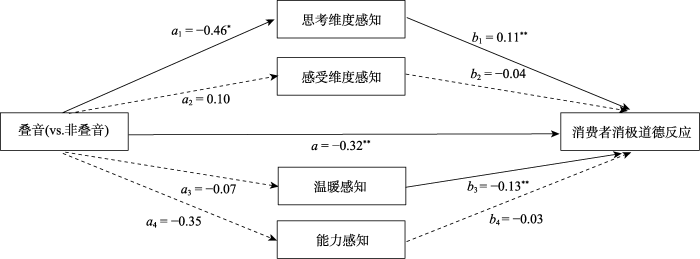
以名称类型(1 = 叠音, 0 = 非叠音)为自变量, 道德反应为因变量的多元方差分析结果表明, 当品牌作为道德主体发生道德违规事件时, 相比于非叠音名称, 被试对叠音名称的品牌更少进行道德谴责(M叠音 = 5.78, SD = 1.06 vs. M非叠音 = 6.19, SD = 0.80, F(1, 194) = 9.23, p = 0.003, η2p = 0.05), 道德愤怒也更小(M叠音 = 5.82, SD = 1.03 vs. M非叠音 = 6.11, SD = 0.90, F(1, 194) = 4.29, p = 0.040, η2p = 0.02)。将这两个变量进行加总平均后形成道德反应的指数, 结果显示, 总体上相比于非叠音组(M = 6.15, SD = 0.71), 叠音组的被试汇报了更低的消极道德反应(M = 5.80, SD = 0.91), F(1, 194) = 9.00, p = 0.003, η2p = 0.04。同时, 在叠音组中(M = 4.11, SD = 1.71), 被试能够比在非叠音组(M = 4.57, SD = 1.28)中感受到更低的品牌心智的思考维度感知, F(1, 194) = 4.57, p = 0.034, η2p = 0.02。而品牌心智的感受维度感知 (M叠音 = 3.23, SD = 1.60; M非叠音 = 3.34, SD = 1.67, F < 1, p = 0.665)、温暖感知(M叠音 = 2.31, SD = 1.42; M非叠音 = 2.38, SD = 1.31, F < 1, p = 0.715)与能力感知(M叠音 = 3.30, SD = 1.75; M非叠音 = 3.64, SD = 1.71, F = 1.97, p = 0.162)在叠音组与非叠音组中则没有显著性差别。
接下来, 我们采用对间接中介效应的自主抽样检验(PROCESS Model 4; Hayes, 2017)来验证思考感知在品牌作为道德主体发生品牌违规事件时, 叠音型品牌对消费者道德反应影响中所起的中介作用。以叠音与否(1 = 叠音, 0 = 非叠音)为自变量, 总体道德反应指数为因变量, 思考维度感知、感受维度感知、温暖感知、能力感知为并行中介变量的模型结果显示, 思考维度感知的间接效应(effect = −0.0513, SE = 0.0328, 95% CI [−0.1269, −0.0002])区间不包含0, 支持了思考维度感知所起的潜在机制作用。此外, 并行的中介效应检验模型还显示, 感受维度感知(95% CI [−0.0278, 0.0353])、温暖感知(95% CI [−0.0424, 0.067])与能力感知(95% CI [−0.0194, 0.0516])的区间都包含0, 结果说明了感受维度感知、温暖感知与能力感知的间接效应不显著。具体的中介路径系数见图1。
图1
4.4 实验2a小结
实验2a的结果表明, 当品牌作为道德主体发生道德违规时, 叠音会使消费者对品牌心智的思考维度感知下降, 从而降低对品牌的愤怒、谴责等消极的道德反应, 支持了本文的假设H2a。同时, 中介机制检验模型显示, 品牌心智的感受维度感知、温暖感知与能力感知的间接效应不显著。这表明, 在道德主体违规情境下, 心智知觉理论在叠音与道德反应的影响中表现出了更强的解释力, 且叠音仅能通过品牌心智的思考维度感知影响人们的道德反应, 而不能通过消费者对品牌心智的感受维度感知产生影响。
5 实验2b: 道德受害者情境下感受维度感知的中介作用
5.1 实验目的与设计
实验2b旨在重复实验1b结果的基础上, 探究在道德受害者受害情境下, 品牌心智的感受维度感知在叠音对消费者道德反应影响中所起的中介机制作用。此外, 本实验也还检验了刻板印象内容模型作为潜在解释机制的可能性。
实验采用(名称: 叠音vs.非叠音)单因素组间实验设计。其中, 叠音品牌名称为“图拉拉”, 非叠音品牌名称为“图拉” (魏华 等, 2016)。实验的情景模拟任务与实验1b相同, 均为数据泄露情境。来自Credamo平台的200名被试参与了实验并获得了1元报酬。其中有4人未通过注意力测试题, 最终有196个样本纳入了接下来的分析(女性119人, 男性77人, Mage = 29.86岁, SD = 7.50岁)。根据实验1a的事前功效分析结果, 本实验的样本量也大于预估的样本量。
5.2 实验过程
我们要求被试进行一项情景模拟任务。具体引导语和过程与实验1b相同。在看完引导语并再次激活语音知觉之后, 我们询问了被试对场景中的品牌的同情与支持程度(1 = 一点也不, 7 = 非常)。接下来被试被要求回答一系列问题, 包括品牌心智的感受维度感知(α = 0.90), 品牌心智的思考维度感知(α = 0.87), 温暖感知(α = 0.79)和能力感知(α = 0.92)。最后, 被试汇报了他们的人口统计信息。
5.3 实验结果
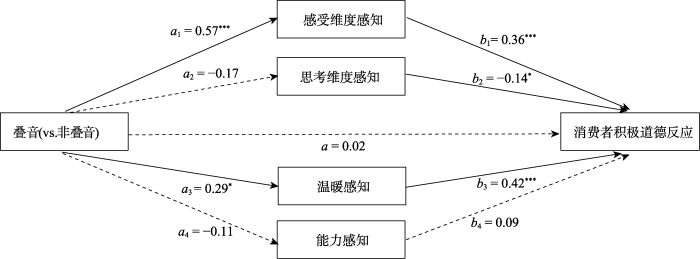
以品牌名称(1 = 叠音, 0 = 非叠音)为自变量, 消费者同情、消费者支持和品牌感受感知等其余变量为因变量的多元方差分析结果表明, 当品牌作为受害方出现时, 人们对于叠音品牌的同情(M叠音 = 5.93, SD = 0.93; M非叠音 = 5.51, SD = 1.25, F(1, 194) = 7.02, p = 0.009, η2p = 0.04)显著高于非叠音品牌。同时, 相比于非叠音品牌, 人们对于叠音品牌的支持也呈边际显著的趋势(M叠音 = 5.84, SD = 1.05; M非叠音 = 5.54, SD = 1.39, F(1, 194) = 4.62, p = 0.09, η2p = 0.01)。将这两个变量进行加总平均后形成总体道德反应的指数。结果显示, 总体上相比于非叠音组(M = 5.53, SD = 1.19), 叠音组的被试汇报了更高的积极道德反应(M = 5.88, SD = 0.89), F(1, 194) = 5.65, p = 0.018, η2p = 0.03。此外, 与非叠音品牌组相比, 叠音品牌组的被试也有更高的品牌心智的感受维度感知(M叠音 = 5.45, SD = 0.86; M非叠音 = 4.89, SD = 1.36, F(1, 194) = 12.23, p = 0.001, η2p = 0.06)与温暖感知(M叠音 = 5.62, SD = 0.87; M非叠音 = 5.33, SD = 1.08, F(1, 194) = 4.28, p = 0.040, η2p = 0.02)。但是, 品牌心智的思考维度感知(M叠音 = 5.10, SD = 1.28; M非叠音 = 5.28, SD = 1.21, F < 1, p = 0.338)与能力感知(M叠音 = 5.09, SD = 1.44; M非叠音 = 5.20, SD = 1.35, F < 1, p = 0.586)则在两组中没有显著性差别。
接着, 我们采用对中介效应的自主抽样检验(PROCESS Model 4; Hayes, 2017)来验证在道德受害者情境下, 感受感知在叠音名称对消费者道德反应影响中所起的中介作用。以叠音与否(1 = 叠音, 0 = 非叠音)为自变量, 总体道德反应指数为因变量, 品牌心智的感受维度感知、思考维度感知、温暖感知、能力感知为并行中介变量的模型结果显示, 品牌心智的感受维度感知的间接效应(effect = 0.2049, SE = 0.0827, 95% CI [0.0675,0.3881])区间不包含0, 支持了感受维度感知所起的潜在机制作用。同时, 温暖感知的间接效应(effect = 0.1216, SE = 0.074, 95% CI [0.0021,0.2849])区间也不包含0, 说明温暖感知也起到了潜在的中介机制作用。进一步的间接效应成对比较(Pairwise contrasts)检验(Hayes, 2017)显示, 感受维度感知减去温暖感知的差值项区间(95% CI [−0.124, 0.2907])包含0, 说明感受维度感知与温暖感知的间接效应差异并不显著。但是, 在控制了温暖感知的间接效应后, 品牌心智的感受维度感知的间接效应依然显著。区分效度检验结果显示, 感受维度感知(
图2
5.4 实验2b小结
实验2b的结果表明, 当品牌作为受害者受害时, 叠音会使消费者对品牌心智的感受维度感知上升, 从而对品牌产生更多的积极的道德反应。同时, 尽管温暖感知也在叠音品牌与消费者积极道德反应的关系中呈现出一定的中介效应, 但是在控制了温暖感知的中介效应后, 感受感知的中介效应仍然显著。此外, 实验2b也说明, 在道德受害者情境下, 叠音仅能通过影响消费者对品牌心智的感受维度感知来影响消费者的积极道德反应, 而不能通过消费者的思考维度感知产生影响。
6 实验3a: 道德主体情境下叠音对消费者后续惩罚行为意图的影响
6.1 实验目的与设计
实验3a在以下几个方面进行了推进。首先, 本实验在重复实验1a和2a的结果的基础上, 将叠音对消费者的道德反应的影响推进到了后续的消费者的惩罚行为上。同时, 在之前的实验中, 叠音组为三个字的名字, 非叠音组为两个字的名字, 两者的字数不同, 因此本实验通过控制两组的名字的字数相同来排除字数差异所带来的影响。
实验采用(名称: 叠音vs.非叠音vs.“小”字)单因素组间实验设计。其中, 叠音名称为“鲁鲁”, 非叠音名称为“格鲁”, “小”字名称为“小鲁”。实验的情景模拟任务与实验2a相同, 均为医药企业涨价事件。来自Credamo平台的300名被试参与了实验并获得了1元报酬。其中有4人未通过注意力测试题, 最终有296个样本纳入了接下来的分析(女性190人, 男性106人, Mage = 29.65岁, SD = 8.49岁)。为了确保统计效力, 我们对所需样本量进行了事前预估。通过G*Power 3.1对样本量的统计功效进行事前分析, 当效应量f = 0.4, 显著性水平为0.05, 样本量N = 138, 组别为3组时, 进行单因素方差分析的统计检验效力Power (1 − β) > 0.99, 本实验样本量大于预估样本量。
6.2 实验过程
首先, 被试被随机分配为三组(叠音vs.非叠音vs.“小”字)并被告知需要进行一项情境想象任务。具体的引导语与步骤与实验2a相同。在重复默念品牌名称以激活语音知觉后, 我们询问了被试与实验1a相同的道德反应问题, 包括道德谴责、道德愤怒与道德厌恶。然后, 被试回答了他们对于品牌心智的感受维度感知(α = 0.89)与思考维度感知(α = 0.91)。同时被试还需回答他们对于品牌的惩罚行为意图(我会采取行动让该品牌陷入困境/我会通过一些方式惩罚该品牌/我会找该品牌的麻烦/我会严厉抨击该品牌/我会让该品牌罪有应得; α = 0.94) (Septianto & Kwon, 2022) (7分制, 1 = 一点也不, 7 = 非常)。最后, 被试汇报了他们的人口统计变量信息。
6.3 实验结果
以名称类型(−1 = 叠音, 0 = 非叠音, 1 = “小”字)为自变量, 道德谴责、道德愤怒与道德厌恶为因变量的多元方差分析结果表明, 当品牌作为道德主体发生道德违规事件时, 叠音组、非叠音组与“小”字组中的被试对品牌的谴责(F(2, 293) = 5.40, p = 0.005, η2p = 0.04)、愤怒(F(2, 293) = 3.58, p = 0.029, η2p = 0.02)与厌恶(F(2, 293) = 3.72, p = 0.026, η2p = 0.03)有显著性差异。进一步的事前比较的结果显示(见表1), 与非叠音组相比, 叠音组中的被试道德谴责(M叠音 = 5.73, SD = 1.01 vs. M非叠音 = 6.18, SD = 0.76, t(293) = −3.11, p = 0.002, d = −0.36)、愤怒(M叠音 = 5.50, SD = 1.10 vs. M非叠音 = 5.88, SD = 0.77, t(293) = −2.36, p = 0.019, d = −0.28)与厌恶水平(M叠音 = 5.41, SD = 1.10 vs. M非叠音 = 5.80, SD = 1.00, t(293) = −2.44, p = 0.016, d = −0.29)更低。然而, 叠音组中的被试与“小”字组中的被试的谴责(M“小”字 = 5.83, SD = 1.20, t < 1, p = 0.515)、愤怒(M“小”字 = 5.52, SD = 1.42, t < 1, p = 0.925)与厌恶水平(M“小”字 = 5.43, SD = 1.27, t < 1, p = 0.870)则没有显著性差异。对愤怒与厌恶的道德情绪进行加总平均得到的道德情绪水平指数也表现出了相似的显著性水平结果(见表1)。相关结果再次支持了假设H1a。
表1 道德主体情况下叠音对消费者道德反应的机制影响事前比较结果
| 变量 | 叠音vs.非叠音 | 叠音vs.“小”字 | “小”字vs.非叠音 | ||||||
|---|---|---|---|---|---|---|---|---|---|
| t | p | d | t | p | d | t | p | d | |
| 道德谴责 | −3.11 | 0.002** | −0.36 | −0.65 | 0.515 | −0.08 | 2.47 | 0.014* | 0.29 |
| 道德愤怒 | −2.36 | 0.019* | −0.28 | −0.09 | 0.925 | −0.01 | 2.27 | 0.024* | 0.27 |
| 道德厌恶 | −2.44 | 0.016* | −0.29 | −0.16 | 0.870 | −0.02 | 2.28 | 0.024* | 0.27 |
| 总体道德情绪 | −2.63 | 0.009** | −0.31 | −0.14 | 0.888 | −0.02 | 2.49 | 0.013* | 0.29 |
| 惩罚行为意图 | −2.23 | 0.026* | −0.26 | −0.08 | 0.936 | −0.01 | 2.16 | 0.032* | 0.25 |
| 感受维度感知 | 0.83 | 0.408 | 0.10 | −0.30 | 0.768 | −0.04 | −1.13 | 0.261 | −0.13 |
| 思考维度感知 | −2.25 | 0.025* | −0.26 | 0.02 | 0.981 | 0.00 | 2.28 | 0.023* | 0.27 |
注: * p < 0.05; ** p < 0.01。
同时, 方差分析的结果还表明, 三组中的被试对品牌的惩罚行为意图(F(2, 293) = 3.22, p = 0.041, η2p = 0.02)、思考维度感知(F(2, 293) = 3.43, p = 0.034, η2p = 0.02)也有显著性的差异, 而对感受维度感知没有显著性的区别(F < 1, p = 0.506)。进一步的事前比较的结果显示, 被试在叠音条件下的惩罚行为意图(M叠音 = 3.90, SD = 1.45 vs. M非叠音 = 4.38, SD = 1.38, t(293) = −2.23, p = 0.026, d = −0.26)和思考维度感知水平(M叠音 = 4.21, SD = 1.36 vs. M非叠音 = 4.64, SD = 1.22, t(293) = −2.25, p = 0.025, d = −0.26)显著低于非叠音条件下的水平。而品牌心智的感受维度感知在两组中则没有差异(M叠音 = 3.70, SD = 1.61 vs. M非叠音 = 3.52, SD = 1.47, t < 1, p = 0.408)。并且, 叠音组与“小”字组中的惩罚行为意图水平(M“小”字 = 3.92, SD = 1.63, t < 1, p = 0.936)、思考维度感知水平(M“小”字 = 4.20, SD = 1.41, t < 1, p = 0.981)以及感受维度感知水平(M“小”字 = 3.77, SD = 1.46, t < 1, p = 0.768)均无显著性的差异。
接下来, 我们先采用对间接中介效应的多类别(multi-categorical)自主抽样检验(PROCESS Model 4; Hayes, 2017)来验证品牌心智的思考维度感知在品牌作为道德主体发生品牌违规事件时, 在叠音对消费者道德情绪反应影响中所起的中介作用。以叠音为自变量, 总体道德反应指数为因变量, 品牌心智的思考维度感知、感受维度感知为中介变量的模型结果显示, 在叠音组(X1 = 0, X2 = 0)与非叠音组(X1 = 1, X2 = 0)的对比中, 思考维度感知的间接效应(effect = 0.1278, SE = 0.0608, 95% CI [0.0182,0.2571])区间不包含0, 支持了品牌心智的思考维度感知所起的潜在机制作用。感受维度感知的间接效应区间(95% CI [−0.0643, 0.1574])包含0, 因此表明, 在道德主体违规情境下, 叠音只影响品牌心智的思考维度感知, 进而影响到后续的道德反应, 而不影响感受维度感知, 支持了假设H2a。而在叠音组与“小”字组(X1 = 0, X2 = 1)的对比中, 思考维度感知(95% CI [−0.1268, 0.1204])与感受维度感知(95% CI [−0.1285, 0.0923])的间接效应区间包含0, 表明与“小”字相比, 叠音对于品牌心智的思考维度感知、感受维度感知与道德反应的影响并没有显著性的差异。
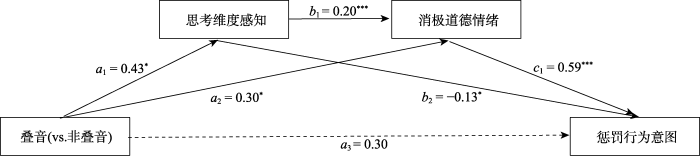
最后, 我们采用对链式中介效应的多类别自主抽样检验(PROCESS Model 6; Hayes, 2017)来验证道德主体违规情境下, 叠音→品牌思考维度感知→消极道德情绪→惩罚行为意图这一链式路径。道德主体违规情境下链式中介效应检验结果显示, 在叠音与非叠音的对比中, 叠音→品牌思考感知→道德情绪→惩罚行为意图链式中介效应区间(effect = 0.05, SE = 0.03, 95% CI [0.005,0.115])不包含0, 表明思考维度感知与道德情绪反应在叠音与消费者惩罚行为意图关系中起到了链式中介的作用, 进一步支持了假设H2a。此外, 在叠音与“小”字的对比中, 思考维度感知与道德情绪反应的链式中介效应的作用也并不显著(95% CI [−0.049, 0.051])。具体的链式中介路径系数见图3。
图3
6.4 实验3a小结
实验3a再次验证了在道德主体违规的情境下, 品牌心智的思考维度感知是叠音影响消费者道德反应的解释机制。并且, 叠音还能够通过降低消费者对品牌心智的思考维度感知, 减少消费者的负面道德情绪反应, 进而减少消费者对品牌的惩罚行为意图。同时, 实验3a还排除了品牌名称字数的干扰对实验结果的影响。此外, 实验3a还发现, “小”字也能够对品牌心智的思考维度感知与消费者道德反应产生和叠音相同的影响。
7 实验3b: 道德受害者情境下叠音对消费者后续购买支持行为意图的影响
7.1 实验目的与设计
实验3b在实验1b与2b的基础上, 旨在继续探究在道德受害者情境下, 叠音影响了道德情绪反应之后对后续消费者购买支持行为意图的影响。同时, 本实验再次在道德受害者情境下继续排除品牌名称字数对实验结果的干扰。最后, 本实验也再次在道德受害者的情境下对比了叠音与“小”字名称对于消费者道德反应影响的效果差异。
实验采用(品牌名称: 叠音vs.非叠音vs.“小”字)单因素组间实验设计。其中, 品牌名称与实验3a相同, 三组名称分别为“鲁鲁” “格鲁”与“小鲁”。实验的情景模拟任务为游戏企业因霸王条款而遭受损失的道德事件。来自Credamo平台的300名被试参与了实验并获得了1元报酬。其中有8人未通过注意力测试题, 最终有292个样本纳入了接下来的分析(女性184人, 男性108人, Mage = 31.48岁, SD = 10.23岁)。根据实验3a的事前功效分析结果, 本实验的样本量也大于预估的样本量。
7.2 实验过程
首先, 被试被随机分配为三组并被告知需要进行一项情境想象任务。具体的引导语如下: “鲁鲁(格鲁/小鲁)是一家你在平时生活中接触过的游戏运营商。近期, 你在新闻报道中了解到, 由于合作过程中游戏制作方提出了不合理的霸王条款, 鲁鲁(格鲁/小鲁)无法继续运营相关游戏, 这可能会导致鲁鲁(格鲁/小鲁)面临上千万人民币的损失。”随后, 我们要求被试在心中再默念一遍品牌名称以激活语音知觉。接着, 我们询问了被试与实验1b相同的问题, 包括同情、遗憾、怜悯、感受维度感知(α = 0.82)与思考维度感知(α = 0.86)。同时被试还需回答他们对于品牌的购买支持行为意图(我非常想购买该品牌的产品以支持该品牌/我很有可能购买该品牌的产品以支持该品牌; r = 0.70) (Herbst et al., 2012) (7分制, 1 = 一点也不, 7 = 非常)。最后, 被试汇报了他们的人口统计变量信息。
7.3 实验结果
以名称类型(−1 = 叠音, 0 = 非叠音, 1 = “小”字)为自变量, 道德同情、道德遗憾为因变量的多元方差分析结果表明, 当品牌作为道德受害者受到伤害时, 叠音组、非叠音组与“小”字组中的被试对品牌的同情(F(2, 289) = 5.40, p = 0.005, η2p = 0.04)与遗憾(F(2, 289) = 3.58, p = 0.029, η2p = 0.02)有显著性差异。进一步的事前比较的结果显示(见表4), 与非叠音组相比, 叠音组中的被试道德同情(M叠音 = 5.92, SD = 0.77 vs. M非叠音 = 5.52, SD = 1.25, t(289) = 2.84, p = 0.005, d = 0.33)与遗憾水平(M叠音 = 6.03, SD = 0.81 vs. M非叠音 = 5.70, SD = 1.23, t(289) = 2.27, p = 0.024, d = 0.27)显著更高。然而, 叠音组中的被试与“小”字组中的被试的同情(M“小”字 = 5.86, SD = 0.85, t < 1, p = 0.703)与遗憾水平(M“小”字 = 6.03, SD = 0.93, t < 1, p = 0.996)则没有显著性差异。
特别的是, 方差分析结果表明, 三组中的被试对品牌的怜悯(F(2, 289) = 2.30, p = 0.102, η2p = 0.02)以及购买支持行为意图(F(2, 289) = 2.89, p = 0.057, η2p = 0.02)并没有显著性的差异。然而, 进一步的事前比较结果显示, 与非叠音组相比, 叠音组中的被试道德怜悯(M叠音 = 6.00, SD = 0.75 vs. M非叠音 = 5.69, SD = 1.30, t(289) = 2.09, p = 0.037, d = 0.25)与购买支持行为意图水平(M叠音 = 5.69, SD = 0.78 vs. M非叠音 = 5.38, SD = 1.16, t(289) = 2.19, p = 0.029, d = 0.26)更高。同时, 叠音组中的被试与“小”字组中的被试的怜悯(M“小”字 = 5.91, SD = 0.95, t < 1, p = 0.524)与购买支持水平(M“小”字 = 5.66, SD = 1.01, t < 1, p = 0.820)没有显著性差异。这一结果表明, 在道德受害者受害的情境下, “小”字似乎对人们的道德反应产生了与叠音相类似的效果。此外, 对道德同情、遗憾以及怜悯进行加总平均得到的积极道德情绪水平指数表现出了与同情和遗憾相似的显著性水平结果(见表2)。相关结果再次支持了假设H1b。
表2 道德受害者下叠音对消费者道德反应的影响及机制事前两两比较结果汇总
| 变量 | 叠音vs.非叠音 | 叠音vs.“小”字 | “小”字vs.非叠音 | ||||||
|---|---|---|---|---|---|---|---|---|---|
| t | p | d | t | p | d | t | p | d | |
| 道德同情 | 2.84 | 0.005** | 0.33 | 0.381 | 0.703 | 0.04 | −2.44 | 0.015* | 0.29 |
| 道德遗憾 | 2.27 | 0.024* | 0.27 | −0.004 | 0.996 | 0.00 | −2.27 | 0.024* | 0.27 |
| 道德怜悯 | 2.09 | 0.037* | 0.25 | 0.638 | 0.524 | 0.08 | −1.44 | 0.150 | 0.17 |
| 总体道德情绪 | 2.80 | 0.005** | 0.33 | 0.397 | 0.692 | 0.05 | −2.39 | 0.018* | 0.28 |
| 购买支持 | 2.19 | 0.029* | 0.26 | 0.228 | 0.820 | 0.03 | −1.95 | 0.052 | 0.23 |
| 感受维度感知 | 2.44 | 0.015* | 0.29 | −0.204 | 0.838 | 0.02 | −2.63 | 0.009** | 0.31 |
| 思考维度感知 | 0.655 | 0.513 | 0.08 | 0.312 | 0.755 | 0.04 | −3.39 | 0.734 | 0.04 |
注: * p < 0.05, ** p < 0.01
最后, 方差分析的结果还表明, 三组中的被试对品牌心智的感受维度感知(F(2, 289) = 4.30, p = 0.014, η2p = 0.03)也有显著性的差异, 而对思考维度感知(F < 1, p = 0.807)没有显著性的区别。进一步的事前比较的结果显示, 被试在叠音条件下的感受维度感知水平(M叠音 = 5.57, SD = 0.85 vs. M非叠音 = 5.24, SD = 1.13, t(289) = 2.44, p = 0.015, d = 0.29)显著高于非叠音条件下的水平。而思考维度感知在两组中则没有差异(M叠音 = 5.47, SD = 1.10 vs. M非叠音 = 5.36, SD = 1.19, t < 1, p = 0.513)。同时, 叠音组与“小”字组中的感受维度感知水平(M“小”字 = 5.60, SD = 0.79, t < 1, p = 0.838)以及思考维度感知水平(M“小”字 = 5.42, SD = 1.05, t < 1, p = 0.755)均无显著性的差异。
接下来, 我们先采用对间接中介效应的多类别自主抽样检验(PROCESS Model 4; Hayes, 2017)来验证感受维度感知在品牌作为道德受害者受到伤害时, 在叠音对消费者道德情绪反应影响中所起的中介作用。以叠音为自变量, 总体道德反应指数为因变量, 品牌心智的感受维度感知、思考维度感知为中介变量的模型结果显示, 在叠音组(X1 = 0, X2 = 0)与非叠音组(X1 = 1, X2 = 0)的对比中, 感受维度感知的间接效应(effect = −0.0901, SE = 0.0521, 95% CI [−0.2076, −0.0068])区间不包含0, 支持了品牌心智的感受维度感知所起的潜在机制作用。思考维度感知的间接效应区间(95% CI [−0.0861, 0.0322])包含0, 因此表明, 在道德受害者受到伤害的情境下, 叠音只影响品牌心智的感受维度感知, 进而影响到后续的道德反应, 而不影响思考维度感知, 支持了假设H2b。而在叠音组与“小”字组(X1 = 0, X2 = 1)的对比中, 感受维度感知(95% CI [−0.0596, 0.0808])与思考维度感知(95% CI [−0.0697, 0.0392])的间接效应区间均包含0, 表明与“小”字相比, 叠音对于思考维度感知、感受维度感知以及道德反应的影响并没有显著性的差异。
最后, 我们采用对链式中介效应的多类别自主抽样检验(PROCESS Model 6; Hayes, 2017)来验证道德受害者情境下, 叠音→感受维度感知→积极道德情绪→购买支持行为意图这一链式路径。道德受害者情境下链式中介效应检验详细结果显示, 在叠音与非叠音的对比中, 叠音→品牌感受感知→道德情绪→购买支持行为链式中介效应区间(effect = −0.0804, SE = 0.0409, 95% CI [−0.1743, −0.0125])不包含0, 表明感受维度感知与道德情绪反应在叠音与消费者购买支持行为意图关系中起到了链式中介的作用, 进一步支持了假设H2b。而品牌心智的思考维度感知在链式中介机制中也并没有起到显著性的作用(95% CI [−0.094, 0.038])。这再次说明了, 叠音在道德受害者的情境下, 只通过影响品牌心智的感受维度感知对消费者的道德情绪与行为产生影响。此外, 在叠音与“小”字的对比中, 品牌心智的感受维度感知与道德情绪也并没有起到链式间接效应机制的作用(95% CI [−0.0504, 0.0677])。具体的链式中介路径系数见图4。
图4
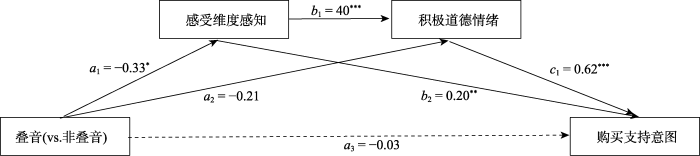
图4
道德受害者情境下叠音(vs.非叠音)对于消费者购买支持意图的链式中介系数路径图
注: * p < 0.05, ** p < 0.01, *** p < 0.001
7.4 实验3b小结
实验3b再次验证了在道德受害者受到伤害的情境下, 品牌心智的感受维度感知是叠音影响消费者道德反应的解释机制。并且, 叠音还能够通过提升消费者对品牌心智的感受维度感知, 增强消费者的积极道德情绪反应, 进而增加消费者对品牌的购买支持行为意图。同时, 实验3b还排除了在道德受害者情境下品牌名称字数的干扰对实验结果的影响。此外, 总体上, 在道德受害者角色下, 叠音与“小”字的效应也没有明显的区别。
8 实验4: 双重道德角色下叠音对于消费者道德反应的影响
8.1 实验目的与设计
前6个实验在不同的道德情境下验证了本文所提出的假设。为了更加严谨地对比不同道德角色下叠音对于消费者的一般道德反应的影响, 实验4通过同一个道德情境下不同道德角色中的叠音效应对比来验证本文的假设, 以增加实验结果的稳健性。
实验4采用2 (品牌名称: 叠音vs.非叠音) × 2 (道德角色: 主体vs.受害者)双因素组间实验设计。其中, 品牌名称与实验3b相同, 分别为“鲁鲁”与“格鲁”。实验的情景模拟任务与实验3b类似, 为游戏制作商与游戏运营商之间的霸王条款事件。其中, 道德主体组中, 实验品牌为游戏制作商, 道德受害者组中, 实验品牌为游戏运营商。来自Credamo平台的400名被试参与了实验并获得了1元报酬。其中有37人未通过注意力测试题, 最终有363个样本纳入了接下来的分析(女性233人, 男性130人, Mage = 31.90岁, SD = 10.94岁)。为了确保统计效力, 我们对所需样本量进行了事前预估。通过G*Power 3.1对样本量的统计功效进行事前分析, 当效应量f = 0.4, 显著性水平为0.05, 样本量N = 151, 组别为4组时, 进行双因素方差分析的统计检验效力Power (1 − β) > 0.99。本实验样本量大于预估样本量。
8.2 实验过程
首先, 被试被随机分配为4组并被告知需要进行一项情境模拟任务。具体的引导语如下: “鲁鲁(格鲁)是一家你在平时生活中接触过的游戏运营商(制作商)。近期, 你在新闻报道中了解到, 由于合作过程中游戏制作商对鲁鲁(格鲁) (鲁鲁(格鲁)对游戏运营商)提出了不合理的霸王条款, 鲁鲁(格鲁) (鲁鲁(格鲁)的游戏运营商)无法继续运营相关游戏, 这可能会导致鲁鲁(格鲁) (鲁鲁(格鲁)的游戏运营商)面临上千万人民币的损失。”随后, 我们要求被试在心中再默念一遍品牌名称以激活语音知觉。
8.3 实验结果
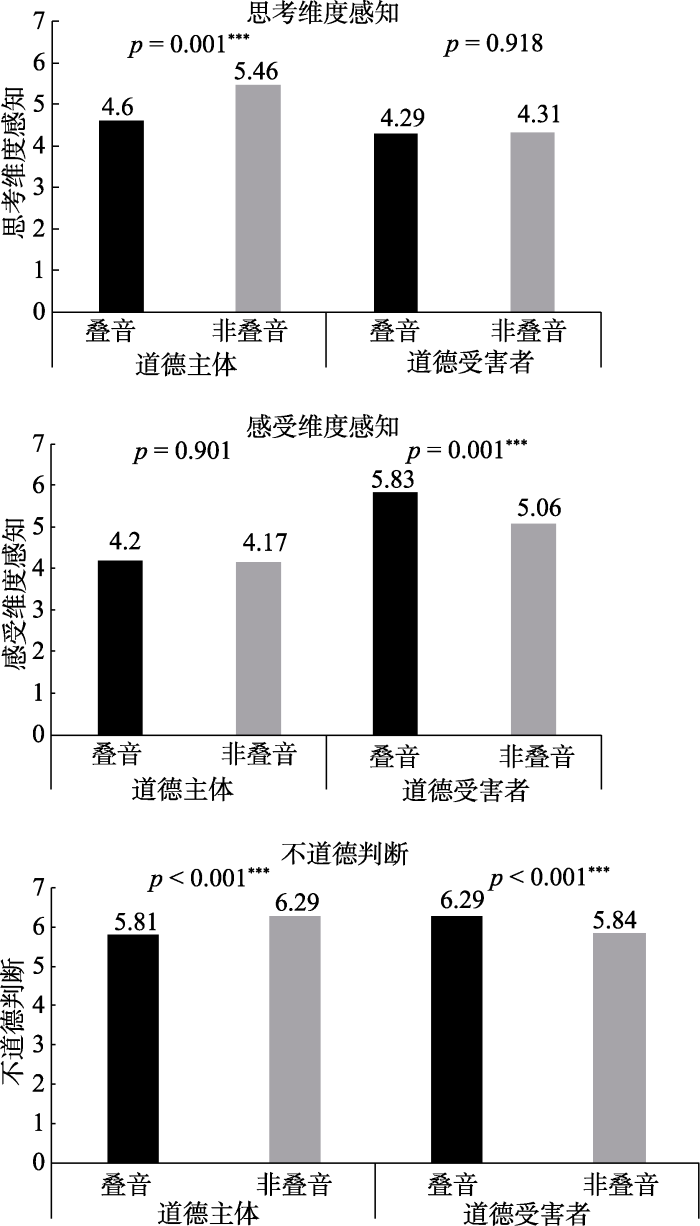
如图5所示, 以名称类型(1 = 叠音, 0 = 非叠音)、道德角色(1 = 主体, 0 = 受害者)及其两者交互项为自变量, 感受维度感知、思考维度感知以及不道德判断为因变量的双因素多元方差分析结果表明, 品牌名称类型与道德角色对于感受维度感知(F(3, 359) = 6.04, p = 0.014, η2p = 0.02)、思考维度感知(F(3, 359) = 7.31, p = 0.007, η2p = 0.02)与不道德判断(F(3, 359) = 34.16, p < 0.001, η2p = 0.09)的交互效应显著。其中, 不道德判断的简单效应分析显示, 在道德主体角色下, 与非叠音组中的被试相比(M = 6.29, SD = 0.57), 叠音组中的被试对于涉及到品牌违规的霸王条款事件的不道德判断更低(M = 5.81, SD = 0.88), F(1, 359) = 18.64, p < 0.001, η2p = 0.05。而在道德受害者角色下, 与非叠音组中的被试相比(M = 5.84, SD = 0.95), 叠音组中的被试对于涉及到品牌受害的霸王条款事件的不道德判断更高(M = 6.29, SD = 0.51), F(1, 359) = 15.64, p < 0.001, η2p = 0.04。同时, 品牌感受维度的简单效应分析显示, 在道德主体角色下, 叠音组与非叠音组中的被试所感知到的品牌感受维度并无显著性差异(M叠音 = 4.20, SD = 1.67; M非叠音 = 4.17, SD = 1.71), F(1, 359) = 0.015, p = 0.901。但在道德受害者角色下, 与非叠音组中的被试相比(M = 5.06, SD = 1.40), 叠音组中的被试对品牌的感受维度感知更高(M = 5.83, SD = 0.68), F(1, 359) = 12.58, p < 0.001, η2p = 0.03。此外, 品牌思考维度的简单效应分析显示, 在道德主体角色下, 与非叠音组中的被试相比(M = 5.46, SD = 1.00), 叠音组中的被试对品牌的思考维度感知更低(M = 4.60, SD = 1.53), F(1, 359) = 15.91, p < 0.001, η2p = 0.04。但在道德受害者角色下, 叠音组与非叠音组中的被试所感知到的品牌思考维度并无显著性差异(M叠音 = 4.29, SD = 1.59; M非叠音 = 4.31, SD = 1.74), F(1, 359) = 0.011, p = 0.918。结果进一步支持了假设H1a、H1b、H2a、H2b。
图5
接下来, 我们继续采用对有调节的间接中介效应的自主抽样检验(PROCESS Model 8; Hayes, 2017)来检验道德角色在叠音效应中所起到的调节作用。以品牌类型(1 = 叠音, 0 = 非叠音)为自变量, 不道德判断为因变量, 感受维度感知、思考维度感知为中介变量, 道德角色(1 = 主体, 0 = 受害者)为调节变量的模型结果显示(见图6), 有调节的直接效应模型成立(b = −0.9156, SE = 0.1567, t(359) = −5.8448, p < 0.001, 95% CI [−1.2237, −0.6076], R2-chng = 0.0869)。具体而言, 在道德主体角色下, 相比于非叠音, 叠音能够显著减弱违规品牌所涉及到的道德事件的不道德判断(effect = −0.4111, SE = 0.1096, 95% CI [−0.6266, −0.1957])。在道德受害者角色下, 相比于非叠音, 叠音能够显著增强受害品牌所涉及到的道德事件的不道德判断(effect = 0.3891, SE = 0.1124, 95% CI [0.1681,0.6101])。其次, 感受维度感知的有调节的间接效应模型成立(index = −0.0552, SE = 0.0384, 95% CI [−0.1467, −0.0008])。具体而言, 在道德受害者角色下, 叠音能够显著增加人们对于品牌感受维度的感知(effect = 0.0571, SE = 0.0328, 95% CI [0.0042,0.1308]), 而在道德主体角色下, 感受维度感知则没有显著性差异(effect = 0.0019, SE = 0.0205, 95% CI [−0.0428, 0.0457])。最后, 思考维度感知的有调节的间接效应模型成立(index = −0.0603, SE = 0.0404, 95% CI [−0.1564, −0.0008])。具体而言, 在道德主体角色下, 叠音能够显著降低人们对于品牌思考维度的感知(effect = −0.0619, SE = 0.0348, 95% CI [−0.1394, −0.0025]), 而在道德受害者角色下, 思考维度感知没有显著性差异(effect = −0.0017, SE = 0.0202, 95% CI [−0.0435, 0.0424])。具体的有调节的中介路径系数见图6。
图6
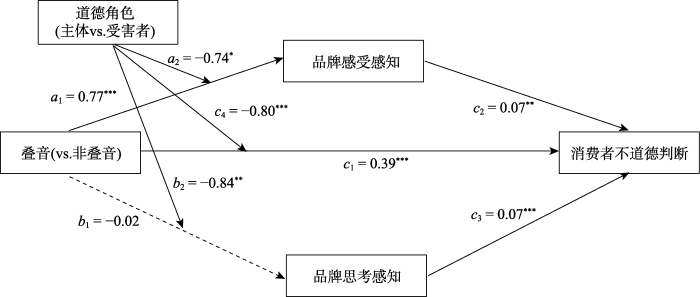
图6
双重道德角色下叠音(vs.非叠音)对消费者不道德判断的中介系数路径图
注: * p < 0.05, ** p < 0.01, *** p < 0.001
8.4 实验4小结
实验4通过品牌在同一个道德情境扮演不同的道德角色的实验, 更加严谨地验证了品牌心智的思考与感受两个维度在叠音品牌名称影响消费者道德反应中的非对称性中介作用。具体而言, 在道德主体违规的情境下, 叠音降低了人们对于品牌的思考维度感知, 从而减弱了对违规品牌所涉及的道德事件的不道德判断。在道德受害者受害的情境下, 叠音增加了人们对于品牌的感受维度感知, 从而增强了对受害品牌所涉及的道德事件的不道德判断。
9 研究结论与讨论
9.1 研究结论
本研究基于心智知觉理论, 通过7个实验探究了品牌语言学关心的语音线索与商业伦理领域关心的道德反应之间的关系, 发现在不同的道德情境下(道德主体违规与道德受害者受害), 叠音品牌名称相较于非叠音对消费者的道德反应影响更强, 这一影响的机制为品牌心智感知。
但品牌心智感知二维度的中介作用在不同的道德情境下是非对称的。具体而言, 当品牌作为道德主体发生道德违规事件时, 相比于非叠音品牌, 消费者会对叠音品牌产生更少的消极道德反应(愤怒、厌恶、谴责、惩罚行为意图), 其内在机制是叠音品牌会降低消费者所感知到的品牌心智的思考维度(感受维度则没有中介作用); 当品牌作为道德受害者受到伤害时, 相比于非叠音品牌, 消费者会对叠音品牌产生更多的积极道德反应(同情、怜悯、遗憾、购买支持行为意图), 其内在机制是叠音品牌会增加消费者所感知到的品牌心智的感受维度(思考维度则没有中介作用)。
由于刻板印象内容模型与心智知觉模型存在一定的相关性(Huang et al., 2020), 本研究验证了两者在机制解释能力上的差异。具体而言, 本研究在道德主体的情境下排除了刻板印象内容模型的可替代性解释。在道德受害者情境下, 尽管刻板印象内容模型的间接效应也是显著的, 但在控制了刻板印象内容模型的间接效应之后, 心智知觉理论还是会在叠音对消费者道德反应的影响中起到显著的间接效应。后续的区分效度分析也表明, 心智知觉理论的两个维度与刻板印象内容模型理论的两个维度相互独立。
为更好地支持本文关于心智知觉理论在中介机制上具备的解释能力, 本文还进行了一项补充实验, 通过在道德受害者的角色下品牌类型(享乐型vs.实用型)的调节作用来佐证心智知觉二维感知的解释机制。前人研究认为, 享乐型产品会激活消费者情感思维层面的信息加工, 实用型产品激活的是认知思维层面的信息加工(Roy & Ng, 2012), 因此相比于实用型产品, 享乐型产品更容易让消费者联想到品牌的感受维度(Huang et al., 2020), 从而影响人们的道德反应。我们设计了一个2 (品牌名称: 叠音vs.非叠音) × 2 (品牌类型: 实用型vs.享乐型)组间实验, 利用强调提神的广告语操纵巧克力为实用型产品, 强调美味的广告语操纵巧克力为享乐型产品, 然后询问了被试对一家被霸王条款事件伤害的巧克力品牌的同情程度及对该品牌感受维度的感知程度。实验结果显示, 在道德受害者的角色下, 叠音与品牌类型对于感受维度感知的交互作用显著, F(1, 394) = 5.09, p = 0.025, η2p = 0.01。进一步的简单效应分析表明, 在享乐组中, 叠音品牌(M = 5.28, SD = 0.89)对于品牌感受感知的影响显著高于非叠音品牌(M = 4.74, SD = 1.16), F(1, 390) = 12.61, p < 0.001, η2p = 0.03。在实用组中, 叠音品牌(M = 4.69, SD = 1.06)对于品牌感受感知的影响与非叠音品牌(M = 4.64, SD = 1.10)相比没有显著性的差异, F(1, 394) = 0.12, p = 0.73。该实验结果进一步支撑了心智知觉理论的解释机制。
最后, 考虑到中文环境下, “小”字会被用于人们对相对年龄较小的人的称呼, 所以本研究还在品牌名称字数相同的前提下, 对比了叠音与“小”字的效应(例如, “鲁鲁”与“小鲁”)。结果表明, 无论在道德主体的情境下还是在道德受害者的情境下, 叠音对人们的道德反应产生的影响不弱于“小”字的影响。
9.2 理论贡献与管理启示
9.2.1 理论贡献
我们的研究具有以下三个方面的理论贡献。
首先, 以往有关商业道德的研究很少同时考察道德主体与道德受害者两种道德情境(Silver, 2019), 更没有验证过心智知觉的两个维度在不同道德角色下存在不对称中介的现象。本研究整合考察了道德主体违规与道德受害者受害两种道德情境下叠音对于消费者道德反应的影响, 并且证明了在道德主体违规情境下, 叠音仅通过品牌心智感知的思考维度影响人们的道德反应, 而在道德受害者情境下, 叠音仅通过品牌心智感知的感受维度影响人们的道德反应。本文的发现是有关消费者道德反应研究成果的重要填补, 更进一步, 有关心智感知二维度作为中介的不对称性的发现也具有较大的理论价值。
其次, 本文是一个跨界研究, 验证了品牌语言学与商业道德伦理学两个领域的成果可能存在的因果关系, 揭示了这种关系背后的“黑箱” (机制)。一方面, 品牌语言学中有关语音特征叠音所内隐的象征意义是否以及如何影响消费者的道德反应存在研究空白。另一方面, 现有关于消费者道德反应的前因变量的探索也鲜有研究从品牌语言学角度开展。本文的研究证明了这两个领域中的重要概念之间存在的因果关系, 通过中介机制的反复验证, 架起了品牌语言学与商业道德伦理学跨界研究的桥梁。
最后, 本文所发现的心智知觉的中介机制, 深化了品牌拟人化文献中有关拟人化产生过程的机制探讨。以往关于品牌拟人化的文献几乎清一色采用刻板内容印象模型理论进行解释(如Aaker et al., 2010; 江红艳 等, 2016; 魏华 等, 2016)。作为一个经典的理论模型, 刻板印象内容模型考虑的是当品牌在被消费者当作人一样看待后, 会发生什么事情(Aaker et al., 2010; Fournier, 2009)。而心智知觉理论则从刻板印象内容模型的前一个阶段考虑了非人事物何时以及为何被感知为人(即在思考和体验两个维度上感知到心智的存在) (Gray et al., 2007; Waytz et al., 2010)。本文将心智知觉理论引入品牌拟人的研究中来, 首先验证了人们如何从思考和体验两个维度上对一件非人事物进行拟人, 并进一步讨论了在不同的道德情境下消费者所产生的道德反应, 本文对刻板印象内容模型作为中介的可能性的排除, 说明这一在拟人化研究中广为采纳的模型, 在道德情境下可能并不是合适的机制, 更合理的是要前置一步地去考查拟人产生的心智感知过程。
9.2.2 管理启示
本文的研究结论对于企业设计和更新品牌名称具有极大的指导意义。首先, 本文的研究发现, 无论是何种道德角色, 企业都可以从叠音品牌名称中获益。考虑到在实际情境中, 一个品牌的命名受到诸多因素的影响, 已有品牌名称多数并不是叠音, 企业更改品牌名称的成本巨大, 因此, 一个实用的建议是在不改变已有品牌名称的前提下, 通过为品牌取一个叠音型的昵称来获得叠音的好处。现实中, 的确有企业这么做, 如物流品牌菜鸟网络在其APP界面中将自己的名称显示为“菜鸟裹裹”。
同时, 本文有关机制的研究结论还可以供道德事件相关的营销沟通文案的撰写者参考。在道德违规类的品牌危机发生时, 营销沟通文案可以适当选用叠音名称来降低公众关于品牌犯错的主观意图的推断; 在道德受害类的品牌危机发生时, 则可以通过适当选用叠音来突出品牌方在精神和情感上所受的痛苦, 以获得更多消费者同情和支持。
其次, 本研究的结论可以从品牌名称泛化到所有个体名称上。例如, 企业给客服取叠音昵称, 也能达到叠音品牌名称所具有的效果。随着人工智能在营销活动中的飞速发展, 智能客服屡见不鲜。如果机器人客服的名称是叠音, 在处理涉及道德危机事件的时候, 消费者会对客服倾向于包容与同情。
此外, 本研究的结论对于公益广告的文案设计也具有一定的指导意义。在道德受害者的情境下, 叠音会增加人们对于受害对象的同情与支持。因此, 在关于保护野生动物、保护环境方面的公益广告中, 设计者们可以通过为野生动物或环境中的生物取一个叠音名称, 以此来赢得人们对于公益事业更大的支持。
最后, 叠音虽然在品牌道德违规事件中展现出了一定的优势效应, 但是使用叠音作为品牌名称并不是只有好处, 而不存在任何负面效应。例如, 叠音会降低品牌的能力感知, 功能型产品要慎用叠音作为品牌名称(魏华 等, 2016)。再如, 根据本文的研究, 叠音会降低品牌的思考维度的感知, 这虽然在道德主体违规的情境下对企业有一定好处, 但是在一般情境下, 叠音所引发的低思考感知有可能会使品牌与企业的产品不适配, 从而降低消费者对企业产品的购买意愿。例如, 当一个强调大数据计算和应用背景的AIGC企业采用叠音作为品牌名称时, 有可能会导致消费者认为其计算能力并不那么强。因此, 本研究的结论并不意味着企业要千篇一律地给自己取个叠音名称, 而是要从企业的实际情况出发, 综合考虑各种因素来决定品牌名称。
9.3 未来研究展望
首先是关于反向因果的争论。道德推理的相关文献指出, 人们在面临道德事件时, 往往会先给出直觉性的道德判断, 再根据判断给出一个合理化的推论(Haidt, 2007)。因此, 针对本文所研究的情境, 人们也有可能先产生直觉性的道德反应, 后给出心智知觉方面的归因。在本文的数据分析中也发现了反向因果的确在统计关系上是成立的。但是, 并不是所有的道德心理学研究都倾向于先有道德反应后有道德推论这样的顺序, 也有道德心理学的研究表明, 人们对事物的无意识的内隐感知能够塑造人们道德判断。例如性别刻板印象、种族刻板印象都会对人们的道德判断产生影响, 这些感知发生在道德判断之前。鉴于本文的所有实验结果都支持我们假设的先有心智感知后有道德反应的假设, 但在统计关系上也确实存在先有道德反应后有心智感知这样的数据分析结果, 我们认为, 道德反应和感知之间的先后关系, 可能与研究涉及的情境有关, 未来的研究可以结合其他类似的研究, 针对感知与道德判断的产生先后顺序与情境之间的关系进行探究。
第二, 现实生活中有许多消费者会在口碑传播过程中为品牌取一个叠音的昵称。当叠音昵称不是企业自身命名而是来自于消费者时, 说明消费者与品牌有亲近的关系, 这可能会加强叠音对道德反应的影响效果。未来的研究可以继续探究叠音命名的来源对于叠音效应的影响。
第三, 未来的研究可以考虑从品牌特征方面拓展本文所发现的叠音效应的边界条件。例如, 叠音对道德反应的影响有可能会受到消费者对品牌的固有印象的影响。当品牌屡次发生道德违规事件时, 本文所发现的叠音效应就有可能会消失(Khamitov et al., 2020)。而当品牌与消费者关系十分亲近时, 消费者更容易包容与谅解违规品牌, 因此消费者与品牌的关系强度也会对本文所发现的叠音效应产生影响。同时, 未来的研究还可以通过设置多种情境来探究何种情况下叠音的效应要强于“小”字何种情况下“小”字的效应会强于叠音。
最后, 本文所发现的叠音效应还有可能受到道德事件的类型(如违反描述性规范的道德事件与违反禁令性规范的道德事件)的影响。当品牌的道德违规事件违反了禁令性规范时, 由于事件的严重性, 叠音可能并不会起到缓和消费者负面道德反应的作用。
致谢
感谢匿名审稿人提出的宝贵意见。感谢上海财经大学商学院硕士研究生龙宇涵、张晓雨, 博士研究生张沐嵘、朱昊宇在文献搜集与实验设计过程中提供的建议与帮助。
参考文献
Nonprofits are seen as warm and for-profits as competent: Firm stereotypes matter
DOI:10.1086/651566 URL [本文引用: 4]
Can psychopathic offenders discern moral wrongs? A new look at the moral/conventional distinction
DOI:10.1037/a0024796
PMID:21842959
[本文引用: 1]

A prominent view of psychopathic moral reasoning suggests that psychopathic individuals cannot properly distinguish between moral wrongs and other types of wrongs. The present study evaluated this view by examining the extent to which 109 incarcerated offenders with varying degrees of psychopathy could distinguish between moral and conventional transgressions relative to each other and to nonincarcerated healthy controls. Using a modified version of the classic Moral/Conventional Transgressions task that uses a forced-choice format to minimize strategic responding, the present study found that total psychopathy score did not predict performance on the task. Task performance was explained by some individual subfacets of psychopathy and by other variables unrelated to psychopathy, such as IQ. The authors conclude that, contrary to earlier claims, insufficient data exist to infer that psychopathic individuals cannot know what is morally wrong.
The sound of brands
DOI:10.1509/jmkg.74.4.097
URL
[本文引用: 9]
Recent research has demonstrated that linguistic characteristics of brand names can cognitively affect product evaluations. In six experiments, the authors demonstrate that affect arising from sound repetition may also be influential. The results reveal across multiple brand names and product categories that exposure to a brand name that has sound repetition in its phonetic structure and is spoken aloud produces positive affect, which favorably affects consumers’ brand evaluations, reactions to cross-selling, and product choice. The effects are moderated by consumers’ sensitivity to repetition, consumers’ opportunity to experience emotions, and the degree to which the brand name's phonetic sound repetition deviates from linguistic expectations. The authors discuss implications for managers and avenues for further research.
Early-stage business model experimentation and pivoting
DOI:10.1016/j.jbusvent.2023.106314 URL [本文引用: 1]
Brand linguistics: A theory-driven framework for the study of language in branding
DOI:10.1016/j.ijresmar.2017.01.003 URL [本文引用: 1]
Rise from the ashes or repeat the past? The effects of fresh start mindset and brand crisis type on consumer forgiveness
“重振旗鼓”还是“重蹈覆辙”——新起点思维与品牌危机类型对消费者宽恕的影响
Crime and punishment: Distinguishing the roles of causal and intentional analyses in moral judgment
DOI:10.1016/j.cognition.2008.03.006
PMID:18439575
[本文引用: 1]
Recent research in moral psychology has attempted to characterize patterns of moral judgments of actions in terms of the causal and intentional properties of those actions. The present study directly compares the roles of consequence, causation, belief and desire in determining moral judgments. Judgments of the wrongness or permissibility of action were found to rely principally on the mental states of an agent, while judgments of blame and punishment are found to rely jointly on mental states and the causal connection of an agent to a harmful consequence. Also, selectively for judgments of punishment and blame, people who attempt but fail to cause harm more are judged more leniently if the harm occurs by independent means than if the harm does not occur at all. An account of these phenomena is proposed that distinguishes two processes of moral judgment: one which begins with harmful consequences and seeks a causally responsible agent, and the other which begins with an action and analyzes the mental states responsible for that action.
The development of intent-based moral judgment
DOI:10.1016/j.cognition.2012.11.008
PMID:23318350
[本文引用: 1]
Between the ages of 4 and 8 children increasingly make moral judgments on the basis of an actor's intent, as opposed to the outcome that the actor brings about. Does this reflect a reorganization of concepts in the moral domain, or simply the development of capacities outside the moral domain such as theory of mind and executive function? Motivated by the past evidence that adults rely partially on outcome-based judgment for judgments of deserved punishment, but not for judgments of moral wrongness, we explore the same categories of judgment in young children. We find that intent-based judgments emerge first in children's assessments of naughtiness and that this subsequently constrains their judgments of deserved punishment. We also find that this developmental trajectory differs for judgments of accidental harm (a bad outcome with benign intent) and judgments of attempted harm (a benign outcome with bad intent). Our findings support a two process model derived from studies of adults: a mental-state based process of judging wrongness constrains an outcome-based process of assigning punishment. The emergence of this two-process architecture in childhood suggests that the developmental shift from outcome- to intent-based judgment involves a conceptual reorganization within the moral domain.Copyright © 2012 Elsevier B.V. All rights reserved.
The influence of moral relativism and disgust on moral intuitive judgment
DOI:10.3724/SP.J.1041.2019.00517
[本文引用: 1]
<p id="C2">The social intuition model suggests that moral reasoning occurs after moral intuitive judgment. The question of how people make intuitive moral judgments, and whether the process is influenced by reasoning and emotion, remains to be answered. The purpose of this study is to explore the influence of moral relativism and disgust on moral intuitive judgment. According to the unimodel of human judgment, intuitive and deliberate judgments are based on similar rules. The hypotheses are as follows: moral relativism increases moral intuitive judgment (H1) and disgust increases moral intuitive judgment (H2).</p><p id="C300">We conducted three experiments to test these hypotheses. In Experiment 1, we examined whether moral intuitive judgment exists. A total of 39 undergraduates were selected and asked to answer “yes” or “no” randomly, like tossing a coin, to 20 moral behaviors, 20 immoral behaviors, and 40 fillers. The accuracy of moral judgment is compared to random level (i.e., 0.5). Accuracy greater than 0.5 was considered indicative of moral intuitive judgment. Single-sample t-test showed that the accuracy of the participants’ random responses was significantly greater than random (i.e., 0.5), indicating the existence of moral intuitions.</p><p id="C301">In Experiment 2, a total of 77 undergraduates were randomly assigned to two different conditions, i.e., moral relativism and moral absolutism. Participants were first primed moral absolutism or moral relativism by scrambling in a sentence, e.g., the scrambled sentence “as to rightness” “cannot” “different types of morality” “be compared” may be recomposed as “Different types of morality cannot be compared as to rightness”, then randomly answer “yes” or “no” to moral judgments. Independent-samples t-test showed that participants were more inclined to make moral intuitive judgments under the conditions of moral absolutism than moral relativism, which suggests that moral relativism weakens participants’ moral intuitive judgment, while moral absolutism promotes participants’ moral intuitive judgment.</p><p id="C302">In Experiment 3, a total of 80 undergraduates were randomly assigned to two different emotional conditions, i.e., disgust and neutral emotion. Participants’ disgust (or neutral emotion) were primed by eight pictures of disgusting facial expressions (or eight pictures of neutral facial expressions) before randomly answering “yes” or “no” to moral judgments. Independent-sample t-test showed that participants were more inclined to make moral intuitive judgments under the conditions of disgust emotion than neutral emotion, which suggests that moral intuition judgments are affected by emotion, and disgust increases individuals’ moral intuitive judgments.</p><p id="C303">In sum, the present research investigated the influence of moral relativism and disgust emotion on moral intuitive judgment, which helps to further understand the mechanism of moral intuitive judgment. In addition, it also provides some guidance for the daily moral judgment. The limitations and further research are also discussed.</p>
道德相对主义和厌恶情绪对道德直觉判断的影响
DOI:10.3724/SP.J.1041.2019.00517
[本文引用: 1]
社会直觉模型认为有意识的道德推理过程发生在道德直觉判断之后。那么, 道德直觉判断又是怎么形成的, 是否受认知推理和情绪的影响?实验1首先验证道德直觉判断的存在; 实验2考察了道德相对主义对道德直觉判断的影响; 实验3考察了厌恶情绪对道德直觉判断的影响。结果发现: (1)道德绝对主义比道德相对主义条件下, 个体更倾向于做出道德直觉判断, 说明道德直觉判断受认知推理影响。(2)厌恶情绪比中立情绪启动条件下, 个体更倾向于做出道德直觉判断, 说明道德直觉判断受情绪影响。因此, 道德直觉判断会受认知推理和情绪的影响。
Dimensions of mind perception
Participants compared the mental capacities of various human and nonhuman characters via online surveys. Factor analysis revealed two dimensions of mind perception, Experience (for example, capacity for hunger) and Agency (for example, capacity for self-control). The dimensions predicted different moral judgments but were both related to valuing of mind.
Moral typecasting: Divergent perceptions of moral agents and moral patients
DOI:10.1037/a0013748
PMID:19254100
[本文引用: 7]
Moral agency is the capacity to do right or wrong, whereas moral patiency is the capacity to be a target of right or wrong. Through 7 studies, the authors explored moral typecasting-an inverse relation between perceptions of moral agency and moral patiency. Across a range of targets and situations, good- and evil-doers (moral agents) were perceived to be less vulnerable to having good and evil done to them. The recipients of good and evil (moral patients), in turn, were perceived as less capable of performing good or evil actions. Moral typecasting stems from the dyadic nature of morality and explains curious effects such as people's willingness to inflict greater pain on those who do good than those who do nothing.
Blaming God for our pain: Human suffering and the divine mind
DOI:10.1177/1088868309350299
PMID:19926831
[本文引用: 4]
Believing in God requires not only a leap of faith but also an extension of people's normal capacity to perceive the minds of others. Usually, people perceive minds of all kinds by trying to understand their conscious experience (what it is like to be them) and their agency (what they can do). Although humans are perceived to have both agency and experience, humans appear to see God as possessing agency, but not experience. God's unique mind is due, the authors suggest, to the uniquely moral role He occupies. In this article, the authors propose that God is seen as the ultimate moral agent, the entity people blame and praise when they receive anomalous harm and help. Support for this proposition comes from research on mind perception, morality, and moral typecasting. Interestingly, although people perceive God as the author of salvation, suffering seems to evoke even more attributions to the divine.
Dimensions of moral emotions
DOI:10.1177/1754073911402388
URL
[本文引用: 5]
Anger, disgust, elevation, sympathy, relief. If the subjective experience of each of these emotions is the same whether elicited by moral or nonmoral events, then what makes moral emotions unique? We suggest that the configuration of moral emotions is special—a configuration given by the underlying structure of morality. Research suggests that people divide the moral world along the two dimensions of valence (help/harm) and moral type (agent/patient). The intersection of these two dimensions gives four moral exemplars—heroes, villains, victims and beneficiaries—each of which elicits unique emotions. For example, victims (harm/patient) elicit sympathy and sadness. Dividing moral emotions into these four quadrants provides predictions about which emotions reinforce, oppose and complement each other.
The new synthesis in moral psychology
DOI:10.1126/science.1137651
PMID:17510357
[本文引用: 1]
People are selfish, yet morally motivated. Morality is universal, yet culturally variable. Such apparent contradictions are dissolving as research from many disciplines converges on a few shared principles, including the importance of moral intuitions, the socially functional (rather than truth-seeking) nature of moral thinking, and the coevolution of moral minds with cultural practices and institutions that create diverse moral communities. I propose a fourth principle to guide future research: Morality is about more than harm and fairness. More research is needed on the collective and religious parts of the moral domain, such as loyalty, authority, and spiritual purity.
On the dangers of pulling a fast one: Advertisement disclaimer speed, brand trust, and purchase intention
DOI:10.1086/660854 URL [本文引用: 1]
Think versus feel: Two dimensions of brand anthropomorphism
The synergistic effect between corporate image and product’s superior benefits: A stereotype content model approach
DOI:10.3724/SP.J.1041.2016.00095 URL [本文引用: 1]
公司形象和产品属性超越的协同效应:基于刻板印象内容模型
Ethical decision making by individuals in organizations: An issue-contingent model
DOI:10.2307/258867 URL [本文引用: 2]
Poetics of reduplicative word formation: Evidence from a rating and recall experiment
DOI:10.1017/langcog.2021.27
URL
[本文引用: 3]
Reduplicative words like chiffchaff or helter-skelter are part of ordinary language use yet most often found in substandard registers in which attitudinal and expressive meaning components are iconically foregrounded. In a rating experiment using nonwords that either conform to, or deviate from, conventional reduplicative patterns in German, the present study identified affective meaning dimensions, judgments of familiarity and esthetic evaluations of sound qualities associated with such words. In a subsequent recall test, we examined the respective mnemonic potential of the different types of reduplication. Results suggest that, in the absence of semantic content, reduplicative forms are inherently associated with several affective meaning associations that are generally considered positive. Two types of reduplicative patterns, namely full reduplication and [i-a]-vowel-alternating reduplication, boost these positive effects to a particularly pronounced degree, leading to an increase in perceived euphony, funniness, familiarity, appreciation, and positive belittling (cuteness) and, at the same time, a decrease in arousal. These two types also turn out to be particularly memorable when compared both to other types of reduplication and to non-reduplicative structures. This study demonstrates that reduplicative morphology may in and of itself, that is, irrespective of the phonemic and the semantic content, contribute to the affective meaning and esthetic evaluation of words.
A systematic review of brand transgression, service failure recovery and product-harm crisis: Integration and guiding insights
DOI:10.1007/s11747-019-00679-1 [本文引用: 8]
Selection Models of Social Appellation in Modern Chinese
现代汉语中社会称谓语的选择模式
Enregistering cuteness of fashion clothes on Chinese social media
DOI:10.1177/1359183521994876
URL
[本文引用: 1]
In the context of cute material culture, this article focuses on the production of valorized cute aesthetic in fashion clothes being sold on Chinese social media. Through corpus-enlightened empirical case studies, the article demonstrates how the baby-talk register converges with the material design and embodiment of clothes to synergically affect the cute materiality of the clothes at issue. With special attention paid to discursive practices of enregisterment, the study tries to recalibrate the existing biased hermeneutics of cute material culture that largely reduce cute clothes to material immediacy and consumerist passivity. The study sheds light on the collegiality and complementarity that enregisterment shows for embodiment and material design in the production of material aesthetics, and by doing so enriches the understanding of materiality within clothing material culture in general.
Same scandal, different moral judgments: The effects of consumer-firm affiliation on weighting transgressor-related information and post-scandal patronage intentions
DOI:10.1108/EJM-10-2020-0728
URL
[本文引用: 1]
Corporate scandals involving senior executives plague many businesses. Although customers and noncustomers may be exposed to news of the same scandal, they may appraise dimensions of the transgression differently, thereby affecting post-scandal patronage intentions. The purpose of this study is to investigate whether and how consumer-firm affiliation affects future patronage intentions by examining nuances in customers’ vs noncustomers’ reactions toward the transgressor’s professional performance and immoral behavior.
Phonetic symbolism and brand name preference
DOI:10.1086/518530 URL [本文引用: 5]
When connection turns to anger: How consumer-brand relationship and crisis type moderate language on social media
DOI:10.1093/jcr/ucad027
URL
[本文引用: 2]
Social media offers brands the ability to gauge consumer reactions to marketing and brand crises. While social media listening has focused on aggregate patterns, consumers differ in how they react to a crisis faced by a particular brand. Analyzing consumer behavior for 39 brands pertaining to 77 brand crises through the lens of consumer posts on brands’ Facebook pages, we find that consumers’ prior online interactions with the brand and the nature of the brand crisis moderate the language they employ in their posts. Specifically, these factors affect the extent to which consumers express anger and the familiarity of their language. While consumers who have not engaged with the brand previously employ more familiar language and self-referencing following values-related crises compared to consumers who have interacted with the brand, these individuals express more anger after performance-related crises. In contrast, consumers who have previously interacted with the brand express more anger in the wake of values-related crises. We discuss the implications of our findings for brand managers using social media posts as a means of monitoring consumer perceptions.
The connotative meanings of sound symbolism in brand names: A conceptual framework
DOI:10.1016/j.jbusres.2022.06.013 URL [本文引用: 4]
Regulatory focus and preference reversal between hedonic and utilitarian consumption
DOI:10.1002/cb.v11.1 URL [本文引用: 1]
A circumplex model of affect
DOI:10.1037/h0077714 URL [本文引用: 1]
The humanizing voice: Speech reveals, and text conceals, a more thoughtful mind in the midst of disagreement
DOI:10.1177/0956797617713798
PMID:29068763
[本文引用: 1]
A person's speech communicates his or her thoughts and feelings. We predicted that beyond conveying the contents of a person's mind, a person's speech also conveys mental capacity, such that hearing a person explain his or her beliefs makes the person seem more mentally capable-and therefore seem to possess more uniquely human mental traits-than reading the same content. We expected this effect to emerge when people are perceived as relatively mindless, such as when they disagree with the evaluator's own beliefs. Three experiments involving polarizing attitudinal issues and political opinions supported these hypotheses. A fourth experiment identified paralinguistic cues in the human voice that convey basic mental capacities. These results suggest that the medium through which people communicate may systematically influence the impressions they form of each other. The tendency to denigrate the minds of the opposition may be tempered by giving them, quite literally, a voice.
Too cute to be bad? Cute brand logo reduces consumer punishment following brand transgressions
DOI:10.1016/j.ijresmar.2021.12.006 URL [本文引用: 7]
Word of mouth versus word of mouse: Speaking about a brand connects you to it more than writing does
DOI:10.1093/jcr/ucy011
URL
[本文引用: 1]
This research merges insights from the communications literature with that on the self-brand connection to examine a novel question: how does speaking versus writing about a liked brand influence the communicator’s own later reactions to that brand? Our conceptualization argues that because oral communication involves a greater focus on social interaction with the communication recipient than does written communication, oral communicators are more likely to express self-related thoughts than are writers, thereby increasing their self-brand connection (SBC). We also assess the implications of this conceptualization, including the identification of theoretically derived boundary conditions for the speech/writing difference, and the downstream effects of heightened SBC. Results from five studies provide support for our predictions, informing both the basic literature on communications, and the body of work on consumer word of mouth.
To be underdogs or top dogs? The brand biography and consumers’ brand attitude: The mediation role of empathy
示弱还是示强?品牌传记与消费者品牌态度:移情的中介作用
Can a corporation be worthy of moral consideration
DOI:10.1007/s10551-018-3787-4
[本文引用: 2]
Much has been written about what corporations owe society and whether it is appropriate to hold them responsible. In contrast, little has been written about whether anything is owed to corporations apart from what is owed to their members. And when this question has been addressed, the answer has always been that corporations are not worthy of any distinct moral consideration. This is even claimed by proponents of corporate agency. In this paper, I argue that proponents of corporate agency should recognize corporations as worthy of moral consideration. Though particular views of moral status are often taken for granted in the literature, corporations can satisfy many views of moral status given the capacities often ascribed to them. They can even meet the conditions of the views assumed. I conclude by suggesting that recognizing the moral status of corporations may not be as drastic or harmful as we might imagine.
Moral emotions and moral behavior
Moral emotions represent a key element of our human moral apparatus, influencing the link between moral standards and moral behavior. This chapter reviews current theory and research on moral emotions. We first focus on a triad of negatively valenced "self-conscious" emotions-shame, guilt, and embarrassment. As in previous decades, much research remains focused on shame and guilt. We review current thinking on the distinction between shame and guilt, and the relative advantages and disadvantages of these two moral emotions. Several new areas of research are highlighted: research on the domain-specific phenomenon of body shame, styles of coping with shame, psychobiological aspects of shame, the link between childhood abuse and later proneness to shame, and the phenomena of vicarious or "collective" experiences of shame and guilt. In recent years, the concept of moral emotions has been expanded to include several positive emotions-elevation, gratitude, and the sometimes morally relevant experience of pride. Finally, we discuss briefly a morally relevant emotional process-other-oriented empathy.
Ad eroticism from a psychological distance perspective: Investigating its effects in light of consumers’ sex, ethical judgments, and moral attentiveness
DOI:10.1016/j.jbusres.2022.01.001 URL [本文引用: 2]
Appellation and its application
称呼语及其使用
How the voice persuades
DOI:10.1037/pspi0000193
PMID:31192632
[本文引用: 2]
Research has examined persuasive language, but relatively little is known about how persuasive people are when they attempt to persuade through language, or acoustic properties of speech (e.g., pitch and volume). People often detect and react against communicators say, but might they be persuaded by speakers' attempts to modulate they say it? Four experiments support this possibility, demonstrating that communicators engaging in paralinguistic persuasion attempts (i.e., modulating their voice to persuade) naturally use paralinguistic cues that influence perceivers' attitudes and choice. Rather than being effective because they go undetected, however, the results suggest a subtler possibility. Even when they are detected, paralinguistic attempts succeed because they make communicators seem more confident without undermining their perceived sincerity. Consequently, speakers' confident vocal demeanor persuades others by serving as a signal that they more strongly endorse the stance they take in their message. Further, we find that paralinguistic approaches to persuasion can be uniquely effective even when linguistic ones are not. A cross-study exploratory analysis and replication experiment reveal that communicators tend to speak louder and vary their volume during paralinguistic persuasion attempts, both of which signal confidence and, in turn, facilitate persuasion. (PsycINFO Database Record (c) 2020 APA, all rights reserved).
Getting consumers to recycle now! When and why cuteness appeals influence prosocial and sustainable behavior
Causes and consequences of mind perception
DOI:10.1016/j.tics.2010.05.006
PMID:20579932
[本文引用: 3]
Perceiving others' minds is a crucial component of social life. People do not, however, always ascribe minds to other people, and sometimes ascribe minds to non-people (e.g. God, gadgets). This article reviews when mind perception occurs, when it does not, and why mind perception is important. Causes of mind perception stem both from the perceiver and perceived, and include the need for social connection (perceiver) and a similarity to oneself (perceived). Mind perception also has profound consequences for both the perceiver and perceived. Ascribing mind confers an entity moral rights and also makes its actions meaningful. Understanding the causes and consequences of mind perception can explain when this most social of cognitive skills will be used, and why it matters.Copyright 2010 Elsevier Ltd. All rights reserved.
The effect of repeated two-syllable brand name on consumers’ perception and attitude
DOI:10.3724/SP.J.1042.2020.01071
[本文引用: 7]
Brand name is significant brand equity. It plays a vital role in delivering brand value, building brand image and highlighting brand characteristics. Previous research found that the semantic and phonetic features of a brand name would influence consumers’ perception and preference. From the perspective of baby schema, we examine the effect of repeated two-syllable brand name on consumers’ brand perception (physical perception and psychological perception) and consumers’ attitude, and also verify the mechanism and boundary of the effect. More specific expositions are as follows: (1) Examining the effect and mechanism of repeated two-syllable brand name on consumers’ physical perception, psychological perception and attitude; (2) Verifying the moderating effect of the internal phonetic feature and the external cuing feature between the repeated two-syllable brand name and consumers’ perception; (3) Verifying the moderating effect of product type and consumers’ feature between the repeated two-syllable brand name and consumers’ attitude.
叠音品牌名称对消费者知觉和态度的影响
DOI:10.3724/SP.J.1042.2020.01071
[本文引用: 7]
品牌名称是重要的品牌资产, 在传递品牌价值、构建品牌形象和凸显品牌特征的过程中起到关键作用。以往研究发现, 品牌名称的语义特征和语音特征(元音、辅音)都会对消费者知觉和态度产生影响, 但少有研究考察叠音这种语音结构特征的作用。从婴儿图式的角度, 考察叠音品牌名称对消费者知觉和态度的影响, 并检验其作用机制和边界。具体内容包括:(1)考察叠音品牌名称对消费者品牌知觉(物理特征知觉、心理特征知觉)及其消费者态度的影响及其作用机制。(2)检验内部语音特征和外部线索特征在叠音品牌名称与消费者知觉之间的调节作用。(3)检验产品类型特征和消费者特征在叠音品牌名称和消费者态度之间的调节作用。
The effect of repeated two-syllable brand name on consumer’s perception and preference
DOI:10.3724/SP.J.1041.2016.01479 URL [本文引用: 16]
叠音品牌名称对消费者知觉和偏好的影响
How do consumers react to company moral transgressions? The role of power distance belief and empathy for victims
DOI:10.1093/jcr/ucaa067
URL
[本文引用: 4]
This research proposes that consumers vary in their response to company moral transgressions as a function of power distance belief (PDB), which is the extent that consumers accept inequality (a prominent moral principle). Specifically, consumers with lower PDB tend to feel more empathy for victims, which in turn heightens harm perceptions and negative moral emotions, leading to less favorable reactions toward the transgressing company. A series of nine studies and four supplementary experiments provides converging evidence for the PDB effect and underlying empathy-based process, while identifying victim salience and company crisis response strategy as theoretically and pragmatically relevant moderators. Specifically, the PDB effect emerges when victim salience is high (evoking greater empathy among lower-PDB consumers) but is attenuated when victim salience is low (and empathy is not evoked). Likewise, the PDB effect on company evaluations can be mitigated when the transgressing company offers both an apology and remedy, which together signal the company’s empathy for victims and remedy for harm that are salient to low-PDB consumers. Together, these findings shed light on how consumer reactions to company moral transgressions vary by culture, transgression characteristics, and company response strategies, providing guidance to companies in crisis.
The present situation and trend of Chinese brand naming: Linguistic approach
中外企业汉语品牌命名的现状与趋势: 语言学视角分析
A sound idea: Phonetic effects of brand names on consumer judgments
DOI:10.1086/383422 URL [本文引用: 4]
How power influences moral judgement: The effect of situational involvement
DOI:10.3724/SP.J.1041.2013.01274
[本文引用: 1]
<p>Previous studies found that when subjects were given a moral dilemma to resolve, high-power participants prefer Rule-based Judgment, while low-power participants prefer Outcome-based Judgement. Lammers and Stapel (2009)attributed this to the benefits attained or retained from the type of judgment, but they did not conduct further research to explain why power-holders felt their benefits were threatened. According to the Evolution of Moral Mechanisms (Krebs 2005), situational involvement connects the power-holders with the moral dilemma story, and compels them to choose the moral judgment that would be advantageous for themselves. Four studies were conducted to explore the relationship between a power-holders’ moral dilemma judgment and situational involvement. Experiment 1 used a disorder sentence task to prime power feelings, and the results showed that the factor of protagonist was not significant as a main effect (F(1,107)=0.38, p=0.54), nor did it interact significantly with the factor of power (F(1,107)=2.27, p=0.14), and no main effect of power (F(1,107)=0.07, p=0.79). In light of moral evolutionary perspectives, we speculate that participants may need more situational priming to elicit their feeling of power, so this paper strengthened the relationship between the moral event and self-experience, and made the priming task more situationalized in experiment 2. Therefore, the differences of moral judgment styles between high and low-power participants disappeared (t(58)=0.56, p=0.58). Furthermore, in experiment 3 and 4, the different situation exposure to moral events can bring different moral judgments among high power participants (t(60)=-4.30, p<0.001), even in natural power conditions without artificial power priming task before presenting moral events. In brief, situational involvement considerably influences the power holders’ moral judgments. When the power holders were presented with a moral dilemma event in which they had personally experienced it, they would shift their moral judgment style from rule-based to outcome-based, which demonstrates that moral judgment is a biological adaptive strategy to a person’s environment.</p>
权力如何影响道德判断行为: 情境卷入的效应


