

ISSN 0439-755X
CN 11-1911/B
主办:中国心理学会
中国科学院心理研究所
出版:科学出版社
CN 11-1911/B
主办:中国心理学会
中国科学院心理研究所
出版:科学出版社
心理学报 ›› 2026, Vol. 58 ›› Issue (6): 1160-1182.doi: 10.3724/SP.J.1041.2026.1160 cstr: 32110.14.2026.1160
马超, 赵璐, 赵鑫( )
)
收稿日期:2025-03-27
发布日期:2026-04-28
出版日期:2026-06-25
通讯作者:
赵鑫, E-mail: psyzhaoxin@nwnu.edu.cn基金资助:
MA Chao, ZHAO Lu, ZHAO Xin()
Received:2025-03-27
Online:2026-04-28
Published:2026-06-25
摘要:
运动视频游戏作为一种兼顾身体运动与认知任务的创新型训练方式, 其不同组合模式对儿童执行功能的影响, 以及认知参与和运动强度在其中的作用, 仍是当前运动−认知领域亟待深入探索的核心议题。本研究通过两项系统性实验考察究竟何种形式的运动视频游戏训练更有利于儿童执行功能的发展。实验1比较融合式(运动视频游戏)与结合式(运动+视频游戏)两种训练模式的差异化影响, 结果表明, 运动视频游戏训练显著提升了儿童的反应抑制和工作记忆刷新能力, 且效果明显优于运动+视频游戏训练。补充实验进一步发现, 相比于年轻成人, 儿童群体在运动视频游戏训练中获得了更大的认知收益, 这得益于其更高的神经可塑性。实验2进一步剖析运动强度和认知参与的作用机制, 结果显示, 认知参与对反应抑制能力的促进作用较运动强度更为显著且持久; 在工作记忆刷新方面, 运动强度和认知参与均发挥积极作用, 但二者未表现出交互效应, 提示两者可能通过独立的神经通路影响执行功能。总的来说, 本研究揭示了运动视频游戏训练在儿童执行功能提升方面的显著效果及作用机制, 为具身认知理论和认知刺激假说提供了新的实证支持, 提示未来研究应优先采用融合式训练模式, 强化认知任务的设计, 并结合个体差异调整运动强度, 以优化训练效果。
中图分类号:
马超, 赵璐, 赵鑫. (2026). 超越屏幕: 运动视频游戏训练可以更好提升儿童执行功能. 心理学报, 58(6), 1160-1182.
MA Chao, ZHAO Lu, ZHAO Xin. (2026). Beyond the screen: Sports video game training can better enhance children’s executive functions. Acta Psychologica Sinica, 58(6), 1160-1182.
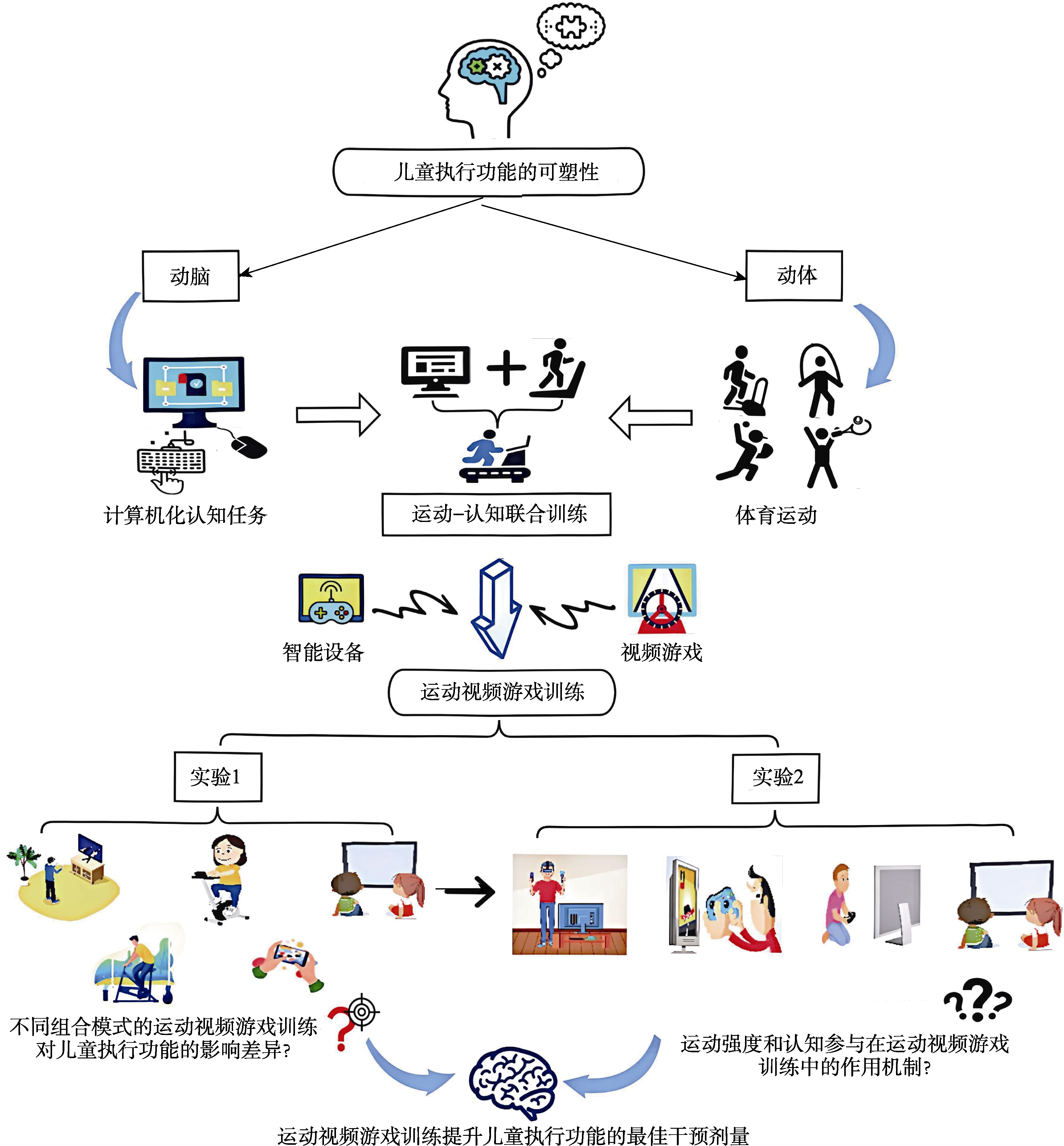
图1 本研究的整体研究思路及框架图 注: 彩图见电子版, 下同
| 组别 | 总计 | 男 | 女 | 年龄(M ± SD, 岁) |
|---|---|---|---|---|
| 运动视频游戏训练组 | 30 | 14 | 16 | 11.43 ± 0.50 |
| 运动+视频游戏训练组 | 30 | 13 | 17 | 11.33 ± 0.48 |
| 纯运动训练组 | 30 | 17 | 13 | 11.40 ± 0.62 |
| 纯视频游戏训练组 | 30 | 18 | 12 | 11.50 ± 0.57 |
| 控制组 | 30 | 16 | 14 | 11.27 ± 0.45 |
| 总计 | 150 | 78 | 72 | 11.39 ± 0.53 |
表1 实验1被试人口学变量
| 组别 | 总计 | 男 | 女 | 年龄(M ± SD, 岁) |
|---|---|---|---|---|
| 运动视频游戏训练组 | 30 | 14 | 16 | 11.43 ± 0.50 |
| 运动+视频游戏训练组 | 30 | 13 | 17 | 11.33 ± 0.48 |
| 纯运动训练组 | 30 | 17 | 13 | 11.40 ± 0.62 |
| 纯视频游戏训练组 | 30 | 18 | 12 | 11.50 ± 0.57 |
| 控制组 | 30 | 16 | 14 | 11.27 ± 0.45 |
| 总计 | 150 | 78 | 72 | 11.39 ± 0.53 |
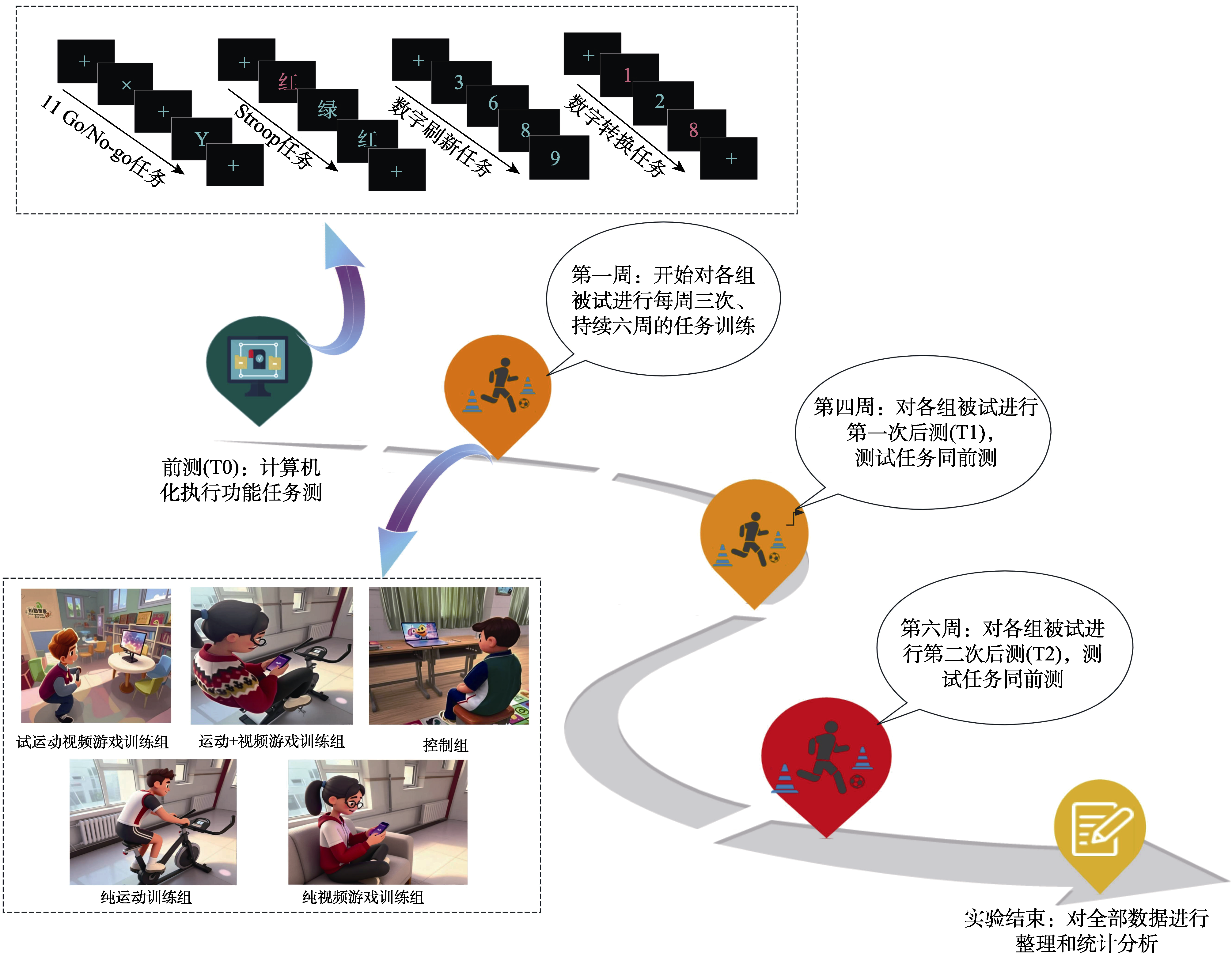
图2 实验1实施流程图
| 变量 | 任务指标 | 因素 | dfs | F | p | η2p |
|---|---|---|---|---|---|---|
| 干扰抑制 | Stroop任务 干扰效应(ms) | 测试阶段 | (4, 145) | 1.73 | 0.180 | 0.01 |
| 组别 | (4, 145) | 0.82 | 0.513 | 0.02 | ||
| 测试阶段×组别 | (4, 145) | 0.35 | 0.947 | 0.01 | ||
| 反应抑制 | Go/No-go任务 No-go正确率 | 测试阶段 | (4, 145) | 10.22 | <0.001 | 0.07 |
| 组别 | (4, 145) | 3.70 | 0.007 | 0.09 | ||
| 测试阶段×组别 | (4, 145) | 0.85 | 0.562 | 0.02 | ||
| 工作记忆刷新 | 数字刷新任务 平均正确率 | 测试阶段 | (4, 145) | 31.38 | <0.001 | 0.18 |
| 组别 | (4, 145) | 8.21 | <0.001 | 0.19 | ||
| 测试阶段×组别 | (4, 145) | 2.82 | 0.005 | 0.07 | ||
| 注意转换 | 注意转换任务 转换代价(ms) | 测试阶段 | (4, 145) | 10.46 | <0.001 | 0.07 |
| 组别 | (4, 145) | 1.75 | 0.143 | 0.05 | ||
| 测试阶段×组别 | (4, 145) | 0.47 | 0.865 | 0.01 |
表2 各组干预前后儿童执行功能各子成分的提升效果
| 变量 | 任务指标 | 因素 | dfs | F | p | η2p |
|---|---|---|---|---|---|---|
| 干扰抑制 | Stroop任务 干扰效应(ms) | 测试阶段 | (4, 145) | 1.73 | 0.180 | 0.01 |
| 组别 | (4, 145) | 0.82 | 0.513 | 0.02 | ||
| 测试阶段×组别 | (4, 145) | 0.35 | 0.947 | 0.01 | ||
| 反应抑制 | Go/No-go任务 No-go正确率 | 测试阶段 | (4, 145) | 10.22 | <0.001 | 0.07 |
| 组别 | (4, 145) | 3.70 | 0.007 | 0.09 | ||
| 测试阶段×组别 | (4, 145) | 0.85 | 0.562 | 0.02 | ||
| 工作记忆刷新 | 数字刷新任务 平均正确率 | 测试阶段 | (4, 145) | 31.38 | <0.001 | 0.18 |
| 组别 | (4, 145) | 8.21 | <0.001 | 0.19 | ||
| 测试阶段×组别 | (4, 145) | 2.82 | 0.005 | 0.07 | ||
| 注意转换 | 注意转换任务 转换代价(ms) | 测试阶段 | (4, 145) | 10.46 | <0.001 | 0.07 |
| 组别 | (4, 145) | 1.75 | 0.143 | 0.05 | ||
| 测试阶段×组别 | (4, 145) | 0.47 | 0.865 | 0.01 |
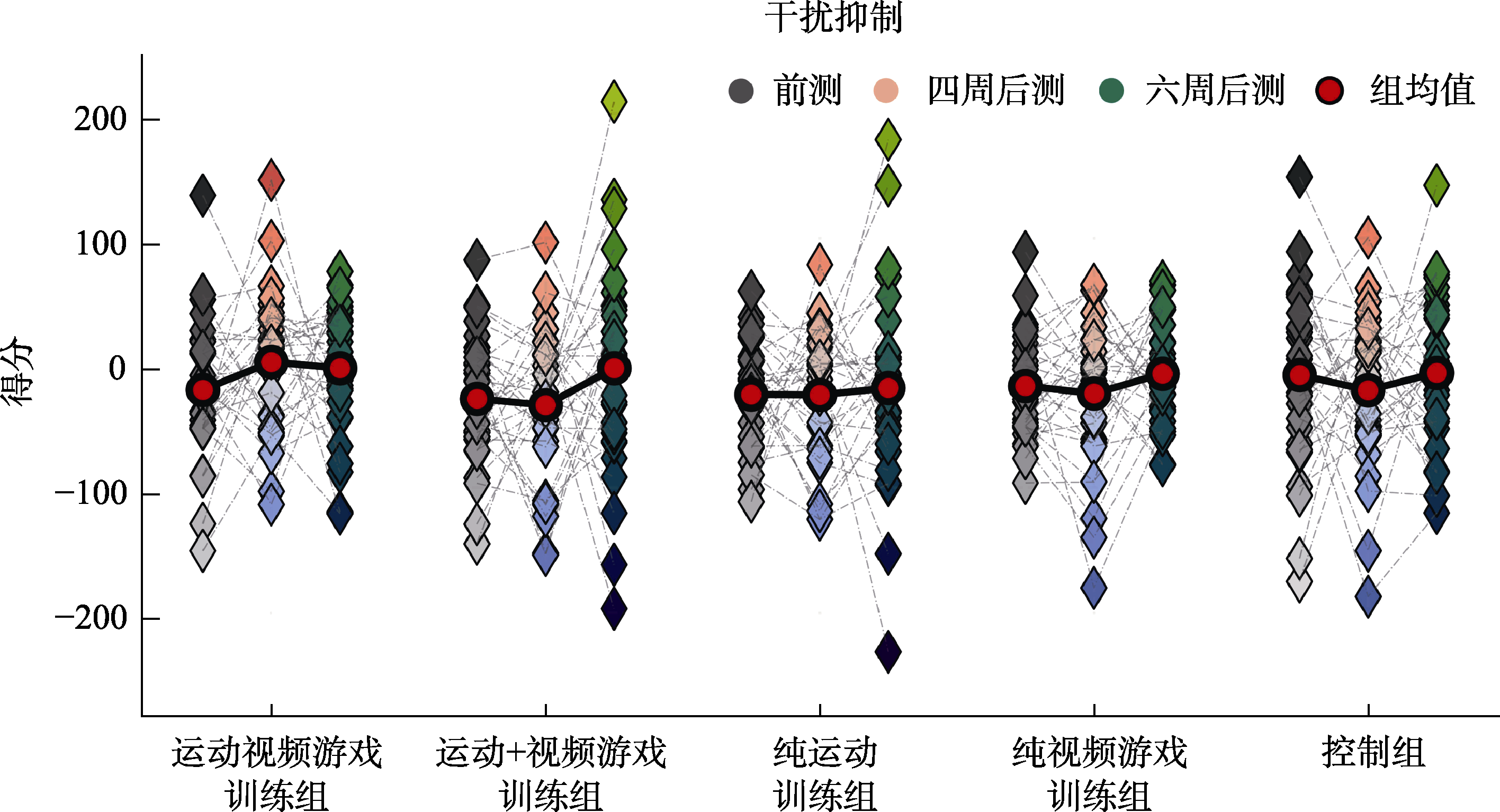
图3 五个实验组训练前后干扰抑制得分的变化趋势

图4 五个实验组训练前后反应抑制得分的变化趋势

图5 五个实验组训练前后工作记忆刷新得分的变化趋势
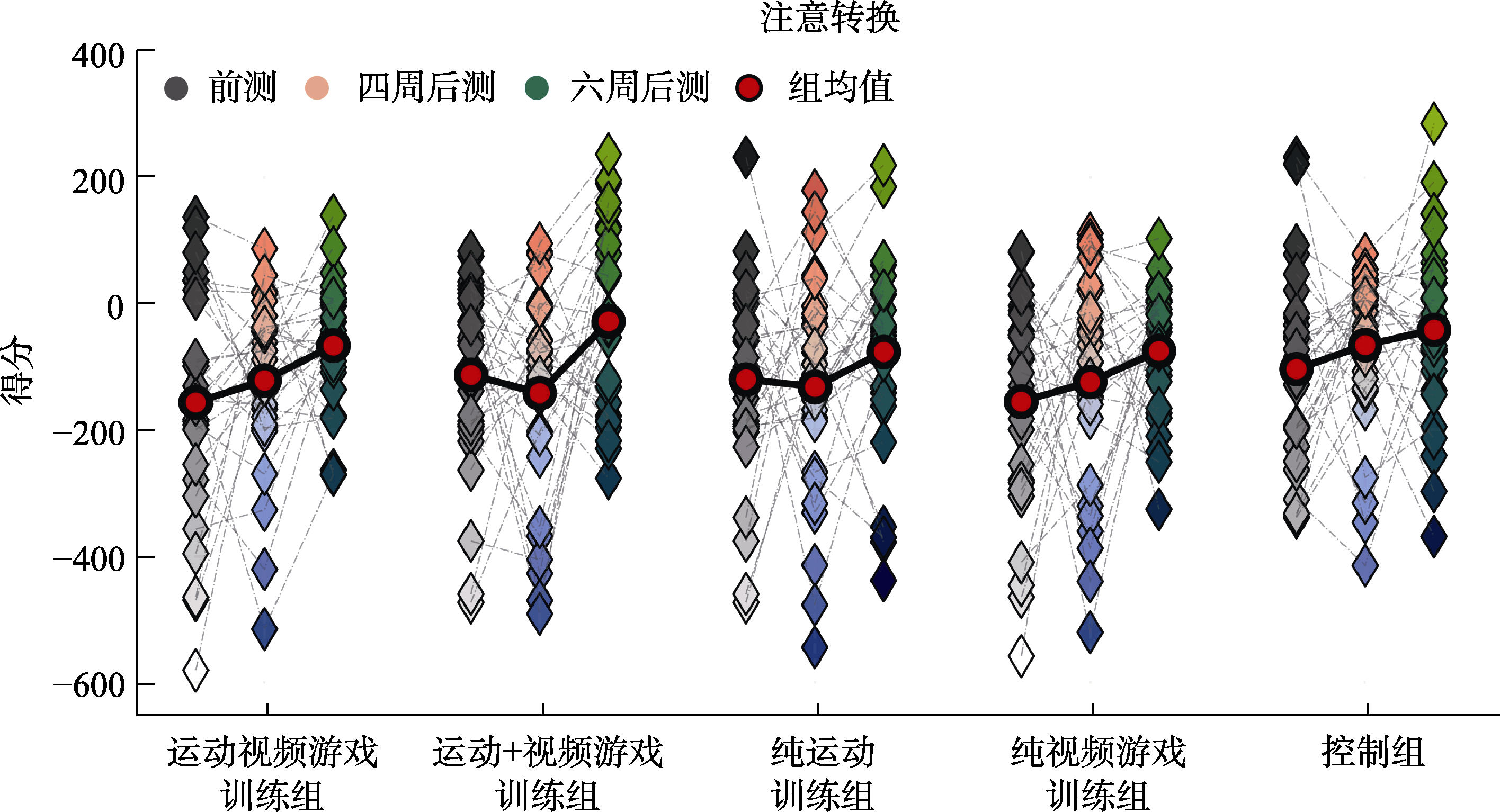
图6 五个实验组训练前后注意转换得分的变化趋势
| 组别 | 总计 | 男 | 女 | 年龄(M ± SD, 岁) |
|---|---|---|---|---|
| 高运动强度+高认知参与组 | 30 | 17 | 13 | 12.30 ± 0.54 |
| 低运动强度+高认知参与组 | 30 | 15 | 15 | 12.53 ± 0.68 |
| 高运动强度+低认知参与组 | 30 | 14 | 16 | 12.50 ± 0.57 |
| 低运动强度+低认知参与组 | 30 | 18 | 12 | 12.43 ± 0.63 |
| 总计 | 120 | 64 | 56 | 12.44 ± 0.61 |
表3 实验2被试人口学变量
| 组别 | 总计 | 男 | 女 | 年龄(M ± SD, 岁) |
|---|---|---|---|---|
| 高运动强度+高认知参与组 | 30 | 17 | 13 | 12.30 ± 0.54 |
| 低运动强度+高认知参与组 | 30 | 15 | 15 | 12.53 ± 0.68 |
| 高运动强度+低认知参与组 | 30 | 14 | 16 | 12.50 ± 0.57 |
| 低运动强度+低认知参与组 | 30 | 18 | 12 | 12.43 ± 0.63 |
| 总计 | 120 | 64 | 56 | 12.44 ± 0.61 |

图7 实验2实施流程图
| 组别 | 运动强度 | 认知参与 | ||
|---|---|---|---|---|
| M | SD | M | SD | |
| 高运动强度+高认知参与组 | 15.98 | 0.63 | 4.64 | 0.48 |
| 低运动强度+高认知参与组 | 7.62 | 0.60 | 4.65 | 0.48 |
| 高运动强度+低认知参与组 | 15.94 | 1.01 | 1.35 | 0.74 |
| 低运动强度+低认知参与组 | 7.57 | 0.62 | 1.36 | 0.62 |
| p | < 0.001 | < 0.001 | ||
表4 实验2操纵有效性分析
| 组别 | 运动强度 | 认知参与 | ||
|---|---|---|---|---|
| M | SD | M | SD | |
| 高运动强度+高认知参与组 | 15.98 | 0.63 | 4.64 | 0.48 |
| 低运动强度+高认知参与组 | 7.62 | 0.60 | 4.65 | 0.48 |
| 高运动强度+低认知参与组 | 15.94 | 1.01 | 1.35 | 0.74 |
| 低运动强度+低认知参与组 | 7.57 | 0.62 | 1.36 | 0.62 |
| p | < 0.001 | < 0.001 | ||
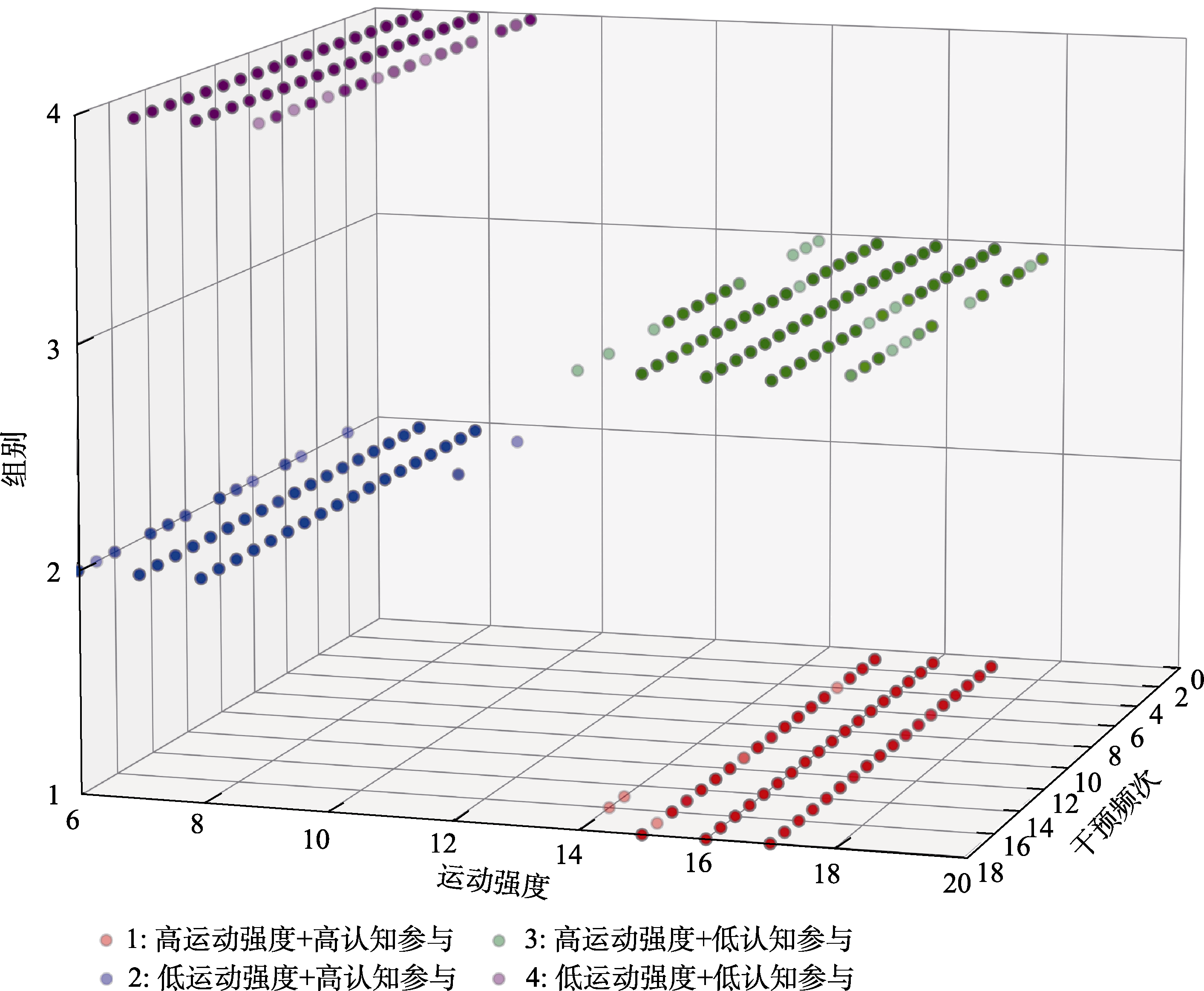
图8 实验2各组被试每次干预后运动强度得分的可视化分布
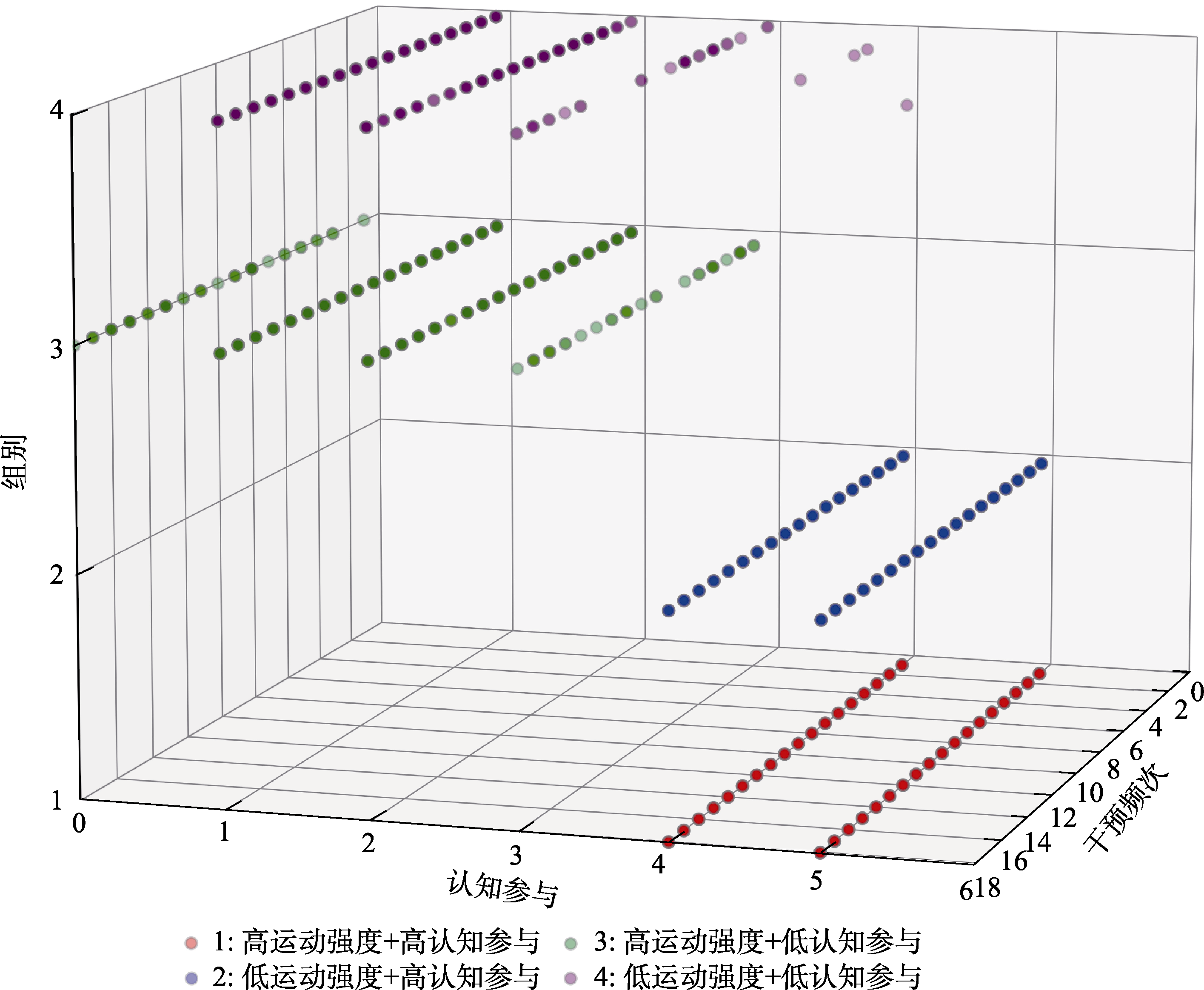
图9 实验2各组被试每次干预后认知参与得分的可视化分布
| 变量 | 任务指标 | 因素 | dfs | F | p | η2p |
|---|---|---|---|---|---|---|
| 反应抑制 | Go/No-go任务 No-go正确率 | 测试阶段 | (3, 116) | 29.88 | <0.001 | 0.21 |
| 运动强度 | (3, 116) | 18.84 | <0.001 | 0.14 | ||
| 测试阶段×运动强度 | (3, 116) | 0.84 | 0.435 | 0.01 | ||
| 认知参与 | (3, 116) | 70.78 | <0.001 | 0.38 | ||
| 测试阶段×认知参与 | (3, 116) | 13.17 | <0.001 | 0.10 | ||
| 测试阶段×运动强度×认知参与 | (3, 116) | 0.58 | 0.558 | 0.01 | ||
| 运动强度×认知参与 | (3, 116) | 1.20 | 0.276 | 0.01 | ||
| 工作记忆刷新 | 数字刷新任务 平均正确率 | 测试阶段 | (3, 116) | 297.25 | <0.001 | 0.72 |
| 运动强度 | (3, 116) | 40.65 | <0.001 | 0.26 | ||
| 测试阶段×运动强度 | (3, 116) | 18.55 | <0.001 | 0.14 | ||
| 认知参与 | (3, 116) | 138.78 | <0.001 | 0.55 | ||
| 测试阶段×认知参与 | (3, 116) | 42.94 | <0.001 | 0.27 | ||
| 测试阶段×运动强度×认知参与 | (3, 116) | 2.05 | 0.140 | 0.02 | ||
| 运动强度×认知参与 | (3, 116) | 0.50 | 0.483 | 0.00 |
表5 各组干预前后运动强度和认知参与对反应抑制和工作记忆刷新的影响效果
| 变量 | 任务指标 | 因素 | dfs | F | p | η2p |
|---|---|---|---|---|---|---|
| 反应抑制 | Go/No-go任务 No-go正确率 | 测试阶段 | (3, 116) | 29.88 | <0.001 | 0.21 |
| 运动强度 | (3, 116) | 18.84 | <0.001 | 0.14 | ||
| 测试阶段×运动强度 | (3, 116) | 0.84 | 0.435 | 0.01 | ||
| 认知参与 | (3, 116) | 70.78 | <0.001 | 0.38 | ||
| 测试阶段×认知参与 | (3, 116) | 13.17 | <0.001 | 0.10 | ||
| 测试阶段×运动强度×认知参与 | (3, 116) | 0.58 | 0.558 | 0.01 | ||
| 运动强度×认知参与 | (3, 116) | 1.20 | 0.276 | 0.01 | ||
| 工作记忆刷新 | 数字刷新任务 平均正确率 | 测试阶段 | (3, 116) | 297.25 | <0.001 | 0.72 |
| 运动强度 | (3, 116) | 40.65 | <0.001 | 0.26 | ||
| 测试阶段×运动强度 | (3, 116) | 18.55 | <0.001 | 0.14 | ||
| 认知参与 | (3, 116) | 138.78 | <0.001 | 0.55 | ||
| 测试阶段×认知参与 | (3, 116) | 42.94 | <0.001 | 0.27 | ||
| 测试阶段×运动强度×认知参与 | (3, 116) | 2.05 | 0.140 | 0.02 | ||
| 运动强度×认知参与 | (3, 116) | 0.50 | 0.483 | 0.00 |
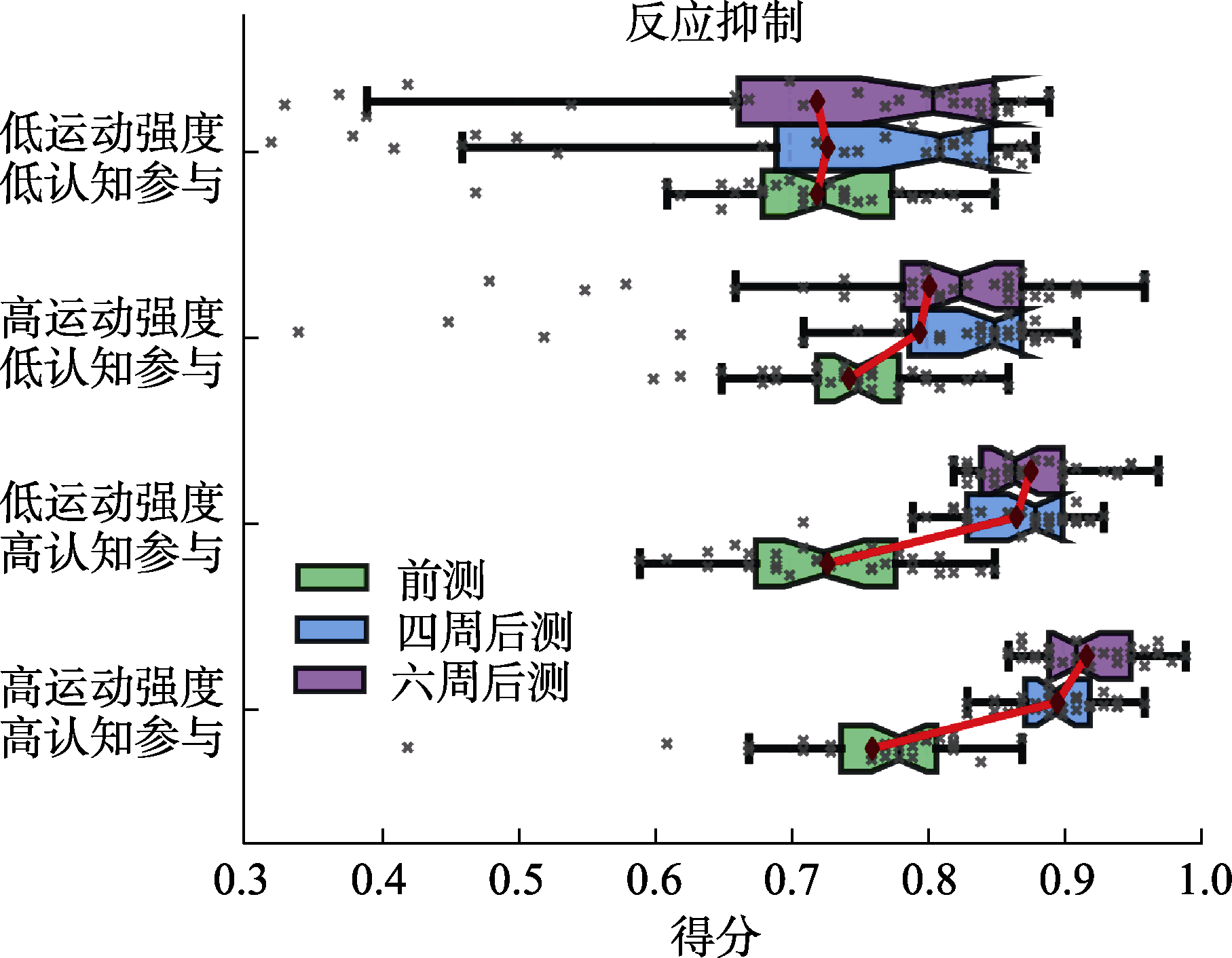
图10 四个实验组训练前后反应抑制得分的变化趋势
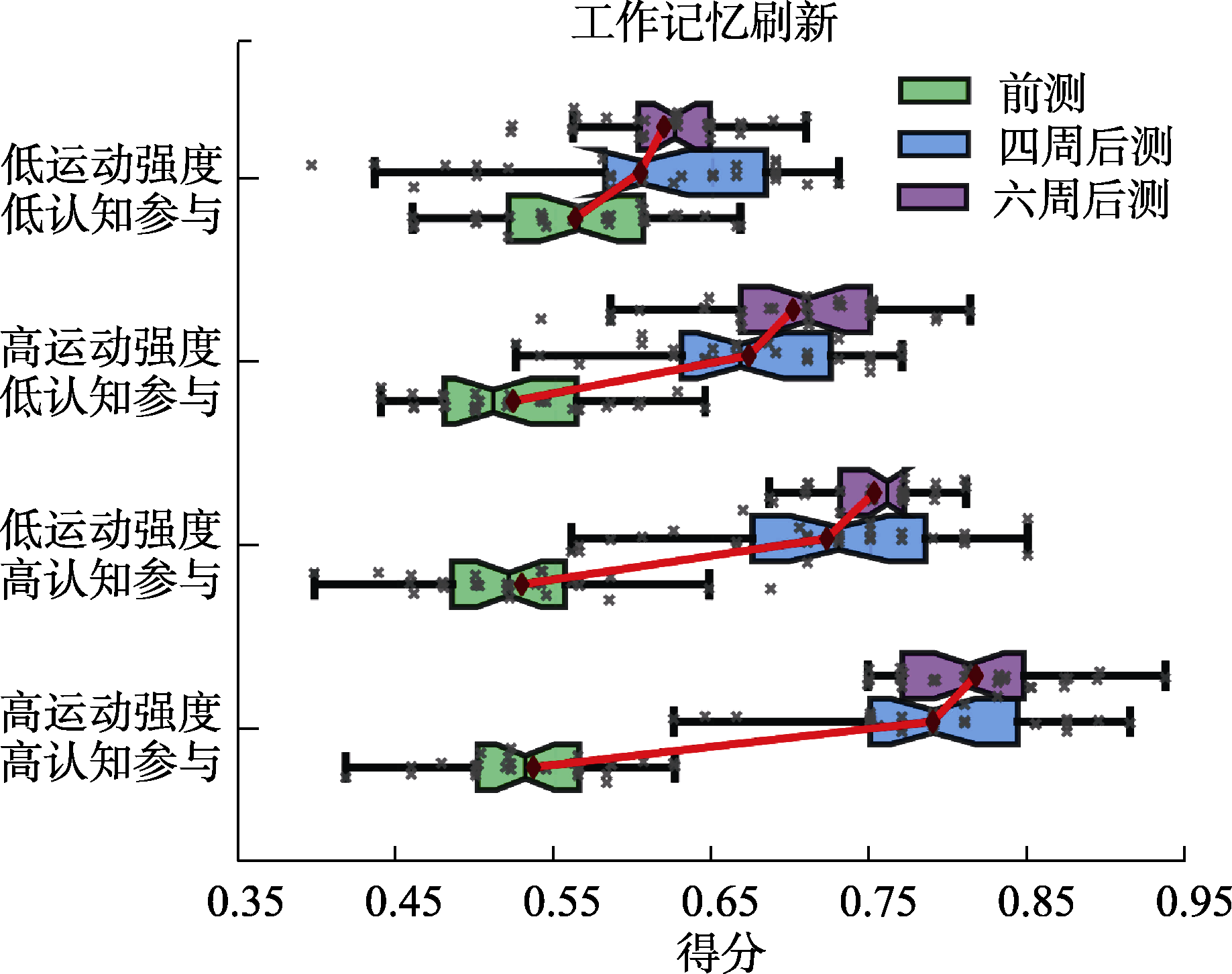
图11 四个实验组训练前后工作记忆刷新得分的变化趋势
| 组别 | 总计 | 男 | 女 | 年龄(M ± SD, 岁) |
|---|---|---|---|---|
| 运动视频游戏训练组 | 30 | 14 | 16 | 19.17 ± 0.87 |
| 运动+视频游戏训练组 | 30 | 13 | 17 | 19.37 ± 0.89 |
| 控制组 | 30 | 16 | 14 | 19.00 ± 0.95 |
| 总计 | 90 | 43 | 47 | 19.18 ± 0.91 |
附表S1 补充实验被试人口学变量
| 组别 | 总计 | 男 | 女 | 年龄(M ± SD, 岁) |
|---|---|---|---|---|
| 运动视频游戏训练组 | 30 | 14 | 16 | 19.17 ± 0.87 |
| 运动+视频游戏训练组 | 30 | 13 | 17 | 19.37 ± 0.89 |
| 控制组 | 30 | 16 | 14 | 19.00 ± 0.95 |
| 总计 | 90 | 43 | 47 | 19.18 ± 0.91 |
| 变量 | 运动视频游戏训练组 | 运动+视频游戏训练组 | 控制组 | F(2, 87) | p | η2p | |||
|---|---|---|---|---|---|---|---|---|---|
| (n = 30) | (n = 30) | (n = 30) | |||||||
| M | SD | M | SD | M | SD | ||||
| 干扰抑制 | |||||||||
| Stroop干扰效应(ms) | −41.27 | 45.93 | −31.28 | 57.15 | −14.81 | 45.86 | 1.42 | 0.25 | 0.03 |
| 反应抑制 | |||||||||
| No-go正确率 | 0.92 | 0.06 | 0.90 | 0.07 | 0.89 | 0.06 | 2.15 | 0.12 | 0.05 |
| 工作记忆刷新 | |||||||||
| 平均正确率 | 0.89 | 0.14 | 0.88 | 0.09 | 0.86 | 0.08 | 0.86 | 0.43 | 0.02 |
| 注意转换 | |||||||||
| 转换代价 (ms) | −284.75 | 193.22 | −240.99 | 184.14 | −320.54 | 243.95 | 1.09 | 0.34 | 0.02 |
附表S2 补充实验年轻成人个体各变量基线水平描述统计及方差分析结果
| 变量 | 运动视频游戏训练组 | 运动+视频游戏训练组 | 控制组 | F(2, 87) | p | η2p | |||
|---|---|---|---|---|---|---|---|---|---|
| (n = 30) | (n = 30) | (n = 30) | |||||||
| M | SD | M | SD | M | SD | ||||
| 干扰抑制 | |||||||||
| Stroop干扰效应(ms) | −41.27 | 45.93 | −31.28 | 57.15 | −14.81 | 45.86 | 1.42 | 0.25 | 0.03 |
| 反应抑制 | |||||||||
| No-go正确率 | 0.92 | 0.06 | 0.90 | 0.07 | 0.89 | 0.06 | 2.15 | 0.12 | 0.05 |
| 工作记忆刷新 | |||||||||
| 平均正确率 | 0.89 | 0.14 | 0.88 | 0.09 | 0.86 | 0.08 | 0.86 | 0.43 | 0.02 |
| 注意转换 | |||||||||
| 转换代价 (ms) | −284.75 | 193.22 | −240.99 | 184.14 | −320.54 | 243.95 | 1.09 | 0.34 | 0.02 |
| 变量 | 任务指标 | 因素 | dfs | F | p | η2p |
|---|---|---|---|---|---|---|
| 干扰抑制 | Stroop任务 干扰效应(ms) | 测试阶段 | (2, 87) | 0.66 | 0.518 | 0.01 |
| 组别 | (2, 87) | 0.77 | 0.465 | 0.02 | ||
| 测试阶段×组别 | (2, 87) | 4.50 | 0.003** | 0.09 | ||
| 反应抑制 | Go/No-go任务 No-go正确率 | 测试阶段 | (2, 87) | 0.08 | 0.921 | 0.00 |
| 组别 | (2, 87) | 4.36 | 0.016 | 0.09 | ||
| 测试阶段×组别 | (2, 87) | 1.21 | 0.309 | 0.03 | ||
| 工作记忆刷新 | 数字刷新任务 平均正确率 | 测试阶段 | (2, 87) | 9.07 | <0.001*** | 0.09 |
| 组别 | (2, 87) | 6.60 | 0.002** | 0.13 | ||
| 测试阶段×组别 | (2, 87) | 1.21 | 0.310 | 0.03 | ||
| 注意转换 | 注意转换任务 转换代价(ms) | 测试阶段 | (2, 87) | 17.02 | <0.001*** | 0.16 |
| 组别 | (2, 87) | 0.76 | 0.471 | 0.02 | ||
| 测试阶段×组别 | (2, 87) | 1.12 | 0.346 | 0.03 |
附表S3 各组干预前后年轻成人个体执行功能各子成分的提升效果
| 变量 | 任务指标 | 因素 | dfs | F | p | η2p |
|---|---|---|---|---|---|---|
| 干扰抑制 | Stroop任务 干扰效应(ms) | 测试阶段 | (2, 87) | 0.66 | 0.518 | 0.01 |
| 组别 | (2, 87) | 0.77 | 0.465 | 0.02 | ||
| 测试阶段×组别 | (2, 87) | 4.50 | 0.003** | 0.09 | ||
| 反应抑制 | Go/No-go任务 No-go正确率 | 测试阶段 | (2, 87) | 0.08 | 0.921 | 0.00 |
| 组别 | (2, 87) | 4.36 | 0.016 | 0.09 | ||
| 测试阶段×组别 | (2, 87) | 1.21 | 0.309 | 0.03 | ||
| 工作记忆刷新 | 数字刷新任务 平均正确率 | 测试阶段 | (2, 87) | 9.07 | <0.001*** | 0.09 |
| 组别 | (2, 87) | 6.60 | 0.002** | 0.13 | ||
| 测试阶段×组别 | (2, 87) | 1.21 | 0.310 | 0.03 | ||
| 注意转换 | 注意转换任务 转换代价(ms) | 测试阶段 | (2, 87) | 17.02 | <0.001*** | 0.16 |
| 组别 | (2, 87) | 0.76 | 0.471 | 0.02 | ||
| 测试阶段×组别 | (2, 87) | 1.12 | 0.346 | 0.03 |
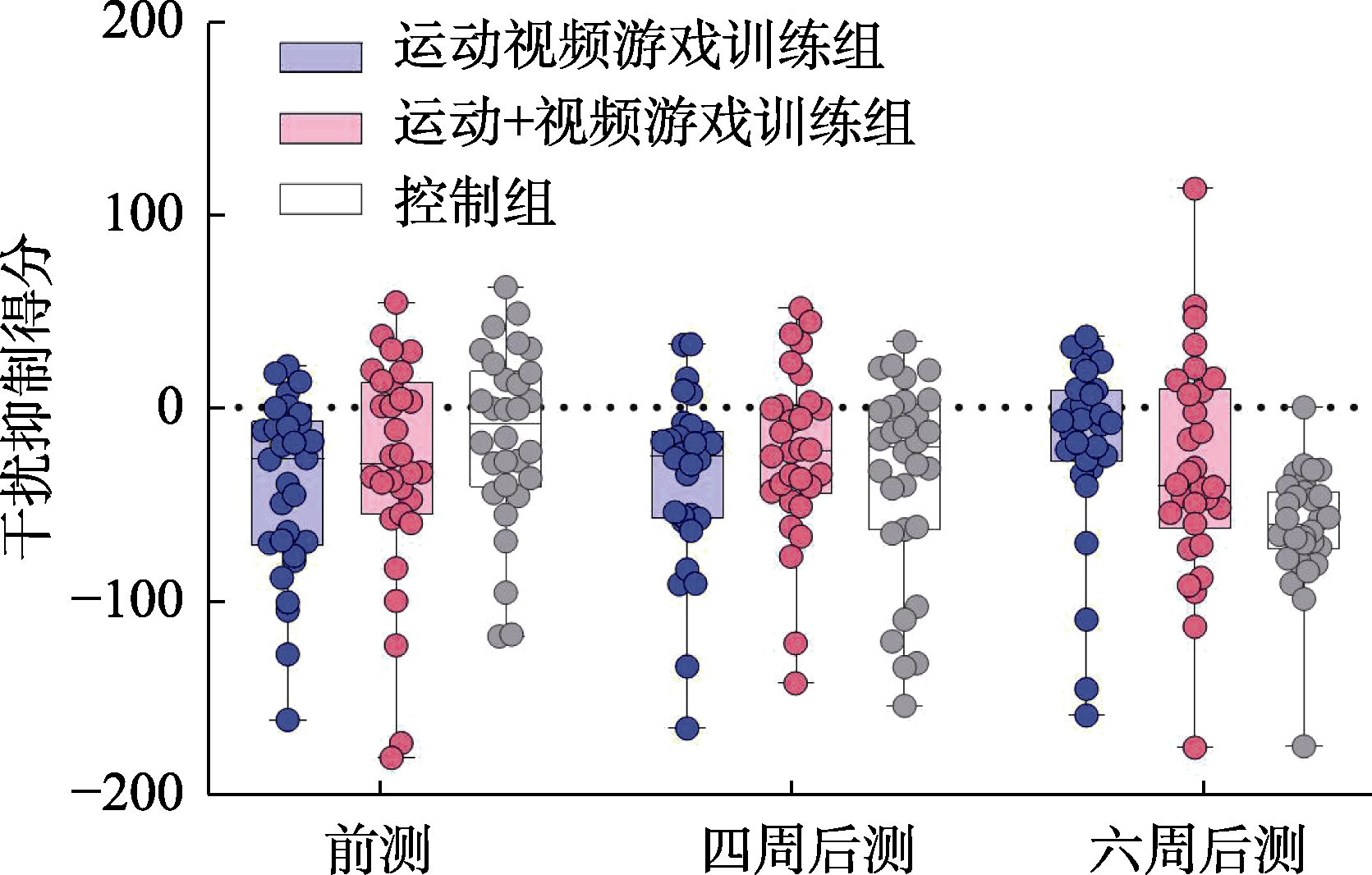
附图S1 三个实验组训练前后干扰抑制得分的变化趋势
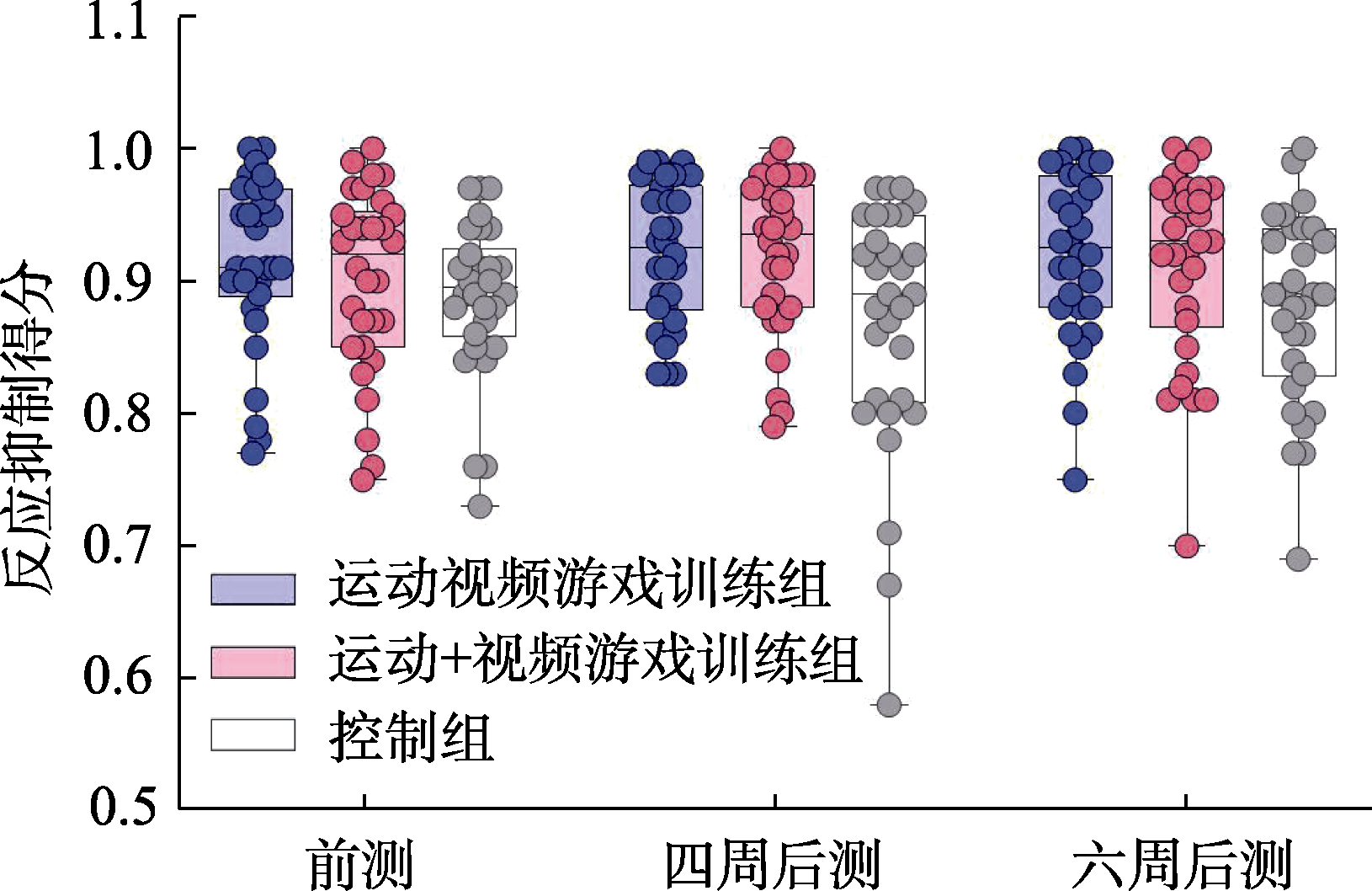
附图S2 三个实验组训练前后反应抑制得分的变化趋势
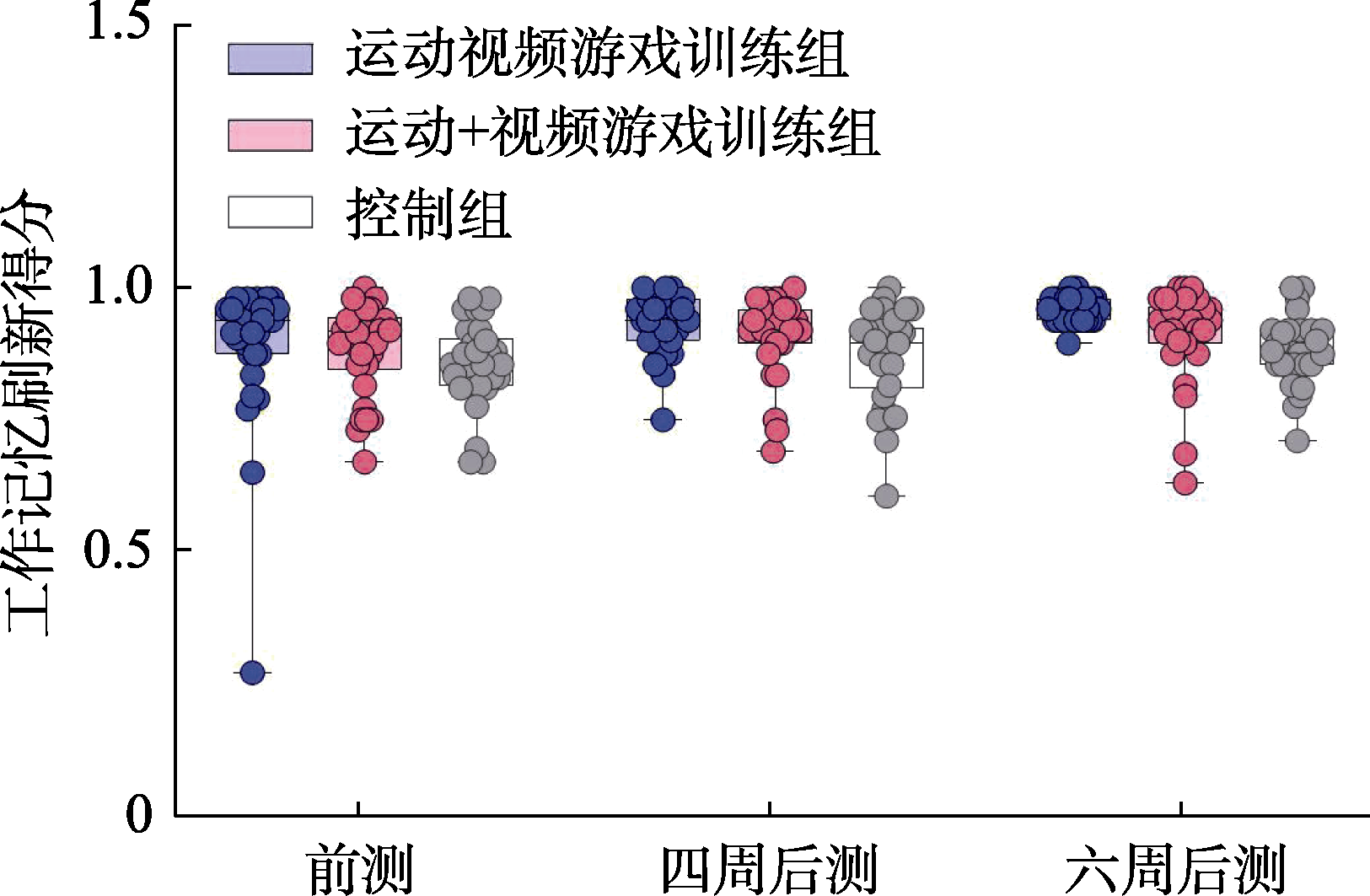
附图S3 三个实验组训练前后工作记忆刷新得分的变化趋势

附图S4 三个实验组训练前后注意转换得分的变化趋势
| 变量 | 运动视频游戏训练组 | 运动+视频游戏训练组 | 纯运动训练组 | 纯视频游戏训练组 | 控制组 | F (4, 145) | p | η2p | |||||
|---|---|---|---|---|---|---|---|---|---|---|---|---|---|
| (n = 30) | (n = 30) | (n = 30) | (n = 30) | (n = 30) | |||||||||
| M | SD | M | SD | M | SD | M | SD | M | SD | ||||
| 干扰抑制 | |||||||||||||
| Stroop干扰效应(ms) | −21.57 | 55.96 | −28.66 | 51.66 | −25.24 | 41.97 | −18.42 | 41.78 | 9.67 | 71.12 | 0.55 | 0.70 | 0.02 |
| 反应抑制 | |||||||||||||
| No-go正确率 | 0.82 | 0.12 | 0.78 | 0.18 | 0.81 | 0.12 | 0.79 | 0.12 | 0.80 | 0.17 | 0.25 | 0.91 | 0.01 |
| 工作记忆刷新 | |||||||||||||
| 平均正确率 | 0.52 | 0.13 | 0.56 | 0.15 | 0.53 | 0.07 | 0.54 | 0.13 | 0.47 | 0.14 | 1.70 | 1.15 | 0.05 |
| 注意转换 | |||||||||||||
| 转换代价(ms) | −191.70 | 262.41 | −143.03 | 219.53 | −149.85 | 225.32 | −155.26 | 165.43 | 104.10 | 151.42 | 0.67 | 0.61 | 0.02 |
附表S4 实验1儿童各变量基线水平的描述统计及方差分析结果
| 变量 | 运动视频游戏训练组 | 运动+视频游戏训练组 | 纯运动训练组 | 纯视频游戏训练组 | 控制组 | F (4, 145) | p | η2p | |||||
|---|---|---|---|---|---|---|---|---|---|---|---|---|---|
| (n = 30) | (n = 30) | (n = 30) | (n = 30) | (n = 30) | |||||||||
| M | SD | M | SD | M | SD | M | SD | M | SD | ||||
| 干扰抑制 | |||||||||||||
| Stroop干扰效应(ms) | −21.57 | 55.96 | −28.66 | 51.66 | −25.24 | 41.97 | −18.42 | 41.78 | 9.67 | 71.12 | 0.55 | 0.70 | 0.02 |
| 反应抑制 | |||||||||||||
| No-go正确率 | 0.82 | 0.12 | 0.78 | 0.18 | 0.81 | 0.12 | 0.79 | 0.12 | 0.80 | 0.17 | 0.25 | 0.91 | 0.01 |
| 工作记忆刷新 | |||||||||||||
| 平均正确率 | 0.52 | 0.13 | 0.56 | 0.15 | 0.53 | 0.07 | 0.54 | 0.13 | 0.47 | 0.14 | 1.70 | 1.15 | 0.05 |
| 注意转换 | |||||||||||||
| 转换代价(ms) | −191.70 | 262.41 | −143.03 | 219.53 | −149.85 | 225.32 | −155.26 | 165.43 | 104.10 | 151.42 | 0.67 | 0.61 | 0.02 |
| 变量 | 任务指标 | 组别 | T0 (M ± SD) | T1 (M ± SD) | T2 (M ± SD) |
|---|---|---|---|---|---|
| 干扰抑制 | Stroop任务 干扰效应(ms) | 运动视频游戏训练组 | −21.57 ± 55.96 | −8.45 ± 75.47 | −4.18 ± 52.15 |
| 运动+视频游戏训练组 | −28.66 ± 51.66 | −33.90 ± 60.00 | −4.21 ± 85.38 | ||
| 纯运动训练组 | −25.24 ± 41.97 | −25.61 ± 53.90 | −20.08 ± 78.95 | ||
| 纯视频游戏训练组 | −18.42 ± 41.78 | −15.64 ± 77.01 | −8.63 ± 40.86 | ||
| 控制组 | −9.67 ± 71.12 | −21.85 ± 62.08 | −7.92 ± 63.30 | ||
| 反应抑制 | Go/No-go任务 No-go正确率 | 运动视频游戏训练组 | 0.82 ± 0.12 | 0.90 ± 0.08 | 0.93 ± 0.03 |
| 运动+视频游戏训练组 | 0.78 ± 0.18 | 0.87 ± 0.11 | 0.84 ± 0.18 | ||
| 纯运动训练组 | 0.81 ± 0.12 | 0.83 ± 0.10 | 0.83 ± 0.10 | ||
| 纯视频游戏训练组 | 0.79 ± 0.12 | 0.83 ± 0.08 | 0.83 ± 0.08 | ||
| 控制组 | 0.80 ± 0.17 | 0.84 ± 0.14 | 0.84 ± 0.14 | ||
| 工作记忆刷新 | 数字刷新任务 平均正确率 | 运动视频游戏训练组 | 0.52 ± 0.13 | 0.70 ± 0.20 | 0.78 ± 0.16 |
| 运动+视频游戏训练组 | 0.55 ± 0.15 | 0.69 ± 0.18 | 0.62 ± 0.14 | ||
| 纯运动训练组 | 0.53 ± 0.07 | 0.57 ± 0.10 | 0.59 ± 0.11 | ||
| 纯视频游戏训练组 | 0.54 ± 0.13 | 0.63 ± 0.17 | 0.66 ± 0.18 | ||
| 控制组 | 0.47 ± 0.14 | 0.56 ± 0.18 | 0.60 ± 0.17 | ||
| 注意转换 | 注意转换任务 转换代价(ms) | 运动视频游戏训练组 | −191.70 ± 262.41 | −139.67 ± 164.56 | −66.31 ± 100.19 |
| 运动+视频游戏训练组 | −143.03 ± 219.52 | −141.95 ± 164.58 | −28.31 ± 143.86 | ||
| 纯运动训练组 | −149.84 ± 225.32 | −131.89 ± 171.60 | −96.58 ± 190.30 | ||
| 纯视频游戏训练组 | −155.26 ± 165.43 | −146.52 ± 207.96 | −75.27 ± 98.71 | ||
| 控制组 | −104.10 ± 151.42 | −65.71 ± 127.21 | −41.84 ± 140.20 |
附表S5 实验1各组干预前后儿童执行功能各成分表现的描述统计结果
| 变量 | 任务指标 | 组别 | T0 (M ± SD) | T1 (M ± SD) | T2 (M ± SD) |
|---|---|---|---|---|---|
| 干扰抑制 | Stroop任务 干扰效应(ms) | 运动视频游戏训练组 | −21.57 ± 55.96 | −8.45 ± 75.47 | −4.18 ± 52.15 |
| 运动+视频游戏训练组 | −28.66 ± 51.66 | −33.90 ± 60.00 | −4.21 ± 85.38 | ||
| 纯运动训练组 | −25.24 ± 41.97 | −25.61 ± 53.90 | −20.08 ± 78.95 | ||
| 纯视频游戏训练组 | −18.42 ± 41.78 | −15.64 ± 77.01 | −8.63 ± 40.86 | ||
| 控制组 | −9.67 ± 71.12 | −21.85 ± 62.08 | −7.92 ± 63.30 | ||
| 反应抑制 | Go/No-go任务 No-go正确率 | 运动视频游戏训练组 | 0.82 ± 0.12 | 0.90 ± 0.08 | 0.93 ± 0.03 |
| 运动+视频游戏训练组 | 0.78 ± 0.18 | 0.87 ± 0.11 | 0.84 ± 0.18 | ||
| 纯运动训练组 | 0.81 ± 0.12 | 0.83 ± 0.10 | 0.83 ± 0.10 | ||
| 纯视频游戏训练组 | 0.79 ± 0.12 | 0.83 ± 0.08 | 0.83 ± 0.08 | ||
| 控制组 | 0.80 ± 0.17 | 0.84 ± 0.14 | 0.84 ± 0.14 | ||
| 工作记忆刷新 | 数字刷新任务 平均正确率 | 运动视频游戏训练组 | 0.52 ± 0.13 | 0.70 ± 0.20 | 0.78 ± 0.16 |
| 运动+视频游戏训练组 | 0.55 ± 0.15 | 0.69 ± 0.18 | 0.62 ± 0.14 | ||
| 纯运动训练组 | 0.53 ± 0.07 | 0.57 ± 0.10 | 0.59 ± 0.11 | ||
| 纯视频游戏训练组 | 0.54 ± 0.13 | 0.63 ± 0.17 | 0.66 ± 0.18 | ||
| 控制组 | 0.47 ± 0.14 | 0.56 ± 0.18 | 0.60 ± 0.17 | ||
| 注意转换 | 注意转换任务 转换代价(ms) | 运动视频游戏训练组 | −191.70 ± 262.41 | −139.67 ± 164.56 | −66.31 ± 100.19 |
| 运动+视频游戏训练组 | −143.03 ± 219.52 | −141.95 ± 164.58 | −28.31 ± 143.86 | ||
| 纯运动训练组 | −149.84 ± 225.32 | −131.89 ± 171.60 | −96.58 ± 190.30 | ||
| 纯视频游戏训练组 | −155.26 ± 165.43 | −146.52 ± 207.96 | −75.27 ± 98.71 | ||
| 控制组 | −104.10 ± 151.42 | −65.71 ± 127.21 | −41.84 ± 140.20 |
| 组别 | 运动强度 | |
|---|---|---|
| M | SD | |
| 高运动强度+高认知参与组 | 137.41 | 1.46 |
| 低运动强度+高认知参与组 | 92.28 | 1.45 |
| 高运动强度+低认知参与组 | 142.46 | 1.44 |
| 低运动强度+低认知参与组 | 97.34 | 1.41 |
| p | <0.001*** | |
附表S6 实验2运动强度操纵有效性补充分析(PolarRS400平均心率)
| 组别 | 运动强度 | |
|---|---|---|
| M | SD | |
| 高运动强度+高认知参与组 | 137.41 | 1.46 |
| 低运动强度+高认知参与组 | 92.28 | 1.45 |
| 高运动强度+低认知参与组 | 142.46 | 1.44 |
| 低运动强度+低认知参与组 | 97.34 | 1.41 |
| p | <0.001*** | |
| 变量 | 高运动强度+ 高认知参与组 | 低运动强度+ 高认知参与组 | 高运动强度+ 低认知参与组 | 低运动强度+ 低认知参与组 | F(3, 116) | p | η2p | ||||
|---|---|---|---|---|---|---|---|---|---|---|---|
| (n = 30) | (n = 30) | (n = 30) | (n = 30) | ||||||||
| M | SD | M | SD | M | SD | M | SD | ||||
| 反应抑制 | |||||||||||
| NOGO正确率 | 0.76 | 0.09 | 0.73 | 0.07 | 0.74 | 0.06 | 0.72 | 0.08 | 1.77 | 0.16 | 0.04 |
| 工作记忆刷新 | |||||||||||
| 平均正确率 | 0.54 | 0.05 | 0.53 | 0.07 | 0.52 | 0.06 | 0.56 | 0.06 | 2.65 | 0.05 | 0.06 |
附表S7 实验2儿童各变量基线水平描述统计及方差分析结果
| 变量 | 高运动强度+ 高认知参与组 | 低运动强度+ 高认知参与组 | 高运动强度+ 低认知参与组 | 低运动强度+ 低认知参与组 | F(3, 116) | p | η2p | ||||
|---|---|---|---|---|---|---|---|---|---|---|---|
| (n = 30) | (n = 30) | (n = 30) | (n = 30) | ||||||||
| M | SD | M | SD | M | SD | M | SD | ||||
| 反应抑制 | |||||||||||
| NOGO正确率 | 0.76 | 0.09 | 0.73 | 0.07 | 0.74 | 0.06 | 0.72 | 0.08 | 1.77 | 0.16 | 0.04 |
| 工作记忆刷新 | |||||||||||
| 平均正确率 | 0.54 | 0.05 | 0.53 | 0.07 | 0.52 | 0.06 | 0.56 | 0.06 | 2.65 | 0.05 | 0.06 |
| 变量 | 任务指标 | 组别 | T0 (M ± SD) | T1 (M ± SD) | T2 (M ± SD) |
|---|---|---|---|---|---|
| 反应抑制 | Go/No-go任务 No-go正确率 | 高运动强度+高认知参与组 | 0.76 ± 0.08 | 0.90 ± 0.03 | 0.92 ± 0.04 |
| 低运动强度+高认知参与组 | 0.73 ± 0.07 | 0.87 ± 0.05 | 0.88 ± 0.04 | ||
| 高运动强度+低认知参与组 | 0.74 ± 0.06 | 0.79 ± 0.14 | 0.80 ± 0.11 | ||
| 低运动强度+低认知参与组 | 0.72 ± 0.08 | 0.73 ± 0.17 | 0.72 ± 0.18 | ||
| 工作记忆刷新 | 数字刷新任务 平均正确率 | 高运动强度+高认知参与组 | 0.54 ± 0.05 | 0.79 ± 0.07 | 0.82 ± 0.05 |
| 低运动强度+高认知参与组 | 0.53 ± 0.07 | 0.72 ± 0.09 | 0.75 ± 0.04 | ||
| 高运动强度+低认知参与组 | 0.52 ± 0.06 | 0.67 ± 0.07 | 0.70 ± 0.07 | ||
| 低运动强度+低认知参与组 | 0.56 ± 0.06 | 0.60 ± 0.09 | 0.62 ± 0.04 |
附表S8 实验2各组干预前后儿童反应抑制和工作记忆刷新表现的描述统计结果
| 变量 | 任务指标 | 组别 | T0 (M ± SD) | T1 (M ± SD) | T2 (M ± SD) |
|---|---|---|---|---|---|
| 反应抑制 | Go/No-go任务 No-go正确率 | 高运动强度+高认知参与组 | 0.76 ± 0.08 | 0.90 ± 0.03 | 0.92 ± 0.04 |
| 低运动强度+高认知参与组 | 0.73 ± 0.07 | 0.87 ± 0.05 | 0.88 ± 0.04 | ||
| 高运动强度+低认知参与组 | 0.74 ± 0.06 | 0.79 ± 0.14 | 0.80 ± 0.11 | ||
| 低运动强度+低认知参与组 | 0.72 ± 0.08 | 0.73 ± 0.17 | 0.72 ± 0.18 | ||
| 工作记忆刷新 | 数字刷新任务 平均正确率 | 高运动强度+高认知参与组 | 0.54 ± 0.05 | 0.79 ± 0.07 | 0.82 ± 0.05 |
| 低运动强度+高认知参与组 | 0.53 ± 0.07 | 0.72 ± 0.09 | 0.75 ± 0.04 | ||
| 高运动强度+低认知参与组 | 0.52 ± 0.06 | 0.67 ± 0.07 | 0.70 ± 0.07 | ||
| 低运动强度+低认知参与组 | 0.56 ± 0.06 | 0.60 ± 0.09 | 0.62 ± 0.04 |
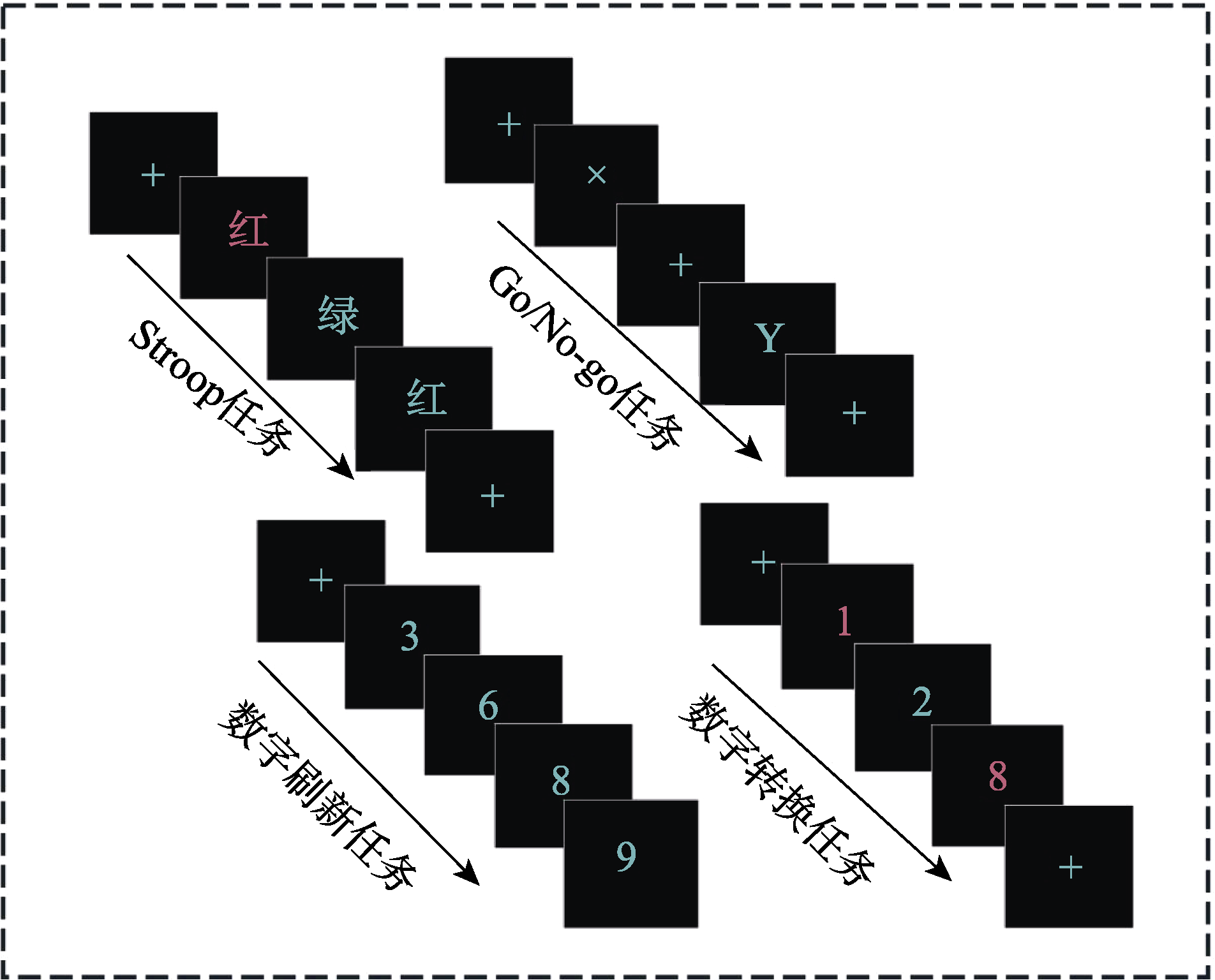
附图S5 前后测执行功能各实验任务示例
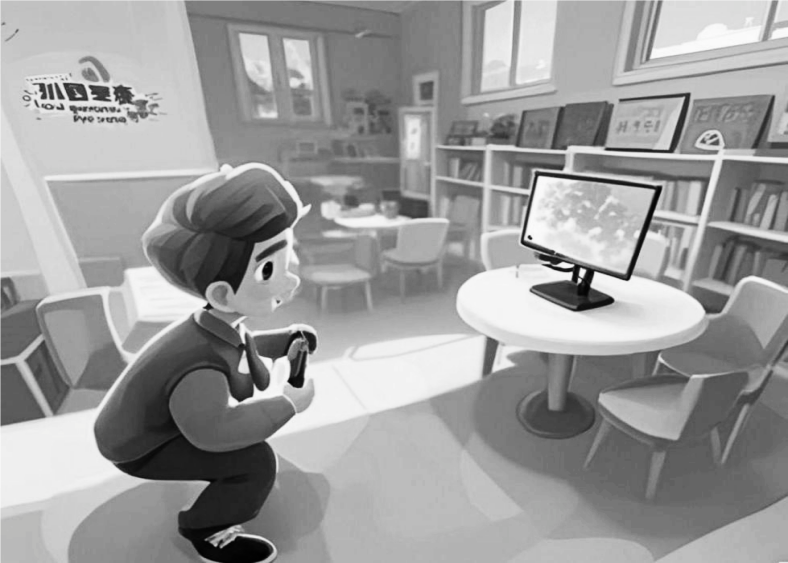
附图S6 实验1运动视频游戏训练组具体干预手段 注: 考虑到伦理学因素的影响, 本研究将全部干预真实图片都进了AI动漫处理。下同。
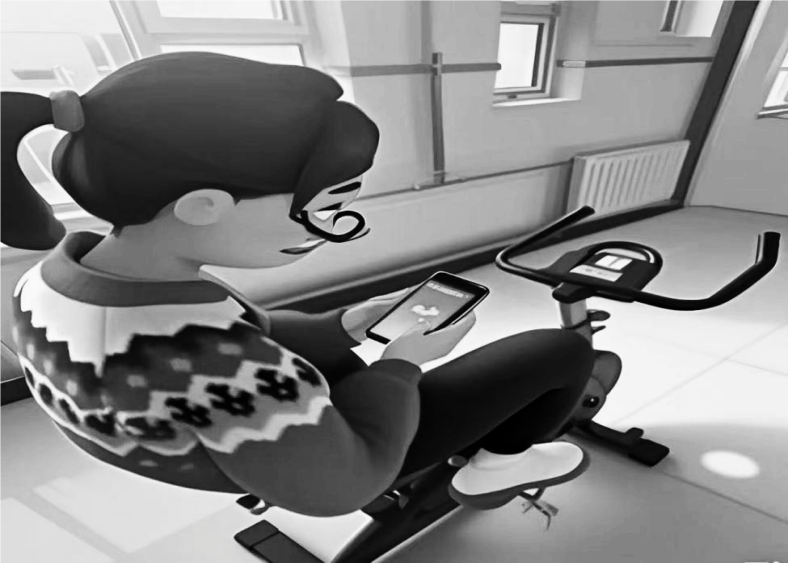
附图S7 实验1运动+视频游戏训练组具体干预手段
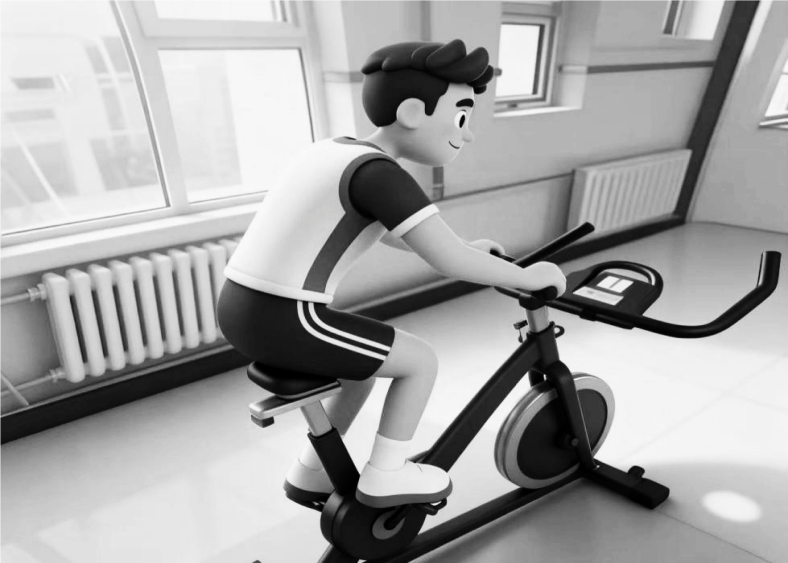
附图S8 实验1纯运动训练组具体干预手段
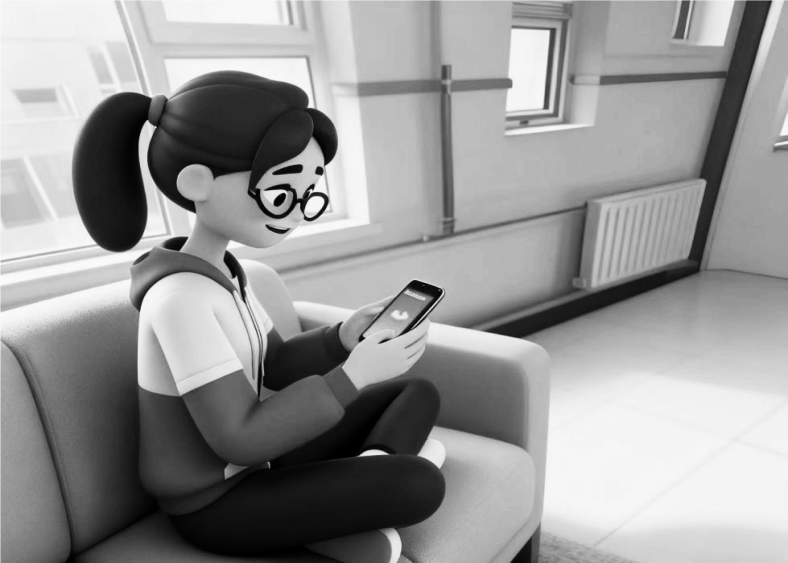
附图S9 实验1纯视频游戏训练组具体干预手段
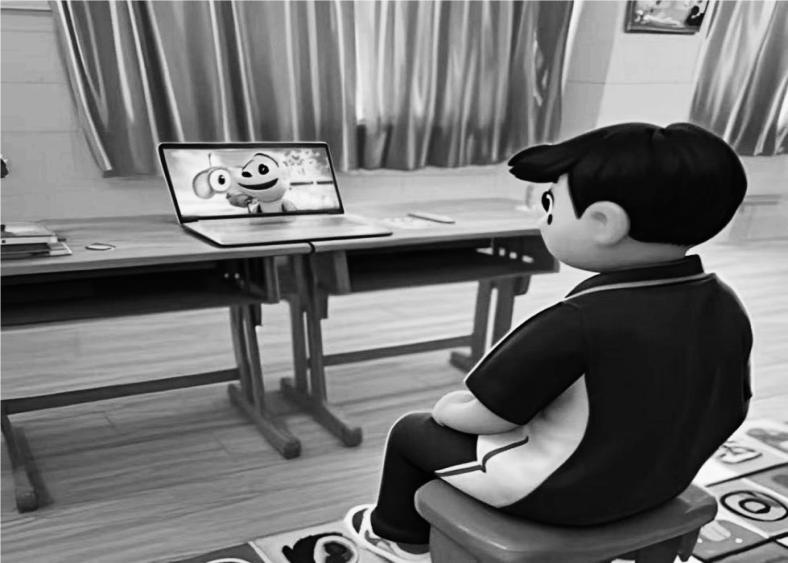
附图S10 实验1控制组具体干预手段
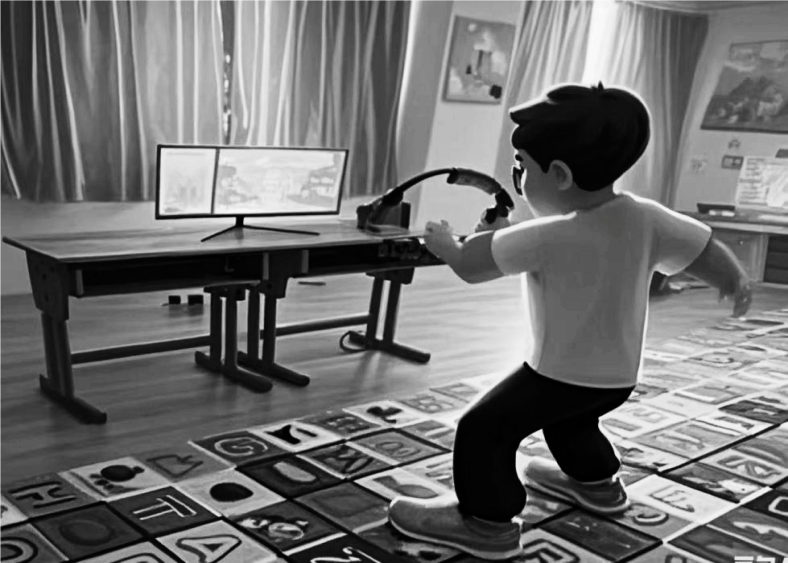
附图S11 实验2高运动强度+高认知参与组具体干预手段
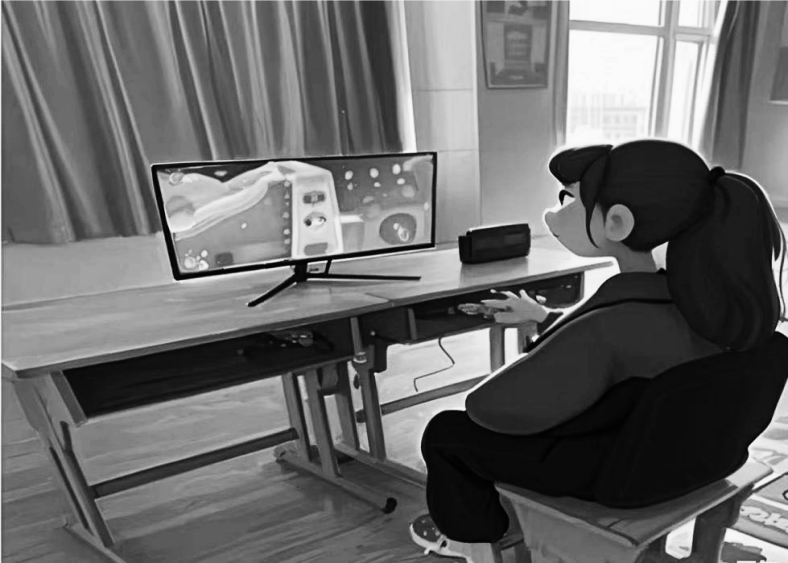
附图S12 实验2低运动强度+高认知参与组具体干预手段
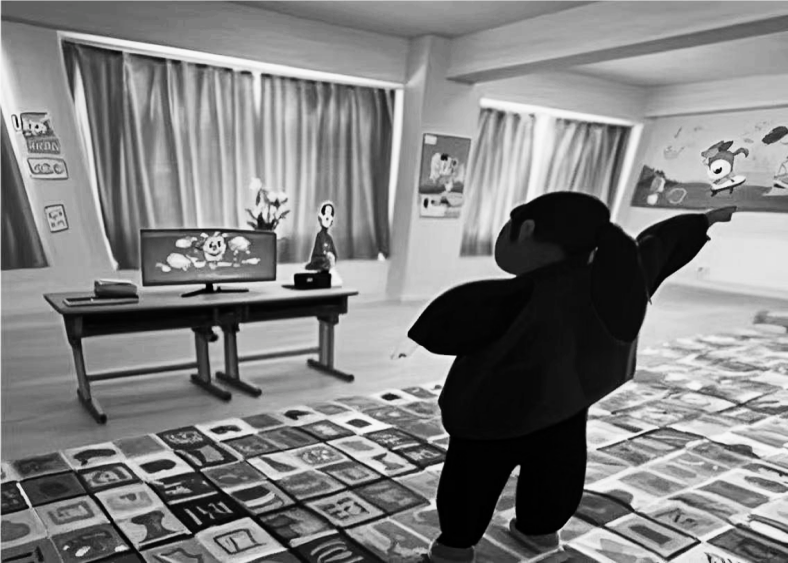
附图S13 实验2高运动强度+低认知参与组具体干预手段
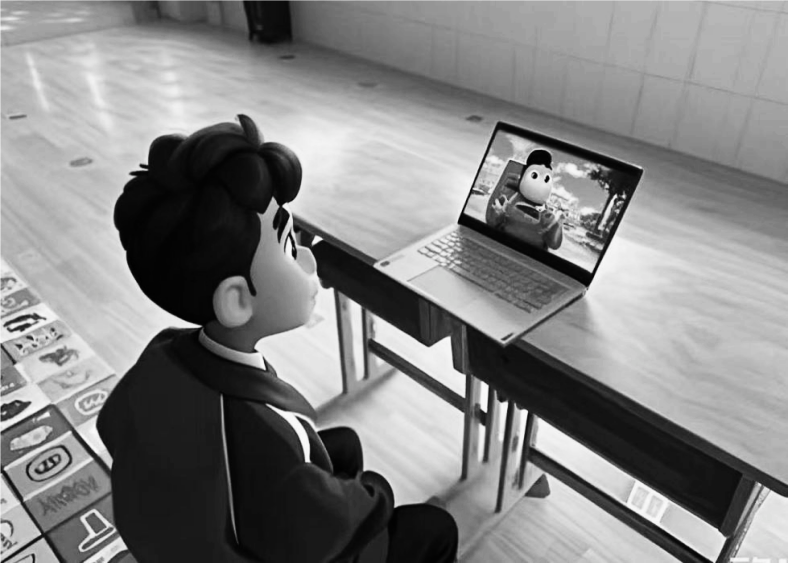
附图S14 实验2低运动强度+低认知参与组具体干预手段
| [1] | Adcock, M., Fankhauser, M., Post, J., Lutz, K., Zizlsperger, L., Luft, A. R., …de Bruin, E. D. (2020). Effects of an in-home multicomponent exergame training on physical functions, cognition, and brain volume of older adults: A randomized controlled trial. Frontiers in Medicine, 6(1), 321. |
| [2] |
Anderson, P. (2002). Assessment and development of executive function (EF) during childhood. Child Neuropsychology, 8(2), 71-82.
doi: 10.1076/chin.8.2.71.8724 pmid: 12638061 |
| [3] | Anzeneder, S., Benzing, V., & Schmidt, M. (2023). Designed acute physical activity to benefit primary school children’s cognition: Effects of cognitive challenge, bout duration and positive affect. Current Issues in Sport Science, 8(2), 25. |
| [4] |
Aron, A. R., Robbins, T. W., & Poldrack, R. A. (2004). Inhibition and the right inferior frontal cortex. Trends in Cognitive Sciences, 8(4), 170-177.
doi: 10.1016/j.tics.2004.02.010 pmid: 15050513 |
| [5] |
Audiffren, M., Tomporowski, P. D., & Zagrodnik, J. (2008). Acute aerobic exercise and information processing: Energizing motor processes during a choice reaction time task. Acta psychologica, 129(3), 410-419.
doi: 10.1016/j.actpsy.2008.09.006 pmid: 18930445 |
| [6] |
Bahar-Fuchs, A., Webb, S., Bartsch, L., Clare, L., Rebok, G., Cherbuin, N., & Anstey, K. J. (2017). Tailored and adaptive computerized cognitive training in older adults at risk for dementia: A randomized controlled trial. Journal of Alzheimer’s Disease, 60(3), 889-911.
doi: 10.3233/JAD-170404 URL |
| [7] |
Barsalou, L. W. (2008). Grounded cognition. Annual Review of Psychology, 59, 617-645.
pmid: 17705682 |
| [8] | Benzing, V., Heinks, T., Eggenberger, N., & Schmidt, M. (2016). Acute cognitively engaging exergame-based physical activity enhances executive functions in adolescents. PloS One, 11(12), e0167501. |
| [9] | Benzing, V., & Schmidt, M. (2017). Cognitively and physically demanding exergaming to improve executive functions of children with attention deficit hyperactivity disorder: A randomised clinical trial. BMC Pediatrics, 17(1), 8. |
| [10] | Benzing, V., & Schmidt, M. (2018). Exergaming for children and adolescents: Strengths, weaknesses, opportunities and threats. Journal of Clinical Medicine, 7(11), 422. |
| [11] | Benzing, V., & Schmidt, M. (2019). The effect of exergaming on executive functions in children with ADHD: A randomized clinical trial. Scandinavian Journal of Medicine & Science in Sports, 29(8), 1243-1253. |
| [12] |
Best, J. R. (2010). Effects of physical activity on children’s executive function: Contributions of experimental research on aerobic exercise. Developmental Review, 30(4), 331-351.
doi: 10.1016/j.dr.2010.08.001 URL |
| [13] |
Best, J. R. (2012). Exergaming immediately enhances children's executive function. Developmental Psychology, 48(5), 1501-1510.
doi: 10.1037/a0026648 pmid: 22148945 |
| [14] |
Blakey, E., Matthews, D., Cragg, L., Buck, J., Cameron, D., Higgins, B.,... Carroll, D. J. (2020). The role of executive functions in socioeconomic attainment gaps: Results from a randomized controlled trial. Child Development, 91(5), 1594-1614.
doi: 10.1111/cdev.13358 URL |
| [15] | Borg, G. (1982). Psychophysical bases of perceived exertion. Medicine & Science in Sports & Exercise, 14(5), 377-381. |
| [16] | Castellote-Caballero, Y., Carcelén Fraile, M. D. C., Aibar- Almazán, A., Afanador-Restrepo, D. F., González-Martín, A. M. (2024). Effect of combined physical-cognitive training on the functional and cognitive capacity of older people with mild cognitive impairment: A randomized controlled trial. BMC Medicine, 22(1), 281. |
| [17] |
Chang, E. C. H., Chu, C. H., Karageorghis, C. I., Wang, C. C., Tsai, J. H. C., Wang, Y. S., & Chang, Y. K. (2017). Relationship between mode of sport training and general cognitive performance. Journal of Sport and Health Science, 6(1), 89-95.
doi: 10.1016/j.jshs.2015.07.007 URL |
| [18] |
Chartier, C., Godard, J., Durand, S., Humeau-Heurtier, A., Menetrier, E., Allain, P., & Besnard, J. (2024). Combinations of physical and cognitive training for subcortical neurodegenerative diseases with physical, cognitive and behavioral symptoms: A systematic review. Neurological Sciences, 45(12), 5571-5589. https://doi.org/10.1007/s10072-024-07808-x
doi: 10.1007/s10072-024-07808-x URL pmid: 39424648 |
| [19] | Contreras-Osorio, F., Campos-Jara, C., Martínez-Salazar, C., Chirosa-Ríos, L., & Martínez-García, D. (2021). Effects of sport-based interventions on children’s executive function: A systematic review and meta-analysis. Brain Sciences, 11(6), 755. |
| [20] | Contreras-Osorio, F., Guzmán-Guzmán, I. P., Cerda-Vega, E., Chirosa-Ríos, L., Ramírez-Campillo, R., & Campos-Jara, C. (2022). Effects of the type of sports practice on the executive functions of schoolchildren. International Journal of Environmental Research and Public Health, 19(7), 3886. |
| [21] |
Cowan, N. (2016). Working memory maturation: Can we get at the essence of cognitive growth? Perspectives on Psychological Science, 11(2), 239-264.
doi: 10.1177/1745691615621279 pmid: 26993277 |
| [22] |
Cumming, M. M., Smith, S. W., & O'Brien, K. (2019). Perceived stress, executive function, perceived stress regulation, and behavioral outcomes of adolescents with and without significant behavior problems. Psychology in the Schools, 56(9), 1359-1380.
doi: 10.1002/pits.v56.9 URL |
| [23] |
Davis, C. L., Tomporowski, P. D., McDowell, J. E., Austin, B. P., Miller, P. H., Yanasak, N. E.,... Naglieri, J. A. (2011). Exercise improves executive function and achievement and alters brain activation in overweight children: A randomized, controlled trial. Health Psychology, 30(1), 91-98.
doi: 10.1037/a0021766 pmid: 21299297 |
| [24] |
Diamond, A. (2013). Executive functions. Annual Review of Psychology, 64, 135-168.
doi: 10.1146/annurev-psych-113011-143750 pmid: 23020641 |
| [25] |
Diamond, A., & Lee, K. (2011). Interventions shown to aid executive function development in children 4 to 12 years old. Science, 333(6045), 959-964.
doi: 10.1126/science.1204529 pmid: 21852486 |
| [26] |
Diamond, A., & Ling, D. S. (2016). Conclusions about interventions, programs, and approaches for improving executive functions that appear justified and those that, despite much hype, do not. Developmental Cognitive Neuroscience, 18, 34-48.
doi: S1878-9293(15)30051-7 pmid: 26749076 |
| [27] |
Dishman, R. K., Berthoud, H. R., Booth, F. W., Cotman, C. W., Edgerton, V. R., Fleshner, M. R.,... Zigmond, M. J. (2006). Neurobiology of exercise. Obesity, 14(3), 345-356.
doi: 10.1038/oby.2006.46 pmid: 16648603 |
| [28] | Durston, S., Thomas, K. M., Yang, Y., Uluğ, A. M., Zimmerman, R. D., & Casey, B. J. (2002). A neural basis for the development of inhibitory control. Developmental Science, 5(4), F9-F16. |
| [29] | Eggenberger, P., Schumacher, V., Angst, M., Theill, N., & de Bruin, E. D. (2015). Does multicomponent physical exercise with simultaneous cognitive training boost cognitive performance in older adults? A 6-month randomized controlled trial with a 1-year follow-up. Clinical Intervetional Aging, 10, 1335-1349. |
| [30] | Egger, F., Benzing, V., Conzelmann, A., & Schmidt, M. (2019). Boost your brain, while having a break! The effects of long-term cognitively engaging physical activity breaks on children's executive functions and academic achievement. PLOS ONE, 14(3), e0212482. |
| [31] |
Fabel, K., Wolf, S., Ehninger, D., Babu, H., Leal-Galicia, P., & Kempermann, G. (2009). Additive effects of physical exercise and environmental enrichment on adult hippocampal neurogenesis in mice. Frontiers in Neuroscience, 3, 50.
doi: 10.3389/neuro.22.002.2009 pmid: 20582277 |
| [32] | Festa, F., Medori, S., & Macrì, M. (2023). Move your body, boost your brain: The positive impact of physical activity on cognition across all age groups. Biomedicines, 11(6), 1765. |
| [33] |
Flynn, R. M., & Richert, R. A. (2018). Cognitive, not physical, engagement in video gaming influences executive functioning. Journal of Cognition and Development, 19(1), 1-20.
doi: 10.1080/15248372.2017.1419246 URL |
| [34] |
Foglia, L., & Wilson, R. A. (2013). Embodied cognition. Wiley Interdisciplinary Reviews: Cognitive Science, 4(3), 319-325.
doi: 10.1002/wcs.v4.3 URL |
| [35] | Formenti, D., Trecroci, A., Duca, M., Cavaggioni, L., D’Angelo, F., Passi, A.,... Alberti, G. (2021). Differences in inhibitory control and motor fitness in children practicing open and closed skill sports. Scientific Reports, 11(1), 4033. |
| [36] |
Gai, X., Xu, J., Yan, Y., Wang, Y., & Xie, X. (2021). Exergame can improve children’s executive function: The role of physical intensity and cognitive engagement. Acta Psychologica Sinica, 53(5), 505-514.
doi: 10.3724/SP.J.1041.2021.00505 |
|
[盖笑松, 许洁, 闫艳, 王元, 谢笑春. (2021). 体感游戏促进儿童的执行功能: 运动强度和认知参与的作用. 心理学报, 53(5), 505-514.]
doi: 10.3724/SP.J.1041.2021.00505 |
|
| [37] | Gates, N. J., Rutjes, A. W., Di Nisio, M., Karim, S., Chong, L.-Y., March, E., … Vernooij, R. W. (2019). Computerised cognitive training for maintaining cognitive function in cognitively healthy people in late life. Cohrane Database of Systematic Reviews, 3(3), CD012277. |
| [38] | George, A. S., George, A. H., & Baskar, T. (2023). Neuro- gaming: How video games shape the brain's cognitive landscape. Partners Universal International Research Journal, 2(4), 128-137. |
| [39] |
Glenberg, A. M. (2010). Embodiment as a unifying perspective for psychology. Wiley Interdisciplinary Reviews: Cognitive Science, 1(4), 586-596.
doi: 10.1002/wcs.v1:4 URL |
| [40] |
Gu, Q., Zou, L., Loprinzi, P. D., Quan, M., & Huang, T. (2019). Effects of open versus closed skill exercise on cognitive function: A systematic review. Frontiers in Psychology, 10, 1707.
doi: 10.3389/fpsyg.2019.01707 pmid: 31507472 |
| [41] | Herold, F., Hamacher, D., Schega, L., & Müller, N. G. (2018). Thinking while moving or moving while thinking-concepts of motor-cognitive training for cognitive performance enhancement. Frontiers in Aging Neuroscience, 10(2), 228. |
| [42] |
Hillman, C. H., Erickson, K. I., & Kramer, A. F. (2008). Be smart, exercise your heart: Exercise effects on brain and cognition. Nature Reviews Neuroscience, 9(1), 58-65.
doi: 10.1038/nrn2298 pmid: 18094706 |
| [43] |
Hillman, C. H., Pontifex, M. B., Raine, L. B., Castelli, D. M., Hall, E. E., & Kramer, A. F. (2009). The effect of acute treadmill walking on cognitive control and academic achievement in preadolescent children. Neuroscience, 159(3), 1044-1054.
doi: 10.1016/j.neuroscience.2009.01.057 pmid: 19356688 |
| [44] |
Hötting, K., & Röder, B. (2013). Beneficial effects of physical exercise on neuroplasticity and cognition. Neuroscience & Biobehavioral Reviews, 37(9), 2243-2257.
doi: 10.1016/j.neubiorev.2013.04.005 URL |
| [45] | Huang, K. T. (2020). Exergaming executive functions: An immersive virtual reality-based cognitive training for adults aged 50 and older. Cyberpsychology, Behavior, and Social Networking, 23(3), 143-149. |
| [46] | Huber, S. K., Knols, R. H., Held, J. P. O., Betschart, M., & de Bruin, E. D. (2024). PEMOCS: Evaluating the effects of a concept-guided, personalised, motor-cognitive exergame training on cognitive functions and gait in chronic Stroke—Study protocol for a randomised controlled trial. Trials, 25(1), 451. |
| [47] |
Irak, M., & Soylu, C. (2023). Effects of excessive video game playing on event-related brain potentials during working memory. Current Psychology, 42(3), 1881-1895.
doi: 10.1007/s12144-021-01573-2 |
| [48] |
Ishihara, T., Sugasawa, S., Matsuda, Y., & Mizuno, M. (2017). Relationship of tennis play to executive function in children and adolescents. European Journal of Sport Science, 17(8), 1074-1083.
doi: 10.1080/17461391.2017.1334831 pmid: 28609253 |
| [49] |
Ji, Z., Feng, T., & Wang, H. (2020). The effects of 12-week physical exercise tapping high-level cognitive functions. Advances in Cognitive Psychology, 16(1), 59-66.
doi: 10.5709/acp-0284-5 pmid: 32676132 |
| [50] |
Kim, G. Y., Han, M. R., & Lee, H. G. (2014). Effect of dual-task rehabilitative training on cognitive and motor function of stroke patients. Journal of Physical Therapy Science, 26(1), 1-6.
doi: 10.1589/jpts.26.1 pmid: 24567664 |
| [51] | Klingberg, T., Fernell, E., Olesen, P. J., Johnson, M., Gustafsson, P., Dahlström, K.,... Westerberg, H. (2005). Computerized training of working memory in children with ADHD-a randomized, controlled trial. Journal of the American Academy of Child & Adolescent Psychiatry, 44(2), 177-186. |
| [52] | Kou, R., Zhang, Z., Zhu, F., Tang, Y., & Li, Z. (2024). Effects of exergaming on executive function and motor ability in children: A systematic review and meta-analysis. PLOS ONE, 19(9), e0309462. https://doi.org/10.1371/journal.pone.0309462 |
| [53] |
Lai, L., Bruce, H., Bherer, L., Lussier, M., & Li, K. (2017). Comparing the transfer effects of simultaneously and sequentially combined aerobic exercise and cognitive training in older adults. Journal of Cognitive Enhancement, 1(4), 478-490.
doi: 10.1007/s41465-017-0052-1 URL |
| [54] |
Lakes, K. D., & Hoyt, W. T. (2004). Promoting self-regulation through school-based martial arts training. Journal of Applied Developmental Psychology, 25(3), 283-302.
doi: 10.1016/j.appdev.2004.04.002 URL |
| [55] |
Lauenroth, A., Ioannidis, A. E., & Teichmann, B. (2016). Influence of combined physical and cognitive training on cognition: A systematic review. BMC Geriatrics, 16, 141.
doi: 10.1186/s12877-016-0315-1 pmid: 27431673 |
| [56] |
Lillard, A. S., & Peterson, J. (2011). The immediate impact of different types of television on young children’s executive function. Pediatrics, 128(4), 644-649.
doi: 10.1542/peds.2010-1919 URL |
| [57] |
Lindenberger, U. (2014). Human cognitive aging: Corriger la fortune? Science, 346(6209), 572-578.
doi: 10.1126/science.1254403 pmid: 25359964 |
| [58] |
Lucia, S., Bianco, V., & Di Russo, F. (2023). Specific effect of a cognitive-motor dual-task training on sport performance and brain processing associated with decision-making in semi-elite basketball players. Psychology of Sport and Exercise, 64, 102302.
doi: 10.1016/j.psychsport.2022.102302 URL |
| [59] |
Ludyga, S., Gerber, M., & Kamijo, K. (2022). Exercise types and working memory components during development. Trends in Cognitive Sciences, 26(3), 191-203.
doi: 10.1016/j.tics.2021.12.004 pmid: 35031211 |
| [60] |
Luna, B., Marek, S., Larsen, B., Tervo-Clemmens, B., & Chahal, R. (2015). An integrative model of the maturation of cognitive control. Annual Review of Neuroscience, 38, 151-170.
doi: 10.1146/annurev-neuro-071714-034054 pmid: 26154978 |
| [61] |
Ma, C., Song, M., & Zhao, X. (2025). The impact of executive functions on English academic performance among Chinese primary school students: A network analysis. Learning and Instruction, 99, 102174.
doi: 10.1016/j.learninstruc.2025.102174 URL |
| [62] |
Ma, C., Wang, Y., Fu, J., & Zhao, X. (2025). The impact of different types of academic stress on subcomponents of executive function in high school students of different grades. Acta Psychologica Sinica, 57(1), 18-35.
doi: 10.3724/SP.J.1041.2025.0018 |
|
[马超, 汪彦云, 付军军, 赵鑫. (2025). 不同类型学业压力对不同年级高中生执行功能子成分的影响. 心理学报, 57(1), 18-35.]
doi: 10.3724/SP.J.1041.2025.0018 |
|
| [63] | Magistro, D., Cooper, S. B., Boat, R., Carlevaro, F., Magno, F., Castagno, C.,... Musella, G. (2022). An After-School Football Session Transiently Improves Cognitive Function in Children. International Journal of Environmental Research and Public Health, 20(1), 164. |
| [64] |
McEwen, B. S., & Morrison, J. H. (2013). The brain on stress: Vulnerability and plasticity of the prefrontal cortex over the life course. Neuron, 79(1), 16-29.
doi: 10.1016/j.neuron.2013.06.028 pmid: 23849196 |
| [65] |
Miyake, A., Friedman, N. P., Emerson, M. J., Witzki, A. H., Howerter, A., & Wager, T. D. (2000). The unity and diversity of executive functions and their contributions to complex “frontal lobe” tasks: A latent variable analysis. Cognitive Psychology, 41(1), 49-100.
doi: 10.1006/cogp.1999.0734 pmid: 10945922 |
| [66] |
Miyamoto, T., Hashimoto, S., Yanamoto, H., Ikawa, M., Nakano, Y., Sekiyama, T.,... Fujioka, H. (2018). Response of brain-derived neurotrophic factor to combining cognitive and physical exercise. European Journal of Sport Science, 18(8), 1119-1127.
doi: 10.1080/17461391.2018.1470676 pmid: 29842831 |
| [67] | Mothes, L., Haag Kristensen, C., Grassi Oliveira, R., Iracema de Lima Argimon, I., Paz Fonseca, R., & Quarti Irigaray, T. (2017). Stressful events and executive functioning in adolescents with and without history of grade repetition. Universitas Psychologica, 16(4), 139-150. |
| [68] | Mullender-Wijnsma, M. J., Hartman, E., de Greeff, J. W., Doolaard, S., Bosker, R. J., & Visscher, C. (2016). Physically active math and language lessons improve academic achievement: A cluster randomized controlled trial. Pediatrics, 137(3), e20152743. |
| [69] |
Pesce, C. (2012). Shifting the focus from quantitative to qualitative exercise characteristics in exercise and cognition research. Journal of Sport and Exercise Psychology, 34(6), 766-786.
doi: 10.1123/jsep.34.6.766 URL |
| [70] |
Raichlen, D. A., & Alexander, G. E. (2017). Adaptive capacity: An evolutionary neuroscience model linking exercise, cognition, and brain health. Trends in Neurosciences, 40(7), 408-421.
doi: S0166-2236(17)30089-9 pmid: 28610948 |
| [71] |
Savulich, G., Piercy, T., Fox, C., Suckling, J., Rowe, J. B., O’Brien, J. T., & Sahakian, B. J. (2017). Cognitive training using a novel memory game on an iPad in patients with amnestic mild cognitive impairment (aMCI). International Journal of Neuropsychopharmacology, 20(8), 624-633.
doi: 10.1093/ijnp/pyx040 URL |
| [72] |
Schäefer, S., & Schumacher, V. (2011). The interplay between cognitive and motor functioning in healthy older adults: Findings from dual-task studies and suggestions for intervention. Gerontology, 57(3), 239-246.
doi: 10.1159/000322197 pmid: 20980735 |
| [73] |
Schäfer, J., Reuter, T., Leuchter, M., & Karbach, J. (2024). Executive functions and problem-solving—The contribution of inhibition, working memory, and cognitive flexibility to science problem-solving performance in elementary school students. Journal of Experimental Child Psychology, 244, 105962.
doi: 10.1016/j.jecp.2024.105962 URL |
| [74] |
Schmidt, M., Jäger, K., Egger, F., Roebers, C. M., & Conzelmann, A. (2015). Cognitively engaging chronic physical activity, but not aerobic exercise, affects executive functions in primary school children: A group-randomized controlled trial. Journal of Sport and Exercise Psychology, 37(6), 575-591.
doi: 10.1123/jsep.2015-0069 URL |
| [75] | Shi, P., Tang, Y., Zhang, Z., Feng, X., & Li, C. (2022). Effect of Physical Exercise in Real-World Settings on Executive Function of Typical Children and Adolescents: A Systematic Review. Brain Sciences, 12(12), 1734. |
| [76] | Stojan, R., & Voelcker-rehage, C. (2019). A systematic review on the cognitive benefits and neurophysiological correlates of exergaming in healthy older adults. Journal of Clinical Medicine, 8(5), 734. |
| [77] |
Tombu, M., & Jolicoeur, P. (2003). A central capacity sharing model of dual-task performance. Journal of Experimental Psychology: Human Perception and Performance, 29(2), 3-18.
doi: 10.1037/0096-1523.29.1.3 URL |
| [78] |
Tomporowski, P. D., McCullick, B., Pendleton, D. M., & Pesce, C. (2015). Exercise and children's cognition: The role of exercise characteristics and a place for metacognition. Journal of Sport and Health Science, 4(1), 47-55.
doi: 10.1016/j.jshs.2014.09.003 URL |
| [79] | Valkenborghs, S. R., Noetel, M., Hillman, C. H., Nilsson, M., Smith, J. J., Ortega, F. B., & Lubans, D. R. (2019). The impact of physical activity on brain structure and function in youth: A systematic review. Pediatrics, 144(4), e20184032. |
| [80] |
Verbruggen, F., & Logan, G. D. (2008). Response inhibition in the stop-signal paradigm. Trends in Cognitive Sciences, 12(11), 418-424.
doi: 10.1016/j.tics.2008.07.005 pmid: 18799345 |
| [81] |
Wang, C. H., Moreau, D., Yang, C. T., Lin, J. T., Tsai, Y. Y., & Tsai, C. L. (2019). The influence of aerobic fitness on top-down and bottom-up mechanisms of interference control. Neuropsychology, 33(2), 245-255.
doi: 10.1037/neu0000507 URL |
| [82] |
Yao, Y., Cui, R., Li, Y., Zeng, L., Jiang, J., Qiu, N., … Liu, T. (2020). Action real-time strategy gaming experience related to enhanced capacity of visual working memory. Frontiers in Human Neuroscience, 14, 333.
doi: 10.3389/fnhum.2020.00333 pmid: 33110407 |
| [83] |
Yogev-seligmann, G., Hausdorff, J. M., & Giladi, N. (2012). Do we always prioritize balance when walking? Towards an integrated model of task prioritization. Movement Disorders, 27(6), 765-770.
doi: 10.1002/mds.24963 pmid: 22419512 |
| [84] |
Yongtawee, A., & Woo, M. J. (2017). The influence of gender, sports type and training experience on cognitive functions in adolescent athletes. Exercise Science, 26(2), 159-167.
doi: 10.15857/ksep.2017.26.2.159 URL |
| [85] | Zhao, X., Chen, L., & Maes, J. H. (2018a). Training and transfer effects of response inhibition training in children and adults. Developmental Science, 21(1), e12511. |
| [86] |
Zhao, X., & Jia, L. (2019). Training and transfer effects of interference control training in children and young adults. Psychological Research, 83(7), 1519-1530.
doi: 10.1007/s00426-018-1007-6 pmid: 29691649 |
| [87] |
Zhao, X., Li, H., Jin, G., Li, S., Zhou, A., Liang, W.,... Cai, Y. (2020). Effects of phonological memory and central executive function on decoding, language comprehension of children in different grades. Acta Psychologica Sinica, 52(4), 469-484.
doi: 10.3724/SP.J.1041.2020.00469 |
|
[赵鑫, 李红利, 金戈, 李世峰, 周爱保, 梁文佳... 蔡亚亚. (2020). 语音记忆和中央执行功能在不同年级儿童解码和语言理解中的作用. 心理学报, 52(4), 469-484.]
doi: 10.3724/SP.J.1041.2020.00469 |
|
| [88] |
Zhao, X., Wang, H., & Maes, J. H. (2020). Training and transfer effects of extensive task-switching training in students. Psychological Research, 84(2), 389-403.
doi: 10.1007/s00426-018-1059-7 pmid: 30019270 |
| [89] |
Zhao, X., Xu, Y., Fu, J., & Maes, J. H. (2018b). Are training and transfer effects of working memory updating training modulated by achievement motivation? Memory & Cognition, 46(3), 398-409.
doi: 10.3758/s13421-017-0773-5 URL |
| [90] |
Zhu, X., & Zhao, X. (2023). Role of executive function in mathematical ability of children in different grades. Acta Psychologica Sinica, 55(5), 696-710.
doi: 10.3724/SP.J.1041.2023.00696 |
|
[祝孝亮, 赵鑫. (2023). 执行功能在不同年级儿童数学能力中的作用. 心理学报, 55(5), 696-710.]
doi: 10.3724/SP.J.1041.2023.00696 |
| [1] | 刘莉, 王静怡, 邢晓沛, 王美芳. 父母严厉管教与儿童情绪管理的动态双向关系:基于随机截距交叉滞后模型的分析[J]. 心理学报, 2026, 58(8): 1553-1566. |
| [2] | 张姝玥, 易景源, 苏玥, 李宇涵, 张积家. 对歌经验对壮族中老年人执行功能的影响:来自行为和fNIRS的证据[J]. 心理学报, 2026, 58(8): 1567-1585. |
| [3] | 蒋莹, 明桦, 张凤, 任屹, 梅刻寒, 黄四林. 贫困经历对儿童执行功能的影响:有限资源的损耗及其补偿[J]. 心理学报, 2026, 58(2): 221-234. |
| [4] | 韩宪国, 金国敏, 李丹, 刘世宏, 吴琴, 刘俊升, 陈欣银. 父母温暖与儿童晚期亲社会行为的关系: 集体取向的作用[J]. 心理学报, 2025, 57(4): 614-630. |
| [5] | 马超, 汪彦云, 付军军, 赵鑫. 不同类型学业压力对不同年级高中生执行功能子成分的影响[J]. 心理学报, 2025, 57(1): 18-35. |
| [6] | 崔一岑, 张易晓, 陈曦梅, 肖明岳, 刘永, 宋诗情, 高笑, 郭成, 陈红. 工具性喂养对9~12岁儿童挑食行为的影响:来自静息态功能磁共振的证据[J]. 心理学报, 2024, 56(6): 731-744. |
| [7] | 郑远霞, 钟敏, 辛聪, 刘国雄, 朱莉琪. 学龄前儿童对道德承诺者的信任判断[J]. 心理学报, 2024, 56(12): 1761-1772. |
| [8] | 郭存, 谢瑞波, 喻艳玲, 夏月, 王振梁, 伍新春. 小学中高年级儿童复合语素意识、词语结构意识与词汇知识的关系:交叉滞后研究[J]. 心理学报, 2024, 56(11): 1488-1498. |
| [9] | 潘莱珂, 翟舒怡, 何洁. 亲子对话中父母教养行为与5~6岁儿童行为反应的动态关系[J]. 心理学报, 2024, 56(10): 1340-1350. |
| [10] | 陈永香, 裴斐斐, 黄佳丽. 语法和语义线索对儿童动词习得的影响[J]. 心理学报, 2024, 56(1): 61-69. |
| [11] | 王阳, 温芳芳, 佐斌. 3~8岁儿童对群体认知的社会性线索偏好及发展特点[J]. 心理学报, 2023, 55(9): 1424-1440. |
| [12] | 范兴华, 方晓义, 赵纤, 陈锋菊. 留守儿童家庭处境不利累积风险与社会适应:压力的中介作用与心理社会资源的调节作用[J]. 心理学报, 2023, 55(8): 1270-1284. |
| [13] | 孟现鑫, 俞德霖, 陈怡静, 张玲, 傅小兰. 儿童期创伤与共情的关系:一项三水平元分析[J]. 心理学报, 2023, 55(8): 1285-1300. |
| [14] | 祝孝亮, 赵鑫. 执行功能在不同年级儿童数学能力中的作用[J]. 心理学报, 2023, 55(5): 696-710. |
| [15] | 刘倩文, 王振宏. 亲子关系、感觉加工敏感性与COMT Val158Met多态性对学前儿童亲社会行为的交互影响[J]. 心理学报, 2023, 55(5): 711-725. |
| 阅读次数 | ||||||
|
全文 |
|
|||||
|
摘要 |
|
|||||
