

ISSN 0439-755X
CN 11-1911/B
主办:中国心理学会
中国科学院心理研究所
出版:科学出版社
CN 11-1911/B
主办:中国心理学会
中国科学院心理研究所
出版:科学出版社
心理学报 ›› 2026, Vol. 58 ›› Issue (6): 1143-1159.doi: 10.3724/SP.J.1041.2026.1143 cstr: 32110.14.2026.1143
张文洁1,2,3, 龙如意1, 李苗青1, 范伟1,2,3, 傅小兰4( )
)
收稿日期:2025-02-08
发布日期:2026-04-28
出版日期:2026-06-25
通讯作者:
傅小兰, E-mail: fuxiaolan@sjtu.edu.cn基金资助:
ZHANG Wenjie1,2,3, LONG Ruyi1, LI Miaoqing1, FAN Wei1,2,3, FU Xiaolan4()
Received:2025-02-08
Online:2026-04-28
Published:2026-06-25
摘要:
本研究通过3个实验探究情绪效价和情绪反应指向对幼儿助人行为的影响及其神经机制。实验1 (N = 259, M = 5.48岁, SD = 0.76岁, 127名男孩)探究了情绪效价(积极、中性、消极)对4~6岁幼儿助人行为的影响, 结果发现, 相比其他情绪, 积极情绪更能促进4~6岁幼儿的助人行为。实验2 (N = 180, M = 5.39岁, SD = 0.79岁, 98名男孩)进一步考察了情绪效价(积极 vs. 消极)和情绪反应指向(指向自我 vs. 指向他人)的交互作用, 结果发现, “指向他人”的消极情绪比“指向自我”的消极情绪更能促进4~6岁幼儿助人行为; 实验3 (N = 34, M = 5.38岁, SD = 0.33岁, 17名男孩)采用功能性近红外光谱技术(fNIRS)探究了在“指向自我”条件下情绪效价对5岁幼儿助人行为影响的神经机制, 结果发现, 在“指向自我”的消极情绪下幼儿助人伴随着更高的背外侧前额叶皮层(DLPFC)激活水平; 而在“指向自我”积极情绪下幼儿助人伴随着更高的颞中回(MTG)激活水平。这些发现表明, 4~6岁幼儿助人行为不仅受情绪效价的影响, 而且还会受到情绪反应指向的调节; 在“指向自我”的消极情绪下5岁幼儿的助人行为可能主要通过认知控制路径实现, 而在“指向自我”的积极情绪下5岁幼儿的助人行为可能主要通过共情−利他路径实现。
中图分类号:
张文洁, 龙如意, 李苗青, 范伟, 傅小兰. (2026). 情绪效价和反应指向对幼儿助人行为的影响: 来自行为和fNIRS的证据. 心理学报, 58(6), 1143-1159.
ZHANG Wenjie, LONG Ruyi, LI Miaoqing, FAN Wei, FU Xiaolan. (2026). The impact of emotional valence and response orientation on helping behavior in young children: Evidence from behavior and fNIRS. Acta Psychologica Sinica, 58(6), 1143-1159.
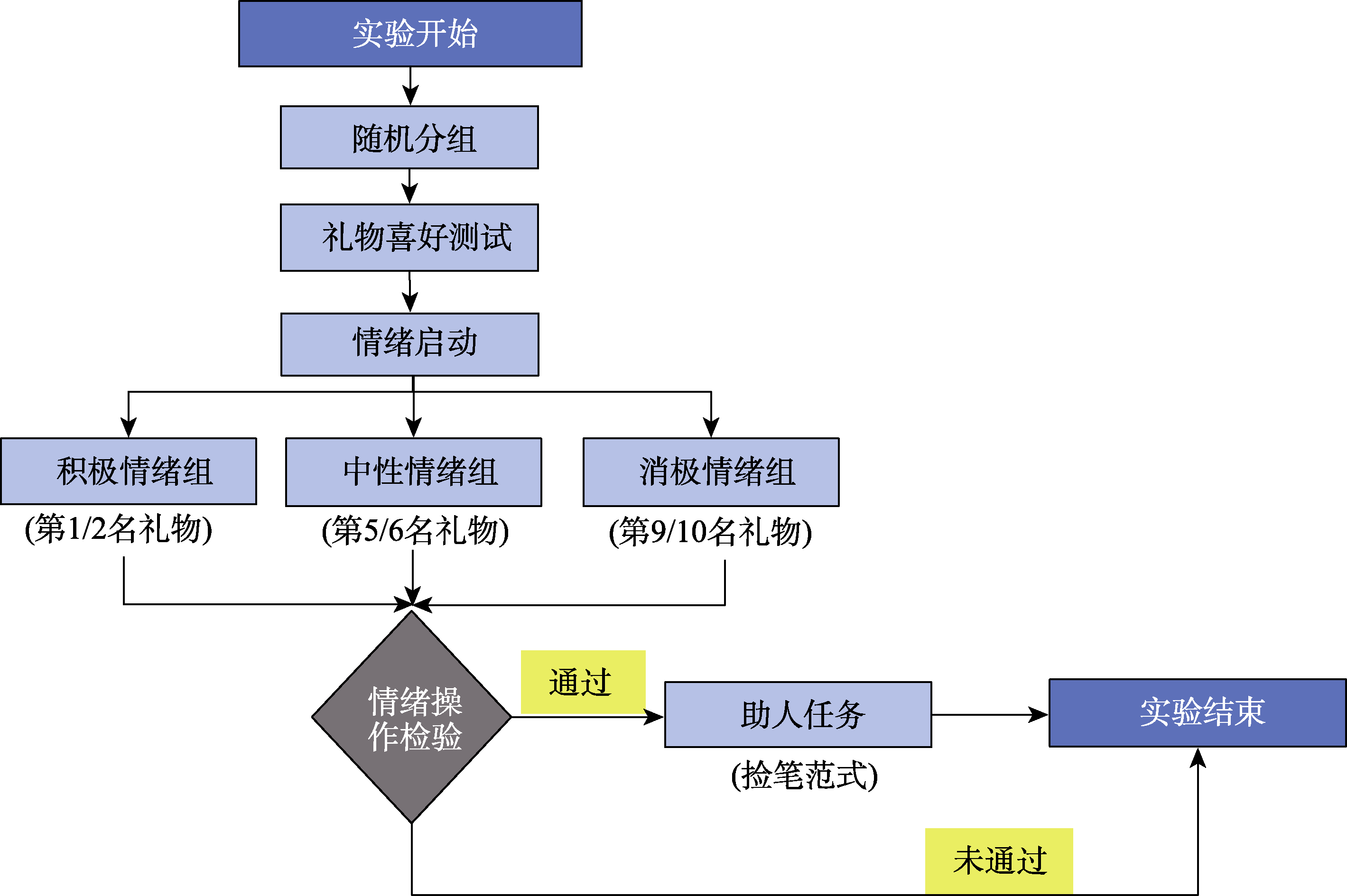
图1 实验1流程图
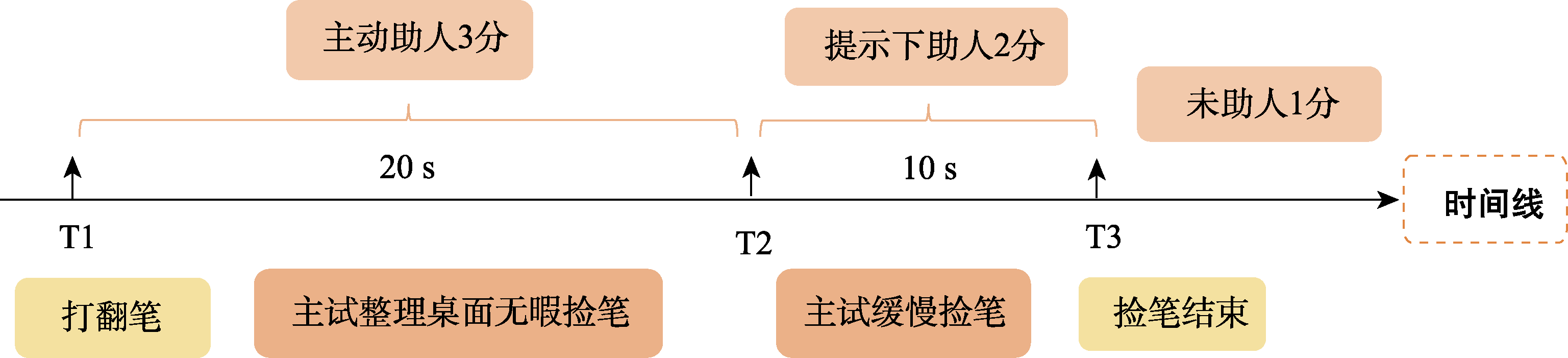
图2 “捡笔范式”助人任务的数据编码
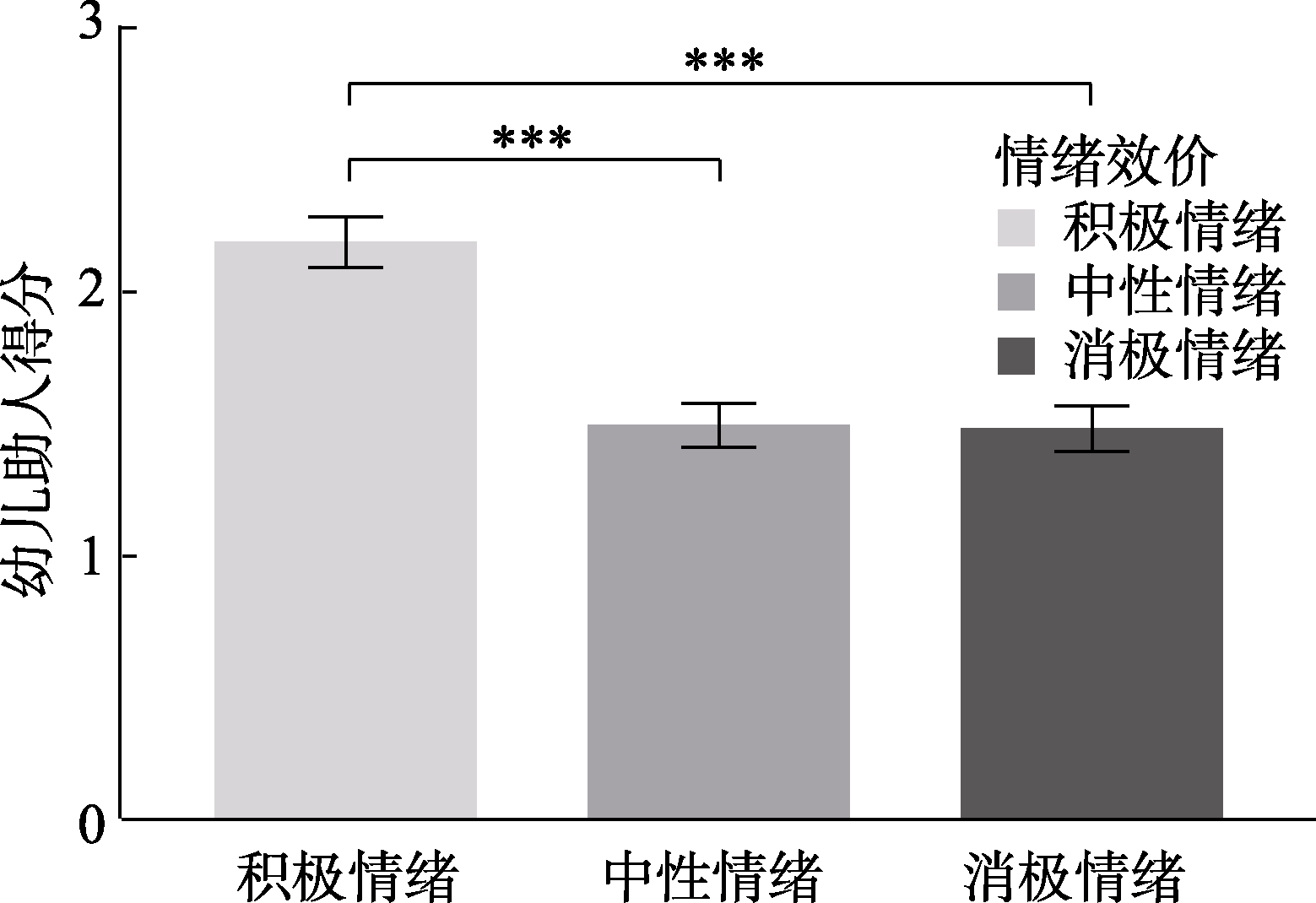
图3 情绪效价对幼儿助人分数的影响 注: 误差线为标准误差。积极情绪组(n = 85)、中性情绪组(n = 91)、消极情绪组(n = 83)。
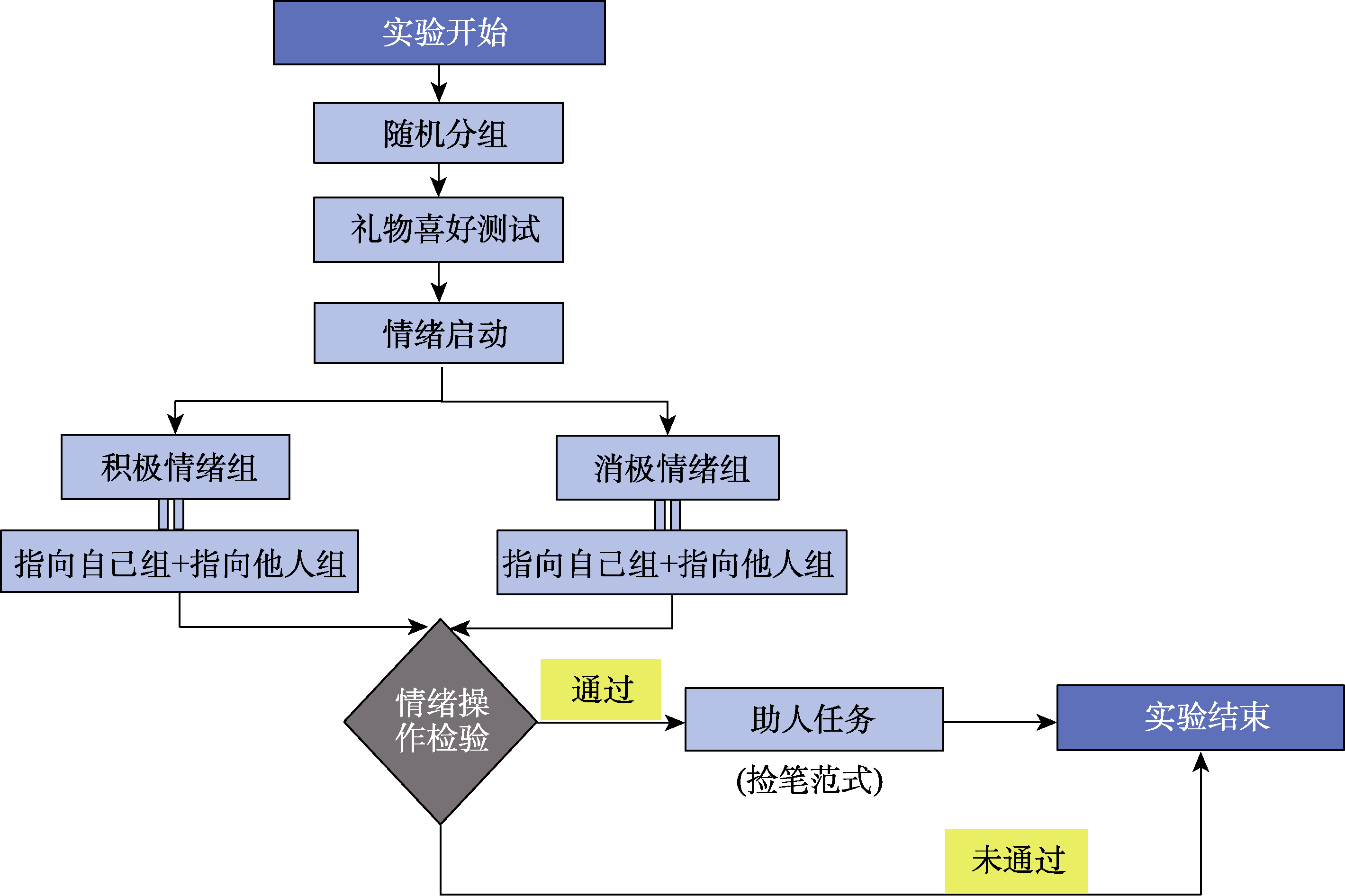
图4 实验2流程图
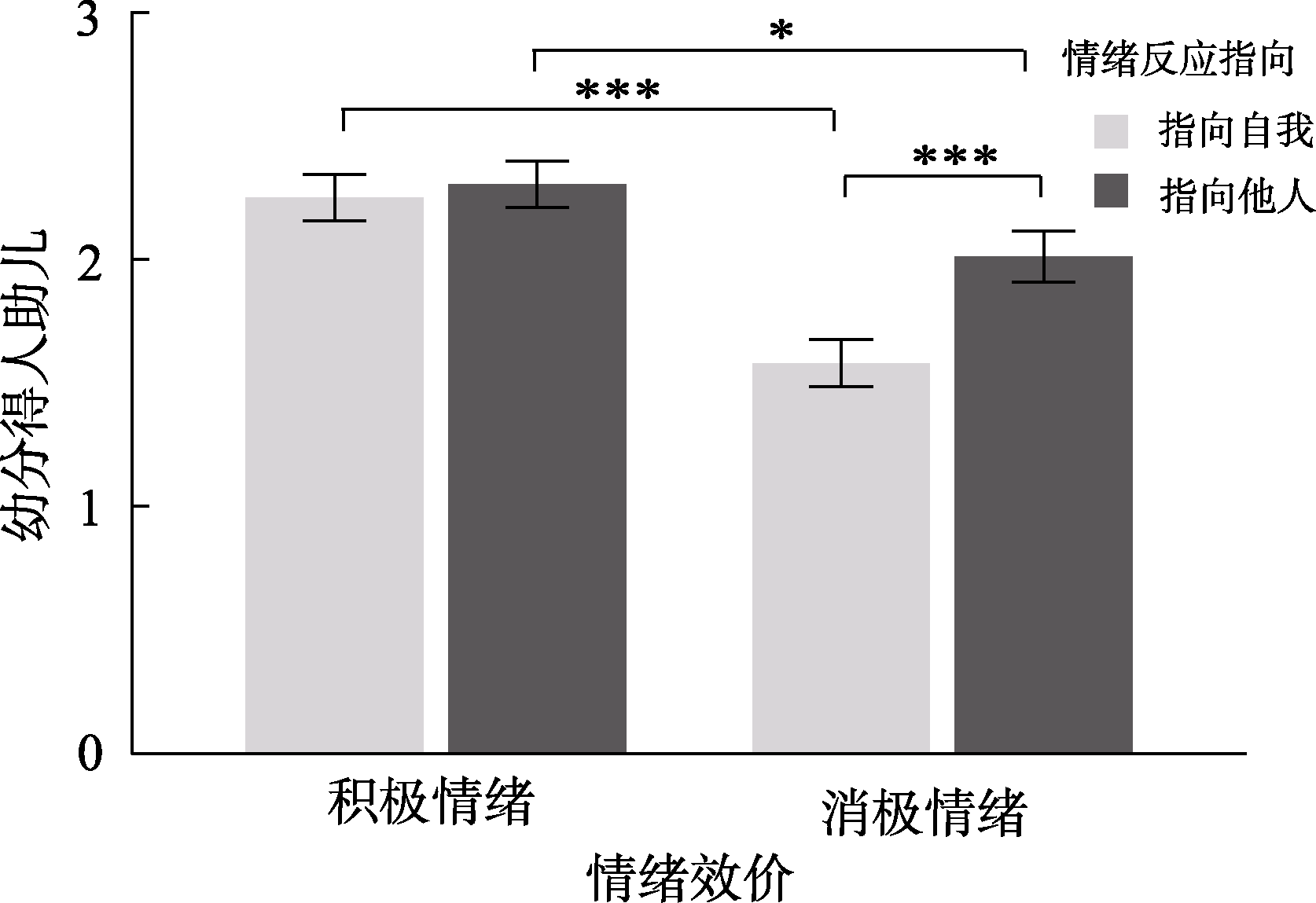
图5 情绪效价和情绪反应指向对幼儿助人得分的影响 注: 误差线为标准误差。积极−指向自我组(n = 92), 积极−指向他人组(n = 92), 消极−指向自我组(n = 88), 消极−指向他人组(n = 88)。
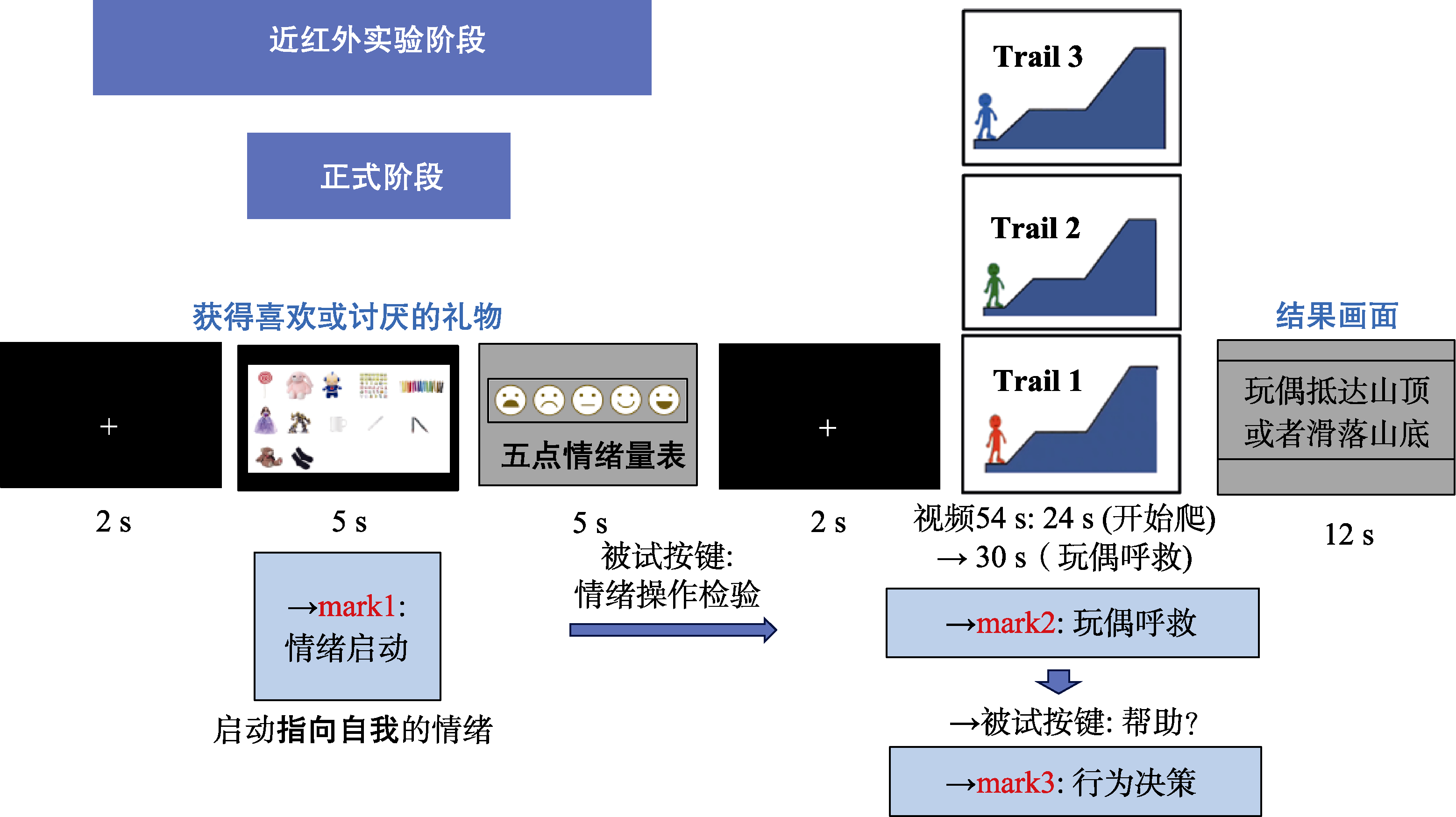
图6 实验3近红外正式阶段流程图
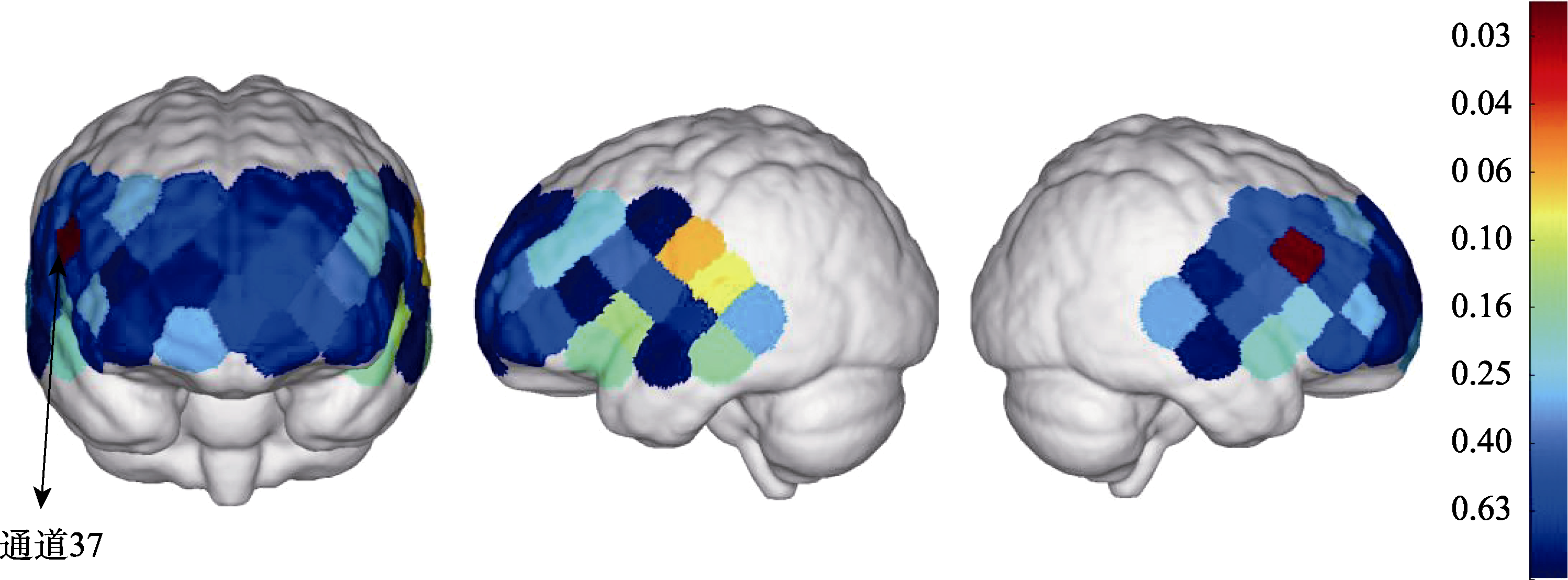
图7 启动积极情绪和消极情绪的幼儿脑激活差异图 注: 通道37为前运动区和运动辅助皮层
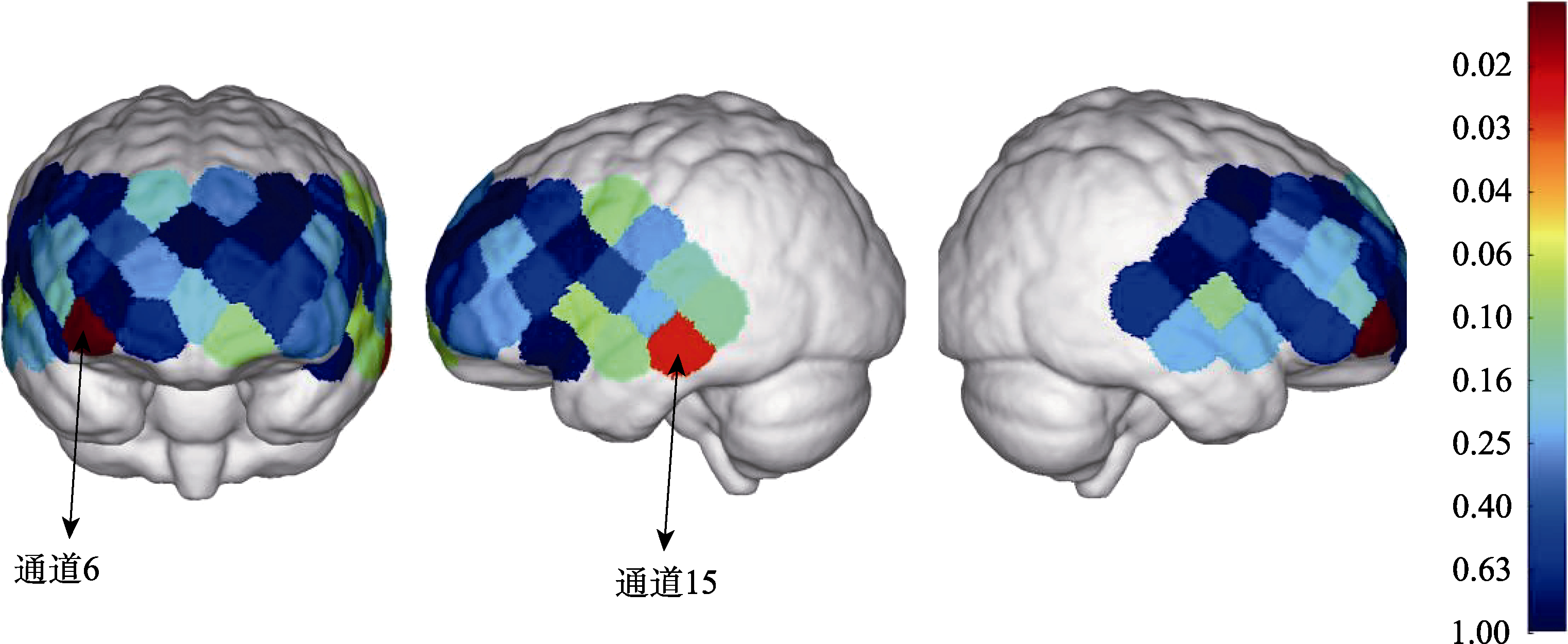
图8 不同情绪下助人决策的幼儿脑激活差异图 注: 通道6为背外侧前额叶皮层;通道15为颞中回
| [1] | Aknin, L. B., Hamlin, J. K., & Dunn, E. W. (2012). Giving leads to happiness in young children. Plos One, 7(6), e39211. |
| [2] |
Barnett, M. A., Howard, J. A., Melton, E. M., & Dino, G. A. (1982). Effect of inducing sadness about self or other on helping behavior in high-and low-empathic children. Child Development, 53(4), 920-923.
doi: 10.2307/1129128 URL |
| [3] |
Bar-Tal, D., Raviv, A., & Goldberg, M. (1982). Helping behavior among preschool children: An observational study. Child Development, 53(2), 396-402.
doi: 10.2307/1128982 URL |
| [4] |
Bellucci, G., Camilleri, J. A., Iyengar, V., Eickhoff, S. B., & Krueger, F. (2020). Neural signatures of prosocial behaviors. Neuroscience & Biobehavioral Reviews, 118, 186-195.
doi: 10.1016/j.neubiorev.2020.07.006 URL |
| [5] |
Bishop, S., Duncan, J., Brett, M., & Lawrence, A. D. (2004). Prefrontal cortical function and anxiety: Controlling attention to threat-related stimuli. Nature Neuroscience, 7(2), 184-188.
doi: 10.1038/nn1173 pmid: 14703573 |
| [6] |
Brigadoi, S., Ceccherini, L., Cutini, S., Scarpa, F., Scatturin, P., Selb, J., … Cooper, R. J. (2014). Motion artifacts in functional near-infrared spectroscopy: A comparison of motion correction techniques applied to real cognitive data. Neuroimage, 85(1), 181-191.
doi: 10.1016/j.neuroimage.2013.04.082 URL |
| [7] |
Buhle, J. T., Silvers, J. A., Wager, T. D., Lopez, R., Onyemekwu, C., Kober, H., Weber, J., & Ochsner, K. N. (2014). Cognitive reappraisal of emotion: A meta-analysis of human neuroimaging studies. Cerebral Cortex, 24(11), 2981-2990.
doi: 10.1093/cercor/bht154 URL |
| [8] |
Carver, L. J., & Vaccaro, B. G. (2007). 12-month-old infants allocate increased neural resources to stimuli associated with negative adult emotion. Developmental Psychology, 43(1), 54-69.
pmid: 17201508 |
| [9] |
Caspers, S., Zilles, K., Laird, A. R., & Eickhoff, S. B. (2010). ALE meta-analysis of action observation and imitation in the human brain. Neuroimage, 50(3), 1148-1167.
doi: 10.1016/j.neuroimage.2009.12.112 pmid: 20056149 |
| [10] | Cha, M., & Song, H. J. (2024). Focusing attention on others’ negative emotions reduces the effect of social relationships on children’s distributive behaviors. Plos One, 19(2), e0295642. |
| [11] | Chen, Y. Q., Han, S., & Yin, B. (2023). Why help others? Insights from rodent to human early childhood research. Frontiers in Behavioral Neuroscience, 17, 1058352. |
| [12] | Decety, J., & Cowell, J. M. (2018). The social neuroscience of empathy and its relationship to moral behavior. In A. R. Beech, A. J. Carter, R. E. Mann, & P. Rotshtein (Eds.), The Wiley Blackwell handbook of forensic neuroscience (pp. 145-169). Wiley Blackwell. |
| [13] |
De Waal, F. B. (2008). Putting the altruism back into altruism: The evolution of empathy. Annual Review of Psychology, 59(1), 279-300.
doi: 10.1146/psych.2008.59.issue-1 URL |
| [14] | Deng, H. Q. (2018). The effect of sadness and anger on pro-social decision making: The role of the interpersonal attribution of responsibility [Unpublished master’s thesis]. Sichuan Normal University, China. |
| [邓华强. (2018). 悲伤与愤怒情绪诱发对助人决策的影响: 人际责任归因的作用 (硕士学位论文). 四川师范大学, 成都.] | |
| [15] |
Deng, L., Luo, P. C., Wang, J. F., Fang, J. C., Zheng, X. C., Li, Y., & Zheng, X. F. (2014). The enhancement of self- orientation on counterempathy. Acta Psychologica Sinica, 46(8), 1103-1111.
doi: 10.3724/SP.J.1041.2014.01103 URL |
| [邓琳, 罗品超, 王俊芳, 方俊聪, 郑晓纯, 李悦, 郑希付. (2014). 不对称情绪分享过程中情绪反应自我指向增强效应的初探. 心理学报, 46(8), 1103-1111.] | |
| [16] |
Donohue, M. R., & Tully, E. C. (2019). Reparative prosocial behaviors alleviate children’s guilt. Developmental Psychology, 55(10), 2102-2113.
doi: 10.1037/dev0000788 pmid: 31343231 |
| [17] |
Eisenberg, N. (2000). Emotion, regulation, and moral development. Annual Review of Psychology, 51(1), 665-697.
doi: 10.1146/psych.2000.51.issue-1 URL |
| [18] | Ekman, P. (1992). An argument for basic emotions. Cognition & Emotion, 6(3-4), 169-200. |
| [19] |
Fehlbaum, L. V., Borbás, R., Paul, K., Eickhoff, S. B., & Raschle, N. M. (2022). Early and late neural correlates of mentalizing: ALE meta-analyses in adults, children and adolescents. Social Cognitive and Affective Neuroscience, 17(4), 351-366.
doi: 10.1093/scan/nsab105 URL |
| [20] | Feng, L. L., Zhong, H., & Zhang, L. L. (2021). Influence of emotional response on state empathy and helping behavior during emotion induction. China Journal of Health Psychology, 29(7), 1085-1091. |
| [冯琳琳, 钟浩, 张乐琳. (2021). 大学生诱发情绪时情绪反应对状态共情与助人行为的影响. 中国健康心理学杂志, 29(7), 1085-1091.] | |
| [21] |
Forgas, J. P., Dunn, E., & Granland, S. (2008). Are you being served…? An unobtrusive experiment of affective influences on helping in a department store. European Journal of Social Psychology, 38(2), 333-342.
doi: 10.1002/ejsp.v38:2 URL |
| [22] |
Fredrickson, B. L. (1998). What good are positive emotions? Review of General Psychology, 2(3), 300-319.
doi: 10.1037/1089-2680.2.3.300 pmid: 21850154 |
| [23] |
Fredrickson, B. L. (2001). The role of positive emotions in positive psychology: The broaden-and-build theory of positive emotions. American Psychologist, 56(3), 218-226.
doi: 10.1037//0003-066x.56.3.218 pmid: 11315248 |
| [24] |
Gori, M., Schiatti, L., & Amadeo, M. B. (2021). Masking emotions: Face masks impair how we read emotions. Frontiers in Psychology, 12, 669432.
doi: 10.3389/fpsyg.2021.669432 URL |
| [25] |
Grabell, A. S., Huppert, T. J., Fishburn, F. A., Li, Y., Hlutkowsky, C. O., Jones, H. M., Wakschlag, L. S., & Perlman, S. B. (2019). Neural correlates of early deliberate emotion regulation: Young children’s responses to interpersonal scaffolding. Developmental Cognitive Neuroscience, 40, 100708.
doi: 10.1016/j.dcn.2019.100708 URL |
| [26] | Gross, J., Emmerling, F., Vostroknutov, A., & Sack, A. T. (2018). Manipulation of pro-sociality and rule-following with non-invasive brain stimulation. Scientific Reports, 8(1), 1827. |
| [27] | Guo, X. Y., & Wang, Z. H. (2007). Concept, function and meaning of positive emotion. Advances in Psychological Science, 15(5), 810-815. |
| [郭小艳, 王振宏. (2007). 积极情绪的概念、功能与意义. 心理科学进展, 15(5), 810-815.] | |
| [28] | Huang, R., Liu, X. Q., & Xue, Y. Z. (2023). An experimental study of pro-social behavior among college students in different emotional validity contexts: Evidence based on the Vibraimage Test. Psychologies Magazine, 18(6), 72-75. |
|
[黄睿, 刘潇荃, 薛云珍. (2023). 不同效价的情绪状态与情境类型对大学生亲社会行为的影响: 基于振动影像测试的实验研究. 心理月刊, 18(6), 72-75.]
doi: 10.19738/j.cnki.psy.2023.06.021 |
|
| [29] |
Isen, A. M., & Levin, P. F. (1972). Effect of feeling good on helping: Cookies and kindness. Journal of Personality and Social Psychology, 21(3), 384-388.
doi: 10.1037/h0032317 pmid: 5060754 |
| [30] | Kang, D., Wen, M., & Cai, S. (2023). Relationship between sharing behavior and emotional state in 4-6-year-old children. Chinese Mental Health Journal, 37(4), 326-331. |
| [康丹, 文敏, 蔡术. (2023). 4-6岁幼儿分享行为与情绪状态的关系. 中国心理卫生杂志, 37(4), 326-331.] | |
| [31] |
Knoch, D., Pascual-Leone, A., Meyer, K., Treyer, V., & Fehr, E. (2006). Diminishing reciprocal fairness by disrupting the right prefrontal cortex. Science, 314(5800), 829-832.
doi: 10.1126/science.1129156 pmid: 17023614 |
| [32] |
Lamy, L., Fischer-Lokou, J., & Guéguen, N. (2012). Priming emotion concepts and helping behavior: How unlived emotions can influence action. Social Behavior and Personality: An International Journal, 40(1), 55-62.
doi: 10.2224/sbp.2012.40.1.55 URL |
| [33] | Lee, Y. E., Yun, J. E. E., Kim, E. Y., & Song, H. J. (2015). The development of infants’ sensitivity to behavioral intentions when inferring others’ social preferences. Plos One, 10(9), e0135588. |
| [34] | Longard, J. (2018). Relations between positive affect and sharing behaviour in early childhood [Unpublished doctorial dissertation]. Dalhousie University Halifax. |
| [35] |
Luo, J. (2018). The neural basis of and a common neural circuitry in different types of pro-social behavior. Frontiers in Psychology, 9, 859.
doi: 10.3389/fpsyg.2018.00859 pmid: 29922197 |
| [36] |
MacGowan, T. L., & Schmidt, L. A. (2021). Helping as prosocial practice: Longitudinal relations among children’s shyness, helping behavior, and empathic response. Journal of Experimental Child Psychology, 209, 105154.
doi: 10.1016/j.jecp.2021.105154 URL |
| [37] |
Misgav, K., Shachnai, R., Abramson, L., Knafo‐Noam, A., & Daniel, E. (2023). Personal values and sustained attention as predictors of children’s helping behavior in middle childhood. Journal of Personality, 91(3), 773-788.
doi: 10.1111/jopy.v91.3 URL |
| [38] |
Moore, B. S., Underwood, B., & Rosenhan, D. L. (1973). Affect and altruism. Developmental Psychology, 8(1), 99-104.
doi: 10.1037/h0033847 URL |
| [39] |
Noble, W. S. (2009). How does multiple testing correction work? Nature Biotechnology, 27(12), 1135-1137.
doi: 10.1038/nbt1209-1135 pmid: 20010596 |
| [40] |
Ochsner, K. N., & Gross, J. J. (2005). The cognitive control of emotion. Trends in Cognitive Sciences, 9(5), 242-249.
doi: 10.1016/j.tics.2005.03.010 pmid: 15866151 |
| [41] |
Passarotti, A. M., Sweeney, J. A., & Pavuluri, M. N. (2010). Differential engagement of cognitive and affective neural systems in pediatric bipolar disorder and attention deficit hyperactivity disorder. Journal of the International Neuropsychological Society, 16(1), 106-117.
doi: 10.1017/S1355617709991019 URL |
| [42] | Petkova, A. V., & Brownell, C. A. (2022). I feel, you feel, we feel: The role of emotion in early prosocial behavior. Oxford University Press. |
| [43] |
Phan, K. L., Wager, T., Taylor, S. F., & Liberzon, I. (2002). Functional neuroanatomy of emotion: A meta-analysis of emotion activation studies in PET and fMRI. Neuroimage, 16(2), 331-348.
doi: 10.1006/nimg.2002.1087 pmid: 12030820 |
| [44] |
Pinti, P., Scholkmann, F., Hamilton, A., Burgess, P., & Tachtsidis, I. (2019). Current status and issues regarding pre-processing of fNIRS neuroimaging data: An investigation of diverse signal filtering methods within a general linear model framework. Frontiers in Human Neuroscience, 12, 505.
doi: 10.3389/fnhum.2018.00505 URL |
| [45] | Pinti, P., Tachtsidis, I., Hamilton, A., Hirsch, J., Aichelburg, C., Gilbert, S., & Burgess, P. W. (2020). The present and future use of functional near-infrared spectroscopy (fNIRS) for cognitive neuroscience. Annals of the New York Academy of Sciences, 1464(1), 5-29. |
| [46] | Piretti, L., Pappaianni, E., Gobbo, S., Rumiati, R. I., Job, R., & Grecucci, A. (2022). Dissociating the role of dACC and dlPFC for emotion appraisal and mood regulation using cathodal tDCS. Cognitive, Affective, & Behavioral Neuroscience, 22(2), 304-315. |
| [47] |
Rosenhan, D. L., Salovey, P., & Hargis, K. (1981). The joys of helping: Focus of attention mediates the impact of positive affect on altruism. Journal of Personality and Social Psychology, 40(5), 899-905.
doi: 10.1037/0022-3514.40.5.899 URL |
| [48] |
Sallquist, J., Eisenberg, N., Spinrad, T. L., Eggum, N. D., & Gaertner, B. M. (2009). Assessment of preschoolers’ positive empathy: Concurrent and longitudinal relations with positive emotion, social competence, and sympathy. The Journal of Positive Psychology, 4(3), 223-233.
doi: 10.1080/17439760902819444 URL |
| [49] |
Schurz, M., Radua, J., Aichhorn, M., Richlan, F., & Perner, J. (2014). Fractionating theory of mind: A meta-analysis of functional brain imaging studies. Neuroscience & Biobehavioral Reviews, 42, 9-34.
doi: 10.1016/j.neubiorev.2014.01.009 URL |
| [50] |
Siegler, R. S. (2005). Children’s learning. American Psychologist, 60(8), 769-778.
pmid: 16351402 |
| [51] |
Siu, T. S. C., & Ho, C. I. (2022). Engaging with happy- sounding music promotes helping behavior in 18-month-olds. Infancy, 27(1), 197-206.
doi: 10.1111/infa.v27.1 URL |
| [52] |
Snippe, E., Jeronimus, B. F., Aan Het Rot, M., Bos, E. H., de Jonge, P., & Wichers, M. (2018). The reciprocity of prosocial behavior and positive affect in daily life. Journal of Personality, 86(2), 139-146.
doi: 10.1111/jopy.12299 pmid: 28093772 |
| [53] |
Steinbeis, N. (2018). Neurocognitive mechanisms of prosociality in childhood. Current Opinion in Psychology, 20, 30-34.
doi: S2352-250X(17)30158-6 pmid: 28830003 |
| [54] |
Strang, S., Gross, J., Schuhmann, T., Riedl, A., Weber, B., & Sack, A. T. (2015). Be nice if you have to—the neurobiological roots of strategic fairness. Social Cognitive and Affective Neuroscience, 10(6), 790-796.
doi: 10.1093/scan/nsu114 URL |
| [55] |
Svetlova, M., Nichols, S. R., & Brownell, C. A. (2010). Toddlers’ prosocial behavior: From instrumental to empathic to altruistic helping. Child Development, 81(6), 1814-1827.
doi: 10.1111/j.1467-8624.2010.01512.x URL |
| [56] |
Telzer, E. H., Masten, C. L., Berkman, E. T., Lieberman, M. D., & Fuligni, A. J. (2011). Neural regions associated with self control and mentalizing are recruited during prosocial behaviors towards the family. Neuroimage, 58(1), 242-249.
doi: 10.1016/j.neuroimage.2011.06.013 pmid: 21703352 |
| [57] | Thiede, N., Stengelin, R., Seibold, A., & Haun, D. B. M. (2023). Testing causal effects of empathy on children’s prosociality in politeness dilemmas - an intervention study. Open Mind: Discoveries in Cognitive Science, 20(7), 691-710. |
| [58] |
Thompson, R. A., & Newton, E. K. (2013). Baby altruists? Examining the complexity of prosocial motivation in young children. Infancy, 18(1), 120-133.
doi: 10.1111/infa.2012.18.issue-1 URL |
| [59] |
Thompson, W. C., Cowan, C. L., & Rosenhan, D. L. (1980). Focus of attention mediates the impact of negative affect on altruism. Journal of Personality and Social Psychology, 38(2), 291-300.
doi: 10.1037/0022-3514.38.2.291 URL |
| [60] |
Underwood, B., Froming, W. J., & Moore, B. S. (1977). Mood, attention, and altruism: A search for mediating variables. Developmental Psychology, 13(5), 541-542.
doi: 10.1037/0012-1649.13.5.541 URL |
| [61] | Van der Meulen, M., van IJzendoorn, M. H., & Crone, E. A. (2016). Neural correlates of prosocial behavior: Compensating social exclusion in a four-player cyberball game. Plos One, 11(7), e0159045. |
| [62] |
Van Kleef, G. A., & Lelieveld, G. J. (2022). Moving the self and others to do good: The emotional underpinnings of prosocial behavior. Current Opinion in Psychology, 44, 80-88.
doi: 10.1016/j.copsyc.2021.08.029 URL |
| [63] |
Wang, J., Yang, Z., Klugah-Brown, B., Zhang, T., Yang, J., Yuan, J., & Biswal, B. B. (2024). The critical mediating roles of the middle temporal gyrus and ventrolateral prefrontal cortex in the dynamic processing of interpersonal emotion regulation. Neuroimage, 300, 120789.
doi: 10.1016/j.neuroimage.2024.120789 URL |
| [64] | Ward, R., & Ramsey, R. (2024). Integrating social cognition into domain‐general control: Interactive activation and competition for the control of action (ICON). Cognitive Science, 48(2), e13415. |
| [65] |
Warneken, F. (2015). Precocious prosociality: Why do young children help? Child Development Perspectives, 9(1), 1-6.
doi: 10.1111/cdep.12101 URL |
| [66] |
Widen, S. C. (2013). Children’s interpretation of facial expressions: The long path from valence-based to specific discrete categories. Emotion Review, 5(1), 72-77.
doi: 10.1177/1754073912451492 URL |
| [67] |
Yamamoto, E., Hirokawa, M., Nunez, E., Hakuno, Y., Sekine, K., Miyahara, S., Suzuki, K., & Minagawa, Y. (2024). Neural and physiological correlates of prosocial behavior: Temporoparietal junction activity in 3-year-old Children. Journal of Cognitive Neuroscience, 36(9), 1977-1994.
doi: 10.1162/jocn_a_02199 URL |
| [68] |
Yang, Z. N., Gu, Z. B., Wang, D. J., Tan, X. Y., & Wang, X. M. (2017). The effect of anger and sadness on prosocial decision making: The role of the interpersonal attribution of responsibility. Acta Psychologica Sinica, 49(3), 393-403.
doi: 10.3724/SP.J.1041.2017.00393 |
| [杨昭宁, 顾子贝, 王杜娟, 谭旭运, 王晓明. (2017). 愤怒和悲伤情绪对助人决策的影响: 人际责任归因的作用. 心理学报, 49(3), 393-403.] | |
| [69] | Yao, X. J. (2015). A study of 3-6 years old children helping behavior in kindergarten [Unpublished master’s thesis]. Central China Normal University, Wu Han. |
| [姚秀娟. (2015). 3-6岁幼儿在园助人行为研究 (硕士学位论文). 华中师范大学, 武汉.] | |
| [70] |
Yeung, M. K. (2021). An optical window into brain function in children and adolescents: A systematic review of functional near-infrared spectroscopy studies. Neuroimage, 227, 117672.
doi: 10.1016/j.neuroimage.2020.117672 URL |
| [71] |
Zahn-Waxler, C., Radke-Yarrow, M., Wagner, E., & Chapman, M. (1992). Development of concern for others. Developmental Psychology, 28(1), 126-136.
doi: 10.1037/0012-1649.28.1.126 URL |
| [72] |
Zelazo, P. D., & Carlson, S. M. (2012). Hot and cool executive function in childhood and adolescence: Development and plasticity. Child Development Perspectives, 6(4), 354-360.
doi: 10.1111/j.1750-8606.2012.00246.x URL |
| [73] | Zeng, M. C., Li, M. X., Li, W. J., & Sun, X. H. (2022). Application of fNIRS hyperscanning in the study of brain mechanism of parent-child Interaction. Journal of Shaanxi Xueqian Normal University, 38(12), 59-67. |
| [曾梦淳, 李梦霞, 李文杰, 孙晓辉. (2022). fNIRS超扫描在亲子互动脑机制研究中的应用. 陕西学前师范学院学报, 38(12), 59-67.] | |
| [74] | Zhong, Y. P., Yang. Z. L., & Fan, W. (2015). The effects of self-other overlap and perspective taking categories on willingness for help. Chinese Journal of Clinical Psychology, 23(1), 63-66. |
| [钟毅平, 杨子鹿, 范伟. (2015). 自我—他人重叠及观点采择类型对助人意愿的影响. 中国临床心理学杂志, 23(1), 63-66.] | |
| [75] | Zinchenko, O., Savelo, O., & Klucharev, V. (2021). Role of the prefrontal cortex in prosocial and self-maximization motivations: An rTMS study. Scientific Reports, 11(1), 22334. |
| [76] |
Zinchenko, O., Yaple, Z. A., & Arsalidou, M. (2018). Brain responses to dynamic facial expressions: A normative meta-analysis. Frontiers in Human Neuroscience, 12, 227.
doi: 10.3389/fnhum.2018.00227 pmid: 29922137 |
| [1] | 李亚丹, 谢聪, 张姬毓, 苏佳豪. 不同类型心智游移对创造性思维的差异化预测及其神经机制[J]. 心理学报, 2026, 58(6): 1090-1112. |
| [2] | 水祎舟, 车翔, 赵治豪, 张禹, 李杰, 刘晨涛, 密思雨, 万炳军, 游旭群. 高水平足球裁判员判罚决策的优势及神经机制[J]. 心理学报, 2025, 57(8): 1391-1413. |
| [3] | 张环, 王晨, 李俊霞, 林琳, 吴捷. 情绪效价和动机强度对社会分享型提取诱发遗忘的影响[J]. 心理学报, 2024, 56(8): 999-1014. |
| [4] | 邱义, 常香玉, 涂毅恒. 双靶点经颅直流电刺激调控短时和持续性疼痛:一项双盲、随机对照研究[J]. 心理学报, 2024, 56(10): 1313-1327. |
| [5] | 黄昕杰, 张弛, 万华根, 张灵聪. 情绪效价可预测性对时间捆绑效应的影响[J]. 心理学报, 2023, 55(1): 36-44. |
| [6] | 宋晓蕾, 贾筱倩, 赵媛, 郭晶晶. 情绪对联合行动中共同表征能力的影响机制[J]. 心理学报, 2020, 52(3): 269-282. |
| [7] | 王思思, 库逸轩. 右侧背外侧前额叶在视觉工作记忆中的因果性作用[J]. 心理学报, 2018, 50(7): 727-738. |
| [8] | 王慧慧, 罗玉丹, 石冰, 余凤琼, 汪凯. 经颅直流电刺激对健康大学生反应抑制的影响 *[J]. 心理学报, 2018, 50(6): 647-654. |
| [9] | 宋晓蕾, 张俊婷, 石杰, 游旭群. 语音反应方式下情绪效价对空间Simon效应的影响[J]. 心理学报, 2017, 49(8): 1031-1040. |
| [10] | 柯淳淳, 聂爱情, 张瑞卿. 回忆任务对合作抑制和错误修剪的调节 ——情绪效价和编码水平的影响[J]. 心理学报, 2017, 49(6): 733-744. |
| [11] | 白学军;张琪涵;章鹏;周菘;刘颖;宋星;彭国慧. 基于fNIRS的运动执行与运动想象脑激活模式比较[J]. 心理学报, 2016, 48(5): 495-508. |
| [12] | 肖红蕊;黄一帆;龚先旻;王大华. 简化的联合再认范式中情绪对错误记忆影响的年龄差异[J]. 心理学报, 2015, 47(1): 19-28. |
| [13] | 肖红蕊;龚先旻;王大华. 老年人错误记忆的情绪效价和时间效应[J]. 心理学报, 2014, 46(7): 922-930. |
| [14] | 窦伟伟;郑希付;杨慧芳;王俊芳;李悦;俄小天;陈倩倩. 认知分心的强度对创伤性信息加工的影响[J]. 心理学报, 2014, 46(5): 656-665. |
| [15] | 邓晓红,张德玄,黄诗雪,袁,雯,周晓林. 阈上和阈下不同情绪线索对返回抑制的影响[J]. 心理学报, 2010, 42(03): 325-333. |
| 阅读次数 | ||||||
|
全文 |
|
|||||
|
摘要 |
|
|||||
