

ISSN 0439-755X
CN 11-1911/B
主办:中国心理学会
中国科学院心理研究所
出版:科学出版社
CN 11-1911/B
主办:中国心理学会
中国科学院心理研究所
出版:科学出版社
心理学报 ›› 2026, Vol. 58 ›› Issue (6): 1183-1196.doi: 10.3724/SP.J.1041.2026.1183 cstr: 32110.14.2026.1183
穆英琦1,†, 徐鹏慧1,†, 吴怡君1,†, 戚玥2,3, 娄艳1, 于晓1( )
)
收稿日期:2025-02-24
发布日期:2026-04-28
出版日期:2026-06-25
通讯作者:
于晓, E-mail: yx0903yingzhong@163.com作者简介:†共同一作。
基金资助:
MU Yingqi1,†, XU Penghui1,†, WU Yijun1,†, QI Yue2,3, Lou Yan1, YU Xiao1()
Received:2025-02-24
Online:2026-04-28
Published:2026-06-25
摘要:
为考察“双减”实施前后父母教育卷入分维度的动态变化及其对小学生学习投入和学习成绩的影响, 本研究以323名小学生(平均年龄11.02 ± 0.83岁, 49%男生)为被试, 在“双减”前(T1)、“双减”实施一年半后(T2)和两年后(T3)分三次测量父母教育卷入, 并在T1和T3测量学习投入、T3收集学习成绩, 构建潜变量增长模型。结果发现: (1)小学生的父母情感卷入、父母智力卷入、父母行为卷入的变化轨迹均呈线性递减趋势; (2)在控制人口学因素后, 对学习投入而言, 父母情感卷入、父母行为卷入的初始水平和变化速度对学生学习投入的影响表现为累加作用模式; 对学习成绩而言, 父母情感卷入仅变化速度对学习成绩的预测显著, 而父母行为卷入的初始水平和变化速度对学习成绩的影响表现为增强作用模式; 父母智力卷入对学习投入及学习成绩的影响均不显著。本研究不仅有助于深入理解“双减”背景下父母教育卷入的发展变化轨迹及其对学习投入和学习成绩的影响, 还能为评估“双减”政策的实施效果以及“双减”政策实施后父母教育卷入的干预提供实证依据。
中图分类号:
穆英琦, 徐鹏慧, 吴怡君, 戚玥, 娄艳, 于晓. (2026). “双减”背景父母教育卷入的变化轨迹对小学生学习投入和学习成绩的差异性影响. 心理学报, 58(6), 1183-1196.
MU Yingqi, XU Penghui, WU Yijun, QI Yue, Lou Yan, YU Xiao. (2026). Trajectories of parental educational involvement before and after China’ s “double reduction” policy and their differential effects on primary school students’ learning engagement and academic achievement. Acta Psychologica Sinica, 58(6), 1183-1196.
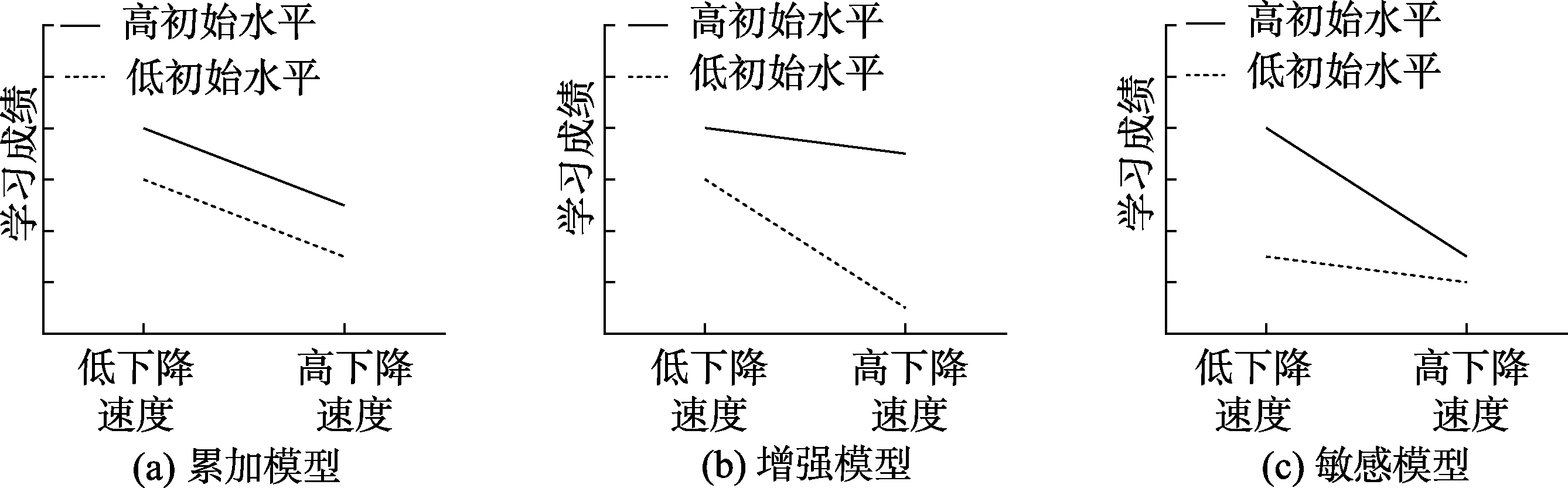
图1 父母教育卷入初始水平和变化速度预测学习成绩的概念框架图
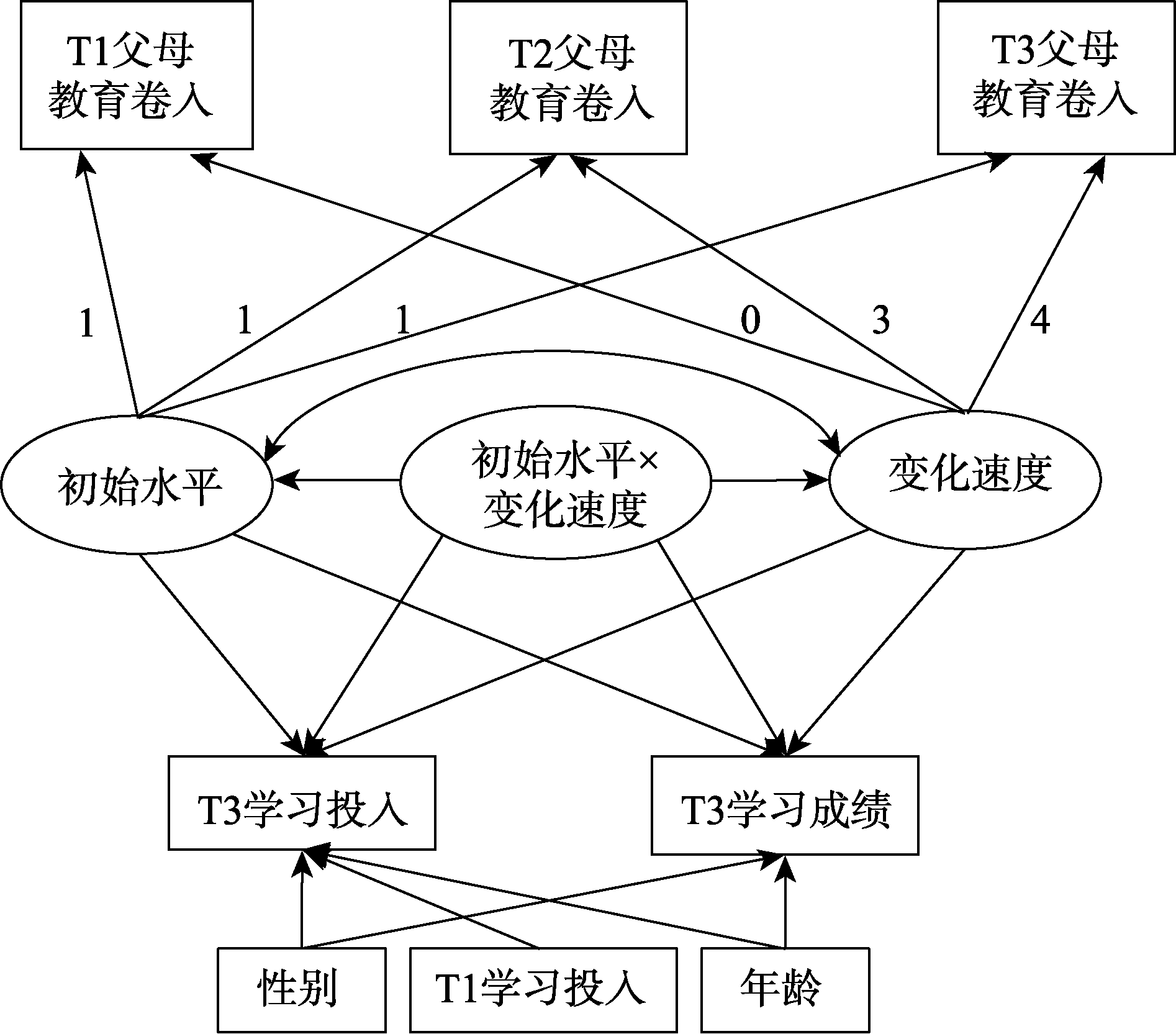
图2 本研究的假设模型 注: 本模型中的“父母教育卷入”代指父母教育卷入分维度的父母情感教育卷入、父母智力教育卷入、父母行为教育卷入。
| 变量 | 1 | 2 | 3 | 4 | 5 | 6 | 7 | 8 | 9 | 10 | 11 | 12 | 13 | 14 | 15 | 16 | 17 |
|---|---|---|---|---|---|---|---|---|---|---|---|---|---|---|---|---|---|
| 1. 年龄(岁) | 1.00 | ||||||||||||||||
| 2. 性别 | −0.01 | 1.00 | |||||||||||||||
| 3. T1父母情感卷入 | −0.11* | 0.04 | 1.00 | ||||||||||||||
| 4. T2父母情感卷入 | 0.15** | −0.10 | 0.03 | 1.00 | |||||||||||||
| 5. T3父母情感卷入 | 0.11* | −0.05 | 0.11* | 0.36** | 1.00 | ||||||||||||
| 6. T1父母智力卷入 | −0.12* | −0.08 | 0.63** | 0.04 | 0.08 | 1.00 | |||||||||||
| 7. T2父母智力卷入 | −0.00 | −0.07 | 0.06 | 0.68** | 0.25** | 0.11* | 1.00 | ||||||||||
| 8. T3父母智力卷入 | −0.01 | 0.04 | 0.06 | 0.31** | 0.63** | 0.12* | 0.38** | 1.00 | |||||||||
| 9. T1父母行为卷入 | −0.09 | −0.07 | 0.50** | 0.03 | 0.09 | 0.48** | 0.03 | 0.11* | 1.00 | ||||||||
| 10. T2父母行为卷入 | 0.06 | −0.02 | −0.00 | 0.41** | 0.09 | 0.10 | 0.50** | 0.19** | 0.11* | 1.00 | |||||||
| 11. T3父母行为卷入 | 0.10 | −0.01 | 0.05 | 0.24** | 0.43** | 0.14* | 0.17** | 0.51** | 0.15** | 0.33** | 1.00 | ||||||
| 12. T1父母教育卷入总分 | −0.13* | −0.04 | 0.88** | 0.04 | 0.12* | 0.87** | 0.09 | 0.11* | 0.74** | 0.08 | 0.13* | 1.00 | |||||
| 13. T2父母教育卷入总分 | 0.09 | −0.08 | 0.04 | 0.88** | 0.30** | 0.10 | 0.88** | 0.36** | 0.06 | 0.72** | 0.29** | 0.08 | 1.00 | ||||
| 14. T3父母教育卷入总分 | 0.08 | −0.01 | 0.09 | 0.37** | 0.86** | 0.13* | 0.33** | 0.88** | 0.14* | 0.23** | 0.73** | 0.14* | 0.38** | 1.00 | |||
| 15. T1学习投入 | 0.04 | 0.09 | 0.29** | 0.08 | 0.04 | 0.29** | 0.03 | 0.06 | 0.15** | 0.07 | 0.10 | 0.31** | 0.07 | 0.08 | 1.00 | ||
| 16. T3学习投入 | −0.06 | −0.01 | 0.10 | 0.25** | 0.35** | 0.10 | 0.19** | 0.30** | 0.12* | 0.18** | 0.13* | 0.12* | 0.25** | 0.33** | 0.20** | 1.00 | |
| 17. T3学习成绩 | −0.05 | 0.06 | 0.07 | 0.10 | 0.09 | 0.04 | −0.01 | 0.08 | 0.05 | 0.19** | 0.16** | 0.07 | 0.10 | 0.13* | 0.27** | 0.20** | 1.00 |
| M | 8.79 | − | 3.93 | 3.56 | 3.58 | 3.67 | 3.35 | 3.35 | 4.09 | 3.50 | 3.46 | 3.88 | 3.47 | 3.47 | 3.53 | 3.46 | 74.11 |
| SD | 0.95 | − | 0.64 | 0.92 | 0.91 | 0.69 | 0.87 | 0.95 | 0.62 | 0.94 | 0.94 | 0.55 | 0.76 | 0.78 | 0.81 | 1.12 | 9.86 |
表1 变量相关系数表
| 变量 | 1 | 2 | 3 | 4 | 5 | 6 | 7 | 8 | 9 | 10 | 11 | 12 | 13 | 14 | 15 | 16 | 17 |
|---|---|---|---|---|---|---|---|---|---|---|---|---|---|---|---|---|---|
| 1. 年龄(岁) | 1.00 | ||||||||||||||||
| 2. 性别 | −0.01 | 1.00 | |||||||||||||||
| 3. T1父母情感卷入 | −0.11* | 0.04 | 1.00 | ||||||||||||||
| 4. T2父母情感卷入 | 0.15** | −0.10 | 0.03 | 1.00 | |||||||||||||
| 5. T3父母情感卷入 | 0.11* | −0.05 | 0.11* | 0.36** | 1.00 | ||||||||||||
| 6. T1父母智力卷入 | −0.12* | −0.08 | 0.63** | 0.04 | 0.08 | 1.00 | |||||||||||
| 7. T2父母智力卷入 | −0.00 | −0.07 | 0.06 | 0.68** | 0.25** | 0.11* | 1.00 | ||||||||||
| 8. T3父母智力卷入 | −0.01 | 0.04 | 0.06 | 0.31** | 0.63** | 0.12* | 0.38** | 1.00 | |||||||||
| 9. T1父母行为卷入 | −0.09 | −0.07 | 0.50** | 0.03 | 0.09 | 0.48** | 0.03 | 0.11* | 1.00 | ||||||||
| 10. T2父母行为卷入 | 0.06 | −0.02 | −0.00 | 0.41** | 0.09 | 0.10 | 0.50** | 0.19** | 0.11* | 1.00 | |||||||
| 11. T3父母行为卷入 | 0.10 | −0.01 | 0.05 | 0.24** | 0.43** | 0.14* | 0.17** | 0.51** | 0.15** | 0.33** | 1.00 | ||||||
| 12. T1父母教育卷入总分 | −0.13* | −0.04 | 0.88** | 0.04 | 0.12* | 0.87** | 0.09 | 0.11* | 0.74** | 0.08 | 0.13* | 1.00 | |||||
| 13. T2父母教育卷入总分 | 0.09 | −0.08 | 0.04 | 0.88** | 0.30** | 0.10 | 0.88** | 0.36** | 0.06 | 0.72** | 0.29** | 0.08 | 1.00 | ||||
| 14. T3父母教育卷入总分 | 0.08 | −0.01 | 0.09 | 0.37** | 0.86** | 0.13* | 0.33** | 0.88** | 0.14* | 0.23** | 0.73** | 0.14* | 0.38** | 1.00 | |||
| 15. T1学习投入 | 0.04 | 0.09 | 0.29** | 0.08 | 0.04 | 0.29** | 0.03 | 0.06 | 0.15** | 0.07 | 0.10 | 0.31** | 0.07 | 0.08 | 1.00 | ||
| 16. T3学习投入 | −0.06 | −0.01 | 0.10 | 0.25** | 0.35** | 0.10 | 0.19** | 0.30** | 0.12* | 0.18** | 0.13* | 0.12* | 0.25** | 0.33** | 0.20** | 1.00 | |
| 17. T3学习成绩 | −0.05 | 0.06 | 0.07 | 0.10 | 0.09 | 0.04 | −0.01 | 0.08 | 0.05 | 0.19** | 0.16** | 0.07 | 0.10 | 0.13* | 0.27** | 0.20** | 1.00 |
| M | 8.79 | − | 3.93 | 3.56 | 3.58 | 3.67 | 3.35 | 3.35 | 4.09 | 3.50 | 3.46 | 3.88 | 3.47 | 3.47 | 3.53 | 3.46 | 74.11 |
| SD | 0.95 | − | 0.64 | 0.92 | 0.91 | 0.69 | 0.87 | 0.95 | 0.62 | 0.94 | 0.94 | 0.55 | 0.76 | 0.78 | 0.81 | 1.12 | 9.86 |
| 模型 | CFI | TLI | RMSEA | SRMR | 90%CI | 系数 | 变异 | 截距与斜率 的相关 | ||
|---|---|---|---|---|---|---|---|---|---|---|
| 截距 | 斜率 | 截距 | 斜率 | |||||||
| 父母情感卷入 | 0.92 | 0.84 | 0.07 | 0.04 | [0.00, 0.13] | 4.94*** | −0.85*** | 0.05* | 0.02*** | < 0.01 |
| 父母智力卷入 | 0.99 | 0.97 | 0.03 | 0.02 | [0.00, 0.10] | 4.83*** | −0.45* | 0.07* | 0.02*** | < 0.01 |
| 父母行为卷入 | 0.92 | 0.85 | 0.07 | 0.04 | [0.00, 0.13] | 4.79*** | −0.74*** | 0.08** | 0.02*** | < 0.01 |
表2 父母教育卷入分维度无条件潜增长曲线模型拟合指标值
| 模型 | CFI | TLI | RMSEA | SRMR | 90%CI | 系数 | 变异 | 截距与斜率 的相关 | ||
|---|---|---|---|---|---|---|---|---|---|---|
| 截距 | 斜率 | 截距 | 斜率 | |||||||
| 父母情感卷入 | 0.92 | 0.84 | 0.07 | 0.04 | [0.00, 0.13] | 4.94*** | −0.85*** | 0.05* | 0.02*** | < 0.01 |
| 父母智力卷入 | 0.99 | 0.97 | 0.03 | 0.02 | [0.00, 0.10] | 4.83*** | −0.45* | 0.07* | 0.02*** | < 0.01 |
| 父母行为卷入 | 0.92 | 0.85 | 0.07 | 0.04 | [0.00, 0.13] | 4.79*** | −0.74*** | 0.08** | 0.02*** | < 0.01 |
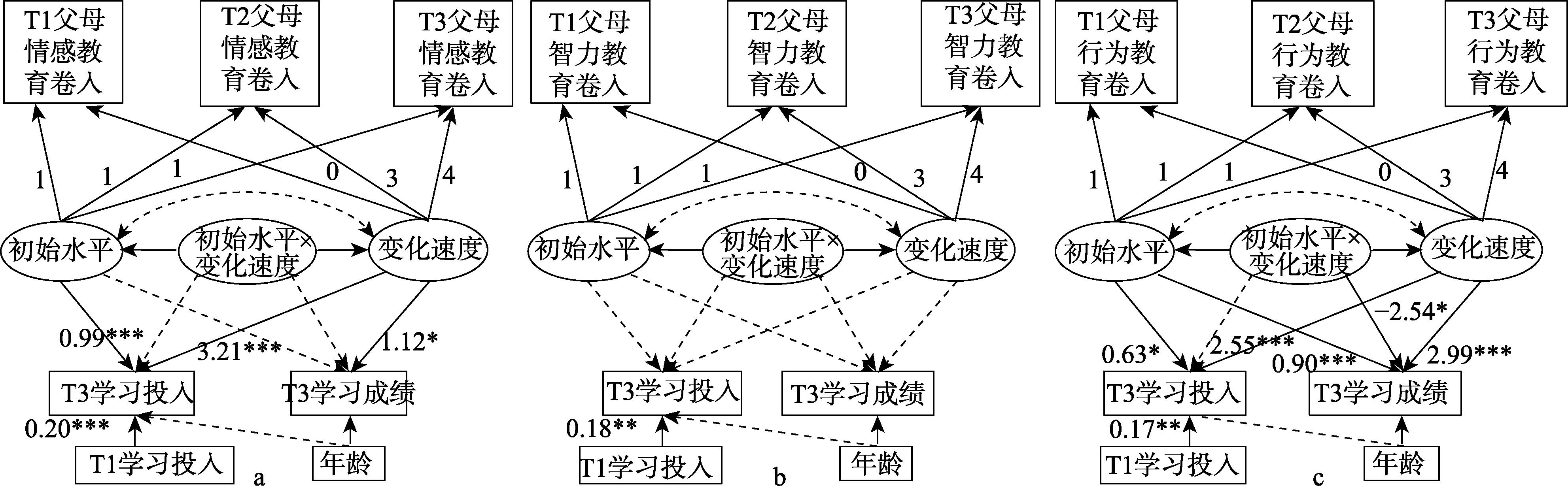
图3 父母教育卷入分维度变化轨迹预测学习投入、学习成绩的有条件潜增长曲线模型 注: 图3a为父母情感教育卷入变化轨迹对学习投入、学习成绩的预测模型; 图3b为父母智力卷入变化轨迹对学习投入、学习成绩的预测模型; 图3c为父母行为卷入变化轨迹对学习投入、学习成绩的预测模型; 实线表示该路径达到统计显著性, 虚线表示该路径未达到统计显著性。
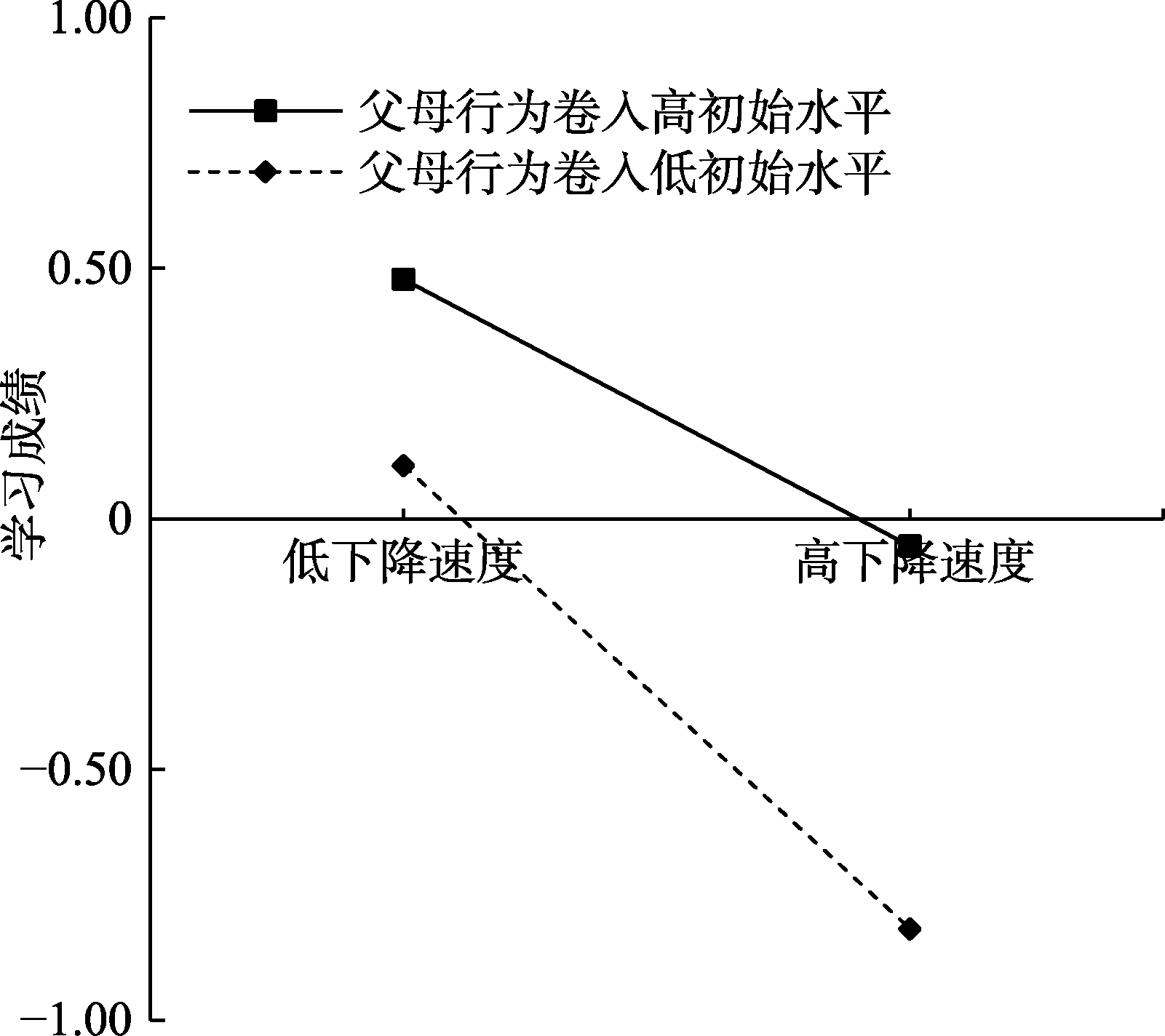
图4 父母行为卷入初始水平和变化速度交互作用于“双减”实施两年后学生的学习成绩
| 模型 | CFI | TLI | RMSEA | SRMR | 90% CI | 系数 | 变异 | 截距与斜率 的相关 | ||
|---|---|---|---|---|---|---|---|---|---|---|
| 截距 | 斜率 | 截距 | 斜率 | |||||||
| 父母教育卷入总分 | 0.91 | 0.82 | 0.08 | 0.04 | [0.02, 0.14] | 4.86*** | −0.68*** | 0.05** | 0.01*** | < 0.01 |
附表1 父母教育卷入整体无条件潜增长曲线模型拟合指标值
| 模型 | CFI | TLI | RMSEA | SRMR | 90% CI | 系数 | 变异 | 截距与斜率 的相关 | ||
|---|---|---|---|---|---|---|---|---|---|---|
| 截距 | 斜率 | 截距 | 斜率 | |||||||
| 父母教育卷入总分 | 0.91 | 0.82 | 0.08 | 0.04 | [0.02, 0.14] | 4.86*** | −0.68*** | 0.05** | 0.01*** | < 0.01 |
| [1] | Aiken, L. S., & West, S. G. (1991). Multiple regression: Testing and interpreting interactions. Sage Publications. |
| [2] |
Bakermans-Kranenburg, M. J., van IJzendoorn, M. H., & Bradley, R. H. (2005). Those who have, receive: The Matthew effect in early childhood intervention in the home environment. Review of Educational Research, 75(1), 1-26.
doi: 10.3102/00346543075001001 URL |
| [3] | Bronfenbrenner, U. (1979). The ecology of human development: Experiments by nature and design. Harvard University Press. |
| [4] |
Castro, M., Expósito-Casas, E., López-Martín, E., Lizasoain, L., Navarro-Asencio, E., & Gaviria, J. L. (2015). Parental involvement on student academic achievement: A meta- analysis. Educational Research Review, 14, 33-46.
doi: 10.1016/j.edurev.2015.01.002 URL |
| [5] | Catsambis, S., & Garland, J. (1997). Parental involvement in students' education during middle and high school (Report No. 18). Baltimore, MD: Johns Hopkins University, Center for Research on the Education of Students Placed at Risk. |
| [6] | Chen, J., Huebner, E. S., & Tian, L. (2020). Longitudinal relations between hope and academic achievement in elementary school students: Behavioral engagement as a mediator. Learning and Individual Differences, 78, Article 101824. https://doi.org/10.1016/j.lindif.2020.101824. |
| [7] |
Cheng, Y. H., Feng, Y., Li, Y. X., Ma, J. Q., Shen, L. L., Zhang, W. J., Wu, X. C., & Feng, Q. D. (2023). The developmental trajectory of oral vocabulary knowledge and its predictive effects on reading abilities among Chinese primary school students: A latent growth model. Acta Psychologica Sinica, 55(7), 1074-1086.
doi: 10.3724/SP.J.1041.2023.01074 |
|
[程亚华, 冯瑶, 李宜逊, 马嘉琪, 沈岚岚, 张文建, 伍新春, 冯秋迪. (2023). 小学儿童口语词汇知识的发展轨迹及其对阅读能力的预测: 一个潜变量增长模型. 心理学报, 55(7), 1074-1086.]
doi: 10.3724/SP.J.1041.2023.01074 |
|
| [8] |
Cheung, C. S., & Pomerantz, E. M. (2011). Parents' involvement in children's learning in the United States and China: Implications for children's academic and emotional adjustment. Child Development, 82(3), 932-950.
doi: 10.1111/j.1467-8624.2011.01582.x pmid: 21418057 |
| [9] |
Ciping, D., Silinskas, G., Wei, W., & Georgiou, G. K. (2015). Cross-lagged relationships between home learning environment and academic achievement in Chinese. Early Childhood Research Quarterly, 33, 12-20.
doi: 10.1016/j.ecresq.2015.05.001 URL |
| [10] |
Daniel, G. (2015). Patterns of parent involvement: A longitudinal analysis of family-school partnerships in the early years of school in Australia. Australasian Journal of Early Childhood, 40, 119-128.
doi: 10.1177/183693911504000115 URL |
| [11] |
Dearing, E., Kreider, H., Simpkins, S. D., & Weiss, H. B. (2006). Family involvement in school and low-income children's literacy: Longitudinal associations between and within families. Journal of Educational Psychology, 98(4), 653-664.
doi: 10.1037/0022-0663.98.4.653 URL |
| [12] |
El-Sheikh, M., Shimizu, M., Erath, S. A., Philbrook, L. E., & Hinnant, J. B. (2019). Dynamic patterns of marital conflict: Relations to trajectories of adolescent adjustment. Developmental Psychology, 55(8), 1720-1732.
doi: 10.1037/dev0000746 pmid: 31169398 |
| [13] |
Englund, M. M., Luckner, A. E., Whaley, G. J. L., & Egeland, B. (2004). Children's achievement in early elementary school: Longitudinal effects of parental involvement, expectations, and quality of assistance. Journal of Educational Psychology, 96(4), 723-730.
doi: 10.1037/0022-0663.96.4.723 URL |
| [14] | Epstein, J. L. (2005). Developing and sustaining research- based programs of school, family, and community partnerships: Summary of five years of NNPS research. Retrieved September 2, 2011 from http://www.csos.jhu.edu/p2000/Research/index.htm |
| [15] |
Fan, W., & Williams, C. M. (2010). The effects of parental involvement on students’ academic self-efficacy, engagement and intrinsic motivation. Educational Psychology, 30(1), 53-74.
doi: 10.1080/01443410903353302 URL |
| [16] |
Flack, C. E., Garbacz, S. A., Stormshak, E. A., & McIntyre, L. L. (2023). A longitudinal study of home-based involvement and dyadic adjustment during the transition to early elementary school. School Psychology, 38(5), 287-293.
doi: 10.1037/spq0000543 URL |
| [17] |
Flavell, J. H. (2000). Development of children's knowledge about the mental world. International Journal of Behavioral Development, 24(1), 15-23. https://doi.org/10.1080/016502500383421
doi: 10.1080/016502500383421 URL |
| [18] |
Garbacz, S. A., McDowall, P. S., Schaughency, E., Sheridan, S. M., & Welch, G. W. (2015). A multidimensional examination of parent involvement across child and parent characteristics. The Elementary School Journal, 115(3), 384-406.
doi: 10.1086/680325 URL |
| [19] |
Graves, S. L., & Brown Wright, L. (2011). Parent involvement at school entry: A national examination of group differences and achievement. School Psychology International, 32(1), 35-48.
doi: 10.1177/0143034310396611 URL |
| [20] | Grimm, K. J., Ram, N., & Estabrook, R. (2017). Growth modeling: Structural equation and multilevel modeling approaches. Guilford Publications. |
| [21] |
Grolnick, W. S., & Ryan, R. M. (1989). Parent styles associated with children's self-regulation and competence in school. Journal of Educational Psychology, 81(2), 143-154.
doi: 10.1037/0022-0663.81.2.143 URL |
| [22] |
Grolnick, W. S., & Slowiaczek, M. L. (1994). Parents’ involvement in children’s schooling: A multidimensional conceptualization and motivational model. Child Development, 65(1), 237-252.
doi: 10.1111/j.1467-8624.1994.tb00747.x pmid: 8131650 |
| [23] | Hayek, J., Schneider, F., Lahoud, N., Tueni, M., & de Vries, H. (2022). Authoritative parenting stimulates academic achievement, also partly via self-efficacy and intention towards getting good grades. PLOS ONE, 17(3), Article e0265595. https://doi.org/10.1371/journal.pone.0265595 |
| [24] |
He, G., Chen, S., Lin, H., & Su, A. (2024). The association between initial metacognition and subsequent academic achievement: A meta-analysis of longitudinal studies. Educational Psychology Review, 36, 81.
doi: 10.1007/s10648-024-09922-w |
| [25] | He, M. H., & Guo, H. M. (2024). Factors influencing parental educational anxiety after the implementation of the “double rreduction” policy, analysis of causes and countermeasures for alleviation. Modern Education Science. 5, 52-58. |
| [贺明华, 郭红梅. (2024). “双减”政策实施后家长教育焦虑的影响因素、原因分析及缓解对策. 现代教育科学, 5, 52-58.] | |
| [26] |
Hill, N. E., & Tyson, D. F. (2009). Parental involvement in middle school: A meta-analytic assessment of the strategies that promote achievement. Developmental Psychology, 45(3), 740-763.
doi: 10.1037/a0015362 pmid: 19413429 |
| [27] |
Hong, W., Zhen, R., Liu, R. D., Wang, M. T., Ding, Y., & Wang, J. (2020). The longitudinal linkages among Chinese children’s behavioural, cognitive, and emotional engagement within a mathematics context. Educational Psychology, 40(6), 666-680.
doi: 10.1080/01443410.2020.1719981 URL |
| [28] |
Hsu, H.-Y., Zhang, D., Kwok, O.-M., Li, Y., & Ju, S. (2011). Distinguishing the influences of father’s and mother’s involvement on adolescent academic achievement: Analyses of Taiwan Education Panel Survey data. The Journal of Early Adolescence, 31(5), 694-713.
doi: 10.1177/0272431610373101 URL |
| [29] |
Hu, L., & Bentler, P. M. (1999). Cutoff criteria for fit indexes in covariance structure analysis: Conventional criteria versus new alternatives. Structural Equation Modeling: A Multidisciplinary Journal, 6(1), 1-55.
doi: 10.1080/10705519909540118 URL |
| [30] |
Jeynes, W. H. (2005). A meta-analysis of the relation of parental involvement to urban elementary school student academic achievement. Urban Education, 40(3), 237-269.
doi: 10.1177/0042085905274540 URL |
| [31] | Kim, J., & Kim, E. (2021). Effect of positive parenting styles as perceived by middle school students on academic achievement and the mediation effect of self-esteem and academic engagement. Sustainability, 13(23), Article 13233. https://doi.org/10.3390/su132313233 |
| [32] |
Lam, S. F., Jimerson, S., Wong, B. P. H., Kikas, E., Shin, H., Veiga, F. H.,... Zollneritsch, J. (2014). Understanding and measuring student engagement in school: The results of an international study from 12 countries. School Psychology Quarterly, 29(2), 213-232.
doi: 10.1037/spq0000057 URL |
| [33] |
Lankester, M., Coles, C., Trotter, A., Scott, S., Downs, J., Dickson, H., & Wickersham, A. (2024). The association between academic achievement and subsequent youth offending: A systematic review and meta-analysis. Journal of Developmental and Life-Course Criminology, 10(4), 477-500.
doi: 10.1007/s40865-025-00266-9 pmid: 40416584 |
| [34] | Li, J., Sun, Z., Wang, X., Li, W., Ding, W., & Xie, R. (2023). Parental involvement and Chinese children's learning engagement: Promotion and arousal. Learning and Individual Differences, 106, Article 102325. https://doi.org/10.1016/j.lindif.2023.102325 |
| [35] | Li, M., Shang, X. H., Fang, X. Y., & Ji, W. G. (2022). From parental educational involvement to students’ achievement: A serial mediation model of parental autonomy support and self-regulation learning potential. Psychological Development and Education, 38(6), 839-847. |
| [李明, 尚新华, 方晓义, 姬文广. (2022). 从父母教育卷入到学业成就: 自主支持与自主学习力的链式中介. 心理发展与教育, 38(6), 839-847.] | |
| [36] | Liang, D. (2021). How can parents embrace the changes after the implementation of the “Double Reduction” policy. China Education News. Retrieved November 25, 2021 from http://www.jyb.cn/rmtzgjyb/202111/t20211125_660340.html |
| [梁丹. (2021). “双减”后家长如何拥抱变化. 中国教育报. 2021-11-25取自http://www.jyb.cn/rmtzgjyb/202111/t20211125_660340.html] | |
| [37] | Liu, H. Y., Zhang, L., & Meng, Q. M. (2005). Teacher collective efficacy and it’s moderating effect on the function of teachers’ self-efficacy. Acta Psychologica Sinica, 37(1), 79-86. |
| [刘红云, 张雷, 孟庆茂. (2005). 小学教师集体效能及其对自我效能功能的调节. 心理学报, 37(1), 79-86.] | |
| [38] | Luo, L., Wu, Y. F., & Wei, W. (2014). Properties of parent- involved education with high quality. Journal of Beijing Normal University (Social Sciences), (1), 53-60. |
| [罗良, 吴艺方, 韦唯. (2014). 高质量父母教育卷入的特征. 北京师范大学学报(社会科学版), (1), 53-60.] | |
| [39] |
Luo, Y. (2023). Parental involvement in senior pupils’ learning in the context of the implementation of China’s double reduction policy. Science Insights Education Frontiers, 14, 2039-2049.
doi: 10.15354/sief.23.re083 URL |
| [40] |
Lv, B., Zhou, H., Guo, X., Liu, C., Liu, Z., & Luo, L. (2016). The relationship between academic achievement and the emotional well-being of elementary school children in China: The moderating role of parent-school communication. Frontiers in Psychology, 7, 948.
doi: 10.3389/fpsyg.2016.00948 pmid: 27445915 |
| [41] | Maccoby, E. E., & Martin, J. A. (1983). Socialization in the context of the family:Parent-child interaction. In P. H. Mussen, & E. M. Hetherington (Eds.), Handbook of child psychology: Vol. 4. Socialization, personality, and social development (pp. 1-101). New York: Wiley. |
| [42] |
Maslowsky, J., Jager, J., & Hemken, D. (2015). Estimating and interpreting latent variable interactions: A tutorial for applying the latent moderated structural equations method. International Journal of Behavioral Development, 39(1), 87-96.
pmid: 26478643 |
| [43] |
Moroni, S., Dumont, H., Trautwein, U., Niggli, A., & Baeriswyl, F. (2015). The need to distinguish between quantity and quality in research on parental involvement: The example of parental help with homework. The Journal of Educational Research, 108(5), 417-431.
doi: 10.1080/00220671.2014.901283 URL |
| [44] |
Ogg, J., & Anthony, C. J. (2020). Process and context: Longitudinal effects of the interactions between parental involvement, parental warmth, and SES on academic achievement. Journal of School Psychology, 78, 96-114.
doi: S0022-4405(19)30094-9 pmid: 32178814 |
| [45] |
Olivier, E., Morin, A. J., Langlois, J., Tardif-Grenier, K., & Archambault, I. (2020). Internalizing and externalizing behavior problems and student engagement in elementary and secondary school students. Journal of Youth and Adolescence, 49(11), 2327-2346.
doi: 10.1007/s10964-020-01295-x |
| [46] |
Patall, E. A., Cooper, H., & Robinson, J. C. (2008). Parent involvement in homework: A research synthesis. Review of Educational Research, 78(4), 1039-1101.
doi: 10.3102/0034654308325185 URL |
| [47] |
Pfost, M., Hattie, J., Dörfler, T., & Artelt, C. (2014). Individual differences in reading development: A review of 25 years of empirical research on Matthew effects in reading. Review of Educational Research, 84(2), 203-244.
doi: 10.3102/0034654313509492 URL |
| [48] |
Pomerantz, E. M., Moorman, E. A., & Litwack, S. D. (2007). The how, whom, and why of parents' involvement in children's academic lives: More is not always better. Review of Educational Research, 77(3), 373-410.
doi: 10.3102/003465430305567 URL |
| [49] |
Pomerantz, E. M., & Wang, Q. (2009). The role of parental control in children's development in Western and East Asian countries. Current Directions in Psychological Science, 18(5), 285-289.
doi: 10.1111/j.1467-8721.2009.01653.x URL |
| [50] |
Preacher, K. J., & Hayes, A. F. (2008). Asymptotic and resampling strategies for assessing and comparing indirect effects in multiple mediator models. Behavior Research Methods, 40(3), 879-891.
doi: 10.3758/brm.40.3.879 pmid: 18697684 |
| [51] | Rubin, D. B. (1978). Multiple imputation for nonresponse in surveys. John Wiley & Sons Press. |
| [52] |
Ryan, R. M., & Deci, E. L. (2000). Self-determination theory and the facilitation of intrinsic motivation, social development, and well-being. American Psychologist, 55(1), 68-78.
doi: 10.1037//0003-066x.55.1.68 pmid: 11392867 |
| [53] |
Schaufeli, W. B., Martínez, I. M., Marques Pinto, A., Salanova, M., & Bakker, A. B. (2002). Burnout and engagement in university students: A cross-national study. Journal of Cross-Cultural Psychology, 33(5), 464-481.
doi: 10.1177/0022022102033005003 URL |
| [54] | Stiggins, R. J., Frisbie, R. J., & Griswold, P. A. (1989). Inside high school grading practices: Building a research agenda. Educational Measurement: Issues and Practice, 8(2), 5-14. |
| [55] |
Sweller, J. (1988). Cognitive load during problem solving: Effects on learning. Cognitive Science, 12(2), 257-285.
doi: 10.1207/s15516709cog1202_4 URL |
| [56] |
Teuber, Z., Sielemann, L., & Wild, E. (2023). Facing academic problems: Longitudinal relations between parental involvement and student academic achievement from a self- determination perspective. British Journal of Educational Psychology, 93(1), 229-244.
doi: 10.1111/bjep.v93.1 URL |
| [57] | Tian, H. J. & Deng, L. Y. How to Respond to Parents' New Expectations after the "Double Reduction" Policy. Guangming Daily. Retrieved December 29, 2022 from https://epaper.gmw.cn/gmrb/html/2022-12/29/nw.D110000gmrb_20221229_1-07.htm |
| [田宏杰, 邓林园. (2022). “双减”后,如何回应家长这些新期待. 光明日报. 2022-12-29取自 https://epaper.gmw.cn/gmrb/html/2022-12/29/nw.D110000gmrb_20221229_1-07.htm] | |
| [58] | Viennet, R., & Pont, B. (2017). Education policy implementation: A literature review and proposed framework. Organizationfor Economic Co-operation and Development Press. |
| [59] | Vygotsky, L. S. (1978). Mind in society: Development of higher psychological processes. Cambridge, MA: Harvard University Press. |
| [60] |
Wang, M. T., Degol, J. L., & Henry, D. A. (2019). An integrative development-in-sociocultural-context model for children's engagement in learning. American Psychologist, 74(9), 1086-1102.
doi: 10.1037/amp0000522 URL |
| [61] |
Wang, M. T., & Eccles, J. S. (2012). Social support matters: Longitudinal effects of social support on three dimensions of school engagement from middle to high school. Child Development, 83(3), 877-895.
doi: 10.1111/j.1467-8624.2012.01745.x URL |
| [62] |
Wang, M. T., & Sheikh-Khalil, S. (2014). Does parental involvement matter for student achievement and mental health in high school? Child Development, 85(2), 610-625.
doi: 10.1111/cdev.12153 URL |
| [63] |
Wei, J., Pomerantz, E. M., Ng, F. F. Y., Yu, Y., Wang, M., & Wang, Q. (2019). Why does parents’ involvement in youth’s learning vary across elementary, middle, and high school? Contemporary Educational Psychology, 56, 262-274.
doi: 10.1016/j.cedpsych.2018.12.007 URL |
| [64] |
Xiao, J. L., Shen, Z. J., Li, X. Y. & Lin, D. H. (2023). Peer victimization trajectories and their relationships with depressive symptoms and externalizing problems: Risk enhancement or risk susceptibility. Acta Psychologica Sinica, 55(6), 978-995.
doi: 10.3724/SP.J.1041.2023.00978 |
|
[肖家乐, 申子姣, 李晓燕, 林丹华. (2023). 同伴侵害变化轨迹及其与抑郁情绪和外化问题的关系: 共同增强还是风险易感. 心理学报, 55(6), 978-995.]
doi: 10.3724/SP.J.1041.2023.00978 |
|
| [65] |
Xu, J. (2024). Homework time management: Do teacher and parent autonomy support matter? Social Psychology of Education, 27, 1947-1966.
doi: 10.1007/s11218-024-09891-6 |
| [66] |
Xu, X., Xu, G., Liu, M., & Deng, C. (2020). Influence of parental academic involvement on the achievement goal orientations of high school students in China: A latent growth model study. The British Journal of Educational Psychology, 90(3), 700-718.
doi: 10.1111/bjep.v90.3 URL |
| [67] |
Yang, J. Y., Yu, X., Zhang, J. Y., Lu, L. F., & Yang, Z. H. (2024). The transition of latent classes of children's learning engagement in primary school against the background of the “double reduction” policy. Acta Psychologica Sinica, 56(3), 295-310.
doi: 10.3724/SP.J.1041.2024.00295 URL |
|
[杨靖渊, 于晓, 张婧漪, 卢骊霏, 杨智辉. (2024). “双减”背景下小学生学习投入的潜在类别转变. 心理学报, 56(3), 295-310.]
doi: 10.3724/SP.J.1041.2024.00295 |
|
| [68] | Yu, X., Chen, Y., Yang, C., Yang, X., Chen, X., & Dang, X. (2022). How does parental involvement matter for children's academic achievement during school closure in primary school?. The British Journal of Educational Psychology, 92(4), 1621-1637. https://doi.org/10.1111/bjep.12526. |
| [69] | Zeng, L. J., Jiang, L. J., & Peng, Y. (2022). The influence of family environment and teacher support on middle school students' academic procrastination: The chain mediating effect of satisfaction of basic psychological needs and psychological capital. Studies of Psychology and Behavior, 20(4), 501-507. |
|
[曾玲娟, 江丽晶, 彭叶. (2022). 家庭环境和教师支持对中学生学业拖延的影响:基本心理需求满足与心理资本的链式中介作用. 心理与行为研究, 20(4), 501-507.]
doi: 10.12139/j.1672-0628.2022.04.010 |
|
| [70] |
Zhou, C. M., Tao, S., Liu, H. Y., Wang, C. C., Qi, X., Dong, Q. (2016). The role of collective perception of school psychological environment in grades 4-6 students’ academic achievement. Acta Psychologica Sinica, 48(2), 185-198.
doi: 10.3724/SP.J.1041.2016.00185 URL |
| [周翠敏, 陶沙, 刘红云, 王翠翠, 齐雪, 董奇. (2016). 学校心理环境对小学4-6年级学生学业表现的作用及条件. 心理学报, 48(2), 185-198.] | |
| [71] | Zhou, H., & Long, L. R. (2004). Statistical remedies for common method biases. Advances in Psychological Science, 12(6), 942-950. |
| [周浩, 龙立荣. (2004). 共同方法偏差的统计检验与控制方法. 心理科学进展, 12(6), 942-950.] |
| [1] | 杨靖渊, 于晓, 张婧漪, 卢骊霏, 杨智辉. “双减”背景下小学生学习投入的潜在类别转变[J]. 心理学报, 2024, 56(3): 295-310. |
| [2] | 程亚华, 冯瑶, 李宜逊, 马嘉琪, 沈岚岚, 张文建, 伍新春, 冯秋迪. 小学儿童口语词汇知识的发展轨迹及其对阅读能力的预测:一个潜变量增长模型[J]. 心理学报, 2023, 55(7): 1074-1086. |
| [3] | 曹衍淼, 方惠慈, 朱欣悦, 纪林芹, 张文新. BDNF基因、同伴关系与青少年早期抑郁:基于动态发展视角[J]. 心理学报, 2023, 55(10): 1620-1636. |
| [4] | 司继伟, 郭凯玥, 赵晓萌, 张明亮, 李红霞, 黄碧娟, 徐艳丽. 小学儿童数学焦虑的潜在类别转变及其父母教育卷入效应:3年纵向考察[J]. 心理学报, 2022, 54(4): 355-370. |
| [5] | 徐冉, 张宝山, 林瑶. 家人情感卷入对老年自我刻板印象的影响:基于潜变量增长模型的分析[J]. 心理学报, 2021, 53(11): 1215-1227. |
| [6] | 张明亮, 司继伟, 杨伟星, 邢淑芬, 李红霞, 张佳佳. BDNF基因rs6265多态性与父母教育卷入对小学儿童基本数学能力的交互作用 *[J]. 心理学报, 2018, 50(9): 1007-1017. |
| [7] | 程亚华, 伍新春, 刘红云, 李虹. 小学低年级儿童口语词汇知识的发展轨迹及其影响因素[J]. 心理学报, 2018, 50(2): 206-215. |
| [8] | 张杉杉;陈楠;刘红云. LGM模型中缺失数据处理方法的比较: ML方法与Diggle-Kenward选择模型[J]. 心理学报, 2017, 49(5): 699-710. |
| [9] | 刘俊升;周颖;李丹. 童年中晚期孤独感的发展轨迹:一项潜变量增长模型分析[J]. 心理学报, 2013, 45(2): 179-192. |
| [10] | 张晓. 童年早期社会能力的发展:一个潜变量增长模型[J]. 心理学报, 2011, 43(12): 1388-1397. |
| [11] | 陈会昌,王秋虎,陈欣银. 对学生学习成绩与社会行为的交叉滞后分析[J]. 心理学报, 2001, 33(6): 53-57. |
| [12] | 李晓东,张炳松. 自我效能、价值、课堂环境及学习成绩与学业求助的关系[J]. 心理学报, 1999, 31(4): 435-443. |
| 阅读次数 | ||||||
|
全文 |
|
|||||
|
摘要 |
|
|||||
