

ISSN 0439-755X
CN 11-1911/B
主办:中国心理学会
中国科学院心理研究所
出版:科学出版社
CN 11-1911/B
主办:中国心理学会
中国科学院心理研究所
出版:科学出版社
心理学报 ›› 2026, Vol. 58 ›› Issue (2): 221-234.doi: 10.3724/SP.J.1041.2026.0221 cstr: 32110.14.2026.0221
• “社会治理视角下经济处境的心理影响及其干预策略”专栏 • 上一篇 下一篇
蒋莹1,2, 明桦2,3, 张凤2,4, 任屹2, 梅刻寒2, 黄四林2( )
)
收稿日期:2024-06-13
发布日期:2025-12-03
出版日期:2026-02-25
通讯作者:
黄四林, E-mail: hsilin@bnu.edu.cn基金资助:
JIANG Ying1,2, MING Hua2,3, ZHANG Feng2,4, REN Yi2, MEI Kehan2, HUANG Silin2()
Received:2024-06-13
Online:2025-12-03
Published:2026-02-25
摘要:
在全面推进乡村振兴实现共同富裕的新进程中, 如何提升贫困经历儿童的内生动力, 阻断贫困代际传递仍是当前面临的核心问题。本研究沿用稀缺理论的视角, 聚焦有贫困经历儿童的心理加工过程, 以中国某原贫困县易地扶贫搬迁配建学校的学龄儿童为被试, 分别诱发稀缺损耗(研究1)、进行稀缺损耗后补偿(研究2), 考察有限资源的损耗与恢复, 能否解释贫困经历儿童执行功能的变化。研究发现:(1)稀缺损耗情境下仅有贫困经历儿童的执行功能下降更多, 由注意资源与自我控制资源的损耗共同解释; (2)金钱和糖果补偿的方式能补充贫困经历儿童已损耗的资源, 而休息和表扬的方式未能起到补偿效果, 即缓解注意稀缺、补充自我控制能量可补偿贫困经历儿童的稀缺损耗, 进一步恢复执行功能表现。本研究揭示了贫困损害儿童执行功能的有限资源机制, 并通过短期补偿为提升贫困经历儿童的执行功能提供可行建议。
中图分类号:
蒋莹, 明桦, 张凤, 任屹, 梅刻寒, 黄四林. (2026). 贫困经历对儿童执行功能的影响:有限资源的损耗及其补偿. 心理学报, 58(2), 221-234.
JIANG Ying, MING Hua, ZHANG Feng, REN Yi, MEI Kehan, HUANG Silin. (2026). Poverty experience and children’s executive function: Depletion and compensation of limited resources. Acta Psychologica Sinica, 58(2), 221-234.
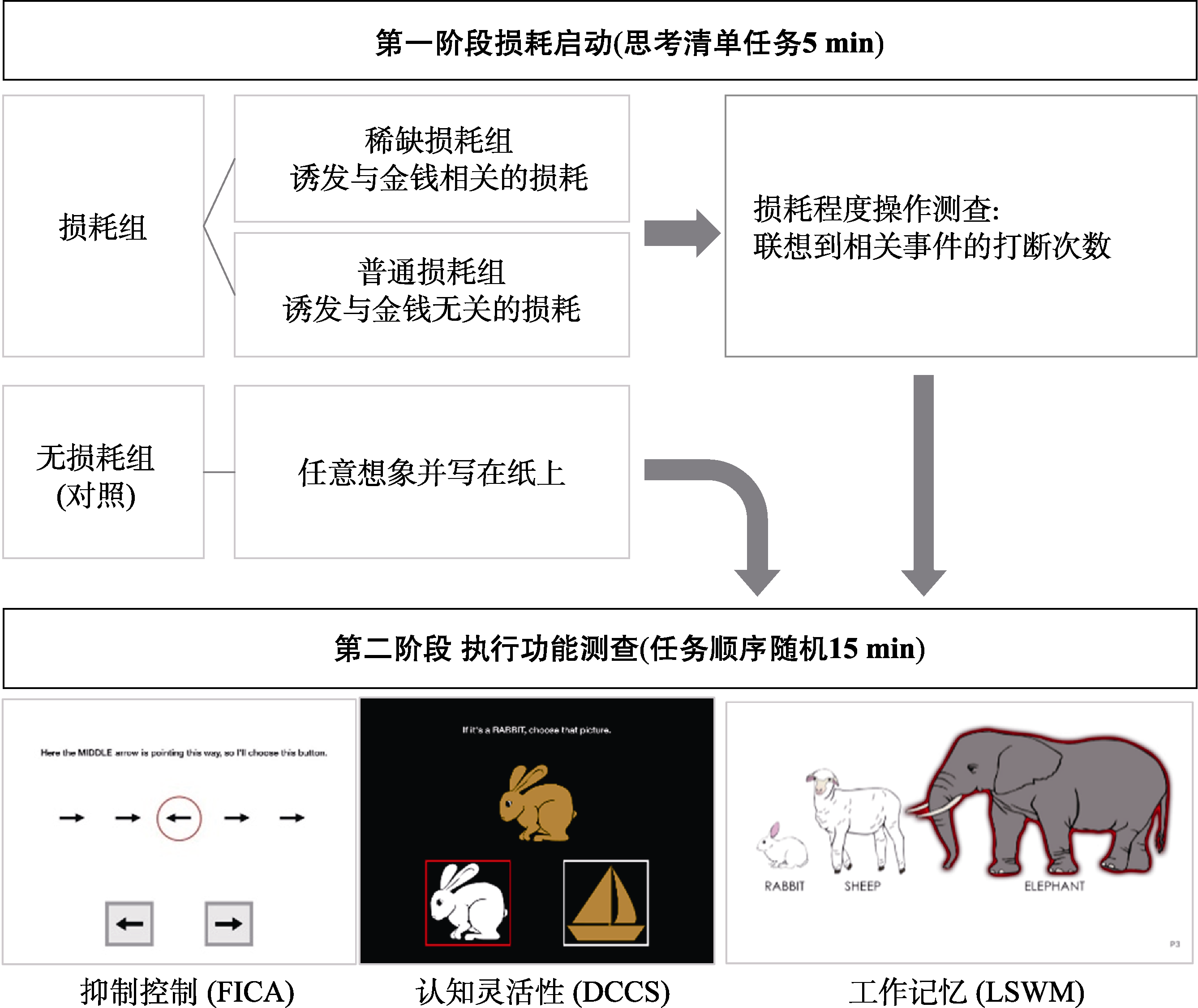
图1 研究1任务流程图
| 具体指标 | 有贫困经历 | 无贫困经历 | ||||
|---|---|---|---|---|---|---|
| 无损耗组 (N = 30) | 稀缺损耗组 (N = 29) | 普通损耗组 (N = 29) | 无损耗组 (N = 32) | 稀缺损耗组 (N = 29) | 普通损耗组 (N = 30) | |
| 打断次数 | −− | 4.52 (3.70) | 1.14 (1.57) | −− | 3.00 (2.38) | 2.30 (2.58) |
| 抑制控制 | 48.80 (11.12) | 40.07 (6.53) | 46.48 (10.29) | 55.47 (11.09) | 45.21 (9.48) | 44.90 (10.60) |
| 认知灵活性 | 53.83 (7.80) | 45.72 (5.74) | 50.07 (7.40) | 53.38 (9.67) | 46.69 (6.65) | 48.43 (9.45) |
| 工作记忆 | 49.57 (7.97) | 43.97 (4.62) | 46.17 (6.46) | 48.78 (5.56) | 50.79 (10.03) | 48.07 (7.78) |
表1 不同组别儿童在任务评价和执行功能上的描述统计
| 具体指标 | 有贫困经历 | 无贫困经历 | ||||
|---|---|---|---|---|---|---|
| 无损耗组 (N = 30) | 稀缺损耗组 (N = 29) | 普通损耗组 (N = 29) | 无损耗组 (N = 32) | 稀缺损耗组 (N = 29) | 普通损耗组 (N = 30) | |
| 打断次数 | −− | 4.52 (3.70) | 1.14 (1.57) | −− | 3.00 (2.38) | 2.30 (2.58) |
| 抑制控制 | 48.80 (11.12) | 40.07 (6.53) | 46.48 (10.29) | 55.47 (11.09) | 45.21 (9.48) | 44.90 (10.60) |
| 认知灵活性 | 53.83 (7.80) | 45.72 (5.74) | 50.07 (7.40) | 53.38 (9.67) | 46.69 (6.65) | 48.43 (9.45) |
| 工作记忆 | 49.57 (7.97) | 43.97 (4.62) | 46.17 (6.46) | 48.78 (5.56) | 50.79 (10.03) | 48.07 (7.78) |
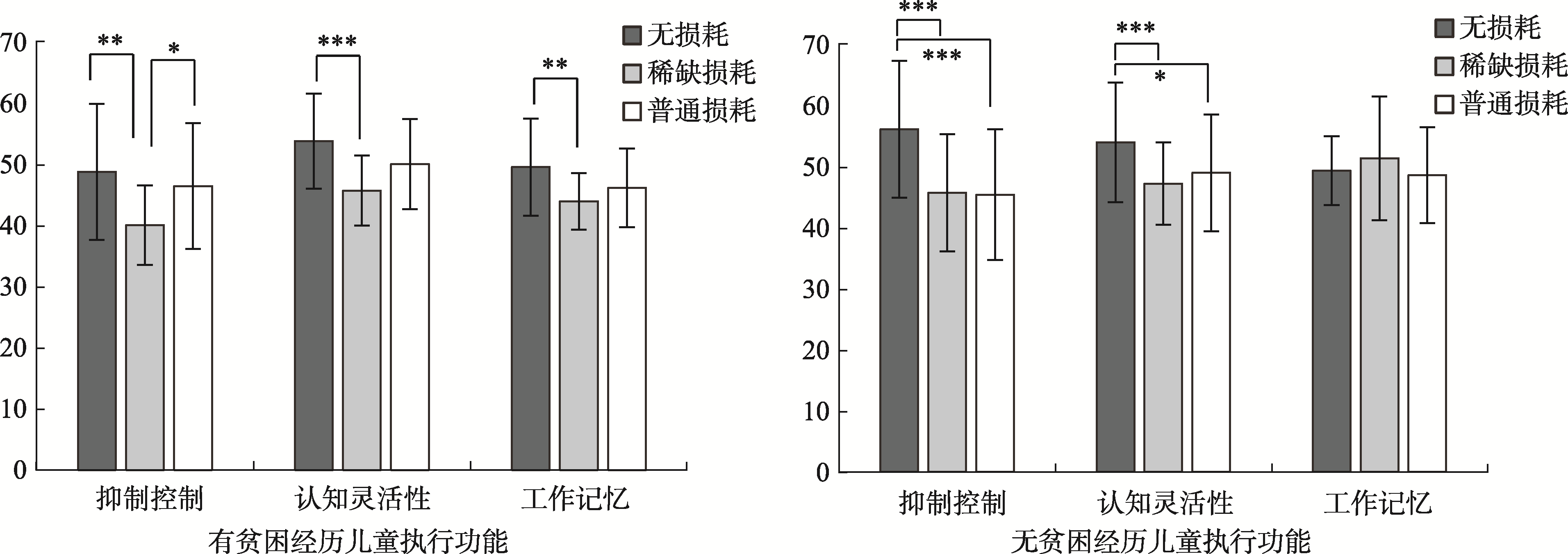
图2 有无贫困经历儿童在不同损耗类型下的执行功能
注:*p <.05, **p < 0.01, ***p < 0.001, 误差线为标准差, 下同
| 组别 | 打断次数 | 疲劳程度 | 沮丧程度 | ||||||
|---|---|---|---|---|---|---|---|---|---|
| M (SD) | t | d | M (SD) | F | η2p | M (SD) | F | η2p | |
| 对照组 | −− | 1.97 (0.75) | 1.81 (0.83) | ||||||
| 损耗无补偿组 | 3.17 (2.66) | 2.69 (1.37) | 2.72 (1.31) | ||||||
| 金钱补偿组 | 3.63 (2.83) | 0.64 | 0.17 | 2.87 (1.66) | 4.55* | 0.10 | 2.73 (1.82) | 4.57* | 0.10 |
| 糖果补偿组 | 2.97 (3.55) | −0.25 | −0.07 | 2.55 (1.30) | 3.81* | 0.08 | 2.52 (1.48) | 4.64* | 0.10 |
| 表扬补偿组 | 3.38 (3.53) | 0.26 | 0.07 | 2.55 (1.40) | 3.53* | 0.08 | 2.62 (1.61) | 4.65* | 0.10 |
| 休息补偿组 | 3.56 (2.68) | 0.57 | 0.15 | 2.88 (1.43) | 5.46** | 0.11 | 2.81 (1.33) | 6.93** | 0.14 |
| 抑制控制 | 认知灵活性 | 工作记忆 | |||||||
| M (SD) | F | η2p | M (SD) | F | η2p | M (SD) | F | η2p | |
| 对照组 | 48.42 (9.78) | 52.65 (8.46) | 49.94 (8.53) | ||||||
| 损耗无补偿组 | 40.72 (7.68) | 46.93 (5.76) | 45.07 (5.90) | ||||||
| 金钱补偿组 | 48.97 (7.35) | 8.94*** | 0.17 | 53.07 (7.84) | 6.19** | 0.13 | 51.27 (7.03) | 5.93** | 0.12 |
| 糖果补偿组 | 46.86 (7.56) | 6.88** | 0.14 | 51.69 (7.73) | 5.01** | 0.10 | 49.62 (7.71) | 3.89* | 0.08 |
| 表扬补偿组 | 40.55 (7.49) | 8.64*** | 0.17 | 48.79 (8.55) | 4.30* | 0.09 | 47.45 (8.58) | 2.93 | 0.06 |
| 休息补偿组 | 42.41 (7.97) | 6.84** | 0.13 | 49.81 (7.56) | 4.49* | 0.09 | 48.38 (10.50) | 2.49 | 0.05 |
表2 儿童对任务的评价、实验后执行功能分数的描述统计及差异分析
| 组别 | 打断次数 | 疲劳程度 | 沮丧程度 | ||||||
|---|---|---|---|---|---|---|---|---|---|
| M (SD) | t | d | M (SD) | F | η2p | M (SD) | F | η2p | |
| 对照组 | −− | 1.97 (0.75) | 1.81 (0.83) | ||||||
| 损耗无补偿组 | 3.17 (2.66) | 2.69 (1.37) | 2.72 (1.31) | ||||||
| 金钱补偿组 | 3.63 (2.83) | 0.64 | 0.17 | 2.87 (1.66) | 4.55* | 0.10 | 2.73 (1.82) | 4.57* | 0.10 |
| 糖果补偿组 | 2.97 (3.55) | −0.25 | −0.07 | 2.55 (1.30) | 3.81* | 0.08 | 2.52 (1.48) | 4.64* | 0.10 |
| 表扬补偿组 | 3.38 (3.53) | 0.26 | 0.07 | 2.55 (1.40) | 3.53* | 0.08 | 2.62 (1.61) | 4.65* | 0.10 |
| 休息补偿组 | 3.56 (2.68) | 0.57 | 0.15 | 2.88 (1.43) | 5.46** | 0.11 | 2.81 (1.33) | 6.93** | 0.14 |
| 抑制控制 | 认知灵活性 | 工作记忆 | |||||||
| M (SD) | F | η2p | M (SD) | F | η2p | M (SD) | F | η2p | |
| 对照组 | 48.42 (9.78) | 52.65 (8.46) | 49.94 (8.53) | ||||||
| 损耗无补偿组 | 40.72 (7.68) | 46.93 (5.76) | 45.07 (5.90) | ||||||
| 金钱补偿组 | 48.97 (7.35) | 8.94*** | 0.17 | 53.07 (7.84) | 6.19** | 0.13 | 51.27 (7.03) | 5.93** | 0.12 |
| 糖果补偿组 | 46.86 (7.56) | 6.88** | 0.14 | 51.69 (7.73) | 5.01** | 0.10 | 49.62 (7.71) | 3.89* | 0.08 |
| 表扬补偿组 | 40.55 (7.49) | 8.64*** | 0.17 | 48.79 (8.55) | 4.30* | 0.09 | 47.45 (8.58) | 2.93 | 0.06 |
| 休息补偿组 | 42.41 (7.97) | 6.84** | 0.13 | 49.81 (7.56) | 4.49* | 0.09 | 48.38 (10.50) | 2.49 | 0.05 |
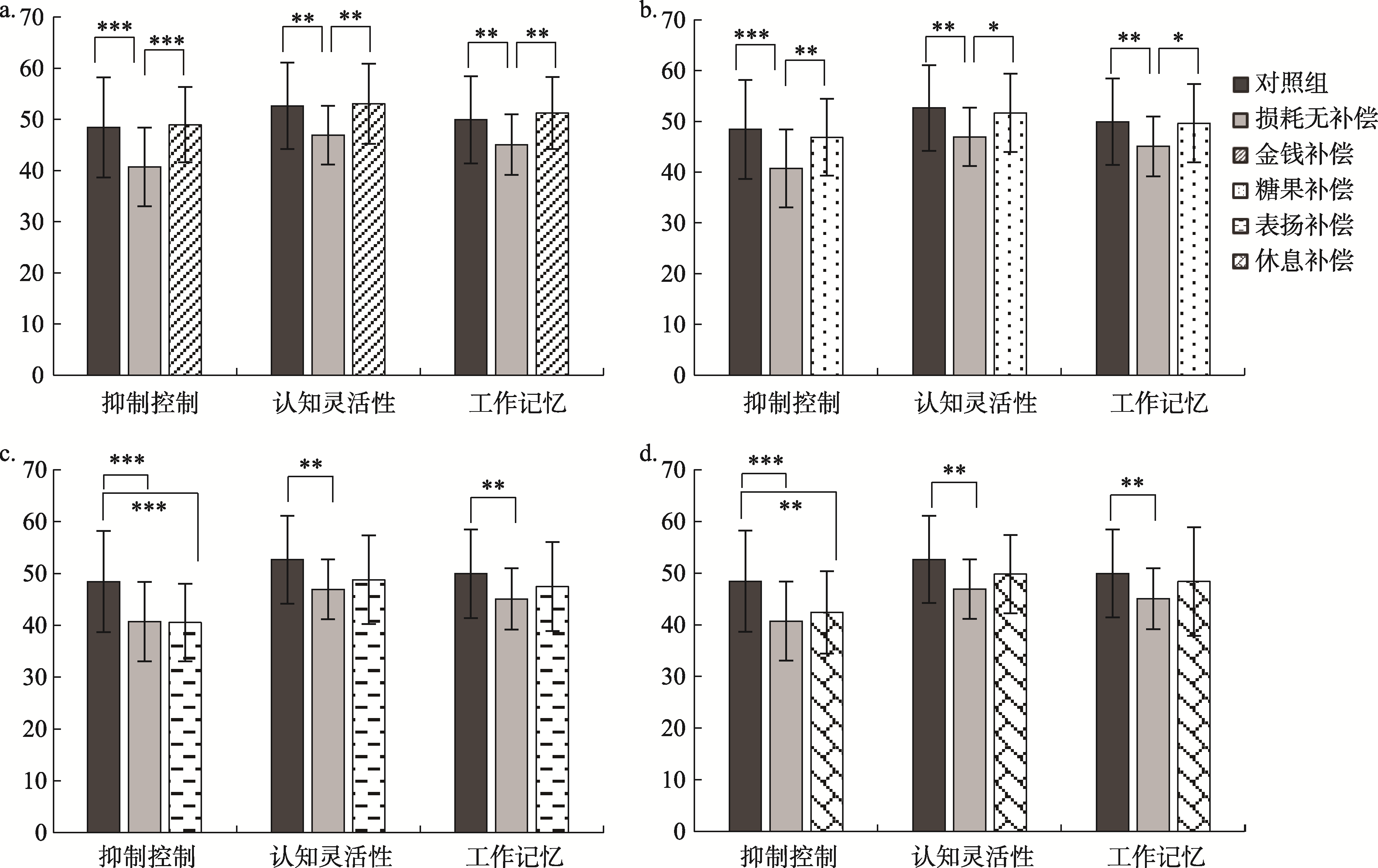
图3 补偿组与损耗无补偿组、对照组的执行功能 注:四图中损耗无补偿组与对照组相同,仅补偿组不同,其中 a.金钱补偿, b.糖果补偿, c.表扬补偿, d.休息补偿
| [1] |
Ahl R. E., Duong S., & Dunham Y. (2019). Children employ wealth cues when predicting others' sharing. Developmental Psychology, 55(2), 303-314.
doi: 10.1037/dev0000643 pmid: 30525834 |
| [2] | Baumeister R. F., & Vohs K. D. (2016). Strength model of self- regulation as limited resource: Assessment, controversies, update. Advances in Experimental Social Psychology, 54, 67-127. |
| [3] |
Bernheim B. D., Ray D., & Yeltekin E. (2015). Poverty and self-control. Econometrica, 83(5), 1877-1911.
doi: 10.3982/ECTA11374 URL |
| [4] |
Berti A. E., & Bombi A. S. (1981). The development of the concept of money and its value: A longitudinal study. Child Development, 52(4), 1179-1182.
doi: 10.2307/1129504 URL |
| [5] |
Bettencourt K. C., & Xu Y. (2016). Decoding the content of visual short-term memory under distraction in occipital and parietal areas. Nature Neuroscience, 19(4), 150-157.
doi: 10.1038/nn.4174 |
| [6] |
Boucher H. C., & Kofos M. N. (2012). The idea of money counteracts ego depletion effects. Journal of Experimental Social Psychology, 48(4), 804-810.
doi: 10.1016/j.jesp.2012.02.003 URL |
| [7] |
Browman A. S., Destin M., Carswell K. L., & Svoboda R. C. (2017). Perceptions of socioeconomic mobility influence academic persistence among low socioeconomic status students. Journal of Experimental Social Psychology, 72, 45-52.
doi: 10.1016/j.jesp.2017.03.006 URL |
| [8] |
Brummelman E., Crocker J., & Bushman B. J. (2016). The praise paradox: When and why praise backfires in children with low self-esteem. Child Development Perspectives, 10(2), 111-115.
doi: 10.1111/cdep.12171 URL |
| [9] |
Cannon C., Goldsmith K., & Roux C. (2019). A self-regulatory model of resource scarcity. Journal of Consumer Psychology, 29(1), 104-127.
doi: 10.1002/jcpy.1035 |
| [10] |
Carter E. C., Kofler L. M., Forster D. E., & McCullough M. E. (2015). A series of meta-analytic tests of the depletion effect: Self-control does not seem to rely on a limited resource. Journal of Experimental Psychology: General, 144(4), 796-815.
doi: 10.1037/xge0000083 URL |
| [11] | China Development Research Foundation. (2023). Child development report in China 2023: Promoting quality development of rural children. Beijing: China Development Press. |
| [中国发展研究基金会. (2023). 中国儿童发展报告2023: 促进农村儿童的高质量发展. 北京: 中国发展出版社.] | |
| [12] |
Claro S., Paunesku D., & Dweck C. S. (2016). Growth mindset tempers the effects of poverty on academic achievement. Proceedings of the National Academy of Sciences, 113(31), 8664-8668.
doi: 10.1073/pnas.1608207113 URL |
| [13] | Crum A. J., Salovey P., & Achor S. (2013). Rethinking stress: The role of mindsets in determining the stress response. Journal of Personality & Social Psychology, 104(4), 716-733. |
| [14] | Decker A. L., Meisler S. L., Hubbard N. A., Bauer C. C., Leonard J., Grotzinger H., ... Gabrieli J. D. (2024). Striatal and behavioral responses to reward vary by socioeconomic status in adolescents. Journal of Neuroscience, 44(11), Article e1633232023. https://doi.org/10.1523/JNEUROSCI.1633-23.2023 |
| [15] |
Diamond A. (2013). Executive functions. Annual Review of Psychology, 64(1), 135-168.
doi: 10.1146/psych.2013.64.issue-1 URL |
| [16] |
Dweck C. S. (2008). Can personality be changed? The role of beliefs in personality and change. Current Directions in Psychological Science, 17(6), 391-394.
doi: 10.1111/j.1467-8721.2008.00612.x URL |
| [17] | Evans G. W., Farah M. J., & Hackman D. A. (2021). Early childhood poverty and adult executive functioning: Distinct, mediating pathways for different domains of executive functioning. Developmental Science, 24(5), Article e13084. https://doi.org/10.1111/desc.13084. |
| [18] |
Eysenck M. W., & Derakshan N. (2011). New perspectives in attentional control theory. Personality and Individual Differences, 50(7), 955-960.
doi: 10.1016/j.paid.2010.08.019 URL |
| [19] |
Faul F., Erdfelder E., Lang A. G., & Buchner A. (2007). G* Power 3: A flexible statistical power analysis program for the social, behavioral, and biomedical sciences. Behavior Research Methods, 39(2), 175-191.
doi: 10.3758/BF03193146 URL |
| [20] |
Flanagan C. A., Kim T., Pykett A., Finlay A., Gallay E. E., & Pancer M. (2014). Adolescents’ theories about economic inequality: Why are some people poor while others are rich? Developmental Psychology, 50(11), 2512-2525.
doi: 10.1037/a0037934 URL |
| [21] |
Fu A. G., Zhang Z. S., Zheng J. H., Yue T., Lin Z. H., Wu N., & Huang X. T. (2020). Qualitative research on the endogenous power mechanism for poverty elimination. Acta Psychology Sinica, 52(1), 66-88.
doi: 10.3724/SP.J.1041.2020.00066 URL |
|
[傅安国, 张再生, 郑剑虹, 岳童, 林肇宏, 吴娜, 黄希庭. (2020). 脱贫内生动力机制的质性探究. 心理学报, 52(1), 66-80.]
doi: 10.3724/SP.J.1041.2020.00066 |
|
| [22] |
Gunderson E. A., Gripshover S. J., Romero C., Dweck C. S., Goldin-Meadow S., & Levine S. C. (2013). Parent praise to 1- to 3-year-olds predicts children's motivational frameworks 5 years later. Child Development, 84(5), 1526-1541.
doi: 10.1111/cdev.12064 pmid: 23397904 |
| [23] |
Heberle A. E., & Carter A. S. (2015). Cognitive aspects of young children's experience of economic disadvantage. Psychological Bulletin, 141(4), 723-746.
doi: 10.1037/bul0000010 pmid: 25822131 |
| [24] | Heckman J. J. (2008). The case for investing in disadvantaged young children. CESifo DICE Report, 6(2), 3-8. |
| [25] |
Karr J. E., Areshenkoff C. N., Rast P., Hofer S. M., Iverson G. L., & Garcia-Barrera M. A. (2018). The unity and diversity of executive functions: A systematic review and re-analysis of latent variable studies. Psychological Bulletin, 144(11), 1147-1185.
doi: 10.1037/bul0000160 pmid: 30080055 |
| [26] |
Kennedy D. O., & Scholey A. B. (2000). Glucose administration, heart rate and cognitive performance: Effects of increasing mental effort. Psychopharmacology, 149(1), 63-71.
pmid: 10789884 |
| [27] | Kurzban R., Duckworth A., Kable J. W., & Myers J. (2013). An opportunity cost model of subjective effort and task performance. Behavioral & Brain Sciences, 36(6), 661-679. |
| [28] | Lawson G. M., Hook C. J., & Farah M. J. (2018). A meta-analysis of the relationship between socioeconomic status and executive function performance among children. Developmental Science, 21(2), Article e12529. https://doi.org/10.1111/desc.12529 |
| [29] |
Luking K. R., Luby J. L., & Barch D. M. (2014). Kids, candy, brain and behavior: Age differences in responses to candy gains and losses. Developmental Cognitive Neuroscience, 9, 82-92.
doi: 10.1016/j.dcn.2014.01.005 pmid: 24534632 |
| [30] |
Mani A., Mullainathan S., Shafir E., & Zhao J. (2013). Poverty impedes cognitive function. Science, 341(6149), 976-980.
doi: 10.1126/science.1238041 pmid: 23990553 |
| [31] |
Merz E. C., Wiltshire C. A., & Noble K. G. (2019). Socioeconomic inequality and the developing brain: Spotlight on language and executive function. Child Development Perspectives, 13(1), 15-20.
doi: 10.1111/cdep.12305 URL |
| [32] |
Mistry R. S., Nenadal L., Griffin K. M., Zimmerman F. J., Cochran H. A., Thomas C. A., & Wilson C. (2016). Children's reasoning about poverty, economic mobility, and helping behavior: Results of a curriculum intervention in the early school years. Journal of Social Issues, 72(4), 760-788.
doi: 10.1111/josi.2016.72.issue-4 URL |
| [33] |
Miyake A., Friedman N. P., Emerson M. J., Witzki A. H., Howerter A., & Wager T. D. (2000). The unity and diversity of executive functions and their contributions to complex “frontal lobe” tasks: A latent variable analysis. Cognitive Psychology, 41(1), 49-100.
doi: 10.1006/cogp.1999.0734 pmid: 10945922 |
| [34] | Mu D. F., & Huang F. (2019). After depletion: The role of rest in replenishment of self-control resource. Psychological Development and Education, 35(6), 657-664. |
| [慕德芳, 黄芳. (2019). 休息对自我损耗的补偿作用. 心理发展与教育, 35(6), 657-664.] | |
| [35] | Mullainathan S., & Shafir E. (2013). Scarcity: Why having too little means so much. New York: Times Books. |
| [36] |
Muraven M., & Baumeister R. F. (2000). Self-regulation and depletion of limited resources: Does self-control resemble a muscle? Psychological Bulletin, 126(2), 247-259.
doi: 10.1037/0033-2909.126.2.247 pmid: 10748642 |
| [37] |
Muraven M., & Slessareva E. (2003). Mechanisms of self-control failure: Motivation and limited resources. Personality and Social Psychology Bulletin, 29(7), 894-906.
pmid: 15018677 |
| [38] |
Muraven M., Tice D. M., & Baumeister R. F. (1998). Self-control as a limited resource: Regulatory depletion patterns. Journal of Personality and Social Psychology, 74(3), 774-789.
pmid: 9523419 |
| [39] | National Institutes of Health. (2023, 02.28). Manually calculating NIH Toolbox V2 Cognition scores. Retrieved April 16, 2025, from https://nihtoolbox.zendesk.com/hc/en-us/articles/13539756622740-Manually-calculating-NIH-Toolbox-V2-Cognition-scores |
| [40] | Nugroho H. W., Salimo H., Hartono H., Hakim M. A., & Probandari A. (2023). Association between poverty and children's working memory abilities in developing countries: A systematic review and meta-analysis. Frontiers in Nutrition, 10, Article 1067626. https://doi.org/10.3389/fnut.2023.1067626 |
| [41] |
Scholey A. B., & Owen L. (2013). Effects of chocolate on cognitive function and mood: A systematic review. Nutrition Reviews, 71(10), 665-681.
doi: 10.1111/nure.12065 pmid: 24117885 |
| [42] |
See B. H., Morris R., Gorard S., Siddiqui N., Easterbrook M. J., Nieuwenhuis M., ... Banerjee R. (2022). A conceptual replication study of a self-affirmation intervention to improve the academic achievement of low-income pupils in England. Educational Research and Evaluation, 27(1-2), 83-116.
doi: 10.1080/13803611.2021.2022317 URL |
| [43] |
Shah A. K., Mullainathan S., & Shafir E. (2012). Some consequences of having too little. Science, 338(6107), 682-685.
doi: 10.1126/science.1222426 pmid: 23118192 |
| [44] |
Shah A. K., Zhao J., Mullainathan S., & Shafir E. (2018). Money in the mental lives of the poor. Social Cognition, 36(1), 4-19.
doi: 10.1521/soco.2018.36.1.4 URL |
| [45] |
Spawton-Rice J. H., & Walker Z. (2022). Do cognitive training applications improve executive function in children with adverse childhood experiences? A pilot study. Applied Neuropsychology: Child, 11(3), 373-382.
doi: 10.1080/21622965.2020.1854094 URL |
| [46] | Spears D. (2011). Economic decision-making in poverty depletes behavioral control. The B.E. Journal of Economic Analysis & Policy, 11(1), 1-42. |
| [47] |
Sturge-Apple M. L., Suor J. H., Davies P. T., Cicchetti D., Skibo M., A, & Rogosch F., A. (2016). Vagal tone and children's delay of gratification: Differential sensitivity in resource-poor and resource-rich environments. Psychological Science, 27(6), 885-893.
doi: 10.1177/0956797616640269 pmid: 27117276 |
| [48] |
Suntheimer N. M., & Wolf S. (2024). Duration of poverty and Ghanaian children’s learning and executive function outcomes. Applied Developmental Science, 28(3), 409-425.
doi: 10.1080/10888691.2023.2225774 URL |
| [49] | Taylor R. L., & Barch D. M. (2022). Inhibitory control within the context of early life poverty and implications for outcomes. Neuroscience & Biobehavioral Reviews. 140. Article e104778. https://doi.org/10.1016/j.neubiorev.2022.104778 |
| [50] | Tomm B. M., & Zhao J. (2016, August). Scarcity captures attention and induces neglect: Eyetracking and behavioral evidence. Paper presented at the Proceedings of the 38th Annual Conference of the Cognitive Science Society. Philadelphia, Pennsylvania. |
| [51] | Troller-Renfree S. V., Costanzo M. A., Duncan G. J., Magnuson K., Gennetian L. A., Yoshikawa H., … Noble K. G. (2022). The impact of a poverty reduction intervention on infant brain activity. Proceedings of the National Academy of Sciences, 119(5), Article e2115649119. https://doi.org/10.1073/pnas.2115649119 |
| [52] |
Tyler J. M., & Burns K. C. (2008). After depletion: The replenishment of the self's regulatory resources. Self and Identity, 7(3), 305-321.
doi: 10.1080/15298860701799997 URL |
| [53] |
Vohs K. D., Schmeichel B. J., Lohmann S., Gronau Q. F., Finley A. J., Ainsworth S. E., ... Albarracín D. (2021). A multisite preregistered paradigmatic test of the ego-depletion effect. Psychological Science, 32(10), 1566-1581.
doi: 10.1177/0956797621989733 URL |
| [54] | Vrantsidis D. M., Clark C. A., Chevalier N., Espy K. A., & Wiebe S. A. (2020). Socioeconomic status and executive function in early childhood: Exploring proximal mechanisms. Developmental Science, 23(3), Article e12917. https://doi.org/10.1111/desc.12917 |
| [55] |
Zelazo P. D. (2020). Executive function and psychopathology: A neurodevelopmental perspective. Annual Review of Clinical Psychology, 16, 431-454.
doi: 10.1146/annurev-clinpsy-072319-024242 pmid: 32075434 |
| [56] |
Zelazo P. D., Anderson J. E., Richler J., Wallner-Allen K., Beaumont J. L., & Weintraub S. (2013). II. NIH Toolbox Cognition Battery (CB): Measuring executive function and attention. Monographs of the Society for Research in Child Development, 78(4), 16-33.
doi: 10.1111/mono.12032 pmid: 23952200 |
| [57] | Zhao X., & Fu A. G. (2023, March). Cognitive development of rural chinese children:Characteristics, influencing factors, and intervention measures. Journal of Capital Normal University (Social Sciences Edition), (1), 149-159. |
| [赵鑫, 傅安国. (2023, 3月). 中国乡村儿童认知发展:特征、影响因素以及干预对策. 首都师范大学学报(社会科学版), (1), 149-159.] |
| [1] | 杨阳, 曹俊, 李潇林, 俄怡然, 谭羽荃, 贾亦心. 敬畏和共同内群体认同:感知资源稀缺性的调节[J]. 心理学报, 2026, 58(4): 667-682. |
| [2] | 康娜, 柳武妹, 曾伏娥. 租赁之物, 急用其效: 产品获取方式如何影响消费者对产品的转租倾向?[J]. 心理学报, 2026, 58(4): 740-754. |
| [3] | 胡小勇, 杜棠艳, 冀月欣, 宫文卓, 王笛新, 郭永玉. 稀缺威胁下低社会经济地位者的短视决策过程[J]. 心理学报, 2026, 58(2): 198-220. |
| [4] | 刘晓敏, 王雪, 向虹宇, 陈增祥, 苏凇. “共享消费悖论”:财务稀缺心态阻碍共享消费[J]. 心理学报, 2025, 57(7): 1281-1294. |
| [5] | 马超, 汪彦云, 付军军, 赵鑫. 不同类型学业压力对不同年级高中生执行功能子成分的影响[J]. 心理学报, 2025, 57(1): 18-35. |
| [6] | 赵娜, 段羽佳, 张恒星. 穷大方:自我建构视角下物质稀缺对慷慨行为的影响[J]. 心理学报, 2024, 56(9): 1176-1189. |
| [7] | 祝孝亮, 赵鑫. 执行功能在不同年级儿童数学能力中的作用[J]. 心理学报, 2023, 55(5): 696-710. |
| [8] | 张航, 王婷, 冯晓慧, 韦义平, 张积家. 铜鼓经验对壮族鼓手的节奏知觉和执行功能的影响[J]. 心理学报, 2023, 55(11): 1762-1779. |
| [9] | 马君, 张锐. 权重望寡:如何化解低地位领导的补偿性辱虐管理行为?[J]. 心理学报, 2022, 54(5): 566-581. |
| [10] | 张青, 王争艳. 母亲敏感性与婴儿气质、注意对学步儿执行功能影响的交互作用:一项两年的追踪研究[J]. 心理学报, 2022, 54(2): 141-153. |
| [11] | 盖笑松, 许洁, 闫艳, 王元, 谢笑春. 体感游戏促进儿童的执行功能:运动强度和认知参与的作用[J]. 心理学报, 2021, 53(5): 505-514. |
| [12] | 赵鑫, 李红利, 金戈, 李世峰, 周爱保, 梁文佳, 郭红霞, 蔡亚亚. 语音记忆和中央执行功能在不同年级儿童解码和语言理解中的作用[J]. 心理学报, 2020, 52(4): 469-484. |
| [13] | 陈晨, 张昕, 孙利平, 秦昕, 邓惠如. 信任以稀为贵?下属感知被信任如何以及何时导致反生产行为[J]. 心理学报, 2020, 52(3): 329-344. |
| [14] | 王元, 李柯, 盖笑松, 曹逸飞. 基于即时反馈的反应抑制训练对青少年和成人执行功能的训练效应和迁移效应[J]. 心理学报, 2020, 52(10): 1212-1223. |
| [15] | 王婷, 植凤英, 陆禹同, 张积家. 侗歌经验对侗族中学生执行功能的影响[J]. 心理学报, 2019, 51(9): 1040-1056. |
| 阅读次数 | ||||||
|
全文 |
|
|||||
|
摘要 |
|
|||||
