

ISSN 0439-755X
CN 11-1911/B
主办:中国心理学会
中国科学院心理研究所
出版:科学出版社
CN 11-1911/B
主办:中国心理学会
中国科学院心理研究所
出版:科学出版社
心理学报 ›› 2026, Vol. 58 ›› Issue (3): 437-449.doi: 10.3724/SP.J.1041.2026.0437 cstr: 32110.14.2026.0437
张晶晶1, 时颖1, 邓善文1, 李佳斌2, 陈庆荣1,3( )
)
收稿日期:2025-01-25
发布日期:2025-12-26
出版日期:2026-03-25
通讯作者:
陈庆荣, E-mail: jscqr80@sina.com基金资助:
ZHANG Jingjing1, SHI Ying1, DENG Shanwen1, LI Jiabin2, CHEN Qingrong1,3()
Received:2025-01-25
Online:2025-12-26
Published:2026-03-25
摘要:
音乐是诗的生命。对于中国古代诗歌而言, 平仄模式是诗歌音乐性的一种典型表达方式。本研究选取五言律诗作为实验材料, 同时操纵诗歌的平仄模式和语义特征, 采用EEG技术考察中国古代诗歌阅读过程中平仄感知和诗意理解的认知神经机制。行为结果显示, 平仄的主效应以及平仄与语义之间的交互作用显著。ERP结果进一步发现, 诗歌阅读过程中存在平仄效应, 表现为早期的P200效应, 以及之后的N400效应和晚期的LPC效应; 不仅如此, 平仄感知和诗意理解在中晚期相互调控和整合, 表现为在N400和LPC上存在交互作用。同时, 为了揭示神经活动与平仄和语义特征的关系, 对EEG数据进行了解码分析, 发现基于EEG数据训练得到的神经网络能够对不同类型诗句进行有效分类。实验结果一致表明, 人们在诗歌阅读过程中期待字音本身的和谐以及音与义的协调, 这种期待影响着诗歌早期的语音表征和随后的音义整合。
中图分类号:
张晶晶, 时颖, 邓善文, 李佳斌, 陈庆荣. (2026). 诗歌平仄与语义加工的认知神经机制. 心理学报, 58(3), 437-449.
ZHANG Jingjing, SHI Ying, DENG Shanwen, LI Jiabin, CHEN Qingrong. (2026). Cognitive neural mechanisms of tonal patterns and semantic processing in poetry. Acta Psychologica Sinica, 58(3), 437-449.
| 实验条件 | 诗句样例 |
|---|---|
| S+T+ | 竹凉/侵/卧/内/, /野月/满/庭/隅/。 |
| S+T− | 竹凉/侵/卧/内/, /野月/满/庭/院/。 |
| S−T+ | 竹凉/侵/卧/内/, /野月/满/庭/啡/。 |
| S−T− | 竹凉/侵/卧/内/, /野月/满/庭/肺/。 |
表1 不同平仄合理性和语义合理性的古代诗句
| 实验条件 | 诗句样例 |
|---|---|
| S+T+ | 竹凉/侵/卧/内/, /野月/满/庭/隅/。 |
| S+T− | 竹凉/侵/卧/内/, /野月/满/庭/院/。 |
| S−T+ | 竹凉/侵/卧/内/, /野月/满/庭/啡/。 |
| S−T− | 竹凉/侵/卧/内/, /野月/满/庭/肺/。 |
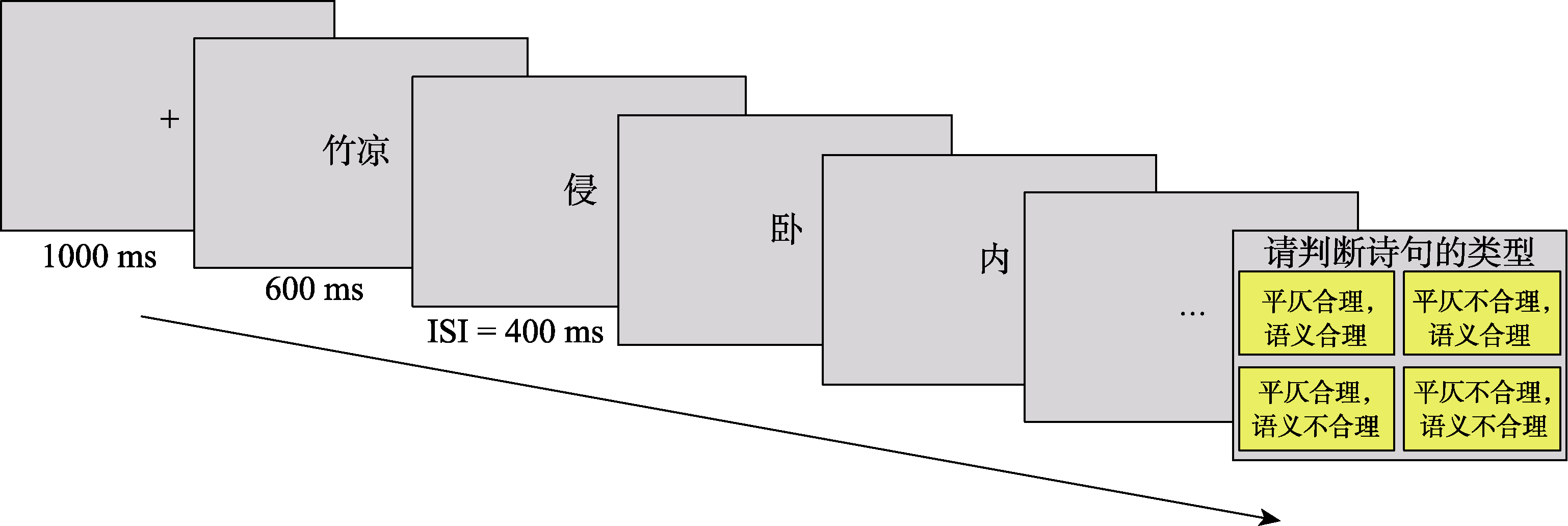
图1 实验流程示意图
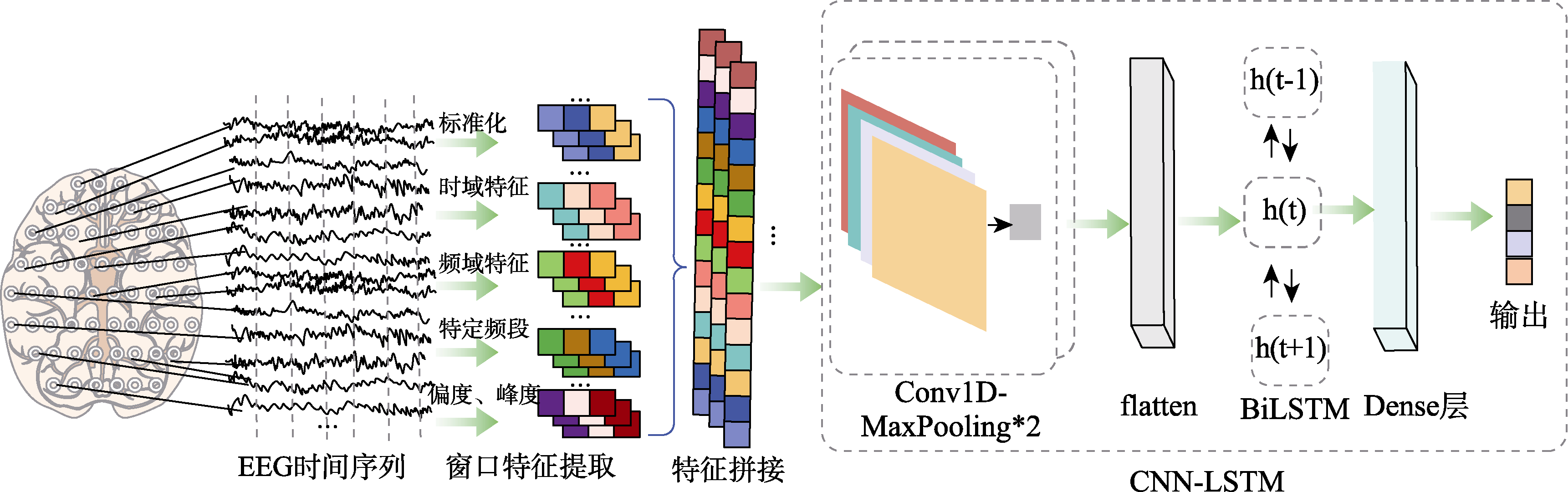
图2 基于CNN-LSTM的EEG分类分析流程图 注:彩图见电子版, 下同
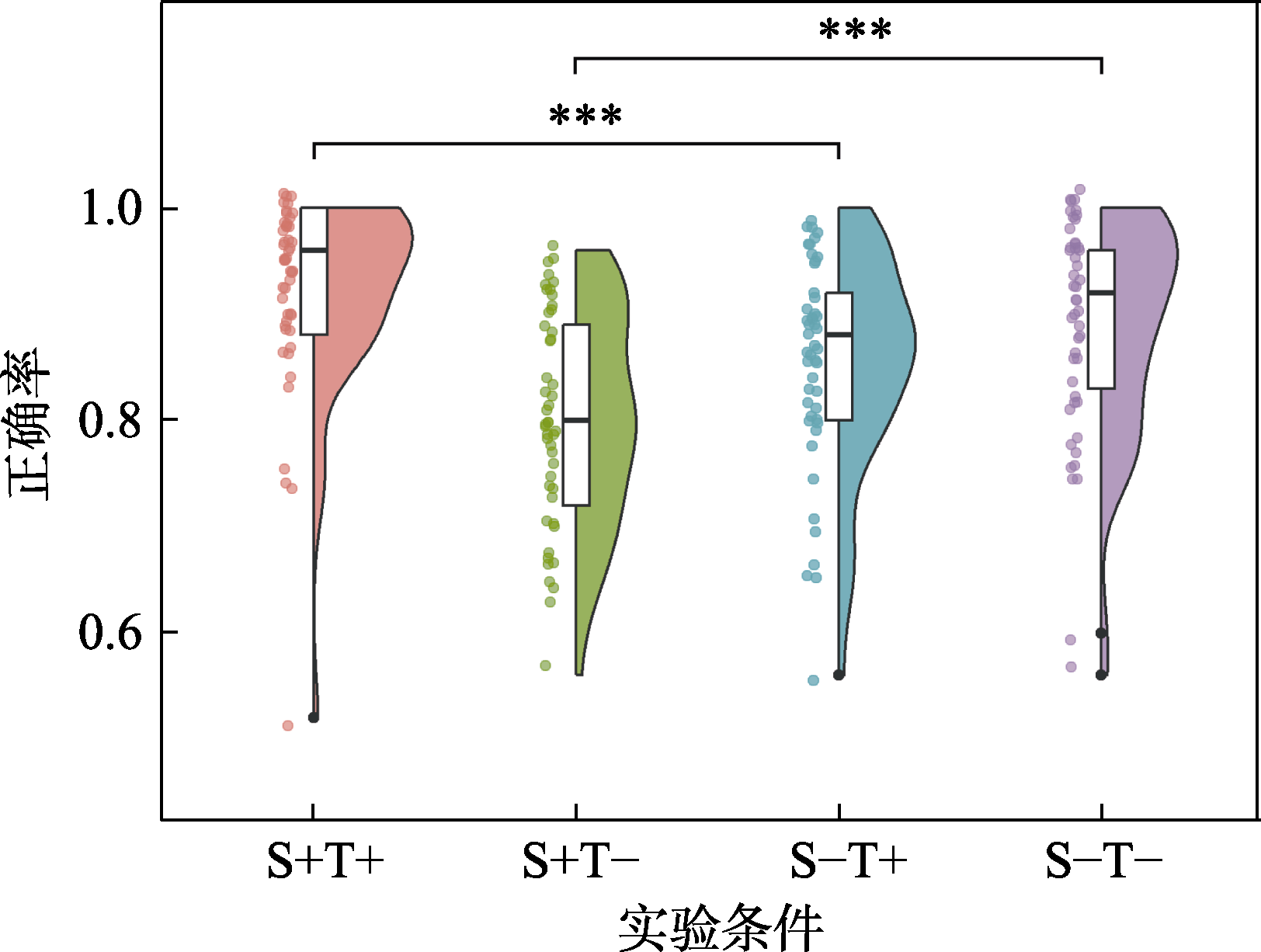
图3 四种实验条件下的正确率。***p < 0.001。
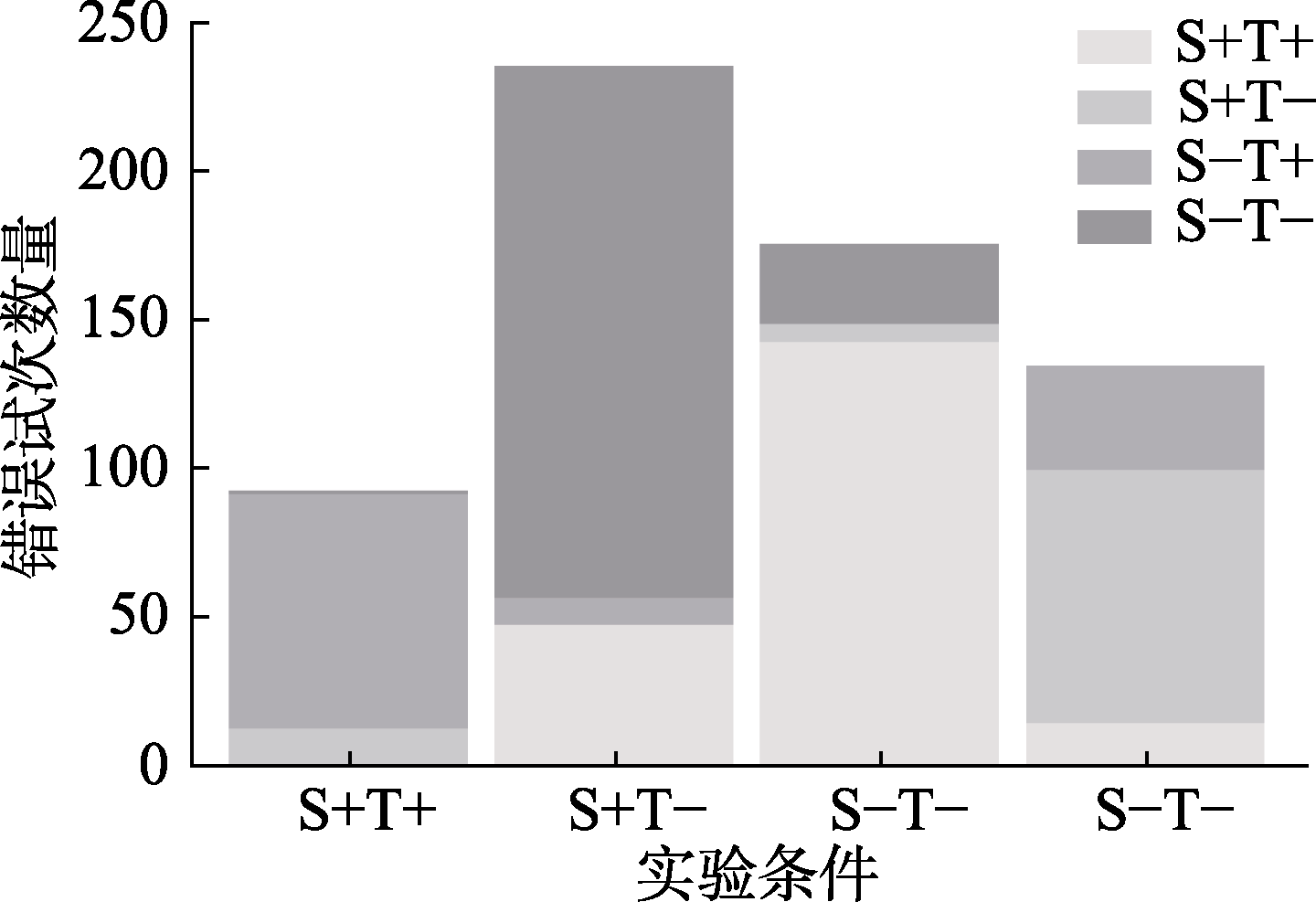
图4 四种实验条件下所有被试错误试次分布图

图5 四种不同类型诗歌关键字诱发的平均波幅。

图6 平仄合理性的主效应及其与语义合理性的交互效应。(a)平仄合理性效应(P200); (b) 平仄合理性和语义合理性的交互作用 (N400); (c) 平仄合理性和语义合理性的交互作用(LPC)。
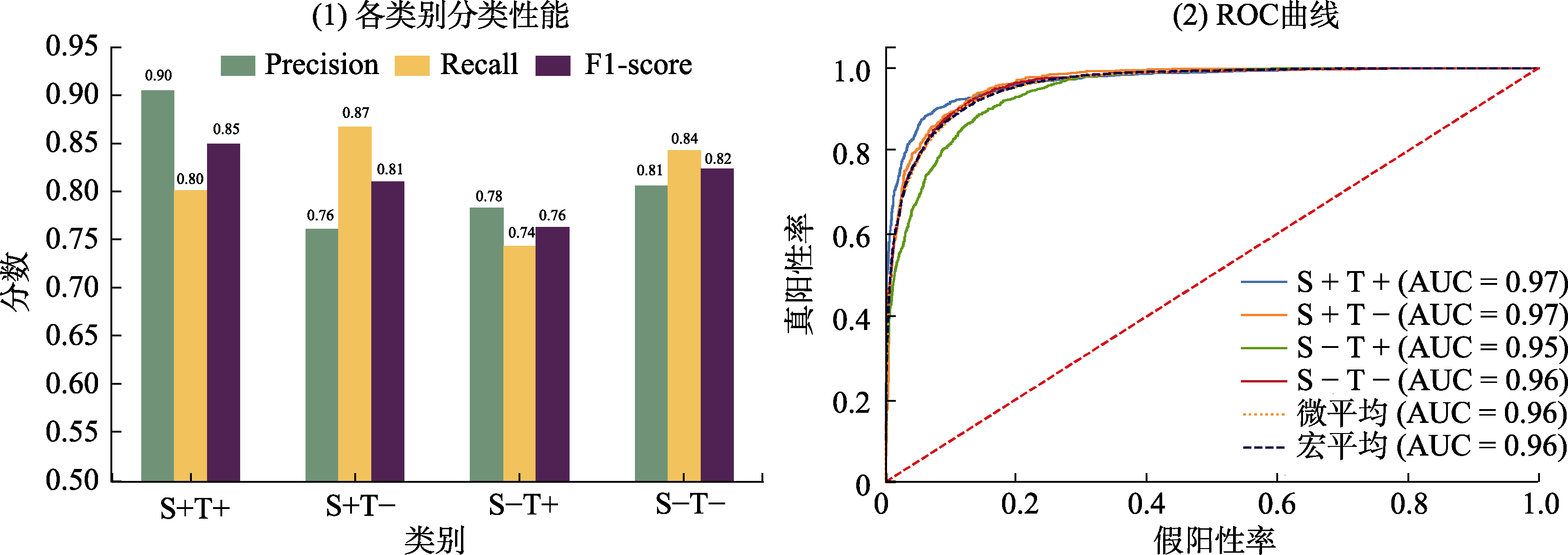
图7 根据EEG数据对不同类型诗句进行分类的性能(1)和多类别分类的ROC曲线(2)。
| [1] | Aristotle A. (1968). Poetics (Vol. 9). Clarendon Press. |
| [2] |
Astésano C., Besson M., & Alter K. (2004). Brain potentials during semantic and prosodic processing in French. Cognitive Brain Research, 18(2), 172-184.
pmid: 14736576 |
| [3] |
Barr D. J., Levy R., Scheepers C., & Tily H. J. (2013). Random effects structure for confirmatory hypothesis testing: Keep it maximal. Journal of Memory and Language, 68(3), 255-278.
doi: 10.1016/j.jml.2012.11.001 URL |
| [4] | Bashivan P., Rish I., Yeasin M., & Codella N. (2015). Learning representations from EEG with deep recurrent- convolutional neural networks. arXiv preprint arXiv: 1511.06448. |
| [5] | Beck J., & Konieczny L. (2020). Rhythmic subvocalization: An eye-tracking study on silent poetry reading. Journal of Eye Movement Research, 13(3), 1-40. |
| [6] |
Bornkessel-Schlesewsky I., & Schlesewsky M. (2008). An alternative perspective on “semantic P600” effects in language comprehension. Brain Research Reviews, 59(1), 55-73.
doi: 10.1016/j.brainresrev.2008.05.003 pmid: 18617270 |
| [7] |
Borra D., & Magosso E. (2021). Deep learning-based EEG analysis: Investigating P3 ERP components. Journal of Integrative Neuroscience, 20(4), 791-811.
doi: 10.31083/j.jin2004083 pmid: 34997705 |
| [8] |
Brauer M., & Curtin J. J. (2018). Linear mixed-effects models and the analysis of nonindependent data: A unified framework to analyze categorical and continuous independent variables that vary within-subjects and/or within-items. Psychological Methods, 23(3), 389-411.
doi: 10.1037/met0000159 pmid: 29172609 |
| [9] |
Brouwer H., Crocker M. W., Venhuizen N. J., & Hoeks J. C. (2017). A neurocomputational model of the N400 and the P600 in language processing. Cognitive Science, 41(Suppl 6), 1318-1352.
doi: 10.1111/cogs.2017.41.issue-S6 URL |
| [10] |
Brouwer H., Fitz H., & Hoeks J. (2012). Getting real about semantic illusions: Rethinking the functional role of the P600 in language comprehension. Brain Research, 1446, 127-143.
doi: 10.1016/j.brainres.2012.01.055 pmid: 22361114 |
| [11] |
Brown C., & Hagoort P. (1993). The processing nature of the N400: Evidence from masked priming. Journal of Cognitive Neuroscience, 5(1), 34-44.
doi: 10.1162/jocn.1993.5.1.34 pmid: 23972118 |
| [12] | Chen Q., & Dou F. (2021). Constructing a Questionnaire to Test the Knowledge of Ancient Chinese Poetry:A preliminary result. Journal of Nanjing Normal University (Social Science Edition), 3, 73-82. |
| [陈庆荣, 窦芬. (2021). 古诗知识经验测评问卷的初步编制. 南京师大学报(社会科学版), 3, 73-82.] | |
| [13] | Chen Q., & Yang Y. (2017). Cognitive mechanisms in reading ancient Chinese poetry: Evidence from eye movements. Social Sciences in China, 3, 48-76+205. |
| [陈庆荣, 杨亦鸣. (2017). 古诗阅读的认知机制: 来自眼动的证据. 中国社会科学, (3), 48-76+205.] | |
| [14] |
Chen Q., Zhang J., Xu X., Scheepers C., Yang Y., & Tanenhaus M. K. (2016). Prosodic expectations in silent reading: ERP evidence from rhyme scheme and semantic congruence in classic Chinese poems. Cognition, 154, 11-21.
doi: S0010-0277(16)30122-6 pmid: 27228392 |
| [15] |
Coch D., Grossi G., Skendzel W., & Neville H. (2005). ERP nonword rhyming effects in children and adults. Journal of Cognitive Neuroscience, 17(1), 168-182.
pmid: 15701247 |
| [16] | Cohen J. (1988). Statistical power analysis for the behavioral sciences. Routledge. |
| [17] |
Connolly J. F., & Phillips N. A. (1994). Event-related potential components reflect phonological and semantic processing of the terminal word of spoken sentences. Journal of Cognitive Neuroscience, 6(3), 256-266.
doi: 10.1162/jocn.1994.6.3.256 pmid: 23964975 |
| [18] |
Cox D. D., & Savoy R. L. (2003). Functional magnetic resonance imaging (fMRI) “brain reading”: Detecting and classifying distributed patterns of fMRI activity in human visual cortex. NeuroImage, 19(2), 261-270.
doi: 10.1016/S1053-8119(03)00049-1 URL |
| [19] | Culler J. (1975). Structuralist poetics: Structuralism, linguistics and the study of literature. Routledge. |
| [20] | Dambacher M., Rolfs M., Göllner K., Kliegl R., & Jacobs A. M. (2009). Event-related potentials reveal rapid verification of predicted visual input. PLoS One, 4(3), e5047. |
| [21] |
Dikker S., Rabagliati H., Farmer T. A., & Pylkkänen L. (2010). Early occipital sensitivity to syntactic category is based on form typicality. Psychological Science, 21(5), 629-634.
doi: 10.1177/0956797610367751 pmid: 20483838 |
| [22] |
Dikker S., Rabagliati H., & Pylkkänen L. (2009). Sensitivity to syntax in visual cortex. Cognition, 110(3), 293-321.
doi: 10.1016/j.cognition.2008.09.008 pmid: 19121826 |
| [23] | Fodor J. A. (1983). The modularity of mind. MIT Press. |
| [24] |
Friederici A. D. (1995). The time course of syntactic activation during language processing: A model based on neuropsychological and neurophysiological data. Brain and Language, 50(3), 259-281.
pmid: 7583190 |
| [25] |
Friederici A. D. (2002). Towards a neural basis of auditory sentence processing. Trends in Cognitive Sciences, 6(2), 78-84.
doi: 10.1016/s1364-6613(00)01839-8 pmid: 15866191 |
| [26] |
Friederici A. D. (2012). The cortical language circuit: From auditory perception to sentence comprehension. Trends in Cognitive Sciences, 16(5), 262-268.
doi: 10.1016/j.tics.2012.04.001 pmid: 22516238 |
| [27] |
Gramfort A., Luessi M., Larson E., Engemann D. A., Strohmeier D., Brodbeck C.,... Hämäläinen M. S. (2013). MEG and EEG data analysis with MNE-Python. Frontiers in Neuroscience, 7, 267.
doi: 10.3389/fnins.2013.00267 pmid: 24431986 |
| [28] | Hagoort, P., Brown C. M., & Osterhout L. (1999). The neurocognition of syntactic processing. In C. M. Brown, & (Eds.),The neurocognition of language, (pp. 273-316). https://doi.org/10.1093/acprof:oso/9780198507932.003.0009 |
| [29] |
Hagoort P., Hald L., Bastiaansen M., & Petersson K. M. (2004). Integration of word meaning and world knowledge in language comprehension. Science, 304(5669), 438-441.
doi: 10.1126/science.1095455 pmid: 15031438 |
| [30] |
Hanauer D. (1998). The genre-specific hypothesis of reading: Reading poetry and encyclopedic items. Poetics, 26(2), 63-80.
doi: 10.1016/S0304-422X(98)00011-4 URL |
| [31] |
Haynes J., & Rees G. (2006). Decoding mental states from brain activity in humans. Nature Reviews Neuroscience, 7(7), 523-534.
doi: 10.1038/nrn1931 |
| [32] | Hirst, D., & Di Cristo A. (Eds.). (1998). Intonation systems: A survey of twenty languages. Cambridge University Press. |
| [33] |
Hu J., Gao S., Ma W., & Yao D. (2012). Dissociation of tone and vowel processing in Mandarin idioms. Psychophysiology, 49(9), 1179-1190.
doi: 10.1111/j.1469-8986.2012.01406.x pmid: 22748083 |
| [34] | Jacobs A. M. (2015). Neurocognitive poetics: Methods and models for investigating the neuronal and cognitive- affective bases of literature reception. Frontiers in Human Neuroscience, 9, 186. |
| [35] | Jakobson, R. (1960). Linguistics and poetics. In T. Sebeok (Ed.), Style in language (pp. 350-377). Cambridge, MA: MIT Press. |
| [36] |
Just M. A., & Carpenter P. A. (1980). A theory of reading: From eye fixations to comprehension. Psychological Review, 87(4), 329-354.
pmid: 7413885 |
| [37] |
Kaan E., Harris A., Gibson E., & Holcomb P. (2000). The P600 as an index of syntactic integration difficulty. Language and Cognitive Processes, 15(2), 159-201.
doi: 10.1080/016909600386084 URL |
| [38] |
Kaan E., & Swaab T. Y. (2003). Repair, revision, and complexity in syntactic analysis: An electrophysiological differentiation. Journal of Cognitive Neuroscience, 15(1), 98-110.
pmid: 12590846 |
| [39] |
Kim A., & Osterhout L. (2005). The independence of combinatory semantic processing: Evidence from event- related potentials. Journal of Memory and Language, 52(2), 205-225.
doi: 10.1016/j.jml.2004.10.002 URL |
| [40] |
Kriegeskorte N., & Douglas P. K. (2019). Interpreting encoding and decoding models. Current Opinion in Neurobiology, 55, 167-179.
doi: S0959-4388(18)30100-4 pmid: 31039527 |
| [41] |
Kutas M., & Federmeier K. D. (2011). Thirty years and counting: Finding meaning in the N400 component of the event-related brain potential (ERP). Annual Review of Psychology, 62(1), 621-647.
doi: 10.1146/psych.2011.62.issue-1 URL |
| [42] | Ladd D. R. (2008). Intonational phonology (2nd ed.). Cambridge University Press. |
| [43] | Lau E. F., Phillips C., & Poeppel D. (2008). A cortical network for semantics: (de)constructing the N400. Nature Reviews Neuroscience, 9(12), 920-933. |
| [44] |
Lenth R., & Lenth M. R. (2018). Package ‘lsmeans’. The American Statistician, 34(4), 216-221.
doi: 10.1080/00031305.1980.10483031 URL |
| [45] | Li S., Zhang T., Yang F., Li X., Wang Z., & Zhao D. (2024). A dynamic multi-scale convolution model for face recognition using event-related potentials. Sensors, 24(13), 4368. |
| [46] | Li W., Wang L., & Yang Y. (2014). Chinese tone and vowel processing exhibits distinctive temporal characteristics: An electrophysiological perspective from classical Chinese poem processing. PLOS ONE, 9(1), e85683. |
| [47] |
Li W., & Yang Y. (2010). Perception of Chinese poem and its electrophysiological effects. Neuroscience, 168(3), 757-768.
doi: 10.1016/j.neuroscience.2010.03.069 pmid: 20382205 |
| [48] |
Li X., Shao X., Xia J., & Xu X. (2019). The cognitive and neural oscillatory mechanisms underlying the facilitating effect of rhythm regularity on speech comprehension. Journal of Neurolinguistics, 49, 155-167.
doi: 10.1016/j.jneuroling.2018.05.004 URL |
| [49] |
Liu Y., Li P., Shu H., Zhang Q., & Chen L. (2010). Structure and meaning in Chinese: An ERP study of idioms. Journal of Neurolinguistics, 23(6), 615-630.
doi: 10.1016/j.jneuroling.2010.06.001 URL |
| [50] |
Luck S. J., & Hillyard S. A. (1994). Electrophysiological correlates of feature analysis during visual search. Psychophysiology, 31(3), 291-308.
doi: 10.1111/j.1469-8986.1994.tb02218.x pmid: 8008793 |
| [51] |
Luo Y., & Zhou X. (2010). ERP evidence for the online processing of rhythmic pattern during Chinese sentence reading. NeuroImage, 49(3), 2836-2849.
doi: 10.1016/j.neuroimage.2009.10.008 pmid: 19833211 |
| [52] | Luo Z. (1993). Chinese Dictionary Compendium. Shanghai: Publishing House of Chinese Dictionary Compendium. |
| [罗竹风. (1993). 汉语大词典. 上海: 汉语大词典出版社.] | |
| [53] |
Magne C., Astésano C., Aramaki M., Ystad S., Kronland- Martinet R., & Besson M. (2007). Influence of syllabic lengthening on semantic processing in spoken French: Behavioral and electrophysiological evidence. Cerebral Cortex, 17(11), 2659-2668.
pmid: 17264253 |
| [54] |
Magne C., Schön D., & Besson M. (2006). Musician children detect pitch violations in both music and language better than nonmusician children: Behavioral and electrophysiological approaches. Journal of Cognitive Neuroscience, 18(2), 199-211.
pmid: 16494681 |
| [55] |
McClelland J. L., & Rumelhart D. E. (1981). An interactive activation model of context effects in letter perception: I. An account of basic findings. Psychological Review, 88(5), 375-407.
doi: 10.1037/0033-295X.88.5.375 URL |
| [56] |
Näätänen R., & Picton T. (1987). The N1 wave of the human electric and magnetic response to sound: A review and an analysis of the component structure. Psychophysiology, 24(4), 375-425.
doi: 10.1111/j.1469-8986.1987.tb00311.x pmid: 3615753 |
| [57] | Nietzsche F. (2012). The birth of tragedy. Courier Corporation. |
| [58] |
Nieuwland M. S. (2019). Do ‘early’ brain responses reveal word form prediction during language comprehension? A critical review. Neuroscience & Biobehavioral Reviews, 96, 367-400.
doi: 10.1016/j.neubiorev.2018.11.019 URL |
| [59] | Nieuwland M. S., Barr D. J., Bartolozzi F., Busch-Moreno S., Darley E., Donaldson D. I.,... Von Grebmer Zu Wolfsthurn S. (2020). Dissociable effects of prediction and integration during language comprehension: Evidence from a large-scale study using brain potentials. Philosophical Transactions of the Royal Society B, 375(1791), 20180522. |
| [60] |
Osterhout L., & Holcomb P. J. (1992). Event-related brain potentials elicited by syntactic anomaly. Journal of Memory and Language, 31(6), 785-806.
doi: 10.1016/0749-596X(92)90039-Z URL |
| [61] |
Rothermich K., & Kotz S. A. (2013). Predictions in speech comprehension: fMRI evidence on the meter-semantic interface. NeuroImage, 70, 89-100.
doi: 10.1016/j.neuroimage.2012.12.013 pmid: 23291188 |
| [62] |
Rothermich K., Schmidt-Kassow M., & Kotz S. A. (2012). Rhythm's gonna get you: Regular meter facilitates semantic sentence processing. Neuropsychologia, 50(2), 232-244.
doi: 10.1016/j.neuropsychologia.2011.10.025 pmid: 22178743 |
| [63] |
Rugg M. D. (1984). Event-related potentials in phonological matching tasks. Brain and Language, 23(2), 225-240.
pmid: 6518354 |
| [64] |
Schirmer A., Tang S. L., Penney T. B., Gunter T. C., & Chen H. C. (2005). Brain responses to segmentally and tonally induced semantic violations in Cantonese. Journal of Cognitive Neuroscience, 17(1), 1-12.
pmid: 15701235 |
| [65] |
Schön D., Magne C., & Besson M. (2004). The music of speech: Music training facilitates pitch processing in both music and language. Psychophysiology, 41(3), 341-349.
doi: 10.1111/1469-8986.00172.x pmid: 15102118 |
| [66] |
Schwartze M., & Kotz S. A. (2013). A dual-pathway neural architecture for specific temporal prediction. Neuroscience & Biobehavioral Reviews, 37(10), 2587-2596.
doi: 10.1016/j.neubiorev.2013.08.005 URL |
| [67] | Tabar Y. R., & Halici U. (2017). A novel deep learning approach for classification of EEG motor imagery signals. Journal of Neural Engineering, 14(1), 016003. |
| [68] |
Tian X., Zhu L., Zhang M., Wang S., Lu Y., Xu X., Jia W., Zheng Y., & Song S. (2024). Social anxiety prediction based on ERP features: A deep learning approach. Journal of Affective Disorders, 367, 545-553.
doi: 10.1016/j.jad.2024.09.006 pmid: 39236887 |
| [69] |
Tong F., & Pratte M. S. (2012). Decoding patterns of human brain activity. Annual Review of Psychology, 63(1), 483-509.
doi: 10.1146/psych.2012.63.issue-1 URL |
| [70] |
Tong Y., Francis A. L., & Gandour J. T. (2008). Processing dependencies between segmental and suprasegmental features in mandarin Chinese. Language and Cognitive Processes, 23(5), 689-708.
doi: 10.1080/01690960701728261 URL |
| [71] | Tsur R. (1983). What is cognitive poetics? Katz Research Institute for Hebrew Literature, Tel Aviv University. |
| [72] | Wang L. (2012). The metrics of Chinese poetry. Beijing: Zhonghua Book Company. |
| [王力. (2012). 诗词格律. 北京: 中华书局.] | |
| [73] | Winter B. (2013). Linear models and linear mixed effects models in R with linguistic applications. arXiv preprint arXiv:1308.5499. |
| [74] |
Yaron I. (2002). Processing of obscure poetic texts: Mechanisms of selection. Journal of Literary Semantics, 31(2), 133-170.
doi: 10.1515/jlse.2002.013 URL |
| [75] | Zeman A., Milton F., Smith A., & Rylance R. (2013). By heart: What is cognitive poetics? An fMRI study of brain activation by poetry and prose. Journal of Consciousness Studies, 20(9-10), 132-158. |
| [76] | Zhang Y. H. (2015). Cognitive poetics and interdisciplinary research on literary comprehension. Journal of Tsinghua University (Philosophy and Social Sciences), 30(2), 139-147+190. |
| [张叶鸿. (2015). 认知诗学与跨学科文学理解研究. 清华大学学报(哲学社会科学版), 30(2), 139-147+190.] | |
| [77] |
Zhang Z., Han M., Zhang F., & Li W. (2020). Musical training improves rhythm integrative processing of classical Chinese poem. Acta Psychologica Sinica, 52(7), 847-860.
doi: 10.3724/SP.J.1041.2020.00847 |
|
[张政华, 韩梅, 张放, 李卫君. (2020). 音乐训练促进诗句韵律整合加工的神经过程. 心理学报, 52(7), 847-860.]
doi: 10.3724/SP.J.1041.2020.00847 |
|
| [78] |
Zhang Z., Zhang H., Sommer W., Yang X., Wei Z., & Li W. (2023). Musical training alters neural processing of tones and vowels in classic Chinese poems. Brain and Cognition, 166, 105952.
doi: 10.1016/j.bandc.2023.105952 URL |
| [79] | Zhang Z., Zhang H., Wang B., Zheng Z., Zhao L., & Li W. (2021). The processing of the tone and the vowel in poems under different tasks: Evidence from ERPs. Studies of Psychology and Behavior, 19(6), 728-735. |
| [张政华, 张航, 王兵, 郑子龙, 赵黎明, 李卫君. (2021). 不同任务下声调和韵母在诗句中的加工过程——来自ERP的证据. 心理与行为研究, 19(6), 728-735.] | |
| [80] | Zhu G. Q. (2012). On Poetry. Beijing: Zhonghua Book Company. |
| [朱光潜. (2012). 诗论. 北京: 中华书局. ] |
| [1] | 陈斯允, 程梅子, 熊继伟, 房心怡, 吴来安. “林间慢板”:音乐节奏如何影响个体的亲环境行为[J]. 心理学报, 2026, 58(4): 698-724. |
| [2] | 代矫剑, 孙明泽, 王东方, 毛新瑞, 郭春彦. 类别和语义距离调节预期对记忆的影响[J]. 心理学报, 2026, 58(1): 1-14. |
| [3] | 杨明川, 李贤卓, 梁丹丹. 语言与音乐经验存在双向迁移: 基于普通话母语音乐人的范畴感知[J]. 心理学报, 2025, 57(9): 1499-1511. |
| [4] | 向颖, 贺斐, 冯琳琳, 龙梦灵, 白学军, 梁菲菲. 中文阅读伴随词汇学习:高效与低效组的认知加工策略比较[J]. 心理学报, 2025, 57(9): 1512-1528. |
| [5] | 华山, 姜欣桐, 高扬震宇, 穆妍, 杜忆. 音乐训练与音乐素养对共情能力的影响[J]. 心理学报, 2025, 57(4): 544-558. |
| [6] | 张环, 秦锡权, 刘雨, 林琳, 吴捷. 不同强度趋近动机积极情绪对基于语义关联性错误记忆的影响及其神经机制[J]. 心理学报, 2025, 57(3): 349-362. |
| [7] | 周临舒, 张雨青, 蔡丹超. 音乐训练促进音高与时间维度在听觉工作记忆中的交互[J]. 心理学报, 2025, 57(10): 1701-1714. |
| [8] | 吴洁, 车子轩. 多通道类别学习的认知特征与神经机制:EEG与DDM证据[J]. 心理学报, 2025, 57(10): 1715-1728. |
| [9] | 吴诗玉, 李赞. 新颖词语义韵的发生机制:“双枣树”效应的证据[J]. 心理学报, 2024, 56(5): 531-541. |
| [10] | 任维聪, 杨婷, 王汉林. 语言符号与知觉符号表征对外语词汇习得的影响比较:来自行为与脑电的实验证据[J]. 心理学报, 2024, 56(5): 542-554. |
| [11] | 黄韫慧, 肖友凯, 初星宇, 卢玥. 语义还是谐音:品牌个性与双关类型的匹配[J]. 心理学报, 2024, 56(11): 1604-1618. |
| [12] | 蔡文琦, 张向阳, 王小娟, 杨剑峰. 汉语复合词语素意义与整词语义整合加工的时间进程[J]. 心理学报, 2023, 55(8): 1207-1219. |
| [13] | 郑茜, 张亭亭, 李量, 范宁, 杨志刚. 言语的情绪韵律和情绪语义对听觉去信息掩蔽的作用[J]. 心理学报, 2023, 55(2): 177-191. |
| [14] | 张航, 王婷, 冯晓慧, 韦义平, 张积家. 铜鼓经验对壮族鼓手的节奏知觉和执行功能的影响[J]. 心理学报, 2023, 55(11): 1762-1779. |
| [15] | 李贤卓, 肖容, 梁丹丹. 声调范畴感知和声调复杂度对音乐音高感知的跨领域影响[J]. 心理学报, 2022, 54(9): 1021-1030. |
| 阅读次数 | ||||||
|
全文 |
|
|||||
|
摘要 |
|
|||||
