

ISSN 0439-755X
CN 11-1911/B
主办:中国心理学会
中国科学院心理研究所
出版:科学出版社
CN 11-1911/B
主办:中国心理学会
中国科学院心理研究所
出版:科学出版社
心理学报 ›› 2026, Vol. 58 ›› Issue (1): 39-56.doi: 10.3724/SP.J.1041.2026.0039 cstr: 32110.14.2026.0039
王雪珂1, 邓芳1, 陈立2,3,4( ), 冯廷勇1()
收稿日期:2025-02-24
发布日期:2025-10-28
出版日期:2026-01-25
通讯作者:
陈立, E-mail: chenli@cqmu.edu.cn;作者简介:王雪珂和邓芳是本文的共同第一作者。
基金资助:
WANG Xueke1, DENG Fang1, CHEN Li2,3,4(), FENG Tingyong1()
Received:2025-02-24
Online:2025-10-28
Published:2026-01-25
摘要:
有效应对和管理负面情绪是孤独症(ASD)儿童适应社会的必备能力, 然而以往研究大多集中于情绪识别和情绪理解, 对ASD儿童情绪调节特征及干预则关注较少。为此, 本研究结合多模态(量表、行为观察和生理测量)多场景(实验室、日常生活)的评估方法, 全面考察ASD儿童的情绪调节特征, 并进一步探究正念和认知行为策略训练对其情绪调节的改善作用。实验1通过挫折任务收集了ASD (n = 23)和典型发育儿童(n = 22)负性情绪的应对策略和生理指标, 并通过量表评估他们在日常生活中的情绪调节能力。结果发现, ASD儿童在应对负面情绪时更多采用非适应性调节策略, 且呈现生理唤醒水平显著更高, 波动更大以及恢复速度更慢的特点; 父母报告也显示ASD儿童在日常生活中更频繁体验消极情绪, 情绪调节能力低于典型发育儿童。基于此, 实验2开发正念和认知行为策略的综合干预方案, 并采用2(干预组、对照组) × 2(前测、后测)实验设计, 干预组进行8周, 每周2次, 每次60分钟, 每组2~3人的干预训练。结果发现, 与对照组相比, 训练后干预组在实验室场景中使用适应性策略的频率显著增加, 非适应性策略显著减少, 且日常生活中的情绪调节能力也显著提升。本研究表明ASD儿童在情绪调节方面的普遍困难, 并为改善其情绪调节能力提供了多模态评估与综合干预的新路径。
中图分类号:
王雪珂, 邓芳, 陈立, 冯廷勇. (2026). 孤独症儿童负性情绪调节特征及干预:基于多模态评估的正念与认知策略训练. 心理学报, 58(1), 39-56.
WANG Xueke, DENG Fang, CHEN Li, FENG Tingyong. (2026). Characteristics and interventions of negative emotion regulation in children with autism: Mindfulness and cognitive strategy training based on multimodal assessment. Acta Psychologica Sinica, 58(1), 39-56.
| 基本情况 | ASD (n = 23) | TD (n = 22) | t (df) | p |
|---|---|---|---|---|
| 年龄 (岁) | 6.57 (0.85) | 6.81 (0.05) | −1.32 (43) | 0.192 |
| 言语能力 | 85.87 (23.07) | 92.27 (19.17) | −1.01 (43) | 0.316 |
表1 被试样本的基本情况M (SD)
| 基本情况 | ASD (n = 23) | TD (n = 22) | t (df) | p |
|---|---|---|---|---|
| 年龄 (岁) | 6.57 (0.85) | 6.81 (0.05) | −1.32 (43) | 0.192 |
| 言语能力 | 85.87 (23.07) | 92.27 (19.17) | −1.01 (43) | 0.316 |
| 序号 | 情绪调节策略 | 具体描述 | 类型 |
|---|---|---|---|
| 01 | 目标导向行为 | • 反复尝试用不同的钥匙来开锁(战略努力) | 建 设 性 策 略 |
| 02 | 寻求支持 | • 以寻求帮助的方式看向主试(眼神寻求) • 口头向主试寻求帮助(语言寻求) • 与主试交谈但不直接寻求帮助(无寻求帮助的语言表达) | |
| 03 | 认知重评 | • 认为这个玩具不玩也可以, 家里还有其他玩具 | |
| 04 | 自我安慰 | • 我就是最棒的、我能行(语言安慰) • 抚摸自己的衣服、摸头发(身体安慰) | |
| 05 | 寻求安慰 | • 从主试那里寻求身体安慰或发声表示需要安慰(例如想要被抱着, 斜靠在主试身上) | |
| 06 | 转移注意力 | • 主动将注意力从当前任务转移到其他地方(例如去观察环境周围的其他物品) | |
| 07 | 声音发泄 | • 通过发出声音发泄情绪(例如, 提高音量、唱歌等) | 发 泄 策 略 |
| 08 | 物理发泄 | • 敲击或者撞击身体、物体等破坏性行为(例如摔东西、发脾气等) | |
| 09 | 自言自语 | • 一直默默私语, 但表达内容没有实际含义 | |
| 10 | 重复刻板行为 | • 重复的不寻常的行为, 没有明显的工具注意力(例如拍手、摇晃身体、舌头行为等) | |
| 11 | 回避策略 | • 回避手头任务的行为(例如扭身或转身离开, 试图离开座位) | 回 避 策 略 |
| 12 | 分心 | • 注意力被动从任务上移开 | |
| 13 | 替代策略 | • 放弃使用钥匙 |
表2 儿童13种情绪调节策略划分表
| 序号 | 情绪调节策略 | 具体描述 | 类型 |
|---|---|---|---|
| 01 | 目标导向行为 | • 反复尝试用不同的钥匙来开锁(战略努力) | 建 设 性 策 略 |
| 02 | 寻求支持 | • 以寻求帮助的方式看向主试(眼神寻求) • 口头向主试寻求帮助(语言寻求) • 与主试交谈但不直接寻求帮助(无寻求帮助的语言表达) | |
| 03 | 认知重评 | • 认为这个玩具不玩也可以, 家里还有其他玩具 | |
| 04 | 自我安慰 | • 我就是最棒的、我能行(语言安慰) • 抚摸自己的衣服、摸头发(身体安慰) | |
| 05 | 寻求安慰 | • 从主试那里寻求身体安慰或发声表示需要安慰(例如想要被抱着, 斜靠在主试身上) | |
| 06 | 转移注意力 | • 主动将注意力从当前任务转移到其他地方(例如去观察环境周围的其他物品) | |
| 07 | 声音发泄 | • 通过发出声音发泄情绪(例如, 提高音量、唱歌等) | 发 泄 策 略 |
| 08 | 物理发泄 | • 敲击或者撞击身体、物体等破坏性行为(例如摔东西、发脾气等) | |
| 09 | 自言自语 | • 一直默默私语, 但表达内容没有实际含义 | |
| 10 | 重复刻板行为 | • 重复的不寻常的行为, 没有明显的工具注意力(例如拍手、摇晃身体、舌头行为等) | |
| 11 | 回避策略 | • 回避手头任务的行为(例如扭身或转身离开, 试图离开座位) | 回 避 策 略 |
| 12 | 分心 | • 注意力被动从任务上移开 | |
| 13 | 替代策略 | • 放弃使用钥匙 |
| 情绪调节 策略类型 | ASD组 (n = 23) | TD组 (n = 22) | t (df) | p | Cohen’s d |
|---|---|---|---|---|---|
| 建设性策略 | 11.17 (3.17) | 14.91 (0.68) | −5.40 (43) | < 0.001 | −1.61 |
| 发泄策略 | 2.91 (3.46) | 0.05 (0.21) | 3.88 (43) | < 0.001 | 1.16 |
| 回避策略 | 2.39 (3.06) | 0.18 (9.66) | 3.32 (43) | 0.002 | 0.99 |
表3 ASD儿童和TD儿童在情绪调节策略上的差异比较
| 情绪调节 策略类型 | ASD组 (n = 23) | TD组 (n = 22) | t (df) | p | Cohen’s d |
|---|---|---|---|---|---|
| 建设性策略 | 11.17 (3.17) | 14.91 (0.68) | −5.40 (43) | < 0.001 | −1.61 |
| 发泄策略 | 2.91 (3.46) | 0.05 (0.21) | 3.88 (43) | < 0.001 | 1.16 |
| 回避策略 | 2.39 (3.06) | 0.18 (9.66) | 3.32 (43) | 0.002 | 0.99 |
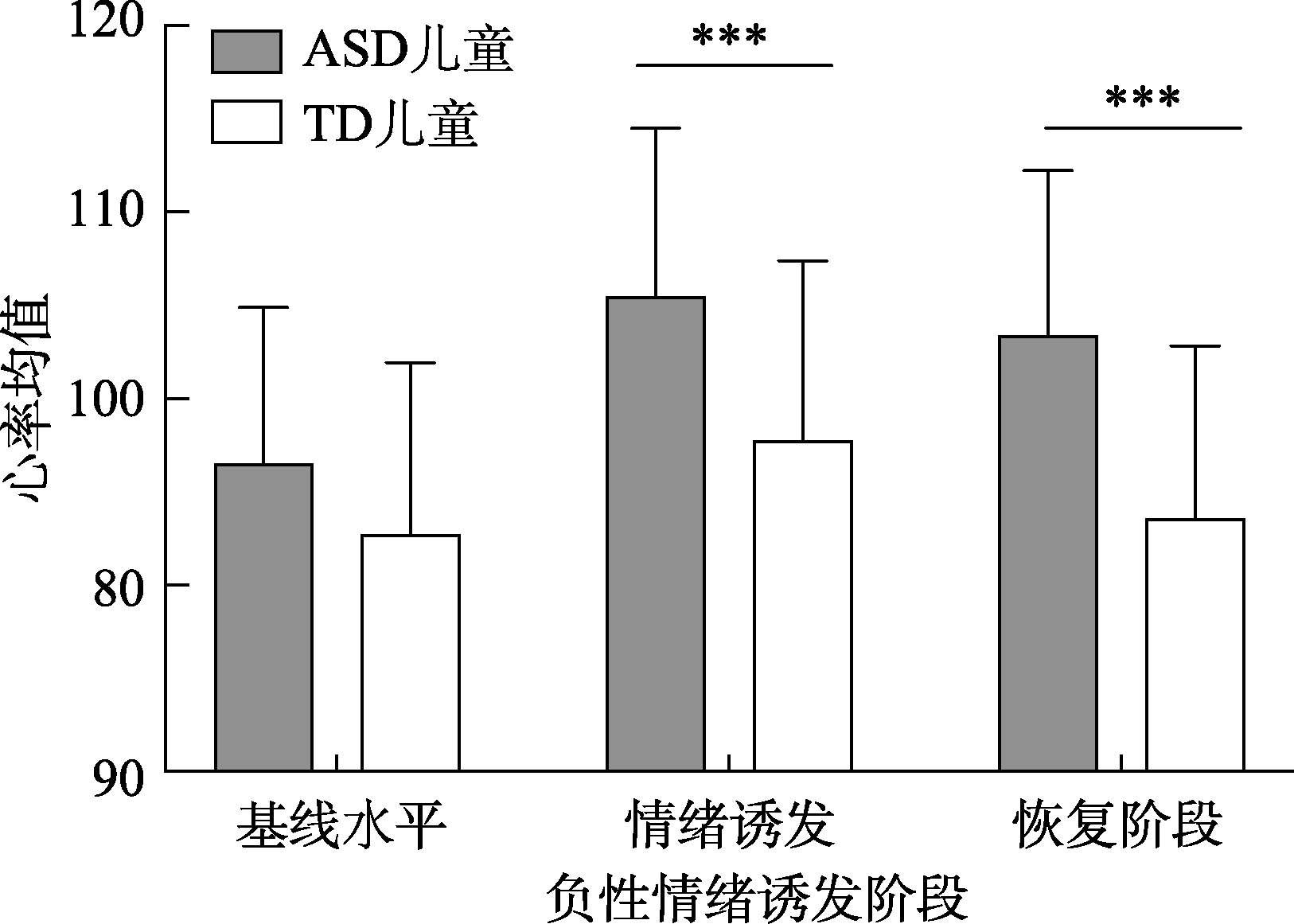
图1 ASD儿童和TD儿童在负性情绪诱发不同阶段的心率均值 注:*** p < 0.001
| 变量 | ASD组 (n = 23) | TD组 (n = 22) | t (df) | p | Cohen’s d |
|---|---|---|---|---|---|
| SCR mean (μS) | 0.77 (0.63) | 0.36 (0.27) | 2.83 (43) | 0.007 | 0.84 |
| PKO | 0.83 (0.05) | 0.78 (0.08) | 2.57 (43) | 0.014 | 0.77 |
表4 ASD儿童和TD儿童在生理指标上的差异比较
| 变量 | ASD组 (n = 23) | TD组 (n = 22) | t (df) | p | Cohen’s d |
|---|---|---|---|---|---|
| SCR mean (μS) | 0.77 (0.63) | 0.36 (0.27) | 2.83 (43) | 0.007 | 0.84 |
| PKO | 0.83 (0.05) | 0.78 (0.08) | 2.57 (43) | 0.014 | 0.77 |
| 变量 | ASD组(n = 23) | TD组(n = 22) | t (df) | p | Cohen’s d |
|---|---|---|---|---|---|
| 情绪调节维度 | 22.35 (1.95) | 24.29 (2.15) | −3.14 (43) | 0.003 | −0.95 |
| 不稳定/消极维度 | 37.65 (5.05) | 32.76 (3.51) | 3.70 (43) | <0.001 | 1.12 |
表5 ASD儿童和TD儿童在量表得分上的差异比较
| 变量 | ASD组(n = 23) | TD组(n = 22) | t (df) | p | Cohen’s d |
|---|---|---|---|---|---|
| 情绪调节维度 | 22.35 (1.95) | 24.29 (2.15) | −3.14 (43) | 0.003 | −0.95 |
| 不稳定/消极维度 | 37.65 (5.05) | 32.76 (3.51) | 3.70 (43) | <0.001 | 1.12 |
| 情绪调节策略 | 生理指标 | 父母报告 | |||||
|---|---|---|---|---|---|---|---|
| 基线阶段HR | 情绪诱发HR | 恢复阶段HR | SCR mean | PKO | 情绪调节维度 | 不稳定/消极维度 | |
| 建设性策略 | −0.25 | −0.35* | −0.32* | −0.28 | −0.19 | −0.12 | −0.34* |
| 发泄策略 | 0.29 | 0.35* | 0.33* | 0.15 | 0.30* | −0.17 | 0.37* |
| 回避策略 | 0.16 | 0.22 | 0.14 | 0.27 | 0.11 | −0.02 | 0.23 |
表6 情绪调节策略与生理指标、量表得分之间的关系
| 情绪调节策略 | 生理指标 | 父母报告 | |||||
|---|---|---|---|---|---|---|---|
| 基线阶段HR | 情绪诱发HR | 恢复阶段HR | SCR mean | PKO | 情绪调节维度 | 不稳定/消极维度 | |
| 建设性策略 | −0.25 | −0.35* | −0.32* | −0.28 | −0.19 | −0.12 | −0.34* |
| 发泄策略 | 0.29 | 0.35* | 0.33* | 0.15 | 0.30* | −0.17 | 0.37* |
| 回避策略 | 0.16 | 0.22 | 0.14 | 0.27 | 0.11 | −0.02 | 0.23 |
| 课时 | 主题 | 课程名称 | 核心活动与练习 | 训练目标 |
|---|---|---|---|---|
| 01 | 情绪知识:情绪识别 | 基本情绪我知道 | 毛毛兔奇遇记; 情绪飞行棋; 我是模仿小达人; 呼吸训练 | • 正确识别4种基本情绪的详细特点, 并进行模仿; 初步关注呼吸 |
| 02 | 情绪知识:情绪理解 | 基本情绪再加深 | 情绪大风车; 我的幸福计划图; 情绪变变变 | • 理解情绪产生的原因; 加深体验不同情绪 |
| 03 | 情绪知识:情绪觉察 | 情绪线索初探查 | 丛林大侦探; 思想大爆发; 绘画情绪日记 | • 使能够根据情绪线索识别他人情绪; 开始关注与觉察自身感受和情绪 |
| 04 | 情绪知识:情绪表达 | 情绪工具多用处 | 情绪温度计、情绪魔法瓶等 | • 学会借助某些工具合理恰当的表达自身的情绪 |
| 05 | 正念:呼吸与注意 | 感官训练营一 | 自主呼吸训练、正念观察、正念倾听(环境) | • 通过视听嗅味触等不同的感觉来训练专注力, 使儿童把注意力集中在当下 |
| 06 | 正念:呼吸与注意 | 感官训练营二 | 正念倾听(人际)、五感解压游戏 | • 加强专注训练, 并灵活运用自己的感知 |
| 07 | 正念:躯体感觉与运动 | 身体探险家 | 像树一样扎根、身体涂色游戏 | • 学会倾听自己身体的感受; 在情绪冲动时能够先觉察自己的身体感受 |
| 08 | 正念:躯体感觉与运动 | 身体方式训练 | 渐进式肌肉方式、紧握双拳 | • 教授一些身体放松的练习; 学习在生理不适的情况下如何快速调整自己 |
| 09 | 正念:觉察心智活动 | 自我探索大冒险 | 快乐指南书、角色扮演 | • 积极和消极情绪触发因素调查, 增加儿童对自身情绪诱因的认识和理解 |
| 10 | 正念:觉察心智活动 | 关联小能手 | 情绪动画解读、击鼓传花游戏、 有益思想导弹 | • 使儿童觉察思想和感受的联系, 以及不同的行为会产生不同行为结果 |
| 11 | 认知行为策略 | 社交规则知多少 | 行为模仿、视频片段分析 | • 区分哪些是合适的情绪行为, 哪些是不合适的情绪行为 |
| 12 | 认知行为策略 | 做情绪的主人 | 情绪天气归类、表达引导 | • 学习情绪产生后的具体做法, 能够用恰当的语言表达自身感受 |
| 13 | 认知行为策略 | 物理工具能利用 | 压力球、玩具巧思用等 | • 教授如何以不影响周围环境的方式直接宣泄高能量 |
| 14 | 认知行为策略 | 转移注意力 | 深呼吸跑道、情绪红绿灯、心情角 | • 学会通过将注意力转移到别处从而来平复心情 |
| 15 | 总结 | 感恩与解压 | 体会感激、冲走忙碌的思绪 | • 使儿童能够体会感恩之情, 多多感受生活之中的美好 |
| 16 | 总结 | 总结回顾 | 学习之路 | • 回顾情绪处理策略, 练习巩固之前学到的技能 |
表7 孤独症儿童情绪调节综合干预课程表
| 课时 | 主题 | 课程名称 | 核心活动与练习 | 训练目标 |
|---|---|---|---|---|
| 01 | 情绪知识:情绪识别 | 基本情绪我知道 | 毛毛兔奇遇记; 情绪飞行棋; 我是模仿小达人; 呼吸训练 | • 正确识别4种基本情绪的详细特点, 并进行模仿; 初步关注呼吸 |
| 02 | 情绪知识:情绪理解 | 基本情绪再加深 | 情绪大风车; 我的幸福计划图; 情绪变变变 | • 理解情绪产生的原因; 加深体验不同情绪 |
| 03 | 情绪知识:情绪觉察 | 情绪线索初探查 | 丛林大侦探; 思想大爆发; 绘画情绪日记 | • 使能够根据情绪线索识别他人情绪; 开始关注与觉察自身感受和情绪 |
| 04 | 情绪知识:情绪表达 | 情绪工具多用处 | 情绪温度计、情绪魔法瓶等 | • 学会借助某些工具合理恰当的表达自身的情绪 |
| 05 | 正念:呼吸与注意 | 感官训练营一 | 自主呼吸训练、正念观察、正念倾听(环境) | • 通过视听嗅味触等不同的感觉来训练专注力, 使儿童把注意力集中在当下 |
| 06 | 正念:呼吸与注意 | 感官训练营二 | 正念倾听(人际)、五感解压游戏 | • 加强专注训练, 并灵活运用自己的感知 |
| 07 | 正念:躯体感觉与运动 | 身体探险家 | 像树一样扎根、身体涂色游戏 | • 学会倾听自己身体的感受; 在情绪冲动时能够先觉察自己的身体感受 |
| 08 | 正念:躯体感觉与运动 | 身体方式训练 | 渐进式肌肉方式、紧握双拳 | • 教授一些身体放松的练习; 学习在生理不适的情况下如何快速调整自己 |
| 09 | 正念:觉察心智活动 | 自我探索大冒险 | 快乐指南书、角色扮演 | • 积极和消极情绪触发因素调查, 增加儿童对自身情绪诱因的认识和理解 |
| 10 | 正念:觉察心智活动 | 关联小能手 | 情绪动画解读、击鼓传花游戏、 有益思想导弹 | • 使儿童觉察思想和感受的联系, 以及不同的行为会产生不同行为结果 |
| 11 | 认知行为策略 | 社交规则知多少 | 行为模仿、视频片段分析 | • 区分哪些是合适的情绪行为, 哪些是不合适的情绪行为 |
| 12 | 认知行为策略 | 做情绪的主人 | 情绪天气归类、表达引导 | • 学习情绪产生后的具体做法, 能够用恰当的语言表达自身感受 |
| 13 | 认知行为策略 | 物理工具能利用 | 压力球、玩具巧思用等 | • 教授如何以不影响周围环境的方式直接宣泄高能量 |
| 14 | 认知行为策略 | 转移注意力 | 深呼吸跑道、情绪红绿灯、心情角 | • 学会通过将注意力转移到别处从而来平复心情 |
| 15 | 总结 | 感恩与解压 | 体会感激、冲走忙碌的思绪 | • 使儿童能够体会感恩之情, 多多感受生活之中的美好 |
| 16 | 总结 | 总结回顾 | 学习之路 | • 回顾情绪处理策略, 练习巩固之前学到的技能 |
| 变量 | 干预组(n = 12) | 对照组(n = 10) | t (df) | p | Cohen’s d |
|---|---|---|---|---|---|
| 行为策略 | |||||
| 建设性策略 | 10.25 (3.60) | 12.10 (2.51) | −1.37 (20) | 0.186 | −0.59 |
| 发泄策略 | 4.08 (4.30) | 1.60 (1.71) | 1.71 (20) | 0.102 | 0.73 |
| 回避策略 | 3.33 (3.55) | 1.7 (2.50) | 1.22 (20) | 0.236 | 0.52 |
| 生理指标 | |||||
| 心率均值 | 103.32 (7.74) | 101.05 (6.11) | 0.75 (20) | 0.462 | 0.32 |
| 皮肤电反应 | 0.82 (0.45) | 0.67 (0.45) | 0.53 (20) | 0.599 | 0.23 |
| 峰率发生值 | 0.84 (0.02) | 0.83 (0.07) | 0.35 (20) | 0.729 | 0.15 |
| 量表得分 | |||||
| 情绪调节 | 22.58 (2.31) | 22.20 (1.55) | 0.45 (20) | 0.660 | 0.19 |
| 不稳定/消极 | 38.67 (5.77) | 36.7 (4.30) | 0.89 (20) | 0.384 | 0.38 |
表8 干预前两组被试情绪调节相关指标的差异检验
| 变量 | 干预组(n = 12) | 对照组(n = 10) | t (df) | p | Cohen’s d |
|---|---|---|---|---|---|
| 行为策略 | |||||
| 建设性策略 | 10.25 (3.60) | 12.10 (2.51) | −1.37 (20) | 0.186 | −0.59 |
| 发泄策略 | 4.08 (4.30) | 1.60 (1.71) | 1.71 (20) | 0.102 | 0.73 |
| 回避策略 | 3.33 (3.55) | 1.7 (2.50) | 1.22 (20) | 0.236 | 0.52 |
| 生理指标 | |||||
| 心率均值 | 103.32 (7.74) | 101.05 (6.11) | 0.75 (20) | 0.462 | 0.32 |
| 皮肤电反应 | 0.82 (0.45) | 0.67 (0.45) | 0.53 (20) | 0.599 | 0.23 |
| 峰率发生值 | 0.84 (0.02) | 0.83 (0.07) | 0.35 (20) | 0.729 | 0.15 |
| 量表得分 | |||||
| 情绪调节 | 22.58 (2.31) | 22.20 (1.55) | 0.45 (20) | 0.660 | 0.19 |
| 不稳定/消极 | 38.67 (5.77) | 36.7 (4.30) | 0.89 (20) | 0.384 | 0.38 |
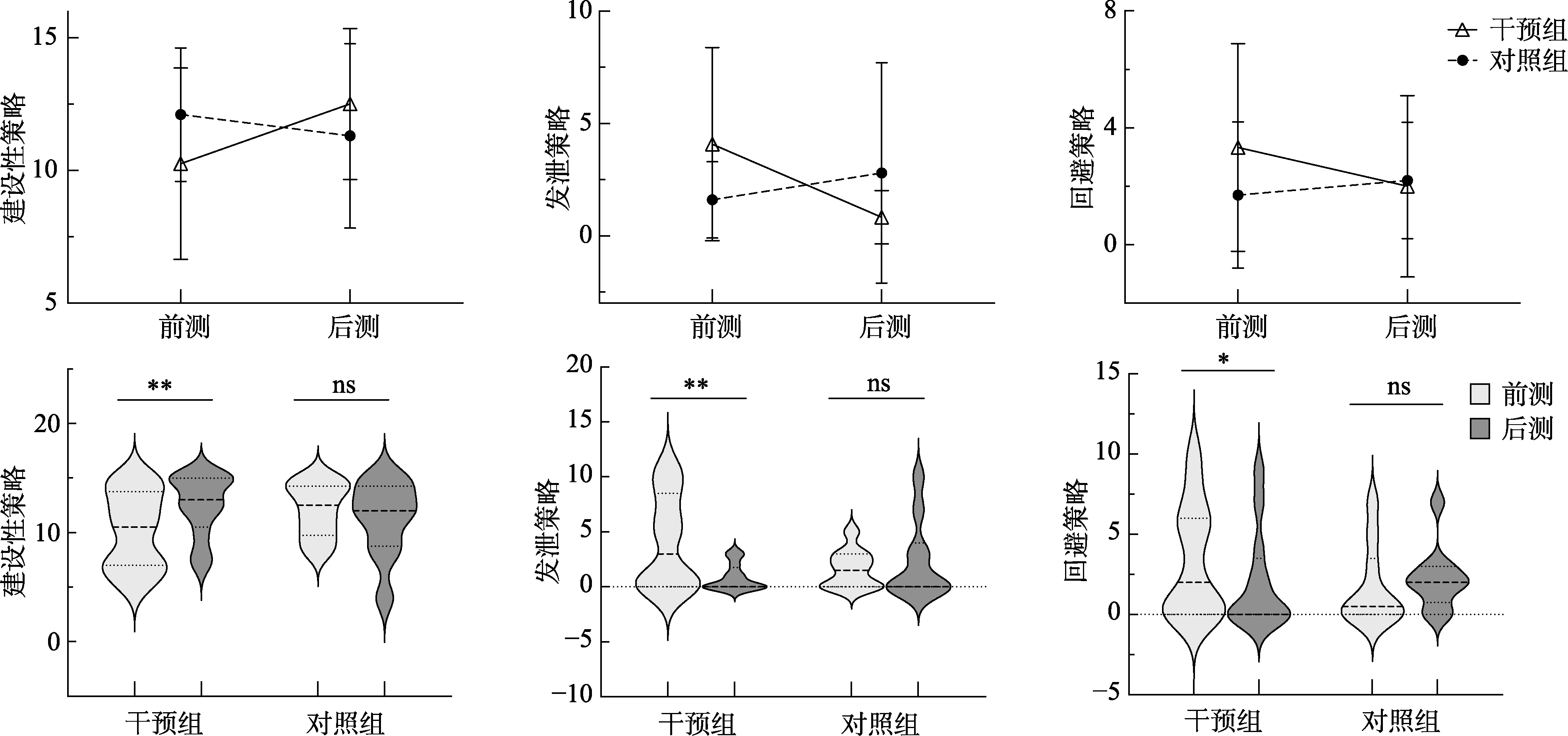
图2 干预组和对照组前后测情绪调节策略得分差异比较 注:ns表示无显著差异, * p < 0.05, ** p < 0.01
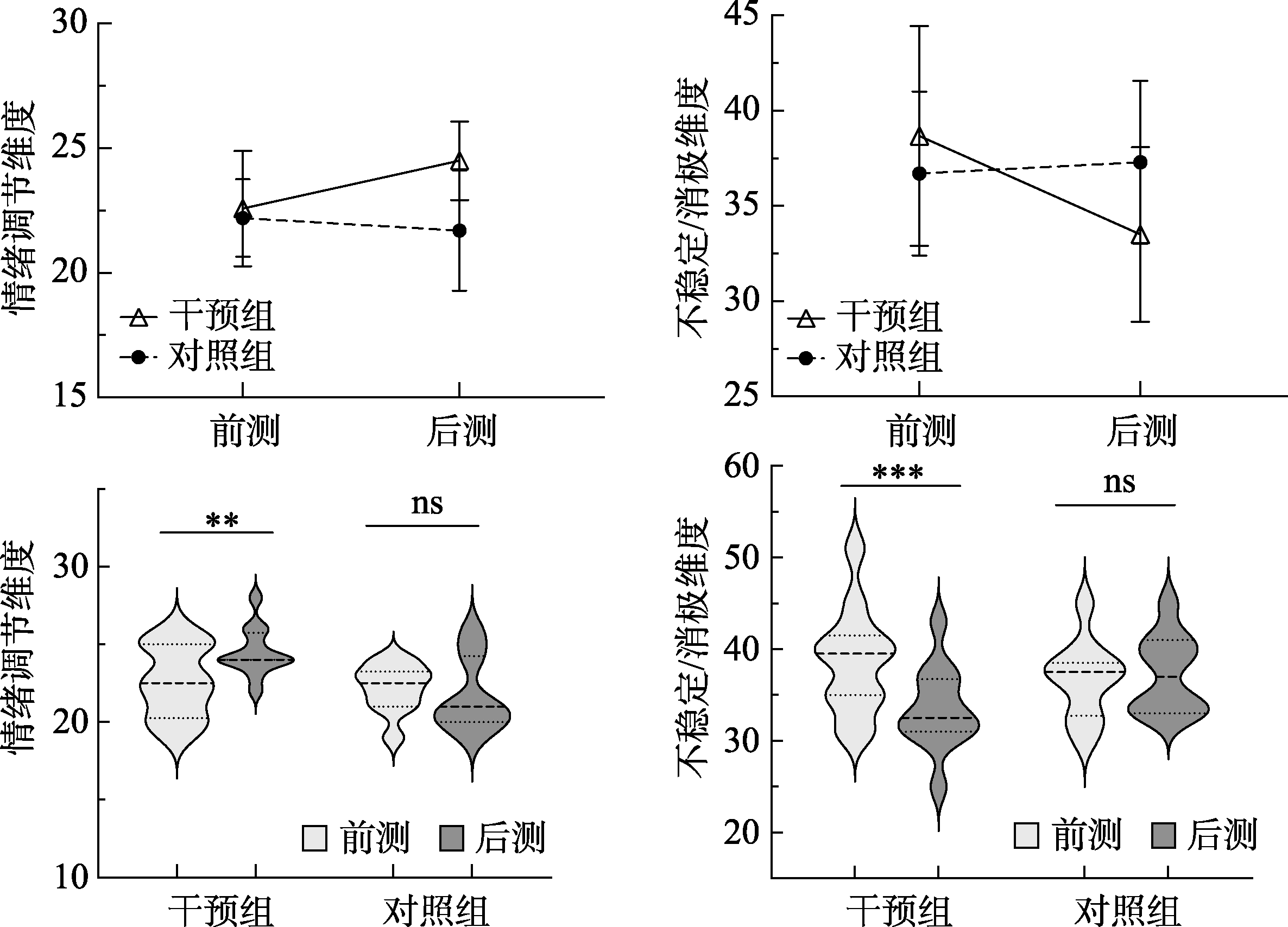
图3 干预组和对照组前后测情绪调节量表得分差异比较 注:ns表示无显著差异, ** p < 0.01, *** p < 0.001
| 情绪调节策略类型 | 情绪调节策略 | ASD组(n = 23) | TD组(n = 22) | t(df) | p | Cohen’s d |
|---|---|---|---|---|---|---|
| 建设性策略 | 目标导向行为 | 9.87 (2.96) | 13.95 (1.21) | −6.00 (43) | < 0.001 | −1.79 |
| 寻求支持 | 1.09 (1.41) | 0.73 (0.94) | 1.00 (43) | 0.322 | 0.30 | |
| 认知重评 | 0.00 (0.00) | 0.09 (0.29) | −1.48 (43) | 0.146 | −0.44 | |
| 自我安慰 | 0.13 (0.46) | 0.05 (0.21) | 0.79 (43) | 0.433 | 0.24 | |
| 寻求安慰 | 0.04 (0.21) | 0.14 (0.47) | −0.87 (43) | 0.391 | −0.26 | |
| 转移注意力 | 0.00 (0.00) | 0.18 (0.66) | −1.31 (43) | 0.196 | −0.39 | |
| 发泄策略 | 声音发泄 | 2.13 (2.58) | 0.05 (0.21) | 3.77 (43) | < 0.001 | 1.13 |
| 物理发泄 | 0.48 (0.73) | 0.00 (0.00) | 3.07 (43) | 0.004 | 0.92 | |
| 自言自语 | 0.09 (0.29) | 0.00 (0.00) | 1.42 (43) | 0.164 | 0.42 | |
| 重复刻板行为 | 0.22 (1.04) | 0.00 (0.00) | 0.98 (43) | 0.334 | 0.29 | |
| 回避策略 | 回避策略 | 0.78 (1.41) | 0.00 (0.00) | 2.60 (43) | 0.013 | 0.77 |
| 分心 | 1.00 (2.00) | 0.05 (0.21) | 2.23 (43) | 0.031 | 0.66 | |
| 替代策略 | 0.57 (1.08) | 0.14 (0.64) | 1.61 (43) | 0.114 | 0.48 |
附表1 ASD儿童和TD儿童在情绪调节策略上(13种)的差异比较
| 情绪调节策略类型 | 情绪调节策略 | ASD组(n = 23) | TD组(n = 22) | t(df) | p | Cohen’s d |
|---|---|---|---|---|---|---|
| 建设性策略 | 目标导向行为 | 9.87 (2.96) | 13.95 (1.21) | −6.00 (43) | < 0.001 | −1.79 |
| 寻求支持 | 1.09 (1.41) | 0.73 (0.94) | 1.00 (43) | 0.322 | 0.30 | |
| 认知重评 | 0.00 (0.00) | 0.09 (0.29) | −1.48 (43) | 0.146 | −0.44 | |
| 自我安慰 | 0.13 (0.46) | 0.05 (0.21) | 0.79 (43) | 0.433 | 0.24 | |
| 寻求安慰 | 0.04 (0.21) | 0.14 (0.47) | −0.87 (43) | 0.391 | −0.26 | |
| 转移注意力 | 0.00 (0.00) | 0.18 (0.66) | −1.31 (43) | 0.196 | −0.39 | |
| 发泄策略 | 声音发泄 | 2.13 (2.58) | 0.05 (0.21) | 3.77 (43) | < 0.001 | 1.13 |
| 物理发泄 | 0.48 (0.73) | 0.00 (0.00) | 3.07 (43) | 0.004 | 0.92 | |
| 自言自语 | 0.09 (0.29) | 0.00 (0.00) | 1.42 (43) | 0.164 | 0.42 | |
| 重复刻板行为 | 0.22 (1.04) | 0.00 (0.00) | 0.98 (43) | 0.334 | 0.29 | |
| 回避策略 | 回避策略 | 0.78 (1.41) | 0.00 (0.00) | 2.60 (43) | 0.013 | 0.77 |
| 分心 | 1.00 (2.00) | 0.05 (0.21) | 2.23 (43) | 0.031 | 0.66 | |
| 替代策略 | 0.57 (1.08) | 0.14 (0.64) | 1.61 (43) | 0.114 | 0.48 |
| 情绪调节策略类型 | 情绪调节策略 | 前测M (SE) | 后测M (SE) | 组间差异(后测−前测) | p | 95% CI |
|---|---|---|---|---|---|---|
| 建设性策略 | 总频次 | 10.25 (0.91) | 12.50 (0.88) | 2.25 (0.69) | 0.004 | [0.82, 3.68] |
| 目标导向行为 | 8.83 (0.82) | 11.50 (0.99) | 2.67 (0.60) | < 0.001 | [1.42, 3.91] | |
| 寻求支持 | 1.17 (0.44) | 1.75 (0.76) | 0.58 (0.92) | 0.532 | [−1.33, 2.49] | |
| 认知重评 | -- | -- | -- | -- | -- | |
| 自我安慰 | 0.25 (0.13) | 0.08 (0.06) | −0.17 (0.15) | 0.291 | [−0.49, 0.15] | |
| 寻求安慰 | 0.00 (0.06) | 0.00 (0.00) | 0.00 (0.06) | 1.000 | [−0.13, 0.13] | |
| 转移注意力 | -- | -- | -- | -- | -- | |
| 发泄策略 | 总频次 | 4.08 (0.98) | 0.83 (0.98) | −3.25 (1.11) | 0.008 | [−5.57, −0.93] |
| 声音发泄 | 3.08 (0.72) | 0.58 (0.58) | −2.50 (0.77) | 0.004 | [−4.10, −0.90] | |
| 物理发泄 | 0.58 (0.22) | 0.25 (0.56) | −0.33 (0.54) | 0.541 | [−1.45, 0.79] | |
| 自言自语 | 0.00 (0.06) | 0.00 (0.00) | 0.00 (0.06) | 1.000 | [−0.13, 0.13] | |
| 重复刻板行为 | 0.42 (0.31) | 0.00 (0.00) | −0.42 (0.31) | 0.190 | [−1.06, 0.23] | |
| 回避策略 | 总频次 | 3.33 (0.87) | 2.00 (0.73) | −1.33 (0.59) | 0.034 | [−2.56, −0.11] |
| 回避策略 | 1.08 (0.40) | 1.58 (0.47) | 0.50 (0.48) | 0.311 | [−0.50, 1.50] | |
| 分心 | 1.33 (0.59) | 0.25 (0.32) | −1.08 (0.56) | 0.068 | [−2.25, 0.09] | |
| 替代策略 | 0.92 (0.31) | 0.17 (0.21) | −0.75 (0.27) | 0.012 | [−1.32, −0.18] |
附表2 干预组前后测情绪调节策略的差异比较 (n= 12)
| 情绪调节策略类型 | 情绪调节策略 | 前测M (SE) | 后测M (SE) | 组间差异(后测−前测) | p | 95% CI |
|---|---|---|---|---|---|---|
| 建设性策略 | 总频次 | 10.25 (0.91) | 12.50 (0.88) | 2.25 (0.69) | 0.004 | [0.82, 3.68] |
| 目标导向行为 | 8.83 (0.82) | 11.50 (0.99) | 2.67 (0.60) | < 0.001 | [1.42, 3.91] | |
| 寻求支持 | 1.17 (0.44) | 1.75 (0.76) | 0.58 (0.92) | 0.532 | [−1.33, 2.49] | |
| 认知重评 | -- | -- | -- | -- | -- | |
| 自我安慰 | 0.25 (0.13) | 0.08 (0.06) | −0.17 (0.15) | 0.291 | [−0.49, 0.15] | |
| 寻求安慰 | 0.00 (0.06) | 0.00 (0.00) | 0.00 (0.06) | 1.000 | [−0.13, 0.13] | |
| 转移注意力 | -- | -- | -- | -- | -- | |
| 发泄策略 | 总频次 | 4.08 (0.98) | 0.83 (0.98) | −3.25 (1.11) | 0.008 | [−5.57, −0.93] |
| 声音发泄 | 3.08 (0.72) | 0.58 (0.58) | −2.50 (0.77) | 0.004 | [−4.10, −0.90] | |
| 物理发泄 | 0.58 (0.22) | 0.25 (0.56) | −0.33 (0.54) | 0.541 | [−1.45, 0.79] | |
| 自言自语 | 0.00 (0.06) | 0.00 (0.00) | 0.00 (0.06) | 1.000 | [−0.13, 0.13] | |
| 重复刻板行为 | 0.42 (0.31) | 0.00 (0.00) | −0.42 (0.31) | 0.190 | [−1.06, 0.23] | |
| 回避策略 | 总频次 | 3.33 (0.87) | 2.00 (0.73) | −1.33 (0.59) | 0.034 | [−2.56, −0.11] |
| 回避策略 | 1.08 (0.40) | 1.58 (0.47) | 0.50 (0.48) | 0.311 | [−0.50, 1.50] | |
| 分心 | 1.33 (0.59) | 0.25 (0.32) | −1.08 (0.56) | 0.068 | [−2.25, 0.09] | |
| 替代策略 | 0.92 (0.31) | 0.17 (0.21) | −0.75 (0.27) | 0.012 | [−1.32, −0.18] |
| 情绪调节策略类型 | 情绪调节策略 | 前测M (SE) | 后测M (SE) | 组间差异(后测−前测) | p | 95% CI |
|---|---|---|---|---|---|---|
| 建设性策略 | 总频次 | 12.10 (1.00) | 11.50 (0.97) | −0.60 (0.75) | 0.433 | [−2.17, 0.97] |
| 目标导向行为 | 10.60 (0.90) | 10.70 (1.08) | 0.10 (0.65) | 0.880 | [−1.26, 1.64] | |
| 寻求支持 | 1.30 (0.48) | 0.80 (0.83) | −0.50 (1.00) | 0.624 | [−2.59, 1.59] | |
| 认知重评 | -- | -- | -- | -- | -- | |
| 自我安慰 | 0.00 (0.15) | 0.00 (0.068) | 0.00 (0.17) | 1.000 | [−0.35, 0.35] | |
| 寻求安慰 | 0.10 (0.07) | 0.00 (0.00) | −0.10 (0.07) | 0.150 | [−0.24, 0.04] | |
| 转移注意力 | -- | -- | -- | -- | -- | |
| 发泄策略 | 总频次 | 1.60 (1.07) | 2.80 (1.07) | 1.20 (1.22) | 0.336 | [−1.34, 3.74] |
| 声音发泄 | 1.10 (0.79) | 1.80 (0.63) | 0.70 (0.84) | 0.414 | [−1.05, 2.45] | |
| 物理发泄 | 0.40 (0.24) | 1.00 (0.62) | 0.60 (0.59) | 0.319 | [−0.63, 1.83] | |
| 自言自语 | 0.10 (0.07) | 0.00 (0.00) | −0.10 (0.07) | 0.150 | [−0.24, 0.04] | |
| 重复刻板行为 | -- | -- | -- | -- | -- | |
| 回避策略 | 总频次 | 1.30 (0.96) | 2.00 (0.79) | 0.70 (0.64) | 0.289 | [−0.64, 2.04] |
| 回避策略 | 0.30 (0.44) | 0.80 (0.62) | 0.50 (0.53) | 0.354 | [−0.60, 1.60] | |
| 分心 | 0.70 (0.65) | 0.80 (0.35) | 0.10 (0.62) | 0.873 | [−1.18, 1.38] | |
| 替代策略 | 0.20 (0.34) | 0.40 (0.22) | 0.20 (0.30) | 0.511 | [−0.42, 0.82] |
附表3 对照组前后测情绪调节策略的差异比较 (n= 10)
| 情绪调节策略类型 | 情绪调节策略 | 前测M (SE) | 后测M (SE) | 组间差异(后测−前测) | p | 95% CI |
|---|---|---|---|---|---|---|
| 建设性策略 | 总频次 | 12.10 (1.00) | 11.50 (0.97) | −0.60 (0.75) | 0.433 | [−2.17, 0.97] |
| 目标导向行为 | 10.60 (0.90) | 10.70 (1.08) | 0.10 (0.65) | 0.880 | [−1.26, 1.64] | |
| 寻求支持 | 1.30 (0.48) | 0.80 (0.83) | −0.50 (1.00) | 0.624 | [−2.59, 1.59] | |
| 认知重评 | -- | -- | -- | -- | -- | |
| 自我安慰 | 0.00 (0.15) | 0.00 (0.068) | 0.00 (0.17) | 1.000 | [−0.35, 0.35] | |
| 寻求安慰 | 0.10 (0.07) | 0.00 (0.00) | −0.10 (0.07) | 0.150 | [−0.24, 0.04] | |
| 转移注意力 | -- | -- | -- | -- | -- | |
| 发泄策略 | 总频次 | 1.60 (1.07) | 2.80 (1.07) | 1.20 (1.22) | 0.336 | [−1.34, 3.74] |
| 声音发泄 | 1.10 (0.79) | 1.80 (0.63) | 0.70 (0.84) | 0.414 | [−1.05, 2.45] | |
| 物理发泄 | 0.40 (0.24) | 1.00 (0.62) | 0.60 (0.59) | 0.319 | [−0.63, 1.83] | |
| 自言自语 | 0.10 (0.07) | 0.00 (0.00) | −0.10 (0.07) | 0.150 | [−0.24, 0.04] | |
| 重复刻板行为 | -- | -- | -- | -- | -- | |
| 回避策略 | 总频次 | 1.30 (0.96) | 2.00 (0.79) | 0.70 (0.64) | 0.289 | [−0.64, 2.04] |
| 回避策略 | 0.30 (0.44) | 0.80 (0.62) | 0.50 (0.53) | 0.354 | [−0.60, 1.60] | |
| 分心 | 0.70 (0.65) | 0.80 (0.35) | 0.10 (0.62) | 0.873 | [−1.18, 1.38] | |
| 替代策略 | 0.20 (0.34) | 0.40 (0.22) | 0.20 (0.30) | 0.511 | [−0.42, 0.82] |
| 因变量(差值分数) | R2 | 标准化β | t | p | 95% CI |
|---|---|---|---|---|---|
| 行为策略 | |||||
| 建设性策略 | 0.40 | −0.41 | −0.11 | 0.910 | [−1.37, 1.23] |
| 发泄策略 | 0.27 | 0.12 | 0.03 | 0.983 | [−2.19, 2.26] |
| 回避策略 | 0.33 | −2.55 | −0.65 | 0.527 | [−1.57, 0.82] |
| 量表得分 | |||||
| 情绪调节 | 0.30 | −2.82 | −0.71 | 0.491 | [−1.56, 0.77] |
| 不稳定/消极 | 0.61 | 5.44 | 1.83 | 0.080 | [−0.21, 3.00] |
附表4 ASD症状得分对干预效果的调节作用(只报告交互项)
| 因变量(差值分数) | R2 | 标准化β | t | p | 95% CI |
|---|---|---|---|---|---|
| 行为策略 | |||||
| 建设性策略 | 0.40 | −0.41 | −0.11 | 0.910 | [−1.37, 1.23] |
| 发泄策略 | 0.27 | 0.12 | 0.03 | 0.983 | [−2.19, 2.26] |
| 回避策略 | 0.33 | −2.55 | −0.65 | 0.527 | [−1.57, 0.82] |
| 量表得分 | |||||
| 情绪调节 | 0.30 | −2.82 | −0.71 | 0.491 | [−1.56, 0.77] |
| 不稳定/消极 | 0.61 | 5.44 | 1.83 | 0.080 | [−0.21, 3.00] |
| [1] |
Aldao, A., Nolen-Hoeksema, S., & Schweizer, S. (2010). Emotion-regulation strategies across psychopathology: A meta-analytic review. Clinical Psychology Review, 30(2), 217-237.
doi: 10.1016/j.cpr.2009.11.004 pmid: 20015584 |
| [2] | American Psychiatric Association. (2013). Diagnostic and statistical manual of mental disorders (5th ed.). Arlington, VA: American Psychiatric Publishing. |
| [3] |
Arora, I., Bellato, A., Ropar, D., Hollis, C., & Groom, M. J. (2021). Is autonomic function during resting-state atypical in Autism: A systematic review of evidence. Neuroscience and Biobehavioral Reviews, 125, 417-441.
doi: 10.1016/j.neubiorev.2021.02.041 pmid: 33662443 |
| [4] | Arora, S., Goodall, S., & Vine, S. (2021). Physiological responses to stress in autism spectrum disorder: A systematic review. Frontiers in Psychiatry, 12, 638715. |
| [5] |
Beck, K. B., Conner, C. M., Breitenfeldt, K. E., Northrup, J. B., White, S. W., & Mazefsky, C. A. (2021). Assessment and treatment of emotion regulation impairment in autism spectrum disorder across the life span current state of the science and future directions. Psychiatric Clinics of North America, 44(1), 95-110.
doi: 10.1016/j.psc.2020.11.008 URL |
| [6] | Beck, K. B., Conner, C. M., & Mazefsky, C. A. (2021). Multimodal assessment of emotion dysregulation in children with autism spectrum disorder. Autism Research, 14(7), 1432-1443. |
| [7] |
Cai, R. Y., Richdale, A. L., Dissanayake, C., & Uljarevic, M. (2019). Resting heart rate variability, emotion regulation, psychological wellbeing and autism symptomatology in adults with and without autism. International Journal of Psychophysiology, 137, 54-62.
doi: S0167-8760(18)30265-4 pmid: 30578793 |
| [8] |
Chiu, H. T., Ip, I. N., Ching, F. N. Y., Wong, B. P. H., Lui, W. H., Tse, C. S., & Wong, S. W. H. (2024). Resting feart rate variability and emotion dysregulation in adolescents with autism spectrum disorder. Journal of Autism and Developmental Disorders, 54(4), 1482-1493.
doi: 10.1007/s10803-022-05847-x |
| [9] |
Chiu, T. A., Anagnostou, E., Brian, J., Chau, T., & Kushki, A. (2016). Specificity of autonomic arousal to anxiety in children with autism spectrum disorder. Autism Research, 9(4), 491-501.
doi: 10.1002/aur.1528 pmid: 26389543 |
| [10] |
Cibralic, S., Kohlhoff, J., Wallace, N., McMahon, C., & Eapen, V. (2019). A systematic review of emotion regulation in children with autism spectrum disorder. Research in Autism Spectrum Disorders, 68, 101422.
doi: 10.1016/j.rasd.2019.101422 URL |
| [11] |
Conner, C. M., White, S. W., Beck, K. B., Golt, J., Smith, I. C., & Mazefsky, C. A. (2019). Improving emotion regulation ability in autism: The Emotional Awareness and Skills Enhancement (EASE) program. Autism, 23(5), 1273-1287.
doi: 10.1177/1362361318810709 pmid: 30400749 |
| [12] |
Conner, C. M., White, S. W., Scahill, L., & Mazefsky, C. A. (2020). The role of emotion regulation and core autism symptoms in the experience of anxiety in autism. Autism, 24(4), 931-940.
doi: 10.1177/1362361320904217 pmid: 32050774 |
| [13] |
Costescu, C., Adrian, R., & Carmen, D. (2024). Executive functions and emotion regulation in children with autism spectrum disorders. European Journal of Special Needs Education, 39(3), 477-486.
doi: 10.1080/08856257.2023.2215010 URL |
| [14] |
Critchley, H. D. (2002). Electrodermal responses: What happens in the brain. Neuroscientist, 8(2), 132-142.
doi: 10.1177/107385840200800209 pmid: 11954558 |
| [15] |
Duncan, A., Meinzen-Derr, J., Ruble, L. A., Fassler, C., & Stark, L. J. (2022). A pilot randomized controlled trial of a daily living skills intervention for adolescents with autism. Journal of Autism and Developmental Disorders, 52(2), 938-949.
doi: 10.1007/s10803-021-04993-y |
| [16] |
Dyson, M. W., Olino, T. M., Durbin, C. E., Goldsmith, H. H., & Klein, D. N. (2012). The structure of temperament in preschoolers: A two-stage factor analytic approach. Emotion, 12(1), 44-57.
doi: 10.1037/a0025023 pmid: 21859196 |
| [17] | Frye, R. E., Vassall, S., Kaur, G., Lewis, C., Karim, M., & Rossignol, D. (2019). Emerging biomarkers in autism spectrum disorder: A systematic review. Annals of Translational Medicine, 7(23), 792. |
| [18] | Goldsmith, H. H., Reilly, J., Lemery, K. S., Longley, S., & Prescott, A. (1999). The laboratory temperament assessment battery: Preschool version, [Technical manual]. Madison, WI: University of Wisconsin. |
| [19] |
Goldsmith, S. F., & Kelley, E. (2018). Associations between emotion regulation and social impairment in children and adolescents with autism spectrum disorder. Journal of Autism and Developmental Disorders, 48(6), 2164-2173.
doi: 10.1007/s10803-018-3483-3 pmid: 29427118 |
| [20] | Grol, M., & De Raedt, R. (2020). The link between resting heart rate variability and affective flexibility. Cognitive, Affective and Behavioral Neuroscience, 20(4), 746-756. |
| [21] |
Gross, J. J. (1998). The emerging field of emotion regulation: An integrative review. Review of General Psychology, 2(3), 271-299.
doi: 10.1037/1089-2680.2.3.271 URL |
| [22] |
Gross, J. J. (2013). Emotion regulation: Taking stock and moving forward. Emotion, 13(3), 359-365.
doi: 10.1037/a0032135 pmid: 23527510 |
| [23] |
Hirschler-Guttenberg, Y., Golan, O., Ostfeld-Etzion, S., & Feldman, R. (2015). Mothering, fathering, and the regulation of negative and positive emotions in high-functioning preschoolers with autism spectrum disorder. Journal of Child Psychology and Psychiatry, 56(5), 530-539.
doi: 10.1111/jcpp.2015.56.issue-5 URL |
| [24] |
Hu, J. S., Li, C. S., Wang, Q., Li, S. Z., Li, T. T., & Liu, S. Q. (2018). The deficiency of attention bias to emotional prosody in the teenagers with autism spectrum disorders: A perceptual mode of low efficiency. Acta Psychologica Sinica, 50(6), 637-646.
doi: 10.3724/SP.J.1041.2018.00637 |
|
[胡金生, 李骋诗, 王琦, 李松泽, 李涛涛, 刘淑清. (2018). 孤独症青少年的情绪韵律注意偏向缺陷: 低效率的知觉模式. 心理学报, 50(6), 637-646.]
doi: 10.3724/SP.J.1041.2018.00637 |
|
| [25] | Hyman, S. L., Levy, S. E., Myers, S. M., Kuo, D., Apkon, S., Davidson, L. F.,... Bridgemohan, C. (2020). Executive summary: Identification, evaluation, and management of children with autism spectrum disorder. Pediatrics, 145(1), e20193448. |
| [26] |
Jahromi, L. B., Meek, S. E., & Ober‐Reynolds, S. (2012). Emotion regulation in the context of frustration in children with high functioning autism and their typical peers. Journal of Child Psychology and Psychiatry, 53(12), 1250-1258.
doi: 10.1111/jcpp.2012.53.issue-12 URL |
| [27] |
Kabat-Zinn, J. (2003). Mindfulness-based interventions in context: Past, present, and future. Clinical Psychology-Science and Practice, 10(2), 144-156.
doi: 10.1093/clipsy.bpg016 URL |
| [28] |
Kreibig, S. D. (2010). Autonomic nervous system activity in emotion: A review. Biological Psychology, 84(3), 394-421.
doi: 10.1016/j.biopsycho.2010.03.010 pmid: 20371374 |
| [29] | Kushki, A., Drumm, E., Pla Mobarak, M., Tanel, N., Dupuis, A., Chau, T., & Anagnostou, E. (2013). Investigating the autonomic nervous system response to anxiety in children with autism spectrum disorders. PloS One, 8(4), e59730. |
| [30] |
Lavender, J. M., Tull, M. T., DiLillo, D., Messman-Moore, T., & Gratz, K. L. (2017). Development and validation of a state-based measure of emotion dysregulation: The State Difficulties in Emotion Regulation Scale (S-DERS). Assessment, 24(2), 197-209.
doi: 10.1177/1073191115601218 pmid: 26297011 |
| [31] |
Li, Q., Song, Y. N., Lian, B., & Feng, T. Y. (2019). Mindfulness training can improve 3-and 4-year-old children’s attention and executive function. Acta Psychologica Sinica, 51(3), 324-336.
doi: 10.3724/SP.J.1041.2019.00324 |
|
[李泉, 宋亚男, 廉彬, 冯廷勇. (2019). 正念训练提升3-4岁幼儿注意力和执行功能. 心理学报, 51(3), 324-336.]
doi: 10.3724/SP.J.1041.2019.00324 |
|
| [32] |
Lindsay, E. K., & Creswell, J. D. (2017). Mechanisms of mindfulness training: Monitor and Acceptance Theory (MAT). Clinical Psychology Review, 51, 48-59.
doi: S0272-7358(16)30200-8 pmid: 27835764 |
| [33] |
Lindsay, E. K., & Creswell, J. D. (2019). Mindfulness, acceptance, and emotion regulation: Perspectives from Monitor and Acceptance Theory (MAT). Current Opinion in Psychology, 28, 120-125.
doi: S2352-250X(18)30223-9 pmid: 30639835 |
| [34] |
Loftus, T., Mathersul, D. C. C., Ooi, M., & Yau, S. H. H. (2023). The efficacy of mindfulness-based therapy for anxiety, social skills, and aggressive behaviors in children and young people with Autism Spectrum Disorder: A systematic review. Frontiers in Psychiatry, 14, 1079471.
doi: 10.3389/fpsyt.2023.1079471 URL |
| [35] |
Mazefsky, C. A., Herrington, J., Siegel, M., Scarpa, A., Maddox, B. B., Scahill, L., & White, S. W. (2013). The role of emotion regulation in Autism Spectrum Disorder. Journal of the American Academy of Child and Adolescent Psychiatry, 52(7), 679-688.
doi: 10.1016/j.jaac.2013.05.006 pmid: 23800481 |
| [36] |
Mazefsky, C. A., Yu, L., White, S. W., Siegel, M., & Pilkonis, P. A. (2018). The emotion dysregulation inventory: Psychometric properties and item response theory calibration in an autism spectrum disorder sample. Autism Research, 11(6), 928-941.
doi: 10.1002/aur.1947 pmid: 29624893 |
| [37] |
Northrup, J. B., Goodwin, M., Montrenes, J., Vezzoli, J., Golt, J., Peura, C. B.,... Mazefsky, C. (2020). Observed emotional reactivity in response to frustration tasks in psychiatrically hospitalized youth with autism spectrum disorder. Autism, 24(4), 968-982.
doi: 10.1177/1362361320908108 pmid: 32169018 |
| [38] |
Northrup, J. B., Patterson, M. T., & Mazefsky, C. A. (2021). Predictors of severity and change in emotion dysregulation among children and adolescents with ASD. Journal of Clinical Child and Adolescent Psychology, 50(6), 708-729.
doi: 10.1080/15374416.2021.1955369 URL |
| [39] |
Nuske, H. J., Hedley, D., Woollacott, A., Thomson, P., Macari, S., & Dissanayake, C. (2017). Developmental delays in emotion regulation strategies in preschoolers with autism. Autism Research, 10(11), 1808-1822.
doi: 10.1002/aur.1827 pmid: 28695672 |
| [40] |
Nuske, H., Young, A., Khan, F., Palermo, E., Ajanaku, B., Pellecchia, M., Vivanti, G.,... Mandell, D. (2024). Systematic review: Emotion dysregulation and challenging behavior interventions for children and adolescents on the autism spectrum with graded key evidence-based strategy recommendations. European Child and Adolescent Psychiatry, 33(6), 1963-1976.
doi: 10.1007/s00787-023-02298-2 |
| [41] |
Poquerusse, J., Pagnini, F., & Langer, E. J. (2021). Mindfulness for autism. Advances in Neurodevelopmental Disorders, 5(1), 77-84.
doi: 10.1007/s41252-020-00180-9 |
| [42] | Pruessner, L., Timm, C., Kalmar, J., Bents, H., Barnow, S., & Mander, J. (2024). Emotion regulation as a mechanism of mindfulness in individual cognitive-behavioral therapy for depression and anxiety disorders. Depression and Anxiety, 2024, 9081139. |
| [43] |
Raugh, I. M., & Strauss, G. P. (2024). Integrating mindfulness into the extended process model of emotion regulation: The Dual-Mode Model of mindful emotion regulation. Emotion, 24(3), 847-866.
doi: 10.1037/emo0001308 URL |
| [44] |
Restoy, D., Oriol-Escude, M., Alonzo-Castillo, T., Magán- Maganto, M., Canal-Bedia, R., Díez-Villoria, E.,... Lugo-Marín, J. (2024). Emotion regulation and emotion dysregulation in children and adolescents with autism spectrum disorder: A meta-analysis of evaluation and intervention studies. Clinical Psychology Review, 109, 102410.
doi: 10.1016/j.cpr.2024.102410 URL |
| [45] |
Ridderinkhof, A., de Bruin, E. I., van den Driesschen, S., & Bögels, S. M. (2020). Attention in children with autism spectrum disorder and the effects of a mindfulness-based program. Journal of Attention Disorders, 24(5), 681-692.
doi: 10.1177/1087054718797428 pmid: 30222027 |
| [46] |
Samson, A. C., Hardan, A. Y., Lee, I. A., Phillips, J. M., & Gross, J. J. (2015). Maladaptive behavior in autism spectrum disorder: The role of emotion experience and emotion regulation. Journal of Autism and Developmental Disorder, 45(11), 3424-3432.
doi: 10.1007/s10803-015-2388-7 URL |
| [47] |
Sharma, S. R., Gonda, X., & Tarazi, F. I. (2018). Autism spectrum disorder: Classification, diagnosis and therapy. Pharmacology and Therapeutics, 190, 91-104.
doi: 10.1016/j.pharmthera.2018.05.007 URL |
| [48] |
Shields, A., & Cicchetti, D. (1997). Emotion regulation among school-age children: The development and validation of a new criterion Q-sort scale. Developmental Psychology, 33(6), 906-916.
doi: 10.1037//0012-1649.33.6.906 pmid: 9383613 |
| [49] |
Sung, Y. S., Lin, C. Y., Chu, S. Y., & Lin, L. Y. (2024). Emotion dysregulation mediates the relationship between sensory processing and behavior problems in young children with autism spectrum disorder: A preliminary study. Journal of Autism and Developmental Disorder, 54(2), 738-748.
doi: 10.1007/s10803-022-05839-x |
| [50] |
Thayer, J. F., Hansen, A. L., Saus-Rose, E., & Johnsen, B. H. (2009). Heart rate variability, prefrontal neural function, and cognitive performance: The neurovisceral integration perspective on self-regulation, adaptation, and health. Annals of Behavioral Medicine, 37(2), 141-153.
doi: 10.1007/s12160-009-9101-z pmid: 19424767 |
| [51] |
Thayer, J. F., & Lane, R. D. (2000). A model of neurovisceral integration in emotion regulation and dysregulation. Journal of Affective Disorders, 61(3), 201-216.
doi: 10.1016/s0165-0327(00)00338-4 pmid: 11163422 |
| [52] |
Thompson, R. A. (2019). Emotion dysregulation: A theme in search of definition. Development and Psychopathology, 31(3), 805-815.
doi: 10.1017/S0954579419000282 pmid: 31030684 |
| [53] |
van der Velden, A. M., Kuyken, W., Wattar, U., Crane, C., Pallesen, K. J., Dahlgaard, J., Fjorback, L. O., & Piet, J. (2015). A systematic review of mechanisms of change in mindfulness-based cognitive therapy in the treatment of recurrent major depressive disorder. Clinical Psychology Review, 37, 26-39.
doi: 10.1016/j.cpr.2015.02.001 pmid: 25748559 |
| [54] |
Vernetti, A., Shic, F., Boccanfuso, L., Macari, S., Kane-Grade, F., Milgramm, A.,... Chawarska, K. (2020). Atypical emotional electrodermal activity in toddlers with autism spectrum disorder. Autism research, 13(9), 1476-1488.
doi: 10.1002/aur.v13.9 URL |
| [55] | Wang, X., Zhao, J., Huang, S., Chen, S., Zhou, T., Li, Q., Luo, X., & Hao, Y. (2021). Cognitive behavioral therapy for autism spectrum disorders: A systematic review. Pediatrics, 147(5), e2020049880. |
| [56] |
Weiss, J. A., Thomson, K., & Chan, L. (2014). A systematic literature review of emotion regulation measurement in individuals with Autism Spectrum Disorder. Autism Research, 7(6), 629-648.
doi: 10.1002/aur.1426 pmid: 25346416 |
| [57] |
Weston, L., Hodgekins, J., & Langdon, P. E. (2016). Effectiveness of cognitive behavioural therapy with people who have autistic spectrum disorders: A systematic review and meta-analysis. Clinical Psychology Review, 49, 41-54.
doi: S0272-7358(16)30071-X pmid: 27592496 |
| [58] |
Wood, J. J., Kendall, P. C., Wood, K. S., Kerns, C. M., Seltzer, M., Small, B. J.,... Storch, E. A. (2020). Cognitive behavioral treatments for anxiety in children with autism spectrum disorder: A randomized clinical trial. JAMA Psychiatry, 77(5), 474-483.
doi: 10.1001/jamapsychiatry.2019.4160 pmid: 31755906 |
| [59] |
Yuan, J., Ding, N., Yang, J., & Liu, Y. (2015). Emotion regulation effects of unconscious acceptance during a frustrating situation: Behavioral and physiological correlates. Scientia Sinica Vitae, 45(1), 84-95.
doi: 10.1360/N052014-00123 URL |
| [袁加锦, 丁南翔, 刘莹莹, 杨洁敏. (2015). 无意识接受策略在挫折情景下的情绪调节效应: 行为与生理证据. 中国科学:生命科学, 45(1), 84-95.] | |
| [60] |
Zantinge, G., van Rijn, S., Stockmann, L., & Swaab, H. (2017). Physiological arousal and emotion regulation strategies in young children with Autism Spectrum Disorders. Journal of Autism and Developmental Disorder, 47(9), 2648-2657.
doi: 10.1007/s10803-017-3181-6 URL |
| [61] |
Zeidan, J., Fombonne, E., Scorah, J., Ibrahim, A., Durkin, M. S., Saxena, S.,... Elsabbagh, M. (2022). Global prevalence of autism: A systematic review update. Autism Research, 15(5), 778-790.
doi: 10.1002/aur.2696 pmid: 35238171 |
| [62] |
Zhou, H., Xu, X., Yan, W., Zou, X., Wu, L., Luo, X.,... Wang, Y. (2020). Prevalence of autism spectrum disorder in China: A nationwide multi-center population-based study among children aged 6 to 12 years. Neuroscience Bulletin, 36(9), 961-971.
doi: 10.1007/s12264-020-00530-6 pmid: 32607739 |
| [63] | Zhu, J. J., Yan, C. Y., Yang, T. T., Zhu, L., Wu, M., Wang, Y. J., & Li, Y. (2020). Reliability and validity of the emotion regulation checklist to Chinese preschoolers. Chinese Journal of Clinical Psychology, 28(6), 1186-1189. |
| [朱晶晶, 颜晨雨, 杨婷婷, 朱莉, 武敏, 王英杰, 李燕. (2020). 情绪调节检核表在中国学前儿童中的信效度检验. 中国临床心理学杂志, 28(6), 1186-1189.] |
| [1] | 宋艺, 付晓彤, 袁加锦, 孙萌, 杨洁敏. 基于执行意图的自我同情语料库编制及其情绪调节功效检验[J]. 心理学报, 2026, 58(3): 480-499. |
| [2] | 李亚琴, 代佳佳, 高伟, 袁加锦. 基于执行意图的认知重评对负性情绪的持续调节效应:纵向脑电证据[J]. 心理学报, 2025, 57(9): 1572-1588. |
| [3] | 何从莲, 袁加锦. 情绪动机对人际情绪调节策略选择的影响:来自行为与超扫描的实验证据[J]. 心理学报, 2025, 57(9): 1589-1608. |
| [4] | 姚雨佳, 颜之悦, 林慧慧, 陈静全, 宣雨阳. 人际距离和策略创造性对人际情绪调节的影响[J]. 心理学报, 2025, 57(1): 125-134. |
| [5] | 王彪, 王珍珍, 刘兴华. 融合中国诗词的线上自助正念干预的可行性及对参与者依从性的影响[J]. 心理学报, 2024, 56(8): 1110-1124. |
| [6] | 童廷婷, 白幼玲, 冯廷勇. 情绪调节改善拖延行为的认知机制:任务厌恶中介作用[J]. 心理学报, 2024, 56(4): 458-468. |
| [7] | 王妹, 程思, 李宜伟, 李红, 张丹丹. 背外侧前额叶在安慰剂效应中的作用:社会情绪调节研究[J]. 心理学报, 2023, 55(7): 1063-1073. |
| [8] | 谢慧, 林轩怡, 胡婉柔, 胡晓晴. 情绪调节促进负性社会反馈的遗忘:来自行为和脑电的证据[J]. 心理学报, 2023, 55(6): 905-919. |
| [9] | 王小琴, 谈雅菲, 蒙杰, 刘源, 位东涛, 杨文静, 邱江. 情绪调节灵活性对负性情绪的影响:来自经验取样的证据[J]. 心理学报, 2023, 55(2): 192-209. |
| [10] | 高可翔, 张岳瑶, 李思瑾, 袁加锦, 李红, 张丹丹. 腹内侧前额叶在内隐认知重评中的因果作用[J]. 心理学报, 2023, 55(2): 210-223. |
| [11] | 刘宇平, 周冰涛, 杨波. 情绪如何引发暴力犯的攻击?基于情绪调节理论的解释[J]. 心理学报, 2022, 54(3): 270-280. |
| [12] | 程瑞, 卢克龙, 郝宁. 愤怒情绪对恶意创造力的影响及调节策略[J]. 心理学报, 2021, 53(8): 847-860. |
| [13] | 袁加锦, 张祎程, 陈圣栋, 罗利, 茹怡珊. 中国情绪调节词语库的初步编制与试用[J]. 心理学报, 2021, 53(5): 445-455. |
| [14] | 莫李澄, 郭田友, 张岳瑶, 徐锋, 张丹丹. 激活右腹外侧前额叶提高抑郁症患者对社会疼痛的情绪调节能力:一项TMS研究[J]. 心理学报, 2021, 53(5): 494-504. |
| [15] | 华艳, 李明霞, 王巧婷, 冯彩霞, 张晶. 左侧眶额皮层在自动情绪调节下注意选择中的作用:来自经颅直流电刺激的证据[J]. 心理学报, 2020, 52(9): 1048-1056. |
| 阅读次数 | ||||||
|
全文 |
|
|||||
|
摘要 |
|
|||||
