

ISSN 0439-755X
CN 11-1911/B
主办:中国心理学会
中国科学院心理研究所
出版:科学出版社
CN 11-1911/B
主办:中国心理学会
中国科学院心理研究所
出版:科学出版社
心理学报 ›› 2026, Vol. 58 ›› Issue (1): 57-73.doi: 10.3724/SP.J.1041.2026.0057 cstr: 32110.14.2026.0057
徐梓豪, 朱冬青( ), 闫小敏
收稿日期:2024-07-30
发布日期:2025-10-28
出版日期:2026-01-25
通讯作者:
朱冬青, E-mail: zdq@cnu.edu.cn基金资助:
XU Zihao, ZHU Dongqing(), YAN Xiaomin
Received:2024-07-30
Online:2025-10-28
Published:2026-01-25
摘要:
患者普遍存在的警惕心理容易诱发其负性行为, 对医患关系构成潜在威胁。本研究基于医患互动视角, 探讨最优化决策对患者警惕心理的影响及其机制。三项研究发现:1)最优化决策显著增强患者对医生医德和医术的警惕; 2)道德推脱在二者之间起中介作用, 即最优化决策通过激发患者的道德推脱而强化其对医生的警惕; 3)医生的友善行为起调节作用, 不仅未能缓解最优化患者的警惕, 反而通过强化道德推脱进一步加剧其警惕程度。本研究通过引入道德推脱理论, 构建最优化决策与患者对医生警惕之间的心理机制, 不仅拓展了警惕和最优化决策人际沟通的研究, 同时为预防和缓解医患矛盾提供新思路。
中图分类号:
徐梓豪, 朱冬青, 闫小敏. (2026). 为何最优化患者对医生更警惕?道德推脱的中介作用. 心理学报, 58(1), 57-73.
XU Zihao, ZHU Dongqing, YAN Xiaomin. (2026). Why are maximizing patients more vigilant toward doctors? The mediation role of moral disengagement. Acta Psychologica Sinica, 58(1), 57-73.

图1 理论框架
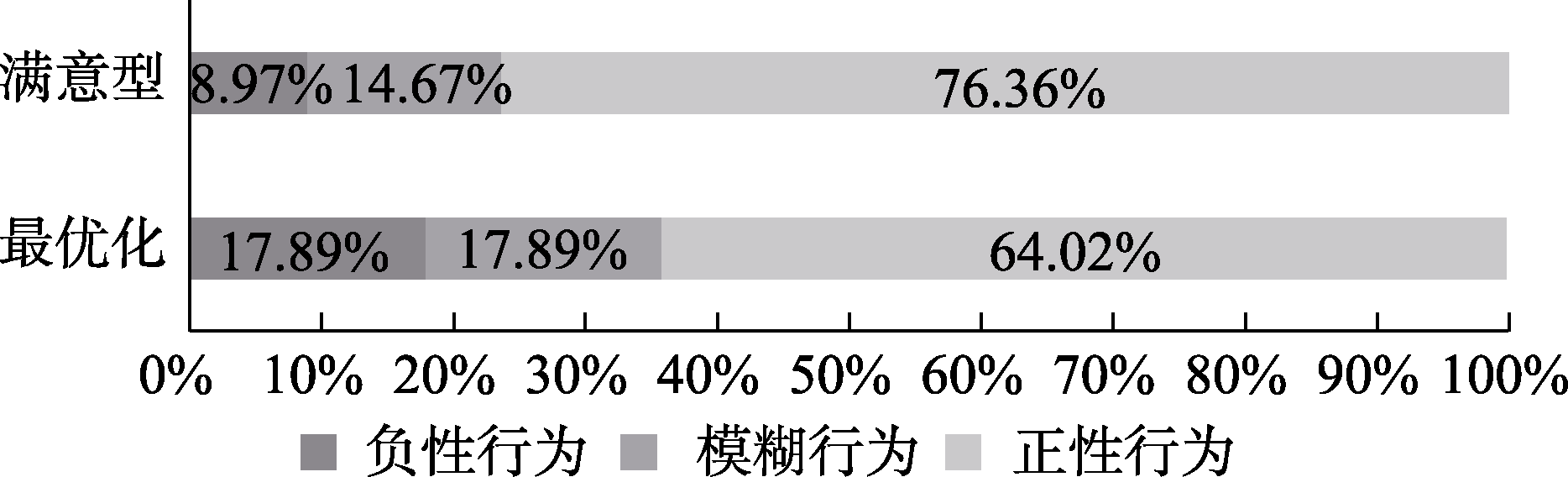
图2 最优化决策对患者对医生警惕的影响(研究1)

图3 道德推脱的中介效应(研究1) (*** p < 0.001)
| 变量 | M | SD | 1 | 2 | 3 | 4 | 5 | 6 | 7 | 8 | 9 | 10 |
|---|---|---|---|---|---|---|---|---|---|---|---|---|
| 1.性别a | (—) | (—) | (—) | |||||||||
| 2.年龄 | 33.69 | 9.26 | 0.01 | (—) | ||||||||
| 3.先验态度 | 5.02 | 1.23 | −0.06** | −0.10** | (0.83) | |||||||
| 4.感知竞争 | 2.77 | 1.32 | 0.09** | −0.15** | 0.05** | (0.80) | ||||||
| 5.问诊质量 | 5.06 | 1.37 | −0.10** | −0.06** | −0.04** | −0.12** | (—) | |||||
| 6.疾病严重程度 | 3.95 | 1.36 | −0.05 | −0.04** | −0.06** | 0.06** | −0.02 | (—) | ||||
| 7.最优化决策 | 4.68 | 1.02 | −0.09** | −0.02 | 0.01 | 0.07** | 0.07** | 0.03* | (0.82) | |||
| 8.友善行为b | 0.74 | 0.43 | −0.06** | −0.10** | −0.10** | 0.05** | 0.14** | 0.01 | 0.30** | (—) | ||
| 9.道德推脱 | 3.73 | 1.07 | −0.06** | −0.06** | −0.01 | 0.08** | 0.02 | 0.04** | 0.68** | 0.39** | (0.86) | |
| 10.对医生的警惕c | 0.19 | 0.39 | −0.02 | −0.01 | 0.00 | 0.00 | 0.03* | −0.01 | 0.40** | 0.07** | 0.44** | (—) |
表1 均值、标准差、相关系数和信度估计(研究2)
| 变量 | M | SD | 1 | 2 | 3 | 4 | 5 | 6 | 7 | 8 | 9 | 10 |
|---|---|---|---|---|---|---|---|---|---|---|---|---|
| 1.性别a | (—) | (—) | (—) | |||||||||
| 2.年龄 | 33.69 | 9.26 | 0.01 | (—) | ||||||||
| 3.先验态度 | 5.02 | 1.23 | −0.06** | −0.10** | (0.83) | |||||||
| 4.感知竞争 | 2.77 | 1.32 | 0.09** | −0.15** | 0.05** | (0.80) | ||||||
| 5.问诊质量 | 5.06 | 1.37 | −0.10** | −0.06** | −0.04** | −0.12** | (—) | |||||
| 6.疾病严重程度 | 3.95 | 1.36 | −0.05 | −0.04** | −0.06** | 0.06** | −0.02 | (—) | ||||
| 7.最优化决策 | 4.68 | 1.02 | −0.09** | −0.02 | 0.01 | 0.07** | 0.07** | 0.03* | (0.82) | |||
| 8.友善行为b | 0.74 | 0.43 | −0.06** | −0.10** | −0.10** | 0.05** | 0.14** | 0.01 | 0.30** | (—) | ||
| 9.道德推脱 | 3.73 | 1.07 | −0.06** | −0.06** | −0.01 | 0.08** | 0.02 | 0.04** | 0.68** | 0.39** | (0.86) | |
| 10.对医生的警惕c | 0.19 | 0.39 | −0.02 | −0.01 | 0.00 | 0.00 | 0.03* | −0.01 | 0.40** | 0.07** | 0.44** | (—) |
| 变量 | 道德推脱 | 患者对医生的警惕 | ||||||||||||||
|---|---|---|---|---|---|---|---|---|---|---|---|---|---|---|---|---|
| 模型1 | 模型2 | 模型3 | 模型4 | 模型5 | 模型6 | 模型7 | 模型8 | |||||||||
| B | SE | B | SE | B | SE | B | SE | B | SE | B | SE | B | SE | B | SE | |
| 1.性别 | −0.13** | 0.03 | 0.01 | 0.02 | 0.02 | 0.02 | 0.03 | 0.02 | −0.10 | 0.06 | −0.04 | 0.07 | −0.05 | 0.07 | −0.04 | 0.07 |
| 2.年龄 | −0.01** | 0.00 | −0.01** | 0.00 | −0.00* | 0.00 | −0.00 | 0.00 | −0.00 | 0.00 | 0.00 | 0.00 | 0.00 | 0.00 | 0.00 | 0.00 |
| 3.先验态度 | −0.02 | 0.01 | −0.02** | 0.01 | −0.00 | 0.01 | 0.00 | 0.01 | 0.00 | 0.03 | 0.01 | 0.03 | 0.01 | 0.03 | 0.01 | 0.03 |
| 4.感知竞争 | 0.06** | 0.01 | 0.02* | 0.01 | 0.01 | 0.01 | 0.01 | 0.01 | 0.01 | 0.03 | −0.02 | 0.03 | −0.02 | 0.03 | −0.03 | 0.03 |
| 5.问诊质量 | 0.02* | 0.01 | −0.02** | 0.01 | −0.04** | 0.01 | −0.04** | 0.01 | 0.05 | 0.02 | 0.02 | 0.02 | 0.04 | 0.02 | 0.03 | 0.02 |
| 6.疾病严重程度 | 0.02* | 0.01 | 0.01 | 0.01 | 0.01 | 0.01 | −0.00 | 0.01 | −0.01 | 0.02 | −0.03 | 0.02 | −0.03 | 0.02 | −0.04 | 0.05 |
| 7.最优化决策 | 0.73** | 0.01 | 0.67** | 0.01 | 0.53** | 0.02 | 0.45** | 0.04 | 0.23** | 0.04 | ||||||
| 8.友善行为 | 0.50** | 0.02 | −0.42** | 0.10 | ||||||||||||
| 9.最优化×友善行为 | 0.21** | 0.02 | ||||||||||||||
| 10.道德推脱 | 0.44** | 0.03 | 0.30** | 0.04 | ||||||||||||
| R2/ Nagelkerke R2 | 0.014 | 0.479 | 0.515 | 0.523 | 0.002 | 0.042 | 0.080 | 0.054 | ||||||||
| ΔR2 | 0.465** | 0.035** | 0.008** | |||||||||||||
表2 道德推脱和患者对医生警惕的回归分析结果
| 变量 | 道德推脱 | 患者对医生的警惕 | ||||||||||||||
|---|---|---|---|---|---|---|---|---|---|---|---|---|---|---|---|---|
| 模型1 | 模型2 | 模型3 | 模型4 | 模型5 | 模型6 | 模型7 | 模型8 | |||||||||
| B | SE | B | SE | B | SE | B | SE | B | SE | B | SE | B | SE | B | SE | |
| 1.性别 | −0.13** | 0.03 | 0.01 | 0.02 | 0.02 | 0.02 | 0.03 | 0.02 | −0.10 | 0.06 | −0.04 | 0.07 | −0.05 | 0.07 | −0.04 | 0.07 |
| 2.年龄 | −0.01** | 0.00 | −0.01** | 0.00 | −0.00* | 0.00 | −0.00 | 0.00 | −0.00 | 0.00 | 0.00 | 0.00 | 0.00 | 0.00 | 0.00 | 0.00 |
| 3.先验态度 | −0.02 | 0.01 | −0.02** | 0.01 | −0.00 | 0.01 | 0.00 | 0.01 | 0.00 | 0.03 | 0.01 | 0.03 | 0.01 | 0.03 | 0.01 | 0.03 |
| 4.感知竞争 | 0.06** | 0.01 | 0.02* | 0.01 | 0.01 | 0.01 | 0.01 | 0.01 | 0.01 | 0.03 | −0.02 | 0.03 | −0.02 | 0.03 | −0.03 | 0.03 |
| 5.问诊质量 | 0.02* | 0.01 | −0.02** | 0.01 | −0.04** | 0.01 | −0.04** | 0.01 | 0.05 | 0.02 | 0.02 | 0.02 | 0.04 | 0.02 | 0.03 | 0.02 |
| 6.疾病严重程度 | 0.02* | 0.01 | 0.01 | 0.01 | 0.01 | 0.01 | −0.00 | 0.01 | −0.01 | 0.02 | −0.03 | 0.02 | −0.03 | 0.02 | −0.04 | 0.05 |
| 7.最优化决策 | 0.73** | 0.01 | 0.67** | 0.01 | 0.53** | 0.02 | 0.45** | 0.04 | 0.23** | 0.04 | ||||||
| 8.友善行为 | 0.50** | 0.02 | −0.42** | 0.10 | ||||||||||||
| 9.最优化×友善行为 | 0.21** | 0.02 | ||||||||||||||
| 10.道德推脱 | 0.44** | 0.03 | 0.30** | 0.04 | ||||||||||||
| R2/ Nagelkerke R2 | 0.014 | 0.479 | 0.515 | 0.523 | 0.002 | 0.042 | 0.080 | 0.054 | ||||||||
| ΔR2 | 0.465** | 0.035** | 0.008** | |||||||||||||
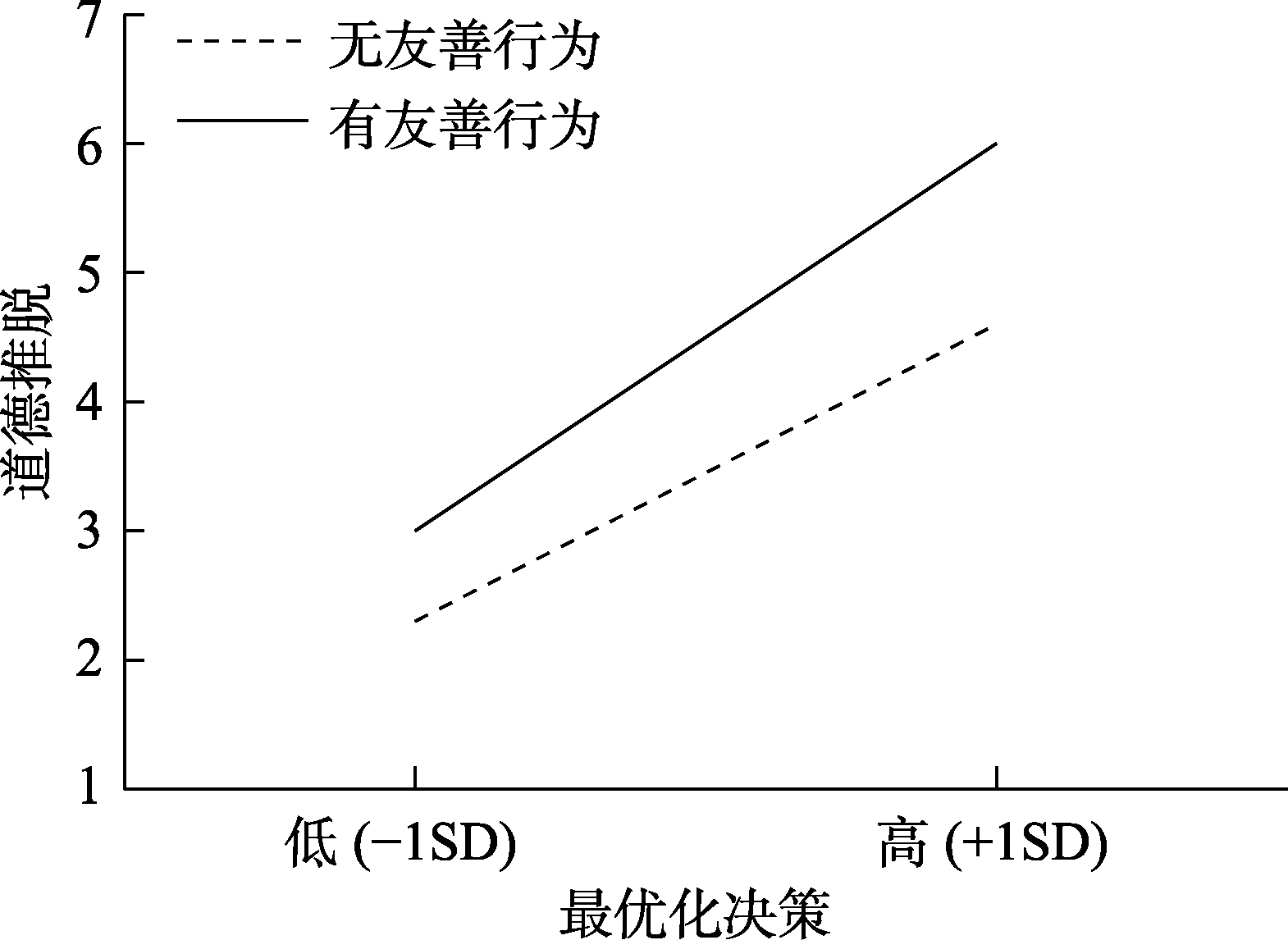
图4 最优化决策和医生友善行为对道德推脱的交互效应(研究2)
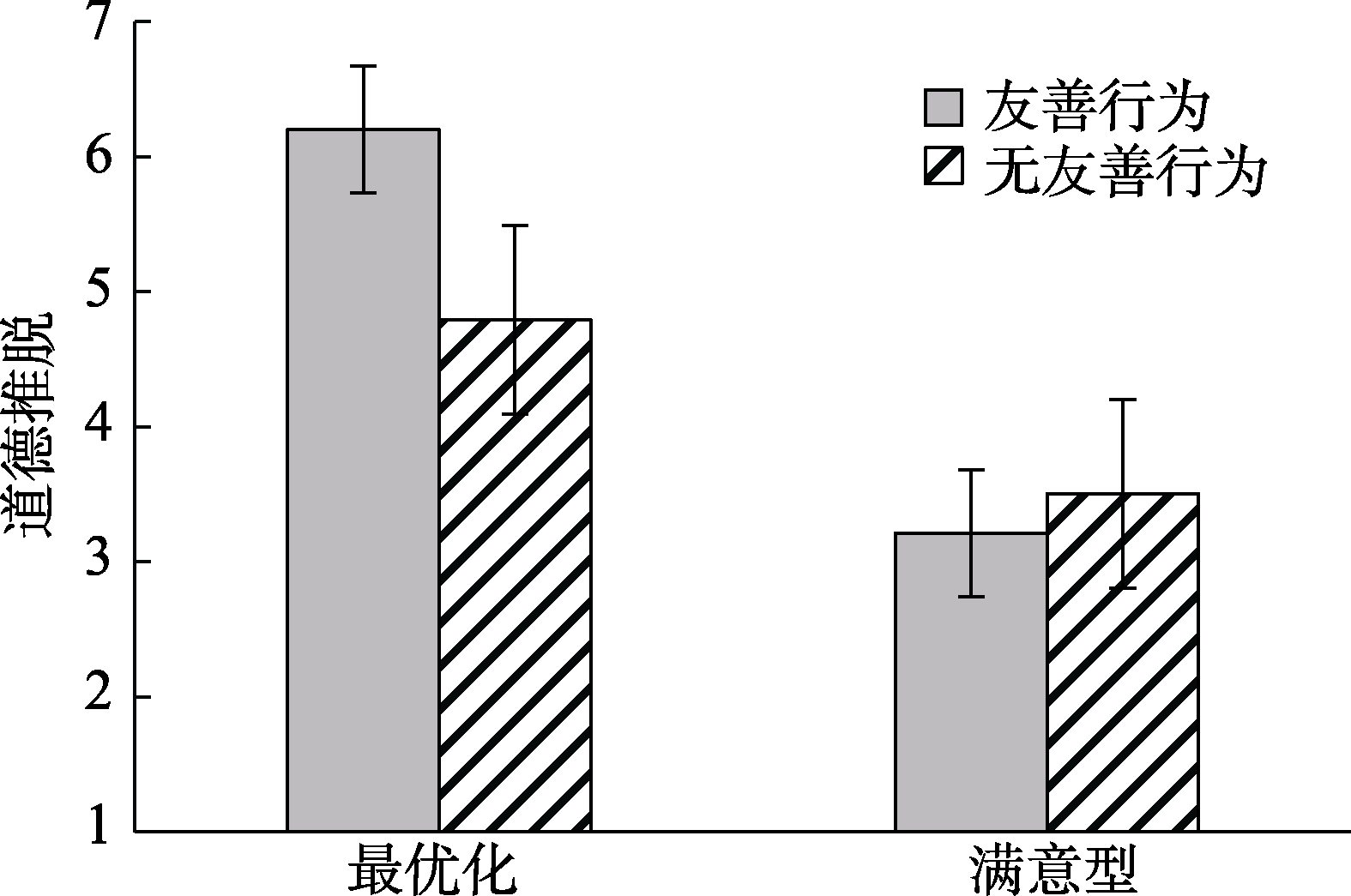
图5 最优化决策和医生友善行为对道德推脱的交互效应(研究3)
| [1] |
Adam, M. T., Krämer, J., & Müller, M. B. (2015). Auction fever! How time pressure and social competition affect bidders’ arousal and bids in retail auctions. Journal of Retailing, 91(3), 468-485.
doi: 10.1016/j.jretai.2015.01.003 URL |
| [2] | Aftab, S. R., & Malik, J. A. (2021). Mediating role of moral disengagement between emotional manipulation and psychological well-being: Does age matter? Behavioral Sciences, 11(9), 117. |
| [3] |
Anderson, L. A., & Dedrick, R. F. (1990). Development of the trust in physician scale: A measure to assess interpersonal trust in patient-physician relationships. Psychological Reports, 67(3 Pt 2), 1091-1100.
doi: 10.2466/pr0.1990.67.3f.1091 pmid: 2084735 |
| [4] | Bandura, A. (1986). Social foundations of thought and action. Englewood Cliffs, NJ: Prentice-Hall. |
| [5] |
Bandura, A. (1991). Social cognitive theory of self-regulation. Organizational Behavior and Human Decision Processes, 50(2), 248-287.
doi: 10.1016/0749-5978(91)90022-L URL |
| [6] |
Bandura, A. (1999). Moral disengagement in the perpetration of inhumanities. Personality and Social Psychology Review, 3(3), 193-209.
doi: 10.1207/s15327957pspr0303_3 pmid: 15661671 |
| [7] |
Bandura, A. (2002a). Selective moral disengagement in the exercise of moral agency. Journal of Moral Education, 31(2), 101-119.
doi: 10.1080/0305724022014322 URL |
| [8] |
Bandura, A. (2002b). Social cognitive theory in cultural context. Applied Psychology, 51(2), 269-290.
doi: 10.1111/apps.2002.51.issue-2 URL |
| [9] |
Barsade, S. G. (2002). The ripple effect: Emotional contagion and its influence on group behavior. Administrative Science Quarterly, 47(4), 644-675.
doi: 10.2307/3094912 URL |
| [10] | Blau, P. (1964). Exchange and power in social life. New York: John Wiley. |
| [11] |
Bonaccio, S., O’Reilly, J., O’Sullivan, S. L., & Chiocchio, F. (2016). Nonverbal behavior and communication in the workplace: A review and an agenda for research. Journal of Management, 42(5), 1044-1074.
doi: 10.1177/0149206315621146 URL |
| [12] |
Brannon, D. C. (2021). The influence of maximizing on personal saving intentions. Personality and Individual Differences, 183, 111120.
doi: 10.1016/j.paid.2021.111120 URL |
| [13] |
Brewer, M. B., & Chen, Y. R. (2007). Where (who) are collectives in collectivism? Toward conceptual clarification of individualism and collectivism. Psychological Review, 114(1), 133-151.
doi: 10.1037/0033-295X.114.1.133 pmid: 17227184 |
| [14] |
Bruine de Bruin, W., Parker, A. M., & Fischhoff, B. (2007). Individual differences in adult decision-making competence. Journal of Personality and Social Psychology, 92(5), 938-956.
doi: 10.1037/0022-3514.92.5.938 pmid: 17484614 |
| [15] | Cannon, W. B. (1932). The wisdom of the body Norton. New York. |
| [16] |
Carver, C. S., & Scheier, M. F. (2014). Dispositional optimism. Trends in Cognitive Sciences, 18(6), 293-299.
doi: 10.1016/j.tics.2014.02.003 pmid: 24630971 |
| [17] |
Cheek, N. N., & Schwartz, B. (2016). On the meaning and measurement of maximization. Judgment and Decision Making, 11(2), 126-146.
doi: 10.1017/S1930297500007257 URL |
| [18] |
Chen, M., & Liang, J. (2017). High performance expectation and unethical pro-organizational behavior: Social cognitive perspective. Acta Psychologica Sinica, 49(1), 94-105.
doi: 10.3724/SP.J.1041.2017.00094 |
| [陈默, 梁建. (2017). 高绩效要求与亲组织不道德行为: 基于社会认知理论的视角. 心理学报, 49(1), 94-105.] | |
| [19] |
Chen, T., Liu, Y., Zhang, B., Wu, Y., Yan, F., & Yan, L. (2024). Electrophysiological correlation between executive vigilance and attention network based on cognitive resource control theory. International Journal of Psychophysiology, 203, 112393.
doi: 10.1016/j.ijpsycho.2024.112393 URL |
| [20] |
Chen, Y., Yang, Y., & Lu, J. (2023). The maximizing penalty: Maximizers are perceived as less warm and receive less social support. Social Psychological and Personality Science, 14, 825-834.
doi: 10.1177/19485506221132377 URL |
| [21] |
Cheng, L., Hao, M., & Wang, F. (2021). Beware of the ‘bad guys’: Economic inequality, perceived competition, and social vigilance. International Review of Social Psychology, 35(1), 1-12.
doi: 10.5334/irsp.613 URL |
| [22] |
Chowdhury, T. G., Ratneshwar, S., & Mohanty, P. (2009). The time-harried shopper: Exploring the differences between maximizers and satisficers. Marketing Letters, 20, 155-167.
doi: 10.1007/s11002-008-9063-0 URL |
| [23] |
Cialdini, R. B., & Goldstein, N. J. (2004). Social influence: Compliance and conformity. Annual Review of Psychology, 55(1), 591-621.
doi: 10.1146/psych.2004.55.issue-1 URL |
| [24] | Cohen, J. D., Braver, T. S., & O´ Reilly, R. C. (1996). A computational approach to prefrontal cortex, cognitive control and schizophrenia: Recent developments and current challenges. Philosophical Transactions of the Royal Society of London. Series B: Biological Sciences, 351(1346), 1515-1527. |
| [25] |
Cohen, T. R., Wolf, S. T., Panter, A. T., & Insko, C. A. (2011). Introducing the GASP scale: A new measure of guilt and shame proneness. Journal of Personality and Social Psychology, 100(5), 947-966.
doi: 10.1037/a0022641 pmid: 21517196 |
| [26] |
Deng, X., Long, S. Y., Shen, Y. L., Zhao, H. H., & He, W. (2023). Influence and mechanisms of common ingroup identity on competitive victimhood in doctor-patient relationships. Acta Psychologica Sinica, 55(5), 752-765.
doi: 10.3724/SP.J.1041.2023.00752 |
|
[邓洵, 龙思邑, 沈依琳, 赵欢欢, 贺雯. (2023). 共同内群体认同对医患竞争受害感的影响及其机制. 心理学报, 55(5), 752-765.]
doi: 10.3724/SP.J.1041.2023.00752 |
|
| [27] |
Detert, J. R., Trevino, L. K., & Sweitzer, V. L. (2008). Moral disengagement in ethical decision making: A study of antecedents and outcomes. Journal of Applied Psychology, 93(2), 374-391.
doi: 10.1037/0021-9010.93.2.374 pmid: 18361639 |
| [28] | Ding, Y., Liu, J., Zhang, X., & Yang, Z. (2022). Dynamic tracking of state anxiety via multi-modal data and machine learning. Frontier in Psychiatry, 13, 757961. |
| [29] | Doyle, C., Lennox, L., & Bell, D. (2013). A systematic review of evidence on the links between patient experience and clinical safety and effectiveness. BMJ Open, 3(1), 57-61. |
| [30] |
Du, P., Chen, X. M., & Zhang, L. (2013). Practice effect on the changes of brain function and its implications. Advances in Psychology, 3(6), 340-345.
doi: 10.12677/AP.2013.36051 URL |
| [杜萍, 陈雪梅, 张丽. (2013). 练习对大脑功能变化的影响及其意义. 心理学进展, 3(6), 340-345.] | |
| [31] |
Duffy, M. K., Scott, K. L., Shaw, J. D., Tepper, B. J., & Aquino, K. (2012). A social context model of envy and social undermining. Academy of Management Journal, 55(3), 643-666.
doi: 10.5465/amj.2009.0804 URL |
| [32] |
Eastwick, P. W., Luchies, L. B., Finkel, E. J., & Hunt, L. L. (2014). The predictive validity of ideal partner preferences: A review and meta-analysis. Psychological Bulletin, 140(3), 623-665.
doi: 10.1037/a0032432 pmid: 23586697 |
| [33] |
Eisenberg, N., Eggum, N. D., & Di Giunta, L. (2010). Empathy-related responding: Associations with prosocial behavior, aggression, and intergroup relations. Social Issues and Policy Review, 4(1), 143-180.
doi: 10.1111/j.1751-2409.2010.01020.x pmid: 21221410 |
| [34] |
Elwyn, G., Frosch, D., Thomson, R., Joseph-Williams, N., Lloyd, A., Kinnersley, P.,... Barry, M. (2012). Shared decision making: A model for clinical practice. Journal of General Internal Medicine, 27(10), 1361-1367.
pmid: 22618581 |
| [35] | Fiske, S. T., Cuddy, A. J. C., & Glick, P. (2002). Emotions up and down:Intergroup emotions result from perceived status and competition. In D. M. Mackie & E. R. Smith (Eds.), From prejudice to intergroup emotions: Differentiated reactions to social groups (pp. 247-264). Philadelphia, PA: Psychology Press. |
| [36] | Friedman, E., Pickowicz, P. G., & Selden, M. (2005). Revolution, resistance, and reform in village China. New Haven: Yale University Press. |
| [37] |
Fu, K. K., Li, Z. Y., Lyu, Y. Q., Li, K. Y., & Lin, F. X. (2020). The doctor-patient relationship from the perspective of psychology: The role of construal level. Advances in Psychology, 10, 667-677.
doi: 10.12677/AP.2020.105082 URL |
| [付可可, 李卓奕, 吕颖琪, 李开云, 林丰勋. (2020). 心理学视角下的医患关系: 解释水平的作用. 心理学进展, 10, 667-677.] | |
| [38] | Gao, Y. F. (2023). Resolving doctor-patient relationship: A review of literature on doctors’ illness experience. Medicine & Philosophy, 44(20), 41-46. |
| [高一飞. (2023). 医患关系何解?——医者患病经历文献述评. 医学与哲学, 44(20), 41-46.] | |
| [39] |
Gärling, T., Gamble, A., Fors, F., & Hjerm, M. (2016). Emotional well-being related to time pressure, impediment to goal progress, and stress-related symptoms. Journal of Happiness Studies, 17, 1789-1799.
doi: 10.1007/s10902-015-9670-4 URL |
| [40] |
Gomes, N., & Semin, G. R. (2020). Mapping human vigilance: The influence of conspecifics. Evolution and Human Behavior, 41(1), 69-75.
doi: 10.1016/j.evolhumbehav.2019.10.002 URL |
| [41] |
Haidet, P., Dains, J. E., Paterniti, D. A., Hechtel, L., Chang, T., Tseng, E., & Rogers, J. C. (2002). Medical student attitudes toward the doctor-patient relationship. Medical Education, 36(6), 568-574.
doi: 10.1046/j.1365-2923.2002.01233.x pmid: 12047673 |
| [42] |
Hall, M. A., Camacho, F., Dugan, E., & Balkrishnan, R. (2002). Trust in the medical profession: Conceptual and measurement issues. Health Services Research, 37(5), 1419-1439.
doi: 10.1111/1475-6773.01070 pmid: 12479504 |
| [43] |
Haque, O. S., & Waytz, A. (2012). Dehumanization in medicine: Causes, solutions, and functions. Perspectives on Psychological Science, 7(2), 176-186.
doi: 10.1177/1745691611429706 pmid: 26168442 |
| [44] | Hayes, A. F. (2012). PROCESS: A versatile computational tool for observed variable mediation, moderation, and conditional process modeling. University of Kansas, KS. |
| [45] |
Hayward, M. L., & Hambrick, D. C. (1997). Explaining the premiums paid for large acquisitions: Evidence of CEO hubris. Administrative Science Quarterly, 42(1), 103-127.
doi: 10.2307/2393810 URL |
| [46] |
Hilton, J. L., & Von Hippel, W. (1996). Stereotypes. Annual Review of Psychology, 47(1), 237-271.
doi: 10.1146/psych.1996.47.issue-1 URL |
| [47] |
Huang, G. H., Wellman, N., Ashford, S. J., Lee, C., & Wang, L. (2017). Deviance and exit: The organizational costs of job insecurity and moral disengagement. Journal of Applied Psychology, 102(1), 26-42.
doi: 10.1037/apl0000158 URL |
| [48] |
Hughes, J., & Scholer, A. A. (2017). When wanting the best goes right or wrong: Distinguishing between adaptive and maladaptive maximization. Personality And Social Psychology Bulletin, 43(4), 570-583.
doi: 10.1177/0146167216689065 pmid: 28903657 |
| [49] |
Iyengar, S. S., Wells, R. E., & Schwartz, B. (2006). Doing better but feeling worse: Looking for the “best” job undermines satisfaction. Psychological Science, 17, 143-150.
pmid: 16466422 |
| [50] |
Kim, K. (2022). Who reads customer reviews after product choice? Maximizing, satisficing, and postchoice information search. Personality and Individual Differences, 184, 111192.
doi: 10.1016/j.paid.2021.111192 URL |
| [51] | Kim, S. S., Kaplowitz, S., & Johnston, M. V. (2004). The effects of physician empathy on patient satisfaction and compliance. Evaluation & the Health Professions, 27(3), 237-251. |
| [52] |
Kimble, M., Boxwala, M., Bean, W., Maletsky, K., Halper, J., Spollen, K., & Fleming, K. (2014). The impact of hypervigilance: Evidence for a forward feedback loop. Journal of Anxiety Disorders, 28(2), 241-245.
doi: 10.1016/j.janxdis.2013.12.006 pmid: 24507631 |
| [53] |
Knobe, J. (2003). Intentional action and side effects in ordinary language. Analysis, 63, 190-194.
doi: 10.1093/analys/63.3.190 URL |
| [54] |
Köther, A. K., Büdenbender, B., Grüne, B., Holbach, S., Huber, J., von Landenberg, N.,... Alpers, G. W. (2022). Different patients, different preferences: A multicenter assessment of patients’ personality traits and anxiety in shared decision making. Cancer Medicine, 11(15), 2999-3008.
doi: 10.1002/cam4.4667 pmid: 35322925 |
| [55] |
Kozhevnikov, M., Evans, C., & Kosslyn, S. M. (2014). Cognitive style as environmentally sensitive individual differences in cognition: A modern synthesis and applications in education, business, and management. Psychological Science in the Public Interest, 15(1), 3-33.
doi: 10.1177/1529100614525555 pmid: 26171827 |
| [56] |
Li, L. M. W., Adams, G., Kurtiş, T., & Hamamura, T. (2015). Beware of friends: The cultural psychology of relational mobility and cautious intimacy. Asian Journal of Social Psychology, 18(2), 124-133.
doi: 10.1111/ajsp.2015.18.issue-2 URL |
| [57] | Lick, D. J., Johnson, K. L., & Riskind, R. G. (2015). Haven’t I seen you before? Straight men who are insecure of their masculinity remember gender-atypical faces. Group Processes & Intergroup Relations, 18(2), 131-152. |
| [58] |
Liu, S. S., Morris, M. W., Talhelm, T., & Yang, Q. (2019). Ingroup vigilance in collectivistic cultures. Proceedings of the National Academy of Sciences, 116(29), 14538-14546.
doi: 10.1073/pnas.1817588116 URL |
| [59] |
Luan, M., Fu, L., & Li, H. (2018). Do maximizers maximize for others? Self-other decision-making differences in maximizing and satisficing. Personality and Individual Differences, 121, 52-56.
doi: 10.1016/j.paid.2017.09.009 URL |
| [60] |
Luan, M., & Li, H. (2017). Maximization paradox: Result of believing in an objective best. Personality and Social Psychology Bulletin, 43, 652-661.
doi: 10.1177/0146167217695552 pmid: 28903632 |
| [61] |
Lyu, X. K., Fu, C. Y., & Wang, X. J. (2019). Effect and underlying mechanism of refutation texts on the trust and moral judgment of patients. Acta Psychologica Sinica, 51(10), 1171-1186.
doi: 10.3724/SP.J.1041.2019.01171 |
|
[吕小康, 付春野, 汪新建. (2019). 反驳文本对患方信任和道德判断的影响与机制. 心理学报, 51(10), 1171-1186.]
doi: 10.3724/SP.J.1041.2019.01171 |
|
| [62] |
Ma, J., & Roese, N. (2014). The maximizing mindset. Journal of Consumer Research, 41, 71-92.
doi: 10.1086/674977 URL |
| [63] |
MacDonald, G., & Leary, M. R. (2005). Why does social exclusion hurt? The relationship between social and physical pain. Psychological Bulletin, 131(2), 202-223.
doi: 10.1037/0033-2909.131.2.202 pmid: 15740417 |
| [64] |
Mackworth, N. H. (1948). The breakdown of vigilance during prolonged visual search. Quarterly Journal of Experimental Psychology, 1(1), 6-21.
doi: 10.1080/17470214808416738 URL |
| [65] |
Mayer, R. C., Davis, J. H., & Schoorman, F. D. (1995). An integrative model of organizational trust. Academy of Management Review, 20(3), 709-734.
doi: 10.2307/258792 URL |
| [66] |
McCrea, S. M., Wieber, F., & Myers, A. L. (2012). Construal level mind-sets moderate self-and social stereotyping. Journal of Personality and Social Psychology, 102(1), 51-68.
doi: 10.1037/a0026108 pmid: 22059845 |
| [67] |
Miller, D. T., & Ross, M. (1975). Self-serving biases in the attribution of causality: Fact or fiction? Psychological Bulletin, 82(2), 213-225.
doi: 10.1037/h0076486 URL |
| [68] |
Misuraca, R., & Teuscher, U. (2013). Time flies when you maximize: Maximizers and satisficers perceive time differently when making decisions. Acta Psychologica, 143, 176-180.
doi: 10.1016/j.actpsy.2013.03.004 URL |
| [69] |
Mogg, K., & Bradley, B. P. (1998). A cognitive-motivational analysis of anxiety. Behaviour Research and Therapy, 36(9), 809-848.
doi: 10.1016/s0005-7967(98)00063-1 pmid: 9701859 |
| [70] |
Moore, C., Detert, J. R., Trevino, L. K., Baker, V. L., & Mayer, D. M. (2012). Why employees do bad things: Moral disengagement and unethical organizational behavior. Personnel Psychology, 65(1), 1-48.
doi: 10.1111/peps.2012.65.issue-1 URL |
| [71] |
Morewedge, C. K. (2009). Negativity bias in attribution of external agency. Journal of Experimental Psychology: General, 138, 535-545.
doi: 10.1037/a0016796 URL |
| [72] | Neumann, J. V., & Morgenstern, O. (1944). Theory of games and economic behavior (Vol. 60). Princeton: Princeton University Press. |
| [73] |
Nickerson, R. S. (1998). Confirmation bias: A ubiquitous phenomenon in many guises. Review of General Psychology, 2(2), 175-220.
doi: 10.1037/1089-2680.2.2.175 URL |
| [74] |
Öhman, A., & Mineka, S. (2001). Fears, phobias, and preparedness: Toward an evolved module of fear and fear learning. Psychological Review, 108(3), 483-522.
pmid: 11488376 |
| [75] |
Pacheco-Unguetti, A. P., Acosta, A., Callejas, A., & Lupiáñez, J. (2010). Attention and anxiety: Different attentional functioning under state and trait anxiety. Psychological Science, 21(2), 298-304.
doi: 10.1177/0956797609359624 pmid: 20424060 |
| [76] |
Polman, E. (2010). Why are maximizers less happy than satisficers? Because they maximize positive and negative outcomes. Journal of Behavioral Decision Making, 23(2), 179-190.
doi: 10.1002/bdm.v23:2 URL |
| [77] |
Rose, C. L., Murphy, L. B., Byard, L., & Nikzad, K. (2002). The role of the big five personality factors in vigilance performance and workload. European Journal of Personality, 16(3), 185-200.
doi: 10.1002/per.451 URL |
| [78] | Rousseau, D. (1995). Psychological contracts in organizations: Understanding written and unwritten agreements. Sage. |
| [79] |
Saeed, N., Akhtar, N., Attri, R., & Yaqub, M. Z. (2024). How violation of consumers’ expectations causes perceived betrayal and related behaviors: Theoretical perspectives from expectancy violation theory. Journal of Retailing and Consumer Services, 81, 103961.
doi: 10.1016/j.jretconser.2024.103961 URL |
| [80] |
Schwartz, B., Ward, A., Monterosso, J., Lyubomirsky, S., White, K., & Lehman, D. R. (2002). Maximizing versus satisficing: Happiness is a matter of choice. Journal of Personality and Social Psychology, 83(5), 1178-1197.
pmid: 12416921 |
| [81] |
Seuntjens, T. G., Zeelenberg, M., van de Ven, N., & Breugelmans, S. M. (2015). Dispositional greed. Journal of Personality and Social Psychology, 108(6), 917-933.
doi: 10.1037/pspp0000031 pmid: 25664899 |
| [82] |
Shalvi, S., Gino, F., Barkan, R., & Ayal, S. (2015). Self- serving justifications: Doing wrong and feeling moral. Current Directions in Psychological Science, 24(2), 125-130.
doi: 10.1177/0963721414553264 URL |
| [83] |
Shang, X., Chen, Z., & Lu, J. (2021). “Will I be judged harshly after trying to help but causing more troubles?” A misprediction about help recipients. Acta Psychologica Sinica, 53(3), 291-305.
doi: 10.3724/SP.J.1041.2021.00291 |
|
[尚雪松, 陈卓, 陆静怡. (2021). 帮忙失败后我会被差评吗?好心帮倒忙中的预测偏差. 心理学报, 53(3), 291-305.]
doi: 10.3724/SP.J.1041.2021.00291 |
|
| [84] | Shi, J. C., Mo, X. K., & Sun, Z. Q. (2012). Content validity index in scale development. Journal of Central South University (Medical Sciences), 37(2), 152-155. |
| [史静琤, 莫显昆, 孙振球. (2012). 量表编制中内容效度指数的应用. 中南大学学报(医学版), 37(2), 152-155.] | |
| [85] |
Shin, Y. S., & Niv, Y. (2021). Biased evaluations emerge from inferring hidden causes. Nature Human Behaviour, 5(9), 1180-1189.
doi: 10.1038/s41562-021-01065-0 pmid: 33686201 |
| [86] |
Shiner, R. L. (2015). Maximizers, satisficers, and their satisfaction with and preferences for reversible versus irreversible decisions. Social Psychological and Personality Science, 6(8), 896-903.
doi: 10.1177/1948550615595271 URL |
| [87] |
Simon, H. A. (1955). A behavioral model of rational choice. Quarterly Journal of Economics, 69, 99-118.
doi: 10.2307/1884852 URL |
| [88] |
Smith, M. R., Chai, R., Nguyen, H. T., Marcora, S. M., & Coutts, A. J. (2019). Comparing the effects of three cognitive tasks on indicators of mental fatigue. The Journal of Psychology, 153(8), 759-783.
doi: 10.1080/00223980.2019.1611530 URL |
| [89] | State Council. (2018). Regulations on the prevention and settlement of medical disputes. Retrieved March 1, 2024, from https://www.gov.cn/zhengce/content/2018-08/31/content_5318057.htm |
| [国务院. (2018). 医疗纠纷预防和处理条例. 2024-03-01取自 https://www.gov.cn/zhengce/content/2018-08/31/content_5318057.htm] | |
| [90] |
Street, R. L. Jr., Makoul, G., Arora, N. K., & Epstein, R. M. (2009). How does communication heal? Pathways linking clinician-patient communication to health outcomes. Patient Education and Counseling, 74(3), 295-301.
doi: 10.1016/j.pec.2008.11.015 pmid: 19150199 |
| [91] | Su, X., Wang, B., & Xue, C. (2010). Current situation and genetic analysis of doctor-patient disputes. Chinese Hospital Management, 30(10), 56-58. |
| [宿小满, 万兵华, 薛赤. (2010). 医患纠纷的现状与成因分析. 中国医院管理, 30(10), 56-58.] | |
| [92] |
Tang, Q. T., Hu, J., Chen, X., & Liu, Y. (2017). The defensive characteristics of negative emotional information processing of avoidant attachment. Advances in Psychology, 7(2), 199-206.
doi: 10.12677/AP.2017.72026 URL |
| [93] |
Tangney, J. P., Stuewig, J., & Mashek, D. J. (2007). Moral emotions and moral behavior. Annual Review of Psychology, 58(1), 345-372.
doi: 10.1146/psych.2007.58.issue-1 URL |
| [94] |
Trope, Y., & Liberman, N. (2010). Construal-level theory of psychological distance. Psychological Review, 117(2), 440-463.
doi: 10.1037/a0018963 pmid: 20438233 |
| [95] | Wang, M., Lan, Y. C., & Zhao, M. (2015). Discussion on presupposed mistrust of patients and trust crisis between doctors and patients. Medicine & Philosophy, 36(3A), 47-50. |
| [王敏, 兰迎春, 赵敏. (2015). 患者预设性不信任与医患信任危机. 医学与哲学, 36(3A), 47-50.] | |
| [96] |
Watson, D., Clark, L. A., & Tellegen, A. (1988). Development and validation of brief measures of positive and negative affect: The PANAS scales. Journal of Personality and Social Psychology, 54(6), 1063-1070.
doi: 10.1037//0022-3514.54.6.1063 pmid: 3397865 |
| [97] |
Weaver, K., Daniloski, K., Schwarz, N., & Cottone, K. (2015). The role of social comparison for maximizers and satisficers: Wanting the best or wanting to be the best? Journal of Consumer Psychology, 25, 372-388.
doi: 10.1016/j.jcps.2014.10.003 URL |
| [98] |
Wojciszke, B. (2005). Morality and competence in person- and self-perception. European Review of Social Psychology, 16, 155-188.
doi: 10.1080/10463280500229619 URL |
| [99] | Wu, J., Zhu, X., Li, Y. Q., Liu, G. D., Zhang, L. K., & Zhang, Y. (2020). Development and validation of the Mental Health Literacy Questionnaire for Chinese Adults. [ChinaXiv:202012.00020] |
| 吴珏, 朱旭, 李艳青, 刘光大, 张灵楷, 张衍. (2020). 心理健康素养问卷编制. [ChinaXiv:202012.00020] | |
| [100] |
Yan, Y. (2018). The ethics and politics of patient-physician mistrust in contemporary China. Developing World Bioethics, 18(1), 7-15.
doi: 10.1111/dewb.12155 pmid: 28714281 |
| [101] | Yuki, M., Schug, J., Horikawa, H., Takemura, K., Sato, K., Yokota, K., & Kamaya, K. (2007). Development of a scale to measure perceptions of relational mobility in society (CERSS Working Paper 75). Sapporo, Japan: Hokkaido University, Center for Experimental Research in Social Sciences. |
| [102] |
Zhao, Y., Sui, J., & Zhou, X. (2023). Effect of perceived economic mobility and income on charitable behavior. Psychology & Marketing, 40(7), 1316-1328.
doi: 10.1002/mar.v40.7 URL |
| [103] |
Zhu, D., Li, X., Yang, S., & Xie, X. F. (2019). More accurate or less accurate: How does maximization orientation affect task completion predictions? Personality and Individual Differences, 137, 173-183.
doi: 10.1016/j.paid.2018.08.025 URL |
| [104] |
Zhu, D., Zhang, Z., & Wang, C. (2021). Performance matters: When supervisors socially accept unethical behavior. Journal of Managerial Psychology, 36(3), 213-225.
doi: 10.1108/JMP-12-2019-0686 URL |
| [105] |
Zhu, D., & Xie, X. (2013). Which one is better, maximizing or satisficing? Advances in Psychological Science, 21(2), 309-316.
doi: 10.3724/SP.J.1042.2013.00309 |
|
[朱冬青, 谢晓非. (2013). 最优化与满意型决策风格孰优孰劣? 心理科学进展, 21(2), 309-316.]
doi: 10.3724/SP.J.1042.2013.00309 |
|
| [106] |
Zhu, M., Wang, J., & Xie, X. (2022). Maximize when valuable: The domain specificity of maximizing decision-making style. Judgment and Decision Making, 17(3), 574-597.
doi: 10.1017/S1930297500003582 URL |
| [107] | Zuo, B., Zhang, Y. Y., Zhao, J., & Wang, J. (2006). The stereotype content model and its researches. Advances in Psychological Science, 14(1), 138-145. |
| [佐斌, 张阳阳, 赵菊, 王娟. (2006). 刻板印象内容模型: 理论假设及研究. 心理科学进展, 14(1), 138-145.] |
| [1] | 岑雨珊, 夏凌翔, 黄润玉, 吕洁. 伤害厌恶的二因素结构及其抑制攻击的机制[J]. 心理学报, 2025, 57(7): 1231-1247. |
| [2] | 王祥坤, 辛自强, 侯友. 我国大中学生道德推脱水平的变迁及宏观成因[J]. 心理学报, 2024, 56(7): 859-875. |
| [3] | 李芮, 夏凌翔. 攻击动机对特质愤怒与反应性攻击关系的中介作用:一项纵向研究[J]. 心理学报, 2021, 53(7): 788-797. |
| [4] | 陈默;梁建. 高绩效要求与亲组织不道德行为:基于社会认知理论的视角[J]. 心理学报, 2017, 49(1): 94-105. |
| [5] | 王栋;陈作松. 运动员运动道德推脱与运动亲反社会行为的关系[J]. 心理学报, 2016, 48(3): 305-317. |
| 阅读次数 | ||||||
|
全文 |
|
|||||
|
摘要 |
|
|||||
