

ISSN 0439-755X
CN 11-1911/B
主办:中国心理学会
中国科学院心理研究所
出版:科学出版社
CN 11-1911/B
主办:中国心理学会
中国科学院心理研究所
出版:科学出版社
心理学报 ›› 2025, Vol. 57 ›› Issue (12): 2242-2258.doi: 10.3724/SP.J.1041.2025.2242 cstr: 32110.14.2025.2242
龙娟, 王婷, 张积家( )
)
收稿日期:2024-12-31
发布日期:2025-09-28
出版日期:2025-12-25
通讯作者:
张积家, E-mail: Zhangjj 1955@163.com基金资助:
LONG Juan, WANG Ting, ZHANG Jijia()
Received:2024-12-31
Online:2025-09-28
Published:2025-12-25
摘要: “贵壮贱老”是我国古代北方游牧民族的共性, “尊老爱幼”是古代华夏民族的习俗。汉族“胡化”和少数民族“汉化”是我国历史上文化融合的表现。通过两个实验, 本研究考察了不同年龄的河北汉族人和云南纳西族人在不同情境中对不同年龄者的保障行为和助人行为意愿。结果发现, 云南纳西族中老年人对老年人的保障行为和助人行为意愿更强烈, 汉族中老年人对中年人的保障行为和助人行为意愿更强烈。这表明, 在长期的文化融合过程中, 受华夏民族“尊老爱幼”的文化影响, 纳西族人的尊老意识变强了; 受少数民族“贵壮贱老”的习俗影响, 河北汉族人也兼具“贵壮”的特征。两民族的中老年人无论在何种情境下均将儿童放在保障行为和助人行为的第一位, 既体现了国人重视子嗣的伦理观, 也受现代化带来的“少子化”影响。两民族的高中生在多数情境下都优先选择保障或帮助儿童或父亲, 表明在当代社会, 民族间的性格取向差异正在消弭。整个研究表明, “胡化”与“汉化”潜移默化地影响着河北汉族人和云南纳西族人的文化心理, 中国各民族的文化心理是文化融合的结果。中国各民族的心理体现出“你中有我, 我中有你”的特点, 这为中华民族多元一体格局理论和陈寅恪的“化认说”提供了坚实的心理学证据。
中图分类号:
龙娟, 王婷, 张积家. (2025). 中华民族文化融合的心理学证据:基于汉族和纳西族的情境实验结果. 心理学报, 57(12), 2242-2258.
LONG Juan, WANG Ting, ZHANG Jijia. (2025). Psychological evidence of cultural integration in the Chinese nation: Experimental findings based on Han and Naxi ethnic groups in scenario experiments. Acta Psychologica Sinica, 57(12), 2242-2258.
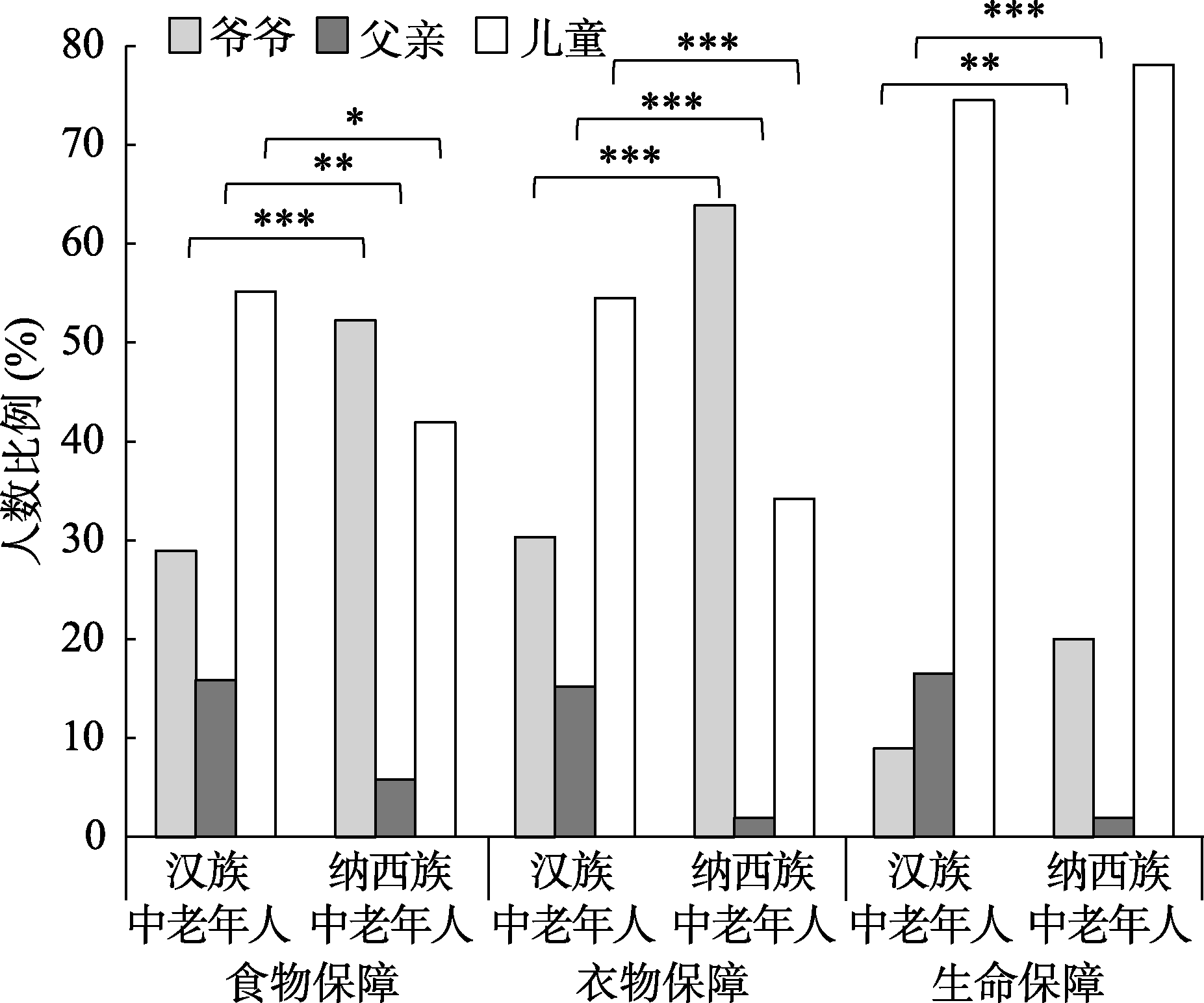
图1 在保障情境下汉族和纳西族中老年人对三种保障对象优先选择的人数(%)
注:*p < 0.05; **p < 0.01; ***p < 0.001, 下同。
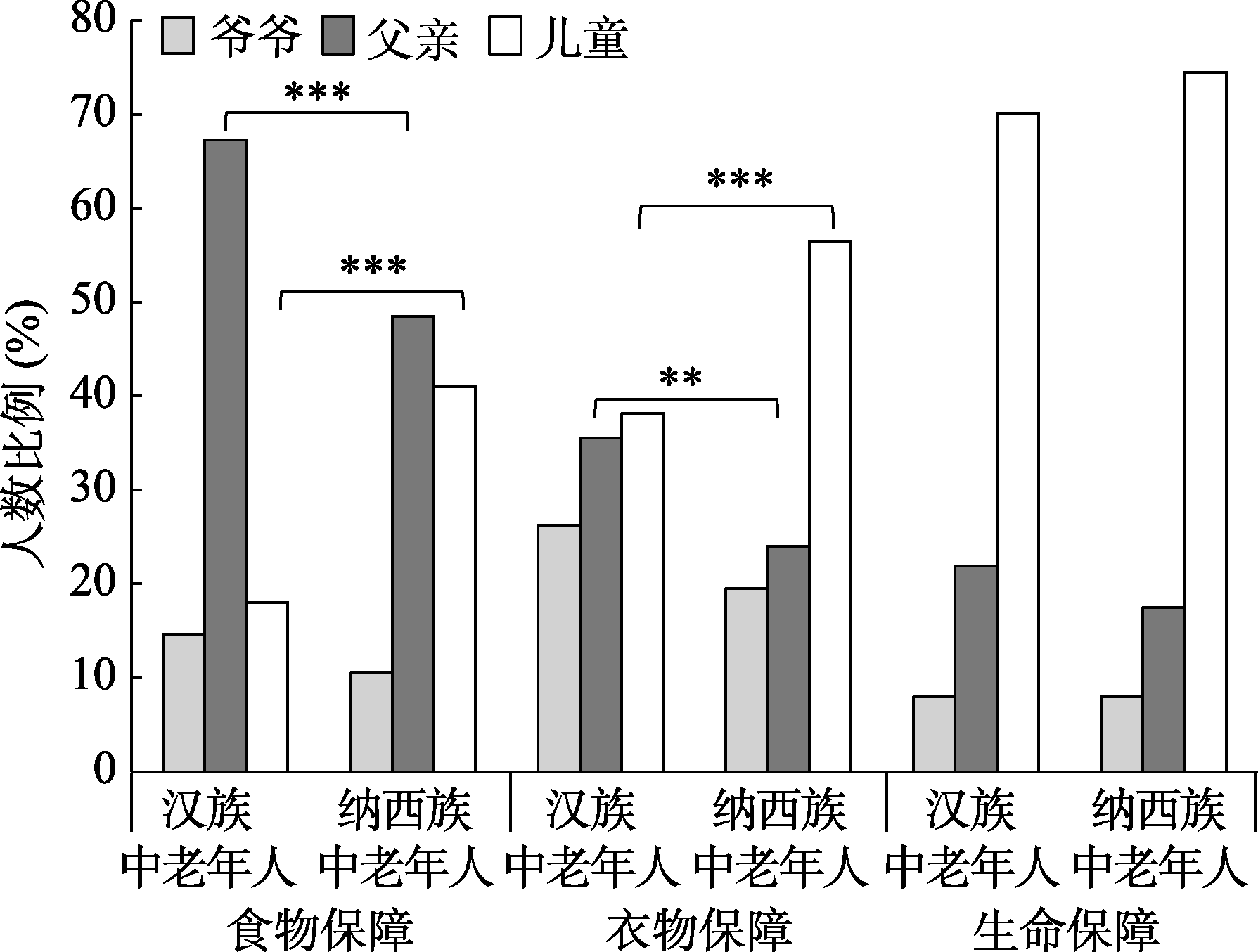
图2 在保障情境下汉族和纳西族的高中生对三种保障对象优先选择的人数(%)
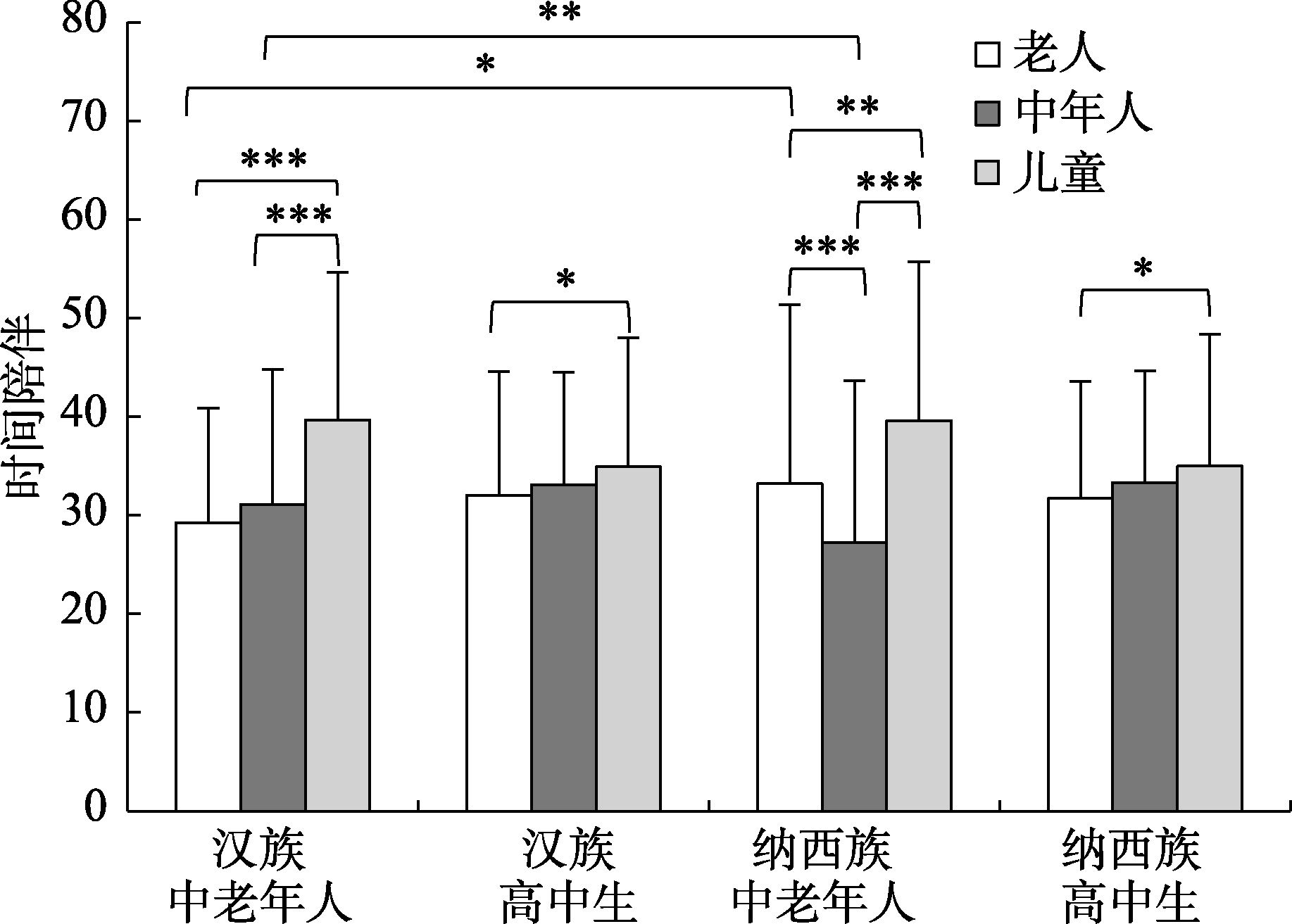
图3 被试对三种受助对象的陪伴时间分配(分钟)
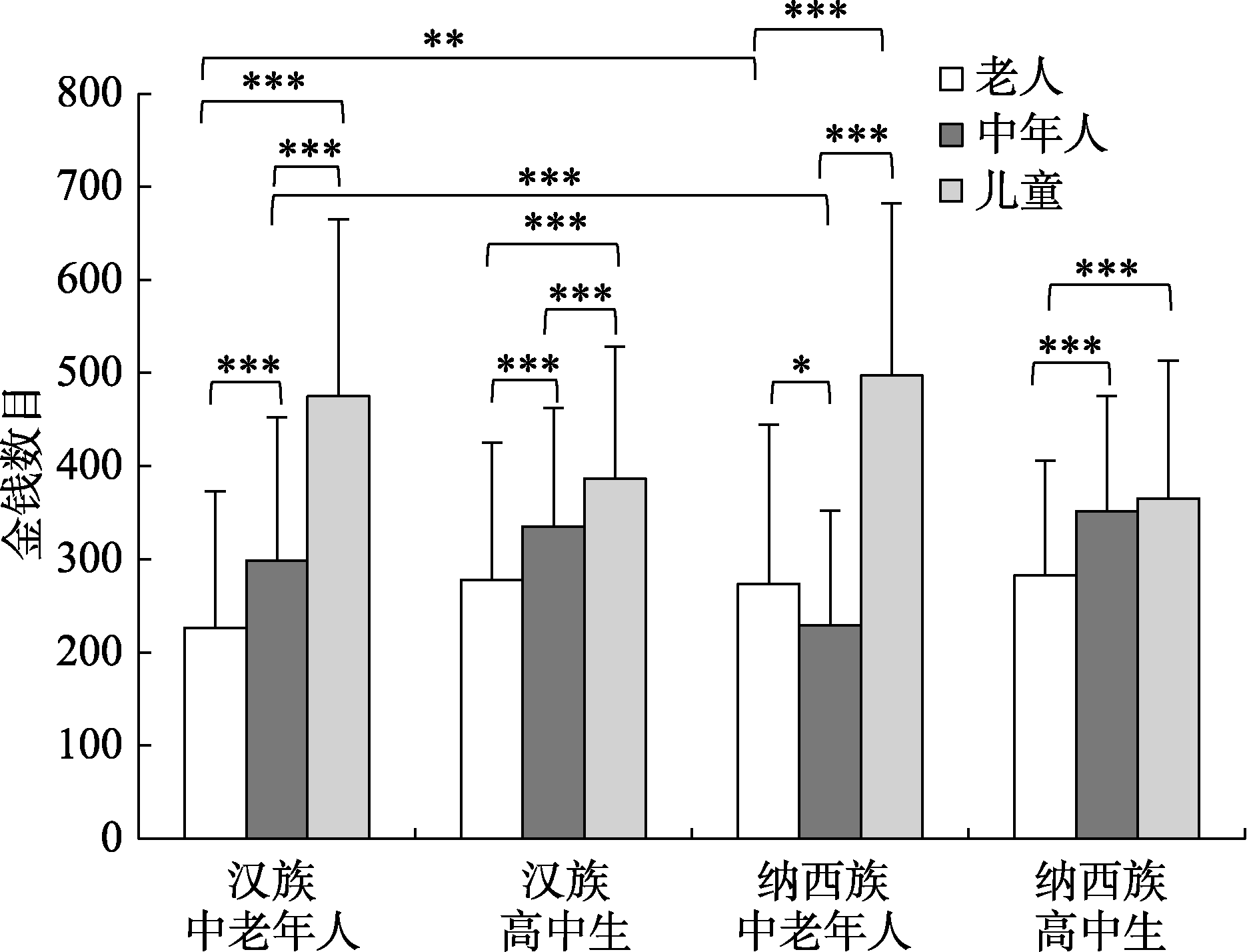
图4 被试对三种受助对象的捐赠金钱(元)
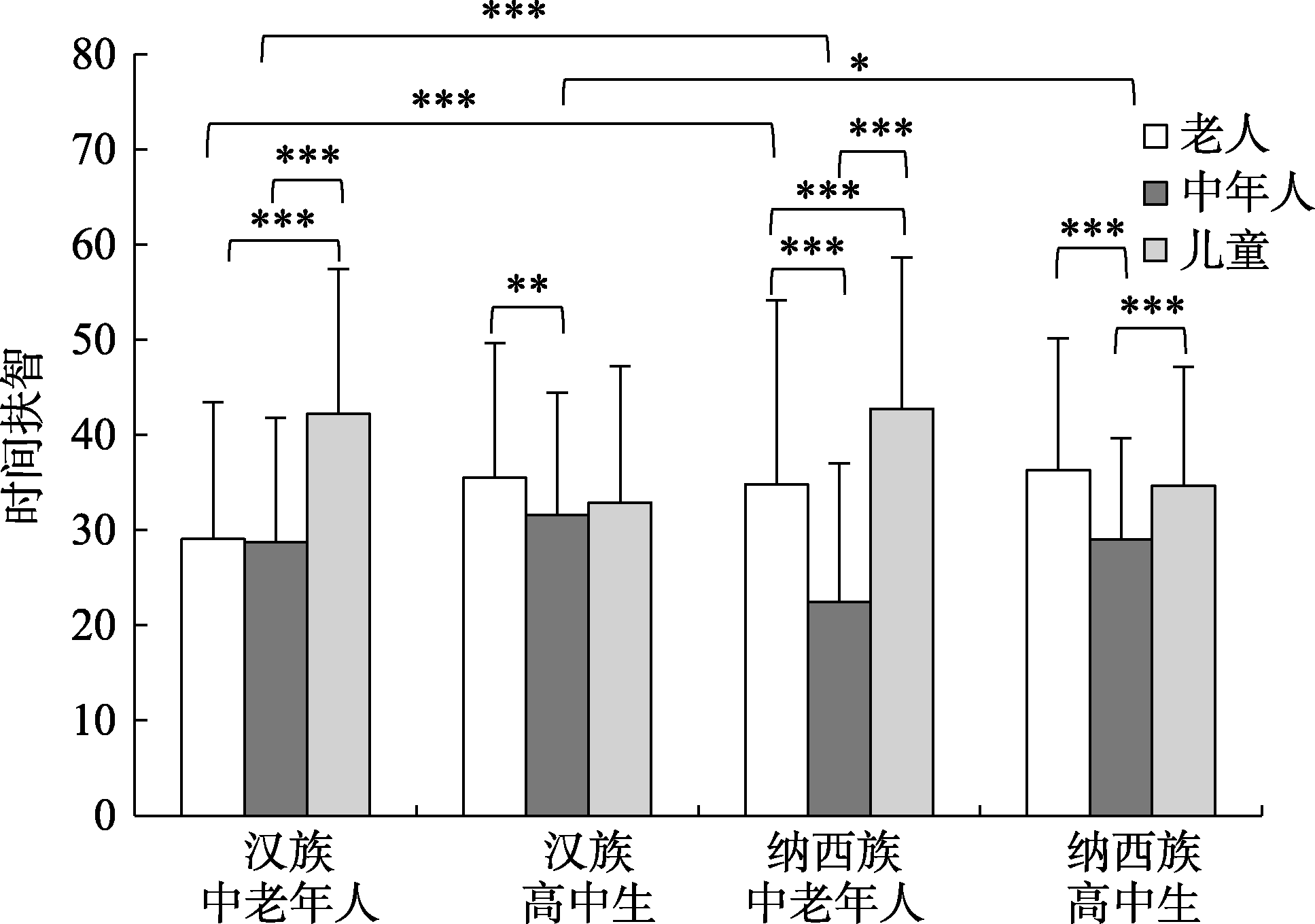
图5 被试对三种受助对象的扶智时间分配(分钟)
| [1] | Batson C. D. (2011). Altruism in humans. Oxford University Press. |
| [2] | Bei D. L., & Hong H. (2007). Rituals for the disadvantaged: From Xunzi to the modern world. Seeking Truth, (2), 5-14. |
| [贝淡宁, 洪浩. (2007). 为弱势者而设计的礼:从荀子到现代社会. 求是学刊, (2), 6-14.] | |
| [3] |
Berry J. W. (1967). Independence and conformity in subsistence- level societies. Journal of Personality and Social Psychology, 7(4), 415-418.
doi: 10.1037/h0025231 pmid: 6065870 |
| [4] |
Berry J. W. (2005). Acculturation: living successfully in two cultures. International Journal of Intercultural Relations, 29(6), 697-712.
doi: 10.1016/j.ijintrel.2005.07.013 URL |
| [5] |
Berry J. W., Kim U., Minde T., & Mok D. (1987). Comparative studies of acculturative stress. The International Migration Review, 21(3), 491-511.
doi: 10.1177/019791838702100303 URL |
| [6] | Cao J. S., & Cheng X. Y. (2024). A review of research on helping behavior. Psychologies Magazine, 19(19), 224-226+240. |
|
[曹军胜, 成笑语. (2024). 助人行为研究综述. 心理月刊, 19(19), 224-226+240.]
doi: 10.19738/j.cnki.psy.2024.19.067 |
|
| [7] | Chamba Y., & Pema T. (2025). Reflections on consolidating the sense of community for the Chinese nation among Tibetan youths from the perspective of cultural integration. Journal of Tibet University (Social Sciences Edition), 40(1), 150-156. |
| [强巴央珍, 白玛次仁. (2025). 文化融合视域下西藏青少年铸牢中华民族共同体意识的思考. 西藏大学学报(社会科学版), 40(1), 150-156.] | |
| [8] | Chen C. X., & Lu J. F. (2005). Cultural connotation of Doue and its reason. Journal of Yan’an University (Social Science Edition), 27(1), 83-86. |
| [陈才训, 吕敬芬. (2005). 窦娥·节妇·孝妇——窦娥形象的文化意蕴及其解读. 延安大学学报 (社会科学版), 27(1), 83-86.] | |
| [9] | Chen Y. K. (2011). A brief essay on the origins of the Sui and Tang dynasties, and a treatise on the political history of the Tang dynasty. Beijing: The Commercial Press. |
| [陈寅恪. (2011). 隋唐制度渊源略论稿·唐代政治史述论稿. 北京: 商务印书馆.] | |
| [10] | Chen Y. K. (2020). Excerpts from Jin Mingguan II. Shanghai: Shanghai Ancient Books Publishing House. |
| [陈寅恪. (2020). 金明馆从稿二编. 上海: 上海古籍出版社.] | |
| [11] | Chen Y. Y., & Huo Y. Q. (2015). On the mechanism analysis of social identity under the background of multiculturalism. Qinghai Social Sciences, (4), 82-87. |
| [陈永涌, 霍涌泉. (2015). 论多元文化背景下社会认同的机制分析. 青海社会科学, (4), 82-87.] | |
| [12] | Chen Z. X. (1983). Chinese cultural geography. Beijing: SDX Joint Publishing Company. |
| [陈正祥. (1983). 中国文化地理. 北京: 生活·读书·新知三联书店.] | |
| [13] | Cheng C. (2002). The course of civilization in the south of the five ridges: Han-nafionalization and Confucianization. Journal of Guangzhou University (Social science edition), (7), 54-58. |
| [程潮. (2002). 论岭南的汉化和儒化历程. 广州大学学报(社会科学版), (7), 54-58.] | |
| [14] | Chou D. X. (2024). Ethnographic nuances in the rural homeland. Petrels, (7), 64-69. |
| [仇多轩. (2024). 温故乡间的细节. 海燕, (7), 64-69.] | |
| [15] | Cui Z. L., Liu Y., & Zhang J. J. (2012). The Character and reason of kinship words of Jinuo ethnic group. Journal of Psychological Science, 35(4), 916-920. |
| [崔占玲, 刘烨, 张积家. (2012). 基诺族中学生的亲属词概念结构及其成因. 心理科学, 35(4), 916-920.] | |
| [16] | Dong X. B. (2007). Cultural genealogy analysis and modernity studies of Yugur ethnic group [Unpublished doctorial dissertation]. Lanzhou University. |
| [董晓波. (2007). 裕固族文化谱系解读及其现代性研究 (博士学位论文). 兰州大学.] | |
| [17] | Duan H. Y. (2011). Social changes of the Naxi nationality after the replacement of Tusi chieftains with government appointed officials. Journal of Yunan Normal University (Humanities and Social Sciences), 43(6), 85-90. |
| [段红云. (2011). 丽江改土归流后纳西族的社会变迁. 云南师范大学学报(哲学社会科学版), 43(6), 85-90.] | |
| [18] | Eisenberg N., & Mussen P. H. (1989). The roots of prosocial behavior in children. Cambridge: Cambridge University Press. |
| [19] | Fan X. Y. (1978). Annotations to the record of Buddhist Monasteries in Luoyang (vol. 2, Chengdong). Shanghai: Shanghai Ancient Books Publishing House. |
| [范祥雍. (1978). 洛阳伽蓝记校注(卷二·城东). 上海: 上海古籍出版社.] | |
| [20] | Fei X. T. (2018). The pattern of diversity of the Chinese nation. Beijing: Minzu University of China Press. |
| [费孝通. (2018). 中华民族多元一体格局. 北京: 中央民族大学出版社.] | |
| [21] |
Fischer P., Krueger J. I., Greitemeyer T., Vogrincic C., Kastenmüller A., Frey D., … Kainbacher M. (2011). The bystander-effect: A meta-analytic review on bystander intervention in dangerous and non-dangerous emergencies. Psychological Bulletin, 137(4), 517-537.
doi: 10.1037/a0023304 pmid: 21534650 |
| [22] | Francis L. K. H. (2002). Clan, caste and club (G. G. Huang, Trans.). Taipei: Nan Tian Publishing Co., Ltd. |
| [许烺光. (2002). 宗族、种姓与社团 (黄光国译). 台北: 南天书局有限公司.] | |
| [23] | Fromm E. (2013). In pursuit of self (S. Sun, Trans.). Shanghai: Shanghai Translation Publishing House. |
| [艾·弗洛姆. (2013). 追寻自我 (孙石译). 上海: 上海译文出版社.] | |
| [24] | Fu S. N. (1931). An outline history of northeast China. Shanghai: Shanghai Joint Publishing Company. |
| [傅斯年. (1931). 东北史纲. 上海: 上海三联书店.] | |
| [25] | Ge S. X., Su X., & Ren C. X. (2024). A study on the new media communication of Gelao ethnic Nuoxi opera in Northern Guizhou based on cultural adaptation theory. Songs Bimonthly, (2), 126-132. |
| [葛世鑫, 苏翔, 任长幸. (2024). 基于文化适应理论的黔北仡佬族傩戏新媒体传播研究. 歌海, (2), 126-132.] | |
| [26] | Gei J. X., Cao S. J., & Wu S. D. (1993). A concise history of Chinese migration. Fuzhou: Fujian People's Publishing House. |
| [葛剑雄, 曹树基, 吴松弟. (1993). 简明中国移民史. 福州: 福建人民出版社.] | |
| [27] | Gu B. (2004). Selected essays on ethnic studies volume II. Lanzhou: Lanzhou University Press. |
| [谷苞. (2004). 民族研究文选(二). 兰州: 兰州大学出版社.] | |
| [28] | Gu J. G. (1939-2-13). The Chinese nation is one. Yishi Newspaper·Frontier Weekly, (9). |
| [顾颉刚. (1939-2-13). 中华民族是一个. 益世报·边疆周刊, (9).] | |
| [29] | Guang T. K. S. (2005). Immigration and city (M. Ma, Trans.). Beijing: The Commercial Press. |
| [广田康生. (2005). 移民和城市 (马铭译). 北京: 商务印书馆.] | |
| [30] | Guo D. L., & He Z. W. (2015). The history of the Naxi people. Kunming: Yunan University Press. |
| [郭大烈, 和志武. (2015). 纳西族史. 昆明: 云南大学出版社.] | |
| [31] | Hu P. S., & Chen M. L. (2007). The classic of filial piety. Beijing: China Publishing House. |
| [胡平生, 陈美兰. (2007). 孝经. 北京: 中华书局.] | |
| [32] | Huang L., & Xue H. (2012). The ethical principles of mutual assistance in disasters. Journal of Wuhan University of Technology (Social Sciences Edition), 25(5), 656-661. |
| [黄璐, 薛恒. (2012). 灾害中互助自救的伦理原则. 武汉理工大学学报(社会科学版), 25(5), 656-661.] | |
| [33] | Huang Shi’s Critical Edition. (1986). General system and codes. Hangzhou: Zhejiang Classical Literature Press. |
| [黄时点校. (1986). 通制条格. 杭州: 浙江古籍出版社.] | |
| [34] | Jones E. (2019). Cultural fusion: A cultural critique based on history and economics (Z. B. Wang, Trans.). Hangzhou: Zhejiang University Press. |
| [埃里克·琼斯. (2019). 文化融合:基于历史学和经济学的文化批判 (王志标译). 杭州: 浙江大学出版社.] | |
| [35] | Ju H. (2017). The male offspring view of the Khitan in Liao Dynasty. Journal of Liaoning Technical University (Social Science Edition), 19(6), 561-566. |
| [鞠贺. (2017). 辽代契丹人的子嗣观. 辽宁工程技术大学学报(社会科学版), 19(6), 561-566.] | |
| [36] | Kou Y., & Xu H. N. (2005). The two functions of empathy on the decision-making of prosocial behavior. Psychological Exploration, 25(3), 73-77. |
| [寇彧, 徐华女. (2005). 移情对亲社会行为决策的两种功能. 心理学探新, 25(3), 73-77.] | |
| [37] |
Lammers J., & Stapel D. A. (2009). How power influences moral thinking. Journal of Personality and Social Psychology, 97(2), 279-289.
doi: 10.1037/a0015437 pmid: 19634975 |
| [38] | Lan Y. L., Zhang H. Y., & Xu H. B. (2005). Personality traits of children of Zhuang nationality in Guangxi. Chinese Mental Health Journal, (1), 22-24. |
| [兰燕灵, 张海燕, 徐红兵. (2005). 广西壮族少年儿童个性特征. 中国心理卫生杂志, (1), 22-24.] | |
| [39] | Li A. M. (1988). Some issues regarding cultural hybridization. Journal of Sun Yat-sen University (Social Science Edition), (4), 45-52. |
| [李安民. (1988). 关于文化涵化的若干问题. 中山大学学报 (哲学社会科学版), (4), 45-52.] | |
| [40] | Li F. S. (2006). The Great Wall and the nation. Beijing: Minzu University of China Press. |
| [李凤山. (2006). 长城与民族. 北京: 中央民族大学出版社.] | |
| [41] | Li H. J., & Zhang J. J. (2019). The conceptual structure of kinship words of Rgyalrong Tibetan. Journal of Guiyang University (Social Sciences), 14(4), 33-41. |
| [李惠娟, 张积家. (2019). 嘉绒藏族的亲属词概念结构——兼同纳西族、摩梭人、彝族、白族比较. 贵阳学院学报(社会科学版), 14(4), 33-41.] | |
| [42] |
Li H. J., Zhang J. J., & Zhang R. X. (2014). The vertically spatial metaphors of kinship words of Qiang nationality. Acta Psychologica Sinica, 46(4), 481-491.
doi: 10.3724/SP.J.1041.2014.00481 |
| [李惠娟, 张积家, 张瑞芯. (2014). 上下意象图式对羌族亲属词认知的影响. 心理学报, 46(4), 481-491.] | |
| [43] | Li J. Z. (2024). Cross-regional population flow and the construction of multi-ethnic interactions, exchanges and integration space: Base on the regional historical investigation of the Western Loess Plateau. Journal of Northwestern Ethnic Studies, (5), 72-82. |
| [李建宗. (2024). 人口流动与多民族交往交流交融空间的形构——基于黄土高原西部的区域史考察. 西北民族研究, (5), 72-82.] | |
| [44] | Li S. F., & Zhang L. (2015). Characteristics, types and influencing factors of suicide behavior in rural areas of northern China: A field survey in an agricultural county. Shangdong Social Sciences, (11), 85-91. |
| [李善峰, 张璐. (2015). 中国北方农村自杀行为的特点、类型和影响因素——基于一个农业县的田野调查. 山东社会科学, (11), 85-91.] | |
| [45] | Li Y. J., & Zhang Y. G. (2022). The evolution and realistic expression of Jiangnan culture. Shanghai Culture, (6), 74-80. |
| [李亚娟, 张永广. (2022). 江南文化的历史演进及其现实表达. 上海文化, (6), 74-80.] | |
| [46] | Liao G. Q. (2015). The "Hanization" of minority ethnic groups and the "Barbarianization" of the Han ethnic group in Yunnan province during the Qing Dynasty. Thinking, 41(2), 113-119. |
| [廖国强. (2015). 清代云南少数民族之“汉化”与汉族之“夷化”. 思想战线, 41(2), 113-119.] | |
| [47] | Lin W. S. (2000). Enlightenment by Prof. Chen Yin-ke’s theory on foreignization and sinicization. Journal of Sun Yat-sen University (Social Science Edition), (1), 42-47. |
| [林悟殊. (2000). 陈寅恪先生“胡化”、“汉化”说的启示. 中山大学学报(社会科学版), (1), 42-47.] | |
| [48] | Liu M. X. (1996). Classics of modern Chinese scholarship: Volume of Huang Kan and Liu Shipei. Shijiazhuang: Hebei Education Press. |
| [刘梦溪. (1996). 中国现代学术经典(黄侃、刘师培卷). 石家庄: 河北教育出版社.] | |
| [49] | Liu Y.W. (2021-10-14). The phenomenon of rural elderly committing suicide has reached a shocking level! China Youth Daily. |
| [刘燕舞. (2021-10-14). 农村老人自杀现象, 已经到了触目惊心的地步! 中国青年报.] | |
| [50] | Lu R. (2001). Transformation and integration: A study of Han Chinese migrants in Yunnan during the Ming dynasty. Kunming: Yunnan Educational Publishing House. |
| [陆韧. (2001). 变迁与交融——明代云南汉族移民研究. 昆明: 云南教育出版社.] | |
| [51] | Ma X. L. & Mu S. (2019). Studies on ethnic concepts of “Han-hua” and “Hu-hua” in ancient China: A review (2000-2018). Journal of Yantai University (Philosophy and Social Science Edition), 32(2), 71-81. |
| [马晓丽, 穆琛. (2019). 新世纪以来中国古代“汉化”、“胡化”研究述评. 烟台大学学报(哲学社会科学版), 32(2), 71-81.] | |
| [52] |
Meng L., Ye C., Wang J. J., & Zhang J. J. (2022). Container metaphor, intergroup attitude, and helping tendency toward domestic and foreign ethnic groups of Tibetan students in hinterland senior high school. Acta Psychologica Sinica, 54(11), 1366-1380.
doi: 10.3724/SP.J.1041.2022.01366 |
|
[孟乐, 叶灿, 王佳佳, 张积家. (2022). 内藏班高中生对国内外民族的容器隐喻、群际态度和助人倾向. 心理学报, 54(11), 1366-1380.]
doi: 10.3724/SP.J.1041.2022.01366 |
|
| [53] | Mu G. Z. (2014). Fertility decline represents the gravest strategic crisis. China Policy Review, (11), 49-51. |
| [穆光宗. (2014). 人口少子化是最大战略危机. 中国经济报告, (11), 49-51.] | |
| [54] | Mu S. H. (2002). The Dongba religion and Naxi culture. Beijing: Minzu University of China Press. |
| [木仕华. (2002). 东巴教与纳西文化. 北京: 中央民族大学出版社.] | |
| [55] | Mu Z. Y. (2008). The origin of Chen Yinchieh’s theory on Foreignization. Academic Exploration, (1), 95-98. |
| [牟振宇. (2008). 陈寅恪“胡化说”由来探析. 学术探索, (1), 95-98.] | |
| [56] |
Nelson L. D., & Norton M. I. (2005). From student to superhero: Situational primes shape future helping. Journal of Experimental Social Psychology, 41(4), 423-430.
doi: 10.1016/j.jesp.2004.08.003 URL |
| [57] | Qing W. J. (2007). Suicide ideation and its risk factors among the elderly in Yuanjiang city, Hunan [Unpublished master’s thesis]. Central South University, Changsha. |
| [卿文静. (2007). 湖南省沅江市农村老年人自杀意念及其危险因素研究 (硕士学位论文). 中南大学, 长沙.] | |
| [58] | Ren N., Zuo B., Hou F. X., & Wang G. J. (2012). Context effect or automatic process? The implicit attitude of undergraduates to old people. Acta Psychologica Sinica, 44(6), 777-788. |
| [任娜, 佐斌, 侯飞翔, 汪国驹. (2012). 情境效应或自动化加工:大学生对老年人的内隐态度. 心理学报, 44(6), 777-788.] | |
| [59] | Rubin G. (2019). The four tendencies: The indispensable personality profiles that reveal how to make your life better (G. Dai, trans.). Beijing: CITIC Press. |
| [格雷琴·鲁宾. (2019). 掌控关系 (岱冈译). 北京: 中信出版社.] | |
| [60] | Shen Y. (1974). The biographies of Kong Jigong, Yang Xuanbao and Shen Tanqing in volume 54 of “The History of Song Dynasty”. Beijing: China Publishing House. |
| [沈约. (1974). 宋书卷五四·孔季恭羊玄保沈昙庆传. 北京: 中华书局.] | |
| [61] |
Slotterback C. S., & Saarnio D. A. (1996). Attitudes toward older adults reported by young adults: Variation based on attitudinal task and attribute categories. Psychology and Aging, 11(4), 563-571.
pmid: 9000289 |
| [62] | Sokolskaya L., & Valentonis A. (2020). The history of the acculturation concept. Journal of Intercultural Communication, 20(3), 31-43. |
| [63] | Song S. H., & Bai Z. S. (1998). Ethnological theory and methodology. Beijing: Minzu University of China Press. |
| [宋蜀华, 白振声. (1998). 民族学理论与方法. 北京: 中央民族大学出版社.] | |
| [64] | Sun L. C., & Luo D. D. (2019). On the inheritance of the education of respect for the elderly in Jurchen nationality in Jin dynasty. Journal of Changchun Education Institute, 35(4), 24-26. |
| [孙凌晨, 罗丹丹. (2019). 论金代女真民族敬老教育的传承. 长春教育学院学报, 35(4), 24-26.] | |
| [65] | Wan M. G. (2017). Don’t neglect cultural adaptation in social exchange and integration. Ethnic Education of China, (5), 12. |
| [万明钢. (2017). 别忽视交往交流交融中的文化适应态度. 中国民族教育, (5), 12.] | |
| [66] | Wang B. X., Wang X. J., & Li W. (2024). The effect of value on the dual processing of association recognition in older adults. Psychological Exploration, 44(2), 122-127. |
| [王宝玺, 王雪静, 李伟. (2024). 价值对老年人联结再认双加工过程的影响. 心理学探新, 44(2), 122-127.] | |
| [67] | Wang H. Z., & Wang W. J. (2024). Han Wanfeng’s films on ethnic minorities: Cultural records and identity transformation. Journal of Film Studies, 6(1), 58-65. |
| [王海洲, 王文君. (2024). 韩万峰的少数民族电影:文化纪录与身份转化. 电影理论研究(中英文), 6(1), 58-65.] | |
| [68] | Wang Q. C., Yin G. E., Zhang S. X., & Yao S. J. (2011). Risky choice framing effects in teenagers’ decision-making. Studies of Psychology and Behavior, 9(4), 268-272+309. |
| [王青春, 阴国恩, 张善霞, 姚姝君. (2011). 青少年决策中的风险选择框架效应. 心理与行为研究, 9(4), 268-272+309.] | |
| [69] | Waxi Q. Y., & Luo Q. (2018). The traditional Yi ethnic practice of “ritualized filial piety” in honoring elders. Journal of Literature and History, (5), 74-78. |
| [瓦西曲一, 罗曲. (2018). 彝族传统“事之以礼”的孝亲敬老习俗. 文史杂志, (5), 74-78.] | |
| [70] | Wei Y. L. (2006). Studies on reasons for Han dynasty's attention to the old-age support system construction-From the view of production mode and culture. Tangdu Journal, 22(4), 23-26. |
| [魏燕利. (2006). 试论汉代注重养老制度建设之根源——以生产方式及思想文化为视角. 唐都学刊, 22(4), 23-26.] | |
| [71] | Wu F., & Chen L. (2022). Cultural mechanism and policy implications of young people’s low fertility desire in contemporary China. Journal of Public Administration, 15(5), 49-65+197. |
| [吴帆, 陈玲. (2022). 当代中国年轻人低生育意愿背后的文化机制及其政策意涵. 公共行政评论, 15(5), 49-65+197.] | |
| [72] | Wu Z. Q. (2008). Du Mu's collected works: A chronological edition with annotations. Beijing: China Publishing House. |
| [吴在庆. (2008). 杜牧集系年校注. 北京: 中华书局.] | |
| [73] |
Xiao E. P., & Zhang J. J. (2012). National language influences national psychology: Evidence from classifying kinship words. Advances in Psychological Science, 20(8), 1189-1200.
doi: 10.3724/SP.J.1042.2012.01189 URL |
| [肖二平, 张积家. (2012). 从亲属词分类看民族语言对民族心理的影响. 心理科学进展, 20(8), 1189-1200.] | |
| [74] | Xie, Z. Z. (2000). Dian Lüe. In G. Y.Fang, Yunnan historical materials series (vol. 6, pp. 696-697). Kunming: Yunnan University Press. |
| [谢肇淛. (2000). 滇略. 见方国瑜(主编), 云南史料丛刊:第六卷 (pp.696-697). 昆明: 云南大学出版社.] | |
| [75] | Xu J. R. (1978). Dali ancient cultural history. Beijing: China Publishing House. |
| [徐嘉瑞. (1978). 大理古代文化史. 北京: 中华书局.] | |
| [76] | Xu P. (2006). Cultural adaptation and change: Sichuan Qiang survey. Shanghai: Shanghai People’s Publishing House. |
| [徐平. (2006). 文化的适应和变迁:四川羌村调查. 上海: 上海人民出版社.] | |
| [77] |
Xu S. A., & Zheng X. (2012). The cognitive style of ethnic minorities. Advances in Psychological Science, 20(8), 1207-1211.
doi: 10.3724/SP.J.1042.2012.01207 URL |
| [许思安, 郑雪. (2012). 少数民族的认知方式. 心理科学进展, 20(8), 1207-1211.] | |
| [78] | Yan Y., & Zou W. X. (2018). Portrayals of the individuals and the group: Images of the victims of extraordinary serious accidents in China (2000-2016). Chinese Journal of Journalism & Communication, 40(6), 138-161. |
| [闫岩, 邹文雪. (2018). 群像与独像: 新世纪以来我国特大事故报道中的受难者形象. 国际新闻界, 40(6), 138-161.] | |
| [79] | Yu H. B., & Yu J. H. (2002). Mu Clan chieftains and Lijiang. Kunming: Yunnan Nationalities Publishing House. |
| [余海波, 余嘉华. (2002). 木氏土司与丽江. 昆明: 云南民族出版社.] | |
| [80] | Yu Y. Q. (2015). A review and prospect of the history of ethnic education research. Journal of Northwest Minzu University (Philosophy and Social Sciences), (3), 153-159+181. |
| [喻永庆. (2015). 民族教育史研究的回顾与展望. 西北民族大学学报 (哲学社会科学版), (3), 153-159+181.] | |
| [81] | Zhang J. F. (2013). Marriage customs and the Hanization process during the Wei, Jin, and Southern-Northern Dynasties. Journal of Chinese Culture, (12), 27-33. |
| [张俊飞. (2013). 婚姻所见魏晋南北朝之胡化现象. 中华文化论坛, (12), 27-33.] | |
| [82] | Zhang J. J., & Feng X. H. (2022). Ethnic marginal: The best perspective in the study of the psychological development of the community of the Chinese nation. Tribune of Education Culture, 14(4), 55-70. |
| [张积家, 冯晓慧. (2022). 族群边缘:中华民族共同体心理发展研究的最佳视角. 教育文化论坛, 14(4), 55-70.] | |
| [83] |
Zhang J. J., Fu Y., & Wang B. (2020). Gender culture influence on spatial and weight metaphors of kinship words: Evidence from Bai, Yi, and Mosuo nationalities. Acta Psychologica Sinica, 52(4), 440-455.
doi: 10.3724/SP.J.1041.2020.00440 |
|
[张积家, 付雅, 王斌. (2020). 文化影响亲属词性别概念加工中的空间隐喻与重量隐喻——来自彝族、白族和摩梭人的证据. 心理学报, 52(4), 440-455.]
doi: 10.3724/SP.J.1041.2020.00440 |
|
| [84] | Zhang J. J., & He X. M. (2004). The conceptual structure of kinship words of Naxi nationality. Acta Psychologica Sinica, 36(6), 654-662. |
| [张积家, 和秀梅. (2004). 纳西族亲属词的概念结构——兼与汉族亲属词概念结构比较. 心理学报, 36(6), 654-662.] | |
| [85] | Zhang J. J., & Qiao Y. Y. (2018). Does growing wheat cultivate the individualistic culture of northern China. Journal of Guiyang University (Social Sciences), 13(5), 32-39. |
| [张积家, 乔艳阳. (2018). 种植小麦培育了中国北方的个人主义文化——结合作物种植史和移民史对中国南北方文化差异的思考. 贵阳学院学报(社会科学版), 13(5), 32-39.] | |
| [86] |
Zhang J. J., Wang J., Xiao E. P., & He X. M. (2013). Influence of culture and circumstance on kinship words’ conceptual structure. Acta Psychologica Sinica, 45(8), 825-839.
doi: 10.3724/SP.J.1041.2013.00825 URL |
| [张积家, 王娟, 肖二平, 和秀梅. (2013). 文化和情境影响亲属词的概念结构. 心理学报, 45(8), 825-839.] | |
| [87] | Zhang J. J., Ye C., & Wang T. (2022). Ecological environment and humanistic environment shaping individual cultural orientation:Evidence from middle school students in Dong and Oroqen areas. Journal of South China Normal University (Social Science Edition), (4), 59-71+206. |
| [张积家, 叶灿, 王婷. (2022). 生态环境和人文环境塑造个体的文化倾向性——来自侗族地区和鄂伦春族地区中学生的证据. 华南师范大学学报 (社会科学版), (4), 59-71+206.] | |
| [88] | Zhang J. J., & Yu L. (2023). Coupling of national identity and cultural identity: On Chen Yinke's thought of national identity “change and recognition theory”. Guangxi Ethnic Studies, (2), 9-18. |
| [张积家, 于玲. (2023). 民族认同与文化认同的耦合——论陈寅恪民族认同思想之“化认说”. 广西民族研究, (2), 9-18.] | |
| [89] | Zhang Q. F., & Hui D. (2009). A comment on the HuHua (胡化) of “Southern Men” in Jin Dynasty. Collected Papers of History Studies, (4), 47-52. |
| [张其凡, 惠冬. (2009). 金朝“南人”胡化考略. 史学集刊, (4), 47-52.] | |
| [90] | Zhang Z. X. (2019). Dispositions and character traits. Zhejiang Social Sciences, (12), 105-110+159. |
| [张子夏. (2019). 倾向与性格特征. 浙江社会科学, (12), 105-110+159.] | |
| [91] | Zhao X. Y. (2004). Basic features of ancient passages in Zang and Yi corridor. Journal of South-Central Minzu University (Humanities and Social Sciences), (3), 76-79. |
| [赵心愚. (2004). 藏彝走廊古代通道的几个基本特点. 中南民族大学学报 (人文社会科学版), (3), 76-79.] | |
| [92] | Zhou Q. (2013). On differences and similarities of Sima Qian's and Ban Gu's views on Yi and Xia. Journal of Langfang Normal University (Social Sciences Edition), 29 (1), 68-74. |
| [周倩. (2013). 马班夷夏观异同探究. 廊坊师范学院学报 (社会科学版), 29(1), 68-74.] |
| [1] | 陈思静, 王震, 杨莎莎, 郑鹏, 何铨. 生育依附抑或生育自主?丈夫的传统性别角色观念对妻子生育意愿的影响[J]. 心理学报, 2025, 57(9): 1661-1676. |
| [2] | 纪婷婷, 王嘉, 丁毅. 人们更同情流浪动物还是流浪汉?基于责任归因视角的解释[J]. 心理学报, 2025, 57(5): 838-859. |
| [3] | 孟鲁, 田宇浩, 王海飞, 董佳一, 蔺星儒, 籍宏伟, 田启瑞, 周梁. 联结还是疏离:探究疫情死亡凸显对亲社会意愿的影响及其作用机制[J]. 心理学报, 2025, 57(4): 652-670. |
| [4] | 唐小飞, 王昌梅, 孙晓东, 张恩忠. 类人智能机器人信任对员工工作贡献意愿的影响: 基于人机关系信任的归维考察[J]. 心理学报, 2025, 57(11): 1933-1950. |
| [5] | 由姗姗, 齐玥, 陈俊廷, 骆磊, 张侃. 人与AI对智能家居机器人的安全信任及其影响因素[J]. 心理学报, 2025, 57(11): 1951-1972. |
| [6] | 龚钰雯, 代颖, 马祖军. 传染病线索和招募信息中主角对献血意愿的影响[J]. 心理学报, 2024, 56(9): 1282-1298. |
| [7] | 陈思静, 沈家辉, 姜侨桀, 杨莎莎. 对他人生育态度和行为的低估抑制了Z世代未生育个体的生育意愿[J]. 心理学报, 2024, 56(6): 759-776. |
| [8] | 李世豪, 栾墨, 李虹, 符国群. 礼物何以传递爱意: 便利型与合意型礼物对择偶交往意愿的影响[J]. 心理学报, 2024, 56(11): 1524-1540. |
| [9] | 黄韫慧, 肖友凯, 初星宇, 卢玥. 语义还是谐音:品牌个性与双关类型的匹配[J]. 心理学报, 2024, 56(11): 1604-1618. |
| [10] | 宋文静, 陈怡煖, 黄韫慧. 募捐信息该强调恢复还是改善受事件可控性调节[J]. 心理学报, 2023, 55(7): 1133-1147. |
| [11] | 孙洪杰, 王美玲, 钟科. 消费失败情境下人际亲密度对口碑传播意愿的U型影响——基于动机冲突的视角[J]. 心理学报, 2023, 55(7): 1176-1191. |
| [12] | 朱振中, 李晓君, 刘福, Haipeng (Allan) Chen. 外观新颖性对消费者购买意愿的影响:自我建构与产品类型的调节效应[J]. 心理学报, 2020, 52(11): 1352-1364. |
| [13] | 杨群, 张启睿, 冯意然, 张积家. 语言和文化影响颜色认知:直接语言效应抑或间接语言效应?[J]. 心理学报, 2019, 51(5): 543-556. |
| [14] | 樊亚凤, 蒋晶, 崔稳权. 网络公益平台默认选项设置对个人捐赠意愿的影响及作用机制[J]. 心理学报, 2019, 51(4): 415-427. |
| [15] | 邢采, 孟彧琦, 林青青, 秦子玉. 生育年龄限制感提高女性的计划生育数量[J]. 心理学报, 2019, 51(4): 428-436. |
| 阅读次数 | ||||||
|
全文 |
|
|||||
|
摘要 |
|
|||||
