

ISSN 0439-755X
CN 11-1911/B
主办:中国心理学会
中国科学院心理研究所
出版:科学出版社
CN 11-1911/B
主办:中国心理学会
中国科学院心理研究所
出版:科学出版社
心理学报 ›› 2025, Vol. 57 ›› Issue (12): 2220-2241.doi: 10.3724/SP.J.1041.2025.2220 cstr: 32110.14.2025.2220
胡小勇1( ), 赵越2, 冀月欣1, 马佳馨3
收稿日期:2024-07-10
发布日期:2025-09-28
出版日期:2025-12-25
通讯作者:
胡小勇, E-mail: huxiaoyong@whu.edu.cn作者简介:第一联系人:†胡小勇和赵越为共同第一作者。
基金资助:
HU Xiaoyong1(), ZHAO Yue2, JI Yuexin1, MA Jiaxin3
Received:2024-07-10
Online:2025-09-28
Published:2025-12-25
摘要: 敬畏拥有着超越一般积极情绪的力量, 能够提高个体的亲社会性。本研究基于小我假说、真我假说以及阶层的社会认知理论, 探讨敬畏影响亲社会性的心理机制及其在不同社会经济地位者中的差异。通过五项涵盖问卷调查、日记法和实验法的研究, 结果表明:敬畏显著正向预测个体的亲社会行为, 小我与真我在其中起到平行中介作用; 敬畏对小我的影响在低社会经济地位者中更加显著, 敬畏对真我的影响在高社会经济地位者中更加显著; 高社会经济地位者通过真我的中介作用显著提升亲社会性; 进一步的机制检验发现, 低社会经济地位者更倾向于通过能力型敬畏激活小我路径, 而高社会经济地位者则倾向于通过审美型敬畏激活真我路径, 进而增强其亲社会行为。本研究为充分发挥敬畏的潜在干预作用, 特别是推动以慈善捐赠为核心的第三次分配战略, 提供了新的理论视角与实证依据。
中图分类号:
胡小勇, 赵越, 冀月欣, 马佳馨. (2025). 敬畏影响不同社会经济地位者亲社会性的心理机制. 心理学报, 57(12), 2220-2241.
HU Xiaoyong, ZHAO Yue, JI Yuexin, MA Jiaxin. (2025). The influence of awe on prosociality: Psychological mechanisms across higher and lower SES individuals. Acta Psychologica Sinica, 57(12), 2220-2241.
| 变量 | 1 | 2 | 3 | 4 |
|---|---|---|---|---|
| 1. 特质敬畏 | 1 | |||
| 2. 小我 | 0.15** | 1 | ||
| 3. 真我 | 0.39*** | −0.01 | 1 | |
| 4. 亲社会倾向 | 0.41*** | 0.18*** | 0.28*** | 1 |
| M | 5.04 | 4.12 | 6.98 | 3.70 |
| SD | 1.00 | 1.52 | 1.45 | 0.59 |
表1 描述性统计与相关分析(N = 414)
| 变量 | 1 | 2 | 3 | 4 |
|---|---|---|---|---|
| 1. 特质敬畏 | 1 | |||
| 2. 小我 | 0.15** | 1 | ||
| 3. 真我 | 0.39*** | −0.01 | 1 | |
| 4. 亲社会倾向 | 0.41*** | 0.18*** | 0.28*** | 1 |
| M | 5.04 | 4.12 | 6.98 | 3.70 |
| SD | 1.00 | 1.52 | 1.45 | 0.59 |
| 模型路径 | Coeff | SE | 95% CI | 效应量 | |
|---|---|---|---|---|---|
| Lower | Upper | ||||
| 直接效应: AWE→PT | 0.22 | 0.03 | 0.155 | 0.283 | 81.48% |
| 间接效应1: AWE→SS→PT | 0.01 | 0.01 | 0.003 | 0.028 | 3.70% |
| 间接效应2: AWE→AS→PT | 0.04 | 0.01 | 0.012 | 0.067 | 14.81% |
| 总间接效应 | 0.05 | 0.02 | 0.021 | 0.085 | 18.52% |
| 总效应 | 0.27 | 0.03 | 0.212 | 0.330 | 100.00% |
表2 中介效应的bootstrap分析结果
| 模型路径 | Coeff | SE | 95% CI | 效应量 | |
|---|---|---|---|---|---|
| Lower | Upper | ||||
| 直接效应: AWE→PT | 0.22 | 0.03 | 0.155 | 0.283 | 81.48% |
| 间接效应1: AWE→SS→PT | 0.01 | 0.01 | 0.003 | 0.028 | 3.70% |
| 间接效应2: AWE→AS→PT | 0.04 | 0.01 | 0.012 | 0.067 | 14.81% |
| 总间接效应 | 0.05 | 0.02 | 0.021 | 0.085 | 18.52% |
| 总效应 | 0.27 | 0.03 | 0.212 | 0.330 | 100.00% |
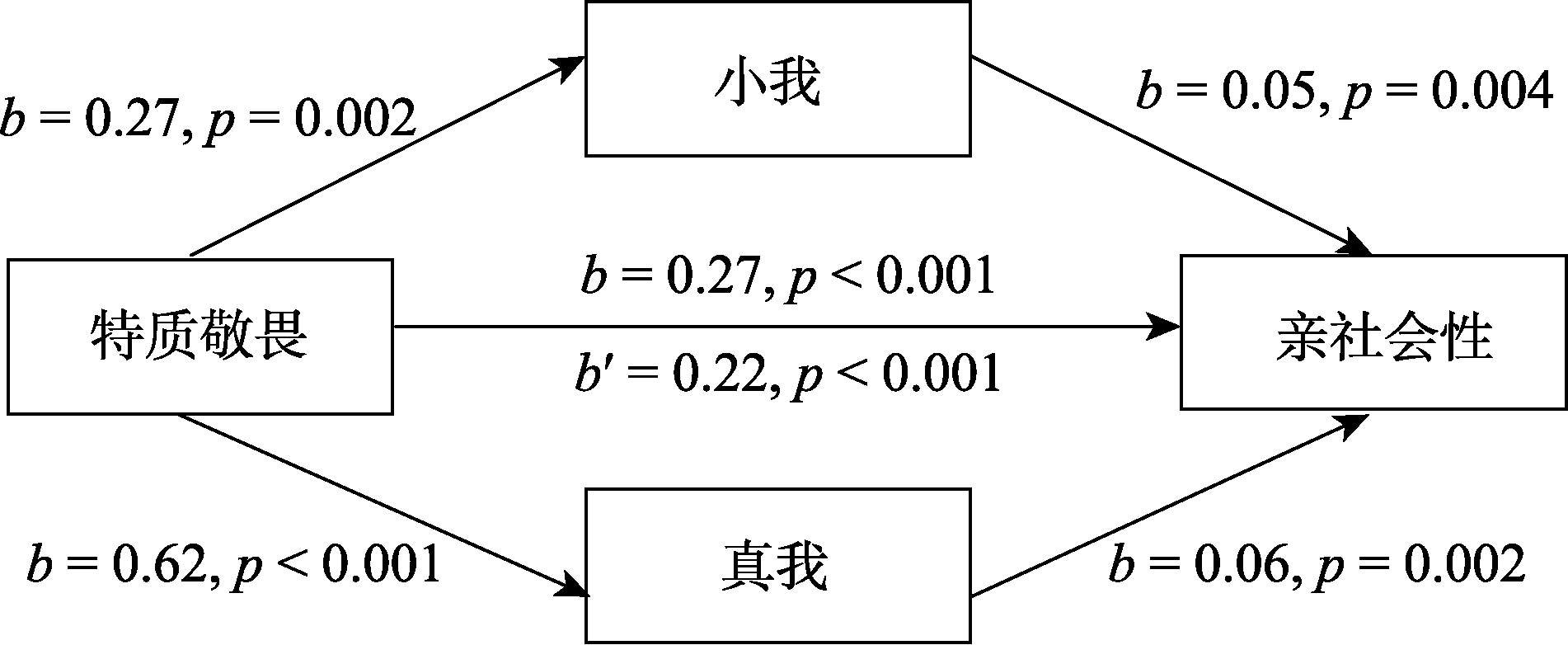
图1 特质敬畏通过小我和真我的平行中介预测亲社会性
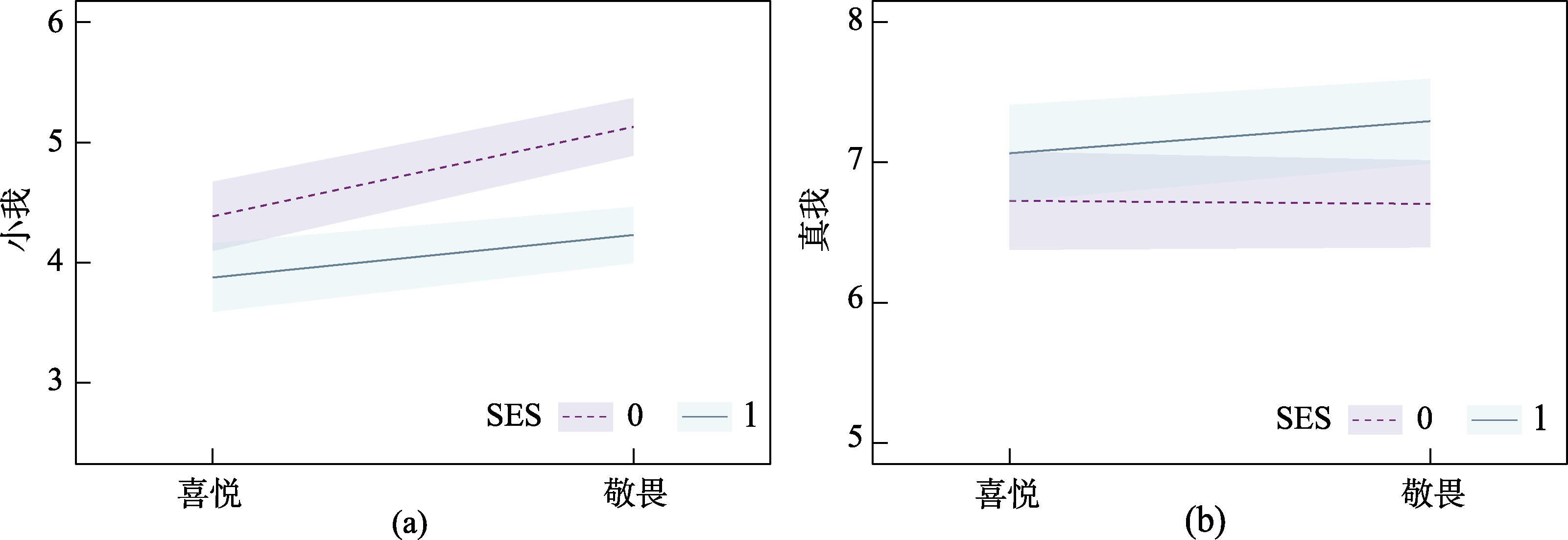
图2 社会经济地位与情绪对小我与真我的交互作用 注:SES代表社会经济地位, 0代表低社会经济地位, 1代表高社会经济地位
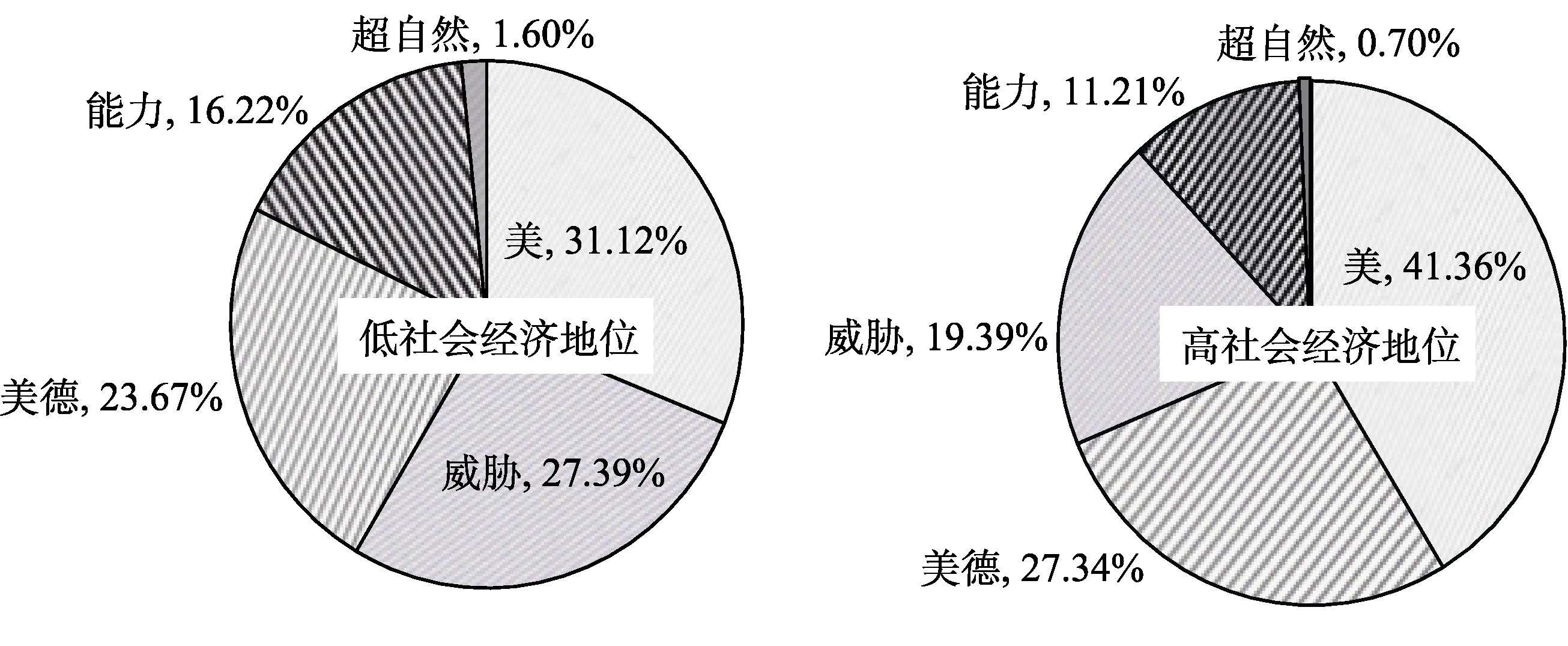
图3 不同社会经济地位者在日常体验中对五大敬畏主题的感知差异
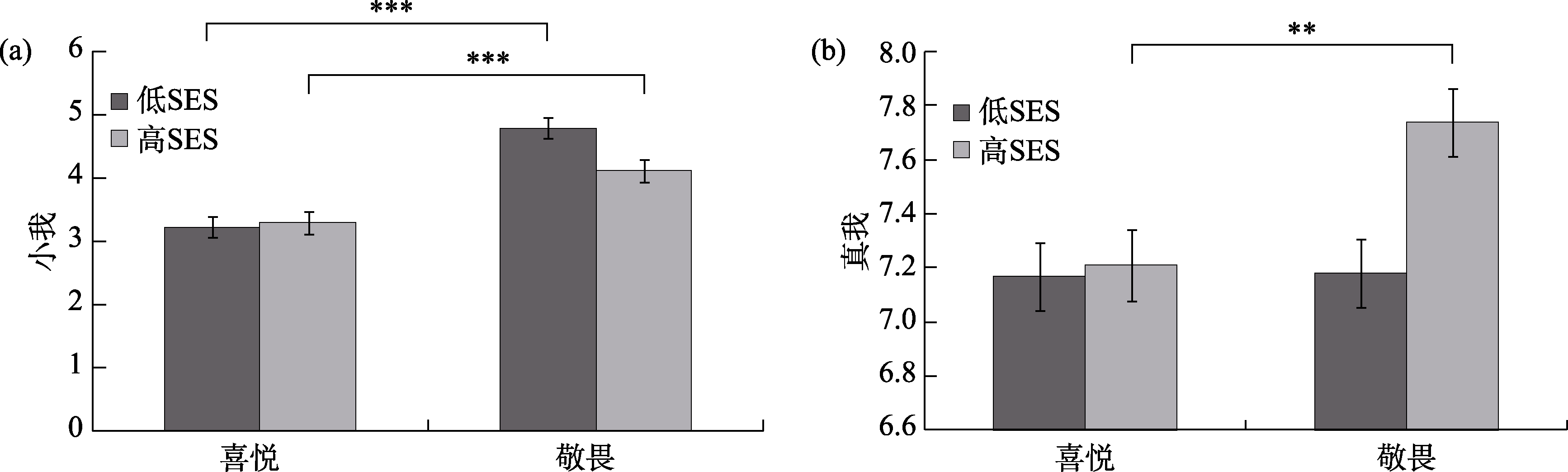
图4 社会经济地位对敬畏的小我与真我效应的调节作用
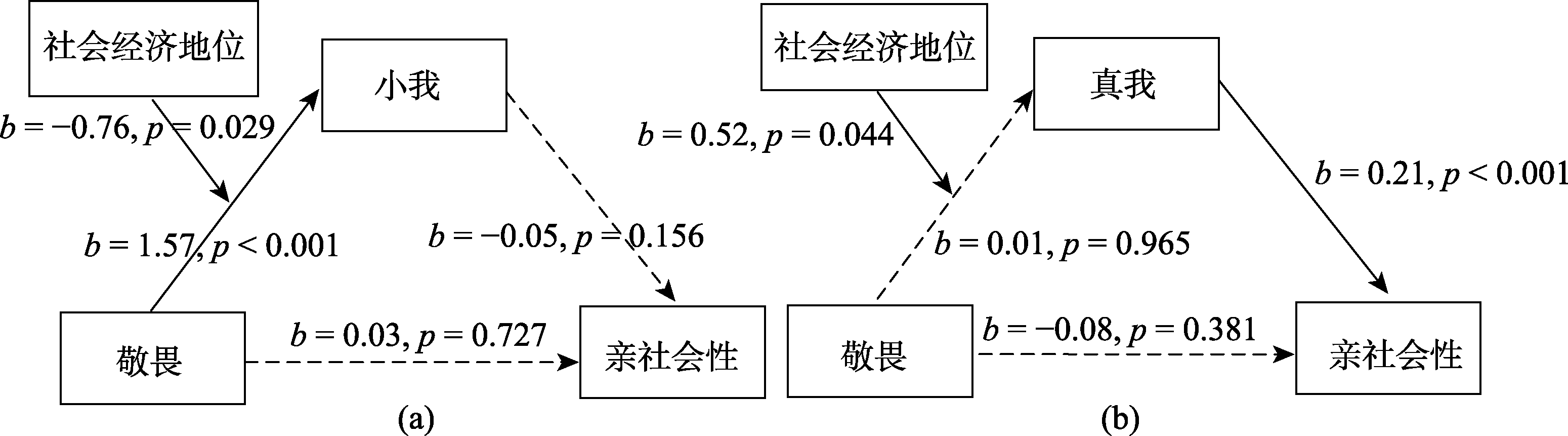
图5 有调节的中介模型(研究2b)
| 预测变量 | 结果变量 | |||||||
|---|---|---|---|---|---|---|---|---|
| 小我 (M1) | 亲社会性 (Y) | |||||||
| Coeff | SE | t | p | Coeff | SE | t | p | |
| 敬畏(X) | 1.57 | 0.24 | 6.58 | 0.000*** | 0.03 | 0.09 | 0.35 | 0.727 |
| 社会经济地位 (W) | 0.08 | 0.25 | 0.34 | 0.735 | ||||
| X×W | −0.76 | 0.35 | −2.20 | 0.029* | ||||
| 小我(M1) | −0.05 | 0.03 | −1.42 | 0.156 | ||||
| R2 = 0.23, F (3, 192) = 18.79, p < 0.001*** | R2 = 0.01, F (2, 193) = 1.06, p = 0.348 | |||||||
| 真我 (M2) | 亲社会性 (Y) | |||||||
| 敬畏(X) | 0.01 | 0.18 | 0.04 | 0.965 | −0.08 | 0.08 | −1.00 | 0.318 |
| 社会经济地位(W) | 0.04 | 0.18 | 0.20 | 0.842 | ||||
| X×W | 0.52 | 0.26 | 2.03 | 0.044* | ||||
| 真我(M2) | 0.21 | 0.04 | 4.67 | 0.000*** | ||||
| R2 = 0.07, F (3, 192) = 4.73, p = 0.003** | R2 = 0.10, F (2, 193) = 10.98, p < 0.001*** | |||||||
表3 有调节的中介模型分析结果(研究2b)
| 预测变量 | 结果变量 | |||||||
|---|---|---|---|---|---|---|---|---|
| 小我 (M1) | 亲社会性 (Y) | |||||||
| Coeff | SE | t | p | Coeff | SE | t | p | |
| 敬畏(X) | 1.57 | 0.24 | 6.58 | 0.000*** | 0.03 | 0.09 | 0.35 | 0.727 |
| 社会经济地位 (W) | 0.08 | 0.25 | 0.34 | 0.735 | ||||
| X×W | −0.76 | 0.35 | −2.20 | 0.029* | ||||
| 小我(M1) | −0.05 | 0.03 | −1.42 | 0.156 | ||||
| R2 = 0.23, F (3, 192) = 18.79, p < 0.001*** | R2 = 0.01, F (2, 193) = 1.06, p = 0.348 | |||||||
| 真我 (M2) | 亲社会性 (Y) | |||||||
| 敬畏(X) | 0.01 | 0.18 | 0.04 | 0.965 | −0.08 | 0.08 | −1.00 | 0.318 |
| 社会经济地位(W) | 0.04 | 0.18 | 0.20 | 0.842 | ||||
| X×W | 0.52 | 0.26 | 2.03 | 0.044* | ||||
| 真我(M2) | 0.21 | 0.04 | 4.67 | 0.000*** | ||||
| R2 = 0.07, F (3, 192) = 4.73, p = 0.003** | R2 = 0.10, F (2, 193) = 10.98, p < 0.001*** | |||||||
| 情绪体验 | 情绪条件 | F | ηp2 | ||
|---|---|---|---|---|---|
| 审美敬畏 | 能力敬畏 | 欢愉 | |||
| 敬畏 | 5.78c | 5.71c | 2.76a, b | 118.01*** | 0.56 |
| 欢愉 | 1.24c | 1.16c | 4.85a, b | 331.87*** | 0.78 |
| 审美享受 | 5.90b, c | 2.97a, c | 3.62a, b | 84.86*** | 0.48 |
| 钦佩 | 3.58b | 5.79a, c | 2.83b | 46.48*** | 0.34 |
表4 不同情绪操纵条件下的情绪体验(研究3a)
| 情绪体验 | 情绪条件 | F | ηp2 | ||
|---|---|---|---|---|---|
| 审美敬畏 | 能力敬畏 | 欢愉 | |||
| 敬畏 | 5.78c | 5.71c | 2.76a, b | 118.01*** | 0.56 |
| 欢愉 | 1.24c | 1.16c | 4.85a, b | 331.87*** | 0.78 |
| 审美享受 | 5.90b, c | 2.97a, c | 3.62a, b | 84.86*** | 0.48 |
| 钦佩 | 3.58b | 5.79a, c | 2.83b | 46.48*** | 0.34 |
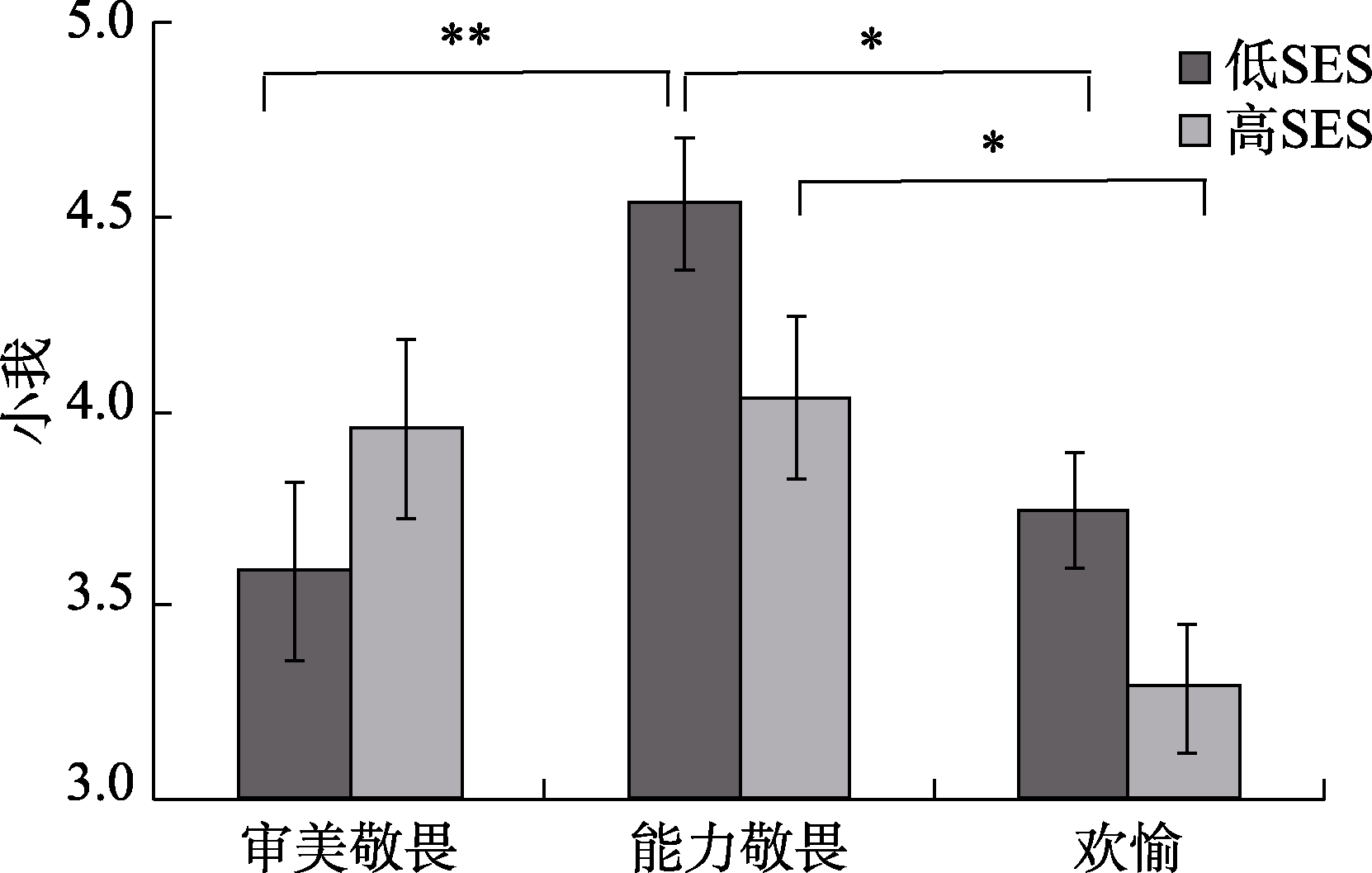
图6 社会经济地位与敬畏类型对小我的交互作用
注:*p < 0.05, **p < 0.01
| 预测变量 | 结果变量 | |||||||
|---|---|---|---|---|---|---|---|---|
| 小我 (M) | 亲社会性 (Y) | |||||||
| Coeff | SE | t | p | Coeff | SE | t | p | |
| D1 | −0.16 | 0.28 | −0.57 | 0.570 | 0.21 | 0.18 | 1.18 | 0.237 |
| D2 | 0.78 | 0.25 | 3.17 | 0.002** | 0.25 | 0.18 | 1.35 | 0.179 |
| 社会经济地位 (W) | −0.47 | 0.25 | −1.85 | 0.065 | ||||
| D1×W | 0.83 | 0.40 | 2.08 | 0.037* | ||||
| D2×W | −0.03 | 0.37 | −0.09 | 0.929 | ||||
| 小我(M) | −0.03 | 0.07 | −0.46 | 0.645 | ||||
表5 有调节的中介模型分析结果(研究3a)
| 预测变量 | 结果变量 | |||||||
|---|---|---|---|---|---|---|---|---|
| 小我 (M) | 亲社会性 (Y) | |||||||
| Coeff | SE | t | p | Coeff | SE | t | p | |
| D1 | −0.16 | 0.28 | −0.57 | 0.570 | 0.21 | 0.18 | 1.18 | 0.237 |
| D2 | 0.78 | 0.25 | 3.17 | 0.002** | 0.25 | 0.18 | 1.35 | 0.179 |
| 社会经济地位 (W) | −0.47 | 0.25 | −1.85 | 0.065 | ||||
| D1×W | 0.83 | 0.40 | 2.08 | 0.037* | ||||
| D2×W | −0.03 | 0.37 | −0.09 | 0.929 | ||||
| 小我(M) | −0.03 | 0.07 | −0.46 | 0.645 | ||||
| 情绪体验 | 情绪条件 | F | ηp2 | ||
|---|---|---|---|---|---|
| 审美敬畏 | 能力敬畏 | 喜悦 | |||
| 敬畏 | 5.65c | 5.35c | 2.61a, b | 91.21*** | 0.51 |
| 喜悦 | 4.88b, c | 3.82a, c | 5.45a, b | 20.49*** | 0.19 |
| 审美享受 | 5.98b, c | 3.94a | 4.33a | 30.74*** | 0.26 |
| 钦佩 | 3.65b | 5.82a, c | 3.49b | 34.50*** | 0.28 |
表6 不同情绪操纵条件下的情绪体验(研究3b)
| 情绪体验 | 情绪条件 | F | ηp2 | ||
|---|---|---|---|---|---|
| 审美敬畏 | 能力敬畏 | 喜悦 | |||
| 敬畏 | 5.65c | 5.35c | 2.61a, b | 91.21*** | 0.51 |
| 喜悦 | 4.88b, c | 3.82a, c | 5.45a, b | 20.49*** | 0.19 |
| 审美享受 | 5.98b, c | 3.94a | 4.33a | 30.74*** | 0.26 |
| 钦佩 | 3.65b | 5.82a, c | 3.49b | 34.50*** | 0.28 |
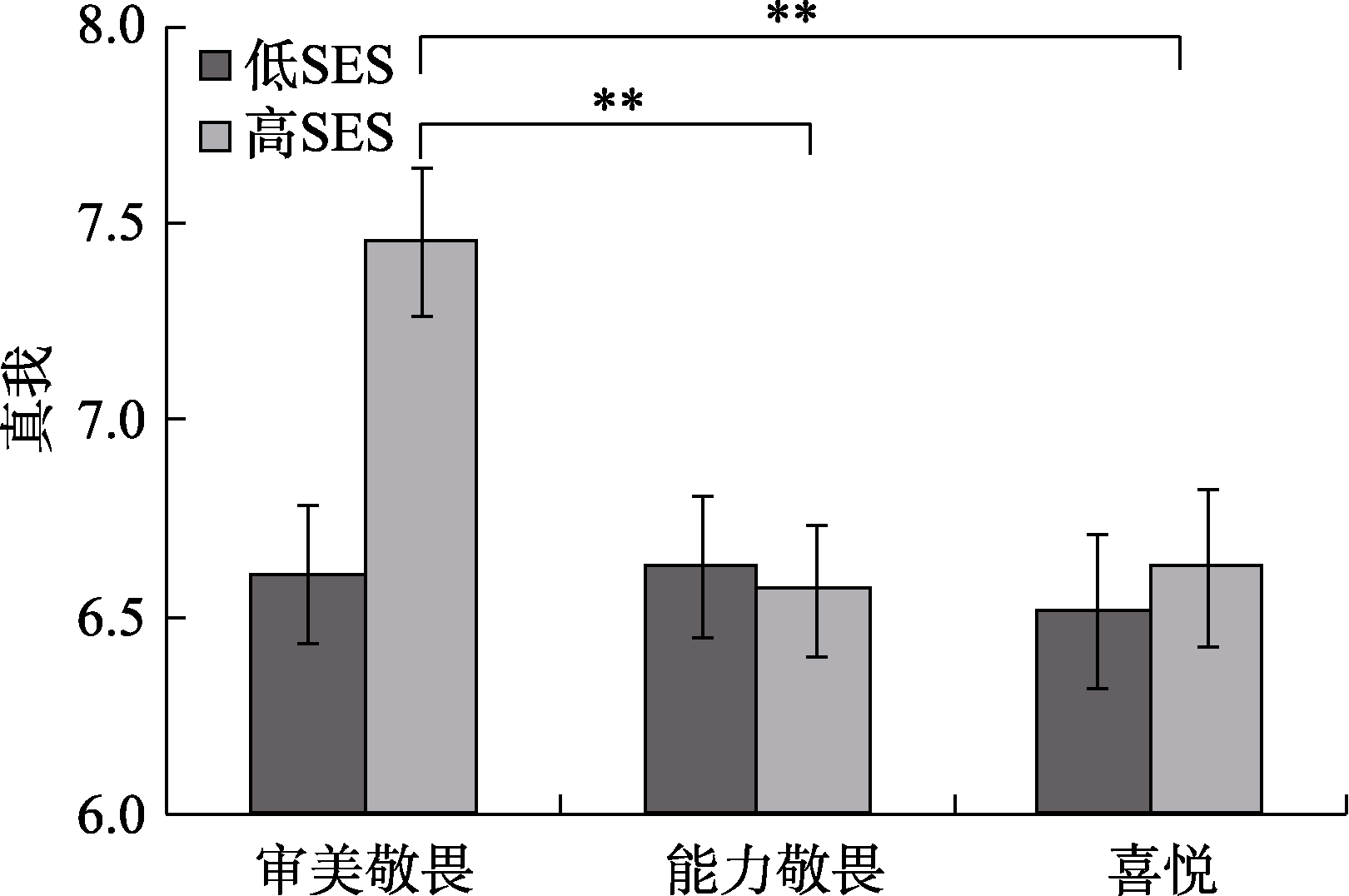
图7 社会经济地位与敬畏类型对真我的交互作用
注:**p < 0.01
| 预测变量 | 结果变量 | |||||||
|---|---|---|---|---|---|---|---|---|
| 真我 (M) | 亲社会性 (Y) | |||||||
| Coeff | SE | t | p | Coeff | SE | t | p | |
| D1 | 0.08 | 0.24 | 0.35 | 0.729 | −0.09 | 0.19 | −0.50 | 0.615 |
| D2 | 0.11 | 0.28 | 0.39 | 0.699 | −0.22 | 0.17 | −1.30 | 0.194 |
| 社会经济地位 (W) | 0.11 | 0.29 | 0.38 | 0.703 | ||||
| D1×W | 0.75 | 0.36 | 2.09 | 0.037* | ||||
| D2×W | −0.18 | 0.40 | −0.44 | 0.660 | ||||
| 真我(M) | 0.19 | 0.07 | 2.64 | 0.008** | ||||
表7 有调节的中介模型分析结果(研究3b)
| 预测变量 | 结果变量 | |||||||
|---|---|---|---|---|---|---|---|---|
| 真我 (M) | 亲社会性 (Y) | |||||||
| Coeff | SE | t | p | Coeff | SE | t | p | |
| D1 | 0.08 | 0.24 | 0.35 | 0.729 | −0.09 | 0.19 | −0.50 | 0.615 |
| D2 | 0.11 | 0.28 | 0.39 | 0.699 | −0.22 | 0.17 | −1.30 | 0.194 |
| 社会经济地位 (W) | 0.11 | 0.29 | 0.38 | 0.703 | ||||
| D1×W | 0.75 | 0.36 | 2.09 | 0.037* | ||||
| D2×W | −0.18 | 0.40 | −0.44 | 0.660 | ||||
| 真我(M) | 0.19 | 0.07 | 2.64 | 0.008** | ||||
| [1] |
Adler N. E., Epel E. S., Castellazzo G., & Ickovics J. R. (2000). Relationship of subjective and objective social status with psychological and physiological functioning: Preliminary data in healthy white women. Health Psychology, 19(6), 586-592. https://doi.org/10.1037//0278-6133.19.6.586
doi: 10.1037//0278-6133.19.6.586 URL pmid: 11129362 |
| [2] |
Bai J., Yang S., Xu B., & Guo Y. (2021). How can successful people share their goodness with the world: The psychological mechanism underlying the upper social classes’ redistributive preferences and the role of humility. Acta Psychologica Sinica, 53(10), 1161-1172. https://doi.org/10.3724/SP.J.1041.2021.01161
doi: 10.3724/SP.J.1041.2021.01161 URL |
|
[白洁, 杨沈龙, 徐步霄, 郭永玉. (2021). 达者何以兼济天下:高阶层再分配偏向的心理机制及谦卑的作用. 心理学报, 53(10), 1161-1172.]
doi: 10.3724/SP.J.1041.2021.01161 |
|
| [3] |
Bai Y., Maruskin L. A., Chen S., Gordon A. M., Stellar J. E., McNeil G. D.,... Keltner D. (2017). Awe, the diminished self, and collective engagement: Universals and cultural variations in the small self. Journal of Personality and Social Psychology, 113(2), 185-209. https://doi.org/10.1037/pspa0000087
doi: 10.1037/pspa0000087 URL pmid: 28481617 |
| [4] |
Bai Y., Ocampo J., Jin G., Chen S., Benet-Martinez V., Monroy M.,... Keltner D. (2021). Awe, daily stress, and elevated life satisfaction. Journal of Personality and Social Psychology, 120(4), 837-860. https://doi.org/10.1037/pspa0000267
doi: 10.1037/pspa0000267 URL pmid: 33764120 |
| [5] |
Carlo G., & Randall B. A. (2002). The development of a measure of prosocial behaviors for late adolescents. Journal of Youth and Adolescence, 31(1), 31-44. https://doi.org/10.1023/A:1014033032440
doi: 10.1023/A:1014033032440 URL |
| [6] |
Cheng L., & Wang X. (2023). Shining our humanity: The benefits of awe on self-humanity. Emotion, 24(3), 589-601. https://doi.org/10.1037/emo0001293
doi: 10.1037/emo0001293 URL pmid: 37676162 |
| [7] | Chirico, A., & Yaden D. B. (2018). Awe:A self-transcendent and sometimes transformative emotion. In H. C.Lench (Ed.), The function of emotions (pp. 221-233). Springer International Publishing. https://doi.org/10.1007/978-3-319-77619-4_11 |
| [8] | Cui X. (2023). The effect of social class on prosocial behavior: The role of social responsibility and awe [Unpublished master’s thesis]. Jinan University, Guangzhou. |
| [崔馨月. (2021). 社会阶层对亲社会行为的影响:社会责任感及敬畏感的作用 (硕士学位论文). 暨南大学, 广州. ] | |
| [9] |
Curran P. G. (2016). Methods for the detection of carelessly invalid responses in survey data. Journal of Experimental Social Psychology, 66, 4-19.
doi: 10.1016/j.jesp.2015.07.006 URL |
| [10] |
Danvers A. F., & Shiota M. N. (2017). Going off script: Effects of awe on memory for script-typical and -irrelevant narrative detail. Emotion, 17(6), 938-952. https://doi.org/10.1037/emo0000277
doi: 10.1037/emo0000277 URL pmid: 28230393 |
| [11] |
Detert J. R., Treviño L. K., & Sweitzer V. L. (2008). Moral disengagement in ethical decision making: A study of antecedents and outcomes. Journal of Applied Psychology, 93(2), 374-391. http://dx.doi.org/10.1037/0021-9010.93.2.374
doi: 10.1037/0021-9010.93.2.374 URL pmid: 18361639 |
| [12] |
Diehl M., Owen S., & Youngblade L. (2004). Agency and communion attributes in adults' spontaneous self- representations. International Journal of Behavioral Development, 28(1), 1-15. https://doi.org/10.1080/01650250344000226
doi: 10.1080/01650250344000226 URL |
| [13] |
Emmons R. A., & McCullough M. E. (2003). Counting blessings versus burdens: An experimental investigation of gratitude and subjective well-being in daily life. Journal of Personality and Social Psychology, 84(2), 377-389. doi:10.1037/0022-3514.84.2.377.
pmid: 12585811 |
| [14] | Fang J., Wen Z., & He Z. (2023). Moderated mediation analyses of a frequently-used types of categorical variable. Chinese Journal of Applied Psychology, 29(4), 291-299. |
| [方杰, 温忠麟, 何子杰. (2023). 常见的类别变量的有调节的中介模型分析. 应用心理学, 29(4), 291-299.] | |
| [15] |
Faul F., Erdfelder E., Lang A. G., & Buchner A. (2007). G*Power 3: A flexible statistical power analysis program for the social, behavioral, and biomedical sciences. Behavior Research Methods, 39(2), 175-191. https://doi.org/10.3758/bf03193146
doi: 10.3758/bf03193146 URL pmid: 17695343 |
| [16] |
Frimer J., Walker L., Dunlop W., Lee B., & Riches A. (2011). The integration of agency and communion in moral personality: Evidence of enlightened self-interest. Journal of Personality and Social Psychology, 101(1), 149-163. https://doi.org/10.1037/a0023780
doi: 10.1037/a0023780 URL pmid: 21574724 |
| [17] | Fu Y. N., Feng R. D., Liu Q., He Y. M., Turel O., Zhang S. Y., & He Q. H. (2022). Awe and prosocial behavior: The mediating role of presence of meaning in life and the moderating role of perceived social support. International Journal of Environmental Research and Public Health, 19(11), Article 6466. https://doi.org/10.3390/ijerph19116466 |
| [18] |
Galinsky A. D., Magee J. C., Gruenfeld D. H, Whitson J. A., & Liljenquist K. A. (2008). Power reduces the press of the situation: Implications for creativity, conformity, and dissonance. Journal of Personality and Social Psychology, 95(6), 1450-1466. https://doi.org/10.1037/a0012633
doi: 10.1037/a0012633 URL pmid: 19025295 |
| [19] |
Gan M., Heller D., & Chen S. (2018). The power in being yourself: Feeling authentic enhances the sense of power. Personality and Social Psychology Bulletin, 44(10), 1460-1472. https://doi.org/10.1177/014616721877100
doi: 10.1177/0146167218771000 URL pmid: 29739292 |
| [20] |
Gordon A. M., Stellar J. E., Anderson C. L., McNeil G. D., Loew D., & Keltner D. (2017). The dark side of the sublime: Distinguishing a threat-based variant of awe. Journal of Personality and Social Psychology, 113(2), 310-328. https://doi.org/10.1037/pspp0000120
doi: 10.1037/pspp0000120 URL pmid: 27929301 |
| [21] |
Guan F., Chen J., Chen O., Liu L., & Zha Y. (2019). Awe and prosocial tendency. Current Psychology, 38(4), 1033-1041. https://doi.org/10.1007/s12144-019-00244-7
doi: 10.1007/s12144-019-00244-7 URL |
| [22] | Hayes A. F. (2018). Introduction to mediation, moderation, and conditional process analysis: A regression-based approach (2nd ed.). New York: Guilford Press. |
| [23] | Huang L., Yang T., & Ji Z. (2003). Applicability of the positive and negative affect scale in Chinese. Chinese Mental Health Journal, 17(1), 54-56. |
| [黄丽, 杨廷忠, 季忠民. (2003). 正性负性情绪量表的中国人群适用性研究. 中国心理卫生杂志, 17(1), 54-56.] | |
| [24] | Ihm, E. D., Paloutzian R. F., van Elk M., & Schooler J. W. (2019). Awe as a meaning-making emotion:On the evolution of awe and the origin of religions. In J. R.Feierman & L.Oviedo (Eds.), The evolution of religion, religiosity and theology (pp. 138-153). Routledge. |
| [25] |
Jiang T., Hicks J., Yuan W., Yin Y., Needy L., & Vess M. (2024). The unique nature and psychosocial implications of awe. Nature Reviews Psychology, 3, 475-488. https://doi.org/10.1038/s44159-024-00322-z
doi: 10.1038/s44159-024-00322-z URL |
| [26] |
Jiang T., & Sedikides C. (2022). Awe motivates authentic-self pursuit via self-transcendence: Implications for prosociality. Journal of Personality and Social Psychology, 123(3), 576-596. https://doi.org/10.1037/pspi0000381
doi: 10.1037/pspi0000381 URL |
| [27] | Jiao L. M., & Luo L. (2022). Dispositional awe positively predicts prosocial tendencies: The multiple mediation effects of connectedness and empathy. International Journal of Environmental Research and Public Health, 19(24), Article 16605. https://doi.org/10.3390/ijerph192416605 |
| [28] | Joye Y., & Bolderdijk J. (2015). An exploratory study into the effects of extraordinary nature on emotions, mood, and prosociality. Frontiers in Psychology, 5, Article 1577. https://doi.org/10.3389/fpsyg.2014.01577 |
| [29] |
Keltner D., & Haidt J. (2003). Approaching awe, a moral, spiritual, and aesthetic emotion. Cognition and Emotion, 17(2), 297-314. https://doi.org/10.1080/02699930302297
doi: 10.1080/02699930302297 URL |
| [30] |
Keltner D., & Piff P. (2020). Self-transcendent awe as a moral grounding of wisdom. Psychological Inquiry, 31(2), 160-163. https://doi.org/10.1080/1047840X.2020.1750927
doi: 10.1080/1047840X.2020.1750927 URL |
| [31] | Konečni V. J. (2005). The aesthetic trinity: Awe, being moved, thrills. Bulletin of Psychology and the Arts, 5(2), 27-44. https://doi.org/10.1037/e674862010-005 |
| [32] | Kou Y., Hong H., Tan C., & Li L. (2007). Revisioning prosocial tendencies measure for adolescent. Psychological Development and Education, 23(1), 112-117. |
| [寇彧, 洪慧芳, 谭晨, 李磊. (2007). 青少年亲社会倾向量表的修订. 心理发展与教育, 23(1),112-117.] | |
| [33] |
Kraus M. W., Côté S., & Keltner D. (2010). Social class, contextualism, and empathic accuracy. Psychological Science, 21(11), 1716-1723. https://doi.org/10.1177/0956797610387613
doi: 10.1177/0956797610387613 URL pmid: 20974714 |
| [34] |
Kraus M. W., Piff P. K., & Keltner D. (2009). Social class, sense of control, and social explanation. Journal of Personality and Social Psychology, 97(6), 992-1004. https://doi.org/10.1037/a0016357
doi: 10.1037/a0016357 URL pmid: 19968415 |
| [35] |
Kraus M. W., Piff P. K., & Keltner D. (2011). Social class as culture: The convergence of resources and rank in the social realm. Current Directions in Psychological Science, 20(4), 246-250. https://doi.org/10.1177/0963721411414654
doi: 10.1177/0963721411414654 URL |
| [36] |
Kraus M. W., Piff P. K., Mendoza-Denton R., Rheinschmidt M. L., & Keltner D. (2012). Social class, solipsism, and contextualism: How the rich are different from the poor. Psychological Review, 119(3), 546-572. https://doi.org/10.1037/a0028756
doi: 10.1037/a0028756 URL pmid: 22775498 |
| [37] | Kuznetsova A., Brockhoff P. B., & Christensen R. H. B. (2017). Imer test package: Tests in linear mixed effects models. Journal of Statistical Software, 82(13), 1-26. https://doi.org/10.18637/jss.v082.i13 |
| [38] |
Lenton A. P., Bruder M., Slabu L., & Sedikides C. (2013). How does “being real” feel? The experience of state authenticity. Journal of Personality, 81(3), 276-289. https://doi.org/10.1111/j.1467-6494.2012.00805.x
doi: 10.1111/jopy.2013.81.issue-3 URL |
| [39] | Lin R., Chen Y., Shen Y., Xiong X., Lin N., & Lian R. (2021). Dispositional awe and online altruism: Testing a moderated mediating model. Frontiers in Psychology, 12, Article 688591. https://doi.org/10.3389/fpsyg.2021.688591 |
| [40] | Lin R., Hong Y., Xiao H., & Lian R. (2020). Dispositional awe and prosocial tendency: The mediating roles of self-transcendent meaning in life and spiritual self- transcendence. Social Behavior and Personality, 48(12), 1-10. https://doi.org/10.2224/sbp.9665 |
| [41] |
Luo L., Zou R., Yang D., & Yuan J. (2022). Awe experience triggered by fighting against COVID-19 promotes prosociality through increased feeling of connectedness and empathy. The Journal of Positive Psychology, 18(6), 866-882. https://doi.org/10.1080/17439760.2022.2131607
doi: 10.1080/17439760.2022.2131607 URL |
| [42] |
Mansfield E. D., & McAdams D. P. (1996). Generativity and themes of agency and communion in adult autobiography. Personality and Social Psychology Bulletin, 22(7), 721-731. https://doi.org/10.1177/0146167296227006
doi: 10.1177/0146167296227006 URL |
| [43] | Maslow A. H. (1962). Toward a psychology of being. Princeton: Van Nostrand. |
| [44] | McDougall W. (1910). Instinct and intelligence. British Journal of Psychology, 3(3), 250-266. https://doi.org/10.1111/j.2044-8295.1910.tb00204.x |
| [45] |
Meng L., & Wang X. (2022). Awe in the workplace promotes prosocial behavior. PsyCh Journal, 12(1), 44-53. https://doi.org/10.1002/pchj.593
doi: 10.1002/pchj.593 URL pmid: 36058883 |
| [46] |
Mesquita B., Boiger M., & De Leersnyder J. (2016). The cultural construction of emotions. Current Opinion in Psychology, 8, 31-36. http://dx.doi.org/10.1016/j.copsyc.2015.09.015
doi: S2352-250X(15)00241-9 URL pmid: 29506799 |
| [47] | Nelson-Coffey S. K., Ruberton P. M., Chancellor J., Cornick J. E., Blascovich J., & Lyubomirsky S. (2019). The proximal experience of awe. PloS One, 14(5), Article e0216780. https://doi.org/10.1371/journal.pone.0216780 |
| [48] |
Norenzayan A., & Heine S. J. (2005). Psychological universals: What are they and how can we know? Psychological Bulletin, 131(5), 763-784. http://dx.doi.org/10.1037/0033-2909.131.5.763
URL pmid: 16187859 |
| [49] |
Oveis C., Horberg E. J., & Keltner D. (2010). Compassion, pride, and social intuitions of self-other similarity. Journal of Personality and Social Psychology, 98(4), 618-630. https://doi.org/10.1037/a0017628
doi: 10.1037/a0017628 URL pmid: 20307133 |
| [50] |
Perlin J. D., & Li L. (2020). Why does awe have prosocial effects? New perspectives on awe and the small self. Perspectives on Psychological Science, 15(2), 291-308. https://doi.org/10.1177/1745691619886006
doi: 10.1177/1745691619886006 URL pmid: 31930954 |
| [51] |
Piff P. K. (2014). Wealth and the inflated self: Class, entitlement, and narcissism. Personality and Social Psychology Bulletin, 40(1), 34-43. http://dx.d0i.0rg/l0.1177/0146167213501699
doi: 10.1177/0146167213501699 URL pmid: 23963971 |
| [52] |
Piff P. K., Dietze P., Feinberg M., Stancato D. M., & Keltner D. (2015). Awe, the small self, and prosocial behavior. Journal of Personality and Social Psychology, 108(6), 883-899. https://doi.org/10.1037/pspi0000018
doi: 10.1037/pspi0000018 URL pmid: 25984788 |
| [53] |
Piff P. K., Kraus M. W., Côté S., Cheng B. H., & Keltner D. (2010). Having less, giving more: The influence of social class on prosocial behavior. Journal of Personality and Social Psychology, 99(5), 771-784. http://dx.doi.org/10.1037/a0020092
doi: 10.1037/a0020092 URL pmid: 20649364 |
| [54] |
Piff P. K., Martinez A. G., & Keltner D. (2012). Me against we: In-group transgression, collective shame, and in-group-directed hostility. Cognition and Emotion, 26(4), 634-649. http://dx.doi.org/10.1080/02699931.2011.595394
doi: 10.1080/02699931.2011.595394 URL |
| [55] |
Prade C., & Saroglou V. (2016). Awe’s effects on generosity and helping. The Journal of Positive Psychology, 11(5), 522-530. https://doi.org/10.1080/17439760.2015.1127992
doi: 10.1080/17439760.2015.1127992 URL |
| [56] | Qian Z. C. (2018). A study on the relationship between awe and moral judgment of college students [Unpublished master’s thesis]. Nanjing Normal University. |
| [钱昭臣. (2018). 大学生敬畏情绪与道德判断的关系研究(硕士学位论文). 南京师范大学.] | |
| [57] |
Rudd M., Vohs K. D., & Aaker J. (2012). Awe expands people’s perception of time, alters decision making, and enhances well-being. Psychological Science, 23(10), 1130-1136. https://doi.org/10.1177/0956797612438731
doi: 10.1177/0956797612438731 URL |
| [58] |
Schmader T., & Sedikides C. (2018). State authenticity as fit to environment: The implications of social identity for fit, authenticity, and self-segregation. Personality and Social Psychology Review, 22(3), 228-259. https://doi.org/10.1177/1088868317734080
doi: 10.1177/1088868317734080 URL pmid: 28975851 |
| [59] |
Schoemann A. M., Boulton A. J., & Short S. D. (2017). Determining power and sample size for simple and complex mediation models. Social Psychological and Personality Science, 8(4), 379-386. https://doi.org/10.1177/1948550617715068
doi: 10.1177/1948550617715068 URL |
| [60] |
Sedikides C., Lenton A. P., Slabu L., & Thomaes S. (2019). Sketching the contours of state authenticity. Review of General Psychology, 23(1), 73-88. https://doi.org/10.1037/gpr0000156
doi: 10.1037/gpr0000156 URL |
| [61] |
Septianto F., Nasution R. A., Arnita D., & Seo Y. (2022). The role of threat-based awe and construal level in charitable advertising. European Journal of Marketing, 56(5), 1532-1555. https://doi.org/10.1108/EJM-06-2021-0403
doi: 10.1108/EJM-06-2021-0403 URL |
| [62] |
Shiota M. N., Keltner D., & John O. P. (2006). Positive emotion dispositions differentially associated with Big Five personality and attachment style. The Journal of Positive Psychology, 1(2), 61-71. https://doi.org/10.1080/17439760500510833
doi: 10.1080/17439760500510833 URL |
| [63] |
Shiota M. N., Keltner D., & Mossman A. (2007). The nature of awe: Elicitors, appraisals, and effects on self-concept. Cognition and Emotion, 21(5), 944-963. https://doi.org/10.1080/02699930600923668
doi: 10.1080/02699930600923668 URL |
| [64] |
So J., Achar C., Han D., Agrawal N., Duhachek A., & Maheswaran D. (2015). The psychology of appraisal: Specific emotions and decision-making. Journal of Consumer Psychology, 25(3), 359-371. https://doi.org/10.1016/j.jcps.2015.04.003
doi: 10.1016/j.jcps.2015.04.003 URL |
| [65] | Stell A. J. (2018). Awe as a self-transcending emotion [Unpublished doctoral dissertation]. University of Sussex. https://hdl.handle.net/10779/uos.23456144.v1 |
| [66] | Stellar J. E. (2021). Awe helps us remember why it is important to forget the self. Annals of the New York Academy of Sciences, 1501(1), 81-84. https://doi.org/10.1111/nyas.14577 |
| [67] |
Stellar J. E., Gordon A. M., Piff P. K., Cordaro D., Anderson C. L., Bai Y.,... Keltner D. (2017). Self-transcendent emotions and their social functions: Compassion, gratitude, and awe bind us to others through prosociality. Emotion Review, 9(3), 200-207. https://doi.org/10.1177/1754073916684557
doi: 10.1177/1754073916684557 URL |
| [68] |
Stephens N. M., Markus H. R., & Townsend S. M. (2007). Choice as an act of meaning: The case of social class. Journal of Personality and Social Psychology, 93(5), 814-830.
pmid: 17983302 |
| [69] |
Sturm V. E., Datta S., Roy A. R. K., Sible I. J., Kosik E. L., Veziris C. R.,... Keltner D. (2022). Big smile, small self: Awe walks promote prosocial positive emotions in older adults. Emotion, 22(5), 1044-1058. https://doi.org/10.1037/emo0000876
doi: 10.1037/emo0000876 URL |
| [70] | Tracy, J. L., Weidman A. C., Cheng J. T., & Martens J. P. (2014). Pride:The fundamental emotion of success, power, and status. In M. M.Tugade, M. N.Shiot, & L. D.Kirby (Eds.), Handbook of positive emotions (pp. 294-310). The Guilford Press. |
| [71] |
Tyson C., Hornsey M. J., & Barlow F. K. (2022). What does it mean to feel small? Three dimensions of the small self. Self and Identity, 21(4), 387-405. https://doi.org/10.1080/15298868.2021.1921018
doi: 10.1080/15298868.2021.1921018 URL |
| [72] |
van Cappellen P., & Saroglou V. (2012). Awe activates religious and spiritual feelings and behavioral intentions. Psychology of Religion and Spirituality, 4(3), 223-236.
doi: 10.1037/a0025986 URL |
| [73] |
Waller M., Mistry D., Jetly R., & Frewen P. (2021). Meditating in virtual reality 3: 360° video of perceptual presence of instructor. Mindfulness, 12(6), 1424-1437. https://doi.org/10.1007/s12671-021-01612-w
doi: 10.1007/s12671-021-01612-w URL |
| [74] |
Watson D., Clark L. A., & Tellegen A. (1988). Development and validation of brief measures of positive and negative affect: The PANAS scales. Journal of Personality and Social Psychology, 54(6), 1063-1070. https://doi.org/10.1037/0022-3514.54.6.1063
doi: 10.1037//0022-3514.54.6.1063 URL pmid: 3397865 |
| [75] |
Yang S., Rao T., Yu F., & Guo Y. (2022). Subjective class research in psychology of social class: Its contributions and deficiencies. Advances in Psychological Science, 30(8), 1883-1893. https://doi.org/10.3724/SP.J.1042.2022.01883
doi: 10.3724/SP.J.1042.2022.01883 URL |
|
[杨沈龙, 饶婷婷, 喻丰, 郭永玉. (2022). 主观阶层研究取向的贡献与弊端. 心理科学进展, 30(8), 1883-1893.]
doi: 10.3724/SP.J.1042.2022.01883 |
|
| [76] | Yang Y., Yang Z., Bao T., Liu Y., & Passmore H. A. (2016). Elicited awe decreases aggression. Journal of Pacific Rim Psychology, 10, Article e11. https://doi.org/10.1017/prp.2016.8 |
| [77] |
Yuan W., Du Y., & Jiang T. (2024). How and when awe improves meaning in life: The role of authentic-self pursuit and trait authenticity. Emotion, 24(2), 412-430. https://doi.org/10.1037/emo0001278
doi: 10.1037/emo0001278 URL |
| [78] | Zhou H., & Long L. (2004). Statistical remedies for common method biases. Advances in Psychological Science, 12(6), 942-950. |
| [周浩, 龙立荣. (2004). 共同方法偏差的统计检验与控制方法. 心理科学进展, 12(6), 942-950.] | |
| [79] | Zhou L., Li S., Peng K., Wang Y., & Guan F. (2022). Revision the Chinese version of the awe experience scale. Chinese Journal of Clinical Psychology, 30(5), 1138-1142. |
| [周凌霄, 李姗殷, 彭凯平, 王阳, 管芳. (2022). 敬畏体验量表的中文版修订. 中国临床心理学杂志, 30(5), 1138-1142.] |
| [1] | 林荣茂, 余巧华, 胡添祥, 张九妹, 叶玉珊, 连榕. 敬畏感与亲社会行为关系的三水平和结构方程模型元分析[J]. 心理学报, 2025, 57(4): 631-651. |
| [2] | 张丽锦, 暴卿, 陈蕾, 梁渊. 儿童认知发展水平诊断工具IPDT的动态化编制及其在低社会经济地位儿童中的应用[J]. 心理学报, 2021, 53(9): 960-975. |
| [3] | 王琳, 陈增祥, 何云. 传承动机对金融冒险行为的影响:未来自我连续性的中介[J]. 心理学报, 2020, 52(8): 1004-1016. |
| [4] | 程亚华, 伍新春, 刘红云, 李虹. 小学低年级儿童口语词汇知识的发展轨迹及其影响因素[J]. 心理学报, 2018, 50(2): 206-215. |
| [5] | 顾红磊, 刘君, 夏天生. 家庭社会经济地位对小学生阅读自主性的影响: 父母鼓励和阅读动机的中介作用[J]. 心理学报, 2017, 49(8): 1063-1071. |
| [6] | 黄婷婷; 刘莉倩;王大华;张文海. 经济地位和计量地位:社会地位比较对主观幸福感的影响及其年龄差异[J]. 心理学报, 2016, 48(9): 1163-1174. |
| [7] | 李锐;田晓明;柳士顺. 仁慈领导会增加员工的亲社会性规则违背吗?[J]. 心理学报, 2015, 47(5): 637-652. |
| 阅读次数 | ||||||
|
全文 |
|
|||||
|
摘要 |
|
|||||
