

ISSN 0439-755X
CN 11-1911/B
主办:中国心理学会
中国科学院心理研究所
出版:科学出版社
CN 11-1911/B
主办:中国心理学会
中国科学院心理研究所
出版:科学出版社
心理学报 ›› 2025, Vol. 57 ›› Issue (9): 1572-1588.doi: 10.3724/SP.J.1041.2025.1572 cstr: 32110.14.2025.1572
李亚琴1,2, 代佳佳1, 高伟1, 袁加锦1,2( )
)
收稿日期:2024-04-18
发布日期:2025-06-26
出版日期:2025-09-25
通讯作者:
袁加锦, E-mail: yuanjiajin168@126.com作者简介:第一联系人:李亚琴和代佳佳同为第一作者。
基金资助:
LI Yaqin1,2, DAI Jiajia1, GAO Wei1, YUAN Jiajin1,2()
Received:2024-04-18
Online:2025-06-26
Published:2025-09-25
摘要: 基于执行意图的认知重评(Implementation Intention-based Reappraisal, IIR)作为一种执行意图(即if-then计划)与适应性认知重评相结合的新自动化情绪调节策略, 可以在不增加认知负荷的情况下实现对负面情绪的调节, 且该调节效应可以从设定情境(If情境)泛化到非设定情境。然而, 以往研究未关注IIR的泛化效果是否具有可持续性。为解决这一问题, 本研究采用脑电技术结合图片观看任务, 以被试自我报告的效价、唤醒度和晚期正电位(late positive potential, LPP)为指标纵向考察IIR对被试当下及未来一周的情绪调节效果。结果显示, 在第0~7天, 相比控制组, IIR组对设定负性情境(血腥图片)的情绪体验及唤醒水平持续降低; 且该调节效应同样稳定出现在对非设定情境(非血腥图片)的唤醒度评价上。同时, 在第0天、第3天和第7天, IIR组相比控制组有更小的中央顶区LPP (400~1500 ms)波幅和额区LPP (400~1100 ms)波幅; 且中央顶区LPP波幅与唤醒度存在显著正相关。上述结果说明IIR不仅能长期调节负性情绪并产生泛化效应, 且其泛化效果存在一定的持续性。这一研究为IIR在情绪调节领域的有效性和稳定性提供了实证支持。
中图分类号:
李亚琴, 代佳佳, 高伟, 袁加锦. (2025). 基于执行意图的认知重评对负性情绪的持续调节效应:纵向脑电证据. 心理学报, 57(9), 1572-1588.
LI Yaqin, DAI Jiajia, GAO Wei, YUAN Jiajin. (2025). Sustainable regulation effects of implementation intention-based reappraisal on negative emotions: Longitudinal EEG evidence. Acta Psychologica Sinica, 57(9), 1572-1588.
| 变量 | 血腥图片 | 非血腥图片 | 中性图片 | p |
|---|---|---|---|---|
| 效价 | 7.47(0.68) | 7.43(0.67) | 4.85(0.20) | 0.999 |
| 唤醒度 | 6.33(1.66) | 6.28(1.61) | 1.46(0.68) | 0.999 |
| 血腥度 | 6.18(1.53) | 2.51(1.17) | 1.01(0.03) | < 0.001 |
| 恶心度 | 6.19(1.70) | 6.48(1.51) | 1.10(0.20) | 0.206 |
| 恐惧度 | 4.90(1.88) | 5.09(1.77) | 1.09(0.20) | 0.800 |
表1 材料评定结果
| 变量 | 血腥图片 | 非血腥图片 | 中性图片 | p |
|---|---|---|---|---|
| 效价 | 7.47(0.68) | 7.43(0.67) | 4.85(0.20) | 0.999 |
| 唤醒度 | 6.33(1.66) | 6.28(1.61) | 1.46(0.68) | 0.999 |
| 血腥度 | 6.18(1.53) | 2.51(1.17) | 1.01(0.03) | < 0.001 |
| 恶心度 | 6.19(1.70) | 6.48(1.51) | 1.10(0.20) | 0.206 |
| 恐惧度 | 4.90(1.88) | 5.09(1.77) | 1.09(0.20) | 0.800 |
| 量表名称 | Cronbach α | KMO值 | Bartlett球形检验 | 公因子累积方差贡献率 | 所有题项的因子载荷 |
|---|---|---|---|---|---|
| 正负性情绪量表 | PA = 0.92 NA = 0.92 | 0.80 | p < 0.001 | 61.86% | > 0.50 |
| 特质焦虑问卷 | 0.89 | 0.80 | p < 0.001 | 66.85% | > 0.50 |
| 状态焦虑问卷 | 0.90 | 0.76 | p < 0.001 | 70.19% | > 0.50 |
| 贝克抑郁量表第二版 | 0.87 | 0.60 | p < 0.001 | 75.80% | > 0.50 |
| 情绪表达量表 | 0.93 | 0.86 | p < 0.001 | 68.51% | > 0.50 |
| 情绪调节问卷 | ERQ-R = 0.89 ERQ-S = 0.81 | 0.75 | p < 0.001 | 65.83% | > 0.50 |
| 认知灵活性问卷 | 0.87 | 0.84 | p < 0.001 | 64.49% | > 0.50 |
表2 本研究中各量表的信效度检验结果
| 量表名称 | Cronbach α | KMO值 | Bartlett球形检验 | 公因子累积方差贡献率 | 所有题项的因子载荷 |
|---|---|---|---|---|---|
| 正负性情绪量表 | PA = 0.92 NA = 0.92 | 0.80 | p < 0.001 | 61.86% | > 0.50 |
| 特质焦虑问卷 | 0.89 | 0.80 | p < 0.001 | 66.85% | > 0.50 |
| 状态焦虑问卷 | 0.90 | 0.76 | p < 0.001 | 70.19% | > 0.50 |
| 贝克抑郁量表第二版 | 0.87 | 0.60 | p < 0.001 | 75.80% | > 0.50 |
| 情绪表达量表 | 0.93 | 0.86 | p < 0.001 | 68.51% | > 0.50 |
| 情绪调节问卷 | ERQ-R = 0.89 ERQ-S = 0.81 | 0.75 | p < 0.001 | 65.83% | > 0.50 |
| 认知灵活性问卷 | 0.87 | 0.84 | p < 0.001 | 64.49% | > 0.50 |

图1 SAM评定任务 注:彩图见电子版, 下同。
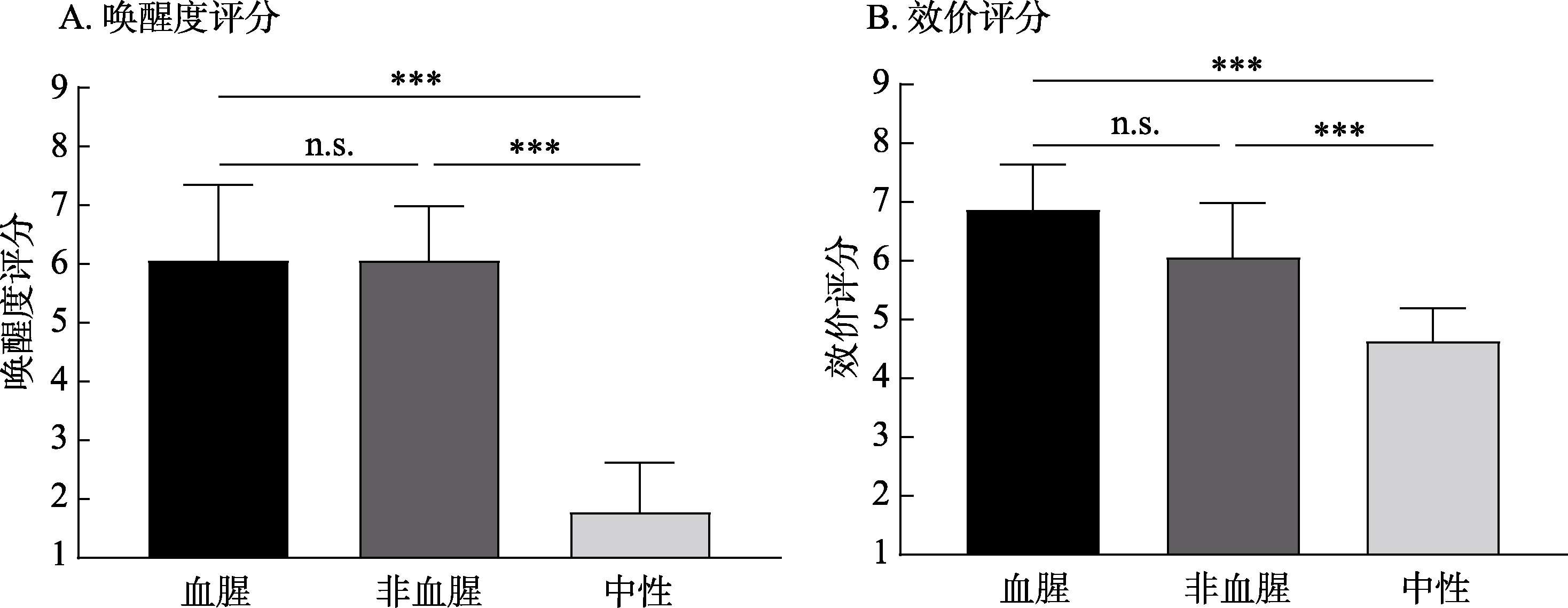
图2 情绪操纵检查结果。A, 控制组对不同图片的唤醒度评分。B, 控制组对不同图片的效价评分。 注: *p < 0.05, **p < 0.01, ***p < 0.001, n.s. p > 0.05。图中误差线为标准差。
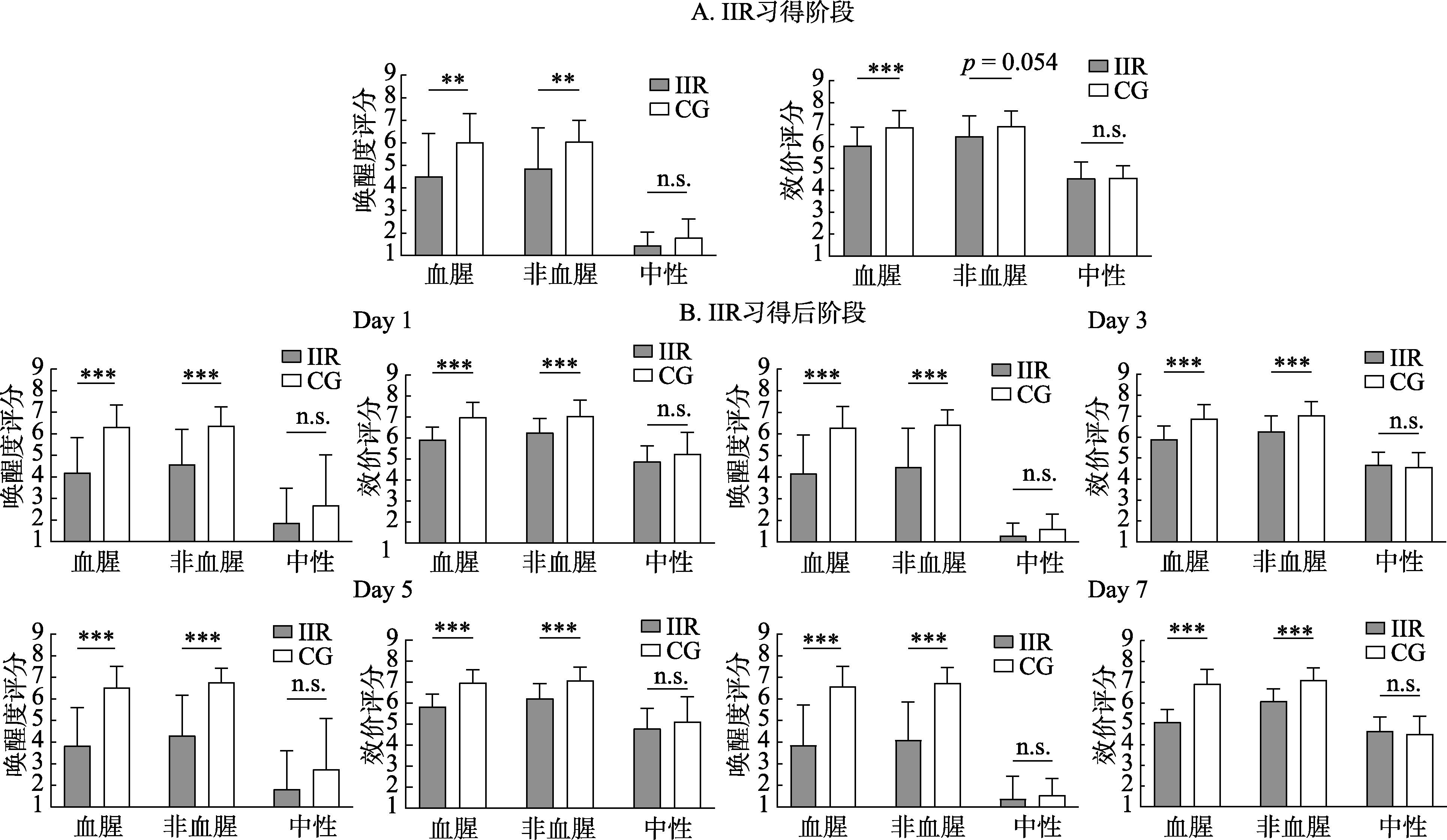
图3 IIR习得及习得后唤醒度和效价上的交互效应。A, 在IIR习得阶段(Day0), IIR组和控制组对不同图片类型的唤醒度和效价评分; 出现的边缘显著结果均标注了具体p值, 下同。B, IIR习得后第1~7天, 唤醒度和效价上的交互效应。在Day1和Day5, 效价的组别×图片类型的交互效应边缘显著, 但简单效应分析(Bonferroni矫正)发现, 在血腥和非血腥条件下均出现IIR组的效价评分显著低于控制组(ps < 0.001)。 注: *p < 0.05, **p < 0.01, ***p < 0.001, n.s. p > 0.05。图中误差线为标准差。
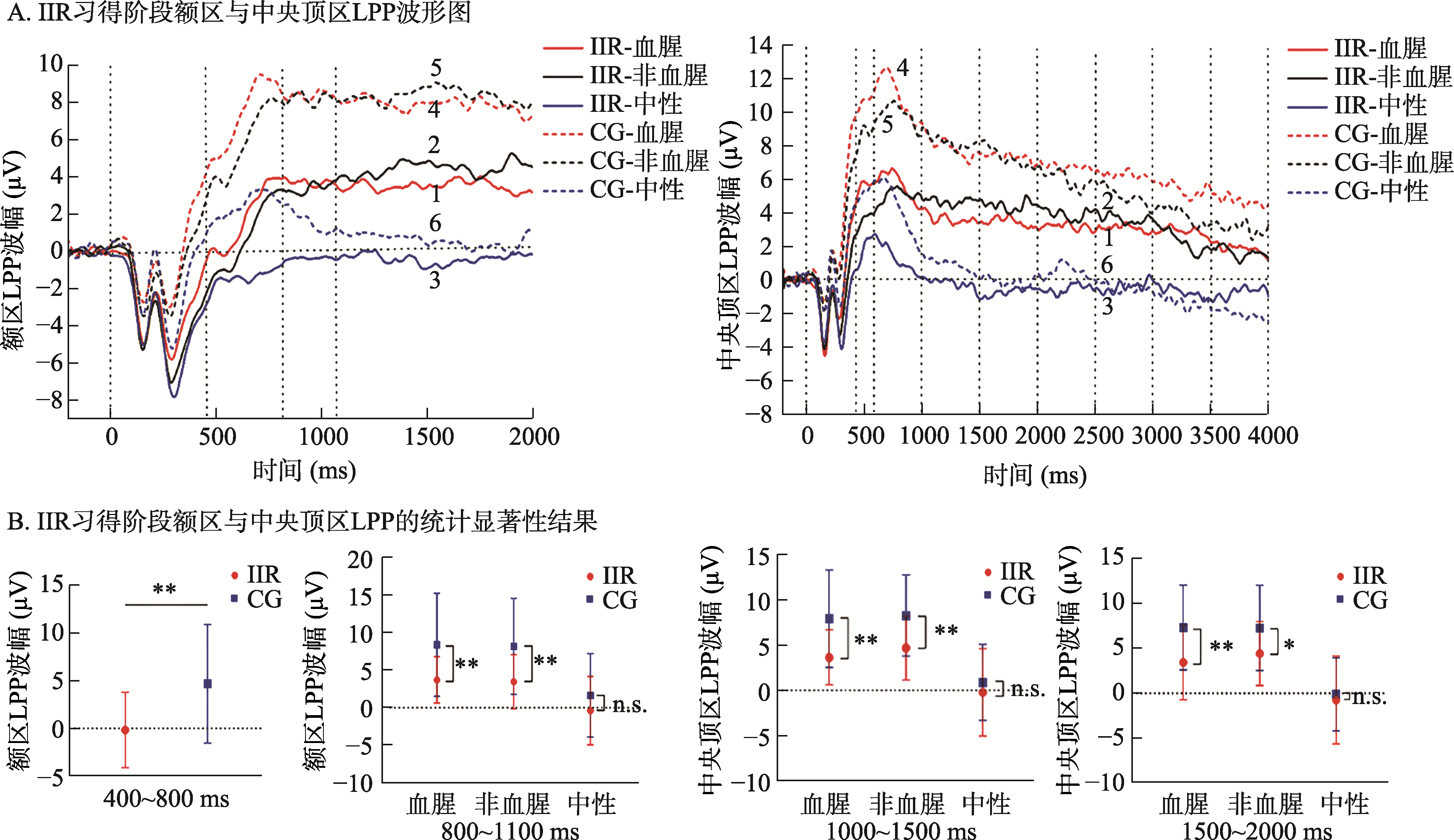
图4 IIR习得阶段不同时间窗中额区与中央顶区LPP的波形及统计显著性分析结果。A, 额区与中央顶区LPP波形图; 左侧为额区LPP波幅, 右侧为中央顶区LPP波幅。B, 不同时间窗内额区与中央顶区LPP波幅的组别主效应及组别×图片类型交互效应的显著性结果; 从左往右依次为额区LPP (400~1100 ms)波幅的组别主效应及组别×图片类型交互效应显著性结果、中央顶区LPP (1000~2000 ms)波幅的组别×图片类型交互效应显著性结果。 注:为提高黑白印刷下的可辨识度, 图A中各波形线上标注了数字编号(1~6), 依次表示IIR-血腥、IIR-非血腥、IIR-中性、CG-血腥、CG-非血腥和CG-中性条件。图中误差线为标准差。*p < 0.05, **p < 0.01, ***p < 0.001, n.s. p > 0.05。
| LPP时间窗 (ms) | IIR(n = 22) | CG(n = 22) | 组别主效应 | 图片类型主效应 | 组别×图片类型交互效应 |
|---|---|---|---|---|---|
| 400~600 | 3.53(3.07) | 8.08(4.96) | p < 0.001 η2 p = 0.241 | p < 0.001 η2 p = 0.509 | p = 0.161 η2 p = 0.044 |
| 600~1000 | 3.97(2.94) | 8.35(4.85) | p < 0.001 η2 p = 0.237 | p < 0.001 η2 p = 0.583 | p = 0.114 η2 p = 0.053 |
| 1000~1500 | 2.70(3.16) | 5.69(4.15) | p = 0.010 η2 p = 0.147 | p < 0.001 η2 p = 0.617 | p = 0.023 η2 p = 0.090 |
| 1500~2000 | 2.38(3.44) | 4.85(3.81) | p = 0.030 η2 p = 0.108 | p < 0.001 η2 p = 0.585 | p = 0.043 η2 p = 0.074 |
| 2000~2500 | 2.18(3.26) | 4.42(3.94) | p = 0.046 η2 p = 0.091 | p < 0.001 η2 p = 0.462 | p = 0.173 η2 p = 0.041 |
| 2500~3000 | 2.10(3.17) | 3.60(3.83) | p = 0.164 η2 p = 0.046 | p < 0.001 η2 p = 0.434 | p = 0.086 η2 p = 0.058 |
| 3000~3500 | 1.50(2.93) | 2.66(3.93) | p = 0.274 η2 p = 0.028 | p < 0.001 η2 p = 0.377 | p = 0.124 η2 p = 0.049 |
| 3500~4000 | 0.90(3.06) | 1.90(3.72) | p = 0.334 η2 p = 0.022 | p < 0.001 η2 p = 0.336 | p = 0.025 η2 p = 0.084 |
表3 IIR习得阶段中央顶区LPP不同时间窗中主效应与交互效应分析结果
| LPP时间窗 (ms) | IIR(n = 22) | CG(n = 22) | 组别主效应 | 图片类型主效应 | 组别×图片类型交互效应 |
|---|---|---|---|---|---|
| 400~600 | 3.53(3.07) | 8.08(4.96) | p < 0.001 η2 p = 0.241 | p < 0.001 η2 p = 0.509 | p = 0.161 η2 p = 0.044 |
| 600~1000 | 3.97(2.94) | 8.35(4.85) | p < 0.001 η2 p = 0.237 | p < 0.001 η2 p = 0.583 | p = 0.114 η2 p = 0.053 |
| 1000~1500 | 2.70(3.16) | 5.69(4.15) | p = 0.010 η2 p = 0.147 | p < 0.001 η2 p = 0.617 | p = 0.023 η2 p = 0.090 |
| 1500~2000 | 2.38(3.44) | 4.85(3.81) | p = 0.030 η2 p = 0.108 | p < 0.001 η2 p = 0.585 | p = 0.043 η2 p = 0.074 |
| 2000~2500 | 2.18(3.26) | 4.42(3.94) | p = 0.046 η2 p = 0.091 | p < 0.001 η2 p = 0.462 | p = 0.173 η2 p = 0.041 |
| 2500~3000 | 2.10(3.17) | 3.60(3.83) | p = 0.164 η2 p = 0.046 | p < 0.001 η2 p = 0.434 | p = 0.086 η2 p = 0.058 |
| 3000~3500 | 1.50(2.93) | 2.66(3.93) | p = 0.274 η2 p = 0.028 | p < 0.001 η2 p = 0.377 | p = 0.124 η2 p = 0.049 |
| 3500~4000 | 0.90(3.06) | 1.90(3.72) | p = 0.334 η2 p = 0.022 | p < 0.001 η2 p = 0.336 | p = 0.025 η2 p = 0.084 |
| 时间 | LPP | LPP时间窗(ms) | IIR(n = 22) | CG(n = 22) | 组别主效应 | 图片类型主效应 | 组别×图片类型交互效应 |
|---|---|---|---|---|---|---|---|
| Day3 | 额区LPP | ||||||
| 400~800 | -2.21(4.62) | 2.01(5.28) | p = 0.007 η2 p = 0.159 | p < 0.001 η2 p = 0.391 | p = 0.770 η2 p = 0.006 | ||
| 800~1100 | 1.45(3.88) | 4.37(3.75) | p = 0.015 η2 p = 0.133 | p < 0.001 η2 p = 0.595 | p = 0.793 η2 p = 0.005 | ||
| 中央顶区LPP | |||||||
| 400~600 | 0.36(3.43) | 5.60(5.07) | p < 0.001 η2 p = 0.277 | p < 0.001 η2 p = 0.366 | p = 0.716 η2 p = 0.007 | ||
| 600~1000 | 2.82(3.08) | 6.64(3.87) | p < 0.001 η2 p = 0.238 | p < 0.001 η2 p = 0.625 | p = 0.821 η2 p = 0.004 | ||
| 1000~1500 | 2.44(3.60) | 4.78(3.20) | p = 0.028 η2 p = 0.110 | p < 0.001 η2 p = 0.617 | p = 0.452 η2 p = 0.019 | ||
| 1500~2000 | 2.18(3.83) | 4.05(3.37) | p = 0.093 η2 p = 0.066 | p < 0.001 η2 p = 0.532 | p = 0.850 η2 p = 0.004 | ||
| 2000~2500 | 1.62(3.57) | 3.13(3.61) | p = 0.171 η2 p = 0.044 | p < 0.001 η2 p = 0.423 | p = 0.340 η2 p = 0.025 | ||
| Day7 | 额区LPP | ||||||
| 400~800 | -2.72(3.59) | 0.68(6.22) | p = 0.032 η2 p = 0.105 | p < 0.001 η2 p = 0.291 | p = 0.183 η2 p = 0.040 | ||
| 800~1100 | 1.00(2.66) | 3.66(4.75) | p = 0.027 η2 p = 0.111 | p < 0.001 η2 p = 0.513 | p = 0.304 η2 p = 0.027 | ||
| 中央顶区LPP | |||||||
| 400~600 | -0.33(3.24) | 3.89(6.08) | p = 0.006 η2 p = 0.164 | p < 0.001 η2 p = 0.248 | p = 0.043 η2 p = 0.074 | ||
| 600~1000 | 1.90(1.90) | 5.51(4.62) | p = 0.002 η2 p = 0.215 | p < 0.001 η2 p = 0.479 | p = 0.268 η2 p = 0.031 | ||
| 1000~1500 | 1.66(2.75) | 4.37(3.82) | p = 0.010 η2 p = 0.148 | p < 0.001 η2 p = 0.477 | p = 0.445 η2 p = 0.018 | ||
| 1500~2000 | 0.94(3.41) | 3.45(4.30) | p = 0.038 η2 p = 0.099 | p < 0.001 η2 p = 0.343 | p = 0.737 η2 p = 0.006 | ||
| 2000~2500 | 0.30(4.00) | 3.01(4.47) | p = 0.040 η2 p = 0.097 | p < 0.001 η2 p = 0.200 | p = 0.747 η2 p = 0.006 |
表4 IIR习得后阶段额区与中央顶区LPP各时间窗中主效应与交互效应分析结果
| 时间 | LPP | LPP时间窗(ms) | IIR(n = 22) | CG(n = 22) | 组别主效应 | 图片类型主效应 | 组别×图片类型交互效应 |
|---|---|---|---|---|---|---|---|
| Day3 | 额区LPP | ||||||
| 400~800 | -2.21(4.62) | 2.01(5.28) | p = 0.007 η2 p = 0.159 | p < 0.001 η2 p = 0.391 | p = 0.770 η2 p = 0.006 | ||
| 800~1100 | 1.45(3.88) | 4.37(3.75) | p = 0.015 η2 p = 0.133 | p < 0.001 η2 p = 0.595 | p = 0.793 η2 p = 0.005 | ||
| 中央顶区LPP | |||||||
| 400~600 | 0.36(3.43) | 5.60(5.07) | p < 0.001 η2 p = 0.277 | p < 0.001 η2 p = 0.366 | p = 0.716 η2 p = 0.007 | ||
| 600~1000 | 2.82(3.08) | 6.64(3.87) | p < 0.001 η2 p = 0.238 | p < 0.001 η2 p = 0.625 | p = 0.821 η2 p = 0.004 | ||
| 1000~1500 | 2.44(3.60) | 4.78(3.20) | p = 0.028 η2 p = 0.110 | p < 0.001 η2 p = 0.617 | p = 0.452 η2 p = 0.019 | ||
| 1500~2000 | 2.18(3.83) | 4.05(3.37) | p = 0.093 η2 p = 0.066 | p < 0.001 η2 p = 0.532 | p = 0.850 η2 p = 0.004 | ||
| 2000~2500 | 1.62(3.57) | 3.13(3.61) | p = 0.171 η2 p = 0.044 | p < 0.001 η2 p = 0.423 | p = 0.340 η2 p = 0.025 | ||
| Day7 | 额区LPP | ||||||
| 400~800 | -2.72(3.59) | 0.68(6.22) | p = 0.032 η2 p = 0.105 | p < 0.001 η2 p = 0.291 | p = 0.183 η2 p = 0.040 | ||
| 800~1100 | 1.00(2.66) | 3.66(4.75) | p = 0.027 η2 p = 0.111 | p < 0.001 η2 p = 0.513 | p = 0.304 η2 p = 0.027 | ||
| 中央顶区LPP | |||||||
| 400~600 | -0.33(3.24) | 3.89(6.08) | p = 0.006 η2 p = 0.164 | p < 0.001 η2 p = 0.248 | p = 0.043 η2 p = 0.074 | ||
| 600~1000 | 1.90(1.90) | 5.51(4.62) | p = 0.002 η2 p = 0.215 | p < 0.001 η2 p = 0.479 | p = 0.268 η2 p = 0.031 | ||
| 1000~1500 | 1.66(2.75) | 4.37(3.82) | p = 0.010 η2 p = 0.148 | p < 0.001 η2 p = 0.477 | p = 0.445 η2 p = 0.018 | ||
| 1500~2000 | 0.94(3.41) | 3.45(4.30) | p = 0.038 η2 p = 0.099 | p < 0.001 η2 p = 0.343 | p = 0.737 η2 p = 0.006 | ||
| 2000~2500 | 0.30(4.00) | 3.01(4.47) | p = 0.040 η2 p = 0.097 | p < 0.001 η2 p = 0.200 | p = 0.747 η2 p = 0.006 |

图5 IIR习得后阶段不同时间窗中额区与中央顶区LPP的波形及统计显著性分析结果。A, 第3天额区与中央顶区LPP波形图; 左侧为额区LPP波幅, 右侧为中央顶区LPP波幅。B, 第3天不同时间窗内额区与中央顶区LPP波幅的组别主效应显著性结果; 从左往右依次为额区LPP (400~1100 ms)、中央顶区LPP (400~1500 ms)波幅的结果。C, 第7天额区与中央顶区LPP波形图; 左侧为额区LPP波幅, 右侧为中央顶区LPP波幅。D, 第7天不同时间窗内额区与中央顶区LPP波幅的组别主效应及组别×图片类型交互效应的显著性结果; 从左往右依次为额区LPP (400~1100 ms)波幅的组别主效应显著性结果、中央顶区LPP (400~2500 ms)波幅的组别主效应显著性结果以及中央顶区LPP (400~600 ms)波幅的组别×图片类型交互效应显著性结果。 注: *p < 0.05, **p < 0.01, ***p < 0.001, n.s. p > 0.05。图中误差线为标准差。为提高黑白印刷下的可辨识度, 图A和图C中各波形线上标注了数字编号(1~6), 依次表示IIR-血腥、IIR-非血腥、IIR-中性、CG-血腥、CG-非血腥和CG-中性条件。
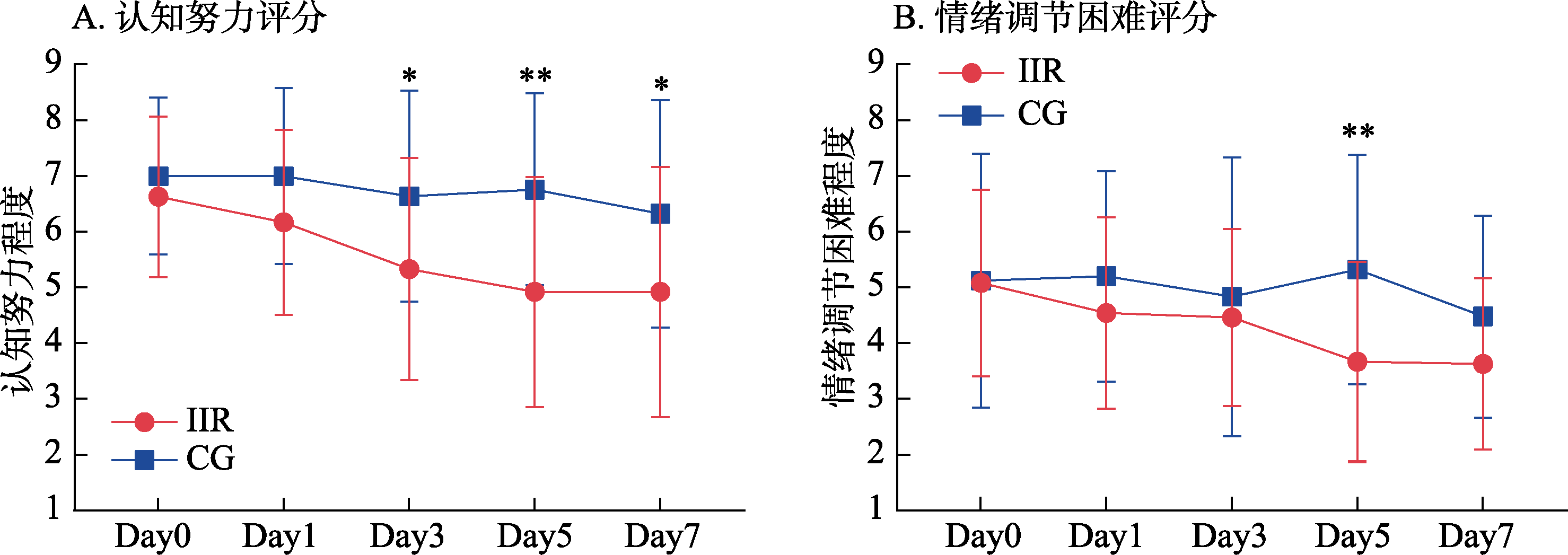
图6 实验后调查结果。A, 认知努力程度评分, 1 = 没有, 9 = 非常。B, 情绪调节困难程度评分, 1 = 没有, 9 = 非常。 注: *p < 0.05, **p < 0.01, ***p < 0.001, n.s. p > 0.05。图中误差线为标准差。
| 变量 | IIR (n = 25) | CG (n = 26) | t | p | Cohen’s d |
|---|---|---|---|---|---|
| 年龄 | 20.16(2.25) | 19.46(1.39) | 1.33 | 0.192 | 0.375 |
| 正性情绪 | 25.24(7.48) | 27.04(7.42) | -0.86 | 0.393 | 0.241 |
| 负性情绪 | 13.16(4.50) | 14.46(4.64) | -1.02 | 0.314 | 0.285 |
| 状态焦虑 | 35.76(8.56) | 36.08(7.15) | -0.14 | 0.886 | 0.040 |
| 特质焦虑 | 39.12(8.63) | 39.35(7.30) | -0.10 | 0.920 | 0.028 |
| 抑郁 | 4.40(4.79) | 5.08(5.28) | -0.48 | 0.634 | 0.134 |
| 情绪表达 | 64.84(13.45) | 61.88(13.13) | 0.79 | 0.431 | 0.222 |
| 认知重评 | 32.28(6.03) | 32.65(5.89) | -0.22 | 0.82 | 0.063 |
| 认知灵活性 | 34.16(7.49) | 35.58(7.06) | -0.70 | 0.49 | 0.195 |
附表1 IIR习得前被试的情绪特质及状态
| 变量 | IIR (n = 25) | CG (n = 26) | t | p | Cohen’s d |
|---|---|---|---|---|---|
| 年龄 | 20.16(2.25) | 19.46(1.39) | 1.33 | 0.192 | 0.375 |
| 正性情绪 | 25.24(7.48) | 27.04(7.42) | -0.86 | 0.393 | 0.241 |
| 负性情绪 | 13.16(4.50) | 14.46(4.64) | -1.02 | 0.314 | 0.285 |
| 状态焦虑 | 35.76(8.56) | 36.08(7.15) | -0.14 | 0.886 | 0.040 |
| 特质焦虑 | 39.12(8.63) | 39.35(7.30) | -0.10 | 0.920 | 0.028 |
| 抑郁 | 4.40(4.79) | 5.08(5.28) | -0.48 | 0.634 | 0.134 |
| 情绪表达 | 64.84(13.45) | 61.88(13.13) | 0.79 | 0.431 | 0.222 |
| 认知重评 | 32.28(6.03) | 32.65(5.89) | -0.22 | 0.82 | 0.063 |
| 认知灵活性 | 34.16(7.49) | 35.58(7.06) | -0.70 | 0.49 | 0.195 |
| 变量 | IIR (n = 25) | CG (n = 26) | t | p | Cohen’s d |
|---|---|---|---|---|---|
| PA-Day1 | 24.72(9.05) | 26.27(7.90) | -0.65 | 0.517 | 0.183 |
| PA-Day3 | 24.08(8.51) | 25.92(8.45) | -0.78 | 0.442 | 0.217 |
| PA-Day5 | 23.80(9.07) | 26.19(7.88) | -1.01 | 0.319 | 0.282 |
| PA-Day7 | 24.04(8.75) | 24.67(7.47) | -0.26 | 0.794 | 0.077 |
| NA-Day1 | 13.28(4.37) | 13.46(3.88) | -0.16 | 0.876 | 0.044 |
| NA-Day3 | 11.96(2.59) | 12.62(3.15) | -0.81 | 0.422 | 0.227 |
| NA-Day5 | 12.24(3.49) | 12.73(3.80) | -0.48 | 0.634 | 0.134 |
| NA-Day7 | 11.87(3.05) | 12.79(3.60) | -0.95 | 0.349 | 0.276 |
| SAI-Day1 | 35.40(7.72) | 36.27(8.42) | -0.38 | 0.703 | 0.108 |
| SAI-Day3 | 36.04(8.25) | 36.65(7.42) | -0.28 | 0.781 | 0.078 |
| SAI-Day5 | 36.24(7.99) | 36.35(7.68) | -0.05 | 0.962 | 0.014 |
| SAI-Day7 | 35.29(7.83) | 37.64(8.28) | -1.02 | 0.313 | 0.291 |
附表2 IIR习得后阶段被试在各实验前的情绪状态
| 变量 | IIR (n = 25) | CG (n = 26) | t | p | Cohen’s d |
|---|---|---|---|---|---|
| PA-Day1 | 24.72(9.05) | 26.27(7.90) | -0.65 | 0.517 | 0.183 |
| PA-Day3 | 24.08(8.51) | 25.92(8.45) | -0.78 | 0.442 | 0.217 |
| PA-Day5 | 23.80(9.07) | 26.19(7.88) | -1.01 | 0.319 | 0.282 |
| PA-Day7 | 24.04(8.75) | 24.67(7.47) | -0.26 | 0.794 | 0.077 |
| NA-Day1 | 13.28(4.37) | 13.46(3.88) | -0.16 | 0.876 | 0.044 |
| NA-Day3 | 11.96(2.59) | 12.62(3.15) | -0.81 | 0.422 | 0.227 |
| NA-Day5 | 12.24(3.49) | 12.73(3.80) | -0.48 | 0.634 | 0.134 |
| NA-Day7 | 11.87(3.05) | 12.79(3.60) | -0.95 | 0.349 | 0.276 |
| SAI-Day1 | 35.40(7.72) | 36.27(8.42) | -0.38 | 0.703 | 0.108 |
| SAI-Day3 | 36.04(8.25) | 36.65(7.42) | -0.28 | 0.781 | 0.078 |
| SAI-Day5 | 36.24(7.99) | 36.35(7.68) | -0.05 | 0.962 | 0.014 |
| SAI-Day7 | 35.29(7.83) | 37.64(8.28) | -1.02 | 0.313 | 0.291 |
| 时间 | LPP | LPP时间窗 (ms) | 血腥 | 非血腥 | 中性 | 图片类型主效应 |
|---|---|---|---|---|---|---|
| Day0 | 额区LPP | |||||
| 400~800 | 3.98(6.49) | 2.59(5.72) | 0.22(6.06) | p < 0.001 η2 p = 0.353 | ||
| 800~1100 | 6.04(5.78) | 5.82(5.66) | 0.62(5.13) | p < 0.001 η2 p = 0.553 | ||
| 中央顶区LPP | ||||||
| 400~600 | 7.98(5.37) | 5.99(4.88) | 3.44(4.88) | p < 0.001 η2 p = 0.509 | ||
| 600~1000 | 8.29(5.41) | 7.48(5.13) | 2.72(4.50) | p < 0.001 η2 p = 0.583 | ||
| 1000~1500 | 5.78(4.83) | 6.48(4.37) | 0.33(4.49) | p < 0.001 η2 p = 0.617 | ||
| 1500~2000 | 5.39(4.83) | 5.86(4.39) | -0.42(4.46) | p < 0.001 η2 p = 0.585 | ||
| 2000~2500 | 4.97(5.10) | 4.99(4.56) | -0.05(4.04) | p < 0.001 η2 p = 0.462 | ||
| 2500~3000 | 4.67(5.37) | 4.33(4.39) | -0.46(3.63) | p < 0.001 η2 p = 0.434 | ||
| 3000~3500 | 4.16(5.23) | 3.10(4.98) | -1.03(3.29) | p < 0.001 η2 p = 0.377 | ||
| 3500~4000 | 3.28(5.22) | 2.34(4.79) | -1.42(3.46) | p < 0.001 η2 p = 0.336 | ||
| Day3 | 额区LPP | |||||
| 400~800 | 0.85(5.76) | 0.94(5.80) | -2.07(5.33) | p < 0.001 η2 p = 0.391 | ||
| 800~1100 | 4.31(4.28) | 4.74(4.79) | -0.31(4.35) | p < 0.001 η2 p = 0.595 | ||
| 中央顶区LPP | ||||||
| 400~600 | 4.24(5.81) | 3.62(5.40) | 1.07(4.83) | p < 0.001 η2 p = 0.366 | ||
| 600~1000 | 6.28(4.55) | 6.60(4.63) | 1.32(3.96) | p < 0.001 η2 p = 0.625 | ||
| 1000~1500 | 5.17(3.93) | 5.40(4.38) | 0.26(3.80) | p < 0.001 η2 p = 0.617 | ||
| 1500~2000 | 4.64(3.66) | 4.79(4.86) | -0.08(4.19) | p < 0.001 η2 p = 0.532 | ||
| 2000~2500 | 3.59(3.85) | 4.10(5.02) | -0.57(4.27) | p < 0.001 η2 p = 0.423 | ||
| Day7 | 额区LPP | |||||
| 400~800 | -0.31(6.37) | -0.05(5.48) | -2.71(5.00) | p < 0.001 η2 p = 0.291 | ||
| 800~1100 | 3.67(5.52) | 4.24(4.60) | -0.92(3.63) | p < 0.001 η2 p = 0.513 | ||
| 中央顶区LPP | ||||||
| 400~600 | 2.42(6.24) | 2.47(5.44) | 0.44(4.87) | p < 0.001 η2 p = 0.248 | ||
| 600~1000 | 4.57(5.09) | 5.45(4.53) | 1.09(3.54) | p < 0.001 η2 p = 0.479 | ||
| 1000~1500 | 4.11(4.48) | 4.75(4.18) | 0.19(3.80) | p < 0.001 η2 p = 0.477 | ||
| 1500~2000 | 3.05(4.83) | 3.63(4.92) | -0.10(4.17) | p < 0.001 η2 p = 0.343 | ||
| 2000~2500 | 2.45(5.44) | 2.46(5.26) | 0.06(4.10) | p < 0.001 η2 p = 0.200 |
附表3 IIR习得及习得后额区与中央顶区LPP各时间窗内图片类型主效应分析
| 时间 | LPP | LPP时间窗 (ms) | 血腥 | 非血腥 | 中性 | 图片类型主效应 |
|---|---|---|---|---|---|---|
| Day0 | 额区LPP | |||||
| 400~800 | 3.98(6.49) | 2.59(5.72) | 0.22(6.06) | p < 0.001 η2 p = 0.353 | ||
| 800~1100 | 6.04(5.78) | 5.82(5.66) | 0.62(5.13) | p < 0.001 η2 p = 0.553 | ||
| 中央顶区LPP | ||||||
| 400~600 | 7.98(5.37) | 5.99(4.88) | 3.44(4.88) | p < 0.001 η2 p = 0.509 | ||
| 600~1000 | 8.29(5.41) | 7.48(5.13) | 2.72(4.50) | p < 0.001 η2 p = 0.583 | ||
| 1000~1500 | 5.78(4.83) | 6.48(4.37) | 0.33(4.49) | p < 0.001 η2 p = 0.617 | ||
| 1500~2000 | 5.39(4.83) | 5.86(4.39) | -0.42(4.46) | p < 0.001 η2 p = 0.585 | ||
| 2000~2500 | 4.97(5.10) | 4.99(4.56) | -0.05(4.04) | p < 0.001 η2 p = 0.462 | ||
| 2500~3000 | 4.67(5.37) | 4.33(4.39) | -0.46(3.63) | p < 0.001 η2 p = 0.434 | ||
| 3000~3500 | 4.16(5.23) | 3.10(4.98) | -1.03(3.29) | p < 0.001 η2 p = 0.377 | ||
| 3500~4000 | 3.28(5.22) | 2.34(4.79) | -1.42(3.46) | p < 0.001 η2 p = 0.336 | ||
| Day3 | 额区LPP | |||||
| 400~800 | 0.85(5.76) | 0.94(5.80) | -2.07(5.33) | p < 0.001 η2 p = 0.391 | ||
| 800~1100 | 4.31(4.28) | 4.74(4.79) | -0.31(4.35) | p < 0.001 η2 p = 0.595 | ||
| 中央顶区LPP | ||||||
| 400~600 | 4.24(5.81) | 3.62(5.40) | 1.07(4.83) | p < 0.001 η2 p = 0.366 | ||
| 600~1000 | 6.28(4.55) | 6.60(4.63) | 1.32(3.96) | p < 0.001 η2 p = 0.625 | ||
| 1000~1500 | 5.17(3.93) | 5.40(4.38) | 0.26(3.80) | p < 0.001 η2 p = 0.617 | ||
| 1500~2000 | 4.64(3.66) | 4.79(4.86) | -0.08(4.19) | p < 0.001 η2 p = 0.532 | ||
| 2000~2500 | 3.59(3.85) | 4.10(5.02) | -0.57(4.27) | p < 0.001 η2 p = 0.423 | ||
| Day7 | 额区LPP | |||||
| 400~800 | -0.31(6.37) | -0.05(5.48) | -2.71(5.00) | p < 0.001 η2 p = 0.291 | ||
| 800~1100 | 3.67(5.52) | 4.24(4.60) | -0.92(3.63) | p < 0.001 η2 p = 0.513 | ||
| 中央顶区LPP | ||||||
| 400~600 | 2.42(6.24) | 2.47(5.44) | 0.44(4.87) | p < 0.001 η2 p = 0.248 | ||
| 600~1000 | 4.57(5.09) | 5.45(4.53) | 1.09(3.54) | p < 0.001 η2 p = 0.479 | ||
| 1000~1500 | 4.11(4.48) | 4.75(4.18) | 0.19(3.80) | p < 0.001 η2 p = 0.477 | ||
| 1500~2000 | 3.05(4.83) | 3.63(4.92) | -0.10(4.17) | p < 0.001 η2 p = 0.343 | ||
| 2000~2500 | 2.45(5.44) | 2.46(5.26) | 0.06(4.10) | p < 0.001 η2 p = 0.200 |
| [1] | Bai, L., Ma, H., Huang, Y. X., & Luo, Y. J. (2005). The development of native Chinese Affective Picture System-A pretest in 46 college students. Chinese Mental Health Journal, 19(11), 719-722. |
| [白露, 马慧, 黄宇霞, 罗跃嘉. (2005). 中国情绪图片系统的编制——在46名中国大学生中的试用. 中国心理卫生杂志, 19(11), 719-722.] | |
| [2] | Bargh, J. A. (1990). Auto-motives:Preconscious determinants of social interaction. In E. T. Higgins & R. M. Sorrentino (Eds.), Handbook of motivation and social cognition: Foundations of social behavior (Vol. 2, pp. 93-130). New York: Guilford Press. |
| [3] |
Bargh, J. A., Gollwitzer, P. M., Lee-Chai, A., Barndollar, K., & Trötschel, R. (2001). The automated will: Nonconscious activation and pursuit of behavioral goals. Journal of Personality and Social Psychology, 81(6), 1014-1027.
pmid: 11761304 |
| [4] | Bargh, J. A., & Williams, L. E. (2007). The nonconscious regulation of emotion. In J. Gross (Ed.), Handbook of emotion regulation (pp. 429-445). New York, NY: Guilford Press. |
| [5] | Beck, A. T., Steer, R. A., & Brown, G. K. (1996). BDI-II, Beck Depression Inventory: Manual (2nd ed.). Psychological Corporation. |
| [6] |
Bieleke, M., Legrand, E., Mignon, A., & Gollwitzer, P. M. (2018). More than planned: Implementation intention effects in non-planned situations. Acta Psychologica, 184, 64-74.
doi: S0001-6918(16)30404-8 pmid: 28666568 |
| [7] |
Bradley, M. M., & Lang, P. J. (1994). Measuring emotion: The self-assessment manikin and the semantic differential. Journal of Behavior Therapy and Experimental Psychiatry, 25(1), 49-59.
doi: 10.1016/0005-7916(94)90063-9 pmid: 7962581 |
| [8] | Buhle, J. T., Silvers, J. A., Wager, T. D., Lopez, R., Onyemekwu, C., Kober, H., ... Ochsner, K. N. (2014). Cognitive reappraisal of emotion: A meta-analysis of human neuroimaging studies. Cerebral Cortex, 24(11), 2981-2990. |
| [9] | Chen, S. D. (2020). Cognitive-neural mechanisms of automatic emotion regulation and its applications in depression [Unpublished doctorial dissertation]. Southwest University, China. |
| [陈圣栋. (2020). 自动化负性情绪调节的认知-神经机制以及在抑郁人群中的应用 (博士学位论文). 西南大学, 重庆.] | |
| [10] | Chen, S., Ding, N., Wang, F., Li, Z., Qin, S., Biswal, B. B., & Yuan, J. (2021). Functional decoupling of emotion coping network subsides automatic emotion regulation by implementation intention. Neural Plasticity, 6639739, 12. |
| [11] |
Chen, S., Yu, K., Yang, J., & Yuan, J. (2020). Automatic reappraisal-based implementation intention produces early and sustainable emotion regulation effects: Event-related potential evidence. Frontiers in Behavioral Neuroscience, 14, 89.
doi: 10.3389/fnbeh.2020.00089 pmid: 32765230 |
| [12] |
Chen, T., Liu, L. L., Cui, J. F., Li, Y., Qin, X. J., Tao, S. L., ... Chan, R. C. (2019). Implementation intention training for prospective memory in schizophrenia: A 3-month follow-up study. Schizophrenia Research, 206, 378-385.
doi: S0920-9964(18)30617-0 pmid: 30366712 |
| [13] | Christou-Champi, S., Farrow, T. F., & Webb, T. L. (2015). Automatic control of negative emotions: Evidence that structured practice increases the efficiency of emotion regulation. Cognition and Emotion, 29(2), 319-331. |
| [14] | Cuthbert, B. N., Schupp, H. T., Bradley, M. M., Birbaumer, N., & Lang, P. J. (2000). Brain potentials in affective picture processing: Covariation with autonomic arousal and affective report. Biological Psychology, 52(2), 95-111. |
| [15] | Daly, M. (2022). Prevalence of depression among adolescents in the U.S. from 2009 to 2019: Analysis of trends by sex, race/ethnicity, and income. Journal of Adolescent Health, 70(3), 496-499. |
| [16] |
Delorme, A., & Makeig, S. (2004). EEGLAB: An open source toolbox for analysis of single-trial EEG dynamics including independent component analysis. Journal of Neuroscience Methods, 134(1), 9-21.
doi: 10.1016/j.jneumeth.2003.10.009 pmid: 15102499 |
| [17] |
Delorme, A., Sejnowski, T., & Makeig, S. (2007). Enhanced detection of artifacts in EEG data using higher-order statistics and independent component analysis. Neuroimage, 34(4), 1443-1449.
doi: 10.1016/j.neuroimage.2006.11.004 pmid: 17188898 |
| [18] | Dennis, T. A., & Hajcak, G. (2009). The late positive potential: A neurophysiological marker for emotion regulation in children. Journal of Child Psychology and Psychiatry, 50(11), 1373-1383. |
| [19] |
Denny, B. T., Inhoff, M. C., Zerubavel, N., Davachi, L., & Ochsner, K. N. (2015). Getting over it: Long-lasting effects of emotion regulation on amygdala response. Psychological Science, 26(9), 1377-1388.
doi: 10.1177/0956797615578863 pmid: 26231911 |
| [20] | Ding, N., Yang, J., Liu, Y., & Yuan, J. (2015). Paying less but harvesting more: The effect of unconscious acceptance in regulating frustrating emotion. Science China Life Sciences, 58(8), 799-809. |
| [21] |
Domes, G., Schulze, L., Böttger, M., Grossmann, A., Hauenstein, K., Wirtz, P. H., ... Herpertz, S. C. (2010). The neural correlates of sex differences in emotional reactivity and emotion regulation. Human Brain Mapping, 31(5), 758-769.
doi: 10.1002/hbm.20903 pmid: 19957268 |
| [22] |
Foti, D., & Hajcak, G. (2008). Deconstructing reappraisal: Descriptions preceding arousing pictures modulate the subsequent neural response. Journal of Cognitive Neuroscience, 20(6), 977-988.
doi: 10.1162/jocn.2008.20066 pmid: 18211235 |
| [23] |
Gallo, I. S., Keil, A., McCulloch, K. C., Rockstroh, B., & Gollwitzer, P. M. (2009). Strategic automation of emotion regulation. Journal of Personality and Social Psychology, 96(1), 11-31.
doi: 10.1037/a0013460 pmid: 19210061 |
| [24] | Gallo, I. S., McCulloch, K. C., & Gollwitzer, P. M. (2012). Differential effects of various types of implementation intentions on the regulation of disgust. Social Cognition, 30(1), 1-17. |
| [25] | Gao, W., Chen, S. D., Long, Q. S., Yang, J. M., & Yuan, J. J. (2018). The progress of emotion regulation methods and paradigms: From voluntary emotion regulation to automatic emotion regulation. Chinese Science Bulletin, 63(4), 415-424. |
| [高伟, 陈圣栋, 龙泉杉, 杨洁敏, 袁加锦. (2018). 情绪调节研究方法的蜕变: 从有意情绪调节到自动化情绪调节. 科学通报, 63(4), 415-424.] | |
| [26] | Gollwitzer, P. M., & Brandstätter, V. (1997). Implementation intentions and effective goal pursuit. Journal of Personality and Social Psychology, 73(1), 186-199. |
| [27] |
Gross, J. J., & John, O. P. (2003). Individual differences in two emotion regulation processes: Implications for affect, relationships, and well-being. Journal of Personality and Social Psychology, 85(2), 348-362.
doi: 10.1037/0022-3514.85.2.348 pmid: 12916575 |
| [28] |
Hajcak, G., MacNamara, A., & Olvet, D. M. (2010). Event- related potentials, emotion, and emotion regulation: An integrative review. Developmental Neuropsychology, 35(2), 129-155.
doi: 10.1080/87565640903526504 pmid: 20390599 |
| [29] |
Hajcak, G., Moser, J. S., & Simons, R. F. (2006). Attending to affect: Appraisal strategies modulate the electrocortical response to arousing pictures. Emotion, 6(3), 517-522.
doi: 10.1037/1528-3542.6.3.517 pmid: 16938092 |
| [30] |
Hassin, R. R., Bargh, J. A., & Zimerman, S. (2009). Automatic and flexible: The case of nonconscious goal pursuit. Social Cognition, 27(1), 20-36.
doi: 10.1521/soco.2009.27.1.20 pmid: 19325712 |
| [31] |
Horan, W. P., Hajcak, G., Wynn, J. K., & Green, M. F. (2013). Impaired emotion regulation in schizophrenia: Evidence from event-related potentials. Psychological Medicine, 43(11), 2377-2391.
doi: 10.1017/S0033291713000019 pmid: 23360592 |
| [32] | Horne, S. J., Topp, T. E., & Quigley, L. (2021). Depression and the willingness to expend cognitive and physical effort for rewards: A systematic review. Clinical Psychology Review, 88, 102065. |
| [33] | Huang, L., Yang, Y. Z., & Ji, Z. M. (2003). Applicability of the Positive and Negative Affect Scale in Chinese. Chinese Mental Health Journal, 17(1), 54-56. |
| [黄丽, 杨廷忠, 季忠民. (2003). 正性负性情绪量表的中国人群适用性研究. 中国心理卫生杂志, 17(1), 54-56.] | |
| [34] | Huang, X., Chen, S., Gao, W., Yang, J., & Yuan, J. (2020). Emotion regulation by implementation intention is generalizable to unspecified situations: The nature of the underlying goal matters. Acta Psychologica, 210, 103144. |
| [35] | Ito, T. A., Cacioppo, J. T., & Lang, P. J. (1998). Eliciting affect using the International Affective Picture System: Trajectories through evaluative space. Personality and Social Psychology Bulletin, 24(8), 855-879. |
| [36] |
Kessel, E. M., Kujawa, A., Goldstein, B., Hajcak, G., Bufferd, S. J., Dyson, M., & Klein, D. N. (2017). Behavioral observations of positive and negative valence systems in early childhood predict physiological measures of emotional processing three years later. Journal of Affective Disorders, 216, 70-77.
doi: S0165-0327(16)30571-7 pmid: 27829516 |
| [37] |
Key, A. P., Jones, D., & Corbett, B. A. (2022). Sex differences in automatic emotion regulation in adolescents with autism spectrum disorder. Autism Research, 15(4), 712-728.
doi: 10.1002/aur.2678 pmid: 35103402 |
| [38] |
Kring, A. M., Smith, D. A., & Neale, J. M. (1994). Individual differences in dispositional expressiveness: Development and validation of the Emotional Expressivity Scale. Journal of Personality and Social Psychology, 66(5), 934-949.
doi: 10.1037//0022-3514.66.5.934 pmid: 8014836 |
| [39] |
Kron, A., Pilkiw, M., Banaei, J., Goldstein, A., & Anderson, A. K. (2015). Are valence and arousal separable in emotional experience? Emotion, 15(1), 35-44.
doi: 10.1037/a0038474 pmid: 25664950 |
| [40] | Lang, P. J., Bradley, M. M., & Cuthbert, B. N. (1999). International Affective Picture System (IAPS): Instruction manual and affective ratings (Tech. Rep. No. A-4). University of Florida, Center for Research in Psychophysiology. |
| [41] |
Lang, P. J., Greenwald, M. K., Bradley, M. M., & Hamm, A. O. (1993). Looking at pictures: Affective, facial, visceral, and behavioral reactions. Psychophysiology, 30(3), 261-273.
doi: 10.1111/j.1469-8986.1993.tb03352.x pmid: 8497555 |
| [42] |
Li, S., Xie, H., Zheng, Z., Chen, W., Xu, F., Hu, X., & Zhang, D. (2022). The causal role of the bilateral ventrolateral prefrontal cortices on emotion regulation of social feedback. Human Brain Mapping, 43(9), 2898-2910.
doi: 10.1002/hbm.25824 pmid: 35261115 |
| [43] | Liang, J., & Lin, H. (2023). Current and lasting effects of affect labeling on late positive potential (LPP) amplitudes elicited by negative events. Brain and Behavior, 13(7), e3065. |
| [44] |
Ma, B., Meng, X. X., Long, Q., Zhang, Z., Chen, S., Yang, J., ... Yuan, J. (2019). Automatic self-focused and situation-focused reappraisal of disgusting emotion by implementation intention: An ERP study. Cognitive Neurodynamics, 13(6), 567-577.
doi: 10.1007/s11571-019-09542-z pmid: 31741693 |
| [45] | Martin, M. M., & Rubin, R. B. (1995). A new measure of cognitive flexibility. Psychological Reports, 76(2), 623-626. |
| [46] | Mauss, I. B., Cook, C. L., & Gross, J. J. (2007). Automatic emotion regulation during anger provocation. Journal of Experimental Social Psychology, 43(5), 698-711. |
| [47] |
Moser, J. S., Hartwig, R., Moran, T. P., Jendrusina, A. A., & Kross, E. (2014). Neural markers of positive reappraisal and their associations with trait reappraisal and worry. Journal of Abnormal Psychology, 123(1), 91-105.
doi: 10.1037/a0035817 pmid: 24661162 |
| [48] | Nolen-Hoeksema, S. (2012). Emotion regulation and psychopathology: The role of gender. Annual Review of Clinical Psychology, 8(1), 161-187. |
| [49] |
O'connor, D. B., Armitage, C. J., & Ferguson, E. (2015). Randomized test of an implementation intention-based tool to reduce stress-induced eating. Annals of Behavioral Medicine, 49(3), 331-343.
doi: 10.1007/s12160-014-9668-x pmid: 25504143 |
| [50] | Qi, B., Zhao, B., Wang, K., & Liu, H. H. (2013). Revision and preliminary application of Cognitive Flexibility Scale for college students. Studies of Psychology and Behavior, 11(1), 120-123. |
| [齐冰, 赵兵, 王琨, 刘欢欢. (2013). 大学生认知灵活性问卷的修订及初步使用. 心理与行为研究, 11(1), 120-123.] | |
| [51] |
Righart, R., & De Gelder, B. (2008). Rapid influence of emotional scenes on encoding of facial expressions: An ERP study. Social Cognitive and Affective Neuroscience, 3(3), 270-278.
doi: 10.1093/scan/nsn021 pmid: 19015119 |
| [52] | Rozin, P., Haidt, J., & McCauley, C. R. (1999). Disgust:The body and soul emotion. In T. Dalgleish & M.J. Power (Eds.), Handbook of cognition and emotion (pp. 429-445). Chichester, England: Wiley. |
| [53] |
Schönfelder, S., Kanske, P., Heissler, J., & Wessa, M. (2014). Time course of emotion-related responding during distraction and reappraisal. Social Cognitive and Affective Neuroscience, 9(9), 1310-1319.
doi: 10.1093/scan/nst116 pmid: 23988760 |
| [54] | Schubring, D., & Schupp, H. T. (2019). Affective picture processing: Alpha‐and lower beta‐band desynchronization reflects emotional arousal. Psychophysiology, 56(8), e13386. |
| [55] |
Shafir, R., Schwartz, N., Blechert, J., & Sheppes, G. (2015). Emotional intensity influences pre-implementation and implementation of distraction and reappraisal. Social Cognitive and Affective Neuroscience, 10(10), 1329-1337.
doi: 10.1093/scan/nsv022 pmid: 25700568 |
| [56] |
Shafir, R., Thiruchselvam, R., Suri, G., Gross, J. J., & Sheppes, G. (2016). Neural processing of emotional-intensity predicts emotion regulation choice. Social Cognitive and Affective Neuroscience, 11(12), 1863-1871.
doi: 10.1093/scan/nsw114 pmid: 27522091 |
| [57] | Spielberger, C. D., Gorsuch, R., Lushene, R. E., Vagg, P. R., & Jacobs, G. A. (1983). Manual for the State-Trait Anxiety Inventory (Form Y). Consulting Psychologists Press. |
| [58] | Stern, C., & West, T. V. (2014). Circumventing anxiety during interpersonal encounters to promote interest in contact: An implementation intention approach. Journal of Experimental Social Psychology, 50, 82-93. |
| [59] | Tanis, J., Vroling, M. S., Martijn, C., van Heijningen, L. A., Maas, J., & Keijsers, G. P. (2022). Effects of implementation intentions on subthreshold binge eating. Eating Disorders, 30(4), 370-384. |
| [60] | Tran, T., Hagen, A. E., Hollenstein, T., & Bowie, C. R. (2021). Physical-and cognitive-effort-based decision-making in depression: Relationships to symptoms and functioning. Clinical Psychological Science, 9(1), 53-67. |
| [61] |
Wang, J., Long, Q., Gu, Y., Zhang, M., Li, Q., Stonier, F., & Chen, A. (2022). Timing characteristics of reactive and proactive emotion regulation. International Journal of Psychophysiology, 181, 104-111.
doi: 10.1016/j.ijpsycho.2022.08.010 pmid: 36049633 |
| [62] | Wang, L., Liu, H. C., Li, Z. Q., & Du, W. (2007). Reliability and validity of Emotion Regulation Questionnaire Chinese revised version. China Journal of Health Psychology, 15(6), 503-505. |
| [王力, 柳恒超, 李中权, 杜卫. (2007). 情绪调节问卷中文版的信效度研究. 中国健康心理学杂志, 15(6), 503-505.] | |
| [63] |
Wang, T., Zhao, L. F., Yang, J. P., Zhang, D. D., & Lei, Z. (2024). Intention and upstream indirect reciprocity: Insights from behavioral and ERP evidence. Acta Psychologica Sinica, 56(12), 1788-1799.
doi: 10.3724/SP.J.1041.2024.01788 |
| [王婷, 赵梁佛, 杨金朋, 张丹丹, 雷震. (2024). 分配意图与上行间接互惠:来自行为与ERP的证据. 心理学报, 56(12), 1788-1799.] | |
| [64] | Wang, X. D., Wang, X. L., & Ma, H. (1999). Rating scales for mental health. Bei Jing: Chinese Mental Health Journal Publisher. |
| [汪向东, 王希林, 马弘. (1999). 心理卫生评定量表手册. 北京: 中国心理卫生杂志社.] | |
| [65] | Wang, Z., Yuan, C. M., Huang, J., Li, Z. Z., Chen, J., Zhang, H. Y., Fang, Y. R., & Xiao, Z. P. (2011). Reliability and validity of the Chinese version of Beck Depression Inventory-II among depression patients. Chinese Mental Health Journal, 25(6), 476-480. |
| [王振, 苑成梅, 黄佳, 李则挚, 陈珏, 张海音, 方贻儒, 肖泽萍. (2011). 贝克抑郁量表第2版中文版在抑郁症患者中的信效度. 中国心理卫生杂志, 25(6), 476-480.] | |
| [66] |
Watson, D., Clark, L. A., & Tellegen, A. (1988). Development and validation of brief measures of positive and negative affect: The PANAS scales. Journal of Personality and Social Psychology, 54(6), 1063-1070.
doi: 10.1037//0022-3514.54.6.1063 pmid: 3397865 |
| [67] |
Webb, T. L., Ononaiye, M. S., Sheeran, P., Reidy, J. G., & Lavda, A. (2010). Using implementation intentions to overcome the effects of social anxiety on attention and appraisals of performance. Personality and Social Psychology Bulletin, 36(5), 612-627.
doi: 10.1177/0146167210367785 pmid: 20371796 |
| [68] |
Weinberg, A., & Hajcak, G. (2010). Beyond good and evil: The time-course of neural activity elicited by specific picture content. Emotion, 10(6), 767-782.
doi: 10.1037/a0020242 pmid: 21058848 |
| [69] | Yang, J., Yan, X., Chen, S., Liu, W., Zhang, X., & Yuan, J. (2022). Increased motivational intensity leads to preference for distraction over reappraisal during emotion regulation: Mediated by attentional breadth. Emotion, 22(7), 1595-1603. |
| [70] |
Yang, Q., Tang, P., Gu, R., Luo, W., & Luo, Y. J. (2015). Implicit emotion regulation affects outcome evaluation. Social Cognitive and Affective Neuroscience, 10(6), 824-831.
doi: 10.1093/scan/nsu124 pmid: 25332404 |
| [71] | Yen, N. S., Chen, K. H., & Liu, E. H. (2010). Emotional modulation of the late positive potential (LPP) generalizes to Chinese individuals. International Journal of Psychophysiology, 75(3), 319-325. |
| [72] | Yuan, J., Luo, Y., Yan, J. H., Meng, X., Yu, F., & Li, H. (2009). Neural correlates of the females' susceptibility to negative emotions: An insight into gender‐related prevalence of affective disturbances. Human Brain Mapping, 30(11), 3676-3686. |
| [73] | Yuan, J., Zhang, Y., Zhao, Y., Gao, K., Tan, S., & Zhang, D. (2023). The emotion-regulation benefits of implicit reappraisal in clinical depression: Behavioral and electrophysiological evidence. Neuroscience Bulletin, 39(6), 973-983. |
| [74] | Zhang, R., Peng, X., Song, X., Long, J., Wang, C., Zhang, C., ... Lee, T. M. (2023). The prevalence and risk of developing major depression among individuals with subthreshold depression in the general population. Psychological Medicine, 53(8), 3611-3620. |
| [75] | Zhang, Y., Li, S., Gao, K., Li, Y., Yuan, J., & Zhang, D. (2023). Implicit, But Not Explicit, Emotion Regulation Relieves Unpleasant Neural Response0s Evoked by High-Intensity Negative Images. Neuroscience Bulletin, 39(8), 1278-1288. |
| [1] | 何从莲, 袁加锦. 情绪动机对人际情绪调节策略选择的影响:来自行为与超扫描的实验证据[J]. 心理学报, 2025, 57(9): 1589-1608. |
| [2] | 姚雨佳, 颜之悦, 林慧慧, 陈静全, 宣雨阳. 人际距离和策略创造性对人际情绪调节的影响[J]. 心理学报, 2025, 57(1): 125-134. |
| [3] | 童廷婷, 白幼玲, 冯廷勇. 情绪调节改善拖延行为的认知机制:任务厌恶中介作用[J]. 心理学报, 2024, 56(4): 458-468. |
| [4] | 王妹, 程思, 李宜伟, 李红, 张丹丹. 背外侧前额叶在安慰剂效应中的作用:社会情绪调节研究[J]. 心理学报, 2023, 55(7): 1063-1073. |
| [5] | 谢慧, 林轩怡, 胡婉柔, 胡晓晴. 情绪调节促进负性社会反馈的遗忘:来自行为和脑电的证据[J]. 心理学报, 2023, 55(6): 905-919. |
| [6] | 王小琴, 谈雅菲, 蒙杰, 刘源, 位东涛, 杨文静, 邱江. 情绪调节灵活性对负性情绪的影响:来自经验取样的证据[J]. 心理学报, 2023, 55(2): 192-209. |
| [7] | 高可翔, 张岳瑶, 李思瑾, 袁加锦, 李红, 张丹丹. 腹内侧前额叶在内隐认知重评中的因果作用[J]. 心理学报, 2023, 55(2): 210-223. |
| [8] | 刘宇平, 周冰涛, 杨波. 情绪如何引发暴力犯的攻击?基于情绪调节理论的解释[J]. 心理学报, 2022, 54(3): 270-280. |
| [9] | 程瑞, 卢克龙, 郝宁. 愤怒情绪对恶意创造力的影响及调节策略[J]. 心理学报, 2021, 53(8): 847-860. |
| [10] | 袁加锦, 张祎程, 陈圣栋, 罗利, 茹怡珊. 中国情绪调节词语库的初步编制与试用[J]. 心理学报, 2021, 53(5): 445-455. |
| [11] | 莫李澄, 郭田友, 张岳瑶, 徐锋, 张丹丹. 激活右腹外侧前额叶提高抑郁症患者对社会疼痛的情绪调节能力:一项TMS研究[J]. 心理学报, 2021, 53(5): 494-504. |
| [12] | 华艳, 李明霞, 王巧婷, 冯彩霞, 张晶. 左侧眶额皮层在自动情绪调节下注意选择中的作用:来自经颅直流电刺激的证据[J]. 心理学报, 2020, 52(9): 1048-1056. |
| [13] | 孙岩, 吕娇娇, 兰帆, 张丽娜. 自我关注重评和情境关注重评情绪调节策略及对随后认知控制的影响[J]. 心理学报, 2020, 52(12): 1393-1406. |
| [14] | 孙岩, 薄思雨, 吕娇娇. 认知重评和表达抑制情绪调节策略的脑网络分析:来自EEG和ERP的证据[J]. 心理学报, 2020, 52(1): 12-25. |
| [15] | 孙俊才, 寻凤娇, 刘萍, 张文海. 高善良特质在情绪调节行动控制中的内隐优势[J]. 心理学报, 2019, 51(7): 781-794. |
| 阅读次数 | ||||||
|
全文 |
|
|||||
|
摘要 |
|
|||||
