

ISSN 0439-755X
CN 11-1911/B
主办:中国心理学会
中国科学院心理研究所
出版:科学出版社
CN 11-1911/B
主办:中国心理学会
中国科学院心理研究所
出版:科学出版社
心理学报 ›› 2025, Vol. 57 ›› Issue (9): 1589-1608.doi: 10.3724/SP.J.1041.2025.1589 cstr: 32110.14.2025.1589
何从莲, 袁加锦( )
)
收稿日期:2024-05-31
发布日期:2025-06-26
出版日期:2025-09-25
通讯作者:
袁加锦, E-mail: yuanjiajin168@sicnu.edu.cn基金资助:
HE Conglian, YUAN Jiajin()
Received:2024-05-31
Online:2025-06-26
Published:2025-09-25
摘要: 人际情绪调节是社会互动中的一方(调节者)有目的地帮助另一方(目标者)控制情绪的过程。本研究通过两个实验考察情绪动机(包括动机强度和方向)对人际情绪调节策略选择的影响及其神经机制。结果发现在回避动机条件下, 被试在调节自己情绪时倾向于选择认知重评/注意转移等调节性策略, 且该倾向不受动机强度的影响; 当调节他人情绪时, 虽然被试也表现出调节策略使用偏好, 但随着动机强度的提高, 被试选择认知重评的倾向显著低于注意转移; 另外, 被试为他人选择重评的比例显著高于为自己选择该策略的比例, 为对方选择观察的比例显著低于为自己选择的比例。在趋近动机条件下, 被试并未表现出对任何调节策略的偏好。近红外成像数据显示, 调节者右侧前额叶的激活能够显著正向预测他们为目标者选择调节策略的倾向; 而左侧颞顶联合区(TPJ)的激活水平能显著负向预测他们为目标者选择认知重评的偏好, 右侧TPJ激活则能正向预测对观察策略(不调节)的选择偏好。超扫描数据表明调节者与目标者在背外侧前额叶(dlPFC)和TPJ上的脑间同步活动水平越高, 调节者越有可能使用认知重评调节目标者的回避动机情绪。上述结果为人际情绪调节策略选择的影响因素及其神经机制提供了新的理解。
中图分类号:
何从莲, 袁加锦. (2025). 情绪动机对人际情绪调节策略选择的影响:来自行为与超扫描的实验证据. 心理学报, 57(9), 1589-1608.
HE Conglian, YUAN Jiajin. (2025). The influence of emotional motivation on interpersonal emotion regulation strategy choice: Evidence from behavioral and hyperscanning. Acta Psychologica Sinica, 57(9), 1589-1608.

图1 研究1任务流程及情绪图片筛选结果图。(a)为研究1任务流程图。(b)、(c)、(d)分别对应8组情绪图片在效价、唤醒度和动机强度上的得分。*** p < 0.001, ns: p > 0.05; bar: SE。彩图见电子版, 下同。
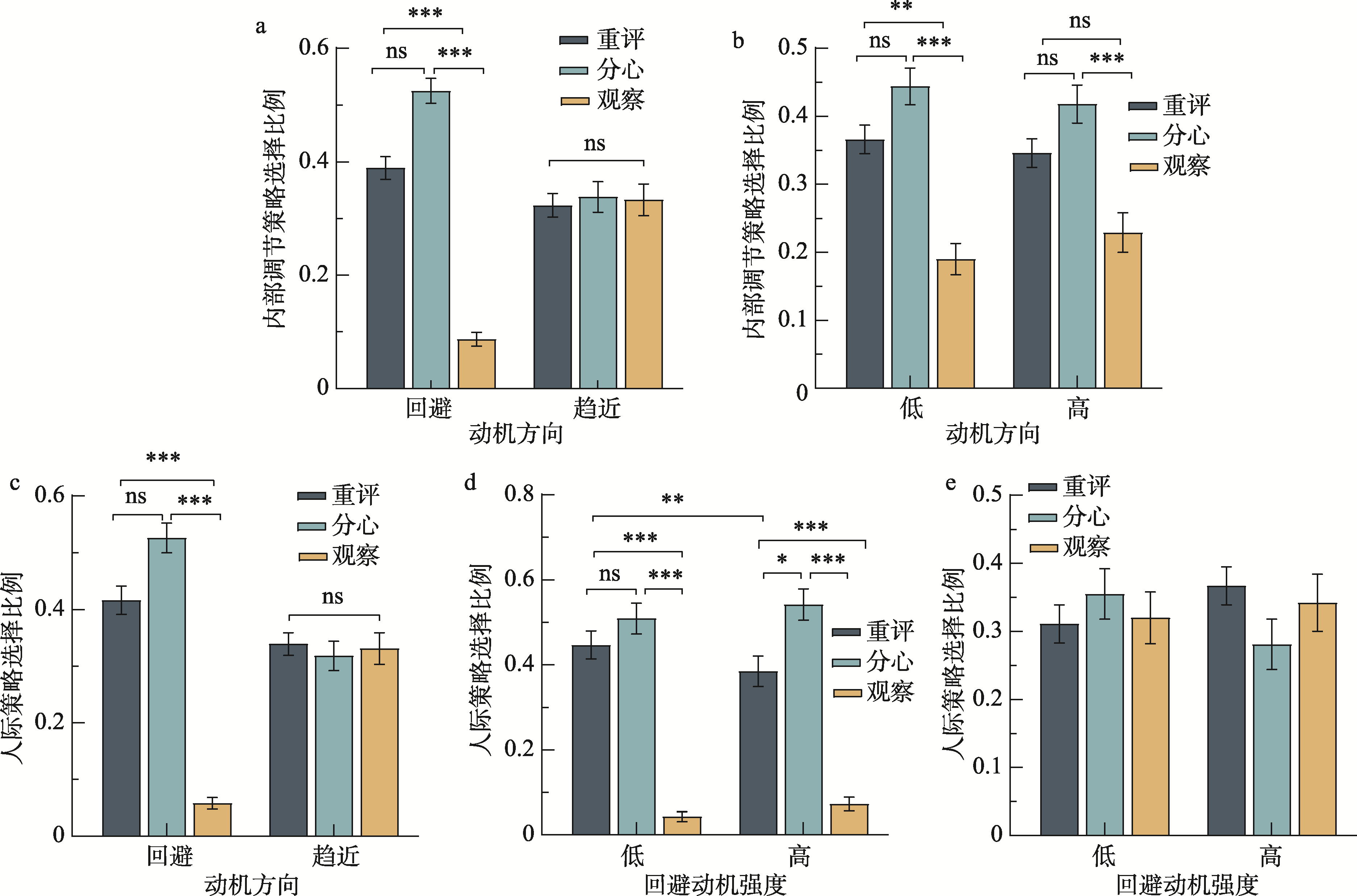
图2 情绪动机对情绪调节策略选择的影响。(a)、(b)分别为内部ERCT中, 情绪动机方向和动机强度对策略选择行为的影响。(c-e)为人际ERCT中, 情绪动机方向和强度对调节者策略选择行为的影响。*** p < 0.001, ** p < 0.01, * p < 0.05, ns: p > 0.05; bar: SE。
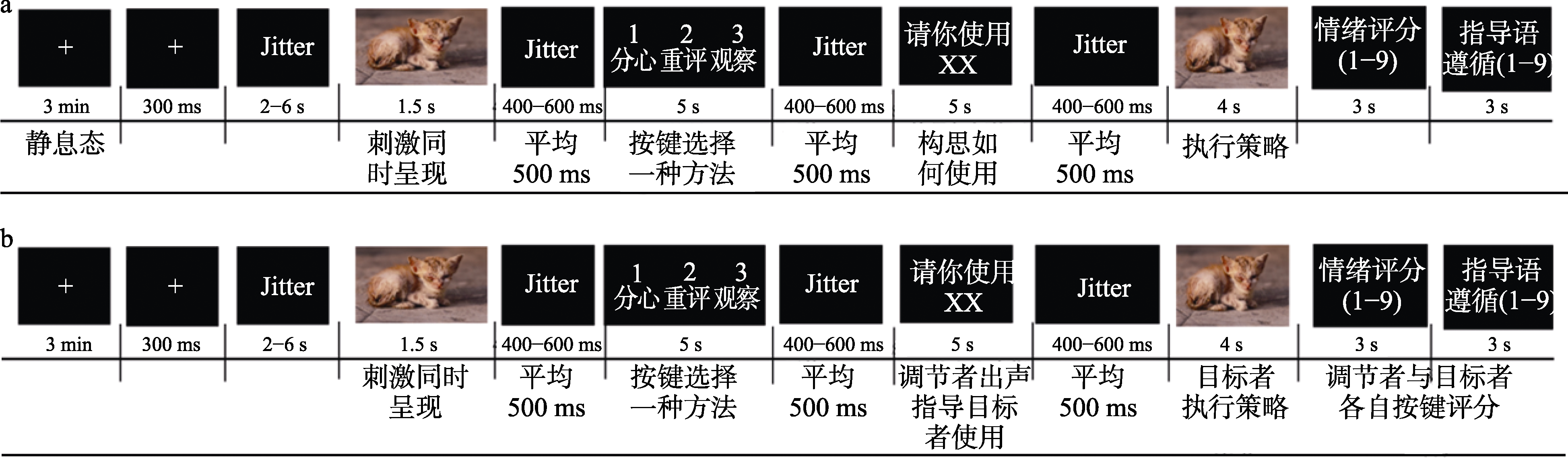
图3 研究2情绪调节选择任务(ERCT)流程图。(a)、(b)分别对应内部ERCT和人际ERCT。

图4 近红外光极排布图。 注:红色圆圈S:光源, 蓝色圆圈D:探测器, 绿色短线:通道; 数字代表各通道编号。
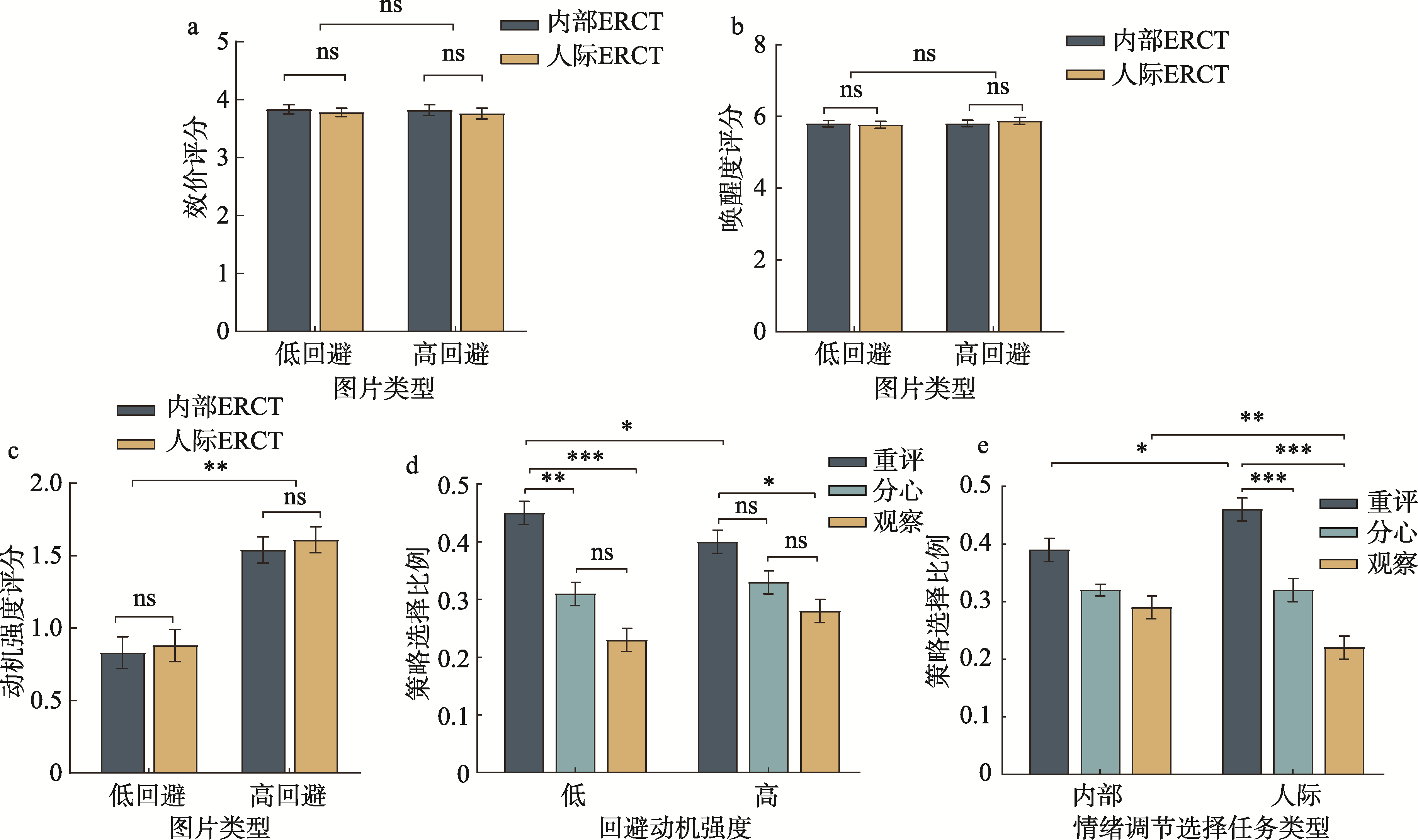
图5 研究2行为结果图。(a-c)为情绪诱发有效性检验结果。(d)为回避动机强度变化对策略选择行为的影响, (e)为不同情绪调节选择任务中调节者的策略选择结果。*** p < 0.001, ** p < 0.01, * p < 0.05, ns: p > 0.05; bar: SE, 下同。
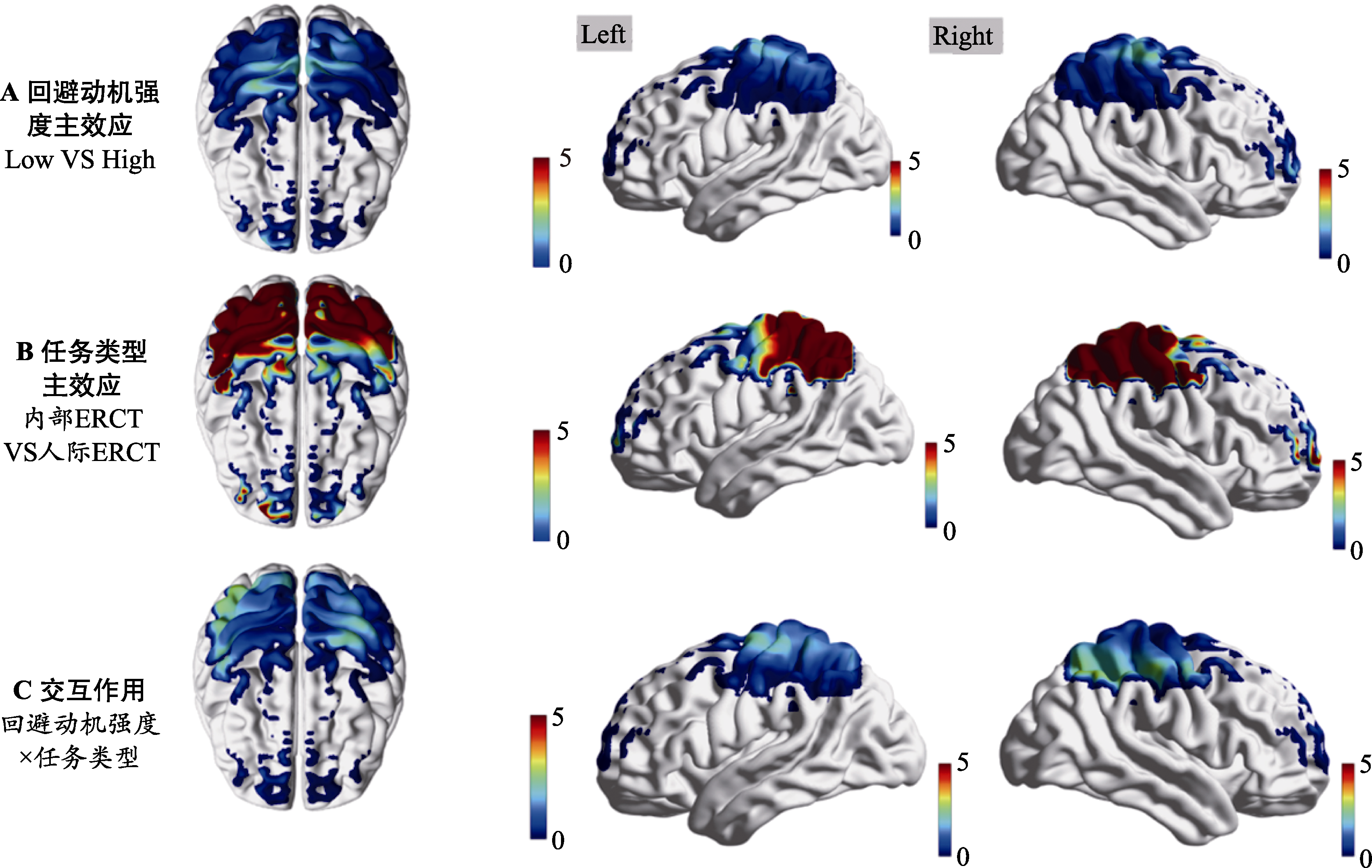
图6 调节者脑区激活成像图。图中颜色代表方差分析的F值(0-5), 颜色越红表示该脑区的交互作用或主效应对应的F值越大。
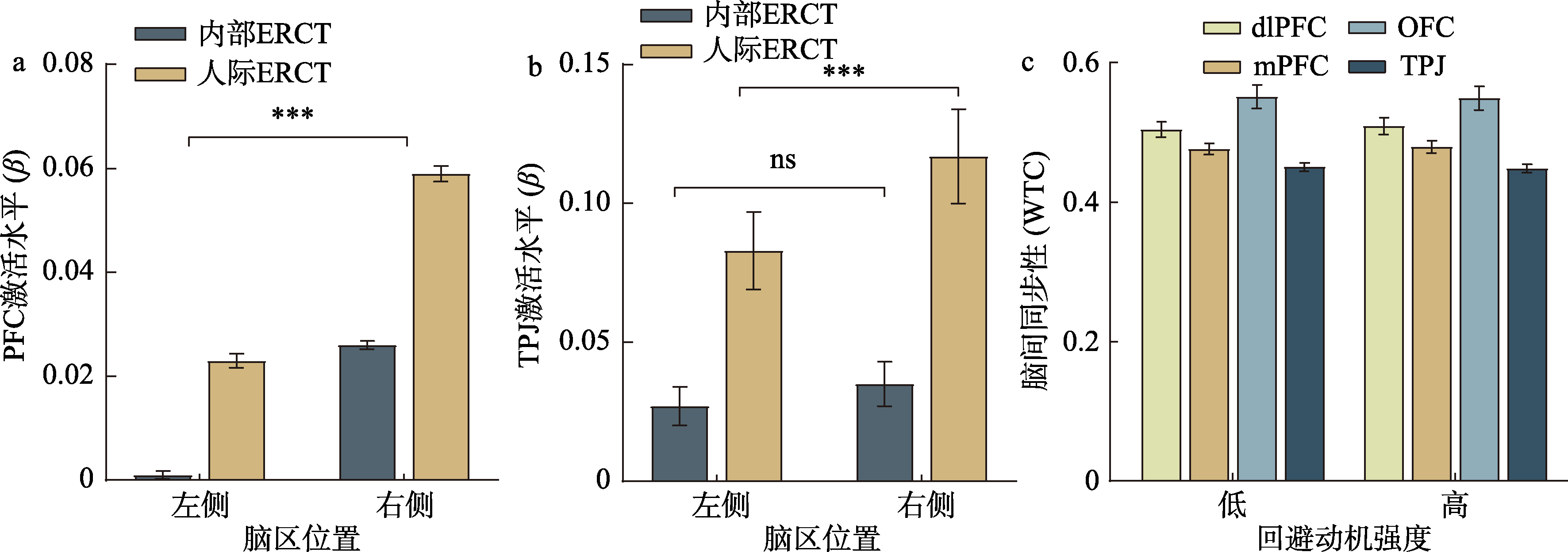
图7 研究2近红外成像结果图。(a)、(b)分别为两部分任务的刺激呈现阶段, 调节者在PFC和TPJ脑区上的激活水平。(c)为不同回避动机强度条件下, 调节者与目标者在人际ERCT刺激呈现阶段上的脑间同步活动水平。
| 回避动机强度 | 因变量 | 模型参数 | 标准化回归系数(β) | t值的显著性(p) |
|---|---|---|---|---|
| 低 | 重评选择比例 | R2 = 0.16 | right PFC = 0.13 | 0.457 |
| F(3, 40) = 2.57 | left TPJ = −0.45 | 0.022 | ||
| p = 0.067 | right TPJ = 0.02 | 0.939 | ||
| 分心选择比例 | R2 = 0.09 | right PFC = 0.28 | 0.130 | |
| F(3, 40) = 1.32 | left TPJ = 0.14 | 0.464 | ||
| p = 0.283 | right TPJ = −0.14 | 0.487 | ||
| 观察选择比例 | R2 = 0.21 | right PFC = −0.41 | 0.019 | |
| F(3, 40) = 3.47 | left TPJ = 0.39 | 0.033 | ||
| p = 0.025 | right TPJ = 0.16 | 0.400 | ||
| 高 | 重评选择比例 | R2 = 0.01 | right PFC = 0.08 | 0.667 |
| F(3, 40) = 0.16 | left TPJ = −0.02 | 0.911 | ||
| p = 0.922 | right TPJ = 0.06 | 0.769 | ||
| 分心选择比例 | R2 = 0.05 | right PFC = 0.26 | 0.143 | |
| F(3, 40) = 0.75 | left TPJ = 0.001 | 0.998 | ||
| p = 0.528 | right TPJ = −0.14 | 0.479 | ||
| 观察选择比例 | R2 = 0.09 | right PFC = −0.28 | 0.104 | |
| F(3, 40) = 1.36 | left TPJ = 0.20 | 0.259 | ||
| p = 0.270 | right TPJ = 0.02 | 0.922 |
表1 人际ERCT中调节者大脑激活对策略选择行为的预测(n = 44)
| 回避动机强度 | 因变量 | 模型参数 | 标准化回归系数(β) | t值的显著性(p) |
|---|---|---|---|---|
| 低 | 重评选择比例 | R2 = 0.16 | right PFC = 0.13 | 0.457 |
| F(3, 40) = 2.57 | left TPJ = −0.45 | 0.022 | ||
| p = 0.067 | right TPJ = 0.02 | 0.939 | ||
| 分心选择比例 | R2 = 0.09 | right PFC = 0.28 | 0.130 | |
| F(3, 40) = 1.32 | left TPJ = 0.14 | 0.464 | ||
| p = 0.283 | right TPJ = −0.14 | 0.487 | ||
| 观察选择比例 | R2 = 0.21 | right PFC = −0.41 | 0.019 | |
| F(3, 40) = 3.47 | left TPJ = 0.39 | 0.033 | ||
| p = 0.025 | right TPJ = 0.16 | 0.400 | ||
| 高 | 重评选择比例 | R2 = 0.01 | right PFC = 0.08 | 0.667 |
| F(3, 40) = 0.16 | left TPJ = −0.02 | 0.911 | ||
| p = 0.922 | right TPJ = 0.06 | 0.769 | ||
| 分心选择比例 | R2 = 0.05 | right PFC = 0.26 | 0.143 | |
| F(3, 40) = 0.75 | left TPJ = 0.001 | 0.998 | ||
| p = 0.528 | right TPJ = −0.14 | 0.479 | ||
| 观察选择比例 | R2 = 0.09 | right PFC = −0.28 | 0.104 | |
| F(3, 40) = 1.36 | left TPJ = 0.20 | 0.259 | ||
| p = 0.270 | right TPJ = 0.02 | 0.922 |
| 因变量 | 模型参数 | 标准化回归系数(β) | t值的显著性(p) |
|---|---|---|---|
| 重评选择比例 | R2 = 0.42 F(6, 33) = 3.94 p = 0.004 | mPFC = 0.51 | 0.116 |
| OFC = −0.83 | 0.043 | ||
| left dlPFC = 0.86 | 0.033 | ||
| right dlPFC = −0.23 | 0.546 | ||
| left TPJ = −0.34 | 0.087 | ||
| right TPJ = 0.39 | 0.037 | ||
| 分心选择比例 | R2 = 0.23 F(6, 33) = 1.67 p = 0.159 | mPFC = −0.26 | 0.480 |
| OFC = 0.20 | 0.669 | ||
| left dlPFC = −0.38 | 0.398 | ||
| right dlPFC = 0.14 | 0.760 | ||
| left TPJ = 0.21 | 0.362 | ||
| 观察选择比例 | R2 = 0.20 F(6, 33) = 1.40 p = 0.243 | mPFC = −0.40 | 0.288 |
| OFC = 0.88 | 0.066 | ||
| left dlPFC = −0.71 | 0.126 | ||
| right dlPFC = 0.15 | 0.735 | ||
| left TPJ = 0.23 | 0.320 | ||
| right TPJ = −0.18 | 0.416 |
表2 低回避情绪动机下调节者−目标者脑间同步水平对调节者策略选择的预测(n = 40)
| 因变量 | 模型参数 | 标准化回归系数(β) | t值的显著性(p) |
|---|---|---|---|
| 重评选择比例 | R2 = 0.42 F(6, 33) = 3.94 p = 0.004 | mPFC = 0.51 | 0.116 |
| OFC = −0.83 | 0.043 | ||
| left dlPFC = 0.86 | 0.033 | ||
| right dlPFC = −0.23 | 0.546 | ||
| left TPJ = −0.34 | 0.087 | ||
| right TPJ = 0.39 | 0.037 | ||
| 分心选择比例 | R2 = 0.23 F(6, 33) = 1.67 p = 0.159 | mPFC = −0.26 | 0.480 |
| OFC = 0.20 | 0.669 | ||
| left dlPFC = −0.38 | 0.398 | ||
| right dlPFC = 0.14 | 0.760 | ||
| left TPJ = 0.21 | 0.362 | ||
| 观察选择比例 | R2 = 0.20 F(6, 33) = 1.40 p = 0.243 | mPFC = −0.40 | 0.288 |
| OFC = 0.88 | 0.066 | ||
| left dlPFC = −0.71 | 0.126 | ||
| right dlPFC = 0.15 | 0.735 | ||
| left TPJ = 0.23 | 0.320 | ||
| right TPJ = −0.18 | 0.416 |
| 因变量 | 模型参数 | 标准化回归系数(β) | t值的显著性(p) |
|---|---|---|---|
| 重评选择比例 | R2 = 0.31 F(6, 33) = 2.52 p = 0.040 | mPFC = −0.18 | 0.632 |
| OFC = −1.33 | 0.008 | ||
| left dlPFC = 0.37 | 0.577 | ||
| right dlPFC = 1.12 | 0.012 | ||
| left TPJ = −0.10 | 0.625 | ||
| right TPJ = 0.46 | 0.038 | ||
| 分心选择比例 | R2 = 0.15 F(6, 33) = 0.94 p = 0.480 | mPFC = 0.27 | 0.544 |
| OFC = −0.48 | 0.366 | ||
| left dlPFC = 0.31 | 0.671 | ||
| right dlPFC = −0.26 | 0.585 | ||
| left TPJ = 0.03 | 0.903 | ||
| right TPJ = −0.24 | 0.324 | ||
| 观察选择比例 | R2 = 0.20 F(6, 33) = 1.33 p = 0.271 | mPFC = −0.20 | 0.630 |
| OFC = 1.35 | 0.012 | ||
| left dlPFC = −0.50 | 0.483 | ||
| right dlPFC = −0.61 | 0.193 | ||
| left TPJ = 0.09 | 0.682 | ||
| right TPJ = −0.14 | 0.540 |
表3 高回避情绪动机下调节者−目标者脑间同步水平对调节者策略选择的预测(n = 40)
| 因变量 | 模型参数 | 标准化回归系数(β) | t值的显著性(p) |
|---|---|---|---|
| 重评选择比例 | R2 = 0.31 F(6, 33) = 2.52 p = 0.040 | mPFC = −0.18 | 0.632 |
| OFC = −1.33 | 0.008 | ||
| left dlPFC = 0.37 | 0.577 | ||
| right dlPFC = 1.12 | 0.012 | ||
| left TPJ = −0.10 | 0.625 | ||
| right TPJ = 0.46 | 0.038 | ||
| 分心选择比例 | R2 = 0.15 F(6, 33) = 0.94 p = 0.480 | mPFC = 0.27 | 0.544 |
| OFC = −0.48 | 0.366 | ||
| left dlPFC = 0.31 | 0.671 | ||
| right dlPFC = −0.26 | 0.585 | ||
| left TPJ = 0.03 | 0.903 | ||
| right TPJ = −0.24 | 0.324 | ||
| 观察选择比例 | R2 = 0.20 F(6, 33) = 1.33 p = 0.271 | mPFC = −0.20 | 0.630 |
| OFC = 1.35 | 0.012 | ||
| left dlPFC = −0.50 | 0.483 | ||
| right dlPFC = −0.61 | 0.193 | ||
| left TPJ = 0.09 | 0.682 | ||
| right TPJ = −0.14 | 0.540 |
| 情绪调节策略选择任务类型 | 所选策略 | 低回避 | 高回避 | 低趋近 | 高趋近 |
|---|---|---|---|---|---|
| 内部ERCT | 重评 | 0.40 ± 0.15 | 0.38 ± 0.18 | 0.34 ± 0.19 | 0.31 ± 0.16 |
| 分心 | 0.53 ± 0.17 | 0.52 ± 0.20 | 0.36 ± 0.23 | 0.31 ± 0.21 | |
| 观察 | 0.08 ± 0.08 | 0.09 ± 0.11 | 0.30 ± 0.19 | 0.36 ± 0.26 | |
| 人际ERCT | 重评 | 0.45 ± 0.19 | 0.39 ± 0.21 | 0.31 ± 0.16 | 0.37 ± 0.16 |
| 分心 | 0.51 ± 0.21 | 0.54 ± 0.21 | 0.36 ± 0.22 | 0.28 ± 0.21 | |
| 观察 | 0.04 ± 0.07 | 0.07 ± 0.21 | 0.32 ± 0.22 | 0.34 ± 0.24 |
附表S1 各情绪动机条件下不同任务中个体的策略平均选择比例(M ± SD)
| 情绪调节策略选择任务类型 | 所选策略 | 低回避 | 高回避 | 低趋近 | 高趋近 |
|---|---|---|---|---|---|
| 内部ERCT | 重评 | 0.40 ± 0.15 | 0.38 ± 0.18 | 0.34 ± 0.19 | 0.31 ± 0.16 |
| 分心 | 0.53 ± 0.17 | 0.52 ± 0.20 | 0.36 ± 0.23 | 0.31 ± 0.21 | |
| 观察 | 0.08 ± 0.08 | 0.09 ± 0.11 | 0.30 ± 0.19 | 0.36 ± 0.26 | |
| 人际ERCT | 重评 | 0.45 ± 0.19 | 0.39 ± 0.21 | 0.31 ± 0.16 | 0.37 ± 0.16 |
| 分心 | 0.51 ± 0.21 | 0.54 ± 0.21 | 0.36 ± 0.22 | 0.28 ± 0.21 | |
| 观察 | 0.04 ± 0.07 | 0.07 ± 0.21 | 0.32 ± 0.22 | 0.34 ± 0.24 |
| 变量 | F | p | Partial η2 |
|---|---|---|---|
| 动机方向 | 3.15 | 0.09 | 0.09 |
| 动机强度 | 0.23 | 0.64 | 0.01 |
| 任务类型 | 0.40 | 0.53 | 0.01 |
| 策略类型 | 20.06 | < 0.001 | 0.39 |
| 动机方向×动机强度 | 0.15 | 0.70 | 0.01 |
| 动机方向×任务类型 | 0.30 | 0.59 | 0.01 |
| 动机强度×任务类型 | 0.55 | 0.46 | 0.02 |
| 动机方向×策略类型 | 38.48 | < 0.001 | 0.55 |
| 动机强度×策略类型 | 3.21 | 0.05 | 0.09 |
| 任务类型×策略类型 | 0.59 | 0.56 | 0.02 |
| 动机方向×动机强度×任务类型 | 0.47 | 0.50 | 0.01 |
| 动机方向×动机强度×策略类型 | 3.61 | 0.03 | 0.10 |
| 动机方向×任务类型×策略类型 | 0.35 | 0.70 | 0.01 |
| 动机强度×任务类型×策略类型 | 0.31 | 0.74 | 0.01 |
| 动机方向×动机强度×任务类型×策略类型 | 3.68 | 0.03 | 0.10 |
附表S2 四因素重复测量方差分析结果(N = 33)
| 变量 | F | p | Partial η2 |
|---|---|---|---|
| 动机方向 | 3.15 | 0.09 | 0.09 |
| 动机强度 | 0.23 | 0.64 | 0.01 |
| 任务类型 | 0.40 | 0.53 | 0.01 |
| 策略类型 | 20.06 | < 0.001 | 0.39 |
| 动机方向×动机强度 | 0.15 | 0.70 | 0.01 |
| 动机方向×任务类型 | 0.30 | 0.59 | 0.01 |
| 动机强度×任务类型 | 0.55 | 0.46 | 0.02 |
| 动机方向×策略类型 | 38.48 | < 0.001 | 0.55 |
| 动机强度×策略类型 | 3.21 | 0.05 | 0.09 |
| 任务类型×策略类型 | 0.59 | 0.56 | 0.02 |
| 动机方向×动机强度×任务类型 | 0.47 | 0.50 | 0.01 |
| 动机方向×动机强度×策略类型 | 3.61 | 0.03 | 0.10 |
| 动机方向×任务类型×策略类型 | 0.35 | 0.70 | 0.01 |
| 动机强度×任务类型×策略类型 | 0.31 | 0.74 | 0.01 |
| 动机方向×动机强度×任务类型×策略类型 | 3.68 | 0.03 | 0.10 |
| 通道 编号 | 发射器− 探测器 | MNI坐标 | Brodmann 分区及脑区重合度* | ||
|---|---|---|---|---|---|
| x | y | z | |||
| 1 | S1-D1 | 54.4087 | −64.7836 | 46.0082 | 39 - Angular gyrus_ part of Wernicke's area (0.93) |
| 2 | S1-D3 | 57.3263 | −50.6134 | 52.6095 | 40 - Supramarginal gyrus part of Wernicke's area (0.94) |
| 3 | S2-D1 | 34.9689 | −63.9744 | 62.5311 | 7 - Somatosensory Association Cortex (0.93) |
| 4 | S2-D3 | 36.8796 | −51.4079 | 69.6644 | 7 - Somatosensory Association Cortex (0.68) |
| 5 | S3-D2 | −36.359 | −64.26 | 59.7477 | 7 - Somatosensory Association Cortex (0.74) |
| 6 | S3-D4 | −38.614 | −52.4034 | 67.853 | 7 - Somatosensory Association Cortex (0.53) |
| 7 | S4-D2 | −56.5506 | −65.8067 | 41.4156 | 39 - Angular gyrus_ part of Wernicke's area (0.98) |
| 8 | S4-D4 | −60.0641 | −51.6615 | 48.1846 | 40 - Supramarginal gyrus part of Wernicke's area (0.87) |
| 9 | S5-D3 | 58.8422 | −34.7445 | 55.5872 | 40 - Supramarginal gyrus part of Wernicke's area (0.58) |
| 10 | S5-D5 | 56.0392 | −20.8439 | 57.6755 | 3 - Primary Somatosensory Cortex (0.47) |
| 12 | S6-D5 | 37.2309 | −21.3494 | 72.4971 | 4 - Primary Motor Cortex (0.63) |
| 14 | S7-D6 | −37.926 | −21.6228 | 72.0886 | 4 - Primary Motor Cortex (0.71) |
| 15 | S8-D4 | −61.0227 | −36.1116 | 53.2459 | 40 - Supramarginal gyrus part of Wernicke's area (0.80) |
| 16 | S8-D6 | −58.0916 | −20.8609 | 55.1969 | 3 - Primary Somatosensory Cortex (0.56) |
| 17 | S9-D5 | 53.1517 | −6.9137 | 54.9788 | 4 - Primary Motor Cortex (0.41) 6 - Pre-Motor and Supplementary Motor Cortex (0.59) |
| 18 | S9-D7 | 49.6831 | 7.6117 | 52.3461 | 6 - Pre-Motor and Supplementary Motor Cortex (0.7) |
| 19 | S10-D5 | 35.1598 | −9.7203 | 69.229 | 6 - Pre-Motor and Supplementary Motor Cortex (0.93) |
| 20 | S10-D7 | 32.7938 | 6.1663 | 66.2847 | 6 - Pre-Motor and Supplementary Motor Cortex (0.70) |
| 21 | S11-D6 | −34.4659 | −8.8191 | 68.7227 | 6 - Pre-Motor and Supplementary Motor Cortex (0.90) |
| 22 | S11-D8 | −31.8668 | 7.0903 | 66.1236 | 6 - Pre-Motor and Supplementary Motor Cortex (0.69) |
| 23 | S12-D6 | −55.2218 | −6.0424 | 53.363 | 6 - Pre-Motor and Supplementary Motor Cortex (0.66) |
| 24 | S12-D8 | −49.7183 | 9.0521 | 51.777 | 6 - Pre-Motor and Supplementary Motor Cortex (0.67) |
| 25 | S13-D7 | 30.6143 | 17.6711 | 62.1171 | 8 - Includes Frontal eye fields (0.90) |
| 26 | S14-D8 | −29.1546 | 18.9128 | 62.5035 | 8 - Includes Frontal eye fields (0.88) |
| 27 | S15-D9 | 27.9412 | 36.1898 | 51.7714 | 9 - Dorsolateral prefrontal cortex (0.63) |
| 28 | S15-D11 | 40.9107 | 38.1954 | 40.8476 | 9 - Dorsolateral prefrontal cortex (0.61) |
| 29 | S16-D9 | 12.3581 | 45.8872 | 52.179 | 9 - Dorsolateral prefrontal cortex (0.73) |
| 30 | S16-D10 | −9.3592 | 48.0675 | 52.3064 | 9 - Dorsolateral prefrontal cortex (0.81) |
| 31 | S16-D12 | 1.0456 | 55.6951 | 40.2499 | 9 - Dorsolateral prefrontal cortex (0.90) |
| 32 | S17-D10 | −26.0758 | 38.3257 | 51.4638 | 9 - Dorsolateral prefrontal cortex (0.74) |
| 33 | S17-D13 | −40.8262 | 40.0934 | 39.4797 | 9 - Dorsolateral prefrontal cortex (0.42) |
| 34 | S18-D9 | 20.6712 | 51.9917 | 41.5768 | 9 - Dorsolateral prefrontal cortex (0.99) |
| 35 | S18-D11 | 34.0131 | 54.4898 | 28.2762 | 46 - Dorsolateral prefrontal cortex (0.98) |
| 36 | S18-D12 | 13.4375 | 63.7052 | 30.858 | 10 - Frontopolar area (0.71) |
| 37 | S18-D14 | 25.3528 | 67.0449 | 16.7319 | 10 - Frontopolar area (0.98) |
| 38 | S19-D10 | −19.5523 | 53.1065 | 40.9674 | 9 - Dorsolateral prefrontal cortex (0.92) |
| 39 | S19-D10 | −12.1443 | 64.3739 | 31.2437 | 10 - Frontopolar area (0.72) |
| 40 | S19-D13 | −33.7944 | 55.0056 | 27.9028 | 46 - Dorsolateral prefrontal cortex (1) |
| 41 | S19-D15 | −23.5638 | 67.4366 | 16.6988 | 10 - Frontopolar area (0.96) |
| 42 | S20-D11 | 46.4588 | 52.1383 | 14.7427 | 46 - Dorsolateral prefrontal cortex (0.84) |
| 43 | S20-D14 | 38.7407 | 63.8563 | 1.1675 | 10 - Frontopolar area (0.74) |
| 44 | S21-D12 | 0.8251 | 67.1413 | 15.7566 | 10 - Frontopolar area (1) |
| 45 | S21-D14 | 14.6621 | 73.3848 | 1.9394 | 10 - Frontopolar area (0.78) |
| 46 | S21-D15 | −13.1752 | 73.3148 | 2.7291 | 10 - Frontopolar area (0.79) |
| 47 | S22-D13 | −46.6791 | 52.4921 | 14.0445 | 46 - Dorsolateral prefrontal cortex (0.78) |
| 48 | S22-D15 | −37.4194 | 64.5714 | 0.87567 | 10 - Frontopolar area (0.77) |
附表S3 近红外通道的空间定位
| 通道 编号 | 发射器− 探测器 | MNI坐标 | Brodmann 分区及脑区重合度* | ||
|---|---|---|---|---|---|
| x | y | z | |||
| 1 | S1-D1 | 54.4087 | −64.7836 | 46.0082 | 39 - Angular gyrus_ part of Wernicke's area (0.93) |
| 2 | S1-D3 | 57.3263 | −50.6134 | 52.6095 | 40 - Supramarginal gyrus part of Wernicke's area (0.94) |
| 3 | S2-D1 | 34.9689 | −63.9744 | 62.5311 | 7 - Somatosensory Association Cortex (0.93) |
| 4 | S2-D3 | 36.8796 | −51.4079 | 69.6644 | 7 - Somatosensory Association Cortex (0.68) |
| 5 | S3-D2 | −36.359 | −64.26 | 59.7477 | 7 - Somatosensory Association Cortex (0.74) |
| 6 | S3-D4 | −38.614 | −52.4034 | 67.853 | 7 - Somatosensory Association Cortex (0.53) |
| 7 | S4-D2 | −56.5506 | −65.8067 | 41.4156 | 39 - Angular gyrus_ part of Wernicke's area (0.98) |
| 8 | S4-D4 | −60.0641 | −51.6615 | 48.1846 | 40 - Supramarginal gyrus part of Wernicke's area (0.87) |
| 9 | S5-D3 | 58.8422 | −34.7445 | 55.5872 | 40 - Supramarginal gyrus part of Wernicke's area (0.58) |
| 10 | S5-D5 | 56.0392 | −20.8439 | 57.6755 | 3 - Primary Somatosensory Cortex (0.47) |
| 12 | S6-D5 | 37.2309 | −21.3494 | 72.4971 | 4 - Primary Motor Cortex (0.63) |
| 14 | S7-D6 | −37.926 | −21.6228 | 72.0886 | 4 - Primary Motor Cortex (0.71) |
| 15 | S8-D4 | −61.0227 | −36.1116 | 53.2459 | 40 - Supramarginal gyrus part of Wernicke's area (0.80) |
| 16 | S8-D6 | −58.0916 | −20.8609 | 55.1969 | 3 - Primary Somatosensory Cortex (0.56) |
| 17 | S9-D5 | 53.1517 | −6.9137 | 54.9788 | 4 - Primary Motor Cortex (0.41) 6 - Pre-Motor and Supplementary Motor Cortex (0.59) |
| 18 | S9-D7 | 49.6831 | 7.6117 | 52.3461 | 6 - Pre-Motor and Supplementary Motor Cortex (0.7) |
| 19 | S10-D5 | 35.1598 | −9.7203 | 69.229 | 6 - Pre-Motor and Supplementary Motor Cortex (0.93) |
| 20 | S10-D7 | 32.7938 | 6.1663 | 66.2847 | 6 - Pre-Motor and Supplementary Motor Cortex (0.70) |
| 21 | S11-D6 | −34.4659 | −8.8191 | 68.7227 | 6 - Pre-Motor and Supplementary Motor Cortex (0.90) |
| 22 | S11-D8 | −31.8668 | 7.0903 | 66.1236 | 6 - Pre-Motor and Supplementary Motor Cortex (0.69) |
| 23 | S12-D6 | −55.2218 | −6.0424 | 53.363 | 6 - Pre-Motor and Supplementary Motor Cortex (0.66) |
| 24 | S12-D8 | −49.7183 | 9.0521 | 51.777 | 6 - Pre-Motor and Supplementary Motor Cortex (0.67) |
| 25 | S13-D7 | 30.6143 | 17.6711 | 62.1171 | 8 - Includes Frontal eye fields (0.90) |
| 26 | S14-D8 | −29.1546 | 18.9128 | 62.5035 | 8 - Includes Frontal eye fields (0.88) |
| 27 | S15-D9 | 27.9412 | 36.1898 | 51.7714 | 9 - Dorsolateral prefrontal cortex (0.63) |
| 28 | S15-D11 | 40.9107 | 38.1954 | 40.8476 | 9 - Dorsolateral prefrontal cortex (0.61) |
| 29 | S16-D9 | 12.3581 | 45.8872 | 52.179 | 9 - Dorsolateral prefrontal cortex (0.73) |
| 30 | S16-D10 | −9.3592 | 48.0675 | 52.3064 | 9 - Dorsolateral prefrontal cortex (0.81) |
| 31 | S16-D12 | 1.0456 | 55.6951 | 40.2499 | 9 - Dorsolateral prefrontal cortex (0.90) |
| 32 | S17-D10 | −26.0758 | 38.3257 | 51.4638 | 9 - Dorsolateral prefrontal cortex (0.74) |
| 33 | S17-D13 | −40.8262 | 40.0934 | 39.4797 | 9 - Dorsolateral prefrontal cortex (0.42) |
| 34 | S18-D9 | 20.6712 | 51.9917 | 41.5768 | 9 - Dorsolateral prefrontal cortex (0.99) |
| 35 | S18-D11 | 34.0131 | 54.4898 | 28.2762 | 46 - Dorsolateral prefrontal cortex (0.98) |
| 36 | S18-D12 | 13.4375 | 63.7052 | 30.858 | 10 - Frontopolar area (0.71) |
| 37 | S18-D14 | 25.3528 | 67.0449 | 16.7319 | 10 - Frontopolar area (0.98) |
| 38 | S19-D10 | −19.5523 | 53.1065 | 40.9674 | 9 - Dorsolateral prefrontal cortex (0.92) |
| 39 | S19-D10 | −12.1443 | 64.3739 | 31.2437 | 10 - Frontopolar area (0.72) |
| 40 | S19-D13 | −33.7944 | 55.0056 | 27.9028 | 46 - Dorsolateral prefrontal cortex (1) |
| 41 | S19-D15 | −23.5638 | 67.4366 | 16.6988 | 10 - Frontopolar area (0.96) |
| 42 | S20-D11 | 46.4588 | 52.1383 | 14.7427 | 46 - Dorsolateral prefrontal cortex (0.84) |
| 43 | S20-D14 | 38.7407 | 63.8563 | 1.1675 | 10 - Frontopolar area (0.74) |
| 44 | S21-D12 | 0.8251 | 67.1413 | 15.7566 | 10 - Frontopolar area (1) |
| 45 | S21-D14 | 14.6621 | 73.3848 | 1.9394 | 10 - Frontopolar area (0.78) |
| 46 | S21-D15 | −13.1752 | 73.3148 | 2.7291 | 10 - Frontopolar area (0.79) |
| 47 | S22-D13 | −46.6791 | 52.4921 | 14.0445 | 46 - Dorsolateral prefrontal cortex (0.78) |
| 48 | S22-D15 | −37.4194 | 64.5714 | 0.87567 | 10 - Frontopolar area (0.77) |
| 回避动机条件 | 因变量 | 模型参数 | 标准化回归系数(β) | t值的显著性(p) |
|---|---|---|---|---|
| 低 | 重评选择比例 | R2 = 0.01 | right PFC = 0.08 | 0.667 |
| F(3, 40) = 0.16 | left TPJ = −0.02 | 0.911 | ||
| p = 0.92 | right TPJ = 0.06 | 0.769 | ||
| 分心选择比例 | R2 = 0.05 | right PFC = 0.01 | 0.943 | |
| F(3, 40) = 0.75 | left TPJ = −0.12 | 0.607 | ||
| p = 0.53 | right TPJ = 0.16 | 0.500 | ||
| 观察选择比例 | R2 = 0.11 | right PFC = −0.16 | 0.354 | |
| F(3, 40) = 1.56 | left TPJ = 0.48 | 0.040 | ||
| p = 0.21 | right TPJ = −0.33 | 0.144 | ||
| 高 | 重评选择比例 | R2 = 0.06 | right PFC = −0.15 | 0.328 |
| F(3, 40) = 0.83 | left TPJ = 0.20 | 0.212 | ||
| p = 0.49 | right TPJ = −0.04 | 0.824 | ||
| 分心选择比例 | R2 = 0.06 | right PFC = 0.04 | 0.821 | |
| F(3, 40) = 0.86 | left TPJ = −0.001 | 0.996 | ||
| p = 0.47 | right TPJ = −0.25 | 0.125 | ||
| 观察选择比例 | R2 = 0.09 | right PFC = 0.12 | 0.425 | |
| F(3, 40) = 1.26 | left TPJ = −0.20 | 0.202 | ||
| p = 0.30 | right TPJ = 0.21 | 0.183 |
附表S4 内部ERCT中调节者脑激活水平对选择策略行为的预测(n = 44)
| 回避动机条件 | 因变量 | 模型参数 | 标准化回归系数(β) | t值的显著性(p) |
|---|---|---|---|---|
| 低 | 重评选择比例 | R2 = 0.01 | right PFC = 0.08 | 0.667 |
| F(3, 40) = 0.16 | left TPJ = −0.02 | 0.911 | ||
| p = 0.92 | right TPJ = 0.06 | 0.769 | ||
| 分心选择比例 | R2 = 0.05 | right PFC = 0.01 | 0.943 | |
| F(3, 40) = 0.75 | left TPJ = −0.12 | 0.607 | ||
| p = 0.53 | right TPJ = 0.16 | 0.500 | ||
| 观察选择比例 | R2 = 0.11 | right PFC = −0.16 | 0.354 | |
| F(3, 40) = 1.56 | left TPJ = 0.48 | 0.040 | ||
| p = 0.21 | right TPJ = −0.33 | 0.144 | ||
| 高 | 重评选择比例 | R2 = 0.06 | right PFC = −0.15 | 0.328 |
| F(3, 40) = 0.83 | left TPJ = 0.20 | 0.212 | ||
| p = 0.49 | right TPJ = −0.04 | 0.824 | ||
| 分心选择比例 | R2 = 0.06 | right PFC = 0.04 | 0.821 | |
| F(3, 40) = 0.86 | left TPJ = −0.001 | 0.996 | ||
| p = 0.47 | right TPJ = −0.25 | 0.125 | ||
| 观察选择比例 | R2 = 0.09 | right PFC = 0.12 | 0.425 | |
| F(3, 40) = 1.26 | left TPJ = −0.20 | 0.202 | ||
| p = 0.30 | right TPJ = 0.21 | 0.183 |
| 变量 | M | SD | 1 | 2 | 3 | 4 | 5 | 6 | 7 |
|---|---|---|---|---|---|---|---|---|---|
| 1 重评选择比例差 | −0.12 | 0.27 | 1 | ||||||
| 2 观察选择比例差 | 0.14 | 0.24 | −0.44 | 1 | |||||
| 3 个人痛苦 | 9.75 | 3.56 | 0.06 | −0.18 | 1 | ||||
| 4 共情关注 | 17.57 | 3.19 | −0.01 | −0.04 | 0.21 | 1 | |||
| 5 观点采择 | 12.61 | 3.76 | 0.23* | −0.22* | 0.11 | 0.10 | 1 | ||
| 6 想象力 | 13.98 | 3.25 | −0.01 | −0.08 | 0.29 | 0.44** | 0.34** | 1 | |
| 7 共情总分 | 53.91 | 9.81 | 0.12 | −0.19 | 0.52*** | 0.49** | 0.50** | 0.69*** | 1 |
附表S5 调节者选择重评/观察的比例之差与共情的相关(n = 44)
| 变量 | M | SD | 1 | 2 | 3 | 4 | 5 | 6 | 7 |
|---|---|---|---|---|---|---|---|---|---|
| 1 重评选择比例差 | −0.12 | 0.27 | 1 | ||||||
| 2 观察选择比例差 | 0.14 | 0.24 | −0.44 | 1 | |||||
| 3 个人痛苦 | 9.75 | 3.56 | 0.06 | −0.18 | 1 | ||||
| 4 共情关注 | 17.57 | 3.19 | −0.01 | −0.04 | 0.21 | 1 | |||
| 5 观点采择 | 12.61 | 3.76 | 0.23* | −0.22* | 0.11 | 0.10 | 1 | ||
| 6 想象力 | 13.98 | 3.25 | −0.01 | −0.08 | 0.29 | 0.44** | 0.34** | 1 | |
| 7 共情总分 | 53.91 | 9.81 | 0.12 | −0.19 | 0.52*** | 0.49** | 0.50** | 0.69*** | 1 |
| 预测变量 | 因变量 | b | SE | β |
|---|---|---|---|---|
| 观点采择评分 | 重评选择比例差 | 0.03 | 0.01 | 0.38* |
| 观察选择比例差 | −0.02 | 0.01 | −0.29 |
附表S6 重评/观察选择比例差与调节者观点采择得分之间的线性回归分析结果(n = 44)
| 预测变量 | 因变量 | b | SE | β |
|---|---|---|---|---|
| 观点采择评分 | 重评选择比例差 | 0.03 | 0.01 | 0.38* |
| 观察选择比例差 | −0.02 | 0.01 | −0.29 |
| [1] | Aldao, A., Sheppes, G., & Gross, J. J. (2015). Emotion Regulation Flexibility. Cognitive Therapy and Research, 39(3), 263-278. |
| [2] | Amodio, D. M., & Frith, C. D. (2006). Meeting of minds:The medial frontal cortex and social cognition. Nature Reviews Neuroscience, 7(4), 268-277. |
| [3] | Aron, A., Aron, E. N., & Smollan, D. (1992). Inclusion of Other in the Self Scale and the structure of interpersonal closeness. Journal of Personality and Social Psychology, 63(4), 596-612. |
| [4] | Aron, A., Aron, E. N., Tudor, M., & Nelson, G. (1991). Close relationships as including other in the self. Journal of Personality and Social Psychology, 60(2), 241-253. |
| [5] | Babiloni, F., & Astolfi, L. (2014). Social neuroscience and hyperscanning techniques: Past, present and future. Neuroscience & Biobehavioral Reviews, 44, 76-93. |
| [6] | Butler, E. A., & Randall, A. K. (2013). Emotional coregulation in close relationships. Emotion Review, 5(2), 202-210. |
| [7] |
Cabib, S., Campus, P., & Colelli, V. (2012). Learning to cope with stress: Psychobiological mechanisms of stress resilience. Reviews in the Neurosciences, 23(5-6), 659-672.
doi: 10.1515/revneuro-2012-0080 pmid: 23159866 |
| [8] |
Campbell, N. M., Dawel, A., Edwards, M., & Goodhew, S. C. (2021). Does motivational intensity exist distinct from valence and arousal? Emotion, 21(5), 1013-1028.
doi: 10.1037/emo0000883 pmid: 33630627 |
| [9] | Canli, T., Ferri, J., & Duman, E. A. (2009). Genetics of emotion regulation. Neuroscience, 164(1), 43-54. |
| [10] | Capuzzo, G., & Floresco, S. B. (2020). Prelimbic and infralimbic prefrontal regulation of active and inhibitory avoidance and reward-seeking. The Journal of Neuroscience, 40(24), 4773-4787. |
| [11] | Carver, C. S., & Harmon-Jones, E. (2009). Anger is an approach- related affect: Evidence and implications. Psychological Bulletin, 135(2), 183-204. |
| [12] | Choate-Summers, M. (2011). Emotion regulation and psychopathology: A transdiagnostic approach to etiology and treatment. Cognitive Behaviour Therapy, 40(1), 78-78. |
| [13] |
Contardi, A., Imperatori, C., Penzo, I., Del Gatto, C., & Farina, B. (2016). The association among difficulties in emotion regulation, hostility, and empathy in a sample of young Italian adults. Frontiers in Psychology, 7, 1068.
doi: 10.3389/fpsyg.2016.01068 pmid: 27486417 |
| [14] |
Dai, R., Liu, R., Liu, T., Zhang, Z., Xiao, X., Sun, P., Yu, X., Wang, D., & Zhu, C. (2018). Holistic cognitive and neural processes: A fNIRS-hyperscanning study on interpersonal sensorimotor synchronization. Social Cognitive and Affective Neuroscience, 13(11), 1141-1154.
doi: 10.1093/scan/nsy090 pmid: 30321411 |
| [15] |
Decety, J., & Jackson, P. L. (2004). The functional architecture of human empathy. Behavioral and Cognitive Neuroscience Reviews, 3(2), 71-100.
doi: 10.1177/1534582304267187 pmid: 15537986 |
| [16] | Domenech, P., & Koechlin, E. (2015). Executive control and decision-making in the prefrontal cortex. Current Opinion in Behavioral Sciences, 1, 101-106. |
| [17] | Doyen, S., Klein, O., Pichon, C.-L., & Cleeremans, A. (2012). Behavioral priming: It's all in the mind, but whose mind? PLOS ONE, 7(1), e29081. |
| [18] | Florean, I.-S., & Păsărelu, C.-R. (2019). Interpersonal emotion regulation and cognitive empathy as mediators between intrapersonal emotion regulation difficulties and couple satisfaction. Journal of Evidence-Based Psychotherapies, 19(2), 119-134. |
| [19] |
Friederici, A. D. (2011). The brain basis of language processing: From structure to function. Physiological Reviews, 91(4), 1357-1392.
doi: 10.1152/physrev.00006.2011 pmid: 22013214 |
| [20] |
Frith, C. D., & Frith, U. (2006). How we predict what other people are going to do. Brain Research, 1079(1), 36-46.
doi: 10.1016/j.brainres.2005.12.126 pmid: 16513098 |
| [21] | Gable, P., & Harmon-Jones, E. (2010). The motivational dimensional model of affect: Implications for breadth of attention, memory, and cognitive categorisation. Cognition & Emotion, 24(2), 322-337. |
| [22] | Geisler, F. C. M., Vennewald, N., Kubiak, T., & Weber, H. (2010). The impact of heart rate variability on subjective well-being is mediated by emotion regulation. Personality and Individual Differences, 49(7), 723-728. |
| [23] |
Goldin, P. R., McRae, K., Ramel., W., & Gross, J. J. (2008). The neural bases of emotion regulation: Reappraisal and suppression of negative emotion. Biological Psychiatry, 63(6), 577-86
doi: 10.1016/j.biopsych.2007.05.031 pmid: 17888411 |
| [24] | Gross, J. J. (1998a). The emerging field of emotion regulation: An integrative review. Emotion Regulation, 2(3), 271-299. |
| [25] | Gross, J. J. (1998b). Antecedent- and response-focused emotion regulation: Divergent consequences for experience, expression, and physiology. Journal of Personality and Social Psychology, 74(1), 224-237. |
| [26] | Gross, J. J. (2014). Emotion regulation:Conceptual and empirical foundations. In J. J.Gross (Ed.), Handbook of emotion regulation, 2 (pp.3-20). Guilford Publications. |
| [27] |
Hallam, G. P., Webb, T. L., Sheeran, P., Miles, E., Niven, K., Wilkinson, I. D., ... Farrow, T. F. D. (2014). The neural correlates of regulating another person’s emotions: An exploratory fMRI study. Frontiers in Human Neuroscience, 8, 376.
doi: 10.3389/fnhum.2014.00376 pmid: 24936178 |
| [28] | Harmon-Jones, E., & Gable, P. A. (2008). Incorporating motivational intensity and direction into the study of emotions: Implications for brain mechanisms of emotion and cognition-emotion interactions. Netherlands Journal of Psychology, 64(4), 132-142. |
| [29] |
Harmon-Jones, E., Harmon-Jones, C., Amodio, D. M., & Gable, P. A. (2011). Attitudes toward emotions. Journal of Personality and Social Psychology, 101(6), 1332-1350.
doi: 10.1037/a0024951 pmid: 21843012 |
| [30] |
Hyde, D. C., Simon, C. E., Ting, F., & Nikolaeva, J. I. (2018). Functional organization of the temporal-parietal junction for theory of mind in preverbal infants: A near-infrared spectroscopy study. Journal of Neuroscience, 38(18), 4264-4274.
doi: 10.1523/JNEUROSCI.0264-17.2018 pmid: 29593053 |
| [31] |
Jones, B., & Rachlin, H. (2006). Social discounting. Psychological Science, 17(4), 283-286.
pmid: 16623683 |
| [32] | Kahneman, D. (1973). Attention and effort (Vol. 1063, pp. 218-226). Englewood Cliffs, NJ: Prentice-Hall. |
| [33] |
Kashdan, T. B., & Rottenberg, J. (2010). Psychological flexibility as a fundamental aspect of health. Clinical Psychology Review, 30(7), 865-878.
doi: 10.1016/j.cpr.2010.03.001 pmid: 21151705 |
| [34] | Kim, H. S., Sherman, D. K., Sasaki, J. Y., Xu, J., Chu, T. Q., Ryu, C., ... Taylor, S. E. (2010). Culture, distress, and oxytocin receptor polymorphism (OXTR) interact to influence emotional support seeking. Proceedings of the National Academy of Sciences, 107(36), 15717-15721. |
| [35] |
Konovalov, A., Hill, C., Daunizeau, J., & Ruff, C. C. (2021). Dissecting functional contributions of the social brain to strategic behavior. Neuron, 109(20), 3323-3337.
doi: 10.1016/j.neuron.2021.07.025 pmid: 34407389 |
| [36] |
Kruglanski, A. W., Bélanger, J. J., Chen, X., Köpetz, C., Pierro, A., & Mannetti, L. (2012). The energetics of motivated cognition: A force-field analysis. Psychological Review, 119(1), 1-20.
doi: 10.1037/a0025488 pmid: 21967165 |
| [37] |
Lancaster, J. L., Woldorff, M. G., Parsons, L. M., Liotti, M., Freitas, C. S., Rainey, L., ... Fox, P. T. (2000). Automated talairach atlas labels for functional brain mapping. Human Brain Mapping, 10(3), 120-131.
doi: 10.1002/1097-0193(200007)10:3<120::aid-hbm30>3.0.co;2-8 pmid: 10912591 |
| [38] |
Levy, S. R., Freitas, A. L., & Salovey, P. (2002). Construing action abstractly and blurring social distinctions: Implications for perceiving homogeneity among, but also empathizing with and helping, others. Journal of Personality and Social Psychology, 83(5), 1224-1238.
pmid: 12416924 |
| [39] | Liu, Z., Lu, K., Hao, N., & Wang, Y. (2023). Cognitive reappraisal and expressive suppression evoke distinct neural connections during interpersonal emotion regulation. The Journal of Neuroscience, 43(49), 8456-8471. |
| [40] | Long, Q., Yang, J., Lou, Y., Cai, A., & Yuan, J. (2015). Humans’ emotional habituation to pleasant stimuli: Behavioral and electrophysiological evidence. Chinese Science Bulletin, 60(36), 3594-3605. |
| [41] | Luo, S., Yuan, H., Wang, Y., & Bond, M. H. (2024). Culturomics: Taking the cross-scale, interdisciplinary science of culture into the next decade. Neuroscience & Biobehavioral Reviews, 167, 105942. |
| [42] | Mandel, D. R. (2006). Economic transactions among friends: Asymmetric generosity but not agreement in buyers’ and sellers’ offers. Journal of Conflict Resolution, 50(4), 584-606. |
| [43] | Marton-Alper, I. Z., Markus, A., Nevat, M., Bennet, R., & Shamay-Tsoory, S. G. (2023). Differential contribution of between and within-brain coupling to movement synchronization. Human Brain Mapping, 44(10), 4136-4151. |
| [44] | Matthews, M., Webb, T. L., & Sheppes, G. (2022). Do people choose the same strategies to regulate other people’s emotions as they choose to regulate their own? Emotion, 22(8), 1723-1738. |
| [45] |
Molavi, B., & Dumont, G. A. (2012). Wavelet-based motion artifact removal for functional near-infrared spectroscopy. Physiological Measurement, 33(2), 259-270.
doi: 10.1088/0967-3334/33/2/259 pmid: 22273765 |
| [46] | Miller, E. K., & Cohen, J. D. (2001). An integrative theory of prefrontal cortex function. Annual Review of Neuroscience, 24(1), 167-202. |
| [47] |
Muraven, M., Shmueli, D., & Burkley, E. (2006). Conserving self-control strength. Journal of Personality and Social Psychology, 91(3), 524-537.
pmid: 16938035 |
| [48] |
Niven, K. (2017). The four key characteristics of interpersonal emotion regulation. Current Opinion in Psychology, 17, 89-93.
doi: S2352-250X(17)30027-1 pmid: 28950980 |
| [49] | Nyklíček, I., Vingerhoets, A. D., & Zeelenberg, M. (2011). Emotion regulation and well-being: A view from different angles (pp. 1-9). Springer New York. |
| [50] |
Ochsner, K. N., Ray, R. D., Cooper, J. C., Robertson, E. R., Chopra, S., Gabrieli, J. D., & Gross, J. J. (2004). For better or for worse: Neural systems supporting the cognitive down-and up-regulation of negative emotion. Neuroimage, 23(2), 483-499.
doi: 10.1016/j.neuroimage.2004.06.030 pmid: 15488398 |
| [51] | Ochsner, K. N., Silvers, J. A., & Buhle, J. T. (2012). Functional imaging studies of emotion regulation:A synthetic review and evolving model of the cognitive control of emotion. Annals of the New York Academy of Sciences, 1251(1), e1-e24. |
| [52] |
Plass, J. L., & Kalyuga, S. (2019). Four ways of considering emotion in cognitive load theory. Educational Psychology Review, 31(2), 339-359.
doi: 10.1007/s10648-019-09473-5 |
| [53] |
Rachlin, H., & Jones, B. A. (2008). Altruism among relatives and non-relatives. Behavioural Processes, 79(2), 120-123.
doi: 10.1016/j.beproc.2008.06.002 pmid: 18625292 |
| [54] |
Reeck, C., Ames, D. R., & Ochsner, K. N. (2016). The social regulation of emotion: An integrative, cross-disciplinary model. Trends in Cognitive Sciences, 20(1), 47-63.
doi: S1364-6613(15)00227-2 pmid: 26564248 |
| [55] | Sang, L. Q., Wang, L., Qiao, L., Zhang, J. N., Li, P. Y., Shang, G. R., ... Qiu, M. G. (2022). Load-dependent activation of bilateral prefrontal cortex: An fNIRS study. Journal of Army Medical University, 44(3), 210-216. |
| [桑林琼, 王莉, 乔梁, 张静娜, 李鹏岳, 尚光荣, ... 邱明国. (2022). 基于fNIRS 的大脑前额叶皮层在不同脑力负荷下的激活模式研究. 陆军军医大学学报, 44(3), 210-216.] | |
| [56] |
Saxe, R., & Kanwisher, N. (2003). People thinking about thinking people: The role of the temporo-parietal junction in “theory of mind”. NeuroImage, 19(4), 1835-1842.
doi: 10.1016/s1053-8119(03)00230-1 pmid: 12948738 |
| [57] |
Shafir, R., Schwartz, N., Blechert, J., & Sheppes, G. (2015). Emotional intensity influences pre-implementation and implementation of distraction and reappraisal. Social Cognitive and Affective Neuroscience, 10(10), 1329-1337.
doi: 10.1093/scan/nsv022 pmid: 25700568 |
| [58] | Sheppes, G. (2014). Emotion regulation choice:Theory and findings. In J. J.Gross (Ed.), Handbook of emotion regulation, 2 (pp.126-139). Psychology Press. |
| [59] |
Sheppes, G., Catran, E., & Meiran, N. (2009). Reappraisal (but not distraction) is going to make you sweat: Physiological evidence for self-control effort. International Journal of Psychophysiology, 71(2), 91-96.
doi: 10.1016/j.ijpsycho.2008.06.006 pmid: 18625273 |
| [60] |
Sheppes, G., & Meiran, N. (2007). Better late than never? On the dynamics of online regulation of sadness using distraction and cognitive reappraisal. Personality and Social Psychology Bulletin, 33(11), 1518-1532.
pmid: 17933748 |
| [61] |
Sheppes, G., Scheibe, S., Suri, G., & Gross, J. J. (2011). Emotion-regulation choice. Psychological Science, 22(11), 1391-1396.
doi: 10.1177/0956797611418350 pmid: 21960251 |
| [62] | Sheppes, G., Scheibe, S., Suri, G., Radu, P., Blechert, J., & Gross, J. J. (2014). Emotion regulation choice: A conceptual framework and supporting evidence. Journal of Experimental Psychology: General, 143(1), 163-181. |
| [63] | Singer, T., & Lamm, C. (2009). The social neuroscience of empathy. Annals of the New York Academy of Sciences, 1156(1), 81-96. |
| [64] | Steward, T., Davey, C. G., Jamieson, A. J., Stephanou, K., Soriano-Mas, C., Felmingham, K. L., & Harrison, B. J. (2021). Dynamic neural interactions supporting the cognitive reappraisal of emotion. Cerebral Cortex, 31(2), 961-973. |
| [65] | Suri, G., Whittaker, K., & Gross, J. J. (2015). Launching reappraisal: It’s less common than you might think. Emotion, 15(1), 73-77. |
| [66] |
Tamir, M., & Ford, B. Q. (2012). Should people pursue feelings that feel good or feelings that do good? Emotional preferences and well-being. Emotion, 12(5), 1061-1070.
doi: 10.1037/a0027223 pmid: 22309724 |
| [67] | Tong, Y., Hocke, L. M., & Frederick, B. D. (2011). Isolating the sources of widespread physiological fluctuations in functional near-infrared spectroscopy signals. Journal of Biomedical Optics, 16(10), 106005. |
| [68] | Torrence, C., & Compo, G. P. (1998). A practical guide to wavelet analysis. Bulletin of the American Meteorological Society, 79(1), 61-78. |
| [69] | Wang, J., Yang, Z., Klugah-Brown, B., Zhang, T., Yang, J., Yuan, J., & Biswal, B. (2024). The critical mediating roles of the middle temporal gyrus and ventrolateral prefrontal cortex in the dynamic processing of interpersonal emotion regulation. NeuroImage, 300, 120789. |
| [70] |
Watson, D., Hubbard, B., & Wiese, D. (2000). Self-other agreement in personality and affectivity: The role of acquaintanceship, trait visibility, and assumed similarity. Journal of Personality and Social Psychology, 78(3), 546-558.
pmid: 10743880 |
| [71] |
Webb, T. L., Miles, E., & Sheeran, P. (2012). Dealing with feeling: A meta-analysis of the effectiveness of strategies derived from the process model of emotion regulation. Psychological Bulletin, 138(4), 775-808.
doi: 10.1037/a0027600 pmid: 22582737 |
| [72] | Yan, X., Gao, W., Yang, J., Campanella, S., & Yuan, J. (2025). Neurophysiological mechanisms underlying the influence of motivational intensity on emotion regulation choice. Psychophysiology, 62(1), e14722. |
| [73] | Yang, J., Yan, X., Chen, S., Liu, W., Zhang, X., & Yuan, J. (2022). Increased motivational intensity leads to preference for distraction over reappraisal during emotion regulation: Mediated by attentional breadth. Emotion, 22(7), 1595-1603. |
| [74] | Yuan, D., Zhang, R., Liu, J., Feng, D., Hu, Y., Li, X., Wang, Y., & Zhou, X. (2022). Interpersonal neural synchronization could predict the outcome of mate choice. Neuropsychologia, 165, 108112. |
| [75] |
Zaki, J., & Williams, W. C. (2013). Interpersonal emotion regulation. Emotion, 13(5), 803-810.
doi: 10.1037/a0033839 pmid: 24098929 |
| [76] | Zhang, F., Dong, Y., Wang, K., Zhan, Z. Y., & Xie, L. F. (2010). Reliability and validity of the Chinese Version of the Interpersonal Reactivity Index-C. Chinese Journal of Clinical Psychology, 18(2), 155-157. |
| [张凤凤, 董毅, 汪凯, 詹志禹, 谢伦芳. (2010). 中文版人际反应指针量表(IRI-C)的信度及效度研究. 中国临床心理学杂志, 18(2), 155-157.] | |
| [77] | Zhang, S. H., Sang, B., Pan, S. H., Liu, Y., & Ma, M. W. (2017). Emotion regulation flexibility: An integrative review. Journal of Psychological Science, 40(4), 905-912. |
| [张少华, 桑标, 潘婷婷, 刘影, 马明伟. (2017). 情绪调节灵活性的研究进展. 心理科学, 40(4), 905-912.] | |
| [78] | Zhang, W., Qiu, L., Tang, F., & Li, H. (2023). Affective or cognitive interpersonal emotion regulation in couples: An fNIRS hyperscanning study. Cerebral Cortex, 33(12), 7960-7970. |
| [79] | Zhou, K., Xu, H., Lu, S., Jiang, S., Hou, G., Deng, X., He, M., & Zhu, Y. (2022). Reward and aversion processing by input-defined parallel nucleus accumbens circuits in mice. Nature Communications, 13(1), 6244. |
| [1] | 张环, 秦锡权, 刘雨, 林琳, 吴捷. 不同强度趋近动机积极情绪对基于语义关联性错误记忆的影响及其神经机制[J]. 心理学报, 2025, 57(3): 349-362. |
| [2] | 姚雨佳, 颜之悦, 林慧慧, 陈静全, 宣雨阳. 人际距离和策略创造性对人际情绪调节的影响[J]. 心理学报, 2025, 57(1): 125-134. |
| [3] | 张丹丹, 王驹, 赵君, 陈淑美, 黄琰淋, 高秋凤. 抑郁倾向对合作的影响:双人同步近红外脑成像研究[J]. 心理学报, 2020, 52(5): 609-622. |
| [4] | 卢家楣,孙俊才,刘伟. 诱发负性情绪时人际情绪调节与个体情绪调节对前瞻记忆的影响 [J]. 心理学报, 2008, 40(12): 1258-1265. |
| 阅读次数 | ||||||
|
全文 |
|
|||||
|
摘要 |
|
|||||
