

ISSN 0439-755X
CN 11-1911/B
主办:中国心理学会
中国科学院心理研究所
出版:科学出版社
CN 11-1911/B
主办:中国心理学会
中国科学院心理研究所
出版:科学出版社
心理学报 ›› 2025, Vol. 57 ›› Issue (7): 1154-1169.doi: 10.3724/SP.J.1041.2025.1154 cstr: 32110.14.2025.1154
王慧媛1, 高玉林1( ), 张明2,3()
收稿日期:2024-07-05
发布日期:2025-04-24
出版日期:2025-07-25
通讯作者:
张明, E-mail: psychzm@mail.usts.edu.cn;基金资助:
WANG Huiyuan1, GAO Yulin1(), ZHANG Ming2,3()
Received:2024-07-05
Online:2025-04-24
Published:2025-07-25
摘要:
采用线索化范式, 建立线索和靶子及非靶项目间的意义关联, 形成较强的注意抑制定势, 探索基于抽象概念水平的同位置成本现象的出现条件及限制因素。实验1建立了基于非靶项目特征的意义水平的注意抑制定势, 首次发现了意义关联的同位置成本现象。实验2排除了线索和非靶项目的意义关联, 结果同位置成本现象消失。实验3作为基线实验考察了与靶子颜色语义无关的线索对视觉空间注意定向的影响, 结果发现无论在哪种靶子屏情况下线索有效性的效应皆不显著。实验4增加了出现在不可能靶子位置的线索, 发现线索出现在可能靶子位置和不可能靶子位置时对注意分配的调节情况不同。实验5排除了线索和非靶项目的意义关联, 同位置成本现象消失且不受线索位置的影响。研究结果说明: (1)同位置成本现象可以发生在抽象的意义概念水平, 受当前的注意控制定势影响; (2)相对于特征知觉关联的同位置成本现象, 意义关联的同位置成本现象需要更强的注意抑制定势; (3)意义关联的同位置成本来源于对非靶特征的抑制, 但仅限于可能靶子位置。
中图分类号:
王慧媛, 高玉林, 张明. (2025). 意义关联的同位置成本现象: 基于非靶特征及可能靶子位置的抑制. 心理学报, 57(7), 1154-1169.
WANG Huiyuan, GAO Yulin, ZHANG Ming. (2025). The same location cost is contingent for meaning: Suppression based on nontarget features and possible target positions. Acta Psychologica Sinica, 57(7), 1154-1169.
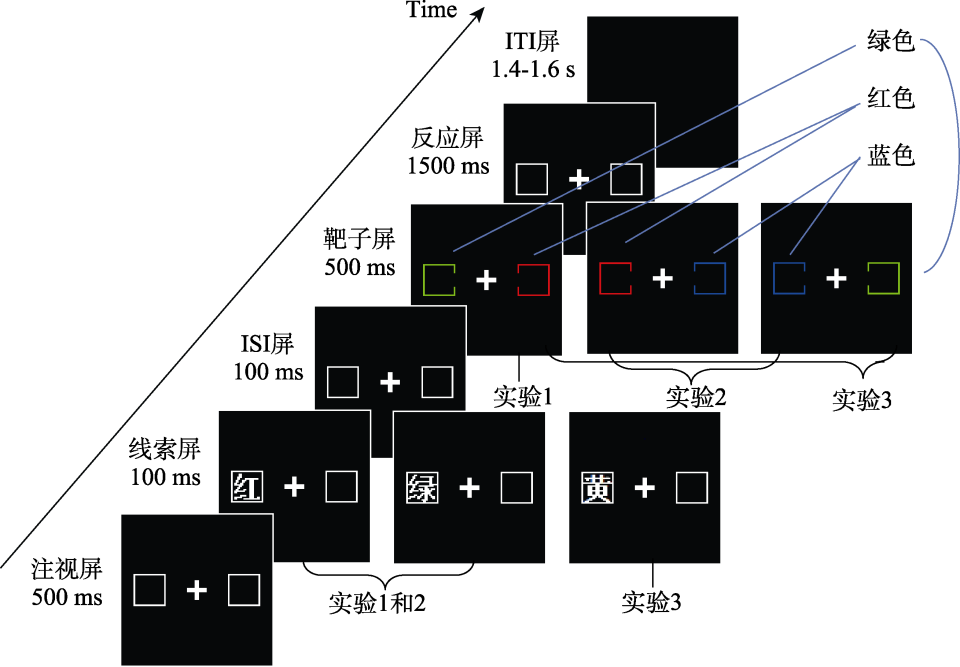
图1 实验1、实验2和实验3的一个典型试次。在每个试次中, 首先呈现注视屏500 ms, 然后呈现线索屏100 ms, 线索位置随机。线索屏和靶子屏的间隔ISI是100 ms, 最后呈现靶子屏500 ms, 靶子屏消失后1500 ms内被试可以进行反应。两次试次间有随机1.4~1.6 s的空屏ITI。实验采用Block设计, 根据线索与靶子的组合情况, 对于每种条件线索汉字和靶子颜色均已确定。在实验1中, 线索为白色的“红”字或“绿”字, 靶子屏中包括红色和绿色方框, 当其中一个为靶子时, 另一个为非靶项目; 实验2与实验1的不同之处在于, 不同Block内靶子为红色或绿色方框, 非靶项目总是蓝色方框; 实验3的线索为白色的“黄”字, 靶子屏包括实验1与实验2的所有形式。彩图见电子版, 下同。
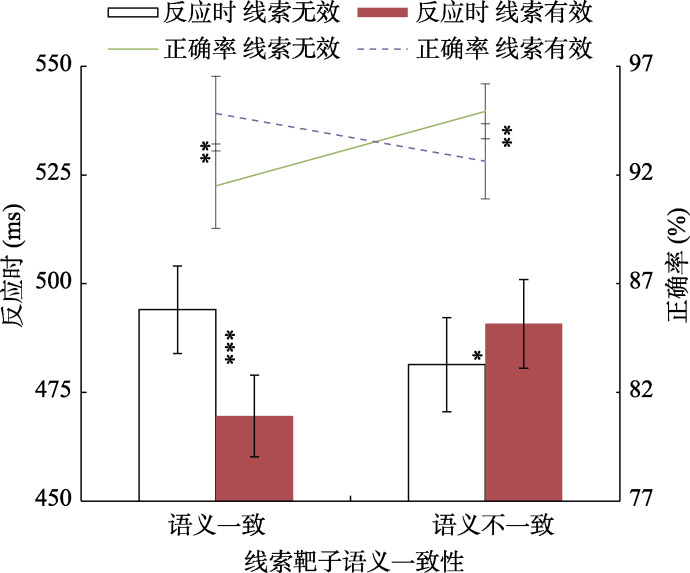
图2 实验1中线索有效性和线索靶子语义一致性的交互作用。当线索靶子语义一致时, 线索无效时的反应慢于线索有效时的反应, 线索无效时的正确率低于线索有效时的正确率; 当线索靶子语义不一致时, 线索无效时的反应快于线索有效时的反应, 线索无效时的正确率高于线索有效时的正确率。
*表示p < 0.05, **表示p < 0.01, ***表示p < 0.001, 下同
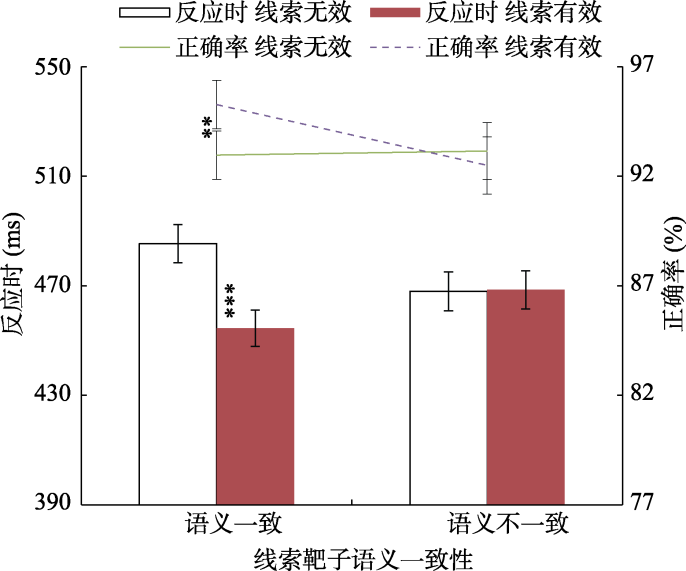
图3 实验2中线索有效性和线索靶子语义一致性的交互作用。当线索靶子语义一致时, 线索无效时的反应慢于线索有效时的反应, 线索无效时的正确率低于线索有效时的正确率; 当线索靶子语义不一致时, 线索无效时的反应与线索有效时的反应无差异, 线索无效时的正确率与线索有效时的正确率无差异。
| 实验 1靶子屏情况 | 实验2靶子屏情况 | ||
|---|---|---|---|
| 反应时 | 线索无效 | 463 ± 53 | 458 ± 50 |
| 线索有效 | 467 ± 51 | 457 ± 50 | |
| 正确率 | 线索无效 | 95.5 ± 7.2 | 94.7 ± 7.3 |
| 线索有效 | 94.8 ± 7.4 | 94.5 ± 7.0 |
表1 实验3中两种靶子屏情况下线索有效性各水平的平均反应时和正确率(M ± SD)
| 实验 1靶子屏情况 | 实验2靶子屏情况 | ||
|---|---|---|---|
| 反应时 | 线索无效 | 463 ± 53 | 458 ± 50 |
| 线索有效 | 467 ± 51 | 457 ± 50 | |
| 正确率 | 线索无效 | 95.5 ± 7.2 | 94.7 ± 7.3 |
| 线索有效 | 94.8 ± 7.4 | 94.5 ± 7.0 |
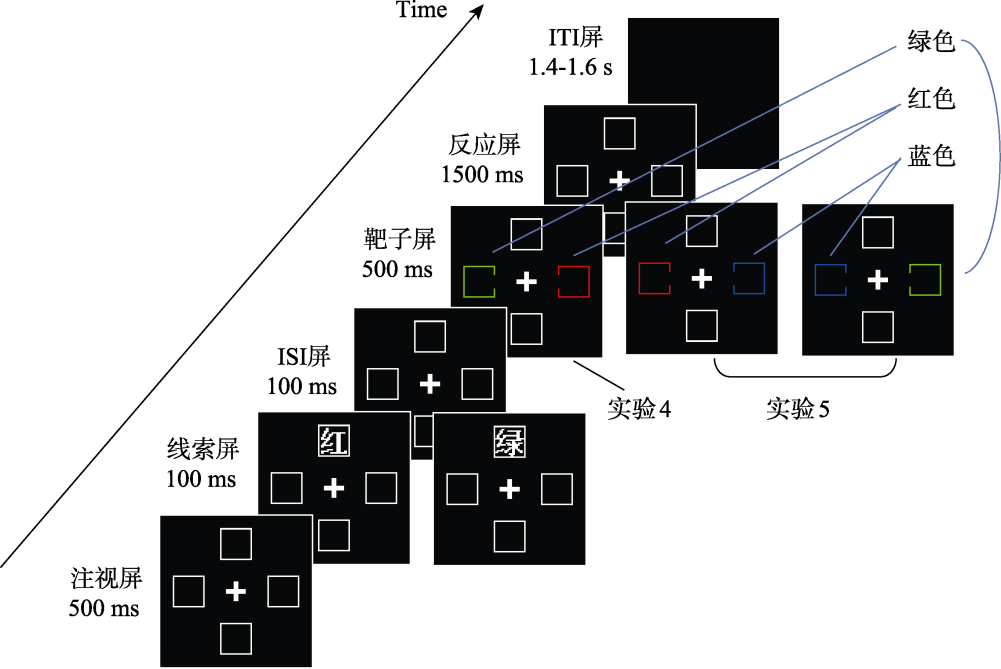
图4 实验4和实验5的一个典型试次。与实验1和实验2相比, 实验4和实验5中中央注视加号周围呈现4个方框, 线索随机出现在4个方框的某一个方框中。靶子屏中的左右两方框依然改变颜色, 上下两方框不改变颜色, 被试的任务分别与实验1和实验2相同。
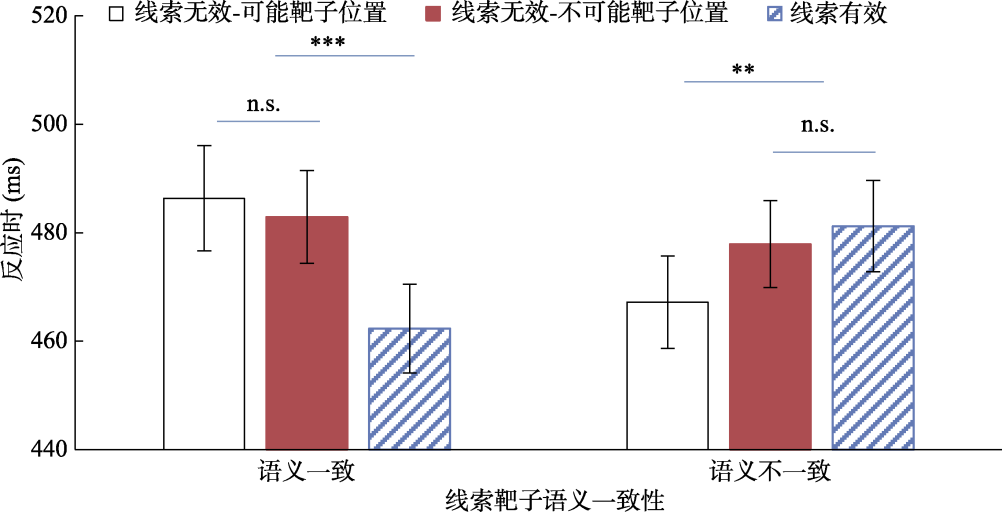
图5 实验4中线索有效性和线索靶子语义一致性的交互作用。当线索靶子语义一致时, 线索是否出现在可能靶子位置其线索无效时的反应无差异, 且皆慢于线索有效时的反应; 当线索靶子语义不一致时, 线索出现在不可能靶子位置线索无效时的反应与线索有效时的反应无差异, 且皆慢于线索出现在可能靶子位置线索无效时的反应。n.s.表示p > 0.05, 下同
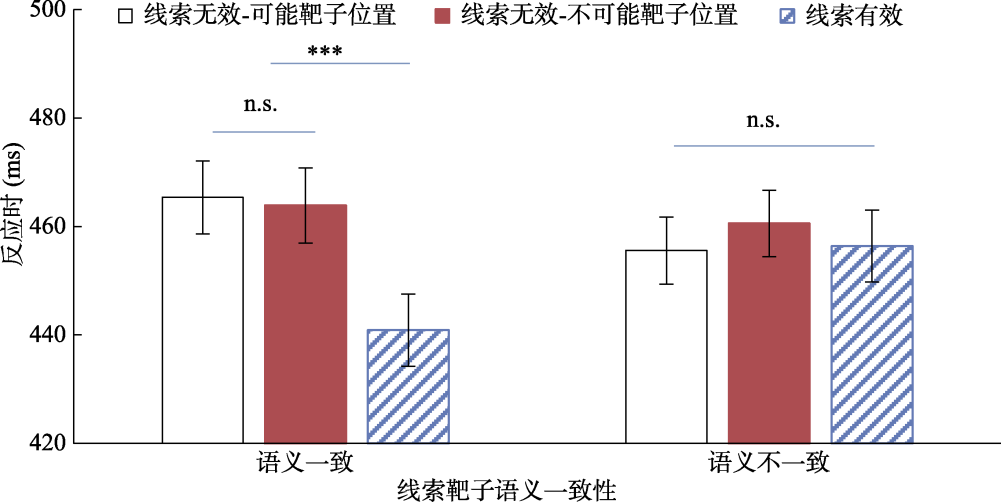
图6 实验5中线索有效性和线索靶子语义一致性的交互作用。当线索靶子语义一致时, 线索是否出现在可能靶子位置其线索无效时的反应无差异, 且皆慢于线索有效时的反应; 当线索靶子语义不一致时, 三种线索有效性水平间无差异。
| [1] | Ansorge, U., & Schoeberl, T. (2017). Attention and suppression: Awareness-independent same-location costs in relational and feature search for spatial frequency targets. Journal of Vision, 17(10), 943. |
| [2] | Becker, S. I. (2010). The role of target-distractor relationships in guiding attention and the eyes in visual search. Journal of Experimental Psychology: General, 139(2), 247-265. |
| [3] |
Becker, S. I., Folk, C. L., & Remington, R. W. (2010). The role of relational information in contingent capture. Journal of Experimental Psychology: Human Perception and Performance, 36(6), 1460-1476.
doi: 10.1037/a0020370 pmid: 20919781 |
| [4] |
Becker, S. I., Folk, C. L., & Remington, R. W. (2013). Attentional capture does not depend on feature similarity, but on target-nontarget relations. Psychological Science, 24(5), 634-647.
doi: 10.1177/0956797612458528 pmid: 23558547 |
| [5] | Besner, D., & Young, T. (2024). On the relationship between spatial attention and semantics in the context of a stroop paradigm. Attention, Perception & Psychophysics, 86(5), 1521-1530. |
| [6] |
Carmel, T., & Lamy, D. (2014). The same-location cost is unrelated to attentional settings: An object-updating account. Journal of Experimental Psychology: Human, Perception and Performance, 40(4), 1465-1478.
doi: 10.1037/a0036383 pmid: 24730745 |
| [7] | Cimminella, F., Sala, S. D., & Coco, M. I. (2020). Extra-foveal processing of object semantics guides early overt attention during visual search. Attention, Perception and Psychophysics, 82(2), 655-670. |
| [8] | Dampuré, J., Ros, C., Rouet, J. F., & Vibert, N. (2014). Task-dependent sensitisation of perceptual and semantic processing during visual search for words. Journal of Cognitive Psychology, 26(5), 530-549. |
| [9] | Doradzińska, Ł., Furtak, M., & Bola, M. (2022). Perception of semantic relations in scenes: A registered report study of attention hold. Consciousness and Cognition, 100(c), 103315. |
| [10] |
Eimer, M., & Kiss, M. (2008). Involuntary attentional capture is determined by task set: Evidence from event-related brain potentials. Journal of Cognitive Neuroscience, 20(8), 1423-1433.
doi: 10.1162/jocn.2008.20099 pmid: 18303979 |
| [11] | Eimer, M., Kiss, M., Press, C., & Sauter, D. (2009). The roles of feature specific task set and bottom-up salience in attentional capture:An ERP study. Journal of Experimental Psychology: Human Perception and Performance, 35(5), 1316-1328. |
| [12] | Feldmann-Wüstefeld, T., Weinberger, M., & Awh, E. (2021). Spatially guided distractor suppression during visual search. The Journal of Neuroscience, 41(14), 3180-3191. |
| [13] | Folk, C. L., Remington, R. W., & Johnston, J. C. (1992). Involuntary covert orienting is contingent on attentional control settings. Journal of Experimental Psychology: Human Perception & Performance, 18(4), 1030-1044. |
| [14] | Forstinger, M., & Ansorge, U. (2024). Top-down suppression of negative features applies flexibly contingent on visual search goals. Attention, Perception & Psychophysics, 86(4), 1120-1147. |
| [15] |
Forstinger, M., Gruener, M., & Ansorge, U. (2022). Unseeing the white bear: Negative search criteria guide visual attention through top-down suppression. Journal of Experimental Psychology: Human Perception and Performance, 48(6), 613-638.
doi: 10.1037/xhp0001001 pmid: 35389707 |
| [16] | Furtak, M., Doradzińska, Ł., Ptashynska, A., Mudrik, L., Nowicka, A., & Bola, M. (2020). Automatic attention capture by threatening, but not by semantically incongruent natural scene images. Cerebral Cortex, 30(7), 4158-4168. |
| [17] |
Gaspelin, N., & Luck, S. J. (2018). Combined electrophysiological and behavioral evidence for the suppression of salient distractors. Journal of Cognitive Neuroscience, 30(9), 1265-1280.
doi: 10.1162/jocn_a_01279 pmid: 29762104 |
| [18] |
Gaspelin, N., & Luck, S. J. (2019). Inhibition as a potential resolution to the attentional capture debate. Current Opinion in Psychology, 29, 12-18.
doi: S2352-250X(18)30177-5 pmid: 30415087 |
| [19] | Goller, F., Schoeberl, T., & Ansorge, U. (2020). Testing the top-down contingent capture of attention for abrupt‐onset cues: Evidence from cue‐elicited N2pc. Psychophysiology, 57(11), e13655. |
| [20] | Goodhew, S. C., Kendall, W., Ferber, S., & Pratt, J. (2014). Setting semantics: Conceptual set can determine the physical properties that capture attention. Attention, Perception, & Psychophysics, 76(6), 1577-1589. |
| [21] | Harris, A., Bradley, C., Yoo, S., & Mattingley, J. (2023). Neurophysiological evidence against attentional suppression as the source of the same-location cost in spatial cueing. Attention, Perception, & Psychophysics, 85(2), 284-292. |
| [22] | Hayes, T. R., & Henderson, J. M. (2019). Scene semantics involuntarily guide attention during visual search. Psychonomic Bulletin & Review, 26(5), 1683-1689. |
| [23] | Hayes, T. R., & Henderson, J. M. (2021). Looking for semantic similarity: What a vector-space model of semantics can tell us about attention in real-world scenes. Psychological Science, 32(8), 1262-1270. |
| [24] |
Huang, W. Y., Su, Y. L., Zhen, Y. F., & Zhe, Q. (2016). The role of top-down spatial attention in contingent attentional capture. Psychophysiology, 53(5), 650-662.
doi: 10.1111/psyp.12615 pmid: 26879628 |
| [25] |
Kahneman, D., Treisman, A., & Gibbs, B. (1992). The reviewing of object files: Object-specific integration of information. Cognitive Psychology, 24(2), 175-219.
doi: 10.1016/0010-0285(92)90007-o pmid: 1582172 |
| [26] |
Kerzel, D., & Burra, N. (2020). Capture by context elements, not attentional suppression of distractors, explains the pd with small search displays. Journal of Cognitive Neuroscience, 32(6), 1170-1183.
doi: 10.1162/jocn_a_01535 pmid: 31967520 |
| [27] | Kerzel, D., & Huynh Cong, S. (2021). Statistical regularities cause attentional suppression with target-matching distractors. Attention, Perception & Psychophysics, 83(1), 270-282. |
| [28] |
Kiefer, M., Trumpp, N. M., Schaitz, C., Reuss, H., & Kunde, W. (2019). Attentional modulation of masked semantic priming by visible and masked task cues. Cognition, 187, 62-77.
doi: S0010-0277(19)30040-X pmid: 30836302 |
| [29] | Lamy, D., Leber, A., & Egeth, H. E. (2004). Effects of task relevance and stimulus-driven salience in feature-search mode. Journal of Experimental Psychology: Human Perception and Performance, 30(6), 1019-1031. |
| [30] | Luck, S. J., Gaspelin, N., Folk, C. L., Remington, R. W., & Theeuwes, J. (2020). Progress toward resolving the attentional capture debate. Visual Cognition, 29(1), 1-21. |
| [31] |
Luck, S. J., & Hillyard, S. A. (1994). Electrophysiological correlates of feature analysis during visual search. Psychophysiology, 31(3), 291-308.
doi: 10.1111/j.1469-8986.1994.tb02218.x pmid: 8008793 |
| [32] | Pashler, H. E. (1988). Cross-dimensional interaction and texture segregation. Perception & Psychophysics, 43(4), 307-318. |
| [33] | Schoeberl, T., Ditye, T., & Ansorge, U. (2018). Same-location costs in peripheral cueing: The role of cue awareness and feature changes. Journal of Experimental Psychology: Human Perception & Performance, 44(3), 433-451. |
| [34] | Schönhammer, J. G., Becker, S. I., & Kerzel, D. (2020). Attentional capture by context cues, not inhibition of cue singletons, Explains Same Location Costs. Journal of Experimental Psychology: Human Perception & Performance, 46(6), 610-628. |
| [35] | Seidl-Rathkopf, K. N., Turk-Browne, N. B., & Kastner, S. (2015). Automatic guidance of attention during real-world visual search. Attention, Perception, & Psychophysics, 77(6), 1881-1895. |
| [36] |
Shomstein, S., Malcolm, G. L., & Nah, J. C. (2019). Intrusive effects of task-irrelevant information on visual selective attention: Semantics and size. Current Opinion in Psychology, 29, 153-159.
doi: S2352-250X(18)30176-3 pmid: 30925285 |
| [37] |
Spilcke-Liss, J., Zhu, J., Gluth, S., Spezio, M., & Gläscher, J. (2019). Semantic incongruency interferes with endogenous attention in cross-modal integration of semantically congruent objects. Frontiers in Integrative Neuroscience, 13, 53.
doi: 10.3389/fnint.2019.00053 pmid: 31572138 |
| [38] | Spruyt, A., Houwer, J. D., & Hermans, D. (2009). Modulation of automatic semantic priming by feature-specific attention allocation. Journal of Memory and Language, 61(1), 37-54. |
| [39] | Theeuwes, J. (1991). Cross-dimensional perceptual selectivity. Perception & Psychophysics, 50(2), 184-193. |
| [40] |
Theeuwes, J. (1993). Visual selective attention: A theoretical analysis. Acta Psychologica, 83(2), 93-154.
pmid: 8342410 |
| [41] | Theeuwes, J. (2004). Top-down search strategies cannot override attentional capture. Psychonomic Bulletin & Review, 11(1), 65-70. |
| [42] |
Theeuwes, J. (2010). Top-down and bottom-up control of visual selection. Acta Psychologica, 135(2), 77-99.
doi: 10.1016/j.actpsy.2010.02.006 pmid: 20507828 |
| [43] | Travis, S. L., Dux, P. E., & Mattingley, J. B. (2019). Neural correlates of goal-directed enhancement and suppression of visual stimuli in the absence of conscious perception. Attention, Perception & Psychophysics, 81(5), 1346-1364. |
| [44] | Wang, B., & Theeuwes, J. (2018). How to inhibit a distractor location? Statistical learning versus active, top-down suppression. Attention, Perception, & Psychophysics, 80(4), 860-870. |
| [45] |
Wang, B., van Driel, J., Ort, E., & Theeuwes, J. (2019). Anticipatory distractor suppression elicited by statistical regularities in visual search. Journal of Cognitive Neuroscience, 31(10), 1535-1548.
doi: 10.1162/jocn_a_01433 pmid: 31180265 |
| [46] | Wang, H. Y., Sui, J., & Zhang, M. (2018). Attentional capture is contingent on attentional control setting for semantic meaning: Evidence from modified spatial cueing paradigm. Acta Psychologica Sinica, 50(10), 1071-1082. |
|
[王慧媛, 隋洁, 张明. (2018). 语义关联的注意捕获——来自线索化范式的证据. 心理学报, 50(10), 1071-1082.]
doi: 10.3724/SP.J.1041.2018.01071 |
|
| [47] | Wegner-Clemens, K., Malcolm, G. L., & Shomstein, S. (2024). Predicting attentional allocation in real-world environments: The need to investigate crossmodal semantic guidance. Wiley Interdisciplinary Reviews. Cognitive Science, 15(3), e1675. |
| [48] | Yantis, S., & Jonides, J. (1984). Abrupt visual onsets and selective attention: Evidence from visual search. Journal of Experimental Psychology: Human Perception and Performance, 10(5), 601-621. |
| [1] | 车晓玮, 徐慧云, 王凯旋, 张倩, 李寿欣. 工作记忆表征精度加工需求对注意引导的影响[J]. 心理学报, 2021, 53(7): 694-713. |
| [2] | 张帆, 王爱君, 张明. 基于干扰物特征的统计规则对注意抑制效应的影响[J]. 心理学报, 2021, 53(6): 555-564. |
| [3] | 王慧媛, 陈艾睿, 张明. 意义关联的注意定向效应:基于空间位置的抑制和捕获[J]. 心理学报, 2021, 53(2): 113-127. |
| [4] | 黄月胜, 张豹, 范兴华, 黄杰. 无关工作记忆表征的负性情绪信息能否捕获视觉注意?一项眼动研究[J]. 心理学报, 2021, 53(1): 26-37. |
| [5] | 郑旭涛, 郭文姣, 陈满, 金佳, 尹军. 社会行为的效价信息对注意捕获的影响:基于帮助和阻碍行为的探讨[J]. 心理学报, 2020, 52(5): 584-596. |
| [6] | 李毕琴, 李玲, 王爱君, 张明. 言语工作记忆内容在语义水平的注意捕获[J]. 心理学报, 2018, 50(5): 483-493. |
| [7] | 王慧媛, 隋洁, 张明. 语义关联的注意捕获——来自线索化范式的证据[J]. 心理学报, 2018, 50(10): 1071-1082. |
| [8] | 刘丽;白学军. 注意控制定势和线索类型在注意捕获中的作用[J]. 心理学报, 2016, 48(9): 1093-1104. |
| [9] | 王慧媛; 隋洁; 张明. 线索靶子关联和搜索策略对注意捕获的作用 ——来自意义线索的证据[J]. 心理学报, 2016, 48(7): 783-793. |
| [10] | 白学军; 刘丽; 宋娟; 郭志英. 特征和位置信息在价值驱动注意捕获中的作用[J]. 心理学报, 2016, 48(11): 1357-1369. |
| [11] | 胡艳梅;张明. 基于记忆的注意捕获和注意抑制效应:ERP证据[J]. 心理学报, 2016, 48(1): 12-21. |
| [12] | 张微;周兵平;臧玲;莫书亮. 网络成瘾倾向者在视觉工作记忆引导下的注意捕获[J]. 心理学报, 2015, 47(10): 1223-1234. |
| [13] | 王慧媛;张明;隋洁. 线索靶子关联和搜索策略对注意捕获的作用[J]. 心理学报, 2014, 46(2): 185-195. |
| [14] | 牟兵兵;宛小昂. 视觉搜索中的情绪干扰项预习效应[J]. 心理学报, 2014, 46(11): 1603-1612. |
| [15] | 刘丽;李运;李力红;白学军. 自上而下的注意控制定势在注意捕获中的作用[J]. 心理学报, 2014, 46(10): 1442-1453. |
| 阅读次数 | ||||||
|
全文 |
|
|||||
|
摘要 |
|
|||||
