

ISSN 0439-755X
CN 11-1911/B
主办:中国心理学会
中国科学院心理研究所
出版:科学出版社
CN 11-1911/B
主办:中国心理学会
中国科学院心理研究所
出版:科学出版社
心理学报 ›› 2025, Vol. 57 ›› Issue (7): 1139-1153.doi: 10.3724/SP.J.1041.2025.1139 cstr: 32110.14.2025.1139
陈杰1,2,3( ), 蔡佳慧1, 兰雅迪1, 李雯婕1
收稿日期:2024-08-11
发布日期:2025-04-24
出版日期:2025-07-25
通讯作者:
陈杰, E-mail: xlxchen@163.com基金资助:
CHEN Jie1,2,3(), CAI Jiahui1, LAN Yadi1, LI Wenjie1
Received:2024-08-11
Online:2025-04-24
Published:2025-07-25
摘要:
以往研究发现, 听觉经验剥夺会导致听障个体视觉注意功能发生变化。但是, 生物运动信息会如何调节听障个体的视觉注意功能仍不清楚。本研究采用注意网络测试(attentional network test)和Flanker范式的变式, 探讨了听障个体对光点生物运动信息的注意网络功能特点。实验1a采用经典注意网络测试考察了听障个体的注意网络功能特点。结果显示, 听障个体执行控制的加工效率显著低于健听个体, 而在警觉和定向上与健听个体无显著差异。实验1b将光点生物运动序列作为目标刺激, 结果显示, 当目标刺激为完整生物运动信息时, 听障个体警觉和执行控制的加工效率显著低于健听个体, 而当目标刺激为局部和打乱生物运动信息时, 两组被试在警觉、定向和执行控制上均无显著差异。实验2采用Flanker范式的变式考察听障个体对生物运动信息的执行控制特点。结果显示, 在完整生物运动信息上, 听障个体执行控制的加工效率显著低于健听个体, 而在局部和打乱生物运动信息上两组被试无显著差异。以上结果说明, 生物运动信息会调节听障个体的注意网络功能, 当目标刺激为完整生物运动信息时, 听障个体的注意警觉和执行控制网络功能存在受损。
中图分类号:
陈杰, 蔡佳慧, 兰雅迪, 李雯婕. (2025). 生物运动信息对听障个体注意网络功能的影响. 心理学报, 57(7), 1139-1153.
CHEN Jie, CAI Jiahui, LAN Yadi, LI Wenjie. (2025). Impact of point-light biological motion information on attentional network function in hearing-impaired individuals. Acta Psychologica Sinica, 57(7), 1139-1153.
| 变量 | 听障组 (n = 33) | 健听组 (n = 33) | t/χ2 | p |
|---|---|---|---|---|
| M ± SD | M ± SD | |||
| 年龄(岁) | 21.55 ± 1.84 | 20.64 ± 2.13 | 1.85 | 0.068 |
| 性别 | 23男/10女 | 21男/12女 | 0.27 | 0.602 |
| 瑞文推理分数 | 48.33 ± 4.31 | 49.91 ± 6.07 | −1.22 | 0.228 |
| 听力损失年龄(岁) | 1.74 ± 1.78 | |||
| 手语习得年龄(岁) | 9.81 ± 3.89 | |||
| 听力损失程度(极重度/重度/重度以下) | 7人/10人/16人 |
表1 实验1a听障组与健听组的人口学数据
| 变量 | 听障组 (n = 33) | 健听组 (n = 33) | t/χ2 | p |
|---|---|---|---|---|
| M ± SD | M ± SD | |||
| 年龄(岁) | 21.55 ± 1.84 | 20.64 ± 2.13 | 1.85 | 0.068 |
| 性别 | 23男/10女 | 21男/12女 | 0.27 | 0.602 |
| 瑞文推理分数 | 48.33 ± 4.31 | 49.91 ± 6.07 | −1.22 | 0.228 |
| 听力损失年龄(岁) | 1.74 ± 1.78 | |||
| 手语习得年龄(岁) | 9.81 ± 3.89 | |||
| 听力损失程度(极重度/重度/重度以下) | 7人/10人/16人 |
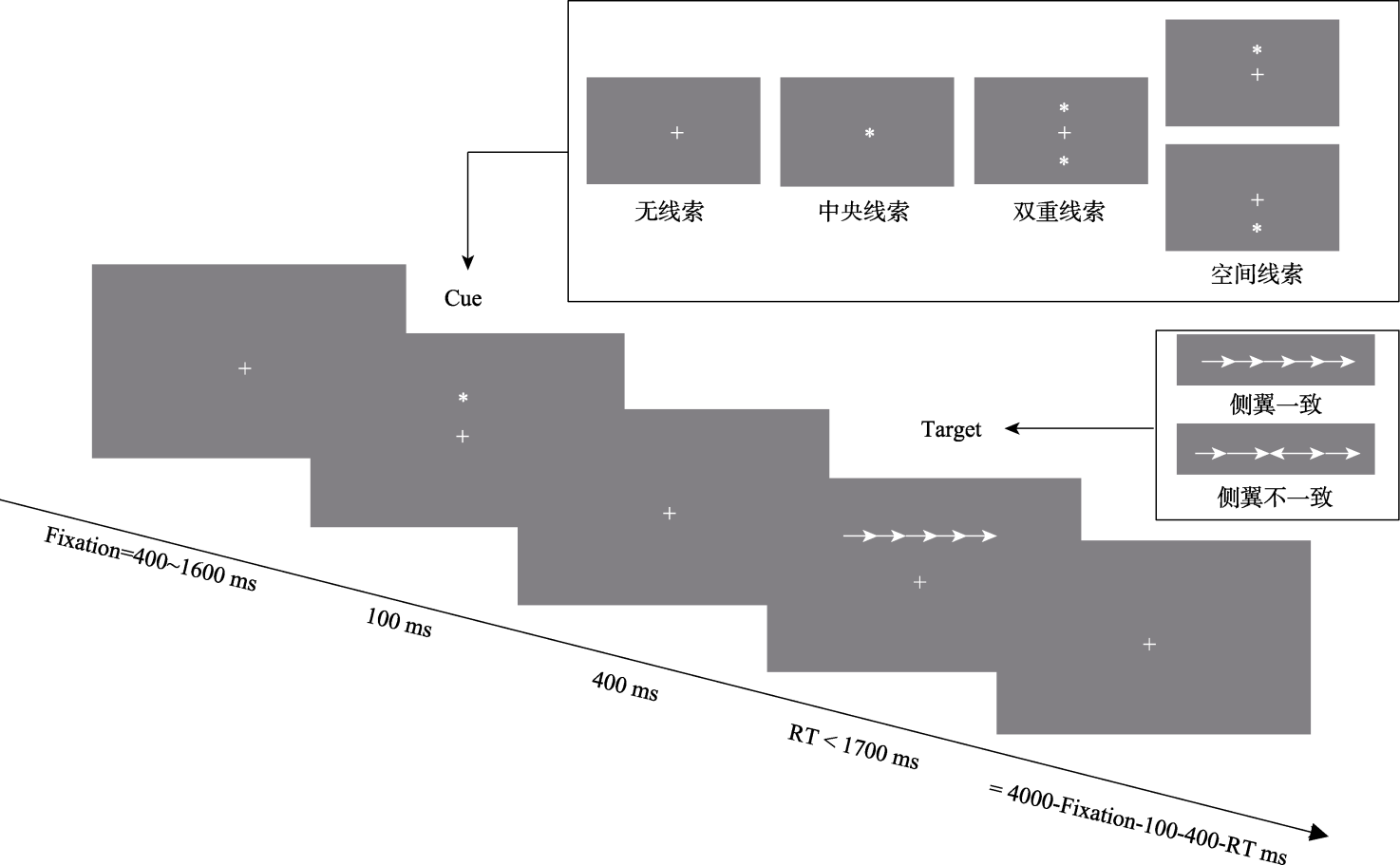
图1 实验1a流程图
| 组别 | 侧翼类型 | 线索类型 | |||
|---|---|---|---|---|---|
| 无线索 | 中央线索 | 双重线索 | 空间线索 | ||
| 听障组 | 一致条件 | 596 (94) | 553 (87) | 542 (87) | 535 (86) |
| 健听组 | 538 (71) | 490 (63) | 480 (59) | 469 (57) | |
| 听障组 | 不一致条件 | 709 (152) | 677 (160) | 655 (136) | 662 (138) |
| 健听组 | 614 (83) | 570 (69) | 555 (64) | 554 (61) | |
表2 听障组与健听组在各条件下的反应时M (SD) (ms)
| 组别 | 侧翼类型 | 线索类型 | |||
|---|---|---|---|---|---|
| 无线索 | 中央线索 | 双重线索 | 空间线索 | ||
| 听障组 | 一致条件 | 596 (94) | 553 (87) | 542 (87) | 535 (86) |
| 健听组 | 538 (71) | 490 (63) | 480 (59) | 469 (57) | |
| 听障组 | 不一致条件 | 709 (152) | 677 (160) | 655 (136) | 662 (138) |
| 健听组 | 614 (83) | 570 (69) | 555 (64) | 554 (61) | |
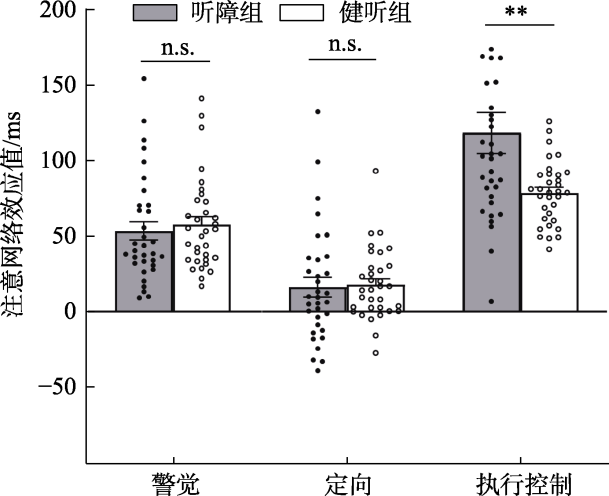
图2 听障组与健听组注意网络效应值比较 注: 误差棒为标准误, **p < 0.01
| 变量 | 听障组(n = 28) | 健听组(n = 28) | t/χ2 | p |
|---|---|---|---|---|
| M ± SD | M ± SD | |||
| 年龄(岁) | 20.75 ± 1.32 | 20.64 ± 2.02 | 0.24 | 0.815 |
| 性别 | 21男/7女 | 21男/7女 | 0.01 | 0.999 |
| 瑞文推理分数 | 48.79 ± 6.70 | 48.50 ± 6.82 | 0.16 | 0.875 |
| 自闭特质分数 | 23.04 ± 2.90 | 21.36 ± 5.07 | 1.52 | 0.134 |
| 听力损失年龄(岁) | 1.88 ± 2.33 | |||
| 手语习得年龄(岁) | 9.48 ± 3.95 | |||
| 听力损失程度(极重度/重度/重度以下) | 10人/5人/13人 |
表3 实验1b听障组与健听组的人口学数据
| 变量 | 听障组(n = 28) | 健听组(n = 28) | t/χ2 | p |
|---|---|---|---|---|
| M ± SD | M ± SD | |||
| 年龄(岁) | 20.75 ± 1.32 | 20.64 ± 2.02 | 0.24 | 0.815 |
| 性别 | 21男/7女 | 21男/7女 | 0.01 | 0.999 |
| 瑞文推理分数 | 48.79 ± 6.70 | 48.50 ± 6.82 | 0.16 | 0.875 |
| 自闭特质分数 | 23.04 ± 2.90 | 21.36 ± 5.07 | 1.52 | 0.134 |
| 听力损失年龄(岁) | 1.88 ± 2.33 | |||
| 手语习得年龄(岁) | 9.48 ± 3.95 | |||
| 听力损失程度(极重度/重度/重度以下) | 10人/5人/13人 |
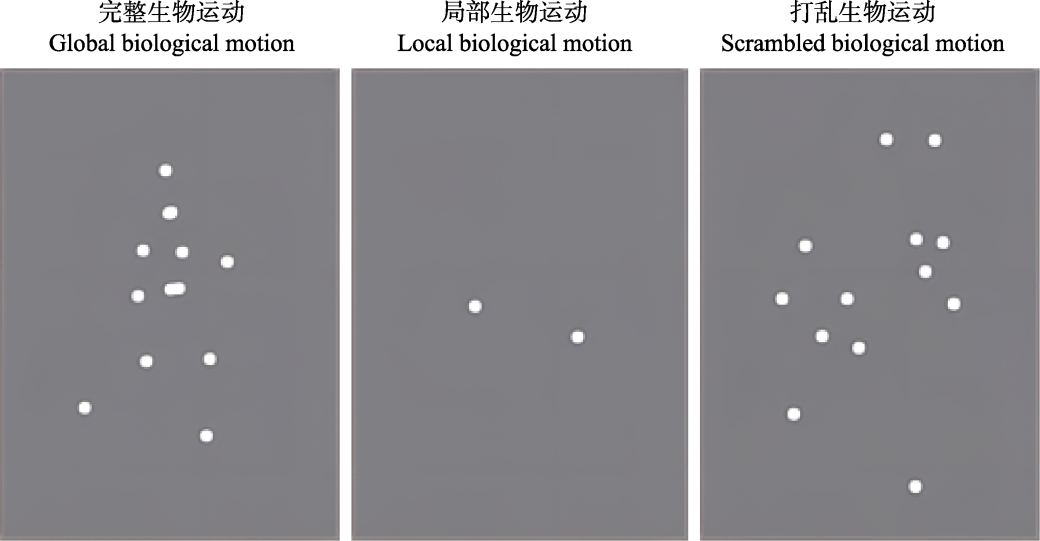
图3 三种生物运动光点序列材料
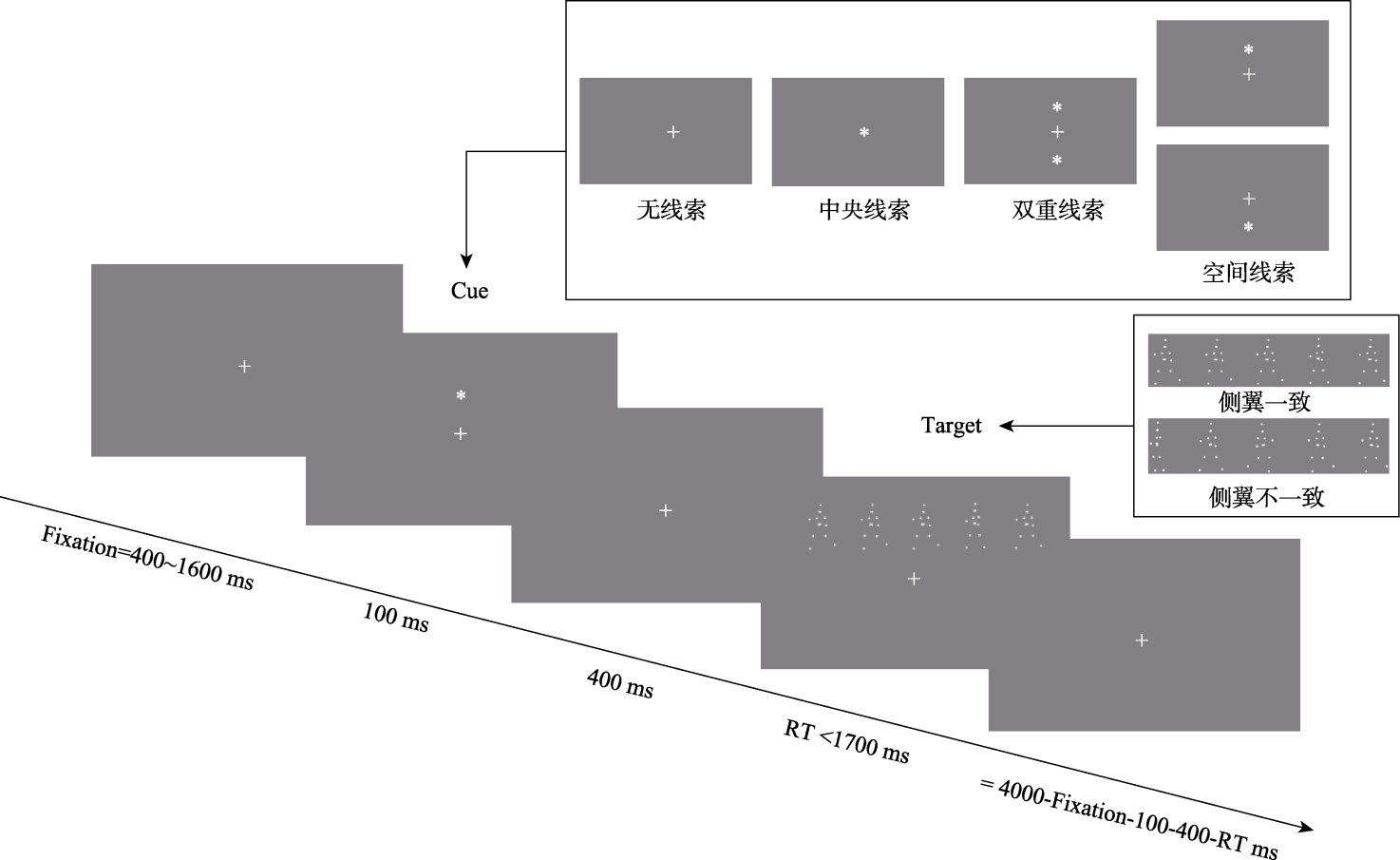
图4 实验1b实验流程图(示例中是完整生物运动注意网络测试)
| 生物运动类型 | 组别 | 侧翼类型 | 线索类型 | |||
|---|---|---|---|---|---|---|
| 无线索 | 中央线索 | 双重线索 | 空间线索 | |||
| 完整生物运动 | 听障组 | 一致条件 | 681 (80) | 654 (87) | 643 (75) | 637 (93) |
| 健听组 | 633 (69) | 588 (67) | 573 (62) | 563 (77) | ||
| 听障组 | 不一致条件 | 749 (100) | 717 (93) | 725 (114) | 705 (111) | |
| 健听组 | 679 (73) | 643 (72) | 628 (60) | 594 (80) | ||
| 局部生物运动 | 听障组 | 一致条件 | 850 (109) | 823 (126) | 812 (125) | 804 (115) |
| 健听组 | 764 (116) | 739 (117) | 744 (132) | 691 (114) | ||
| 听障组 | 不一致条件 | 910 (132) | 856 (129) | 866 (141) | 841 (148) | |
| 健听组 | 826 (137) | 786 (102) | 812 (139) | 757 (109) | ||
| 打乱生物运动 | 听障组 | 一致条件 | 836 (159) | 799 (139) | 785 (148) | 775 (162) |
| 健听组 | 696 (128) | 637 (113) | 643 (96) | 628 (113) | ||
| 听障组 | 不一致条件 | 874 (156) | 826 (140) | 833 (168) | 806 (159) | |
| 健听组 | 717 (108) | 675 (129) | 672 (117) | 636 (109) | ||
表4 听障组与健听组在各个条件下的反应时M (SD) (ms)
| 生物运动类型 | 组别 | 侧翼类型 | 线索类型 | |||
|---|---|---|---|---|---|---|
| 无线索 | 中央线索 | 双重线索 | 空间线索 | |||
| 完整生物运动 | 听障组 | 一致条件 | 681 (80) | 654 (87) | 643 (75) | 637 (93) |
| 健听组 | 633 (69) | 588 (67) | 573 (62) | 563 (77) | ||
| 听障组 | 不一致条件 | 749 (100) | 717 (93) | 725 (114) | 705 (111) | |
| 健听组 | 679 (73) | 643 (72) | 628 (60) | 594 (80) | ||
| 局部生物运动 | 听障组 | 一致条件 | 850 (109) | 823 (126) | 812 (125) | 804 (115) |
| 健听组 | 764 (116) | 739 (117) | 744 (132) | 691 (114) | ||
| 听障组 | 不一致条件 | 910 (132) | 856 (129) | 866 (141) | 841 (148) | |
| 健听组 | 826 (137) | 786 (102) | 812 (139) | 757 (109) | ||
| 打乱生物运动 | 听障组 | 一致条件 | 836 (159) | 799 (139) | 785 (148) | 775 (162) |
| 健听组 | 696 (128) | 637 (113) | 643 (96) | 628 (113) | ||
| 听障组 | 不一致条件 | 874 (156) | 826 (140) | 833 (168) | 806 (159) | |
| 健听组 | 717 (108) | 675 (129) | 672 (117) | 636 (109) | ||
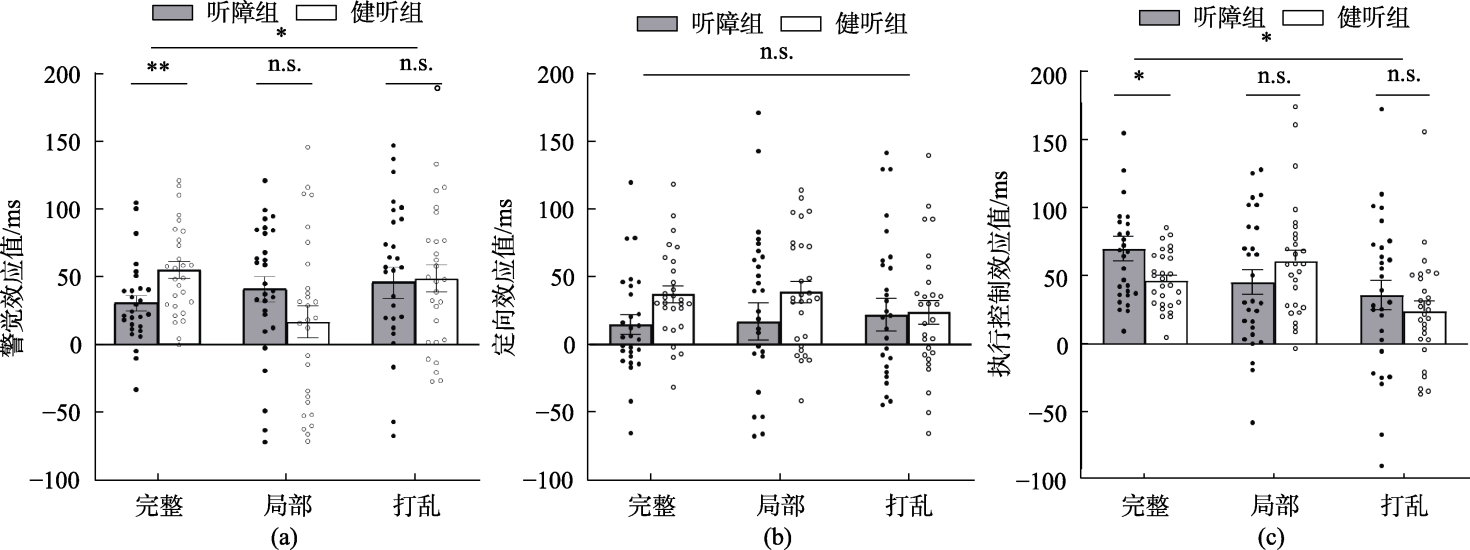
图5 听障组与健听组在三种生物运动类型上的注意网络效应值比较 注: 误差棒为标准误, **p < 0.01, *p < 0.05
| 变量 | 听障组(n = 27) | 健听组(n = 27) | t/χ2 | p |
|---|---|---|---|---|
| M ± SD | M ± SD | |||
| 年龄(岁) | 21.15 ± 1.75 | 20.37 ± 1.50 | 1.76 | 0.085 |
| 性别 | 14男/13女 | 14男/13女 | 0.01 | 0.999 |
| 瑞文推理分数 | 48.44 ± 5.63 | 51.15 ± 6.47 | −1.64 | 0.107 |
| 自闭特质分数 | 22.89 ± 3.41 | 22.78 ± 4.59 | 0.10 | 0.920 |
| 听力损失年龄(岁) | 1.04 ± 1.26 | |||
| 手语习得年龄(岁) | 9.41 ± 3.65 | |||
| 听力损失程度(极重度/重度/重度以下) | 9人/12人/6人 |
表5 实验2听障组与健听组的人口学数据
| 变量 | 听障组(n = 27) | 健听组(n = 27) | t/χ2 | p |
|---|---|---|---|---|
| M ± SD | M ± SD | |||
| 年龄(岁) | 21.15 ± 1.75 | 20.37 ± 1.50 | 1.76 | 0.085 |
| 性别 | 14男/13女 | 14男/13女 | 0.01 | 0.999 |
| 瑞文推理分数 | 48.44 ± 5.63 | 51.15 ± 6.47 | −1.64 | 0.107 |
| 自闭特质分数 | 22.89 ± 3.41 | 22.78 ± 4.59 | 0.10 | 0.920 |
| 听力损失年龄(岁) | 1.04 ± 1.26 | |||
| 手语习得年龄(岁) | 9.41 ± 3.65 | |||
| 听力损失程度(极重度/重度/重度以下) | 9人/12人/6人 |
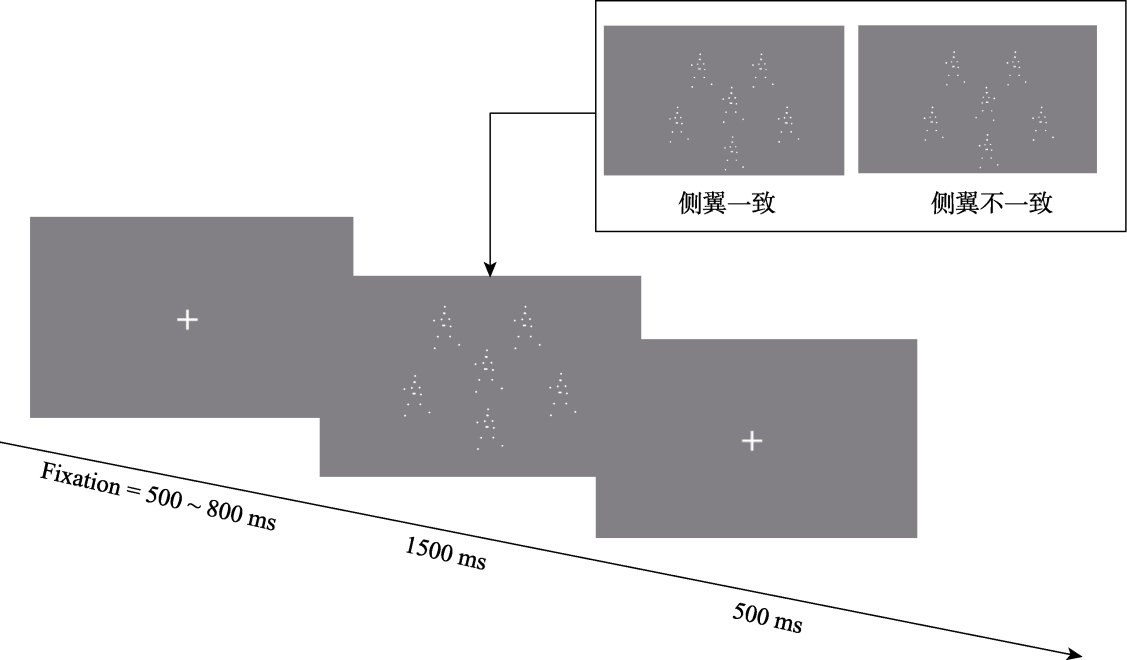
图6 实验2任务流程图(示例中为完整生物运动Flanker任务)
| 生物运动类型 | 侧翼刺激类型 | 组别 | 反应时 |
|---|---|---|---|
| 完整生物运动 | 一致 | 听障组 | 573 (82) |
| 健听组 | 531 (55) | ||
| 不一致 | 听障组 | 601 (79) | |
| 健听组 | 545 (57) | ||
| 局部生物运动 | 一致 | 听障组 | 663 (105) |
| 健听组 | 604 (78) | ||
| 不一致 | 听障组 | 704 (109) | |
| 健听组 | 666 (96) | ||
| 打乱生物运动 | 一致 | 听障组 | 577 (83) |
| 健听组 | 552 (83) | ||
| 不一致 | 听障组 | 594 (80) | |
| 健听组 | 561 (89) |
表6 听障组与健听组在Flanker任务中各条件下的反应时M (SD) (ms)
| 生物运动类型 | 侧翼刺激类型 | 组别 | 反应时 |
|---|---|---|---|
| 完整生物运动 | 一致 | 听障组 | 573 (82) |
| 健听组 | 531 (55) | ||
| 不一致 | 听障组 | 601 (79) | |
| 健听组 | 545 (57) | ||
| 局部生物运动 | 一致 | 听障组 | 663 (105) |
| 健听组 | 604 (78) | ||
| 不一致 | 听障组 | 704 (109) | |
| 健听组 | 666 (96) | ||
| 打乱生物运动 | 一致 | 听障组 | 577 (83) |
| 健听组 | 552 (83) | ||
| 不一致 | 听障组 | 594 (80) | |
| 健听组 | 561 (89) |
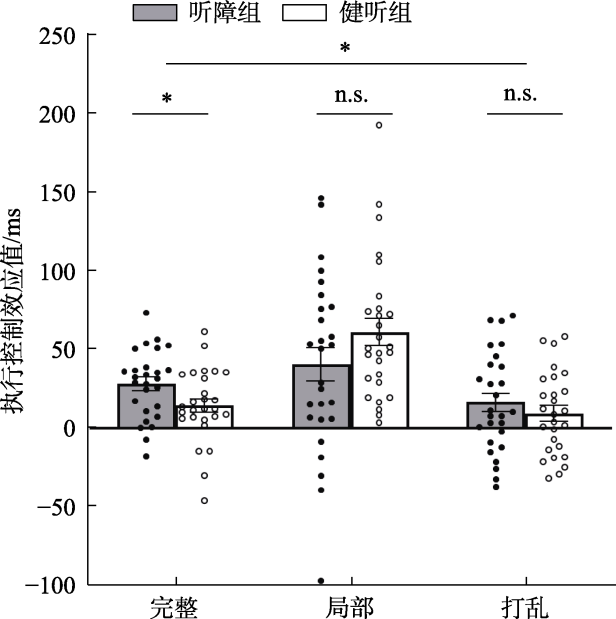
图7 听障组与健听组在三种生物运动类型上的执行控制效应值比较 注: 执行控制效应值 = RT侧翼不一致 − RT侧翼一致; 误差棒为标准误, *p < 0.05
| [1] | Baron-Cohen, S., Wheelwright, S., Hill, J., Raste, Y., & Plumb, I. (2001). The “Reading the Mind in the Eyes” Test revised version: A study with normal adults, and adults with Asperger syndrome or high-functioning autism. The Journal of Child Psychology and Psychiatry and Allied Disciplines, 42(2), 241-251. |
| [2] |
Batten, G., Oakes, P. M., & Alexander, T. (2014). Factors associated with social interactions between deaf children and their hearing peers: A systematic literature review. Journal of Deaf Studies and Deaf Education, 19(3), 285-302.
doi: 10.1093/deafed/ent052 pmid: 24222193 |
| [3] |
Bavelier, D., Dye, M. W. G., & Hauser, P. C. (2006). Do deaf individuals see better? Trends in Cognitive Sciences, 10(11), 512-518.
doi: 10.1016/j.tics.2006.09.006 pmid: 17015029 |
| [4] | Bavelier, D., Tomann, A., Hutton, C., Mitchell, T., Corina, D., Liu, G., & Neville, H. (2000). Visual attention to the periphery is enhanced in congenitally deaf individuals. The Journal of Neuroscience, 20(17), RC93. |
| [5] |
Blake, R., Turner, L. M., Smoski, M. J., Pozdol, S. L., & Stone, W. L. (2003). Visual recognition of biological motion is impaired in children with autism. Psychological Science, 14(2), 151-157.
doi: 10.1111/1467-9280.01434 pmid: 12661677 |
| [6] |
Callejas, A., Lupiàñez, J., Funes, M. J., & Tudela, P. (2005). Modulations among the alerting, orienting and executive control networks. Experimental Brain Research, 167(1), 27-37.
doi: 10.1007/s00221-005-2365-z pmid: 16021429 |
| [7] | Chang, D. H. F., & Troje, N. F. (2009). Characterizing global and local mechanisms in biological motion perception. Journal of Vision, 9(5), 8-8. |
| [8] | Chen, Q., Zhao, J. F., Gu, H., Xing, X. L., & Li, X. M. (2020). An ERP study on cognitive inhibition control of deaf children. Psychological Development and Education, 36(3), 275-282. |
| [陈琼, 赵俊峰, 谷璜, 邢小莉, 李晓铭. (2020). 听障儿童认知抑制控制的脑电特点. 心理发展与教育, 36(3), 275-282.] | |
| [9] |
Daza, M. T., & Phillips-Silver, J. (2013). Development of attention networks in deaf children: Support for the integrative hypothesis. Research in Developmental Disabilities, 34(9), 2661-2668.
doi: 10.1016/j.ridd.2013.05.012 pmid: 23747946 |
| [10] | de Gracia, M. R. L., de Rosnay, M., Hawes, D. J., & Perez, M. V. T. (2021). Differences in emotion knowledge among Filipino deaf children, adolescents, and young adults. Personality and Individual Differences, 180, 110967. |
| [11] |
Dye, M. W. G., & Bavelier, D. (2010). Attentional enhancements and deficits in deaf populations: An integrative review. Restorative Neurology and Neuroscience, 28(2), 181-192.
doi: 10.3233/RNN-2010-0501 pmid: 20404407 |
| [12] | Dye, M. W. G., & Bavelier, D. (2013). Visual attention in deaf humans:A neuroplasticity perspective. In A. Kral, A. N. Popper, & R. R. Fay (Eds.), Deafness (Vol. 47, pp. 237- 263). Springer New York. |
| [13] |
Dye, M. W. G., Baril, D. E., & Bavelier, D. (2007). Which aspects of visual attention are changed by deafness? The case of the attentional network test. Neuropsychologia, 45(8), 1801-1811.
pmid: 17291549 |
| [14] |
Faul, F., Erdfelder, E., Lang, A. G., & Buchner, A. (2007). G*power 3: A flexible statistical power analysis program for the social, behavioral, and biomedical sciences. Behavior Research Methods, 39(2), 175-191.
doi: 10.3758/bf03193146 pmid: 17695343 |
| [15] |
Fan, J., Gu, X., Guise, K. G., Liu, X., Fossella, J., Wang, H., & Posner, M. I. (2009). Testing the behavioral interaction and integration of attentional networks. Brain and Cognition, 70(2), 209-220.
doi: 10.1016/j.bandc.2009.02.002 pmid: 19269079 |
| [16] |
Fan, J., McCandliss, B. D., Sommer, T., Raz, A., & Posner, M. I. (2002). Testing the efficiency and independence of attentional networks. Journal of Cognitive Neuroscience, 14(3), 340-347.
doi: 10.1162/089892902317361886 pmid: 11970796 |
| [17] | Fan, J., & Posner, M. (2004). Human attentional networks. Psychiatrische Praxis, 31(S2), 210-214. |
| [18] | Federico, F., Marotta, A., Adriani, T., Maccari, L., & Casagrande, M. (2013). Attention network test—The impact of social information on executive control, alerting and orienting. Acta Psychologica, 143(1), 65-70. |
| [19] |
Fernandez-Duque, D., & Posner, M. I. (1997). Relating the mechanisms of orienting and alerting. Neuropsychologia, 35(4), 477-486.
pmid: 9106276 |
| [20] | Figueras, B., Edwards, L., & Langdon, D. (2008). Executive function and language in deaf children. The Journal of Deaf Studies and Deaf Education, 13(3), 362-377. |
| [21] |
Freitag, C. M., Konrad, C., Häberlen, M., Kleser, C., Gontard, A. V., Reith, W., Troje, N. F., & Krick, C. M. (2008). Perception of biological motion in autism spectrum disorders. Neuropsychologia, 46(5), 1480-1494.
doi: 10.1016/j.neuropsychologia.2007.12.025 pmid: 18262208 |
| [22] | Friesen, C. K., & Kingstone, A. (2003). Abrupt onsets and gaze direction cues trigger independent reflexive attentional effects. Cognition, 87(1), B1-B10. |
| [23] |
Gao, H., Li, Y. Z., Hu, D., Zhu, M., Gao, X. P., & Hu, T. Y. (2018). Cognitive advantage for self-information: Evidence from the orienting network of attention. Acta Psychologica Sinica, 50(12), 1356-1368.
doi: 10.3724/SP.J.1041.2018.01356 |
|
[高虹, 李杨卓, 胡蝶, 朱敏, 高湘萍, 胡天翊. (2018). 自我信息识别优势——来自注意定向网络的证据. 心理学报, 50(12), 1356-1368.]
doi: 10.3724/SP.J.1041.2018.01356 |
|
| [24] |
Giese, M. A., & Poggio, T. (2003). Neural mechanisms for the recognition of biological movements. Nature Reviews Neuroscience, 4(3), 179-192.
pmid: 12612631 |
| [25] |
Heimler, B., van Zoest, W., Baruffaldi, F., Rinaldi, P., Caselli, M. C., & Pavani, F. (2015). Attentional orienting to social and nonsocial cues in early deaf adults. Journal of Experimental Psychology: Human Perception and Performance, 41(6), 1758-1771.
doi: 10.1037/xhp0000099 pmid: 26280262 |
| [26] | Hirai, M., & Senju, A. (2020). The two-process theory of biological motion processing. Neuroscience & Biobehavioral Reviews, 111, 114-124. |
| [27] |
Horn, D. L., Davis, R. A. O., Pisoni, D. B., & Miyamoto, R. T. (2005). Development of visual attention skills in prelingually deaf children who use cochlear implants. Ear and Hearing, 26(4), 389-408.
pmid: 16079634 |
| [28] | Jacob, P., & Alexander, G. (2023). Impaired biological motion processing and motor skills in adults with autistic traits. Journal of Autism and Developmental Disorders, 53(8), 2998-3011. |
| [29] | Jastorff, J., & Orban, G. A. (2009). Human functional magnetic resonance imaging reveals separation and integration of shape and motion cues in biological motion processing. The Journal of Neuroscience, 29(22), 7315-7329. |
| [30] | Jiang, Y., & Wang, L. (2011). Biological motion perception: The roles of global configuration and local motion. Advances in Psychological Science, 19(3), 301-311. |
| [蒋毅, 王莉. (2011). 生物运动加工特异性: 整体结构和局部运动的作用. 心理科学进展, 19(3), 301-311.] | |
| [31] | Johansson, G. (1973). Visual perception of biological motion and a model for its analysis. Perception & Psychophysics, 14(2), 201-211. |
| [32] | Kaiser, M. D., & Shiffrar, M. (2013). Variability in the visual perception of human motion as a function of the observer's autistic traits. In K. L. Johnson & M. Shiffrar (Eds.), People watching: Social, perceptual, and neurophysiological studies of body perception(pp. 159-178). Oxford University Press. |
| [33] | Kéri, S., & Benedek, G. (2009). Oxytocin enhances the perception of biological motion in humans. Cognitive, Affective, & Behavioral Neuroscience, 9(3), 237-241. |
| [34] |
Kim, J., Norton, D., McBain, R., Ongur, D., & Chen, Y. (2013). Deficient biological motion perception in schizophrenia: results from a motion noise paradigm. Frontiers in Psychology, 4, 391.
doi: 10.3389/fpsyg.2013.00391 pmid: 23847566 |
| [35] | Koldewyn, K., Whitney, D., & Rivera, S. M. (2010). The psychophysics of visual motion and global form processing in autism. Brain, 133(2), 599-610. |
| [36] |
Langton, S. R. H., Watt, R. J., & Bruce, V. (2000). Do the eyes have it? Cues to the direction of social attention. Trends in Cognitive Sciences, 4(2), 50-59.
doi: 10.1016/s1364-6613(99)01436-9 pmid: 10652522 |
| [37] | Larson, A. M., & Loschky, L. C. (2009). The contributions of central versus peripheral vision to scene gist recognition. Journal of Vision, 9(10), 6-16. |
| [38] | Lemke, U., & Scherpiet, S. (2015). Oral communication in individuals with hearing impairment—Considerations regarding attentional, cognitive and social resources. Frontiers in Psychology, 6, 998. |
| [39] | Liu, M. J. (2008). Screening adults for Asperger syndrome and high-functioning autism by using the Autism-spectrum Quotient (AQ) (Mandarin version). Bulletin of Special Education, 33(1), 73-92. |
| [刘萌容. (2008). 「自闭症光谱量表」─Autism-spectrum Quotient中文成人版之预测效度及相关因素分析. 特殊教育研究学刊, 33(1), 73-92.] | |
| [40] | Ludlow, A. K., Heaton, P., & Deruelle, C. (2013). Decoding actions and emotions in deaf children: Evidence from a biological motion task. Journal of Cognition and Development, 14(4), 561-572. |
| [41] | Pavani, F., & Bottari, D. (2012). Visual abilities in individuals with profound deafness:A critical review. In M. M. Murray, & M. T. Wallace (Ed.), The neural bases of multisensory processes (pp. 421-445). CRC Press/Taylor & Francis. |
| [42] | Pavlova, M. A. (2012). Biological motion processing as a hallmark of social cognition. Cerebral Cortex, 22(5), 981-995. |
| [43] |
Peterson, C. C., & Siegal, M. (1995). Deafness, conversation and theory of mind. Journal of Child Psychology and Psychiatry, 36(3), 459-474.
pmid: 7782409 |
| [44] |
Posner, M. I. (1980). Orienting of attention. Quarterly Journal of Experimental Psychology, 32(1), 3-25.
doi: 10.1080/00335558008248231 pmid: 7367577 |
| [45] | Posner, M. I., & Petersen, S. E. (1990). The attention system of the human brain. Annual Review of Neuroscience, 13(1), 25-42. |
| [46] |
Proksch, J., & Bavelier, D. (2002). Changes in the spatial distribution of visual attention after early deafness. Journal of Cognitive Neuroscience, 14(5), 687-701.
pmid: 12167254 |
| [47] | Quittner, A. L., Barker, D. H., Snell, C., Cruz, I., McDonald, L. G., Grimley, M. E., … CDaCI Investigative Team. (2007). Improvements in visual attention in deaf infants and toddlers after cochlear implantation. Audiological Medicine, 5(4), 242-249. |
| [48] | Quittner, A. L., Smith, L. B., Osberger, M. J., Mitchell, T. V., & Katz, D. B. (1994). The impact of audition on the development of visual attention. Psychological Science, 5(6), 347-353. |
| [49] |
Remmel, E., & Peters, K. (2009). Theory of mind and language in children with cochlear implants. Journal of Deaf Studies and Deaf Education, 14(2), 218-36.
doi: 10.1093/deafed/enn036 pmid: 18796736 |
| [50] |
Russell, J. A., Hosie, C. D., Gray, C., Scott, C., Hunter, N., Banks, J. S., & Macaualy, M. C. (1998). The development of theory of mind in deaf children. Journal of Child Psychology and Psychiatry, 39(6), 903-910.
pmid: 9758198 |
| [51] |
Shi, J., Weng, X., He, S., & Jiang, Y. (2010). Biological motion cues trigger reflexive attentional orienting. Cognition, 117(3), 348-354.
doi: 10.1016/j.cognition.2010.09.001 pmid: 20883983 |
| [52] | Simion, F., Regolin, L., & Bulf, H. (2008). A predisposition for biological motion in the newborn baby. Proceedings of the National Academy of Sciences, 105(2), 809-813. |
| [53] |
Smith, L. B., Quittner, A. L., Osberger, M. J., & Miyamoto, R. (1998). Audition and visual attention: The developmental trajectory in deaf and hearing populations. Developmental Psychology, 34(5), 840-850.
pmid: 9779732 |
| [54] | Stanzione, C., & Schick, B. (2014). Environmental language factors in theory of mind development: Evidence from children who are deaf/hard-of-hearing or who have specific language impairment. Topics in Language Disorders, 34(4), 296-312. |
| [55] | Troje, N. F. (2008). Biological motion perception. In A. Basbaum, A. Kaneko, G. M. Shepherd, & G. Westheimer (Eds.), The senses: A comprehensive reference: Vol. 2: Vision II (pp. 231-238). Elsevier. |
| [56] | Troje, N. F. (2013). What is biological motion? Definition, stimuli and paradigms. In M. D. Rutherford, & V. A. Kuhlmeier (Eds.), Perception: Detection and interpretation of animacy, agency, and intention (pp. 13-36). MIT Press, Cambridge, MA. |
| [57] | Troje, N. F., & Westhoff, C. (2006). The inversion effect in biological motion perception: Evidence for a “life detector”? Current Biology, 16(8), 821-824. |
| [58] | Vangeneugden, J., Peelen, M. V., Tadin, D., & Battelli, L. (2014). Distinct neural mechanisms for body form and body motion discriminations. The Journal of Neuroscience, 34(2), 574-585. |
| [59] |
Wang, L., Wang, Y., Xu, Q., Liu, D., Ji, H., Yu, Y., … Jiang, Y. (2020). Heritability of reflexive social attention triggered by eye gaze and walking direction: Common and unique genetic underpinnings. Psychological Medicine, 50(3), 475-483.
doi: 10.1017/S003329171900031X pmid: 30829191 |
| [60] |
Wang, L., Yang, X., Shi, J., & Jiang, Y. (2014). The feet have it: Local biological motion cues trigger reflexive attentional orienting in the brain. NeuroImage, 84, 217-224.
doi: 10.1016/j.neuroimage.2013.08.041 pmid: 23994124 |
| [61] |
Wang, L., Zhang, K., He, S., & Jiang, Y. (2010). Searching for life motion signals: Visual search asymmetry in local but not global biological-motion processing. Psychological Science, 21(8), 1083-1089.
doi: 10.1177/0956797610376072 pmid: 20581341 |
| [62] | Wang, Y., Wang, L., Xu, Q., Liu, D., Chen, L., Troje, N. F., He, S., & Jiang, Y. (2018). Heritable aspects of biological motion perception and its covariation with autistic traits. Proceedings of the National Academy of Sciences, 115(8), 1937-1942. |
| [63] | Zeng, T. A., Bu, X. O., Wang, T. Z., & Ma, H. L. (2019). The effects of early auditory deprivation on children's attention network. Chinese Journal of Special Education, (10), 20-25. |
| [曾桐奥, 卜晓鸥, 王庭照, 马海林. (2019). 早期听觉剥夺对儿童注意网络的影响. 中国特殊教育, (10), 20-25.] | |
| [64] | Zhang, H. C., & Wang, X. P. (1989). Standardization research on Raven's Standard Progressive Matrices in China. Acta Psychologica Sinica, 21(2), 113-121. |
| [张厚粲, 王晓平. (1989). 瑞文标准推理测验在我国的修订. 心理学报, 21(2), 113-121.] |
| [1] | 杜静,汪凯,董毅,范津. 万拉法新对抑郁症注意网络功能的影响[J]. 心理学报, 2006, 38(02): 247-253. |
| 阅读次数 | ||||||
|
全文 |
|
|||||
|
摘要 |
|
|||||
