

ISSN 0439-755X
CN 11-1911/B
主办:中国心理学会
中国科学院心理研究所
出版:科学出版社
CN 11-1911/B
主办:中国心理学会
中国科学院心理研究所
出版:科学出版社
心理学报 ›› 2025, Vol. 57 ›› Issue (7): 1170-1186.doi: 10.3724/SP.J.1041.2025.1170 cstr: 32110.14.2025.1170
汪俊1,2( ), 郑峥1,2()
收稿日期:2023-03-20
发布日期:2025-04-24
出版日期:2025-07-25
通讯作者:
郑峥, E-mail: zhengz@zjnu.edu.cn;基金资助:
WANG Jun1,2(), ZHENG Zheng1,2()
Received:2023-03-20
Online:2025-04-24
Published:2025-07-25
摘要:
以往研究大多从个体水平上探究时间知觉偏差来源, 但鲜有研究关注社会情境下的时间知觉偏差机制。本研究结合联合行动情景和时间二分任务范式, 系统探究了联合行动情境对个体时间知觉的影响机制。实验1发现, 相对于单人情境, 联合情境下个体长时距的主观相等点向同伴短时距任务区间显著偏移(即主观相等点下降), 且时间知觉敏感性显著下降。实验2通过操纵信念激发共同表征, 并通过同伴不在场削弱社会促进强度。结果显示, 相较于单人情境, 个体在信念情景下表现出与联合情境类似的主观相等点偏移, 但时间知觉敏感性无显著变化。实验3中通过操纵同伴的任务目标为非时间估计任务来削弱共同表征的影响, 同时通过操纵同伴在场激发社会促进。结果显示, 相较于单人情境, 个体的时间知觉敏感性显著下降, 但主观相等点无显著偏移。综上, 联合行动情境中个体通过共同表征机制表征同伴的时距任务信息, 从而导致时间估计发生偏移; 而当他人在场竞争注意资源时, 个体时间知觉敏感性会显著降低。
中图分类号:
汪俊, 郑峥. (2025). 联合行动情境对个体时间知觉的影响. 心理学报, 57(7), 1170-1186.
WANG Jun, ZHENG Zheng. (2025). The effect of joint action contexts on time perception. Acta Psychologica Sinica, 57(7), 1170-1186.
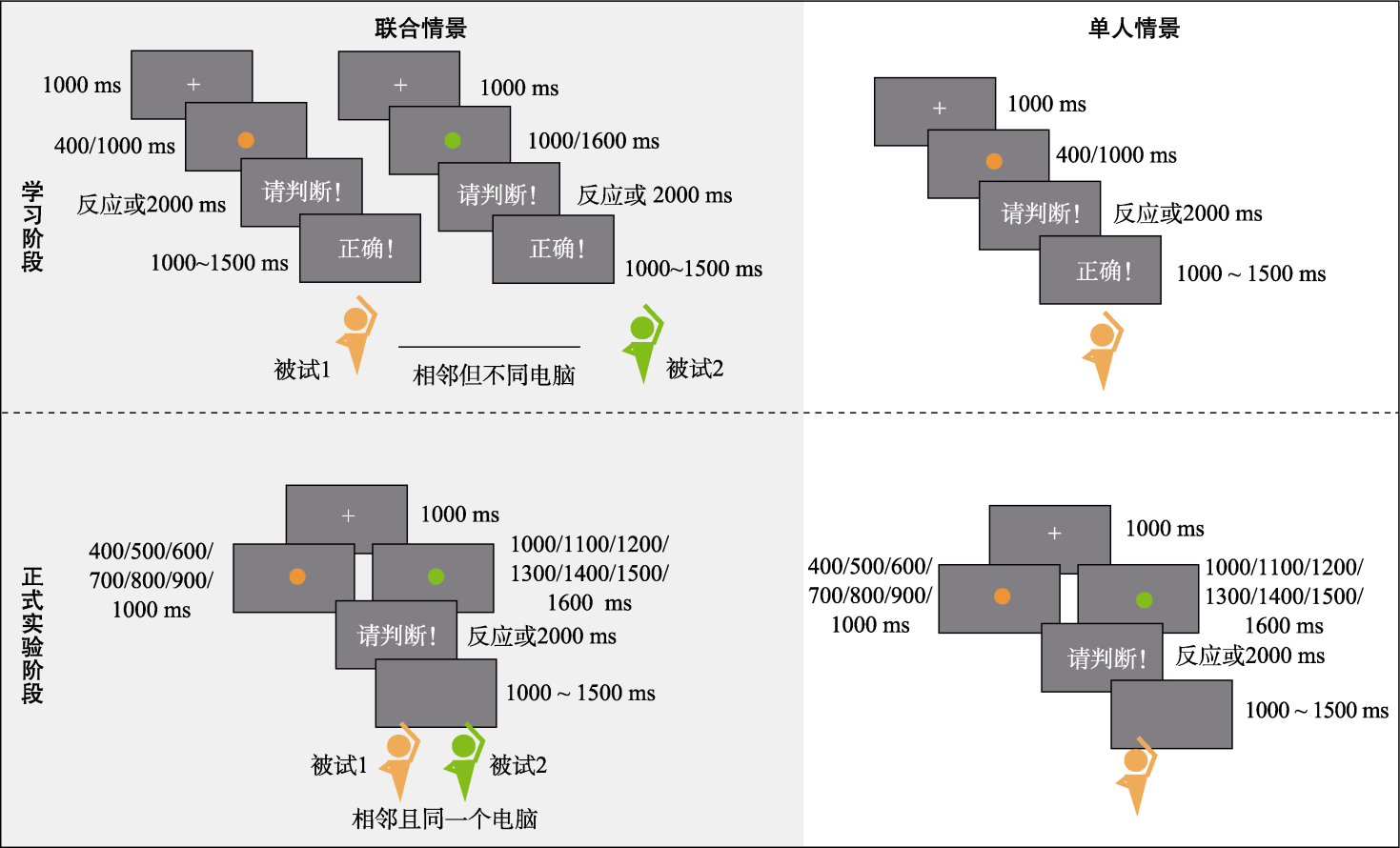
图1 实验1流程示意图。左侧为联合情境, 右侧为单人情境; 虚线以上为学习阶段, 虚线以下为正式实验阶段。
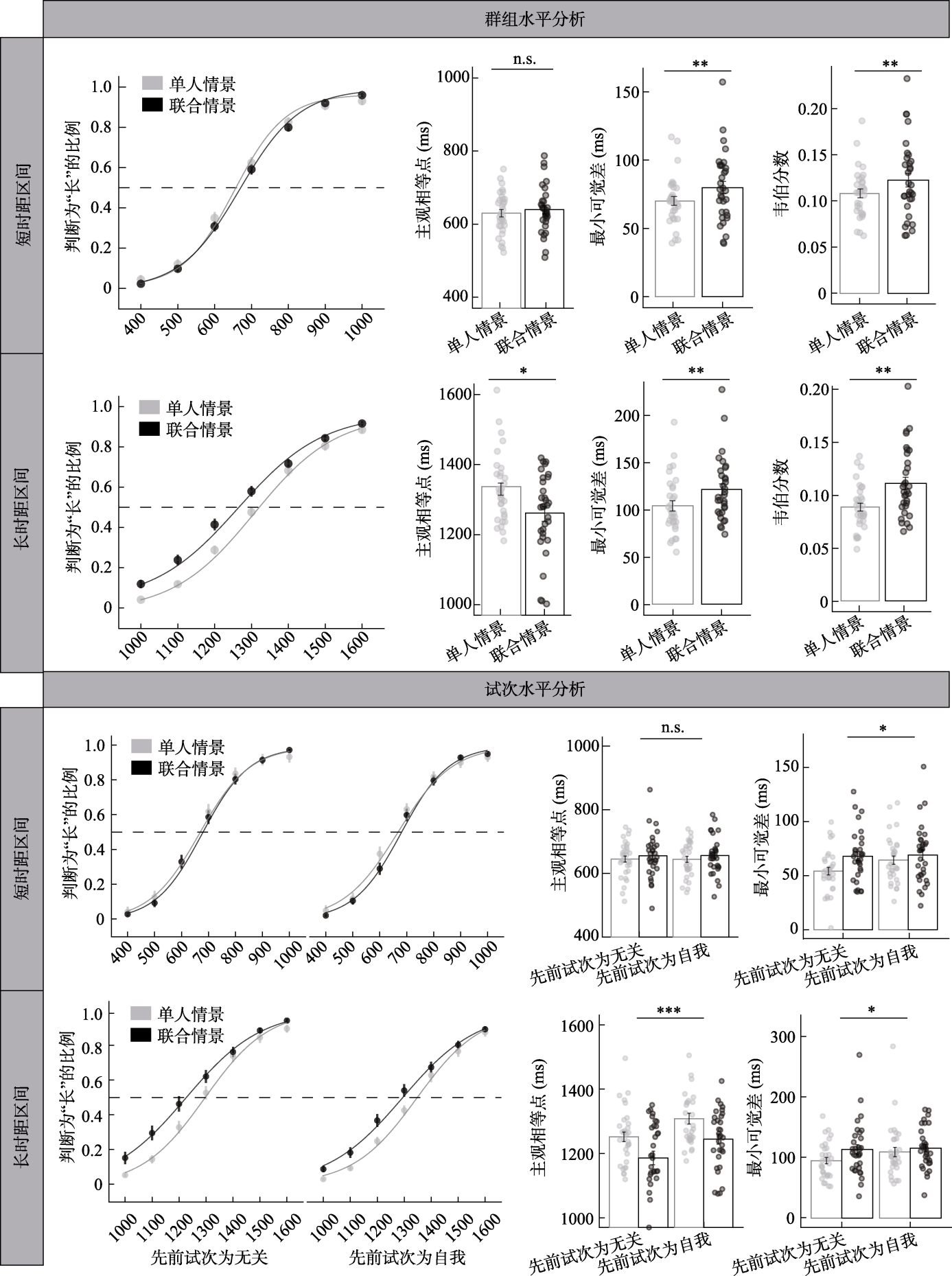
图2 实验1中长、短时距区间条件下联合情境、单人情境的群组水平分析和试次水平分析结果。其中左侧部分展示了各条件下的心理物理曲线, 纵坐标为将测试刺激时距判断为“长”的比例, 横坐标为不同测试时距水平。其中代表50%判断比率的虚线与心理物理曲线的交汇点反映了被试在不同条件下的主观相等点。右侧条形图依次展示了不同任务情境(单人情境与联合情境)下的平均主观相等点、最小可觉差和韦伯分数结果。图中上方为群组水平分析结果, 下方为试次水平分析结果。误差线代表标准误差(SE)。*p < 0.05, **p < 0.01, ***p < 0.001, n.s.代表p > 0.05。
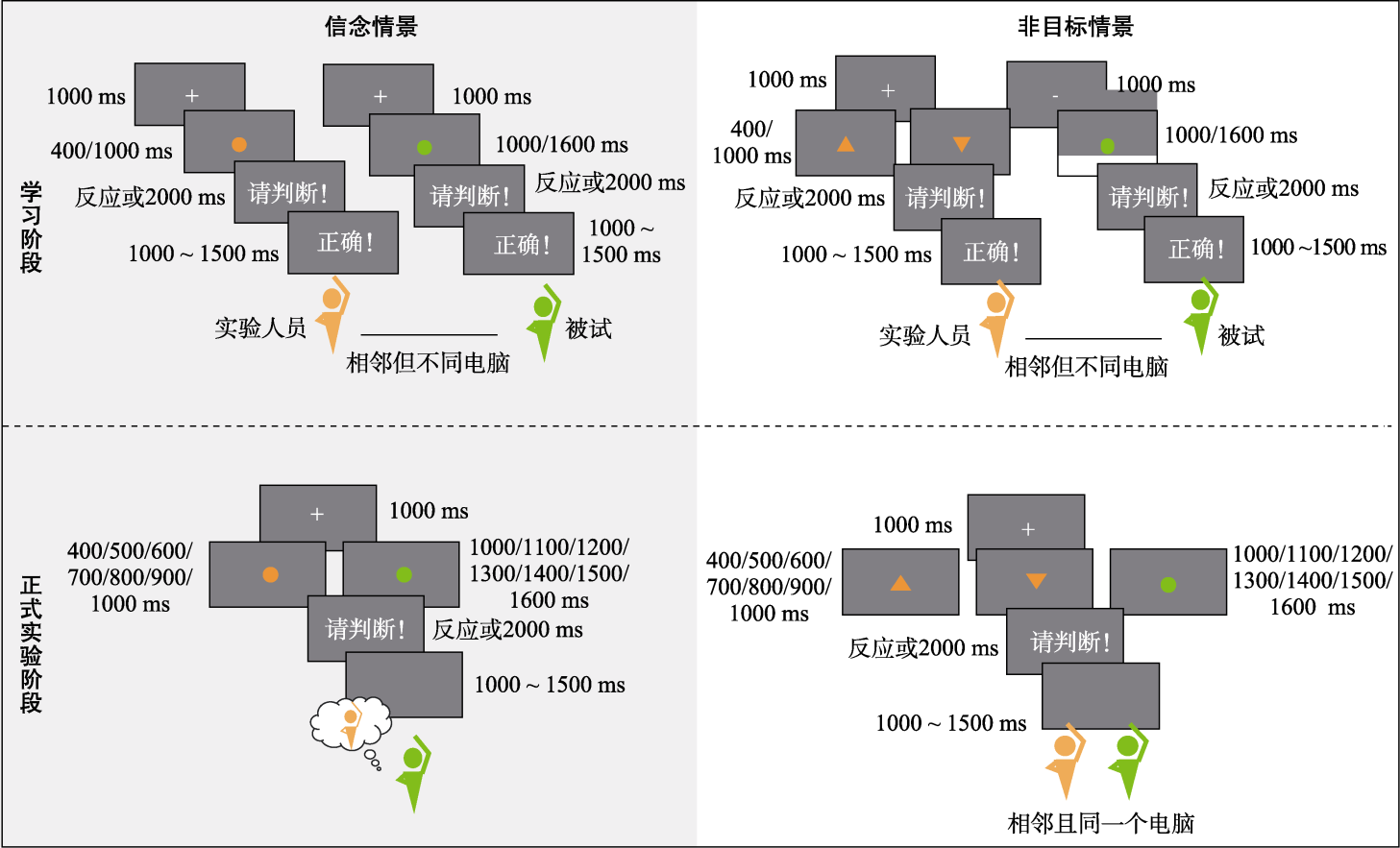
图3 实验2和实验3的流程示意图。左侧为实验2的信念情境, 右侧为实验3的非目标情境; 虚线以上为学习阶段, 虚线以下为正式实验阶段。
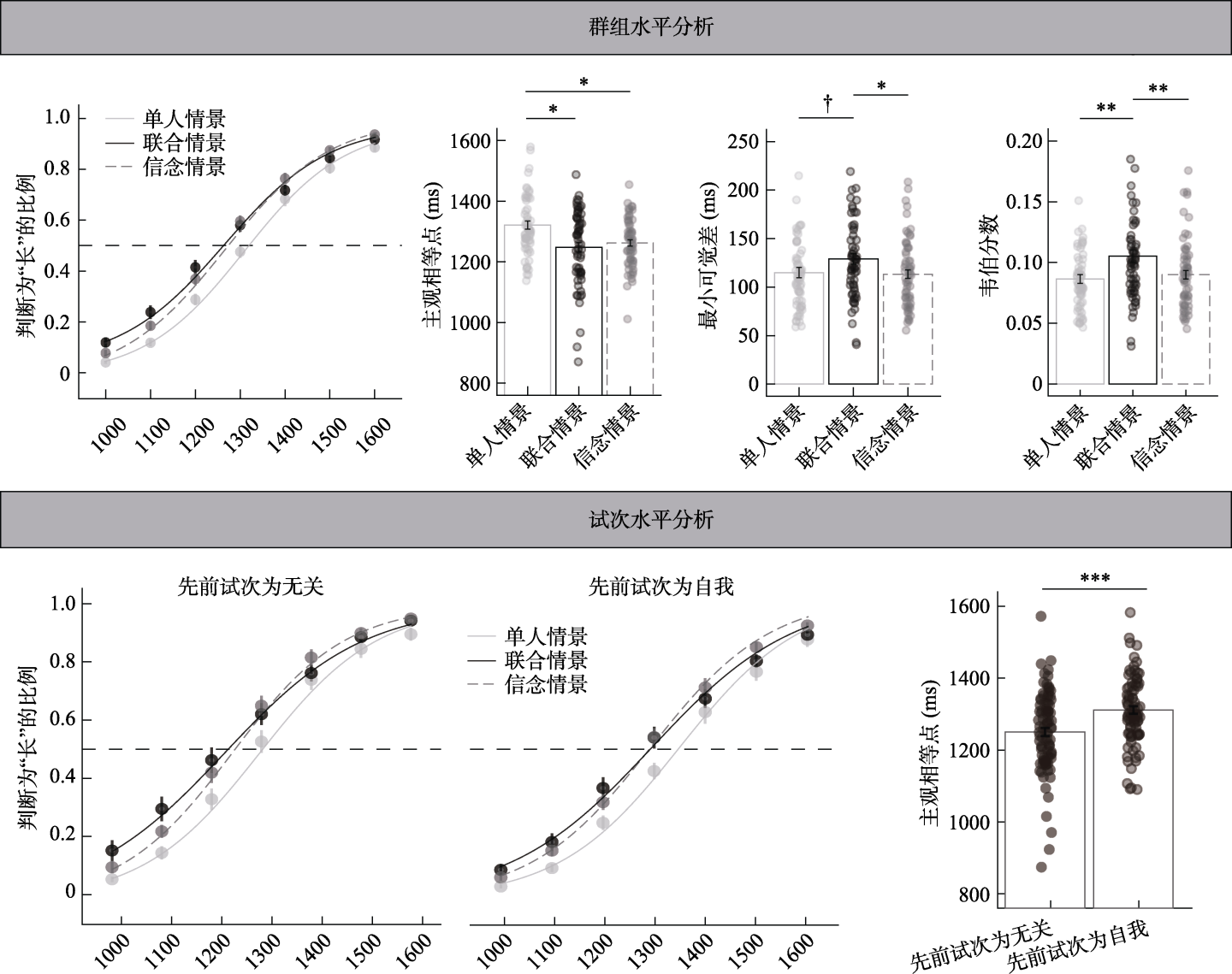
图4 实验2中不同背景下的群组水平分析和试次水平分析结果。图中上方为群组水平的分析结果, 下方为试次水平的分析结果。误差线表示标准误差(SE)。†p < 0.1, *p < 0.05, **p < 0.01, ***p < 0.001。
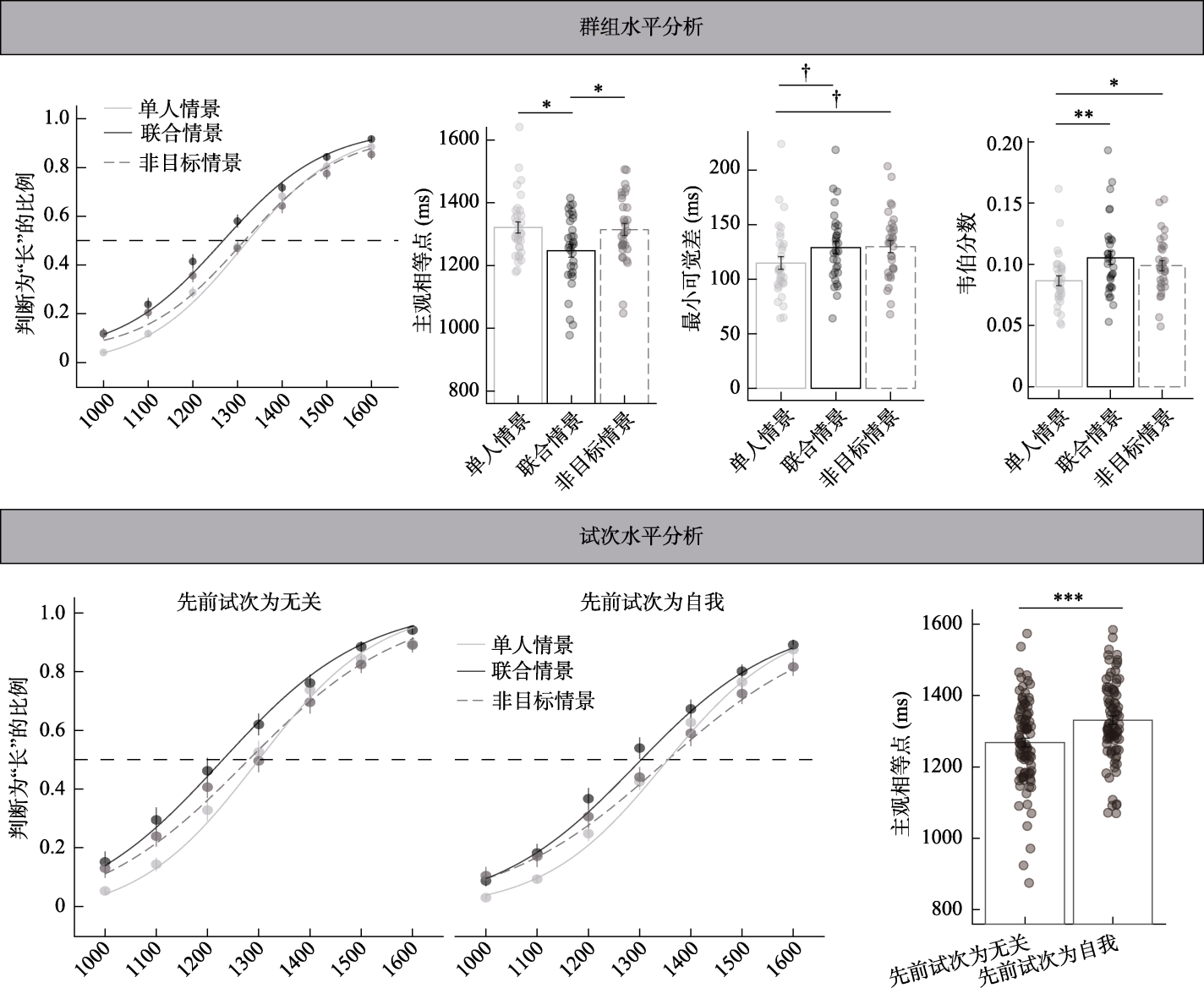
图5 实验3中不同背景下的群组水平分析和试次水平分析结果. 图中上方为群组水平的分析结果, 下方为试次水平的分析结果。误差线表示标准误差(SE)。†p < 0.1, *p < 0.05, **p < 0.01, ***p < 0.001。
| [1] | Acerbi, L., Wolpert, D., & Vijayakumar, S. (2012). Internal representations of temporal statistics and feedback calibrate motor-sensory interval timing. PLoS Computational Biology, 8(11), e1002771. https://doi.org/10.1371/journal.pcbi.1002771 |
| [2] | Atmaca, S., Sebanz, N., & Knoblich, G. (2011). The joint flanker effect: Sharing tasks with real and imagined co- actors. Experimental Brain Research, 3(4), 371-385. |
| [3] | Beaurenaut, M., Dezecache, G., & Grezes, J. (2021). Action co-representation under threat: A social simon study. Cognition, 215, 104829. https://doi.org/10.1016/j.cognition.2021.104829 |
| [4] |
Brown, S. (1985). Time perception and attention: the effects of prospective versus retrospective paradigms and task demands on perceived duration. Perception and Psychophysics, 38(2), 115-124. https://doi.org/10.3758/bf03198848
URL pmid: 4088803 |
| [5] |
Bond, C., Jr., & Titus, L. (1983). Social facilitation: A meta- analysis of 241 studies. Psychological Bulletin, 94(2), 265-292. https://doi.org/10.1037/0033-2909.94.2.265
URL pmid: 6356198 |
| [6] | Burra, N., & Kerzel, D. (2021). Meeting another's gaze shortens subjective time by capturing attention. Cognition, 212, 104734. https://doi.org/10.1016/j.cognition.2021.104734 |
| [7] | Chambon, M., Droit-Volet, S., & Niedenthal, P. (2008). The effect of embodying the elderly on time perception. Journal of Experimental Social Psychology, 44(3), 672-678. https://doi.org/10.1016/j.jesp.2007.04.014 |
| [8] |
Chen, S., Wang, T., & Bao, Y. (2023). Serial dependence in timing at the perceptual level being modulated by working memory. PsyCh Journal, 12(6), 774-786. https://doi.org/10.1002/pchj.653
doi: 10.1002/pchj.653 URL pmid: 37528541 |
| [9] |
Cottrell, N., Wack, D., Sekerak, G., & Rittle, R. (1968). Social facilitation of dominant responses by the presence of an audience and the mere presence of others. Journal of Personality and Social Psychology, 9(3), 245-250. https://doi.org/10.1037/h0025902
URL pmid: 5666972 |
| [10] |
Faul, F., Erdfelder, E., Lang, A.-G., & Buchner, A. (2007). G*Power 3: A flexible statistical power analysis program for the social, behavioral, and biomedical sciences. Behavior Research Methods, 39(2), 175-191. https://doi.org/10.3758/bf03193146
doi: 10.3758/bf03193146 URL pmid: 17695343 |
| [11] | Ferraro, L., Iani, C., Mariani, M., Milanese, N., & Rubichi, S. (2011). Facilitation and interference components in the joint Simon task. Experimental Brain Research, 211(3), 337-343. https://doi.org/10.1007/s00221-011-2711-2 |
| [12] | Guo, R., Wang, T., & Zhang, J. (2020). The influence of multilingualism and multiculturalism on individual and social switching: Evidence from the Xibe. Acta Psychologica Sinica, 52(9), 1071-1086. |
|
[郭人豪, 王婷, 张积家. (2020). 多元语言文化对个体情境下与社会情境下认知转换功能的差异性影响——来自锡伯族的证据. 心理学报, 52(9), 1071-1086.]
doi: 10.3724/SP.J.1041.2020.01071 |
|
| [13] |
Hudson, M., Nicholson, T., Ellis, R., & Bach, P. (2016). I see what you say: Prior knowledge of other's goals automatically biases the perception of their actions. Cognition, 146, 245-250. https://doi.org/10.1016/j.cognition.2015.09.021
doi: 10.1016/j.cognition.2015.09.021 URL pmid: 26484497 |
| [14] |
Huguet, P., Galvaing, M., Monteil, J., & Dumas, F. (1999). Social presence effects in the Stroop task: Further evidence for an attentional view of social facilitation. Journal of Personality and Social Psychology, 77(5), 1011-1025. https://doi.org/10.1037/0022-3514.77.5.1011
URL pmid: 10573878 |
| [15] |
Iacoboni, M., Molnar-Szakacs, I., Gallese, V., Buccino, G., Mazziotta, J., & Rizzolatti, G. (2005). Grasping the intentions of others with one's own mirror neuron system. PLoS Biology, 3(3), e79. https://doi.org/10.1371/journal.pbio.0030079
doi: 10.1371/journal.pbio.0030079 URL pmid: 15736981 |
| [16] |
Ishikawa, K., & Okubo, M. (2016). Overestimation of the subjective experience of time in social anxiety: Effects of facial expression, gaze direction, and time course. Frontiers in Psychology, 7, 611. https://doi.org/10.3389/fpsyg.2016.00611
doi: 10.3389/fpsyg.2016.00611 URL pmid: 27199844 |
| [17] | JASP Team. (2022). JASP (Version 0.16.3) [Computer software]. |
| [18] |
Jazayeri, M., & Shadlen, M. (2010). Temporal context calibrates interval timing. Nature Neuroscience, 13(8), 1020-1026. https://doi.org/10.1038/nn.2590
doi: 10.1038/nn.2590 URL pmid: 20581842 |
| [19] |
Kourtis, D., Knoblich, G., Woźniak, M., & Sebanz, N. (2014). Attention allocation and task representation during joint action planning. Journal of Cognitive Neuroscience, 26(10), 2275-2286. https://doi.org/10.1162/jocn_a_00634
doi: 10.1162/jocn_a_00634 URL pmid: 24702448 |
| [20] |
Li, B., Chen, Y., Xiao, L., Liu, P., & Huang, X. (2017). Duration adaptation modulates EEG correlates of subsequent temporal encoding. Neuroimage, 147, 143-151. https://doi.org/10.1016/j.neuroimage.2016.12.015
doi: S1053-8119(16)30738-8 URL pmid: 27939922 |
| [21] | Li, B., & Huang, X. (2019). Research advances on the duration aftereffect. Acta Physiologica Sinica, 71(1), 95-104. https://10.13294/j.aps.2018.0099 |
| [李宝林, 黄希庭. (2019). 时距知觉适应后效的研究进展. 生理学报, 71(1), 95-104.] | |
| [22] | Lin, C. (2003). Effects of illumination, viewing distance, and lighting color on perception time. Perceptual and Motor Skills, 96(3 Pt 1), 817-826. https://doi.org/10.2466/pms.96.3.817-826 |
| [23] |
Loehr, J., Kourtis, D., Vesper, C., Sebanz, N., & Knoblich, G. (2013). Monitoring individual and joint action outcomes in duet music performance. Journal of Cognitive Neuroscience, 25(7), 1049-1061. https://doi.org/10.1162/jocn_a_00388
doi: 10.1162/jocn_a_00388 URL pmid: 23489144 |
| [24] |
Milanese, N., Iani, C., & Rubichi, S. (2010). Shared learning shapes human performance: Transfer effects in task sharing. Cognition, 116(1), 15-22. https://doi.org/10.1016/j.cognition.2010.03.010
doi: 10.1016/j.cognition.2010.03.010 URL pmid: 20381024 |
| [25] | Mnif, M., Chikh, S., & Jarraya, M. (2022). Effect of social context on cognitive and motor behavior: A systematic review. Journal of Motor Behavior, 54(5), 631-647. https://doi.org/10.1080/00222895.2022.2060928 |
| [26] | Nather, F., Bueno, J., & Bigand, E. (2013). Body movement implied by static images modulates eye movements and subjective time estimation. Psychology & Neuroscience, 6(3), 261-270. https://doi.org/10.3922/j.psns.2013.3.04. |
| [27] | Oliva, M., Niehorster, D., Jarodzka, H., & Holmqvist, K. (2017). Influence of coactors on saccadic and manual responses. I-perception, 8(1), 2041669517692814. https://doi.org/10.1177/2041669517692814. |
| [28] |
Sadibolova, R., & Terhune, D. B. (2022). The temporal context in bayesian models of interval timing: Recent advances and future directions. Behavioral Neuroscience, 136(5), 364-373. https://doi.org/10.1037/bne0000513
doi: 10.1037/bne0000513 URL pmid: 35737557 |
| [29] |
Schirmer, A., Meck, W., & Penney, T. (2016). The socio- temporal brain: Connecting people in time. Trends in Cognitive Sciences, 20(10), 760-772. https://doi.org/10.1016/j.tics.2016.08.002.
doi: S1364-6613(16)30119-X URL pmid: 27615804 |
| [30] | Sebanz, N., Bekkering, H., & Knoblich, G. (2006). Joint action: Bodies and minds moving together. Trends in Cognitive Science, 10(2), 70-76. https://doi.org/10.1016/ j.tics.2005. 12.009. |
| [31] | Sebanz, N., & Knoblich, G. (2021). Progress in joint-action research. Current Directions in Psychological Science, 30(2), 138-143. |
| [32] |
Sebanz, N., Knoblich, G., & Prinz, W. (2003). Representing others' actions: Just like one's own? Cognition, 88(3), B11-B21. https://doi.org/10.1016/s0010-0277(03)00043-x
doi: 10.1016/s0010-0277(03)00043-x URL pmid: 12804818 |
| [33] | Shen, B., Chen, Y., He, Z., Li, W., Yu, H., & Zhou, X. (2023). The competition dynamics of approach and avoidance motivations following interpersonal transgression. Proceedings of the National Academy of Sciences of the United States of America, 120(40), e2302484120. https://doi.org/10.1073/pnas.2302484120. |
| [34] | Shi, Z., Church, R., & Meck, W. (2013). Bayesian optimization of time perception. Trends in Cognive Science, 17(11), 556-564. https://doi.org/10.1016/j.tics.2013.09.009 |
| [35] |
Song, X., & Dong, M. (2023). A multidimensional representation model of interpersonal collaboration: From the perspective of cognitive representation. Advances in Psychological Science, 31(7), 1288-1302.
doi: 10.3724/SP.J.1042.2023.01288 |
|
[宋晓蕾, 董梅梅. (2023). 人际协同的多重表征模型——基于认知表征的视角. 心理科学进展, 31(7), 1288-1302.]
doi: 10.3724/SP.J.1042.2023.01288 |
|
| [36] |
Song, X., Jia, X., Zhao, Y., & Guo, J. (2020). The underlying mechanism of emotions on co-representation in joint actions. Acta Psychologica Sinica, 52(3), 269-282.
doi: 10.3724/SP.J.1041.2020.00269 |
|
宋晓蕾, 贾筱倩, 赵媛, 郭晶晶. (2020). 情绪对联合行动中共同表征能力的影响机制. 心理学报, 52(3), 269-282.]
doi: 10.3724/SP.J.1041.2020.00269 |
|
| [37] |
Sui, J., Rotshtein, P., & Humphreys, G. (2013). Coupling social attention to the self forms a network for personal significance. Proceedings of the National Academy of Sciences of the United States of America, 110(19), 7607-7612. https://doi.org/10.1073/pnas.1221862110
doi: 10.1073/pnas.1221862110 URL pmid: 23610386 |
| [38] |
Treutwein, B., & Strasburger, H. (1999). Fitting the psychometric function. Perception and Psychophysics, 61(1), 87-106. https://doi.org/10.3758/bf03211951
doi: 10.3758/bf03211951 URL pmid: 10070202 |
| [39] | Tsai, C., Kuo, W., Hung, D., & Tzeng, O. (2008). Action co- representation is tuned to other humans. Journal of Cognitive Neuroscience, 20(11), 2015-2024. https://doi.org/10.1162/jocn.2008.20144 |
| [40] | Tseng, C., Li, J., & Cheng, M. (2022). Social affiliation is sufficient to provoke the partner-advantage. Scientific Reports, 12(1), 21293. https://doi.org/10.1038/s41598-022-25052-1 |
| [41] | van Rijn, H. (2016). Accounting for memory mechanisms in interval timing: A review. Current Opinion in Behavioral Sciences, 8, 245-249. https://doi.org/10.1016/j.cobeha.2016.02.016 |
| [42] | Vesper, C., Schmitz, L., & Knoblich, G. (2017). Modulating action duration to establish nonconventional communication. Journal of Experimental Psychology: General, 146(12), 1722-1737. https://doi.org/10.1037/xge0000379 |
| [43] | Vroomen, J., & Keetels, M. (2010). Perception of intersensory synchrony: A tutorial review. Attention Perception & Psychophys, 72(4), 871-884. https://doi.org/10.3758/APP.72.4.871 |
| [44] | Wang, C., Li, H., Jia, L., Li, F., & Wang, J. (2020). Theta band behavioral fluctuations synchronized interpersonally during cooperation. Psychonomic Bulletin & Review, 27(3), 563-570. https://doi.org/10.3758/s13423-020-01711-0 |
| [45] | Wang, T., Luo, Y., Ivry, R., Tsay, J., Pöppel, E., & Bao, Y. (2023). A unitary mechanism underlies adaptation to both local and global environmental statistics in time perception. PLoS Computational Biology, 19(5), e1011116. https:// doi.org/10.1371/journal.pcbi.1011116 |
| [46] |
Xu, S., & Song, X. (2016). Joint Simon effect: Current research, influencing factors and theories. Advances in Psychological Science, 24(3), 367-378.
doi: 10.3724/SP.J.1042.2016.00367 |
|
[徐胜, 宋晓蕾. (2016). 联合Simon效应: 现状、影响因素与理论解释. 心理科学进展, 24(3), 367-378.]
doi: 10.3724/SP.J.1042.2016.00367 |
|
| [47] |
Yao, Z., Zhang, L., & Zhang, K. (2015). Development and Influencing factors of the scalar timing model. Advances in Psychological Science, 23(5), 784-792. https://doi.org/10.3724/sp.J.1042.2015.00784
doi: 10.3724/SP.J.1042.2015.00784 URL |
|
[姚竹曦, 张亮, 张侃. (2015). 标量计时模型的影响因素及发展. 心理科学进展, 23(5), 784-792.]
doi: 10.3724/SP.J.1042.2015.00784 |
|
| [48] |
Zajonc, R. (1965). Social facilitation: A solution is suggested for an old unresolved social psychological problem. Science, 149(3681), 269-274. https://doi.org/10.1126/science.149.3681.269
doi: 10.1126/science.149.3681.269 URL pmid: 14300526 |
| [49] | Zang, X., Zinchenko, A., Wu, J., Zhu, X., Fang, F., & Shi, Z. (2022). Contextual cueing in co-active visual search: Joint action allows acquisition of task-irrelevant context. Attention Perception & Psychophys, 84(4), 1114-1129. https://doi.org/10.3758/s13414-022-02470-x |
| [50] |
Zhang, H., Hou, S., Wang, H., Lian, Y., & Yang, H. (2020). Socially shared retrieval-induced forgetting in a naturalistic collaborative retrieval situation. Acta Psychologica Sinica, 52(6), 716-729.
doi: 10.3724/SP.J.1041.2020.00716 |
|
[张环, 侯双, 王海曼, 廉宇煊, 杨海波. (2020). 他人在场条件下的社会分享型提取诱发遗忘. 心理学报, 52(6), 716-729.]
doi: 10.3724/SP.J.1041.2020.00716 |
|
| [51] | Zheng, Z., & Wang, J. (2023). Co-actors represent each other's task regularity through social statistical learning. Cognition, 235, 105411. https://doi.org/10.1016/j.cognition.2023.105411 |
| [52] | Zheng, Z., & Wang, J. (2024a). Interbrain neural correlates of self and other integration in joint statistical learning. npj Science of Learning, 9(1), 68. https://doi.org/10.1038/s41539-024-00280-4 |
| [53] | Zheng, Z., & Wang, J. (2024b). Interpersonal prior information informs ensemble coding through the co-representation process. Psychonomic Bulletin & Review, 31(2), 886-896. https://doi.org/10.3758/s13423-023-02390-3 |
| [1] | 纪丽君, 吴莹, 杨宜音. 中国人的时间知觉广度[J]. 心理学报, 2023, 55(3): 421-434. |
| [2] | 郭人豪, 王婷, 张积家. 多元语言文化对个体情境下与社会情境下认知转换功能的差异性影响——来自锡伯族的证据[J]. 心理学报, 2020, 52(9): 1071-1086. |
| [3] | 王鹏, 王晓田, 高娟, 黎夏岚, 徐静. 适应性时间管理:死亡意识对时间知觉和跨期决策的影响[J]. 心理学报, 2019, 51(12): 1341-1350. |
| [4] | 彭明, 金文颖, 蔡梦菲, 周宗奎. 网络词语与非网络词语的知觉差异:时间知觉、 空间距离知觉与知觉范围[J]. 心理学报, 2017, 49(7): 866-874. |
| [5] | 刘馨元;张志杰. 空间−时间关联的中介共同表征结构: 来自反转STEARC效应的证据[J]. 心理学报, 2017, 49(4): 427-438. |
| [6] | 刘扬;孙彦. 时间分解效应及其对跨期决策的影响[J]. 心理学报, 2016, 48(4): 362-370. |
| [7] | 陈有国,张志杰,黄希庭,郭秀艳,袁宏,张甜. 时间知觉的注意调节:一项ERP研究[J]. 心理学报, 2007, 39(06): 1002-1011. |
| [8] | 刘瑞光,黄希庭. 运动视觉信息中时间知觉线索的实验研究[J]. 心理学报, 1999, 31(1): 15-20. |
| 阅读次数 | ||||||
|
全文 |
|
|||||
|
摘要 |
|
|||||
