

ISSN 0439-755X
CN 11-1911/B
主办:中国心理学会
中国科学院心理研究所
出版:科学出版社
CN 11-1911/B
主办:中国心理学会
中国科学院心理研究所
出版:科学出版社
心理学报 ›› 2025, Vol. 57 ›› Issue (12): 2116-2130.doi: 10.3724/SP.J.1041.2025.2116 cstr: 32110.14.2025.2116
伍越, 吕薇( )
)
收稿日期:2024-04-05
发布日期:2025-09-28
出版日期:2025-12-25
通讯作者:
吕薇, E-mail: lvwei@snnu.edu.cn基金资助:
WU Yue, LÜ Wei()
Received:2024-04-05
Online:2025-09-28
Published:2025-12-25
摘要: 童年期虐待与青少年自伤行为密切相关, 但仍缺乏研究从“基因×环境-内表型-行为表型”理论视角探究其内在机制。本研究基于多基因累加得分研究范式, 采用问卷法和DNA分型技术, 在两个独立样本(主样本包含407名青少年, Mage = 12.77 ± 0.74岁; 验证样本包含109名青少年, Mage = 12.54 ± 0.60岁)中探讨童年期虐待与青少年自伤行为的关系, 并考察下丘脑-垂体-肾上腺轴(HPA轴)多基因累加得分的调节作用, 以及抑郁的中介作用。结果发现:(1)童年期虐待与青少年自伤行为正相关; (2) HPA轴多基因累加得分与童年期虐待的交互作用不直接影响青少年自伤行为, 而是通过抑郁间接影响青少年自伤行为, 具体而言, 和HPA轴多基因累加得分较低的青少年相比, HPA轴多基因累加得分高的青少年在经历童年期虐待后有更高的抑郁水平, 从而增加了其自伤行为的风险。研究结果在另一个独立样本中得到了重复验证。研究结果有利于从早期环境、遗传基因及个体内表型多角度深入揭示青少年自伤行为的形成机制, 并为青少年自伤的干预提供了方向。
中图分类号:
伍越, 吕薇. (2025). 童年期虐待与青少年自伤行为:下丘脑-垂体-肾上腺轴多基因及抑郁的作用. 心理学报, 57(12), 2116-2130.
WU Yue, LÜ Wei. (2025). Childhood abuse and adolescent non-suicidal self-injury: The effects of hypothalamic-pituitary-adrenal axis multilocus genetic variation and depression. Acta Psychologica Sinica, 57(12), 2116-2130.
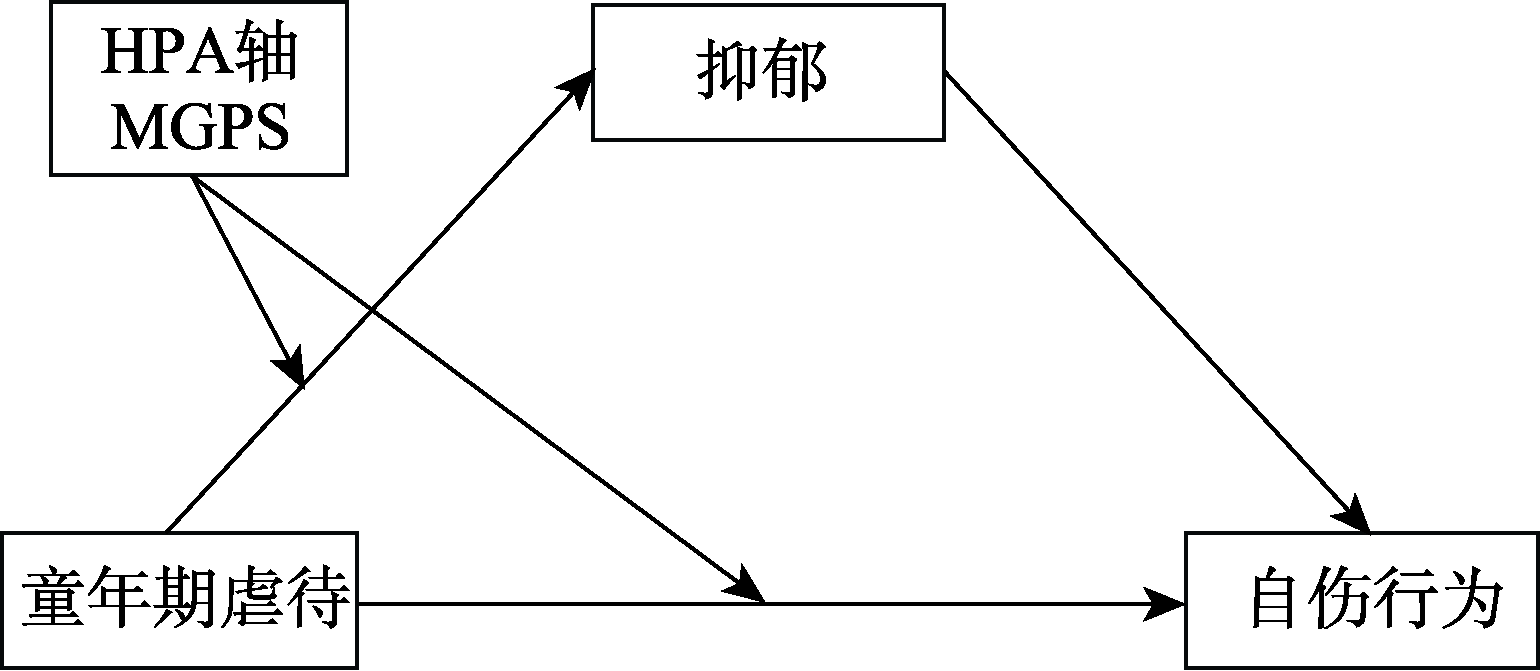
图1 假设模型图 注:HPA轴MGPS代表下丘脑-垂体-肾上腺轴多基因累加得分。
| 基因 | 位点 | 基因型分布 | 缺失 | MAF | Hardy-Weinberg平衡 | |||
|---|---|---|---|---|---|---|---|---|
| χ2 | p | |||||||
| CRHR1 | rs110402 | AA (316) | AG (85) | GG (5) | 1 | 11.70% | 0.07 | 0.79 |
| FKBP5 | rs1360780 | CC (215) | CT(162) | TT(29) | 1 | 27.09% | 0.04 | 0.84 |
| FKBP5 | rs4713902 | TT(242) | CT(142) | CC (22) | 1 | 22.91% | 0.04 | 0.85 |
| NR3C1 | rs41423247 | GG (254) | CG (139) | CC (14) | 0 | 20.52% | 0.91 | 0.34 |
| COMT | rs4680 | GG (229) | AG (147) | AA (27) | 4 | 24.94% | 0.27 | 0.61 |
表1 基因位点的基因型分布(主样本)
| 基因 | 位点 | 基因型分布 | 缺失 | MAF | Hardy-Weinberg平衡 | |||
|---|---|---|---|---|---|---|---|---|
| χ2 | p | |||||||
| CRHR1 | rs110402 | AA (316) | AG (85) | GG (5) | 1 | 11.70% | 0.07 | 0.79 |
| FKBP5 | rs1360780 | CC (215) | CT(162) | TT(29) | 1 | 27.09% | 0.04 | 0.84 |
| FKBP5 | rs4713902 | TT(242) | CT(142) | CC (22) | 1 | 22.91% | 0.04 | 0.85 |
| NR3C1 | rs41423247 | GG (254) | CG (139) | CC (14) | 0 | 20.52% | 0.91 | 0.34 |
| COMT | rs4680 | GG (229) | AG (147) | AA (27) | 4 | 24.94% | 0.27 | 0.61 |
| SNP | 各SNP及其与个体风险表型的关系 | 编码 |
|---|---|---|
| CRHR1 rs110402 | CRHR1基因编码促肾上腺皮质激素释放激素1型受体, 通过调节促肾上腺皮质激素释放激素对垂体的作用, 刺激促肾上腺皮质激素和皮质醇的合成与释放(Polanczyk et al., | GG = 1, GA = 1, AA = 0 |
| FKBP5 rs1360780 | FKBP5基因编码FK506结合蛋白。该蛋白与糖皮质激素受体结合, 降低其对皮质醇的敏感性, 进而导致HPA轴负反馈减弱(Stramecki et al., | TT = 1, CT = 1, CC = 0 |
| FKBP5 rs4713902 | FKBP5 rs4713902多态性影响FKBP5表达(Lee et al., | TT = 1, CT = 1, CC = 0 |
| NR3C1 rs41423247 | NR3C1基因编码糖皮质激素受体, 糖皮质激素受体分布在身体各器官组织中, 调节身体生理功能以应对急性应激源; 处于下丘脑和垂体的糖皮质激素受体与皮质醇结合向HPA轴提供负反馈(Tyrka et al., | CC = 1, CG = 1, GG = 0 |
| COMT rs4680 | COMT基因编码儿茶酚胺氧位甲基转移酶, 负责儿茶酚胺分解代谢(Oswald et al., | AA = 1, GA = 0, GG = 0 |
表2 各基因位点及其与个体风险表型的关系
| SNP | 各SNP及其与个体风险表型的关系 | 编码 |
|---|---|---|
| CRHR1 rs110402 | CRHR1基因编码促肾上腺皮质激素释放激素1型受体, 通过调节促肾上腺皮质激素释放激素对垂体的作用, 刺激促肾上腺皮质激素和皮质醇的合成与释放(Polanczyk et al., | GG = 1, GA = 1, AA = 0 |
| FKBP5 rs1360780 | FKBP5基因编码FK506结合蛋白。该蛋白与糖皮质激素受体结合, 降低其对皮质醇的敏感性, 进而导致HPA轴负反馈减弱(Stramecki et al., | TT = 1, CT = 1, CC = 0 |
| FKBP5 rs4713902 | FKBP5 rs4713902多态性影响FKBP5表达(Lee et al., | TT = 1, CT = 1, CC = 0 |
| NR3C1 rs41423247 | NR3C1基因编码糖皮质激素受体, 糖皮质激素受体分布在身体各器官组织中, 调节身体生理功能以应对急性应激源; 处于下丘脑和垂体的糖皮质激素受体与皮质醇结合向HPA轴提供负反馈(Tyrka et al., | CC = 1, CG = 1, GG = 0 |
| COMT rs4680 | COMT基因编码儿茶酚胺氧位甲基转移酶, 负责儿茶酚胺分解代谢(Oswald et al., | AA = 1, GA = 0, GG = 0 |
| 变量 | 1 | 2 | 3 | 4 | 5 | 6 | 7 |
|---|---|---|---|---|---|---|---|
| 1. HPA轴MGPS | - | ||||||
| 2. 性别 | 0.11* | - | |||||
| 3. 年龄 | 0.04 | -0.07 | - | ||||
| 4. 童年期忽视 | 0.00 | -0.07 | -0.00 | - | |||
| 5. 童年期虐待 | -0.02 | -0.09 | 0.06 | 0.43*** | - | ||
| 6. 抑郁 | 0.06 | 0.04 | 0.07 | 0.32*** | 0.47*** | - | |
| 7. 自伤行为 | -0.03 | 0.04 | 0.05 | 0.19*** | 0.27*** | 0.43*** | - |
| M | 2.08 | — | 12.77 | 20.81 | 19.33 | 16.00 | 1.04 |
| SD | 0.90 | — | 0.74 | 7.48 | 6.20 | 10.85 | 1.99 |
表3 各研究变量间的相关(主样本)
| 变量 | 1 | 2 | 3 | 4 | 5 | 6 | 7 |
|---|---|---|---|---|---|---|---|
| 1. HPA轴MGPS | - | ||||||
| 2. 性别 | 0.11* | - | |||||
| 3. 年龄 | 0.04 | -0.07 | - | ||||
| 4. 童年期忽视 | 0.00 | -0.07 | -0.00 | - | |||
| 5. 童年期虐待 | -0.02 | -0.09 | 0.06 | 0.43*** | - | ||
| 6. 抑郁 | 0.06 | 0.04 | 0.07 | 0.32*** | 0.47*** | - | |
| 7. 自伤行为 | -0.03 | 0.04 | 0.05 | 0.19*** | 0.27*** | 0.43*** | - |
| M | 2.08 | — | 12.77 | 20.81 | 19.33 | 16.00 | 1.04 |
| SD | 0.90 | — | 0.74 | 7.48 | 6.20 | 10.85 | 1.99 |
| 变量 | β(SE) | t | p | q | 95% CI | R2 | F | ||
|---|---|---|---|---|---|---|---|---|---|
| 模型1 (因变量:自伤行为) | 0.09 | 9.46*** | |||||||
| 性别 | 0.07(0.05) | 1.39 | 0.167 | 0.223 | [-0.03, 0.16] | ||||
| 年龄 | 0.04(0.05) | 0.84 | 0.402 | 0.402 | [-0.05, 0.13] | ||||
| 童年期忽视 | 0.09(0.05) | 1.76 | 0.079 | 0.158 | [-0.01, 0.20] | ||||
| 童年期虐待 | 0.24(0.05) | 4.45*** | <0.001 | <0.001 | [0.13, 0.34] | ||||
| 模型2 (因变量:抑郁) | 0.30 | 13.77*** | |||||||
| 性别 | 0.06(0.04) | 1.48 | 0.141 | 0.296 | [-0.02, 0.15] | ||||
| 年龄 | 0.06(0.04) | 1.50 | 0.134 | 0.296 | [-0.02, 0.15] | ||||
| 童年期忽视 | 0.15(0.05) | 3.13** | 0.002 | 0.011 | [0.06, 0.24] | ||||
| 童年期虐待 | 0.44(0.08) | 5.67*** | <0.001 | <0.001 | [0.29, 0.60] | ||||
| HPA轴MGPS | 0.05(0.05) | 1.06 | 0.291 | 0.349 | [-0.04, 0.14] | ||||
| 童年期虐待×HPA轴MGPS | 0.17(0.06) | 2.58* | 0.010 | 0.041 | [0.04, 0.29] | ||||
| 模型3 (因变量:自伤行为) | 0.22 | 8.30*** | |||||||
| 性别 | 0.04(0.05) | 0.78 | 0.435 | 0.719 | [-0.05, 0.13] | ||||
| 年龄 | 0.03(0.05) | 0.58 | 0.559 | 0.723 | [-0.06, 0.12] | ||||
| 童年期忽视 | 0.03(0.05) | 0.51 | 0.612 | 0.723 | [-0.07, 0.13] | ||||
| 童年期虐待 | 0.25(0.09) | 2.93** | 0.004 | 0.023 | [0.08, 0.42] | ||||
| 抑郁 | 0.36(0.05) | 6.84*** | <0.001 | <0.001 | [0.26, 0.47] | ||||
| HPA轴MGPS | -0.06(0.05) | -1.14 | 0.257 | 0.556 | [-0.16, 0.04] | ||||
| 童年期虐待×HPA轴MGPS | -0.05(0.07) | -0.67 | 0.504 | 0.723 | [-0.18, 0.09] | ||||
表4 假设模型检验(主样本)
| 变量 | β(SE) | t | p | q | 95% CI | R2 | F | ||
|---|---|---|---|---|---|---|---|---|---|
| 模型1 (因变量:自伤行为) | 0.09 | 9.46*** | |||||||
| 性别 | 0.07(0.05) | 1.39 | 0.167 | 0.223 | [-0.03, 0.16] | ||||
| 年龄 | 0.04(0.05) | 0.84 | 0.402 | 0.402 | [-0.05, 0.13] | ||||
| 童年期忽视 | 0.09(0.05) | 1.76 | 0.079 | 0.158 | [-0.01, 0.20] | ||||
| 童年期虐待 | 0.24(0.05) | 4.45*** | <0.001 | <0.001 | [0.13, 0.34] | ||||
| 模型2 (因变量:抑郁) | 0.30 | 13.77*** | |||||||
| 性别 | 0.06(0.04) | 1.48 | 0.141 | 0.296 | [-0.02, 0.15] | ||||
| 年龄 | 0.06(0.04) | 1.50 | 0.134 | 0.296 | [-0.02, 0.15] | ||||
| 童年期忽视 | 0.15(0.05) | 3.13** | 0.002 | 0.011 | [0.06, 0.24] | ||||
| 童年期虐待 | 0.44(0.08) | 5.67*** | <0.001 | <0.001 | [0.29, 0.60] | ||||
| HPA轴MGPS | 0.05(0.05) | 1.06 | 0.291 | 0.349 | [-0.04, 0.14] | ||||
| 童年期虐待×HPA轴MGPS | 0.17(0.06) | 2.58* | 0.010 | 0.041 | [0.04, 0.29] | ||||
| 模型3 (因变量:自伤行为) | 0.22 | 8.30*** | |||||||
| 性别 | 0.04(0.05) | 0.78 | 0.435 | 0.719 | [-0.05, 0.13] | ||||
| 年龄 | 0.03(0.05) | 0.58 | 0.559 | 0.723 | [-0.06, 0.12] | ||||
| 童年期忽视 | 0.03(0.05) | 0.51 | 0.612 | 0.723 | [-0.07, 0.13] | ||||
| 童年期虐待 | 0.25(0.09) | 2.93** | 0.004 | 0.023 | [0.08, 0.42] | ||||
| 抑郁 | 0.36(0.05) | 6.84*** | <0.001 | <0.001 | [0.26, 0.47] | ||||
| HPA轴MGPS | -0.06(0.05) | -1.14 | 0.257 | 0.556 | [-0.16, 0.04] | ||||
| 童年期虐待×HPA轴MGPS | -0.05(0.07) | -0.67 | 0.504 | 0.723 | [-0.18, 0.09] | ||||
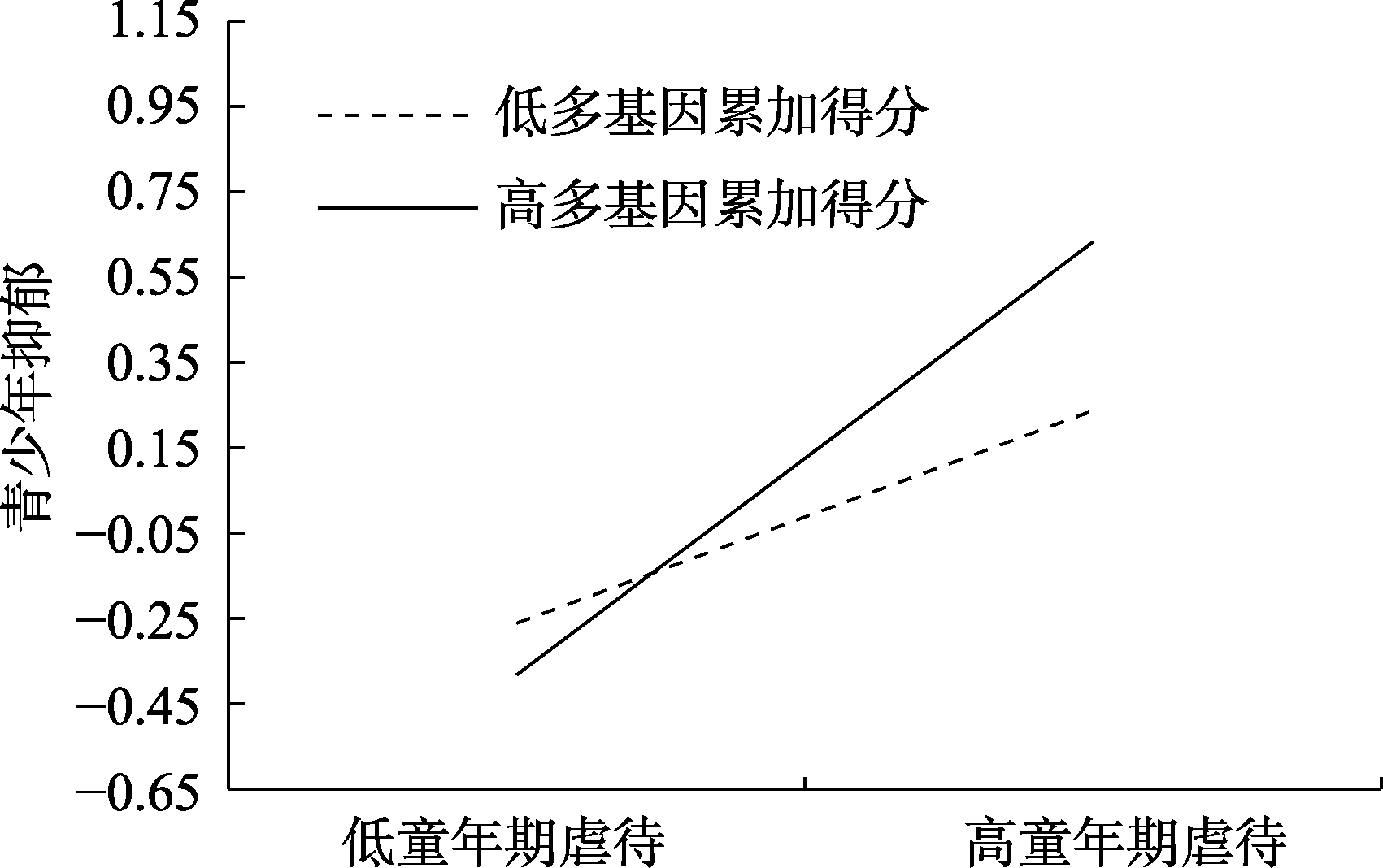
图2 HPA轴多基因累加得分与童年期虐待对青少年抑郁的影响(主样本)
| 基因 | 位点 | 基因型分布 | 缺失 | MAF | Hardy-Weinberg平衡 | |||
|---|---|---|---|---|---|---|---|---|
| χ2 | p | |||||||
| CRHR1 | rs110402 | AA (90) | AG (13) | GG (6) | 0 | 11.47% | 18.56 | < 10-4 |
| FKBP5 | rs1360780 | CC (49) | CT(47) | TT(13) | 0 | 33.49% | 0.11 | 0.74 |
| FKBP5 | rs4713902 | TT(67) | CT(38) | CC (4) | 0 | 21.10% | 0.24 | 0.62 |
| NR3C1 | rs41423247 | GG (71) | CG (35) | CC (3) | 0 | 18.81% | 0.29 | 0.59 |
| COMT | rs4680 | GG (55) | AG (43) | AA (9) | 2 | 28.50% | 0.02 | 0.88 |
表5 基因位点的基因型分布(验证样本)
| 基因 | 位点 | 基因型分布 | 缺失 | MAF | Hardy-Weinberg平衡 | |||
|---|---|---|---|---|---|---|---|---|
| χ2 | p | |||||||
| CRHR1 | rs110402 | AA (90) | AG (13) | GG (6) | 0 | 11.47% | 18.56 | < 10-4 |
| FKBP5 | rs1360780 | CC (49) | CT(47) | TT(13) | 0 | 33.49% | 0.11 | 0.74 |
| FKBP5 | rs4713902 | TT(67) | CT(38) | CC (4) | 0 | 21.10% | 0.24 | 0.62 |
| NR3C1 | rs41423247 | GG (71) | CG (35) | CC (3) | 0 | 18.81% | 0.29 | 0.59 |
| COMT | rs4680 | GG (55) | AG (43) | AA (9) | 2 | 28.50% | 0.02 | 0.88 |
| 变量 | 1 | 2 | 3 | 4 | 5 | 6 | 7 |
|---|---|---|---|---|---|---|---|
| 1. HPA轴MGPS | - | ||||||
| 2. 性别 | -0.07 | - | |||||
| 3. 年龄 | 0.07 | -0.01 | - | ||||
| 4. 童年期忽视 | -0.04 | 0.06 | 0.21* | - | |||
| 5. 童年期虐待 | -0.07 | 0.10 | 0.23* | 0.47*** | - | ||
| 6. 抑郁 | 0.04 | 0.18 | 0.07 | 0.18 | 0.32** | - | |
| 7. 自伤行为 | 0.03 | 0.19* | 0.15 | 0.13 | 0.29** | 0.56*** | - |
| M | 2.12 | — | 12.54 | 17.42 | 18.71 | 22.23 | 1.37 |
| SD | 0.87 | — | 0.60 | 4.32 | 5.29 | 11.30 | 2.15 |
表6 各研究变量间的相关(验证样本)
| 变量 | 1 | 2 | 3 | 4 | 5 | 6 | 7 |
|---|---|---|---|---|---|---|---|
| 1. HPA轴MGPS | - | ||||||
| 2. 性别 | -0.07 | - | |||||
| 3. 年龄 | 0.07 | -0.01 | - | ||||
| 4. 童年期忽视 | -0.04 | 0.06 | 0.21* | - | |||
| 5. 童年期虐待 | -0.07 | 0.10 | 0.23* | 0.47*** | - | ||
| 6. 抑郁 | 0.04 | 0.18 | 0.07 | 0.18 | 0.32** | - | |
| 7. 自伤行为 | 0.03 | 0.19* | 0.15 | 0.13 | 0.29** | 0.56*** | - |
| M | 2.12 | — | 12.54 | 17.42 | 18.71 | 22.23 | 1.37 |
| SD | 0.87 | — | 0.60 | 4.32 | 5.29 | 11.30 | 2.15 |
| 变量 | β(SE) | t | p | q | 95% CI | R2 | F | ||
|---|---|---|---|---|---|---|---|---|---|
| 模型1(因变量:自伤行为) | 0.12 | 3.45* | |||||||
| 性别 | 0.17(0.09) | 1.78 | 0.077 | 0.154 | [-0.02, 0.35] | ||||
| 年龄 | 0.09(0.10) | 0.98 | 0.330 | 0.440 | [-0.10, 0.28] | ||||
| 童年期忽视 | -0.02(0.11) | -0.19 | 0.854 | 0.854 | [-0.23, 0.19] | ||||
| 童年期虐待 | 0.26(0.11) | 2.45* | 0.016 | 0.064 | [0.05, 0.47] | ||||
| 模型2(因变量:抑郁) | 0.21 | 2.07* | |||||||
| 性别 | 0.15(0.10) | 1.53 | 0.131 | 0.392 | [-0.05, 0.34] | ||||
| 年龄 | -0.01(0.10) | -0.12 | 0.901 | 0.962 | [-0.20, 0.18] | ||||
| 童年期忽视 | -0.03(0.11) | -0.22 | 0.826 | 0.962 | [-0.25, 0.20] | ||||
| 童年期虐待 | 0.43(0.15) | 2.81** | 0.006 | 0.073 | [0.13, 0.74] | ||||
| HPA轴MGPS | 0.14(0.10) | 1.37 | 0.175 | 0.421 | [-0.06, 0.34] | ||||
| 童年期虐待×HPA轴MGPS | 0.31(0.14) | 2.18* | 0.032 | 0.191 | [0.03, 0.59] | ||||
| 模型3(因变量:自伤行为) | 0.36 | 4.10*** | |||||||
| 性别 | 0.09(0.09) | 0.98 | 0.331 | 0.776 | [-0.09, 0.27] | ||||
| 年龄 | 0.09(0.09) | 1.06 | 0.290 | 0.776 | [-0.08, 0.26] | ||||
| 童年期忽视 | -0.03(0.10) | -0.26 | 0.792 | 0.979 | [-0.23, 0.18] | ||||
| 童年期虐待 | 0.21(0.15) | 1.46 | 0.147 | 0.776 | [-0.08, 0.50] | ||||
| 抑郁 | 0.50(0.09) | 5.36*** | <0.001 | <0.001 | [0.32, 0.69] | ||||
| HPA轴MGPS | 0.01(0.09) | 0.07 | 0.948 | 0.979 | [-0.18, 0.19] | ||||
| 童年期虐待×HPA轴MGPS | 0.14(0.13) | 1.05 | 0.297 | 0.776 | [-0.12, 0.40] | ||||
表7 假设模型检验(验证样本)
| 变量 | β(SE) | t | p | q | 95% CI | R2 | F | ||
|---|---|---|---|---|---|---|---|---|---|
| 模型1(因变量:自伤行为) | 0.12 | 3.45* | |||||||
| 性别 | 0.17(0.09) | 1.78 | 0.077 | 0.154 | [-0.02, 0.35] | ||||
| 年龄 | 0.09(0.10) | 0.98 | 0.330 | 0.440 | [-0.10, 0.28] | ||||
| 童年期忽视 | -0.02(0.11) | -0.19 | 0.854 | 0.854 | [-0.23, 0.19] | ||||
| 童年期虐待 | 0.26(0.11) | 2.45* | 0.016 | 0.064 | [0.05, 0.47] | ||||
| 模型2(因变量:抑郁) | 0.21 | 2.07* | |||||||
| 性别 | 0.15(0.10) | 1.53 | 0.131 | 0.392 | [-0.05, 0.34] | ||||
| 年龄 | -0.01(0.10) | -0.12 | 0.901 | 0.962 | [-0.20, 0.18] | ||||
| 童年期忽视 | -0.03(0.11) | -0.22 | 0.826 | 0.962 | [-0.25, 0.20] | ||||
| 童年期虐待 | 0.43(0.15) | 2.81** | 0.006 | 0.073 | [0.13, 0.74] | ||||
| HPA轴MGPS | 0.14(0.10) | 1.37 | 0.175 | 0.421 | [-0.06, 0.34] | ||||
| 童年期虐待×HPA轴MGPS | 0.31(0.14) | 2.18* | 0.032 | 0.191 | [0.03, 0.59] | ||||
| 模型3(因变量:自伤行为) | 0.36 | 4.10*** | |||||||
| 性别 | 0.09(0.09) | 0.98 | 0.331 | 0.776 | [-0.09, 0.27] | ||||
| 年龄 | 0.09(0.09) | 1.06 | 0.290 | 0.776 | [-0.08, 0.26] | ||||
| 童年期忽视 | -0.03(0.10) | -0.26 | 0.792 | 0.979 | [-0.23, 0.18] | ||||
| 童年期虐待 | 0.21(0.15) | 1.46 | 0.147 | 0.776 | [-0.08, 0.50] | ||||
| 抑郁 | 0.50(0.09) | 5.36*** | <0.001 | <0.001 | [0.32, 0.69] | ||||
| HPA轴MGPS | 0.01(0.09) | 0.07 | 0.948 | 0.979 | [-0.18, 0.19] | ||||
| 童年期虐待×HPA轴MGPS | 0.14(0.13) | 1.05 | 0.297 | 0.776 | [-0.12, 0.40] | ||||
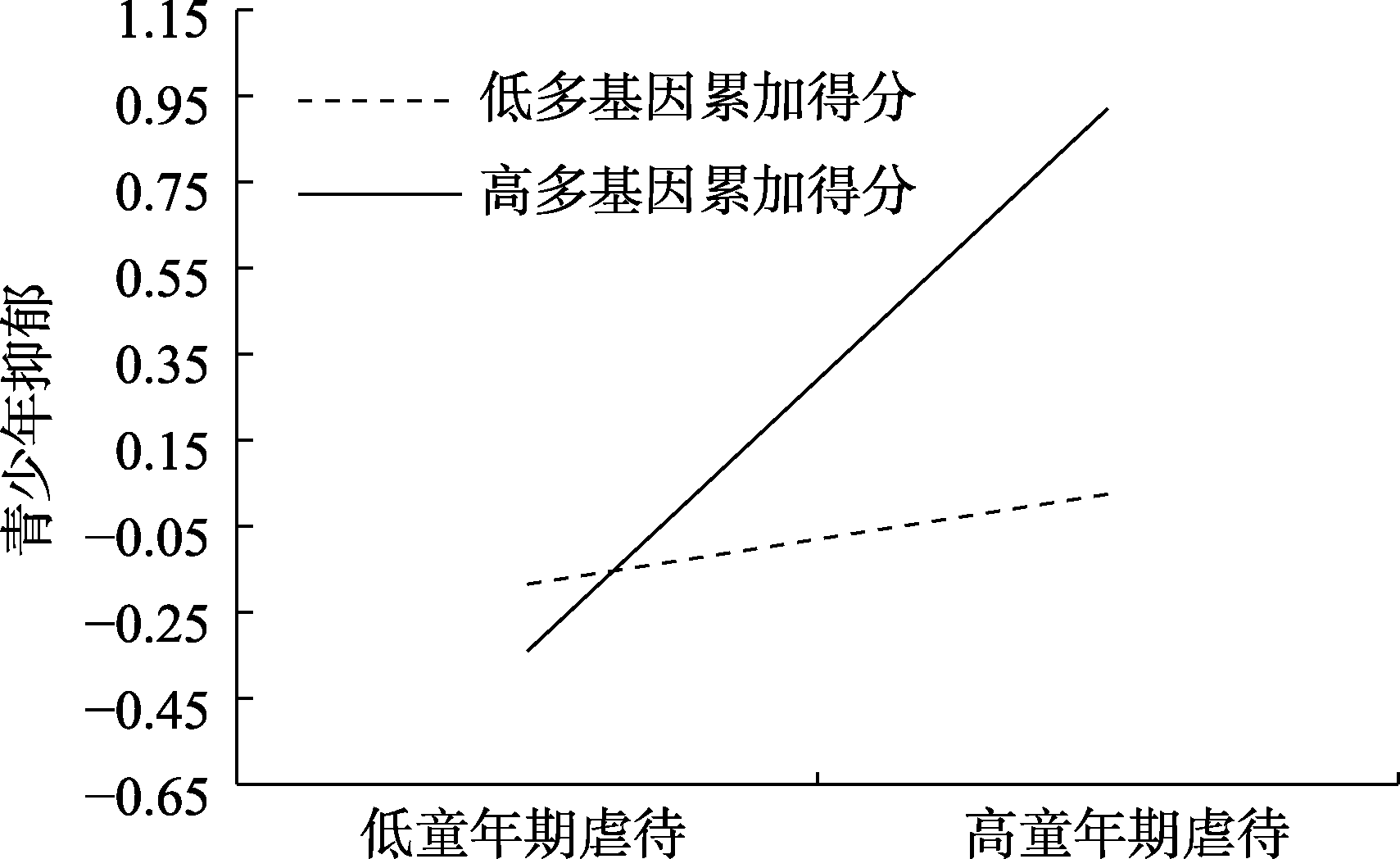
图3 HPA轴多基因累加得分与童年期虐待对青少年抑郁的影响(验证样本)
| [1] |
Adrian M., Kiff C., Glazner C., Kohen R., Tracy J. H., Zhou C., … Vander Stoep A. (2015). Examining gene- environment interactions in comorbid depressive and disruptive behavior disorders using a Bayesian approach. Journal of Psychiatric Research, 68, 125-133.
doi: 10.1016/j.jpsychires.2015.06.004 pmid: 26228411 |
| [2] |
Bai R., Gao Y. M., Li J. W., & Liu X. (2023). Combined effects of distal and proximal interpersonal stress and FKBP5gene on adolescent self-injury behavior: The developmental perspective. Acta Psychologica Sinica, 55(9), 1477-1488.
doi: 10.3724/SP.J.1041.2023.01477 URL |
|
[白荣, 高叶淼, 李金文, 刘霞. (2023). 远近端人际压力与FKBP5基因对青少年自伤行为的联合影响:基于发展的视角. 心理学报, 55(9), 1477-1488.]
doi: 10.3724/SP.J.1041.2023.01477 |
|
| [3] |
Baiden P., Stewart S. L., & Fallon B. (2017). The role of adverse childhood experiences as determinants of non-suicidal self-injury among children and adolescents referred to community and inpatient mental health settings. Child Abuse & Neglect, 69, 163-176.
doi: 10.1016/j.chiabu.2017.04.011 URL |
| [4] |
Belsky J., & Pluess M. (2009). Beyond diathesis stress: Differential susceptibility to environmental influences. Psychological Bulletin, 135(6), 885-908.
doi: 10.1037/a0017376 pmid: 19883141 |
| [5] | Benjamini Y., & Yekutieli D. (2001). The control of the false discovery rate in multiple testing under dependency. Annals of Statistics, 29(4), 1165-1188. |
| [6] |
Bernstein D. P., Stein J. A., Newcomb M. D., Walker E., Pogge D., Ahluvalia T., … Zule W. (2003). Development and validation of a brief screening version of the Childhood Trauma Questionnaire. Child Abuse & Neglect, 27(2), 169-190.
doi: 10.1016/S0145-2134(02)00541-0 URL |
| [7] | Binder E. B., Bradley R. G., Liu W., Epstein M. P., Deveau T. C., Mercer K. B., … Ressler K. J. (2008). Association of FKBP5 polymorphisms and childhood abuse with risk of posttraumatic stress disorder symptoms in adults. Journal of the American Medical Association, 299(11), 1291-1305. |
| [8] |
Brodsky B. S. (2016). Early childhood environment and genetic interactions: The diathesis for suicidal behavior. Current Psychiatry Reports, 18(9), 86.
doi: 10.1007/s11920-016-0716-z pmid: 27484207 |
| [9] |
Brown R. C., & Plener P. L. (2017). Non-suicidal self-injury in adolescence. Current Psychiatry Reports, 19(3), 20.
doi: 10.1007/s11920-017-0767-9 pmid: 28315191 |
| [10] |
Cao C., & Rijlaarsdam J. (2023). Childhood parenting and adolescent internalizing and externalizing symptoms: Moderation by multilocus hypothalamic-pituitary-adrenal axis-related genetic variation. Development and Psychopathology, 35(2), 524-536.
doi: 10.1017/S0954579421001620 URL |
| [11] |
Cao Y. M., Fang H. C., Zhu X. Y., Ji L. Q., & Zhang W. X. (2023). Associations among brain-derived neurotrophic factor gene, peer relationships, and depression across early adolescence: Dynamic genetic effects. Acta Psychologica Sinica, 55(10), 1620-1636.
doi: 10.3724/SP.J.1041.2023.01620 |
|
[曹衍淼, 方惠慈, 朱欣悦, 纪林芹, 张文新. (2023). BDNF 基因、同伴关系与青少年早期抑郁:基于动态发展视角. 心理学报, 55(10), 1620-1636.]
doi: 10.3724/SP.J.1041.2023.01620 |
|
| [12] |
Cao Y. M., & Zhang W. X. (2019). The influence of dopaminergic genetic variants and maternal parenting on adolescent depressive symptoms: A multilocus genetic study. Acta Psychologica Sinica, 51(10), 1102-1115.
doi: 10.3724/SP.J.1041.2019.01102 |
|
[曹衍淼, 张文新. (2019). 多巴胺系统基因与母亲教养行为对青少年抑郁的影响:一项多基因研究. 心理学报, 51(10), 1102-1115.]
doi: 10.3724/SP.J.1041.2019.01102 |
|
| [13] |
Caspi A., & Moffitt T. E. (2006). Gene-environment interactions in psychiatry: Joining forces with neuroscience. Nature Reviews Neuroscience, 7(7), 583-590.
doi: 10.1038/nrn1925 pmid: 16791147 |
| [14] | Chen Z. Y., Yang X. D., & Li X. Y. (2009). Psychometric features of CES-D in Chinese adolescents. Chinese Journal of Clinical Psychology, 17(4), 443-445+448. |
| [陈祉妍, 杨小冬, 李新影. (2009). 流调中心抑郁量表在我国青少年中的试用. 中国临床心理学杂志, 17(4), 443-445+448.] | |
| [15] |
Choi H. Y., Kim G. E., Kong K. A., Lee Y. J., Lim W. J., Park S. H., … Kim S. I. (2018). Psychological and genetic risk factors associated with suicidal behavior in Korean patients with mood disorders. Journal of Affective Disorders, 235, 489-498.
doi: 10.1016/j.jad.2018.04.059 URL |
| [16] |
Coley R. L., Sims J., & Carrano J. (2017). Environmental risks outweigh dopaminergic genetic risks for alcohol use and abuse from adolescence through early adulthood. Drug and Alcohol Dependence, 175, 106-118.
doi: 10.1016/j.drugalcdep.2017.01.042 URL |
| [17] |
Dackis M. N., Rogosch F. A., Oshri A., & Cicchetti D. (2012). The role of limbic system irritability in linking history of childhood maltreatment and psychiatric outcomes in low-income, high-risk women: Moderation by FK506 binding protein 5 haplotype. Development and Psychopathology, 24(4), 1237-1252.
doi: 10.1017/S0954579412000673 pmid: 23062294 |
| [18] |
Di Iorio C. R., Carey C. E., Michalski L. J., Corral-Frias N. S., Conley E. D., Hariri A. R., & Bogdan R. (2017). Hypothalamic-pituitary-adrenal axis genetic variation and early stress moderates amygdala function. Psychoneuroendocrinology, 80, 170-178.
doi: S0306-4530(16)30776-4 pmid: 28364727 |
| [19] |
Fan Y., Liu J., Zeng Y., Conrad R., & Tang Y. (2021). Factors associated with non-suicidal self-injury in Chinese adolescents: A meta-analysis. Frontiers in Psychiatry, 12, 747031.
doi: 10.3389/fpsyt.2021.747031 URL |
| [20] | Fernández-de-Las-Peñas C., Ambite-Quesada S., Palacios- Ceña M., Guillem-Mesado A., Guerrero-Peral Á., Pareja J. A., & Arendt-Nielsen L. (2019). Catechol-O-methyltransferase (COMT) rs4680 Val158Met polymorphism is associated with widespread pressure pain sensitivity and depression in women with chronic, but not episodic, tension-type headache. The Clinical Journal of Pain, 35(4), 345-352. |
| [21] |
Fox K. R., Franklin J. C., Ribeiro J. D., Kleiman E. M., Bentley K. H., & Nock M. K. (2015). Meta-analysis of risk factors for nonsuicidal self-injury. Clinical Psychology Review, 42, 156-167.
doi: 10.1016/j.cpr.2015.09.002 pmid: 26416295 |
| [22] |
Garisch J. A., & Wilson M. S. (2015). Prevalence, correlates, and prospective predictors of non-suicidal self-injury among New Zealand adolescents: Cross-sectional and longitudinal survey data. Child and Adolescent Psychiatry and Mental Health, 9, 28.
doi: 10.1186/s13034-015-0055-6 pmid: 26157484 |
| [23] |
Großmann N. L., Weihs A., Kühn L., Sauer S., Röh S., Wiechmann T., … Grabe H. J. (2024). Methylation patterns of the FKBP5 gene in association with childhood maltreatment and depressive disorders. International Journal of Molecular Sciences, 25(3), 1485.
doi: 10.3390/ijms25031485 URL |
| [24] |
Gu H., Ma P., & Xia T. (2020). Childhood emotional abuse and adolescent nonsuicidal self-injury: The mediating role of identity confusion and moderating role of rumination. Child Abuse & Neglect, 106, 104474.
doi: 10.1016/j.chiabu.2020.104474 URL |
| [25] |
Heim C., Bradley B., Mletzko T. C., Deveau T. C., Musselman D. L., Nemeroff C. B., … Binder E. B. (2009). Effect of childhood trauma on adult depression and neuroendocrine function: Sex-specific moderation by CRH receptor 1 gene. Frontiers in Behavioral Neuroscience, 3, 41.
doi: 10.3389/neuro.08.041.2009 pmid: 20161813 |
| [26] |
Hernández-Díaz Y., González-Castro T. B., Tovilla-Zárate C. A., Juárez-Rojop I. E., López-Narváez M. L., Pérez- Hernández N., … Genis-Mendoza A. D. (2021). Association between polymorphisms of FKBP5 gene and suicide attempt in a Mexican population: A case-control study. Brain Research Bulletin, 166, 37-43.
doi: 10.1016/j.brainresbull.2020.11.002 pmid: 33161050 |
| [27] |
Hu C., Huang J., Shang Y., Huang T., Jiang W., & Yuan Y. (2023). Child maltreatment exposure and adolescent nonsuicidal self-injury: The mediating roles of difficulty in emotion regulation and depressive symptoms. Child and Adolescent Psychiatry and Mental Health, 17(1), 16.
doi: 10.1186/s13034-023-00557-3 pmid: 36709294 |
| [28] |
Hu Z., Yuan X., Zhang Y., Lu Z., Chen J., & Hu M. (2021). Reasoning, problem solving, attention/vigilance, and working memory are candidate phenotypes of non-suicidal self-injury in Chinese Han nationality. Neuroscience Letters, 753, 135878.
doi: 10.1016/j.neulet.2021.135878 URL |
| [29] |
Iob E., Ajnakina O., & Steptoe A. (2023). The interactive association of adverse childhood experiences and polygenic susceptibility with depressive symptoms and chronic inflammation in older adults: A prospective cohort study. Psychological Medicine, 53(4), 1426-1436.
doi: 10.1017/S0033291721003007 pmid: 37010219 |
| [30] |
Jia Y., Cheng S., Liu L., Cheng B., Liang C., Ye J., … Zhang F. (2023). Association between birth by caesarian section and anxiety, self-harm: A gene-environment interaction study using UK Biobank data. BMC Psychiatry, 23(1), 237.
doi: 10.1186/s12888-023-04720-0 pmid: 37029353 |
| [31] |
Keijser R., Olofsdotter S., Nilsson K. W., & Aslund C. (2021). Three-way interaction effects of early life stress, positive parenting and FKBP5 in the development of depressive symptoms in a general population. Journal of Neural Transmission, 128(9), 1409-1424.
doi: 10.1007/s00702-021-02405-0 |
| [32] |
Keller M. C. (2014). Gene × environment interaction studies have not properly controlled for potential confounders: The problem and the (simple) solution. Biological Psychiatry, 75(1), 18-24.
doi: 10.1016/j.biopsych.2013.09.006 pmid: 24135711 |
| [33] |
Klengel T., Mehta D., Anacker C., Rex-Haffner M., Pruessner J. C., Pariante C. M., … Binder E. B. (2013). Allele-specific FKBP5 DNA demethylation mediates gene-childhood trauma interactions. Nature Neuroscience, 16(1), 33-41.
doi: 10.1038/nn.3275 |
| [34] |
Koss K. J., & Gunnar M. R. (2018). Annual research review: Early adversity, the hypothalamic-pituitary-adrenocortical axis, and child psychopathology. Journal of Child Psychology and Psychiatry, 59(4), 327-346.
doi: 10.1111/jcpp.2018.59.issue-4 URL |
| [35] |
Kuan P. F., Yang X., Kotov R., Clouston S., Bromet E., & Luft B. J. (2022). Metabolomics analysis of post-traumatic stress disorder symptoms in World Trade Center responders. Translational Psychiatry, 12(1), 174.
doi: 10.1038/s41398-022-01940-y |
| [36] |
Lamontagne S. J., Ballard E. D., & Zarate C. A. (2022). Effects of stress on endophenotypes of suicide across species: A role for ketamine in risk mitigation. Neurobiology of Stress, 18, 100450.
doi: 10.1016/j.ynstr.2022.100450 URL |
| [37] |
Leboyer M., Leboyer M., Bellivier F., Jouvent R., Nosten- Bertrand M., Mallet J., & Pauls D. (1998). Psychiatric genetics: Search for phenotypes. Trends in Neurosciences, 21(3), 102-105.
doi: 10.1016/s0166-2236(97)01187-9 pmid: 9530915 |
| [38] |
Lee R. S., Mahon P. B., Zandi P. P., McCaul M. E., Yang X., Bali U., & Wand G. S. (2018). DNA methylation and sex-specific expression of FKBP5 as correlates of one-month bedtime cortisol levels in healthy individuals. Psychoneuroendocrinology, 97, 164-173.
doi: S0306-4530(18)30291-9 pmid: 30036794 |
| [39] |
Liu R. T., Scopelliti K. M., Pittman S. K., & Zamora A. S. (2018). Childhood maltreatment and non-suicidal self-injury: A systematic review and meta-analysis. The Lancet Psychiatry, 5(1), 51-64.
doi: 10.1016/S2215-0366(17)30469-8 URL |
| [40] | Liu S., Qi Q., Zeng Z., & Hu Y. (2024). Cumulative ecological risk and nonsuicidal self-injury in adolescents: The mediation of depression and the moderation of impulsiveness. Child: Care, Health and Development, 50(1), e13211. |
| [41] | Mars B., Heron J., Crane C., Hawton K., Lewis G., Macleod J., … Gunnell D. (2014). Clinical and social outcomes of adolescent self harm: Population based birth cohort study. BMJ, 349, g5954. |
| [42] |
Martín-Blanco A., Ferrer M., Soler J., Arranz M. J., Vega D., Calvo N., … Pascual J. C. (2016). The role of hypothalamus-pituitary-adrenal genes and childhood trauma in borderline personality disorder. European Archives of Psychiatry and Clinical Neuroscience, 266(4), 307-316.
doi: 10.1007/s00406-015-0612-2 pmid: 26182893 |
| [43] |
McKenna B. G., Hammen C., & Brennan P. A. (2021). HPA-axis multilocus genetic profile score moderates the association between maternal prenatal perceived stress and offspring depression in early adulthood. Development and Psychopathology, 33(1), 122-134.
doi: 10.1017/S0954579419001639 URL |
| [44] |
Miller A. B., Sheridan M. A., Hanson J. L., McLaughlin K. A., Bates J. E., Lansford J. E., … Dodge K. A. (2018). Dimensions of deprivation and threat, psychopathology, and potential mediators: A multi-year longitudinal analysis. Journal of Abnormal Psychology, 127(2), 160-170.
doi: 10.1037/abn0000331 pmid: 29528670 |
| [45] |
Monroe S. M., & Simons A. D. (1991). Diathesis-stress theories in the context of life stress research: Implications for the depressive disorders. Psychological Bulletin, 110(3), 406-425.
doi: 10.1037/0033-2909.110.3.406 pmid: 1758917 |
| [46] |
Moran P., Coffey C., Romaniuk H., Olsson C., Borschmann R., Carlin J. B., & Patton G. C. (2012). The natural history of self-harm from adolescence to young adulthood: A population-based cohort study. Lancet, 379(9812), 236-243.
doi: 10.1016/S0140-6736(11)61141-0 pmid: 22100201 |
| [47] |
Nedic G., Nikolac M., Sviglin K. N., Muck-Seler D., Borovecki F., & Pivac N. (2011). Association study of a functional catechol-O-methyltransferase (COMT) Val108/158Met polymorphism and suicide attempts in patients with alcohol dependence. The International Journal of Neuropsychopharmacology, 14(3), 377-388.
doi: 10.1017/S1461145710001057 URL |
| [48] |
Nock M. K. (2009). Why do people hurt themselves? New insights into the nature and functions of self-injury. Current Directions in Psychological Science, 18(2), 78-83.
doi: 10.1111/j.1467-8721.2009.01613.x pmid: 20161092 |
| [49] |
Normann C., & Buttenschon H. N. (2019). Gene-environment interactions between HPA-axis genes and stressful life events in depression: A systematic review. Acta Neuropsychiatrica, 31(4), 186-192.
doi: 10.1017/neu.2019.16 pmid: 31106715 |
| [50] |
Normann C., & Buttenschon H. N. (2020). Gene-environment interactions between HPA-axis genes and childhood maltreatment in depression: A systematic review. Acta Neuropsychiatrica, 32(3), 111-121.
doi: 10.1017/neu.2020.1 URL |
| [51] | Oswald L. M., McCaul M., Choi L., Yang X., & Wand G. S. (2004). Catechol-O-methyltransferase polymorphism alters hypothalamic-pituitary-adrenal axis responses to naloxone: A preliminary report. Biological Psychiatry, 55(1), 102-105. |
| [52] |
Otte C., Gold S. M., Penninx B. W., Pariante C. M., Etkin A., Fava M., … Schatzberg A. F. (2016). Major depressive disorder. Nature Reviews Disease Primers, 2, 16065.
doi: 10.1038/nrdp.2016.65 pmid: 27629598 |
| [53] |
Pagliaccio D., Luby J. L., Bogdan R., Agrawal A., Gaffrey M. S., Belden A. C., … Barch D. M. (2014). Stress-system genes and life stress predict cortisol levels and amygdala and hippocampal volumes in children. Neuropsychopharmacology, 39(5), 1245-1253.
doi: 10.1038/npp.2013.327 pmid: 24304824 |
| [54] | Paul E., & Ortin A. (2019). Psychopathological mechanisms of early neglect and abuse on suicidal ideation and self-harm in middle childhood. European Child & Adolescent Psychiatry, 28(10), 1311-1319. |
| [55] |
Piechaczek C. E., Greimel E., Feldmann L., Pehl V., Allgaier A., Frey M., … Schulte-Körne G. (2019). Interactions between FKBP5 variation and environmental stressors in adolescent Major Depression. Psychoneuroendocrinology, 106, 28-37.
doi: S0306-4530(18)31016-3 pmid: 30953930 |
| [56] |
Plieger T., Lepper J., Klein A., & Reuter M. (2023). Effects of the glucocorticoid receptor gene (NR3C1) and subjective birth experience on the risk of postpartum depression and maternal bonding. Psychoneuroendocrinology, 148, 105995.
doi: 10.1016/j.psyneuen.2022.105995 URL |
| [57] |
Polanczyk G., Caspi A., Williams B., Price T. S., Danese A., Sugden K., … Moffitt T. E. (2009). Protective effect of CRHR1 gene variants on the development of adult depression following childhood maltreatment: Replication and extension. Archives of General Psychiatry, 66(9), 978-985.
doi: 10.1001/archgenpsychiatry.2009.114 URL |
| [58] |
Quevedo K., Martin J., Scott H., Smyda G., & Pfeifer J. H. (2016). The neurobiology of self-knowledge in depressed and self-injurious youth. Psychiatry Research: Neuroimaging, 254, 145-155.
doi: 10.1016/j.pscychresns.2016.06.015 pmid: 27442923 |
| [59] |
Radloff L. S. (1977). The CES-D Scale: A self-report depression scale for research in the general population. Applied Psychological Measurement, 1(3), 385-401.
doi: 10.1177/014662167700100306 URL |
| [60] |
Ramo-Fernández L., Boeck C., Koenig A. M., Schury K., Binder E. B., Gündel H., … Kolassa I. (2019). The effects of childhood maltreatment on epigenetic regulation of stress-response associated genes: An intergenerational approach. Scientific Reports, 9(1), 983.
doi: 10.1038/s41598-018-36689-2 pmid: 31000782 |
| [61] |
Reichl C., Heyer A., Brunner R., Parzer P., Völker J. M., Resch F., & Kaess M. (2016). Hypothalamic-pituitary- adrenal axis, childhood adversity and adolescent nonsuicidal self-injury. Psychoneuroendocrinology, 74, 203-211.
doi: 10.1016/j.psyneuen.2016.09.011 URL |
| [62] |
Ressler K. J., Bradley B., Mercer K. B., Deveau T. C., Smith A. K., Gillespie C. F., … Binder E. B. (2010). Polymorphisms in CRHR1 and the serotonin transporter loci: Gene × gene × environment interactions on depressive symptoms. American Journal of Medical Genetics Part B-Neuropsychiatric Genetics, 153B (3), 812-824.
doi: 10.1002/ajmg.b.31052 pmid: 20029939 |
| [63] |
Reuter M., Markett S., Melchers M., & Montag C. (2012). Interaction of the cholinergic system and the hypothalamic- pituitary-adrenal axis as a risk factor for depression: Evidence from a genetic association study. NeuroReport, 23(12), 717-720.
doi: 10.1097/WNR.0b013e32835671ba URL |
| [64] |
Rovaris D. L., Aroche A. P., da Silva B. S., Kappel D. B., Pezzi J. C., Levandowski M. L., … Bau C. H. D. (2016). Glucocorticoid receptor gene modulates severity of depression in women with crack cocaine addiction. European Neuropsychopharmacology, 26(9), 1438-1447.
doi: 10.1016/j.euroneuro.2016.06.010 URL |
| [65] |
Roy A., Hodgkinson C. A., DeLuca V., Goldman D., & Enoch M. (2012). Two HPA axis genes, CRHBP and FKBP5, interact with childhood trauma to increase the risk for suicidal behavior. Journal of Psychiatric Research, 46(1), 72-79.
doi: 10.1016/j.jpsychires.2011.09.009 URL |
| [66] |
Starr L. R., & Huang M. (2019). HPA-axis multilocus genetic variation moderates associations between environmental stress and depressive symptoms among adolescents. Development and Psychopathology, 31(04), 1339-1352.
doi: 10.1017/S0954579418000779 URL |
| [67] | Stramecki F., Frydecka D., & Misiak B. (2020). The role of the interaction between the FKBP5 gene and stressful life events in the pathophysiology of schizophrenia: A narrative review. Archives of Psychiatry and Psychotherapy, 22(3), 7-16. |
| [68] |
Stramecki F., Misiak B., Gawęda Ł., Prochwicz K., Kłosowska J., Samochowiec J., … Frydecka D. (2022). The moderating role of the FKBP5 gene polymorphisms in the relationship between attachment style, perceived stress and psychotic-like experiences in non-clinical young adults. Journal of Clinical Medicine, 11(6), 1614.
doi: 10.3390/jcm11061614 URL |
| [69] |
Swannell S. V., Martin G. E., Page A., Hasking P., & St John N. J. (2014). Prevalence of nonsuicidal self-injury in nonclinical samples: Systematic review, meta-analysis and meta-regression. Suicide and Life-Threatening Behavior, 44(3), 273-303.
doi: 10.1111/sltb.12070 pmid: 24422986 |
| [70] |
Tyrka A. R., Ridout K. K., & Parade S. H. (2016). Childhood adversity and epigenetic regulation of glucocorticoid signaling genes: Associations in children and adults. Development and Psychopathology, 28(4), 1319-1331.
doi: 10.1017/S0954579416000870 URL |
| [71] |
Umesh S., Nizamie S. H., Goyal N., Tikka S., & Bose S. (2018). Social anhedonia and gamma band abnormalities as a composite/multivariate endophenotype for schizophrenia: A dense array EEG study. Early Intervention in Psychiatry, 12(3), 362-371.
doi: 10.1111/eip.12327 pmid: 27001559 |
| [72] |
Valencia-Agudo F., Burcher G. C., Ezpeleta L., & Kramer T. (2018). Nonsuicidal self-injury in community adolescents: A systematic review of prospective predictors, mediators and moderators. Journal of Adolescence, 65, 25-38.
doi: S0140-1971(18)30028-9 pmid: 29522914 |
| [73] | Wan Y., Chen J., Sun Y., & Tao F. (2015). Impact of childhood abuse on the risk of non-suicidal self-injury in mainland Chinese adolescents. PLOS ONE, 10(6), e0131239. |
| [74] | Wang B. Y., Zhang M. Q., Zhang J. T., Hu J., You J. N., & Liang Y. J. (2015). Latent transition analysis of the self-injury in adolescents: A longitudinal study. Journal of Psychological Science, 38(6), 1368-1376. |
| [王碧瑶, 张敏强, 张洁婷, 胡俊, 攸佳宁, 梁耀坚. (2015). 青少年自我伤害行为的潜在转变分析:一项纵向研究. 心理科学, 38(6), 1368-1376.] | |
| [75] |
Wang X., Ding F., Cheng C., He J., Wang X., & Yao S. (2022). Psychometric properties and measurement invariance of the Childhood Trauma Questionnaire (Short Form) across genders, time points and presence of major depressive disorder among Chinese adolescents. Frontiers in Psychology, 13, 816051.
doi: 10.3389/fpsyg.2022.816051 URL |
| [76] | Watson R., Harvey K., McCabe C., & Reynolds S. (2020). Understanding anhedonia: A qualitative study exploring loss of interest and pleasure in adolescent depression. European Child & Adolescent Psychiatry, 29(4), 489-499. |
| [77] |
Widaman K. F., Helm J. L., Castro-Schilo L., Pluess M., Stallings M. C., & Belsky J. (2012). Distinguishing ordinal and disordinal interactions. Psychological Methods, 17(4), 615-622.
doi: 10.1037/a0030003 pmid: 22984788 |
| [78] |
Wilkinson P., Kelvin R., Roberts C., Dubicka B., & Goodyer I. (2011). Clinical and psychosocial predictors of suicide attempts and nonsuicidal self-injury in the Adolescent Depression Antidepressants and Psychotherapy Trial (ADAPT). The American Journal of Psychiatry, 168(5), 495-501.
doi: 10.1176/appi.ajp.2010.10050718 URL |
| [79] |
Wu N., Hou Y., Chen P., & You J. (2019). Peer acceptance and nonsuicidal self-injury among Chinese adolescents: A longitudinal moderated mediation model. Journal of Youth and Adolescence, 48(9), 1806-1817.
doi: 10.1007/s10964-019-01093-0 pmid: 31385231 |
| [80] |
Xu C., Chen J., Cui Z., Wen R., Han H., Jin L., … Peng Z. (2020). Abnormal anhedonia as a potential endophenotype in obsessive-compulsive disorder. Neuropsychiatric Disease and Treatment, 16, 3001-3010.
doi: 10.2147/NDT.S268148 pmid: 33324061 |
| [81] |
Yates T. M. (2004). The developmental psychopathology of self-injurious behavior: Compensatory regulation in posttraumatic adaptation. Clinical Psychology Review, 24(1), 35-74.
pmid: 14992806 |
| [82] |
You J., Leung F., Lai C. M., & Fu K. (2012). The associations between non-suicidal self-injury and borderline personality disorder features among Chinese adolescents. Journal of Personality Disorders, 26(2), 226-237.
doi: 10.1521/pedi.2012.26.2.226 pmid: 22486452 |
| [83] |
Yu L. X., Ling X., & Jiang G. R. (2013). Impulsivity in non-suicidal self-injurious adolescents in China, Acta Psychologica Sinica, 45(3), 320-335.
doi: 10.3724/SP.J.1041.2013.00320 |
| [于丽霞, 凌霄, 江光荣. (2013). 自伤青少年的冲动性. 心理学报, 45(3), 320-335.] | |
| [84] |
Zanarini M. C., Gunderson J. G., Frankenburg F. R., & Chauncey D. L. (1989). The Revised Diagnostic Interview for Borderlines: Discriminating BPD from other Axis II disorders. Journal of Personality Disorders, 3(1), 10-18.
doi: 10.1521/pedi.1989.3.1.10 URL |
| [85] |
Zeng Z. H., Liu S. J., Yang Q., Wang H. C., Liu C. Z., Zhao Q., … Hu Y. Q. (2024). The impact of parent-child relationship on adolescent social adjustment following childhood trauma: Moderation by HPA axis multilocus profile score. Acta Psychologica Sinica, 56(8), 1091-1109.
doi: 10.3724/SP.J.1041.2024.01091 |
|
[曾子豪, 刘双金, 杨琴, 王宏才, 刘承珍, 赵纤, … 胡义秋. (2024). 童年期创伤后亲子关系对青少年社会适应的影响:HPA轴系统多基因的调节. 心理学报, 56(8), 1091-1109.]
doi: 10.3724/SP.J.1041.2024.01091 |
|
| [86] |
Zhang H., Li L., Wu M., Chen Z., Hu X., Chen Y., … Gong Q. (2016). Brain gray matter alterations in first episodes of depression: A meta-analysis of whole-brain studies. Neuroscience and Biobehavioral Reviews, 60, 43-50.
doi: 10.1016/j.neubiorev.2015.10.011 pmid: 26592799 |
| [87] |
Zhang W. X., Li X., Chen G. H., & Cao Y. M. (2021). The relationship between positive parenting and adolescent prosocial behaviour: The mediating role of empathy and the moderating role of the oxytocin receptor gene. Acta Psychologica Sinica, 53(9), 976-991.
doi: 10.3724/SP.J.1041.2021.00976 |
|
[张文新, 李曦, 陈光辉, 曹衍淼. (2021). 母亲积极教养与青少年亲社会行为:共情的中介作用与OXTR基因的调节作用. 心理学报, 53(9), 976-991.]
doi: 10.3724/SP.J.1041.2021.00976 |
|
| [88] | Zhang Y., Hu Z., Hu M., Lu Z., Yu H., & Yuan X. (2022). Effects of childhood trauma on nonsuicidal self-injury in adolescent patients with bipolar II depression. Brain and Behavior, 12(11), e2771. |
| [89] |
Zhou J., & Gong X. (2023). Longitudinal relation between maladaptive parenting and nonsuicidal self-injury among Chinese early adolescents: The roles of internalizing symptoms and FKBP5 gene variation. Journal of Affective Disorders, 331, 33-42.
doi: 10.1016/j.jad.2023.03.034 pmid: 36934853 |
| [90] |
Zimmermann P., & Iwanski A. (2014). Emotion regulation from early adolescence to emerging adulthood and middle adulthood: Age differences, gender differences, and emotion-specific developmental variations. International Journal of Behavioral Development, 38(2), 182-194.
doi: 10.1177/0165025413515405 URL |
| [1] | 罗晓慧, 胡月琴, 刘红云. 压力过程对抑郁状态的动态预测:基于多层决策树[J]. 心理学报, 2025, 57(8): 1363-1377. |
| [2] | 李雨桐, 李璇, 岳泽明, 李亚红, 隋雪. 抑郁倾向个体对言语情绪信息的加工偏向[J]. 心理学报, 2025, 57(6): 1041-1055. |
| [3] | 李喜, 张畅, 于睿泽, 殷一珈, 周同, 刘伟, 陈宁. 童年期情感虐待与欺凌受害在青少年抑郁症状发展中的联合作用:序列中介还是增强调节[J]. 心理学报, 2025, 57(6): 1056-1069. |
| [4] | 孙岩, 王艺锦, 侯沛雨, 冯雪, 兰帆. 抑郁倾向对自我关注重评和情境关注重评影响的脑网络研究[J]. 心理学报, 2025, 57(2): 232-246. |
| [5] | 顾红磊, 余伟明, 成宇芳. 同一性混乱和青少年自伤的循环作用关系: 疏离感的纵向中介效应[J]. 心理学报, 2025, 57(2): 247-259. |
| [6] | 邓丽芳, 裴蓓, 高天艾. 数智时代工作紧张人群阈下抑郁的影响因素:基于机器学习的证据[J]. 心理学报, 2025, 57(11): 2001-2021. |
| [7] | 郭筱琳, 张艺凡, 关岳琳, 罗良. 亲子孝道观念冲突与青少年子女抑郁的关系[J]. 心理学报, 2025, 57(1): 58-70. |
| [8] | 杨之旭, 彭海云, 辛素飞. 疫情后期青少年的抑郁和焦虑变迁趋势及其潜在因果:一项追踪研究[J]. 心理学报, 2024, 56(4): 482-496. |
| [9] | 吴政宇, 王飞, 王德文, 刘正奎. 高原之上的忧郁: 海拔高度与抑郁风险的关系[J]. 心理学报, 2024, 56(12): 1773-1787. |
| [10] | 白荣, 高叶淼, 李金文, 刘霞. 远近端人际压力与FKBP5基因对青少年自伤行为的联合影响:基于发展的视角[J]. 心理学报, 2023, 55(9): 1477-1488. |
| [11] | 谢慧, 林轩怡, 胡婉柔, 胡晓晴. 情绪调节促进负性社会反馈的遗忘:来自行为和脑电的证据[J]. 心理学报, 2023, 55(6): 905-919. |
| [12] | 肖家乐, 申子姣, 李晓燕, 林丹华. 同伴侵害变化轨迹及其与抑郁情绪和外化问题的关系:共同增强还是风险易感[J]. 心理学报, 2023, 55(6): 978-993. |
| [13] | 李彧, 位东涛, 邱江. 抑郁症的人格类型及其脑功能连接基础[J]. 心理学报, 2023, 55(5): 740-751. |
| [14] | 徐健捷, 张一一, 林德堃, 车俐颖, 宋漫漫, 韩卓. 亲子依恋与儿童抑郁症状的关系:儿童对环境的生物敏感性的作用及父母差异[J]. 心理学报, 2023, 55(3): 469-480. |
| [15] | 郝子雨, 李欢欢, 林亦轩. 抑郁症自杀未遂者的痛苦逃避与背外侧前额叶−脑岛有效连接特征[J]. 心理学报, 2023, 55(12): 1966-1978. |
| 阅读次数 | ||||||
|
全文 |
|
|||||
|
摘要 |
|
|||||
