

ISSN 0439-755X
CN 11-1911/B
主办:中国心理学会
中国科学院心理研究所
出版:科学出版社
CN 11-1911/B
主办:中国心理学会
中国科学院心理研究所
出版:科学出版社
心理学报 ›› 2025, Vol. 57 ›› Issue (12): 2100-2115.doi: 10.3724/SP.J.1041.2025.2100 cstr: 32110.14.2025.2100
冯彪1,2, 张栋桓1, 陈伟1, 曾灵1, 吴潇悦1, 黄君琳1, 郑希付1( )
)
收稿日期:2024-12-29
发布日期:2025-09-28
出版日期:2025-12-25
通讯作者:
郑希付, E-mail: zhengxifu@m.scnu.edu.cn基金资助:
FENG Biao1,2, ZHANG Donghuan1, CHEN Wei1, ZENG Ling1, WU Xiaoyue1, HUANG Junlin1, ZHENG Xifu1()
Received:2024-12-29
Online:2025-09-28
Published:2025-12-25
摘要: 过度的恐惧泛化是各类焦虑症的核心症状, 人类的恐惧反应既可沿刺激的知觉线索传递, 也可根据刺激的概念信息蔓延, 给患者的生活造成极大负担。本研究采用经典的差异性条件恐惧范式, 以US预期和皮肤电反应为指标, 探讨了恐惧习得前的学习经验对两种恐惧泛化路径的调节作用。本研究共招募50名在校大学生, 在恐惧习得前, 被试被随机分为两组, 一组对刺激的知觉属性进行判断学习(知觉组), 另一组则对刺激的概念属性进行判断学习(概念组), 随后两组被试进行完全相同的恐惧习得和泛化测试。结果显示, 知觉组被试产生了显著的知觉性恐惧泛化, 而概念组被试则表现出明显的概念性恐惧泛化, 先前经验显著影响了被试恐惧泛化的路径。此外, 概念组被试还表现出明显的知觉性恐惧泛化的倾向, 而知觉组却未发现任何概念性恐惧泛化的迹象, 两组被试在恐惧泛化路径上表现出非对称的特点。
中图分类号:
冯彪, 张栋桓, 陈伟, 曾灵, 吴潇悦, 黄君琳, 郑希付. (2025). 知觉还是概念?先前学习经验对恐惧泛化路径的调节. 心理学报, 57(12), 2100-2115.
FENG Biao, ZHANG Donghuan, CHEN Wei, ZENG Ling, WU Xiaoyue, HUANG Junlin, ZHENG Xifu. (2025). Perceptual or conceptual? Modulation of fear generalization pathways by prior learning experience. Acta Psychologica Sinica, 57(12), 2100-2115.
| 变量 | 组别 | t或χ2 | p | |
|---|---|---|---|---|
| 知觉组(n = 26) | 概念组(n = 24) | |||
| 男被试人数(占比) | 5(19.23%) | 4(16.67%) | 0.06 | 0.814 |
| 年龄(岁) | 21.23 ± 2.47 | 21.25 ± 1.30 | 0.03 | 0.973 |
| DASS21-D | 5.92 ± 6.34 | 7.67 ±7.57 | 0.89 | 0.380 |
| DASS21-A | 7.15± 5.66 | 7.25 ± 5.27 | 0.06 | 0.951 |
| DASS21-S | 8.46 ± 5.49 | 9.50 ± 5.60 | 0.66 | 0.511 |
| IU12-P | 16.19 ± 3.49 | 18.04 ± 4.52 | 1.63 | 0.110 |
| IU12-I | 9.38 ± 2.58 | 11.00 ± 3.23 | 1.96 | 0.056 |
| ASI3-P | 4.19 ± 4.13 | 5.91 ± 5.13 | 1.31 | 0.195 |
| ASI3-C | 5.15 ± 3.13 | 5.54 ± 4.28 | 0.37 | 0.715 |
| ASI3-S | 7.00 ± 3.89 | 8.38 ± 5.12 | 1.07 | 0.288 |
表1 被试分组及问卷信息表
| 变量 | 组别 | t或χ2 | p | |
|---|---|---|---|---|
| 知觉组(n = 26) | 概念组(n = 24) | |||
| 男被试人数(占比) | 5(19.23%) | 4(16.67%) | 0.06 | 0.814 |
| 年龄(岁) | 21.23 ± 2.47 | 21.25 ± 1.30 | 0.03 | 0.973 |
| DASS21-D | 5.92 ± 6.34 | 7.67 ±7.57 | 0.89 | 0.380 |
| DASS21-A | 7.15± 5.66 | 7.25 ± 5.27 | 0.06 | 0.951 |
| DASS21-S | 8.46 ± 5.49 | 9.50 ± 5.60 | 0.66 | 0.511 |
| IU12-P | 16.19 ± 3.49 | 18.04 ± 4.52 | 1.63 | 0.110 |
| IU12-I | 9.38 ± 2.58 | 11.00 ± 3.23 | 1.96 | 0.056 |
| ASI3-P | 4.19 ± 4.13 | 5.91 ± 5.13 | 1.31 | 0.195 |
| ASI3-C | 5.15 ± 3.13 | 5.54 ± 4.28 | 0.37 | 0.715 |
| ASI3-S | 7.00 ± 3.89 | 8.38 ± 5.12 | 1.07 | 0.288 |
| 前学习阶段 | 恐惧习得阶段 | 泛化测试阶段1 (断开电击仪) | 泛化测试阶段2 (连接电击仪) |
|---|---|---|---|
| 知觉组 知觉属性判断(“紫色还是蓝色”), 40个试次 概念组 概念属性判断(“动物还是工具”), 40个试次 | CS+ × 8 (75% 电击) CS- × 8(无电击) | C+P+ × 1(无电击) C+P0 × 1(无电击) C+P- × 1(无电击) C-P+ × 1(无电击) C-P0 × 1(无电击) C0P- × 1(无电击) C0P+ × 1(无电击) C-P- × 1(无电击) | C+P+ × 1(100%电击) C+P0 × 1(无电击) C+P- × 1(无电击) C-P+ × 1(无电击) C-P0 × 1(无电击) C0P- × 1(无电击) C0P+ × 1(无电击) C-P- × 1(无电击) |
表2 实验流程及参数表
| 前学习阶段 | 恐惧习得阶段 | 泛化测试阶段1 (断开电击仪) | 泛化测试阶段2 (连接电击仪) |
|---|---|---|---|
| 知觉组 知觉属性判断(“紫色还是蓝色”), 40个试次 概念组 概念属性判断(“动物还是工具”), 40个试次 | CS+ × 8 (75% 电击) CS- × 8(无电击) | C+P+ × 1(无电击) C+P0 × 1(无电击) C+P- × 1(无电击) C-P+ × 1(无电击) C-P0 × 1(无电击) C0P- × 1(无电击) C0P+ × 1(无电击) C-P- × 1(无电击) | C+P+ × 1(100%电击) C+P0 × 1(无电击) C+P- × 1(无电击) C-P+ × 1(无电击) C-P0 × 1(无电击) C0P- × 1(无电击) C0P+ × 1(无电击) C-P- × 1(无电击) |
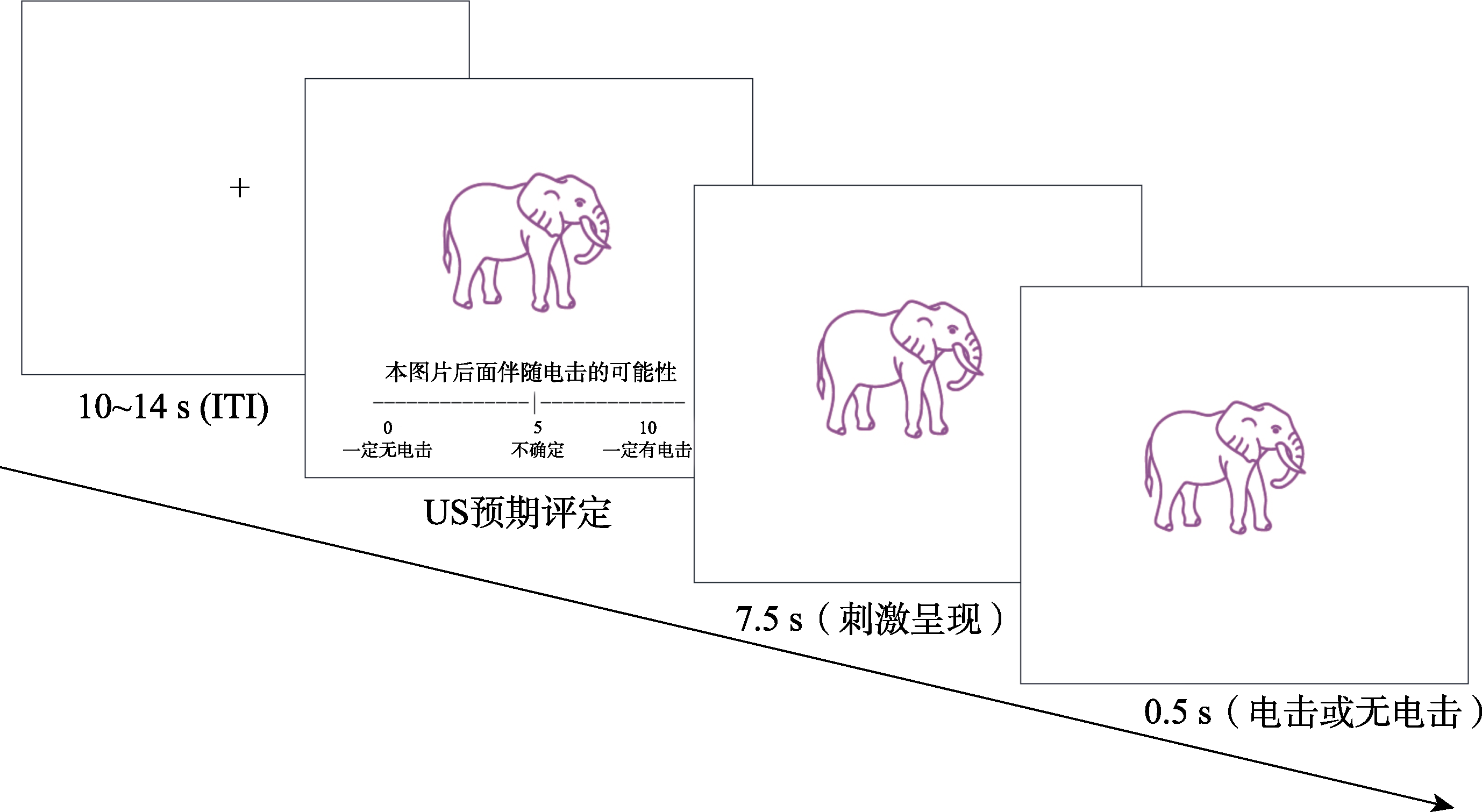
图1 实验试次示意图
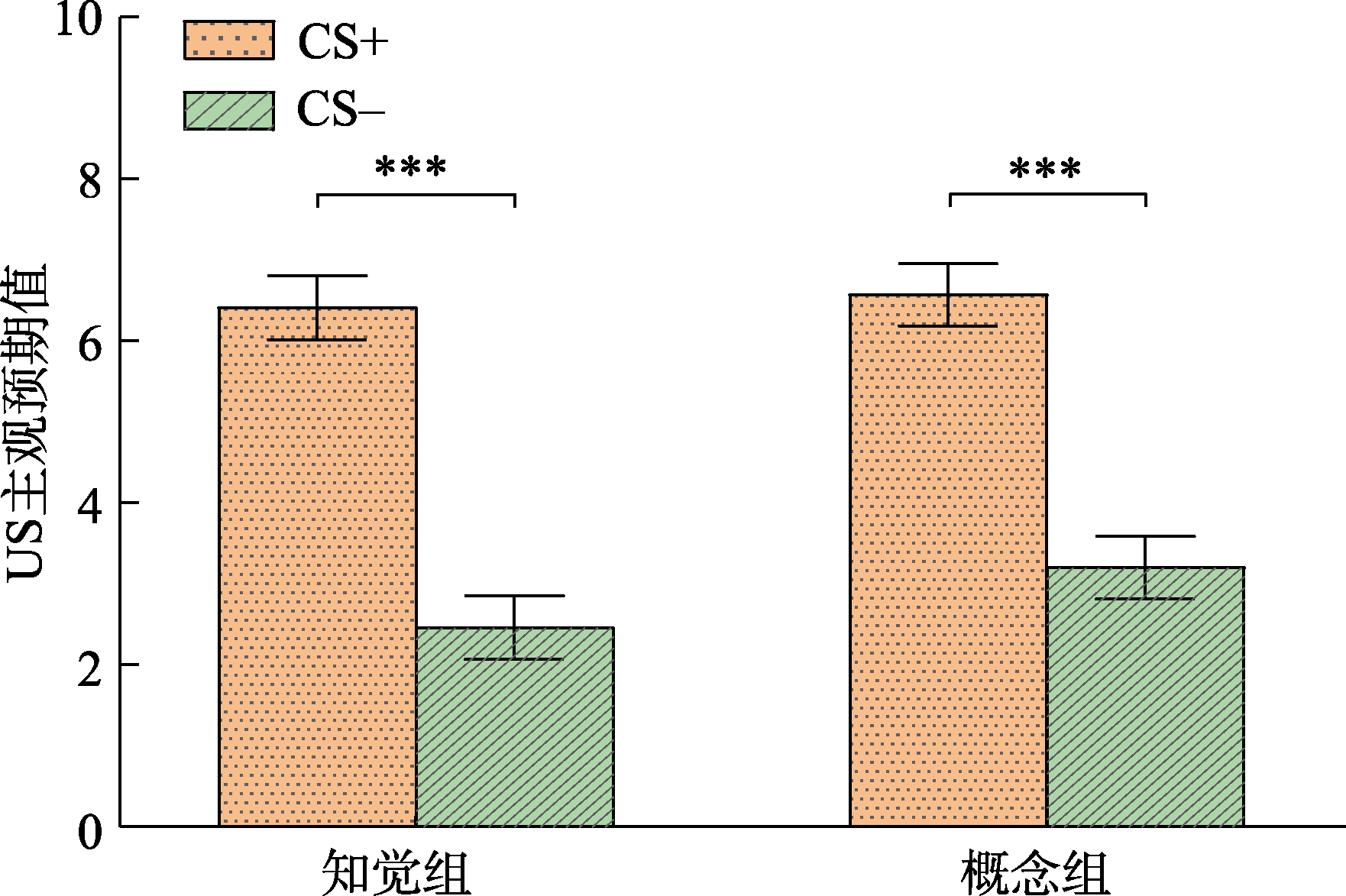
图2 恐惧习得阶段, 两组被试对CS+和CS-的US主观预期 注:*p < 0.05, **p < 0.01, ***p < 0.001, ns为不显著, 误差线为标准误, 下同。
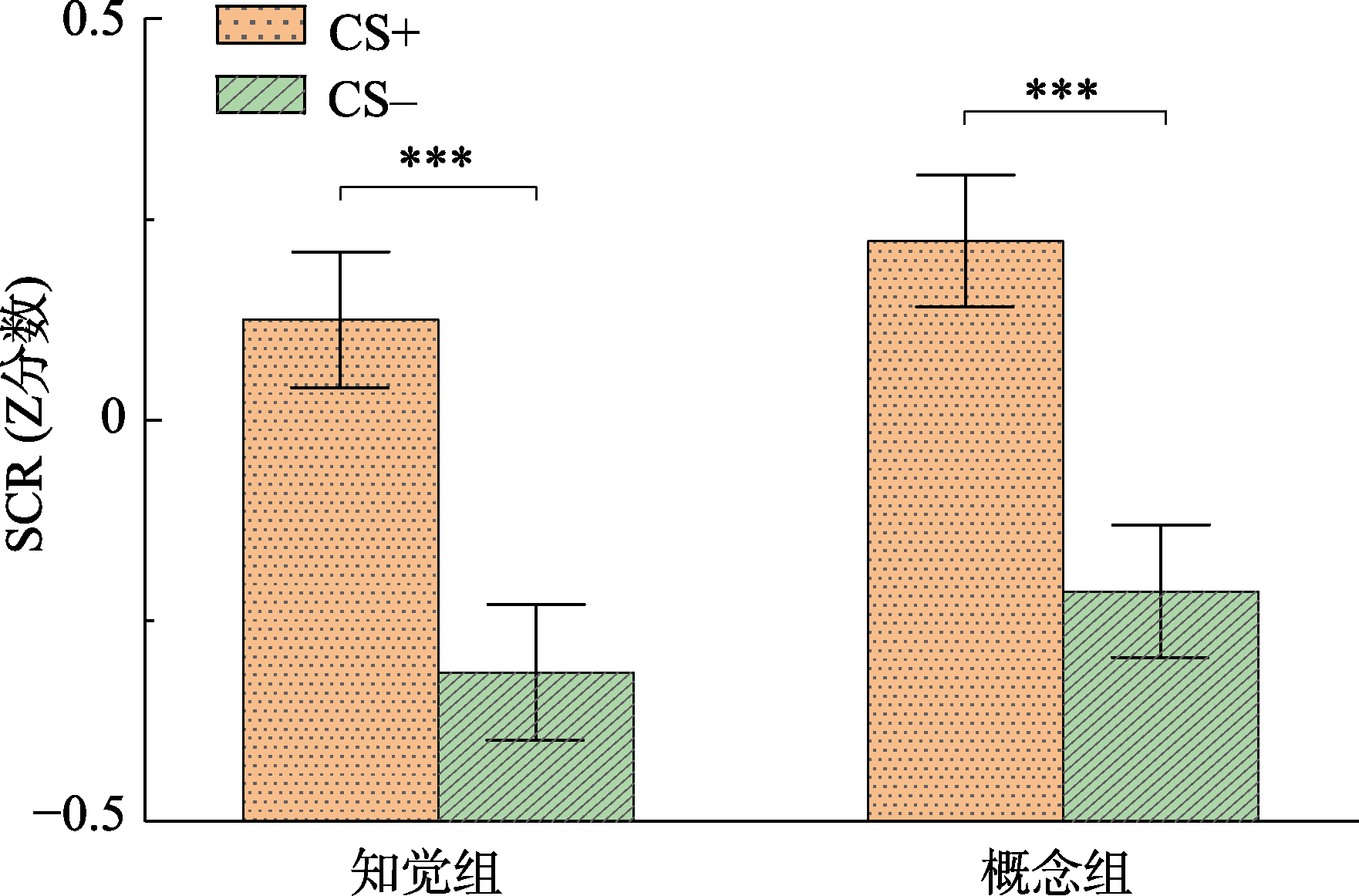
图3 恐惧习得阶段, 两组被试对CS+和CS-的SCR (Z分数)
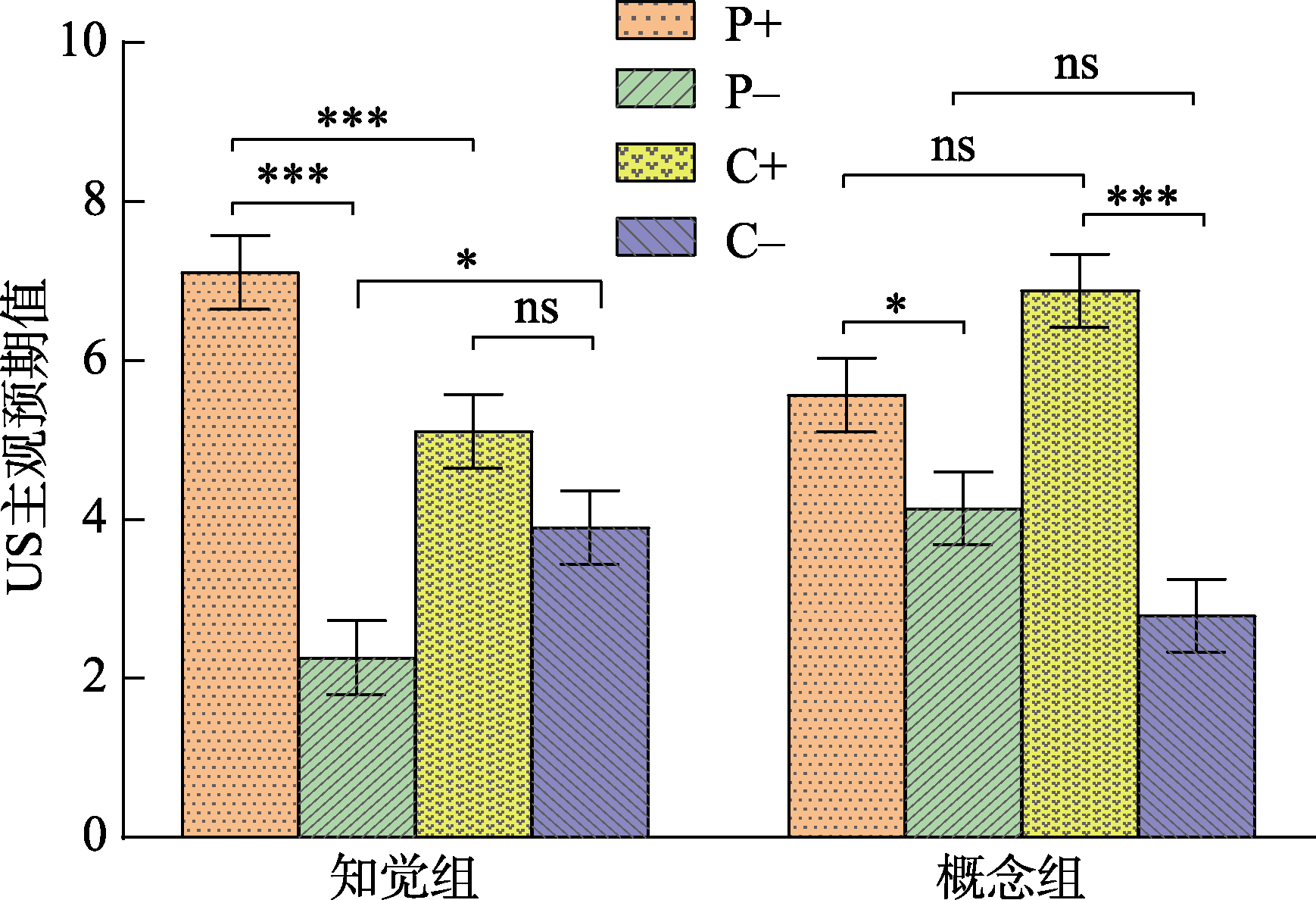
图4 泛化测试阶段1中, 两组被试对泛化刺激的总体US预期
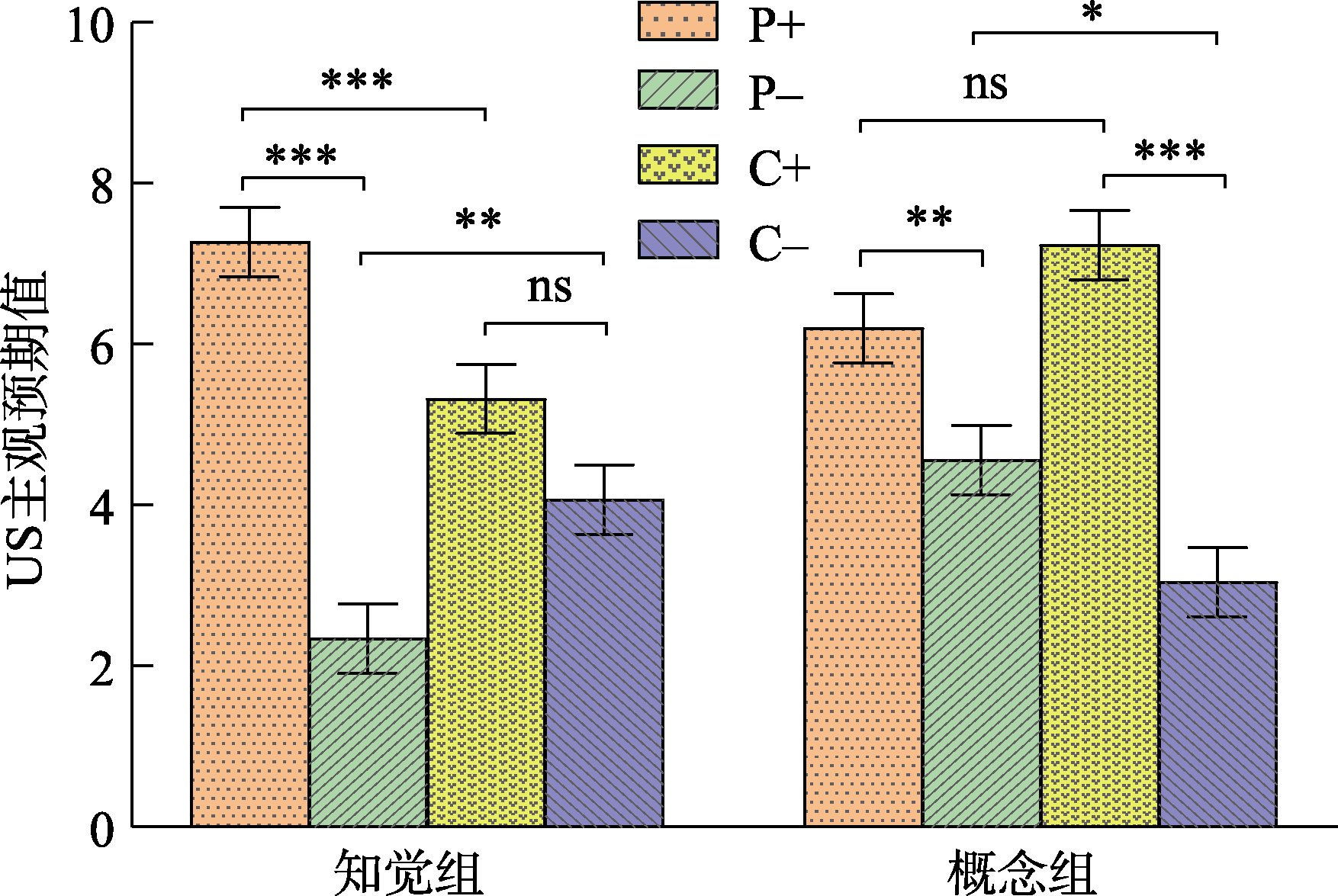
图5 泛化测试阶段2中, 两组被试对泛化刺激的总体US预期
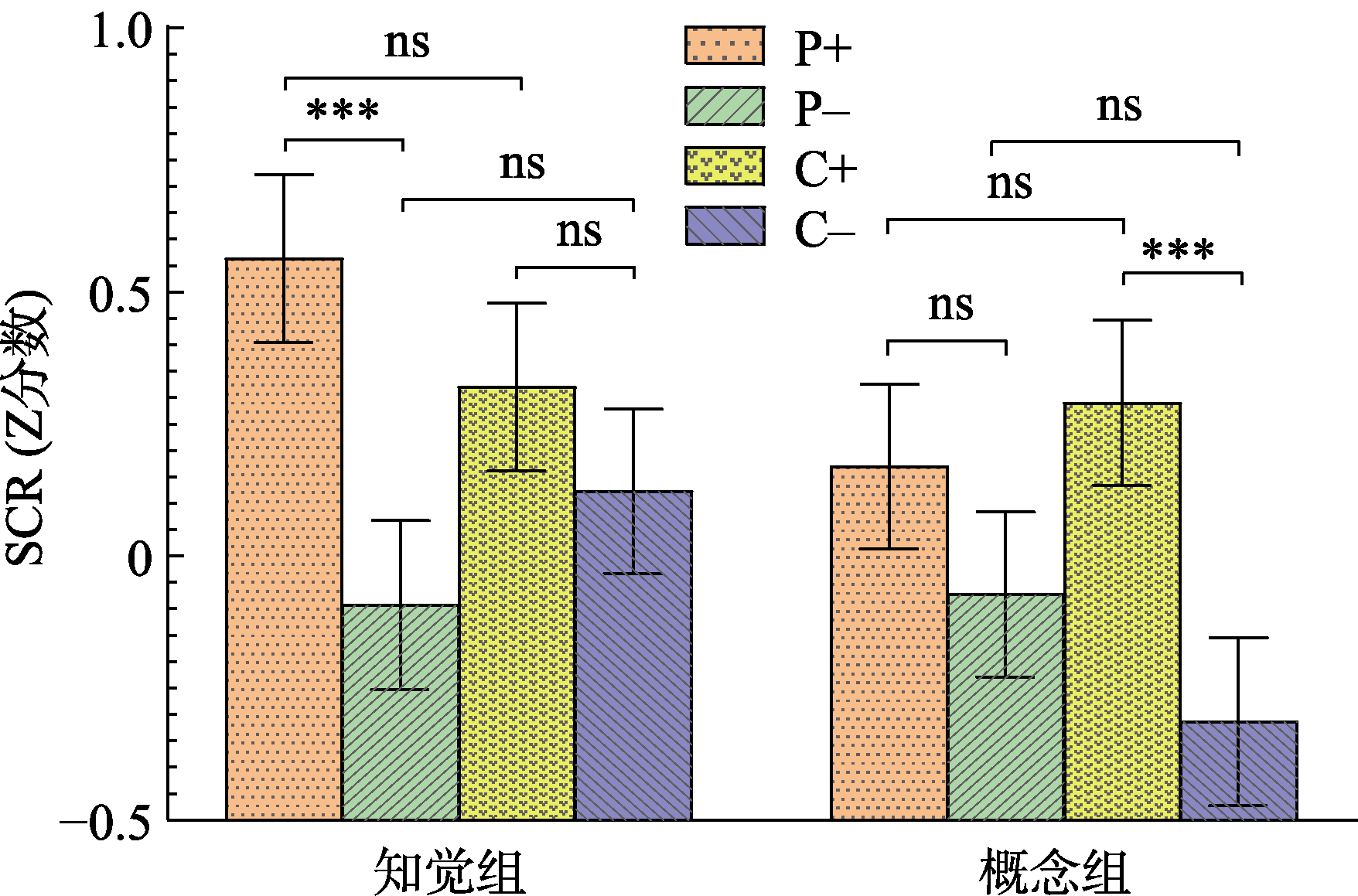
图6 泛化测试阶段2中, 两组被试对泛化刺激的总体SCR (Z分数)
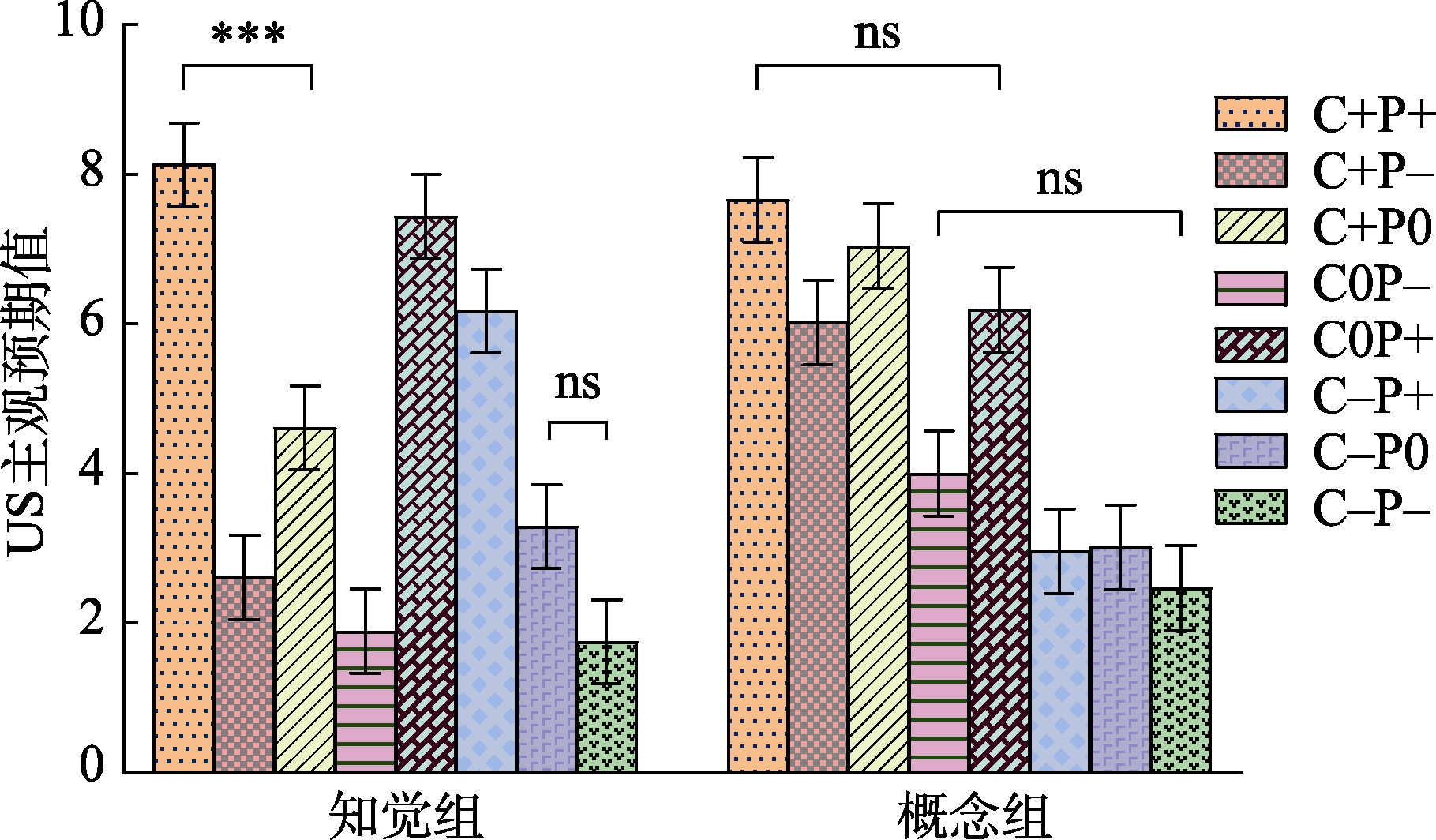
图7 泛化测试阶段1中, 两组被试对各泛化刺激的US预期
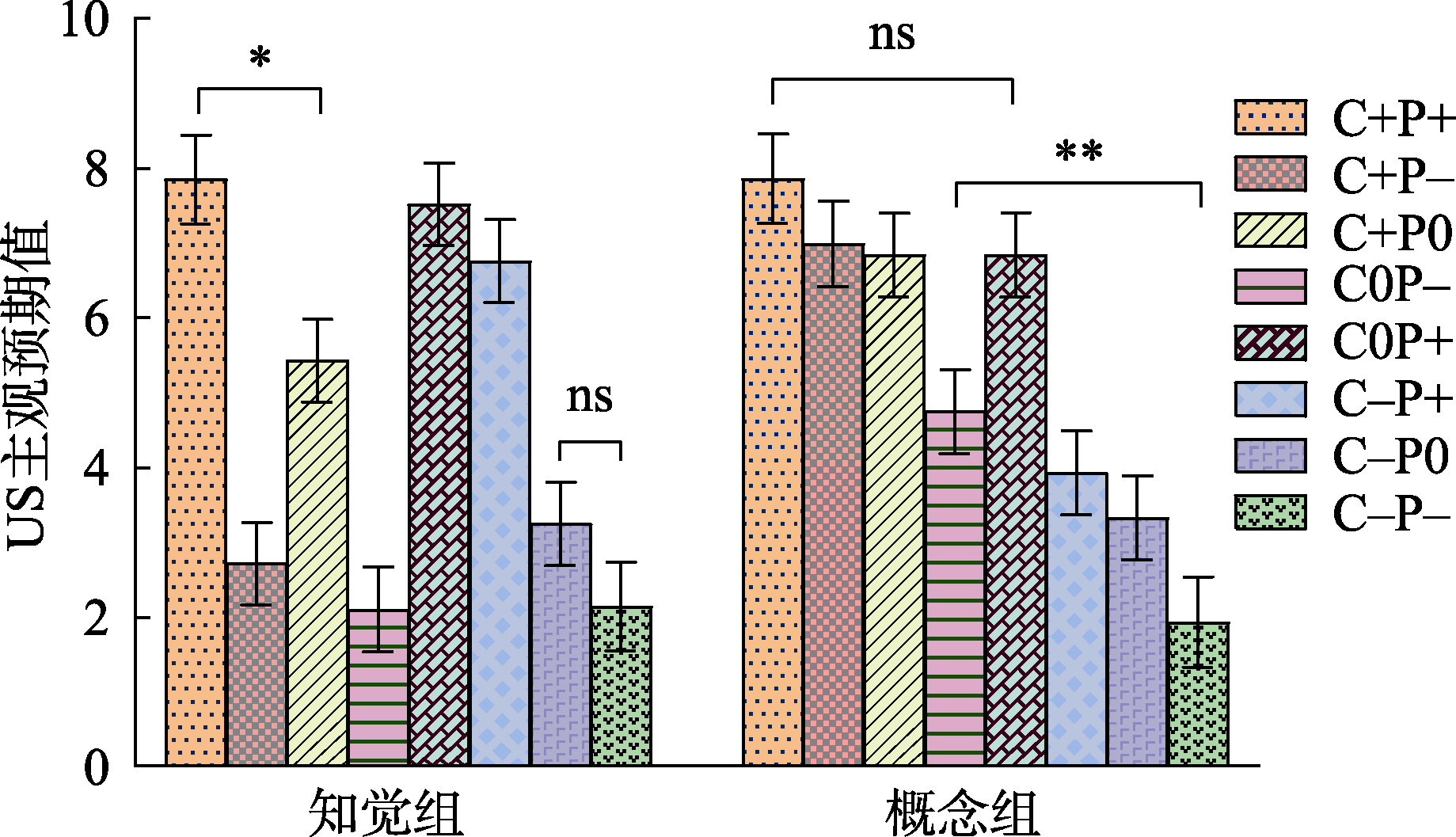
图8 泛化测试阶段2中, 两组被试对各泛化刺激的US预期
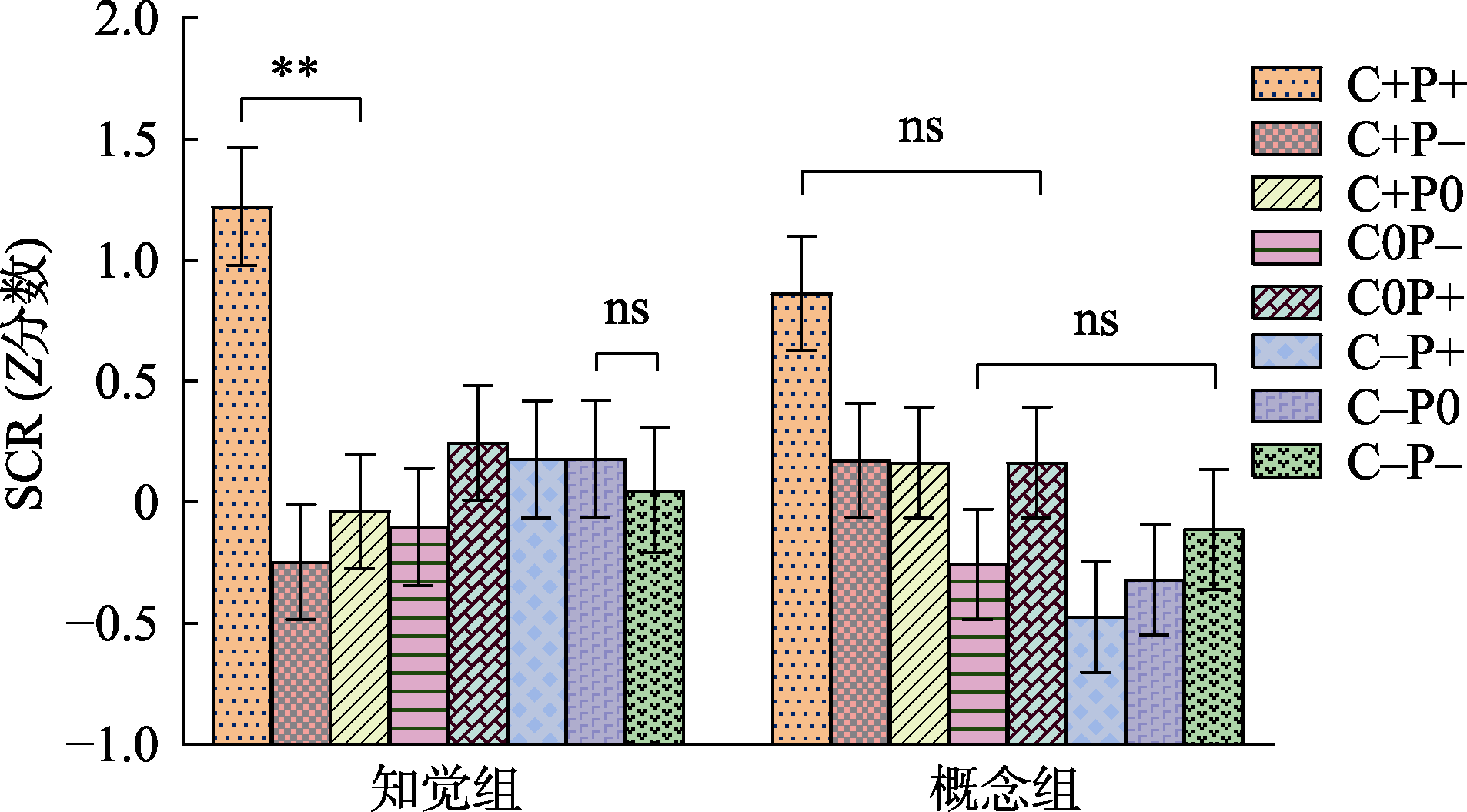
图9 泛化测试2中, 两组被试对各泛化刺激的SCR (Z分数)
| 实验阶段及 结果变量 | 模型名称 | 模型结构 | 拟合结果 | 模型选用 |
|---|---|---|---|---|
| \ | model_full (全模型) | 结果变量 = 性别 + 年龄 + DASS21_A + DASS21_S + DASS21_D + IU_P + IU_I + ASI3_P + ASI3_S + ASI3_C + 前习得阶段的正确率 + 刺激反应时 + 刺激类别 + 组别 + 组别×刺激类别 + (1 | 被试) | \ | \ |
| 习得阶段 US主观预期 | model_AQ_US0 | 全模型 | singular | 无效模型 |
| model_AQ_US1 | 在全模型上去掉被试的随机截距(一般线性模型) | 拟合显著。 F(15, 84) = 13.64, p < 0.001 Multiple R-squared = 0.7091 Adjusted R-squared = 0.6573 | 选用本模型 | |
| 习得阶段 SCR | model_AQ_SCR0 | 全模型 | singular | 无效模型 |
| model_AQ_SCR1 | 在全模型上去掉被试的随机截距(一般线性模型) | 拟合显著。 F(15, 80) = 4.84, p < 0.001 Multiple R-squared = 0.4755 Adjusted R-squared = 0.3772 | 选用本模型 |
附表1 恐惧习得阶段模型拟合和对比
| 实验阶段及 结果变量 | 模型名称 | 模型结构 | 拟合结果 | 模型选用 |
|---|---|---|---|---|
| \ | model_full (全模型) | 结果变量 = 性别 + 年龄 + DASS21_A + DASS21_S + DASS21_D + IU_P + IU_I + ASI3_P + ASI3_S + ASI3_C + 前习得阶段的正确率 + 刺激反应时 + 刺激类别 + 组别 + 组别×刺激类别 + (1 | 被试) | \ | \ |
| 习得阶段 US主观预期 | model_AQ_US0 | 全模型 | singular | 无效模型 |
| model_AQ_US1 | 在全模型上去掉被试的随机截距(一般线性模型) | 拟合显著。 F(15, 84) = 13.64, p < 0.001 Multiple R-squared = 0.7091 Adjusted R-squared = 0.6573 | 选用本模型 | |
| 习得阶段 SCR | model_AQ_SCR0 | 全模型 | singular | 无效模型 |
| model_AQ_SCR1 | 在全模型上去掉被试的随机截距(一般线性模型) | 拟合显著。 F(15, 80) = 4.84, p < 0.001 Multiple R-squared = 0.4755 Adjusted R-squared = 0.3772 | 选用本模型 |
| 实验阶段及 结果变量 | 模型名称 | 模型结构 | 拟合结果 | 模型选用 |
|---|---|---|---|---|
| \ | model_full (全模型) | 结果变量 = 性别 + 年龄 + DASS21_A + DASS21_S + DASS21_D + IU_P + IU_I + ASI3_P + ASI3_S + ASI3_C + 前习得阶段的正确率 + 刺激反应时 + 刺激类别 + 组别 + 组别×刺激类别 + 刺激顺序 + (1 + 刺激顺序 | 被试) + (1 | 刺激顺序) | \ | \ |
| 泛化测试阶段1 US主观预期 | model_GE1_US0 | 全模型 | singular | 无效模型 |
| model_GE1_US1 | 在全模型上去掉被试随机截距和刺激顺序随机斜率的相关 | singular | 无效模型 | |
| model_GE1_US2 | 在全模型上去掉刺激顺序的随机斜率 | singular | 无效模型 | |
| model_GE1_US3 | 在全模型上去掉刺激顺序的固定效应 | singular | 无效模型 | |
| model_GE1_US4 | 在全模型上去掉刺激顺序的随机截距 | singular | 无效模型 | |
| model_GE1_US5 | 在全模型上去掉刺激顺序的随机截距, 并去掉刺激顺序的随机斜率 | singular | 无效模型 | |
| model_GE1_US6 | 在全模型上去掉所有随机效应(一般线性模型) | 拟合显著。 F(20, 179) = 9.02, p < 0.001 Multiple R-squared = 0.5018 Adjusted R-squared = 0.4462 | 选用本模型 | |
| 泛化测试阶段2 US主观预期 | model_GE2_US0 | 全模型 | singular | 无效模型 |
| model_GE2_US1 | 在全模型上去掉被试随机截距和刺激顺序随机斜率的相关 | singular | 无效模型 | |
| model_GE2_US2 | 在全模型上去掉刺激顺序的随机斜率 | singular | 无效模型 | |
| model_GE2_US3 | 在全模型上去掉刺激顺序的固定效应 | singular | 无效模型 | |
| model_GE2_US4 | 在全模型上去掉刺激顺序的随机截距 | singular | 无效模型 | |
| model_GE2_US5 | 在全模型上去掉刺激顺序的随机截距, 并去掉刺激顺序的随机斜率(即, 随机效应仅保留被试的随机截距项) | 收敛。 Var:被试 (Intercept)= 0.03384 ICC:被试 = 0.01192 Var: Residual = 2.80592 R_(m)² = 0.52854 R_(c)² = 0.53416 Omega² = 0.56378 | 选用本模型 | |
| 泛化测试阶段2 SCR | model_GE2_SCR0 | 全模型 | singular | 无效模型 |
| model_GE2_SCR1 | 在全模型上去掉被试随机截距和刺激顺序随机斜率的相关 | singular | 无效模型 | |
| model_GE2_SCR2 | 在全模型上去掉刺激顺序的随机斜率 | singular | 无效模型 | |
| model_GE2_SCR3 | 在全模型上去掉刺激顺序的固定效应 | singular | 无效模型 | |
| model_GE2_SCR4 | 在全模型上去掉刺激顺序的随机截距 | singular | 无效模型 | |
| model_GE2_SCR5 | 在全模型上去掉刺激顺序的随机截距, 并去掉刺激顺序的随机斜率(即, 随机效应仅保留被试的随机截距项) | 收敛。 Var:被试(Intercept) = 0.07608 ICC:被试 = 0.26055 Var: Residual = 0.21593 R_(m)² = 0.27244 R_(c)² = 0.46200 Omega² = 0.52179 | 选用本模型 |
附表2 泛化测试阶段模型拟合和对比(整体)
| 实验阶段及 结果变量 | 模型名称 | 模型结构 | 拟合结果 | 模型选用 |
|---|---|---|---|---|
| \ | model_full (全模型) | 结果变量 = 性别 + 年龄 + DASS21_A + DASS21_S + DASS21_D + IU_P + IU_I + ASI3_P + ASI3_S + ASI3_C + 前习得阶段的正确率 + 刺激反应时 + 刺激类别 + 组别 + 组别×刺激类别 + 刺激顺序 + (1 + 刺激顺序 | 被试) + (1 | 刺激顺序) | \ | \ |
| 泛化测试阶段1 US主观预期 | model_GE1_US0 | 全模型 | singular | 无效模型 |
| model_GE1_US1 | 在全模型上去掉被试随机截距和刺激顺序随机斜率的相关 | singular | 无效模型 | |
| model_GE1_US2 | 在全模型上去掉刺激顺序的随机斜率 | singular | 无效模型 | |
| model_GE1_US3 | 在全模型上去掉刺激顺序的固定效应 | singular | 无效模型 | |
| model_GE1_US4 | 在全模型上去掉刺激顺序的随机截距 | singular | 无效模型 | |
| model_GE1_US5 | 在全模型上去掉刺激顺序的随机截距, 并去掉刺激顺序的随机斜率 | singular | 无效模型 | |
| model_GE1_US6 | 在全模型上去掉所有随机效应(一般线性模型) | 拟合显著。 F(20, 179) = 9.02, p < 0.001 Multiple R-squared = 0.5018 Adjusted R-squared = 0.4462 | 选用本模型 | |
| 泛化测试阶段2 US主观预期 | model_GE2_US0 | 全模型 | singular | 无效模型 |
| model_GE2_US1 | 在全模型上去掉被试随机截距和刺激顺序随机斜率的相关 | singular | 无效模型 | |
| model_GE2_US2 | 在全模型上去掉刺激顺序的随机斜率 | singular | 无效模型 | |
| model_GE2_US3 | 在全模型上去掉刺激顺序的固定效应 | singular | 无效模型 | |
| model_GE2_US4 | 在全模型上去掉刺激顺序的随机截距 | singular | 无效模型 | |
| model_GE2_US5 | 在全模型上去掉刺激顺序的随机截距, 并去掉刺激顺序的随机斜率(即, 随机效应仅保留被试的随机截距项) | 收敛。 Var:被试 (Intercept)= 0.03384 ICC:被试 = 0.01192 Var: Residual = 2.80592 R_(m)² = 0.52854 R_(c)² = 0.53416 Omega² = 0.56378 | 选用本模型 | |
| 泛化测试阶段2 SCR | model_GE2_SCR0 | 全模型 | singular | 无效模型 |
| model_GE2_SCR1 | 在全模型上去掉被试随机截距和刺激顺序随机斜率的相关 | singular | 无效模型 | |
| model_GE2_SCR2 | 在全模型上去掉刺激顺序的随机斜率 | singular | 无效模型 | |
| model_GE2_SCR3 | 在全模型上去掉刺激顺序的固定效应 | singular | 无效模型 | |
| model_GE2_SCR4 | 在全模型上去掉刺激顺序的随机截距 | singular | 无效模型 | |
| model_GE2_SCR5 | 在全模型上去掉刺激顺序的随机截距, 并去掉刺激顺序的随机斜率(即, 随机效应仅保留被试的随机截距项) | 收敛。 Var:被试(Intercept) = 0.07608 ICC:被试 = 0.26055 Var: Residual = 0.21593 R_(m)² = 0.27244 R_(c)² = 0.46200 Omega² = 0.52179 | 选用本模型 |
| 实验阶段及 结果变量 | 模型名称 | 模型结构 | 拟合结果 | 模型选用 |
|---|---|---|---|---|
| \ | model_full (全模型) | 结果变量 = 性别 + 年龄 + DASS21_A + DASS21_S + DASS21_D + IU_P + IU_I + ASI3_P + ASI3_S + ASI3_C + 前习得阶段的正确率 + 刺激反应时 + 刺激类别 + 组别 + 组别×刺激类别 + 刺激顺序 + (1 + 刺激顺序 | 被试) + (1 | 刺激顺序) | \ | \ |
| 泛化测试阶段1 US主观预期 | model_GE1_US0 | 全模型 | singular, 未收敛 | 无效模型 |
| 在全模型上去掉被试随机截距和刺激顺序随机斜率的相关 | singular | 无效模型 | ||
| model_GE1_US1 | 在全模型上去掉刺激顺序的随机斜率 | singular | 无效模型 | |
| model_GE1_US2 | 在全模型上去掉刺激顺序的固定效应 | singular | 无效模型 | |
| model_GE1_US3 | 在全模型上去掉刺激顺序的随机截距 | singular | 无效模型 | |
| model_GE1_US4 | 在全模型上去掉刺激顺序的随机截距, 并去掉刺激顺序的随机斜率(仅保留被试的随机截距项) | singular | 无效模型 | |
| model_GE1_US5 | 在全模型上去掉所有随机效应(一般线性模型) | 拟合显著。 F(28, 371) = 11.39, p < 0.001 Multiple R-squared = 0.4622 Adjusted R-squared = 0.4216 | 选用本模型 | |
| 泛化测试阶段2 US主观预期 | model_GE2_US0 | 全模型 | singular, 未收敛 | 无效模型 |
| 在全模型上去掉被试随机截距和刺激顺序随机斜率的相关 | singular | 无效模型 | ||
| model_GE2_US1 | 在全模型上去掉刺激顺序的随机斜率 | singular | 无效模型 | |
| model_GE2_US2 | 在全模型上去掉刺激顺序的固定效应 | singular, 未收敛 | 无效模型 | |
| model_GE2_US3 | 在全模型上去掉刺激顺序的随机截距 | 收敛, 但Var:被试 (Intercept)接近于0(1.637e-05) | 无效模型 | |
| model_GE2_US4 | 在全模型上去掉刺激顺序的随机截距, 并去掉刺激顺序的随机斜率(即, 随机效应仅保留被试的随机截距项) | 收敛。 Var: 被试 (Intercept) = 0.14100 Var: Residual = 5.48831 ICC:被试 = 0.02505 R_(m)² = 0.46142 R_(c)² = 0.47491 Omega² = 0.49976 | 选用本模型 | |
| 泛化测试阶段2 SCR | model_GE2_SCR0 | 全模型 | 收敛。 Var: 被试(Intercept) = 0.15560 Var: 被试 刺激顺序 = 0.00668 ICC: 被试 = 0.14648 Var: 刺激顺序 (Intercept) = 0.00599 ICC:刺激顺序 = 0.00564 Var: Residual = 0.90061 AIC = 1114.69 BIC = 1247.38 R_(m)² = 0.18195 R_(c)² = 0.22670 Omega² = 0.26754 | 这几个收敛的模型之间的似然比检验均无显著差异, 选用模型残差和AIC、BIC数值都较小, 而Marginal R², Conditional R²和Omega²数值都较大的model_GE2_SCR3 |
| model_GE2_SCR1 | 在全模型上去掉被试随机截距和刺激顺序随机斜率的相关 | singular | ||
| model_GE2_SCR2 | 在全模型上去掉刺激顺序的随机斜率 | 收敛。 Var:被试(Intercept) = 0.00575 ICC: 被试 = 0.00604 Var: 刺激顺序(Intercept) = 0.00457 ICC: 刺激顺序 = 0.00480 Var: Residual = 0.94164 AIC = 1112.164 BIC = 1237.049 R_(m)² = 0.18295 R_(c)² = 0.19181 Omega² = 0.20580 | ||
| model_GE2_SCR3 | 在全模型上去掉刺激顺序的固定效应 | Var:被试(Intercept) = 0.14800 Var:被试 刺激顺序 = 0.00631 ICC: 被试 = 0.14066 Var: 刺激顺序 = 0.00210 ICC: 刺激顺序 = 0.00200 Var: Residual = 0.90204 AIC = 1107.952 BIC = 1236.739 R_(m)² = 0.18138 R_(c)² = 0.22109 Omega² = 0.26179 | ||
| model_GE2_SCR4 | 在全模型上去掉刺激顺序的随机截距(即, 随机效应保留被试的随机截距和刺激顺序的随机斜率) | 收敛。 Var: 被试(Intercept) = 0.151583 ICC: 被试 = 0.14333 Var: 被试 刺激顺序 = 0.00650 Var: Residual = 0.90602 AIC = 1112.861 BIC = 1241.648 R_(m)² = 0.18004 R_(c)² = 0.21832 Omega² = 0.25947 | ||
| model_GE2_SCR5 | 在全模型上去掉刺激顺序的随机截距, 并去掉刺激顺序的随机斜率(仅保留被试的随机截距项) | 收敛。 Var: 被试(Intercept)= 0.00524 ICC: 被试 = 0.00552 Var: Residual = 0.94500 AIC = 1110.259 BIC = 1231.241 R_(m)² = 0.18142 R_(c)² = 0.18594 Omega² = 0.20055 |
附表3 泛化测试阶段模型拟合和对比(各刺激)
| 实验阶段及 结果变量 | 模型名称 | 模型结构 | 拟合结果 | 模型选用 |
|---|---|---|---|---|
| \ | model_full (全模型) | 结果变量 = 性别 + 年龄 + DASS21_A + DASS21_S + DASS21_D + IU_P + IU_I + ASI3_P + ASI3_S + ASI3_C + 前习得阶段的正确率 + 刺激反应时 + 刺激类别 + 组别 + 组别×刺激类别 + 刺激顺序 + (1 + 刺激顺序 | 被试) + (1 | 刺激顺序) | \ | \ |
| 泛化测试阶段1 US主观预期 | model_GE1_US0 | 全模型 | singular, 未收敛 | 无效模型 |
| 在全模型上去掉被试随机截距和刺激顺序随机斜率的相关 | singular | 无效模型 | ||
| model_GE1_US1 | 在全模型上去掉刺激顺序的随机斜率 | singular | 无效模型 | |
| model_GE1_US2 | 在全模型上去掉刺激顺序的固定效应 | singular | 无效模型 | |
| model_GE1_US3 | 在全模型上去掉刺激顺序的随机截距 | singular | 无效模型 | |
| model_GE1_US4 | 在全模型上去掉刺激顺序的随机截距, 并去掉刺激顺序的随机斜率(仅保留被试的随机截距项) | singular | 无效模型 | |
| model_GE1_US5 | 在全模型上去掉所有随机效应(一般线性模型) | 拟合显著。 F(28, 371) = 11.39, p < 0.001 Multiple R-squared = 0.4622 Adjusted R-squared = 0.4216 | 选用本模型 | |
| 泛化测试阶段2 US主观预期 | model_GE2_US0 | 全模型 | singular, 未收敛 | 无效模型 |
| 在全模型上去掉被试随机截距和刺激顺序随机斜率的相关 | singular | 无效模型 | ||
| model_GE2_US1 | 在全模型上去掉刺激顺序的随机斜率 | singular | 无效模型 | |
| model_GE2_US2 | 在全模型上去掉刺激顺序的固定效应 | singular, 未收敛 | 无效模型 | |
| model_GE2_US3 | 在全模型上去掉刺激顺序的随机截距 | 收敛, 但Var:被试 (Intercept)接近于0(1.637e-05) | 无效模型 | |
| model_GE2_US4 | 在全模型上去掉刺激顺序的随机截距, 并去掉刺激顺序的随机斜率(即, 随机效应仅保留被试的随机截距项) | 收敛。 Var: 被试 (Intercept) = 0.14100 Var: Residual = 5.48831 ICC:被试 = 0.02505 R_(m)² = 0.46142 R_(c)² = 0.47491 Omega² = 0.49976 | 选用本模型 | |
| 泛化测试阶段2 SCR | model_GE2_SCR0 | 全模型 | 收敛。 Var: 被试(Intercept) = 0.15560 Var: 被试 刺激顺序 = 0.00668 ICC: 被试 = 0.14648 Var: 刺激顺序 (Intercept) = 0.00599 ICC:刺激顺序 = 0.00564 Var: Residual = 0.90061 AIC = 1114.69 BIC = 1247.38 R_(m)² = 0.18195 R_(c)² = 0.22670 Omega² = 0.26754 | 这几个收敛的模型之间的似然比检验均无显著差异, 选用模型残差和AIC、BIC数值都较小, 而Marginal R², Conditional R²和Omega²数值都较大的model_GE2_SCR3 |
| model_GE2_SCR1 | 在全模型上去掉被试随机截距和刺激顺序随机斜率的相关 | singular | ||
| model_GE2_SCR2 | 在全模型上去掉刺激顺序的随机斜率 | 收敛。 Var:被试(Intercept) = 0.00575 ICC: 被试 = 0.00604 Var: 刺激顺序(Intercept) = 0.00457 ICC: 刺激顺序 = 0.00480 Var: Residual = 0.94164 AIC = 1112.164 BIC = 1237.049 R_(m)² = 0.18295 R_(c)² = 0.19181 Omega² = 0.20580 | ||
| model_GE2_SCR3 | 在全模型上去掉刺激顺序的固定效应 | Var:被试(Intercept) = 0.14800 Var:被试 刺激顺序 = 0.00631 ICC: 被试 = 0.14066 Var: 刺激顺序 = 0.00210 ICC: 刺激顺序 = 0.00200 Var: Residual = 0.90204 AIC = 1107.952 BIC = 1236.739 R_(m)² = 0.18138 R_(c)² = 0.22109 Omega² = 0.26179 | ||
| model_GE2_SCR4 | 在全模型上去掉刺激顺序的随机截距(即, 随机效应保留被试的随机截距和刺激顺序的随机斜率) | 收敛。 Var: 被试(Intercept) = 0.151583 ICC: 被试 = 0.14333 Var: 被试 刺激顺序 = 0.00650 Var: Residual = 0.90602 AIC = 1112.861 BIC = 1241.648 R_(m)² = 0.18004 R_(c)² = 0.21832 Omega² = 0.25947 | ||
| model_GE2_SCR5 | 在全模型上去掉刺激顺序的随机截距, 并去掉刺激顺序的随机斜率(仅保留被试的随机截距项) | 收敛。 Var: 被试(Intercept)= 0.00524 ICC: 被试 = 0.00552 Var: Residual = 0.94500 AIC = 1110.259 BIC = 1231.241 R_(m)² = 0.18142 R_(c)² = 0.18594 Omega² = 0.20055 |
| [1] |
Ahmed O., & Lovibond P. F. (2015). The impact of previously learned feature-relevance on generalisation of conditioned fear in humans. Journal of Behavior Therapy and Experimental Psychiatry, 46, 59-65. https://doi.org/10.1016/j.jbtep.2014.08.001
doi: 10.1016/j.jbtep.2014.08.001 URL pmid: 25233359 |
| [2] | American Psychiatric Association. (2013). Diagnostic and statistical manual of mental disorders: DSM-5. Washington, DC: American Psychiatric Publishing. |
| [3] |
Bauer E. A., MacNamara A., Sandre A., Lonsdorf T. B., Weinberg A., Morriss J., & van Reekum C. M. (2020). Intolerance of uncertainty and threat generalization: A replication and extension. Psychophysiology, 57(5), e13546. https://doi.org/10.1111/psyp.13546
doi: 10.1111/psyp.v57.5 URL |
| [4] |
Blair M. R., Watson M. R., Walshe R. C., & Maj F. (2009). Extremely selective attention: eye-tracking studies of the dynamic allocation of attention to stimulus features in categorization. Journal of Experimental Psychology: Learning, Memory, and Cognition, 35(5), 1196-1206. https://doi.org/10.1037/a0016272
doi: 10.1037/a0016272 URL |
| [5] |
Cooper S. E., van Dis E. A. M., Hagenaars M. A., Krypotos A. M., Nemeroff C. B., Lissek S.,... Dunsmoor J. E. (2022). A meta-analysis of conditioned fear generalization in anxiety-related disorders. Neuropsychopharmacology, 47(9), 1652-1661. https://doi.org/10.1038/s41386-022-01332-2
doi: 10.1038/s41386-022-01332-2 URL pmid: 35501429 |
| [6] |
Dowd E. W., Mitroff S. R., & LaBar K. S. (2016). Fear generalization gradients in visuospatial attention. Emotion, 16(7), 1011-1018. https://doi.org/10.1037/emo0000197
doi: 10.1037/emo0000197 URL pmid: 27213724 |
| [7] |
Dunsmoor J. E., & LaBar K. S. (2013). Effects of discrimination training on fear generalization gradients and perceptual classification in humans. Behavioral Neuroscience, 127(3), 350-356. https://doi.org/10.1037/a0031933
doi: 10.1037/a0031933 URL pmid: 23421709 |
| [8] |
Dunsmoor J. E., Martin A., & LaBar K. S. (2012). Role of conceptual knowledge in learning and retention of conditioned fear. Biological Psychology, 89(2), 300-305. https://doi.org/10.1016/j.biopsycho.2011.11.002
doi: 10.1016/j.biopsycho.2011.11.002 URL pmid: 22118937 |
| [9] |
Dunsmoor J. E., & Murphy G. L. (2014). Stimulus typicality determines how broadly fear is generalized. Psychological Science, 25(9), 1816-1821. https://doi.org/10.1177/0956797614535401
doi: 10.1177/0956797614535401 URL pmid: 25015685 |
| [10] |
Dunsmoor J. E., & Murphy G. L. (2015). Categories, concepts, and conditioning: How humans generalize fear. Trends in Cognitive Sciences, 19(2), 73-77. https://doi.org/10.1016/j.tics.2014.12.003
doi: 10.1016/j.tics.2014.12.003 URL pmid: 25577706 |
| [11] |
Dunsmoor J. E., & Paz R. (2015). Fear generalization and anxiety: Behavioral and neural mechanisms. Biological Psychiatry, 78(5), 336-343. https://doi.org/10.1016/j.biopsych.2015.04.010
doi: 10.1016/j.biopsych.2015.04.010 URL pmid: 25981173 |
| [12] |
Dymond S., Dunsmoor J. E., Vervliet B., Roche B., & Hermans D. (2015). Fear generalization in humans: Systematic review and implications for anxiety disorder research. Behavior Therapy, 46(5), 561-582. https://doi.org/10.1016/j.beth.2014.10.001
doi: 10.1016/j.beth.2014.10.001 URL pmid: 26459838 |
| [13] |
Fan M., Zhang D., Zhao S., Xie Q., Chen W., Jie J.,... Zheng X. (2022). Stimulus diversity increases category-based fear generalization and the effect of intolerance of uncertainty. Behaviour Research and Therapy, 159, 104201. https://doi.org/10.1016/j.brat.2022.104201
doi: 10.1016/j.brat.2022.104201 URL |
| [14] |
Feng B., Zeng L., Hu Z., Fan X., Ai X., Huang F., & Zheng X. (2025). Global precedence effect in fear generalization and the role of trait anxiety and intolerance of uncertainty. Behaviour Research and Therapy, 184, 104669. https://doi.org/10.1016/j.brat.2024.104669
doi: 10.1016/j.brat.2024.104669 URL |
| [15] |
Fernandes A. C., & Garcia-Marques T. (2020). A meta-analytical review of the familiarity temporal effect: Testing assumptions of the attentional and the fluency-attributional accounts. Psychological Bulletin, 146(3), 187-217. https://doi.org/10.1037/bul0000222
doi: 10.1037/bul0000222 URL pmid: 31944797 |
| [16] |
Finucane A. M., & Power M. J. (2010). The effect of fear on attentional processing in a sample of healthy females. Journal of Anxiety Disorders, 24(1), 42-48. https://doi.org/10.1016/j.janxdis.2009.08.005
doi: 10.1016/j.janxdis.2009.08.005 URL pmid: 19729280 |
| [17] |
Franconeri S. L., Alvarez G. A., & Cavanagh P. (2013). Flexible cognitive resources: Competitive content maps for attention and memory. Trends in Cognitive Sciences, 17(3), 134-141. https://doi.org/10.1016/j.tics.2013.01.010
doi: 10.1016/j.tics.2013.01.010 URL pmid: 23428935 |
| [18] |
Fraunfelter L., Gerdes A. B. M., & Alpers G. W. (2022). Fear one, fear them all: A systematic review and meta-analysis of fear generalization in pathological anxiety. Neuroscience and Biobehavioral Reviews, 139, 104707. https://doi.org/10.1016/j.neubiorev.2022.104707
doi: 10.1016/j.neubiorev.2022.104707 URL |
| [19] |
Gerdes A. B. M., Fraunfelter L., & Alpers G. W. (2020). Hear it, fear it: Fear generalizes from conditioned pictures to semantically related sounds. Journal of Anxiety Disorders, 69, 102174. https://doi.org/10.1016/j.janxdis.2019.102174
doi: 10.1016/j.janxdis.2019.102174 URL |
| [20] |
Gerlach C. (2009). Category-specificity in visual object recognition. Cognition, 111(3), 281-301. https://doi.org/10.1016/j.cognition.2009.02.005
doi: 10.1016/j.cognition.2009.02.005 URL pmid: 19324331 |
| [21] | Goldstone, R. L., Steyvers M., Spencer-Smith J., & Kersten A. (2000). Interactions between perceptual and conceptual learning. In E.Dietrich & A. B.Markman (Eds.), Cognitive dynamics: Conceptual and representational change in humans and machines. (pp.191-228). Lawrence Erlbaum Associates Publishers. |
| [22] |
Golkar A., Selbing I., Flygare O., Ohman A., & Olsson A. (2013). Other people as means to a safe end: Vicarious extinction blocks the return of learned fear. Psychological Science, 24(11), 2182-2190. https://doi.org/10.1177/0956797613489890
doi: 10.1177/0956797613489890 URL pmid: 24022651 |
| [23] | Gong X., Xie X. Y., Xu R., & Luo Y. J. (2010). Psychometric properties of the Chinese Versions of DASS-21 in Chinese college students. Chinese Journal of Clinical Psychology, 18(4), 443-446. https://doi.org/10.16128/j.cnki.1005-3611.2010.04.020 |
| [龚栩, 谢熹瑶, 徐蕊, 罗跃嘉. (2010). 抑郁-焦虑-压力量表简体中文版(DASS-21)在中国大学生中的测试报告. 中国临床心理学杂志, 18(4), 443-446. ] | |
| [24] |
Grill-Spector K., & Weiner K. S. (2014). The functional architecture of the ventral temporal cortex and its role in categorization. Nature Reviews Neuroscience, 15(8), 536-548. https://doi.org/10.1038/nrn3747
doi: 10.1038/nrn3747 URL pmid: 24962370 |
| [25] |
Hasson U., Chen J., & Honey C. J. (2015). Hierarchical process memory: Memory as an integral component of information processing. Trends in Cognitive Sciences, 19(6), 304-313. https://doi.org/10.1016/j.tics.2015.04.006
doi: 10.1016/j.tics.2015.04.006 URL pmid: 25980649 |
| [26] | Hinrichs R., van Rooij S. J., Michopoulos V., Schultebraucks K., Winters S., Maples-Keller J.,... Jovanovic T. (2019). Increased skin conductance response in the immediate aftermath of trauma predicts PTSD risk. Chronic Stress, 3, 1-11. https://doi.org/10.1177/2470547019844441 |
| [27] |
Jepma M., & Wager T. D. (2015). Conceptual conditioning: Mechanisms mediating conditioning effects on pain. Psychological Science, 26(11), 1728-1739. https://doi.org/10.1177/0956797615597658
doi: 10.1177/0956797615597658 URL pmid: 26381506 |
| [28] | Kan I. P., & Thompson-Schill S. L. (2004). Selection from perceptual and conceptual representations. Cognitive, Affective, & Behavioral Neuroscience, 4(4), 466-482. https://doi.org/10.3758/cabn.4.4.466 |
| [29] |
Kim S., & Rehder B. (2010). How prior knowledge affects selective attention during category learning: An eyetracking study. Memory & Cognition, 39(4), 649-665. https://doi.org/10.3758/s13421-010-0050-3.
doi: 10.3758/s13421-010-0050-3 URL |
| [30] |
LeDoux J. E., & Pine D. S. (2016). Using neuroscience to help understand fear and anxiety: A two-system framework. American Journal of Psychiatry, 173(11), 1083-1093. https://doi.org/10.1176/appi.ajp.2016.16030353
URL pmid: 27609244 |
| [31] |
Lee Y. I., Lee D., Kim H., Kim M. J., Jeong H., Kim D.,... Choi S. H. (2024). Overgeneralization of conditioned fear in patients with social anxiety disorder. Frontiers in Psychiatry, 15, 1415135. https://doi.org/10.3389/fpsyt.2024.1415135
doi: 10.3389/fpsyt.2024.1415135 URL |
| [32] | Lei Y., Wang J. X., Cheng Q. F., Zhang W. H., & Mei E. (2017). The influence mechanism of categories and concepts on fear generalization. Journal of Psychological Science, 40(5), 1266-1273. https://doi.org/10.16719/j.cnki.1671-6981.20170537 |
| [雷怡, 王金霞, 陈庆飞, 张文海, 梅颖. (2017). 分类和概念对恐惧泛化的影响机制. 心理科学, 40(5), 1266-1273. ] | |
| [33] |
Liao S. Q., & Zheng X. F. (2016). Inhibition of cognitive reappraisal on the negative valence facilitates extinction in conditioned fear. Acta Psychologica Sinica, 48(4), 352-361. https://doi.org/10.3724/sp.J.1041.2016.00352
doi: 10.3724/SP.J.1041.2016.00352 URL |
| [廖素群, 郑希付. (2016). 认知重评对负性效价的抑制促进条件性恐惧消退. 心理学报, 48(4), 352-361.] | |
| [34] |
Lipp O. V., Waters A. M., Luck C. C., Ryan K. M., & Craske M. G. (2020). Novel approaches for strengthening human fear extinction: The roles of novelty, additional USs, and additional GSs. Behaviour Research and Therapy, 124, 103529. https://doi.org/10.1016/j.brat.2019.103529
doi: 10.1016/j.brat.2019.103529 URL |
| [35] |
Lissek S., Biggs A. L., Rabin S. J., Cornwell B. R., Alvarez R. P., Pine D. S., & Grillon C. (2008). Generalization of conditioned fear-potentiated startle in humans: Experimental validation and clinical relevance. Behaviour Research and Therapy, 46(5), 678-687. https://doi.org/10.1016/j.brat.2008.02.005
doi: 10.1016/j.brat.2008.02.005 URL pmid: 18394587 |
| [36] |
Lopresto D., Schipper P., & Homberg J. R. (2016). Neural circuits and mechanisms involved in fear generalization: Implications for the pathophysiology and treatment of posttraumatic stress disorder. Neuroscience and Biobehavioral Reviews, 60, 31-42. https://doi.org/10.1016/j.neubiorev.2015.10.009
doi: 10.1016/j.neubiorev.2015.10.009 URL pmid: 26519776 |
| [37] |
Mertens G., Bouwman V., & Engelhard I. M. (2021). Conceptual fear generalization gradients and their relationship with anxious traits: Results from a Registered Report. International Journal of Psychophysiology, 170, 43-50. https://doi.org/10.1016/j.ijpsycho.2021.09.007
doi: 10.1016/j.ijpsycho.2021.09.007 URL pmid: 34606931 |
| [38] |
Morey R. A., Haswell C. C., Stjepanovic D., Mid-Atlantic M. W., Dunsmoor J. E., & LaBar K. S. (2020). Neural correlates of conceptual-level fear generalization in posttraumatic stress disorder. Neuropsychopharmacology, 45(8), 1380-1389. https://doi.org/10.1038/s41386-020-0661-8
doi: 10.1038/s41386-020-0661-8 URL pmid: 32222725 |
| [39] |
Mulckhuyse M., Crombez G., & Van der Stigchel S. (2013). Conditioned fear modulates visual selection. Emotion, 13(3), 529-536. https://doi.org/10.1037/a0031076
doi: 10.1037/a0031076 URL pmid: 23356561 |
| [40] |
Nosofsky R. M. (1986). Attention, similarity, and the identification-categorization relationship. Journal of Experimental Psychology: General, 115(1), 39-57.
doi: 10.1037/0096-3445.115.1.39 URL |
| [41] |
Peperkorn H. M., Alpers G. W., & Mühlberger A. (2013). Triggers of fear: Perceptual cues versus conceptual information in spider phobia. Journal of Clinical Psychology, 70(7), 704-714. https://doi.org/10.1002/jclp.22057
doi: 10.1002/jclp.2014.70.issue-7 URL |
| [42] |
Resnik J., Sobel N., & Paz R. (2011). Auditory aversive learning increases discrimination thresholds. Nature Neuroscience, 14(6), 791-796. https://doi.org/10.1038/nn.2802
doi: 10.1038/nn.2802 URL pmid: 21552275 |
| [43] |
Reutter M., & Gamer M. (2023). Individual patterns of visual exploration predict the extent of fear generalization in humans. Emotion, 23(5), 1267-1280. https://doi.org/10.1037/emo0001134
doi: 10.1037/emo0001134 URL |
| [44] |
Scheveneels S., Boddez Y., & Hermans D. (2021). Predicting clinical outcomes via human fear conditioning: A narrative review. Behaviour Research and Therapy, 142, 103870. https://doi.org/10.1016/j.brat.2021.103870
doi: 10.1016/j.brat.2021.103870 URL |
| [45] |
Sep M. S. C., Steenmeijer A., & Kennis M. (2019). The relation between anxious personality traits and fear generalization in healthy subjects: A systematic review and meta-analysis. Neuroscience & Biobehavioral Reviews, 107, 320-328. https://doi.org/10.1016/j.neubiorev.2019.09.029
doi: 10.1016/j.neubiorev.2019.09.029 URL |
| [46] |
Shepard R. N. (1987). Toward a universal law of generalization for psychological science. Science, 237(4820), 1317-1323. http://www.jstor.org/stable/1700004
doi: 10.1126/science.3629243 URL pmid: 3629243 |
| [47] |
Shiban Y., Peperkorn H., Alpers G. W., Pauli P., & Mühlberger A. (2016). Influence of perceptual cues and conceptual information on the activation and reduction of claustrophobic fear. Journal of Behavior Therapy and Experimental Psychiatry, 51, 19-26. https://doi.org/10.1016/j.jbtep.2015.11.002
doi: 10.1016/j.jbtep.2015.11.002 URL pmid: 26687921 |
| [48] |
Stegmann Y., Schiele M. A., Schümann D., Lonsdorf T. B., Zwanzger P., Romanos M.,... Pauli P. (2019). Individual differences in human fear generalization—pattern identification and implications for anxiety disorders. Translational Psychiatry, 9(1), 307. https://doi.org/10.1038/s41398-019-0646-8
doi: 10.1038/s41398-019-0646-8 URL pmid: 31740663 |
| [49] |
Vervliet B., & Geens M. (2014). Fear generalization in humans: Impact of feature learning on conditioning and extinction. Neurobiology of Learning and Memory, 113, 143-148. https://doi.org/10.1016/j.nlm.2013.10.002
doi: 10.1016/j.nlm.2013.10.002 URL pmid: 24120427 |
| [50] |
Vervliet B., Kindt M., Vansteenwegen D., & Hermans D. (2010a). Fear generalization in humans: Impact of prior non-fearful experiences. Behaviour Research and Therapy, 48(11), 1078-1084. https://doi.org/10.1016/j.brat.2010.07.002
doi: 10.1016/j.brat.2010.07.002 URL |
| [51] |
Vervliet B., Kindt M., Vansteenwegen D., & Hermans D. (2010b). Fear generalization in humans: Impact of verbal instructions. Behaviour Research and Therapy, 48(1), 38-43. https://doi.org/10.1016/j.brat.2009.09.005
doi: 10.1016/j.brat.2009.09.005 URL |
| [52] |
Vuilleumier P. (2005). How brains beware: Neural mechanisms of emotional attention. Trends in Cognitive Sciences, 9(12), 585-594. https://doi.org/10.1016/j.tics.2005.10.011
doi: 10.1016/j.tics.2005.10.011 URL pmid: 16289871 |
| [53] | Wang J., Mei E., Wu Q., Xie T., Dou H., & Lei Y. (2021). Influence of perceptual and conceptual information on fear generalization: A behavioral and event-related potential study. Cognitive, Affective, & Behavioral Neuroscience, 21(5), 1054-1065. https://doi.org/10.3758/s13415-021-00912-x |
| [54] |
Wang J., Wang Y., Liao M., Zou Y., Lei Y., & Zhu Y. (2021). Conditioned generalisation in generalised anxiety disorder: The role of concurrent perceptual and conceptual cues. Cognition and Emotion, 35(8), 1516-1526. https://doi.org/10.1080/02699931.2021.1982677
doi: 10.1080/02699931.2021.1982677 URL |
| [55] | Wang L., Liu W. T., Zhu X. Z., Wang Y. P., Li L.Y., Yang Y. L. & George R. A. (2014). Validity and reliability of the Chinese Version of the Anxiety Sensitivity Index-3 in healthy adult women. Chinese Mental Health Journal, 28(10), 767-771. |
| [王雷, 刘婉婷, 朱熊兆, 王瑜萍, 李玲艳, 杨玉玲, George R. A. (2014). 焦虑敏感指数量表3版中文版测评健康成年女性的效度和信度. 中国心理卫生杂志, 28(10), 767-771. ] | |
| [56] |
Webler R. D., Berg H., Fhong K., Tuominen L., Holt D. J., Morey R. A.,... Lissek S. (2021). The neurobiology of human fear generalization: Meta-analysis and working neural model. Neuroscience and Biobehavioral Reviews, 128, 421-436. https://doi.org/10.1016/j.neubiorev.2021.06.035
doi: 10.1016/j.neubiorev.2021.06.035 URL pmid: 34242718 |
| [57] |
Wong A. H. K., & Lovibond P. F. (2021). Breakfast or bakery? The role of categorical ambiguity in overgeneralization of learned fear in trait anxiety. Emotion, 21(4), 856-870. https://doi.org/10.1037/emo0000739
doi: 10.1037/emo0000739 URL |
| [58] | Wickens, C. D. (1991). Processing resources and attention. In D.Damos (Ed.), Multiple task performance (pp. 3-34). CRC Press. |
| [59] |
Zaman J., Yu K., & Lee J. C. (2023). Individual differences in stimulus identification, rule induction, and generalization of learning. Journal of Experimental Psychology: Learning, Memory, and Cognition, 49(6), 1004-1017. https://doi.org/10.1037/xlm0001153
doi: 10.1037/xlm0001153 URL |
| [60] |
Zhang J., Wang J., Wang Y., Zhang D., Li H., & Lei Y. (2024). Sleep deprivation increases the generalization of perceptual and concept-based fear: An fNIRS study. Journal of Anxiety Disorders, 105, 102892. https://doi.org/10.1016/j.janxdis.2024.102892
doi: 10.1016/j.janxdis.2024.102892 URL |
| [61] | Zhang Y. J., Song J. B., Gao Y. T., Wu S. J., Song L., & Miao D. M. (2017). Reliability and validity of the Intolerance of Uncertainty Scale-Short form in university students. Chinese Journal of Clinical Psychology, 25(2), 285-288. https://doi.org/10.16128/j.cnki.1005-3611.2017.02.020 |
| [张亚娟, 宋继波, 高云涛, 武圣君, 宋蕾, 苗丹民. (2017). 无法忍受不确定性量表(简版)在中国大学生中的信效度检验. 中国临床心理学杂志, 25(2), 285-288.] |
| [1] | 杨鑫超, 陈燕铃, 郑俊猛, 张荣祥, 牟晓, 徐强. 工作记忆负荷对社交焦虑个体注意偏向的调节作用: 来自稳态视觉诱发电位的证据[J]. 心理学报, 2025, 57(10): 1729-1744. |
| [2] | 郑茜, 张亭亭, 李量, 范宁, 杨志刚. 言语的情绪韵律和情绪语义对听觉去信息掩蔽的作用[J]. 心理学报, 2023, 55(2): 177-191. |
| [3] | 尹华站, 张丽, 刘鹏玉, 李丹. 负性情绪的动机维度对时距知觉的影响:注意控制和注意偏向的中介作用[J]. 心理学报, 2023, 55(12): 1917-1931. |
| [4] | 彭宇彬, 宛小昂. 视觉搜索中风味引发对关联颜色的注意偏向[J]. 心理学报, 2022, 54(7): 736-747. |
| [5] | 张妮, 刘文, 刘方, 郭鑫. 8~12岁儿童抑郁与认知重评的关系:悲伤面孔注意偏向的中介作用[J]. 心理学报, 2022, 54(1): 25-39. |
| [6] | 侯娟, 朱英格, 方晓义. 手机成瘾与抑郁:社交焦虑和负性情绪信息注意偏向的多重中介作用[J]. 心理学报, 2021, 53(4): 362-373. |
| [7] | 华艳, 李明霞, 王巧婷, 冯彩霞, 张晶. 左侧眶额皮层在自动情绪调节下注意选择中的作用:来自经颅直流电刺激的证据[J]. 心理学报, 2020, 52(9): 1048-1056. |
| [8] | 雷怡, 夏琦, 莫志凤, 李红. 面孔可爱度和客观熟悉度对婴儿面孔注意偏向效应的影响[J]. 心理学报, 2020, 52(7): 811-822. |
| [9] | 任志洪, 赵子仪, 余香莲, 赵春晓, 张琳, 林羽中, 张微. 睾酮素与反社会倾向未成年犯的攻击行为:敌意注意偏向的中介和皮质醇的调节作用[J]. 心理学报, 2020, 52(11): 1288-1300. |
| [10] | 刘静远, 李虹. 状态焦虑对时距知觉的影响:认知评价和注意偏向有调节的中介作用[J]. 心理学报, 2019, 51(7): 747-758. |
| [11] | 胡金生, 李骋诗, 王琦, 李松泽, 李涛涛, 刘淑清. 孤独症青少年的情绪韵律注意偏向缺陷:低效率的知觉模式*[J]. 心理学报, 2018, 50(6): 637-646. |
| [12] | 袁小钧, 崔晓霞, 曹正操, 阚红, 王晓, 汪亚珉. 虚拟仿真场景中威胁性视觉刺激搜索的注意偏向效应 *[J]. 心理学报, 2018, 50(6): 622-636. |
| [13] | 徐 亮, 谢晓媛, 闫 沛, 李俊娇, 郑希付. 条件性恐惧泛化的性别差异[J]. 心理学报, 2018, 50(2): 197-205. |
| [14] | 冯彪;徐亮;张蔚欣;陈婷;王文清;郑希付. 积极情绪对条件性恐惧泛化的抑制作用[J]. 心理学报, 2017, 49(3): 317-328. |
| [15] | 孙俊才; 石荣. 哭泣表情面孔的注意偏向:眼动的证据[J]. 心理学报, 2017, 49(2): 155-163. |
| 阅读次数 | ||||||
|
全文 |
|
|||||
|
摘要 |
|
|||||
