

ISSN 1671-3710
CN 11-4766/R
主办:中国科学院心理研究所
出版:科学出版社
心理科学进展 ›› 2026, Vol. 34 ›› Issue (10): 1722-1732.doi: 10.3724/SP.J.1042.2026.1722 cstr: 32111.14.2026.1722
郑亚( ), 杨子阳
收稿日期:2026-03-13
出版日期:2026-10-15
发布日期:2026-07-20
通讯作者:
郑亚, E-mail: zhengya1982@gmail.com基金资助:
ZHENG Ya(), YANG Ziyang
Received:2026-03-13
Online:2026-10-15
Published:2026-07-20
摘要:
亲社会行为往往需要个人付出成本为他人带来收益, 当前研究大多关注他人收益在亲社会行为中的作用, 忽略了自我成本的影响。少量关注自我成本的研究聚焦努力成本与他人奖赏的决策机制, 忽视了自我努力调控他人收益的完整神经动态变化过程。在前期研究中, 我们发现利己努力既会前瞻性折扣奖赏价值也会回溯性增加奖赏价值的悖论机制。我们推测这种努力与奖赏的双阶段模型可能是亲社会行为的一个新机制。为证实这一假说, 我们将结合行为实验与脑电和脑成像等技术, 比较个体付出认知努力为自己和为他人赢得奖赏的神经动态变化, 并考察这种神经动态过程在不同努力类型和收益领域的一般性和特异性机制, 从而阐明亲社会努力影响奖赏加工的认知神经机制。该机制的阐明有助于弥补主流理论的不足, 为理解亲社会行为中自我成本和他人收益之间的关系及促进亲社会行为提供新视角。
中图分类号:
郑亚, 杨子阳. (2026). 亲社会努力影响奖赏加工的双阶段模型. 心理科学进展 , 34(10), 1722-1732.
ZHENG Ya, YANG Ziyang. (2026). A two-stage model of the effects of prosocial effort on reward processing. Advances in Psychological Science, 34(10), 1722-1732.
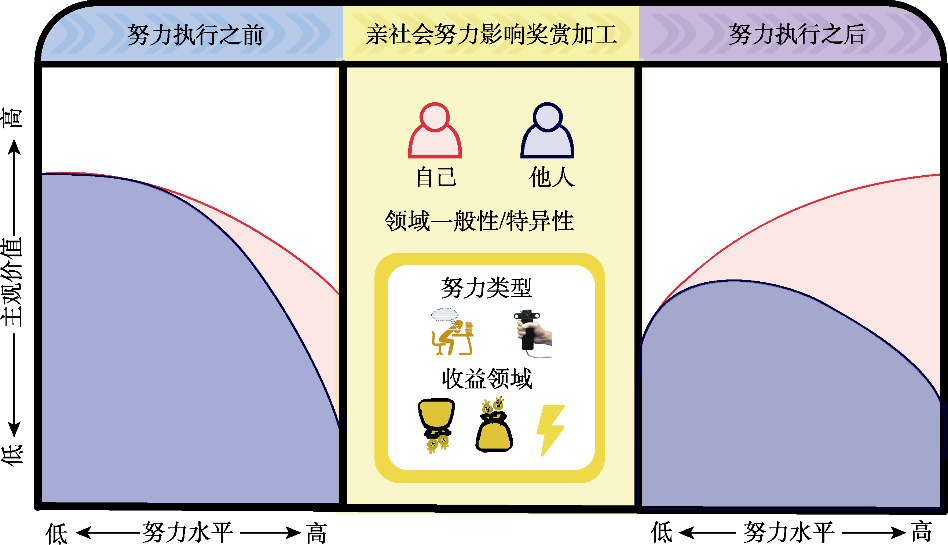
图1 亲社会努力影响奖赏加工的双阶段模型图。该模型的核心假设聚焦于努力在执行之前和之后如何影响奖赏的主观价值。红色实线代表自我努力影响自我奖赏的主观价值(先贬值后增值), 蓝色实线代表自我努力影响他人奖赏的主观价值(双重贬值)。主观价值包括奖赏刺激在努力执行前后诱发的主观报告、行为偏好、EEG或fMRI反应等。彩图见电子版, 下同

图2 实验1任务流程图
| [1] | 谢晓非, 寇彧. (2024). 亲社会行为:社会互动和社会发展中的人性光辉(序言). 心理学报, 56(9), 1157-1158. https://doi.org/10.3724/sp.J.1041.2024.01157 |
| [2] | Aronson, E., & Mills, J. (1959). The effect of severity of initiation on liking for a group. The Journal of Abnormal and Social Psychology, 59(2), 177-181. https://doi.org/10.1037/h0047195 |
| [3] | Batson, C. D., Batson, J. G., Slingsby, J. K., Harrell, K. L., Peekna, H. M., & Todd, R. M. (1991). Empathic joy and the empathy-altruism hypothesis. Journal of Personality and Social Psychology, 61(3), 413-426. https://doi.org/10.1037/0022-3514.61.3.413 |
| [4] | Bogdanov, M., Renault, H., LoParco, S., Weinberg, A., & Otto, A. R. (2022). Cognitive effort exertion enhances electrophysiological responses to rewarding outcomes. Cerebral Cortex, 32(19), 4255-4270. https://doi.org/10.1093/cercor/bhab480 |
| [5] | Brown, S. L., & Brown, R. M. (2015). Connecting prosocial behavior to improved physical health: Contributions from the neurobiology of parenting. Neuroscience & Biobehavioral Reviews, 55, 1-17. https://doi.org/10.1016/j.neubiorev.2015.04.004 |
| [6] | Bustamante, L. A., Oshinowo, T., Lee, J. R., Tong, E., Burton, A. R., Shenhav, A., Cohen, J. D., & Daw, N. D. (2023). Effort Foraging Task reveals positive correlation between individual differences in the cost of cognitive and physical effort in humans. Proceedings of the National Academy of Sciences, 120(50), e2221510120. |
| [7] | Chong, T. T., Apps, M., Giehl, K., Sillence, A., Grima, L. L., & Husain, M. (2017). Neurocomputational mechanisms underlying subjective valuation of effort costs. PLoS Biology, 15(2), e1002598. https://doi.org/10.1371/journal.pbio.1002598 |
| [8] | Clay, G., Mlynski, C., Korb, F. M., Goschke, T., & Job, V. (2022). Rewarding cognitive effort increases the intrinsic value of mental labor. Proceedings of the National Academy of Sciences, 119(5), e2111785119. https://doi.org/10.1073/pnas.2111785119 |
| [9] | Contreras-Huerta, L. S., Lockwood, P. L., Bird, G., Apps, M. A. J., & Crockett, M. J. (2022). Prosocial behavior is associated with transdiagnostic markers of affective sensitivity in multiple domains. Emotion, 22(5), 820-835. https://doi.org/10.1037/emo0000813 |
| [10] | Contreras-Huerta, L. S., Pisauro, M. A., & Apps, M. A. J. (2020). Effort shapes social cognition and behaviour: A neuro-cognitive framework. Neuroscience & Biobehavioral Reviews, 118, 426-439. https://doi.org/10.1016/j.neubiorev.2020.08.003 |
| [11] | Crockett, M. J., Kurth-Nelson, Z., Siegel, J. Z., Dayan, P., & Dolan, R. J. (2014). Harm to others outweighs harm to self in moral decision making. Proceedings of the National Academy of Sciences, 111(48), 17320-17325. |
| [12] | Crockett, M. J., Siegel, J. Z., Kurth-Nelson, Z., Dayan, P., & Dolan, R. J. (2017). Moral transgressions corrupt neural representations of value. Nature Neuroscience, 20(6), 879-885. https://doi.org/10.1038/nn.4557 |
| [13] | Depow, G. J., Lin, H., & Inzlicht, M. (2022). Cognitive effort for self, strangers, and charities. Scientific Reports, 12(1), 15009. https://doi.org/10.1038/s41598-022-19163-y |
| [14] | Dobryakova, E., Jessup, R. K., & Tricomi, E. (2017). Modulation of ventral striatal activity by cognitive effort. NeuroImage, 147, 330-338. https://doi.org/10.1016/j.neuroimage.2016.12.029 |
| [15] | Engel, C. (2011). Dictator games: A meta study. Experimental Economics, 14(4), 583-610. https://doi.org/10.1007/s10683-011-9283-7 |
| [16] | Forbes, P. A. G., Aydogan, G., Braunstein, J., Todorova, B., Wagner, I. C., Lockwood, P. L., ... Lamm, C. (2024). Acute stress reduces effortful prosocial behaviour. eLife, 12, RP87271. https://doi.org/10.7554/eLife.87271 |
| [17] | Gaule, A., Martin, P., Lockwood, P. L., Cutler, J., Apps, M., Roberts, R., ... Viding, E. (2024). Reduced prosocial motivation and effort in adolescents with conduct problems and callous-unemotional traits. Journal of Child Psychology and Psychiatry, 65(8), 1061-1071. |
| [18] | Gouldner, A. W. (1960). The norm of reciprocity: A preliminary statement. American Sociological Review, 25(2), 161-178. |
| [19] | Hein, G., Silani, G., Preuschoff, K., Batson, C. D., & Singer, T. (2010). Neural responses to ingroup and outgroup members' suffering predict individual differences in costly helping. Neuron, 68(1), 149-160. https://doi.org/10.1016/j.neuron.2010.09.003 |
| [20] | Hernandez Lallement, J., Kuss, K., Trautner, P., Weber, B., Falk, A., & Fliessbach, K. (2014). Effort increases sensitivity to reward and loss magnitude in the human brain. Social Cognitive and Affective Neuroscience, 9(3), 342-349. https://doi.org/10.1093/scan/nss147 |
| [21] | Husain, M., & Roiser, J. P. (2018). Neuroscience of apathy and anhedonia: A transdiagnostic approach. Nature Reviews Neuroscience, 19(8), 470-484. https://doi.org/10.1038/s41583-018-0029-9 |
| [22] | Imas, A. (2014). Working for the "warm glow": On the benefits and limits of prosocial incentives. Journal of Public Economics, 114, 14-18. https://doi.org/10.1016/j.jpubeco.2013.11.006 |
| [23] | Inzlicht, M., Shenhav, A., & Olivola, C. Y. (2018). The effort paradox: Effort is both costly and valued. Trends in Cognitive Sciences, 22(4), 337-349. https://doi.org/10.1016/j.tics.2018.01.007 |
| [24] | Jiang, H., & Zheng, Y. (2024). Effort expenditure increases risk-taking for improbable rewards. Personality and Social Psychology Bulletin, 51(8), 1-15. https://doi.org/10.1177/01461672231218746 |
| [25] | Jones, B. A. (2021). A review of social discounting: The impact of social distance on altruism. The Psychological Record, 72(3), 511-515. https://doi.org/10.1007/s40732-021-00488-5 |
| [26] | Kool, W., & Botvinick, M. (2018). Mental labour. Nature Human Behaviour, 2(12), 899-908. https://doi.org/10.1038/s41562-018-0401-9 |
| [27] | Kurzban, R., Duckworth, A., Kable, J. W., & Myers, J. (2013). An opportunity cost model of subjective effort and task performance. Behavioral and Brain Sciences, 36(6), 661-679. https://doi.org/10.1017/S0140525X12003196 |
| [28] | Liu, J., Gu, R., Liao, C., Lu, J., Fang, Y., Xu, P., Luo, Y. J., & Cui, F. (2020). The neural mechanism of the social framing effect: Evidence from fMRI and tDCS studies. Journal of Neuroscience, 40(18), 3646-3656. |
| [29] | Lockwood, P. L., Abdurahman, A., Gabay, A. S., Drew, D., Tamm, M., Husain, M., & Apps, M. A. J. (2021). Aging increases prosocial motivation for effort. Psychological Science, 32(5), 668-681. https://doi.org/10.1177/0956797620975781 |
| [30] | Lockwood, P. L., Apps, M. A., & Chang, S. W. (2020). Is there a ‘social’brain? Implementations and algorithms. Trends in Cognitive Sciences, 24(10), 802-813. https://doi.org/10.1016/j.tics.2020.06.011 |
| [31] | Lockwood, P. L., Hamonet, M., Zhang, S. H., Ratnavel, A., Salmony, F. U., Husain, M., & Apps, M. A. J. (2017). Prosocial apathy for helping others when effort is required. Nature Human Behaviour, 1(7), 0131. https://doi.org/10.1038/s41562-017-0131 |
| [32] | Lockwood, P. L., van den Bos, W., & Dreher, J.-C. (2025). Moral learning and decision-making across the lifespan. Annual Review of Psychology, 76(1), 475-500. https://doi.org/10.1146/annurev-psych-021324-060611 |
| [33] | Lockwood, P. L., Wittmann, M. K., Nili, H., Matsumoto- Ryan, M., Abdurahman, A., Cutler, J., Husain, M., & Apps, M. A. J. (2022). Distinct neural representations for prosocial and self-benefiting effort. Current Biology, 32(19), 4172-4185. https://doi.org/10.1016/j.cub.2022.08.010 |
| [34] | Lopez-Gamundi, P., Mas-Herrero, E., & Marco-Pallares, J. (2024). Disentangling effort from probability of success: Temporal dynamics of frontal midline theta in effort-based reward processing. Cortex, 176, 94-112. https://doi.org/10.1016/j.cortex.2024.03.014 |
| [35] | Norton, M. I., Mochon, D., & Ariely, D. (2012). The IKEA effect: When labor leads to love. Journal of Consumer Psychology, 22(3), 453-460. https://doi.org/10.1016/j.jcps.2011.08.002 |
| [36] | Pan, W., Lu, J., Wu, L., Kou, J., & Lei, Y. (2023). Expending effort may share neural responses with reward and evokes high subjective satisfaction. Biological Psychology, 177, 108480. https://doi.org/10.1016/j.biopsycho.2022.108480 |
| [37] | Persson, E., Tinghög, G., & Västfjäll, D. (2024). Intertemporal prosocial behavior: A review and research agenda. Frontiers in Psychology, 15, 1359447. |
| [38] | Pfattheicher, S., Nielsen, Y. A., & Thielmann, I. (2022). Prosocial behavior and altruism: A review of concepts and definitions. Current Opinion in Psychology, 44, 124-129. https://doi.org/10.1016/j.copsyc.2021.08.021 |
| [39] | Qu, C., Hu, Y., Tang, Z., Derrington, E., & Dreher, J. C. (2020). Neurocomputational mechanisms underlying immoral decisions benefiting self or others. Social Cognitive and Affective Neuroscience, 15(2), 135-149. https://doi.org/10.1093/scan/nsaa029 |
| [40] | Ruff, C. C., & Fehr, E. (2014). The neurobiology of rewards and values in social decision making. Nature Reviews Neuroscience, 15(8), 549-562. https://doi.org/10.1038/nrn3776 |
| [41] | Sellitto, M., Neufang, S., Schweda, A., Weber, B., & Kalenscher, T. (2021). Arbitration between insula and temporoparietal junction subserves framing-induced boosts in generosity during social discounting. NeuroImage, 238, 118211. https://doi.org/10.1016/j.neuroimage.2021.118211 |
| [42] | Shenhav, A., Musslick, S., Lieder, F., Kool, W., Griffiths, T. L., Cohen, J. D., & Botvinick, M. M. (2017). Toward a rational and mechanistic account of mental effort. Annual Review of Neuroscience, 40, 99-124. https://doi.org/10.1146/annurev-neuro-072116-031526 |
| [43] | Suzuki, S., Lawlor, V. M., Cooper, J. A., Arulpragasam, A. R., & Treadway, M. T. (2021). Distinct regions of the striatum underlying effort, movement initiation and effort discounting. Nature Human Behaviour, 5(3), 378-388. https://doi.org/10.1038/s41562-020-00972-y |
| [44] | Talbot, J., Cutler, J., Tamm, M., Little, S. J., Harmer, C. J., Husain, M., Lockwood, P. L., & Apps, M. A. J. (2025). Dopamine boosts motivation for prosocial effort in Parkinson’s disease. The Journal of Neuroscience, e1593242024. https://doi.org/10.1523/jneurosci.1593-24.2024 |
| [45] | Umemoto, A., Lin, H., & Holroyd, C. B. (2022). Electrophysiological measures of conflict and reward processing are associated with decisions to engage in physical effort. Psychophysiology, 60(2), e14176. https:// doi.org/10.1111/psyp.14176 |
| [46] | Vanags, P., Cutler, J., Kosse, F., & Lockwood, P. L. (2025). Greater income and financial well-being are associated with higher prosocial preferences and behaviors across 76 countries. PNAS nexus, 4(2), pgae582. https://doi.org/10.1093/pnasnexus/pgae582 |
| [47] | Westbrook, A., van den Bosch, R., Maatta, J. I., Hofmans, L., Papadopetraki, D., Cools, R., & Frank, M. J. (2020). Dopamine promotes cognitive effort by biasing the benefits versus costs of cognitive work. Science, 367(6484), 1362-1366. https://doi.org/10.1126/science.aaz5891 |
| [48] | Wu, M., & Zheng, Y. (2023). Physical effort paradox during reward evaluation and links to perceived control. Cerebral Cortex, 33(15), 9343-9353. https://doi.org/10.1093/cercor/bhad207 |
| [49] | Wu, R., Ferguson, A. M., & Inzlicht, M. (2023). Do humans prefer cognitive effort over doing nothing? Journal of Experimental Psychology: General, 152(4), 1069-1079. https://doi.org/10.1037/xge0001320 |
| [50] | Yi, W., Mei, S., Zhang, M., & Zheng, Y. (2020). Decomposing the effort paradox in reward processing: Time matters. Neuropsychologia, 137, 107311. |
| [51] | Zentall, T. R. (2010). Justification of effort by humans and pigeons. Current Directions in Psychological Science, 19(5), 296-300. https://doi.org/10.1177/0963721410383381 |
| [52] | Zhang, M., & Zheng, Y. (2022). Neural dynamics of effort-modulated reward processing. Psychophysiology, 59(10), e14070. https://doi.org/10.1111/psyp.14070 |
| [53] | Zheng, Y., Zhang, M., & Wu, M. (2024). Effort discounts reward-based control allocation: A neurodynamic perspective. Psychophysiology, 61(2), e14451. https://doi.org/10.1111/psyp.14451 |
| [1] | 寇彧, 丁越, 杨小钧, 查一畅. 亲社会行为智慧干预框架的构建[J]. 心理科学进展, 2026, 34(8): 1456-1467. |
| [2] | 宋方兴, 冯广, 鲍敏. 奖赏对短时程单眼剥夺效应的影响及机制[J]. 心理科学进展, 2026, 34(6): 919-931. |
| [3] | 陈曦梅, 李为, 陈红. 基于奖赏−抑制双系统模型饮食失调的神经机制[J]. 心理科学进展, 2026, 34(4): 597-607. |
| [4] | 申玥, 辛聪, 郑远霞, 刘国雄. 儿童亲社会行为中的声誉管理及其心理机制[J]. 心理科学进展, 2026, 34(4): 726-741. |
| [5] | 范伟, 程颖. 悲伤与亲社会行为关系的三水平元分析[J]. 心理科学进展, 2026, 34(1): 83-96. |
| [6] | 张雪萌, 刘永, 韩茵, 陈红. 社交媒体互动反馈对食物奖赏加工的影响机制[J]. 心理科学进展, 2025, 33(5): 753-765. |
| [7] | 沈殷琪, 蔡怡, 吴继霞. 第三方干预对亲社会行为的影响:一项三水平元分析[J]. 心理科学进展, 2025, 33(12): 2121-2137. |
| [8] | 刘楠, 邱钰婷, 董志强, 李爱梅. 抚育动机何以促进亲社会行为?基于进化适应性的认知−能量机制及助推[J]. 心理科学进展, 2025, 33(11): 1854-1869. |
| [9] | 杨艺琳, 杨文登, 郑亚. 认知努力如何测量:方法、问题与改进[J]. 心理科学进展, 2025, 33(11): 1912-1825. |
| [10] | 温秀娟, 马毓璟, 谭斯祺, 李芸, 刘文华. 身体还是认知努力的损害?抑郁症努力奖赏动机评估及计算模型应用[J]. 心理科学进展, 2025, 33(1): 107-122. |
| [11] | 李俊朋, 周临舒, 江俊, 王丹妮, 蒋存梅. 音乐对亲社会行为的影响及其作用机制[J]. 心理科学进展, 2024, 32(7): 1179-1194. |
| [12] | 诸彦含, 贺彬, 孙蕾. 状态权力感对亲社会行为的影响:一项三水平元分析[J]. 心理科学进展, 2024, 32(11): 1786-1799. |
| [13] | 陈斯允, 徐惠琪, 李诗颖, 牛小曼, 许丽颖. 俭以养德?节俭对亲社会行为的双刃剑效应及其理论解释[J]. 心理科学进展, 2024, 32(10): 1680-1696. |
| [14] | 许销冰, 程兰萍, 孙洪杰. 时间拟人化倾向及其对亲社会行为的影响[J]. 心理科学进展, 2023, 31(9): 1569-1582. |
| [15] | 周冰涛, 刘宇平, 赵辉, 杨波. 攻击行为的愉悦效应[J]. 心理科学进展, 2023, 31(9): 1714-1727. |
| 阅读次数 | ||||||
|
全文 |
|
|||||
|
摘要 |
|
|||||
