

ISSN 1671-3710
CN 11-4766/R
主办:中国科学院心理研究所
出版:科学出版社
心理科学进展 ›› 2026, Vol. 34 ›› Issue (10): 1733-1748.doi: 10.3724/SP.J.1042.2026.1733 cstr: 32111.14.2026.1733
程佳琳1, 李劲松2( )
收稿日期:2025-11-15
出版日期:2026-10-15
发布日期:2026-07-20
通讯作者:
李劲松, E-mail: jsongli@mail.shufe.edu.cn基金资助:
CHENG Jialin1, LI Jinsong2()
Received:2025-11-15
Online:2026-10-15
Published:2026-07-20
摘要:
随着人工智能(Artificial Intelligence, AI)在企业中的应用与落地, 越来越多的工作团队改变以往传统的目标设置方法, 试图在AI赋能条件下通过极限目标激发员工和团队创造力。但AI赋能下极限目标的形成机理及其对创造力的影响机制尚未得到系统的探讨与验证。基于此, 本文主要研究内容包括:(1)探索AI赋能条件下极限目标的形成机理; (2)基于社会−技术系统理论, 研究个体探索性学习在极限目标和个体创造力间的中介作用, 以及AI有用性感知的调节作用; (3)基于社会−技术系统理论, 研究人−AI合作在极限目标和团队创造力间的中介作用, 以及人−AI工作角色清晰的调节作用; (4)极限目标形成机理及其影响效应的应用验证。将前述研究中“环境刺激→目标设置→员工行为结果”的主要结论在实际场景中进行运用, 为企业促进个体和团队创造力提供参考。所取得的研究成果, 将填补极限目标研究的空白, 为管理者借助AI技术赋能员工和团队推进极限目标提供指导。
中图分类号:
程佳琳, 李劲松. (2026). AI赋能视角下极限目标设置的驱动机制及其影响效应. 心理科学进展 , 34(10), 1733-1748.
CHENG Jialin, LI Jinsong. (2026). Driving mechanisms and impacts of stretch goals: An AI-enabled perspective. Advances in Psychological Science, 34(10), 1733-1748.
| 目标类型 | 定义 | 特点 |
|---|---|---|
| 极限目标 (Stretch Goal) | 在一个工作单元内, 依据团队成员当前的实践、技能和知识似乎无法实现的目标(Zhang & Jia, | 极度困难, 极端新颖, 没有实现目标的已知路径(Sitkin et al., |
| 挑战性目标 (Challenging Goal) | 个体主观上认为“困难但可实现”的目标(Locke & Latham, | 目标的要求没有超过个体目前所掌握的知识和技能(Mawritz et al., |
| 绩效目标 (Performance Goal) | 在一定时间内, 对给定的任务达到特定、具体熟练程度的期望(Locke & Latham, | 具有明确要达到的任务或结果(Sitkin et al., |
| 学习目标 (Learning Goal) | 一种探索或发现完成任务的相关策略或程序的期望(Locke & Latham, | 将程序性知识的获取作为目标本身(Sitkin et al., |
| 目标导向 (Goal Orientation) | 一种人的特质, 包括信念、价值观和标准, 这些会影响员工如何应对一般的特定任务(Dweck, | 分为学习和绩效目标导向(Seijts et al., |
表1 极限目标与其他目标的比较
| 目标类型 | 定义 | 特点 |
|---|---|---|
| 极限目标 (Stretch Goal) | 在一个工作单元内, 依据团队成员当前的实践、技能和知识似乎无法实现的目标(Zhang & Jia, | 极度困难, 极端新颖, 没有实现目标的已知路径(Sitkin et al., |
| 挑战性目标 (Challenging Goal) | 个体主观上认为“困难但可实现”的目标(Locke & Latham, | 目标的要求没有超过个体目前所掌握的知识和技能(Mawritz et al., |
| 绩效目标 (Performance Goal) | 在一定时间内, 对给定的任务达到特定、具体熟练程度的期望(Locke & Latham, | 具有明确要达到的任务或结果(Sitkin et al., |
| 学习目标 (Learning Goal) | 一种探索或发现完成任务的相关策略或程序的期望(Locke & Latham, | 将程序性知识的获取作为目标本身(Sitkin et al., |
| 目标导向 (Goal Orientation) | 一种人的特质, 包括信念、价值观和标准, 这些会影响员工如何应对一般的特定任务(Dweck, | 分为学习和绩效目标导向(Seijts et al., |
| 作者(时间) | 研究理论 | 主要发现 | 研究方法 |
|---|---|---|---|
| Zhang & Jia ( | 社会交换理论和不确定管理理论 | 极限目标会导致不道德行为和关系冲突, 信息公平氛围和人际公平氛围可以缓解极限目标的消极影响。 | 问卷调查 |
| Gary et al. ( | 目标设置理论 | ①与中等目标相比, 极限目标会产生巨大的绩效差异。②与中等目标相比, 极限目标提高了少数参与者的绩效, 但许多参与者放弃了极限目标, 转而追求较低的自我设定目标或者在面临破产威胁时转向生存目标。 | 实验 |
| 陈畅等( | 压力交易理论 | 极限目标会导致员工的情绪耗竭, 同时阻碍型评估起到中介作用, 员工换位思考对上述关系有显著的调节作用。 | 问卷调查 |
| Chen et al. ( | 悖论理论和资源保存理论 | 极限目标通过资源稀缺引发员工工作家庭冲突, 员工悖论心态对上述关系有显著的调节作用。 | 问卷调查 |
| Chen et al. ( | 组织认同理论 | 极限目标通过矛盾认同导致员工不道德行为, 竞争心理氛围对上述关系有显著的调节作用。 | 问卷调查 |
| 陈畅 等( | 心理许可理论 | 极限目标会通过心理特权引发员工不道德行为, 员工的创新自我效能感对上述关系有显著的调节作用。 | 问卷调查 |
| Ahmadi et al. ( | 基于实践和文献提出命题, 没有具体的理论 | 极限目标会增加具有重要能力和知识的员工提交高质量的创新想法。具有重要能力和知识的员工包括①过去提交过高质量创新想法的员工, ②具有丰富工作经验的员工以及③在层级中担任高级职位的员工。 | 问卷调查 二手数据 |
| Yasar et al. ( | 目标设置理论 | 沟通的开放性正向调节极限目标和项目融资成功之间的关系。如果目标沟通良好, 具有极限目标的项目更有可能融资成功。 | 二手数据 |
| Berger et al. ( | 情感评价理论 | ①不管员工是被分配简单目标还是极限目标, 如果激励措施是基于目标的亲社会奖励, 他们努力程度都会更高。②在亲社会(相对于现金)奖励的情况下, 目标难度和努力之间存在曲线线性关系。 | 实验 |
| 马君 等( | 情绪认知评价理论 | 极限目标会加重员工职场焦虑进而引发不道德行为, 员工失败学习和组织创新支持感能够弱化极限目标对员工不道德行为的影响。 | 问卷调查 |
| Yang ( | 组织目标理论 | ①在极限目标条件下, 采用事实反思策略(Factual Reflection Strategy)的管理者能取得更高的绩效。②在中等目标条件下, 采用反事实反思策略(Counter- factual Reflection Strategy)的管理者能取得更高的绩效。 | 实验 |
表2 极限目标的相关研究
| 作者(时间) | 研究理论 | 主要发现 | 研究方法 |
|---|---|---|---|
| Zhang & Jia ( | 社会交换理论和不确定管理理论 | 极限目标会导致不道德行为和关系冲突, 信息公平氛围和人际公平氛围可以缓解极限目标的消极影响。 | 问卷调查 |
| Gary et al. ( | 目标设置理论 | ①与中等目标相比, 极限目标会产生巨大的绩效差异。②与中等目标相比, 极限目标提高了少数参与者的绩效, 但许多参与者放弃了极限目标, 转而追求较低的自我设定目标或者在面临破产威胁时转向生存目标。 | 实验 |
| 陈畅等( | 压力交易理论 | 极限目标会导致员工的情绪耗竭, 同时阻碍型评估起到中介作用, 员工换位思考对上述关系有显著的调节作用。 | 问卷调查 |
| Chen et al. ( | 悖论理论和资源保存理论 | 极限目标通过资源稀缺引发员工工作家庭冲突, 员工悖论心态对上述关系有显著的调节作用。 | 问卷调查 |
| Chen et al. ( | 组织认同理论 | 极限目标通过矛盾认同导致员工不道德行为, 竞争心理氛围对上述关系有显著的调节作用。 | 问卷调查 |
| 陈畅 等( | 心理许可理论 | 极限目标会通过心理特权引发员工不道德行为, 员工的创新自我效能感对上述关系有显著的调节作用。 | 问卷调查 |
| Ahmadi et al. ( | 基于实践和文献提出命题, 没有具体的理论 | 极限目标会增加具有重要能力和知识的员工提交高质量的创新想法。具有重要能力和知识的员工包括①过去提交过高质量创新想法的员工, ②具有丰富工作经验的员工以及③在层级中担任高级职位的员工。 | 问卷调查 二手数据 |
| Yasar et al. ( | 目标设置理论 | 沟通的开放性正向调节极限目标和项目融资成功之间的关系。如果目标沟通良好, 具有极限目标的项目更有可能融资成功。 | 二手数据 |
| Berger et al. ( | 情感评价理论 | ①不管员工是被分配简单目标还是极限目标, 如果激励措施是基于目标的亲社会奖励, 他们努力程度都会更高。②在亲社会(相对于现金)奖励的情况下, 目标难度和努力之间存在曲线线性关系。 | 实验 |
| 马君 等( | 情绪认知评价理论 | 极限目标会加重员工职场焦虑进而引发不道德行为, 员工失败学习和组织创新支持感能够弱化极限目标对员工不道德行为的影响。 | 问卷调查 |
| Yang ( | 组织目标理论 | ①在极限目标条件下, 采用事实反思策略(Factual Reflection Strategy)的管理者能取得更高的绩效。②在中等目标条件下, 采用反事实反思策略(Counter- factual Reflection Strategy)的管理者能取得更高的绩效。 | 实验 |
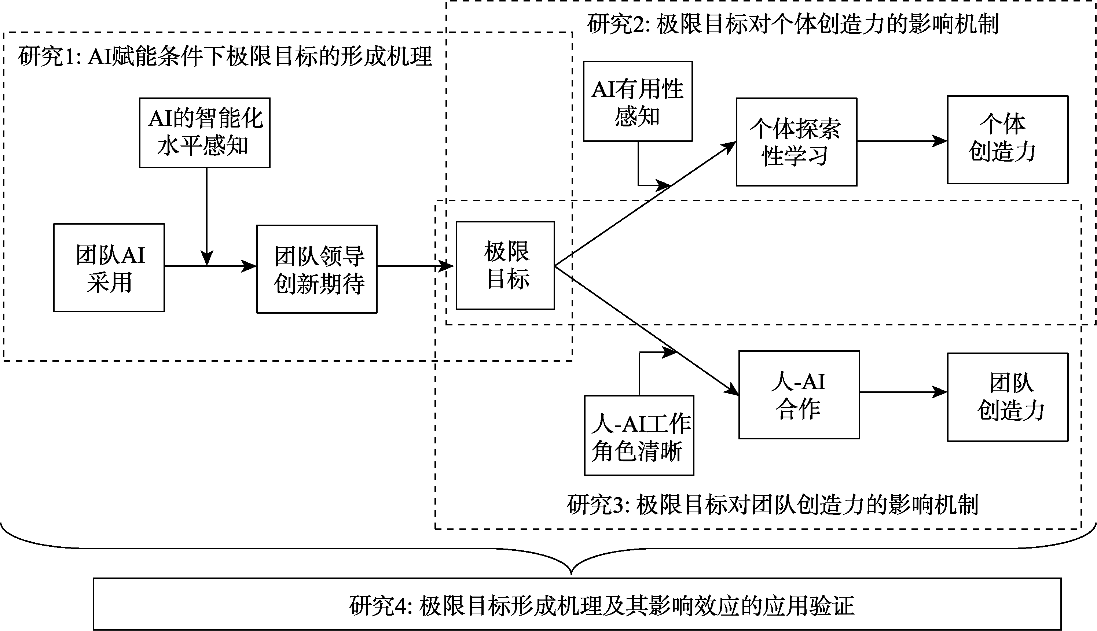
图1 本文的总体理论框架
| [1] | 陈畅, 张喆, 贾明. (2019). 组织延展性目标对员工情绪耗竭的影响机制研究: 基于压力交易理论的视角. 管理工程学报, 33(3), 1-8. |
| [2] | 陈畅, 张喆, 贾明. (2021). 组织延展性目标的黑暗面研究:基于心理许可理论的一个被调节的中介模型. 管理工程学报, 35(4), 72-80. |
| [3] | 葛元骎, 孙小蒙. (2025). 数智化转型对科技型企业高端颠覆性创新的影响--基于新一代人工智能创新发展试验区试点的准自然实验. 工程管理科技前沿, 预发表. |
| [4] | 刘楠, 邱钰婷, 董志强, 李爱梅. (2025). 抚育动机何以促进亲社会行为?基于进化适应性的认知-能量机制及助推. 心理科学进展, 33(11), 1854-1869. |
| [5] | 马君, 朱梦霆, 杨均. (2023). 弯道超车还是弯道翻车:延展性目标与员工不道德行为的双调节模型. 财经论丛, (3), 82-92. |
| [6] | 裴冠雄, 董波, 金佳, 孟亮, 张加林. (2026). 营销数字人对话智能特征的动态加工与神经机制. 心理科学进展, 34(2), 227-238. |
| [7] | 彭剑锋. (2023). 新一代人工智能对组织与人力资源管理的影响与挑战. 中国人力资源开发, 40(7), 8-14. |
| [8] | 谢小云, 左玉涵, 胡琼晶. (2021). 数字化时代的人力资源管理:基于人与技术交互的视角. 管理世界, 37(1), 200-216. |
| [9] | 尹萌, 牛雄鹰. (2024). 与AI“共舞”:系统化视角下的AI-员工协作. 心理科学进展, 32(1), 162-176. |
| [10] | 赵旭宏, 张鹏程, 赵书松, 刘明伟. (2025). 非正式创新如何突破约束实现组织创新成果转化--基于创造力约束和创新多阶段视角的扎根研究. 南开管理评论, 28(3), 185-196. |
| [11] | 张志学, 华中生, 谢小云. (2024). 数智时代人机协同的研究现状与未来方向. 管理工程学报, 38(1), 1-13. |
| [12] | 周潇, 胡恩华, 单红梅. (2023). 人力资源管理实践与工会实践的耦合对员工创造力的影响. 科研管理, 44(11), 164-172. |
| [13] | Abadie, A., Roux, M., Chowdhury, S., & Dey, P. (2023). Interlinking organisational resources, AI adoption and omnichannel integration quality in Ghana’s healthcare supply chain. Journal of Business Research, 162, 113866. |
| [14] | Ahmadi, S., Jansen, J. J. P., & Eggers, J. P. (2022). Using stretch goals for idea generation among employees: One size does not fit all. Organization Science, 33(2), 671-687. |
| [15] | Alhur, M., Omar, F., Alqirem, R., & Yousuf, A. A. N. (2025). Adopting the future: How generative AI, agentic AI, and blockchain are redefining success for Dubai’s emerging start-ups. Human Behavior and Emerging Technologies, 2025, 9751686. |
| [16] | Alimamy, S., & Kuhail, M. A. (2023). I will be with you Alexa! The impact of intelligent virtual assistant’s authenticity and personalization on user reusage intentions. Computers in Human Behavior, 143, 107711. |
| [17] | Allal-Cherif, O., Climent, J. C., & Berenguer, K. J. U. (2023). Born to be sustainable: How to combine strategic disruption, open innovation, and process digitization to create a sustainable business. Journal of Business Research, 154, 113379. |
| [18] | Anthony, C., Bechky, B. A., Fayard, A. L. (2023). “Collaborating” with AI: Taking a system view to explore the future of work. Organization Science, 34(5), 1672-1694. |
| [19] | Appelbaum, S. H. (1997). Socio-technical systems theory: An intervention strategy for organizational development. Management Decision, 35(6), 452-463. |
| [20] | Balakrishnan, J., Abed, S. S., & Jones, P. (2022). The role of meta-UTAUT factors, perceived anthropomorphism, perceived intelligence, and social self-efficacy in chatbot- based services? Technological Forecasting & Social Change, 180(3), 121692. |
| [21] | Bankins, S., & Formosa, P. (2023). The ethical implications of artificial intelligence (AI) for meaningful work. Journal of Business Ethics, 185, 725-740. |
| [22] | Bankins, S., Ocampo, A. C., Marrone, M., Restubog, S. L., & Woo, S. E. (2024). A multilevel review of artificial intelligence in organizations: Implications for organizational behavior research and practice. Journal of Organizational Behavior, 45(2), 159-182. |
| [23] | Basu, S., Majumdar, B., Mukherjee, K., Munjal, S., & Palaksha, C. (2023). Artificial intelligence-HRM interactions and outcomes: A systematic review and causal configurational explanation. Human Resource Management Review, 33(1), 100893. |
| [24] | Berger, L., Guo, L., & Presslee, A. (2023). Motivating employees with goal-based prosocial rewards. Contemporary Accounting Research, 40(1), 231-256. |
| [25] | Bezrukova, K., Griffith, T. L., Spell, C., Rice, V., & Yang, H. E. (2023). Artificial intelligence and groups: Effects of attitudes and discretion on collaboration. Group & Organization Management, 48(2), 629-670. |
| [26] | Blazevic, V., & Lievens, A. (2004). Learning during the new financial service innovation process: Antecedents and performance effects. Journal of Business Research, 57(4), 374-391. |
| [27] | Bostrom, R. P., & Heinen, J. S. (1977). MIS problems and failures: A socio-technical perspective: Part I: The Causes. MIS Quarterly, 1(3), 17-32. |
| [28] | Bouschery, S. G., Blazevic, V., & Piller, F. T. (2023). Augmenting human innovation teams with artificial intelligence: Exploring transformer-based language models. Journal of Product Innovation Management, 40(2), 139-153. |
| [29] | Broekhuizen, T., Dekker, H., de Faria, P., Firk, S., Nguyen, D. K., & Sofka, W. (2023). AI for managing open innovation: Opportunities, challenges, and a research agenda. Journal of Business Research, 167, 114196. |
| [30] | Byron, K., Keem, S., Darden, T., Shalley, C. E., & Zhou, J. (2023). Building blocks of idea generation and implementation in teams: A meta-analysis of team design and team creativity and innovation. Personnel Psychology, 76(1), 249-278. |
| [31] | Cao, L. M., Chen, C., Dong, X., Wang, M., & Qin, X. (2023). The dark side of AI identity: Investigating when and why AI identity entitles unethical behavior. Computers in Human Behavior, 143, 107669. |
| [32] | Carmeli, A., & Schaubroeck, J. (2007). The influence of leaders’ and other referents’ normative expectations on individual involvement in creative work. The Leadership Quarterly, 18(1), 35-48. |
| [33] | Chan, D. (1998). Functional relations among constructs in the same content domain at different levels of analysis: A typology of composition models. Journal of Applied Psychology, 83(2), 234-246. |
| [34] | Chang, Y. Y., & Shih, H. Y. (2019). Work curiosity: A new lens for understanding employee creativity. Human Resource Management Review, 29(4), 100672. |
| [35] | Chen, C., Zhang, Z., & Jia, M. (2020). Effect of stretch goals on work-family conflict: Role of resource scarcity and employee paradox mindset. Chinese Management Studies, 14(3), 737-749. |
| [36] | Chen, C., Zhang, Z., & Jia, M. (2021). Stretch goals and unethical behavior: Role of ambivalent identification and competitive psychological climate. Management Decision, 59(8), 2005-2023. |
| [37] | Cheng, B., Lin, H. X., & Kong, Y. R. (2023). Challenge or hindrance? How and when organizational artificial intelligence adoption influences employee job crafting. Journal of Business Research, 164, 113987. |
| [38] | Chowdhury, S., Budhwar, P., Dey, P. K., Joel-Edgar, S., & Abadie, A. (2022). AI-employee collaboration and business performance: Integrating knowledge-based view, socio-technical systems and organisational socialisation framework. Journal of Business Research, 144, 31-49. |
| [39] | Cummings, T. G. (1978). Self-regulating work groups: A socio-technical synthesis. Academy of Management Review, 3(3), 625-634. |
| [40] | de Jong, A., Schepers, J. L., Lages, C. R., & Kadić-Maglajlić, S. (2021). The role of the service manager’s perceived career success in frontline employees’ learning processes and service improvement. Journal of Business Research, 134, 601-617. |
| [41] | Dhiman, N., Jamwal, M., & Kumar, A. (2023). Enhancing value in customer journey by considering the adoption of artificial intelligence tools. Journal of Business Research, 167, 114142. |
| [42] | Dweck, C. S. (1986). Motivational processes affecting learning. American Psychologist, 41(10), 1040-1048. |
| [43] | Einola, K., & Khoreva, V. (2023). Best friend or broken tool? Exploring the co-existence of humans and artificial intelligence in the workplace ecosystem. Human Resource Management, 62(1), 117-135. |
| [44] | Escriba-Carda, N., Balbastre-Benavent, F., & Canet-Giner, M. T. (2017). Employees’ perceptions of high-performance work systems and innovative behaviour: The role of exploratory learning. European Management Journal, 35(2), 273-281. |
| [45] | Farmer, S. M., Tierney, P., & Kung-McIntyre, K. (2003). Employee creativity in Taiwan: An application of role identity theory. Academy of Management Journal, 46(5), 618-630. |
| [46] | Fernandes, T., & Oliveira, E. (2021). Understanding consumers’ acceptance of automated technologies in service encounters: Drivers of digital voice assistants adoption. Journal of Business Research, 122, 180-191. |
| [47] | Frey, C. B., & Osborne, M. A. (2017). The future of employment: How susceptible are jobs to computerisation? Technological Forecasting and Social Change, 114, 254-280. |
| [48] | Friedman, S. (2013). Priming Subconscious Goals. In In E. A. Locke, & G. P. Latham (Eds.), New developments in goal setting and task performance (pp. 549-565). Routledge. |
| [49] | Gary, M. S., Yang, M. M., Yetton, P. W., & Sterman, J. D. (2017). Stretch goals and the distribution of organizational performance. Organization Science, 28(3), 395-410. |
| [50] | Giudice, M. D., Scuotto, V., Orlando, B., & Mustilli, M. (2023). Toward the human-centered approach. A revised model of individual acceptance of AI. Human Resource Management Review, 33(1), 100856. |
| [51] | Glikson, E., & Woolley, A. W. (2020). Human trust in artificial intelligence: Review of empirical research. Academy of Management Annals, 14(2), 627-660. |
| [52] | Göhsl, J. F. (2025). What if disruption really happens-Are competition law and digital regulation fit for a new era of AI-driven competition? Journal of Competition Law & Economics. https://doi.org/10.1093/joclec/nhaf029 |
| [53] | Gong, Y. P., Kim, T. Y., Lee, D. R., & Zhu, J. (2013). A multilevel model of team goal orientation, information exchange, and creativity. Academy of Management Journal, 56(3), 827-851. |
| [54] | Gupta, A. K., Smith, K. G., & Shalley, C. E. (2006). The interplay between exploration and exploitation. Academy of Management Journal, 49(4), 693-706. |
| [55] | Haefner, N., Wincent, J., Parida, V., & Gassmann, O. (2021). Artificial intelligence and innovation management: A review, framework, and research agenda. Technological Forecasting & Social Change, 162, 120392. |
| [56] | Hamel, G., & Prahalad, C. K. (1993). Strategy as stretch and leverage. Harvard Business Review, 71(2), 75-84. |
| [57] | Harrison, G. W., & List, J. A. (2004). Field experiments. Journal of Economic Literature, 42(4), 1009-1055. |
| [58] | Hoever, I. J., Zhou, J., van knippenberg, D. (2018). Different strokes for different teams: The contingent effects of positive and negative feedback on the creativity of informationally homogeneous and diverse teams. Academy of Management Journal, 61(6), 2159-2181. |
| [59] | Huang, J. W., & Li, Y. H. (2012). Slack resources in team learning and project performance. Journal of Business Research, 65(3), 381-388. |
| [60] | Jia, L. D., Shaw, J. D., Tsui, A. S., & Park, T. Y. (2014). A Social-structural perspective on employee-organization relationships and team creativity. Academy of Management Journal, 57(3), 869-891. |
| [61] | Kaplan, A., & Haenlein, M. (2019). Siri, Siri, in my hand: Who’s the fairest in the land? On the interpretations, illustrations, and implications of artificial intelligence. Business Horizons, 62(1), 15-25. |
| [62] | Kerr, S., & Landauer, S. (2004). Using stretch goals to promote organizational effectiveness and personal growth: General Electric and Goldman Sachs. Academy of Management Executive, 18(4), 134-138. |
| [63] | Kerr, S., & Lepelley, D. (2013). Stretch goals: Risks, possibilities, and best practices. In E. A. Locke & G. P. Latham (Eds.), New developments in goal setting and task performance (pp. 21-31). Routledge. |
| [64] | Kong, H, Y., Yin, Z. H., Baruch, Y. H., & Yuan, Y. (2023). The impact of trust in AI on career sustainability: The role of employee-AI collaboration and protean career orientation. Journal of Vocational Behavior, 146, 103928. |
| [65] | Larson, L., & DeChurch, L. A. (2020). Leading teams in the digital age: Four perspectives on technology and what they mean for leading teams. The Leadership Quarterly, 31(1), 101377. |
| [66] | Leung, K. & Wang, J. (2015). Social processes and team creativity in multicultural teams: A socio-technical framework. Journal of Organizational Behavior, 36(7), 1008-1025. |
| [67] | Li, Y., Li, N., Li, C. J., & Li, J. Y. (2020). The boon and bane of creative “stars”: A social network exploration of how and when team creativity is (and is not) driven by a star teammate. Academy of Management Journal, 63(2), 613-635. |
| [68] | Locke, E. A., & Latham, G. P. (1984). Goal setting: A motivational technique that works. Prentice Hall. |
| [69] | Locke, E. A., & Latham, G. P. (1990). A theory of goal setting and task performance. Prentice Hall. |
| [70] | Locke, E. A., & Latham, G. P. (2002). Building a practically useful theory of goal setting and task motivation: A 35-year odyssey. American Psychologist, 57(9), 705-717. |
| [71] | Makarius, E. E., Mukherjee, D., Fox, J. D. & Fox, A. K. (2020). Rising with the machines: A sociotechnical framework for bringing artificial intelligence into the organization. Journal of Business Research, 120, 262-273. |
| [72] | Marikyan, D., Papagiannidis, S., Rana, O. F., Ranjan, R., & Morgan, G. (2022). Alexa, let’s talk about my productivity: The impact of digital assistants on work productivity. Journal of Business Research, 142, 572-584. |
| [73] | Maruping, L. M., & Agarwal, R. (2004). Managing team interpersonal processes through technology: A task- technology fit perspective. Journal of Applied Psychology, 89(6), 975-990. |
| [74] | Mawritz, M. B., Folger, R., & Latham, G. P. (2014). Supervisors’ exceedingly difficult goals and abusive supervision: The mediating effects of hindrance stress, anger, and anxiety. Journal of Organizational Behavior, 35(3), 358-372. |
| [75] | Müller, B., Roth, D., & Kreimeyer, M. (2023). Barriers to the use of artificial intelligence in the product development-A survey of dimensions involved. Proceedings of the International Conference on Engineering Design (ICED23), Bordeaux, France, 24-28 July 2023. |
| [76] | Naumann, S. E., & Bennett, N. (2000). A case for procedural justice climate: Development and test of a multilevel model. Academy of Management Journal, 43(5), 881-889. |
| [77] | Neill, S., Pathak, R. D., Ribbens, B. A., Noel, T. W., & Singh, G. (2020). The influence of managerial optimism and self-regulation on learning and business growth expectations within an emerging economic context. Asia Pacific Journal of Management, 37(1), 187-204. |
| [78] | O’Neill, T. A., Flathmann, C., McNeese, N. J., & Salas, E. (2023). Human-autonomy teaming: Need for a guiding team-based framework? Computers in Human Behavior, 146(1), 107762. |
| [79] | Pillai, R., & Sivathanu, B. (2020). Adoption of AI-based chatbots for hospitality and tourism. International Journal of Contemporary Hospitality Management, 32(10), 3199-3226. |
| [80] | Priya, B., & Sharma, V. (2023). Exploring users’ adoption intentions of intelligent virtual assistants in financial services: An anthropomorphic perspectives and socio- psychological perspectives. Computers in Human Behavior, 148, 107912. |
| [81] | Rampersad, G. (2020). Robot will take your job: Innovation for an era of artificial intelligence. Journal of Business Research, 116, 68-74. |
| [82] | Salancik, G. R., & Pfeffer, J. (1978). A social information processing approach to job attitudes and task design. Administrative Science Quarterly, 23(2), 224-253. |
| [83] | Seijts, G. H., Latham, G. P., Tasa, K., & Latham, B. W. (2004). Goal setting and goal orientation: An integration of two different yet related literatures. Academy of Management Journal, 47(2), 227-239. |
| [84] | Sitkin, S. B., See, K. E., Miller, C. C., Lawless, M. W., & Carton, A. M. (2011). The paradox of stretch goals: Organizations in pursuit of the seemingly impossible. Academy of Management Review, 36(3), 544-566. |
| [85] | Shin, S. J., & Zhou, J. (2007). When is educational specialization heterogeneity related to creativity in research and development teams? Transformational leadership as a moderator. Journal of Applied Psychology, 92(6), 1709-1721. |
| [86] | Solow, D., Vairaktarakis, G., Piderit, S. K., & Tsai, M.-C. (2002). Managerial insights into the effects of interactions on replacing members of a team. Management Science, 48(8), 1060-1073. |
| [87] | Tang, P. M., Koopman, J., Yam, K. C., De Cremer, D., Zhang, J. H. & Reynders, P. (2023). The self-regulatory consequences of dependence on intelligent machines at work: Evidence from field and experimental studies. Human Resource Management, 62(5), 721-744. |
| [88] | Thompson, K. R., Hochwarter, W. A., & Mathys, N. J. (1997). Stretch targets: What makes them effective? Academy of Management Executive, 11(3), 48-60. |
| [89] | Tsai, C. Y., Marshall, J. D., Choudhury, A., Serban, A., Hou, Y.T.Y, Jung, M. F., ... Yammarino, F. J. (2022). Human- robot collaboration: A multilevel and integrated leadership framework. The Leadership Quarterly, 33(1), 101594. |
| [90] | Vainieri, M., Volaa, F., Soriano, G. G., & Nuti, S. (2016). How to set challenging goals and conduct fair evaluation in regional public health systems. Insights from Valencia and Tuscany Regions. Health Policy, 120(11), 1270-1278. |
| [91] | Vanderstukken, A., Schreurs, B., Germeys, F., Van den Broeck, A., & Proost, K. (2019). Should supervisors communicate goals or visions? The moderating role of subordinates’ psychological distance. Journal of Applied Social Psychology, 49(11), 671-683. |
| [92] | Verganti, R., Vendraminelli, L., & Iansiti, M. (2020). Innovation and design in the age of artificial intelligence. Journal of Product Innovation Management, 37(3), 212-227. |
| [93] | Vieira, V. A. (2013). Stimuli-organism-response framework: A meta-analytic review in the store environment. Journal of Business Research, 66(9), 1420-1426. |
| [94] | Wilson, H. J., & Daugherty, P. R. (2018). Collaborative intelligence: Humans and AI are joining forces. Harvard Business Review, 96(4), 114-123. |
| [95] | Yang, M. M. (2024). Stretch goals, factual/counterfactual reflection strategies, and firm performance. Journal of Management Studies, 61(1), 141-177. |
| [96] | Yasar, B., Yımaz, I. S., Hatipoglu, N., & Salih, A. (2022). Stretching the success in reward-based crowdfunding. Journal of Business Research, 152, 205-220. |
| [97] | You, S., & Robert, L. P. (2017). Teaming up with robots: An IMOI (inputs-mediators-outputs- inputs) framework of human-robot teamwork. International Journal of Robotic Engineering, 2(3), 1-7. |
| [98] | Zhang, Z., & Jia, M. (2013). How can companies decrease the disruptive effects of stretch goals? The moderating role of interpersonal- and informational-justice climates. Human relations, 66(7), 993-1020. |
| [99] | Zhou, L., Wang, M., & Vancouver, J. B. (2019). A formal model of leadership goal striving: Development of core process mechanisms and extensions to action team context. Journal of Applied Psychology, 104(3), 388-410. |
| [1] | 宋潇潇, 凌小蝶, 谷慧敏, 马双. 生成式人工智能个性化推荐对旅游信息决策的影响[J]. 心理科学进展, 2026, 34(9): 1590-1605. |
| [2] | 陈慧, 丰超. 当员工遇见AI:员工-AI协作的构念测量、前因组态与影响机制[J]. 心理科学进展, 2026, 34(8): 1309-1329. |
| [3] | 刘笑辰, 邓凌霏, 吴羡娇, 吴宁. 从“负能”到“赋能”:AIGC“污染”的作用机理及干预策略[J]. 心理科学进展, 2026, 34(7): 1109-1126. |
| [4] | 舒跃育, 李春江, 任笑笑, 谢霞, 张银霞, 宋欢. 人工智能在心理传记学中的应用可能、挑战与启示[J]. 心理科学进展, 2026, 34(7): 1284-1298. |
| [5] | 李纯青, 郝日艳, 刘伟. 人机共生体验的形成机制与作用效果[J]. 心理科学进展, 2026, 34(6): 932-952. |
| [6] | 唐伟, 钟文瑞, 雷震, 张丹丹. 人工智能代理对道德决策的影响[J]. 心理科学进展, 2026, 34(6): 1084-1096. |
| [7] | 田雪涛, 周文杰, 骆方, 乔志宏, 丰怡. 生成式大语言模型赋能心理测量学:优势、挑战与应用[J]. 心理科学进展, 2026, 34(3): 404-423. |
| [8] | 宋一晓, 曾铭灼, 苏涛. 机会抑或威胁? 人与AI协作系统对员工工作效能影响的元分析[J]. 心理科学进展, 2026, 34(3): 461-486. |
| [9] | 陶奕达, 于晓宇. AI增强的科学决策方法对创业想法形成的作用[J]. 心理科学进展, 2026, 34(12): 2121-2138. |
| [10] | 曹文蕊, 刘贝妮, 张山杉, 田宗霖. 当顾客被算法赋权:零工工作者应对顾客不当行为的动态机制与干预[J]. 心理科学进展, 2026, 34(10): 1749-1767. |
| [11] | 万千一, 温斯情, 马早明, 胡波. 大学生AI素养与自我效能关系的贝叶斯元分析[J]. 心理科学进展, 2026, 34(10): 1779-1794. |
| [12] | 周淑金, 朱静怡, 涂洪悦, 李燕. 从利己到伤害: 负创造力向恶意创造力的演化路径与干预[J]. 心理科学进展, 2026, 34(10): 1876-1886. |
| [13] | 武靖宇, 金鑫. 算法介导下的情感趋同:生成式人工智能情感传染机制[J]. 心理科学进展, 2026, 34(1): 123-133. |
| [14] | 李研, 陈维, 武瑞娟. AI技术背景下虚拟影响者营销效应及其作用机制[J]. 心理科学进展, 2025, 33(8): 1425-1442. |
| [15] | 宗树伟, 杨付, 龙立荣, 韩翼. 促进还是抑制?生成式人工智能建议采纳对创造力的双刃剑效应[J]. 心理科学进展, 2025, 33(6): 905-915. |
| 阅读次数 | ||||||
|
全文 |
|
|||||
|
摘要 |
|
|||||
